Thursday, November 26, 2015

Home alone, sick, sick of turkey on Thanksgiving, but hey, the turkey soup is sublime, come on in

I abdicated on going out to a Thanksgiving feast this evening as I was a bit under the weather, and I didn't want to be around people, or be hacking on everyone. I was glad for the excuse. I wasn’t up for it, and couldn’t rise to the occasion. Also, I'm a bit turkey'd out from my impromptu self-thrown birthday bash on Tues. And we've another birthday party lined up for Saturday (not mine), and a huge Thanksgiving feast to attend on Sunday! Pacing myself.

See, I bought a bird for Thanksgiving, and all the trimmings, but Neil got a last-minute invite to an old friend’s party. I could see that he’d rather be with them, than staying home with me. It was pretty obvious. No loyalty toward the sick here. Not his kind of thing. Celebrating Thanksgiving at their house was his tradition, not mine. 

Truth be known, I didn’t particularly enjoy being around them—over the top Orinda suburbia is so much work, so I was glad for an excuse not to go. No forced cadaver smiles and inane chitchat for the crowd. He lives for that kind of stuff, for me it’s sheer agony on a good day. It takes up too much energy and bandwidth, of which I’m in short supply. He went on to the party alone. House to myself. Blessed peace and quiet with a little downtime for dessert.

Unfortunately, if I don't feel great, my make-happy face slapped on haphazardly for a crowd of relative strangers, is arguably the same face as my resting bitch face. I can’t fake that stuff. And there’s always the inevitable mention of my inconvenient birthday, no one wants to acknowledge they missed again, hastily swept under the carpet. Not the same as being with family. They forget my birthday too but I don’t have to put on a happy face for them. Mind your Ps & Qs and all that. (My cousins had to work, so we'll probably also have a make-up date there as well.) 

You know how sound is so visceral when you don't feel good? Almost like having synaesthesia. Flannelly, with vague popcorn overtones. Couldn't abide the hubbub of a party. Besides, I’m dozy, and gravelly-eyed with nurgling innards, and a cough, Ugh. I picked up something a while ago and I got chilled and overtired, and it came knocking back. Virus, though, not flu.  

Since Neil was away to the burbs for Thanksgiving, I needed to cook that blasted bird brining away in a beer cooler swamp in the back yard. I've never brined a turkey before. (Thank you Alton Brown!) So I threw meself a wee surprise party and cooked the turkey on Tuesday—I was surprised that it was so divine, and the brined carcass made for a great soup. Just don’t add salt.

I think I'm just peopled out too. I cleaned up after my party yesterday, made the soup straightaway, but I felt like I was in a quagmire of quicksand. And I kept thinking I'm just overtired, until about 4 AM—when it struck with a vengeance. I began feeling better by the afternoon, but I was lying down all day. I sure didn't want to face a roomful of strangers, all I could envision was curling up with a book, OK, well, so it's a warm MacBook purring on my lap, a Kindle app, and soup.

Grandma always made soup from chickens and turkey carcasses so it comes natural to me. I make a pretty good soup too. Lots of vitamins & minerals in the carcass, so it's a good ting to have. Most people don't know how to make soup, which is sad, as it was such a staple in our house. Nothing out of cans and cartons—like now. Secret is to add a lot of wine or vinegar to the broth to draw the goodies out. Don't boil it too hard either. Lots of whatever's left over in the fridge goes in the pot too. Lots of onion and garlic. The idea of soup is a longed for time, home in the distant past.

Tuesday's turkey carcass is now a lovely soup, which I made yesterday. Apparently, for today. Soop, beautiful soop. That's all that I live for... Happy Thanksgiving from the soup pot. And with a nod to Oliver, the Musical. Soon enough it will be time to gird your loins, let the Christmas season commence.

From a Facebook post, added, rev. 11.26.20


Saturday, November 21, 2015

Salvaging old files (again)


Having grown weary of scanning and transcribing old journals (from the pre-electronic era), for poems and journal entries, since mid-October I mosied on over to my MFA papers, and collections folders, where I found lots of material I'd forgotten about. A few of my missing poems from 2000-2003, for starters. The beggars!

I also found a treasure trove of folklore collections for Alan Dundes, and book synopses from my Celtic Romanticism class at UC Berkeley. Wish I had discovered them when I was prepping for my Celtic bard talk at Sacramento Poetry Center last month.

Some of those lean middle years of little writing posted on my blog, suddenly swelled to respectable numbers. But alas, there were few poems, and a few pieces I was hunting down an electronic copy of, were corrupt beyond belief. I took a few screen shots. Ugh. (See below.) The worst culprits seem to be from the Works 2, and Word 4 era; they were updated to Word 5, and beyond, but they ghosted themselves into ASCII oblivion anyway. Word 5 docs also didn't fare well.

The early pre-electronic years on this blog have gained many entries. It makes for an interesting timeline. I did that then? So while some writers are deep into NaNoWriMo, I'm spelunking the past for treasure, and revising some pieces. My NaRevWriMo.

In order to rescue corrupted files, I experimented with different applications, and discovered that sometimes those blank docs would reveal some of their secrets if I used other word processing programs (not Word, itself), and I opened them in TextEdit, RTF, etc.) Usually cracking a document open, revealed all the corrections as well as random ASCII bits. In other words, hodgepodge.

I am constantly correcting and updating my work. That's what writers do. Revise, revise, revise. Imagine every iteration you ever wrote, saved all in one doc., in fragments, like an old laundry pile. That's what lurks behind the scene on your Word.doc. (What you see is but a shell hiding the messiness of writing, rewriting, and endless saving—not to mention your printer's vital stats.) In other words, it's a word salad. Not useful. More like electronic cuneiform. In my attempt to salvage some of those docs, I've rewritten poems, so are they new poems, or old poems?

And since I've backed up all my old files onto new hard drives, I've merely copied the corrupted files there too. Yiii! I do have some old work on CDs, from 2000-2003, so that's my last hope, other than finding hard copy.

My advice to you all: don't assume your old files from the last century, are safely backed up on old hard drives and floppy disks. Open them up and air them out, then transcribe them to a new format before it's too late. Otherwise the cybergods will find them and eat them up—like moths to cashmere sweaters deep in the closet of time.

A Response to a FB Post Conflating Vikings with Bronze Age Celts

((Note bene: Because this piece begins in medias res, right in the middle of things, it doesn't have an introductory lead-in paragraph. I didn't know I was going to get so involved in it, or I would've saved the Facebook poster's statement. At one point, in her attempt to equate all things Celtic as Scottish, she conflated Vikings with Bronze Age Celts, by then, I was gnashing my teeth. Hence this bloggy bit. Of course, at this point, I'm writing into the void, as she'll never lay eyes on this post. Hopefully it will entertain you. There are some cool maps at the bottom too. This is how my Irish redheads blog evolved as well. In bits and pieces. Unlike Athena who sprung, full grown from Zeus's forehead, I have to ramble about to get to where I'm going—and I often know not where. And so, here we are, together again.)


Dear Historically-Challenged Reader,

The Vikings were LATE on the Irish cultural event horizon by nearly 2000 years. They had less influence in Ireland than what they were given credit for. Not only that, they were quickly assimilated in Ireland.

That's what happens when you marry Irish women, their children are half Irish, whose sons will who marry more Irish women, so they're now only 1/4 Viking in two generations. You see where that goes—since the Vikings brought few Viking women to Ireland.

And Viking power waned after the Battle of Clontarf in 1014 at the hands of Irish High King, Brian Bóruma mac Cennétig. If the Norsemen hadn't attempted to impose taxes in Munster, then, Irish history might have been different, then Viking influence would have had a profound impact.

Viking heritage in Ireland is but a drop in the bucket of time. Viking settlement and rule lasted roughly 200 years. And of course, those Icelandic Vikings had a lot of Irish ancestry, as the migratory brunt came from the Dublin Norse stronghold. See  the Icelandic Laxdæla saga, and Burnt Njall's saga, etc., rife with Irishmen and Irish women—most favored as slaves and feisty concubines.

Yes, the Vikings did settle permanently in Shetland, but the Celts (and pre-Celts) who lived there before the Vikings arrived, never actually went away. There's the historical misnomer. (Lots of Celtic DNA survives to this day.) Ditto with the Viking settlements in the Hebrides, and the Isle of Man. The Celts, or more technically correct, the Irish Scoti as they were called (which does NOT mean they were Scottish, but Irish), eventually drove the Vikings out. (Battle of Largs.)

Also that marrying/taking the Irish women thang, applies here too. Somerled, Lord of the Isles, was more Irish than Viking by blood (and by allegiance). The Norse-Irish culture was hybrid, not just Viking.

BTW, the word Scotland comes to us via Latin naming by way of Ireland. Scotia Major was Ireland, and because there were so many Irish living in what is now called Scotland, which was known as Scotia Minor until the 11thc. and the term was still used up to the 16th c.).

Isidore of Seville in 580 CE wrote: "Scotia and Hibernia are the same country." Adomnán, St. Columba's 3rd cousin, referred to the Gaels as Scotti.

It wasn't until the 15th c., that Pope Leo X (1475-1521) decreed that Scotland was, well, Scotland, and as such, had exclusive right over the word Scotland, which resulted in a huge landgrab as the English-Scots took over Irish monasteries on the Continent (i.e., Schottenklöster Irish Benedictine monasteries in south Germany taken over by Scots.).
Schottenklöster (meaning "Gaelic monasteries" in German, singular:Schottenkloster) is the name applied to the monastic foundations of Scottish and Irish missionaries in Continental Europe, particularly to the [Irish] Benedictine monasteries in Germany, which in the beginning of the 13th century were combined into one congregation whose abbot-general was the Abbot of the Scots monastery at RegensburgWiki
So there must've been internecine Irish/Scottish/English squabbling over who owned what, and perhaps some genuine confusion, for a pope to adjudicate as to what country owned the placename. The Irish monks got kicked out of their own monasteries; I'm sure there were some seriously irritated Irishmen. I bet full coffers were also at stake.

So, the next time you notice that Lindisfarne is referred to as an Anglo-Saxon monastery, that's propaganda, the polar opposite of historicity, at work. It was an Irish founded Hiberno-Saxon venture. But I digress. (If Blogger had a sidebar, this would be encapsulated, but I don't want to start another post.)

Where was I?

As to your note on the Viking and Irish similarities in artwork, therefore the Vikings must've taught the Irish how to utilize knotwork design, the Irish practically invented it! The La Tène culture, the source behind a lot of Irish art, equally predates the Viking era by 2000 years. A lot of native British Celtic art is erroneously attributed to Anglo-Saxons in Great Britian, who also predate the Vikings. (The Irish and the Britons shared many cultural traits, including artifacts. Then there was the British-Irish_Anglo-Saxon hybrid culture that followed.

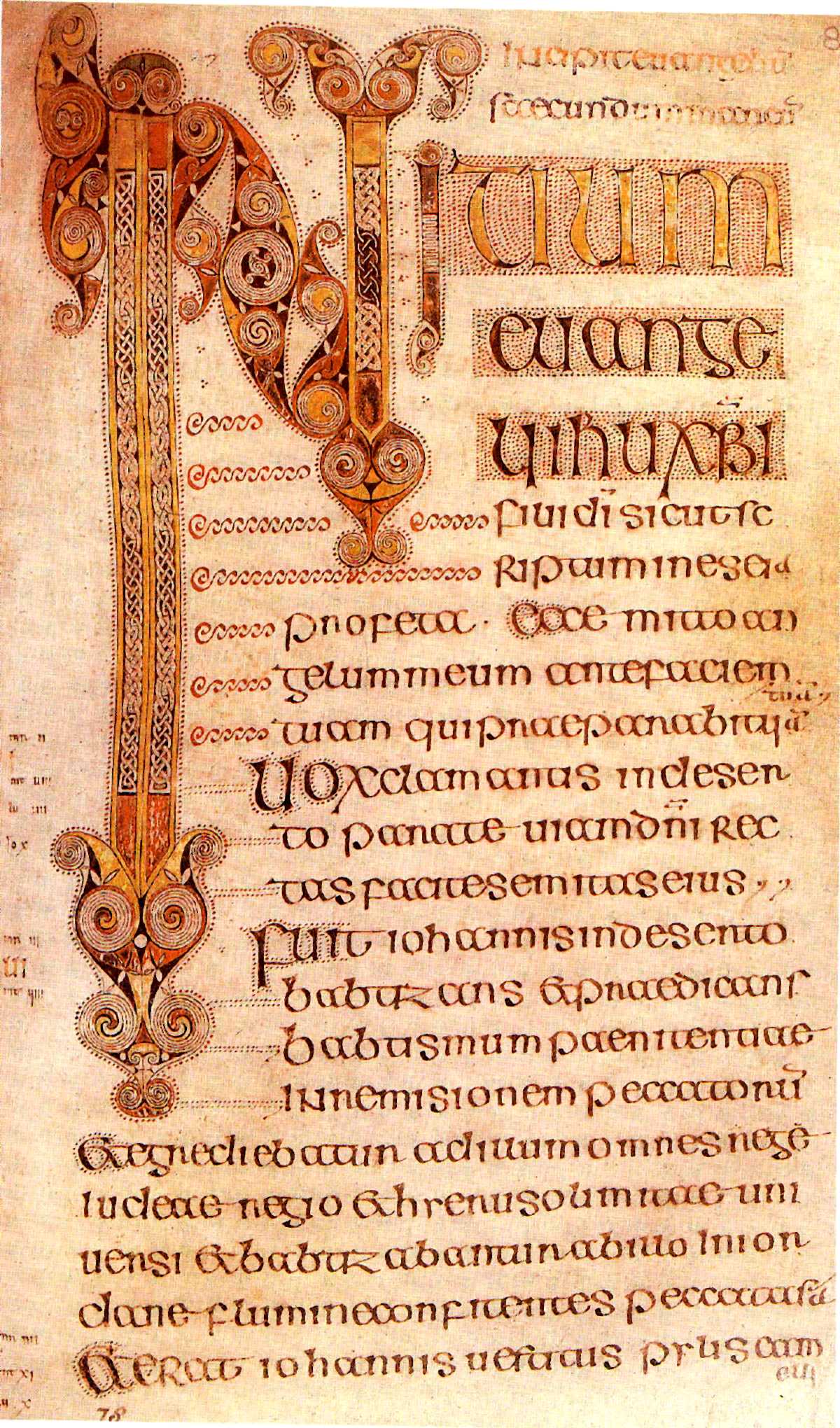
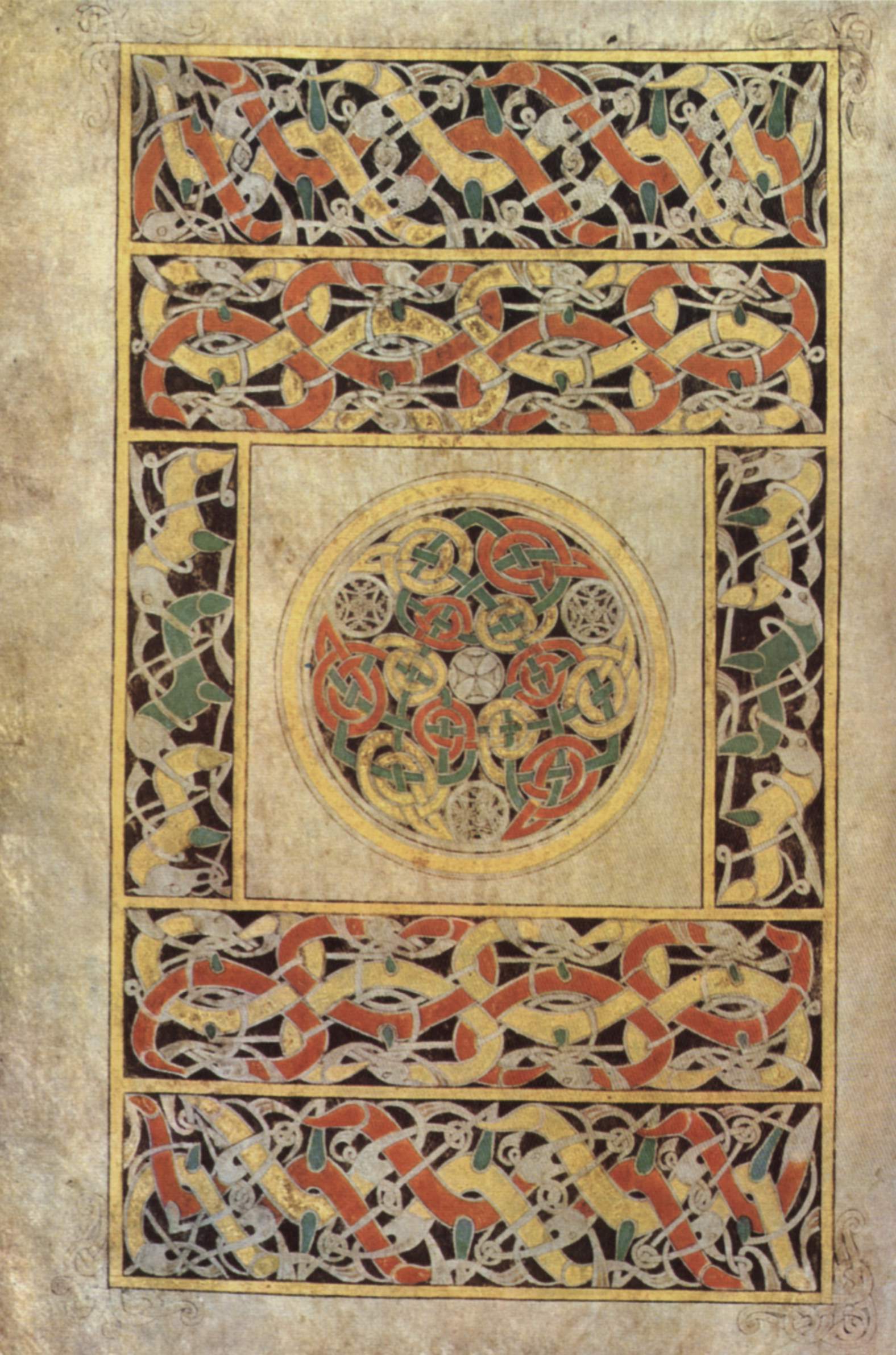
I would venture to say that the Insular art style with Celtic spirals, curvilinear, and geometric shapes employed in the Book of Durrow were not influenced by Norse or Viking raiding artisans. This kind of complex, intricate art did not suddenly spring forth in a brand new art form, the illustrated book arts. Especially when one's homeland was being invaded by Vikings. So what came first? Chicken or egg? (See folios 1v, 85v, 125v at bottom of Wiki page.)

There's more of a correlation with Anglo-Saxon art, and even that was a hybrid art form, later called the Hiberno-Saxon style. I find no Germanic Continental evidence of this Insular art form. What each of these cultures have in common, is exposure to Insular Celts. Early medieval Celtic book treasure bindings were highly coveted by the Vikings. One can only imagine what the lost treasure cover for the Book of Kells looked like.
Various metal fragments of what were probably book-mounts have survived, usually adapted as jewellery by Vikings. —Wiki
(Also, the Bronze Age Celts, and Celtic culture dominated the Continent, so some of their artifacts could have been found by what later become the ancestors of the Vikings.) There was cultural contact. But there's scant evidence that Viking artifacts predate Irish and Celtic art styles. To make an absurd parallel, many little girls the world over love Hello Kitty, that doesn't mean they were all Japanese samurai.


Gospel of Mark, Book of Durrow, 650-700 AD. —Wiki

The Vikings were raiders, they brought back artifacts from other cultures, which in turn, influenced their art. Geometric interlace doesn't appear in Viking culture until after they had contact with Britain and Ireland. They also brought back (Irish) slaves, who were artisans....Again, keep in mind the timeline, and it was a hybrid culture].

(See mid-9th c. Oseberg ship-burial. Artifacts included the Oseberg bucket, with patterned enamel figures similar "to the Gospel books of the Insular art of the British Isles, such as the Book of Durrow, (ca.650 AD)." —Wiki, and Irish Archaeology.

Several Viking ships in Roskilde Fjord, and the Skuldelev ships were made in Ireland. So claiming who did/owned what in the past is never quite as simple as it seems from our perspective. We don't know who carved the ships, and, again, it was a hybrid culture. Also, there was no timber in Iceland, so Icelandic ships too would've been built in Ireland or wood imported to Scandinavia.)

Book of Durrow Carpet page, similar in style to the Oseberg bucket, 650-700 AD. —Wiki
Check out the timeline, The Vikings (780–1100), and this one, but keep in mind that much of what we think of as Viking art was the result of artifacts collected from other cultures during raiding.

If you get a good grasp of the pre-Classical, Classical, and post Classical Celtic cultures, and migrations, then it will all make more sense.

Unfortunately working from a knowledge base that dates to the Plantation of Ulster as a reference point, is politically biased, therefore suspect. History written in the voice of the victor, and all that. Also, the intense hatred the English harbored for the ethnic Irish has also adversely colored "history." So, most Irish connections were extirpated. The OED is a prime example.

In Scotland, a lot of so-called Scots, were actually Irish. The Industrial Revolution, and two famines meant that many Irish immigrated to Scotland—especially The Barrows in Glesga, and along Clydebank (ships).

Yes, the Romans named the Picts, Picti, after a Continental Picti tribe, who were probably from the same Gaulish tribe. Picts were probably P-Celtic vs. Q-Celtic speakers. The Picts were also in N. Ireland, they were called the Cruithne, or Cruithín (they have an asteroid named after them, LOL!) The Cruithne/Criuthín included several tuatha, including the the Dál nAraidi—who settled in Scotland. Qritani/Cruithne comes from the word *pritenī (Pretani). Q-Celtic Irish speakers hated the plosive P sound and swapped it out for a more gutteral cough sound, hard c/q/k C: Cruithne/Pritani. mac/map, etc.

Ireland had many P-Celtic speaking tribes, as well as Q-Celtic speakers (Gaels, Galicia). See Ptolemy's map of Ireland for tribal names: Briganti, Dumnoni, etc. Cruithni and Menapi were probably Gaulish. The Ganganoi were also in N. Wales. In the 5th c AD, Gwynned was an Irish enclave, so there was a lot of back and forth movement.
A rendition of Ptolemy's map (Vlaclav Hollar, ca. 1650s-70s) —Wiki
Julius Caesar, in his Commentarii de Bello Gallico, is the first to call the island Hibernia... Wiki

Galicians were not Spaniards, but Iberian Celts, one of many CeltIberian tribes. Asturias, Galicia were Celtic kingdoms that managed to survive until the Middle Ages. They probably were the original Hispania immigrants who settled in Ireland, according to the Lebor Gabala Erenn (where the name Scotia is chronicled.)

In the Song of Amergin, the first Gael to settle in Ireland, (Galician) poet-druid Amergin (mac) Mil quells the sea, after the very tall Tuatha Dé Danánn send a big wind spell, proving he was a bigger, badder druid, than they. And to really ridiculously telescope mythological time, they slunk away, shrank, went underground, and became the fairyfolk!

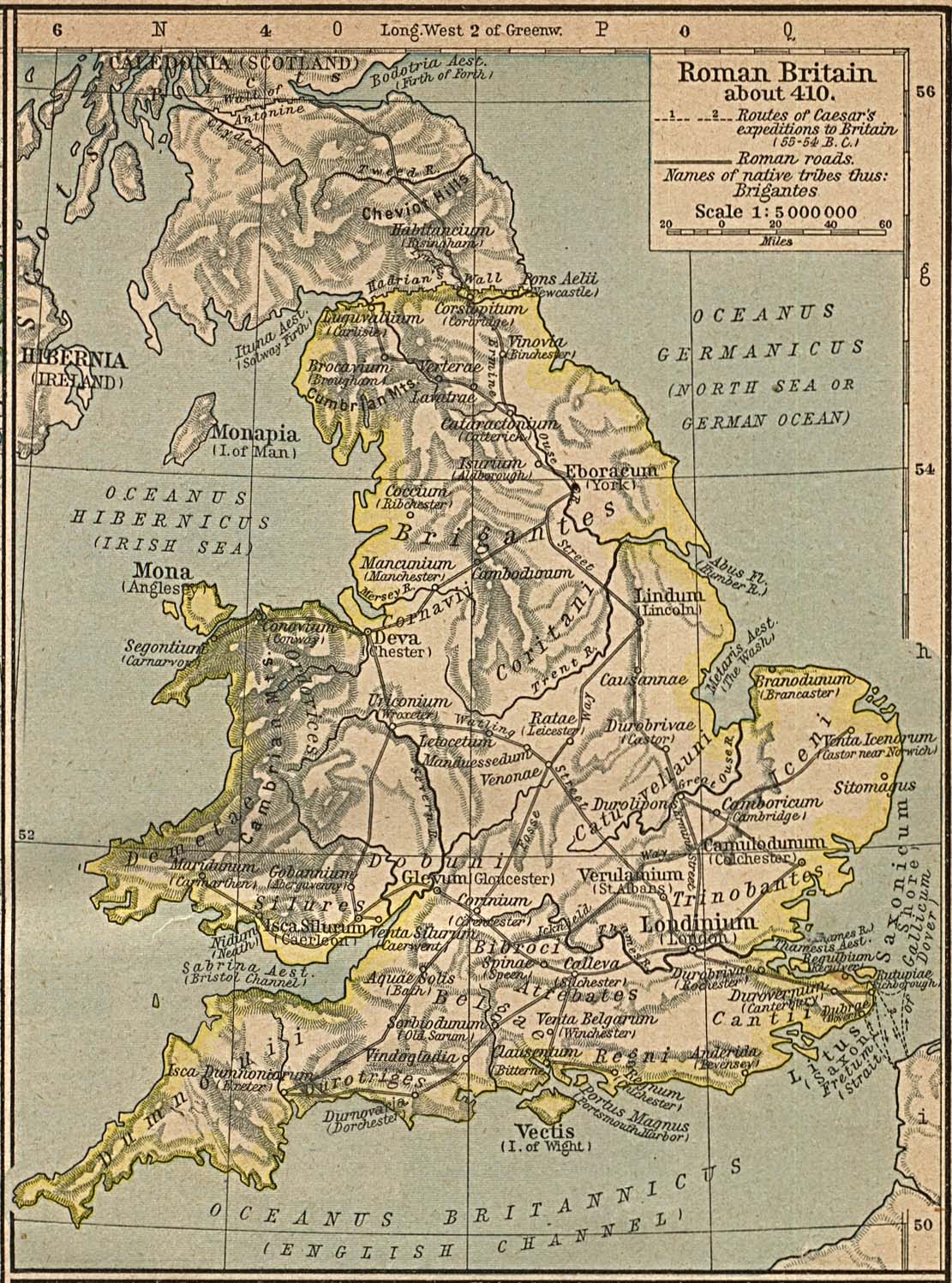
Here's a lovely Roman world view map of Scotland & Eire; note the use of the word Scotti in N. Ireland. Note also that Scotland was not called Scotland, but Valentia, and Caledonia. The Brigantes of Maxima Caesariensis were a buffer between Caesariens (Roman Britain) and what we now refer to as Scotland. Only Southern England, Kent, Cornwall and Devon (Cantii, Damnonii and Belgae tribes) was called Brittania.


Roman Britain —Wiki

Another old map.


Roman Britain in 410 —Wiki

And an updated 1654 map that chronicles Scotland as Scotia and Ireland as Hibernia/Ivverna. Pope Leo X (1475-1521) decreed (when?) that Scotland had exclusive rights to the term Scotland.
In early medieval times Ireland was known not only as Éire but also as Scotia, a name that the Romans used at times to refer to Ireland as well as Scotland. —Wiki

A 1654 map that notes Scotia as Scotland and Hibernia/Ivverna —Wiki

Friday, November 20, 2015

Meeting Annie Leibovitz


“The camera makes you forget you’re there. It’s not like you are hiding but you forget, you are just looking so much.” – Annie Leibovitz

Don't I know about that one. Bearing witness, so intimate, yet, one is removed from the event. Sometimes the camera renders one invisible. I met Annie once at a museum opening of her work, and the work of Hung Liu. Larger than life, Annie was hardly invisible! I was pretty chuffed, I even have a photo of her. But it's out of focus, as if the lens couldn't take all of her in.

Snow Mountain Wilderness, our Newest National Monument


Sierra Club photo, The Davis Enterprise
In winter, whenever we traveled back from the Sierras after skiing, we'd look for the sun setting in the Berryessa Gap, and then we'd look to the north, where Snow Mountain stood out like a sentinel, dusted with snow in an otherwise indistinct long, dark ridge of coastal mountains. 

I always longed to visit Snow Mountain, but we never did. Whenever we were headed east to the Sierras from the Bay Area, it was too far out of the way. Returning home, we were too tired from skiing. When we traveled north on Highway 99 (what later became I-5,) in summer, I'd look longingly at the peaks, but farther, more exotic, mountain ranges beckoned. Again, Snow Mountain was too far off the beaten path to be a convenient side trip.

That is not to say we didn't visit many of the dirt roads of the North Coast, driving from Ukiah to WIlber Hot Springs, or Orr's Springs, on isolated forest roads to the coast. (I was sure we were going to die up there one time when we got lost on one long east-west ridge).

Or a hair-raising detour to Humboldt County's Lost Coast, when it truly was lost. And a memorable drive to the southern lip of the mouth of the Klamath River in Del Norte County. But we never made it to Snow Mountain. On my bucket list.

At 7,056 feet, the east peak of Snow Mountain, one of the highest mountains in the Northern California coastal range, supports an astounding array of biodiversity.

Surrounded by deep canyons and a steep elevation gain, several ecological biomes are compressed, resulting in biological sky-islands. Added to that, the geology, with serpentine, greenstone and basalt, as well as an array of sedimentary rocks, creates unique and diverse biomes.

More than 500 species of plants including mountain mahogany, rare Sonoma manzanita, pygmy stands of Sargent's cypress and serpentine willow, as well as 122 species of wildlife, including Tule elk, threatened species, Western pond turtle, and endangered sooty grouse, not to mention nearly half of California’s 108 species of damsel- and "kamakazi" dragon-flies, call Snow Mountain Wilderness area home.

BLM photo (dead link, thanks #45.)
In spring, a dazzling display of wildflowers that rivals that of Lancaster's Antelope Valley's poppy preserve, paint the slopes in impressionist splashes of golden, and lupine hues.

Tuleyome Conservation Group photo, The Davis Enterprise 
Part of the North Coastal Mountain range, the twin summits of Snow Mountain are the result of an ancient upthrust seamount. Sort of like my favorite volcanic plug, Morro Rock, and her 12 (not 7, or 9) Oligocene epoch sisters (23-28 million years old). Both were volcanos born from tectonic faults, but it seems that Snow Mountain was a slightly younger undersea volcano from the Miocene epoch.

Snow Mountain is an interesting melange, both genetically, and geologically speaking, with serpentine; greenstone, basalt and pillow lava—submarine volcanic rocks that commuted from far west of California, courtesy of tectonic uplift, as well as a full compliment of sedimentary rocks from the North American plate. Some, laid down during the Miocene epoch, when the Central Valley was an inland sea.


The Berryessa Snow Mountain National Monument —of which the Snow Mountain Wilderness is a part of, includes portions of seven counties; Glenn, Lake, Colusa, Mendocino, Yolo, Napa, and Solano counties.

The Snow Mountain Wilderness, itself, is comprised of parts of Glenn, Colusa and Lake counties. Both Lake and Colusa counties share the remote summits of Snow Mountain. The highest point, the east peak (7,056 ft.) is ithe highest point in Lake County, and the west peak (7,040 ft.) is the highest point in Colusa County. One of the largest swaths of undeveloped public lands in the middle of all this urban density, Berryessa Snow Mountain is truly California’s undiscovered country.

Now that it's our newest (and largest) national monument, there's no excuse not to visit Snow Mountain. Along with Pinnacles National Monument (the closest I've been to The Pinnacles is Cholame, where James Dean died, and yes, that was on my bucket list). Both are located in our proverbial greater back yard. Time to dust off that bucket list.

Tuesday, November 17, 2015

Power management engineer


My Apple wifi keyboard has been freaking out because I refuse to change the batteries, I get lots of helpful popup windows, and tutorials on how to change the batteries just in case I'm not clear on the concept.

At battery level at 10%, so far, I've managed to eke out at least three months worth of juice; it's now at 5% charge, I'm working on my 2nd month of dying batteries, and it hasn't dropped down to, say, 3%. So those dire warnings are some serious malarkey. It does cut out from time to time, but it always did.  I do, however, get odd letters and artifacts whenever I type.

If I have to use batteries at all, I'm gonna use them until the bitter end. And even when the end is nigh, they're good fr a couple of months on my wifi mouse, then the kitchen clock gets 'em. In that order.

My cameras get first battery dibs, BTW. Keyboard gets 2nd battery dibs, along with the flashlights. Anyone else eke out every available bit of energy from batteries? I get 2-4 separate life cycles out of them.

Alas, the rechargeables (or cheap/regular batteries) will not work at all in my cameras...that's how I got into this bizarre battery management system to begin with.

Sunday, November 15, 2015

Red Hair, A German Trait?


This is a comment from my Viking-Irish Redhead Gene Myth blog post turned into a blogeen of its own. I've reposted it here. I wind up doing so much research in order to answer people's comments, it takes me hours to write a rebuttal. Maybe it'll turn into a full post later.
Ross Hunter said...

Red hair is actually a very German trait. I know this not only from my own family history going back several hundred years on my Mom's side of the family, but also from my personal studies on many sources. Even the book "Germania", written around the year 98AD, describes the Germans as having "rutilae comae" which is reddish hair. The Romans who came into contact with the Germans brought that trait into their own society, thus the now large number of red haired Italians. The Germans were described as very warlike in in Germania, and in idle times, they often dreamed of waging their next war. While that may seem to put them in a romantic light, it's actually not that awesome considering their attrition rate. They also were said to have practiced human sacrifice and held a lot of superstitions at the time. They were described as "indians" and wore very little clothing.

I'm actually surprised that people don't associate red hair with Germans more often than they do, it's actually pretty common, even the old bog bodies from Germany have well preserved reddish to golden red hair. Sure, things have changed a lot in the modern days, but there is a lot of historical, concrete evidence to support this. APRIL 27, 2015
Maureen Hurley said...
Dear Ross Hunter,

Sorry I never commented back I must've missed it. A few notes on Germany and redheads. What is now present day Germany now was not Germany then. Much of what is Germany now, was actually Celtic territory, not German. Especially Bavaria, and the area around Cologne.

The bog bodies were found in present day northern Germany, etc., but that doesn't make them German. We tend to use current political boundaries to define ancient peoples, and that is a false syllogism. Ahlintel Man, and others were from Lower Saxony and Schleswig-Holstein, which was part of Jutland, so they could also be Frisian/Danish/Scandinavian/Celtic bog bodies.

However, the Nienburg (and the Jastorf) had material cultural characteristics similar to Celtic cultures.... It should, as the Nienburg culture (grave goods, and weaponry) was the northward thrust of the Hallstatt culture. Some La tene influence as well.

The thing to keep in mind here is that Hallstatt was NOT a Germanic culture. Lower Saxony and Schleswig-Holstein were not settled by the Germans unto the 3-7th c.s AD., considerably later than the bog-folk. At any rate, there is archaeological evidence of isolated Celtic settlements as well in Jutland.

Hair color is impossible to determine on a bog body as bog water, heavy in tannins, both leaches and stains. DNA analysis would have to be done to determine if they were redheads. Blond or grey hair would stain read in bog water, so it's not a reliable indicator.

"There has also been migration from former Celtic areas into Scandinavia .... investigations at Dosenmoor, Schleswig-Holstein, and Svanemose, Jutland, Boreas " —The Germani - Haplogroup I2b1 info

There were Celts also in the Netherlands, and many bog bodies were found near Drenthe.

The Celts lived on both sides of the Rhine. Caesar, when he was thumping the war chest coffers stretched the truth a bit (a lot). Hw said that the Gauls were an awful foe, and that the "Germans" were even worse, so he could get funding. Tacitus stretched the truth even further, both did so, to meet their own political needs—which was to get more money from the senate.

Remember, victory was written in the voice of the winners, who had a political agenda. We need to read those old texts with a grain of salt. Rhetoric.

Part of the confusion lies in the fact that the word Germania is not a German tribe, just like Teutates: both are Celtic words. Germania is actually a Celtic war cry, and Teutates, was a Celtic god.

I have read Tacitus carefully, and many of the names he uses are linguistically Celtic, not Germanic, so methinks he was fabricating just a bit. They also could have been a Celto-Germanic tribe. But culturally and linguistically, many of the peoples that Tacitus described, were Celtic, not Germanic.

As to those red-haired Italians, the north of Italy was settled by the same Celts that settled in Anatolia. Especially around Ravenna, Modena, the Po Valley, and the mountains: it was called Cis-Alpine Gaul. So yes, the red-hair gene would be dominant in the north.

Friday, November 13, 2015

San Geronimo Valley fire (photo)


I finally got around to uploading my camera pix of the San Geronimo Valley fire; thought I'd missed the sliming episodes. So this is what my 2nd cousin Pat Ward does for a living, he puts out fires, just like his father. This a fire bird, I couldn't see the call numbers of the plane. Later, a helitac joined in on the fun, with a water scoop, surprising the fish and egrets in the pond, to no end. This one had a happy ending as CalFire had it under control in a very short period of time. Woodacre FD, good job, guys! CAL FIRE Local 2881 Honor Guard.

Tuesday, November 10, 2015

Revising Old Poems by Writing them Backwards


Seeking poetry prompts for November, and finding none, I decided to go to NaWriPoMo 2015 webpage and work my way backwards down last April's prompts. The very last prompt (my first prompt) is/was to write an old poem backwards. (I'm not sure if it improves them any...)

 Here's the prompt:
Start with the last line and work your way up the page to the beginning. Another way to go about this might be to take a poem you’ve already written, and flip the order of the lines and from there, edit it so the poem now works with its new order.
CATCH & RELEASE

Something about the measuring of days
brings me closer to poetry.
I feel the lines surge through me, 
as I wind my way along backroads
to my cousin's house in Nicasio,
and I let every one of them go.

11/18/2015
MEASURING THE DAYS (original poem)
23 Sept 1995

What, no NaNoWriMo for Poets?


Expecting to see a poetic equivalent to NaNoWriMo, I waited for those writing prompts to magically appear on Facebook. Not even a peep from Molly Fisk (unless she took it offline, and I missed the announcement).

What, there's no NaNoWriMo for poets this year? After what Canada's new Le Dreamy PM said today, that the world needs more poets?

“…we need poets to change the world.” -Justin Trudeau, PM

So I decided to go to NaWriPoMo 2015 and work my way backwards down the prompts. The last (my first prompt is/was to write a poem backwards.
Start with the last line and work your way up the page to the beginning. Another way to go about this might be to take a poem you’ve already written, and flip the order of the lines and from there, edit it so the poem now works with its new order.
What tickles me about this assignment is that I've been combing old journals and posting old work to fluff out my blog timeline all month long, so this is write up my alley! (*Stet.).

It's so hard not to tear into that old work, and rewrite it. I'm thinking archivilly. Well, strangely, this gives me permission. I may not even get past this first/last prompt. (OK, so I do tweak them a bit, but I put a rev. note at the bottom, OK?).

I've been using Scannable with my iPod (eyepod?) to take a snapscan of old journal entries as the ink's migrated—especially where I used black le Pens, black ink with breakaway yellow auras, almost unreadable. Some of the lavender and green pens were fugitive colors. Dark cobalt blue ink stained right on through to the other side. Usually on the pages where i did little marginalia drawings that I'd love to have a clean copy of. Another task for Photoshop. Later.

Scannable, though quirky as all get-up, does a decent job of eliminating most of the notorious ink bleeds so I can at least read the text. But the cleanup job in Photos is mighty tedious. Then, I discovered I could send them to iBook and make a PDF. Soon I will have an online collection of my old journals from 1979 to 2000 on my iPad. To say the least, I am suffering from eyestrain, so every little bit helps.

I've got a photo system rigged up with a music stand for the iPad, a podium for my journals, and wedges of black cardboard to mask unwanted sides and portions—as the app goes wild and takes photos of plaid pillows, my hands, etc., and a light array, dampened with paper shields to cut the glare. Very ad hoc. But it works. Until it doesn't work. Then my pages look skewed and drunk.

This also means that I can rescue the journal that took a dive into the Szecheny Baths in Budapest, rendering my Austria and Hungary travel writing into a series of Rorschach inkblots. (LOL, I wrote Rorschit, my Freudian slip's showing).

Now if only I could figure out how to get those huge PDFs of my journals off the iPad, as they're ghosts in the machine, only visible in iBooks. No way to access them. And I prefer the big screen and my old Mac for reading and writing. 

Also, if I can read my texts on the big screen, blowing it up huge, so I can see it, then I can use my Dragon Dictate iPad app to turn that hen-scratching into an editable format. 

Alas, Dragon Dictate is very hard of hearing, and somewhat senile, or it daydreams of being in Herorot, so it's no marriage made in heaven. It capitalizes all common nouns, and can't understand simple words like hair, ear, sea, etc., though it records all my Oh fer fucksakes, just fine.

It's like a bad case of tin can dictaphoniitis. Alas, they're not very interesting aural mistakes, either. Most of the time I'm left puzzling over what on earth I was saying. So I make something up. Or eliminate it altogether. Needless to say, I've a lot of gibberish posts stuck in draft mode. The Blogger's version of the Twilight Zone.

Changing the world, one poem at a time, I am.

Sunday, November 8, 2015

Writing Down the Bone Soup


A writer friend, Penelope la Montagne, posted on Facebook, that she was grateful for the "clean your refrigerator kind of soup." Nothing quite like homemade soup on a chilly day, made from fridge leftovers and a can of chicken broth. You can never quite replicate the exact goodness each time you made it. But it always warms the "ccckies of your heart," said Penelope. That made me giggle. What kind of cookies? Oreos?

I guess the fridge leftovers are crucial components of making decent stone soup. Sometimes it's called nail soup. But stone soup has a better ring to it than nail soup. Eww, not those kind of nail parings. Though if you had enough of hooves, I suppose it would work. Or you might wind up with a pot of glue to hang that hideous wallpaper you've been saving. 

How to make stone soup. First, you begin with a large pot, better wash it out. When's the last time you used it? I mean, really. Oh, the cat was hiding in it? Now, nearly fill it (the pot, not the cat) with some water, and then add your well-scrubbed magic rock. No, not the pet rock! Then wait for your guests to arrive bearing gifts for the pot. And maybe some pot.

I made some magic soup the other night. A poet friend was sick; but we were having a CPITS meeting at my house, so I offered to make chicken soup. 

First, I emptied the contents of my fridge into my soup pot, and then added a box of vegetable broth and another box of chicken broth. But, to my dismay, I discovered that I had no stashed chicken, not in the freezer, nor in my emergency food stash.  

And to add insult to injury, I'd used up the rest of the good garlic for the last of the summer pesto. I had garlic, but it was Chinese, and I wasn't about to use it. Never buy garlic sans roots, it's Chinese and it never sprouts, or grows, if you plant it. They do something to it, and that can't be good.

So I asked John Oliver Simon to bring me some real garlic. Then, I asked him to bring me some chicken. Then, I needed some celery, and parsley to go with it. Parsley is great for the heart.

Perhaps I should interject here that John is an ex. I never thought I'd ever see the day when John would be sitting in my kitchen waiting for the soup to boil, without my wanting to murder him. Ironically, I'm scamnning and transcribing bit of old journals so his name keeps popping up. Must be the homing pigeon return cycle.

Tobey Kaplan brought potstickers, spring rolls, and wine. Lots of wine. You know how poets are. We tossed some potstickers into the broth, drank some wine, and bowed down to the soup pot, grateful for its bounty. And we said yum. The thick chicken soup was divine, and it fed multitudes of poets. Well, it fed almost a dozen of us. The wine, not so much.

For dessert, Fred Dodsworth brought bananas and crisp persimmons that glowed like low winter suns on the horizon, no cookies, though. Speaking of cookies, nobody brought any—not even the Chinese fortune kind. No cookies or cockles to warm the heart.

(I've been obsessed with cookies lately: zapping computer cookies and obsolete deep file preferences, after I discovered a Firefox add-on I was using to watch BBC, was a disguised botnet.

All Maxine Chernoff's files were held hostage by Bitcoin malware and she had to pay a poet's ransom to get her writing back. That also happened to Eileen Malone too. I was terrified at the thought of losing all my writing. Maxine got all her files back. Eileen was not so lucky.

Sure, I've got all my files backed up on separate hard drives, but they're attached to the computer. Piece a cake for a botnet to access it via the back door port, firewall be damned. Yeah, I have a Mac, it's less likely to be attacked by botnet malware. And my friends are both are PC users. Friends don't let friends use Windows. I guess I deleted an important file, the Finder keeps crashing.)

Which led me on a circuitous path from cookies to cockles and muscles (stet), to canned soup, to a former neighbor's noisy young urban balcony-raised cockerels (no coop), whose bones probably made the best chicken soup ever.

I witnessed their demise (the chickens, not the Ethiopians) one Sunday at dawn. Well, I witnessed their shadow's demise on the wall, as the Ethiopian woman sang to the rising sun and held the unlucky fellows up to the sun before the coup de gras.

I was horrified to see an article circulating on Facebook by a young urbanite chef on how to make "bone" soup. And folks cooing: oh, I wanna learn that, or shrieking: gross! (There was even an "I know, I know," eye-rolling ewww /squee component embedded in the article.) The tin can generation is dumb and dumber. Even the phrase, tin can is lost on them. Foil-lined box generation. How do they think chicken broth is made anyway?

In our house, soup was a pilgrimage of sorts. My grannie never threw bones away. Into the pot they went. We always saved the skin, gristle and connective tissue too. Nothing wasted, except the squawk a doodle do.

Add onion skins, garlic, carrots, celery, peppercorns, bay leaves, and wine, or vinegar, and simmer slowly 1-2 hours, until the gristle falls off the rubbery bones, and skim any scum. Strain broth into a clean pot. Add fresh vegetables (see above list), orzo, or barley, bring it to a boil for 15 minutes (barley needs an hour), skim, season. If it jells when cooled, you made it right.

Well, what about the dawg bone, you might ask: fuggedaboutit. It was a case of get in line, after the stewpot. Sort of like Saturday bath night (one tub of water, and three people waiting in line). Yep, it was a stiff broth, all right, by the time my little brother got into it.

And what about warming the cockles of the heart? I always thought it had to do with spoiled mollusks, so that saying always puzzled me. Then I thought cockles were associated with Molly Malone's cockles and mussels in Dublin's fair city. Cookies and cockles, alive alive, oh. Uh-oh, the Cookie Monster....and the tart with the cart.

Then, speaking of pilgrimages of the heart, I thought maybe the cockles were a reference to St. James. Pilgrims wore cockle, or scallop shells around their necks as they walked the Camino.

So I joked, mussels is muscles, which is true, as muscle, mussel and mouse all stem from the same root word. Warms your mousy little heart muscle, doesn't it? I never associated it with ventricles, or cochlea. Some Easter egg hunt that was. 

All this to say is that writing is never a very straight line. 

Tuesday, November 3, 2015

The Mulligan


In Cape Cod, a giant alligator snapping turtle the size of a garbage can lid, zealously guarded the 18th hole. When a golfball came sailing in, he'd rise up and open his maw, the golfers chalked it up to bad luck, and forfeited the game. There was no option of putting around him. Some mulligan he was. Prehistoric. Thorny neck and a carapace that looked like steep rooftops. His eyes may have been rheumy, but he sported a sharp hooked beak that meant business, it could snap a putter in two. Maybe it was a she and she thought those golf balls were eggs. And when that snapper opened her maws wide, it was like daybreak, and everybody skedaddled like vampires at first light.

Red Tide


The summer of 1981, we traveled north to stay at a friend's trailer in Pulsbo, on the Hood Canal in Washington. It was the summer solstice. At low tide, I waded in, Hood Canal was a seafood cornucopia. I gathered armloads of shellfish bounty (mussels, cockles, clams, oysters) like a mighty hunter. I swam seal-like and collected the bounty. The sea provided.  They called me mermaid, and goddess, seaweed wrapped around my thighs. (I was also the only one who knew how to clean the shellfish. So much for the menfolk). And that night we feasted on seafood. Breaded clams. Oysters on the half shell. Mussel and scallop chowder. But as we were all gorging on shellfish, seasoned with garlic and butter, and drinking wine, a news warning flashed on the TV. Red tide this far north? Gulp! I imagined symptoms of red tide poisoning, though there was no evidence of red tide anywhere. It was a long wild night of the imagination, but they soon forgot about it. Someone rolled a doobie, everybody laughed, and carried on, but I was checking for symptoms all through the night wondering if I had poisoned us all.

Friday, October 30, 2015

San Geronimo Valley fire photo


San Geronimo Valley fire; thought I'd missed the sliming episodes. So this is what my cousin Pat Ward does, he puts out fires. Captain Pat lost four fingers on one hand, and two on the other in the Valley Fire. But he's alive. This a a plane, I couldn't see the call numbers. Later, a helitac joined in on the fun, with a water scoop over the pond, surprising the fish and egrets, to no end. This one had a happy ending as CalFire had it under control in a very short period of time. Woodacre FD, good job, guys!

Monday, October 26, 2015

Amazon no longer supports Kindle app on legacy Macs, I can't access my books!


Amazon Cloud: whatta crocka caca! Amazon no longer allows those of us with the legacy Kindle app on our legacy Macs /OS, to download our purchased books. My Kindle app for Mac (Snow Leopard 10.6.8) no longer downloads or syncs content. This happened with NO advance warning that they were going to completely hamstring the old version of Kindle for Mac. Had I known, I would've downloaded everything. Especially my comments. Now I can't download any old, or new purchases. I can read what I have in my library, but now I can no longer sync between devices.

I spent a long time on Amazon Chat, airing my grievances with someone named Pooja, offshore. It became patently clear that they don’t do Macs in India, as Pooja kept offering PC style solutions. Amazon's final solution: either upgrade to OS X.9 (not even remotely possible on this old Mac), or, use Amazon Cloud. Right.


What can I say? The Amazon Cloud Reader is awful awful awful. Buggy, unresponsive, it stalls, hangs, and that's just for starters. I can't stand watching rainbow beachballs and gears endlessly spinning. Forget about searching the text—something I do a lot of when I write reviews. It's stuck on "indexing." (Restart, again.) Amazon Cloud webpage takes up a half a GB real memory? And even more VM? And all my comments are gone. I use the comment tool a lot to flag typos, bad writing, good lines, etc., for my Amazon book reviews.


Seems like a grand potential class action lawsuit scenario, Amazon orphaning those of us who have legacy hard/software, from our legally purchased ebooks. Amazon's response, that I can read it on Amazon Cloud or my iPod (too tiny, too much eyestrain for these old challenged eyes), is beside the point, and it's not a viable solution. I get it that software developed in 2012 is long in tooth, and needs to be sunsetted, it's one thing to no longer update it, but to hamper its functionality, is just wrong. If you're in a similar predicament, I suggest that you complain to Amazon. (See my transcript below).

Saturday, October 24, 2015

WRITER'S NIGHTMARE

WRITER'S NIGHTMARE

As I cull copies of old typed poems
& pair them with their electronic kin, 
a pile of paper orphans grows. Lost poems.
No equivalents. Only faded dot-matrix hard copies.
Seedy little islands of ink on paper,
the last stand of the printed word.
I've gone and disturbed those old poems.
They no longer dream of the past.
They've become a chattering wilderness, 
they invade my dreams, all jumbled up 
and juking about out of order.
Unreasonable harvest.

It all began last summer when I was laid up.
I couldn't open a file that had lain fallow,
it reverted into a gray Unix brick,
like a digital weedy cultivar gone rogue.
(Yes but think of all those trees I saved
by not printing them out. Now what?)
And other poems have lost vast tracts of text. 
Words just went missing. On walkabout.
Words no writer ever wants to hear.

10/23/2015

Paper Trail


As I weed and ameliorate old copies of typed poems, & their revisions, with the electronic files on my hard drives, and with this blog (I've been posting my work by year as a means to keep track of it all—and it creates a nifty timeline as well), I have an ever-increasing pile of paper poems with no electronic files. No equivalents. Only hard copies. Makes me shudder. Makes me wonder what was lost.

So, I'm slowly coming to the conclusion that the dearth of work from 1995-2000 may be due to hard drive failure? This insane archiving process all started a couple of summers ago when I realized I couldn't open some old poetry and prose files, they'd reverted to gray Unix bricks. Other files, that I could force open, had lost chunks of text. Sometimes vast chunks of text. A writer's nightmare. And so, it continues. 

I had typed most of my old work from the early 80s into Appleworks, which later created a translation problem, but I was able to salvage most of it with old Macs I had rebuilt, but this paper trail is an entirely new dilemma as I contemplate what writing was lost. 

Words no writer ever wants to hear.

Weird to revisit that old writing, if I can find it, that is. I came across a pile of poems I had workshopped at Napa Poetry Conferences and realized that I didn't have electronic files for most of them. But clearly they had been electronic files as the hard copies are printed out in faded dot matrix.

I also found a few lurkers in back issues of Sonoma Mandala and other old publications from the 1980s. I still have a few more boxes of papers to sort, so hopefully the missing work will resurface. It's bad enough that I've lost most of my news stories and photo tear sheets from the Sonnoma County Stump and The Paper. But not my poems. Not the gumdrop muffins!

I figure I have a fighting chance to keep my work electronically current by using my blog! Alas, most of of my work is not on paper. Unfortunately it would kill the equivalent of an entire forest to print it all out. It was wildly liberating to know that you don't have to print out hard copy. My writing output grew exponentially.

Remember those electronic printer typewriters that printed out a line at a time? Expensive little film ink cartridges. Some of my work was from that machine, so there would be no electronic equivalents. But even still. Sheesh.

Some of those poems I had saved from the he 5 inch floppy disks to the the 3.5 inch ones. Even files on the 3.5" hard floppy disks are a challenge to rescue. The floppy dist themselves are reverting to ferrous oxide. I trolled them a while back.

I got a USB floppy disk reader (hard to find!)  from Craigslist. I met an Indian fellow in a San Jose parking lot at sunset. Very clandestine. But I suppose I could attempt another trolling. No matter how we back up our writing, it's all temporal. 

I think I decided a lot of my old writing wasn't worth upgrading to .doc files. I left it go fallow, not realizing it's all part of the matrix. 

A friend said: it is alive and well on some cloud out there... perhaps entertaining multitudes in outer galaxies.

Along with those old Jackie Gleason reruns.

Words no writer ever wants to hear (first draft)


As I weed and ameliorate old copies of typed poems, & revisions, with  their electronic files, an ever-increasing pile of orphan paper poems grows . No electronic equivalents. Only faded dot-matrix hard copies. Makes me shudder. Makes me wonder what else was lost. I'm slowly coming to the conclusion that the dearth of work from 1995-2000 may be due to hard drive failure. I began the archival process a couple of summers ago when I realized I couldn't open old files, they'd reverted to gray Unix bricks. Other files had lost chunks of text. Especially the endings of poems. A writer's nightmare. Words no writer ever wants to hear.

from a Facebook post
see Paper Trail
WRITER'S NIGHTMARE

Maureen O Hara dies at 95


Today marks the passing of Irish film icon Maureen O’Hara at age 95. Paramount YouTube channel is hosting  several video tributes to her: Rio Grande, How Green Was My Valley, Parent Trap, Miracle On 34th Street, Quiet Man, Hunchback of Norte Dame. Maureen O'Sullivan (Mia Farrow's mother) was my mother's namesake, and mine, but Maureen O'Hara was also very much in the family matrix. Sláinte agat macushla mo chroidhe. 🍀Goodbye Maureen🍀 May the roads rise up to greet you and may you be in heaven ah half hour before the devil knows you’re dead.


Wednesday, October 21, 2015

SILENT HAICHES

SILENT HAICHES

My grannie taught me to write
old school Gaelic League Irish
with dots over the muted consonants; 
they were marked with a sí buailte,
a diacritic hangover from Old Irish.
Sí buailte means strike—not to strike,
no infinitive verb in Irish. Drop the fada 
Seán becomes sean, which means old, she said.
She didn't like reformed Irish at all. 
Modern typography couldn't  handle those dots
so haiches were added after the consonant.
"There are no Haiches in Irish, she scoffed. 
"Haich is a ladder to the sky, 
Haich is silent, holy, haich is like God." 
So I learned the old style writing
with long-tailed rs and esses
I learned to dot my Ts and Cs to soften them.
Then we had some tea with milk and sugar
as we silently worked on our letters.

Oct, 24/2015

Tuesday, October 20, 2015

Trudeau the Younger


“Many of you have worried that Canada has lost its compassionate and constructive voice in the world over the past 10 years. Well, I have a simple message for you on behalf of 35 million Canadians. We’re back.” —Justin Trudeau
When I was in Vancouver in August, I was shocked by how much Canada had changed: it was gritty, cynical, and contained all the negative attributes of the US, and those attitudes had supplanted what made Canada unique. OK, so Vancouver isn't all of Canada, but I could really see/feel the change. Not so much in Victoria (I was last there in 2009), but then, Victoria is a tourist destination. Easier to hide the homelessness and desperation. The Canadian dollar may be worth less than ours, but everything is grossly overinflated. Food costs an arm and a leg. Makes the homeless in Stanley Park fear for their limbs. Much of Vancouver is now owned by multinationals. Here's hoping the corporate tide can be reversed. I have visited Vancouver scores of times since the early 1970s, I was there before Gastown was turned into Ghirardelli Square North. When It still really was a rough neighborhood. I even slept out in Stanley Park. Different times.

Sunday, October 18, 2015

White Peacock


This morning I threw on my Las Vegas Highland Games teeshirt, with its eulogized mascot, the missing white peacock. He's been missing from Floyd Lamb State Park for a couple of years now. Either a coyote got him, or maybe he was birdnapped. White peacocks are exceedingly rare. He was leucistic, not albino, he had expressive dark eyes.

I miss that old bird. Every time Neil would get on stage to sing, the paycock would hop on the black stage and join him. Then he'd do the I love you fandance tail thing. It was hysterical. The unlikely duo performed several sets like this together. We speculated that it must've been Neil's white hair that set the peacock off. And maybe his honeyed voice. Kindredness. But the peacock's version of singing was atrocious. Yelling Help! Help! when it wasn't even a Beatles song.

We all prefer to think he was birdnapped, someone stole in during the night and climbed one of the tall cottonwoods and grabbed him while he was sleeping. We curse the mysterious thief and wonder what kind of life that peacock is living now. That scenario is infinitely preferable to the other alternative, coyotes crunching bones. Of course, that whole wash is awash with bones—huge dinosaur bones, that is. You'd think they'd keep the coyotes busy and at bay.

Saturday, October 17, 2015

THE WOOD LADY


THE WOOD LADY
       
Our firewood lady
was hatchet-faced, hard as nails,
drove a hard bargain.

Her husband was fond
of the bottle leaving her 
to raise three daughters.

All alone she was 
with no way to support them—
a grim countenance.

We called her Iron Pants
A hard woman, she
took no prisoners. 

Amazon women
stacked wood to the sky and kept
Daphne in the trees.

The hunters mourned them
for longing kindled a fire 
deep in the heartwood.

But those cords of wood
kept us warm against the cold,
kept the night at bay.

17 Oct. 2015

Tuesday, October 13, 2015

Poet role call, National Poetry Week poster from 1993

Blast from the past: National Poetry Week readings, 1993. Wonder where some of these folks are: Herman Berlandt is still on the Mesa. I visited Herman about 3 years ago and he has alcohol-related dementia, barely remembered me. Scary. Vernon Edgar looks in on him, takes care of him. Blind leading the blind. They seem to be enjoying life.

Last I heard. Julia Vinograd is still on the Avenue. She read at Watershed. Zoravia Bettiol moved back to Brazil; she may or may not still be with us. Robert Hunter, Mel C. Thompson, where are youse? David Fisher disappeared ages ago. I fear the worst. Last letter I sent was marked Return to Sender. What makes me especially sad is that I lost track of David and then couldn't find him again. I did several internet searches. Nada. Only to find he was alive all this time, only to find that he died this year. Sheesh! As Donna Champion said, Sometimes people retreat into their own lives, leaving past lives to the wind.

Bruce Isaacson said: Mel C. Thompson walks the earth! Made recent books by Deborah Fruchey and Nancy Depper, both excellent. All those found on the Facebook, but not Eli Coppola or Sparrow 13 who just doesn't compute. Dominique Lowell I think is walking Detroit,  Laura Conway walks Prague. Always wondered about Judy Grahn whose great A Woman is Talking to Death haunts mind still. Juan Felipe Herrera was walking Las Vegas recently and that was great treat.  Maureen--what a line up!  People don't know story of Herman Berlandt & Nat'l Poetry Week, they should.

I said, Wow. Blast from the past, or what Bruce? Fantastic roll call. I am relieved to know that Robert Hunter & Judy Grahn are still with us. Piri Thomas passed on. Sparrow 13 is on FB with a different name. I've got proof sheets from these readings. I just need a good negative scanner. Sad to hear about Piri Thomas. I really liked Piri.

I just met Pasha DeSaix yesterday at Whitman McGowan's memorial! All this time I thought she was a man. LOL. We're now FB friends. She knew my mom, and said she was just thinking of her a few days ago. I told her that she had given my mom a n audio tape, Leonard Cohen's 10 New Songs, and after my mother died, I played it incessantly. Thanked her for the unintended gift from so many years ago. Then she sent me a photo of my mom taken months before her death. The universe offering such strange gifts.

I had wild frenetic dreams all last night, I think Whitman was very much with us yesterday at the memorial. He was certainly in my head. I gave up on trying to sleep. Middle Aged Dub...

Whitman McGowan's joined Vampyr Mike Kassel, Joie Cook, Piri Thomas and David Fisher for that great open poetry reading in the sky. What a grand open mike list that must be. Wonder who's emcee?

From a Facebook post.

Monday, October 12, 2015

Trolling Old Journals


I found a stack of old journals mixed in with newer journals, and since I've misplaced most of my old writing, I took a peek, to see if there was anything I could glean, or steal.

My 1981 journals, where I spent the summer in Port Townsend, the Olympic Peninsula, and Pulsbo, were particularly rich, so I've been typing up (dictating) a few poems and prose pieces.

I was able to date several old poems, having found the original draft. What I discovered is that the writing is much more solid than I expected. Funny how you think your old work is inferior. And your new work accounts for shit. Perception. Not what it's cracked up to be.

I am enamored with my Port Townsend prose piece, and my Mt. Olympus piece, where I had a very, very close encounter with a Rocky Mountain goat.

These prose pieces would've never seen the light of day, as I only typed up poems. Prose scared me. But for the most part, it's solid and muscular. What was I thinking that it was all so bad? Part of why I began this blog was to teach myself to write prose. But the urge for story ran parallel with my poems. Anyway, should you want to peak, this link is a shortcut. (New work also in 1997, 98, and 2000. Not a lot. Yet.)

►  1981 (29)

It all began when I was uploading old poems to this blogspace, and I discovered that many of my files were corrupted. In particular, the electronic version of the HOH RIVER VALLEY file is toast. And I still haven't found the hard copy. It exists, but I don't have access to it.

My other long-term goal was to fill in the posts where I have too few poems for a given year. I am/was a prolific writer, so this is a search for lost work. Retyping old work is a bit like reinventing the wheel. But on the other hand, I'm treating it like revision.

Most of the 11 years I need more work for, are the years I don't have journals for, they're tucked away deep in a box in storage. 1998 to 2000, the years I was in grad school are particularly paltry. I know I have writing, but where is it? 1982 I was in a car accident, so I probably didn't write much. Ditto 1997/98. Some of those years I was in Amsterdam, or Russia, so it may be a case of typing up work that I never had a chance to make an electronic file.

Sunday, October 11, 2015

Transliteration gone awry


I was practicing a poem aloud in Irish, but my speech recognition software, Dragon Dictate, was sneakily recording me. It made for a superb word salad of Misa Rafteri. It's so freakin' bizarre, that I had to record it three times just to see if there was any pattern or sense at all. I might go back and see if there is a phrase or two to salvage. But I think it's safe to say that Dragon Dictate does not recognize Irish. Not even tiny a little bit. So much for the Indo-European continuum. It's too weird to even steal lines from.
Cilla long dogfishes crawl the spoiler
Gonzalez to another skunk
wrong thing though she is a master list
soulless for three PhoneMag
if Tisha could get them on the fifth
and May the Mimiga Walla eggs cinnamon

the data must be finished by then
Mimiga Kuala eggs cinnamon

Michelin study Cilla long.
this is crawl the spoiler Gonzalez
to enough skunks wrong
they don't see a set of master list

soulless monthly phone
could get them on the fifth
and May the Mimiga Kawala eggs
cinnamon soiled of 4K follow

Study Cilla long Dulces's crawl
the soil or Gonzalez two and a skunk wrong
they don't see is that a master list soulless
monthly phone could get a monthly bill finish
May the Mimiga Kuala eggs cinnamon oil
the funky follow

This is the actual poem:

Mise Raifteirí, an file, lán dóchais is grá
I am Raftery, a poet full hope /love

le súile gan solas, ciúineas gan crá,
eyes without light silence without heart

ag dul síos ar m'aistear le solas mo chroí,
at going down on my journey to light my heart

fann agus tuirseach go deireach mo shlí;
faint and tired to the end of my road

féach anois me lem aghaidh ar Bhalla
look now my face at/against at Balla (a town) or wall

ag seinm cheoil do phócaí falamh.
at making /playing music with pockets empty

Saturday, October 10, 2015

Adze-Heads & Blind Poets: Anthony Raftery—The End of A Bardic Literary Tradition


Notes for an oral presentation on Celtic Bardic Poetry for the Sacramento Poetry Center. I had no intention of writing a blog post about this material but everyone wanted a copy of my notes.

SUMMARY: What is a Bard, historical, social role, examples, historical quotes, from Amergin to Antony Raftery with a segue on St. Patrick, aka Adze Head, the Viking era, the 17th-18th c, to the the end of an era, Blind Raftery, The Irish Renaissance (Celtic Twilight), WB Yeats, Padraic Pearse, etc.


The Celtic bardic tradition dates back to at least the Iron Age, and refers to a class of poets trained in the Bardic schools of Gaul, Iberia, Wales, Ireland and Scotland.


Iron Age ‘bard’ (Brittany) & Celtic ‘Crwth


CELTIC BARDIC TRADITION

A Celtic bard was professional poet & storyteller, sponsored by a clan, or tuath, or patron (later associated with the big, or noble houses). An itinerant bard's job was to keep the king lists and genealogical records straight, praise a patron's ancestors, and to commemorate his heroic deeds. Court bards were expected to know 350 chief stories, 100 sub-stories, as well as have the ability to sing 100 different kinds of verse. They also needed to be able to tell epic tales such as the Táin Bó Cuailnge, The Cattle Raid of Cooley, and recount the heroic exploits of CúChulainn, and Fionn mac Cumhaill, on demand. From memory.

And yes, there were female bards, “while admitting that females cried the Caoine* over the dead, yet in Cathluina we read, “The daughter of Moran seized the harp, and her voice of music praised the strangers. Their souls melted at the song, like the wreath of snow before the eye of the sun.”

**The modern word, to keen, comes from caoine, there were professional keeners in Ireland up to the 20th century.)

How did they manage  to do it? Keep all those tales in their heads? Memorize, memorize, memorize. Poetic and musical forms were important not only for aesthetics, but also for their mnemonic value. And yes, sometimes, the stories were lost. For example:
The chief poet, Senchán Torpeist, summoned a meeting of all the bards and story-tellers and professional poets of Ireland, in order to make sure if any one of them could recite the Tain completely. And they said they knew but fragments of it.
                   —Irish Texts Society, Douglas Hyde, 1899
(Senchán sent the bards off to Brittany to hone their epic chops.)

TYPES OF POETS (those poet-types)

• Old Irish: bard, fili, pl. filid, ollam, druid
       (Latin: vates; Proto Indo European widluios: seer)
• Modern Irish: bard (Ward) file, plural filí, ollamh/s
• Scottish Gaelic: bàrd, filidh, pl. filidhean,
• Manx Gaelic: bard, feelee,
• Welsh: bardd, pl. beirdd, gweled, ovate

Norse and Anglo-Saxon skalds & skops were considered to be liars, they made up things. They told tall tales.

English words scoff, and scold are derived from those AS poets.

Celtic bards, fili and ollamh were the tellers of truth. Truthsayers.


CLASSICAL WORLD  EXTERNAL NOTES ON BARDS OUTSIDE THE CULTURE
And there are among them composers of verses whom they call Bards; these singing to instruments similar to a lyre, applaud some, while they vituperate others.
                      —Diodorus Siculus
                          Histories 8BCE

Diodorus Siculus observed that “Bards; they applaud some, while they vituperate others,” Vituperate: berate, censure, condemn. Strong words.

A bard’s curse was nothing to sneeze at: not only could he raise boils, “he stopped by his power the corn's growth; and the satire of another caused a shortness of life.”

Bid móin 7 mothar a feranna-som co bráth.
Their lands will be boglands and thickets until judgement day.
They (bards) acted as heralds, knowing the genealogy of their chiefs. With white robe, harp in hand, they encouraged warriors in battle. Their power of satire was dreaded; and their praise, desired.
                 Irish Druids and Old Irish Religions, James Bonwick, 1894

A COPY OF PTOLEMY's MAP OF IRELAND

Ptolemy's map of the Pretanic Isles, ca. 150 AD —Wiki

So what was known about Ireland via the Classical world? Check out Ptolemy's maps. He has some placenames and tribe names listed, including the Brigante, Domnainn (Devnoni), (P-Celtic) Iverni, Volunti, Dairini (Dal Riata; Q-Celtic), and Cruithni (Picts— Cruithni  is a Goidelic corruption of Pretani). What Ptolemy's map documents is the earliest "evidence" of two Celtic languages in Ireland.

A NOTE ON CELTIC LANGUAGES

P-Celtic? Q-Celtic? Huh? P-Celtic is Pretanic, or Brittonic; Q-Celtic is Goidelic. 
P-Celtic (most of Britain, Cornwall, Devon, and Caledonia), closely related to Gaulish, favors plosive soundss like Ps; Q-Celtic (Ireland, Manx and most of Scotland) avoided P sounds and substituted K sound, so Welsh map (son of) becomes mac in Irish. Welsh pen (head) becomes ceann, or ben if it’s a mountain. Cornish pysk (fish) becomes iasc in Irish. Tad (father) becomes athair in Irish. What’s interesting about tad is that it’s avoiding the P sound too—as in pater. Can you see how tad became dad? That final d often gets swallowed, so it's closer to Da, than Dadd.


IRISH NOTES ON BARDS FROM WITHIN THE CULTURE
The Dinn Seanchas has poems by the Irish Bard of the second century, Finin Mac Luchna; and it asserts that "the people deemed each other's voices sweeter than the warblings of the melodious harp."
                Irish Druids and Old Irish Religions,
                          —James Bonwick, 1894

TRISKLE  / TRINITY  St Patrick said to introduce trinity via shamrock, but the concept of Indo European 3 is far older than that.


THE FIRST BARD OF IRELAND WAS A MILESIAN FROM IBERIA

The Gael, from Espania (Galicia), the Milesians, were first mentioned in the Lebor Gabála Érenn, or the Book of Takings (redacted in the 11th c.). A Milesian, Iberian-born Amergin is considered to be Ireland's first bard, and Blind Raftery, is considered to be Ireland's last true Celtic bard.

Who were the MIlesians? The sons of Mil Espáine. Think of those Celts of Hispania/Iberia, as a shared culture with the Insular Celts of Britain and Ireland.

Their descendants still live in Galicia and Northern Portugal. Celtic languages impacted various dialects of Latin, which in turn, created the Romance languages. Remember that the next time you're in your car or chariot. Carros, Irish: carpait (chariot).

I know, the OED obfuscates word origins when it come to things Irish, it claims nearly all Irish words as being of Scottish origin. So the Irish contribution to English is practically nil, until you learn to code-read. But the Spanish and Portuguese didn't hate their Celtic neighbors with such fervor as the English. So words like car, chariot, and bag are cited. Bag, bolg, bolsa. We are the bagmen of trivia. But I digress.


THE MILESIANS COME TO IRELAND: a quick and durty redaction

Mil's grandfather, Ith, in his tower, said he could see Ireland. His sons wanted to know what kind of craic he was on, as they could see only clouds. But he was determined to follow that vision, so he packed up his family and set sail to the land of green. 

He came upon three Irish kings at Tara bitterly quarreling, so Ith, trying to be helpful, said to Mac Cuill, Mac Cecht and Mac Gréine.: “Perhaps you should follow the laws of your land.” That went over well. Not. Perhaos you should shut your gob, they replied. So they killed poor old Ith instead of each other. 

 (What catches my attention in this story is that they were all speaking the same language. No interpreters needed. So it wasn't a case of what gets lost in translation.)

Ith's kith & kin got rather pithy and took umbrage to the most grievously foul murder of their patriarch (Note that it's now a patriarchal society. Those weasely medieval monkish scribes. Note also that this was an oral tradition, not literary, as the Celts were not fond of writing. Poetry and epic were oral art forms. So sticking to the story was tantamount.) 

So Ith's kin and kin set sail with revenge in mind. The sent in the baddest of the way-bad poets. They sent in Amergin.
Amergin, brother of Heber,
was the earliest of Milesian poets.
Irish Druids and Old Irish Religions,
James Bonwick, 1894
The first Irish poem, "The Mystery", attributed to Amergin, a Milesian prince or druid who settled in Ireland hundreds of years before Christ, is from the "Leabhar Gabhala", or "Book of Invasions". Irish tradition has it that they were the first verses made in Ireland, perhaps they are amongst the oldest surviving lines of any vernacular tongue in Europe.'
—Douglas Hyde, A Taste of Ireland’s Poets

SO WHO WAS AMERGIN ANYWAY?

As Chief Ollam, (Poet Laureate/teacher) of Ireland, Amergin Glúingel ("white knees"), one of the sons of Míl Espáine, was also a druid. He calmed the wind by reciting a verse to quell a magical storm raised by the Irish Tuatha de Danann (Children of the Goddess Danu) to keep the Milesians from reaching shore. He sang an invocation to the spirit of Ireland. The Song of Amergin (aka The Mystery) is considered to be one of the oldest poems in irish, passed down in the oral tradition.
THE MYSTERY 
I am the wind which breathes upon the sea, (glosses)
I am the wave of the ocean,
I am the murmur of the billows,
I am the ox of the seven combats,
I am the vulture upon the rocks,
I am a beam of the sun,
I am the fairest of plants,
I am a wild boar in valour,
I am a salmon in the water,
I am a lake in the plain,
I am a word of science,
I am the point of the lance of battle,
I am the God who created in the head the fire.
Who is it who throws light into the meeting on the mountain?
Who announces the ages of the moon?
Who teaches the place where couches the sun?
                                                               (If not I)
    — Translated by Douglas Hyde

(There are several translations of this incantation, including Robert Graves' version in The White Goddess. (My synopsis of The White Goddess, here.) I've compiled a revision using several translations, but I find that as a poet, I am most attracted to Douglas Hyde's version. Though it's an incantation, I suspect it's also a coded poem, something like a power brokering list, a remnant of a shape-changing poem, a collection of story titles, or even a calendar of sorts.

The storytelling season was during the winter months, beginning now, at Samhain, the Celtic New Year, and each bard was required to have a vast repertoire of poems, songs and stories committed to memory.

What little we do have of surviving poems from the Irish bardic tradition are written in Old Irish, or Latin Irish, and attributed to the 6th to the 10th centuries. But most of those poems were transcribed much later, in Middle Irish, during the 11th to 14th c. So dating the poems is tricky as the Irish language was changing,

(An aside: who first transcribed English? Yep, the Irish monks. By way of Latin and Irish.)


TALIESIN, AMERGIN'S WELSH COUNTERPART

We know that the tradition of Amergin conservatively dates back to at least the 6th century, because in Wales, his counterpart (or doppleganger) is Taliesin of the "shining brow." In the Book of Taliesin, scribed in Middle Welsh, Taliesin is called Ben Beirdd, or Chief of Bards. Ben, pen, ap = head, and Beirdd is bard.

Another poet is mentioned. The name Aneirin, sounds suspiciously like Amergin.

Taliesin too incants a shape-changing poem (but in the past tense):

I have been a multitude of shapes,
Before I assumed a consistent form.
I have been a sword, narrow, variegated,
I have been a tear in the air,
I have been in the dullest of stars.
I have been a word among letters,
I have been a book in the origin.
I have been the light of lanterns. 
I have been a course, I have been an eagle.
I have been a coracle in the seas:
I have been compliant in the banquet.
I have been a drop in a shower;
I have been a sword in the grasp of the hand:
I have been a shield in battle.
I have been a string in a harp....
        XIII Kat Godeu, The Battle of the Trees
(See the Second Battle of Mag Tuireadh (Cath Dédenach Maige Tuired) between the Tuatha Dé Danánn and the Formorians. And the Lebor na hUidre story of Tuan mac Cairill who retains his memories of all his incarnations, has a similar theme of invaders, and shape-changing: he awoke as a stag, a wild boar, cormorant, an eagle/hawk, a salmon, he was caught, eaten, and reborn human.
In another story, the sun goddess Etain, was turned into a pool of water, then a worm and a fly by a jealous wife, and as a tiny fly, she was accidentally swallowed and reborn.)

In the Tale of the Two Swineherds, Friuch and Rucht quarrel, and fight in various animal forms.They become two worms, swallowed by two cows; who give birth to the Whitehorn, and to the dun Bull of Cuailgne, the very animals that set off the war in the Táin (see my synopsis here). The Welsh parallel is Cerridwen and Gwion, who becomes a grain of wheat, Cerridwen, as a hen, finds and swallows him, and he is reborn as Taliesin. Shape-changing also plays a role in KIng Arthur (Le Mort d'Arthur, here), as well as in the Song of Amergin, Ireland's oldest vernacular poem.
The first Irish poem, "The Mystery", attributed to Amergin, a Milesian prince or druid who settled in Ireland hundreds of years before Christ, is from the "Leabhar Gabhala", or "Book of Invasions". Irish tradition has it that they were the first verses made in Ireland, perhaps they are amongst the oldest surviving lines of any vernacular tongue in Europe.'

                  —Douglas Hyde, A Taste of Ireland’s Poets
(A little archaeological rumination about the learnéd class:  The Life and Death of a Druid Prince: The Story of Lindow Man, an Archaeological Sensation  by Anne Ross & Don Robins


HOW WE BANDY ABOUT THE BARDS

We tend to bandy about the term "bard" about lightly, and thanks to the political machinations of the English, the Celtic bard was reduced to little more than a wandering minstrel. But there was a time when a bard was much more than a musician. He or she was the cultural equivalent of Google, an arbitrator, and the Spotify playlist of the day.


HOSPITALITY & SATIRE aka CURSES

Now, here's the thing, Irish chiefs and kings were supposed to offer hospitality and gifts to all strangers, especially wandering bards and ollamhs (professor bards). If patrons were to refuse hospitality, they were publicly satirized and shamed. Satire was considered the first true art form of Ireland.

Satirizing included a curse, and since the bards were a class of druid, poets' curses were something to be feared—even up to the Renaissance. That other Bard, whose grandmother was Irish,(yes, Shakespeare), could throw a curse or two. (Speaking on curses, a mayor renamed his castle Rougemont "Because a bard of Ireland told me once /I should not live long after I saw Richmond." —King Richard, Richard III.)


THE COMING OF ST. PATRICK, aka Adze-Head

And what about Old Adze-Head, you ask? What's he got to do with it? The Irish poets called St. Patrick Ticfa Tálcenn, a reference to he who was crazed in the head, perhaps from wearing that pointy mitered hat.

Patrick’s real name was Maewyn Succat. "Padraig" was his holy name handle. He was a pig wrangler for seven long years.There was probably no love lost. It took him that long to learn Irish. But perhaps, St Patrick's arrival was the beginning of the end of the bardic tradition.... With the coming of a British slave captured by Irish raiders, everything changed.

Because you see....
Among the virtues of early Irish poetry are accurate observation and precise diction. Those early poets said exactly what they meant, and meant (for the most part) exactly what they said.
                                —Ancient Irish Poetry & Early Christian Verse
The Druids (bards, ollamhs, fili) in Erin “were assembled, and each of them exhibited his art before Patrick, in the presence of every chief in Erin.  —What did not clash with the Word of God in the written law, and in the New Testament, and with the consciences of the believers, was confirmed in the laws of the Brehons by Patrick” ... was allowed.
               Cain Patrick, from the Ancient Laws and Institutes of Ireland
                A History of the Irish Nation,  Mary Francis Cusack, 1876
Not everyone thought that bringing Christianity was destructive (but I prefer the vernacular poetry, especially that scriptorium cat, Pangur Ban):
The introduction of Christianity gave a new and exalted direction to poetry.
                —The Dublin Penny Journal, Philip Dixon Hardy, 1832
Tícfa Tálcenn
tar muir mercenn,
a thí thollcenn,
a chrann crombcenn.
Canfaid michrábud
a mias i n-airthiur a thige;
fris-gérat a muinter uile:
'Amén, Amén.'

Across the sea comes Adze-head,
crazed in the head,
his cloak with a hole for the head,
his staff bent in the head.
He chants impiety
from his table in front of his house;
all his people answer:
'Amen, Amen.' 
from James Carney Medieval Irish Lyric Poetry & The bards

THE SCRIBES

(There are other bards I could have entered here but covering such a vast track of time, but I had to include the story of Pangur Ban, a white Welsh cat. How do we know he's Welsh? Name begins with a P.)
The scholar and his cat, Pangur Bán(from the Irish tr. by Robin Flower )

I and Pangur Ban my cat,
'Tis a like task we are at:
Hunting mice is his delight,
Hunting words I sit all night.
Better far than praise of men
'Tis to sit with book and pen;
Pangur bears me no ill-will,
He too plies his simple skill.
'Tis a merry task to see
At our tasks how glad are we,
When at home we sit and find
Entertainment to our mind.
Oftentimes a mouse will stray
In the hero Pangur's way;
Oftentimes my keen thought set
Takes a meaning in its net.
'Gainst the wall he sets his eye
Full and fierce and sharp and sly;
'Gainst the wall of knowledge I
All my little wisdom try.
When a mouse darts from its den,
O how glad is Pangur then!
O what gladness do I prove
When I solve the doubts I love!
So in peace our task we ply,
Pangur Ban, my cat, and I;
In our arts we find our bliss,
I have mine and he has his.
Practice every day has made
Pangur perfect in his trade;
I get wisdom day and night
Turning darkness into light.

The Blackbird of Belfast Lough 
The little bird
lets a whistle go
from the point of a beak,
bright yellow:
throws out a cry
above Loch Laíg,
a blackbird from branch
(a cairn of yellow). 
Int én bec
ro·léic feit
do rind guip
glanbuidi
fo·ceird faíd
ós Loch Laíg
lon do craíb
charnbuidi. 
from James Carney Medieval Irish Lyric Poetry & The bards

THE VIKING ERA

Another poem I toyed with, but Early Irish is more opaque than Middle Irish. But this one sums up the era.
TONIGHT I FEAR NOT THE VIKINGS 
Is acher ingáith innocht
fufuasna faircggae findḟolt
ni ágor réimm mora minn
dondláechraid lainn oua lothlind
Bitter is the wind tonight
It tosses the ocean’s white hair
Tonight I fear not the fierce warriors of Norway
Coursing on the Irish Sea. 
             (translation Kuno Meyer)
Bitter and wild is the wind tonight                                              
tossing the tresses of the sea to white.
On such a night as this I feel at ease;
fierce Northmen only course the quiet seas.
         (translation James Carney)

This was an anonymous marginalia poem found in an Early Irish manuscript  from the monastery of St. Gall, Switzerland, written ca. 850 AD, possibly composed at Nendrum, or Bangor monasteries, Co. Down, N. Ireland.
Fil súil nglais
fégbas Érinn dar a hais;
noco n-aicébá íarmothá
firu Érenn nách a mná.
There is a blue eye  (grey eye)
that will look back at Ireland;
never again will it see
the men of Ireland or her women.
    (translation Dennis King)

An 11th c. poem supposedly uttered by exiled St. Colum Cille as he sailed from Ireland in exile.


THE BEGINNING OF THE END OF THE BARDIC TRADITION
For two centuries after the invasion of Henry II (1170). the voice of the muse was but feebly heard in Ireland. The bards fell with their country, and like the captive Israelites hung their untuned harps on the willows
     —The Dublin Penny Journal,Philip Dixon Hardy, 1832
The Statutes of Kilkenny (Edward III, 1366) made it penal to entertain any Irish Bard; but Munster Bards continued to hold their annual Sessions to the early part of last century. Carolan, the old blind harper, called last of the Bards, died in 1738.
               —Irish Druids and Old Irish Religions,
                     James Bonwick - 1894
In 1522, English law existed in only four of the Irish counties; and Brehons and Ollamhs (teachers) were known to the end of the seventeenth century —Ancient Laws and Institutes of Ireland.
Now while our harps were hanged soe,
The men, whose captives then we lay,
Did on our griefs insulting goe,
And more to grieve us thus did say,
You that of musique make such show,
Come sing us now a Sion lay;
Oh no, we have nor voice nor hand,
For such a song, in such a land!"

—The Dublin Penny Journal, Philip Dixon Hardy, 1832
The bardic schools were still in existence in 17th c. Ireland and 18th c. Gaelic-speaking Scotland. But after Ireland was conquered by the English in the 1600's, the Irish language fell from grace. It was its death knell of a cultural tradition that spanned more than 1500 years. There were parallels in Scotland and Wales, but Ireland took the brunt of cultural genocide at the hands of the English.


THE LAST WELSH BARD

Thomas Gray’s poem, The Bard, recounts the tale of Edward I’s massacre of the Welsh bards. The English carried on the tradition set by Caesar, to rid the world of Celts. (See my synopsis here.)

The Bard, Thomas Jones (1774)
Poised on the edge of cliff clutching a harp, the last surviving bard places a curse on the English invaders before leaping to his death. This dramatic history painting has become iconic for Wales. Based on Thomas Gray’s poem The Bard, it recounts the tale of Edward I’s legendary massacre of the Welsh bards.
Bards were highly regarded in Welsh society at that time, and were thought to be descendants of the Celtic druids. Jones makes this connection by giving his Bard druidic features – a long white beard and hooded robe. The stone circle in the background, based on Stonehenge, emphasizes the antiquity of the druid.
                 —National Museum of Wales

THE BARD: a Pindaric Ode —Thomas Gray 

“Ruin seize thee, ruthless King!
Confusion on thy banners wait!
Tho’ fanned by Conquest’s crimson wing,
They mock the air with idle state.
Helm, nor hauberk’s twisted mail,
Nor e’en thy virtues, Tyrant, shall avail
To save thy secret soul from nightly fears,
From Cambria’s curse, from Cambria’s tears!”
Such were the sounds that o’er the crested pride
Of the first Edward scattered wild dismay,
As down the steep of Snowdon’s shaggy side
He wound with toilsome march his long array.
Stout Glo’ster stood aghast in speechless trance:
“To arms!” cried Mortimer, and couched his quiv’ring lance

On a rock, whose haughty brow
Frowns o’er cold Conway’s foaming flood,
Robed in the sable garb of woe
With haggard eyes the Poet stood;
(Loose his beard and hoary hair
Streamed like a meteor to the troubled air)
And with a master’s hand, and prophet’s fire,
Struck the deep sorrows of his lyre.
“Hark, how each giant-oak and desert-cave
Sighs to the torrent’s awful voice beneath!
O’er thee, O King! their hundred arms they wave,
Revenge on thee in hoarser murmurs breathe;
Vocal no more, since Cambria’s fatal day,
To high-born Hoel’s harp, or soft Llewellyn’s lay.

Enough for me: with joy I see
The diff’rent doom our fates assign.
Be thine Despair and sceptred Care;
To triumph and to die are mine.”
He spoke, and headlong from the mountain’s height
Deep in the roaring tide he plunged to endless night.

                               —Thomas Gray, 1757


The Bard by John Martin (1817)

Thomas Gray's poem kicked of the Romantic Movement as well as the impetus for the Celtic Twilight.

(See my UC Berkeley Celtic Studies synopses of The Bard, by Thomas Grey and The Lay of the Last Minstrel, Sir Walter Scott)


THE LAST IRISH BARD

BLIND RAFTERY  Antoine Ó Raifteiri  or Aodhagan Ó Reachtabhra

Antoine Ó Raifteirí (1779–1835) is considered to be the last wandering Irish bard. By last bard, I mean, Raftery was the last of the itinerant Gaelic-speaking bards of Ireland who composed poems in Gaelic. He was born in Killedan, in County Mayo, Ireland in 1779 or 1784, His father was a weaver who moved to Killedan from County Sligo to work for a local landlord. Around 1785, Raftery's family caught smallpox. Within three weeks, Raftery's parents, and eight brothers and sisters had died. The last image young Anthony saw before going purlblind from smallpox was his family laid out on the floor for burial.

Raftery, who was a wandering bard (and fiddler), made his living by singing his songs and poems in the mansions of the rich Anglo-Irish gentry. He worked as a stableboy, but after a mishap when he ran his patron's favorite horse into a bog, drowning it, Antóin lost both his job and home, and became an itinerant poet.

Red-headed Raftery was slender and he earned his living by wrestling when his audience was too poor to pay him. He always wore a long frieze coat and corduroy breeches, and carried his fiddle in a sack. He eventually married and had children. But we don't know much more about him. Raftery died in 1885 and was buried in Kileeneen Cemetery, near Craughwell, County Galway.

Raftery's work utilized the traditional forms of Middle Irish poetry—that also marked the end of an old literary tradition. None of Raftery's poems were ever written down during his lifetime, but they were collected by his pupils, and by folklorists, including Yeats, and Lady Gregory, who published them. Raftery is mentioned in James Joyce's Ulysses, and he is the blind poet commemorated in Yeats's poem, The Tower.
Strange, but the man who made the song was blind;
Yet, now I have considered it, I find
That nothing strange; the tragedy began
With Homer that was a blind man,...
                         —WB Yeats


MY CONNECTION TO RAFTERY

My connection to Blind Raftery is a story of odd beginnings and endings. Raftery was one of the first Irish language bards I encountered while studying modern Irish at UC Berkeley.

At the end of the last century, U.C. Berkeley was experiencing a second Celtic Twilight, or renaissance, and the Celtic Studies Department was a vibrant place to hang out. I was pursuing my MFA, and needed a year of language, so, one summer I took what I thought was a beginning Irish class. It was easily the hardest thing I've undertaken.

My Irish teachers were Joe Nugent from Mullingar, and Breen (Bria) Ó Conchubhair, a Kerry man from Tralee. Breen is one of Irish language poet Nuala Ní Dhomhnaill's translators, along with Paul Muldoon.

My first Irish translation assignment was a short poem, Misa Rafteri / I am Rafteri. I can't find my version, but I labored long and hard over it,
MISE RAFTERY 
Mise Raifteirí, an file,
lán dóchais is grá
le súile gan solas,
ciúineas gan crá
Dul siar ar m'aistear,

le solas mo chroí
Fann agus tuirseach,
go deireadh mo shlí
Feach anois mé

m'aghaidh le bhalla,
Ag seinm ceoil
do phocaí folamh.
I am Raftery, the poet,
full of hope and love
With eyes without light,
silence without torment.
Going back on my journey,

with the light of my heart
Weak and tired,
until the end of my way.
Look at me now,

facing the wall
Playing music,
for empty pockets.
Here is an interlinear literal translation:
Mise Raifteirí, an file, lán dóchais is grá
I am Raftery, a poet full hope /love
le súile gan solas, ciúineas gan crá,
eyes without light silence without heart
ag dul síos ar m'aistear le solas mo chroí,
at going down on my journey to light my heart
fann agus tuirseach go deireach mo shlí;
faint and tired to the end of my road
féach anois me lem aghaidh ar Bhalla
look now my face at/against at Balla (a town) or wall
ag seinm cheoil do phócaí falamh.
at making /playing music with pockets empty

Hear the poem read in Irish.

=========
TEACHING POETRY TO KIDS, PASSING ON THE TRADITION

I teach poetry through California Poets in the Schools, and the first lesson I teach my young students is an I Am poem. Amergin is the model.

AFTER AMERGIN
I am the water upon the sea
I was the one who challenged the wind
to sing upon the waves
I ran from the moon's shadow
that crept across the deserted plain
I dreamt of twilight's sadness
Who but I made all these things?
—Maureen Hurley
An in-class CPITS ditty that goes nowhere in particular, ca May 2008

And just to be cheeky, I've included:
THE DELIGHT SONG OF TSOAI-TALEE (N. Scott Momaday’s Kiowa name)
I am a feather on the bright sky
I am the blue horse that runs in the plain
I am the fish that rolls, shining, in the water
I am the shadow that follows a child
I am the evening light, the lustre of meadows
I am an eagle playing with the wind
I am a cluster of bright beads
I am the farthest star
I am the cold of dawn
I am the roaring of the rain
I am the glitter on the crust of the snow
I am the long track of the moon in a lake
I am a flame of four colors
I am a deer standing away in the dusk
I am a field of sumac and the pomme blanche
I am an angle of geese in the winter sky
I am the hunger of a young wolf
I am the whole dream of these things 
You see, I am alive, I am alive
I stand in good relation to the earth
I stand in good relation to the gods
I stand in good relation to all that is beautiful
I stand in good relation to the daughter of Tsen-tainte (White Horse)
You see, I am alive, I am alive

—N. Scott Momaday
OK I'm being a bit tongue-in-cheek by adding a Kiowa poet, but do note Momaday's middle name. (Scott means Irish, BTW). The model is at hand. Amergin's influence is still with us today.


SO, WHO WAS THE VERY LAST BARD?

Of course the contender for the last Irish bard could be awarded to several poets, Certainly Turlough O Carolan (1670-1738), the blind harper, who also wrote in Gaelic. He too caught smallpox, went blind and was trained at the harp by Ruari Dall (dall means blind, hmmm). Turlough composed 214 praise songs, or planxties for English ascendancy families. Sí Bheag, Sí Mhor is one of my favorite pieces.

Thomas Moore (1776-1852 ), Ireland's national bard, like Scotland's Robert Burns, wrote solely in English: most notably "The Harp That Once Through Tara’s Halls", "Believe Me, if All Those Endearing Young Charms", "The Minstrel Boy" and "The Last Rose of Summer". His melodies are not traditional, but were often based on modern compositions (like O Carolan). Moore adopted an English accent and moved to London. When his friend Lord Byron died, making Moore his literary executor to publish his memoirs, Moore burned them. Augh!

And you might argue that the Celtic bardic tradition carries on in the form of Irish folk songs, but they are part of the Anglo-Irish tradition, vs the Gaelic tradition. An important distinction, once removed from the primary culture through a foreign language.

Since I had an accidental I Am theme going on in this lecture, I chose Raftery (1779-1885) who is often referred to as the last itinerant, or wandering bard. Neither O Carolan or Moore were old school wandering bards, though they indeed were bards.

AND THE TRADITION CONTINUES: MODERN IRELAND
Mise Éire
Mise Éire:
Sine mé ná an Chailleach Bhéarra 
Mór mo ghlóir:
Mé a rug Cú Chulainn cróga. 
Mór mo náir:
Mo chlann féin a dhíol a máthair. 
Mór mo phian:
Bithnaimhde do mo shíorchiapadh. 
Mór mo bhrón:
D’éag an dream inar chuireas dóchas. 
Mise Éire:
Uaigní mé ná an Chailleach Bhéarra.
I AM IRELAND
I am Ireland:
I am older than the old woman of Beare. 
Great my glory:
I who bore Cuchulainn, the brave. 
Great my shame:
My own children who sold their mother. 
Great my pain:
My irreconcilable enemy who harrasses me continually… 
Great my sorrow
That crowd, in whom I placed my trust, died. 
I am Ireland
I am lonelier than the old woman of Beare. 
—Padraic Pearse, 1912
Padraic Pearse © Jim FitzPatrick 2015 
But the envoi I leave you with, is that Padraic Pearse too wrote an I Am poem, and since he is considered one of the founding fathers of Ireland, it seems like a fitting place to close this story, from the mythic beginning of a nation, its death, its reincarnation and its rebirth.
As Padraic Pearce said: 
Tír gan teanga, tír gan anam.
A country without a language
is a country without a soul.

My grandmother instilled in me the importance off language, she said use it well agains them. Perhaps this is why I became a poet. I am hot fluent in Irish but I can get by in the enemy tongue.


I am of Ireland,
And the Holy Land of Ireland,
And time runs on,' cried she.
"Come out of charity
And dance with me in Ireland.'
       William Butler Yeats


HOPE FOR THE FUTURE

I want to leave you with the name of a modern Irish poet who carries on the tradition of Irish poetry, Nuala Ni Dhomhnaill of Dun Laoghaire, County Dublin, who calls the Irish language "the corpse that sits up and talks back."