Showing posts with label John Cooke. Show all posts

Sunday, May 20, 2012

Ken Kesey

Ken Kesey once sent me rather unusually inscribed checks to purchase some new age tarot cards I was selling. My job at Western Star Press, located in the basement of Alice Kent's big Victorian house in Kentfield, was sorting old tarot decks. 


My best friend's mother, artist, Rosalind Sharpe Wall and Alice Kent's brother, Bohemian, John Starr Cooke made a New Age Tarot deck, The New Tarot: a deck for the Aquarian Age (1969).


(See poet-librarian Jim Carmin's Facebook post and photo, about unpacking a VCR tape from Ken Kesey for the Multnomah Library Special Collections. Shall we say, it was, um, an acid-colored and tie-dyed VCR tape? Jim's post was the source of inspiration for this blog post. Once again, thanks Jim!)


There's not much on the internet about Alice Kent's brother, John, or the The New Tarot for the Aquarian Age, for that matter, which is odd, as John, friend of Timothy Leary, William S. Burroughs, and Paul Bowles, a disciple of Aleister Crowley, was revered as a sufi, he had the shakti. But I found this second-hand description of interest:
The New Tarot aka The Tarot for the Aquarian Age 
This deck is very different from most Tarot decks. The Majors have all been renamed and the suits are Blades, Serpents, Pears and Stones, which represent air, fire, water and earth respectively. The Majors are radically different; The Fool is called Nameless One, The High Priestess becomes The Mother, The Lovers becomes Unity and The World becomes The Virgin. All of the trumps are like this with the exception of The Hanged Man. The court cards have the normal names (Page, Knight, Queen and King), but the pictures do not show people. The Minors do not show scenes, rather they show the number and the requisite number of pears, serpents etc. The deck comes with 3 books, a 150-page guide which explains the reasoning and symbolism on each card followed by a short question and answer section for each card. The symbols were supposedly given to the designer during Ouija board readings in 1962 and 1963 and the deck was purportedly predicted by Madame Blavatsky in her magazine Lucifer. The second book describes a spread called The Game of Destiny, and the third book is a small booklet, similar in size to most deck booklets which describes a game to be played with the deck called The Royal Maze. The deck has its own box and the boxed deck and the books come in a larger box. © 1997 by Michele Jackson (the link is dead).
During the early 60s, John was living in Carmel. The Ouija board medium who/that channeled the deck to John, was called the One. So they called the deck The word of One. In 1964, a posse of psychedelic rangers traipsed down to John's place in Cuernavaca, at the foot of Popocatapetl, in Mexico, to work out the details. 

The New Age brujos delved into the occult with a little help from LSD, datura and magic mushrooms, to shepherd in the New Age. And then they brought it back to the Haight Ashbury. Which, in turn, led to the Human Be-In...that's where I come into this story, as I was there with my mother, who knew Timothy Leary....

And Ken Kesey and his Merry Pranksters were fed LSD treats courtesy of the US Army. Which led to electric kool-aid acid tests where other pranksters could “turn on, tune in, and drop out.” And the incarnation of Further in her day-glo splendor (and, yes, I boarded the bus when Ken stopped).

John and Rosalind designed the Tarot deck, Roz did the artwork. She wasn't very good at drawing or painting people as I recall... But she persisted with her painting throughout her life. I inherited a big box of her brushes, paints and tools when she died. The odor of rancid linseed reminds me of her.


My job was sorting and making up the decks to make them whole. And I do mean sorting—the printer had a serious mishap or played 52-card pick up with hundreds of decks during the final print run. Wheee! Talk about not having a full deck....

Though the cards were officially out of print, orders were still coming in. After all, this was THE tarot deck for the Aquarian Age. My tedious job was to send people missing cards, and  make up new complete decks—which required finding all the cards, and sorting them into major arcanas. Those images inhabited my waking and sleeping moments. Especially the burning ouroboros. Ad infinitum.

I didn't dare tell my mom about this rather particular job as my mom and Rosalind were arch-enemies on the highest wiccan order—they had a falling out over this deck. My mom had designed her own deck. They traded notes, then realized that they didn't see eye-to-eye on intellectual matters of the occult.


Ken and I struck up a correspondence of sorts. I told Ken that my mom, whom he likely knew, made me read his books. (She got around—and perhaps unofficially qualified as a Merry Prankster, as she probably dropped acid with Timothy Leary whom Nixon dubbed "the most dangerous man in America").


When the Beatnik scene died out, my mom embraced the next wave. She became a well-tuned psycho-delic card-carrying member of the "turn on, tune in and drop out" crowd. She made me read One Flew Over the Cuckoo's Nest when I was young, in order to better understand what her manic-depressive illness was like. 


Ken must've been impressed with that story, as a consolation prize, he sent me a signed complete set of a poetry & prose journal he was editor of, called "Spit in the Ocean." Much of it was beyond my comprehension. But I was a late bloomer. I do remember pausing over a grainy photo of the original Further, the magic bus I had once hitched a ride on coming home from high school—driven by Ken Kesey himself. What a strange trip that was.


Ken wrote me that the bus broke down and was rotting in the lower south forty pasture on his farm in Pleasant Hill, Oregon. It was the original Further. Maybe even during the Summer of Love. Who remembers, who cares? It was then. And this is now. It's always now but memory has a way of sneaking in and curling up on a sunspot when you're not thinking about it.
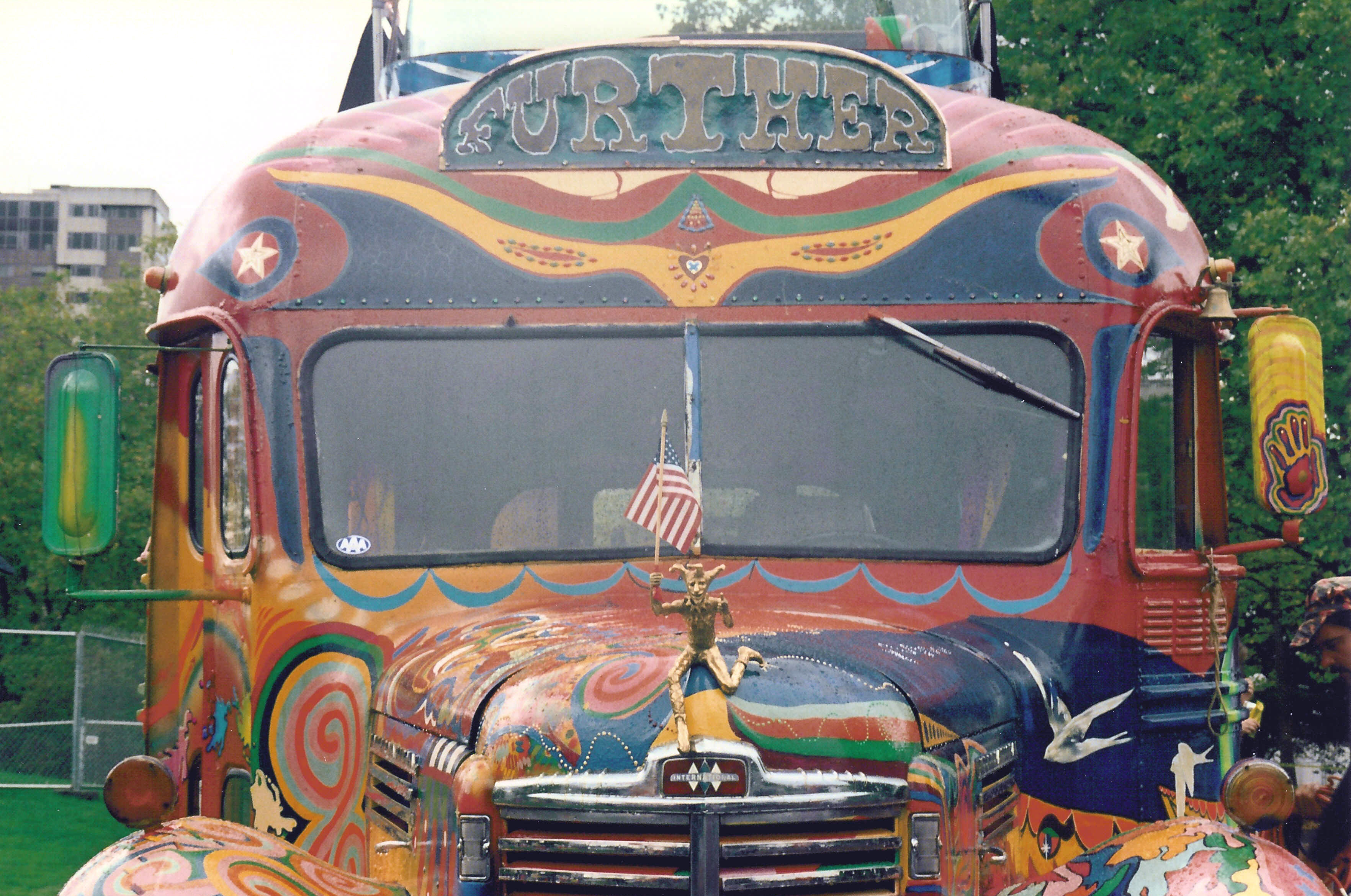

Further, the 2nd (painted in the late 1980s), proof that you can go back home again.
I was also distracted by Ebbe Boregaard outside my window, who was stripped down, a bronzed Viking god, rebuilding the front steps of the old house, telling me stories of restoring his Egyptian scow and poetry. Little did I know that the gods of poetry were beginning to develop the plot on my becoming a writer. I was 17. What did I know?


I didn't save Ken Kesey's letters or the books. Or rather, my first boyfriend Sweet old Bob Hamilton, ran off with a redhead named Dulcie, and all my books—he was the "literate" one who got me into this mess to begin with. Someone out there has them and is probably wondering who this "Maureen" was and why Ken Kesey sent them to her. 


Perhaps they'll turn up in a special collection somewhere. Perhaps it's just a spit in the ocean after all.


See my post: Hitching in Marin during late 60s, early 70s

Monday, October 11, 2010

Hitching in Marin during late 60s, early 70s


When I was a teenager, I bought my guitar stings from Van Morrison's mother at Caledonia Records in Fairfax.


It was worth the bother to get there as she'd make us a cuppa tea with shortbread. I was round-eyed—she sounded like my grannie but was from the north of Ireland. I looked for horns. We shared a name in common: Violet—but her fingernails and mouth were little scarlet wounds circling her cigarette.

Mr. Morrison, in his tweeds, was sitting on a stool, puffing away on his pipe, smiling at us from afar. Meanwhile one of Van's songs—maybe it was Gloria—was blaring on KFRC's Top Ten. I was learning Pastures of Plenty, and Cottenpicking—they chastizing me for not having a guitar case for such a valuable guitar.

One time she was shop-sitting for a friend at Amazing Grace Music, an old gas station cum music store on a tiny wedge of land between the Miracle Mile (Red Hill Ave.) and San Anselmo Avenue in San Anselmo. It was much farther out of the way for me so I rarely went there, but I had a Martin and I needed some Martin strings.

Mrs. Morrison made Van give me a ride home. Van the Man in the van was not pleased. He was seriously bent out of shape by the request so I was terrified to speak to him. And it was a long ride home held in utter silence. I lived far from town—way out in Forest Knolls, and he lived even farther out in Inverness.

Violet Morrison was a chanteuse in Northern Ireland

There was no bus service out to The Valley so it was either thumb, or shank's mare. Van the Man drove a van. I had no real idea who he was at the time... I was so fecking shy I couldn't talk to him even if I wanted to.

It seems that every rock musician from the 60s moved out to West Marin—sort of a fallout from the Haight. West Marin was invaded by the likes of the Sons of Champlin, Big Brother & the Holding Company, Grateful Dead, Jefferson Airplane—to name a few. 


They saw us kids hitching home every day—to us, it was merely an alternate bus service. We didn't think twice that these guys were famous. The road out to The Valley was long and winding, and in those days, people generally stopped for hitchikers.


Jesse Colin Young, who also lived in Inverness, was much easier to talk to than Van. He had cute little kids who took swimming lessons with ze French Mrs. Zettl who lived half way up Arroyo Road—so I got a ride almost all the way home from Jesse.

Carlos Santana was silent like Van—absolute mauna. He had a nice Mercedes with fawn leather seats though... One morning, I was still half-asleep, hitching into Drake High School (emphasis at that point was on getting high), Carlos pulled over to offer me a lift.

It was pretty early so Carlos might not have been awake either. He was pulling pretty hard on both his coffee mug and a joint. He looked half-dressed—like he just rolled out of bed. I remember being a little shocked that he wore those baggy string pants. Them string pants were riding dangerously low on Carlito's hips as I recall....

Carlos moved into my friend Lindy Young's place on Tamal Road (right up from Linda Gregg's place—where Jerry Garcia later died) and he had horses too—that was our common ground. I don't remember much else—other than I got to school on time.

Got a ride from decopage artists Larry Fuentes and Dickens Bascom too.
Dickens' art car had an entire Remington typewriter that still worked glued to the trunk of his Fort Falcon. The sides and fins were lined with worn out sneaker bottoms—like fish scales. Poetic justice.

My College of Marin classmate David Best copied Dickens Bascom and Larry Fuentes' art-cars and came up with some amazing art-cars of his own—and made a career of it. I loved the flocked chia seed Cadillac punctuated with mirror shards and a water buffalo head hood ornament that he used to park at Micky McGowan's Unknown Museum in Mill Valley.

The Unknown Museum, (founded ca. 1974—but I think it was earlier than that) which closed its doors in 1989, was something to behold with all its repurposed Americana detritus as iconography—the ultimate recycler's wetdream.

David told me that at night the deer came down to graze on the car. Mickey the cobbler had a Fiat stuffed with Disney toys and Barbie dolls.The Fiat didn't run, but David's Caddy did—I sat in it with David and talked until the cows came home, but never got a real ride in it. So I guess it doesn't count. Somewhere I have the slides... fodder for another blog.

Monday, October 23, 1995

Bohemian Housewarming Party


At my childhood friend Micaela's housewarming party in Berkeley, I ran into small segments of our past; it's such a shock to see Micaela and her brother Chris, mirrored in the faces of their children. Christopher has a 10-year-old boy named Chris who looks just like him; Chris must've been 10 when I first met him. I wasn’t prepared for this telescoping of time.

Chris is an equipment appraiser for Bank of America, a vice president in a roomful of vice presidents, living in suburbia, with the wife and two kids. I expected so much more from Chris, with his intellectual prowess, I expected him to go places. All the people that his parents knew were part of the avant-garde Bohemian world. Instead, the black corporate heart of America took him hostage. I wanted to say to him, Where is Chris and what have you done with him? 

The people we met through Micaela and Chris’ parents, and step-parents were unusual—in and of themselves. Bohemian artists for the most part.
Arthur Boericke was friends with Jaimie de Angulo. I remember the stories about the drunken sweat lodge parties in Berkeley. Imagine building a full-on sweat lodge in a Berkeley backyard.

I think Arthur was a sociologist by trade. During the 1970s, he wrote Handmade Houses: A Guide to the Woodbutcher's Art, the first book of its kind. Then there was Patrick Wall who was Micaela and Chris's father, from the island of Jersey, his formidable intellect, his love of classical music, his coldness shaped us. His third wife, Betty the potter, once married to painter Wilfred Lang, was a worrywart and self-depricating in a delightful way that made up for Pat's distance.

Micaela and I went for a hike on Saturday and while comparing notes, we discovered that both Pat and my grandmother actively discouraged us from using the broad American Aaaaa sound they found so offensive to their ears. Their tirades against our using that nasal American A sound left us feeling a little like mini Eliza Doolittles. They didn’t want us to sound American. To this day I still say ofTen with a full T sound instead of offen.


Betty's first husband, Wilfred Lane, recently died; his paintings are valuable already, said Chris. Micaela mentions the name of the woman that kept Wilfred in suspense for years – Marsha. I remember meeting her with her Mexican tiered skirts and Wilfred with his gobs of tiered turquoise. They were all living in Santa Fe at the time.

Betty Wall gave me these when I was a young. I returned the pots, bowls & cups to Micaela

The New Mexico contingency included Betty and Wilfred and the children—Chris and Micaela's stepbrothers and sisters: Pete, Sonia, Stan, and Justina—the joke always was: What is your name? Tina. Tina? No, Justina. Just Tina? and so on. But they originally hailed from Sausalito. Circular file.

I suspected that Pete had a crush on Micaela, she was so beautiful, and but he went off to become a spy And she became a hippie. In the early 1970s I stayed with Pete and his wife Sara in Parksville, British Columbia. They moved to Florida where he built wooden boats, and later got divorced. She's now living in Hawaii and he's in Galveston Texas, said Chris. The others I didn't ask about. 

Stan was living in the Virgin Islands. I think Micaela was always a little in love with Stan who looked like bad boy James Dean. I was a little in love with Chris. I imagine Sonia and Tina are still living in New Mexico. Sonia was one of the first people to move to Morning Star Ranch in Occidental, and become part of Lou Gottlieb's commune. She was always out there on the periphery of way cool. Ironically I lived just down the road from Morning Star in the early 1980s.

Chris and Micaela's mother, Rosalind Sharpe Wall died about four years back; her book on Big Sur memories was on its third printing. Kudos, but sad that none of this happening during Rosalind's lifetime ironically. She grew up on a rancho in Bixby Canyon in Big Sur. Rosalind dabbled in paint too, which was handy as her then husband Patrick was an art dealer in Carmel. The first modern art dealer on the West Coast. 

One artist that was well represented in Patrick's house beside Wilfred Lang, was Carmel artist Ellwood Graham. Graham's paintings always fascinated me. (See more Pat Wall, Modern Art Dealer: Ellwood Graham).

Rosalind dabbled in the occult as well. She was an overbearing woman who always had some project going. She was a bit like Frida Kahlo, and Wilfred was a lot like Diego Rivera but they never hooked up. I couldn’t imagine that combo. Both of them larger than life. I don't think the fabric in the time-space continuum could've contained it.

The mysterious Marsha was more like Georgia O'Keeffe, the model. I've no idea what she did, other than to be haughty. Her full size portrait has a marionette at the bottom. Was it a portrait of the artist, Wilfred? who was pulling the strings?

Rosalind, and my mother were like two cats locked up in a room, too similar for words, each itching to defrock the other of her occult witches' vestments. Each calling the other a fraud, each designing their own tarot decks. Rosalind's rather simplistic deck design was at least published, in John Starr Cooke's The New Tarot: The Tarot for the Aquarian Age (Boxed Set with Cards)1970.

It turned out that Brite Bonnier, the painter with her jaunty beret and red sports car, was also a friend of John Cook's. Small world. She was at the party with her small dog. I was so glad to see her again, the last time I saw her, I was a child.

I arrived late to Micaela’s housewarming, having nearly been nearly clobbered by a bad driver who, as luck would have it, was also coming to the party as well. I wanted to clobber her in real time as well, but thought that would make a bad entrance. I had to go a block out of my way to keep from being hit, so when I finally parked, Micaela and Brite were on the front steps. 

And I was in a rage so I wasn't introduced to Brite ’til much later. That I even remembered her last name was a miracle. She mentioned her brother living in Sweden. I think he visited once. I never knew she was Swedish. She asked if I remembered the barge in Sausalito. I'm not sure, but I do remember the Charles Van Damme, Pero and Alice Wolfe's houseboat, and the others. 

I remember crashing parties when we were kids, Chris lighting off cherry bombs underwater. We were banned from the parties, but snuck in anyway. I was on the Charles Van Damme ferryboat at least two times when Varda lived there. His paintings were bolted to the walls of the skewed boat. I recognized the paintings by style, like the ones I had seen in Patrick's house in Sausalito, and later when he was our neighbor in Forest Knolls. Varda, Lang, Graham: a litany of Bohemian artists: West Coast names that changed the very face of art.

I remember late at night walking the plank at Pero and Alice's houseboat, and peeking into the windows to see the partygoers, the water was alive with biolytic luminescence under the full moon. Which place was Brite Bonnier's? She was friends with John Cook and I will have to interview her to find out more about it. 

I tell Brite the story of how I managed Western Star Press for Alice Kent. Alice was John's sister. Before John's death in the early 60s, Chris, Micaela and I used to steal trinkets from the Trade Faire, a ferryboat emporium. We were nine and ten years old and we mailed large turquoise rings to John Cook in Cuernavaca. He must've wondered about why we were sending him turquoise rings in the mail as we didn't have any money.

I remember John Cooke, a tall broad-shouldered bald silent man with a kindly face. At that age we knew nothing of the world. Betty called us her brats. And we ran wild through the shipways and alleys of Sausalito, and the hills of Forest Knolls. I didn't know I would want those memories back one day, but with the tag that explains their significance and relevance.

For it was those interesting people that help shape us and made us who we are. By their very presence, and not necessarily by design. The order of the Golden Dawn, Allister Crowley, Alan Watts, Jean Varda—these are all names out of my childhood. But I have no place to put them in the larger order of things. Just fleeting recollections of childhood.

Actor and dancer John Cooke was a kind of a mythical God. We instinctively knew he was special, but we didn't know why. Begin the Beguin was his favorite song, said Alice Kent. Did the Sufis really burn him with their hands on his shoulders at the airport because no one ever escaped their order – was it in Morocco? Tangiers? The imprint of the hand on the shoulder had the doctor shaking their heads, for it was to become the cancer that eventually killed him. 

John's Tarot for the New Aquarian age was decades ahead of its time. And we grew up on the arcane trivia from the Tibetan and the Egyptian books of the dead, we grew up on tarot, and astrology, you name it—long before there was a New Age. 

My mother's world, and Micaela and Chris' world, each parent was a satellite with an asteroid belt of followers—and small rivalries were of no concern to us. My mom was an actress and costume set designer at the Gate Playhouse Theatre in Sausalito. 

Patrick was a connoisseur of the arts, he was in the realm of the philosophical world. Rosalind Sharpe was into the occult, living in Sausalito during the early 60s as well—these people that helped shape my life. 

What I remember most are the visual images, the quality of light, the colors of the sky, the colors of the bay and the cypress trees, and the odor of nasturtiums and geraniums. Chris's paper route. The stinking bay. The dilapidated boats. Gate Five. Tiki Junction. And now all those adults who lived there are nearly all dead now, and their stories, buried. All I have left are these incomplete fragments that have little cohesiveness, or shape. 

What about Pero and Alice Wolfe? the story of Pero who once owned Anchor Steam Beer, crossing the bay in a boat dressed to the nines, to go to the opera, but they forgot to check the tide table. So they spent the night fighting the tides, the ferocious bay singing primal arias. Who will write their stories?

Micaela said her lover, musician Tim Boomer, with whom she had bought the house, hence the housewarming party, reminded her a bit of me, Chris, Rosalind, and Pat. All of us so strong-willed with lots of interesting things to say. 

Micaela elaborated how her mother was so overbearing, she snuffed her out like a candle. And I'm shocked by the inference. Did she feel of no importance as a child with nothing to say? Sure, I spin fantastic stories now, but back then I was rather mute, quiet and shy. My entire world was made of horses. Micaela went on to say that the best years of her childhood were spent with me running around the hills of Forest Knolls with me (when I thought I was a horse).

School was awful, a kind of death for her. Me too. She dropped out during her sophomore year. I'd always thought it was because of the drug scene. We grew apart by the time puberty had set in. And she was far more adventurous, the Summer of Love, pot, etc., while I was still verging on redneck, and more than a couple of years behind her socially, so to speak.

I remember a reconciliation of sorts at age 13 or 14. We spent a good week together making miniskirts out of old 50s corduroy pencil skirts, and castoff clothing, and then we gradually drew apart into our own respective fragmented worlds. 

We lost touch when she moved—or ran away. I didn't consciously drop her as a friend, she just moved on. Our values were no longer the same. I suspect sex had something to do with it. She was 14, I waited until I was 18. The invisible border between child and woman had been drawn out and there was no defrocking of the wall, pardon the pun on her last name, Wall.

Micaela reminded me of the time that Ken and Mary Howard were having a party and a movie on Arroyo Road and we were forbidden to attend. But Chris was allowed to go. So incensed, we snuck over to the Howard's place at sunset after they had all left, and under the cover of dusk, we crept into the darkened living room to watch The Wild Ones.

Brando lounged on his motorcycle. In the late 1940s, bikers took over Hollister. What are you rebelling against? ask someone. What've you got? quipped Brando. After the movie was over, we made our escape via the kitchen, only to be busted for tripping over the silverware box. The Bohemians we were surrounded by, busted us for watching The Wild Ones. Odd. What exactly were they sheltering us from?

We'd seen much more by way of errant or deviant behavior in real life. Jean Varda liked young women, lots of them, Alan Watts, and Jaunita Mousson all lived on the Charles van Damme. Not all at the same time. Maybe it was her party, I don't know. My neighbor George said that the Charles van Damme was falling apart even way back then and she was busted for something and then hauled out. 

Who moved in after Juanita? Brite Bonnier? But she had the barge I think. Perhaps it was Varda. Anyway, what was the big deal about seeing Brando anyway? Ken Howard was a Harvard man and Mary had East Coast leanings, and money too. Both are dead now, their daughters, Debbie who now goes by the name of Nina, and Sarah, were pretty whacked and scarred by that warring relationship. 

Ken and Pat were very much alike—both carpenters, both very intellectual, utterly charming and bitterly cold towards women, unless they wanted sex. They were unnecessarily cruel to their daughters, who didn't survive them emotionally. The boys fared better, Chris Wall, and Guy Howard, but they chose the American life over Bohemia. Perhaps to escape their parents. 

Children of Bohemians living a middle-class life, feeling like frauds, and feeling guilty for going against the quasi-Bohemian grain, fitting into neither world very well. I was the observer, raised by my grandmother from a previous generation, call it Victorian, or Edwardian, and a way of life destined to fail, for what could follow that? 

The Beatniks were not the physical inheritors of the Bohemians, for they escaped the middle-class, and sought refuge here, while we children of Bohemians were never middle class. More like ravaged by a social experiment. I later found out that one of the thinkers that influenced the Bohemian movement, Allister Crowley was an omni-sexual pervert, flaunting sexual mores and delving into magic. But we were sheltered from any deviant behaviour. 

I'm sure Brite Bonnier and John Cooke were both bisexual, and Crowley's teachings would've seemed like a blessing to them. Brite, being Swedish, only had quasi-American morals to overthrow. John Cooke came from a real missionary family, for they were the famous Cookes of Hawaii. They were the black sheep, Alice assured me, not the Castle-Cookes, not the Big Five.

The Beats would've been closer to my mother's age. And Patrick was from a previous generation; he was in his 40s when he had children. Our generation is doing much of the same thing, having children so late... or not at all, except by accident, not design. That failure to commit runs deep.