Showing posts with label Yucatan. Show all posts

Friday, April 1, 1994

XIBALBA

XIBALBA

In Teotihuacán, the place where men become gods,
under the place of fear, under the Fifth Sun,
the scorpions at the base of the world tree are asleep.
In Xibalba, the place of ancestors, the underworld is dark.
The eliptic band of constellations that marks
the daily path of the sun across the night sky
is searching for the beginning of dreams.

From dreams comes information: the time to plant,
the weavings, the time to sacrifice.
It is said nourishing the gods nourishes the people.
Where is the king whose sexual blood was spilled
         onto the codex for the good of the people?
Whose bloodsmoke rose to open the door to the sky?

When a woman puts on her huipil
it is said her head emerges at the center of the world.
A door designed by dreams weaves
patterns from the beginning of the world.
I dream of scorpions stinging me again and again.
Under the Fifth Sun, under the place of fear,
six-legged gods were born from smoke
                                                of inquisition.

Nourishing only the sterility of yourself,
in a tragic falling off from myth and history,
                                    like a despotic Aztec rey,
you lanced yourself with thorns,
spilled only ink on parchment, not royal blood.
It combusts in the darkness of desk drawers.
No holy smoke for the gods of the sky.

In a door designed by dreams
my head emerged in the center of the world
to where I no longer feared you.
You no longer wounded me,
my conquistador
mi amor. . .

4/94

Tuesday, November 24, 1987

ON TURNING 35 IN CABO


On turning 35 in Cabo, I reflect back.
In this life, I've stood on pahoehoe and aa,
new lava at the crater of Kilauea, steam forests and ferns.
I've watched the sunset from Haleakala,
a volcano that rises 30,000 feet above the sea floor.
I've seen the tongue of the ocean from the air,
swam in the Caribbean where a shark followed me home.
The aurora borealis glowed, but I didn't understand
northern latitudes when the sun set at midnight.
At the end of California, El Arco,
I watched frigate birds with 8 foot wingspans soar overhead.
I walked in rain forests of Kauaii and the Olympic Peninsula.
From Mount Whitney, the tallest mountain
in the continental US, I witnessed a forest fire.
I stood barefoot at Badwater, 282 feet below sea level,
and I followed worn trails in the salt flats
to hidden streams where pupfish from an earlier sea
still swim.
It took me 20 years to get to Tenochitlán,
the ancient lakebed of Mexico City,
And in the Yucatán, I climbed the pyramids
and crawled inside El Caracól, the observatory
during the winter solstice. The sun danced.
I rode to the stars while on ether, farther than
the combined distance of all my horses.
In Switzerland I climbed the Jungfrau,
rode the highest cog railway in the world
to crawl inside a crevasse in the glacier
to see the layers of ice and striations of every blue imaginable.
At the Columbia Ice Fields, I listened to the growl and hiss
of the great wall of ice that created its own cloud system.
I bathed in the Skeena River on an Indian reservation
where the glacial river numbed my skull til it cracked.
A week in the Sierras, a black bear slept on me,
I was too tired to get up and run. Probably saved my life.
I stood on the lips of Glacier Peak
and Half Dome without a rope or harness.
Half Dome I climb twice because
I forgot what it was like the first time.
At Loch Ness I didn't see Nessie
but I crawled through a dungeon in an abbey.
I had tea with the governor's wife in the Bahamas.
I didn't know that when Taikaido drummers danced
my relationship was about to end
but it took me two years to find out.
My first abortion at 24, my second at 27.
I meddled with nature, paid the price, lost the men,
stayed sick for two years, kidneys, uterus,
then a whiplash. My body weakened. My knee tore.
It took me eight years before I could ski again.
I rode an Icelandic pony called Helgar,
fiercely primitive, like a Celtic pony.
The fossils of clam shells in Central Valley cliffs
convinced me of an inland sea, but at 10,000 feet,
there are freshwater clams, how do you explain that,
or the reef fish in the sacred cenote well at Chichen Itza,
trapped miles from the sea, or hidden rivers.
The circle of candlewax in front of the stela at Cobá,
With the odor of sacred copal we welcomed the New Year.
We saw he two cuatemundis cross the road,
we ran over another one that night,
running over an endangered species.
Third time's a charm. I won't mention the turtle steak.
I saw the edge of night, the bell curve of the earth,
I saw stars and a daytime sky all at once,
sunset from an airplane flying over the North Pole.
From the air, the rift of the Grand Canyon
looked like a vast crack in the earth.
At Tikal, the temple of the Jaguar,
the howler monkey kept hidden in the canopy of trees.
Soldiers stopped our car searching for undesirables,
800 peasants have disappeared in Chiapas.
All for agrarian reform.
In downtown Mexico City, armed guards
in bulletproof vests direct traffic.
And the blood that didn't come with the moon
and the question rises once again.
The end of another relationship.
Few couples can survive the guilt.
Until I return home, I won't know if the slow bleeding
is a sign of division or multiplication.
Guerillas hide in the forests of Tikal,
the Indians, stoic in the face of soldiers,
On the Harmonic Convergence,
we celebrated at the Mayan church of Chamula,
all these roads less traveled,
but the universe unraveled....
November 24/1987
Cabo San Lucas
It looks like a page and the ending was lost, I found this in my sketchpad.
added 10.16 minor revisions.

Friday, July 31, 1987

AKAD DZIB

AKAD DZIB

We climbed every pyramid in the new world.
An amber ring of melted beeswax and copal
at the foot of the stele. The New Year.

Hummingbirds keep track of 8,000 sunrises
and jaguars count katones by multiplying
the blood of generations with reed sticks.

In the temple of the Phalli,
moss-green penises, larger
than a man's head; the walls
have sanctioned innumerable couplings.

Some breathing thing makes its way
through the ruins, but no one appears
in the korbeled arches to initiate
me on the low limestone bed.

A presence of eyes staring at my back
follows me out of the jungle toward the gaggle
of tourists aiming cameras at Chac-mool.

You filled my mouth with food and jade beads
& the sky was held up by four ceiba trees.
Quetzal feathers fell from the sky

like obscure writing & we collected them
in cloth bags woven on strap looms
made of sandalwood and bone.

Chichén Itzá,
1987, Mérida, Yucatán

1988 Poet News/ Sacramento Poetry Review
1987 Falling to Sea Level (revised)

Thursday, January 1, 1987

Mérida Mordida


At the farmers' market, the Ladinos sellers stop harassing us momentarily to admire and to touch my turquoise necklace. Suddenly I had something they wanted. The Mayans revere jade above gold, turquoise was a close second. 

Are we returned to Mérida, our car was gone. Towed? Stolen?

Mérida without baggage. No luggage. Just the clothing on our backs and a few pesos in our pockets. A long story, several trips across the city, and several dollars poorer, we retrieve our rented car from the towing compound.

A Ladino family takes pity on us and gives us a ride from the compound to the fine office on the other side of Mérida, and back to the compound again. Their car too was towed. 

They laugh as John jokes with them in Spanish about grudas, or grutas, meaning mordidas. We get charged six times local rate because we are gringos. They are in their late 40s, with a carful of children. Their fine is much less. They won't accept any money for driving us back and forth. We shake hands and smile. Odd way to meet the local populace. We're cruising around in a huge tanker American car with a bunch of Mayans. 

In line again, we meet a man who had made the unfortunate mistake of being outside his house at 2 AM with his car and trailer, when the police pulled up. When they questioned him, he said he lived there, but they towed his car and trailer anyway, then beat him up and threw him in jail. The fine was high for him too. We all pulled out spare change to help him. Moral: don't park in the streets of Merida or you'll pay la mordida.

Quetzal Feathers, Jaguar Sighting


The pyramids of the Yucatán. We climbed every pyramid we could find. We climbed each temple, counting stairs and breaths, as the year drew to a close. At the stela below the temple of Cobá, an amber ring of copal and melted wax. Candles held vigil beneath the shell pitted limestone stelae. The Mayan hieroglyphs are pitted almost beyond recognition.

A Mayan park ranger in zoris, a whistle about his neck, mounted on a rusted bike, said that a jaguar was killed here for nights ago. We can almost hear the eerie cat cry and the jungle reeks of cat odor.

At Chichén Viejo there are few tourists. It is off the beaten path. In the partially cleared jungle, pale grass like a fur coat, covers the stones. Each mound, a collapsed temple or a hut. Lives lived and lost. Unexcavated.

I'm in the Templo del Falos. I could hear something breathing outside but I was the only one inside. John was away exploring another temple.

I wanted to sit on those wide stone benches 
and touch you. There, and there.
But you pulled away, ever the acetic. 
Your eyes were brimming with desire.


We follow the Mayan path of raised limestone blocks back into the jungle. I hear the breathing of hounds behind me. I feel the presence of eyes upon my back. The whispering grows louder, more intensified as we walk faster.

At the na, a Mayan hut, an oval boat-like thatched wattle and daub hut, we stopped, look down into the dry well. And we took photos but the shutter stuck, and you refused to cross the threshold of the hut a second time.

I am entranced by a small stone idol with indistinct features at the foot of the fire pit. Light ash is still swirling in the air. Remnants of the 20th century, some plastic bags in the rafters, and bottles behind the shack. Someone still uses this hut.

The gods have moved away from Uxmal and Chichén Itzá. They live here in the ruins. I say all this is nonsense. There are no more gods. This is merely rock and sky. Acab Dzib keeps its silence. Obscure writing.

But something is still following us through the jungle. Not tourists, they don't come this far. From a small temple, earlier, we spied a stray group of tourists. They never even saw us. We knew we were alone here. And something was tracking us. We broke into a run, following the curved green wall, the urge to hurry intensifying our need to return to the 20th century.

Something blue catches my eye. I pick up a ragged, broken brilliant feather that turns blue and green then indigo like a peacock feather, that iridescent green. I look at it and realize it is a quetzal feather. No they're extinct in this area my guidebook says. A green bluejay? No too bright. What is this feather doing here? An old feather, part of a Mayan headdress?

The bushes have eyes. We protect ourselves from curses and emerge from behind the nunnery into dazzling light, where sedate groups of tourist randomly snap photographs while we linger on the edge of darkness, the jungle closes in behind just with a snap.

You bow to the darkness, your fingers in lotus position against them like a hex.

In this jungle we are unbound by time. This river of air unfolds clocks and we cross memories and images, interstices. When one path crosses another, we are are unsure of when will be, but not where we are.

I keep imagining mysterious stories in this jungle, of those who hiked along these paths and reemerged years later with wild tales of feathered serpents and stone Chaak Mools turning their heads to watch them pass.


Tourists sit on the raingod Chaak's offering bowl, the one that Chaak Mool holds out begging for a fresh human heart. Instead he gets dozens of large human asses draped on the lip of his offertory bowl. He wears that same half amused expression for centuries on the end. Perhaps those who sat on his stomach will die of heart failure.

There are traces of red ocher embedded in the deep crevices of the statues. Someone is worshiping them still. Polychrome temples, pavilions and statues. Red iron, cinnabar, yellow ocher, chrome green. And that indescribable Maya blue—the sacred color of Chaak, the rain god. The red and black umbers are the most enduring colors of the stucco frescoes and carved walls, are but obscure traces of what once was here.

We count steps on the pyramid: 91 steps times four sides equals 364, and the top step equals one year. The Mayans still paint unlucky people blue but no longer throw them down the well or into the cenote.

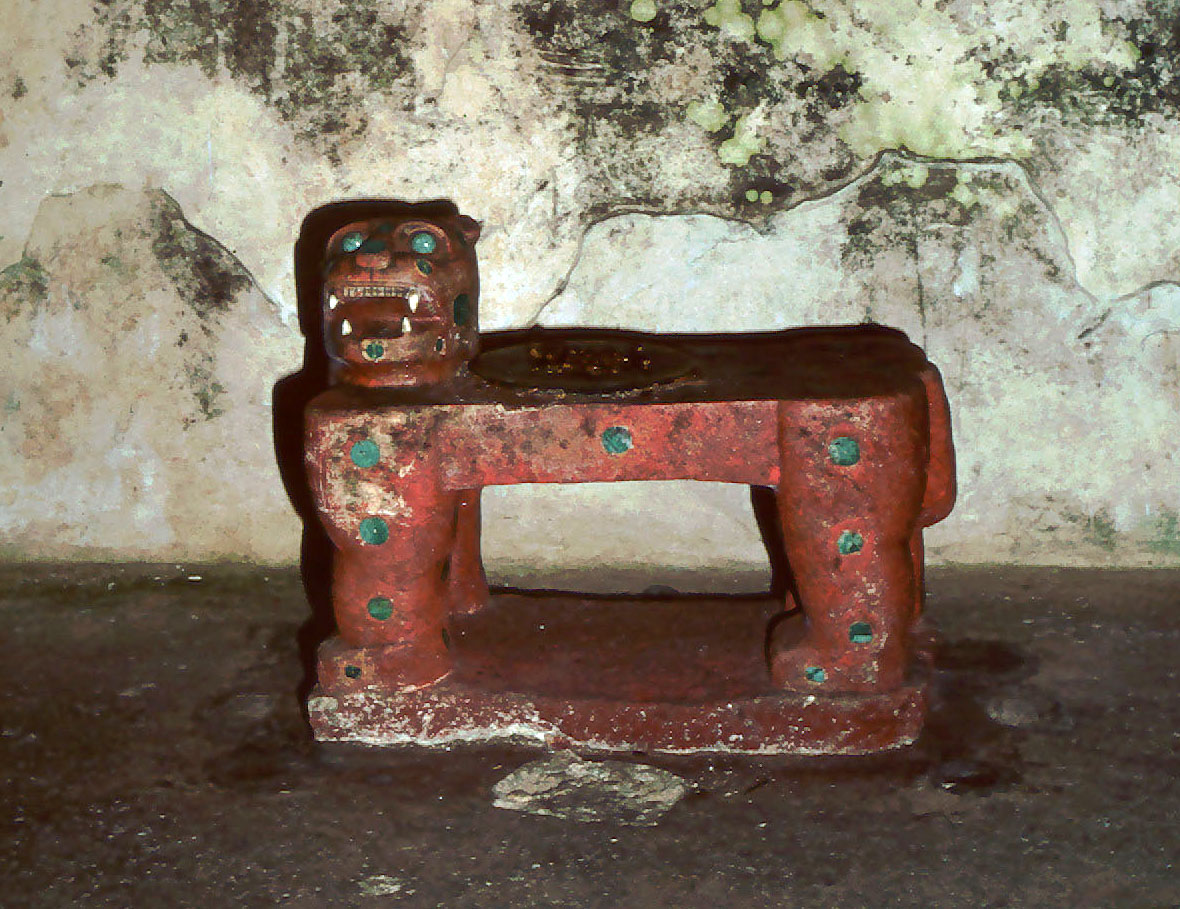
Underneath El Castillo, the tallest pyramid of each city is called El Castillo, there's usually a governor's palace and a nunnery. Whether these titular roles actually existed as such as another matter—this is what they are called. Inside the Castillo is another temple, and inside that temple is the throne of the red jaguar with jade eyes. Like infinity looking in on itself.

Trono de Jaguar en El Castillo, Chichen Itza.

RACING DARKNESS


We glimpsed our first Coatimundi in the Yucatán,
which we promptly ran over with our rental car.
A rare jungle animal. And we ran it down.
His black and white tail with its warning stripes,
was useless against nervous gringos racing the darkness.
Whoops! said John, I guess it was his time.

Late Dec., or early Jan., 1987 (written down on 1/7/87—probably on a scrap of paper)
added  & revised 9/17 In Mexico, it is never a good idea to drive after dark.

Tuesday, December 23, 1986

Winter solstice, Chichén Itzá

Winter Solstice, Chichén Itzá

I'm inside El Caracol, Chichén Itzá, at sunset. During the solstice, light neatly passes through one opening unscathed, with little shadow on the side walls. magic.

Sunlight wraps itself around the walls, illuminating them. I go camera crazy. In the top chamber, I take photos of John with refracted light. He is a sun god.
You have to rock climb in order to get up inside El Caracol. The circular stairway ends 12 feet above the outside hall. A tree trunk beam with carved steps near the opening to the roof offers a way up. John enters the circular stairwell. I climb an outside wall. The distance from the beam to the opening is too far for me to span. I need to try another approach.

From the top of El Caracol, on the observatory, you can enter the stairwell but then you must crawl on hands and knees because the stairs were not meant to be used in the upright position. It's about reverence. I scoot up the steps on my fanny, thus startling some Mexican boys on their way down, not many women come here. It's not an easy journey.

On the top of what's left of El Caracol, there are three slots on the roof, sight-lines for star constellations, the moon and Venus. One wonders what other astronomical observations were made here. The guidebooks place an unusual emphasis on Venus. It seems that Venus is well represented, or the guidebooks are all rather simple.

On top of the outer wall, sections of the roof had caved in, one looks down into the dark heart of El Caracol. And dreams. Time stands still. We will never know what astronomical alignments they marked.

The Yucatán is basically a flat limestone terrace raised a few feet above sea level. To the south, a long line of hills breaks the view. these hills or pu'uc rise less than 360 feet above sea level along the rift that shoved them up. A string of cenotes, or sinkholes, are visible from the air. Round wells in various stages of collapse. Jade green water necklaces strung across the Yucatán.

There are tropical fish in the sacred cenotes of Chichén Itzá, at least 100 miles inland from the sea, and there are no natural rivers here. How did the fish get here? By hurricane? By land, or sea? Where they planted here by Toltecs, or by the Mayans? Or were they trapped here during a hurricane and evolved into freshwater fish?

We hiked to the profane cenote, secular is a more apt word, and the soil gives way. We careen down a steep slope and grab at some trees to stop us. The descent into the cenote is like falling into the jaws of an ant lion's sand trap.

Inside the cenote, we discover an overgrown water temple. The land is riddled with limestone arches and partial caves. Some looked painted. So little has been done here, there is still so much to discover—even at Chichén Itzá.

At Kabáh, we find the keystone arch, the gate to the city, 11 straight miles from Uxmal on a straight, raised Mayan road. Sacabe, or sacabeob, the sacred white roads. There are no cenotes here, the Mayans are entirely dependent upon the vagaries of rain, and the capriciousness of Cha'ac, or Tlaloc in Toltec. Near the temple of the long nosed god, there is an altar to Chacmul with his head turned toward the sun. We eat bitter Mayan oranges from a wild orange tree growing in the rubble of a fallen edifice. Bitter orange, naranja agria, or Su'uts' pak'áal, is a medley of all the citrus flavors of the world. It's also the main ingredient in the chicken, and the cochinita, or puerco pibil dishes indigenous to the region.

Each pueblo strung along the main highway that travels the length of the Yucatán peninsula is like a tiny jewel encapsulating several eras of history. The Na, or traditional Mayan thatched huts stand alongside colonial buildings with their imposing tall double doors, replete with windows that open out into the world.

Topos, speed bumps, steep enough to launch your car like Steve McQueen's famous car chase scene in Bullitt, keep most of the cars at a reasonable pace. Iridescent wild turkeys (Meleagris ocellata) and pigs continually cross the road, along with the ubiquitous chickens.

A small Mayan dog, the tz'i', a delicate hound with soft ears, is seen slinking around nearly everywhere. The Mayans have nine words for dog, whether it was eaten, sacrificed, or raised to the status of a deity. In the Mesoamerican calendar, Itzcuintli, the tenth day is the day of the dog.

The diminutive, well-proportioned Mayans readily smile at you. Women carry buckets of corn to the granary, and  bring buckets of cornmeal back home on their heads. More women weave white huipil shifts, long lace petticoats, and the skinny Mayan shawl that doubles as a head cushion for a heavy-headed load.

Men everywhere on bicycles carry large bundles of wood from the jungle. An older man carries wood on his back, anchored with a forehead strap, the bundle of wood nearly as big as he is. Coatimundis and long-tailed blackbirds hide in the jungle, painted with the brilliant plumage of unnamed birds. Chuckwallas, temple guardians, enjoy their small spot in the sun.

I dreamed of iridescent feathers
falling from the sky
and we raced after them,
collecting their bounty in our arms.
A bouquet of such promise.

12/23/1986
Chichén Itzá
added 9/17
minor revision