Showing posts with label Ireland. Show all posts

Wednesday, July 3, 2024

CHAINBOUND STORIES


I grew up amid chainbound stories 
adorned with dark family secrets 
like the phantom itch of severed limbs, 
the stories my family carried to this country 
in carpetbags and unhinged suitcases 
with broken clasps bundled with leather belts 
made of discarded bridles, the horses long dead.
The stories that held us captive 
were whispered around kitchen tables
littered with an ancient tongue that was not shared
but hinted at—we learned secret words but not syntax,
the whiskey glasses jumped like startled hares
as fists punctuated each rebel sentence,
and under darkfall, munitions were gathered 
in basement cellars and jail evidence lockers,
sent home in shipments of potatoes
by way of Liverpool and Enniskillen
to fund the long war against the Crown.
I grew up with unspoken stories of freedom 
a tongue loosely translated in a homeland, 
a war not my own, a puzzle of the past 
leading us inexorably forward.

Write On! with Susie Terence 

Wednesday, September 20, 2023

I AM OF CALIFORNIA


I am of Ireland, the holy land of Ireland, 
the green land of myth and mystery. 
I have seen my grandfather bent over his books, 
as if they could restore the myriad atrocities 
dealt by the hands of the enemy. 
I did not know why he left his homeland 
to continue insurrection from this land of the free. 
So I sat on his lap and blew out wooden matches 
as he sucked on another stogie, 
that would eventually kill him 
as surely as those British bullets. 
Rubber ones hadn't yet been invented. 
That particular atrocity would come later.

I am of Ireland, that fabled land 
of verdant song & story. 
I watched my grandmother as she pinched pennies,
and hunkered down over potato beds in the garden,
raking & weeding, cajoling them into the stewpot 
where cabbage sang arias to bacon & ham hocks 
or tongue when we were lucky enough to get them. 
I never knew the poverty belt was cinched tight 
around our necks until I left home, 
the idea of perspective was always trapped 
in the green depths of the rearview mirror.

I am of California, the golden rolling hills 
where hawks argue over turf in a blue vaulted sky.
I need to quit using the word vaulted
It's just that the sky is a cathedral, 
a star of the sea shining in the distance 
where I was once baptized in pickled brine. 
But I gave it up, not for God, nor the vigilant nuns,
but when the women were ordered to give up 
their bodies, to spread their legs wide & cowp, 
then bend a supplicant's knee at the altar of prosperity. 
There was no melting pot, we were condemned 
by the fabric of our customs & names & religion.
The hidden wealth of the immigrant pushed aside 
made superfluous by insidious inquality 
of this WASPish nation wanting to break us all.

9/20/23 Write On! with Susie Terence

Thursday, August 3, 2023

Potayto, potato. How about tomapotatl as pomato is already taken?


Do check out Cultivariable, a great site for everything potato, including buying seeds.

The other day I recalled reading an article in July, 2017 that claimed that potatoes also grew in North America, and I thought what was dubbed the Indian potato was merely a simile, something lost in translation, or a case of mistaken identity. There was almost no follow-up information on it. I chalked it up to a mistranslation. Looks like, but is not equal to….and then Covid came along and I forgot about it. 

Yesterday, on Facebook, Discover Magazine reposted an archived article from 2021 on Solanum jamesii, or the Indian potato, now renamed the Four Corners “potato,” which renewed my interest. But the somewhat updated article compared it to domestic potatoes because it produces tubers. I thought to myself: hundreds of others solanum species have tubers too. 

However, the Four Corners potato, Solanum jamesiiis not what we think of as the ubiquitous potato. It's related to, but not the same as the garden potato, Solanum tuberosum, domesticated in the Andes 8,000 to 10,000 years ago. 

I let my fingers do the Googling, and found that what are called Apache and Navajo potatoes were hybrid varieties of the domestic potato. A dead end. Back in the summer of 2017, potato farmer /poet Art Goodtimes piqued my curiosity about Solanum jamesii which led to a spirited discussion about the origin and nomenclature of potatoes. And researching "Indian potatoes" led me to another order of plant altogether, an aquatic species related to taro root, Sagittaria latifolia, or duck potato. If it walks like a duck... What quackery!

Growing up Irish meant I ate potatoes every night for dinner. When I traveled through the Andes, I ate many varieties of strange potatoes, the most bitter was black, and grew on the island of Amantani in Lake Titicaca. My GI tract never forgave me. Apparently I was supposed to also eat the arcilla de chaco, or clay jacket—which absorbs the bitterness. When it comes to eating wild potatoes, bitter is not good, and sour is even worse. Spit it out, I tell you.

Astonishing diversity of Incan potatoes in CIP International Potato Center's seed bank.

There are something like 53 known species, and 4000 types, or varieties (not sub-species) of domestic potatoes in Peru alone. And even more in Bolivia and Chile—not to mention the Amazon. According to CIP, the International Potato Center, a genetic seed bank located in Lima, Peru, there are 151 to 180 species of wild potatoes, worldwide. The actual count is in dramatic flux as we discover new species, lose others due to climate change, and make advances in DNA sequencing. 

In fact, the entire Solanaceae family is undergoing genetic reconstruction. Solanaceae is a huge family, there are over 3000 to 4000 species worldwide. And solanum includes a whopping 1500 genera: potatoes, tomatoes, peppers, eggplant, tobacco, datura, and petunias, to name a few. They’re all members of the nightshade family.

And like most solanum species, the Four Corners “potato,” Solanum jamesiiprefers to grow in disturbed soil—which suggests to ecologist Bruce Pavlik and his wife, Lisbeth Louderback, who is an archaeology curator at the Natural History Museum of Utah, that this wild potato may have been domesticated as early as 11,000 years ago. I'm not so sure about that. It’s not like hybridizing teosinte.

Escalante Valley was once referred to as Potato Valley. Pavlik and Louderback have been genome sequencing the wild potatoes near the pueblos for signs of domestication—they're looking for a genetic bottleneck. Ok, so I have trouble with their advanced reference date, as it predates Andean domestication, and, besides, it was the end of the Ice Age. Potatoes hate frost. (In the 2017 Salt Lake Tribune article, Louderback, in her doctoral thesis, quoted 10,000 to 11,000 years. See also University of Utah News).

Everything about the Four Corners “potato” is toxic—like many members of the nightshade family—unless you boil or eat the immature tubers with gobs of white clay called gleesh’ (think Kaopectate) to counteract the toxins—so it’s different than the domesticated South American potatoes of Bolivia and Peru. It’s more of a dangerous wild potato cousin with a deadly kick.

It also turns out that the Four Corners “potato” toxins are also different than those found in domestic potatoes. The toxin is the same found in tomatoes. So maybe cavalierly calling it a potato just because it has a tiny tuber the size of a grape, is a bit premature. Maybe call it tomapotatl

Oddly enough, Santa Rosa, horticulturalist Luther, Burbank, the man who invented the Burbank, or russet potato, aka the Idaho potato, did developed an edible white potato-tomato berry called a pomato. But, unlike the ill-fated Wonderberry, also a nightshade, which resembled a huckleberry, victim of a smear campaign touting its toxicity, the pomato didn’t breed true, so he gave it up. But in 1934, an Australian successfully bred a pomato. Many flowering ornamental solanum produce tubers too, but noshing on them could be a one-way ticket to paradise—no matter how you roll the old snake-eyes.

I realize that it’s a handy linguistic shortcut to call this wild potato cousin a "potato," because it’s so much easier to say potato family instead of saying the nightshade family. Old habits die hard. And then there’s the toxic baggage attached to the word nightshade. Think Atropa Belladonna and deadly atropine. How about an expansionist mindset, with a new name, instead of a reductionist one handcuffed by the tyranny of simile?  

The Diné word for the potato is Nimási. Maybe we should call the Four Corners “potato” that. But then we’d also have to include the Apache, Hopi, Kawaik, Southern Paiute, Tewa, Zia and Zuni names, etc., not to mention the Ancestral Pueblo (Anasazi) names. So maybe calling it the Four Corners “wild potato” is a far better name. Otherwise we’ll have hordes of eco-nuts going afield to nosh on them thinking they’re benign.

For the record, botanists insist that pretty much all wild potato species are not safe to eat, other than in small amounts, due to their high glycoalkaloid content. Also, Solanum jamesii is not native to California, which means it was introduced from somewhere else. But where?

Wiki spells it out: “Solanum jamesii is a species of nightshade. Its range includes the southern United States. All parts of the plant, and especially the fruit, are toxic, containing solanine when it matures. Immature tuber roots are edible.” But they’re the size of grapes, so how do you know if they’re immature? They tell off-color jokes? 

It turns out that Solanum jamesii is not the only “wild potato” in the old pueblo. One or two other southwest wild potato species, depending upon how you count your potatoes, are Solanum stoloniferum aka Solanum fendleri, or Fendler’s horsenettle—genetically speaking, they are variants of one species, the controversy rages on. Horsenettles are generally not called potatoes, BTW. 

Because of the toxicity, they are often considered famine foods. And people sometimes eat the ripe berries, or ground cherries. And since they vary in toxicity, you never know which ones will be real stinkers I’m not willing to be the guinea pig.

Let’s talk toxicity. “The primary glycoalkaloid in this Solanum jamesii species is tomatine, unlike the domesticated potato, in which the primary glycoalkaloids are solanine and chaconine." And there’s also a smidgeon of the nicotine alkaloid too! Tomatine puts this species firmly in the tomato camp—name your poison. Put that in your pipe and smoke it. 

Wow! Potato blossoms. Cultivariable is a great site for everything potato, and then some.

The question begs, how closely related is the Four Corners “wild potato” to South American potatoes? As James Dinneen in The ancient potato of the future, quipped, DNA-wise, “The Four Corners potato, Solanum jamesii, is related to the common potato in somewhat the same way coyotes are related to dogs.” Both are canines and can interbreed. But the domestic dog is descended from wolves. You’re barking up the wrong tree if you think they're siblings.

Why does any of this matter? Because, Dear One, genetic diversity. Wild species carry a wide range of unusual survival traits. Take the Irish potato famine—had there been a way to introduce more resilient genes into the potato monoculture against the potato blight (Phytophthora infestans), then one million people might not have needlessly died. Or immigrated.

The USDA is interested in the Four Corners potato’s astonishing 8-year shelf life, resistance to disease, and to drought. Climate change is affecting domestic monoculture potatoes, which is the world's third largest important food crop. Potatoes need specific heat requirements and 12-hours of daylight in order to reproduce. Not all nightshades reproduce by seed, some spread via tubers, or reroot via creeping stolons.

I plowed through a lengthy list of solanum section of Petota, and found that Solanum commersonii is resistant to root rot and nematodes. Solanum demissum, Solanum pinnatisectum, and Solanum bulbocastanum, an ornamental nightshade, are resistant to the potato blight, and "has been used to genetically engineer resistance into the cultivated varieties of potatoes around the world." —Wiki 

Genetic traits from tough wild potato species can be hybridized into our domestic potatoes. And before you go off the deep end about genetic modification, every plant we consume has been genetically modified—from aubergine to zucchini. Especially corn and broccoli. Besides, the voodoo magic of crossbreeding solanum species is far better than sticking pins into a potato. 

Where is Mr. Potatohead when you need him?

Saturday, June 17, 2023

My father’s pony


Not all of us had functional fathers, or parents that were present. Neither of my parents were cut out for the job of marriage, let alone, raising a child. Let’s just say, it’s complicated. Mine was an absentee father who drowned in the belly of a Seagram’s 7 bottle, and never recovered. His heart failed him. It’s heartbreaking that he turned out to be such a tragically flawed individual. From a photo I learned that he loved Big Band music and played the piano. Recently I found a news clipping—very nearly accidentally—where it reported that  his mother had committed suicide using rat poison, leaving him to find the body after school. And a note saying that he should join the priesthood. The only thing I was ever told was that she had committed suicide, nothing more. Finding the news clipping was devastating. Also enlightening. And with that, came the beginning of compassion. No wonder the poor man was so effed up. His father, a San Francisco cop, died earlier of TB. Perhaps it was all too much for her, being a single mother, and it sounded like she suffered from depression. And a sadist uncle stepped in to raise my poor father. He might have been better off in a foster home. I chose this photo of my father on a pony because obviously it was a time of innocence versus the grim reality of what was to follow. My crazy, gorgeous, talented, bipolar mother wasn’t much better a parent. She left me with my grandmother as she went off to design costumes for Frank Sinatra’s showgirls, and to pursue Hollywood dreams—but then, when she came to collect me, I refused to leave my grandmother. I was extraordinarily lucky in that my grandmother raised me. She was both my mother and my father. And I don’t regret that in the least. However I refuse to close ranks for the sake of Hallmark cards or sympathy, by hiding the unacknowledged family trauma caused nearly as much damage and grief as the myriad traumas themselves, that is why I chose to share this story. I’m not one to latibulate. Cormac McCarthy, God Rest his Soul, ain’t got nothing on my family tree! After all that, mea culpa, mea maxima culpa. For those of you who had extraordinary fathers in your lives, I wish you all a Happy Father’s Day.

Wednesday, March 8, 2023

Who am I on this international day of women?


March 8, 2023. Who am I on this international day of women? I am of Ireland where every place has a name and every name has a meaning. I am of four generations of strong Irish women: my great-grandmother, Jane/Sineád Rose Sullivan/Ó Súilleabháin (dark/hawk-eyed) (Walsh/Breathnach-from Wales), from Gortnascreena/GortnaScríne (place of the standing stone), Drimoleague (Droim Dhá Liag, ridge of two stones), near Skibbereen (An Sciobairín, a place of small skiffs). 

I am of Ireland. Her daughter, my grandmother, Jenny/Sineád Walsh (Reilly/Ó Raghallaigh-valiant), from Coom-anOre/Com an Óir (hollow or Valley of gold-as in a goldmine), really another place of standing stones between the River Bandon (Abhainn na Bandan, ban-dea, as in Tuatha Dé, the goddess), near Dunmanway (Dúnmaonmhuí, Dún Mánmha, the fort of yellow haired? women) and Bantry (Beanntraí, place of Beann's people (ban/ben = peak, point, prong, horn or top), Co. Cork (Corcaí/corcach, marsh). 

I am of Ireland. My grandmother, who begat Maureen/Máirín Reilly (Hurley/O hUirthile-descendants of some warrior dude, ok, it means sea-tide), San Francisco, and my mother who begat me, Maureen Hurley, Máirín ni hUirthile of San Francisco. 

Ich am of Irlonde,
Ant of the holy londe
Of Irlonde.

Goode sire, praye ich thee,
For of sainte charitee,
Com ant daunce wyt me
In Irlonde.

Medieval Irish Lyric, circa 13th-14th century AD)

I am of Ireland. Come and dance with me. What’s in a name? I can trace my mothers back to six generations of strong Irish women. My great-grandmother’s mother was Kate Connolly/O'Conghaile (descendant of Conghal, fierce wolf/hound), also born in Gortnascreena, whose mother was Julia Downey, or Devney (no v or w in Irish, O'Dunadhaigh- keeper /defender of the fort), from Esk, Kerry (an Eisc-the Fish? Or uisce?) Esk (a place of waterfalls) is a mountain near Glengarriff, overlooking Dingle, on the Beara Peninsula. 

Kerry is Ciarraí, or Ciarraighe, meaning the people of Ciar (the dark ones), the name of a pre-Celtic? tribe. The legendary founder of the tribe was Ciar, son of Fergus mac Róich, the son of great stallion. That takes us back into the mythological cycle. And there the trail ends. 

Who am I? I am all these women The entire maternal side of my family is 100% Irish, a rarity, despite the Walsh name. I guess you could say my ancestors came from between a few rocks and quite a few hard places. Then there’s my father’s side, also from near the River Bandon. But from there, the trail leads across the sea to Antigonish, and becomes murky, from Boston to SF, where Viola Mae Heaney, my other grandmother was born of a dysfunctional family, and so the generational trail of mental abuse ends with me.

Saturday, January 11, 2020

Mis-musing on the name of Kenneth Mac Alpine


Someone in our British Medieval History group, wanted to know why Kenneth MacAlpin, (ca. 800 to 858) the first King of Scots, was also called  "king of the Picts". Was he a Pict who gained the Dal Riata/Gael throne, or the opposite?

Moderator Peter W Graham (whom I adore), said:
Probably of mixed parentage his mother being PICT and father a Dalriada Scotti, it is believed that the pict crown passed through the female line , the Scotti through the male, after the royal families of both were decimated by invading Norse Kinnaed was the most senior of both lines left, ignore the slaughter of the nobles it’s a myth. The Picti and Scotti were forced to unite under him against a common enemy and found the kingdom of Alba.
And of course, I was off and running. I said that Kenneth’s name was not Pictish, but Irish. Cináed mac Ailpin, which means the fire born one, possibly the son of that devotee of Colm, or Columba Aka Malcolm. (No K in either form of Gaelic). Pictish was a Brythonic language, like Welsh, so the very word son, or Mac designates the name as a Goidelic language. Welsh word for son is is mab, or ap. Alpin is likely  Pictish, as p was avoided In early Irish, a loan letter. Some think Alpin was Ailpein, Albin, or possibly alba, or alp.

Peter replied, Well Gaelic Scot and Irish had already started to separate. That got me going and I fell down the rabbit hole (again).

I said Early medieval Scots Gaelic and Northern Irish Gaelic were closely related Goidelic dialects, with Donegal Irish being the closest mutually comparable connection. Despite the fact there were probably about five separate Irish Gaelic (and Scottish) dialects, the grammatical rules don’t change much. (Spelling is another matter entirely.)

I found this on a medieval Scotland site: The nominative, Mael Coluim, Mal Coluim, Mal Colum, Mal Coloum, was spelled Maíl Choluim, or Mal Colaim in the genitive form. So, spelling was variable according to grammatical changes. The references are from Kenneth Jackson’s The Gaelic Notes in the Book of Deer.
Kenneth's origins are uncertain, as are his ties, if any, to previous kings of the Picts or Dál Riata. Among the genealogies contained in the Rawlinson B 502manuscript, dating from around 1130, is the supposed descent of Malcolm II of Scotland. Medieval genealogies are unreliable sources, but many historians still accept Kenneth's descent from the established Cenél nGabráin, or at the very least from some unknown minor sept of the Dál Riata. The manuscript provides the following ancestry for Kenneth:

...Cináed son of Alpín son of Eochaid son of Áed Find son of Domangart son of Domnall Brecc son of Eochaid Buide son of Áedán son of Gabrán son of Domangart son of Fergus Mór ... —Wiki Kenneth MacAlpin, Rawlinson ms B502
Máel is a devotee, or follower (of Christ), and Colm is a dove, pronounced Colum. So Máel+Colm is Malcolm. Máel (pronounced mal) was sometimes also used as a prefix to a Welsh name, Maelgwyn, and Mael Madog, follower of Madoc. And that Ma- in Madog may be a redundancy, máelmáel. But máel is an Irish prefix suggesting tonsured one, a monk. Which type of tonsure, I’m not sure, there were two warring factions of tonsure styles, the Druidic version was most radical.

Since we were covering goidelic languages, I tossed in some Manx too. Manx, though spelled with phonetic English orthography, was probably similar to Leinster Irish and Galwegian Scots Gaelic. Transcribing Manx into English sounds was a language disaster. Root words were lost as well as case endings, phonetic Gaelic is almost impossible to unpack. When I was looking at Manx tales, I had to say the words out loud in order to make any connection. By contrast I can suss out Scottish Gaelic place names via the Irish without too much trouble.

Also, during  the Medieval era, the term Scottii did not necessarily mean somebody was Scottish, it was a fluid concept—it meant they were Irish, or of Irish derivation—hence the term Dál Riada Scotti. Since Roman times, Ireland has been called Scotia Major, and Scotland was called Scotia Minor until the 16Th c. This simple fact seems to confuse people to no end. For the record, most of Scotland’s saints were Irish born.

Still on an odd language roll, I said: Weirdly, a dialect of Munster Irish was spoken in some of the Hebrides—especially Barra. You’d think with Colm Cille, that copyright thief, hailing from the north of Ireland, the Northern Irish dialect would’ve prevailed throughout the Hebrides. Certainly Iona. Munster Irish is very different than Northern Irish. People got around!

Gilbert Markus  caught me up on my references. I said, yes go raibh maith agat, the first part of the Rawlinson B502 was written down in the 11th c. Sometimes referred to as the Lebar Glinne Dá Locha, just to confuse things. Weren’t the annals of Tigernach later? But those early ms were not the works of sole authors, or authorship as we think of it today—same scribal hand, maybe. Well, two, or three hands. Annalists were responsible for organizing the material, not authors. Historians, maybe. But annalists were not necessary historians. And it was a collective compendium of what was thought to be historically accurate at the time. And yes, whoever was commissioning the ms would’ve had an agenda.

Now, speaking of hidden agendas, and constitutional fictions, the late 16th c. Holinshed's Chronicles was recreated history to shore up certain family trees and political agendas. Take Shakespeare’s MacBeth, for example. Poor MacBeth got seriously slammed. Yes, you’re right, there is not a radical divide between Scottish Gaelic, Irish, and Manx other than wildly different spellings, and pronunciation. My Irish teacher was always saying the difference between a language and a dialect is an army.

Well, hello, I just fell down the damned rabbit hole again, lock, stock and bunny tail, chasing the wrong name.

Comparison of Scottish Gaelic and Irish

Tuesday, July 16, 2019

St. Vincent’s School for Boys


Don Timeteo Murphy, from Wexford, Ireland, while on his deathbed with appendicitis, bequeathed 317 acres to the first archbishop of San Francisco—on a dare, to build an orphanage for boys who lost their family from cholera (it was called an orphan asylum), and the stipulation was to have it up and running within two years—or forfeit the land. So Alemany called in the nuns— namely Sister Frances McEnnis. Fellow Wexfordian, James Miller helped to build it. Miller was also a benefactor of St.Vincent's School, lending the school his labor, timber resources, and financial support in its earliest years.

St. Vincent's RC, 1855 - 1924, Orphan Asylum

"The lumber and supplies were hauled by ox team and Mr. Miller and a Mr. Kirk built the building. The school was completed and named St.Vincent’s Seminary, the name of the patron saint of the Daughters of Charity of St. Vincent de Paul." —Dixie Schoolhouse (dead link)


On January 7, 1855, St. Vincent's School for boys opened its doors—“to aid in the establishment of a seminary or institution of learning.”


"On his deathbed, San Rafael land grantee Timothy Murphy promised 317 acres of land to Joseph Alemany, the first Archbishop of San Francisco. But as with any good Irishman, there was a catch to Murphy’s offer: the acreage would revert back to Murphy’s heirs unless a school was operating on the premises within two years. And as often happens, the best man for the job was . . . a woman. At the time, however, Sister Frances McEnnis was living with the Sisters of Charity of Saint Vincent de Paul in Emmitsburg, Maryland.

According to A Mission That Endures: A History of St. Vincent’s School for Boys by Peter Rudy, when notified by Archbishop Alemany that the Sisters of Charity were needed to care for children orphaned by a recent cholera plague, Sister McEnnis and a small band of nuns agreed to make the hazardous trip and immediately headed west. After a grueling cross-country journey, they raised the necessary funds and made sure the school was open for students on January 1, 1855—beating Murphy’s deadline by ten days. As for naming the school, Sister McEnnis reached back to her roots: it would be called St. Vincent’s.

Thursday, July 28, 2016

Those Irish-Iberian Connections


There's an article on a webpage, Signs of the Times (Sott.net—The world for people who think) from 2013 that gets trotted out regularly on Facebook,  DNA shows Irish people have more complex origins than previously thought, that, for some reason, pushes my buttons. I suspect that it's the way it's written that froths my dander, more than anything else.

This is my off the cuff response to the article: I need to go back and synthesize it, until I find my way with it. Now I don't have a through line. Working on it.

I wrote: This article/writer needs to be taken with a grain of salt (or read carefully) in that what it's trying to point out, and what it actually does point out, seem to be two different agendas. It's a bit of a rehash. Or maybe a mishmash.

RE: the statement that "The blood in Irish veins is Celtic, right? Well, not exactly.... the Irish are close genetic relatives of the people of northern Spain." OK, here's the argument she's making. Thesis statement, if you will.
 

However, there needs to be a qualifier: yes, there's a link with Galicia, a known Celtic country, not with Spain, nor Basquelands, either. Bronze Age Iberia was mostly settled by Celts who spoke Gaulish, fergawdsakes, of course there would be genetic links. Ditto that with Northern Portugal too.

The Irish are not related to the Spanish (or Portuguese), they're related to an ancient group of Celtic  peoples (pre-Spanish), some of whom who still inhabit the northern parts of the Iberian Peninsula. 


The minute you mention Spain, everybody immediately jumps to Basque links—no, they're not related, and certainly not linguistically related. Then they jump to Black Irish, and ridiculous Spanish Armada links. The persistence of myth is hard to eradicate.

The author goes on to say: "the latest research into both British and Irish DNA suggests that people on the two islands have much genetically in common."

Yes. We're still talking about Haplogroup 1 (or Rb1—related to the redhead gene) here. Same as the Keltoi of Central Europe. Didn't she just claim the opposite?

My main gripe: there has never been a conclusive genome map done of the entire British Isles by one scientific group. Not like what was done in Iceland. That needs to be done first, before sweeping conclusions can be made. Not isolate genome bits here and there, with piecemeal theories pastiched together.

"Many people still refer to Irish, Scottish and Welsh as Celtic culture." (This is what I think she's trying to refute via ethnicity).

They still are culturally related, this article proves nothing. Culture is defined by many signatures, and not all need to be present at once: language, ritual/religion, DNA, etc.

Let's look at the larger use of rhetoric. The scope of the article. Her stance: Irish are not the same as British. Therefore they're not directly descended from the Keltoi of central Europe. Ergo, also not related to the British. This article was written in 2013, by someone in Northern Ireland. So what is her point? The case she's making? Otherness? Why? What purpose?

FWIW, I have books on the history of the Celts dating back to the 1990s and earlier that acknowledge that there's an Iberian (not Spanish) connection with Ireland. But it's not the only Celtic connection. I don't think the Central European Keltoi La Tene artistic links came from Iberia. Just sayin'.

Also, there's linguistic evidence in Ireland of both P-Celtic and Q-Celtic languages, via tribal and placenames, which suggests a much more complex picture of Celtic migrations than what's painted here. But it's a start.

Monday, June 13, 2016

On Finns and Celts


A comment from my Viking-Irish Redhead Gene Myth post turned into a long blog post of its own. So I decided to repost it here. I may or may not get around to fashioning it into a story so these are notes.
Arhi Kuittinen Finnsanity said...
Mother of European culture is Finnic culture.
Blue eyed, blonde and red haired ur-culture. Finnish language is the oldest language in Europe.
"Vikings" were originally Kvens, Kveenit, the biggest Finnish Tribe years 400-1100. Popes robber barons made unholy big crusade to the Finland 1100 and ended the oldest culture in Europe which was called by Greeks Hyberborea. Finland was the last who standed against pope and Vatican.
King word is from Finnish word Kuningas.
Queen is from Kven word, "She is Kven".
Apollo cult hwrote about nordic Hyperborea the home of Greek knowledge and religion.
20 the most old written history text about Europe speaks about Hyperborea.
Blue eyed sea people destroyed Egyptian culture in Ramses III times - Ramsesses and Seth I were red haired Finnic Pharaos.
In China oldest mummies are red haired Finnic - N1C1 genetic line.
Silk road was Finnic project by these white skinned Finnic mummies.
Moscow and every big European city were originally Finnic town and commercial place.
In England there was Finnish names and Towns like Caleva.
Druids were continuing and developing original Finnic rituals but the language changed during 10000 years.
In Stone Henge there is both Moon and Sun ritually respected - that is Finnic cult, holistic feminine cult. "Hengettäret".
In Finland you can found 35 OLDER stone henges' ruins, Jätinkirkko, 5500 years old astronomical temples.
Lord Of The Rings -book is based on Finnic tales "Kalevala", Battle of the warlocks, etc.
Now you know something about the root of the European culture.


Maureen Hurley said...

LOL, Arhi Kuittinen Finnsanity, you've certainly conflated many, many cultures—not to mention time-zones, and millennia (Neolithic Stonehenge to Medieval Vikings), to support your theory, with no sustaining facts whatsoever. But thank you for your close reading, and comments.

For what it's worth, Stonehenge predates both the Finns and Celts. It was not built by the Finns (or the Druids, for that matter). Every culture on earth worships, or has worshiped the sun and the moon. And most cultures have created celestial, or astronomical temple calendars. The Finns didn't invent the idea. Whether Stonehenge was built by blue-eyed blonds, is moot.

Lithuanian-American archaeologist, Marija Gimbutas said the pre-Indo-European Neolithic and Bronze Age cultures of "Old Europe" were the builders of Stonehenge, etc.

The Greeks were not referring to the Finns when they wrote of Hyberborea. The Hyperboreans were a mythical idyllic people who lived forever, "beyond the North Wind," in a land of eternal spring, where there was no war, or strife. That definition says more about the Greek state of affairs, than it did about Finnic culture.

Whether you read the works of Homer, Pindar, or Herodotus, the Greeks were referring to Hyberborea ,a land north of Thrace, BTW. Roman historian Plutarch connected the Hyperboreans with the Gauls. Hecataeus of Abdera further claimed that Hyperborea was Britain.

Pseudo-Scymnus wrote that the hero Boreas, for whom Hyberborea was named, dwelled at the extremity of Gaulish territory (Britain). Hyperborea was one of several terrae incognito. One of the unknown, unmapped realms.

BTW, during this timeframe there was no such thing as Finland. From the 12th c., onward, Finland was part of Sweden. When Adolf Ivar Arwidsson (1791–1858), proclaimed, "we are no-longer Swedes, we do not want to become Russians, let us therefore be Finns," the idea of Finland was born.

The term "Nordic" does not refer to Finns. As you said, Finns are another culture. Nordic means Norse. As in Norseman. It can refer to five separate countries, from Greenland to Denmark. The word Viking can mean raider or pirate, and it's not a Finnish word. There were viking raiders of many cultures, including the Irish, though the Roman term was Scotii.

The relationship between Finnish and the Indo-European Scandanavian or Celtic languages is scant, as Balto-Finnic is a completely unrelated branch of the Uralic language family. Kuningas is from Proto-Finnic *kuningas, which was borrowed from Proto-Germanic *kuningaz. Finnic, a conservative language, even preserved the Germanic normative singular case.

As to Egypt, there were Celtic mercenaries during the reign of the Ptolemys, who were Greek, not Finnic.

Nor were the Tocharians of the Taklimakan Desert Finnic. Their language, Tocharian A, was Indo-European, not Finnic, it shared many linguistic similarities with Irish, both highly inflected archaic languages.

The specific sheep wool found and the style of plaid twill weaving reflects that of N. Europe, what is now Germany, then a Celtic, or Celto-Germanic region. (We know of this because of placenames, and personal names, as recorded by Tacitus, and others.)

Since you mentioned genetics earlier, by blood, the genetic bond between Finns and Swedes is closer than, say, the Finns and Irish. Haplogroup N1c is found in northeastern Europe, Siberia, and the Far East. It's a descendant of an East Asian macro-haplogroup. Uralic N1c1 is found in Samoyedic (Nganasans, Enets, Nenets and Selkups); and Finno-Ugric (Finno-Permic: Baltic Finnic (Finnish, Karelian, Estonia, etc.); and Permic: (Komi, Udmurt). Saamic (Saami), Volgaic (Mari, Mordvin), Ugric, Hungarian, and Ob-Ugric (Khanty, Masi). The Baltic Finnic branch is related to the migration of the N1c1a1a1 (VL29) group.

As to the Tarim Basin mummies, I don't know where you got your information from. Please cite your sources. The paternal lines of male remains belongs to Y-DNA haplogroup R1a1, and a later Tocharian haplogroup genetic signature is R1b-M343.

You're right that Tolkien used Finnic sources. The Silmarillion is partially based on Finnic tales recorded in the "Kalevala" (which is a 19th c. construct from folkloric fragments from Karelian, Estonian, (Baltic), and Finnish oral folklore and mythology. But it was compiled into epic verse by Elias Lönnrot, who also coined the name, "Kalevala."

Like Scottish poet James Macpherson's Ossian Cycle, so influential in the development of the Romantic movement, the Kalevala is not an authentic, replete tale unto itself. It is a quilt, a pastiche. LOTR was also heavily based on Welsh and other cultural (read Celtic, and Anglo-Saxon) mythologies as well.

The Romantic movement emphasized emotion as an authentic source of aesthetic experience, vs. rational, or Classicist ideals: not inclusive of history, anthropology, nor archaeology. It was the birth of the ideal of the Noble Savage, and epic folk hero—which ironically, stemmed from the ancient Greek writings. Full circle.


Friday, March 25, 2016

Splitting Hares and Rabbiting on


A young brown hare, watercolor, 1502, Albrect Dürer —Wiki

A photographer, hoping to sell prints, conflated rabbits with snowshoe hares calling them Easter Bunnies. Augh! For the record, hares are not bunny rabbits. They're not even distant cousins either. They may look alike, but it's convergent evolution. It's a great herbivore model. But they are a very separate species, even more divergent than sheep are to goats. More like gazelles and sheep. Different genus, Genius!

Through I suspect the hare was the mythological pre-Christian role model, the term, Easter Bunny referred to a rabbit, because in the Middle Ages rabbits (not hares) were called cunnys, which rhymes with bunny and hunny. Baby cunnys were called rabbits (or kits), but that word cunny was later changed to coneys, because prostitutes were called... Well, you get the picture. Coney Island. Rabbits, or....?

European cunnys/conejos (Oryctolagus cuniculus) are not native to most of Europe, they came from Iberia, they're not even native to Northern Europe or Britain. Some historians think rabbits were brought to Northern Europe and Britain by the Romans. But the Romans preferred to eat sleepy doormice. So, this speculation is wrong, as “during the Middle Ages, they were regarded as a high-status food and transported across Europe.” —Discover Magazine

Most historians agree that rabbits were introduced to Northern Europe in the Middle Ages. The Normans brought rabbits to Britain and Ireland. And cunnys were easy dinner fixins'. Which led to a population explosion, and some really weird Medieval manuscript drawings of bloodthirsty hares (not bunnies) armed to the teeth with lances, axes, swords, hellbent on harming humans. 

Hares do not make good pets, they're not domesticated, and share few traits with rabbits. They're solitary creatures, prone to boxing and brawling with potential mates and interlopers alike. The term "mad as a March hare" came from observing their combatative breeding nuptials. (Don't preach to me about the "wrong" use of combatative vs combative. Just. Don't. It's in the OED.) How mad? Go ask Alice.

Lewis Carroll's Alice and the Mad March Hare (a European hare)—Wiki

Mountain hares are smaller than European, or brown hares. The maigheach bhan, or bocaire fasaich, or Scottish mountain hare (Lepus timidus), is a hare of many colors and an astonishing assortment of names: whiddie baudrons, bawtie, cutty, donie, fuddie, lang lugs and maukin. AKA the blue hare, tundra hare, variable hare, the white, snow, or alpine hare (but never an Arctic hare), the mountain hare is big on camo—like ptarmigans and stoats, it turns white in winter—except for the Irish hare (L. t. hibernicus), a separate (sub) species—it prefers to tan the beaches. 

(In Irish mythology, the shapeshifter hare, the giorrea (little deer), is associated with the realm of the Otherworld. To harm a hare carried dire consequences. The warrior Oisín was spirited away to the Otherworld for accidentally wounding a hare with his dart, who was a woman of the Sídhe. Druids used hares in divination and prophesy by catching them, then turning them loose to guise the path of their escape.)

There are hares, and there are even more hares. There are 32 species of hares worldwide, and not one of them can crossbreed with rabbits (they have 48 chromosomes vs. rabbits' 44 chromosomes.) According to an article in LiveScience, “There are … "cryptic species" that appear identical but are genetically distinct.” Probably a good thing too, otherwise we'd have Monty Python killer rabbit-hares running amok armed with swords and whatnot whacking the bushes and our kneecaps.


European explorers were terribly cavalier at identifying Old and New World animals so there were bound to be mix-ups. Take our native North American hares, for example. Jackrabbits are not rabbits. Hares are larger, have longer black-tipped ears, large amber eyes, long hind legs, and are positively antisocial as compared to cuddly wabbits. They also tuck their tails down when they run—and they’re faster too, clocking in at 45MPH.

Despite its confusing common name, a jackrabbit is a hare. Short for jackass-(who looks like a)-rabbit. Got that? Of course, the word “jack” in front of rabbit, sort of like a Cousin Jack reference, as in being distantly related (not Cornish miners), was probably a nod to the fact that the explorers knew the New World creatures were hares. Jacks and Jills refer to hares, not rabbits.

On the other hand, a Belgian hare is not a hare, it's a true rabbit bred to look like a hare. A cottontail, on the other hand, really is a wabbit. Rabbits are social animals and make great pets. Think Peter Rabbit. Not anti-social Jack, or he'll smack the shit outta you. That goes for Jill too. Especially Jill.

According to H. L. Menken, "Zoologically speaking, there are no native rabbits in the United States; they are all hares." I guess he never saw a cottontail. Or perhaps fuzzy logic was involved. What he probably meant was there are no European rabbits (Oryctolagus) vs. native rabbits in America. Which is true as cottontails (Sylvilagus) are a separate species.


Rabbits and hares from the Leporidae family (not its sub-order, Genus), which is a sub-branch of the order Lagomorpha, which includes rabbits, hares and pikas (sometimes called rock hares). Got that? It's a Kings Played Chess On Fine Grain Sand ss moment... Order, Family, Genus, Species: it goes Lagomorpha, Leporidae. And that's where the semblance ends.

North and South American cottontail rabbits Sylvilagus are the ONLY rabbit that doesn't burrow, like the hare. They're sort of a straddle-the-difference species niche. They're not Old World rabbits. They're more rabbitish than rabbity, at this point, I'm probably splitting hares. Sylvilagus xx— (13 species) are not European rabbits (Oryctolagus cuniculus—there can be only one!), starting with its tail, and its habits. But I'm not about to list all the burrowing/ feeding differences, let alone, weird kinetic skull differences. You'll have to look them up yourself hare

BTW, since I know you're dying to ask, cottontails (Sylvilaguscannot interbreed with domestic European (Oryctolagusrabbits. Though they can do the down and dirty, and even produce embryos, European rabbits have 22 pairs of chromosomes, while native wild cottontails have 21pairs of chromosomes. Score one for DNA! At least that gene pool's clean.

Sunday, December 6, 2015

Walk through the British Museum using Google Street View


When I went to the British Museum more than a half lifetime ago, I got lost in the bowels, somewhere between the Roman coins and the Elgin marbles, and lost all track of time. I had to run through the rest of the museum before it closed. I streaked by Peter Paul Rubens. All those fleshy apparitions.
But now using Google Street View you can  Walk through the British Museum without going to London
I spent hours virtually wandering these halls. Luckily I had the presence of mind to save the URLs. I've made some pitstops below. It's super easy to get lost via Google Street View. 

Ireland & Celtic Europe, where I spent most of my time in the Museum, but it was dark, not like this wonderfulk well-lit display.


Saturday, October 10, 2015

Adze-Heads & Blind Poets: Anthony Raftery—The End of A Bardic Literary Tradition


Notes for an oral presentation on Celtic Bardic Poetry for the Sacramento Poetry Center. I had no intention of writing a blog post about this material but everyone wanted a copy of my notes.

SUMMARY: What is a Bard, historical, social role, examples, historical quotes, from Amergin to Antony Raftery with a segue on St. Patrick, aka Adze Head, the Viking era, the 17th-18th c, to the the end of an era, Blind Raftery, The Irish Renaissance (Celtic Twilight), WB Yeats, Padraic Pearse, etc.


The Celtic bardic tradition dates back to at least the Iron Age, and refers to a class of poets trained in the Bardic schools of Gaul, Iberia, Wales, Ireland and Scotland.


Iron Age ‘bard’ (Brittany) & Celtic ‘Crwth


CELTIC BARDIC TRADITION

A Celtic bard was professional poet & storyteller, sponsored by a clan, or tuath, or patron (later associated with the big, or noble houses). An itinerant bard's job was to keep the king lists and genealogical records straight, praise a patron's ancestors, and to commemorate his heroic deeds. Court bards were expected to know 350 chief stories, 100 sub-stories, as well as have the ability to sing 100 different kinds of verse. They also needed to be able to tell epic tales such as the Táin Bó Cuailnge, The Cattle Raid of Cooley, and recount the heroic exploits of CúChulainn, and Fionn mac Cumhaill, on demand. From memory.

And yes, there were female bards, “while admitting that females cried the Caoine* over the dead, yet in Cathluina we read, “The daughter of Moran seized the harp, and her voice of music praised the strangers. Their souls melted at the song, like the wreath of snow before the eye of the sun.”

**The modern word, to keen, comes from caoine, there were professional keeners in Ireland up to the 20th century.)

How did they manage  to do it? Keep all those tales in their heads? Memorize, memorize, memorize. Poetic and musical forms were important not only for aesthetics, but also for their mnemonic value. And yes, sometimes, the stories were lost. For example:
The chief poet, Senchán Torpeist, summoned a meeting of all the bards and story-tellers and professional poets of Ireland, in order to make sure if any one of them could recite the Tain completely. And they said they knew but fragments of it.
                   —Irish Texts Society, Douglas Hyde, 1899
(Senchán sent the bards off to Brittany to hone their epic chops.)

TYPES OF POETS (those poet-types)

• Old Irish: bard, fili, pl. filid, ollam, druid
       (Latin: vates; Proto Indo European widluios: seer)
• Modern Irish: bard (Ward) file, plural filí, ollamh/s
• Scottish Gaelic: bàrd, filidh, pl. filidhean,
• Manx Gaelic: bard, feelee,
• Welsh: bardd, pl. beirdd, gweled, ovate

Norse and Anglo-Saxon skalds & skops were considered to be liars, they made up things. They told tall tales.

English words scoff, and scold are derived from those AS poets.

Celtic bards, fili and ollamh were the tellers of truth. Truthsayers.


CLASSICAL WORLD  EXTERNAL NOTES ON BARDS OUTSIDE THE CULTURE
And there are among them composers of verses whom they call Bards; these singing to instruments similar to a lyre, applaud some, while they vituperate others.
                      —Diodorus Siculus
                          Histories 8BCE

Diodorus Siculus observed that “Bards; they applaud some, while they vituperate others,” Vituperate: berate, censure, condemn. Strong words.

A bard’s curse was nothing to sneeze at: not only could he raise boils, “he stopped by his power the corn's growth; and the satire of another caused a shortness of life.”

Bid móin 7 mothar a feranna-som co bráth.
Their lands will be boglands and thickets until judgement day.
They (bards) acted as heralds, knowing the genealogy of their chiefs. With white robe, harp in hand, they encouraged warriors in battle. Their power of satire was dreaded; and their praise, desired.
                 Irish Druids and Old Irish Religions, James Bonwick, 1894

A COPY OF PTOLEMY's MAP OF IRELAND

Ptolemy's map of the Pretanic Isles, ca. 150 AD —Wiki

So what was known about Ireland via the Classical world? Check out Ptolemy's maps. He has some placenames and tribe names listed, including the Brigante, Domnainn (Devnoni), (P-Celtic) Iverni, Volunti, Dairini (Dal Riata; Q-Celtic), and Cruithni (Picts— Cruithni  is a Goidelic corruption of Pretani). What Ptolemy's map documents is the earliest "evidence" of two Celtic languages in Ireland.

A NOTE ON CELTIC LANGUAGES

P-Celtic? Q-Celtic? Huh? P-Celtic is Pretanic, or Brittonic; Q-Celtic is Goidelic. 
P-Celtic (most of Britain, Cornwall, Devon, and Caledonia), closely related to Gaulish, favors plosive soundss like Ps; Q-Celtic (Ireland, Manx and most of Scotland) avoided P sounds and substituted K sound, so Welsh map (son of) becomes mac in Irish. Welsh pen (head) becomes ceann, or ben if it’s a mountain. Cornish pysk (fish) becomes iasc in Irish. Tad (father) becomes athair in Irish. What’s interesting about tad is that it’s avoiding the P sound too—as in pater. Can you see how tad became dad? That final d often gets swallowed, so it's closer to Da, than Dadd.


IRISH NOTES ON BARDS FROM WITHIN THE CULTURE
The Dinn Seanchas has poems by the Irish Bard of the second century, Finin Mac Luchna; and it asserts that "the people deemed each other's voices sweeter than the warblings of the melodious harp."
                Irish Druids and Old Irish Religions,
                          —James Bonwick, 1894

TRISKLE  / TRINITY  St Patrick said to introduce trinity via shamrock, but the concept of Indo European 3 is far older than that.


THE FIRST BARD OF IRELAND WAS A MILESIAN FROM IBERIA

The Gael, from Espania (Galicia), the Milesians, were first mentioned in the Lebor Gabála Érenn, or the Book of Takings (redacted in the 11th c.). A Milesian, Iberian-born Amergin is considered to be Ireland's first bard, and Blind Raftery, is considered to be Ireland's last true Celtic bard.

Who were the MIlesians? The sons of Mil Espáine. Think of those Celts of Hispania/Iberia, as a shared culture with the Insular Celts of Britain and Ireland.

Their descendants still live in Galicia and Northern Portugal. Celtic languages impacted various dialects of Latin, which in turn, created the Romance languages. Remember that the next time you're in your car or chariot. Carros, Irish: carpait (chariot).

I know, the OED obfuscates word origins when it come to things Irish, it claims nearly all Irish words as being of Scottish origin. So the Irish contribution to English is practically nil, until you learn to code-read. But the Spanish and Portuguese didn't hate their Celtic neighbors with such fervor as the English. So words like car, chariot, and bag are cited. Bag, bolg, bolsa. We are the bagmen of trivia. But I digress.


THE MILESIANS COME TO IRELAND: a quick and durty redaction

Mil's grandfather, Ith, in his tower, said he could see Ireland. His sons wanted to know what kind of craic he was on, as they could see only clouds. But he was determined to follow that vision, so he packed up his family and set sail to the land of green. 

He came upon three Irish kings at Tara bitterly quarreling, so Ith, trying to be helpful, said to Mac Cuill, Mac Cecht and Mac Gréine.: “Perhaps you should follow the laws of your land.” That went over well. Not. Perhaos you should shut your gob, they replied. So they killed poor old Ith instead of each other. 

 (What catches my attention in this story is that they were all speaking the same language. No interpreters needed. So it wasn't a case of what gets lost in translation.)

Ith's kith & kin got rather pithy and took umbrage to the most grievously foul murder of their patriarch (Note that it's now a patriarchal society. Those weasely medieval monkish scribes. Note also that this was an oral tradition, not literary, as the Celts were not fond of writing. Poetry and epic were oral art forms. So sticking to the story was tantamount.) 

So Ith's kin and kin set sail with revenge in mind. The sent in the baddest of the way-bad poets. They sent in Amergin.
Amergin, brother of Heber,
was the earliest of Milesian poets.
Irish Druids and Old Irish Religions,
James Bonwick, 1894
The first Irish poem, "The Mystery", attributed to Amergin, a Milesian prince or druid who settled in Ireland hundreds of years before Christ, is from the "Leabhar Gabhala", or "Book of Invasions". Irish tradition has it that they were the first verses made in Ireland, perhaps they are amongst the oldest surviving lines of any vernacular tongue in Europe.'
—Douglas Hyde, A Taste of Ireland’s Poets

SO WHO WAS AMERGIN ANYWAY?

As Chief Ollam, (Poet Laureate/teacher) of Ireland, Amergin Glúingel ("white knees"), one of the sons of Míl Espáine, was also a druid. He calmed the wind by reciting a verse to quell a magical storm raised by the Irish Tuatha de Danann (Children of the Goddess Danu) to keep the Milesians from reaching shore. He sang an invocation to the spirit of Ireland. The Song of Amergin (aka The Mystery) is considered to be one of the oldest poems in irish, passed down in the oral tradition.
THE MYSTERY 
I am the wind which breathes upon the sea, (glosses)
I am the wave of the ocean,
I am the murmur of the billows,
I am the ox of the seven combats,
I am the vulture upon the rocks,
I am a beam of the sun,
I am the fairest of plants,
I am a wild boar in valour,
I am a salmon in the water,
I am a lake in the plain,
I am a word of science,
I am the point of the lance of battle,
I am the God who created in the head the fire.
Who is it who throws light into the meeting on the mountain?
Who announces the ages of the moon?
Who teaches the place where couches the sun?
                                                               (If not I)
    — Translated by Douglas Hyde

(There are several translations of this incantation, including Robert Graves' version in The White Goddess. (My synopsis of The White Goddess, here.) I've compiled a revision using several translations, but I find that as a poet, I am most attracted to Douglas Hyde's version. Though it's an incantation, I suspect it's also a coded poem, something like a power brokering list, a remnant of a shape-changing poem, a collection of story titles, or even a calendar of sorts.

The storytelling season was during the winter months, beginning now, at Samhain, the Celtic New Year, and each bard was required to have a vast repertoire of poems, songs and stories committed to memory.

What little we do have of surviving poems from the Irish bardic tradition are written in Old Irish, or Latin Irish, and attributed to the 6th to the 10th centuries. But most of those poems were transcribed much later, in Middle Irish, during the 11th to 14th c. So dating the poems is tricky as the Irish language was changing,

(An aside: who first transcribed English? Yep, the Irish monks. By way of Latin and Irish.)


TALIESIN, AMERGIN'S WELSH COUNTERPART

We know that the tradition of Amergin conservatively dates back to at least the 6th century, because in Wales, his counterpart (or doppleganger) is Taliesin of the "shining brow." In the Book of Taliesin, scribed in Middle Welsh, Taliesin is called Ben Beirdd, or Chief of Bards. Ben, pen, ap = head, and Beirdd is bard.

Another poet is mentioned. The name Aneirin, sounds suspiciously like Amergin.

Taliesin too incants a shape-changing poem (but in the past tense):

I have been a multitude of shapes,
Before I assumed a consistent form.
I have been a sword, narrow, variegated,
I have been a tear in the air,
I have been in the dullest of stars.
I have been a word among letters,
I have been a book in the origin.
I have been the light of lanterns. 
I have been a course, I have been an eagle.
I have been a coracle in the seas:
I have been compliant in the banquet.
I have been a drop in a shower;
I have been a sword in the grasp of the hand:
I have been a shield in battle.
I have been a string in a harp....
        XIII Kat Godeu, The Battle of the Trees
(See the Second Battle of Mag Tuireadh (Cath Dédenach Maige Tuired) between the Tuatha Dé Danánn and the Formorians. And the Lebor na hUidre story of Tuan mac Cairill who retains his memories of all his incarnations, has a similar theme of invaders, and shape-changing: he awoke as a stag, a wild boar, cormorant, an eagle/hawk, a salmon, he was caught, eaten, and reborn human.
In another story, the sun goddess Etain, was turned into a pool of water, then a worm and a fly by a jealous wife, and as a tiny fly, she was accidentally swallowed and reborn.)

In the Tale of the Two Swineherds, Friuch and Rucht quarrel, and fight in various animal forms.They become two worms, swallowed by two cows; who give birth to the Whitehorn, and to the dun Bull of Cuailgne, the very animals that set off the war in the Táin (see my synopsis here). The Welsh parallel is Cerridwen and Gwion, who becomes a grain of wheat, Cerridwen, as a hen, finds and swallows him, and he is reborn as Taliesin. Shape-changing also plays a role in KIng Arthur (Le Mort d'Arthur, here), as well as in the Song of Amergin, Ireland's oldest vernacular poem.
The first Irish poem, "The Mystery", attributed to Amergin, a Milesian prince or druid who settled in Ireland hundreds of years before Christ, is from the "Leabhar Gabhala", or "Book of Invasions". Irish tradition has it that they were the first verses made in Ireland, perhaps they are amongst the oldest surviving lines of any vernacular tongue in Europe.'

                  —Douglas Hyde, A Taste of Ireland’s Poets
(A little archaeological rumination about the learnéd class:  The Life and Death of a Druid Prince: The Story of Lindow Man, an Archaeological Sensation  by Anne Ross & Don Robins


HOW WE BANDY ABOUT THE BARDS

We tend to bandy about the term "bard" about lightly, and thanks to the political machinations of the English, the Celtic bard was reduced to little more than a wandering minstrel. But there was a time when a bard was much more than a musician. He or she was the cultural equivalent of Google, an arbitrator, and the Spotify playlist of the day.


HOSPITALITY & SATIRE aka CURSES

Now, here's the thing, Irish chiefs and kings were supposed to offer hospitality and gifts to all strangers, especially wandering bards and ollamhs (professor bards). If patrons were to refuse hospitality, they were publicly satirized and shamed. Satire was considered the first true art form of Ireland.

Satirizing included a curse, and since the bards were a class of druid, poets' curses were something to be feared—even up to the Renaissance. That other Bard, whose grandmother was Irish,(yes, Shakespeare), could throw a curse or two. (Speaking on curses, a mayor renamed his castle Rougemont "Because a bard of Ireland told me once /I should not live long after I saw Richmond." —King Richard, Richard III.)


THE COMING OF ST. PATRICK, aka Adze-Head

And what about Old Adze-Head, you ask? What's he got to do with it? The Irish poets called St. Patrick Ticfa Tálcenn, a reference to he who was crazed in the head, perhaps from wearing that pointy mitered hat.

Patrick’s real name was Maewyn Succat. "Padraig" was his holy name handle. He was a pig wrangler for seven long years.There was probably no love lost. It took him that long to learn Irish. But perhaps, St Patrick's arrival was the beginning of the end of the bardic tradition.... With the coming of a British slave captured by Irish raiders, everything changed.

Because you see....
Among the virtues of early Irish poetry are accurate observation and precise diction. Those early poets said exactly what they meant, and meant (for the most part) exactly what they said.
                                —Ancient Irish Poetry & Early Christian Verse
The Druids (bards, ollamhs, fili) in Erin “were assembled, and each of them exhibited his art before Patrick, in the presence of every chief in Erin.  —What did not clash with the Word of God in the written law, and in the New Testament, and with the consciences of the believers, was confirmed in the laws of the Brehons by Patrick” ... was allowed.
               Cain Patrick, from the Ancient Laws and Institutes of Ireland
                A History of the Irish Nation,  Mary Francis Cusack, 1876
Not everyone thought that bringing Christianity was destructive (but I prefer the vernacular poetry, especially that scriptorium cat, Pangur Ban):
The introduction of Christianity gave a new and exalted direction to poetry.
                —The Dublin Penny Journal, Philip Dixon Hardy, 1832
Tícfa Tálcenn
tar muir mercenn,
a thí thollcenn,
a chrann crombcenn.
Canfaid michrábud
a mias i n-airthiur a thige;
fris-gérat a muinter uile:
'Amén, Amén.'

Across the sea comes Adze-head,
crazed in the head,
his cloak with a hole for the head,
his staff bent in the head.
He chants impiety
from his table in front of his house;
all his people answer:
'Amen, Amen.' 
from James Carney Medieval Irish Lyric Poetry & The bards

THE SCRIBES

(There are other bards I could have entered here but covering such a vast track of time, but I had to include the story of Pangur Ban, a white Welsh cat. How do we know he's Welsh? Name begins with a P.)
The scholar and his cat, Pangur Bán(from the Irish tr. by Robin Flower )

I and Pangur Ban my cat,
'Tis a like task we are at:
Hunting mice is his delight,
Hunting words I sit all night.
Better far than praise of men
'Tis to sit with book and pen;
Pangur bears me no ill-will,
He too plies his simple skill.
'Tis a merry task to see
At our tasks how glad are we,
When at home we sit and find
Entertainment to our mind.
Oftentimes a mouse will stray
In the hero Pangur's way;
Oftentimes my keen thought set
Takes a meaning in its net.
'Gainst the wall he sets his eye
Full and fierce and sharp and sly;
'Gainst the wall of knowledge I
All my little wisdom try.
When a mouse darts from its den,
O how glad is Pangur then!
O what gladness do I prove
When I solve the doubts I love!
So in peace our task we ply,
Pangur Ban, my cat, and I;
In our arts we find our bliss,
I have mine and he has his.
Practice every day has made
Pangur perfect in his trade;
I get wisdom day and night
Turning darkness into light.

The Blackbird of Belfast Lough 
The little bird
lets a whistle go
from the point of a beak,
bright yellow:
throws out a cry
above Loch Laíg,
a blackbird from branch
(a cairn of yellow). 
Int én bec
ro·léic feit
do rind guip
glanbuidi
fo·ceird faíd
ós Loch Laíg
lon do craíb
charnbuidi. 
from James Carney Medieval Irish Lyric Poetry & The bards

THE VIKING ERA

Another poem I toyed with, but Early Irish is more opaque than Middle Irish. But this one sums up the era.
TONIGHT I FEAR NOT THE VIKINGS 
Is acher ingáith innocht
fufuasna faircggae findḟolt
ni ágor réimm mora minn
dondláechraid lainn oua lothlind
Bitter is the wind tonight
It tosses the ocean’s white hair
Tonight I fear not the fierce warriors of Norway
Coursing on the Irish Sea. 
             (translation Kuno Meyer)
Bitter and wild is the wind tonight                                              
tossing the tresses of the sea to white.
On such a night as this I feel at ease;
fierce Northmen only course the quiet seas.
         (translation James Carney)

This was an anonymous marginalia poem found in an Early Irish manuscript  from the monastery of St. Gall, Switzerland, written ca. 850 AD, possibly composed at Nendrum, or Bangor monasteries, Co. Down, N. Ireland.
Fil súil nglais
fégbas Érinn dar a hais;
noco n-aicébá íarmothá
firu Érenn nách a mná.
There is a blue eye  (grey eye)
that will look back at Ireland;
never again will it see
the men of Ireland or her women.
    (translation Dennis King)

An 11th c. poem supposedly uttered by exiled St. Colum Cille as he sailed from Ireland in exile.


THE BEGINNING OF THE END OF THE BARDIC TRADITION
For two centuries after the invasion of Henry II (1170). the voice of the muse was but feebly heard in Ireland. The bards fell with their country, and like the captive Israelites hung their untuned harps on the willows
     —The Dublin Penny Journal,Philip Dixon Hardy, 1832
The Statutes of Kilkenny (Edward III, 1366) made it penal to entertain any Irish Bard; but Munster Bards continued to hold their annual Sessions to the early part of last century. Carolan, the old blind harper, called last of the Bards, died in 1738.
               —Irish Druids and Old Irish Religions,
                     James Bonwick - 1894
In 1522, English law existed in only four of the Irish counties; and Brehons and Ollamhs (teachers) were known to the end of the seventeenth century —Ancient Laws and Institutes of Ireland.
Now while our harps were hanged soe,
The men, whose captives then we lay,
Did on our griefs insulting goe,
And more to grieve us thus did say,
You that of musique make such show,
Come sing us now a Sion lay;
Oh no, we have nor voice nor hand,
For such a song, in such a land!"

—The Dublin Penny Journal, Philip Dixon Hardy, 1832
The bardic schools were still in existence in 17th c. Ireland and 18th c. Gaelic-speaking Scotland. But after Ireland was conquered by the English in the 1600's, the Irish language fell from grace. It was its death knell of a cultural tradition that spanned more than 1500 years. There were parallels in Scotland and Wales, but Ireland took the brunt of cultural genocide at the hands of the English.


THE LAST WELSH BARD

Thomas Gray’s poem, The Bard, recounts the tale of Edward I’s massacre of the Welsh bards. The English carried on the tradition set by Caesar, to rid the world of Celts. (See my synopsis here.)

The Bard, Thomas Jones (1774)
Poised on the edge of cliff clutching a harp, the last surviving bard places a curse on the English invaders before leaping to his death. This dramatic history painting has become iconic for Wales. Based on Thomas Gray’s poem The Bard, it recounts the tale of Edward I’s legendary massacre of the Welsh bards.
Bards were highly regarded in Welsh society at that time, and were thought to be descendants of the Celtic druids. Jones makes this connection by giving his Bard druidic features – a long white beard and hooded robe. The stone circle in the background, based on Stonehenge, emphasizes the antiquity of the druid.
                 —National Museum of Wales

THE BARD: a Pindaric Ode —Thomas Gray 

“Ruin seize thee, ruthless King!
Confusion on thy banners wait!
Tho’ fanned by Conquest’s crimson wing,
They mock the air with idle state.
Helm, nor hauberk’s twisted mail,
Nor e’en thy virtues, Tyrant, shall avail
To save thy secret soul from nightly fears,
From Cambria’s curse, from Cambria’s tears!”
Such were the sounds that o’er the crested pride
Of the first Edward scattered wild dismay,
As down the steep of Snowdon’s shaggy side
He wound with toilsome march his long array.
Stout Glo’ster stood aghast in speechless trance:
“To arms!” cried Mortimer, and couched his quiv’ring lance

On a rock, whose haughty brow
Frowns o’er cold Conway’s foaming flood,
Robed in the sable garb of woe
With haggard eyes the Poet stood;
(Loose his beard and hoary hair
Streamed like a meteor to the troubled air)
And with a master’s hand, and prophet’s fire,
Struck the deep sorrows of his lyre.
“Hark, how each giant-oak and desert-cave
Sighs to the torrent’s awful voice beneath!
O’er thee, O King! their hundred arms they wave,
Revenge on thee in hoarser murmurs breathe;
Vocal no more, since Cambria’s fatal day,
To high-born Hoel’s harp, or soft Llewellyn’s lay.

Enough for me: with joy I see
The diff’rent doom our fates assign.
Be thine Despair and sceptred Care;
To triumph and to die are mine.”
He spoke, and headlong from the mountain’s height
Deep in the roaring tide he plunged to endless night.

                               —Thomas Gray, 1757


The Bard by John Martin (1817)

Thomas Gray's poem kicked of the Romantic Movement as well as the impetus for the Celtic Twilight.

(See my UC Berkeley Celtic Studies synopses of The Bard, by Thomas Grey and The Lay of the Last Minstrel, Sir Walter Scott)


THE LAST IRISH BARD

BLIND RAFTERY  Antoine Ó Raifteiri  or Aodhagan Ó Reachtabhra

Antoine Ó Raifteirí (1779–1835) is considered to be the last wandering Irish bard. By last bard, I mean, Raftery was the last of the itinerant Gaelic-speaking bards of Ireland who composed poems in Gaelic. He was born in Killedan, in County Mayo, Ireland in 1779 or 1784, His father was a weaver who moved to Killedan from County Sligo to work for a local landlord. Around 1785, Raftery's family caught smallpox. Within three weeks, Raftery's parents, and eight brothers and sisters had died. The last image young Anthony saw before going purlblind from smallpox was his family laid out on the floor for burial.

Raftery, who was a wandering bard (and fiddler), made his living by singing his songs and poems in the mansions of the rich Anglo-Irish gentry. He worked as a stableboy, but after a mishap when he ran his patron's favorite horse into a bog, drowning it, Antóin lost both his job and home, and became an itinerant poet.

Red-headed Raftery was slender and he earned his living by wrestling when his audience was too poor to pay him. He always wore a long frieze coat and corduroy breeches, and carried his fiddle in a sack. He eventually married and had children. But we don't know much more about him. Raftery died in 1885 and was buried in Kileeneen Cemetery, near Craughwell, County Galway.

Raftery's work utilized the traditional forms of Middle Irish poetry—that also marked the end of an old literary tradition. None of Raftery's poems were ever written down during his lifetime, but they were collected by his pupils, and by folklorists, including Yeats, and Lady Gregory, who published them. Raftery is mentioned in James Joyce's Ulysses, and he is the blind poet commemorated in Yeats's poem, The Tower.
Strange, but the man who made the song was blind;
Yet, now I have considered it, I find
That nothing strange; the tragedy began
With Homer that was a blind man,...
                         —WB Yeats


MY CONNECTION TO RAFTERY

My connection to Blind Raftery is a story of odd beginnings and endings. Raftery was one of the first Irish language bards I encountered while studying modern Irish at UC Berkeley.

At the end of the last century, U.C. Berkeley was experiencing a second Celtic Twilight, or renaissance, and the Celtic Studies Department was a vibrant place to hang out. I was pursuing my MFA, and needed a year of language, so, one summer I took what I thought was a beginning Irish class. It was easily the hardest thing I've undertaken.

My Irish teachers were Joe Nugent from Mullingar, and Breen (Bria) Ó Conchubhair, a Kerry man from Tralee. Breen is one of Irish language poet Nuala Ní Dhomhnaill's translators, along with Paul Muldoon.

My first Irish translation assignment was a short poem, Misa Rafteri / I am Rafteri. I can't find my version, but I labored long and hard over it,
MISE RAFTERY 
Mise Raifteirí, an file,
lán dóchais is grá
le súile gan solas,
ciúineas gan crá
Dul siar ar m'aistear,

le solas mo chroí
Fann agus tuirseach,
go deireadh mo shlí
Feach anois mé

m'aghaidh le bhalla,
Ag seinm ceoil
do phocaí folamh.
I am Raftery, the poet,
full of hope and love
With eyes without light,
silence without torment.
Going back on my journey,

with the light of my heart
Weak and tired,
until the end of my way.
Look at me now,

facing the wall
Playing music,
for empty pockets.
Here is an interlinear literal translation:
Mise Raifteirí, an file, lán dóchais is grá
I am Raftery, a poet full hope /love
le súile gan solas, ciúineas gan crá,
eyes without light silence without heart
ag dul síos ar m'aistear le solas mo chroí,
at going down on my journey to light my heart
fann agus tuirseach go deireach mo shlí;
faint and tired to the end of my road
féach anois me lem aghaidh ar Bhalla
look now my face at/against at Balla (a town) or wall
ag seinm cheoil do phócaí falamh.
at making /playing music with pockets empty

Hear the poem read in Irish.

=========
TEACHING POETRY TO KIDS, PASSING ON THE TRADITION

I teach poetry through California Poets in the Schools, and the first lesson I teach my young students is an I Am poem. Amergin is the model.

AFTER AMERGIN
I am the water upon the sea
I was the one who challenged the wind
to sing upon the waves
I ran from the moon's shadow
that crept across the deserted plain
I dreamt of twilight's sadness
Who but I made all these things?
—Maureen Hurley
An in-class CPITS ditty that goes nowhere in particular, ca May 2008

And just to be cheeky, I've included:
THE DELIGHT SONG OF TSOAI-TALEE (N. Scott Momaday’s Kiowa name)
I am a feather on the bright sky
I am the blue horse that runs in the plain
I am the fish that rolls, shining, in the water
I am the shadow that follows a child
I am the evening light, the lustre of meadows
I am an eagle playing with the wind
I am a cluster of bright beads
I am the farthest star
I am the cold of dawn
I am the roaring of the rain
I am the glitter on the crust of the snow
I am the long track of the moon in a lake
I am a flame of four colors
I am a deer standing away in the dusk
I am a field of sumac and the pomme blanche
I am an angle of geese in the winter sky
I am the hunger of a young wolf
I am the whole dream of these things 
You see, I am alive, I am alive
I stand in good relation to the earth
I stand in good relation to the gods
I stand in good relation to all that is beautiful
I stand in good relation to the daughter of Tsen-tainte (White Horse)
You see, I am alive, I am alive

—N. Scott Momaday
OK I'm being a bit tongue-in-cheek by adding a Kiowa poet, but do note Momaday's middle name. (Scott means Irish, BTW). The model is at hand. Amergin's influence is still with us today.


SO, WHO WAS THE VERY LAST BARD?

Of course the contender for the last Irish bard could be awarded to several poets, Certainly Turlough O Carolan (1670-1738), the blind harper, who also wrote in Gaelic. He too caught smallpox, went blind and was trained at the harp by Ruari Dall (dall means blind, hmmm). Turlough composed 214 praise songs, or planxties for English ascendancy families. Sí Bheag, Sí Mhor is one of my favorite pieces.

Thomas Moore (1776-1852 ), Ireland's national bard, like Scotland's Robert Burns, wrote solely in English: most notably "The Harp That Once Through Tara’s Halls", "Believe Me, if All Those Endearing Young Charms", "The Minstrel Boy" and "The Last Rose of Summer". His melodies are not traditional, but were often based on modern compositions (like O Carolan). Moore adopted an English accent and moved to London. When his friend Lord Byron died, making Moore his literary executor to publish his memoirs, Moore burned them. Augh!

And you might argue that the Celtic bardic tradition carries on in the form of Irish folk songs, but they are part of the Anglo-Irish tradition, vs the Gaelic tradition. An important distinction, once removed from the primary culture through a foreign language.

Since I had an accidental I Am theme going on in this lecture, I chose Raftery (1779-1885) who is often referred to as the last itinerant, or wandering bard. Neither O Carolan or Moore were old school wandering bards, though they indeed were bards.

AND THE TRADITION CONTINUES: MODERN IRELAND
Mise Éire
Mise Éire:
Sine mé ná an Chailleach Bhéarra 
Mór mo ghlóir:
Mé a rug Cú Chulainn cróga. 
Mór mo náir:
Mo chlann féin a dhíol a máthair. 
Mór mo phian:
Bithnaimhde do mo shíorchiapadh. 
Mór mo bhrón:
D’éag an dream inar chuireas dóchas. 
Mise Éire:
Uaigní mé ná an Chailleach Bhéarra.
I AM IRELAND
I am Ireland:
I am older than the old woman of Beare. 
Great my glory:
I who bore Cuchulainn, the brave. 
Great my shame:
My own children who sold their mother. 
Great my pain:
My irreconcilable enemy who harrasses me continually… 
Great my sorrow
That crowd, in whom I placed my trust, died. 
I am Ireland
I am lonelier than the old woman of Beare. 
—Padraic Pearse, 1912
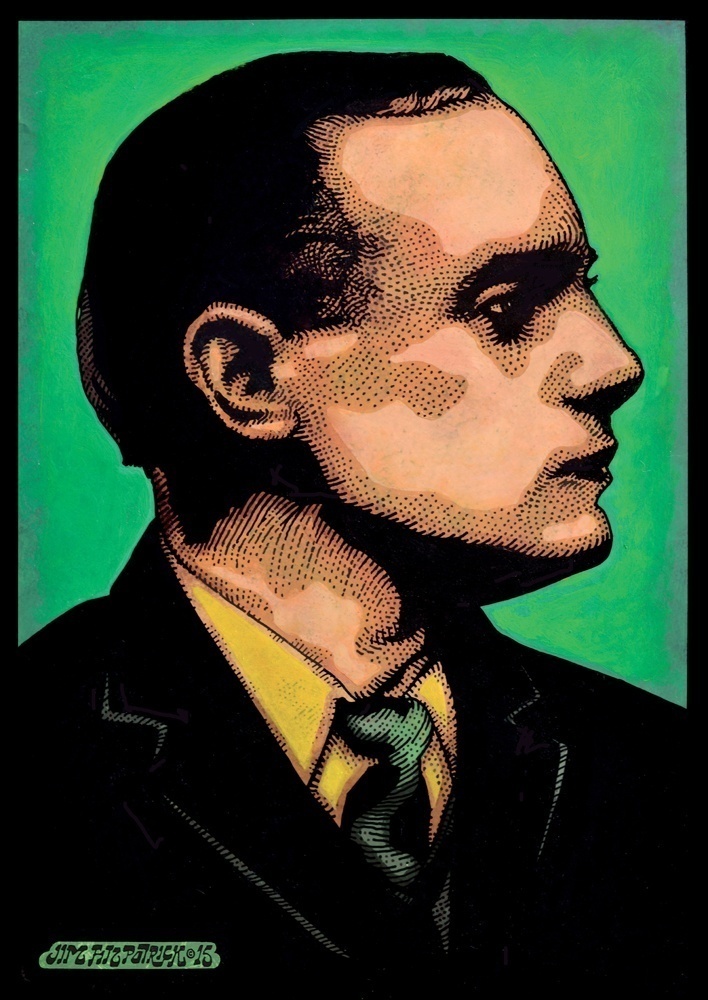
Padraic Pearse © Jim FitzPatrick 2015 
But the envoi I leave you with, is that Padraic Pearse too wrote an I Am poem, and since he is considered one of the founding fathers of Ireland, it seems like a fitting place to close this story, from the mythic beginning of a nation, its death, its reincarnation and its rebirth.
As Padraic Pearce said: 
Tír gan teanga, tír gan anam.
A country without a language
is a country without a soul.

My grandmother instilled in me the importance off language, she said use it well agains them. Perhaps this is why I became a poet. I am hot fluent in Irish but I can get by in the enemy tongue.


I am of Ireland,
And the Holy Land of Ireland,
And time runs on,' cried she.
"Come out of charity
And dance with me in Ireland.'
       William Butler Yeats


HOPE FOR THE FUTURE

I want to leave you with the name of a modern Irish poet who carries on the tradition of Irish poetry, Nuala Ni Dhomhnaill of Dun Laoghaire, County Dublin, who calls the Irish language "the corpse that sits up and talks back."