Showing posts with label Amsterdam. Show all posts

Saturday, July 6, 2013

ReVisioning the 1992 Biljmer Plane Crash, Amsterdam (& the Asiana Crash at SFO)


This morning, as I was outside in the garden, I thought I heard or felt something—more like a percussion than a sound—and I said to myself, Jeez, it feels like a bomb just went off—or a plane crash. I live near the Oakland Airport which is across the bay from the San Francisco airport. I laughed at my silliness and chalked it up to an overactive imagination.

But I was uneasy, sensing that some disaster had occurred. I came inside to check the news only to find my Twitter feed going crazy.

What I saw on my screen: a tweet from Samsung executive, David Eun: "I just crash landed at SFO. Tail ripped off. Most everyone seems fine. I'm ok. Surreal..." And he posted a photo of the crippled jet. Asiana Airline accident today at SFOOh no! So I wasn't imagining things.

There were 290 to 350 passengers on board from Seoul to SFO. Someone said: it's a hard landing, no landing gear. Another eye-witness said the plane struck the seawall, then the tail ripped off, and it cartwheeled off Ramp 28. (I think it just slid off the tarmac). The fuselage also caught fire as people fled the plane, sliding down the inflatable emergency ramps. Suitcases were scattered everywhere like flotsam. Or maybe it was a herd of Goats R Us weed-whacker goats rubbernecking.

As I followed the grisly news reports, an image I thought I had forgotten, came to mind. Another plane crash, from long ago, in another country. So, I let my fingers do some web walking as I waited for the news to unfold.

In 1992, I witnessed an Israeli cargo airplane crash in Amsterdam. An El Al Boeing 747 plane circling from Schiphol Airport was flying unusually low over the IJsselmeer, when I heard a pop overhead, and then a big splash right next to me.
We walked along the Durgerdam, admiring the sunset. —Wiki

My friend Vinz said we were just outside the village near the Durgerdam bus stop. Durgerdam is 7 km east of Dam Square. We were walking along the dyke of the IJsselmeer, admiring the colors on the water, the October sunset in North Holland. Everything on fire. Beauty everywhere.

We were walking on that peninsula above the red dot at Durgerdam —Wiki

I thought the splash I heard was an improbable seal or an even more unlikely whale breaching—not even remotely possible in the artificial enclosed lake, that is the IJssel, which is a branch, or tributary of the Rhine. I laughed at my foolish notion. OK, one helluva big fish, then.

But as the events unfolded, I quickly put it together that the pop I heard was the El Al Boeing 747 plane's right wing engine exploding, and the splash—the engine falling into the water. That was awfully close, that engine could've fallen on us, had the plane been over land (as the flight map I posted below suggests—but it's wrong). 

Then, we watched, stunned, as the eastbound plane veered hard right over land and plowed into two high rise buildings of BijlmerThe fireball as it struck the apartments was like an atomic blast—we could hear and feel it from miles away. I took photos of the fireball but I couldn't override the automatic camera flash—and so, I got nothing on film.  

We made our way back to the crash site. The Boeing 747 crashed into the Bijlmermeer, near the Elsrijkdreef- Bijlmerdreef T-intersectionI remember looking up in a linden tree to see an airplane seatbelt, a melted Barbie doll, and fuel dripping from the leaves like rain. I took more photos and there was no way home but to walk. All transport from Biljmer was cut off. All busses were being used as ambulances.

Why did the El Al pilot bank 90° right, into the housing project instead of flying over the IJsselmeer (formerly the Zuiderzee) where he could've crash-landed on the water? Surely the pilot knew he was in trouble long before he reached land.
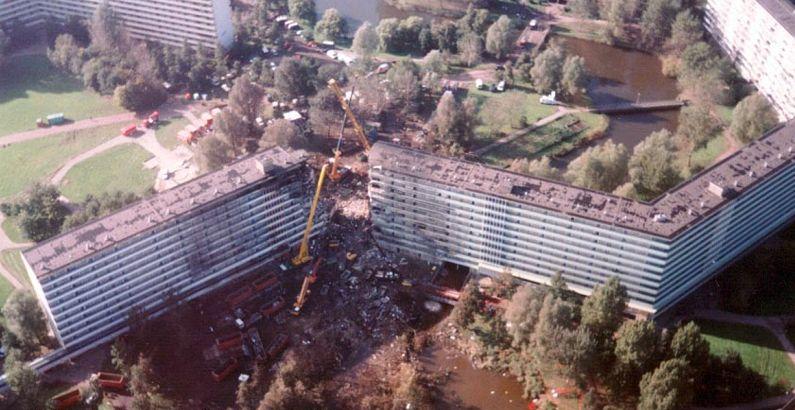
At 6:35 pm, the first officer radioed to ATC: "Going down, #1862, going down, going down, copy, going down." In the background, the captain was heard instructing the first officer in Hebrew to raise the flaps and lower the landing gear. —Bijlmerramp, Wiki

They say 48 people died a the Bijlmerramp—but we saw busloads of bodies leaving. There was a huge population of undocumented illegal immigrants living there as well—and everyone was at home in time for Sunday dinner.

We were walking along the shore to the north of the final green line. Pilot was flying over the water when the right engine fell off. He banked and turned. Everything in slo-mo. This map is wrong, as we were near Durgerdam, walking east, the plane passed me on the right, not the left side.

Then came the cover-up. What was in the plane: fertilizer, petro-, and bio-chemicals? Bomb fixings? No news, no answers anywhere. I was interviewed by Amsterdam Underground Radio—the reporter was positive it was some sort of conspiracy but I didn't feed the beast of paranoia. Merely reported what I saw, and deduced. Too well trained by my editor, Nick Valentine, to let the crazed reporter lead me.

From GoogleEarth

Today's crash at SFO brought the memory of the Biljmer crash back in startling clarity. Another Boeing. Two people have been confirmed dead & at least 130 injured, with 41 in critical condition. Such a tragedy. Amazing that so many survived. We should not be witnessing things like this. It brings back the vivid images of 9/11 as well. The things we can never erase form our minds, leaving us shellshocked.

Will the final verdict also be metal fatigue as well? Or pilot error? Or both? My cousin is a mechanic for United at SFO. Maybe we'll get another picture from the mechanics who will be working on the plane. I'll post later, if we do. Meanwhile, if you landed at this blog in error, I've posted some Asiana links below.

Tuesday, February 27, 2007

Letters to Celia Woloch

c/o Vins van Neerven, 
Hogerbeetsstraat 97 III, 
1052 VV Amsterdam, Netherlands 
   
Celia, my grlfrnd—                 Aug. Sept., 1992-93?

In the weightlessness of space, an astronaut’s heart shrinks. —Omni

AUG 20—Even in between sobs, it’s good to hear your voice via the Ma Belle satellite. And yes, I’m not writing much, lacking the focus. Where are the poems hidden? Why won’t they come?

Maybe this letter will open up the dam (Amster-dam: the 16th c. dam on the Amsterele river is real, not a metaphor. I’ve given into the timelessness of being at loose ends—with no agendas, hidden or otherwise—in a country not my own, seeking what oddities life has to offer.)

Where do poems come from? Page One of my notebook documents the oddities of The Final Frontier: After fighting nearly three years with Soviet bureaucracy for permission to hook up a computer telecommunications system with the Ukraine for a cultural exchange program, I finally let go of the idea. 

Then, shortly after April Fool’s Day, I received my first E-mail message from Oleg via GlasNET. Was it incongruous to read a satellite message transmitted half-way around the world that began with: “Cosmonaut lands, doesn’t recognize his own country?” 

Ex-lovers aside, how ironic: my first message from the new independent nation, Ukraine, is not about freedom, but about space, the final frontier. O-oh K.!?

Yes. Forgotten during the 1991 August coup, stranded Soviet cosmonaut Sergei Krikalev helplessly watched his country disappear: changing its name, anthem, and political order. The abandoned space program was officially broke with no way to get him home. 

Secret calls in the night; someone trying to sell Soviet space ships for hard currency. When Krikalev eventually returned to Earth after ten months in space, he didn’t recognize his own country. It was then discovered in the weightlessness of space, an astronaut’s heart shrinks. 

Moral: be careful of hasty conclusions and hearts stranded in space. Complex metaphor swiftly approaching from the starboard side. Will I regret not going to Russia after the Fall, and seeing for myself, the changes?

Monday, February 26, 2007

Letter to Charles McGeehan

Dear Bertaijn & Charles—Happy Holidays!

It’s been raining steadily for a week, a slow, gentle rain, drumming fingers of rain on the moss-green scalp of my cabin roof nestled beneath live oaks. I’m cozily curled up in bed with the flu, playing with my computer.

There are flash flood warnings in Northern California, Oregon and Washington and record feet of snow has fallen in the mountains. I’ve been lax about writing to anyone since I’ve been back home. A kind of lethargy creeps over me. I do what’s necessary, read, and little else. Perhaps hibernation. . . Of course, it doesn’t help that I have an injured wrist.

Right before I left Amsterdam, I got into a bicycle accident. As I was returning home to Linde Voûte’s on Oetgenstraat from Westerpark, some idiot took a curved wrought-iron flower trellis (the arch that goes over a gate) out of the back of his double-parked car on Prinsengracht (near Utrechtstraat), and swung it in front of me, cutting my right hand. 

I tried to protect my face but smashed into a parked car, bruising my left wrist when I hit the back windshield. It was either smash into a parked car or fly into the canal—which would you choose? It was raining, and the bike’s brakes were no good on wet cobblestone & brick. 

Anyway, I’ve been ignoring my wrist for the past 2 months—until it hurt so badly (I was smashing a clove of garlic with the flat of a knife; the little bones in my wrist made a crunching sound like potato crisps!). I finally went to the doctor who put it into a splint to rest it—a bad sprain. 

I’m slowly typing (two-fingered pecking) this letter wearing my stupid wrist brace—which looks (& is beginning to smell) like an old gym shoe, and as winter’s chill creeps in, my bones ache (snow in the Sierras); injuries don’t heal quite as fast as they used to.

I’m finally finished with my Breytenbach essay on translation. I can’t believe it took me so long to write it, but I didn’t have the background or knowledge necessary to quickly write something. 

Besides, if I knew what I was going to write about, I wouldn’t write at all. What’s the point? The essay & footnotes is nearly 10,000 words (verbose), and it was very difficult for me. It’s long overdue, I hope J.L van Schaik Publishers (South Africa) will still use it!

It’s hard to say exactly how I’ve been wasting my time as I’m never idle. You know how it is, the life of a writer is a proverbial black hole. In Autumn I never have much ($) work: I’m teaching a poetry class to children, ages 6-8; I finished 3 “Elderhostel” classes (California history, poetry, art, etc.) to 60+ year-olds—and my strangest job yet—was as a naturalist leading a group of businessmen on a day hike to the headlands near Sausalito (& the Golden Gate Bridge) last Friday (probably when I caught this cold). 

Did Paul Evans do another issue of ORAL magazine? Charles, you haven’t sent me the second batch of poems that I typeset—you were going to proof them, remember? As soon as I get them, I’ll make corrections ASAP and send you a clean copy of all that I’ve typeset so we can see where the “holes” are. 

Herman got a letter from Guillermo Gelacio, & some photos. Guillermo was concerned with, among other things, Herman’s general sloppiness in the Asian issue. I’ve tried to tell him to take care, he’s losing credibility. 

A good thing we’re near the end of the project. He’s truly incorrigable, and becoming worse with time, impossible to work with. I want to make sure we get our issue together soon so send the corrected poems.

Here’s a letter fragment I never sent:

19 Sept., 1996 (midnight insomnia) Home, I am—and after a week of sunshine, I need dark shades—unused as I am to so much concentrated light. The weather’s turning cold. Fingernail moon (and a total eclipse on the 26th—the last one of the millenium—which I doubt you’ll even see, Dutch weather being what it is. 

Still suffering from acute jetlag, tunnel vision & disorientation by late afternoon is typical (for 6 pm is really 3 am—and I wonder why I have no appetite for dinner!). 

Driving is excruciating (asleep at the wheel is a virtual reality). My cousin Dave’s having the same symptoms. We may have jumped into this culture/time zone but the bio-rhythms aren’t yet shifting. 

He said “I have to keep moving around, flapping my arms, just to keep awake at work.” I laughed at the idea of Dave flapping his wings in an airplane hangar with all those dismantled planes. 

At a lively Brazilian party in San Francisco, I made the mistake of sitting alone on the couch for a few minutes. My eyes may have been open, but that’s all. I couldn’t even speak, let alone understand the Brazilians’ Spanish (who speak with a Portuguese accent). 

I drove Herman Berlandt & his girlfriend, Verona home to Novato, literally cross-eyed, thinking “I’ll never make it home” and slept on their couch. They say it takes a minimum of 1 day of suffering for each time zone. 

I remember how it took me weeks to recover from Russia. How long will I suffer this time? Someone said that in a Concorde jet, you travel so fast, you arrive before you leave—earlier, that is, in New York than when you leave Paris! Where’s Einstein when you need him?

My cousin Sínead (Dave’s sister) and I went huckleberrying last weekend out at our secret spot on a hill near Tomales Bay, where we used to go with my grandmother. (They’re like tiny blueberries with 50 times the flavor.) 

From the isthmus, we could see Point Reyes in the distance, like a comma against the shining sea, separating Drake’s Bay from the raging Pacific—a misnamed ocean. 

Offshore fog rising up like a vast wall where tiny fishing boats disappeared into its maws, made me think of the painter, Turner. The pine forest took a beating from last year’s severe storms—so many uprooted trees met an abrupt end—we used them as aerial pathways up the hillsides. 

Since it’s all part of the Point Reyes National Seashore, we’re not supposed to gather anything—even huckleberries, so I stole an antler. We were hiding from the rangers but we had Sínead’s 22-month-old nephew, Séan to lug through the undergrowth. I had the odd sensation we were re-enacting an age-old ritual, gathering berries before the fall—no matter that our skin is white, not red. 

My aunt will make pies and ice cream, our teeth will be indigo-stained for days (like my fingers). How Pictish! The berries are so labor-intensive (cleaning takes longer than picking) we make jokes, compare them to caviar. (We went to an equinox party at Albert Straus's—a local ranch and made gallons of huckleberry ice cream).

I spent my flight over the Atlantic being terribly sleepy but wide awake with fear. Unfortunately my airplane dessert had hazelnut filling in it, tho they said it was jam. . . and I had to take antihistimines, the stewardesses coming by periodically to see if I was still breathing. I was trying to figure out a place where I could hide to inject myself with adrenaline, if it came to that. 

I’m such a coward around needles and every muscle in your body contracts at once on adrenaline. The one time I had to take it, I could hear my scull crack as every muscle in my scalp went into shrinkwrap overdrive! Zip!

What struck me most about returning home is the sharp, aromatic odor of bay laurel, poison oak pollen, and sun-burnt hay, flavored with the acrid, thirsty dust—the smell of late summer making me nostalgic (like Proust and his madelines?). 

Seeing all the lovely, steep hillsides against a cerulean sky, cloaked in tawny blond oatgrasses like sleeping lions, and the thick green-black oaks roiling in their crotches—so sexual, it surprises me anew each time I return. 

I’ll never forget how the mirrored San Francisco Bay and Mt. Tamalpias (our Mt. Fuji-san) from the fire-ravaged Oakland hills takes my breath away. The Sonoma-Marin Coast Miwok Indian word for the shining golden gate, Yulupa. 

All that’s left of the Bay Area Ohlone Indians’ stories of this landscape is: Dancing on the brink of the world. 

I love this landscape, but not the culture. I hate the vacuous American loudness, the lack of body awareness, the shallow chrome and Formica existence, the urban sprawl. . . the ultimate loneliness. I try to be somewhat tolerant, but I guess it’s not within my nature. And so I am alone, dancing on the brink of I know not what.

My 2nd night home, I was invited to a Sebastopol Arts Council meeting for the promotion of poetry in west Sonoma County, and I felt so jaded. “Been there, done that. Got the shirt. . .” 

Guess I should be glad poetry is so “in” but it just makes me bad-tempered and ornery—especially when they dream big, and haven’t a clue as to what goes on in putting on reading series and workshops, wanting more volunteer labor to make it happen. . .and I’ve got that shirt too—in several sizes. (And it’s got bloody holes in it by now!).

It feels a bit like a mausoleum here, in this poetry mecca of the world (and in my cabin too). I know I’ll grow used to it soon enough. 

I saw a bizarre English movie, The Draughtsman’s Contract, by Peter Greenaway, the director of The Cook, the Thief, his Wife and her Lover. At the end there were all these Dutch references—someone speaking Dutch which I could almost understand. It had the peculiar effect of making me homesick for the wrong country. 

They say you always leave a part of yourself behind when you travel. Does that mean there’s less of me returning home each time I go away? (Heminway said: Travel broadens the mind. Writing broadens the ass. I write standing up.)

I’ve got to find a new home for our poetry reading series—book 20+ readers thru Dec. & do a newsletter /mailing on my own (done!). I’ve got a few 2-day teaching jobs with Elderhostel (open university for retired folks) in Oct. One on creativity and the arts, the other on early California history—I’ve got to start cramming the info. in soon. It takes me a while to re-establish those kinds of facts—I teach through telling lively stories and anecdotes—otherwise my elderly “students” will fall asleep.

* * * * * * *

Charles, today’s the anniversary of day President Kennedy was shot. The proverbial question: what were you doing, where were you? (Not on the grassy knoll, I presume!) 

I was in 3rd grade, sick with a flu (like today), sitting with my grandmother with my feet propped on the warm sides of the stove firebox (we have a gas stove with a wood burner for heat in Forest Knolls—not that newfangled modern heating! 

Bertaijn, my Grandmother’s house in Forest Knolls reminds me so much of your wonderful farm house in Rogny! Thank you again so much for inviting us, it was a highlight of my summer). Actually, she was sitting by the stove, I was wallowing around on the floor in my quilted robe like a red and yellow paisley dust-walrus. It was a dreary day, much like today.

My aunt Canice’s husband Bill (Dave’s father—they were staying with us a while. At one time or another, my grandmother’s house was a second home (a flophouse?) for three of her four daughters in various incarnations of distress). 

Bill Dinsmore (a sloppy drunk) came bursting through the front door, mid-afternoon—full of news. He was so excited, I mistook it for joyousness or frivolity. “The President’s been shot!” he shreiked. In retrospect, I think it was merely excitement and shock enhanced by the booze. 

My grandmother’s reaction of anguish (she who had buried a husband, a son and several brothers and sisters by this time), such a bizarre foil to my uncle’s giggling, I didn’t know what to think, only that Kennedy was akin to being a relative in our household. The Irish Catholics have elevated him to secular sainthood.

When visiting my relatives in Ireland in 1973, I was struck by how every house had its altar niche with Jesus and/or Mary (rarely Joseph) and Kennedy illuminated by a (red) votive candle. The sacred heart. Later, in 1989, when I visited Peru, it was like being in Ireland—Kennedy’s half-mast eyes blankly stared out at me from every niche. What do the dead still see from the eyes of photographs?

Of course, lots of controversial stories about Kennedy have surfaced since then. But, regardless of his politics and womanizing, he truly represented something as intangible as hope to so many oppressed peoples the world over. 

I can’t think of another American president that had that kind of global impact. Certainly not the Rosevelts, nor Eisenhower (course I wasn’t really politically savvy yet—born in 1952). Clinton’s been compared to Kennedy—but that’s a joke. Clinton couldn’t even fill the shadows of the soles of Kennedy’s feet. Still, I wonder, what would our perception of Kennedy been like if he’d run for office now, more than 25 years after his death; how would the world view him now?

Weird to see Fidel Castro on the telly the other night, Knnedy’s embargo from the Bay of Pigs crisis still in effect—we get little news of Cuba. I saw him on a Mexican TV channel—no voice of James Earl Jones sonorously announcing in that rich baritone: This is CNN! 

Charles, remember those radio emergency broadcast tests when we were kids? The piercing tones followed by the announcement, “This is only a test. If it had been a real emergency . . .” and we thought maybe the bomb was gonna drop? They’ve just eliminated them (I was surprised to hear them on the BBC radio broadcast you listen to in the morning). Now there’s new technology, just some computer chirps and clicks.

Charles, happy birthday to you too! I forgot the date, fellow Sagge.; my birthday’s in 2 days. I’ll be 44, or as my grandmother would say: Farty-Faer. Fulla hot air in more ways than one—nasty flubug!

1 Dec. Sun. Well, a friend (a student’s mother) whisked me away to the beautiful tourist town of Carmel-by-the Sea for the weekend, so I turned 44 beneath a full Gemini moon by the Pacific Ocean (we were 2 houses away from the beach, a painter friend of hers rented a house for a full month). 

I no sooner returned home (Tues.) and left again to spend Thanksgiving in Novato with Herman and Verona (his actress-girlfriend) and her 2 (adult) children, a Brazilian artist (Zoravia), and a Scottish actor (Neal O’Neill from Glasgow in a kilt (I think I’m in love!) played guitar, so we sang for our supper on full stomachs. 

Herman said he was going to call you, Charles, but every time we get the urge, we realize the hour you definately would not appreciate. There’s that little matter of time. He said he wrote to you but you never answered. He was worried about you, your health. Please write back to us soon.

My innards are still unhappy, so I spent the weekend back in bed reading after nearly a week of socializing. I’ve been reading more on the Celts—discovered that Laon was a celtic hillfort, and later, an Irish monastary until ca. 1500 to 1700 AD. 

My favorite mystery scholar whom I know little about, a founder of many of the continental universities, was Johannes Scottus Eriugena (John, the Irishman b. 810). He taught 25 years at Laon and at the Paris Court School for Charles the Bald (when he wasn’t being accused of heresy—which was often—for his radical doctrine preached the concept of free will. 

Note: this was long before Luther was a gleam in his great-grandparents’ eyes). In 486 the Loire was settled by Merovingin Franks, I don’t remember the dates at Marle. 

Do you have any information on the Abbey ring, Bertaijn? Suffice to say, there were probably still a few Gauls around—surely the Romans didn’t kill them all? Certainly most of the so-called “Roman’ troops were comprised of conquered Gauls—and with the fresh influx of Irish blood—well it seems to explain why everyone was wearing those Celtic beltbuckles! 

The thing is, no other group of people ever accomplished that kind of inlay design work. The Merovingian buckles were pretty crude workmanship though. Let’s all go back to Marle next summer—for a longer stay so I can scout out some history. 

Bertaijn, if you need some manual labor, I’ll be your slave. I’m very good at that sort of thing. Plastering, painting, gardening, etc. I’ve done all kinds of hard labor growing up in the country. Guess I’d better learn some French!

Here’s a little story about Eriugena: An emperor (Charles the Bald?) made a playful pun on two similar sounding words in Latin: sottum and scottum, and asked John what’s the difference between a fool and a Scot (Irishman) to which John replied, “Only the table.” (In Latin, of course: Quid distat inter sottum et scottum?).

The king must’ve been seated across from the Irishman. I bet he was flabbergasted by the answer—talk about turned tables! But then it is said in our myths, satire was the first art form invented in Ireland. 

I found this gem in my friend Vinz’s flat: Adversus stultitiam pugnare nil est laboriusius nulla enim auctonate vinci fatetur nulla ratione suddetor. Which goes something like: nothing is more laborious than to fight against stupidity for it won’t bend to any authority and it won’t be convinced by any reason. 

He must have had some very challenging students at Laon! If I don’t send this soon, it’ll be Christmas! Adieu. A’voir! Kisses & hugs!

P.S/ Well Christmas has come (the goose—well, actually, the turkey— is come and gone), and your package sat on the floor waiting for the last of my photos, and though the pieces were assembled, I forgot to mail this, so now I make another feeble attempt before year’s end. 

When I started this letter it was raining; would you believe it’s still raining! We have flood warnings for tomorrow, the Russian River is to crest at Hacienda Bridge in the afternoon, just 2 miles from my house. The power’s been threatening to go out all day, flickering—we’ve had terrible winds. Small branches falling on my roof and the hood of my truck. In today’s newspaper, a photo of ice skaters in Holland and in the Midwest—South Dakota, I think.

Charles, twice now I’ve tried calling you but no answer. Hope all’s well. I spent Christmas Eve and morning with my cousins Dave and Sinead in Nicasio; Christmas dinner and Boxing Day with Herman & Verona. 

Herman was given an old Mac computer, I have to find him a printer and a monitor. Did you ever get a better computer? What you really need is a letter quality printer ASAP! Your old computer programs might not be able to run the printer though, nowadays everything has its own special programs. 

You really should upgrade your whole system all at once if you can. Surely Anjum can help you? In the past two years there have been so many new chips (Intel, Pentium) invented, that the relatively new computers are now considered “obsolete” and if you can find someone who’s upgrading to a newer system, you should be able to find a deal somewhere. 

Since you only need a system for relatively simple wordprocessing and printing, it doesn’t have to be brand-new! You could get by with a small hard drive of 40 MB and 4-8 MB memory, both of which are upgradable. It would be nice to get a fax-modem too, because the telephone is so expensive. 

I realize you want an IBM style clone system, and they’re probably much cheaper, but if you should happen to come across a Mac system, Vinz has a Mac LC, and we can give you all the software and fonts you need. IBM’s highly touted Windows ’95 operating system (it runs the machine—you can’t get computers that run solely off program disks anymore) is merely a rip-off of Mac’s operating system invented circa 1989.

I don’t know if Dave’s sent you his photos yet, he’s been meaning to. Dave’s been working long hours on the “swing shift” (getting home at 2 am) in order to “buy” his grandfather’s house—an unscrupulous unrelated cousin managed to get her name included on the will and by California law, if property isn’t specifically bequeathed, it goes to whoever’s on the will. A real mess for him, but at least he’ll eventually own the house in Nicasio. 

The irony is that his so-called “inheritance” house will cost him about the same as if he were to buy it on the open market! But it’s a sweet old house—fraught with structural problems. That’s why he could relate so well to the problems of your house in France. 

(Do you think this is a long enough P.S.? I’m obsessed with filling the entire page with writing, I abhor the blank page in a letter, squeezing in as many words as possible, thinking I’m somehow getting my money’s worth at the Post Office. I know it doesn’t make sense, this obsession of mine, that’s why it’s so difficult for me to write letters—because once I get going I can’t stop! Enough already!!!)

November 22 - to Dec. 31?, 1996 

Wednesday, April 9, 2003

SMALL VIEW, ii


SMALL VIEW, ii                                                          


Midsummer: we stood on a dune above the North Sea,
talking of Caesar and philosophy, naming the intangible
sandwiched between schools of thought. Cogito ergo sum.
At Zaandfort, we admired the slow hunger of glaciers on stone
and the ceaseless appetite of the Rhine, carrying a payload
of what once was the secret heart of mountains.

Not content with things themselves,
we named small desires, translated them into stone.
The smithy’s forge transformed nameless dirt into iron,
stayed countless armies of sand into glass palaces.

Things cannot stand for what they are,
without moniker as if we brought them into being
with our mad desire for definition. To think is to name.
At the house of Descartes we measured the ratio of shadow
to light and found it wanting within our own darkness.
Throwing stones at the shattered ego, an afterthought.

As Blake would say: to seek eternity in a grain of sand...
But then, he saw God in an apple tree when he was four
   and newly come to the naming of things.
How did he know it was God if there was not yet a name for it?
Was it verb or noun?

                           This naming: And God said...
sheds no more light than the man in the moon.
Yet we persist, we insist on this naming,
yet overlook the way warbled glass in the old house
imperfectly admits sunlight into a room.

Should we turn the windows upside down every 50 years?
Stand the rubric of time on its ear in order to see clearly?

We could name it an aspect of time, call it slumped glass,
explain it with the poetics of physics: slow fluid
seeking gravity’s kiss, admire rippled light cast onto skin,
a genesis of follicles and dappled shadows on the floorboards,
or imagine an ancestral memory of sea and sand and wind.

Appellation, cognomen, epithet.
We hammer and tong Latinate structure
into verb or into noun as it suits:
we designate it nom de guerre, nom de plume,
we call it pseudonym, or maybe nothing at all.


4/9/03


Tuesday, September 11, 2001

A Mantra for the Mujahedeen

     Say it over and over again until it makes sense.

Gospodi, gospodi pomilui / mujahedeen relentlessly echoes in my head. I’m caught in a convocation of languages in the cracks between tongues as I watch the World Trade Center towers fall again and again in slo-mo, and I can’t seem to make sense of it in my native tongue. It becomes a mantra: gospodi/ mujahedeen /gospodi. Why is it that Old Church Slavonic is colliding with Arabic mid-thought? God have mercy on us/ a holy war. Say jihad. Say it over and over again until it makes sense. Gospodi/mujahedeen. But it will never make sense.

I have no skills to comprehend the images of those who held hands as they plunged to their death. I cannot grapple with the word jihad or the rhetoric of Psalm 23 in any language. Say it. Say it again. Does it ease the burden of grief? In Arabic numerals the victims dial 9-11 –- all circuits are jammed. Those still trapped beneath 100 floors of rubble are calling their loved ones one last time for a final goodbye — to say: "I’m fine," before the batteries fail and the building shifts. Yea, though those who leapt unto the shadow of the Valley of Death — to say, "I love you." Je t’aime, or Te amo to perfect strangers during freefall, and really mean it. What went through their minds?

Arabic: the names of stars. Aldebaran, zenith, zero, zealot. The sky, so silent, no birds flying. Mea maxima culpa. Gospodi. There are no words in any language that will do justice.

I’m studying ancient manuscripts and I am reminded that it was medieval Arabs, in love with knowledge who saved the writings of the classical world after the Vikings destroyed the Irish copies. In medias res. In the middle of things. An Irish monk scribed in the margin: We walk in one another’s shadows.

Across the centuries, Shadowlands and Second Comings cannot ease the burden. We grow old with grief. We attempt normalcy, resurrect schedules. We dust off the words of the Pledge of Allegiance, unspoken since childhood — in my case, nearly 40 years ago. Dressed in red white and blue, thousands of Americans line up to donate blood. Even those in other countries are giving blood: Yasser Arafat among them.

In front of Sproul Hall at Berkeley, I pass a girl who nervously fingers her dove-grey hijab. Her pale eyes reflect a palpable fear. Already there have been acts of violence against Middle Easterners bearing American flags. It’s like a bad dèja vú of the ’60s at Berkeley. In San Francisco, an Armenian-American greengrocer is mistaken for the enemy. Animal blood is spilled on his doorstep. But he was born here. A Middle Eastern woman holding an American flag shops for dinner, in the pram, her baby wears a flag. A beefy man with a flag the size of a bedsheet strapped to his Harley with a broomstick vigilantly patrols the parking lot. An elderly Mexican man gives away red, white & blue roses to women. What else is there to do?

In class, we trade war stories: Five years ago, I witnessed an Israeli cargo plane fall out of the sky, a harbinger of things to come. The engine exploded, and I heard it fall into the sea. A mushroom cloud of fuel consumed a refugee complex. I thought Armageddon had begun. I still can’t shake images of debris draped from a tree — was it the pilot’s seatbelt? A mangled Barbie doll amid fuselage and ashes. The Israeli linguist remembers last year’s sniper who missed her twice, as she stood on the terrace overlooking the Arab Ouarter. A half-hearted attempt at a simple target. We deconstruct words as our world, buried beyond recognition, offers little solace.

On TV, we watch rescue workers gather round a fire truck, burned beyond recognition — an altar for the more than 300 dead firemen. One man recalls driving over too many body parts to count. Numanistics: I want to slide into the perfection of absolute zero. At Ground Zero, cabbies rip the seats from their cabs to carry the dead. New lines form at blood banks — solace from the living. Barges carry the dead across the River Styx because the island can’t contain all her dead. The living flee across Brooklyn Bridge. or escape TO New Jersey, of all places! Anything to get off the island.

How many degrees of separation are any of us from the dead? We are all at Ground Zero, because on that Tuesday, each of us died a little. I am one degree of separation from Alan Beavans, who was on Flight 93. I cannot think in abstractions, I can only understand this atrocity in terms of individuals. At midnight I find myself chanting a kaddish of the names of my Middle Eastern friends. Among them, Oleg. Where is Oleg, my Armenian friend who took me into the churches of Kiev where we listened to the choir singing gospodi?

Today, I learn a new word: Taliban. And another: jihad. This jihad is like Ireland in that the memory of hatred is older than the civilization that raised it. I can’t help but think of the gyre of the last plague-ridden millennium where, thinking that the end of the world was buried in the calendral equation of zeroes, Anglo-Saxon crusaders stormed Jerusalem — annihilating both Arabs and Christians alike on the temple steps, making all religion null and void. Armageddon resurfaces amid the pond scum of right-wing fundamentalists and racists exorcising rites of free speech, and latent seeds sprout in a new field, fertilized by the blood of civilians. The president’s myopic message is about an eye for an eye, but nothing is black and white — especially not blood.

The sky, so quiet, even the birds are not flying. A raven lands in front of us, sharpens his beak. Another joins him. War birds of the Irish, come to remind us they are hungry for eyes. My grandmother said that when the wild birds enter the house, it is a sure sign of death. A hummingbird stops to eye me. He sways and dips as if in benediction — making a sign of the cross — and takes off. Without a metaphor in common with the terrorists, I imagine I am blessed by birds, but tell me why is it that the wrens are huddling around the bird feeder, and fluttering at the windows as if to get in? Too late I remember that in Aztec mythology the hummingbird, Huitzilipochtli, is the god of war.

At candlelight vigils, we learn a new term: asymmetrical warfare, as if geometry were a country of refuge. In this way, we also learned terms from the Gulf War: collateral damage, and friendly fire. I’m afraid that in the weeks and months ahead will be full of such euphemisms. The city is on "yellow alert." On the steps of City Hall, we gather for an interfaith memorial service. A Baptist preacher prays, "Oh Lord please help the President to make the right decision — not the one he wants to make." It is also Jumnah Sabat: What are they praying for at the mosques? A Muslim-American says, "This has nothing to do with our religion that teaches tolerance, peace and harmony." I want to believe him but what about the fundamentalists on both sides? I am lost in the biblical equations that come tumbling down. I find a pair of gilt harem slippers dumped on the street and worry about the woman who last wore them: her foot, the same size as mine. I am that woman behind the veil as well.

Gospodi God have mercy on the unholy warriors, the mujahedeen, for we know not what they do, for the word of Allah is not their witness. Written on the wind, the names of the innocent dead, Muslims among them. Say their names 5000 times, say them again until it becomes a mantra. Gospodi pomilui, mujahedeen, Islam, shalom, salaam. As God is their witness, may the gates of heaven always be beyond the reach of terrorists.

How silent is the sky. Huddled around the bird feeder, even the doves are refusing to fly.

© 2001Maureen Hurley Reprinted from Killing the Buddha A Mantra for the Mujahedeen

Tuesday, April 1, 1997

April Foolishness

In the weightlessness of space,
an astronaut's heart shrinks.—Omni Magazine


A VOICE from home via the satellite link-up lessened the burden of homesickness. But where were the poems hidden? Why didn’t they come? Maybe living in another country would open the dam. Amster-dam: the 16th c. dam on the Amsterele river is real, not a metaphor. I've given into the timelessness of being at loose ends—no agendas, hidden or otherwise—in a country not my own, seeking what oddities life has to offer, for death takes such a long time coming in. In another country I could no longer dam my grief, I shed my skin, undressed down to the bone, and resurrected small pieces of myself from the ground up, for death irrevokably changes you, you cannot go home to who you were. Ever.

Death arrived out of breath, I was an orphan. I trolled old sources searching for my lost art. Page One of my journal documented the oddities of The Final Frontier: After fighting three years with Soviet bureaucracy to hook up a computer telecommunications system with the Ukraine for a cultural exchange program, I finally let go of the idea. Then, one April Fool's Day, my first E-mail message arrived from my ex lover via GlasNET. Incongruous to read a satellite message transmitted half-way around the world that began with: “Cosmonaut lands, doesn't recognize his own country.” My first message from the new independent nation, Ukraine, was not about freedom, but about space, the final frontier.

In another journal I found the story of a physicist who told me a story how he demonstrated jet propulsion while seated in his daughter’s Red Racer wagon; using a fire extinguisher for a booster rocket, he shot through the ivy league halls to the surprise of students and faculty alike. He liked to clown around, to act foolish. He gave me one of the first holograms ever made of a chambered nautilus sliced in half. It reminded me of the cross section of a space ship. I was not immune to his charisma or the three dimensional illusion of physics: a rainbow of light, the visible spectrum trapped on that sheet of mylar set my blood racing, but I was uneasy with the whispered secret rumors. Was it in spring? The word fool once meant someone who was in love. Foolish love. April Fools, a day for practical jokes and sex role reversals. My foolish Papá, said the daughter whose warrior soprano vision guided us through the turbulent protests of the ’60s and ’70s. Show me the prison, show me the jail... I study the exposed labial chambers of the nautilus for clues. What’s worse, the walled silence, or the knowing? Will I be silenced for writing holographic truth dammed behind the slander of divided light?

Inexplicably it reminded me of a hologram of St. Steven’s crown with its bent cross László gave me as we stood on the banks of the Danube the day my half-Russian childhood best friend, Stephanie was cremated on the other side of the world. My hands let rose petals stain the muddy river, I wanted to be home to touch the place where the wind took her up. Home to where her Nanna greeted us each day after school in the old tongue where ikonii and troikas were uttered in the present tense. That place called home that Nanna left, became the wind’s body, Stephanie came to me in sleep, we rode our horses out into the deep. Orion’s belt marked our crossing. She was mute, her eyes like stars. Death swallows the unspoken words hovering in the mouths of the dead. When she comes to visit from the other side, my grandmother’s mouth is a thin line dividing worlds in the country of death. I watch Lír’s sea foam horses racing the wind down the strand.

Death nearly boarded the spaceship Mir, forgotten during the 1991 August coup. Stranded Soviet cosmonaut Sergei Krikalev helplessly watched his country disappear: changing its name, anthem, and political order. The abandoned space program was officially broke with no way to get him home. Secret calls in the night; someone trying to sell Soviet space ships for hard currency. When Krikalev returned to Earth after ten months in space, he didn't recognize his own country. White ravens in the snow. In the weightlessness of space, an astronaut's heart shrinks. A loss of innocence. Complex metaphor approaching from the starboard side. In the safe harbor of Amsterdam, I mourned the mounting bodycount, my uncles, parents and best friend. I couldn’t go to Russia after the Fall, to see for myself, the changes. Instead, I translated mute testimony from the dead: my words took on the art of silence and omission. I placed my heart on a small casket, set it adrift in a dark, weightless sea.

Said No to another man who wanted to own me because he loved God more than me.

Who could compete with that?


© 1997, revised 2000 Maureen Hurley

Thursday, September 19, 1996

Journal fragments, Amsterdam, Brugge, Laon

Journal fragment: 19 Sept., 1996 (midnight insomnia)

Home, I am—and after a week of sunshine, I need dark glasses—unused as I am to so much concentrated light. The weather’s turning cold. Fingernail moon (and a total eclipse on the 26th—the last one of the millennium.)

Still suffering from acute jetlag & tunnel vision, disorientation by late afternoon is typical (6 PM is really 3 AM—and I wonder why I have no appetite for dinner!).

Driving is excruciating (asleep at the wheel is a reality). My cousin Dave’s having the same symptoms. We may have jumped into this culture/time zone but the bio-rhythms aren’t yet shifting. He said “I have to keep moving around, flapping my arms, just to keep awake at work.” I laughed at the idea of Dave flapping his wings in an airplane hangar with all those dismantled 747 planes.

At a lively Brazilian party in San Francisco, I made the mistake of sitting alone on the couch for a few minutes. My eyes may have been open, but that’s all. I couldn’t even speak, let alone understand the Brazilians’ Spanish (who speak with a Portuguese accent).

I drove Herman Berlandt & Verona home to Novato in Marin County, north of San Francisco, literally cross-eyed, thinking “I’ll never make it home” (an hour and a half’s drive) so I slept on their couch.

They say it takes a minimum of 1 day of suffering for each time zone. I remember how it took me weeks to recover from Russia. How long will I suffer this time? Someone said that in a Concorde jet, you travel so fast, you hypothetically arrive before you leave—earlier, that is, in New York than when one leaves Paris! Where’s Einstein when you need him?

In August, my cousin Dave Dinsmore came over to Amsterdam to visit me—he works for United Airlines—Dave, Charles McGeehan and his girlfriend Bertaijn and I went to France for a few days—

We took the coast route from Rotterdam to Zeeland islands—dunes marsh and grey sea—and the ferry at Vlissingen to Belgium. I saw the windmill and had that curious sensation of collapsed time, remembering our mad walk to the train station, wanting to visit Wim Hofman but we had so little time, having stopped overlong in Middleburg.

Dave was so amazed, we wound up staying overlong, and had to hurry to Brugge—which was even more amazing—we were so exhausted, we spent the night (in an inn) beneath the tower on the main square.

We got caught in horrible traffic in Lille—no road signs on the freeways, so we circled and circled the countryside for hours trying to avoid the toll roads and navigate our way east by following topographic clues and a certain slant of sunlight until dusk overtook us;

Lille, a real hellhole. Dunkirk ever to the west. The Battle of the Bulge was fought somewhere near here. You can still feel the ghostly reminder the blood-soaked fields at sunset when the light is right and the fog rises up like apparitions.

We wound up several times in a village where Reblais was born, Proust too. Closet hysteric Charles McGeehan forgot his passport (and his epilepsy pills) so we didn’t want to get caught up in a immigration control lines.

Dave and I, having no French money, didn’t want to take the toll roads. Asking a Frenchman directions in a village square was a farce worthy of a Monty Python comedy sketch. Only Bertaijn spoke French.

A 6-hour trip from Amsterdam to Laon took us nearly three days. Kafavy said the journey, not the destination, matters. On the way back, we stopped off in Antwerp; sat in the afternoon sun in front of that glorious Gothic cathedral quaffing strong Belgian beer. We earned the sight of spires piercing the blueness of sky.

Odd, Laon’s hill fortress Gothic cathedral has no spires, just stumps.

I was able to spend some time at a friend’s dilapidated country house in France, in a tiny hamlet of Rogny on the Abbey Road (founded by Irish monks in the Dark Ages) between Marle & Laon, in Picardy, Ainse.

Charles (Bert Schierbeek’s translator) McGeehan’s exwife/girlfriend, Bertaijn’s farmhouse needs so much work, I’d love to stay there next summer in exchange for working on it—it reminds me of my grandmother’s house where I grew up in Forest Knolls.

A certain angle of light, red roses splayed against a wall, farm machinery from another era strewn in every nook and cranny. Triggerpoints of memory.

Charles is an interesting character, a GI stationed in Germany in the late ’60s, on furlough, who never left Holland; he’d met a Dutch girl on a train: Bertaijn. Now he’s 60 years old, an expatriate, neither wholly Dutch nor American.

Bertaijn was Bert Schierbeek’s sister-in-law; we met at Bert’s funeral my first day in Holland in June. We were 500 strong, the coffin, a barge dressed in flowers and sheaves of poetry—including our own Mother Earth Journal. Bert used to spend time at Bertaijn’s farmhouse. My cousin Dave & I felt his presence there. . .


1 Dec. Sun. I’ve been reading up on my ancestors, the Celts—I discovered that Laon (where I was in France) was an Irish monastery until ca. 1500 to 1700 AD.

My favorite mystery scholar whom I know little about, a founder of many of the continental universities, was Johannes Scottus Eriugena (or John, the Irishman b. 810).

He taught 25 years at Laon and at the Paris Court School for Charles the Bald (when he wasn’t being accused of heresy—which was often—for his radical doctrine preached the concept of free will. Note: this was long before Luther was a gleam in his great-grandparents’ eyes).

Here’s a little story about Eriugena: An emperor (Charles the Bald?) made a playful pun on two similar sounding words in Latin: sottum and scottum, and asked John what’s the difference between a fool and a Scot (Irishman) to which John replied, “Only the table.” (In Latin, of course: Quid distat inter sottum et scottum?). The king must’ve been seated across from the Irishman. I bet he was flabbergasted by the answer—talk about turned tables!

But then it is said in our myths, satire was the first art form invented in Ireland. I found this gem in my friend Vinz’s flat: Adversus stultitiam pugnare nil est laboriusius nulla enim auctonate vinci fatetur nulla ratione suddetor. Which goes something like: nothing is more laborious than to fight against stupidity for it won’t bend to any authority and it won’t be convinced by any reason. He must have had some very challenging students at Laon University!

I’m in the process of applying for an Irish passport (my grandparents left before Ireland became a republic, so I’m the last generation allowed to apply for a passport.) My uncle John was in Dublin this summer and got his inside of two weeks.

The passport allows us to work in the European Community, an important consideration. I guess I’m tired of having to always struggle to find work each year, with no future, retirement, or security—nothing at all, for this is the life of an “independent contractor,” outside the system, so to speak.

This is life in America for the struggling artist. Brains and talent account for little in the land where the greenback dollar is God. I think I’d like to work at one of the American schools in Europe—Poetry, English & Art. I want a life where I can spend time in Europe, as I am always unhappy to return to the states, where I need to earn money.

My 2nd night home, I was invited to a Sebastopol Arts Council meeting for the promotion of poetry in west Sonoma County, and I felt so jaded. “Been there, done that. Got the shirt. . .” Guess I should be glad poetry is so “in” but it just makes me bad-tempered and ornery—especially when they dream big, and haven’t a clue as to what goes on in putting on reading series and workshops, wanting more volunteer labor to make it happen. . .and I’ve got that shirt too—in several sizes. (And it’s got bloody holes in it by now!).

It feels a bit like a mausoleum here, in this poetry mecca of the world (and in my cabin too). I know I’ll grow used to it soon enough. I saw a bizarre English movie, The Draughtsman’s Contract, by Peter Greenaway, the director of The Cook, the Thief, his Wife and her Lover. At the end there were all these Dutch references—someone speaking Dutch which I could almost understand. It had the peculiar effect of making me homesick for the wrong country.

They say you always leave a part of yourself behind when you travel. Does that mean there’s less of me returning home each time I go away? (Hemingway said: Travel broadens the mind. Writing broadens the ass. I write standing up.)

Before I left Amsterdam, I got into a bicycle accident. As I was returning home to Oetgenstraat from Westerpark, some idiot took a curved wrought-iron flower trellis (the arch that goes over a gate) out of the back of his double-parked car on Prinsengracht (near Utrechtstraat), and swung it in front of me, cutting my right hand.

I tried to protect my face but smashed into a parked car, bruising my left wrist when I hit the back windshield. It was either smash into a parked car or fly into the canal—which to choose? The bike’s brakes were no good on wet cobblestone & brick.

I’ve been ignoring my wrist for the past 2 months—until it hurt so badly (I was smashing a clove of garlic with the flat of a knife; the little bones in my wrist made a crunching sound like potato crisps!).

I went to the doctor who put it into a splint to rest it—a bad sprain with injury to the ulnar nerve. I’m a slow typist wearing a wrist brace which looks (& is beginning to smell) like an old gym shoe, and as winter’s chill creeps in, my bones ache; injuries don’t heal quite as fast as they used to.

Thursday, August 15, 1996

STORM

STORM

Persistent whispering of cottonwoods 
praying for rain in the desert, 
trick the air into believing 
the deluge has come.
This far below sea level, 
the clouds dump torrents upon us. 
The street becomes rivulets 
weeping into the River Amstel.
The cottonwoods' promise 
is answered a hundredfold 
and in biblical proportions.
But this is an alien land, 
no sundance for the tree of life 
this far north from the plains 
of the Lakota Sioux.
No sun, for that matter.

Everyone complains 
that God has stolen summer.
Perhaps it's because on this continent,
they've forgotten how to dance to the sun. 
I read that Baal was the god of rain.
I thought he was the sun god.
I am reminded that Mesopotamia
wasn't always a desert.
But something is brewing.
The dust devils are restless.
The dry wadis channel flash floods
into standing waves, cresting at 6 feet,
sweeping entire villages out to sea. 
The streets are flooded in Amsterdam,
but I am safe here, below sea level,
in the canals of Amsterdam.
I am dancing in the rain,
dancing for the sun.

15 August 1996
Amsterdam
transcribed and slightly edited 24 Oct., 2015

YABYUM BORDELLO


While looking in his wife's mirror
I admire myself, in his eyes? Or mine?
He is a photographer who tries to capture
the intangible soul behind the eyes,
but never will. He lives in a flat
that was once a bank vault, 
with thick impenetrable walls.
It's appropriate that he lives

next door to the YabYum Bordello
I'm just a housesitter with benefits.
There must be something in the air,
for tonight, even the luna moths circle 

the light leaking from the YabYum Bordello.
I'm watching Vanya on 42nd St., again,
suffering from an acute lack of sleep,
age is a creeping mirror in the darkness.
Under the cover of night, men queue up, 

the neon sign flashes, in red and gold,
a door slams, they enter slowly
and push back the thought 
of encroaching old age, 
threading denial with their cocks. 
A momentary respite. While I
live like a nun above the rooftops,
the vault of sky, my witness.
Sometimes it seems the gables 
shift and sway liike tall ships.
Any port in a storm, says
the lonely cry of a seagull.
who patrols the YabYum sign,
with folded wings so like a wimple.

15 August 1996
Amsterdam
transcribed and edited 24 Oct., 2015

Wednesday, July 24, 1996

RED POPPIES


RED POPPIES
                   for Dave Hanson, painter

The cats lick red currant jam
from a Delft garden of breakfast plates,
bright poppies bleed beneath tulip tongues.

Seeking freedom of the street, silly creatures                 
lavish more lives off balconies—fallen angels
catapulting toward a dazzling span of birds.

Sentenced behind white walls, I am jailer & judge.
Imprisoned by the small accusations of rain,
they’re galloping nightmares in search of wings.

On a rumpled spine and ridge of rug, damp offering
underfoot—leaf litter dragged in by the tail—
I erode their landscape with a compulsion for order.

Alít retrieves crumpled paper, playing catch
and mouse with words I cannot return to, nor answer
her queries so carefully uttered in the tongue of cat.

Worn to a shadow scrutinizing closet corners,
Isis prowls the darkness for the lost pieces of Osiris,
meows at the door, knows the missing piece is in the street.

Alít curls, comma-hard, to sleep harder still
into the action of verb, as if shelter of rib and arm
held a consummate clause of breath and repose.

Clasping paws to head in a Gordian knot,
she’s a glottal stop at the end of a sentence,
purring a closed “O” to the sins of the street

Where fragile poppies bleed into canals reflecting
a veneration of church spires injecting
a venial anodyne well below waterline.

24 July 1996
Amsterdam
rev. 2/2001

Tuesday, July 16, 1996

Amsterdam Journal: editing poems for Mother Earth Journal 7/16

16 July Tuesday

I marvel at Paul's brain, the way he's able to write verse on short notice. For the Winston Kingdom intro, which is a small book that I'm to be included in, we mentioned we met there last night, but a band was booked. So did we.

We wandered into the red light district looking for a broojie or roll, which I never did find. He said. Look, I could have gone home and made you a sandwich by now. We settled for bread and coffee at the hostel and edited poems.

I was having trouble with choosing Kathy Pemberton's poems because they're inverse. Interestingly, he chose poems similar to what I had chosen and neither of us could find a poem by Ann Gartland that worked.

Yesterday I typeset 26 poems and did 4 and a 1/2 rough translation of Anna Torres's poems. I'm beginning to suspect Charles is very uneven with his translations. I did compare some of his translations with my rough ones and approximately 80% of the translation holds up and then he goes and does something lazy, or screwy.

 When I get to Enrique's poems. however, there were a few that escaped my red pen. Editors pen. Sloppy, sloppy language. For every typeset poem, I rejected another. These poems have been culled by Charles and Herman already. And while I checled most of the typeset ones, the ones that got past my security aren't terribly strong. There are some good ones. But mostly it's just run-of-the-mill poetry.

Again. Charles's taste is to uneven and we haven't a common denominator as to what is good. He is too caught up in politics, and chooses the message over the poem. I choose th poem over the message. And I worry about some of his Dutch translations as well. Paul's never seen one to compare and says what are you seeing translated seems good. Okay if it works in English, we will take it.

Earlier I had called up Paul asking him if he would look at those two files and help me choose the better one. Both of us had put in a long day's work translating and typesetting the poems. Oh Maureen, hi, he answered, genuinely glad to hear from me, though he sounded a bit surprised. I don't know why we talk, we see each other every few days. I'd have it every day if I could, for he makes me feel good.

On Saturday there was a shifting away from lust on both our parts, because it was was getting too dangerous. We're still in the Platonic mode but just barely there is a deeper intimacy in the way we sit and talk. The problem is we are forced into rushing things and once it happens the other side the intangible friendships take a bruising or are squelched, only to resurface later to play a pivotal part in the universe. The uneasiness that too soon follows.

Yes, we are running out of time, soon I will need to go home, and maybe we will never become lovers, and that's okay too. I didn't think it's only me imagining this deeper connection but he is so much younger than I, with his life experience. So I tend to appreciate what is rare from the previous experience and disappointments.

Midnight's the Witching hour in Amsterdam if one depends upon public transportation. The last tram was in as we walked to the center central-station. I quickly hugged him and turned to run and he wasn't expecting it and so it was a bit of a tangle of arms and bikes and legs. Without thinking I kissed him on the neck and ran to get my trolley, and then I was mortified, thinking now he'll spook for sure. Though we have a date at the library this afternoon, we'll see.

All the way home I was grinning, feeling a bit silly and embarrassed, the beer made me impetuous. But I hug and kiss most of my friends goodbye: Jan, Vince, Charles even Bertaijn and Annabel Torres whom I hardly know so I know him so much better than any of them. Except Vins and Jan. Oh well, I'm not going to worry about it. It's his problem if there is one. He called and said we're to meet at 4 PM in the library, and sounded fine. All that worry for nothing.

HERONS AT HOTEL HEMONYHOF


HERONS AT HOTEL HEMONYHOF
                                                                                                           
   I am architect: I am prophet: . . I am the cell. . .the opening chasm…
   And  my original country is the region of the summer stars….
                                       Taliesin of the Radiant Brow
                                                      —for Paul Evans

A lone heron stands vigil before the blind eyes
of windows, seeking the other trapped behind glass:
approaches the front steps in that leggy stance,
cranes his neck as if to see around the facade,

confronts stubborn brick and marble, the oblivious guest,
returns to his post—though the mating season has passed.
The sun slips behind a cloud, the other fades as if obscured by mist.
The fisher king sees through the camera lens, strides to the street,

impervious to the leaf clutter of courting pigeons beneath his feet,
he looks back a thousand years to when the Amstel held a consummate
knotted fist of migration. Geis: a bird from the left—bad omen—
still I touch him. He preens and bows so that the dance may begin.

Centuries from home, we wheel and circle these same canals;
mirrored in our eyes, ancestral fires take flight. In exile,
we each lean toward the other, as if having caught ourselves
’scryed in the veiled windows of the otherworld.

16/7/96
Amsterdam

geis/gessa: a spell, or taboo
scry: to fortell, or see the future

Monday, July 15, 1996

Amsterdam Journal: Vins & Joos 7/15


5 PM I'm on my way to Vins's flat to be checked out by his lady. Paul asks you haven't met her yet? I say, It's somewhat strange to me too, but Vins was an old friend long before we became lovers. I just never thought I'd be riding a tram to see my ex-lover and his woman some three years later. It takes some getting used to. Being on the outs like this.

Odder yet, since I saw Jan Bogaerts yesterday, meeting with him at the Winston Kingdom a couple of hours before I was to see Paul, the widening gyre of three men, are ripping apart the very fabric of my life.

Jan ambushed me in the alley near Winston Kingdom with his Leica. I usually avoid the camera lens. I hopped off the metro and ran through the alleyways from Niewemarkt, amazed that the map actually worked. My relationship with maps is suspicious at best, I am always the most surprised when I get to my intended destination.

15 July

Sunday, July 14, 1996

Amsterdam Journal: dinner & gin

14 Sunday 1 AM

I'm back home from Paul's house. And now I'm really confused. Is it me, or him? Both of us? Is there something going on, or is it all in my head? Diffuse sexual buzz, versus pals? Or is it that men just can't help themselves? I can't tell whether he was considering seducing me or not, we were pretty cozy on the couch after dinner. And if he was truly wishing to keep his distance, he wouldn't have sat next to me like that.

I knew he was still feeling a bit addled from his wisdom teeth, no pain pills today, so he could drink wine. I keep thinking, what does he want from me? I use stories to keep our distance, to cover the questioning looks. I said I need to know how late the ferries run. Offering him a way out, and he responded by saying, If we leave now, then you can catch the last tram home. Which I did.

He rode me down to the ferry on the back of his bike, this was forgivable contact, my arms around his waist and my boobs brushing his buttocks as he pumped the petals down the streets. The stars were out, he yelled over his shoulder, It's so beautiful, and I answered, It's the first time that I've seen the stars in Amsterdam. It's so beautiful, I think I'll just ride the ferry back-and-forth all night long.

I did hug him goodbye at the ferry, because the lack of contact between us is so obvious. Everyone else is three-kissing me right left and center, but we've never so much as touched. Is it because it's a loaded issue, or is he undemonstrative like the English? Afraid I might get the wrong idea? The not-touching makes it more obvious. I keep reminding myself that each thing takes its own time wrapping its own gift. Be patient. I'm observing him, learning his patterns. Like a game of cards.

He sometimes dismisses or underplays things, so I have ask him again to see how he answers on the second or third round, and from that I learned some semblance of accuracy. For example, I asked if he understood Welsh words, and could he read a sentence? He answered, yes, after telling me he didn't know Welsh. When I questioned him he said I wasn't being precise enough. Oh?

I asked if he was using the Shell Oil building as his guide to the ferry terminal, he answered, The Galaxy Hotel. I was proposed to once in the Hotel Cosmos, I replied. What did he say? asked Paul. I said, I don't know, it was in Russian. Obviously I refused, I said, As you can plainly see.

For dinner I had brought wine and flowers from the red light district. I'd gotten them earlier with Jan Bogaerts, who met me at the Winston Kingdom. We shared oude jenevers (ancestor of gin), in tiny tulip-shaped glass filled to the brim, at Amsterdam's oldest jenever shop, Van Wees and Wynand Fockink. It tasted like I was felling a juniper tree and breathing in the sawdust. We wandered down the streets catching up with old times. I hope I'll have some time to write about him tomorrow.

Saturday, July 13, 1996

Amsterdam Journal: not enough sleep 7/13

13 Saturday

I'm to have dinner with Paul tonight, and another dinner tomorrow night with Vins and Joos. She is Vince's childhood friend whom he married after I left him three years ago. I slept until 11:30 as I got home quite late. The stop-trein took forever, I traveled from 10:15 to 1:30 AM, more than three hours getting home, and it took 2 1/2 hours on the intercity train. Then I had to walk home in the dark, following the number four tracks up Rockin, Rembrandt's Plein and Utrechtstraat, then Frederiks Plein, and across the Amstel River. I now have getting home down to a science, walking in the bikepath, the wrong direction. But what else is new?

Friday, July 12, 1996

Amsterdam Journal: Vlissingen


There were at least 10 stops on the Brussels-Amsterdam train to Vlissingen> Being late, because I had forgotten my rail card, I had to take the slow stoptrein from Berkoff to Rosendahl and thought I would never arrive. The difference that one hour makes is cumulative, when it's the stoptrein vs. the express train.

I'm in Zeeland, at last, the houses and steeples are more like Noord-Brabant, gorgeous Flemish architecture. And Vlissingen. Happy I was to see the sun in Vlissingen, when Wim Hofman and I walked along the shore, looking into Belgium, and following the path of World War II, the places where the Germans bombed the dunes.

My Noord-Brabant impressions were not that far off. Wim's wife, Toka, is from Noord-Brabant, Wim's parents are from there also, their accent is soft and comforting. I felt so at home, as both my friends, Vins van Neerven and Jan Bogaerts, are also from there. Their daughter Magreet and I hit it right off, sometimes even shouting the same things in unison. Whether in Spanish, or in English, we were like a house afire.

Their house, The Wereld, the world, is truly the center of the world with a beautiful paved garden straight out of Provence. The house, with its three stories, is built like an old sailing ship with curved handcarved oak beams. 

The Netherlands lost most, or all of its oaks during the 18th-century for the tall ships. Wim's house, despite its venerable age, it dates back to the 1500s, has light, airy rooms, spare furniture, good rugs, cool slate floors that begged for a child's chalk drawings. .

As we walked through the town, I pointed out to Wim the red currants in the market, saying how much I loved them. Dinner consisted of pork, very long green beans, salad, potatoes, and a kind of seaweed. Toka said it was a Vlissingen specialty. It was salty but very tasty. And the red currants for dessert. I was honored.

As it turned out, they were expecting me for the weekend, but I had already bought a round-trip ticket, and I couldn't change it. We could've stayed and explored Middleburg in the morning, said Wim. I was devastated as I so wanted to explore the towns.

The light stays until 10:30 in the evening, even this far south in the Netherlands. Because of the light I was also loath to leave, and I finally felt comfortable because I was out of the city. I kept sighing to relieve the stress. I am truly happiest far from the city center, night the night life is not for me.

As it turns out Wim is fairly famous as a children's book author and illustrator with some 22 books to his credit, and he has won many prizes, etc. I feel honored to meet him, and have my art upon his wall. It turns out he also uses scratchboard for illustration. No wonder he is so interested in my work, we have parallel lives. He wrote his first book at 18th and was published by 21, a career that has never stopped. 

I like his acrylics they are full of interesting shapes and textures. I liked what I saw. Like Paul Klee, I tell him. Most of his work was in Belgium, he said. He uses to tagbard scraps from museums, like me. He prefers to recycle. 

Wim is part of a writers cooperative where, for 400 guilders, they produce a book and distribution is included—some 20 bookstores. Maybe my chapbook, Evidence of Light, would have a market that way. First, I'd have to produce a manuscript in Dutch. It's worth checking into; I'll have to tell Vins about it. 

On the boardwalk, "it isn't much, but this is where it all started. Wim points to a house of a famous writer: Hugo Verhas. I don't recognize the name.

We gazed across the river mouth into Belgium, and then walked west along the coast to the North Sea, watching the Dutch and Belgian pilot boats churn across the straits, delivering their top brass cargo to shore.

We climbed the old flour mill tower, still in use, with its quintessential Don Quixote sails, spinning like enormous gull wings, reflected in the narrow canal, a step back in time. Several steps back in time. Such stories to tell.