Showing posts with label pony. Show all posts

Wednesday, April 15, 2020

Connemara pony origins


Cúchulainns’s pony, Liath Macha, was a grey. Connemara pony—Wiki

A well-meaning writer friend who leads New Age spiritual anim cara style trips to Ireland, invoking its mythical misty past, posted a story on Facebook about how the Vikings brought the Connemara pony to Ireland. Well, you can bet your bottom dollar that got my goat, er, pony. I mean he has something like 4000 followers who dote on his every word. Perhaps seeking damage control, I posted this comment on his page:

Contrary to what Wikipedia says, the Connemara pony is native to Ireland, it was not brought to Ireland by the Vikings. I can’t even begin to fathom how that notion came about. There were already plenty of fine horses in Ireland. And because Ireland was a cattle culture from the Bronze Age, right up to the Viking invasions, horses too were very much part of the cultural landscape.

The Connemara pony’s genetic ancestry is derived from an ancient source that predates the arrival of the Vikings. In fact, they carry a northern late glacial European mDNA C1 gene cluster shared with Exmoor, Shetland, Fjord, Icelandic, and Scottish Highland ponies—which “suggests a common late glacial or postglacial origin for these pony breeds.” 1. DNA studies were conducted on “five British-Irish native pony populations... Carneddau (Welsh)... Connemara ponies (native to Ireland) and Highland ponies (native to Scotland).” 2. And  they discovered that “The Highland and Connemara matrilines were more closely related than to the Welsh ponies.” Meaning they probably did travel back and forth across the Irish Sea.

We know, at least according to the Irish epics, that native aboriginal Bronze Age British and Irish ponies were theoretically being raced in two-wheeled chariots as early as 400 BC. Icelandic ponies, related to what is called the early Celtic horse—specifically the Kerry Bog pony, Ireland’s oldest breed—probably contributed to the Icelandic pony gene pool too, as Dublin was the main port of call to Iceland, not Norway.) The ambling, or toelting gene present in 8th c. British horses and Icelandic horses, but NOT in Scandinavian horses—strongly suggests that Icelandic horse ancestry included ponies from Shetland and the British Isles.

Sometimes articles cite the Andalusian horse as an ancestor breed that contributing to the Connemara bloodlines. The problem with that theory is that the Andalusian horse carries a completely different gene cluster, D1. The DNA isn’t there. So how does this work? Magical thinking? During the 1970s Connemara ponies were crossbred with warmbloods to “improve the breed” as a sport horse.

But to be fair, “In the 12th Century, Spanish (Iberian) stallions were imported and used to breed with small (Welsh) mountain mares.” 2. in Wales, to create the bigger Powys, and Hackney pony (British). So it’s remotely possible some of that hot Iberian bloodline eventually found its way into the Connemara pony bloodlines, but, here’s the rub, the appropriate DNA cluster simply isn’t there. Besides, the 12th c. is no longer considered to be the Viking era, the Norman era, maybe.

This story may be the source of the Andalusian bloodline theory. “The Connemara Pony's origins go back some 2,500 years to the time when Celtic warriors brought their dun-colored ponies onto the island of Ireland and used them to draw war chariots and carts along the beaches and river plains of their newfound home. The history is obscure, yet the Connemara Pony is considered Ireland's only native breed. Mythology tells us that the tribes of western Ireland were mounted. Legend has it that when the Spanish Armada sank off the Connemara coast in the 16th Century, the horses swam to shore and bred with the native ponies running wild in the mountains.” 3.

But anything linking an Armada ancestry theory is always suspect. Legend, and not fact. Repeat something often enough, and it becomes “true.” Like with today’s politics. Ditto that with the Viking story. Also, why would Vikings even need to bring horses to Ireland, it would be like bringing coals to Newcastle. (I actually had to explain that idiom to someone who had never heard of Newcastle before. It’s a good thing I didn’t have to explain First Footing. But I digress.)

During the 1700s, Arabian blood was introduced to many Forest, or northern/cold horse breeds. That’s how we got the thoroughbred. But according to conservation genetics of endangered horse breeds, the native pony breeds show far less less foreign genetic influence than the large horses—probably because they weren’t considered valuable. Their diminutive size protected their gene pool. But no matter what, the native mare always carries essence of the bloodline. Blood will out.

Anyway, silence was his loud reply.

Monday, September 9, 2019

On the ambling gait of horses


About 20 to 30 breeds of modern horses carry what is referred to as a "gatekeeper" gene which produces gaited pacers, or amblers—a trait highly prized during the Middle Ages. The jennet and palfrey were considered prized amblers, noted for their smooth rides. Good for traveling long distances.
 
Medieval ambling palfrey. Folio 8r of an Apocalypse. British Museum—Wiki

If you've ever ridden a horse any distance at spanking diagonal-legged trot, it's a jarring staccato of a ride that's murder on the spine and the innards. The smooth ambling, or pacing gait, where one foot never leaves the ground, overstepping, and/or front and back legs moving, not diagonally, but laterally as one unit on each side, like the four-beat walk, but much faster—softens the blow, so to speak. 

Ambling is like having a horse with good shocks and extra speed gears. Think four on the floor, plus two or three extra overdrive gears in car terms. Most horses have three or four gaits: the four-beat walk, the two-beat jog and the faster trot (some horses are unclear on the idea of jog, other can't grok the idea of canter), the three-beat rocking horse canter, and the faster gallop where all four feet leave the ground. Amblers have one or two more gaits similar to a lateral trot. 

Amblers will rarely canter or gallop. Their gallop gear is wonky. Helgar, the Icelandic pony we rode, would begrudgingly gallop, and he preferred trotting to tölting. It was like riding a jackhammer on a knifeblade. But when he tölted, it was like riding on clouds. 

Not all amblers will naturally amble—some need tune-ups. But you can't train a non-ambling horse to amble. Amblers make up for a lack of a working galloping gear (in Icelandic terms), by tölting, or when they really burn rubber with the faster lugskeið or flying paces which is full blast tölting at 30 mph. That's almost as fast as a thoroughbred racehorse. But Icelandic ponies are not the only gaited horses, there are many old or isolated breeds that retain this archaic gene. Where did it come from?

(See Edward Muybridge's photo animated gif of a flying pacer).

During the Middle Ages, there was no such thing as the idea of a modern “breed” though hominids have been cross-breeding plants and animals for eons; selective inbreeding for specific dominant genetic traits is a modern concept. In the past, body “type” was used as a genetic breeding criteria. The Old English word breed comes from bredan which means to "bring young to birth." Not terribly enlightening or specific. The definition of the word breed has changed considerably since the Middle Ages.

During the agricultural revolution of the 18th c., farmer Robert Bakewell of Leicestershire, England, methodically bred superior sheep (Lincoln Longwool), Dishley Longhorn cattle (double the weight of other cattle), and strong workhorses (the Black Cart horse, ancestor of the Shire), by inbreeding livestock for specific traits via artificial selection vs. letting nature take its course, to strengthen and enhance certain traits. His animal husbandry experiments influenced the thinking of Charles Darwin in Origin of Species.

The Celtic horse/pony, with ancient Celtiberian origins, was a probable ancestral carrier of the ambling gene; still present in the surviving indigenous wild horses of Iberia, the Sorraia (a scrawny Guadalquivir marsh horse dubbed Marismeño by Columbus), and other rare breeds including the Garrano, Gallego, Asturcón, Pottok and Losino. (I use the word Iberia loosely vs. Spain and Portugal as the Iberian horses, whose shared ambling DNA traits predate the foundation of those political entities.)

These Iberian wild horses were also the probable ambling ancestors of all the New World gaited horse breeds including the Florida CrackerMissouri fox trotter (the ambling gait was called the fox trot), Saddlebred, StandardbredTennessee Walking Horse, and the Puerto Rican Paso Fino—and the myriad related Latin American ambling breeds. 

In the British Isles, the ambling gene was carried by the extinct Irish hobby, (foundation bloodline of the Connemara pony and the thoroughbred); the DartmoorExmoorFellHighland, and Shetland (but not the Fjord horse), all carry the ambling gene. 

During the early 19th c. like the beleaguered Kerry Bog pony, the tiny Faroe Island pony, a distinct breed related to the Shetland, and the Icelandic pony, was extensively exported to the UK, used as troglodyte pit ponies to haul coal—never to see the light again. The need for pit ponies was so great that almost none were left in the Faroes. 

The term, Irish hobby/hoby has an interesting linguistic lineage, hobin/obann in early Irish, or hobynis in early Scots (the preferred ride of Robert the Bruce), came from the French haubini and morphed into hobbeye; which is cognate with palfrey (Latin, paraveredus, a courier horse, from the Gaulish vorēdos. The German Zelter, or ambler is cognate with Icelandic, tölt.)

And one amang, an Iyrysch man, (he's referring to a hobelar)
Uppone his hoby swyftly ran... John Barbour, The Brus, 1375

Sweyn Forkbeard on a dappled palfrey.  Life of King Edward the Confessor, 13th c. Wiki

Oddly, two indigenous horse breeds in Northwest India—those weird-cross-eared horses of Marwari or Malani from the Jodhpur region of Rajasthan, and the Kathiawari, a desert war horse of the Gujarat, both have genetic ties to the Mongolian horse (not a pacer), and they are also gaited. Which considerably widens the origin of the ambling gene pool. Northern India, Iberia, Ireland, Iceland.

The native Northern European horses, including the Dartmoor and Exmoor ponies along with the Kerry Bog pony (all have a genetic link to Mongolian horses) are considered to be among the most ancient of breeds, possibly even Neolithic breeds, dating back to the Pleistocene era, along with the Sorraia and Garrano of Iberia, and all carry that gatekeeper gene. Convergent evolution? I think not.

Sadly most nations nearly slaughtered their ancient horse breeds, considering them superfluous and obsolete—especially after WWI, once the combustion engine was developed. Many countries actively slaughtered those horses carrying this rare ancient gene, for dogfood, or for eating the very grass their valuable blooded livestock needed. Those persecuted feral horses that escaped to the fens and bogs of Europe managed to survive, keeping the rare genetic pool alive, but just barely. Once a population gets too low, a genetic bottleneck occurs—which means lost gene variations.

Now here's the mystery: the recessive gatekeeper ambling gene DMRT3 is NOT present in most modern horse breeds, including the venerable Norwegian Fjord Horse breed (which throws a huge spanner into the notion that Icelandic horses and the nearly extinct Faroe ponies (related to the Icelandic horse) are solely descended from fjord horses. (I cannot fathom a chonky fjord draft horse tölting, let alone, traveling to Iceland on a tiny wooden Viking ship).

Pict on an ambling pony, with his carnyxBullien Stone, 9th c. Wiki

And yes, you read that right, the Irish Celts inhabited the Faroe Islands as well as Iceland long before the Vikings—and the only reason why the Icelandic pony is called a horse, is that there's no word for pony in Icelandic. Besides, all those island horses were diminutive. Think of Shetlands.


Nor is the recessive pacing gene present in the ancient Przewalski’s horse species. So where did it come from? Mongol horses? Tarpans? Who's on First? Since the ancestor of horses were once a New World species... nah.

The Mongol horse, an archaic breed and foundation stock for all Asian horses, including the Outer Mongolian Tuvan horse, has the most genetic variability of any horse, vs. the extreme bottlenecked Przewalski's horse, a distinctly separate species with extra chromosomes, saved from extinction because of ten horses found in European zoos. (The Botai horse of Kazakhstan may have been a Przewalski's horse, or a hybrid, but it's the earliest reference we have to domestication of the horse— if you consider eating them a form of domestication.)

It is surmised that some wild Mongol horses still exist alongside their more domesticated kin. They are all considered feral or semi-feral, somewhat like the American mustang. But, not all Mongol horses are one homogenous breed; there is the desert horse with big feet, the agile mountain horse, and the Steppe horse—which is used for racing. Has anyone looked at the other Mongol horses for that primitive ambling gene? 

There is some conjecture that the ambling gene might have been inherited from the Eurasian Tarpan, thought to be the original wild horse, Equus ferus ferus. There were two subspecies of tarpan, the forest, and the steppe horse. The Eurasian forest tarpan was the probable ancestor of the European horse of the Pleistocene era, made famous by the paintings on the cave walls of Las Caux, and Altamira. 

Herodotus described pale (dun?) wild steppe horses in what is now the Ukraine in the 5th c. BC. Sadly, the last tarpan, a diminutive grullo with a full falling mane (not a standing mohawk like the Przewalski's horse), and primitive markings, including a dorsal stripe and shoulder stripes, died in a Russian zoo in 1909. The last wild tarpans had been extirpated between 1875 and 1890. And "the last free-ranging mare was accidentally killed during an attempt at capture." (Wiki)
The name "tarpan" or "tarpani" derives from a Turkic language name meaning "wild horse". The Tatars and the Cossacks distinguished the wild horse from the feral horse; the latter was called Takja or Muzin. ... Most studies have been based on two preserved specimens but research has not positively linked the tarpan to Pleistocene or Holocene-era animals.—Wiki
Primitive wild horses still roamed free in Europe and Russia until the 16th century. There were captive wild horses in Russian and Polish zoos ca. 1750s, that were "small and strong, with robust limbs, a large thick head," small eyes, pinned ears, a shaggy dun, or mouse-colored coats with a light belly (primitive pangaré markings), "short dark manes and tails, and a beard." Their whinny was more like a donkey bray. And "They were also absolutely untameable." (Wiki) And no, they weren't wild asses, the European wild ass went extinct during the Pleistocene. 

It seems that the tarpan and Przewalski's horse shared the untameable gene, along with the equally vicious Syrian onager of the Middle East. (Untameable is the main difference between wild and domestic animals—and why zebras can't be domesticated).

So, it's possible the forest tarpan may have carried that ambling gene, but at this point, it's all pure conjecture.

According to Wiki:
In 2012, a DNAstudy found that horses from several gaited and harness racing breeds carried a mutation on the gene DMRT3, which controls the spinal neurological circuits related to limb movement and motion. In 2014, that mutation was found to originate in a single ancestor to all gaited horses....Ambling was described as early as the Hittite writings of Kikkuli. (Kikkuli was a Hurrian charioteer and "master horse trainer of the land of Mitanni.")

Unfortunately the Wiki article does not expand upon that single ancestor to all gaited horses.* But Kikkuli, that master horse trainer, who recorded the presence of amblers on his training regime treatise inscribed on cuneiform tablets. 

Kunga draft hybrids, 'Standard of Ur' mosaic, 3rd m BC, British Museum

While everyone else in the Middle East were using hybrid kunga asses to pull cumbersome war carts, the Hittite charioteers with their superior (Kabarda or Circassian?) war horses, quickly supplanted the kungas, and forged an empire that included Turkey, Syria, Lebanon and Northern Iraq. 

The ousted kunga asses were a hybrid between the large Syrian onagers (among the fastest of land mammals—at 40mph, they could easily outrun horses) that were bred with more tractable donkeys. (The hybrid kungas predated the horse-donkey hybrid mule by 1500 years. Imagine what could've happened to warfare advantage if horses and onagers had been crossed). 

So the perhaps the ambling gene arose somewhere in the Middle East. Back to the homeland of the Tarpan. The last known Syrian onager was shot in 1927 in Jordan, and the last captive onager died in a Vienna zoo that same year.

And here's an aside: it seems that ambling, a trait duly noted by the Hittites, would go a long way in ameliorating the origin of those odd amblers of northwestern India. From the Middle East to Iberia is an easy enough connection to understand, but to the bogs of Ireland? I guess we will never know the gene's origin, or why certain isolated horse populations retained the gene, despite the meteoric rise of the modern horse. But we're glad they did.

The oldest known horse sculpture found in the Vogelherd cave, Germany, was carved ca. 32,000 years ago. —Wiki

Kiger mustangs carry rare Iberian Sorraia mtDNA


A chalk drawing on a broken school desk I made for an art show.

Someone posted on Facebook a photo of dun-colored Kiger mustangs, a horse that carries a rare mtDNA recessive dun-color gene from Iberia, and I fell down the Google rabbithole. I noted the phenotype was similar to the endangered Iberian horses related to the Gallego, and Sorraia breeds. The Southeastern Oregon Kiger mustangs were originally flagged as being unusual because of their dun coloring. Instead of shooting the mustangs for dogfood, someone thought to sequence their mDNA. So, being a horse of a different color literally saved a rare genetic pool from extinction.

BLM photo of dun Kiger mustangs in southeastern Oregon

The BLM photos of the Kiger mustangs made me think of the autochthonous, or Neolithic CeltIberian Sorraia (closely related to the Marismeño) horse, also with rare mtDNA markers. Coat coloration was the clue. Horses that are dun colored (a bay, or chestnut dilution gene), or grey-dun grullo (an even rarer black dilution gene—neither roan, nor grey) not only carry a primitive recessive coloration gene, they often have dark faces and points with pangaré markings, body mottling, zebra-striped legs, and dorsal stripes—a primitive dun horse trait similar to those tarpan-like horses represented in paleolithic cave paintings. Their manes and tails are often bi-colored with white guard hairs and black upright manes like that of the feral Polish Konik horse, and the Heck. The wild Przewalski's horse has a solid black upright mane and tail.
Many equines appearing in prehistoric cave paintings such as in Chauvet cave are dun, and several closely related species in the genus Equus show dun characteristics. These include the Przewalski's horse...and an extinct subspecies of horse, the tarpan. —Wiki

Chauvet, Ardèche, France, 31 000 BP —Wiki

Contrary to popular belief, Spanish and Portuguese explorers didn't ship their prized Baroque Andalusian horses to the New World. Instead, they sent primitive native horses on long ocean voyages that lasted two months or more. Hardy and resistant, unlike the valuable blooded horses preferred by the nobility, those diminutive horses captured from the fens and marshes of Portugal, were practically breathatarians, and  could survive the harshest of conditions, and subsist on little food or water.

Paleolithic artwork in Lascaux II, note the horse is pacing, not trotting—Wiki
Because the native ponies weren't valued as blood animals, they also nearly became extinct in both the New and Old Worlds via neglect and distain. The Sorraia was once hunted for food, and the Exmoor ponies of Britain was used for target practice during WWII, they were a source of illegal meat in the cities. During the 1970s, the BLM was infamous for slaughtering entire herds of mustangs for dogfood. And their nearest ancestor, the native American wild horse was probably also hunted to extinction during the Ice Age.

Tuesday, April 5, 2016

Horses in Heaven


Someone posted a meme that all your old horses will be in Heaven. I think: Oh great, I'll be stuck keeping the Little Shits, consummate escape artists, in the pasture. Pure purgatory. I spent more time chasing after them at midnight, than I care to admit....they loved to roam. Shetland-raccoon crossbreed. I used to tie them up on a long rope to graze in spring, but they'd escape. So I hobbled their forelegs, ditto their back legs. Then I hobbled both ends. Damned if they couldn't gallop fully hobbled and trussed up like turkeys. I finally resorted to double hobbling with a cross rope between the front and back end....still they'd dink down the road on moonlit nights.

4/5/2016


Tuesday, July 7, 2015

Shetland foal, H.M.S. Salt


My furbaby, Summer of 1971. I named the foal H.M.S. Salt because he loved salt, licking our hand clean. And he was like a little ship in the night. I should've named him Holiday, as he was probably born on Memorial Day weekend. Gusty brought him home, after having disappeared for over a month. I thought I had lost her for good. I was devastated. Her sister, Little One, who never quite got a proper name. At first we called her Dusty, but then name didn’t stick, everyone always referred to her as the little one. She was inconsolate with grief. She was a follower. Then she was an auntie pony.


I had no inkling that Gusty the Hussy had found Flash, a little silver dapple stud pony who lived down the road at the Hendrickson place, the year before... let alone, managed to get into his corral. Or vice versa. They were always escaping. Corrals? We don't need no stinkin' corrals. I spent many a moonlit night chasing my ponies up and down Arroyo Road.

I bought them from Bear Valley Stables for $25 each, as a surprise Christmas gift for my brother Guy (who didn't want them). Little One was supposed to be Guy’s pony but by then he had moved onto bicycles. 

I had tied a long string to a big Christmas card under the Christmas tree, that led out of the house to the basement to where they were munching hay. He looked pained and said that he didn’t want them, and handed the card back to me. I was crushed. I thought I was doing a good thing. It took me forever to save up for them. The price was $50 for one pony, or $25 each if I took both. A bargain. Two for one. Besides, they were so little, and so attached to each other. 

I blame the passage of time for the epic gift fail. When he said he wanted a pony for his birthday, it was in deep summer. It took me forever to save up for them. The price was $50 for one pony, or $25 each if I took both. A bargain. Two for one. Besides, they were so little, and so attached to each other. I don’t know if they were twins, or if Gusty was a year older, or if they had different mothers—but they were definitely orphaned sisters.


I stuck them both in the back seat of my Volvo van (you can see a corner of it in the photo), they were tiny and fearless together. When I sold them in 1972, as I was going off to Europe to work for the summer in Switzerland, they wound up back in Bear Valley, my vet, Doc Daniels bought them. They lived out their days in lush saltgrass pastures, tenderly administered to by little girls who loved them. The stud colt, and another feral pony who had adopted me, went north to Petaluma. I never saw any of them again. I was letting go of the albatross of the past so I could set sail to new islands. A bittersweet moment.

8

I was always at a loss as to what color to call my soot-faced ponies, they were not palominos, no cream or dilution gene—or the usual light-skinned/eyed colors; not chestnuts, no red in their coats, but they were closer to pale liver chestnuts with silver dapple gene (flaxen manes & tails, a completely different gene than palomino); they were not duns (no black points, mane, tail); and they were far too dark skinned/eyed for dusty, or chocolate palominos; note the dorsal stripe on the baby, who will turn dark like his mother. They were winter, or seasonal palominos, but their gray brown summer coats had pale dapples, their hooves striped, so silver dapple gene it is. A common Shetland color, as it turns out. 

My veterinarian, Dr. Daniels bought my ponies for his little girls and they lived not far from where I bought them, at Bear Valley Stables. Little One grew up and was renamed Musty. Finally she got a real name. Kim Daniels said that they rode her in the Point Reyes parade. They turned out to be real beauties. They gave so much joy to other little girls who rode them too (last photo). 


This was expanded revised 2020, 2021, when the last two photos magically appeared on Facebook, gifts giving me closure to a story of loss and grief that never quite healed itself.

Friday, March 13, 2015

Shetlandish Escape Artists


My Shetlands were a mighty pint-sized force to be reckoned with. Talented escape artists. I got so desperate that I'd hobble their front legs as they were grazing, (a long lead was useless), but they'd nimbly hop over to the neighbor's lush lawn. Or they would tool down the road to visit Flash the little silver dapple stallion for some hubba-hubba squeal time—usually in the middle,of the night.  So I hobbled their back legs too. They GALLOPED in double spancels, then I cross-tied the hobbles and the little frickers stag-leaped their way down the road, looking like little Lippizanners in Airs Above the Ground. I was so desperate, I considered hog-tying them. Don't mention electric fences. Already been there, done that. They simply dove right through electric fences. Not like Ralf the Cow who got her udder hung up on the wire. My aunt called them the Little Shits. My vet eventually bought them, they were a matched pair, and I had to laugh, as he spent the next decade or so chasing them all over Bear Valley and Olema.


Saturday, May 17, 2014

Eating the Wind


When I was a kid, King of the Wind was my go-to comfort book. So, the Godolphin, the Darley Arabian, and the Byerly Turk were my small horse gods.

I had a sorrel quarter horse mare, Becky Dart, who carried some of the same bloodlines as California Chrome—right back to Man o' War... and the Darley Arabian—they were Drinkers of the Wind. I had the fastest horse in West Marin. I rode the wind. No one could beat her at the quarter mile. 

But at the mile marker, I was always left eating crow.

My horse, Becky Dart (a Three Bars/Doc Bar/Dart Bar lineage mare), looked a bit like this mare, she was leaner and had better conformation—including a higher croup, like an Arabian. She was related to Man o War through War Hug, four generations back.

The thrill of riding an animal faster than any other four-legged creature on earth, save a cheetah, or an antelope—neither of which you can ride—was an euphoric experience.

Fact: the only animals able to run faster than an American Quarter Horse (55 MPH), close cousin to the thoroughbred, and mustang, are the those sprinters, the cheetah (70-80 MPH) and the Pronghorn antelope (60 MPH). However, they're only capable of short bursts of speed. A cheetah can accelerate from 0 to 100 km/h (62 mph) in three seconds. That's something like 96 feet per second. 

Here's the rub: cheetahs can't run fast for an hour, or even a quarter of an hour. Cheetahs can sprint full tilt for about 100 feet before they overheat.
At the quarter mile, the quarter horse would still probably win, as it can easily sustain speeds up to 55 MPH for a quarter of a mile (1320 feet in 21 seconds). Thomsons gazelle, wildebeasts and lions (50 MPH) would be eating the quarter horse's dust.

Becky Dart: Born to Run (I borrowed a couple of sentences from this blog post)

Friday, December 31, 2010

The Little Shits

When I was barely a teenager, my life was held hostage by the wiles of two Shetland fillies who went where they pleased, when they pleased—dubbed the Little Shits by irate neighbors. No corral could hold them. I even tried hobbling them, but they could gallop, hobbled at both ends and with a cross tie. Shackled like prisoners, they still got out to terrorize the neighborhood. I dreaded full moons and the staccato of tiny hooves on pavement. One spring the bigger one disappeared only to return with a colt. So cute! My heart melted all over again but I realized I couldn't deal with a third hellion. Then I was joined by a 4th Shetland—who ran away from a distant neighbor. Then all manner of ungulates began to appear in our lower field. Once a miniature stud horse with his sidekick—a huge horse. I may have been horse crazy but I was overwhelmed trying to feed them all on babysitter's wages.


Tuesday, May 29, 2007

Helgar the Horrible

Hliods bid ek allar helgar kindir,
Listen to me all sacred people,
—from “The Poetic Edda”

Brenda Fullick’s dun-colored Icelandic pony, Helgar the Horrible, was unlike the other horses. He wasn't wily as my bandit Shetlands, dubbed the “Little Shytes” by irate neighbors, as there wasn’t a fence made that could contain the ponies. Nor was he prissy like the dainty Welsh ponies pretending to be grown-up horses at a gymkhana, their manes in need of imaginary smoothing.

Helgar was more akin to the dour donkeys—but the similarities ended with the dorsal stripes. Helgar didn't carry a grudge the way they did. Bent on carrot revenge, one donkey named Joshua, clamped down on my finger like a bulldog as I flailed on her forehead with my free hand. Luckily I had strong bones.

Helgar was an anomaly. How an Icelandic pony, descendent of Viking horses, came to northern California in the early 1960s, was an enigma. He couldn’t tell us his story. He was alone in a strange land, no kindred herd to cling to.

One quirk offered a faint clue to Helgar’s mysterious past, he was afraid of water tanks. Once he slammed Brenda against a redwood wine vat full of spring water. It resounded like a huge drum. The tank must have reminded him of rough seas. Unlike Leif Ericksson, who sailed to America in an open longship, maybe Helgar was imprisoned inside the belly of a freighter on that long dark voyage from Iceland.

If we offered Helgar a ladle-full of water, he’d rear up, with eyes rolled up inside his head, like a rabid dog at the sight of water. But he ferociously crossed streams and attacked his feed trough, a cast-iron bathtub, with impunity. Our tuna fish sandwiches were fair game as well.

This Icelandic pony was thick-headed—both metaphorically and literally. Physics wasn't his strong suit. Sometimes his brakes didn't work quite right. Hence the moniker, “Helgar the Horrible” (after Hägar, a Viking cartoon character). Helgar was otherwise very sweet.

Brenda was more than willing to trade mounts after he skidded off an embankment or two, or when he ran into the side of a barn that materialized out of nowhere. Why he was named after Hägar's wife, Helga, we'll never know. If the name Helgar is from Old Norse heilagr, a girl's name meaning the “holy, or blessed one”, then Helgar was a holy terror. Riding Helgar was a baptism by fire: we all rode him with a wing and a prayer.

Poor Helgar was an exile seeking companionship among Shetlands, donkeys and calves, he really didn’t like horses. We grew up with a circus collection of ungulates including a plains bison, (we called them buffalo), who peacefully grazed with the Holsteins in front of the Nicasio church—until some dimestore cowboy shot him one hopped-up Saturday night. Or at least that’s how the story went down in our circles. Wildfire gossip. She probably died of old age.

Rancher Mr. Nunes got another bison calf and fed him loaves of dry French bread, Nickel looked like a woolly version of Winston Churchill, replete with cigar. (Old American nickels had an imprint of a bison on one side with an Indian on the obverse side.) Nickel was a gentle, if massive presence, grazing on the slopes of Mt. Barnabe with the Herefords and Holsteins.

Helgar was fleet-footed—except for whenever he had a momentary lapse with physics. He could manage a spanking trot along the thinnest of goat tracks as if it were a groomed bridal path. He never needed shoeing, his hard hooves were like flint. We could ride him all day long and he would never tire, no matter how steep the terrain.

At daybreak, we’d traverse along the steep coastal ridges of West Marin, north of San Francisco, from Tomales to Bay, to Bolinas Ridge, or the slopes of Mt. Tamalpais, “the Sleeping Lady”—all were a good day’s ride from home. Helgar was a tank, he always wanted to be first to climb to the top of a peak. He was like a kid playing “King of the mountain.”

Occasionally the stunted bull calf, Mr. Smitts, tagged along. (We called him Mr. Smitts because he was smitten by the Shetlands. They were exactly his size). He didn't know he was bovine which was downright embarrassing in spring when his hormones began to rise. At an inopportune moment, he’d roll his eyes up and hop up right behind us, lowing and drooling; we were more in danger of being impaled in the back by his budding horns (and libido) than by getting lost.

Mr. Smitts kept his distance from Helgar who gave him a swift, well planted kick if he ventured too near. We often rode back from our adventures in darkness, sometimes under a full moon, the ponies always knew the way home.

When it came to speed, Helgar preferred to amble or trot, he had at least three gears, and he could trot almost as fast as a cantering thoroughbred. But it was like riding a jackhammer. We would sing, our voices revving “uh-uh-uh” like a car ignition, in time with his vigorous gait.

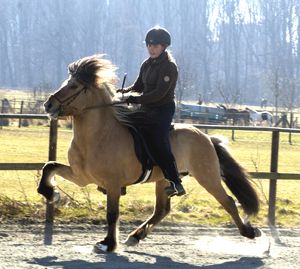
It was nearly impossible to get Helgar to canter or gallop (drumming our heels into his felted side was useless). At best it was a rough valhopp—with one end of the horse cantering and the other end trotting. If we were lucky, he would break into a high-stepping tölt (a smooth running gait), or a flugskeið, (flying pace) and when the horses left him in the dust, he'd come up from behind, all worried, nostrils flaring, as if to say, “Hey, what’s the big rush?”

An Icelandic horse’s rapid ambling gait known as the tölt (Wiki)

There was an ornery jugheaded sorrel Standardbred named Brandy I sometimes rode (I had to get past his teeth to mount him. I didn’t have my own horse at the time, so I got the ones nobody else wanted to ride). Brandy, a retired racing harness horse, heavier than a thoroughbred, must've stood at 18 hands, while Helgar was a mere 12 hands tall. Brandy was no legendary Dan Patch—who never lost a race, but he could really trot. The two horses looked ridiculous earnestly pacing side by side.

Helgar's fierce pacing was very distinct. I can still see him in my mind's eye with his head thrown back, fetlocks flashing out like hairy pistons, matching Brandy stride for stride. However, it wasn’t a comfortable ride, not like being on a Peruvian Paso Fino.

Helgar really had a thick skull, not refined like the modern Welsh pony who might carry an Arabian gene or two—though they had the same ancestor, the extinct Celtic pony, of which, the Exmoor pony is said to be the closest relative. (See also the endangered Iberian Sorraia—with distinctive DNA—ancestor to the Spanish mustang, the Galician, the Garrano/Minho and the Austurcón ponies).

Helgar also had long guard hairs on his fetlocks and jaw, and an unruly mohawk mane —like the prehistoric horses in the Cro-Magnon cave art of Altamira and Lascaux. When winter set in, he looked like a hefty hamster, his coat was so thick—he never adapted to mild California winters.

Cave painting of a dun horse from LascauxFrance ca. 15,000 BC (Upper Paleolithic). Wiki

Helgar refused to go in a barn or paddock shelter, preferring to stand in the downpour. From beneath a shaggy dun coat, he’d peer our at us with bright beady eyes, rain running right off him. We thought he was a little daft as we got 45 to 60 inches of rain, and frost too. Not like in Iceland, of course, but cold enough to freeze the ground.

Helgar was a summer camp pony, so he was probably picked up at an auction somewhere during the early 1960s. Gregg's Forest Farm Summer Camp leased out their horses to us locals from September until June. Brenda, who lived right below Gregg’s Camp, had first pick. It was always Helgar. When the Fullicks move into in the Sutton's old house on Arroyo Road, I lost my playmate, Pete. My world crumbled. But I gained a good riding friend.

Brenda was a couple of years younger than me and a bit mercurial. But her foster mom, the tall willowy blonde Judy Fullick, who was badly burned in a fire, and my mom were once good friends. I don't remember the story about how Judy got burned, there was a bit of a mystery to it. I do remember that there were two Judys in the Valley, the other Judy was Steve's mom, Judy Tristano. In those day, Pete and Steve were best friends. They wouldn't always play with me because I was a girl but when they went to the treefort up the hill, I traipsed behind them.

I ignored Brenda (who was younger than me) for ages, but my enduring love of horses led me down many diverse roads. Brenda and I became friends, united by our love of horses. She was somebody to ride with. Each fall, Brenda always got Helgar from Forest Farm Camp, so he was her de facto horse, except for during the summer months when inner city kids rode him—or tried to.

Helgar got a kick out of bucking those city slickers off, so come September, Brenda had to show him who was boss all over again. His buck, more like a rocking horse than a bronco’s, was all for show. I suspected his bouts with precipices were also for show. He was some kind of pony. A real wing borrower.

Sunday, July 25, 2004

Letter to Sigrun in Iceland (Helgar the Horrible)


Icelandic Horses in the rain mic@vikinghorse.freeserve.co.uk
Sigrun,

Alas I have no photos of Helgar the Horrible, who by this time is probably in Icelandic horse heaven! He was a gelding, not a stallion. I suspect that's why he was allowed to come to the US in the first place, no danger of gene pool problems.

He was unusual, some of his behavior was unlike that horses. Closer to pony or donkey behavior. Unlike the donkeys, he was not revengeful & didn't carry a grudge. BUT you never knew quite what to expect from him. He wasn't as wily as the Shetlands. Boy was he sometimes thick-headed: both metaphorically & literally! He once tried to take me right through a water tank. Guess physics wasn't his strong point... We never quite knew what made him tick. He was pretty enigmatic. Sometimes his brakes didn't work right so we never knew what to expect....

He was surefooted...except whenever he had a momentary lapse with physics, that is. He never needed shoeing, his hard hooves were like flint. You could ride him all day long and he never would tire, no matter how steep the mountain, and believe me, we rode hard. We took our assorted ponies, horses, donkeys and an occasional lonesome stunted (dwarf) bull calf named Mr. Smitts out for miles over the steep coastal ridges of Marin County, Northern California, as far as Point Reyes national seashore, and Bolinas (from Forest Knolls)... (we called the bull calf that because he was smitten by our Shetland ponies, and didn't know he was a bovine... which was downright embarrassing in the spring when his hormones began to run... he'd hop up right behind me, and the danger of being impaled in the back by his horns was...but I digress.)

Wednesday, September 26, 1984

MONET AT DUSK

MONET AT DUSK
‘An artist!’ replied the man, ‘How I have captured you
galloping across the bridge like a wild pony.’
—from THE LOST PONY
—for Duane BigEagle

In a book I found a photograph of a small child—
Was it you? Beyond the edge of the page,
horses dragged wet wings across the night sky,
in search of other continents, with you hidden in their folds—
as color from a tube, as a brush to canvas—like a Monet at dusk.
Beneath our hooves, the grey cobblestone clattered;
the streets of Paris glistened with rain
as we scattered buildings reflected in puddles.

Last time I saw you, you were painting the Seine.
I remember how the color blue
slowly became the most important thing in the room
when she asked who you were sleeping with.
We balanced on the worn enamel tub;
the incessant dripping of water wore us down.

Sometimes I dream of another country,
I was homesick—the barking dogs reminded me of home.
I was homesick for my native tongue.
Do you remember the clouds?
You rode across my body;
I thought of the chipped porcelain of her breasts.
All this longing for home.
What of the mother of your son?

Once our ponies stamped a platform in the snow;
their frozen breath rang like small bells
falling in the fragile air.
On the Oklahoma plain,
the dark comma of a buffalo in snow
hyphenates death in winter,
and abbreviates the distance
of lean bellies toward spring.
I’ve kept a lock of hair all these winters
in case you needed strength,
but you were gone like a wild pony.

I remember the places we’ve never been,
and the vastness of the prairie, because Paris
opened up its sky, lost snow turned to rain—
the puddles captured and reflected buildings
scattering like horses rising on the wing.

9/26/84
Petaluma