Some of my retro 1980s Russian River Poison Oak Festival photos from The Paper were published in the Press Democrat. Daylighting these old negatives is always good. Thank you Maci Martell.
Showing posts with label West Sonoma County Paper. Show all posts
Showing posts with label West Sonoma County Paper. Show all posts
Thursday, March 23, 2023


Monday, February 6, 2017
Facebook memory: photo shoot with Richard Salzman, take one and a half
 |
| Seeking chronological order, I posted a version of this story but this was written in 2017. |
So I went to see my neighbor Richard Salzman and he said Just use yourself. I set up the lighting on a music stand, and the camera on a tripod, set the focal plane, shutter and aperture, and hoped for the best. (No light meter, just my jaundiced eye.) It's sort of an assisted selfie. Of course, you can't go wrong with a Hasselblad. Incredible glass. Large format negatives were more forgiving, you could practically use then as contact prints, as is.
The Paper (North Bay Bohemian) editor Nick Valentine would loan his camera to me from time to time. The camera was worth the price of a small country. I quaked whenever I used it. I never expected Nick to use the photo for The Paper, but he did. That's Richard Salzman tickling the ivories, in Forestville. Late 80s?
Now, our cabins were the size of a minute. You had to go outside in order to change your mind. Richard moving his piano into that cabin was a major feat of ingenuity. So we were also fighting physics too, to get the distance, and most of my body into the frame. I had to shoot it from the corner of the bed.
You know, it's funny, but I had no real sense of self, or how I looked to others—my inner dialogue was always nattering on, telling me that I was homely as a mud fence. My tall, leggy aunts and mother were the gorgeous creatures. My Aunt Jane was the Gallo Girl on the back of the Sunday Funnies, and Time Magazine. I was indoctrinated at an early age not to be vain, or focus on my looks, etc. And the girls in school were seriously cruel, as a rule of thumb, always making fun of me, because I was from the San Geronimo Valley, and wore hand-me-downs, etc. So glad when the hippie movement rolled in, because it no longer mattered what we wore. Liberating.
I was not a fan of the mirror either. I once made the mistake of looking at myself at Judy Soga's house—after someone had slipped me some acid Koolaid earlier that afternoon at the Kent Lake spillway, and let’s just say it was a long, rough ride. Took me years to get over that trip. The Pinnochio nose slidehsow didn't help. I drank a whole lot of it, as it was a hot day at the spillway.. I was stratospheric for a solid week. My ride was a darker turn of the soul as well. Why I am glad the heaviest stuff I ever tried was peyote. Hitching out the The Valley after peyote tea, I swear I saw the ghosts of Miwoks by the golf course.
Speaking of print ads, Bill Deutra, the Marlboro Man, lived right across from me, lovely man, full of stories, the KS ravaging his handsome face. He'd take me out tea dancing in Guerneville. Told me about JEdgar's propensity for cross-dressing. I know the feeling. I felt like I was (reverse) cross-dressing in this photo. Out of character, out of soul depth, charging right ahead into the abyss. I was madly in love with poetry itself, the rest was ephemera.
Photo shoot with Richard Salzman, 1981, long and winding musical version, Take two

I was doing a photo shoot, a double truck spread on fashion, which was one of my weirdest assignments ever for The Paper, (so not my thing), and I needed one more image...my models were flighty young creatures from my poetry class at El Molino High School, were gone for the evening, and I was the last one standing in the field at deadline. Dreadline. I set up the lighting on a music stand, and the camera on a tripod, set the focal plane, shutter and aperture, and hoped for the best. (No light meter, just my jaundiced eye.) It's sort of an assisted selfie.
I had these huge 200-watt bulbs that I stuck into aluminum reflector lamp shades with clippies. Seriously low tech. I used Tri-X, with a slow shutter speed, wide open aperture, and pushed the film in the developing process. Almost no post process. Grey scale was all there. Of course, the Hasselblad negative film was so big, it was practically like making a contact print.
Of course, you can't go wrong with a Hasselblad. Incredible glass. Large format negatives were more forgiving, you could practically use then as a contact print, as is. The Paper (North Bay Bohemian) editor Nick Valentine would loan it to me from time to time. The camera was worth the price of a small country. I quaked whenever I used it. I never expected Nick to use the photo for The Paper, but he did. I remember I was mortified at the time. I really didn't think Nick would go for it... I still have some of the half-tones from some of my photos. In some cases, the half-tone is the only copy I have.
I did clean up nicely from time to time. But I preferred old clothes to new duds. I wound up keeping the outfit, and used it to land a couple of jobs. I still had a waistline and my boobs weren't frequent flyers. I love thrift stores. My grannie and mother were both seamstresses, so I learned to sew at an early age. I was relieved when the hippie look became popular. So much less stress. I will NEVER wear panty hose again. Just sayin'. My friend Lee Perron said I used to dress to challenge—whatever that meant, other than wearing lingerie long before Madonna was a household word.
That's Richard Salzman tickling the ivories, in Forestville. Late 80s? They don’t shoot piano players, do they? Ken Bullock said that I looked like a torch singer. At the time, my favorite torchiere song in those days were My Funny Valentine, Stormy Weather and Stormy Monday.And Ewan McCall's First time ever I saw your face, a tribute to Peggy Seeger knocked me stone cold with its beauty. But there's that little thing called words. And the notes, they all have to line up exactly. I was never good at that. I get too nervous and it all flies out the window. My Torchiere amore, you're the one that I adore...
Even Don Coffin chimed in on my thread. We'd all go nuts whenever he drove up the Celli driveway in that big green caddy with all that chrome grille, ‘cuz it meant the craic was on. Don would step out with his fancy cowboy boots and mandolin. An Irish saying, means to part-ay on like there's no tomorrow! Don always traveled with some musical instrument or other. And Paul was a switch-hitter, he could go either classical or bluegrass.
Sone incredible music sessions at the cabins with Paul, Alistair Ingram, and Richard Salzman on the flute, because he couldn’t drag the piano out into the driveway, which was our communal living room, because there wasn’t a cabin big enough to hold us all. I asked Don if he was with Kate Wolf when she was living in Forest Knolls. I just remember her white ford falcon stationwagon parked in front of the Forest knolls USPO, not much else.
A high school friend, Toni Tierney commented on my photo saying it’s a Stevie Nicks look. Funny she should say that, I used to clean house for one of the band members—tall guy with an English accent. was it Fleetwood Mac himself? Dunno. They lived behind The Drake Club in Fairfax. Still trying to piece together that memory. Wish I could sing like her. I can still see the inside of the house in my mind's eye. They had an adorable toddler. The man was lovely, offered me tea, but she was a cold fish.
I didn't last long as a housecleaner for Fleetwood Mac. The blonde just didn’t like me. But they turned me onto some good music. Probably the first time I ever listened to a lot of Fleetwood Mac. Rhiannon became my favorite song. Weirdly, they turned me on to Michael Franks. He had me at those popsickle toes. I hear they're planning to buy the old recording studio in Sausalio. LOL. Toni confirmed that it was Fleetwood himself—and they probably paid me with checks too...Talk about autographs. But I was never into the fame thing.
You know, it's funny, but I had no real sense of self, or how I looked to others—my inner dialogue was always beating me up and nattering on that I was homely as a mud fence. I was a tortured angst-ridden soul. (Still am). At Lagunitas school, Jimmy Bohman taunted me, called me Skinny, and Flaca. Cruel kids. And trying to fit in at Drake high school, just wasn't within my skill-set. Those were miserable years. Thank god for art. It literally saved me. And my horses. Always the horses. Riding alone along the ridges of Mt. Barnabe brought me solace and refuge from the savage world.
I’m still not a fan of the mirror either...made the mistake of looking at myself at Judy Soga's house—someone had slipped me some acid Koolaid that afternoon at the spillway, and it was a long, rough ride. Took me years to get over that trip. The Pinnochio nose slidehsow didn't help. Yeah, my ride was a darker turn of the soul. Hitching out the The Valley after drinking some peyote tea, I swear I saw the ghosts of Miwoks at the Nicasio turn-off, by the golf course. Must’ve been Geoff Davis’s doing. He said he used to see their ghosts there by the pond. Said there was a village there. I never could shake that image. Window to the past.
I was certainly indoctrinated at an early age not to be vain, or to focus on my looks, etc. And the girls in school were seriously cruel, as a rule of thumb, always making fun of me, because I was from The San Geronimo Valley, I wore hand-me-downs, etc. So glad when the hippie movement rolled in, because it no longer mattered what we wore. Liberating to finally be ourselves in a massive hippie crowd.
My aunts and mother were the gorgeous creatures. My Aunt Jane was the Gallo Girl on the back of the Sunday Funnies, and Time Magazine. Speaking of print ads, Bill Deutra, the Marlboro Man, lived right across from me, lovely man, full of stories, the KS ravaging his handsome face. He'd take me out tea dancing in Guerneville. Told me about JEdgar's propensity for cross-dressing. I know the feeling. I felt like I was (reverse) cross-dressing in this photo. Out of character, out of soul depth, charging right ahead into the abyss. I was madly in love with poetry itself, the rest was ephemera.
2/2017
Added 2/20
Monday, October 6, 2014
The Value of Poetry: Pure Gold
After I sent out a zany email to the Press Democrat to cover our upcoming California Poets in the Schools symposium, Voices of Gold, they decided to write a little feature on me instead. Oops. I became the news. Last time the PD did a story on me, the Loma Prieta earthquake struck. The next time I had something big and newsworthy, 9/11 happened—just as I was going out the door to the Marin Poetry Center reading, and the coffee table book I was promoting, Writing the Rails—Best Loved Train Stories (Black Dog & Leventhal), was remaindered before it was released. Third time's a charm? These are my soft notes. It will be interesting to see how it will be shaped. It has a Sonoma County slant as those are the newspaper demographics. It took me two days to write this—like a cat writing my way out of a paper bag. Of course, now that I've sent it in (too late now), I see all kinds of rough segues, errors, and bits in need of revision. It is what it is...
What is the value of poetry?
The doctor poet-William Carlos Williams wrote: 'It is difficult to get the news from poems, yet men die miserably every day for lack of what is found there.” Poetry allows us to examine our emotions and and contemplate our thoughts. Wordsworth scribed: “Poetry is human emotion recollected in tranquillity.” Not that there’s much by way of tranquillity to be had during this day and age. In the process of recollection, poetry gives shape and form and meaning to those constantly chattering voices inside our heads, and renders them into an art form.
What can poetry accomplish that prose cannot?
Prose is to poetry as math is to music—you need both—but prose is analytical, expository, and tends toward the utilitarian. Poetry is like dancing with words. Poetry gives shape to our innermost feelings, and presents them in a tangible art form that others can enjoy, and get the Aha! epiphany. The ancient Greeks dubbed poetry as the mother of all arts. During a poetry lesson on “If…,” one of my kindergarten students at San Miguel School stood up and proclaimed: “If I were king of the universe, I’d dance for a living.” He got the Aha! moment.
Ironically I hated the study of poetry when I was young, because I didn't get it. I have dyslexia—which was part of the problem. But I was looking at form versus content, or meaning. As a writer, I’m not a big fan of metered verse, though we tend to speak in iambic stress. It took me a long time to make that full circle—which is ironic in that I coach high school students to recite poetry for the Poetry Out Loud competition.
CPITS poets create a personalized a standards-based grade level curriculum (California history, the ancient world, water cycles, or health ed.,) and infuse it with magic and mystery, often marrying theatre, music and visual arts with the literary arts.
How does the CPITS program capture—and hold—a child’s interest?
Through the immediacy and approachability of our CPTS poetry lesson plans, we offer poems from the great body of literature, as well as peer student poems, as models. It’s a mirroring process. We write our own poems based on other poems.
Imagine being a student cut off from writing about your feeling and thoughts. With the current state curriculum standards, most student writing is expository, or fill in the dots, and there’s no room for creative self-expression. Then imagine these wild poets who come along, they take language, they damsel it up and shake it all about. Suddenly that stuffy poetry is equal parts theater and soap-box pulpit, coupled with innermost feelings fueled by wild imagination—and suddenly it’s all fun.
Most kids discover that writing their own poetry is liberating—especially those kids who traditionally don’t do well in school, or have trouble accessing the language arts curriculum. Because there’s no right or wrong way to write poetry, it’s a place where they can excel. Then, their poems are published in a school handout or a book—and suddenly poetry matters.
Suddenly you’ve kids with a vested interest in getting every word right, and every simile and comma in its exact right place. It happens like that. I was teaching in a tough East Oakland inner-city school where a fifth grader, Franklin, my star poet, was expelled. As he cleared out his desk, he eavesdropped in on the poetry lesson. He put his stuff down, grabbed some paper out of the trash, and madly wrote an amazing stream of consciousness poem that was later published in our 2012 CPITS anthology, Turning into Stars.
I wish there was a CPITS residency offered when I was in school. Since CPITS was founded in 1964, it could’ve been technically possible. It would’ve changed my entire relationship with school and with poetry. About the time I began to write poetry, I was also diagnosed with dyslexia. There’s a reason why I had so much trouble in school, and why did I have to wait until I was 30 to discover that I loved to write?
When traditional education failed, poetry taught me to think, and I went on to write essays and arts grants—I had seven California Arts Council artist-in-residency grant at Mark West School in Santa Rosa. And I became a feature writer for the Sonoma County Stump as well as for the West Sonoma County Paper (now the North Bay Bohemian.) None of it would’ve happened if I hadn’t discovered poetry.
The reason why I’m in the classroom, is that, as a poet, I’m a role model. I can reach those kids who traditionally fall through the cracks, and show them how they can access their minds. Poetry creates a powerful tool for change and self actualization. A former student from Mark West School, who didn’t think poetry was important, called me up at midnight to read me a poem he’d just written out of the blue. Scott Meisner was a 21-year-old college student with a MBA who finally got the Aha! moment when he realized that poetry matters.
If the program isn’t at my child’s school, how can I help bring it there?
The best way to get poetry into the schools is usually through a parent volunteer, the PTA, or a teacher. At Alexander Valley School, a teacher, Peggy Maddock, brought poetry to the school—and now first grade teacher Shannon Hausman continues the tradition. Since 1991, I’ve taught an entire generation of Alexander Valley kids poetry.
There are numerous school and community funding sources that can be utilized to fund a CPITS residency. We are trained to work with teachers to locate and develop funding sources: including specialized school funds—from gifted and talented, youth at risk, library funds, etc; to state and local arts education resources: the Community Foundation of Sonoma County, and the California Arts Council. We’ve become gifted grantwriters in the process.
During this time of dire funding for the arts, we’ve some great breaking news: thanks to a California Arts Council /Artists in Schools grant, Sonoma County CPITS poets will offer long-term, in-depth poetry writing residencies at four schools in Sonoma County. Contact the Sonoma-Napa CPITS Area Coordinator Meg Hamill, megmariehamill@gmail.com, or the San Francisco CPITS office info@CPITS.org, (415) 221-4201, for more information.
CPITS, a collective of professional poets who bring literary craft into classrooms statewide, is one of the nation’s oldest visiting writers program—and this weekend we’re celebrating our 50th anniversary October 10-12 at IONS Earthrise Retreat on the Sono-Marin border. If you’re an artist and want to work in the schools, or you’re a teacher interested in enriching your language arts curriculum, our CPITS Symposium, Voices of Gold, is an excellent resource and training ground. We’ve ten more spaces open for day-use folks, either Saturday, or Saturday and Sunday. Two more IONS rooms just opened up if they need to stay over. The view from the ridge is breathtaking and the food is fabulous.
Our keynote will be former California Poet Laureate Al Young. On Friday, an intensive “method writing” workshop will be led by Los Angeles poet and screenwriter Jack Grapes. The symposium will also features spoken word artist Josh Healey and visiting poets from around the state who will share proven strategies to deliver hands-on and out-loud poetry in schools.
If you’d like to become involved as a teacher, poet, donor or school, please find us on the web at www.cpits.org to help build the future for young writers in California. Statewide CPITS residencies reach more than 25,000 students, and trained CPITS poets offer time-tested teaching tools to enhance literacy, and foster creative problem solving and self-expression. Poetry workshops are held at public and private schools, juvenile hall, libraries, after-school programs, hospitals, multilingual settings and other community venues.
And if you can’t come to the symposium, you might want to order our inaugural CPITS lesson plan book, “Poetry Crossing: 50 Lessons for K-12 Classrooms.” Edited by former CPITS AC, Phyllis Meshalum of Sebastopol, it’s a large format ready-to-roll writing lesson ideas for all ages.
Friday, July 12, 2013
Protesting at the Grove
Hot July on the Russian River. Land of bathers and boaters. Land of barbecues and Bohemians. Resort towns and summer homes abound on the river from Forestville, Rio Nido, Guerneville, Monte Rio, Duncan's Mills, to Jenner.
The Bohemian Grove, is a 2700-acre encampment with permanent dwellings. It's also the screening site for potential new members nominated during Spring Jinks, in June. Forty-year members, called "The Old Guard," are the gatekeepers.
What began as Midsummer High Jinks, the Bohemian Club's cultural centerpiece, where poems were once recited, songs sung, and dramatic readings given under the redwood trees, has, over the decades, devolved into the spawning ground of global politics.
The Bohemian Grove's annual commencement ceremony, a theatrical production, the Cremation of Care, commemorates the burning of an effigy of "Dull Care" on an altar of a 40-foot stucco owl, by hooded Druids, kicks off the encampment. Instead of allegorically banishing worldly cares, and the informal "Lakeside Talks," have fostered an abuse of political power. Guest speakers have included Henry Kissinger to Helmut Kohl. The virtues of lyric poetry was the farthest thing from their minds.
The Grove is a place where many political webs are spun, and it's the birthplace of warmongering projects from the Manhattan Project, to the Gulf War, and the invasion of Iraq. Policies made inside the Grove affect the outside world. The decision to drop the A-bomb on Hiroshima was made at the Grove.

The year when the Chancellor of West Germany Helmut Kohl was guest speaker (I'm still trying to anchor the date—ca, 1982-85), rent-a-cops were brought it. Things quickly got ugly. With camera in hand, I documented the event for The Paper, but they came for me too. As I outran the law, I was clubbed from behind between the shoulder blades.
Judi Bari of Earth First! fame, was one of the eco-activists who worked for the alternative newspaper, generically called The Paper, (later dubbed The West County Paper, then the Sonoma County Independent. Now it's The North Bay Bohemian). Talk about full circle!
Perhaps the lights I saw were of the Clubhouse designed by Bernard Maybeck the site of the 1942 Manhattan Project planning meeting. The top secret project that would lay claim my mother's first cousin's personal life, and then, later, her life, via cancer. Certainly, they were ghosts.
Not much to tell, it was during the early 1980s, AIDS was still undercover, so I took my Olympic swimmer home. He was sleek as a seal. We did the backstroke and the butterfly and the breaststroke. No speedos were harmed in the process. I dropped him off at the gates at dawn. Was I sleeping with the enemy?
All that water under the bridge.
The Russian River is also summer home to the Bohemian Grove encampment, sponsored by San Francisco's Bohemian Club, a private men's enclave, founded in 1872. The club's mascot is an owl, and their motto is "Weaving Spiders Come Not Here." The idea is that you leave your cares behind.
Imagine upwards of 3,000 big-wig male guests descending upon an old sawmill and camping out. That's the Bohemian Grove encampment. The Bohemian Club guest list has included every Republican and some Democratic presidents since 1923, and myriad cabinet officials. Add CEOs of large corporations, oil magnates, financial institutions, banks, military contractors, utilities commissions, and the national media. Let's just say a whole lot of in-bed friendships are forged at the Grove.
Members of the once arty Bohemian Club were comprised of journalists, painters, pianists, and poets. Now, membership is comprised of local and global leaders, politicians, and businessmen—who are entertained by the Bohemians—those self-same artists and musicians who originally founded the club.
Imagine upwards of 3,000 big-wig male guests descending upon an old sawmill and camping out. That's the Bohemian Grove encampment. The Bohemian Club guest list has included every Republican and some Democratic presidents since 1923, and myriad cabinet officials. Add CEOs of large corporations, oil magnates, financial institutions, banks, military contractors, utilities commissions, and the national media. Let's just say a whole lot of in-bed friendships are forged at the Grove.
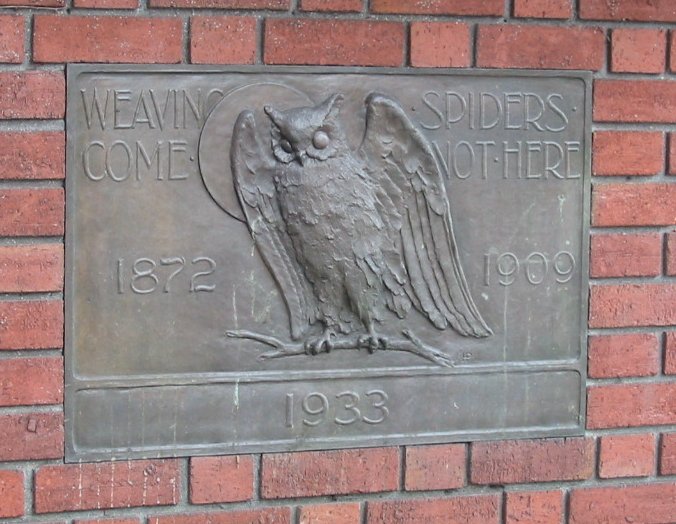 |
| Weaving spiders come not here—inscription with an owl mascot on a bronze plaque at Taylor & Post Streets, San Francisco |
 |
| Bohemian tent, 1900s, Porter Garnett, George Sterling, Jack London —Wiki |
Summer camping in the North Bay is a fine old San Francisco tradition. In fact, most city folks moved en masse to the river for the summer. (Probably trying to escape the fog.) Grand hotels like the Monte Rio, were vast summer palaces. The river was jammed from shore to shore, from beginning to end, with campers.
The first Bohemian Club campout was at Taylorville (Samuel P. Taylor State Park), in West Marin, a little over a hundred years ago, in 1878. That's right down the creek from where I grew up on the Lagunitas/Forest Knolls border.
The Bohemian Club campout began as a rousing thespian send-off for founding member, Henry "Harry" Edwards, a stage actor (and entomologist) headed for the New York stage. The liquor flowed wild and free, men flubbed their lines, a rousing good time was had by all, and a hundred drunken men slept it off under the redwoods. It's amazing the Japanese paper lanterns didn't burn the place down. Harry went east, but such a good time was had by all, thespian camping became an annual tradition without Harry.
Why Camp Taylor, you might ask? The name of the creek should give you a broad hint: Papermill. Rags from the city arrived by train, watermills pulped them into paper, which was sent back to the city for the newspapers, mint currency and so on. The Bohemian Club was founded by newspapermen.
Because of train access, Camp Taylor was also a popular summer destination and so many folks camped all along the length of Papermill (or Lagunitas) Creek during the summer, it was a zoo. (And a cesspool, too, I would imagine.)
When the Bohemian Club's camp outgrew Camp Taylor, it moved south to Muir Woods in the 1900s, where it picked up the moniker Bohemian Grove. (There's a plaque for that.) The Bohemian Club scouted out new locations along the Russian River, and moved summer camp to a redwood stand at Duncan's Mills, near the mouth of the Russian River, before settling permanently in the Meeker Sawmill in Monte Rio in 1893.
The first Bohemian Club campout was at Taylorville (Samuel P. Taylor State Park), in West Marin, a little over a hundred years ago, in 1878. That's right down the creek from where I grew up on the Lagunitas/Forest Knolls border.
The Bohemian Club campout began as a rousing thespian send-off for founding member, Henry "Harry" Edwards, a stage actor (and entomologist) headed for the New York stage. The liquor flowed wild and free, men flubbed their lines, a rousing good time was had by all, and a hundred drunken men slept it off under the redwoods. It's amazing the Japanese paper lanterns didn't burn the place down. Harry went east, but such a good time was had by all, thespian camping became an annual tradition without Harry.
Why Camp Taylor, you might ask? The name of the creek should give you a broad hint: Papermill. Rags from the city arrived by train, watermills pulped them into paper, which was sent back to the city for the newspapers, mint currency and so on. The Bohemian Club was founded by newspapermen.
Because of train access, Camp Taylor was also a popular summer destination and so many folks camped all along the length of Papermill (or Lagunitas) Creek during the summer, it was a zoo. (And a cesspool, too, I would imagine.)
When the Bohemian Club's camp outgrew Camp Taylor, it moved south to Muir Woods in the 1900s, where it picked up the moniker Bohemian Grove. (There's a plaque for that.) The Bohemian Club scouted out new locations along the Russian River, and moved summer camp to a redwood stand at Duncan's Mills, near the mouth of the Russian River, before settling permanently in the Meeker Sawmill in Monte Rio in 1893.
The Bohemian Grove, is a 2700-acre encampment with permanent dwellings. It's also the screening site for potential new members nominated during Spring Jinks, in June. Forty-year members, called "The Old Guard," are the gatekeepers.
What began as Midsummer High Jinks, the Bohemian Club's cultural centerpiece, where poems were once recited, songs sung, and dramatic readings given under the redwood trees, has, over the decades, devolved into the spawning ground of global politics.
 |
| The Owl Shrine and the lake— a man-made pond. —Wiki |
The Bohemian Grove's annual commencement ceremony, a theatrical production, the Cremation of Care, commemorates the burning of an effigy of "Dull Care" on an altar of a 40-foot stucco owl, by hooded Druids, kicks off the encampment. Instead of allegorically banishing worldly cares, and the informal "Lakeside Talks," have fostered an abuse of political power. Guest speakers have included Henry Kissinger to Helmut Kohl. The virtues of lyric poetry was the farthest thing from their minds.
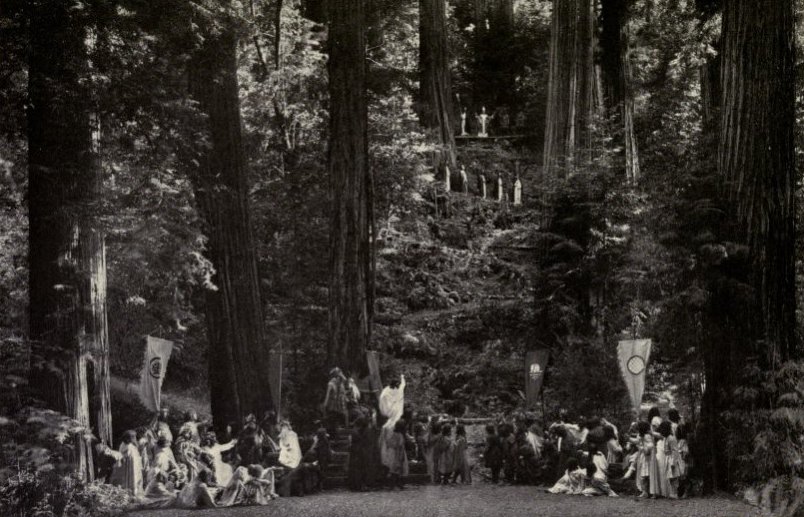 |
| A dress rehearsal for the 1909 Grove Play, St. Patrick at Tara —Wiki |
 |
| Maynard Dixon's illustration of the 1909 Grove Play St. Patrick at Tara, the spirit of Irish hero Cuchulainn appears to Saint Patrick among the Redwoods. —Wiki |
The Grove is a place where many political webs are spun, and it's the birthplace of warmongering projects from the Manhattan Project, to the Gulf War, and the invasion of Iraq. Policies made inside the Grove affect the outside world. The decision to drop the A-bomb on Hiroshima was made at the Grove.
 |
| Cremation of Care in 1907 -Wiki |
See Bohemian Grove Through The Years. (Press Democrat)
The twin Bohemias: I grew up in Forest Knolls, and came of political age in Forestville. I traded one forest for another, but unlike many a frequent Grove camper, peeing on the trees—like Governor Reagan who famously quipped, "If you've seen one redwood, you've seen them all," I could see the forest and the trees. Some pretty tall Paul Bunyon tales got their bullish start at the Grove by leaving the Babe home. Some say more like Moloch.
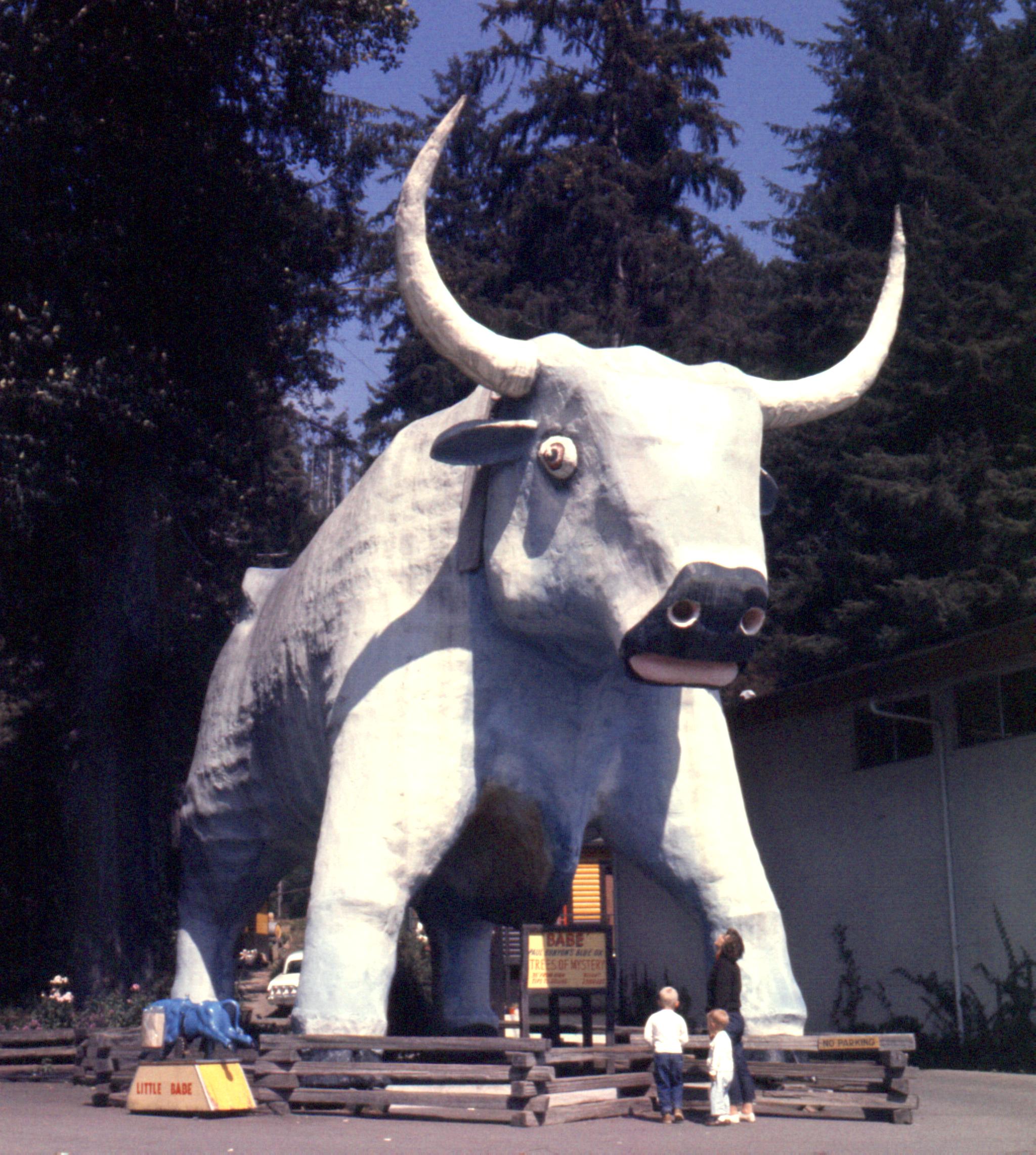 |
| Babe the Blue Ox, Trees of Mystery, Klamath, CA —Wiki |
Fishing for stories, Paper reporter, Simone Wilson and I once posed as hookers at the Northwoods Lodge as the Boho campers furiously slaked themselves on our side of the river. There were FBI (replete in pencil pants and white socks, just like in the movies) and infamous San Francisco hookers. Only there were no cameras that night. Stealth cameras, maybe.
Frowsy redheaded Rose, the madam, carrying on the Barbary Coast tradition of prostitution during the 1980s, refreshed her lipstick in the mirror, looked me in the eye and said: I don't know who you gals are working for, but there's a bust going down tonight.
Frowsy redheaded Rose, the madam, carrying on the Barbary Coast tradition of prostitution during the 1980s, refreshed her lipstick in the mirror, looked me in the eye and said: I don't know who you gals are working for, but there's a bust going down tonight.
I was oddly flattered that Rose thought I was the real deal, but then, my mom once worked for Sally Stanford at The Valhalla —as a cocktail waitress. I had the best models.
Margo St. James of COYOTE spoke to our Women's Studies class at College of Marin in the early 70s, and I've read poetry with Carol Leigh AKA Scarlot Harlot, who coined the term, sex worker. So I could namedrop and not blow my cover.
Should I have confessed to Rose that I was working undercover, not under the covers? (The S&L bust was coming to a head at Manu Khomeini's lodge. Yes, a nephew. The family jewels reached that far.)
Margo St. James of COYOTE spoke to our Women's Studies class at College of Marin in the early 70s, and I've read poetry with Carol Leigh AKA Scarlot Harlot, who coined the term, sex worker. So I could namedrop and not blow my cover.
Should I have confessed to Rose that I was working undercover, not under the covers? (The S&L bust was coming to a head at Manu Khomeini's lodge. Yes, a nephew. The family jewels reached that far.)

Earlier that day, Marin poet Karla Anderdatter of The Butterfly Tree, drove up from Muir Beach and met us on the Monte Rio Bridge for a protest staged outside the Grove as the campers drove in.
Camp Meeker's Mary Moore, a former beauty queen, and founder of the Bohemian Grove Action Network, and SoNoMore Atomics, rallied us on the bullhorn, declaring it a "Weapons-Free Zone" as the Bohemians barrelled through the gate.
Mary's encampment (founded ca. 1980) outside the gates to the Grove, and counter-ceremony was called the "Resurrection of Care," as a foil to the Cremation of Care. It was a reverse exorcism of the Demons. Mary rightly surmised that club members with corporate interests adversely influenced government.
Mary's encampment (founded ca. 1980) outside the gates to the Grove, and counter-ceremony was called the "Resurrection of Care," as a foil to the Cremation of Care. It was a reverse exorcism of the Demons. Mary rightly surmised that club members with corporate interests adversely influenced government.
The year when the Chancellor of West Germany Helmut Kohl was guest speaker (I'm still trying to anchor the date—ca, 1982-85), rent-a-cops were brought it. Things quickly got ugly. With camera in hand, I documented the event for The Paper, but they came for me too. As I outran the law, I was clubbed from behind between the shoulder blades.
Judi Bari of Earth First! fame, was one of the eco-activists who worked for the alternative newspaper, generically called The Paper, (later dubbed The West County Paper, then the Sonoma County Independent. Now it's The North Bay Bohemian). Talk about full circle!
They're mostly all gone now, these wild wolf women. Somewhere I have the negatives to prove it. Somewhere.
Someone asked: did we cross the river? We did the next best thing, we went skinny-dipping, and Bohos came over to our side of the river to slake their thirst. The famous optometrist returning from Russia. Nothing wrong with his eyes. Leering at our young flesh, he fed us the news in drips and drabs.
There were many allegedly said's in Simone's news story on Helmut Kohl's Lakeside Chat. Me—I hardly knew who he was. I was always finding out the facts after the fact. But I was the photographer. No big deal.
That night, while we were angling for more story at the oasis, someone asked: would you like to go into the Grove? A US Olympic swimmer, friend of Mark Spitz, was working there as a Camp Valet. (I don't remember which camp. Owl?) So, I dropped my cover and we blew the joint.
What was his name: Mike Stamm? He broke a world record for the backstroke. He also could've been lying. Pre-internet. Somewhere I have notes. Somewhere. He took me quite a ways into the grove after midnight. Not much to see in the dark. A large parking lot. Lights in the distance. Some passionate kissing in the back seat.
Someone asked: did we cross the river? We did the next best thing, we went skinny-dipping, and Bohos came over to our side of the river to slake their thirst. The famous optometrist returning from Russia. Nothing wrong with his eyes. Leering at our young flesh, he fed us the news in drips and drabs.
There were many allegedly said's in Simone's news story on Helmut Kohl's Lakeside Chat. Me—I hardly knew who he was. I was always finding out the facts after the fact. But I was the photographer. No big deal.
That night, while we were angling for more story at the oasis, someone asked: would you like to go into the Grove? A US Olympic swimmer, friend of Mark Spitz, was working there as a Camp Valet. (I don't remember which camp. Owl?) So, I dropped my cover and we blew the joint.
What was his name: Mike Stamm? He broke a world record for the backstroke. He also could've been lying. Pre-internet. Somewhere I have notes. Somewhere. He took me quite a ways into the grove after midnight. Not much to see in the dark. A large parking lot. Lights in the distance. Some passionate kissing in the back seat.
 |
| Manhattan Project —Wiki |
Perhaps the lights I saw were of the Clubhouse designed by Bernard Maybeck the site of the 1942 Manhattan Project planning meeting. The top secret project that would lay claim my mother's first cousin's personal life, and then, later, her life, via cancer. Certainly, they were ghosts.
Not much to tell, it was during the early 1980s, AIDS was still undercover, so I took my Olympic swimmer home. He was sleek as a seal. We did the backstroke and the butterfly and the breaststroke. No speedos were harmed in the process. I dropped him off at the gates at dawn. Was I sleeping with the enemy?
All that water under the bridge.
Wednesday, December 5, 2012
Take Five, Dave!
If you make a mistake in jazz, you don't give up. You work it into the next line, so it isn't a mistake —Dave Brubeck, December 6, 1920 - December 5, 2012Jazz musician Dave Brubeck thought he was going to be a cowboy when he grew up. He was born and raised on a ranch in Concord, and at age 11, his family moved to a 45,000-acre ranch in the Sierra foothills near Ione, Ca. He could ride and rope with the best of them. But his mother, afraid for his hands, wouldn't let him rope anything older than a yearling. His uncle had lost a finger that way.
While at school, Dave was studying to be a veterinarian, but music led him astray. No matter that he couldn't read sheet music. He memorized everything from Chopin to cowboy songs. One thing led to another.
Brubeck's mother, Elizabeth Ivey, was a classically trained pianist who had studied in London. "When Dave was 4 or 5, he would position himself under the piano while she was playing Chopin," Gloyd said. Because of poor eyesight, Mr. Brubeck had trouble reading (music), and "his mother gave up on trying to teach him." Mr. Brubeck learned by listening, and by the time he was a teenager, he was playing with adults in a local dance band. —SF Gate
 |
| Dave's family had a ranch and hotel on the east side of Honey Lake (Amedee). He had numerous relatives including the Gibson/Haley clan of Litchfield, Carol Doyle of the old Doyle Motor etc. His aunt is buried there. —Tim Purdy |
During the late 1950s, Dave used to hang out in North Beach and at the Sausalito Gate Playhouse theater, where my mom was an actress. I met him when I was very young. I thought the opening line to Take Five was like the rhythm of galloping horses. He liked that.
I remember asking my mom what the Off Broadway stage director Skip Rognlien meant when he said, "Take Five everybody!" during a rehearsal—I was still putting two and two together. I wanted to know what that had to do with Dave Brubeck's Take Five. She laughed and said it meant that they could all take a five-minute smoke break. I was disappointed. Dave's music was more exciting.
I was five-going-on-six, precociously collecting numbers. Quartet was four. Fourfivesix! This many? Two hands. She said: "jazz interlude."
Take Five peaked at #2 on the Top 40 Billboard singles chart in 1961. It was a signature piece for that era. You heard it playing everywhere. Down Bridge Street to Caledonia in Sausalito. Take Five (with Blue Rondo on the B-side) became the best-selling 45 rpm record ever released. But Dave Brubeck had a heart as big as the wide open skies of California. He never forgot his roots. The album cover was signed.
 |
| To be viewed in 5/6 time. When I was young, I loved the album art on Brubeck's album cover by S. Neil Fujita, and probably embellished it with crayons. For some reason, I insisted that it was mine, and not my mother's, though the record was hers. It must've held some triggerpoint of memory of my meeting Dave. It was a half-pint's wild west standoff. Reasoning was not going to work. She finally relented, and let me keep it. |
“One of the reasons I believe in jazz, is that the oneness of man can come through the rhythm of your heart. It’s the same anyplace in the world, that heartbeat. It’s the first thing you hear when you’re born—or before you’re born—and it’s the last thing you hear.” —Dave Brubeck, NYTimes obitDave Brubeck was into collaborating with other musicians and poets. He didn't pull rank or status. My friend Ken Bullock said that there may be a tape—rare as a photo of Khrushchiev's shoe pounding the UN table—somewhere of poet Jack Spicer reading to Brubeck's combo. Herb Caen heard it & said it was good.
The Spicer-Brubeck tape—one of the great missing treasures. From his pre-serial poem period, as in The Collected Books. He was a great reader in those days. For all the wonderful collection of mostly serial poems—again, the real stuff—on PennSound, it lacks his finest extant reading, at the Poetry Center in '57, including great, even eerie readings of "Poem for Bird & Myself," "Imaginary Elegies" & "Psychoanalysis: An Elegy" to a crowd primed to the hilt. Can only begin to imagine what he would've sounded like with Brubeck. —Ken Bullock
 |
Tom Pich photo courtesy of National Endowment for the Arts
|
After a long interlude indeed, I ran into Dave during the early 1990s, at the Russian River JazzFest—I was on assignment taking photos for The West Sonoma County Paper, and Dave and I got to talking about those days of Beat-Bohemia in the SF Bay Area.
Being painfully shy and also being at odds with being so out in the public as a photojournalist, I broke the ice by way of introduction, by giving Dave an anthology of my student art and poetry from my California Arts Council artist residency at Mark West School in Santa Rosa.
Dave thumbed through it, thoughtful, pausing here and there, then he asked me to read a poem or two (I chose Trevor Yeats—This Body is to Ask), and then he handed it back to me and said, "Now, sign it!" There was no early warning signal for paradigm change. There I was. There we were. Is-ness incarnate.
Because I was a poet-artist-photographer working in the schools, Dave introduced me to the musicians (Bob Dorough (Doboro sp?—I can't find a reference to him but I can sing you his song about an old mattress tag he once knew, "Do Not Remove Under Penalty of Law"). The incredibly sweet, Blossom Dearie, and Polish pianist Adam Mankowicz) were interviewing me! Tables turned. What did I know about jazz? Nada.
Not exactly sure what to do, I gave all the jazz musicians poetry books. For some reason, poetry was my ticket to ride. What I didn't know was the role that poetry played in jazz, or repressed nations—like Poland. (Bell learning curve ahead. I later wound up in Russia.)
Dave and I held other held themes in common. He wanted to be a rancher like his father, he grew up on a cattle ranch in Ione; my grand-uncle, Wild Bill Walsh, sold his truck for a bottle of bad whiskey and a good hand of cards in Ione.
Dave wanted to be a veterinarian. As did I. His first love was rodeo roping. I was a fan of All Things Horses—my religion was The Grand National—and rodeo champ Larry Mahan was an idol. But art hogtied us in 30 seconds flat and that was that.
We did not discuss Dave's myriad accolades, we just sat in the warm sun like a couple of cowboys and talked about other things that moved us, as the California hills cradled us, and the long silvered tongue of the Russian River played a riff toward the sea.
Perhaps my editor, Nick Valentine, was disappointed because I didn't mine Dave for pithy quotes. But Dave wanted to blur the boundary between subject and object. I was fine with that.
I found I didn't have the reporter's cold heart, I was no ambulance chaser, after all. The being at-one in the moment was more important than the storyline. Strange meadowlarks, indeed.
I wrote a little story of praise on Dave for The West Sonoma County Paper, and sent the clipping to him. Dave wrote ME a letter (to the editor) in praise of my story and photography. I have it
somewhere, along with the photos.
 |
| Dave’s letter to the editor, The Paper, December, 1983 |
RIP Dave Brubeck, your heart never failed you. Take five, Dave. Take Five.
It's a staccato of horses hooves, pounding an opening heartline to the melody. Trust me, I'm not that intellectual, I suck at math. I never set out to find jazz, but jazz just keeps on finding, and outing me.
Saturday, July 21, 2012
Alexander Cockburn, Dead and Alive
When I worked for the West Sonoma County Paper (aka The Paper, The Independent, then The North Bay Bohemian) we knew Alex Cockburn because he wrote for a sister newspaper, The Anderson Valley Advertiser, and he'd often send us missives (and books) that kept us up late at night changing our headlines on more than one occasion.
Cockburn wrote for both radical and conservative newspapers and magazines—from the Wall Street Journal to The Village Voice. He penned a controversial column for The Nation, called "Beat the Devil." And so he did. With a stick. Nothing was sacrosanct. His newsletter, CounterPunch sucker-punched greasy politicians right and left. Alex was a bit of a Schrödinger's cat, he could argue both sides of the quantum superposition paradox and come out smiling.
I first met Alex when the Russians began coming to the North Bay—we had a grand Irish confab in the middle of all that splendid Soviet defection at a Booneville winery. I was covering Soviet artists for The Paper. Did I have the presence of mind to photograph Alex? Not sure. I think not. And now he's gone. There's a hole in the universe where he used to be. I don't have the heart to write an obituary. So this will have to do. Goodbye old man. Like Lenin said, "Be as radical as reality." I know you will take those pearly gates by storm.
July 21, 2012
added and expanded 7/24/16
first draft
When I worked for the Western Sonoma County Paper (aka Independent/NB Bohemian) we knew Alex because he wrote for a sister newspaper, Anderson Valley Advertiser, and he'd often send us missives (and books) that kept us up late at night–changing our headlines on more than one occasion. I met him when the Russians began coming to North Bay—did I have the presence of mind to photograph him? Not sure.
Thursday, July 28, 2011
Remembering Nick Valentine & Phil Osborn at The Paper
 |
| Nick Valentine, 1941-2011. |
Where to begin? I find myself wandering incoherent as a cloud, woolgathering attempting to trick myself into writing this obit in medias res with a mea culpea to you, Dear Reader, and to two newspapermen I once knew, as well as to the end of an era.
What I really want to say to my blog is: Not today, Dear, I have a headache. Gutting closets, tearing the house apart and whatnot has left me stiff and the raging headache is a byproduct of—or rather, a result of old car injuries acting up. To begin my morning with tea and advil. And bad news. Ugh. If i don't just start writing—warts and all—it'll never happen. The self-imposed dreadline.
Today the bad news just kept on coming: an old friend, photographer and writer, Simone Wilson, emailed me that our mentor and newspaper legend of The Paper (now the North Bay Bohemian), editor Nick Valentine died on June 25, in Brisbane, Australia (1941-2011).
And hard on the heels of that sad news, Simone told me that Phil Osborne (1938-2011) the photographer who trained me in the darkroom arts, also died in July 15, in Cloverdale, CA.
Perhaps it's not so strange that these two men died within weeks of each other. For over a decade, Nick & Phil were the backbone and ribs of an alternative weekly tabloid newspaper owned by Elizabeth Poole that we worked for during the 1980s and 1990s. What I learned about photography and writing—I owe to these two great mentors who taught and encouraged me, and allowed me to develop my own style. Godspeed.
 |
| Editor Nick Valentine 1941-2011 ©1991 Jesse Valentine |
Nick Valentine was founding editor of The Paper: West Sonoma County's Independent Voice (1979—1993). The Paper was where I learned my varied and sullen craft: writing and photography. Jazz pianist Bob Lucas was The Paper's first publisher, he paid the bills. Shortly thereafter, Bob sold it to Elizabeth Poole whose family owned a string of newspapers back east. So you could say Elizabeth was born into the newspaper business.
One story has it that Guerneville resident Stan Buck was credited with generically naming it The Paper—the place where people got their local news. But the other story has it that when Elizabeth Poole came to work with Nick as an intern from Sonoma State, an Abbot and Costello Who's on first conversation followed. And the paper became The Paper.
During that time, The Paper evolved from a mimeographed flyer to a tabloid. Nick was editor-in-chief for ten years, focusing on local news, with in-depth political and environmental coverage pertinent to West county. Nick had a finely-honed sense of justice and strong working class ethics—he kept a sharp lookout for the rights of the little guy. Perhaps his short stint with The Russian River News—then owned by the Santa Rosa Press Democrat, sharpened his political awareness.
"Poole bought the financially struggling Paper that year and kept it alive with her family’s money through the 1980s, when at its peak it was printing 15,000 copies a week. After Poole sold it in 1990 The Paper evolved into The Independent and moved to Santa Rosa where it became the Northbay Bohemian." —Frank Robertson, Sonoma West Times & News. 7/27/2011.
The financially strapped Paper offices bounced up and down the Russian River: Monte Rio, Guernewood Park, Guerneville, Forestville. When The Paper morphed into The West Sonoma County Paper, it made a break with the River and moved to the tiny hamlet of Freestone. Then it moved to urban Santa Rosa, it tried to grow up and lose its hippie duds, and then it became the The Sonoma County Independent ca. 1993 (publishers Boland-Carroll Inc.).
The Paper, 1989 Ironically, one of my writing students from Mark West School, Gabe Meline, is now the editor of the North Bay Bohemian. I must've taught him something, it's improved greatly under his tenure. Here is a link to a 25-year retrospective of The Paper from the Bohemian's rather flat lens.Then, The Paper was rebranded The North Bay Bohemian when it was purchased by Metro Newspapers (Rosemary Olson, publisher). By the time it became the Bohemian (when was that 1996?), and Greg Cahill was editor, the paper no longer had any West County roots to speak of, and I was unceremoniously kicked to the curb.

NICK VALENTINE
Nick Valentine died in Brisbane, Australia, at the age of 69 from pneumonia—complications of a lung disease. Most likely emphysema. To my way of thinking, Nick died too young. A bearded bear of a man, Nick never did take very good care of himself. Svelte dark Virginia Slims cigarettes and Coca-Cola were his mainstay.
Nick was one caf-fiend Coke-swigging smoking chimney of an editor during Wednesday-night-cum-Thursday morning production drop deadline. When the Coke ran out, Nick switched to leftover coffee sludge, spiked with condensed milk and sugar, and kept on working. I think he only missed the printer's deadline once.
 |
| Brother Toby of the Starcross community in Annapolis challenged the notion that AIDS was solely a "gay" disease by offering shelter to AIDS infected orphans. His story shepherded AIDS into mainstream consciousness. |
Putting the paper to bed in the wee hours meant that we—the paste up crew, and the darkroom tech (me)—pulled many all-nighters working against time itself in the ramshackle offices above the store. Many's the time I drove home to Forestville along River Road in my VW Bug, with dawn nudging the reluctant stars out of the sky. A few times I delivered the flats to the Healdsburg printer at daybreak.
 |
| Nick Valentine, the Oak Leaf, May 1976. |
PHIL OSBORN
Tuesday, May 24, 2011
Cab Calloway
Cab Calloway was one cool hep cat! I remember watching the old black and white movies when I was a kid, and when Cab Calloway did his heidi heidi hei/heidi ho thing—I was positively mesmerized. Calloway was truly the king of scat singing.
Cab Calloway was also way ahead of his time. He produced the first music videos decades before MTV. I always associated Cab with Betty Boop. I loved how the old black and white cartoons had real music scores: jazz, stride piano—you name it. We got a music education without knowing it.
Yep, Cab was one cool hep s-cat cat. Check out We The Cats Will Hep Ya - Cab Calloway Band from Sensations Of 1945. I wonder what ever happened to the groovin' kid? Elucidate. Elucidate. I love the long coattails.
Amazingly, Cab Calloway, who was born on Christmas Day, in 1907, didn't let old age get in the way. He continued to perform the nightclub circuit until his death in November of 1994 at the age of 86. He was one hep cat alright.
Speaking of scat singing, when I was working for the West Sonoma County Paper, I spent a memorable evening in the 1980s or early 1990s with the incomparable Scatman Crothers at a Guerneville Diner (River Inn?) next to the River Theater.
I don't remember why he was in town. Before that night I had never heard of him. Man, the stories he told—we were riveted to the booth until way past closing—3 AM. The waitress closed up around us, but the Scatman was on a roll. And she had the good sense not to mess with that.
My friend and neighbor, Jonathan London had a groovy poem, Hep Cat, he was working on. (Was he with us that night in Guerneville?) Around the time Scatman blew outa town, Jonathan got a nibble from the big publishers who liked Hep Cat, and could he turn it into a children's book? Suddenly hep was in. And so was Jonathan riding high on a long coattail wind. Elucidate. Elucidate, indeed. hep-hep-hurray. He gave me signed copies. I wonder where those books are now?
Gonna have to dig up that old story and post it. Yepppety beebop, ba beebop yeah.
Yep, Cab was one cool hep s-cat cat. Check out We The Cats Will Hep Ya - Cab Calloway Band from Sensations Of 1945. I wonder what ever happened to the groovin' kid? Elucidate. Elucidate. I love the long coattails.
Amazingly, Cab Calloway, who was born on Christmas Day, in 1907, didn't let old age get in the way. He continued to perform the nightclub circuit until his death in November of 1994 at the age of 86. He was one hep cat alright.
Speaking of scat singing, when I was working for the West Sonoma County Paper, I spent a memorable evening in the 1980s or early 1990s with the incomparable Scatman Crothers at a Guerneville Diner (River Inn?) next to the River Theater.
I don't remember why he was in town. Before that night I had never heard of him. Man, the stories he told—we were riveted to the booth until way past closing—3 AM. The waitress closed up around us, but the Scatman was on a roll. And she had the good sense not to mess with that.
My friend and neighbor, Jonathan London had a groovy poem, Hep Cat, he was working on. (Was he with us that night in Guerneville?) Around the time Scatman blew outa town, Jonathan got a nibble from the big publishers who liked Hep Cat, and could he turn it into a children's book? Suddenly hep was in. And so was Jonathan riding high on a long coattail wind. Elucidate. Elucidate, indeed. hep-hep-hurray. He gave me signed copies. I wonder where those books are now?
Gonna have to dig up that old story and post it. Yepppety beebop, ba beebop yeah.
Tuesday, January 26, 2010
Out of the Blue, for W. A. Mathieu
Founder of the Sufi Choir, musical director for The Committee Theater, and Chicago's Second City Theater, instructor at San Francisco Conservatory of Music, and Mills College, W. A Mathieu, who goes by Allaudin, was also the arranger for Big Bands including the Stan Kenton, and Duke Ellington orchestras—in those days he was better known as Bill Mathieu. Allaudin is his spiritual name.
The mystic improvisational composer is author of four books and some 20 CDs and casette tape. Pete Seeger once said, "Mathieu has found the words to tell the power of music."
I was of course, stunned, as the essay in question was a decade old (talk about words coming back to haunt you!), but I was even more stunned when he didn't remember who I was. Or meeting me upon several occasions. He had long since lost the connecting threads across the passage of time—which made the phone call all the more amazing as he had to call two people to find my number. Third time's a charm.
Allaudin thought the line was merely from an article he'd saved from 1991. But the real backstory is probably more like this: I was nervous meeting him and I brought something of myself by way of gift to deflect the awkwardness of the moment of first meeting.
That particular moment was an interview for a poem I was about to write. I was collaborating on a project with a brilliant student of Allaudin's, composer-pianist Kirk Whipple of the Unconservatory (formerly of Sonoma County; now located in Miami, with a branch—Cranberry Coast Concert Series, in Onset, MA).
Kirk Whipple was honoring his music teachers and friends with a series of nocturnes entitled Elemental Portraits: Nocturnes for Two Pianos. My job was to listen to Kirk's notes and musical ideas—to freewrite, and then transform it all into drafts. My final job was to meet the subjects and then shape the final poem. I don't normally write poems this way, by interviewing strangers. So it was all a learning curve into the realm of music.
Allaudin's piece was called "Uncle Al's Cloudscape." ( You can listen to a fragment of music.) Sometime in 1991 or 1992—I think it was late winter, or spring, Allaudin and I hiked up to the top of the hill of his back garden located in the outskirts of Sebastopol, and he recounted the day when he saw in the sky a cloud in the shape of a clef note. Pause. Take a breath. Caesura. He took it as a profound sign from the universe. And paid heed.
We were quickly off task: our conversation meandered like a circuitous brook in a vast meadow of possibility. It was an afternoon indelibly etched into my mind. So of course, I was shocked that he didn't remember me.
But he did remember me. Sort of. He just didn't equate that particular me with the me who wrote "I, Poet" so many years ago. Or this present me he was talking to last night on the disembodied ambiguity of the phone. He thought we were all unrelated strangers, but I had the unfair advantage of memory. And then I wondered if there were many lost moments like that where memory and experience are unequally shared among acquaintances.
But the story gets stranger still. Out of the blue, an old college friend, Kathie had just mailed me a "care package' of odds and ends she'd collected over the years. Blame it on the Blue moon.
When Kathie purges her house, she mails the goodies to her friends. In my care package was a xeroxed copy of "I, Poet" folded in amongst trinkets, poetry books and cassette tapes. I was shocked to see the article after all these years. I did not read it, but tucked it away, in the "to do" pile as I'm trying to get much of my work online.
This blog is one vehicle for my old work. Though I am pretty discouraged that the only comments I get these days are spam. Who knew spambots read poetry! (I wish Blogger had a "Captcha' for comments. As the spambots find my open comment links, I have to shut them down. Soon no real people will be able to comment on my work—half the reason why I'm blogging in the first place. But that's fodder for another blogger.)
It was as if that article was waiting to be rediscovered and when I ignored "I, Poet", then the article sent in the heavy artillery. You will read this again. You will own your words. My own words coming back to haunt—or bite me. Clearly, it was a sign from the universe. I haven't written a poem in ages. Mea maxima culpea.
Allaudin wanted provenance for the book he's writing, he wanted the original "I, Poet" article to footnote it, so I hunted it down, scanned, and sent it to him.
I glanced at the line Allaudin wanted to quote: "A poem is like a stone thrown into the pool of our collective unconsciousness. A small splash—concentric ripples spreading out into the conscious dimensions of the larger pool of humanity—can affect change." —Maureen Hurley, from "I, Poet," page 23, The West Sonoma County Paper, June 20 - July 3, 1991.
That exercise gave me the idea to scan in the actual page as a jpg and post it in my blog. I've been bogged down trying to scan bad copies of my articles—reduced to 6 point type. It makes for a lot of slog work.
Is it really worth the effort and time to create these online archives? Who is reading them? Who cares? Besides, I have so few surviving tear sheets, they're rare as hen's teeth. Most of my memorabilia from those days is in storage, but many boxes were destroyed when the shed roof leaked one particularly stormy winter. Unlike Kathie, though we're both childless, I never purged because the published writing is my progeny.
In the beginning, I meticulously saved everything that appeared in print: my doodles, my photos, and my articles. I catalogued the journey of a career in writing. I learned by doing, and working for The Sonoma County Stump with Joe Leary, and then the West Sonoma County Paper with Nick Valentine was a good training ground. Make that a good university of accidental exposure. Right place, right time. And teachers willing to nurture a budding writer.
Allaudin was delighted but not surprised by the circuitous homing pigeon aspect of our connections. Chalked it up to age. The universe works in mysterious ways. Out of the blue, indeed.
I still haven't read "I, Poet" but I've been carefully eyeing it along the edges, cleaning up the margins with Photoshop and I've posted the scan on this site. Maybe it was the last blue moon that triggered this landslide from the past. Instructions from the universe. Have you done your homework?
Soon I will transcribe the piece, but it is readable as is if you double click on it full size. And on the archival front, it also gave me the idea to post the few tear sheets I've scanned in situ along with the transcription as jpgs. I like that.
Maybe I'll write a poem and call it "Out of the Blue."
Subscribe to:
Posts (Atom)

