Dear Historically-Challenged Reader,
The Vikings were LATE on the Irish cultural event horizon by nearly 2000 years. They had less influence in Ireland than what they were given credit for. Not only that, they were quickly assimilated in Ireland.
That's what happens when you marry Irish women, their children are half Irish, whose sons will who marry more Irish women, so they're now only 1/4 Viking in two generations. You see where that goes—since the Vikings brought few Viking women to Ireland.
And Viking power waned after the Battle of Clontarf in 1014 at the hands of Irish High King, Brian Bóruma mac Cennétig. If the Norsemen hadn't attempted to impose taxes in Munster, then, Irish history might have been different, then Viking influence would have had a profound impact.
Viking heritage in Ireland is but a drop in the bucket of time. Viking settlement and rule lasted roughly 200 years. And of course, those Icelandic Vikings had a lot of Irish ancestry, as the migratory brunt came from the Dublin Norse stronghold. See the Icelandic Laxdæla saga, and Burnt Njall's saga, etc., rife with Irishmen and Irish women—most favored as slaves and feisty concubines.
Yes, the Vikings did settle permanently in Shetland, but the Celts (and pre-Celts) who lived there before the Vikings arrived, never actually went away. There's the historical misnomer. (Lots of Celtic DNA survives to this day.) Ditto with the Viking settlements in the Hebrides, and the Isle of Man. The Celts, or more technically correct, the Irish Scoti as they were called (which does NOT mean they were Scottish, but Irish), eventually drove the Vikings out. (Battle of Largs.)
Also that marrying/taking the Irish women thang, applies here too. Somerled, Lord of the Isles, was more Irish than Viking by blood (and by allegiance). The Norse-Irish culture was hybrid, not just Viking.
BTW, the word Scotland comes to us via Latin naming by way of Ireland. Scotia Major was Ireland, and because there were so many Irish living in what is now called Scotland, which was known as Scotia Minor until the 11thc. and the term was still used up to the 16th c.).
Isidore of Seville in 580 CE wrote: "Scotia and Hibernia are the same country." Adomnán, St. Columba's 3rd cousin, referred to the Gaels as Scotti.
It wasn't until the 15th c., that Pope Leo X (1475-1521) decreed that Scotland was, well, Scotland, and as such, had exclusive right over the word Scotland, which resulted in a huge landgrab as the English-Scots took over Irish monasteries on the Continent (i.e., Schottenklöster Irish Benedictine monasteries in south Germany taken over by Scots.).
Schottenklöster (meaning "Gaelic monasteries" in German, singular:Schottenkloster) is the name applied to the monastic foundations of Scottish and Irish missionaries in Continental Europe, particularly to the [Irish] Benedictine monasteries in Germany, which in the beginning of the 13th century were combined into one congregation whose abbot-general was the Abbot of the Scots monastery at Regensburg. —Wiki
So there must've been internecine Irish/Scottish/English squabbling over who owned what, and perhaps some genuine confusion, for a pope to adjudicate as to what country owned the placename. The Irish monks got kicked out of their own monasteries; I'm sure there were some seriously irritated Irishmen. I bet full coffers were also at stake.
So, the next time you notice that Lindisfarne is referred to as an Anglo-Saxon monastery, that's propaganda, the polar opposite of historicity, at work. It was an Irish founded Hiberno-Saxon venture. But I digress. (If Blogger had a sidebar, this would be encapsulated, but I don't want to start another post.)
Where was I?
So, the next time you notice that Lindisfarne is referred to as an Anglo-Saxon monastery, that's propaganda, the polar opposite of historicity, at work. It was an Irish founded Hiberno-Saxon venture. But I digress. (If Blogger had a sidebar, this would be encapsulated, but I don't want to start another post.)
Where was I?
As to your note on the Viking and Irish similarities in artwork, therefore the Vikings must've taught the Irish how to utilize knotwork design, the Irish practically invented it! The La Tène culture, the source behind a lot of Irish art, equally predates the Viking era by 2000 years. A lot of native British Celtic art is erroneously attributed to Anglo-Saxons in Great Britian, who also predate the Vikings. (The Irish and the Britons shared many cultural traits, including artifacts. Then there was the British-Irish_Anglo-Saxon hybrid culture that followed.
I would venture to say that the Insular art style with Celtic spirals, curvilinear, and geometric shapes employed in the Book of Durrow were not influenced by Norse or Viking raiding artisans. This kind of complex, intricate art did not suddenly spring forth in a brand new art form, the illustrated book arts. Especially when one's homeland was being invaded by Vikings. So what came first? Chicken or egg? (See folios 1v, 85v, 125v at bottom of Wiki page.)
There's more of a correlation with Anglo-Saxon art, and even that was a hybrid art form, later called the Hiberno-Saxon style. I find no Germanic Continental evidence of this Insular art form. What each of these cultures have in common, is exposure to Insular Celts. Early medieval Celtic book treasure bindings were highly coveted by the Vikings. One can only imagine what the lost treasure cover for the Book of Kells looked like.
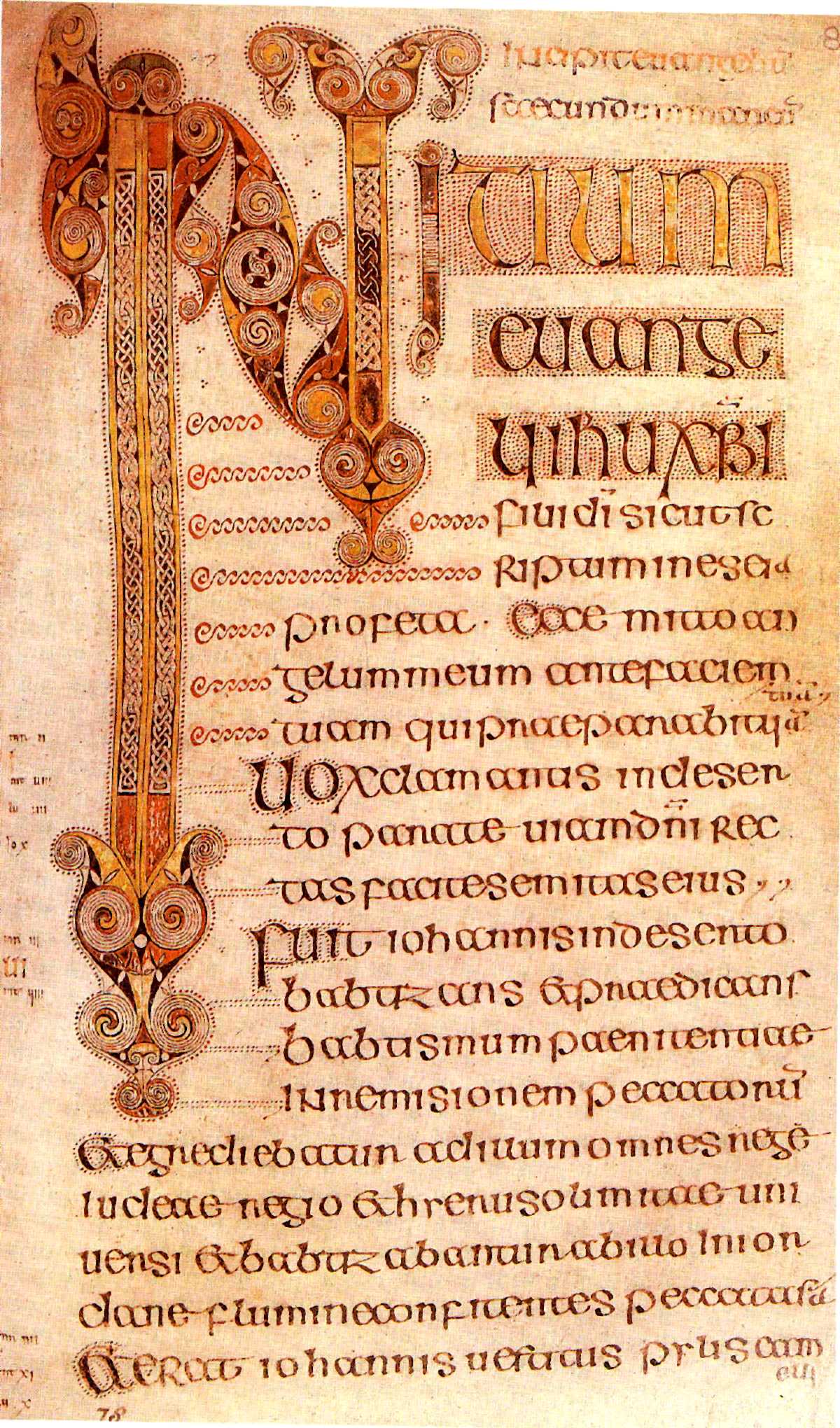
Gospel of Mark, Book of Durrow, 650-700 AD. —Wiki
The Vikings were raiders, they brought back artifacts from other cultures, which in turn, influenced their art. Geometric interlace doesn't appear in Viking culture until after they had contact with Britain and Ireland. They also brought back (Irish) slaves, who were artisans....Again, keep in mind the timeline, and it was a hybrid culture].
(See mid-9th c. Oseberg ship-burial. Artifacts included the Oseberg bucket, with patterned enamel figures similar "to the Gospel books of the Insular art of the British Isles, such as the Book of Durrow, (ca.650 AD)." —Wiki, and Irish Archaeology.
Several Viking ships in Roskilde Fjord, and the Skuldelev ships were made in Ireland. So claiming who did/owned what in the past is never quite as simple as it seems from our perspective. We don't know who carved the ships, and, again, it was a hybrid culture. Also, there was no timber in Iceland, so Icelandic ships too would've been built in Ireland or wood imported to Scandinavia.)
Check out the timeline, The Vikings (780–1100), and this one, but keep in mind that much of what we think of as Viking art was the result of artifacts collected from other cultures during raiding.
If you get a good grasp of the pre-Classical, Classical, and post Classical Celtic cultures, and migrations, then it will all make more sense.
Unfortunately working from a knowledge base that dates to the Plantation of Ulster as a reference point, is politically biased, therefore suspect. History written in the voice of the victor, and all that. Also, the intense hatred the English harbored for the ethnic Irish has also adversely colored "history." So, most Irish connections were extirpated. The OED is a prime example.
In Scotland, a lot of so-called Scots, were actually Irish. The Industrial Revolution, and two famines meant that many Irish immigrated to Scotland—especially The Barrows in Glesga, and along Clydebank (ships).
Yes, the Romans named the Picts, Picti, after a Continental Picti tribe, who were probably from the same Gaulish tribe. Picts were probably P-Celtic vs. Q-Celtic speakers. The Picts were also in N. Ireland, they were called the Cruithne, or Cruithín (they have an asteroid named after them, LOL!) The Cruithne/Criuthín included several tuatha, including the the Dál nAraidi—who settled in Scotland. Qritani/Cruithne comes from the word *pritenī (Pretani). Q-Celtic Irish speakers hated the plosive P sound and swapped it out for a more gutteral cough sound, hard c/q/k C: Cruithne/Pritani. mac/map, etc.
Ireland had many P-Celtic speaking tribes, as well as Q-Celtic speakers (Gaels, Galicia). See Ptolemy's map of Ireland for tribal names: Briganti, Dumnoni, etc. Cruithni and Menapi were probably Gaulish. The Ganganoi were also in N. Wales. In the 5th c AD, Gwynned was an Irish enclave, so there was a lot of back and forth movement.
I would venture to say that the Insular art style with Celtic spirals, curvilinear, and geometric shapes employed in the Book of Durrow were not influenced by Norse or Viking raiding artisans. This kind of complex, intricate art did not suddenly spring forth in a brand new art form, the illustrated book arts. Especially when one's homeland was being invaded by Vikings. So what came first? Chicken or egg? (See folios 1v, 85v, 125v at bottom of Wiki page.)
There's more of a correlation with Anglo-Saxon art, and even that was a hybrid art form, later called the Hiberno-Saxon style. I find no Germanic Continental evidence of this Insular art form. What each of these cultures have in common, is exposure to Insular Celts. Early medieval Celtic book treasure bindings were highly coveted by the Vikings. One can only imagine what the lost treasure cover for the Book of Kells looked like.
Various metal fragments of what were probably book-mounts have survived, usually adapted as jewellery by Vikings. —Wiki(Also, the Bronze Age Celts, and Celtic culture dominated the Continent, so some of their artifacts could have been found by what later become the ancestors of the Vikings.) There was cultural contact. But there's scant evidence that Viking artifacts predate Irish and Celtic art styles. To make an absurd parallel, many little girls the world over love Hello Kitty, that doesn't mean they were all Japanese samurai.
Gospel of Mark, Book of Durrow, 650-700 AD. —Wiki
The Vikings were raiders, they brought back artifacts from other cultures, which in turn, influenced their art. Geometric interlace doesn't appear in Viking culture until after they had contact with Britain and Ireland. They also brought back (Irish) slaves, who were artisans....Again, keep in mind the timeline, and it was a hybrid culture].
(See mid-9th c. Oseberg ship-burial. Artifacts included the Oseberg bucket, with patterned enamel figures similar "to the Gospel books of the Insular art of the British Isles, such as the Book of Durrow, (ca.650 AD)." —Wiki, and Irish Archaeology.
Several Viking ships in Roskilde Fjord, and the Skuldelev ships were made in Ireland. So claiming who did/owned what in the past is never quite as simple as it seems from our perspective. We don't know who carved the ships, and, again, it was a hybrid culture. Also, there was no timber in Iceland, so Icelandic ships too would've been built in Ireland or wood imported to Scandinavia.)
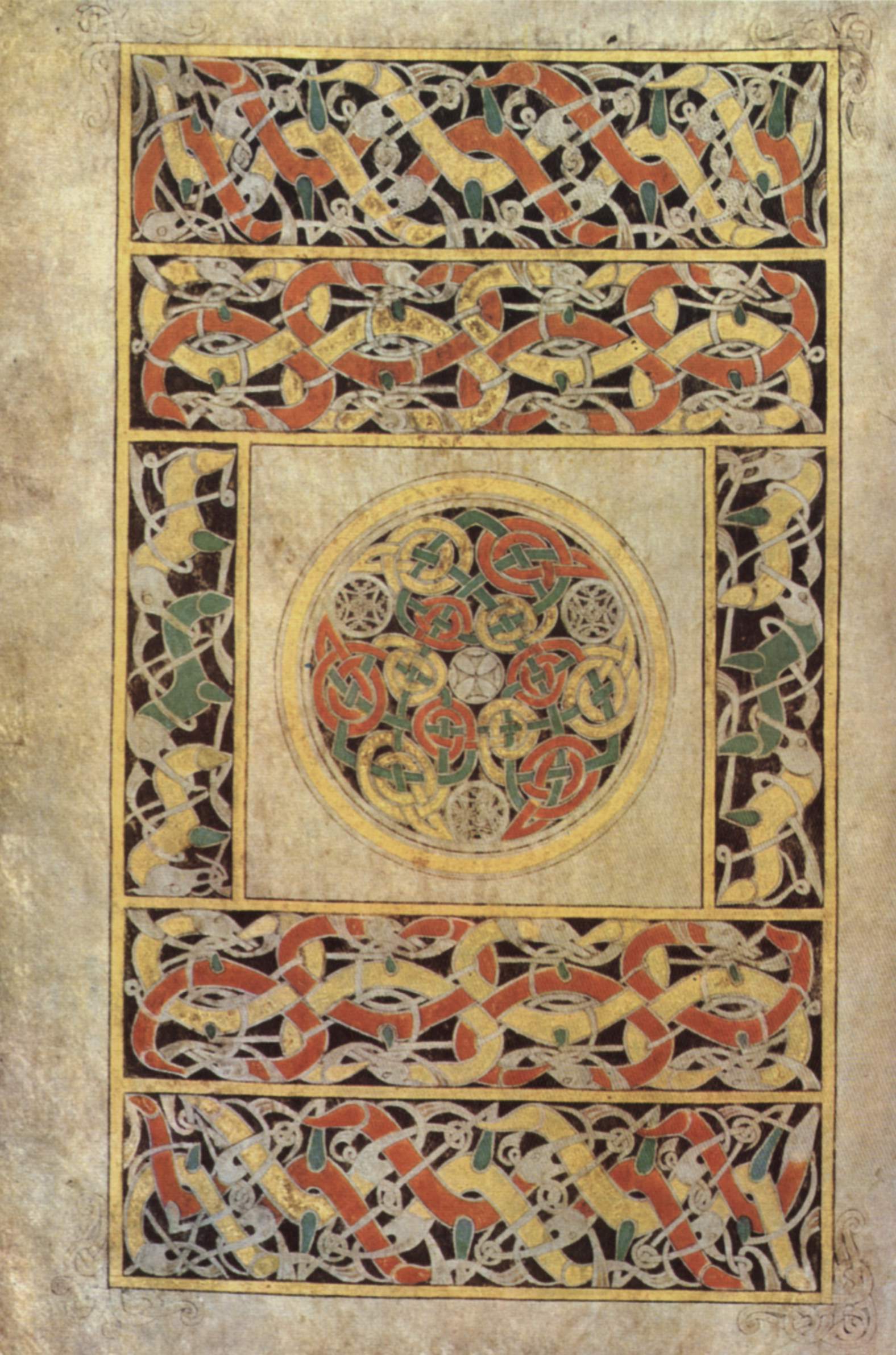 |
| Book of Durrow Carpet page, similar in style to the Oseberg bucket, 650-700 AD. —Wiki |
If you get a good grasp of the pre-Classical, Classical, and post Classical Celtic cultures, and migrations, then it will all make more sense.
Unfortunately working from a knowledge base that dates to the Plantation of Ulster as a reference point, is politically biased, therefore suspect. History written in the voice of the victor, and all that. Also, the intense hatred the English harbored for the ethnic Irish has also adversely colored "history." So, most Irish connections were extirpated. The OED is a prime example.
In Scotland, a lot of so-called Scots, were actually Irish. The Industrial Revolution, and two famines meant that many Irish immigrated to Scotland—especially The Barrows in Glesga, and along Clydebank (ships).
Yes, the Romans named the Picts, Picti, after a Continental Picti tribe, who were probably from the same Gaulish tribe. Picts were probably P-Celtic vs. Q-Celtic speakers. The Picts were also in N. Ireland, they were called the Cruithne, or Cruithín (they have an asteroid named after them, LOL!) The Cruithne/Criuthín included several tuatha, including the the Dál nAraidi—who settled in Scotland. Qritani/Cruithne comes from the word *pritenī (Pretani). Q-Celtic Irish speakers hated the plosive P sound and swapped it out for a more gutteral cough sound, hard c/q/k C: Cruithne/Pritani. mac/map, etc.
Ireland had many P-Celtic speaking tribes, as well as Q-Celtic speakers (Gaels, Galicia). See Ptolemy's map of Ireland for tribal names: Briganti, Dumnoni, etc. Cruithni and Menapi were probably Gaulish. The Ganganoi were also in N. Wales. In the 5th c AD, Gwynned was an Irish enclave, so there was a lot of back and forth movement.
.jpg) |
| A rendition of Ptolemy's map (Vlaclav Hollar, ca. 1650s-70s) —Wiki |
Julius Caesar, in his Commentarii de Bello Gallico, is the first to call the island Hibernia... —Wiki
Galicians were not Spaniards, but Iberian Celts, one of many CeltIberian tribes. Asturias, Galicia were Celtic kingdoms that managed to survive until the Middle Ages. They probably were the original Hispania immigrants who settled in Ireland, according to the Lebor Gabala Erenn (where the name Scotia is chronicled.)
In the Song of Amergin, the first Gael to settle in Ireland, (Galician) poet-druid Amergin (mac) Mil quells the sea, after the very tall Tuatha Dé Danánn send a big wind spell, proving he was a bigger, badder druid, than they. And to really ridiculously telescope mythological time, they slunk away, shrank, went underground, and became the fairyfolk!
Here's a lovely Roman world view map of Scotland & Eire; note the use of the word Scotti in N. Ireland. Note also that Scotland was not called Scotland, but Valentia, and Caledonia. The Brigantes of Maxima Caesariensis were a buffer between Caesariens (Roman Britain) and what we now refer to as Scotland. Only Southern England, Kent, Cornwall and Devon (Cantii, Damnonii and Belgae tribes) was called Brittania.

Roman Britain —Wiki
Another old map.
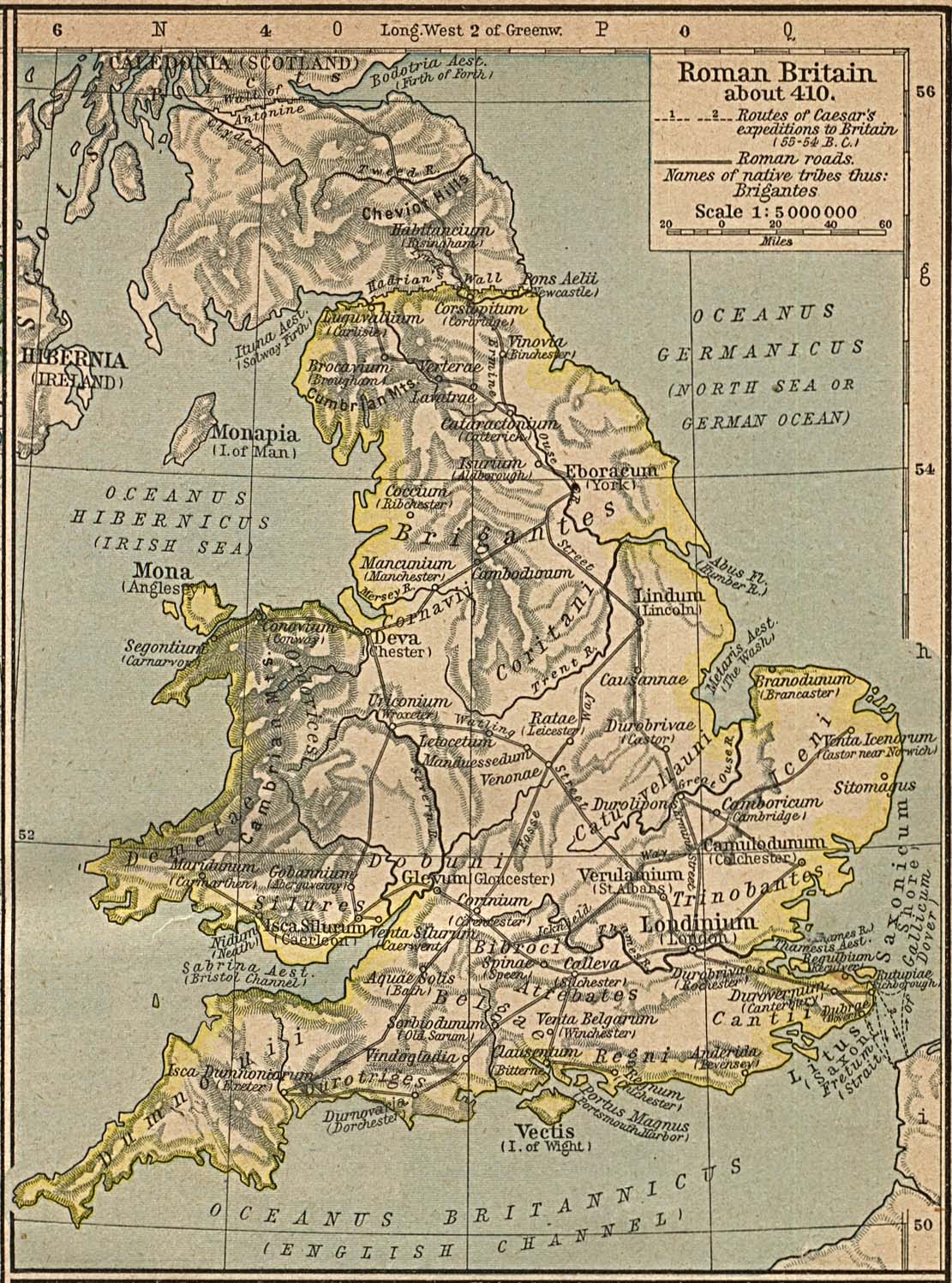
Roman Britain in 410 —Wiki
And an updated 1654 map that chronicles Scotland as Scotia and Ireland as Hibernia/Ivverna. Pope Leo X (1475-1521) decreed (when?) that Scotland had exclusive rights to the term Scotland.
In the Song of Amergin, the first Gael to settle in Ireland, (Galician) poet-druid Amergin (mac) Mil quells the sea, after the very tall Tuatha Dé Danánn send a big wind spell, proving he was a bigger, badder druid, than they. And to really ridiculously telescope mythological time, they slunk away, shrank, went underground, and became the fairyfolk!
Here's a lovely Roman world view map of Scotland & Eire; note the use of the word Scotti in N. Ireland. Note also that Scotland was not called Scotland, but Valentia, and Caledonia. The Brigantes of Maxima Caesariensis were a buffer between Caesariens (Roman Britain) and what we now refer to as Scotland. Only Southern England, Kent, Cornwall and Devon (Cantii, Damnonii and Belgae tribes) was called Brittania.
Roman Britain —Wiki
Another old map.
Roman Britain in 410 —Wiki
And an updated 1654 map that chronicles Scotland as Scotia and Ireland as Hibernia/Ivverna. Pope Leo X (1475-1521) decreed (when?) that Scotland had exclusive rights to the term Scotland.
In early medieval times Ireland was known not only as Éire but also as Scotia, a name that the Romans used at times to refer to Ireland as well as Scotland. —Wiki


