1/25/23 Write On! With Susie Terence
Wednesday, January 25, 2023
9/11, A DEFERRED TRAGEDY
1/25/23 Write On! With Susie Terence
Standing on the lintel between worlds
Wednesday, April 13, 2022
MISSING THE BOAT
Wednesday, March 30, 2022
BETWEEN WORLDS
Saturday, July 6, 2013
ReVisioning the 1992 Biljmer Plane Crash, Amsterdam (& the Asiana Crash at SFO)
This morning, as I was outside in the garden, I thought I heard or felt something—more like a percussion than a sound—and I said to myself, Jeez, it feels like a bomb just went off—or a plane crash. I live near the Oakland Airport which is across the bay from the San Francisco airport. I laughed at my silliness and chalked it up to an overactive imagination.
But I was uneasy, sensing that some disaster had occurred. I came inside to check the news only to find my Twitter feed going crazy.
There were 290 to 350 passengers on board from Seoul to SFO. Someone said: it's a hard landing, no landing gear. Another eye-witness said the plane struck the seawall, then the tail ripped off, and it cartwheeled off Ramp 28. (I think it just slid off the tarmac). The fuselage also caught fire as people fled the plane, sliding down the inflatable emergency ramps. Suitcases were scattered everywhere like flotsam. Or maybe it was a herd of Goats R Us weed-whacker goats rubbernecking.
As I followed the grisly news reports, an image I thought I had forgotten, came to mind. Another plane crash, from long ago, in another country. So, I let my fingers do some web walking as I waited for the news to unfold.
In 1992, I witnessed an Israeli cargo airplane crash in Amsterdam. An El Al Boeing 747 plane circling from Schiphol Airport was flying unusually low over the IJsselmeer, when I heard a pop overhead, and then a big splash right next to me.
| We walked along the Durgerdam, admiring the sunset. —Wiki |
My friend Vinz said we were just outside the village near the Durgerdam bus stop. Durgerdam is 7 km east of Dam Square. We were walking along the dyke of the IJsselmeer, admiring the colors on the water, the October sunset in North Holland. Everything on fire. Beauty everywhere.
| We were walking on that peninsula above the red dot at Durgerdam —Wiki |
I thought the splash I heard was an improbable seal or an even more unlikely whale breaching—not even remotely possible in the artificial enclosed lake, that is the IJssel, which is a branch, or tributary of the Rhine. I laughed at my foolish notion. OK, one helluva big fish, then.
But as the events unfolded, I quickly put it together that the pop I heard was the El Al Boeing 747 plane's right wing engine exploding, and the splash—the engine falling into the water. That was awfully close, that engine could've fallen on us, had the plane been over land (as the flight map I posted below suggests—but it's wrong).
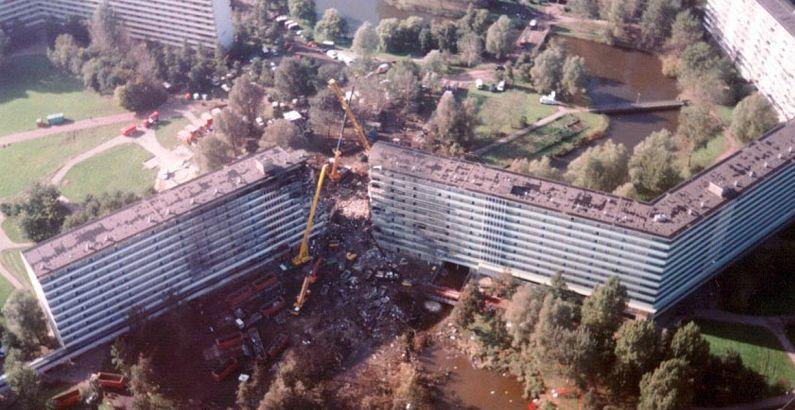
Then, we watched, stunned, as the eastbound plane veered hard right over land and plowed into two high rise buildings of Bijlmer. The fireball as it struck the apartments was like an atomic blast—we could hear and feel it from miles away. I took photos of the fireball but I couldn't override the automatic camera flash—and so, I got nothing on film.
We made our way back to the crash site. The Boeing 747 crashed into the Bijlmermeer, near the Elsrijkdreef- Bijlmerdreef T-intersection. I remember looking up in a linden tree to see an airplane seatbelt, a melted Barbie doll, and fuel dripping from the leaves like rain. I took more photos and there was no way home but to walk. All transport from Biljmer was cut off. All busses were being used as ambulances.
Why did the El Al pilot bank 90° right, into the housing project instead of flying over the IJsselmeer (formerly the Zuiderzee) where he could've crash-landed on the water? Surely the pilot knew he was in trouble long before he reached land.
At 6:35 pm, the first officer radioed to ATC: "Going down, #1862, going down, going down, copy, going down." In the background, the captain was heard instructing the first officer in Hebrew to raise the flaps and lower the landing gear. —Bijlmerramp, Wiki
|
They say 48 people died a the Bijlmerramp—but we saw busloads of bodies leaving. There was a huge population of undocumented illegal immigrants living there as well—and everyone was at home in time for Sunday dinner.
Then came the cover-up. What was in the plane: fertilizer, petro-, and bio-chemicals? Bomb fixings? No news, no answers anywhere. I was interviewed by Amsterdam Underground Radio—the reporter was positive it was some sort of conspiracy but I didn't feed the beast of paranoia. Merely reported what I saw, and deduced. Too well trained by my editor, Nick Valentine, to let the crazed reporter lead me.
![]() |
| From GoogleEarth |
Today's crash at SFO brought the memory of the Biljmer crash back in startling clarity. Another Boeing. Two people have been confirmed dead & at least 130 injured, with 41 in critical condition. Such a tragedy. Amazing that so many survived. We should not be witnessing things like this. It brings back the vivid images of 9/11 as well. The things we can never erase form our minds, leaving us shellshocked.
Will the final verdict also be metal fatigue as well? Or pilot error? Or both? My cousin is a mechanic for United at SFO. Maybe we'll get another picture from the mechanics who will be working on the plane. I'll post later, if we do. Meanwhile, if you landed at this blog in error, I've posted some Asiana links below.
Saturday, October 20, 2012
Patriotic Citizen
Friday, August 17, 2007
A 9/11 survivor
Today I met a 9/11 survivor, an artist, Jeanette McKinley, who told me tales of what it was like being at Ground Zero. She talks of huroncito depression, of how the material world accounts for little. She can’t make her art.. she is mute. She and Jane Bark trade conspiracy theories, but when it got interesting was when she told her personal story. I had no notebook, no camera, so this will be a story told in spurts, in no particular order. I will write until my wrist tires. I took a spill on a month ago and I am gimpy in both knee and wrist. But 911 is on everyone’s minds, subtext, and context. No time to write, but then the story dissipates. Unlike Allan Beavans, she was given a few more years’ worth of life to contemplate being a survivor. (She died a few years later of lung cancer, having breathed in lungfuls of toxic smoke.)
Saturday, February 24, 2007
Terceira, Azores, Right After 9/11
A week after the attack of 9/11, I was staying at a pension in the sleepy town of Praia da Vittoria, on Terceira Island, in the Azores—right in the middle of the Atlantic Ocean. My cousin, my aunt and I had no idea that we would be bunking right across from Lajes Field, the largest US military base in the Atlantic rim region and the Atlantic Ocean¹s largest aviation refueling station.
From our bedroom window we could look right into the air base and watch the planes land. A steady stream of incoming military planes rumbled directly over our roof and a parade of planes taxiing into position for takeoff to the US. There were few commercial planes were lining up with all these big boys.
I found out that the enormous black C-5 cargo planes were coming from the Middle East and they were landing approximately every 45 minutes—night and day.
Unfortunately we were directly beneath their flight path. Huge and matte black, they made a Boeing 747 look like a svelte mosquito in the sky. They endlessly soared above our heads every 45 minutes—day and night. We could even see the heat waves rising from the engines and feel their deep ominous rumble deep within our chests.
At a hotel cafe overlooking the beach and airstrip, we became acquainted with a retired US Air Force officer, who was stationed in the Azores when he was in the military. Since then, he's spent so much in the Azores, he was considered to be a regular islander.
Because I needed supporting biographical data for my folklore interviews, I was able to ask him all sorts of personal questions that wouldn't normally crop up in conversations with relative strangers. One question led to another.
He explained that ³this is the most action I¹ve seen around here in years, he said that these C-5 transports had been flying in before 9/11 happened, and that the empty planes landing here to refuel on their way back from Kuwait.
As he spoke, we began to realize that, if what he and our senses were telling us was true, then these planes had been part of an enormous military buildup just outside Iraq--and that this buildup had begun long before the attacks on 9/11.
I did the math: even by most conservative estimates: 10 days x 24 hours = 240 planes, that's 240 platoons. If what the islanders and the officer said was true, that they were coming in since before 9/11 attack—that's a whole lot of US soldiers in Kuwait. What for?
Monday, January 1, 2007
Cybernalia
What stands between my self and my e-self is a blog, a bit of cyber-literatia, or maybe cyber-inventia—maybe dementia—something I've resisted. A gimped knee has me web bound, Resistance is futile. The time is present. No time like...
Like the Beat poet Bobby Kaufman, it's as if I took a ten-year vow of silence, but the trance was merely a purgatorial haven or hell of my own creation. Initially, I blamed the silence on a near-fatal car accident (no, my life did not flash before my eyes), or I blamed the silence on grad school. Someone said they quit writing poetry in grad school. It burns it right out of you. With my MFA thesis's seven-year grace period about to expire, I know that one all to well.
But it comes down to this: who am I writing to and what for? The what for is what haunts me. Nihilism raises its ugly head.
Everything is post 2001 now. My old voice has fled, a victim of the mujadeen or the al Queda. Tired of writing about lovers gone bad (BTDT, been there, done that, the tee shirt is a holy rag or more like a holy cow), I grew weary of the rhetoric that inevitably follows writing with a political stance, I turned inward and with a number two pencil eraser, began to erase the inner markings, the deliniations of the soul, that force which drives us to create, to send our prodigal names out there into the world. But even that imploded.
At first, I was physically exhausted from a near-fatal car accident in June of 1997. I hadn't counted on the post-traumatic stress lasting for so long. Or my brain to go south for an extended winter. But I found that a punctured lung weakens more than the breath —for breath, the source of inspiration, is the root of creativity. Not as in God has breathed into, In-spire as in spiritus, but not sanctus. I'm a recovered Catholic enrolled in a two-step program sacred and profane.
Then it was onto to grad school to waken my slothful brain. I was fulfilling a decade old dream. And then I took the deepening vow of poverty a la Dante's Inferno–a poet and a student replete with student loans. Which was followed by a rebuilding of a life, such as it was. A decade of reinvention of the self from Ground Zero has led me back to my first fragile love, art. Poetry has gone on holiday. All that's left are the unformed stories.
And so, couch-bound by a bum knee and stuck in time present, I began to surf. I surfed my name to see how I fared during that decade of near silence and I was surprised to see that I actually had a web presence, though I'd never actively sought one. In fact, I shunned it. All my co writers and classmates were deep into the publish or perish frenzy while I was happy listing in the doledrums. (Been there, done that. Even seeing my name in print no longer inspires or thrills the way it once did. In my 30s and 40s, I was driven by a dark ambition.)
Fooled into thinking I'd find the time later to do what I want—all those big, unnameable projects looming on the horizon—but the horizon is dressed in death's robes and the passage of time is akin to snake-wrestling with cobras. Spit in your eye. Leave you with a Homeric blindness and no story to tell. Life and relationships have a way of taking over. It comes down to who does the housework. Who does the dishes, or scrubs the toilet. Poor Sylvia Plath, I'm beginning to understand her dark fascination with the oven. Did Ted Hughes metamorphose into the sly fox of art and escape domestic responsibility in order to achieve a fragile immortality of words?
But even now, I am afraid to let my cybernalia loose into the world, This blogless blog is bogged down in its aimlessness. Shiftless. No point of view. No goal. Who will read it? And why? Get a job. Going to the bog. Full of shyte. Call it initiation. Baptism. Begin. Regardless. Or take the anywhere approach and see the music of what happens.
Poets Mike Tuggle and Sharon Doubiago each said to write the stories down, you're a storyteller, I said no to that, thinking my stories weren't worth much. But then I said no to poetry too and perversely, it said yes to me, then shamelessly ran off with a lover. I don't know where. I don't have a burning urge to file a missing poems report. But I have to finish my MFA theses. Write anything. See where it leads. Jilted prose redux is what promises to follow during these august daze.
© 2007 Maureen Hurley
NOTE BENE) This blog post was indeed written in August 2007, but I had so much revised and new material to upload there was a logjam so I reorganized the blogs as I had created this site in January and then forgot about it. There was all this perfectly good cyberspace going to waste and I found that I could move the files around by date. And so I did. Since most of it is older work being revised, it really isn't date specific. So I opted for the genre approach. It's still evolving but Feb-Mar is early memory stuff, April is poetry month, May is mostly USSR stuff, July is reserved for my many MFA plays and monologues... then it's sort of calendar specific. I imagine it will keep evolving and shifting until I find an organic order. Drive the Technorati spiders crazy I suppose.
Guy Kawasaki says to write a blog like it's a book, good advice but the physics of it are all wrong as people stumbling upon it are not going to begin at the beginning. They'll either join in by subject matter or by newest entry...no way to read a book. SO there's no chronological attempt. Merely thematic.
To see some of my art go to
Maureen Hurley at MySpace.
Sunday, September 21, 2003
With a Weary Heart...
Tuesday, September 9, 2003
Educating the Imagination
McCarthy in the Classroom?
Censorship has always been present in the classroom. As teachers and teaching writers, we are used to choosing which poems are appropriate for the end-of-the-year anthology, which story we will have a child revise for Parent Night. It’s uncomfortable, but it’s true. At its most harmless, censorship can operate to maintain equilibrium and respect. But since Columbine, and even more prevalently after the events of September 11th, censorshop and subtle forms of censure have begun to hinder educators in their efforts to teach creative writing.
One California teacher I spoke with expressed her concerns that school administrators (in conjunction with the courts) are gradually becoming the “thought police” of student writing. Write a scare story or a dark poem, and go to jail. The case of California student George “T.” is a compelling example. A San José Supreme Court appeal case this fall will test First Amendment rights when the court decides whether or not the 15-year-old student’s dark poetry constitutes a crime. The bizarre case of George “T.” is not an isolated one. Since Columbine, there has been a rising number if iuncidents in which school authorities and courts have arrested children for their art.
Homeland security and jingoism have only exacerbated the pressures on teachers. Since the war in Iraq began last winter, censorship has played out in myriad ways. One writing teacher in the Bay Area told how a colleage at his high scholl prohibited any student discussion that was critical of President Bush’s policies. The end result? A host of student poems containing retaliatory pro-war rhetoric. On a similar note, another teacher said her principal objected to the idea of student peace songs being a part of their annual spring concert, for fear that some parents might object.
While I have not encountered outright censorship in California schools, I noticed something more subtle occuring in my own writing residencies—in a word, self-censorship. For two year now, I have found myself walking on eggshells in order to assure school administrators that I am “safe.” But my students are scared of terrorism and war, and naturally their concerns emerge in their writing. And it is not merely fear they express, but pacifism. I have frequently been caught in the double bind of wanting to please school administrators on the one hand, and on the other— wanting to offer a safe haven for students to express themselves.
During the course of research for this article, I discovered that I was not alone. Several writing teachers expressed an almost palpable fear, an unspoken code for teachers not to mention the “unmentionable.” And while these fellow educators assured me that they were not being censored, their actions spoke louder than words. With the exception of one teacher who plans to retire this year, not one would allow their names to be used in this article, for fear of future repercussions from both their school administrators and from parents in the community.
Wednesday, September 11, 2002
9/11 Redux
If poetry is news which stays news as Ezra Pound said, then the anniversary of September 11 is poetry at creation, too raw to be crafted into words. On the anniversary of September 11, we sit around the table celebrating a birthday. How last year, a relative sipped coffee from the 109th floor—just two days before. Kismet. Windows on the World, the dizzying flight of birds, a portent of things to come. In the space of time it took God to make the world, the towers returned to primordial dust and stone, taking with them the slender thread of hope from the new millennium.
She came to visit at summer’s end, evoking a gentler time when there was time enough to vacation with families, when summer meant a change of residence. Or of mind. That ritual of return from Long Island to the workaday world. A book out of childhood, or a Frank Capra movie in black and white, starring James Stewart, where another idea of America existed in literature and culture, though not part of my existence on this narrow sleeve of coast where we’re west of the West. Tir na nÓg! my grandmother called it, the land of youth, or was it the land of death? More like Elysian fields—I long for the return to the city from an alien seaboard, from an eastern summer to an America we never saw, only seen in movies or read about in books.
We stood silent on the Fields of Mars in Leningrad before the Fall, the purity of snow hid and nourished the imagination. My translator Oleg told me stories of the 900-day siege, how starving Soviets stripped canvasses from frames to save paintings from Hitler’s advance. Da Vinci’s Madonna and Carravagio’s food rolled up like holy scrolls stored in empty cupboards awaiting liberation. A piece of art was saved for each death. Sacrifice for three million. Enough art to feed the eye.
At the Hermitage, a madman confronted Picasso’s blue period every day at closing time. For seven days I watched him as Matisse’s dancers dizzied me into their arms. I was drawn to that pure flame of Impressionist light because I was haunted by all the dead underfoot, the fluttering wing and crunch of snow hiding a multitude of sins. Oleg led me across the square snow-blind, during the Thaw, we were blue spots dancing between line and vision. Ash and dust chased him through the canyons of Manhattan. He ran and ran and ran from a horror more grisly and real than anything he imagined in the USSR—even Siberia. There’s nothing to ease his burden. The guilt of surviving haunts this man I held as the myth of communism unwound—as he held me when the myth of America began to unravel.
No that’s not true. Another man sits beside me monopolizing the conversation in abstractions. We change partners with the seasons. When the world fell apart he didn’t hold me, his arms were filled with his own darkness. But in the mirror I heard other words like whispering metal hangers in a closet violently opened into unexpected light. He brushed them aside as if they were the strings of an Aeolian harp as he searched for a ritual icon of well being. But I am trapped by a need to translate urgent closet whispering into prose.
Roads almost taken. Whose footprint in the ashes and dust? Like the dust of the moon. One small step. That raw poetry of creation. What we expect to see greets us, not how others see us. In the mirror, that was America burning the retina. Too blind to see, I weep unexpectedly at found art: the image of shoes, a twisted fire engine door, a contorted girder of steel becoming a companion piece to image of Brancusi’s birds bursting into flight.
As we celebrate another anniversary, time greets us with our mother’s eyes, our grandfather’s chin, a hint of dewlaps to soften the resolve and clean sweep of jawline, the tiny advance of crowsfeet. My eyes weep in a dry season, Indian summer. As I approach my own half-life mark, I am mute. What is the point of examining the soul in a time of fire? The only thing I know how to do well has abandoned me at the altar. I am both jilted bride and groom, priest and witness. Scrivener of raw news, not poetry. I am raw at creation. The woman keeps replaying the view out that window from the 109th floor in slo-mo while others debate what to do with the hole in the ground.
At Ground Zero, we are of two minds envisioning both monument and building rising from sacred ground, because the land is too valuable for sentiment alone. Traditionalists and modernists argue over what kind of art to chose. A melted steel girder evokes support for abstract images of Brancusi’s birds alighting towards that moment of flight. Between wars, his mythic Maiastrae deconstructed into golden phoenixes and steel birds in space—essence of flight without benefit of wings or feathers. Ascension of flight. Ezra Pound worshipped Brancusi’s flight of perfection insisting it could only be understood in aesthetic absolutes divorced from the mediocrity of daily life.
Dali said while we are asleep in this world we are awake in another. Dreaming he was a bird, da Vinci drew a diagram of flight. But it took ages before the Wright boys would awaken it. The two brothers plotted against gravity to conquer the wind from the seat of a bicycle. They never dreamed of weapons such as these as they ran across meadows of Kitty Hawk with wings made from sails attached to their arms—modern day Icaruses seeking the eye of the sun while Dedalus hugged the coastline of tradition. In that 12-second flight that changed the world, they flew the distance of half a wingspan of a Boeing 747. Faced with the ability to sail beyond the sunset, the idea of distant worlds shrank to a pinhead.
On the anniversary of September 11, the sky was strangely silent. A pause of flight. A dite of sky angels passing. Old myths resurrect themselves to sustain our flight across the metaphor of time. We filled glass jars with momentos, cantos and thousands of origami birds like at Nagasaki, to send to the World Trade Center, the personal experience transcending pain, becoming universal poetry, raw at creation. Images of planes and fiery towers burned on the retina transformed into thousands of origami birds fluttering like snow to the streets below. On their wings they carry messages and stories toward the next world into a chrysalis of light.
Raw at Creation
If poetry is news which stays news, as Ezra Pound said, then September 11 is poetry at creation, too raw to be crafted into words. On the anniversary of 9/11, we sit around the table celebrating a birthday, a relative describing how she sipped coffee from the 109th floor -- just two days before. Kismet. Windows on the World, the dizzying flight of birds, a portent of things to come. In the space of time it took God to make the world, the towers returned to primordial dust and stone, taking with them the slender thread of hope from the new millennium.
She came to visit at summer’s end, evoking a gentler time when there was time enough to vacation with families, when summer meant a change of residence. Or of mind. That ritual of return from Long Island to the workaday world. A book out of childhood, or a Frank Capra movie in black and white, starring James Stewart, where another idea of America existed in literature and culture. Tir na nóg! my grandmother called it, the land of youth, or was it the land of death? More like Elysian fields.
We stood silent on the Fields of Mars in Leningrad before the Fall, the purity of snow hid and nourished the imagination. My translator Oleg told me stories of the 900-day siege, how starving Soviets stripped canvasses from frames to save paintings from Hitler’s advance. Da Vinci’s Madonna and Carravagio’s food rolled up like holy scrolls stored in empty cupboards awaiting liberation. A piece of art was saved for each death. Sacrifice for three million. Enough art to feed the eye.
At the Hermitage, a madman confronted Picasso’s blue period every day at closing time. For seven days I watched him as Matisse’s dancers dizzied me into their arms. I was drawn to that pure flame of Impressionist light because I was haunted by all the dead underfoot, the fluttering wing and crunch of snow hiding a multitude of sins. Oleg led me across the square snow-blind, during the Thaw, we were blue spots dancing between line and vision. Later, ash and dust chased him through the canyons of Manhattan. He ran and ran and ran from a horror more grisly and real than anything he imagined in the USSR -- even Siberia. There’s nothing to ease his burden. The guilt of surviving haunts this man I held in my arms as the myth of communism unwound -- just as he held me when the myth of America began to unravel.
We change partners with the seasons. Another man sits beside me. When the world fell apart he didn’t hold me, his arms were filled with his own darkness. But in the mirror, I heard words like whispering metal hangers in a closet violently opened into unexpected light. He brushed them aside as if they were the strings of an Aeolian harp. I am trapped by a need to translate urgent closet whispering into prose. I weep unexpectedly at found art: the image of shoes, a twisted fire engine door, a contorted girder of steel becoming a companion piece to image of Brancusi’s birds bursting into flight.
As we celebrate another anniversary, time greets us with our mother’s eyes, our grandfather’s chin, a hint of dewlaps to soften the resolve and clean sweep of jawline, the tiny advance of crow’s feet. As I approach my own half-life mark, I am mute. What is the point of examining the soul in a time of fire? The only thing I know how to do well has abandoned me at the altar. I am both jilted bride and groom, priest and witness. Scrivener of raw news, not poetry. I am raw at creation.
At Ground Zero, we are of two minds, envisioning both monument and building rising from sacred ground, because the land is too valuable for sentiment alone. Traditionalists and modernists argue over what kind of art to choose. A melted steel girder evokes support for abstract images of Brancusi’s birds alighting towards that moment of flight. Between wars, his mythic Maiastrae deconstructed into golden phoenixes and steel birds in space -- essence of flight without benefit of wings or feathers. Ascension of flight. Ezra Pound worshipped Brancusi’s flight of perfection, insisting it could only be understood in aesthetic absolutes divorced from the mediocrity of daily life.
Dali said while we are asleep in this world we are awake in another. Dreaming he was a bird, da Vinci drew a diagram of flight. But it took ages before the Wright boys would awaken it. The two brothers plotted against gravity to conquer the wind from the seat of a bicycle. They never dreamed of weapons such as these as they ran across meadows of Kitty Hawk with wings made from sails attached to their arms -- modern day Icaruses seeking the eye of the sun while Dedalus hugged the coastline of tradition. In that 12-second flight that changed the world, they flew the distance of half a wingspan of a Boeing 747. Faced with the ability to sail beyond the sunset, the idea of distant worlds shrank to a pinhead.
On the anniversary of September 11th, the sky was strangely silent. A pause of flight. A dite of sky angels passing. Old myths resurrect themselves to sustain our passage across the metaphor of time. We filled glass jars with mementos, cantos, and thousands of origami birds like at Nagasaki, to send to the World Trade Center, the personal experience transcending pain, becoming universal poetry. Images of planes and fiery towers burned on the retina transformed into thousands of paper birds fluttering like snow to the streets below. On their wings they carry messages and stories toward the next world in a chrysalis of light.
© 2002 Maureen Hurley Reprinted from Killing the Buddha Raw at Creation
Tuesday, September 11, 2001
A Mantra for the Mujahedeen
Gospodi, gospodi pomilui / mujahedeen relentlessly echoes in my head. I’m caught in a convocation of languages in the cracks between tongues as I watch the World Trade Center towers fall again and again in slo-mo, and I can’t seem to make sense of it in my native tongue. It becomes a mantra: gospodi/ mujahedeen /gospodi. Why is it that Old Church Slavonic is colliding with Arabic mid-thought? God have mercy on us/ a holy war. Say jihad. Say it over and over again until it makes sense. Gospodi/mujahedeen. But it will never make sense.
I have no skills to comprehend the images of those who held hands as they plunged to their death. I cannot grapple with the word jihad or the rhetoric of Psalm 23 in any language. Say it. Say it again. Does it ease the burden of grief? In Arabic numerals the victims dial 9-11 –- all circuits are jammed. Those still trapped beneath 100 floors of rubble are calling their loved ones one last time for a final goodbye — to say: "I’m fine," before the batteries fail and the building shifts. Yea, though those who leapt unto the shadow of the Valley of Death — to say, "I love you." Je t’aime, or Te amo to perfect strangers during freefall, and really mean it. What went through their minds?
Arabic: the names of stars. Aldebaran, zenith, zero, zealot. The sky, so silent, no birds flying. Mea maxima culpa. Gospodi. There are no words in any language that will do justice.
I’m studying ancient manuscripts and I am reminded that it was medieval Arabs, in love with knowledge who saved the writings of the classical world after the Vikings destroyed the Irish copies. In medias res. In the middle of things. An Irish monk scribed in the margin: We walk in one another’s shadows.
Across the centuries, Shadowlands and Second Comings cannot ease the burden. We grow old with grief. We attempt normalcy, resurrect schedules. We dust off the words of the Pledge of Allegiance, unspoken since childhood — in my case, nearly 40 years ago. Dressed in red white and blue, thousands of Americans line up to donate blood. Even those in other countries are giving blood: Yasser Arafat among them.
In front of Sproul Hall at Berkeley, I pass a girl who nervously fingers her dove-grey hijab. Her pale eyes reflect a palpable fear. Already there have been acts of violence against Middle Easterners bearing American flags. It’s like a bad dèja vú of the ’60s at Berkeley. In San Francisco, an Armenian-American greengrocer is mistaken for the enemy. Animal blood is spilled on his doorstep. But he was born here. A Middle Eastern woman holding an American flag shops for dinner, in the pram, her baby wears a flag. A beefy man with a flag the size of a bedsheet strapped to his Harley with a broomstick vigilantly patrols the parking lot. An elderly Mexican man gives away red, white & blue roses to women. What else is there to do?
In class, we trade war stories: Five years ago, I witnessed an Israeli cargo plane fall out of the sky, a harbinger of things to come. The engine exploded, and I heard it fall into the sea. A mushroom cloud of fuel consumed a refugee complex. I thought Armageddon had begun. I still can’t shake images of debris draped from a tree — was it the pilot’s seatbelt? A mangled Barbie doll amid fuselage and ashes. The Israeli linguist remembers last year’s sniper who missed her twice, as she stood on the terrace overlooking the Arab Ouarter. A half-hearted attempt at a simple target. We deconstruct words as our world, buried beyond recognition, offers little solace.
On TV, we watch rescue workers gather round a fire truck, burned beyond recognition — an altar for the more than 300 dead firemen. One man recalls driving over too many body parts to count. Numanistics: I want to slide into the perfection of absolute zero. At Ground Zero, cabbies rip the seats from their cabs to carry the dead. New lines form at blood banks — solace from the living. Barges carry the dead across the River Styx because the island can’t contain all her dead. The living flee across Brooklyn Bridge. or escape TO New Jersey, of all places! Anything to get off the island.
How many degrees of separation are any of us from the dead? We are all at Ground Zero, because on that Tuesday, each of us died a little. I am one degree of separation from Alan Beavans, who was on Flight 93. I cannot think in abstractions, I can only understand this atrocity in terms of individuals. At midnight I find myself chanting a kaddish of the names of my Middle Eastern friends. Among them, Oleg. Where is Oleg, my Armenian friend who took me into the churches of Kiev where we listened to the choir singing gospodi?
Today, I learn a new word: Taliban. And another: jihad. This jihad is like Ireland in that the memory of hatred is older than the civilization that raised it. I can’t help but think of the gyre of the last plague-ridden millennium where, thinking that the end of the world was buried in the calendral equation of zeroes, Anglo-Saxon crusaders stormed Jerusalem — annihilating both Arabs and Christians alike on the temple steps, making all religion null and void. Armageddon resurfaces amid the pond scum of right-wing fundamentalists and racists exorcising rites of free speech, and latent seeds sprout in a new field, fertilized by the blood of civilians. The president’s myopic message is about an eye for an eye, but nothing is black and white — especially not blood.
The sky, so quiet, even the birds are not flying. A raven lands in front of us, sharpens his beak. Another joins him. War birds of the Irish, come to remind us they are hungry for eyes. My grandmother said that when the wild birds enter the house, it is a sure sign of death. A hummingbird stops to eye me. He sways and dips as if in benediction — making a sign of the cross — and takes off. Without a metaphor in common with the terrorists, I imagine I am blessed by birds, but tell me why is it that the wrens are huddling around the bird feeder, and fluttering at the windows as if to get in? Too late I remember that in Aztec mythology the hummingbird, Huitzilipochtli, is the god of war.
At candlelight vigils, we learn a new term: asymmetrical warfare, as if geometry were a country of refuge. In this way, we also learned terms from the Gulf War: collateral damage, and friendly fire. I’m afraid that in the weeks and months ahead will be full of such euphemisms. The city is on "yellow alert." On the steps of City Hall, we gather for an interfaith memorial service. A Baptist preacher prays, "Oh Lord please help the President to make the right decision — not the one he wants to make." It is also Jumnah Sabat: What are they praying for at the mosques? A Muslim-American says, "This has nothing to do with our religion that teaches tolerance, peace and harmony." I want to believe him but what about the fundamentalists on both sides? I am lost in the biblical equations that come tumbling down. I find a pair of gilt harem slippers dumped on the street and worry about the woman who last wore them: her foot, the same size as mine. I am that woman behind the veil as well.
Gospodi God have mercy on the unholy warriors, the mujahedeen, for we know not what they do, for the word of Allah is not their witness. Written on the wind, the names of the innocent dead, Muslims among them. Say their names 5000 times, say them again until it becomes a mantra. Gospodi pomilui, mujahedeen, Islam, shalom, salaam. As God is their witness, may the gates of heaven always be beyond the reach of terrorists.
How silent is the sky. Huddled around the bird feeder, even the doves are refusing to fly.
© 2001Maureen Hurley Reprinted from Killing the Buddha A Mantra for the Mujahedeen