Thursday, December 31, 2015
Wee Celtic beasties for silk scarf design 8//15
July-Aug. 11/2015
MoHurley's Amazon Book Reviews 2015
(This piece was originally posted June 20, 2015, but seeking verisimilitude, I've moved each year's reviews to Dec. 31. It's too hard to find them buried mid-year.)
As I said, I'll read just about anything. But not without some teeth gnashing. So I review some of the ebooks upon occasion. Sometimes I get lucky and even find gems among the dross. They get full five-star rating. Check those authors out. Usually the first book's free....
I consider the review process a good honing skill: I read and mentally edit books as I go. My cousin, tired of listening to me complain about how awful some of those ebooks were, said: Why don't you review them too? (And shut up, already.) And so I did. Another tool in the craft toolkit.
What do I look for when I review a book? Strong plot, storyline, and interesting characters with depth, not flat, stereotypes. Some young writers, not clear on the concept of show, don't tell, rely upon the crutches of rampant consumerism to flesh out their story. Using designer clothing labels to define a character, or to set the scene, and the story reads like an ad. Does the description build our understanding of the character, or plot? Is it necessary to the storyline? Do I need to know the protagonist wore an Ann Klein blouse?
I look for a believable plot, good storyline, and figurative language that doesn't intrude, and subtle intellect. Novels stem from the oral tradition. Storyteller George Sanders says it best:
"...the process of crafting a good story means not condescending to your reader. It means creating sentences that clue them into something unnoticed about the character, and allowing them to figure it out. “A bad story is one where you know what the story is and you're sure of it," he says in this short film, George Saunders: On Story."
Then there are the typos, and poor craft. It's a bad omen when the writer has typos in the synopsis. I generally won't download a book if it does. And then there are the stories that have typos on page one. Really? If an author doesn't know the difference between it's and its, it does not bode well for the "sullied craft" of writing. Possessive apostrophes do not need to precede every single word that ends with ess. Doorknobs don't need to possess the room, unless, of course, they're possessed. But that's another kettle of fish entirely.
Please mosey on over and LIKE some of my reviews. Amazon's all about Like, just like on Facebook. Except, like, the buttons are, like, different. My older reviews are buried deep. But the most recent ones should be fairly easy to access.
Last day of the year, Farallones, photo
A macaw-colored sky. Last sunset of the year, floating islands of the Farallones from the tip of Point Reyes, The air was so clear, it looked like you could touch them. They're part of Point Reyes' lost siblings. Soon the Point will become an island too. Island moving north. Think I finally killed my camera, all the photos came out too dark, but this one, gaudy as it is, worked. It breaks the rules. Never divide a photo directly in half, it's static (unless it's the Farallones). Don't shoot clichés like sunsets and islands (unless it's the Farallones). Don't shoot in low light sans tripod, avoid pixellation and noise. Image was loaded with burned sunspots from pointing it at the sun, burning the processor. I don't think it'll recover. I was able to clone the sunspots out of the sky. I left one sunspot in the lower left corner as a reminder. The upper left corner looked like a pong table gone mad. Who knew that reflected water off Schooner Creek after 4 PM on one of the shortest afternoon of the year would completely fry my camera in multiple corners? I've fried other cameras before, and undoubtably will fry more cameras in the future, and since the sunspots are usually in the upper corners of the sky, I took to shooting pohotos upside down (the camera, not me) to avoid the sunspots. Damage control was not possible this time. I was so distressed I didn't even look at the photos the next year. Editing was a nightmare. So this is a salvage job.
© Maureen Hurley 2015
Sunday, December 27, 2015
In Defense of the Rat
My friend Donna posted on Facebook, a charming story about country woodrats nesting in the back of her woodpile. Donna addressed the give-and-take relationship between the need for woodland creatures to have a safe haven and her need for firewood in order to keep warm. It was a poetic Thoreau moment. However, acute hysteria reigned on her thread. Fear of plague was bandied about. It was like a witch hunt.
I realized that this fear is yet another intersection of the disengagement and distancing between (wo)man and nature. I felt obliged to defend the honor of rats who, by nature, are fastidiously clean, and are incessant groomers.
It's true that plague fleas prefer rodents. The marmot or gerbil were probably the original overland flea hosts (who carry in their gut the bacterium, Yersinia pestis, source of the Bubonic plague, or Black Death). Plague originally came from China via the Silk Road of Mongolia, then it resurfaced again by stowaway rats in Southern Italy in 1340. Rattus norvegicus are not first host choice for plague fleas, but marmots and ground squirrels are. So one should add all rodents including chipmunks to the creature avoid-list, if you're concerned about contracting the plague.
![]() |
| Plague doctor, engraving Paul Fürst, c. 1721 —Wiki |
During the Middle Ages, from 1348 through 1351, 25% to 60% of the European population died of the plague, it reduced the world population from 450 million to 350–375 million. Thanks to antibiotics, by 1959, worldwide plague casualties dropped to 200 per year. Plague symptoms (big buboes—hence the name bubonic plague), are also very obvious, not something you could ignore, and it's treatable with antibiotics.
We've had plague fleas in California since at least 1900, possibly since 1855, it arrived by steamer to San Francisco from China via Hawaii in 1899 (originally via rats, but the plague quickly jumped ship to a new host, native California ground squirrels). The last California plague outbreak (one person was infected) was a decade ago. It's a pretty rare occurrence.
I remember a plague warning at Fallen Leaf Lake during the early 1970s. But nobody contracted it. I had rescued a wayward vole wandering down the road, so I was checking my armpits and groin for weeks for signs of plague. But first, you have to get bitten by a rodent flea (not a dog flea, nor a deer flea...) carrying the plague...
Anyway, fear of rodents is a deep one, but it's highly unlikely you'd catch anything at all from them. (Yes, rats do poop over our stuff), but they do not all carry diseases. As long as rodents are not running amok in my house, I don't have problems with them. But once they cross that threshold, then my killer instinct emerges, the gloves (and shoes) come off. My preferred weapons of choice are sticky glue traps, and a sandal. No poison to enter the food chain, snap traps don't work, and I'm not interested in using live traps. Besides, house mice and most rats are not native creatures.
Woodrats are territorial, solitary creatures as they rarely travel more than 100 feet from their nests. They have plush, speckled fur, almost like chinchillas. Not at all like rats. They're definitely borrowers, or rather, traders. They love anything shiny or round: car keys, bottle caps and quarters. And they will often trade one shiny item for another. Hence the name, traderats. Funniest thing found in a packrat nest: a set of false teeth. Imagine the backstory....
Because woodrats are such great hoarders, archaeologists will often excavate their middens in search of artifacts. Not only that, the middens serve as a timeline as well. The oldest woodrat midden found was dated at 21,000 years old, and from it, archaeologists were able to tell when certain plants arrived in the Southwest. It was also a remarkable record of climate change.
When Donna's friend was a child, she recounted that when she stayed overnight at her grandmother's house, she imagined rats running across her feet as she slept in her feather bed. She remembers her grandmother sweeping a rat down the garden path with a broom. And when a great-uncle made sandwiches for their tea, she saw mice skitter over the drainboard, the stage was set. Clearly her grandmother and great uncle had no fear of mice. So she learned it elsewhere.
She recounted another childhood story, when the family cat brought a mouse into the house, she and her mother climbed onto a sideboard, screaming. Her mother phoned her husband, who was a bank manager, to rescue them from the mouse. I told her that Kitty clearly loved her, bringing her such treats. She was not amused.
My neighbor also had a severe musophobia. I found a wild field mouse trapped in a coffee can and brought it over to show her my treasure. She screamed and climbed a chair... I was shocked. I was about 6 years old and had never witnessed such behavior in an adult. Such a tiny animal. Why was she so afraid? I looked into the can again, and took him home, convinced adults were nuts.
Unfortunately there's no reverse button for musophobia. Those phobias probably evolved for good reason. I was thinking of Victorian women who used to scream at the sight of mice (in novels), the mice making a beeline for those billowing skirts...and I shudder.
I found a deermouse in one of my grannie's old handbags and it leaped out of the handbag and madly circled around under my sweater a few times before it exited. A little rill of fear—would he bite me? I was fairly critter crazy from a tender age and adopted them early and often. I wanted to be a vet. And I did work for horse training stables. So though it was a novel experience, I was not afraid.
A silly red squirrel lives on my fence, and during the drought I made him a water dish. So he runs up and down the fence, stroking it with his chin, saying "Mine! Mine!" He hides his acorns in the water goblet, then has to dive in to retrieve them as they sink. Hilarious. Just like the squirrel in the animated movie, Ice Age. He has been known to purr, but he doesn't want to share that section of the fence, or that water goblet. However, I don't stand close enough to share his fleas.
Chilly weather
If the house was any colder, you'd think I was in Siberia by the way I'm dressed. Ohchin cholodna. Wish I could light a fire. Those days are long gone...so I layer and layer and layer.
A favorite pair of motheaten gloves, becomes the new fashion statement. I cut the fingertips off so I can write. I 'm wearing two sweaters, a flannel nightie, a down vest, and jacket, fingerless gloves, hood, down blankie, Toasty now. I think it's warming up, around 40° as I can see my breath. A cold nose is an occupational hazard.
Thermostat is daid daid daid. Thermostat went out ages ago, luckily we've had such mild winters, so it's not been an issue. Brrr. it's been in the low 40s. Maybe even the high 30s.
I absolutely hate using the furnace. Can't stand the stink, but today it's warmer, but I still have to find a new thermostat. If it's the old copper wire leading to the thermostat that's at fault, we're screwed. Where's Ebeneezer, you ask? Heater's been kaput for at least five years, maybe longer...it just hasn't been that cold. Oakland's nowhere near as cold as Forest Knolls.
A cold friend has suddenly taken up baking marathons, as she couldn't get the furnace to work. My thermostat is newish, but broken, and I HATE the gas heater. It stinks, gives me blinding headaches, and yes, we've a carbon monoxide reader...
It's practically toasty today at 46°. Not as cold today. But I'm wearing layers. I have a saltsock neck warmer. If it gets that cold again tonight, I'll zap it.
Old house, wattle & daub (almost that old, it's wood slats and plaster—pre sheetrock days). But the bonus is that the heating bill is very low: only the stove and water heater.
I'm not exactly convinced burning wood fires is as bad as the Clean Air Control Board says. If you're burning real wood, that is, not presto logs. Colder than a witches' tit.
Saturday, December 26, 2015
St. Stephen’s Day
‘Dreoilín, Dreoilín, Rí na nÉan,
Dreoilín a fuaireas-sa thíos ar an inse,
Istigh fé charraig agus carbhat síoda air,
Thugas-sa chugaibhse é, lánúin an tí seo,
Agus má thugann sibh onóir na Féile dom’ Dhreoilín
Le bhur lámha do shíneadh,
Go mbeire an bhliain fé mhaise agus fé áthas arís oraibh.’
The wren the wren the king of all birds,
Saint Stephen's day he got caught in the furze,
Although he is little his family is great,
Cheer up landlady an give us a treat,
Up with the kettle and down with the pan,
Give us some money to bury the wren!
I took the equivalent of two years modern Irish at UC Berkeley one summer, I bottomed out in July, my learning button broke. I later took Archaic/Old Irish to translate the epics (all bookwork), but I still can't read it, other than recognize words and phrases here and there.
I can swear profusely (and rather inventively) in several languages. I also did a year of medieval Welsh, but was completely ADD as it was during 9/11... Yes, Welsh is easier to learn, no doubt. But there's not that much crossover. And of course all the extra "vowel" types and double consonants are maddening. But I can do a pretty good Ll sound.
Even Russian is easier than Irish. I remember looking longingly into the other classrooms, where people were learning Spanish, Latin and Russian, and it seemed like comfortable slippers by comparison. I could understand what they were saying with little effort. Hey, they don't conjugate prepositions!
I lived in the USSR for a while so I had to pick it up fast. You should've seen me in Portugal right after 9/11. Waving my arms like helicopter blades as I spoke a a bastard Portuguese- Spanish. Everyone thought I was Italian.
Monday, December 14, 2015
Sendoff for Whitman McGowan
I just met Pasha DeSaix yesterday at Whitman's memorial! All this time I thought she was a man. LOL. We're now FB friends. She knew my mom, and said she was just thinking of her a few days ago. I told her that she had given my mom a n audio tape, Leonard Cohen's 10 New Songs, and after my mother died, I played it incessantly. Thanked her for the unintended gift from so many years ago.
Sunday, December 13, 2015
BABY, IT'S COLD OUTSIDE
Went to grab my vest
only to find he had nabbed it
and left it behind
left at a party
like the vest I had bought him
not so long ago
a gift he had lost
careless love like the others
who'd compete with that?
Sunday, December 6, 2015
Walk through the British Museum using Google Street View
When I went to the British Museum more than a half lifetime ago, I got lost in the bowels, somewhere between the Roman coins and the Elgin marbles, and lost all track of time. I had to run through the rest of the museum before it closed. I streaked by Peter Paul Rubens. All those fleshy apparitions.
But now using Google Street View you can Walk through the British Museum without going to London
I spent hours virtually wandering these halls. Luckily I had the presence of mind to save the URLs. I've made some pitstops below. It's super easy to get lost via Google Street View.
Santa and the Stovepipe
Saturday, December 5, 2015
Hurley: Sea Tide
"Hurley, Murihily, O Morhelly, Murley, O'hUrthuile Ó Muirthile and Morley from Murthuile meaning “sea tide,” is from mur/ muir. Of the sea tides, the Hurleys were sea-farers and mariners. A name almost exclusively from Cork, where my family hails from.
Upon occasion, I've also been called the Morrígan, goddess of battle, strife, and sovereignty (the phantom, or great queen); the Morrígu or the plural triune, the Morrígna. She is depicted as a skald crow, or raven flying over the battlefield, and her triune animal shapes are the eel, wolf, and cow. Not solely the goddess of death, she is the goddess of wealth of the land. Her triune sister aspects are: Badb, Macha and Nemain (or Anand).
Mor may derive from an Indo-European stem, cognate with Old English maere (which gives us "nightmare" and rí-gan translates as queen, or rather, king., from the Proto-Celtic, *Moro-rīganī-s. But in Old, and Middle Irish, it was scribed as mór, which means great, grand, big; from PIE, *Māra Rīganī-s.
There is also a connection with the Arthurian Morgan le Fay; mor may derive from a Welsh word for the sea, môr, but the scholarly argument against that derivation is that the names are from different cultures and branches of the Celtic linguistic tree. However, there are plenty of cognates in Welsh and Irish, so it is not a strong argument. (All Brythonic forms are *mor; all Goidelic forms are muir; Manx is spelled mooir). The Morrígan could be Queen of the Sea, she was tempestuous enough.
The Welsh, Mair, Manx Moirrey, Irish/Scottish: Maura, Moira (English: Mariah), with the diminutive -ín ending added, equals little Mary. Mairenn, Máirín, Maureen. But then, even the name Mary also has connotations with the sea, as in Our Lady of the Sea.
In the Middle Ages, Mary was equated with the sea, mare, as in Stella Maris. Not that misogynistic Jewish definition of Maryam as bitterness, or bitter herbs, nor rebelliousness (well, maybe that). Mariam, as in drop of the sea. A name considered so holy in Ireland, it wasn't even used until the Renaissance.
Then there's Muirín from muir f (genitive singular, and nominative plural mara). Old Irish muir, from Proto-Celtic *mori, (Welsh môr, Manx mooir), from Proto-Indo-European*móri, (Latin mare, English mere, German Meer). I guess the idea of a rough sea was always a nightmare.
Hebrew word ma'or for star and yam for the sea equals Maryam. Stella Maris, Venus. Sea-star, also Polaris, the lode-star leading the way. Once I was chosen as Queen of the May, and I crowned the statue of Mary with a crown of roses. And I was baptized at Star of the Sea. Ave Maris Stella. And I grew up in Marin, within sight of the sea, if I climbed up Mt. Barnabe.
![]() |
| Goleen Star of the Sea, Mizen Head, Co. Cork, most southwesterly point in Ireland —Wiki |
Thursday, December 3, 2015
Donkey Wars
Mad donkeys
EARLY WARNING SYSTEM
A Note on my Writing Lifted by Other Websites
I sometimes stumble upon bits of my blog posts on other websites, with no credit. If I can find a link, I will write to the offender, and usually they'll make a link back to my site, etc. But there are some websites where there is no way to reach out to the plagiarist.
Tinsley later apologised, see her letter at the bottom of my Chilean Miners post. She back-pedalled a bit, to say the least. Rather than just use bits of my piece, or give me credit, she took it down. I guess we took her down when she realized the legal implications between the concept of "fair use," and copyright infringement.
Borrowing a few lines is considered to be fair use (for educational purposes only) under the copyright act.
Someone also lifted my Black Bart story, but a few emails later, it was resolved nicely...a Dutch fellow interested in old firearms, used my story to illustrate his antique gun collection. Turns out he just really, really liked my story.
black bart - Dutch Gunswww.dutchguns.com/black%20bart.htm Het origineel is te vinden op http://mohurley.blogspot.com/2009/09/black-bart. html. This article is not mine, but found on the internet. It is written by Maureen ...
-
Another nefarious sort lifted my entire interview and photo of Jim Dodge, then posted it on his own blog, zoran rosko vacuum player with no link or mention. Grrr. I guess the word vacuum explains it all. I was able to leave a comment:
Maureen Hurley7/29/11, 5:19 AM If you're going to lift my entire blog post and repost it here, please at least use my name and offer a back link to it. BTW, you're also breaking copyright.
Maureen Hurley http://mohurley.blogspot.com/2009/09/jim-dodge.html
The Tender Soldier: A True Story of War and Sacrifice - Google Books Result
https://books.google.com/books?isbn=1439177406Vanessa M. Gezari - 2014 - History
See also Price, “Barney West Famous for Tricky Tikis,” and “Tiki Junction, Sausalito,” http://mohurley.blogspot.com/2007/03/tiki-junction-sausalito.html, accessed ...
- cassidyslangscam paid somewhat of a sideways backhanded tribute to me as well, in that he quotes bits of my blog, but didn't like Danny Cassidy (or my blog) all that much. "So, while there are things I dislike about the blog, she is displaying an admirable amount of integrity here and drawing a clear line between the man and his crazy theories. Unfortunately, this kind of integrity is rare."
- And yes, my photos are stolen as well; But most people do attribute them to me. Until I began to Google my name, I never even knew about this one from Bird & Beckett, a great indie bookstore in SSF, and I've read there... and I do love that photo of HD Moe, RIP.
I'm less happy about the outright theft of a Brownie Mary photo on a YouTube book review,, but my blog was given credit: The Long MANGLED MESSY MALIGNED Life of MARIJUANA. And it doesn't have a huge following (218 views in one year... So I'll wait and see,)
- "A footnote: The photo of H. D. Moe above is from Maureen Hurley’s blog (is she perhaps the photographer as well?) athttp://mohurley.blogspot.com/2009/09/black-bart-rides-again.html. There, you’ll find a wonderful account with stunning images from the Black Bart Poetry Festival held at the On Broadway Theatre in North Beach in 1983, with Dave Moe in attendance, among a cast of luminaries that will make you regret ever missing a promising gathering of bards. The post begins with the well-told tale of Black Bart, himself, “California’s first and most notorious stagecoach robber poet” and quotes a commentator who noted that “whatever Black Bart lacked as a rhymer, he sure made up for as a robber.” If you think poetry is a crime, you’re not alone! But crime pays, just like poetry, no? Bring a dollar or two for the poets!"
- I know I've pissed a few people off with my post calling Arby's dancing chimps ad racist and offensive, and also my Viking Redhead post ruffled a few feathers....many divergent threads there. But enough of this obsession, I'm onto page 5 of Google results and am cross-eyed and growing weary...a lot of spammy, bogus sites replete with the red herring siren call of seeing my handle mohurley.blogspot in print, merely as bizarre spam filler.
Of course this search process only works if my name's attached to my work. There's probably a lot more of my work out there with no credit at all. Not much I can do about that. Except use unique search lines for each post, and at 1500-plus posts, I don't see that happening any time soon.
That's how I stumbled upon my stolen Jim Dodge post, a unique line handle led me to a post where the writing seemed strangely familiar. Which led to that moment of epiphany: hey wait! I wrote that! The irony is, If I wait too much longer I won't remember that I wrote it anyway.
Ultimately, leaving my post up on the vacuum cleaner's blog site benefits my friend, writer Jim Dodge, so I did not invoke legal aid on that blatant post theft. I took screenshots of it, 11 of them, just in case....
So it boils down to this, if you write, you have a few options, leave your writing under lock and key, mouldering in a drawer, while submitting some of it in small sequential batches in the hopes that someone will eventually use it in a print journal, or you can electronically publish your work, whether with self-publishing in a blog, or with electronic magazines. (And that still won't stop people from lifting your work.)
Writing is a compulsion, I have to write, I don't seem to have much control over what I write, so write, I must. That's how I learn, how I comprehend the world around me. I never set out to write about a given subject. It's an organic process, with no tangible beginning, middle, or end.I guess the question begs, who do you write for, yourself, or for others, in the hopes that someone will read your work, and perhaps be moved by it? I do know that by publishing my writing here, such as it is, it forces me to rewrite and to work much harder at my sullied craft, than if it was strictly a private affair. It ups my game considerably. Ah, exposure, exposure, exposure is everything. I'm not sure theft is the most obvious form of flattery.
Thursday, November 26, 2015
Home alone, sick, sick of turkey on Thanksgiving, but hey, the turkey soup is sublime, come on in
I abdicated on going out to a Thanksgiving feast this evening as I was a bit under the weather, and I didn't want to be around people, or be hacking on everyone. I was glad for the excuse. I wasn’t up for it, and couldn’t rise to the occasion. Also, I'm a bit turkey'd out from my impromptu self-thrown birthday bash on Tues. And we've another birthday party lined up for Saturday (not mine), and a huge Thanksgiving feast to attend on Sunday! Pacing myself.
See, I bought a bird for Thanksgiving, and all the trimmings, but Neil got a last-minute invite to an old friend’s party. I could see that he’d rather be with them, than staying home with me. It was pretty obvious. No loyalty toward the sick here. Not his kind of thing. Celebrating Thanksgiving at their house was his tradition, not mine.
Truth be known, I didn’t particularly enjoy being around them—over the top Orinda suburbia is so much work, so I was glad for an excuse not to go. No forced cadaver smiles and inane chitchat for the crowd. He lives for that kind of stuff, for me it’s sheer agony on a good day. It takes up too much energy and bandwidth, of which I’m in short supply. He went on to the party alone. House to myself. Blessed peace and quiet with a little downtime for dessert.
Unfortunately, if I don't feel great, my make-happy face slapped on haphazardly for a crowd of relative strangers, is arguably the same face as my resting bitch face. I can’t fake that stuff. And there’s always the inevitable mention of my inconvenient birthday, no one wants to acknowledge they missed again, hastily swept under the carpet. Not the same as being with family. They forget my birthday too but I don’t have to put on a happy face for them. Mind your Ps & Qs and all that. (My cousins had to work, so we'll probably also have a make-up date there as well.)
You know how sound is so visceral when you don't feel good? Almost like having synaesthesia. Flannelly, with vague popcorn overtones. Couldn't abide the hubbub of a party. Besides, I’m dozy, and gravelly-eyed with nurgling innards, and a cough, Ugh. I picked up something a while ago and I got chilled and overtired, and it came knocking back. Virus, though, not flu.
Since Neil was away to the burbs for Thanksgiving, I needed to cook that blasted bird brining away in a beer cooler swamp in the back yard. I've never brined a turkey before. (Thank you Alton Brown!) So I threw meself a wee surprise party and cooked the turkey on Tuesday—I was surprised that it was so divine, and the brined carcass made for a great soup. Just don’t add salt.
I think I'm just peopled out too. I cleaned up after my party yesterday, made the soup straightaway, but I felt like I was in a quagmire of quicksand. And I kept thinking I'm just overtired, until about 4 AM—when it struck with a vengeance. I began feeling better by the afternoon, but I was lying down all day. I sure didn't want to face a roomful of strangers, all I could envision was curling up with a book, OK, well, so it's a warm MacBook purring on my lap, a Kindle app, and soup.
Grandma always made soup from chickens and turkey carcasses so it comes natural to me. I make a pretty good soup too. Lots of vitamins & minerals in the carcass, so it's a good ting to have. Most people don't know how to make soup, which is sad, as it was such a staple in our house. Nothing out of cans and cartons—like now. Secret is to add a lot of wine or vinegar to the broth to draw the goodies out. Don't boil it too hard either. Lots of whatever's left over in the fridge goes in the pot too. Lots of onion and garlic. The idea of soup is a longed for time, home in the distant past.
Tuesday's turkey carcass is now a lovely soup, which I made yesterday. Apparently, for today. Soop, beautiful soop. That's all that I live for... Happy Thanksgiving from the soup pot. And with a nod to Oliver, the Musical. Soon enough it will be time to gird your loins, let the Christmas season commence.
From a Facebook post, added, rev. 11.26.20
Saturday, November 21, 2015
Salvaging old files (again)
Having grown weary of scanning and transcribing old journals (from the pre-electronic era), for poems and journal entries, since mid-October I mosied on over to my MFA papers, and collections folders, where I found lots of material I'd forgotten about. A few of my missing poems from 2000-2003, for starters. The beggars!
I also found a treasure trove of folklore collections for Alan Dundes, and book synopses from my Celtic Romanticism class at UC Berkeley. Wish I had discovered them when I was prepping for my Celtic bard talk at Sacramento Poetry Center last month.
Some of those lean middle years of little writing posted on my blog, suddenly swelled to respectable numbers. But alas, there were few poems, and a few pieces I was hunting down an electronic copy of, were corrupt beyond belief. I took a few screen shots. Ugh. (See below.) The worst culprits seem to be from the Works 2, and Word 4 era; they were updated to Word 5, and beyond, but they ghosted themselves into ASCII oblivion anyway. Word 5 docs also didn't fare well.
The early pre-electronic years on this blog have gained many entries. It makes for an interesting timeline. I did that then? So while some writers are deep into NaNoWriMo, I'm spelunking the past for treasure, and revising some pieces. My NaRevWriMo.
In order to rescue corrupted files, I experimented with different applications, and discovered that sometimes those blank docs would reveal some of their secrets if I used other word processing programs (not Word, itself), and I opened them in TextEdit, RTF, etc.) Usually cracking a document open, revealed all the corrections as well as random ASCII bits. In other words, hodgepodge.
I am constantly correcting and updating my work. That's what writers do. Revise, revise, revise. Imagine every iteration you ever wrote, saved all in one doc., in fragments, like an old laundry pile. That's what lurks behind the scene on your Word.doc. (What you see is but a shell hiding the messiness of writing, rewriting, and endless saving—not to mention your printer's vital stats.) In other words, it's a word salad. Not useful. More like electronic cuneiform. In my attempt to salvage some of those docs, I've rewritten poems, so are they new poems, or old poems?
And since I've backed up all my old files onto new hard drives, I've merely copied the corrupted files there too. Yiii! I do have some old work on CDs, from 2000-2003, so that's my last hope, other than finding hard copy.
My advice to you all: don't assume your old files from the last century, are safely backed up on old hard drives and floppy disks. Open them up and air them out, then transcribe them to a new format before it's too late. Otherwise the cybergods will find them and eat them up—like moths to cashmere sweaters deep in the closet of time.
A Response to a FB Post Conflating Vikings with Bronze Age Celts
Dear Historically-Challenged Reader,
The Vikings were LATE on the Irish cultural event horizon by nearly 2000 years. They had less influence in Ireland than what they were given credit for. Not only that, they were quickly assimilated in Ireland.
That's what happens when you marry Irish women, their children are half Irish, whose sons will who marry more Irish women, so they're now only 1/4 Viking in two generations. You see where that goes—since the Vikings brought few Viking women to Ireland.
And Viking power waned after the Battle of Clontarf in 1014 at the hands of Irish High King, Brian Bóruma mac Cennétig. If the Norsemen hadn't attempted to impose taxes in Munster, then, Irish history might have been different, then Viking influence would have had a profound impact.
Viking heritage in Ireland is but a drop in the bucket of time. Viking settlement and rule lasted roughly 200 years. And of course, those Icelandic Vikings had a lot of Irish ancestry, as the migratory brunt came from the Dublin Norse stronghold. See the Icelandic Laxdæla saga, and Burnt Njall's saga, etc., rife with Irishmen and Irish women—most favored as slaves and feisty concubines.
Yes, the Vikings did settle permanently in Shetland, but the Celts (and pre-Celts) who lived there before the Vikings arrived, never actually went away. There's the historical misnomer. (Lots of Celtic DNA survives to this day.) Ditto with the Viking settlements in the Hebrides, and the Isle of Man. The Celts, or more technically correct, the Irish Scoti as they were called (which does NOT mean they were Scottish, but Irish), eventually drove the Vikings out. (Battle of Largs.)
Also that marrying/taking the Irish women thang, applies here too. Somerled, Lord of the Isles, was more Irish than Viking by blood (and by allegiance). The Norse-Irish culture was hybrid, not just Viking.
BTW, the word Scotland comes to us via Latin naming by way of Ireland. Scotia Major was Ireland, and because there were so many Irish living in what is now called Scotland, which was known as Scotia Minor until the 11thc. and the term was still used up to the 16th c.).
Isidore of Seville in 580 CE wrote: "Scotia and Hibernia are the same country." Adomnán, St. Columba's 3rd cousin, referred to the Gaels as Scotti.
Schottenklöster (meaning "Gaelic monasteries" in German, singular:Schottenkloster) is the name applied to the monastic foundations of Scottish and Irish missionaries in Continental Europe, particularly to the [Irish] Benedictine monasteries in Germany, which in the beginning of the 13th century were combined into one congregation whose abbot-general was the Abbot of the Scots monastery at Regensburg. —Wiki
So, the next time you notice that Lindisfarne is referred to as an Anglo-Saxon monastery, that's propaganda, the polar opposite of historicity, at work. It was an Irish founded Hiberno-Saxon venture. But I digress. (If Blogger had a sidebar, this would be encapsulated, but I don't want to start another post.)
Where was I?
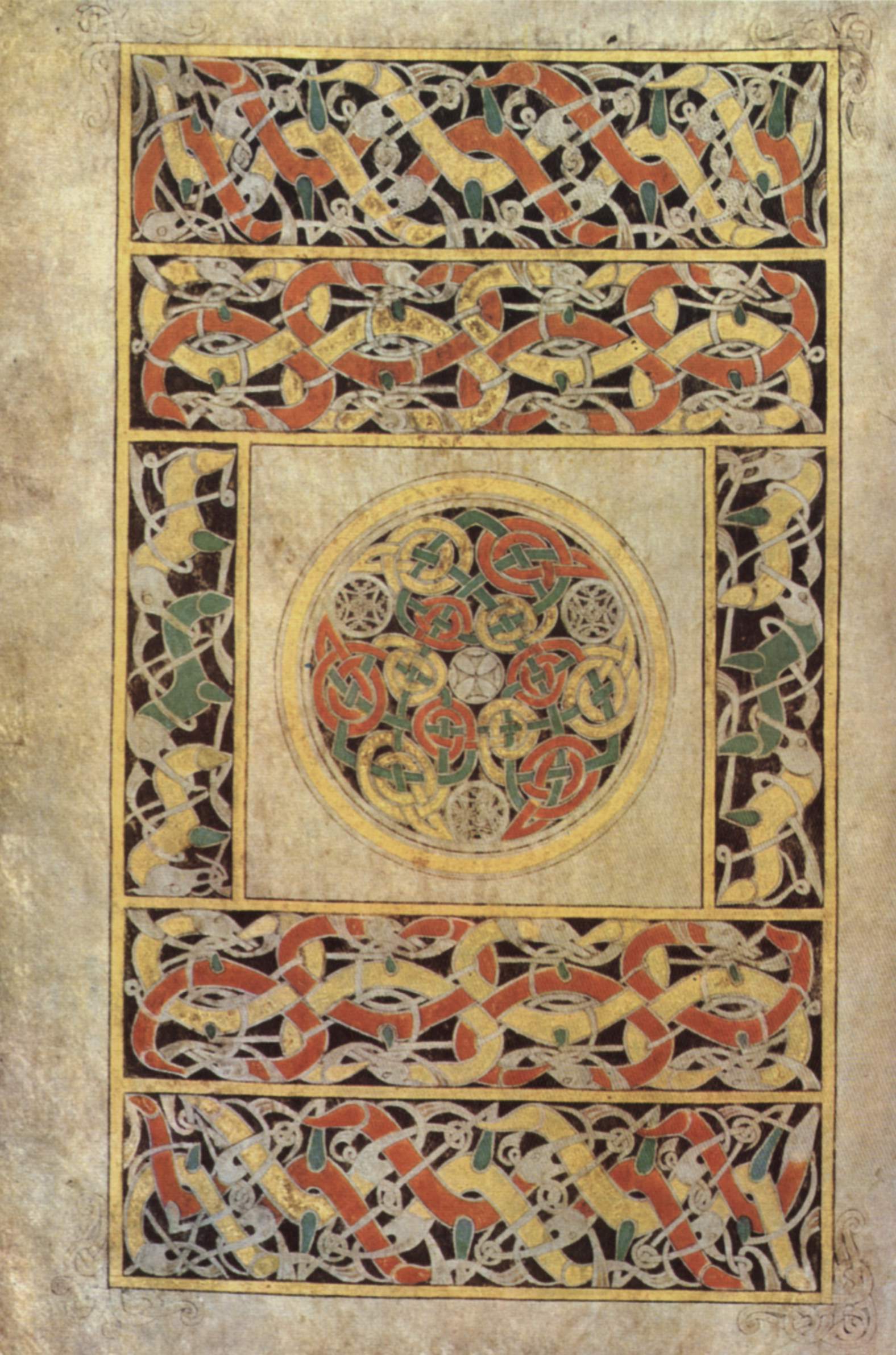
I would venture to say that the Insular art style with Celtic spirals, curvilinear, and geometric shapes employed in the Book of Durrow were not influenced by Norse or Viking raiding artisans. This kind of complex, intricate art did not suddenly spring forth in a brand new art form, the illustrated book arts. Especially when one's homeland was being invaded by Vikings. So what came first? Chicken or egg? (See folios 1v, 85v, 125v at bottom of Wiki page.)
There's more of a correlation with Anglo-Saxon art, and even that was a hybrid art form, later called the Hiberno-Saxon style. I find no Germanic Continental evidence of this Insular art form. What each of these cultures have in common, is exposure to Insular Celts. Early medieval Celtic book treasure bindings were highly coveted by the Vikings. One can only imagine what the lost treasure cover for the Book of Kells looked like.
Various metal fragments of what were probably book-mounts have survived, usually adapted as jewellery by Vikings. —Wiki(Also, the Bronze Age Celts, and Celtic culture dominated the Continent, so some of their artifacts could have been found by what later become the ancestors of the Vikings.) There was cultural contact. But there's scant evidence that Viking artifacts predate Irish and Celtic art styles. To make an absurd parallel, many little girls the world over love Hello Kitty, that doesn't mean they were all Japanese samurai.
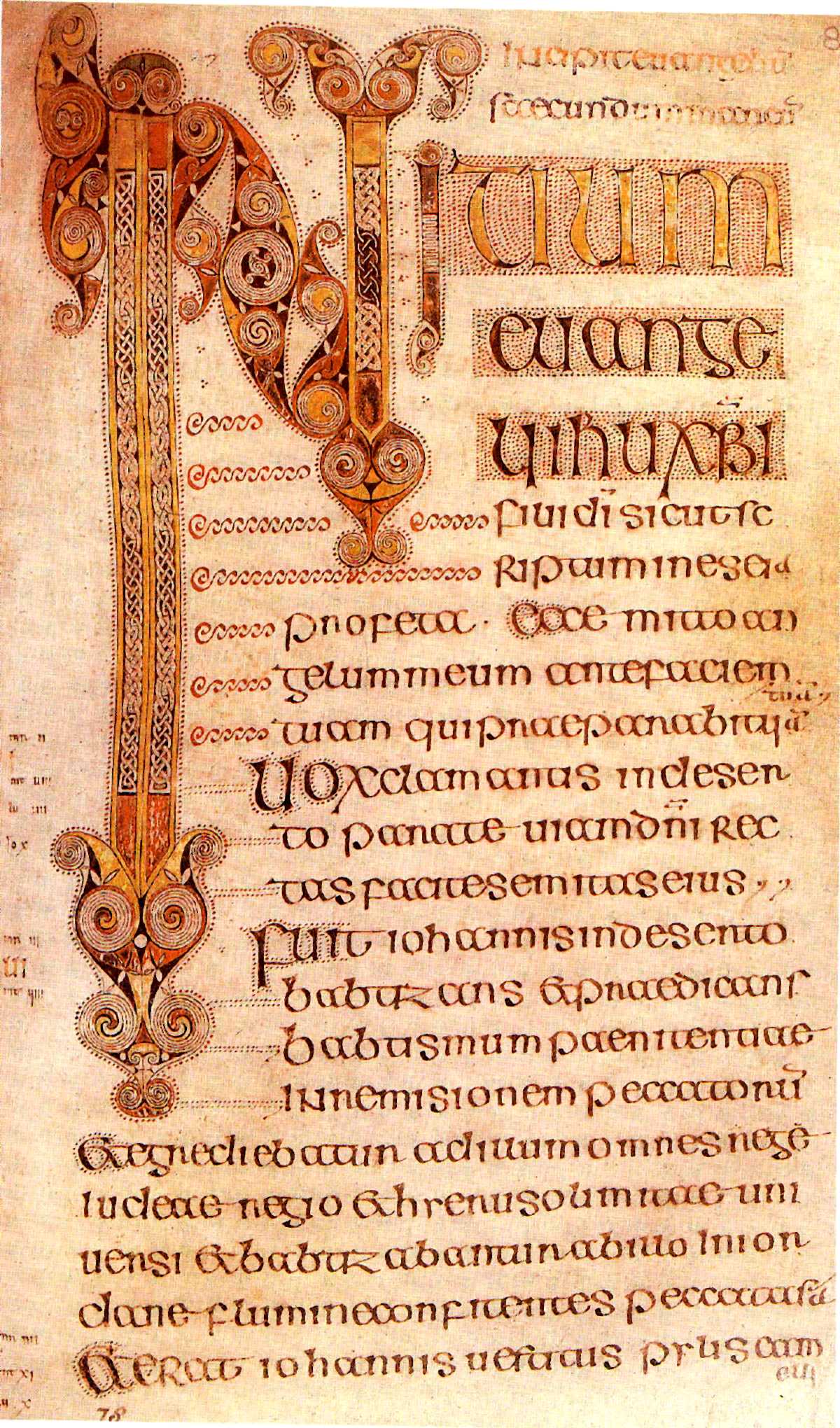
Gospel of Mark, Book of Durrow, 650-700 AD. —Wiki
The Vikings were raiders, they brought back artifacts from other cultures, which in turn, influenced their art. Geometric interlace doesn't appear in Viking culture until after they had contact with Britain and Ireland. They also brought back (Irish) slaves, who were artisans....Again, keep in mind the timeline, and it was a hybrid culture].
(See mid-9th c. Oseberg ship-burial. Artifacts included the Oseberg bucket, with patterned enamel figures similar "to the Gospel books of the Insular art of the British Isles, such as the Book of Durrow, (ca.650 AD)." —Wiki, and Irish Archaeology.
Several Viking ships in Roskilde Fjord, and the Skuldelev ships were made in Ireland. So claiming who did/owned what in the past is never quite as simple as it seems from our perspective. We don't know who carved the ships, and, again, it was a hybrid culture. Also, there was no timber in Iceland, so Icelandic ships too would've been built in Ireland or wood imported to Scandinavia.)
![]() |
| Book of Durrow Carpet page, similar in style to the Oseberg bucket, 650-700 AD. —Wiki |
If you get a good grasp of the pre-Classical, Classical, and post Classical Celtic cultures, and migrations, then it will all make more sense.
Unfortunately working from a knowledge base that dates to the Plantation of Ulster as a reference point, is politically biased, therefore suspect. History written in the voice of the victor, and all that. Also, the intense hatred the English harbored for the ethnic Irish has also adversely colored "history." So, most Irish connections were extirpated. The OED is a prime example.
In Scotland, a lot of so-called Scots, were actually Irish. The Industrial Revolution, and two famines meant that many Irish immigrated to Scotland—especially The Barrows in Glesga, and along Clydebank (ships).
Yes, the Romans named the Picts, Picti, after a Continental Picti tribe, who were probably from the same Gaulish tribe. Picts were probably P-Celtic vs. Q-Celtic speakers. The Picts were also in N. Ireland, they were called the Cruithne, or Cruithín (they have an asteroid named after them, LOL!) The Cruithne/Criuthín included several tuatha, including the the Dál nAraidi—who settled in Scotland. Qritani/Cruithne comes from the word *pritenī (Pretani). Q-Celtic Irish speakers hated the plosive P sound and swapped it out for a more gutteral cough sound, hard c/q/k C: Cruithne/Pritani. mac/map, etc.
Ireland had many P-Celtic speaking tribes, as well as Q-Celtic speakers (Gaels, Galicia). See Ptolemy's map of Ireland for tribal names: Briganti, Dumnoni, etc. Cruithni and Menapi were probably Gaulish. The Ganganoi were also in N. Wales. In the 5th c AD, Gwynned was an Irish enclave, so there was a lot of back and forth movement.
![]() |
| A rendition of Ptolemy's map (Vlaclav Hollar, ca. 1650s-70s) —Wiki |
Julius Caesar, in his Commentarii de Bello Gallico, is the first to call the island Hibernia... —Wiki
In the Song of Amergin, the first Gael to settle in Ireland, (Galician) poet-druid Amergin (mac) Mil quells the sea, after the very tall Tuatha Dé Danánn send a big wind spell, proving he was a bigger, badder druid, than they. And to really ridiculously telescope mythological time, they slunk away, shrank, went underground, and became the fairyfolk!
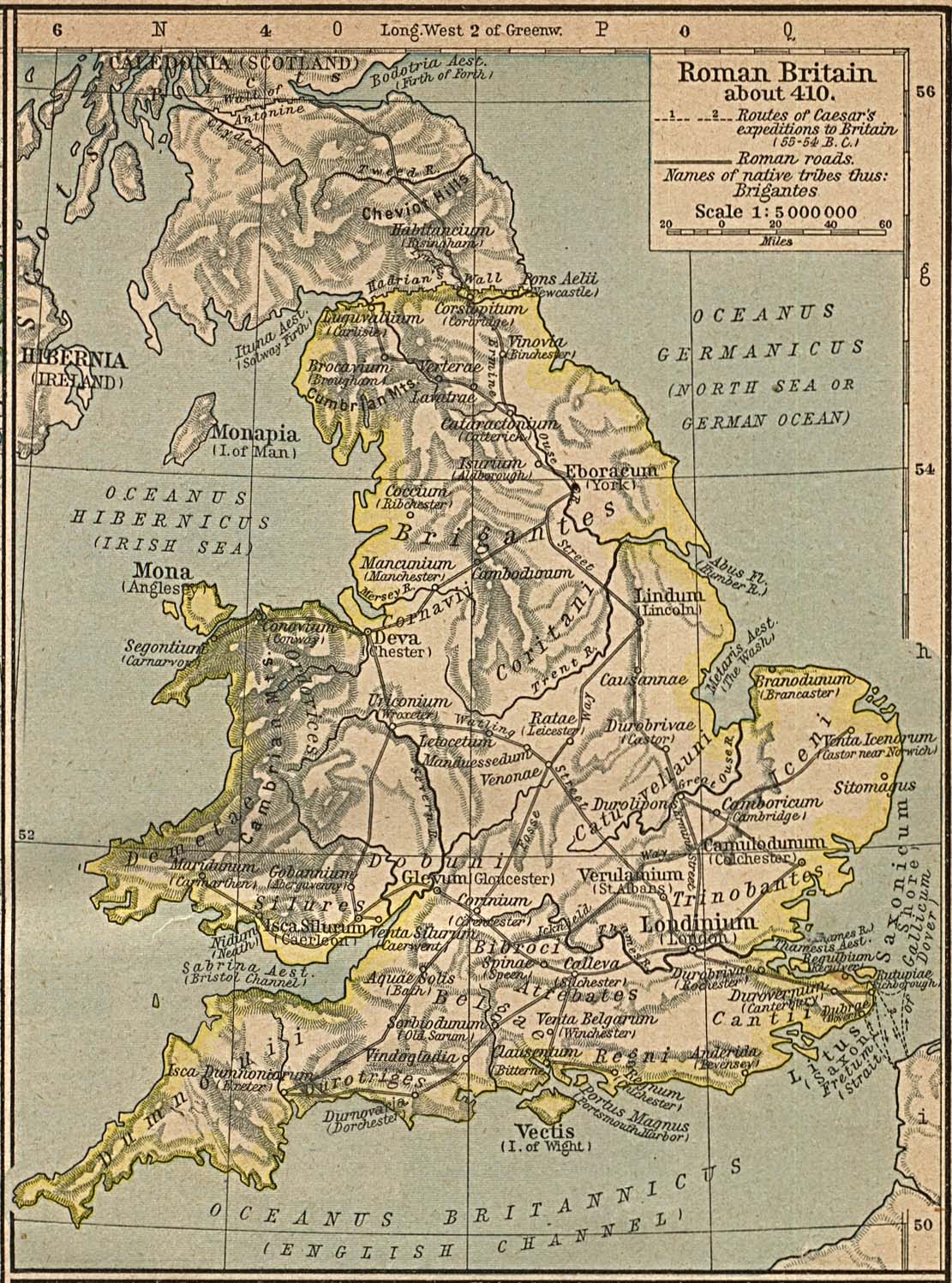
Here's a lovely Roman world view map of Scotland & Eire; note the use of the word Scotti in N. Ireland. Note also that Scotland was not called Scotland, but Valentia, and Caledonia. The Brigantes of Maxima Caesariensis were a buffer between Caesariens (Roman Britain) and what we now refer to as Scotland. Only Southern England, Kent, Cornwall and Devon (Cantii, Damnonii and Belgae tribes) was called Brittania.

Roman Britain —Wiki
Another old map.

Roman Britain in 410 —Wiki
And an updated 1654 map that chronicles Scotland as Scotia and Ireland as Hibernia/Ivverna. Pope Leo X (1475-1521) decreed (when?) that Scotland had exclusive rights to the term Scotland.
In early medieval times Ireland was known not only as Éire but also as Scotia, a name that the Romans used at times to refer to Ireland as well as Scotland. —Wiki
Friday, November 20, 2015
Meeting Annie Leibovitz
“The camera makes you forget you’re there. It’s not like you are hiding but you forget, you are just looking so much.” – Annie Leibovitz
Don't I know about that one. Bearing witness, so intimate, yet, one is removed from the event. Sometimes the camera renders one invisible. I met Annie once at a museum opening of her work, and the work of Hung Liu. Larger than life, Annie was hardly invisible! I was pretty chuffed, I even have a photo of her. But it's out of focus, as if the lens couldn't take all of her in.
Snow Mountain Wilderness, our Newest National Monument
![]() |
| Sierra Club photo, The Davis Enterprise |
Or a hair-raising detour to Humboldt County's Lost Coast, when it truly was lost. And a memorable drive to the southern lip of the mouth of the Klamath River in Del Norte County. But we never made it to Snow Mountain. On my bucket list.
Surrounded by deep canyons and a steep elevation gain, several ecological biomes are compressed, resulting in biological sky-islands. Added to that, the geology, with serpentine, greenstone and basalt, as well as an array of sedimentary rocks, creates unique and diverse biomes.
More than 500 species of plants including mountain mahogany, rare Sonoma manzanita, pygmy stands of Sargent's cypress and serpentine willow, as well as 122 species of wildlife, including Tule elk, threatened species, Western pond turtle, and endangered sooty grouse, not to mention nearly half of California’s 108 species of damsel- and "kamakazi" dragon-flies, call Snow Mountain Wilderness area home.
![]() |
| BLM photo (dead link, thanks #45.) |
![]() |
| Tuleyome Conservation Group photo, The Davis Enterprise |
Snow Mountain is an interesting melange, both genetically, and geologically speaking, with serpentine; greenstone, basalt and pillow lava—submarine volcanic rocks that commuted from far west of California, courtesy of tectonic uplift, as well as a full compliment of sedimentary rocks from the North American plate. Some, laid down during the Miocene epoch, when the Central Valley was an inland sea.
The Snow Mountain Wilderness, itself, is comprised of parts of Glenn, Colusa and Lake counties. Both Lake and Colusa counties share the remote summits of Snow Mountain. The highest point, the east peak (7,056 ft.) is ithe highest point in Lake County, and the west peak (7,040 ft.) is the highest point in Colusa County. One of the largest swaths of undeveloped public lands in the middle of all this urban density, Berryessa Snow Mountain is truly California’s undiscovered country.


.png)


.jpg)