Showing posts with label Russian River Writers’ Guild. Show all posts
Showing posts with label Russian River Writers’ Guild. Show all posts
Sunday, November 14, 2010
Remembering John Prine's Brother at Garbo's
Chicago Sun Times columnist and movie critic, Roger Ebert, wrote "John Prine is the poet of my life. People say he's great, but he's a lot better than that." I recommend reading Roger Ebert's Journal, a column he originally wrote in 1970, "John Prine: American Legend—A Singing Mailman Who Delivers a Powerful Message in a Few Words."
(Ebert's also updated the original story by posting some great John Prine YouTube links. The " Angel From Montgomery" backstory is worth the price of admission.) Bob Dylan once said "Prine's stuff is pure Proustian existentialism." I concur.
I have an interesting John Prine segue too via his brother. Circa 1980, John Prine's brother played John's songs for drinks at our Russian River Writers' Guild Monday Nite Poetry & Prose Reading series at Garbo's bar in Guernewood Park, CA. That's how I first learned to really listen to the words of John Prine's songs as poetry.
Ironically, it was songs—Irish ballads that first led me to writing. But that's another story. Prine always had such good angst-riddled lines: "You've broken the speed of the sound of loneliness...How can you ask about tomorrow?" My kind of lines. I was living in a perpetually warped möbius strip time.
(In the 1980s, we were living under a dark cloud: many of the gay club owners who housed our poetry venues were succumbing to a mysterious disease. Nobody knew what it was. Or its name. But we personally knew the names of the fallen: Peter Pender, the pianist/gold medal figure skater, bridge/chess champ who owned Fife's Resort with partner Hugh Ross, Stumptown Annie's owner, decorated Vietnam Purple Heart veteran, Leonard Matlovich, the first gay man to "come out" while in the military—was no longer looking like Kevin Spacey. It was too much to bear.
There was also my neighbor, handsome Bill Dutra, the original Marlboro Man, his beautiful face ravaged... Note Bene: I can't find info on Bill on the internet but he may have been Christian Haren. The info on Christian (or Chuck) fits—he owned The Chocolate Factory in Guerneville. But I can't find a photo.
Bill showed me an old tear sheet photo of him as the Marlboro Man—which I recognized. Bill told us amazing stories of being an actor, working with John Wayne—how I found out Dr. Kildare was gay—and stories of Key West. So all the pieces fit—just not the name of the Castro Street Cowboy.
I could have confabulated the name—but I've an uncanny memory for details. Whoa! Now I've segued so far from my story, I'm even scaring myself. So sorry. Another story, another time. (The Russian River basin attracted many Hollywood types, Fred MacMurray, Raymond Burr, Irene Dailey all lived in its watershed.)
My personal John Prine favorites were the songs that had recently made the charts. I loved "Paradise," but we all called it " Daddy Won'tcha Take me Back to Muhlenberg County," a song Prine says he wrote for his father. There's some good backstory video on the song here.
When I was a senior in high school in 1969, the town of Paradise, in Muhlenburg County, was drowned by the floodwaters of the Green River when a dam was erected, so barges could get to the Peabody coal fields. All about progress.


Saturday, July 24, 2010
For the Duration
Marianne Ware, poet, novelist, & the grand dame of belles lettres—the epistolary packin' mama mentor of countless Sonoma County writers—passed away on her 74th summer solstice. Too soon. We expected her to be here much longer to greet the return of the sun. Now something of the sun is gone from us. Eclipsed.
I first met Marianne through Lee Perron—they were coordinating the Russian River Writers' Guild. I was newly arrived to poetry, and before I knew it, I was roped into the Writers' Guild, which became both my teething ring and my training ground.
Little did I know, I was also fresh fodder—grist for the mill—to help run it. And later, I was left holding the bag. But I learned to stick it out for the duration. At the time, I was living out of my car after a bad breakup. She even found me a place to live—at her daughter Laurie's cabins.
Because Marianne was adamant that prose also be represented at the RRWG reading series, and because of her, I learned to dabble in prose. Dyslexic that I am, I discovered what writing—like people—came in all sorts of shapes and sizes. Not just poems and stories, but letters, notes, lists. They all served to inform.
Marianne brought the light of writing into the lives of so many of us. She encouraged us to find our own true authentic voice. To spread our wings and to fly close—but not too close—to the sun. She always encouraged the next generation of fledgling writers: Doug Powell, Glenn Ingersoll, Trane deVore. The Guild offered a platform for new and established writers to read together.
We booked poets & writers—even musicians from near and far to share their love of the word. Utah Phillips, Rosalee Sorrells, Bobbie Louise Hawkins, Ed Balchowski. Some of the writers she encouraged made it to the big stage: Andrei Codrescu, Michael Oandatje, D.A. Powell, Jane Hirshfield come to mind. But the history of the Guild is a whole other story. We are here to honor Marianne today.
Tuesday, December 29, 2009
Missing Leonard Matlovich
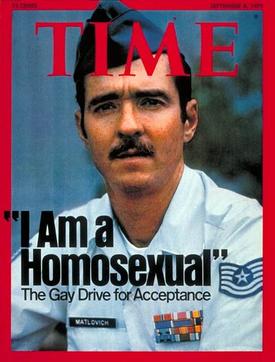 |
| September 8, 1975, issue of Time magazine |
When I was in the military, they gave me a medal for killing two men and a discharge for loving one.—Leonard Matlovich, Vietnam Veteran (1943-1988)Vietnam war veteran and Purple Heart recipient wounded in Da Nang, USAF pilot, Sgt. Leonard Matolvitch was the first gay man in the military to come out of the closet. In 1975, he was discharged for being "unfit for service" he was gay. He made the cover of Time Magazine.
Guerneville writer, Randy Shilts, in Conduct Unbecoming: Gays and Lesbians in the US Military, wrote: "It marked the first time the young gay movement had made the cover of a major newsweekly. To a movement still struggling for legitimacy, the event was a major turning point."
Leonard sued for reinstatement, but the court case dragged on until 1980, the military refused to reinstate him, but offered him a lump sum of $160,000 for back pay and his pension. He took the money and ran, and in 1981, he moved to Gurerneville, on the Russian River, an up-and-coming gay mecca.
Leonard was also a big patron of poetry, I used to produce poetry readings at his Stumptown Annie's Pizza Parlour in Guerneville, ca. 1983, he sold the place in Jan., 1984.) Bobby Kaufman was on The River in those days—pretty strung out but Leonard was always a gracious host. In his honey-sweet Savannah drawl, Leonard once told me that J Edgar Hoover was a cross-dresser! Things like that.
 |
| Stumptown Annie’s |
In 1984, AIDS had reared its ugly head on the river. He sold Stumptown Annie's, and moved to Paris, while visiting the graves of lovers Gertrude Stein and Alice B. Toklas and Oscar Wilde, he got the idea to create an AIDS memorial.
He moved back to the Castro District, in San Francisco, where he sold Ford cars. In 1986, a nasty chest cold was confirmed as AIDS. He became a champion for HIV/AIDS research, when he came out on Good Morning America that he was HIV positive, we were devastated.
On the steps of the California State Capitol during the March on Sacramento for Gay and Lesbian Rights, on May 7, 1988, Leonard made his final appearance:
...And I want you to look at the flag, our rainbow flag, and I want you to look at it with pride in your heart, because we too have a dream. And what is our dream? Ours is more than an American dream. It's a universal dream. Because in South Africa, we're black and white, and in Northern Ireland, we're Protestant and Catholic, and in Israel we're Jew and Muslim. And our mission is to reach out and teach people to love, and not to hate. And you know the reality of the situation is that before we as an individual meet, the only thing we have in common is our sexuality. And in the AIDS crisis - and I have AIDS - and in the AIDS crisis, if there is any one word that describes our community's reaction to AIDS, that word is love, love, love.Less than a month before his 45th birthday, on June 22, 1988, Leonard died of complications from AIDS, in LA, beneath a large photo of Martin Luther King, Jr. Ironic that Leonard's tombstone at Congressional Cemetery in Washington, D.C., is in the same row as that old cross-dresser, FBI Director J. Edgar Hoover. Leonard's grave is a LGBT tourist attraction, and has become a de facto AIDS memorial site.
I miss you Leonard. Thank you for coming out so others could too. It was a very brave thing to do.
rev. 12/17/17
Monday, January 15, 1996
On The Day Paul Mariah Died
Martin Luther King Day
Bob Flannery read a poem at Mudd's Café, that asked the most beautiful question: What is your dharma name? Then says, Bineh. Labia? He said the Nahual word for wise man or artist is Tolteca, or toltecayotl. The other night the phone rang at 3 AM. My dead mother, the artist, wanting me to read her I Ching horoscope. So I cast
the bronze coins. Saw where they fell. They spoke in tongues. Noni Howard also called to say that I had a poem in the Parnassus of World Poets, which one? The day she told me was the day that Paul Mariah died. We are losing our cultural icons.
1/15/1996
added & rev. 11/17
Paul Mariah died on Friday, the 12th
1/15/1996
added & rev. 11/17
Paul Mariah died on Friday, the 12th
Monday, November 6, 1995
Kizer, O'Hehir reading at Mudd's
Diana reads about living on the earthquake fault. She said that poems fall into categories: children, parents, relationships. I don't believe in God but I'll try anyway, and then she writes a poem about salvation. Poetry of loss and of separation from the mother.
I said my mother's ashes gather dust on the bureau in my brother's room where the forgotten pieces of the discarded past seek eternal rest. A dog chewed on the crucifix, it's a secret hiding place of Sacrament, amid the tarnished golf clubs. Diana tells me to write of an apple and then relate it to my mother. I think the last known wild aurochs died in Poland in 1627, when did the last wood bison die? Fallen among the apples.
Saturday, October 14, 1995
Inverness Fire
I haven't had a chance to write in my journal since I came back from the Mendocino Woodlands. I came home to the big Inverness fire and to O.J. Simpson's acquittal. There was little news to be had in the deep woods, but on Tuesday we did get the news of O.J. Simpson. The woods couldn't filter that injustice out, it was so atrocious.
Meanwhile 12,000 acres of Bishop Pine went up in smoke as the Pope gave mass in the pouring New Jersey rain, drenched believers filling the football field.
Last night I went to a party with Verona Seiter and Herman Berlandt at Zoravia Bettoil's flat in Pacific Heights, she is a Brazilian artist. Full moon over the San Francisco Bay took our breath away. A magical night.
We danced the samba, the lambada, with the Latin American ex-pats. Zoravia said I can move my hips like no other. I am flattered. I guess. She said that she thought that she could gyrate and flick her pelvis, until she saw me in action. She said every man's eyes were glued to my hips. I was wearing the ruffled tea dress from my 25th high school reunion, which helped. The Brazilian Consul wanted more than just a dance in the moonlight.
That complement coming from a Brazilian from São Paulo is a compliment indeed, but then I had reason to move like that. The more I hurt inside, the harder I danced, rejected by my neighbor Sonny and his latest skank, Pat. Because of them I am somewhat homeless, she is now living with him, invading my space with her negative energy. I can't be at my home anymore. This is why I danced so hard.
Herman and I snuck off to Bolinas on Sunday. And I tried to find out if my friends were burned out. At the American Red Cross in Point Reyes, I find Stephen Torre's name on the roster. The fire left his house standing, miraculously, since it stands atop Drakeview Estates Road, at the ridgeline. His neighbor, Van Morrison, lost everything. His place burned to the ground. Even the gold and platinum records. Bob Hamilton and I once almost bought the lot next to Van's place but there was no water.
Steve's house was listed as habitable but he did not show up for the Russian River Writers' Guild Monday night reading, nor did Kathy Evans. Oh well. I called her to see why she didn't show up for her reading, and she's having a hit histamine reaction to the world, and to the smoke. I give her the allergic saga, how works the immune system.
Meanwhile, Steve is in British Columbia thinking he has no home. I tell her it's still standing. Kathy can't believe it. Stress levels threaten to undo us all. No way to reach Steve.
Anyway, to catch up on things, last Sunday afternoon, Herman and I hiked from RCA Beach to Palomarin Beach. There were very few people on the trail. We didn't realize we had hiked so far north.
Behind the roped off area, was the fire zone. The park rangers were quite surprised to see us, saying we'd hike to a fair distance. The park is closed as the trees are still sizzling. And looters have invaded, making their mark. There are cops everywhere. The rangers rifle, a symbol for martial law.
We can't see the fire, but my voice begins to hurt by nightfall. We hiked up one creek to a waterfall. Herman, for all his 72 years, is surprisingly agile. He continues to remind me of my grandmother. How odd. How we used to go on long hikes and adventures without any real preplanning. They just happen.
Herman too likes this spontaneous approach to dailiness, we are invincible. We spend Sunday night in his cabin on the Mesa. A nice dinner of salmon and couscous. I always take it upon myself to cook most meals, treating Herman. I suspect Verona does the same, but I like to cook for him. Maybe it's the female thing. He purchases most of the food and does the dishes, so it's a decent exchange.
I've been managing to keep away from home because of Sonny. Which means my life is changing. I don't have my home anchor anymore. Sonny's son Nathan hardly ever visits anymore and wonders why I'm never home. I explain, it's not forever. Yesterday Nathan's mother, Cindy, came to get him, leaving Sonny and Pat alone, and I growl.
I've taken to flipping him off whenever they drive by. Safe within the walls of my tiny cabin, I'm living between two places—my cabin, and my truck, my bags are always packed. Bolinas is my refuge, it's becoming my new home, and I am on fire, raging against betrayal, and the injustice of it all.
Monday, October 17, 1994


Thursday, February 10, 1994
Letter to Johnny Otis, re: RRWG Scheduling SNAFUs
Dear Johnny,
date? He was inducted into the Rock and Roll Hall of Fame in Jan. 20, 1994.
First, let me say CONGRATULATIONS on your well-deserved awards! YES! I hope you enjoyed the African Poetry & Mother Earth issues I left you. I left some for Nick too at the café, but I don’t know if he got them. I didn’t put them in his box
About the Russian River Writers’ Guild poetry series—we’re facing some restructuring because David Bromige is quitting out of shee frustration due to conflicting communiques. Problems include finding another MC for Tuesday night, or switching to Monday, door percentage, and communication—the chain of command at the club. I have two people who can participate on Monday nights (they teach classes on Tuesdays) and I can’t carry the burden of the series alone (see P.S.). If we can quickly find MC’s for alternate Tuesdays, then the problem is temporarily alleviated. I realize Jim Kohn’s a key link for your weekly scheduling—maybe it’s merely a case of too many fish (or chains) in the stewpot but we are having a communication problem. Hence this letter.
Ironically, the idea of booking poetry on Monday vs. Tuesday night came up when Jim was thinking of moving us to Monday nights. He said the music nights were so financially successful (& overbooked) he wanted to expand the music programming.
date? He was inducted into the Rock and Roll Hall of Fame in Jan. 20, 1994.
First, let me say CONGRATULATIONS on your well-deserved awards! YES! I hope you enjoyed the African Poetry & Mother Earth issues I left you. I left some for Nick too at the café, but I don’t know if he got them. I didn’t put them in his box
About the Russian River Writers’ Guild poetry series—we’re facing some restructuring because David Bromige is quitting out of shee frustration due to conflicting communiques. Problems include finding another MC for Tuesday night, or switching to Monday, door percentage, and communication—the chain of command at the club. I have two people who can participate on Monday nights (they teach classes on Tuesdays) and I can’t carry the burden of the series alone (see P.S.). If we can quickly find MC’s for alternate Tuesdays, then the problem is temporarily alleviated. I realize Jim Kohn’s a key link for your weekly scheduling—maybe it’s merely a case of too many fish (or chains) in the stewpot but we are having a communication problem. Hence this letter.
Ironically, the idea of booking poetry on Monday vs. Tuesday night came up when Jim was thinking of moving us to Monday nights. He said the music nights were so financially successful (& overbooked) he wanted to expand the music programming.
Faced with the prospect of being bumped from the club, of course we agreed to switch to Monday nights, and booked readers on Mondays beginning in Feb.; we already had Jan. schedule in place by Oct.
Then in Dec., I guess Jim either forgot or changed his mind, telling David, “What am I going to do with Tuesday nights? Go dark?” To accommodate Jim we changed back to Tuesdays. To make a long story short, just like in the game, “telephone,” the story kept changing each time we talked to Jim (or his machine), which led to David’s quitting. Jim told David that I’d requested Mondays when I said “Monday were always our first choice and yes, I’ll ask the other coordinators about switching.” They agreed to it, and I told Jim, “OK, we’ll switch.”
We were asked to give the club $1 per head (1/2 the pot) in Jan. by Jim, but you said we could begin paying our $1 tithe in Feb. not Jan. We’d already promised Jan. door to scheduled readers, and publicity (including admission $) was out Oct. (At the last minute Jim told us we had to charge $4 starting in Jan.; the Jan. calendar was late; it was impossible to reach him in Dec. so we couldn’t deliver mailing list to him, etc.—were other bones of contention.) In retrospect, it would’ve made more sense to meet with both you and Jim in Nov. to work out the details together. (A note: if the club is losing money, may I suggest using only one counter person on poetry nites?)
Each item is very minor and is certainly workable—but it’s stressful when the changes affects so many of us; we’re already donating countless unpaid hours of our time, and coordinating so many people. As an organization, we’ve been in existence for nearly 25 years; it’s always been a labor of love.
We were asked to give the club $1 per head (1/2 the pot) in Jan. by Jim, but you said we could begin paying our $1 tithe in Feb. not Jan. We’d already promised Jan. door to scheduled readers, and publicity (including admission $) was out Oct. (At the last minute Jim told us we had to charge $4 starting in Jan.; the Jan. calendar was late; it was impossible to reach him in Dec. so we couldn’t deliver mailing list to him, etc.—were other bones of contention.) In retrospect, it would’ve made more sense to meet with both you and Jim in Nov. to work out the details together. (A note: if the club is losing money, may I suggest using only one counter person on poetry nites?)
Each item is very minor and is certainly workable—but it’s stressful when the changes affects so many of us; we’re already donating countless unpaid hours of our time, and coordinating so many people. As an organization, we’ve been in existence for nearly 25 years; it’s always been a labor of love.
Working too long with a shoestring budget means the string eventually breaks. Something as minor as raising the door to $4 could be our swan song, the death of the series—if the audience won’t come. Even at $3 we’re running on nervous! (We’re still adjusting to the fact that we need to give 1/3 of our pot to the door—at the Senior Center our rent was $5 per night.)
And because we pull in so little, we’re not eligible to make use of some matching grants to pay poets. Since you do need door money from us, we’d like to try to find a way to eventually underwrite the series—someone to pay the “rent”—like the Sonoma County Community Foundation as we are a non-profit arts organization. But we won’t see any funding until summer when the awards are announced.
We’re grateful that you’ve allowed us the opportunity to use the space. Because of your generosity, poetry in Sonoma County has been seriously revitalized, and we’re just now developing a strong poetry audience after years of benign neglect. It would be a shame to quit. We love the space, the ambiance—and the fact the your counter people also like poetry—we even booked Rose Halliday for Feb. I hope we can work out the details but at this point, if I can’t replace David, I may have to drop out too. I’d like to see the series continue. I hope you’ll bear with us until we can work out the logistics.
Sincerely,
Maureen Hurley
P.S. On a more personal note, since I work in the schools as an artist in residence, (and schools are really broke this year), I have to generate jobs—my situation is critical. My father’s death in Dec. has tapped all my reserves—his assets were signed over to a co-worker (it looks like fraud, but I can’t afford legal advice)—leaving me with the burden and no recourse. I can’t absorb the time/cost of running the series.
We’re grateful that you’ve allowed us the opportunity to use the space. Because of your generosity, poetry in Sonoma County has been seriously revitalized, and we’re just now developing a strong poetry audience after years of benign neglect. It would be a shame to quit. We love the space, the ambiance—and the fact the your counter people also like poetry—we even booked Rose Halliday for Feb. I hope we can work out the details but at this point, if I can’t replace David, I may have to drop out too. I’d like to see the series continue. I hope you’ll bear with us until we can work out the logistics.
Sincerely,
Maureen Hurley
P.S. On a more personal note, since I work in the schools as an artist in residence, (and schools are really broke this year), I have to generate jobs—my situation is critical. My father’s death in Dec. has tapped all my reserves—his assets were signed over to a co-worker (it looks like fraud, but I can’t afford legal advice)—leaving me with the burden and no recourse. I can’t absorb the time/cost of running the series.
Monday, March 4, 1991


Thursday, September 20, 1990


Wednesday, September 12, 1990

Friday, June 2, 1989

Tuesday, April 18, 1989
L' APRES-MIDI
L' APRES-MIDI
You have found me out,
slipped in clean as a knife,
your poems lucid as a white room
in late afternoon where
I want to stand before you
pre-architectural. Slip off these words
into something more comfortable,
reveal the inner curve of femur,
the hollow of pelvis framed
against the purity of desert sky
& feel your breath sing against my ribs.
Where my breasts flowered
your disembodied hands harvest
brilliance arcing on blank pages.
We burn against the night's silence
lost, looking for home.
I taste your words on my tongue,
dreaming them as if they were alive,
incandescent as flanks of white horses
in the rain—your poems shed light,
nuzzle breathless in my ear.
It's not so much the words themselves
but the way they touch
the muddy river where, for a moment,
our tongues found truth hidden in the roots.
There is a curve of eyebrow,
an alluvial valley that speaks
of such tenderness, we turn stones,
& turn them again. What does it matter
if the sun will die, your kisses like stars.
The physics of writing consumes us.
Not ambivalence. Not the other sin.
It cannot hide serpentine from the river—
the brightness from within—a burning moth
circling the pale fire of your eyes.
You tell me : too many loves in our past
& slip into the Paris night, well armed,
calling it by the clear light of poetry
because love also requires such brutal attention.
Can one name the instant when the heart
of the untamable beast ignites or dies?
Afraid of what it might be,
in the naked room, what are we then?
4/18/89
—For Bruce Isaacson
in homage to Robert Sund & Georgia O'Keefe
You have found me out,
slipped in clean as a knife,
your poems lucid as a white room
in late afternoon where
I want to stand before you
pre-architectural. Slip off these words
into something more comfortable,
reveal the inner curve of femur,
the hollow of pelvis framed
against the purity of desert sky
& feel your breath sing against my ribs.
Where my breasts flowered
your disembodied hands harvest
brilliance arcing on blank pages.
We burn against the night's silence
lost, looking for home.
I taste your words on my tongue,
dreaming them as if they were alive,
incandescent as flanks of white horses
in the rain—your poems shed light,
nuzzle breathless in my ear.
It's not so much the words themselves
but the way they touch
the muddy river where, for a moment,
our tongues found truth hidden in the roots.
There is a curve of eyebrow,
an alluvial valley that speaks
of such tenderness, we turn stones,
& turn them again. What does it matter
if the sun will die, your kisses like stars.
The physics of writing consumes us.
Not ambivalence. Not the other sin.
It cannot hide serpentine from the river—
the brightness from within—a burning moth
circling the pale fire of your eyes.
You tell me : too many loves in our past
& slip into the Paris night, well armed,
calling it by the clear light of poetry
because love also requires such brutal attention.
Can one name the instant when the heart
of the untamable beast ignites or dies?
Afraid of what it might be,
in the naked room, what are we then?
4/18/89
Saturday, February 4, 1989

Wednesday, January 6, 1988
Russian River Writers' Guild
RUSSIAN RIVER WRITERS' GUILD POETRY AND PROSE SERIES; A HISTORICAL PERSPECTIVE
With early west county beginnings in bakeries, bars, and bookstores, the poetry and prose series of the Russian River Writers' Guild (RRWG) is the oldest ongoing reading series in the greater Bay Area and north coast.
The RRWG has kept the "literatii" entertained in most west county towns, from Monte Rio, its first home, to Occidental, Guerneville, Santa Rosa and Sebastopol.
Since the early '70's, both famous and infamous poets across the nation have shared the podium with local poets. Literally, hundreds of poets—from nationally recognized names such as McArthur prize recipient Robert Hass; Robert Bly whose translations of Rilke were published by Calliopea Press; and 95-year-old Meridel LeSueur, a McCarthy era blacklisted writer rediscovered in the 70's by the women's movement—to the real unknowns who have just discovered the power of the written word.
Since the San Francisco literary renaissance of the '50's, when Kenneth Rexroth introduced experimental jazz and "Beat" poets such as Allen Ginsberg and Jack Kerouac to the literary world of New York, the Bay Area poetry scene has blossomed.
Hundreds of small presses abound and Poetry Flash, the Bay Area's literary calendar of events lists scores of readings for each day of the week. (needs transition ...)
One former RRWG coordinator, Andrei Codrescu, Rumanian poet and editor of numerous books and anthologies including Up Late: American Poetry since 1970, is best known as the poetry correspondant for National Public Radio's weekly series, All Things Considered. His fellow coordinator, Pat Nolan has poems and translations published in Random House Book of 20th Century French Poetry, Paris Review, Rolling Stone, and Up Late. Codrescu lists Nolan as a leader of the "California School of Writing" according to Nolan's wife, Gail King, also a former Guild coordinator.
Guild co-founder and "jewish mother", Marianne Ware, whose chapbook, Bodies Nearly Touching, published by Nolan and King (Doris Green Editions), was printed in the 1987 Editor's Choice II anthology highlighting small presses. The obligatory hug she gave each reader in greeting was dubbed by coordinator Jim Montrose the "obligatory hug" and became the name of the Guild's monthly newsletter which lists upcoming poetic events, prose, and poetry of featured readers.
Former coordinators Lee Perron and Maureen Hurley said the heyday of the series ('79 to '82) was when novelist Margie Summerfield offered them a free space with a stage, lighting and sophistocated sound system at Garbo's Cabaret & Bar in Guernewood Park. Many customers who came in for a drink were startled at first, but soon took to poetry.
Perron and Hurley booked many poetry and arts events that would appeal to larger audiences who traditionally didn't attend poetry readings. Poets and musicians, dancers and actors all performed their poetic works. Folksinger-poets U. Utah Phillips and Ed Balchowsky, Bobbie Louise Hawkins and Rosalie Sorrels; actor-director Fred Curchak, artist Greer Upton, dancer Jere Graham and songwriter Michael Beargrease Hansen were also part of the line up.
Some poetry events drew crowds of more than 200 such as the poetry and musical extravaganza by Elizabeth Herron, Fran Carbonaro and Rick Duvall. It was raining like hell and the river was rising but Robert Bly who flew in for his book party at Sonoma State cosponsored by the Guild and Public Poetry Center, wandered in. They didn't charge him admission.
For many, the Guild provides a platform to explore and develop new ideas and areers. Perron, published in American Poetry Review, and CoEvolution Quarterly developed Sun Moon Bear Productions, a small business which distributes prints and fine press poetry across the nation.
Hurley, who wrote her first grant for RRWG, received artist-in-residency grants from national, state and private funders. From ad hoc RRWG documentor, she became a photojournalist and is published in San Francisco Chronicle Book Review, and Oakland Museum Magazine.
Other coordinators from the RRWG's 17-year-history include Mark Clagett, Donna Champion, Bonnie Olsen, Claire Josefine, Ellen Appel, Gil Helmik and Hunce Voelker.
Readers have included Sonoma poet Paul Mariah, publisher of 47 titles from Manroot Press; Pushcart Prize winners David Bromige and Sharon Doubiago; David Fisher, winner of the William Carlos Williams award; Beat poets Jack Michelene, and the late Bob Kaufman—who coined the word "Beatnik;" Jim Dodge of Fup fame; Gerald Haslam who wrote The Oakies; the late Boschka Layton and Helen Luster; and Canadian Poet Laureate Irving Layton, and Jorge Lujan from Mexico City
The work of the Guild-- whether booking readings, editing and publishing, or soliticing memberships is all facilitated by dedicated volunteers. RRWG's strength and longevity is a statement of the commitment of local poets to the organization.
In 1985, RRWG entered the book publishing business with Tracks in the Widest Orbit, selected poems of J. H. Montrose, Jim was a Guild coordinator who died of cancer. In 1986, in Conjunction with Aldebaran Press, Falling to Sea Level, a bilingual edition of poems by Maureen Hurley and John Oliver Simon, now in its third printing, was released.
Upcoming projects include the first ever RRWG anthology of participating poets and Sonoma county writers. The deadline for submission of poems, artwork, fiction and non-fiction is February 1, 1988. (See address below).
Poetry is ideal entertainment for the traditional "blue Monday" night of the week when restaurants and cabarets close. Warning. Poetry can be addicting. Many of the Guild's followers have exclaimed, "I didn't know I even liked poetry!"
The 8th annual Neurotic/Erotic Valentine Open Reading to be MC'd by the Madame of Poetry, Marianne Ware, is guaranteed to draw a large audience of poets of all persuasions.
Readings at the Burbank Activities Center, 167 North High Street, Sebastopol are on the first and third Mondays of each month, 7:30 p.m., with a half-hour open mike followed by two featured readers. Admission is $2 at the door.
In addition to the regular series, the Guild sponsors other events from time to time. Currently, on alternate Mondays, there are also readings at the Guerneville Veterans Memorial Building. Membership, participation and attendance of events are open to everyone. Language, lace cuff, surreal, dada, street, serious, academic, frivolous, and poets of all persuasions and opinions are welcome.
For more information about the readings, workshops, publications, membership, or to volunteer, please call or write to Mark Claggett, Coordinator, Russian River Writers' Guild, 5P.O. Box 1123, Sebastopol, CA 95473. (707) 829-0237.
Friday, June 20, 1986
Falling to Sea Level, Aldebaran Review (photo)

¡Presente! Mi corazón de los sueños. Buen viaje mi amor viejo. 23 April 1942 -16 Jan 2018
Monday, April 14, 1986
Broadside: Homage to Ken Poff, by David Fisher


Ironically, Paul didn't contract AIDS, He refused to get tested for years, but died of pneumonia in January 1996.
Posted 10/24/18
See Letter to David Fisher
Posted 10/24/18
See Letter to David Fisher
Monday, January 20, 1986


Subscribe to:
Posts (Atom)

