Showing posts with label St. Columba. Show all posts

Saturday, September 28, 2013

Colum Cille & the Picts notes

Another Facebook comment  from my Celtic Surnames and Place-names - History and Origins group. We were discussing the roots of placenames with aver, inver. I created a long list. I will post it here later—when I find it! I am conversing with someone whose handle is Celtic England (in italics.) The rest is mine


St. Adamnán, 9th abbot of Iona (627– 704 AD), in a centennial celebration of his distant cousin, St. Columba, scribed Vita Columbae. St. Adamnán wrote that Colum Cille (521-597 AD) was able to converse with King of the Picts, Bridei ca. 565 AD in Inverness.

Of course, Inverness—Inbhir Nis—is a Gaelic word—dating from at least 679 AD—according to Adamnán.

Bridei is mentioned in 558–560 AD in the Irish annals. The Annals of Ulster report "the migration before Máelchú's son, i.e., king Bruide"—which makes him a pagan Irish king in Pictland? Or Bruide— son of Máelchú, or Maelcom/n, an Irish name, or Melcho; or possibly even Maelgwn-Welsh. It would certainly explain why Columba, who spoke Irish, could converse with him. An overlooked detail.

Adomnán of Iona, Life of St Columba, tr. & ed. Richard Sharpe. Penguin, London, 1995.

(Celtic England wrote that Maelchu and Malcolm are different names. He also notes that he used a translator.)

I'm merely gathering from many sources. But we're not so much debating the spelling of King Brude's father's name—the thread is more watery in nature as in river, mouth. Pictish vs Gaelic place names, no?

One source noted Maelwyn. It was also distinguished as Maelchon vs com. I wondered over the spelling. Máel (disciple/follower of) + Con (Máelchon), or Máel Com. Máel + Coluim = Malcolm. I found this too: Mael means 'prince' in Breton and Welsh.

Celtic England: given that he subdues a monster in the river ness we might not want to take what Adamnan says too literally, especially as the Vita Columbae was finished in about 703 and that Columba's visit to Bridei's court was supposed to be in 566 or so. 


Nonetheless, Inverness was an Irish place-name in Adamnán's time. That, we can take literally. Forms: inber; Inber; indbir. VC, Book 1: chs, 26, 29, etc.

Abhainn is Irish for river. Don't let the spelling throw you off*, it sounds like Aven, or Awen.

(*IE in which the consonants count for very little and the vowels for nothing at all.)

You disparage the text because of the Loch Ness monster? Note that Adamnán refers to the monster as an account told to Columba by the Pictish inhabitants of Loch Ness: "according to the account of those who were burying him…"
"ON another occasion also, when the blessed man was living for some days in the province of the Picts, he was obliged to cross the river Nesa (the Ness); and when he reached the bank of the river, he saw some of the inhabitants burying an unfortunate man, who, according to the account of those who were burying him, was a short time before seized, as he was swimming, and bitten most severely by a monster that lived in the water;"
ALIO quoque in tempore, cum vir beatus in Pictorum provincia per aliquot moraretur dies, necesse habuit fluvium transire Nesam: ad cujus cum accessisset ripam, alios ex accolis aspicit misellum humantes homunculum; quem, ut ipsi sepultores ferebant, quaedam paulo ante nantem aquatilis praeripiens bestia morsu momordit saevissimo: —Book II, ch 28.
Vita Columbae was written in Latin–so I doubt that the translator's veracity is in question. Vita Columbae was written 100 years after the death of St Columba aka Colum Cille (521-597 AD) —to commemorate the centennial of his death. It would've been completed loser to 697AD  than 700 AD. So 703 AD is a bit late. Besides, Adamnán was doing some serious traveling in 703 AD, the year before he died. No time to work on a treatise that was due in 697 AD. 
"Adomnan had almost certainly finished the Life of Columba before traveling to Northumbria for his last visit. Bede tells us that Adomnan had an extended visit in Northumbria and then traveled to Ireland where he discussed eucmentical relations between the Irish and Rome and then he returned home where he died before the next Easter"
http://www.fordham.edu/halsall/basis/columba-l.asp


Sunday, March 15, 2009

from Annals of the 4 Masters—St Patrick Timeline

Notes from the ANNALS OF THE 4 MASTERS
AKA The Annals of Donegal comprised of the:
Annals of Tigernach,
Annals of Clonmacnaoise,
Annals of Inisfallen,
Annals of  Ulster,
and the Book of Conquests; and the books of O'Maol Conereys, Kilronan, Leacan, Isles of the Saints, MacMangus, etc. (Michael O'Clery, et al, compilers 1332-1608).

(Note Bene: Most  of this is more or less from the Univ. of Cork electronic texts and Annals, v.2, Owen Connellan, tr., Dublin, 1845. I've long since lost the original links. So sorry. I compiled this timeline at the end of last century (by hand)—at a time when I had limited internet access—and there was no such thing as broadband so I've included a Wikipedia link above. Hope that helps. There is so much more available on the web these days than when I began studying the Irish texts.


I spent a lot of time searching UC Berkeley Library microfiche databases. I also spent a lot of time in the dusty library basement with turn of the (19th) century facsimiles of Irish Annals. This was all long before I started blogging—as blogging hadn't yet been invented. I never expected my notes to live on in this form. But someone asked me for a timeline. And so here it is. 


This timeline is also augmented from miscellaneous timelines I was reading [they are marked in various ((inventive)) parentheses]. I used several timelines in order to be able to read Patrick's Confessios and Adámnan's Life of Columba in some sort of  quasi-historical context. 


So this is really my personal cribnotes for a class I took at UC Berkley on Medieval Irish texts with Professor Dan Melia. I found it helpful to have both the subject's and the author's timeline at hand—especially since the Viking invasions both promulgated and destroyed much of Ireland's literary history and oral tradition. 


I found that I had to read the texts with two minds, maybe three minds—from the medieval mindset—and from the modern mindset—simultaneously. What was commonplace knowledge during medieval times was often omitted from the texts. (So you have to fill in the missing blanks with your modern mindset). Current medieval notions and schools of thought also have to be kept in mind. What was accepted knowledge, what was the new thinking of the time, etc. And keep in mind what was considered to be old-fashioned thinking way back then.


You have to bring a lot to the table to read ancient texts. You cannot read the texts with 20th or 21st century eyes—then judge them with with modern morals and value systems. That will interfere with your understanding of the medieval world. Sorry this is so clumsily said—I'm sure someone has said this more succinctly. Just my observations. 


I loved Dan Melia's advice on reading the texts: you need to build separate rooms in your mind to house the texts. Mansions of the mind! I needed a freakin' master floor plan to find my way out of the labrynth. The timelines were my only hope. There are also some lovely quatrains buried in the Annals. Tidbits to keep you going.  —MH)

((From the Annales Cambriae; ‡ = different MS)) and is marked as such. Often, there was a conflict of dates—I noted them whenever possible. My comments are marked with [these.]


(429) 430. The second year of Laeghaire. In this year Pope Celestinus the First sent Palladius to Ireland, to propagate the faith among the Irish, and he landed in the country of Leinster with a company of twelve men. Nathi, son of Garchu, refused to admit him; but, however, he baptized a few persons in Ireland, and three wooden churches were erected by him, namely, Cell Fhine, Teach Na Romhan, and Domhnach Arta.

At Cell Fhine he left his books, and a shrine with the relics of Paul and Peter, and many martyrs besides. He left these four in these churches: Augustinus, Benedictus, Silvester, and Solinus. Palladius, on his returning back to Rome (as he did not receive respect in Ireland), contracted a disease in the country of the Cruithnigh, and died thereof.

431. Saint Patrick was ordained bishop by the holy Pope, Celestine the First, who ordered him to go to Ireland, to preach and teach faith and piety to the Gaeidhil, and also to baptize them.

432. Patrick came to Ireland this year, and proceeded to baptize and bless the Irish, men, women, sons, and daughters, except a few who did not consent to receive faith or baptism from him, as his Life relates.

[There were more than a few that resisted—but Patrick was not above smiting the non-believers.. Interesting, he was given the tropes and powers of the druids. Monks hedging their bets?]

Ath Truim was founded by Patrick, it having been granted by Fedhlim, son of Laeghaire, son of Niall, to God and to him, Loman, and Fortchern. Flann Mainistrech cecinit:

Patrick, Abbot of all Ireland,
son of Calphrann, son of Fotaide,
Son of Deisse,—not fit to be dispraised,
son of Cormac Mor, son of Lebriuth,
Son of Ota, son of Orric the Good,
son of Moric, son of Leo of full success,
Son of Maximus, 'tis not unfit to name him,
son of Encretti, the tall and comely,
Son of Philisti, the best of men,
son of Fereni without a tempest,
1Son of Britan, otter of the sea,
1from whom the vigorous Britons came;
Cochnias was his modest mother;
1Nemthor his native town;
1Of Munster not small his share,
which Patrick redeemed from sorrow.

437. Finnbharr Mac Ua Bairdene, died.

438. The Seanchus and Feinechus of Ireland were purified and written, the writings and old books of Ireland having been collected and brought to one place, at the request of Saint Patrick. These were the nine supporting props by whom this was done:

Laeghaire, i.e. King of Ireland,
Corc, and Daire, the three kings;
Patrick, Benen, and Cairneach, the three saints;
Ross, Dubhthach, and Fearghus, the three antiquaries,

as this quatrain testifies:

Laeghaire, Corc, Daire the stern,
Patrick, Benen, Cairneach the just,
Ross, Dubhthach, Fearghus with goodness,
the nine props these of the Seanchus Mor.

(Armagh founded)

447. Secundinus, i.e. Seachnall Mac Ua Baird, the son of Patrick's sister, Darerca, Bishop of Ard Macha Armagh, yielded his spirit on the twenty seventh of November, in the seventy fifth year of his age.

((447 ‡ Days as dark as night.‡Annales Cambirae))

448. The family of Patrick of the prayers,
who had good Latin,
I remember; no feeble court were they,
their order, and their names.
Sechnall, his bishop without fault;
Mochta after him his priest;
Bishop Erc his sweet spoken Judge;
his champion, Bishop Maccaeirthinn;
Benen, his psalmist;
and Coemhan, his chamberlain;
Sinell his bell ringer,
1and Aithcen his true cook;
The priest Mescan, without evil,
1his friend and his brewer;
The priest Bescna, sweet his verses,
the chaplain of the son of Alprann.
His three smiths, expert at shaping,
Macecht, Laebhan, and Fortchern.
His three artificers, of great endowment,
Aesbuite, Tairill, and Tasach.
His three embroiderers, not despicable,
Lupaid, Erca, and Cruimthiris.
Odhran, his charioteer, without blemish,
Rodan, son of Braga, his shepherd.
Ippis, Tigris, and Erca,
and Liamhain, with Eibeachta:
For them Patrick excelled in wonders,
for them he was truly miraculous.
Carniuch was the priest that baptized him;
German his tutor, without blemish.
The priest Manach, of great endowment,
was his man for supplying wood.
His sister's son was Banban, of fame;
Martin his mother's brother.
Most sapient was the youth
Mochonnoc, his hospitaller.
Cribri and Lasra, of mantles,
beautiful daughters of Gleaghrann.
Macraith the wise, and Erc,—
he prophesied in his three wills.
Brogan, the scribe of his school;
the priest Logha, his helmsman,—
It is not a thing unsung,—
and Machui his true fosterson.
Good the man whose great family they were,
to whom God gave a crozier without sorrow;
Chiefs with whom the bells are heard,
a good family was the family of Patrick.
May the Trinity, which is powerful over all,
distribute to us the boon of great love;
The king who, moved by soft Latin,
redeemed by Patrick's prayer.

((453 Easter altered on the Lord's Day by Pope Leo, Bishop of Rome.))

((454 St. Brigid is born.)) at Faughart.

457. The battle of Ath Dara was fought against the Leinstermen by Laeghaire, son of Niall. Laeghaire was taken in that battle; and Laeghaire took oaths by the Sun and the Wind, and all the elements, to the Leinstermen, that he would never come against them, after setting him at liberty.


The Ui Neill and the Oirghialla attempting to bring it to Armagh; the Ulta to keep it with themselves. And the Ui Neill and the Oirghialla came to a certain water, and the river swelled against them so that they were not able to cross it in consequence of the greatness of the flood. When the flood had subsided these hosts united on terms of peace, i.e. the Ui Neill and the Ulta, to bring the body of Patrick with them. It appeared to each of them that each had the body conveying it to their respective territories, so that God separated them in this manner, without a fight or battle. The body of Patrick was afterwards interred at Dun Da Lethglas with great honour and veneration; and during the twelve nights that the religious seniors were watching the body with psalms and hymns, it was not night in Magh Inis or the neighbouring lands, as they thought, but as if it were the full undarkened light of day.


Since Christ was born, a correct enumeration,
Four hundred and fair ninety,
Three years add to these,
Till the death of Patrick, chief Apostle.

((521 St. Columba is born. The death of St. Brigid (523).))

(523) 525. Saint Brighit, virgin, Abbess of Cill Dara, died. It was to her Cill Dara was first granted, and by her it was founded. Brighit was she who never turned her mind or attention from the Lord for the space of one hour, but was constantly meditating and thinking of him in her heart and mind, as is evident in her own Life, and in the Life of St. Brenainn, Bishop of Cluain Fearta. She spent her time diligently serving the Lord, performing wonders and miracles, healing every disease and every malady, as her Life relates, until she resigned her spirit to heaven, the first day of the month of February; and her body was interred at Dun, in the same tomb with Patrick, with honour and veneration.

535. The church of Doire Calgaigh was founded by Colum Cille, the place having been granted to him by his own tribe, i.e. the race of Conall Gulban, son of Niall.

543. The fifth year of Diarmaid. There was an extraordinary universal plague through the world, which swept away the noblest third part of the human race.

548. St. Ciaran, son of the artificer, Abbot of Cluain Mic Nois, died on the ninth day of September. Thirty three years was the length of his life. St. Tighearnach, Bishop of Cluain Eois, died on the 4th of April. St. Colum, son of Crimhthann, died. St. Finnen, Abbot of Cluain Eraird, tutor of the saints of Ireland, died.

(549 a great mortality. c. 500 Brigid founds Kildare; Brendan founds monasteries, travels to Wales & Iona).

553. Brenainn of Birra was seen ascending in a chariot into the sky this year. Cluain Fearta was founded by St. Brenainn.

554. The last feast of Teamhair [Tara] was made by Diarmaid, King of Ireland. Curnan, son of Aedh, son of Eochaidh Tirmcharna, i.e. the son of the King of Connaught, was put to death by Diarmaid, son of Cearbhall, in violation of the guarantee and protection of Colum Cille, having been forcibly torn from his hands, which was the cause of the battle of Cul Dreimhne.

555. The battle of Cul Dreimhne was gained against Diarmaid, son of Cearbhall, by Fearghus and Domhnall, the two sons of Muircheartach, son of Earca; by Ainmire, son of Sedna; and by Ainnidh, son of Duach; and by Aedh, son of Eochaidh Tirmcharna, King of Connaught.

[The first instance of copyright.]


((689. The rain turned to blood in Britain, and ‡in Ireland‡ milk and butter turned to blood)).

690. It rained a shower of blood in Leinster this year. Butter was there also turned into lumps of gore and blood, so that it was manifest to all in general. The wolf was heard speaking with human voice, which was horrific to all. (Tirechan writes Collectanea of St Patrick).

(697. Synod of Birr, Adamnan's Law of the Innocents promulgated).

(700. Adamnan published Vita Columbae Muirchu: Vita Patricii; Crith Galblath; anon. Life of Cuthbert); Famine & pestilence toook place during three years in Ireland so that man ate man.)

703. Adamnan, son of Ronan, abbot of Ia Coluim Cille, died on the 23rd of September, after having been twenty six years in the abbacy, and after the seventy seventh year of his age. Adamnan was a good man, according to the testimony of St. Beda, for he was tearful, penitent, given to prayer, diligent, ascetic, and temperate; for he never used to eat excepting on Sunday and Thursday only; he made a slave of himself to these virtues; and, moreover, he was wise and learned in the clear understanding of the holy Scriptures of God.

715. The fair of Tailltin was celebrated by Fearghal, son of Maelduin; and Fogartach Ua Cearrnaigh disturbed the fair, for he killed Maelrubha, and the son of Dubhsleibhe.

716. Three wonderful showers fell in this year: a shower of silver on Othain Mor, a shower of honey on Othain Beag, and a shower of blood in Leinster.


It was in it i.e. this year, moreover, that the cakes were converted into blood, and the blood flowed from them when being cut. It was in it also the birds used to speak with human voice.

815. There were unusual ice and great snow in this year, from Christmas to Shrovetide.

819 The plundering of Edar by the foreigners, who carried off a great prey of women.

822. The law of Patrick was promulgated over Munster by Felim, son of Crimhthann, and by Airtri, son of Conchobhar, i.e. Bishop of Ard Macha.

830. The first plundering of Ard Macha. Ard Macha was plundered thrice in one month by the foreigners, and it had never been plundered by strangers before. The plundering of Daimhliag and the tribe of Cianachta, with all their churches, by the foreigners....Tuathal, son of Fearadhach, was carried off by the foreigners, and the shrine of Adamnan from Domhnach Maighen.

835. Cluain Mor Maedhog was burned on Christmas night by the foreigners; and a great number was slain by them, and many prisoners were carried off. The oratory of Gleann Da Locha was also burned by them. All the country of Connaught was likewise desolated by them. Great produce both of masts and acorns, which so choked up the brooks that they ceased running. Cill Dara was plundered by the foreigners...

836. A fleet of sixty ships of Norsemen on the Boyne. Another fleet of sixty ships on the Abhainn Liphthe. ...plundered and spoiled... churches and habitations of men, and goodly tribes, flocks, and herds....The first taking of Ath Cliath by the foreigners. (Dublin).

854. Great ice and frost, so that the chief lakes and the chief rivers of Ireland were passable to footmen and horsemen, from the ninth of the Calends of December to the eighth of the Ides of January .

875. Great wind, lightning, and thunder, in Ireland this year; and showers of blood were afterwards shed, so that lumps of gore and blood were visible on the extensive plains at Dumha An Deasa. The shrine of Colum Cille, and his relics in general, were brought to Ireland, to avoid the foreigners.

887. The plundering of Cill Dara and Cluain Iraird by the foreigners.


Thursday, October 23, 2008

Notes on Iona Hostel Poems

The Iona blogeen started out as a small memory fragment and then I was overwhelmed with all the history I wanted to include. Hence, the "Under Construction" sign. Will I ever got back to it?

As I researched Iona, I later found out that St Columba is the Patron Saint of poets, the reason why all those laminated poems were stapled to the undersides of our bunks at the hostel. Now, how did I miss that crucial bit of information?

The 12 posted poets/poems (there were more) I managed to record with my camera were:

The Bloody Orkneys, Anon (penned by a bored naval officer, Hamish Blair stationed there during the War)
Whitby-sur-Moyola, Seamus Heaney
The Eemis Stane, and The Bonnie Broukit Bairn, Hugh MacDiarmid
Can I fly Too?, Philip Hobsbaum
Evening, H. D.
Intrusion of the Human; An Ordinary Day; and Wild Oats, Norman MacCaig
The Bride, Tom Scott
The Tree, Maureen Sangster
The Voyeur, Tom Leonard
The Moment, Kathleen Raine

There were many more poems...and so little time. I was in hog heaven, at the hostel at the end of the island. Poems, twilight, and the white sand shore.

Outside the front door of the hostel, on the hill was a stone carved with a verse about being still that I forgot to take a photo of. I wish I had it now.

I looked up the poets on the internet and most seem to be either from the West of Scotland (writing in Scots dialects, primarily of the beauty of untrammeled nature), or they lived in the West of Scotland.

I found that many of these early to mid- 20th c. poets were associated with Philip Hobsbaum's literary school, "The Group," including Seamus Heaney. I do remember Seamus mentioning Hobsbaum and "The Group" as being central to his writing style.

And some of the selected poets were friends of Hugh MacDiarmid (Christopher Murray Grieve) or Louis MacNeice. Some are associated with the Universities of Edinburgh or Glasgow.

Anti-Scottish Romanticism seems to be a core element, as is Scottish Modernist/ Nationalism. Of course, Heaney and H.D. aren't Scottish... H.D. and Norman MacCaig write in an imagist free verse style, closest to my own work.

I couldn't find "The Tree", or Maureen Sangster anywhere on the internet. If anyone has information, it's be much appreciated.

My low-light photos of the poems are very poor, I was able to find several poems online. Maybe I will write a blog on them later. Meanwhile, this entry will serve to identify the poems. If anyone else has any info on the poems or other poems hot listed, please drop me a line.

Thursday, January 3, 2008

Letter to Shirley MacLaine's Camino, Johannes Scottus Eríugena

Dear Shirley,

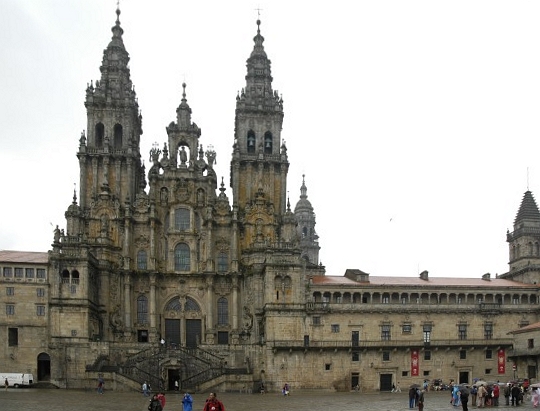
I enjoyed many aspects of the autobiographical memoir of your pilgrimage and journey on El Camino de Santiago de Compostela, or
The Way of Saint James over the Pyrenees and across Spain, ending in the Celtic lands of Galicia and Finisterra at the end of the known world.

Your book, Camino: Journey of the Spirit  provided an entertaining read while I was rainbound with Scottish in-&-out-law relatives in Renfrewshire during the winter holidays (San Francisco is my natal town).

According to Medieval legend, St. James's remains were carried by boat from Jerusalem to Libredon in Galicia where he was buried. In 813, a bright star guided a shepherd to the burial site, Santiago de Compostela. The miracle of St. James also served as a political wedge and a rallying battle cry against the invading Moors. (Wiki)

To travel West, to Tír na nÓg, the island of the ever-young (or the ever-dead), that mythical place beyond the edges of the map, is well attested in Irish Celtic mythology and oral tradition. But the idea that the genesis for this particular pilgrimage would have originated in Scotland under John the Scot literally has one traveling in the wrong direction. Do the geography. France seems to be the likely origin of el Camino de Santiago de Compostela pilgrimage. Spain was another route.

Pilgrimage to the West would have taken the Irish monks (most medieval Scottish monks were Irish-born) rather out of the way of Galicia—to Iceland and the Farøe Islands (or Vineland!). Irish hermits settled there the sixth century, introducing sheep, oats and early Irish language to the islands. Farøes place names to St Patrick and St. Brigit attest to pre-Viking, Irish occupation.

The Irish Saint Brendan (ca. 484–578 AD), was said to have visited the Farøes on two or three occasions (512-530 AD), naming Sheep Island (Farøe means sheep) and Paradise Island of Birds. 


St. Columba was more contrary, sailing northwest to Iona. For the record, Scotland's patron saint Columba (or Columcille—and instigator of the world's first use of copyright) was Irish-born. Iona was not part of Scotland then. There was no Scotland as we know it. The Hebrides were their own entity—settled by the Irish—I might add.

I must however, take umbrage with your passing off the first 
John the Scot (b. 800-815 AD in Ireland)—as being Scottish. He was Irish.  


It is possible that the idea of pilgrimage to the shrine of St. James, or Iago of Compostela was based on Gaulish Celtic tradition and cultivated by the Irish missionaries of Iona, the Hebrides, Scotland and Europe as the Irish monks were the innkeepers of Christianity and knowledge (fios) throughout the Dark Ages in Paris, Rheims, Bobbio, St. Gallen, Laon, and other important Christian centers of learning. Galicia is still a Celtic stronghold to this day.


The Irish also found interesting ways to write themselves into the Bible as they weren't mentioned in the Old Testament as one of the Lost Tribes or otherwise. So they got inventive. And there have always been strong ties between Galicia and Ireland. De Valera, Ireland's first president was Galician. But I digress.


The origins of the Santiago de Compostela legend dates back to ca. 813, roughly the same time Johannes Scotus Eríugena (see also) or, John the Scot, was born, circa 800 to 815 AD. in Ireland—not Scotland. John spent most of his adult life in what later became France under the patronage of Charles the Bald. Charlemagne (b. 742 ) died in 814 AD—a year before John was born. (Now that really would've been an anachronistic miracle having Charlemange converse with John at such a tender age!)

From 575 to 725 AD, Irish monks founded some 150 abbeys on the continent. To paraphrase Paul Gallagher's study, Irish Monastery Movement:
Irish monastic scholars were renown throughout Europe for their knowledge of Greek, [Arabic], and Hebrew. Irish [monks founded European] monasteries that produced the teachers and scholars in Europe and remained centers of classical scholarship until the Viking invasions.
If you had some medieval learning, you'd be aware that the word "Scot" referred to Ireland as Ireland was then known (since Roman times) as Scotia Major and Scotland (the part that was settled by the Irish) was known as Scotia Minor. That part of Scotland was called Little Ireland. Scotia probably means pirate, or raider, so I guess you're in fine order there.

We don't know when John arrived in Paris (circa 830-40 AD?), but he was a monk at the Benedictine Abbey of St. Denis, a place of ancient pilgrimage, the most sacred place to be in France. By 630 AD, it was also one of the richest and most influential abbeys in Europe. Burial ground of kings, a new church was completed by Charlemagne in 877 AD.


It is clear you did some research as you got much of John the Scot's story right, but alas, by making John the Scot a Scots-Irish man, you anachrostically conflated him with a 12th c. Bishpop of Scotland who, curiously, also seems to be Irish-born. John the Scot was more commonly known throughout history as Johannes Scottus Eríugena. Eire is the ancient word for Ireland, and "gen" means born: as in Irish-born.

As to your extrapolation of
William of Malmesbury's story of a king asking John: "Quid distat inter sottum et scottum?" as being a literary Easter egg of your discovery, this is an old story I learned at the knee of my Irish grandmother, it is not particularly obscure.


Carolingian king Charles the Bald had his hands full with the Breton Celts of Gaul who defeated him at the Battle of Ballon in 845. Challenging wits with John the Scot was not perhaps his brightest moment. But John was appointed head of the Court school.


Circa 843 AD, the Frankish king, Charles the Bald (b. 823 AD), not Charlemange as you had noted, asked the famous question of John. Anyway, the story is well attested in medieval manuscripts, and as John was also a famous medieval poet and philosopher, it's a story that often gets repeated.


Johannes Scottus Eriugena b. ca. 800-815, d. ca. 874-877 AD, (also spelled Scottigena, Eriygena, Ierugena, and Erigena—means a "native of Ireland.") John the Scot, "a man of strong and eloquent mind", one of the brightest free thinkers of the Middle Ages, was eulogized as "coming out of the darkness like a meteor." A neoPlatonist, versed in knowledge of Greek, Arabic, and Hebrew, wrote that true philosophy is true religion. His work was condemned in 855 and 859 AD and labled "Scots porridge.")


This is the quote in full
The king, Charles the Bald, who was dining with John asked: Quid distat inter sottum et Scottum?
(What separates a sot (drunkard) from an Irishman?)
John replied: Mensa tantum.
(Only a table).

(See a cartoon of the event here.)


Did John the Scot ever go to Santiago de Compostela? We don't know but the first written record of a pilgrimage to Santiago de Compostela was a century after his death.

…the story of St. James was resurrected in perfect timing to spearhead the reconquest of Spain for Christianity, starting with the battle of Clavijo in 844 to the decisive victory at Las Navas de Tolosa in 1212, each time St. James appeared at the crucial moment to turn the tide of battle. St. James, Santiago Matamoros depicted as the knight in shining armour astride a white charger decapitating Moors with his sword. The first written record of pilgrimage to Santiago was when Bishop Gotescalco journeyed there in 950 and in 1072 Alfonso VI abolished tolls for all pilgrims travelling up into Galicia through Val Carce. —THE CAMINO – PAST, PRESENT & FUTURE

Legend has it that John the Scot was invited back to Britain by Alfred the Great (who was educate in Ireland) to become Abbot of Malmesbury, or Athelny, or Oxford, but he was stabbed to death in 884 (10 years after his death) by acolyte-students with their pens for "trying to get them to think." (Philosophers). But seeing how goose wing quills were used for pens—I think this is a flight of fancy.


It's also said that John fled to Ireland at Charles the Bald's bidding as the pope was on a rampage after John's translation of Dennis the Areopagite was published without his consent. One count gives John's death in 874 in Ireland, another in 884 in Malmesbury. But it seems John died the same year as his long-time friend, Charles the Bald, in 877 AD.  —History of Ireland, p 202-3.


John Scot Eriugena was a monk at St. Denis before going to the Carolingian court and Rheims; Eriugena retired to the monastery of Laon, a center of Irish influence in France. —Paul Gallagher, Irish Monastery Movement


I've visited several places where John the Scot was reputed to have taught including the hillfort citadel of Laon. My particular interest is in place name origins and in opidda, or Celtic hilltown forts—I've spent this Christmas season combing Google Earth in Renfrewshire for standing stones and Iron/bronze age forts and standing stones.


(An interesting aside, modern Scots still 'dress the stones' on the Solstice and New Years. Ach it was a hellish oiche maiden (hogmanay) this year (2006-07) with storms and 70 mph winds, but we managed to dress Cloch-na-Rhyderrick, or Clochoderrick, (perhaps I'll tell you about King Rhyderrick, friend of Columcille sometime—I was a student of UC Berkeley's Celtic Studies program.)

The stone of Rhyderrick, some call it Merlin's Stone—depending upon which story you hear—is still dressed today: others were clearly there before us, leaving red flowers and holly. As were the standing stones of the Girdle Toll in Irivne, Ayrshire.

I learned to dress the standing stones (with flowers, red berries, evergreens and whiskey) from my Irish Bantry Bay grannie, so I was the strange American hanging out with the rock, what's geologically called a glacial erratic. It's not technically a standing stone.

The rock, at one time, wobbled and it was used as a druidic judgement stone. It no longer wobbles as the mud is packed in around its base. We were trying not to get electrocuted by the farmer's fence as we so very carefully went over the stone stile—but I digress.

I imagine you must take umbrage at fan divulgence. Rest assured, I'm no raging fan, though I loved many of your movies. I'm a writer, cursed with the gift of the gab—or gob—on a 3 AM caffeind jag, and sufficiently irritated by your stretching of truth—or, shanghaiing of truth in Camino, to write to you, though I assume you'll never see it, nor respond. No matter, I will defend John the Scot's rightful birthright to cyberspace.


(Note bene: As to celebrity, I live with an actor, and I am the daughter of an actress so I know that tangled route. Between matinee and curtain call, my babysitters were the likes of Tommy Smothers, Lloyd Bridges & Sterling Hayden. The Gate Playhouse in Sausalito, Tiki Junction. My mother variously went by Maureen Reilly (nee), Maureen Hurley; one of her stage names was Kellé Hurley (as there was another actress Maureen Hurley); she was a dancer too, she admired you, and had me Out on a Limb reading your books at an early age.

Some of my school friends did make it to the big arena like Robin Williams, so please be assured I'm no autograph seeker nor fame collector. I did so love the writings of Kenneth Tynan, so that bit of story of Kathleen was precious to me...'horsemen pass by.' I'm more like Kathleen, pragmatic, less inclined to believe. But I do have glimmerings of the Sight, which drives my pragmatism crazy.)

Anyway, you might be interested to know that John the Scot was, perhaps, the most famous medieval philosopher, having translated the False-Dionysis treatise on the idea of free will. This treatise lead to an intellectual foment across Europe as John the Scot/ Johannes Scottus Eriugena had again taken up 5th c. Britons Celestinus and Pelagius' cause of free will versus the rote catechism of religious experience through the auspices of church dogma.


Needless to say, the idea of free will was not a popular concept with the pope as it undermined the church's papal authority (and tithing coffers). The pope had also posthumously excommunicated Pelagius for heresey. John the Scot too was well buried as it were, but he was rediscovered in 1680, and repatriated again to become the new rage of intelectual thought, profoundly influencing Schoppehaur and Kant—probably Spinoza as well. (Alas, Spinoza died in Amsterdam a full 4 years before John's treatises were widly published.

I have stood before the small iron gate of the synagogye where Spioza worshipped. So I reiterate, John was hardly as obscure as you suggest in Camino.

What becomes fascinating, however, is that you latched onto John the Scot, he does become the neo-Platonist who reintroduces the concept of individual experience with God, and free will vs church/state mandated group experience of religion. "Saints, sinners, generals, misfits, kings and queens. It is done by the intent to find one's deepest spiritual meaning and resolutions regarding conflicts in Self."

And so, here we are… so I thank you for that rediscovery, or shall I say, revisualized, with a deeper undertanding that comes with age. I too hope to complete the real Camino trek, before I'm 60, if possible (a bum knee—too many falls from horses in my youth—makes it a tough 500-mile proposition as I'm 54 and not at all likely to get younger) so your story (and imagination) did serve to re-inspire me to traverse the same route as Dante, Saint Francis of Assisi, Charlemagne, and Chaucer to go on pilgrimage.


In medieval legend, The Milky Way was said to be formed from the dust raised by  the vast hordes of trekking pilgrims. The Spanish name for the Milky Way is El Camino de Santiago. Folk etymology has it that Compostela means field of stars.


The road of St. John may indeed be lit by a field of stars. Hoever, the Galician word, Compostella, derived from the Latin, compositum, is Composita Tella meaning "burial ground," not Field of Stars. With that, I'll bury this rant.


(This letter was sent to Shirley's webpage. No answer was the loud reply.)


Tuesday, September 19, 2000

Adamnán of Iona: Life of St Columba, summary


Klar, Celtic Romanticism 170
Summary:

ADAMNÁN OF IONA: LIFE OF ST COLUMBA
Fisherman of the Fishful River

St. Adamnán, 3rd paternal cousin to Columba (of the northern Uí Néill princes: Cenél Conaill, the religious dynasty of Iona) writes a Tripartite Life, 100 years after Columba’s death.

Using earlier Lives (Sts Antony, Benedict) as his models, he portrays his kinsman as a Christ-like archdruid and warrior-king—much in the vein of the Tripartite Life of St. Patrick and the Historical Life... by St. Fiacc, ca. 500. 

Though the three sections of the book are loosely modeled after the (150) Psalms (Columba dies while writing the 34th Psalm), many of the stories are straight out of folk tradition. 

Foremost of Columba’s larger than life accomplishments is his ability to control the weather (wind, water: especially the sea), a druidic function. Good following wind (lateen sails) for good sailors. A religious hero, Columba is associated with pagan heroes and gods: is he Mananán mac Lír, or Finn? Light is heavily associated with him (probably the Aurora Borealis), making him a half-mortal CuChulainn type hero: Lug comes to mind. We learn angels travel at the speed of light.

Lots of epic tags—with feasts lasting 3 days and 3 nights, Otherworldly music, water monsters, chariots, a magic cloak, magic hunting stake, ruddy cheeks, holy/evil wells and floating magic white healing stones thus making him a healer as well... Along with Columba’s beseeching that no one is to breathe a word that he’s special “he wanted to avoid boasting,” is the monkish preoccupation that the community will be overrun with pilgrims who, under the laws of hospitality, would have to be fed and housed. 

Adamnán mentions “Soldiers of Christ” reaffirming the fianna warrior role of monks who dip white robes into red blood (priestly & warrior functions). Heaven and death (many stories record saints’ deaths) takes on the guise of the Otherworld, the Land of Promise. 

Several saint/heroes are mentioned: Brendan of Birr, Colmán, Finnian (St. Uinniau—the ‘F’ silent/lenited) to titillate the crowd. The cult of Columba is so strong he can even perform posthumous weather miracles.

Columba has a way with animals: salmon leap into his boat (don’t eat his seals!). His white horse (king-function?) buries his head in Columba’s lap (paying homage?) and weeps at his upcoming death. Many cattle/milk-demon stories (bull’s milk = white blood; a sacrifice story. 

He spends time on an unidentified islet called Hinba: h-in-ba (h-inis bó) could be translated as the isle of the cows. He raises laymen to nobleman status with 5-fold (105) herds of magic cows. As the Life was written in Latin, it seems Eilean Shona (the S is silent) where they built longships? could be construed as a garbled form of Iona (a scribal error?).

Several references to holy or “righteous” pagans earning their way towards heaven—smack of Pelagianism—baptism, an afterthought. The landscape is fraught with remote isle hermitages; every monk searching for his own little hut (in a bee-loud glade), an influence from St. Antony of Egypt. 

Curious are the painstaking references to “...three witnesses as required by law,” Adamnán inserts: he sounds like a Brehon. 

Adamnán sternly addresses his future audience: the reader/copyist several times: this ms. wasn’t just meant to be read aloud to assembled monks after dinner, but also to be read alone in the scriptorium. There is a preoccupation with copying manuscripts: whenever Columba absent-mindedly blesses something is when he’s copying a book—the very reason why he was exiled to begin with (and, a war). 

The story also documents the first copyright, and the first reference to proofreading (the missing letter ‘i”). Adamnán makes light of Columba’s crime, and beseeches readers to copy HIS text word-for-word (to receive blessings and to establish Ionian Church claims farther afield—a missionary effort.) 

It is Adomnán’s last wish that copies of the ms. of Columba reach the far corners tripartite Celtic homeland (& Christendom): Spain (Celto-Iberia), Italy Beyond the Alps (Cisalpine Gaul), and Gaul—even to Rome.