Showing posts with label Scotland. Show all posts

Wednesday, February 7, 2024

Full moon bridge


The medieval bridge built in a half circle meets itself full circle in the middle of the placid river. It could be Tibet, it could be Italy, or Scotland. Once I saw a perfect reflection of Kelvin Bridge down at the river bank. 

The shore lined with hypodermic needles tied us to this century. Go down to the river and flirt with death, seeking a path to nirvana that will take you down. The circle of Kelvin Bridge and river contemplates itself in a wilderness out of time with the mean streets of Glasgow. 

Meanwhile in Tibet, the photo is of a primitive cow and her calf follow their owner across an old bridge, still standing. He should be from another era with his bamboo hat and palm frond rain cape. He carries the harness yoke for her on his right shoulder. She needs no lead line to know that they are going home.

Once I crossed the Brig o’ Doon in Alloway, a pure arc across the river. Someone had strewn red carnations on the cobbled footpath. There is a new bridge for cars, but here time stops and lets no one pass. 

The herringbone pattern of cobbles was laid to confuse and thwart witches, a drunken Tam O’Shanter on the run. Well done, Cutty Sark.The creatures of the night cannot cross the water so they sulk and wait for the poet. While he had the DTs, Rabbie Burns taunted too many thirsty warlocks looking for the keystone. Not to mention Nannie, who caught the tail end of the horse.

2/7/24 Molly Fisk, poem a day, OK, so it’s not a poem.

Tuesday, December 12, 2023

Robin redbreast


One summer evening, I was crossing the Church St. footbridge over the River Teith in Callendar, Scotland, when a small bird hopped up to me, expectantly eying my red boot. I let out a little squeal of delight when I recognized what he was. A real robin! I didn’t dare move for fear I would disturb or harm him. 

Of course I had no idea that the diminutive European robin redbreast of English literature and fairytale fame, a flycatcher, was a bird of a completely different feather than our rather robust north American robin, a large thrush built like a Sherman tank. Or a hefty bird in hand.

Both birds are more orange than red, but there, the similarity ends. The word for the color orange was a linguistic newcomer to 16th c. Britain. In those days, the color choices were either yellow or red, or both. But robin red-yellow breast doesn’t quite have the same ring to it. And as it turns out that there are many species of birds that are called robins the world over. Australia’s flame robin is similar in size to our American robin.


Callendar was home to the famous Scottish outlaw, Rob Roy McGregor, or Raibeart Ruadh MacGriogair. Rob, or Robin was a diminutive form of Robert. In this case, Roy was an Anglicized form of Ruaidh, or the red one. Rob Roy Way separates the Highlands from the Lowlands. 

And Rob Roy, a Jacobite rabble-rouser, was a cattle rustler cum folk hero. The Highland outlaw, immortalized by Sir Walter Scott, became a legend within his own lifetime. Liam Neeson made for a big braw rogue in the movie.

The lingering twilight on the footbridge spanning the Teith River was beautiful. The long golden hours of summer, were as good as it gets. As I was taking photos of the river reflections, a tiny orange-breasted bird hopped right up to me on impossibly thin legs, and promptly fell in love with one of my red Reebok boots. 

I had never seen an European robin before, I had only heard about them from my Irish grandmother, and of course the Mother Goose nursery rhyme and finger games came to mind—for species identification purposes only, of course. 

Little Robin Redbreast
Sat upon a rail;
Niddle noble went his head,
Widdle waggle went his tail.— Little Robin Redbreast


There are many apocryphal stories associated with robins, mostly to do with Jesus and purgatory. They covered the bodies of two dead children with leaves in Babes of the Wood. In Irish mythology to kill a robin is to invoke bad luck for the rest of your life. There is no cure. They’ve become a ubiquitous symbol of Christmas, featured on Christmas cards and postage stamps. And of course, they’re also associated with Robin Hood, defender of the poor.
Legend has it that when Jesus was dying on the cross, the robin, then simply brown in colour, flew to his side and sang into his ear in order to comfort him in his pain. The blood from his wounds stained the robin's breast, and thereafter all robins carry the mark of Christ's blood upon them. —Wiki
It was not the first time my red Reeboks were siren sentinels to robins. Once, while I was exploring the Crystal Lakes rift near San Francisco, an American robin, perhaps seeking a sole-mate, became equally enamored of my red boot. 

I had to stand patiently on the Callander footbridge in the gloaming until the little love affair with my boot was over. The fading of the light brought a close to this little romance. Pure magic.

Saturday, December 31, 2022

The Isle of Staffa

In 2008, we sailed by the isle of Staffa from the Iona to Mull ferry and I was dumbstruck by the beauty of all that columnar basalt dressed in lichen, moss, and sea spray. I wanted to jump off the deck of the small ferry boat. Of course there was no time to backtrack and visit the island. 

Ours was a mad overnight run from Oban, courtesy of a newfound friend who scored us coveted ferry tickets for locals on an overbooked ferry. Driving down Mull from the wee village of Craignure to catch the Iona ferry at Fionnphort, we were late late late, so we barreled down the one-lane road like banshees along the glaciated Ross of Mull which took my breath away, such ragged beauty. 

Iona was extraordinary, on my bucket list for ages, My Irish grandmother, who inspired me to visit Iona, often talked about Iona and Tír na nÓg, the land of the ever-young, in the same breath—it was a whirlwind visit replete with several missed ferries, no place to stay, last minute reprieve, but then, it was over, we had to leave that singular beauty. 

Tuesday, December 6, 2022

In search of the Gorbals

The Gorbals was the ultimate slum of Glasgow, primarily settled by the famine Irish, Poles, and Russian Jews who worked in the shipyards, ironworks, weaving, and manufacturing factories during the Industrial Revolution. 

Probably the roughest neighborhood in all of Scotland, portions of the Gorbals were razed for the notorious substandard council flats, concrete towers during the 1960s, featured in a 2011 BBC exposé, were laden with serious structural defects, and rampant mold, etc., then replaced by the tony/ugly urban box renewal housing in the late 1990s-early 2000s, thus displacing literally everyone (90,000+) who lived there. 

I remember the plane circling Glasgow, 1972, the edifices grim, and streaked with coal dust. I never wanted that plane to land. That mean city. All that urban renewal merely traded one atrocity for another. Most of the blocks were leveled between 2000 to 2016. Then came the displacement. Now, the Gorbals houses about 9000 of the upwardly mobile in brutalist structures, but what happened to that writhing sea of humanity displaced by urban renewal? Where did they go, to East Kilbride?

I got to see a small section of what was left of the Gorbals in 2008. The Gorbals was famous for its ongoing flea markets. But, by then, most of the area was rubble rubble rubble everywhere. It looked like a bomb had been dropped. The novel, No Mean City (1935) is set in the Gorbals.

My friend’s father, Joe Hardstone, a talented musician, was born and raised in the Gorbals, it took a special ear to be able to understand what he said. He also spoke Russian and Yiddish with a Gorbals accent. I could understand him just fine because I was raised by my grandmother from southern Cork, Ireland. Joe/Isaac became one of the fastest sprinters in the Gorbals, outrunning the street gangs that lurked on every corner, with his violin under arm. 

Most of the famous Gorbalites were boxers and futba’ players on account of all that running. Perhaps the Gorbals most famous exports were the landed Irish who were murderers and gangsters. Jimmy Boyle, who murdered a gang member, switched careers and became a famous novelist and playwright while in prison. UK Poet Laureate Carol Ann Duffy grew up in the Gorbals. As did Sir Thomas Lipton, the teabag man, Allan Pinkerton, as in the detective agency, and Mickey Rooney’s Da. All Irish, I might add.

Mending the kilt

Saturday, January 11, 2020

Mis-musing on the name of Kenneth Mac Alpine


Someone in our British Medieval History group, wanted to know why Kenneth MacAlpin, (ca. 800 to 858) the first King of Scots, was also called  "king of the Picts". Was he a Pict who gained the Dal Riata/Gael throne, or the opposite?

Moderator Peter W Graham (whom I adore), said:
Probably of mixed parentage his mother being PICT and father a Dalriada Scotti, it is believed that the pict crown passed through the female line , the Scotti through the male, after the royal families of both were decimated by invading Norse Kinnaed was the most senior of both lines left, ignore the slaughter of the nobles it’s a myth. The Picti and Scotti were forced to unite under him against a common enemy and found the kingdom of Alba.
And of course, I was off and running. I said that Kenneth’s name was not Pictish, but Irish. Cináed mac Ailpin, which means the fire born one, possibly the son of that devotee of Colm, or Columba Aka Malcolm. (No K in either form of Gaelic). Pictish was a Brythonic language, like Welsh, so the very word son, or Mac designates the name as a Goidelic language. Welsh word for son is is mab, or ap. Alpin is likely  Pictish, as p was avoided In early Irish, a loan letter. Some think Alpin was Ailpein, Albin, or possibly alba, or alp.

Peter replied, Well Gaelic Scot and Irish had already started to separate. That got me going and I fell down the rabbit hole (again).

I said Early medieval Scots Gaelic and Northern Irish Gaelic were closely related Goidelic dialects, with Donegal Irish being the closest mutually comparable connection. Despite the fact there were probably about five separate Irish Gaelic (and Scottish) dialects, the grammatical rules don’t change much. (Spelling is another matter entirely.)

I found this on a medieval Scotland site: The nominative, Mael Coluim, Mal Coluim, Mal Colum, Mal Coloum, was spelled Maíl Choluim, or Mal Colaim in the genitive form. So, spelling was variable according to grammatical changes. The references are from Kenneth Jackson’s The Gaelic Notes in the Book of Deer.
Kenneth's origins are uncertain, as are his ties, if any, to previous kings of the Picts or Dál Riata. Among the genealogies contained in the Rawlinson B 502manuscript, dating from around 1130, is the supposed descent of Malcolm II of Scotland. Medieval genealogies are unreliable sources, but many historians still accept Kenneth's descent from the established Cenél nGabráin, or at the very least from some unknown minor sept of the Dál Riata. The manuscript provides the following ancestry for Kenneth:

...Cináed son of Alpín son of Eochaid son of Áed Find son of Domangart son of Domnall Brecc son of Eochaid Buide son of Áedán son of Gabrán son of Domangart son of Fergus Mór ... —Wiki Kenneth MacAlpin, Rawlinson ms B502
Máel is a devotee, or follower (of Christ), and Colm is a dove, pronounced Colum. So Máel+Colm is Malcolm. Máel (pronounced mal) was sometimes also used as a prefix to a Welsh name, Maelgwyn, and Mael Madog, follower of Madoc. And that Ma- in Madog may be a redundancy, máelmáel. But máel is an Irish prefix suggesting tonsured one, a monk. Which type of tonsure, I’m not sure, there were two warring factions of tonsure styles, the Druidic version was most radical.

Since we were covering goidelic languages, I tossed in some Manx too. Manx, though spelled with phonetic English orthography, was probably similar to Leinster Irish and Galwegian Scots Gaelic. Transcribing Manx into English sounds was a language disaster. Root words were lost as well as case endings, phonetic Gaelic is almost impossible to unpack. When I was looking at Manx tales, I had to say the words out loud in order to make any connection. By contrast I can suss out Scottish Gaelic place names via the Irish without too much trouble.

Also, during  the Medieval era, the term Scottii did not necessarily mean somebody was Scottish, it was a fluid concept—it meant they were Irish, or of Irish derivation—hence the term Dál Riada Scotti. Since Roman times, Ireland has been called Scotia Major, and Scotland was called Scotia Minor until the 16Th c. This simple fact seems to confuse people to no end. For the record, most of Scotland’s saints were Irish born.

Still on an odd language roll, I said: Weirdly, a dialect of Munster Irish was spoken in some of the Hebrides—especially Barra. You’d think with Colm Cille, that copyright thief, hailing from the north of Ireland, the Northern Irish dialect would’ve prevailed throughout the Hebrides. Certainly Iona. Munster Irish is very different than Northern Irish. People got around!

Gilbert Markus  caught me up on my references. I said, yes go raibh maith agat, the first part of the Rawlinson B502 was written down in the 11th c. Sometimes referred to as the Lebar Glinne Dá Locha, just to confuse things. Weren’t the annals of Tigernach later? But those early ms were not the works of sole authors, or authorship as we think of it today—same scribal hand, maybe. Well, two, or three hands. Annalists were responsible for organizing the material, not authors. Historians, maybe. But annalists were not necessary historians. And it was a collective compendium of what was thought to be historically accurate at the time. And yes, whoever was commissioning the ms would’ve had an agenda.

Now, speaking of hidden agendas, and constitutional fictions, the late 16th c. Holinshed's Chronicles was recreated history to shore up certain family trees and political agendas. Take Shakespeare’s MacBeth, for example. Poor MacBeth got seriously slammed. Yes, you’re right, there is not a radical divide between Scottish Gaelic, Irish, and Manx other than wildly different spellings, and pronunciation. My Irish teacher was always saying the difference between a language and a dialect is an army.

Well, hello, I just fell down the damned rabbit hole again, lock, stock and bunny tail, chasing the wrong name.

Comparison of Scottish Gaelic and Irish

Monday, June 13, 2016

On Finns and Celts


A comment from my Viking-Irish Redhead Gene Myth post turned into a long blog post of its own. So I decided to repost it here. I may or may not get around to fashioning it into a story so these are notes.
Arhi Kuittinen Finnsanity said...
Mother of European culture is Finnic culture.
Blue eyed, blonde and red haired ur-culture. Finnish language is the oldest language in Europe.
"Vikings" were originally Kvens, Kveenit, the biggest Finnish Tribe years 400-1100. Popes robber barons made unholy big crusade to the Finland 1100 and ended the oldest culture in Europe which was called by Greeks Hyberborea. Finland was the last who standed against pope and Vatican.
King word is from Finnish word Kuningas.
Queen is from Kven word, "She is Kven".
Apollo cult hwrote about nordic Hyperborea the home of Greek knowledge and religion.
20 the most old written history text about Europe speaks about Hyperborea.
Blue eyed sea people destroyed Egyptian culture in Ramses III times - Ramsesses and Seth I were red haired Finnic Pharaos.
In China oldest mummies are red haired Finnic - N1C1 genetic line.
Silk road was Finnic project by these white skinned Finnic mummies.
Moscow and every big European city were originally Finnic town and commercial place.
In England there was Finnish names and Towns like Caleva.
Druids were continuing and developing original Finnic rituals but the language changed during 10000 years.
In Stone Henge there is both Moon and Sun ritually respected - that is Finnic cult, holistic feminine cult. "Hengettäret".
In Finland you can found 35 OLDER stone henges' ruins, Jätinkirkko, 5500 years old astronomical temples.
Lord Of The Rings -book is based on Finnic tales "Kalevala", Battle of the warlocks, etc.
Now you know something about the root of the European culture.


Maureen Hurley said...

LOL, Arhi Kuittinen Finnsanity, you've certainly conflated many, many cultures—not to mention time-zones, and millennia (Neolithic Stonehenge to Medieval Vikings), to support your theory, with no sustaining facts whatsoever. But thank you for your close reading, and comments.

For what it's worth, Stonehenge predates both the Finns and Celts. It was not built by the Finns (or the Druids, for that matter). Every culture on earth worships, or has worshiped the sun and the moon. And most cultures have created celestial, or astronomical temple calendars. The Finns didn't invent the idea. Whether Stonehenge was built by blue-eyed blonds, is moot.

Lithuanian-American archaeologist, Marija Gimbutas said the pre-Indo-European Neolithic and Bronze Age cultures of "Old Europe" were the builders of Stonehenge, etc.

The Greeks were not referring to the Finns when they wrote of Hyberborea. The Hyperboreans were a mythical idyllic people who lived forever, "beyond the North Wind," in a land of eternal spring, where there was no war, or strife. That definition says more about the Greek state of affairs, than it did about Finnic culture.

Whether you read the works of Homer, Pindar, or Herodotus, the Greeks were referring to Hyberborea ,a land north of Thrace, BTW. Roman historian Plutarch connected the Hyperboreans with the Gauls. Hecataeus of Abdera further claimed that Hyperborea was Britain.

Pseudo-Scymnus wrote that the hero Boreas, for whom Hyberborea was named, dwelled at the extremity of Gaulish territory (Britain). Hyperborea was one of several terrae incognito. One of the unknown, unmapped realms.

BTW, during this timeframe there was no such thing as Finland. From the 12th c., onward, Finland was part of Sweden. When Adolf Ivar Arwidsson (1791–1858), proclaimed, "we are no-longer Swedes, we do not want to become Russians, let us therefore be Finns," the idea of Finland was born.

The term "Nordic" does not refer to Finns. As you said, Finns are another culture. Nordic means Norse. As in Norseman. It can refer to five separate countries, from Greenland to Denmark. The word Viking can mean raider or pirate, and it's not a Finnish word. There were viking raiders of many cultures, including the Irish, though the Roman term was Scotii.

The relationship between Finnish and the Indo-European Scandanavian or Celtic languages is scant, as Balto-Finnic is a completely unrelated branch of the Uralic language family. Kuningas is from Proto-Finnic *kuningas, which was borrowed from Proto-Germanic *kuningaz. Finnic, a conservative language, even preserved the Germanic normative singular case.

As to Egypt, there were Celtic mercenaries during the reign of the Ptolemys, who were Greek, not Finnic.

Nor were the Tocharians of the Taklimakan Desert Finnic. Their language, Tocharian A, was Indo-European, not Finnic, it shared many linguistic similarities with Irish, both highly inflected archaic languages.

The specific sheep wool found and the style of plaid twill weaving reflects that of N. Europe, what is now Germany, then a Celtic, or Celto-Germanic region. (We know of this because of placenames, and personal names, as recorded by Tacitus, and others.)

Since you mentioned genetics earlier, by blood, the genetic bond between Finns and Swedes is closer than, say, the Finns and Irish. Haplogroup N1c is found in northeastern Europe, Siberia, and the Far East. It's a descendant of an East Asian macro-haplogroup. Uralic N1c1 is found in Samoyedic (Nganasans, Enets, Nenets and Selkups); and Finno-Ugric (Finno-Permic: Baltic Finnic (Finnish, Karelian, Estonia, etc.); and Permic: (Komi, Udmurt). Saamic (Saami), Volgaic (Mari, Mordvin), Ugric, Hungarian, and Ob-Ugric (Khanty, Masi). The Baltic Finnic branch is related to the migration of the N1c1a1a1 (VL29) group.

As to the Tarim Basin mummies, I don't know where you got your information from. Please cite your sources. The paternal lines of male remains belongs to Y-DNA haplogroup R1a1, and a later Tocharian haplogroup genetic signature is R1b-M343.

You're right that Tolkien used Finnic sources. The Silmarillion is partially based on Finnic tales recorded in the "Kalevala" (which is a 19th c. construct from folkloric fragments from Karelian, Estonian, (Baltic), and Finnish oral folklore and mythology. But it was compiled into epic verse by Elias Lönnrot, who also coined the name, "Kalevala."

Like Scottish poet James Macpherson's Ossian Cycle, so influential in the development of the Romantic movement, the Kalevala is not an authentic, replete tale unto itself. It is a quilt, a pastiche. LOTR was also heavily based on Welsh and other cultural (read Celtic, and Anglo-Saxon) mythologies as well.

The Romantic movement emphasized emotion as an authentic source of aesthetic experience, vs. rational, or Classicist ideals: not inclusive of history, anthropology, nor archaeology. It was the birth of the ideal of the Noble Savage, and epic folk hero—which ironically, stemmed from the ancient Greek writings. Full circle.


Sunday, July 12, 2015

MacCamelot: Stealing King Arthur, or Musing on Pseudo Histories


Oops! I made a grave mistake of responding to a link posted on someone's Facebook page. It was a poorly written pseudo-history article on King Arthur. I noted that it was an argument full of holes, and posted a comment (below), expecting a lively exchange. Instead I was unfriended for my candor. So very sad for the loss of friendship, I clearly misjudged her. I'm also flummoxed. Was I barking up the wrong tree? Perhaps I should have checked my allegory at the door.

Maybe it's because I've read so much pre-medieval and medieval scholarship, that I can't engage in reading pop-culture articles without a response. I thought the article was very poorly thought out, and said so. But it got me interested in researching the so-called "Scottish connection posed by Edinburgh author Adam Ardrey, (apparently he has an axe to grind with the English and Christianity). I was also curious to see if there were any interesting rebuttals posted on the internet.

I couldn't access the original link to the article in question as my friend had unfriended me. Then I remembered my browser's History menu. Yes! So here it is:

Was King Arthur actually Scottish? New research assesses the evidence

(More to come once I process it... or you can take a gander over to the Celebrate Scotland site. What follows below are roughshod notes—as I try and sort out my thoughts on the page. Or try and write my way out of a paper bag. So consider this a draft in progress.)


What I wrote on my former friend's Facebook page: 
"Augh, these dim-witted articles drive me crazy. Wasn't a myth of English-speaking people, as no one was really speaking much by way of English yet. Briton, maybe, Cumbric. Welsh was still differentiating itself from Cumbric at the time. Nennius was a bit of a fabulator. Geoffrey of Monmouth was much worse. If so, Arthur would have to be king of the Dalriadic Scotti, not the modern Scots. And it would be spelled Artio(s) or Artiaus (the bear). The entire west of Britain was Cumbric-speaking after the 5th c., with pockets of Erse speakers, significantly in Eboricum, along the Clyde, the Hebrides, and to north.
The place-names mentioned in the article are, in essence, Welsh words. it's really hard to get Avalon/ Welsh Afallon; Breton Avallenn from Hinba, or Iona.
Then there's the problem that both the Bretons and the Irish also have Arthurian tale, not to mention that the oldest Arthurian tale, Culhwch and Olwen is in Welsh.
Must be some sort of sugar rush from swilling too much Irn Bru affecting their brains."
So, was that above post harsh enough to merit my banishment from the kingdom of Facebook Friendships?


OK, so what little we do know is that King Arthur of myth and legend, was busy fighting against the Anglo-Saxon foe, so he couldn't be English as the Angles become Anglish. The Kingdom of Scotland wasn't founded until ca. 839, or 850 AD, so Arthur also couldn't be Scottish, as there was no such thing as Scotland yet. Caledonia was populated with Pictish natives and Irish settlers.

The Irish Scotti of Ulster migrated en masse to the edge of the Pictish lands (in what is now western Scotland), and founded the Kingdom of Dalriada (Dál Riata) in Caledonia at the end of the 5th c., so, if King Arthur was Scottish, as the article claimed, by this same insane reasoning, wouldn't that make Arthur Irish, and not Scottish?? LOL.

Pictland eventually fell to the Irish Scotti in 839 AD., Certainly Arthur was a Celtic, maybe Cumbrian, or proto-Welsh, or Cornish, or possibly a Romano-British, war leader, but Scottish? But not Anglish. What would Bede say?


This article, from the Scotsman, offers a more balanced rendition (if only they didn't use the word "Scottish"; my goat dander is all up in a fluff:

Author Adam Ardrey claims that Arthur was actually Arthur Mac Aedan, the sixth-century son of an ancient King of Scotland. Ardrey claims that instead of the romantic English king of legend who lived at Camelot – which is often said to be Tintagel in Cornwall or in Wales – Arthur was actually Arthur Mac Aedan, the sixth-century son of an ancient King of Scotland, whose Camelot was a marsh in Argyll. Ardrey, an amateur historian who works as an advocate in Edinburgh and previously wrote a book claiming Merlin the wizard was actually a politician from Glasgow, spent years investigating his theories and says that they can be proved “beyond reasonable doubt”. The assertions in his book Finding Arthur: The True Origins Of The Once And Future King are strengthened by the discovery in 2011—what some experts believe is King Arthur’s round table at Stirling Castle. Read more here: The Scotsman


Arthur was an English king? Where did that memo come from? In the 6th c, there was no Scotland. Certainly not a Scottish king. Pictish, maybe. And Merlin was a Weegie politician? 'Splains a lot. Must've been a Tory. Ardrey's theories can be proved “beyond reasonable doubt”? Amateur historian, indeed.

Saturday, January 31, 2015

"Up Helly Aa," reconstructed Fire Festival, or Imbolc in Viking drag?

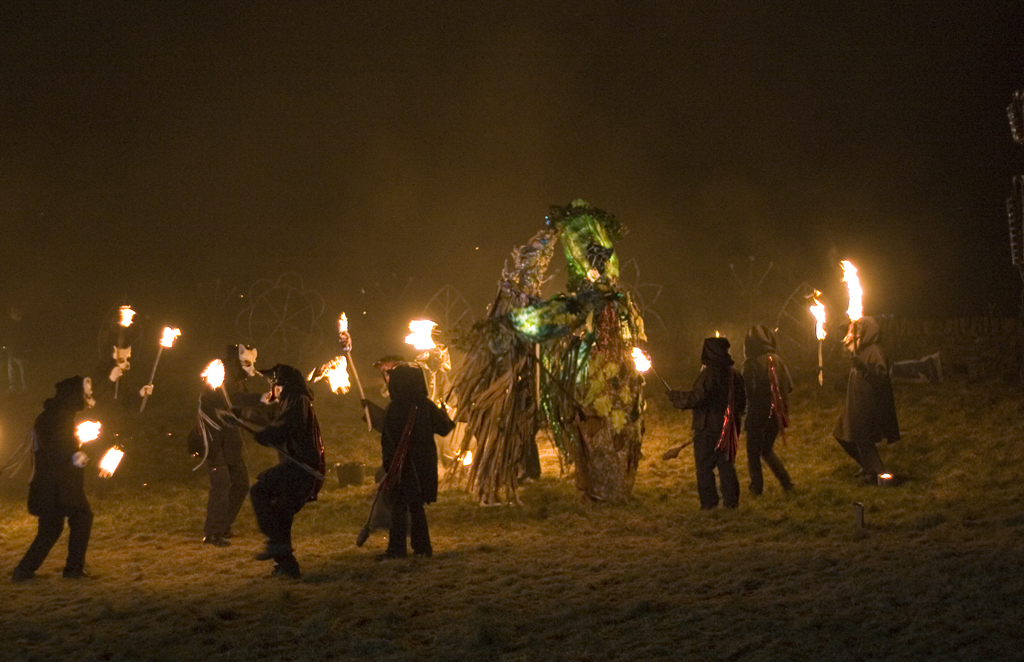
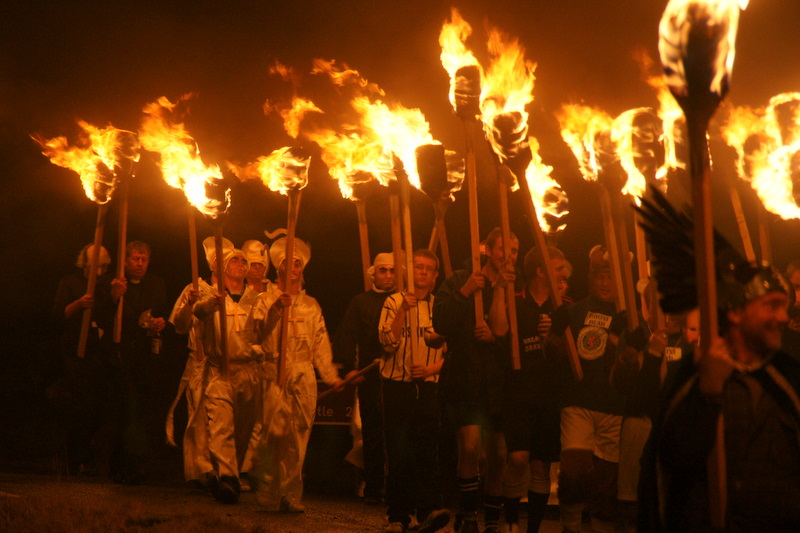
Guizers with torches at Up Helly Aa celebration in Uyeasound,Shetland.  Before the 19th c., tar barrels, not torches, were used. They look a bit KKKish.
The “Viking” Up Helly Aa fire festival celebrated on the last Tuesday of January (originally held on old Christmas Eve) in the Shetland Isles in Northern Scotland, is not a Norse festival, but a "reconstructed" Victorian Solstice fire festival. I'm not convinced the festival has any Viking roots, though modern-day Shetlanders, proud of their Norse heritage, would probably avow it does. 

The setting of the beacons, or the wards along the coasts and the lit tar barrels rolled downhill are well-attested Celtic motifs. The lit barrels, (my great grandfather also lit on Beltaine in Bantry County Cork, Ireland), evolved into setting a fire a long ship. 

The origin is a bit more obscure, as the Vikings invaded the Shetland Islands during the 9th century, and the fire festival was founded in 1880s—1905, more than 500 years after Norse rule was vanquished. Besides, there were other cultures living in the Shetland Isles since the Neolithic era. They didn’t just disappear with the arrival of the Vikings.

The Vikings, as we know, were not big on sharing the wealth, and 19th century Viking scholars were also not keen on sharing either. When something is claimed as being authentically Viking in Celtic lands, there is often a convenient blurring of anthropological lines, with the idea of Vikings still plundering other cultures a millennia after assimilation.

What cultures in situ before the Viking invasion, are often overlooked, because it doesn't fit current romantic thought. So, rather than observing the overlay with a cultural substrate, we often get skewed cultural theories based solely on later invading cultures—especially in Scotland where the Viking love affair is still in full swing some six centuries later. There is only "I" in Viking. Not even poetic license can alter that.

Shetland (sometimes referred to as Thule in Classical tracts), was no terra nullius before the Vikings invaded. The archipelagos of Shetland, the Orkneys and the Hebrides, also were not considered part of Scotland, which did not become a kingdom until the ninth century. The Latin term Scoti/Scotti referred to the Irish Gaels, whether in Ireland (Scotia Major) or Scotland (Scotia Minor). 

Long before the Shetland archipelago (Scots Gaelic: Sealtainn) was under Icelandic-Norse control, it was a Mesolithic, Neolithic, then a Celtic stronghold—for millennia. The Shetland Islands were originally settled by Neolithic Bell-Beaker peoples, then the Celts and the Picts, and the Scotti, or the Irish Celts—who also celebrated a fire festival on this date as well. Thule was supposedly settled by blue painted people (Picts), it could be a corruption of the word for fire, Iceland was also referred to as Innis Tile.

The first written mention of the Shetland Islands, comprised of some 300 islands and skerries, is from the Icelandic 13th c. epic, Njal’s saga. And of course, redheaded Njal with his fierce temper was probably an Irish-Norse Dubliner. At least one Irish Scotti place-name survived the Viking invasions, Dunrossness, and the islands of Papa Stour (Papey Stóra) and Papa Little (P. Litla) refers to Irish Culdee monks. Brother Island may also refer to those Irish monks. Three island place-names may be of Pictish or even pre-Celtic origin: Fetlar, Unst and Yell—once heavily settled by Culdee monks (Pappay/Papil Ness, Loch of Papil and Papil Bay.) St. Ninian’s Isle too was a papar stronghold.

Another Celtic influenced place-name Muckle meaning “big” in 17th c. Scots dialect, and Rua, meaning red (Old Irish ruiadh), a red granite islet, though Muckle Rua is erroneously identified as a Norse place-name, as is Dunrossness. But Dun is fort and ross is a promontory. And ness is a common Scots-Norse accretion also meaning headland in case one didn’t know what a ross was—a clear indication that the promontory was already aptly named before the Vikings arrived. Nothing to do with a noisy tidal race

The early medieval Pictish Bressay Stone,  (It’s in the basement of the National Museum in Edinburgh) with Celtic knotwork and beasties, has an Ogam inscription: “The cross of Natdad's daughter, child of Maqqddrroann,” (OId Irish Mac (son of) Droann. More here.) One of five Ogham stones in Shetland, the inscription is an admixture of Old Irish, and Norn, as the word for daughter is in Norse. Certainly, most of the village names would be of Old Norse derivation as the Irish Scotti didn’t go in big for the idea of towns.

Since the Neolithic era, (4000 BC), people have raised cattle and sheep, and farmed the Shetland Isles. What survives are prehistoric field systems, Bronze Age burnt mounds, Iron Age brochs, and Pictish wheelhouses. The oldest archaeological find, ca. 4000 BC, is a midden at West Voe, Sumburgh. Hard to imagine now, but much of the North Sea was once dry land, Shetland was lightly wooded and the climate was warmer. Neolithic burials include stone cists, and heel-chambered cairns on the island of Vementry, Punds Water and Islesburgh. Skara Brae, Maes Howe, and Ring of Brogar, in nearby Orkney, are extraordinary Neolithic monuments.

During the Bronze Age (2000 to 600 BC), the climate deteriorated, peat bogs spread, and sea level rose. Some 300 crescent-shaped burnt mounds (possible hearths) date back to the Bronze Age. "Ireland was the chief center for the manufacture of bronze and Scotland's early settlers were energetic seamen." Even way then there was a lot of travel between the islands. For millennia, there was Irish contact in the Shetlands, whether by trade, or by theft: a bronze-gilt harness mounting was made in Ireland during the 8th or 9th c. AD, was excavated from an archaeological dig.

Possibly due to a population explosion, or increased warfare, the Iron Age in Shetland saw the rise of massive fortifications: double-walled circular towers, and dry stone brochs—sometimes called "Pictish Towers", but their construction predates the Picts. Ancestors of the Picts, maybe.

Of the 120 Iron Age broch sites, Old Scatness, and the Broch of Mousa (ca. 100 BC), are among the finest preserved examples of Iron Age fort towers. In the case of Old Scatness, the Celts, the late Iron Age Picts, then the Vikings each built atop the old fortifications. Excavations at Jarlshof, confirm archaeological evidence in Mainland, Shetland, since the Bronze Age.
By the sixth century AD, Shetland had become integrated into the mainstream of Pictish politics and life. Artefacts such as painted pebbles and carved symbol stones demonstrate a strong Pictish presence in the islands. Good examples include the ogham script of the Lunnasting Stone, and Christian cross-slabs which include fine examples such as the cross slab and the Monk’s Stone, both from Papil.... From the late 8th century, Shetland was subject to the turbulent impact of the expanding Viking world.—Visit Shetland
The Viking invasions began ca. 800 AD. The earliest archaeological evidence of Norse occupation is in the nearby Orkneys (Viking Shetland was administered as part of the Orkneys, and they were both called the Northern Isles). In 800 AD, a Pictish, or Irish Culdee hoard of silver bowls, brooches, torcs, thimbles, chapes, and a porpoise jaw, was found beneath St. Ninian's church floor on Shetland's St. Ninian's Isle. (See St Ninian's Isle Treasure. St. Ninian AKA Apostle to the Southern Picts).
Human settlement of the island dates from circa 3000 BC and there are remains of several Neolithic burial chambers known as 'heel-shaped cairns'. Little is known of the pre-Celtic and Celtic eras, but when the Norse arrived it is likely they found a religious settlement as the name of the island derives from Papey Stóra meaning "Big island of the Papar" (Celtic monks), in distinction to Papa Little. —Wiki  (see Culdees or papar.)
In 1299 AD, the oldest Old Norse manuscript from Shetland (the Norse called it Hjaltland), was over a duel, where the isle of Papa Stour is referenced. Thorvald Thoresson, accused of corruption, was called "dominus de Papay." In early Irish literature, Shetland was referred to as Inse Catt—"the Isles of Cats." And the name Shetland, like Caithiness, may derive from the Pictish name for the cat islands. Ferocious European wildcats were not your modern moggies.

During the outbreak of Celtic Christianity, when "green" martyrs were seeking hermitages to commune with God, the Irish monks settled on most of the Hebrides, Orkneys and the Shetland Isles, as well as the Faroe Islands, and Iceland, the first stepping stone from Shetland to Iceland. Iceland was settled by the Norse, and Celts from the British Isles—including from Hebrides and Shetland.
During the Dark Ages, groups of outlaws and farmers took to the sea from the northernmost reaches of Europe. These seafaring marauders became known as the Vikings. Some of these outcasts among the Vikings were to achieve historical distinction indirectly through dubious means. —from The Struggle against Colonialism and Imperialism in Kalaallit Nunaat
What's interesting about the Up Helly Aa festival is that it completely obliterates any connection with the peoples of the past, other than a nod to 19th century Viking revival nostalgia. It's a wayward case of settler colonialism displacing the preexisting subculture, as a means strengthening an invader's power base to shore up national identity. This was certainly true in Iceland even though Iceland was settled by as many Irish as Vikings. So, what is Up Helly Aa?
According to John Jamieson's Etymological Dictionary of the Scottish Language (1818), up is used in the sense of something being at an end, and derives from the Old Norse word uppi which is still used in Faroese and Icelandic, while helly refers to a holy day or festival. The Scottish National Dictionary defines helly, probably derived from the Old Norse helgr (helgi in the dative and accusative case, meaning a holiday or festival), as "[a] series of festive days, esp. the period in which Christmas festivities are held from 25th Dec. to 5th Jan." while aa may represent a', meaning "all".  —Wiki Up Helly Aa
But the Northern Isles were once described as "Pictish in culture and speech."  Not Viking. Few Irish pr Pictish place-names survive, except for the northern islands Fetlar with its stone Funzie Girt (Finn's Dyke) a Bronze Age Berlin Wall, Unst and Yell, the second largest island, with 12 brochs, and 15 early chapels—a Culdee stronghold, probably not as enticing to the Norse. The dearth of Celtic "place-names suggest that the Picts may have been forced onto poorer land."There is another school of thought that they are pre-Celtic place names.
Despite many archaeological remains, we have only a patchy understanding of those who lived in Shetland before the Viking invasions of around 800 AD. Immediately before the Vikings arrived, though, it’s clear that Shetland – like much of Scotland - was part of the Pictish culture. By the time of the Viking invasion, possibly two or three hundred years earlier, Christianity had reached the islands. —History of Shetland
The "Northern Isles were the first to be conquered by Vikings and the last to be relinquished by the Norwegian crown." The historical record is weak but Woolf (2007) suggests the Icelandic sagas proclaiming dominion over the Shetland Isles are stories concocted "to legitimise Norwegian claims to sovereignty in the region.Perhaps that is also why a Celtic fire festival, possibly Imbolc, underwent a transformation into Up Helly aa.

An interesting aside: according to the Icelandic sagas, Egil's saga, and the Orkneyinga saga, the Broch of Mousa was used as a refuge for runaway lovers.

I suppose if one is inventive enough, the Norse origin of other island place-names could be challenged: Vementry (Old Norse: "Vemunðarey) could also be derived from a form of Finn, as in Finn's beach: as in Ventry, (Irish: Ceann Trá—which means head beach), which is an anglicization of Fionntrá, in Dingle, Co. Kerry. St. Ninian was also known as Fionnian. M, B and F, in the genitive, take on a v sound. But I'm being linguistically silly.

Maybe it would be more fruitful to look at DNA. Shetland's genetic heritage is 60% Norwegian Y-chromosome DNA (R1a Sigurd), and 40% is ancient Briton (Celts) DNA. The most common male Y chromosomes reflect the most recent migration. Apparently the Norse married lots of local women; as Norse (matrilineal) mtDNA was 30%. However:
[in] Orkney and Shetland, Roberts reported (1985, 1990) that both island populations diverged considerably in allele frequencies from neighboring populations. Roberts concluded that the islanders of Orkney and Shetland most likely represented remnants of an aboriginal gene pool that had changed on the British mainland because of later population movements.... Of the Scottish populations, Orkney [not Shetland] evidently has the closest matrilineal links with Scandinavia. The inhabitants of the Scottish islands share two to seven times more of their lineages exclusively with Gaels than they do with Scandinavians.... mtDNA lineages can be used to identify recent migration. Viking men settled and intermarried with existing populations in Shetland... —mtDNA and the Islands of the North Atlantic
So, with all that intact ancient matrilineal Celtic Briton gene pool intact, do you think their fire customs, celebrated since time immemorial, would suddenly be forgotten and just disappear with the occupation of the Vikings—only to return as a new and improved Viking festival? Methinks this particular fire festival smacks of the neo-Romantic Viking revivalist movement: think truncated Wagner as performed by Viking mummers. (Note that Up Helly Aa is not celebrated in Scandinavia.) 

According to the Smithsonian article, "Up Helly Aa was first celebrated in the 1880s. Before then, rowdy residents would take to the streets to mark the end of the Yule season by burning tar barrels." 

Up Helly Aa is a procession of 1000 guizers celebrating their Norse heritage. Guizers (dis-guisers and galoshins) are a long-standing tradition in the Celtic ream; our modern Halloween trick or treaters are guisers

The festival is stapled onto the end of Yule season (see: Burning of the clavie), but even using the old calendar, "Old Twelfth" would have fallen on Jan. 17, not the end of January, which would be Imbolc, the Fire Festival of Brigid.

A parallel story of confusion: an Irish Medieval History Facebook post notes that people erroneously assume the pagan Celtic Goddess Brigid, who represented the light half of the year, was transported into Christianity as Saint Brigid. Ancient customs and religious beliefs were not swept away with the arrival of Christianity and traditions associated with St. Brigid’s day are thought to date from the pre-Christian period. Candlemas is the Christian overlay of Imbolc.

So taking that model for cultural continuance, despite new landlords, I suspect this Shetland fire festival is an offshoot of the festival of Imbolc, and of the pan-Celtic Goddess Brigid, which was a time for a massive spring clean-up, burning old possessions and replacing them with new ones. 


Since Neolithic times, cross-quarter days, that midway point between solstice and equinox, were celebrated with fire festivals. Cross-quarter days were marked via astronomical alignments on ancient monuments: Mound of the Hostages: Hill of Tara, Howth, Newgrange, Stonehenge. The four fire festivals, Samhain (the end of the Celtic harvest year), Imbolc, Beltane and Lughnasadh also mark the beginning of each season. Spring was the beginning of the Roman New Year.

Imbolc might derive from Old Irish í mBolc, meaning in the belly (as in pregnant—bolg — Spanish /Galician bolsa means bag); it might mean purification or, First Milk.
...which arises from the word “oimelc/oí melg” used in the 10th century Sanas Cormaic (Cormac’s Glossary) which some people have taken to mean “sheep’s milk”. The word “melg” meaning ‘milk’ comes from the Proto-Indo-European (PIE—the ancestor language of most European languages) word “melg” which means "to wipe, to rub off". Purification/ cleansing was an important aspect of many ancient festivals and “oí melg” is not milking but rubbing, as in the act of cleansing. Further evidence of cleansing comes from the Roman festival of Februalia. The Old Irish word for February is ‘febra’, ‘febrae’ from Latin ‘Februarius’ which in turn comes from ‘februa’ meaning purifications. —Irish Medieval History: February 1st or Imbolc 
Imbolc was the second of the four great fire festivals, with significance placed upon the Light of fire. The Irish word for spring, "errach” thought to be related to the word “airreach” which means hauling and dragging. In Ireland, Imbolc is referred to as the big Spring Clean. "Right up to the twentieth century, on Brigid’s eve, the house was be scrubbed from top to bottom by the women who worked into the night." 

All debris was burned (including floor rushes, beds and bedding). Bonfires galore. Oh, and Brigid is a daughter of the Dagda, and a poet. She is the patron of the hearth, healing, metal smithcraft; and inventor of poetry, keening, and beer making. Ya don't want to piss her off. Burn, baby, burn. Sláinte!
A Bhríd, a Bhríd, thig a sligh as gabh do leabaidh
Bríd Bríd, come in; thy bed is ready
Brede, Brede, come to my house tonight.
Open the door for Brede and let Brede come in.
Imbolc festival in Marsden, Yorkshire. —Wiki

Brigid's the goddess of weather, for an early spring, forget the groundhog, chant this instead:
Thig an nathair as an toll
Là donn Brìde,
Ged robh trì troighean dhen t-sneachd
Air leac an làir.
 
The serpent will come from the hole
On the brown Day of Bríde,
Though there should be three feet of snow
On the flat surface of the ground.
Lá Fhéile Bríde shona dóibh go léir (Happy St. Brigid’s festival day to you all)!

Tuesday, November 25, 2014

Viking Tribes notes

DRAFT

A Facebook site I often visit, Medievalist, which is a gateway for their blog of delightful medievalness, Medievalists.net, which posts medieval art, book reviews, videos, the adorable "Five-Minute Medievalist} column, and abstracts of scholarly papers on the medieval world. 

Sometimes I find myself disagreeing with posts. Especially when it comes to misinformation about vikings and the blatant appropriation of other cultures. (I guess it's fitting, considering they were raiders, but they're still raiding other cultures long after they ceased to exist.

This one particular paper, Norsemen And Vikings: The Culture That Inspired Decades Of Fear by Alexandra McKenna and John Broom, a paper given at the West East Institute International Academic Conference, October 2014, was not only rife with typos, it was loaded with wrong information. (The overall consensus was that it was a generically bad academic paper.)

So naturally, I posted a teeny comment. Four hours later, I'd traversed every Wiki post ever written on vikings and norsemen, from the Nordic Iron Age to the end of the viking era. This compaction is what follows. I really do need to revisit it but not now. I'm kind of sick of it.


Re: "...not all Norsemen were Vikings." And not all Vikings were Norsemen either. (And, oh, the typos... I thought papers were supposed to be proofread before publication.) "In one sentence, Medieval Britain was a land dominated by people of Norse decent, ..." Really?

And the in another sentence, (via Alby Stone), the paper attempts to co-opt the British Grail stories as stories inspired by Odin? Bah! Terrible paper. Truncated history at its worst.
Someone replied to my post saying: In the paper they said that not all Norse were Vikings. It was more of an occupation. Warriors would go on Viking expeditions. Many of the Norse were peaceful farmers just trying to make a living.
Nothing like revisionist history in the making.
Another more enlightened soul wrote: On the contrary, farming was rare in Norse Scandinavia due to landscapes and forests. In fact the nobility of the Norse were the few who had farms.
So I was on a roll. Not all Vikings were Norsemen.There were many nordic tribes and "Scatinavia" was comprised of thralls (slaves), karls (farmers), and Jarls (nobility—merchants). 

Slavery (from across Eurasia) was the central hub of Norse society—and not all Norsem were even Norse! The thralls, for instance. Slaves were often sold to Arabs for silver. Slaves made really good rowers...

Scandinavians of Thule were comprised of many tribes (modern terms: Nortmanni/Norwegians, Swedes and Dane) Rhos, Geats, Heruls, Dani, Jutes/Gutes/Gotlanders, Goths, Hallins, Suiones: Suehans/Suetidi (aka Varangians); and even Finns/Fenni (Hämenites/Tavastians Kvens, Karelians; possibly Sáami) who were radically different groups/tribes. 

The early Irish scribes distinguished between the different types of vikings Finn-Gall and Dubh-Gall. Generally speaking Norwegian vikings raided Ireland, Scotland, Faroes, Iceland, and Greenland; the Danes plundered Ireland, England and France; and the Swedish vikings raided Russia. All were different viking groups (aka Ascomanni, Lochlanach, Dene, Rus, Varangians).

The Vikings practiced an austere form of primogeniture, the eldest son got the entire farm, cattle, wealth, everything. There was also political unrest, not enough farmland, and all those landless younger sons (not firstborn) were encouraged to go a plundering (or kicked to the kerb).

This was also true of the landless younger sons of noblemen of 14th c. Spain, who plundered the New World with an equal vengeance. Perhaps it was because they were the offspring of vikings. Visigoths were considered the forefathers of Spanish nobility—A Spanish saying: an arrogant man is: "haciéndose los godos," acting like a Goth.

Wald [ruled] the Woings, 
Wod the Thuringians, 
Saeferth the Sycgs, 
Ongendtheow the Swedes, 
Sceafthere the Umbers, 
Sceafa the Lombards,

I don't know if I'll ever get back to this and turn it into a blog, add all the lost links—I never thought I'd put this much time into it, so I didn't save my urls. But then I said that about the Viking Redhead Myth post too. It doesn't hold up as well as a standalone blog entry, not like the Lindisfarne post. It needs context, but I'm tired.

Sunday, October 6, 2013

English evolved from Scandinavian?

"The English language brings out the best in the Irish. They court it like a beautiful woman. They make it bray with donkey laughter. They hurl it at the sky like a paint pot full of rainbows, and then make it chant a dirge for man's fate and man's follies that is as mournful as misty spring rain crying over the fallow earth." T E Kalem —from Brendan Behan's play, Borstal Boy
A Science Daily post from Nov, 2012 suggests that English evolved from Scandinavian. Two professors in Norway make an interesting hypothesis that English evolved from Old Norse, making English North Germanic rather than West Germanic.
Jan Terje Faarlund, professor of linguistics at the University of Oslo said: "What is particularly interesting is that Old English adopted words for day-to-day things that were already in the language. Usually one borrows words and concepts for new things. In English almost the reverse is true—the day-to-day words are Scandinavian, and there are many of them," says Faarlund.
Here are some examples: anger, awe, bag, band, big, birth, both, bull, cake, call, cast, cosy, cross, die, dirt, dream, egg, fellow, flat, gain, get, gift, give, guess, guest, hug, husband, ill, kid, law, leg, lift, likely, link, loan, loose, low, mistake, odd, race, raise, root, rotten, same, seat, seem, sister, skill, skin, skirt, sky, steak, though, thrive, Thursday, tight, till, trust, ugly, want, weak, window, wing, wrong. Linguist Makes Sensational Claim: English Is a Scandinavian Language
I nearly snorted and circular breathed in my cuppa tea when I read that headline. I can hear the linguistic shit hitting the fan now.

Awww, there goes Beowulf!

So, let me get this straight, Everyone in the British Isles loved the Norse so much,   (they refused to have much to do with the invaders), that they couldn't even say Gimme an egg, Sister! in their own language(s) before the arrival of the Vikings? (It was mainly the Anglo—Saxons vs the short-lived Viking Danelaw (50 to 100 years of rule); most of the Britons were holed up in Wales or Brittany.

Sister and egg aren't even loan words ferhevinsakes! I'm no linguist but even I can poke holes in this argument. People usually borrow words and concepts for new things like computer, floppy disk, USB. Not for things they already know, or already have.

What would Bede say? All this splitting infinitives and hairs sounds like the Scandinavians are once again being culture pirates. A vikingr the academics will go.

Their hypothesis: English evolved out of Old Norse several centuries later? Not congruently? What about language drift, or convergent evolution—or even being closely related via the Indo-European continuum? It's like saying English (or Irish) evolved from Sanskrit because there are parallel words in both languages.

Sister is a prime example from the Proto-Indo-European continuum: *swésōr is recognizable and sounds familiar enough to be merely a dialect, rather than another language. No matter how many dialect armies and navys are conjured up, I'm fairly certain that Old Norse did not exist during the era that PIE was evolving. And then there's egg—clearly a very close word in Proto-Germanic:
From Middle English egge, from Old Norse egg (“egg”), from Proto-Germanic *ajją (“egg”).
Well, maybe egg isn't such a good example as Chaucer uses both ey, and egg. That could be a case of Norse and Anglo-Saxon eggs side by side. One could argue that that hard gg vs soft jj sound was borrowed from the Norse. I won't mention bull eggs here. (But you can look that world up if you like).

I wonder why outlaw wasn't on that list? That and law, and penny, schilling, etc.

The article was daft. (Not as daft as the eejit who recently posted that English has always existed in Great Britain. (MJ Harper, ‘The History of Britain Revealed’) The Belgae in Gaul and Britain were Celts, not Germans, ya twit. (It reads something like How the Martians Saved Civilization.) English ain't the mother tongue. Really.) Whose tongue was in what neither cheek?

Then there's the syntax argument:

•(subject/verb/object), SVO vs. Old English verb endings. Just to liven things up, Irish is VSOP. Good initials for brandy too. The Vikings, though they settled in Ireland too, had almost no impact on Irish other than town words, nautical terms, jarl, and window.

•Prepositions at the end of a sentence (a very good thing they didn't look at Irish!)

•My personal favorite: genitive (plural)s (The Queen of England's hat).

•Split infinitives (I promise to never laugh again). Well, there are no infinitive verbs in Irish, but we're not talking Irish here.

I admit I'm shaky on syntax. I know by doing. (By writing, that is). But since I had to go and make that strange segue, apparently the Norse absorbed more Irish words than the Irish themselves did of Old Norse words: "bachall (staff, crozier) >bagall; capall (horse) > kapall; lám (hand) > lámr; tarb (bull) > tarfr; and teine (fire) > dini.

Perhaps most surprisingly of all, one Norse word for a ship lung is taken from the Irish long." —Medieval Review Ó Muirithe, Diarmaid. From the Viking Word-Hoard: A Dictionary of Scandinavian Words in the Languages of Britain and Ireland. Dublin.

I'm sure I could argue some silly string theory that Gaelic impacted Old Norse, as spoken by Vikings, who, were, after a generation or two, no longer even Norse, but Norse-Irish, and Norse-Scottish. Irish and Scottish were pretty much the same people in those days as there was no Kingdom of Scotland yet. I can't use the term "one people" because nobody was unified.

Viking men did not bring any Norse women with them when they settled new turf. They just kidnapped Irish and Scottish women—and women are the bearers of language and culture—they taught their kids to speak Irish. And to a lesser degree, Norse British/Anglo-Saxon, mix, etc. (Iceland and the Faroes have a higher Irish/Scottish mDNA, than Norse yDNA but I already wrote about that).

So why would Old English suddenly die out, leave a linguistic void, and Old Norse suddenly take its place, and then evolve into modern English? Old habits die hard. We won't mention the other four English dialects that concurrently existed in the British Isles. Who has read Beowulf, or Sir Gawain in the original dialect? Or Blind Harry's Wallace?

OK, so the "Pearl Poet" author of Sir Gawain was from ca. the 14th c., as were Blind Harry, and Chaucer a little before that, and Beowulf was written in the late 10th or early 11th c., but the texts do serve to demonstrate that several different Middle English dialects survived, Not Old Norse. BTW, Beowulf was translated into late West Saxon from an older English dialect.

Clearly this is a case of lunatic fringe instead of Celtic Fringe. Like I said, those Norse academicians are cultural pirates! I don't think anyone was hypothetically sober at the time. Bring on Monty Python's version of Njall's Saga! Skol pafiskin!

Saturday, October 5, 2013

Olaf the Peacock's Irish Mother


Heiðarvíga saga, story of the heath-slayings

  The Icelandic sagas are prose histories of the Norse —and Celts—who settled in Iceland during the 10th - 11th centuries. The sagas, capturing an earlier oral tradition, were probably set to writing during the 13th and 14th centuries.

"Some of the richest and most interesting writings from medieval Europe come from one of its furthest corners: during the 13th and 14th century Icelanders began to write down the stories they had collected orally from previous centuries. These sagas would cover events in Iceland and elsewhere, going back to the days when the island was first discovered and settled back in the ninth century. They are stories of family feuds, outlaws and the occasional monster lurking somewhere the uninhabited stretches of the Iceland.' —Medievalists.net 

The only problem with this post narrative (above) from Medievalists.net is that when the Viking Norse "discovered" an "empty" Iceland, and Norse colonists arrived ca. 870-930 AD—there were already Northern European settlements dating from ca. 400-500 AD. And the other problem with Medievalist's statement is that those Icelanders were not wholly Norse, their slaves and concubines were often Irish or Scottish. Of course, viking means pirate, so I guess pirating of history itself is fitting.

Naddod was a Faroese Viking (by way of Shetland) who is credited with the discovery of Iceland. Grímur Kamban became the first to settle ca. 825. Grimur was either Irish/Scottish or Norse Irish, with a Gaelic nickname. 

Garðarr Svavarsson is credited as the first Scandinavian to have lived in Iceland one winter. He was was married to a woman from the Hebrides. A Hebridean woman would be Irish/Scottish, not Norse as the Norse did not bring Norse women with them. They took Celts as slaves. The Vikings were NOT the first Northern Europeans in the Faroes, and Iceland. (Not to mention, the Inuit.) Unless, of course, one were to definitively define Icelanders (and Faroes Islanders) as half-Scandinavian and half-Celtic.
The medieval chronicler Ari Thorgilsson said Ingólfr was the first Nordic settler in Iceland, but mentioned that "Papar" – i.e. Irish monks and hermits – had been in the country before the Norsemen. He wrote that they left because they did not want to live amongst the newly arrived pagans.  Ingólfr Arnarson —Wiki
Hjörleifr had been murdered by his Irish slaves because of his ill-treatment. Ingólfr hunted them down and killed them in the Westman Islands (Vestmannaeyjar, named after the slaves).
This tidbit's significant as you will see from the excerpts of the tale posted below, the Laxdaela Saga. The sagas seem to be "fictionalised distortions of real societies.…" and 'family sagas' of Icelandic literature are quite distinct, the overall network of saga society is consistent with real social networks." It's a strong possibility the Icelanders were following in the tradition of Irish recording of oral tradition, though a few centuries later. They could also have had Irish scribes living among them.

(BTW, what is this skewed fascination with Vikings anyway, and why is most everything we associate with Vikings, is plain old wrong? Like (Celtic) horned helmets? Where did we pick up this romantic ideal fraught with bogus information? Does it date back to Hitler, and his search for the "pure" Aryan race? Or is it an earlier Victorian hangover? But I digress.)

The ceremonial Waterloo Helmet is the only existing Celtic bronze horned helmet —La Tène  c.150–50 BC. —Wiki

The word "viking" was first popularised at the beginning of the 19th century by Erik Gustaf Geijer in his poem, The Viking. Geijer's poem did much to propagate the new romanticised ideal of the Viking, which had little basis in historical fact.    —Vikings  

A romanticised picture of Vikings as noble savages began to take root in the 18th century, and this developed and became widely propagated during the 19th-century Viking revival.

Norse myths were religiously adopted by Germanic Neopaganists in Germanic countries during the early 20th c., and in most of the the English-speaking world during the 1960s. It's probably during that latest Neopagan adaptation that most of our Viking misconceptions were spawned.

There's an Irish oral tradition that a Tralee mariner Brendan the Navigator visited Iceland and the Faroe Islands circa 400 AD. Bantry's (where my family is from) patron saint is Brendan. (Based on an immram, or voyage tale, the Brendan Voyage tale was transcribed in Latin in 800 AD.) The description of Brendan's "insulae" (islands) is remarkably similar to the Faroe Islands.

One fanciful name for these mythical northern islands was Thule, which was reported to be "a six days' sail north of Britain, and near the frozen sea." (There was persistent belief that islands to the west of Great Britain recorded as early as 330 BC. Whether fact or fiction, it fed the questing beast)  

The Irish Tír na-nÓg (Land of the Ever-young) was another mythical island to the west. Reason enough to set sail—because they were there. "The Icelanders' own records mention about 400 original settlers "with mostly Celtic nicknames" who were living in Iceland previous to Norse colonization. (Clements). The significant part of that statement is that settlers were there previous to Norse discovery.

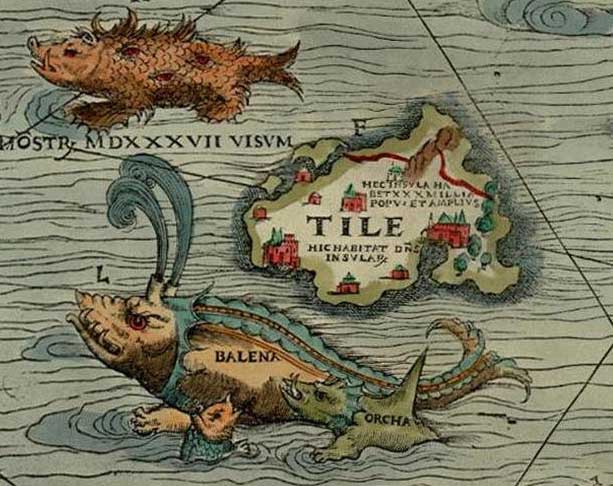
Thule or Tile on the Carta Marina of 1539 by Olaus Magnus, located northwest of the Orkney islands, with a "monster, seen in 1537", a whale ("balena"), and an orca. —Wiki

My Bantry grandmother told me that the Irish monks brought sheep to the Faroes, and the name, though Nordic, means sheep islands. And sheep islands do figure into the Brendan tales.

St. Brendan described the largest island as the Island of Sheep (Streymoy?) A bay in the southern part of Streymoy, is called Brandansvik (St. Brendan's Bay). His "bird paradise" might be the island of Mykines. There are several Faroe places named after the Irish monks (papar) including remote caves. —Faroe Islands Review History
The Faroes were part of a trade network with Dublin as a hub, and many Irish women made their way there as wives or slaves. DNA analysis shows that 84% of Faroese females are of Irish or Scottish descent.  —Faroe Islands Review History
(NB: contrary to modern belief, Irish monks were NOT celebate.)

Dicuil, in the 2nd half of the 8th century, wrote of "heremitae ex nostra Scotia" ("hermits from our land of Ireland"—Scotia was Ireland, not Scotland!) who lived on the northerly islands of Britain for a hundred years until the arrival of Norse pirates. An Irish nickname of Faroe islanders, Na Scigirí, possibly refers to the Eyja-Skeggjar (land of bearded men).

Northern European settlements (whether Irish, Scottish or Pictish) in the Faroes have been archaeologically dated to ca. 400 AD.
“There is also good evidence that they [the Celts] had sails: there is a model boat from Ireland that dates from about 100 BC that has a mast, which could be a model for Celtic boats more generally,” Jennings said. “There is not so much evidence of sails in Norway until as late as 700 AD. It is therefore more likely that these early Faroese settlers came from the British Isles.” —Andrew Jennings, Nordic Historian
The Vikings settled in the Faroe Islands before they went to Iceland, ca. 800 AD. Then, 60 years later, Iceland was supposedly "discovered" by the Norse. That's the equivalent of three generations in the Faroes before the Norse shoved off to Iceland. Plenty of time to hear about those Celtic settlements in Iceland. During the settlement of Iceland, the Faroes, the half-way mark, was the only provision stop for grain, meat and water.

The Faroe Islands, a remote North Atlantic archipelago, stepping stones half-way between Scotland Norway and Iceland, were inhabited 500 years before the Vikings arrived. Archaeologists taking "scientific samples for environmental archaeological analysis from the medieval Viking settlement,“ did not expect to find evidence of a previous culture.

Archaeologists Mike Church and Símun V. Arge said: “We uncovered some burnt peat ash containing barley grains under the Viking longhouse. It was not until we had it dated that we realized what we had found.” Barley is not indigenous to the Faroes, and there were "old field systems that didn’t seem to tie into later settlements." Church concluded, “There is evidence of Irish hermits sailing into the North Atlantic islands in a passage by an Irish Monk called Dicuil in 825AD.”
Many other islands lie in the northerly British Ocean. One reaches them from the northerly islands of Britain, by sailing directly for two days and two nights with a full sail in a favourable wind the whole time … Most of these islands are small, they are separated by narrow channels, and for nearly a hundred years hermits lived there, coming from our land, Ireland, by boat.
Here's the rub: Icelanders have maintained that they were purely Scandinavian, and that they lived in genetic isolation for 1200 years. Note that there were no Irish mentioned in the equation. The Irish were expunged from Icelandic oral tradition and there's almost no mention of the Irish in the Icelandic sagas that were recorded around the 13-14th centuries—with the exception of the Laxdaela Saga, and Burnt Njáll—whose name sounded suspiciously like the Irish Niall. (Kin to 5th c. Niall Nóigiallach, whose middle name was randy: he dinna wear pants; his Y-DNA genes got around. M222 sub-clade rools.) But in the 1970s, my English professors insisted there was NO relationship—merely coincidence. Icelandic peoples were Scandinavian.

Then the human genome mapping project got up to speed. Lo, there were chinks in the Viking armor. Iceland had relative genetic isolation, yes, but their preferred bedfellahs of choice were Irish captives—who did not come or go gentle unto that good night. And who were the real transmitters of culture? The Icelandic-Irish women who spoke to their children in Irish, and in some cases, gave them Irish names. And we know this because they just happened to turn up in Icelandic sagas.

New genetic studies in Iceland uphold a deep Irish connection in that the DNA genome tests reveals that 20% males and 63% females are of Irish ancestry (Irish Roots in Iceland). "The population of the Faroe Islands appears to have the highest level of asymmetry in Scandinavian vs British Isles ancestry proportions among female and male settlers of the archipelago." mDNA analysis shows that 84% of Faroese females are of Irish or Scottish descent. Mitochondrial DNA is passed from mother to offspring. (Then there is the mystery of the Celtic sheep in the Faroes.)

Burnt Njáll the lawyer, and Erik the Red(head) had prodigious tempers. (I'm gathering that when the omens were bad, the Vikings burnt all the lawyers.) All that loose Irish DNA might explain some of those Viking redheads too. Tróndur í Gøtu of the Færeyinga Saga, was described as having "a shock head of red hair, and…freckled of face and right grim of look", features which were inherent to Faroese, who are said to have descended from Thorstan the Red's daughter. (I bet she was Irish). The appearance of red hair and freckles were exotic enough to be recorded in the sagas. By contrast, most Norse were dark-haired, not blond.

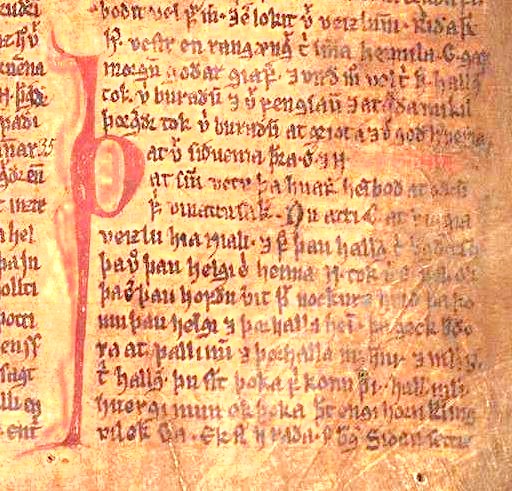
Excerpt from Njáls saga (Möðruvallabók AM 32 folio 13r cia. 1350). —Wiki

At least 60% of the Icelandic and Faroese.maternal gene pool hails from Ireland and Scotland. And the Viking contribution: "mtDNA lineages from Scandinavia to the populations of Iceland, Orkney, the Western Isles, and the Isle of Skye are 37.5%, 35.5%, 11.5%, and 12.5%, respectively." The mDNA study shows that the majority of female settlers came from the British Isles, "whereas ~80% of male settlers were Scandinavian." This data confirms Irish oral tradition. 

The study also notes that "the Gaelic contribution to the Icelandic mtDNA pool may have been at least as large as that from Scandinavia." (mtDNA and the Islands of the North Atlantic). That means there were almost no Scandinavian women emigrating form Norway. Norse-Irish women from Dublin and the Hebrides, yes.

I found interesting research on Iceland where "genealogy is an integral part of the culture — 80% of all Icelandic people who have ever lived can be traced on family trees." The country is isolated geographically, with little migration from other places ever since a few hundred Vikings and some Celts arrived almost 1200 years ago. (Decodeing Iceland's DNA). Note the acretion: "and some Celts," and these Celts are?

Islandia map by Abraham Ortelius ca 1590 —Wiki

Contrary to what we've been led to believe, Iceland was not an isolated Norse settlement unto itself. There's also a slew of Icelandic-Irish names which is curious as Vikings were more conservative naming boys than girls: Njáll/Njála, Brjan/Brjánn, Dufniall/ Domnall, Konall, Kjartan, Kjallakr, Kaðall, Kormakr, Meldun, Melpatrikr, Oskar, Patrek, Brigit. 

An Icelandic village, Patreksfjörður, is Padraig's Fjord. Vestmannaeyjar means "Irish Island." Írafell, and a mountain called, Írafellsbunga (are Éire (Irish) Fell, and  Éire Mountain, respectively), and Kjaransvík (Ciaran’s Bay) in the Westfjörðs, which seems to have been an Irish-Icelandic stronghold.

Of particular interest is the placename, Melkorkustaðir, once home to an irate Irish slave girl, Melkorka (see my story below), who was mother of Olaf the Peacock, a prominent character in many Icelandic sagas. None of this proves the Irish were in Iceland beforehand, it just proves they were there right alongside the Norse—in the thick of things. It also strongly suggests the sagas are based on historical fact.

Recent archaeological digs in the Faroes and Iceland note that there were Northern European settlements from ca. 400 to 800 AD, that definitely predate the Norse settlements. Archaeologists are reluctant to suggest as to who these people actually were. Chances of finding burials and intact DNA are slim to none. 

Also, Vikings often built on top of the older sites—which means their either integrated, or wiped the other settlers out. We know the earlier settlers raised barley, cut peat turf, and built soil beds with ash and seaweed—like Aran Islanders.

Another fact that seems to get buried in the Viking version of history is that female Icelandic settlers; slaves and concubines were predominantly Irish. Aud the Deep-minded, (Unn, or Auðr, daughter of Ketil Flatnose (ruler of the Hebrides)—he kicks off Laxdael Saga). Aud/Unn/Auðr, wife of Olaf the White, King of Dublin (853 AD), brought Irish slaves with her to Iceland from Dublin (by way of Caithiness). (Clements). She may not have been Irish, but it's possible that her father was Norse Irish, (and the chances of her mother being Irish?) which makes her…

At any rate, Aud/Unn/Auðr was a singularly unViking woman: she secretly built a ship in the forest (Scandinavian women were not allowed to own ships; had fewer rights—unlike Irish women who were on equal footing with men); she sailed to Orkney; married off one of her granddaughters; and then set sail for Iceland. She then freed all her Irish slaves in Iceland. Another reference noted she had a child with an Irish slave. I guess the attraction worked both ways. Fiercely independent Aud sounds similar to 15th c. Irish pirate queen, Gráinne Ó Máille ( c. 1530 – c. 1603).

Olaf the Peacock's grandfather, Höskuldr Dala-Kollsson's mother was Thorgerd Thorsteinsdottir, daughter of Thorstein the Red, who was son of Olaf the White, King of Dublin, whose father was Hiberno-Norse warlord Ingjald Helgasson. I won't even mention that several these Icelandic and Norse characters who settled the Hebrides, or came from there, before emigrating to Iceland, were also Norse-Irish. (And no you won’t be tested  on this.)

Ketill Bjǫrnsson, aka Flatnose (Old Norse: Flatnefr), was a 9th c. (Irish?) Norse King of the Isles—who led raids AGAINST Norway. (Orkneyinga Saga). However, Irish genealogy recorded that Aud's father was also Irish King Aedh. (Annals of Ulster). It could be a scribal error, or there was more than one outrageously uppity Norse woman named Aud. And Aud sounds a lot like Aedh. A female version of Hugh? 

Ketill sounds suspiciously like Kaðall/Cathal, and Flatnefr may be a phonetic corruption of Find (white). Scratch the surface—most emigrating Norsemen had Irish mothers, their children had Irish nicknames. (Jennings and Kruse).

The sagas of Iceland's colonization attempted to expunge all record of any Irish presence, but the Laxdaela saga-maker captured an Irish family pedigree—probably because the story wouldn't work without the Irish connection. Unique among Icelandic sagas, the Laxdaela Saga seems to have a feminine hand—recording matrilineal lineages in both Norse and Irish; perhaps it was composed by a woman, in Western Iceland, ca. 1230-1260.

Excerpts from the Laxdaela SagaChapter 21: