Showing posts with label Faroe Islands. Show all posts

Sunday, October 6, 2013

English evolved from Scandinavian?

"The English language brings out the best in the Irish. They court it like a beautiful woman. They make it bray with donkey laughter. They hurl it at the sky like a paint pot full of rainbows, and then make it chant a dirge for man's fate and man's follies that is as mournful as misty spring rain crying over the fallow earth." T E Kalem —from Brendan Behan's play, Borstal Boy
A Science Daily post from Nov, 2012 suggests that English evolved from Scandinavian. Two professors in Norway make an interesting hypothesis that English evolved from Old Norse, making English North Germanic rather than West Germanic.
Jan Terje Faarlund, professor of linguistics at the University of Oslo said: "What is particularly interesting is that Old English adopted words for day-to-day things that were already in the language. Usually one borrows words and concepts for new things. In English almost the reverse is true—the day-to-day words are Scandinavian, and there are many of them," says Faarlund.
Here are some examples: anger, awe, bag, band, big, birth, both, bull, cake, call, cast, cosy, cross, die, dirt, dream, egg, fellow, flat, gain, get, gift, give, guess, guest, hug, husband, ill, kid, law, leg, lift, likely, link, loan, loose, low, mistake, odd, race, raise, root, rotten, same, seat, seem, sister, skill, skin, skirt, sky, steak, though, thrive, Thursday, tight, till, trust, ugly, want, weak, window, wing, wrong. —Linguist Makes Sensational Claim: English Is a Scandinavian Language
I nearly snorted and circular breathed in my cuppa tea when I read that headline. I can hear the linguistic shit hitting the fan now.

Awww, there goes Beowulf!

So, let me get this straight, Everyone in the British Isles loved the Norse so much,   (they refused to have much to do with the invaders), that they couldn't even say Gimme an egg, Sister! in their own language(s) before the arrival of the Vikings? (It was mainly the Anglo—Saxons vs the short-lived Viking Danelaw (50 to 100 years of rule); most of the Britons were holed up in Wales or Brittany.

Sister and egg aren't even loan words ferhevinsakes! I'm no linguist but even I can poke holes in this argument. People usually borrow words and concepts for new things like computer, floppy disk, USB. Not for things they already know, or already have.

What would Bede say? All this splitting infinitives and hairs sounds like the Scandinavians are once again being culture pirates. A vikingr the academics will go.

Their hypothesis: English evolved out of Old Norse several centuries later? Not congruently? What about language drift, or convergent evolution—or even being closely related via the Indo-European continuum? It's like saying English (or Irish) evolved from Sanskrit because there are parallel words in both languages.

Sister is a prime example from the Proto-Indo-European continuum: *swésōr is recognizable and sounds familiar enough to be merely a dialect, rather than another language. No matter how many dialect armies and navys are conjured up, I'm fairly certain that Old Norse did not exist during the era that PIE was evolving. And then there's egg—clearly a very close word in Proto-Germanic:
From Middle English egge, from Old Norse egg (“egg”), from Proto-Germanic *ajją (“egg”).
Well, maybe egg isn't such a good example as Chaucer uses both ey, and egg. That could be a case of Norse and Anglo-Saxon eggs side by side. One could argue that that hard gg vs soft jj sound was borrowed from the Norse. I won't mention bull eggs here. (But you can look that world up if you like).

I wonder why outlaw wasn't on that list? That and law, and penny, schilling, etc.

The article was daft. (Not as daft as the eejit who recently posted that English has always existed in Great Britain. (MJ Harper, ‘The History of Britain Revealed’) The Belgae in Gaul and Britain were Celts, not Germans, ya twit. (It reads something like How the Martians Saved Civilization.) English ain't the mother tongue. Really.) Whose tongue was in what neither cheek?

Then there's the syntax argument:

•(subject/verb/object), SVO vs. Old English verb endings. Just to liven things up, Irish is VSOP. Good initials for brandy too. The Vikings, though they settled in Ireland too, had almost no impact on Irish other than town words, nautical terms, jarl, and window.

•Prepositions at the end of a sentence (a very good thing they didn't look at Irish!)

•My personal favorite: genitive (plural)s (The Queen of England's hat).

•Split infinitives (I promise to never laugh again). Well, there are no infinitive verbs in Irish, but we're not talking Irish here.

I admit I'm shaky on syntax. I know by doing. (By writing, that is). But since I had to go and make that strange segue, apparently the Norse absorbed more Irish words than the Irish themselves did of Old Norse words: "bachall (staff, crozier) >bagall; capall (horse) > kapall; lám (hand) > lámr; tarb (bull) > tarfr; and teine (fire) > dini.

Perhaps most surprisingly of all, one Norse word for a ship lung is taken from the Irish long." —Medieval Review Ó Muirithe, Diarmaid. From the Viking Word-Hoard: A Dictionary of Scandinavian Words in the Languages of Britain and Ireland. Dublin.

I'm sure I could argue some silly string theory that Gaelic impacted Old Norse, as spoken by Vikings, who, were, after a generation or two, no longer even Norse, but Norse-Irish, and Norse-Scottish. Irish and Scottish were pretty much the same people in those days as there was no Kingdom of Scotland yet. I can't use the term "one people" because nobody was unified.

Viking men did not bring any Norse women with them when they settled new turf. They just kidnapped Irish and Scottish women—and women are the bearers of language and culture—they taught their kids to speak Irish. And to a lesser degree, Norse British/Anglo-Saxon, mix, etc. (Iceland and the Faroes have a higher Irish/Scottish mDNA, than Norse yDNA but I already wrote about that).

So why would Old English suddenly die out, leave a linguistic void, and Old Norse suddenly take its place, and then evolve into modern English? Old habits die hard. We won't mention the other four English dialects that concurrently existed in the British Isles. Who has read Beowulf, or Sir Gawain in the original dialect? Or Blind Harry's Wallace?

OK, so the "Pearl Poet" author of Sir Gawain was from ca. the 14th c., as were Blind Harry, and Chaucer a little before that, and Beowulf was written in the late 10th or early 11th c., but the texts do serve to demonstrate that several different Middle English dialects survived, Not Old Norse. BTW, Beowulf was translated into late West Saxon from an older English dialect.

Clearly this is a case of lunatic fringe instead of Celtic Fringe. Like I said, those Norse academicians are cultural pirates! I don't think anyone was hypothetically sober at the time. Bring on Monty Python's version of Njall's Saga! Skol pafiskin!

Saturday, October 5, 2013

Olaf the Peacock's Irish Mother


Heiðarvíga saga, story of the heath-slayings

  The Icelandic sagas are prose histories of the Norse —and Celts—who settled in Iceland during the 10th - 11th centuries. The sagas, capturing an earlier oral tradition, were probably set to writing during the 13th and 14th centuries.

"Some of the richest and most interesting writings from medieval Europe come from one of its furthest corners: during the 13th and 14th century Icelanders began to write down the stories they had collected orally from previous centuries. These sagas would cover events in Iceland and elsewhere, going back to the days when the island was first discovered and settled back in the ninth century. They are stories of family feuds, outlaws and the occasional monster lurking somewhere the uninhabited stretches of the Iceland.' —Medievalists.net 

The only problem with this post narrative (above) from Medievalists.net is that when the Viking Norse "discovered" an "empty" Iceland, and Norse colonists arrived ca. 870-930 AD—there were already Northern European settlements dating from ca. 400-500 AD. And the other problem with Medievalist's statement is that those Icelanders were not wholly Norse, their slaves and concubines were often Irish or Scottish. Of course, viking means pirate, so I guess pirating of history itself is fitting.

Naddod was a Faroese Viking (by way of Shetland) who is credited with the discovery of Iceland. Grímur Kamban became the first to settle ca. 825. Grimur was either Irish/Scottish or Norse Irish, with a Gaelic nickname. 

Garðarr Svavarsson is credited as the first Scandinavian to have lived in Iceland one winter. He was was married to a woman from the Hebrides. A Hebridean woman would be Irish/Scottish, not Norse as the Norse did not bring Norse women with them. They took Celts as slaves. The Vikings were NOT the first Northern Europeans in the Faroes, and Iceland. (Not to mention, the Inuit.) Unless, of course, one were to definitively define Icelanders (and Faroes Islanders) as half-Scandinavian and half-Celtic.
The medieval chronicler Ari Thorgilsson said Ingólfr was the first Nordic settler in Iceland, but mentioned that "Papar" – i.e. Irish monks and hermits – had been in the country before the Norsemen. He wrote that they left because they did not want to live amongst the newly arrived pagans.  Ingólfr Arnarson —Wiki
Hjörleifr had been murdered by his Irish slaves because of his ill-treatment. Ingólfr hunted them down and killed them in the Westman Islands (Vestmannaeyjar, named after the slaves).
This tidbit's significant as you will see from the excerpts of the tale posted below, the Laxdaela Saga. The sagas seem to be "fictionalised distortions of real societies.…" and 'family sagas' of Icelandic literature are quite distinct, the overall network of saga society is consistent with real social networks." It's a strong possibility the Icelanders were following in the tradition of Irish recording of oral tradition, though a few centuries later. They could also have had Irish scribes living among them.

(BTW, what is this skewed fascination with Vikings anyway, and why is most everything we associate with Vikings, is plain old wrong? Like (Celtic) horned helmets? Where did we pick up this romantic ideal fraught with bogus information? Does it date back to Hitler, and his search for the "pure" Aryan race? Or is it an earlier Victorian hangover? But I digress.)

The ceremonial Waterloo Helmet is the only existing Celtic bronze horned helmet —La Tène  c.150–50 BC. —Wiki

The word "viking" was first popularised at the beginning of the 19th century by Erik Gustaf Geijer in his poem, The Viking. Geijer's poem did much to propagate the new romanticised ideal of the Viking, which had little basis in historical fact.    —Vikings  

A romanticised picture of Vikings as noble savages began to take root in the 18th century, and this developed and became widely propagated during the 19th-century Viking revival.

Norse myths were religiously adopted by Germanic Neopaganists in Germanic countries during the early 20th c., and in most of the the English-speaking world during the 1960s. It's probably during that latest Neopagan adaptation that most of our Viking misconceptions were spawned.

There's an Irish oral tradition that a Tralee mariner Brendan the Navigator visited Iceland and the Faroe Islands circa 400 AD. Bantry's (where my family is from) patron saint is Brendan. (Based on an immram, or voyage tale, the Brendan Voyage tale was transcribed in Latin in 800 AD.) The description of Brendan's "insulae" (islands) is remarkably similar to the Faroe Islands.

One fanciful name for these mythical northern islands was Thule, which was reported to be "a six days' sail north of Britain, and near the frozen sea." (There was persistent belief that islands to the west of Great Britain recorded as early as 330 BC. Whether fact or fiction, it fed the questing beast)  

The Irish Tír na-nÓg (Land of the Ever-young) was another mythical island to the west. Reason enough to set sail—because they were there. "The Icelanders' own records mention about 400 original settlers "with mostly Celtic nicknames" who were living in Iceland previous to Norse colonization. (Clements). The significant part of that statement is that settlers were there previous to Norse discovery.

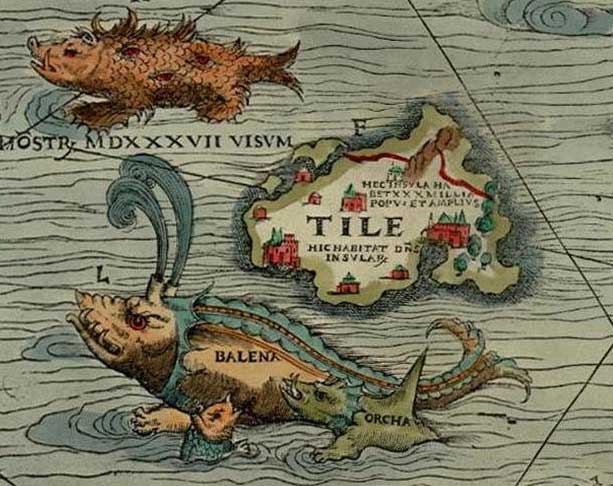
Thule or Tile on the Carta Marina of 1539 by Olaus Magnus, located northwest of the Orkney islands, with a "monster, seen in 1537", a whale ("balena"), and an orca. —Wiki

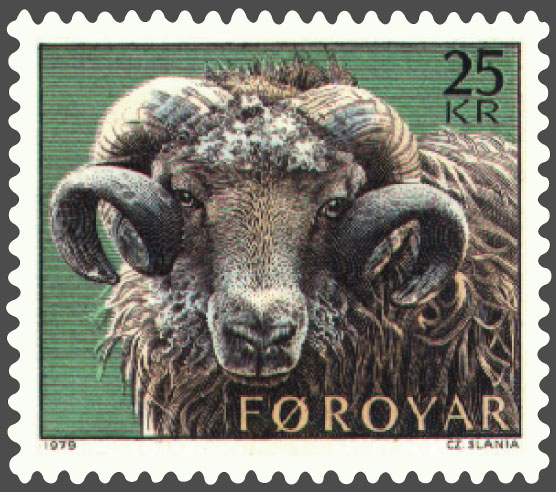
My Bantry grandmother told me that the Irish monks brought sheep to the Faroes, and the name, though Nordic, means sheep islands. And sheep islands do figure into the Brendan tales.

St. Brendan described the largest island as the Island of Sheep (Streymoy?) A bay in the southern part of Streymoy, is called Brandansvik (St. Brendan's Bay). His "bird paradise" might be the island of Mykines. There are several Faroe places named after the Irish monks (papar) including remote caves. —Faroe Islands Review History
The Faroes were part of a trade network with Dublin as a hub, and many Irish women made their way there as wives or slaves. DNA analysis shows that 84% of Faroese females are of Irish or Scottish descent.  —Faroe Islands Review History
(NB: contrary to modern belief, Irish monks were NOT celebate.)

Dicuil, in the 2nd half of the 8th century, wrote of "heremitae ex nostra Scotia" ("hermits from our land of Ireland"—Scotia was Ireland, not Scotland!) who lived on the northerly islands of Britain for a hundred years until the arrival of Norse pirates. An Irish nickname of Faroe islanders, Na Scigirí, possibly refers to the Eyja-Skeggjar (land of bearded men).

Northern European settlements (whether Irish, Scottish or Pictish) in the Faroes have been archaeologically dated to ca. 400 AD.
“There is also good evidence that they [the Celts] had sails: there is a model boat from Ireland that dates from about 100 BC that has a mast, which could be a model for Celtic boats more generally,” Jennings said. “There is not so much evidence of sails in Norway until as late as 700 AD. It is therefore more likely that these early Faroese settlers came from the British Isles.” —Andrew Jennings, Nordic Historian
The Vikings settled in the Faroe Islands before they went to Iceland, ca. 800 AD. Then, 60 years later, Iceland was supposedly "discovered" by the Norse. That's the equivalent of three generations in the Faroes before the Norse shoved off to Iceland. Plenty of time to hear about those Celtic settlements in Iceland. During the settlement of Iceland, the Faroes, the half-way mark, was the only provision stop for grain, meat and water.

The Faroe Islands, a remote North Atlantic archipelago, stepping stones half-way between Scotland Norway and Iceland, were inhabited 500 years before the Vikings arrived. Archaeologists taking "scientific samples for environmental archaeological analysis from the medieval Viking settlement,“ did not expect to find evidence of a previous culture.

Archaeologists Mike Church and Símun V. Arge said: “We uncovered some burnt peat ash containing barley grains under the Viking longhouse. It was not until we had it dated that we realized what we had found.” Barley is not indigenous to the Faroes, and there were "old field systems that didn’t seem to tie into later settlements." Church concluded, “There is evidence of Irish hermits sailing into the North Atlantic islands in a passage by an Irish Monk called Dicuil in 825AD.”
Many other islands lie in the northerly British Ocean. One reaches them from the northerly islands of Britain, by sailing directly for two days and two nights with a full sail in a favourable wind the whole time … Most of these islands are small, they are separated by narrow channels, and for nearly a hundred years hermits lived there, coming from our land, Ireland, by boat.
Here's the rub: Icelanders have maintained that they were purely Scandinavian, and that they lived in genetic isolation for 1200 years. Note that there were no Irish mentioned in the equation. The Irish were expunged from Icelandic oral tradition and there's almost no mention of the Irish in the Icelandic sagas that were recorded around the 13-14th centuries—with the exception of the Laxdaela Saga, and Burnt Njáll—whose name sounded suspiciously like the Irish Niall. (Kin to 5th c. Niall Nóigiallach, whose middle name was randy: he dinna wear pants; his Y-DNA genes got around. M222 sub-clade rools.) But in the 1970s, my English professors insisted there was NO relationship—merely coincidence. Icelandic peoples were Scandinavian.

Then the human genome mapping project got up to speed. Lo, there were chinks in the Viking armor. Iceland had relative genetic isolation, yes, but their preferred bedfellahs of choice were Irish captives—who did not come or go gentle unto that good night. And who were the real transmitters of culture? The Icelandic-Irish women who spoke to their children in Irish, and in some cases, gave them Irish names. And we know this because they just happened to turn up in Icelandic sagas.

New genetic studies in Iceland uphold a deep Irish connection in that the DNA genome tests reveals that 20% males and 63% females are of Irish ancestry (Irish Roots in Iceland). "The population of the Faroe Islands appears to have the highest level of asymmetry in Scandinavian vs British Isles ancestry proportions among female and male settlers of the archipelago." mDNA analysis shows that 84% of Faroese females are of Irish or Scottish descent. Mitochondrial DNA is passed from mother to offspring. (Then there is the mystery of the Celtic sheep in the Faroes.)

Burnt Njáll the lawyer, and Erik the Red(head) had prodigious tempers. (I'm gathering that when the omens were bad, the Vikings burnt all the lawyers.) All that loose Irish DNA might explain some of those Viking redheads too. Tróndur í Gøtu of the Færeyinga Saga, was described as having "a shock head of red hair, and…freckled of face and right grim of look", features which were inherent to Faroese, who are said to have descended from Thorstan the Red's daughter. (I bet she was Irish). The appearance of red hair and freckles were exotic enough to be recorded in the sagas. By contrast, most Norse were dark-haired, not blond.

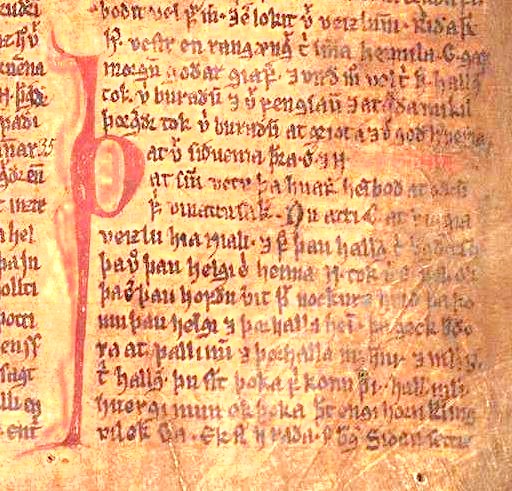
Excerpt from Njáls saga (Möðruvallabók AM 32 folio 13r cia. 1350). —Wiki

At least 60% of the Icelandic and Faroese.maternal gene pool hails from Ireland and Scotland. And the Viking contribution: "mtDNA lineages from Scandinavia to the populations of Iceland, Orkney, the Western Isles, and the Isle of Skye are 37.5%, 35.5%, 11.5%, and 12.5%, respectively." The mDNA study shows that the majority of female settlers came from the British Isles, "whereas ~80% of male settlers were Scandinavian." This data confirms Irish oral tradition. 

The study also notes that "the Gaelic contribution to the Icelandic mtDNA pool may have been at least as large as that from Scandinavia." (mtDNA and the Islands of the North Atlantic). That means there were almost no Scandinavian women emigrating form Norway. Norse-Irish women from Dublin and the Hebrides, yes.

I found interesting research on Iceland where "genealogy is an integral part of the culture — 80% of all Icelandic people who have ever lived can be traced on family trees." The country is isolated geographically, with little migration from other places ever since a few hundred Vikings and some Celts arrived almost 1200 years ago. (Decodeing Iceland's DNA). Note the acretion: "and some Celts," and these Celts are?

Islandia map by Abraham Ortelius ca 1590 —Wiki

Contrary to what we've been led to believe, Iceland was not an isolated Norse settlement unto itself. There's also a slew of Icelandic-Irish names which is curious as Vikings were more conservative naming boys than girls: Njáll/Njála, Brjan/Brjánn, Dufniall/ Domnall, Konall, Kjartan, Kjallakr, Kaðall, Kormakr, Meldun, Melpatrikr, Oskar, Patrek, Brigit. 

An Icelandic village, Patreksfjörður, is Padraig's Fjord. Vestmannaeyjar means "Irish Island." Írafell, and a mountain called, Írafellsbunga (are Éire (Irish) Fell, and  Éire Mountain, respectively), and Kjaransvík (Ciaran’s Bay) in the Westfjörðs, which seems to have been an Irish-Icelandic stronghold.

Of particular interest is the placename, Melkorkustaðir, once home to an irate Irish slave girl, Melkorka (see my story below), who was mother of Olaf the Peacock, a prominent character in many Icelandic sagas. None of this proves the Irish were in Iceland beforehand, it just proves they were there right alongside the Norse—in the thick of things. It also strongly suggests the sagas are based on historical fact.

Recent archaeological digs in the Faroes and Iceland note that there were Northern European settlements from ca. 400 to 800 AD, that definitely predate the Norse settlements. Archaeologists are reluctant to suggest as to who these people actually were. Chances of finding burials and intact DNA are slim to none. 

Also, Vikings often built on top of the older sites—which means their either integrated, or wiped the other settlers out. We know the earlier settlers raised barley, cut peat turf, and built soil beds with ash and seaweed—like Aran Islanders.

Another fact that seems to get buried in the Viking version of history is that female Icelandic settlers; slaves and concubines were predominantly Irish. Aud the Deep-minded, (Unn, or Auðr, daughter of Ketil Flatnose (ruler of the Hebrides)—he kicks off Laxdael Saga). Aud/Unn/Auðr, wife of Olaf the White, King of Dublin (853 AD), brought Irish slaves with her to Iceland from Dublin (by way of Caithiness). (Clements). She may not have been Irish, but it's possible that her father was Norse Irish, (and the chances of her mother being Irish?) which makes her…

At any rate, Aud/Unn/Auðr was a singularly unViking woman: she secretly built a ship in the forest (Scandinavian women were not allowed to own ships; had fewer rights—unlike Irish women who were on equal footing with men); she sailed to Orkney; married off one of her granddaughters; and then set sail for Iceland. She then freed all her Irish slaves in Iceland. Another reference noted she had a child with an Irish slave. I guess the attraction worked both ways. Fiercely independent Aud sounds similar to 15th c. Irish pirate queen, Gráinne Ó Máille ( c. 1530 – c. 1603).

Olaf the Peacock's grandfather, Höskuldr Dala-Kollsson's mother was Thorgerd Thorsteinsdottir, daughter of Thorstein the Red, who was son of Olaf the White, King of Dublin, whose father was Hiberno-Norse warlord Ingjald Helgasson. I won't even mention that several these Icelandic and Norse characters who settled the Hebrides, or came from there, before emigrating to Iceland, were also Norse-Irish. (And no you won’t be tested  on this.)

Ketill Bjǫrnsson, aka Flatnose (Old Norse: Flatnefr), was a 9th c. (Irish?) Norse King of the Isles—who led raids AGAINST Norway. (Orkneyinga Saga). However, Irish genealogy recorded that Aud's father was also Irish King Aedh. (Annals of Ulster). It could be a scribal error, or there was more than one outrageously uppity Norse woman named Aud. And Aud sounds a lot like Aedh. A female version of Hugh? 

Ketill sounds suspiciously like Kaðall/Cathal, and Flatnefr may be a phonetic corruption of Find (white). Scratch the surface—most emigrating Norsemen had Irish mothers, their children had Irish nicknames. (Jennings and Kruse).

The sagas of Iceland's colonization attempted to expunge all record of any Irish presence, but the Laxdaela saga-maker captured an Irish family pedigree—probably because the story wouldn't work without the Irish connection. Unique among Icelandic sagas, the Laxdaela Saga seems to have a feminine hand—recording matrilineal lineages in both Norse and Irish; perhaps it was composed by a woman, in Western Iceland, ca. 1230-1260.

Excerpts from the Laxdaela Saga, Chapter 21:

Wednesday, August 21, 2013

Sheep Islands: What about the sheep? Notes on the Voyage of St. Brendan


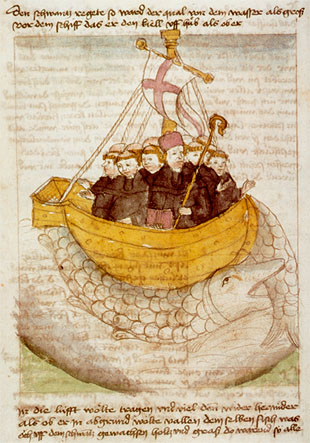
Saint Brendan & the whale—from a 15th-c. German manuscript. Wiki

There is an Irish oral tradition that the Irish settled in the Faroes, during the pre-Viking era, and the descriptions in the Voyage of St. Brendan, of "insulae" (islands) sounds remarkably similar to the Faroe Islands. There was a persistent belief that islands to the west of Great Britain existed as early as 330 BC.  One fanciful name for those northern islands was Thule, which was "a six days' sail north of Britain, and near the frozen sea."

My Bantry grandmother told me that Irish monks brought sheep to the Faroes, and the toponym, though Nordic, means sheep islands. And sheep islands do figure heavily into the Brendan tales. There are several stories from the Navigatio of St. Bréanainn of Clonfert.

Some say Brendan (c. 484 – 577), was born to Finnlug (Fair Lugh) and Cara of the Altraige tribe, of the Ciarraige Luachra, the people of Ciar, who gave their name to County Kerry, on Fenit Island, near Tralee. I don't know if Tralee and Bantry both claim Brendan as he's also Bantry's patron saint. Galway, too clams Brendan. All have one thing in common—they are all seaport towns.

We do know Brendan was a real Irish sailor.His name in Irish: Broen-finn, or 'fair-drop', Naomh (St) Breandán. In Icelandic, it keeps the Latin, Brandanus. 

Brendan was baptized by an ex-druid, Saint Erc of Slane (and Cornwall, aka St Erth), and schooled by Saint Ita, "the Brigid of Munster", or "foster-mother of saints" who had some major goddess qualities.

After sailing around the Irish, and the Hebridean islands, he set sail into the void from Kerry.

Brendan built a currach—a leather boat. The boat frame was woven from hazel and willow wattles, he covered the naomhóg the "little holy one", with cowhides tanned in oak-bark and softened/waterproofed with bog butter. He added a mast and a white linen sail. And he was set to go—with either 14 or 16 of his bestie apostles. It must've been one very crowded, smelly vessel.


The gold Broighter boat is a model of an Iron Age Irish boat from 100 BC, replete with 18 golden oars, rowlocks, benches, a paddle rudder for steering, boathook, a yardarm, tools, and a mast for a sail. “There is also good evidence that they [the Celts] had sails: there is a model boat from Ireland that dates from about 100 BC that has a mast, which could be a model for Celtic boats more generally,” Jennings said. “There is not so much evidence of sails in Norway until as late as 700 AD. It is therefore more likely that these early Faroese settlers came from the British Isles.” —Andrew Jennings, Nordic Historian The Norse word for a ship lung is from the Irish word long." —Medieval Review

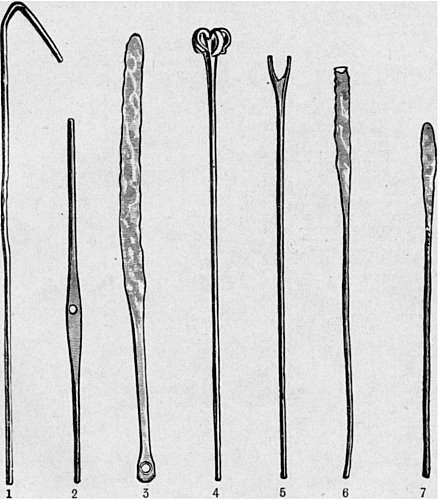
Broighter boat,1.Boat hook 2.Mast yard 3.Steering oar 4.Small grappling iron 5.Forked implements 6.Square ended oars 7.Oars. —Wiki

The boat, a votive offering in the La Tene style, was found by two ploughmen near Loch Foyle in 1896; compare it to the 15th c. German drawing at the top of this page.

The Broighter boat —Wiki

The Brendan immram Voyage tale was transcribed from Irish into Latin in 800 AD.) Old Irish Immrama (from iomramh-voyage), or voyager stories, depict a hero's sea journey to the Otherworld, (with a Christian overlay); they date to ca. the 3rd c. AD.

The Otherworld is always to the West. Tír na-nÓg (Land of the Ever-young) was another mythical island to the west. Reason enough to set sail—because they were there. In his legendary quest, St. Brendan was seeking the Isle of the Blessed (Saint Brendan's phantom Island), which may have been the Faroe islands.

Half-way to Iceland, the Faroes are the first stepping stone across the North Atlantic. 

St. Brendan described the largest of the Faroe Isles island as the Island of Sheep (Streymoy?) A bay in the southern part of Streymoy, is called Brandansvik (St. Brendan's Bay). His "bird paradise" might be the island of Mykines. There are several Faroe places named after the Irish monks (papar) including remote caves. —Faroe Islands Review History
The Faroes were part of a trade network with Dublin as a hub, and many Irish women made their way there as wives or slaves. DNA analysis shows that 84% of Faroese females are of Irish or Scottish descent. —Faroe Islands Review History
(NB: contrary to modern belief, Irish monks were NOT celebate.)

Northern European settlements in the Faroes have been archaeologically dated to ca. 400 AD. Some 500 years later, the Vikings arrived in the Faroes, enroute to Iceland, and it looks like they may not have destroyed all evidence of Irish settlement in the Faroes. There is malted barley grain carbon-dated older than the Viking era—Barley is not indigenous to the Faroes—and old field systems that didn’t fit into later settlements.

There are also placenames of two Faroe settlements are Irish saints' names (Patrick & Brigit), survive—albeit with a Norse spelling. There might be other embedded Irish words. The Norse who settled in the Faroes were probably Norse-Irish from Dublin, not Norse from Scandinavia.

Medieval chronicler Ari Thorgilsson said Ingólfr was the first Nordic settler in Iceland, but mentioned that "Papar" – i.e. Irish monks and hermits – had been in the country before the Norsemen. He wrote that they left because they did not want to live amongst the newly arrived pagans. Ingólfr Arnarson —Wiki

According to the Færeyjar Saga, an Icelandic Christian conversion story, one Faroe islander was "Tróndur í Gøtu, a descendant of Scandinavian chiefs who settled in Dublin, Ireland." And "Icelanders' own records record that 400 original settlers "with mostly Celtic nicknames" were living in Iceland previous to Norse colonization. (Clements). The significance of that statement is that European settlers were in Iceland and the Faroes long before Norse discovery.

In the 2nd half of the 8th century, Irish monk-geographer, Dicuil in "De menura orbis terrae" wrote of "heremitae ex nostra Scotia" ("hermits from our land of Ireland") living in the Faroes. (Scotia referred to Ireland, not Scotland!)  They lived on the northerly islands of Britain for a hundred years until the arrival of Norse pirates. An Irish nickname of Faroe islanders, Na Scigirí, possibly refers to the Eyja-Skeggjar (land of bearded men).

Dicuil’s geographical book describes islands that aren't mentioned in any other writing of the time:
Many other islands lie in the northerly British Ocean. One reaches them from the northerly islands of Britain, by sailing directly for two days and two nights with a full sail in a favourable wind the whole time … Most of these islands are small, they are separated by narrow channels, and for nearly a hundred years hermits lived there, coming from our land, Ireland, by boat.
Archaeologists now believe Dicui was referring to the Faroes. Faroe or Føroyar means sheep in Norse. When the Norse arrived, there were already sheep there. So, who brought the sheep? The puffins?

Immrama, or voyage stories, are different than echtrae or adventure stories. The hero's faith is challenged—often with a multitude of pagan motifs. In this case, with herds of black sheep and white sheep on a disappearing island shrouded in fog.

THE VOYAGE OF BRENDAN SYNOPSIS (Chapters are relative depending on version,There are over 100 manuscripts of the Brendan story, not counting translations.)

In chapter 8 or 9 of the Navigatio, Brendan's sailors discovered an island of sheep, ate some lamb, and stayed on for Holy Week (before Easter). NB—the Irish celebrated Eater as late as mid-May. Let's just say there was a major difference of opinion with Rome as to when Easter was on the calendar. (In The Voyage of Mael Duin, monks also visited an island of sheep.

The following year, (chapter 14) they returned to the islands of Sheep, Jasconius, and the Paradise of Birds. (So we know there were at least three islands, and lots of birds and whales.) A bird said they had to repeat their journey seven years before they were holy enough to reach the Island of Paradise. They discovered a "coagulated" sea (icebergs?), sea monsters, more whales and fish, an island of grapes, magic (lethe?) water, griffins, seals, otters, an island of angry blacksmiths throwing hot slag at them, and more volcanoes. 

In chapter 28, they returned to the island of Sheep, Jasconius, and the Paradise of Birds, before finding the Promised Land of Saints. They returned home, where St. Brendan died. -Wiki synopsis.

Some excerpts:
Perambulantes autem illam insulam invenerunt diverses turmas ovium unius coloris id est albi ita ut non possent ultra videre terram prae multitudine ovium.  
On the island we found flocks of white sheep—we could not see the land, for the multitudes of sheep. (They sacrificed an ewe lamb. Loaded up the boat with mutton.) 
Sanctus Brendanus illum quomodo potuissent oves esse tam magnae sicut ibi visae sunt. Erant enim majores quam boves. Cui ille dixit: «Nemo colligit lac de ovibus in hac insula nec hiemps distringit illas sed in pascuis semper commorantur die noctuque. 
Brendan said the sheep were larger than cattle. "No one collects milk from sheep in this island or winter pastures them, they live in accordance with day and night. (So the sheep are feral, and the sailors drink sheep's milk.) They set sail.
Erat autem illa insula petrosa sine ulla herba. Silva rara erat ibi et in litore illius nihil de arena fuit.  
The island, however, was rocky, without grass. The forest was rare and there was no sand on the shore.      —from Navigatio Sancti Brendani Abbatis
So what about them sheep? Small N. European short-tailed sheep, related to Icelandic sheep, not inclined to hang out in herds. Hardy. No birds of a feather flock together philosophy for them.

On medieval maps, Brendan's fabled misty Isle appeared in various locations (including west of the Canaries—the Azores?). And on Christopher Columbus's maps—most notable is Martin Behaim's Erdapfel of 1492—known as La isla de San Borondón or isla de Samborombó. Borondón and Samborombó is St. Brendan in Spanish.

A reoccuring theme of the immrama is that you can't go home again—ever...certainly never to return the same person as when you left. Sort of like going on the Camino. Enlightenment was always sought and invoked on far distant shores. Apparently sheep were also somehow involved. Brendan's Feast Day is May 16. A good day to eat sheep.

Sunday, July 14, 2013

Ocean Going Ships Timeline


Fabio Paolo Barbieri (on Facebook) wrote that Vikings invented the first ocean-going ships. I think not. Ocean-going ship, or sea-going boat? There's a fine line of distinction. What is the difference?

A working definition of ships (vs boats) is based on their ability to carry cargo, or people, and operate independently for extended periods of time. (They also had sails and oars, usually a keel, but not always.) And length, too. Any vessel over 100 feet was a ship. Or, a ship had a fitted deck above the water line, a boat may have a cockpit or it may be completely open. (Which brings us back to the matter of ballast and cargo definition of ship—as it was stored under the deck.)

But ancient boats too were definitely ocean-going, carried cargo, and were self-sustaining for long periods of time. That got me a-Googling.
The earliest known reference to an organization devoted to ships in ancient India is to the Mauryan Empire from the 4th century BC. It is believed that the navigation as a science originated on the river Indus some 5000 years ago. Maritime trade began with safer coastal trade and evolved with the manipulation of the monsoon winds, soon resulting in trade crossing boundaries such as the Arabian Sea and the Bay of Bengal. —Ancient Maritime History . Wikipedia
One simple answer was: a ship can carry a boat, but a boat cannot carry a ship. Did Viking ships carry boats? Nope. Another definition is "A vessel with only one deck is a boat, more than one deck—it's a ship." Again, that rules out Viking boats. 

I also found this: "A ship is a vessel with no fewer than three masts." Well, that rules out all vessel until the iconic sailing ships of the 1800s!  BTW, there is no evidence of sails on Viking boats until 700 AD; in contrast, St. Brendan (c. 484-577) was sailing far and wide in his wee báidín replete with 12 apostles. In fact, the Norse word for ship, lung is borrowed from the Irish word long." And the Irish word for boat, báta, is a loanword from...the Latin.  Bark (ship) (barque, barca.


Old Norse
Irish
English
French
Spanish
Danish
Norwegian
bátr
bád
boat
bateau
barco, 
barca, 
embarcación
båd; fartøj
båt, fartøy


                —from Loanwords in the Irish language

The one I loved was: You can row a boat, you can't row a ship. A ship is propelled by sail (or power only). Oars make vessels into boats?

Another answer: The difference between a ship or a boat has to do with function. On a boat, the function is on its deck, the function of a ship is inside it. That definitely rules out those Viking boats. A boat leans into a turn—a ship leans out.  But these are modern definitions.

We are rather slovenly with our terminology as to the differences between ships (also a verbal noun). and boats, and tend to use them interchangeably, and when in doubt we revert to the word vessel. 

I suspect in the ancient world, any seaworthy vessel capable of sailing far distances, was a ship, either with upper deck, or open boat. I suspect our friend was using this definition for a Viking ship: A ship is an ocean-going vessel. A boat is a coastal vessel, it hugs the shoreline and inland waters. You can ship things on boats.


boat (n.) Look up boat at Dictionary.com
Old English bat "boat, ship, vessel," from Proto-Germanic *bait- (cognates: Old Norse batr, Dutch boot, German Boot), possibly from PIE root *bheid- "to split" (see fissure) if the notion is of making a boat by hollowing out a tree trunk; or it may be an extension of the name for some part of a ship. French bateau "boat" is from Old English or Norse. Spanish batel, Italian battello, Medieval Latin batellus likewise probably are from Germanic.
ship (v.) Look up ship at Dictionary.com
c.1300, "to send or transport (merchandise, people) by ship; to board a ship; to travel by ship, sail, set sail," also figurative, fromship (n.). Old English scipian is attested only in the senses "take ship, embark; be furnished with a ship." 
c.1300, "a ship," from ship (n.). Meaning "act of sending (freight) by a ship, etc." is from late 15c. As "ships generally or collectively" from 1590s.
vessel (n.) Look up vessel at Dictionary.com
c.1300, "container," from Old French vessel "container, receptacle, barrel; ship" (12c., Modern French vaisseau) from Late Latinvascellum "small vase or urn," also "a ship," alteration of Latin vasculum, diminutive of vas "vessel." Sense of "ship, boat" is found in English from early 14c. "The association between hollow utensils and boats appears in all languages."
skipper (n.1) Look up skipper at Dictionary.com
"captain or master of a ship," late 14c., from Middle Dutch scipper, from scip (see ship (n.)). Compare English shipper, used from late 15c. to 17c. in sense "skipper." Transferred sense of "captain of a sporting team" is from 1830.

At the very least, I had a good time assembling this timeline and learned gobs about vasculitii (from Latin vasculum "a small vessel," diminutive of vas "vessel"), to all types of boats, in the process. The haphazardness of this timeline (still in flux) has much to do with the order in which I found the information, sometimes, literally, boat by boat.


My very ad hoc timeline:

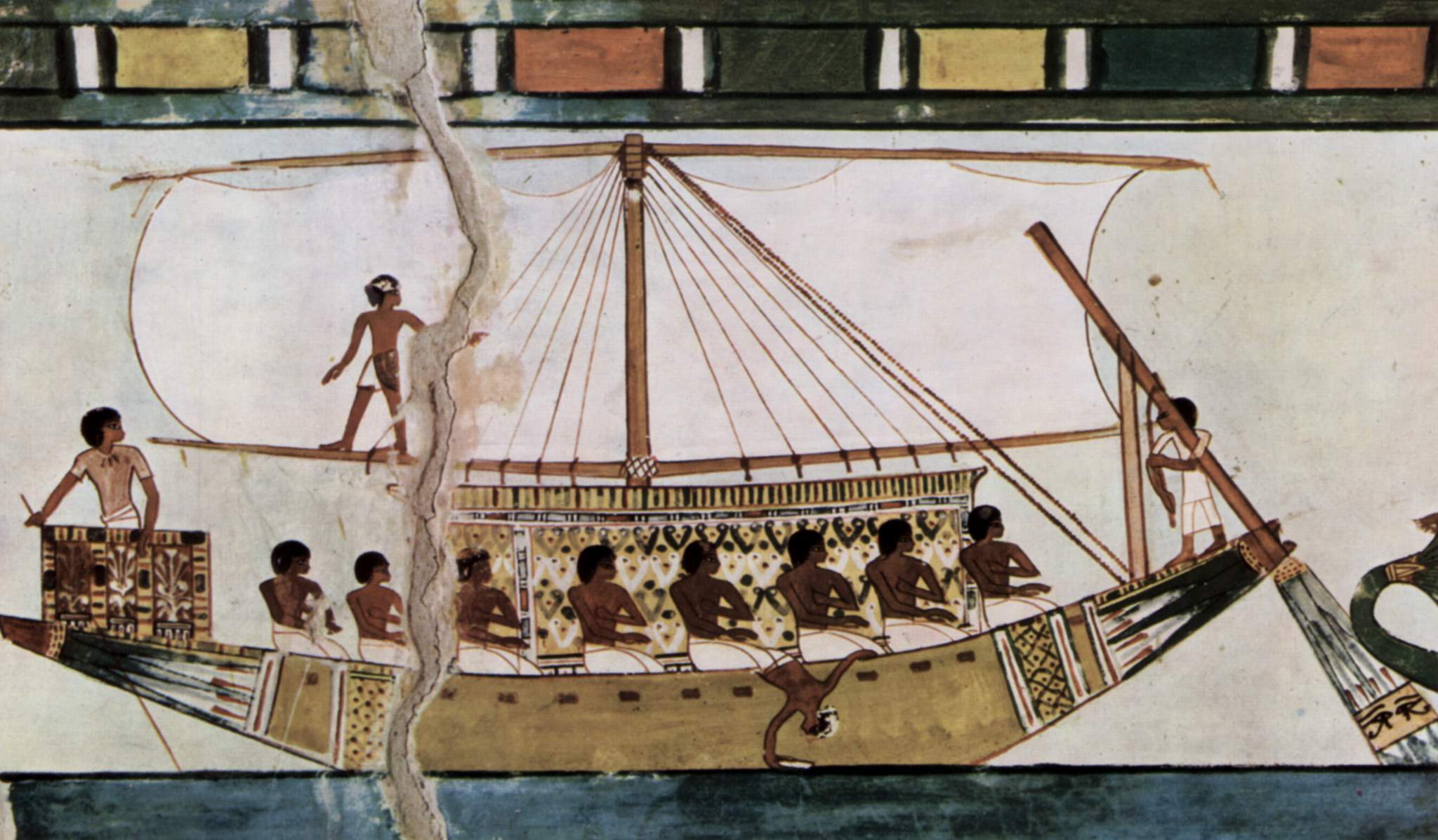
3000 BC—Ancient Egyptians assembled wooden planks into a hull using woven straps to lash planks together, and reeds for caulking to seal the seams. (Q: is this a river boat or sea boat?—The Mediterranean Sea is much calmer than the ocean. So we take this with a grain of salt. We're thinking river barge or rafts. But here's the thing, many had sails. Some had 16 oars. Ship or boat? You decide.

ca. 2600 BC—The Mohenjodaro had extensive technical ship-building texts.

By 2500 BC, the Egyptians were building wooden vessels capable of sailing across oceans. 

2500 BC—Somalis were trading with the Arabian Peninsula; Swahili & Mali were part of huge maritime cultures of Central Africa. 

2030 BC—Ferriby Boat 3, Humber River, Yorkshire, Britain, probably was ocean-going, but because it was a flat-bottomed boat, there's considerable debate.

2000 BC—Minoan naval power controlled the Mediterranean.

1940 BC—Ferriby Boat 2, Humber River, Britain.

1900 BC World's Oldest Sea Vessels Discovered in Egypt ca. 4,000 years ago, capable of voyages 1,000 miles away.

1880-1680 BC—Ferriby Boat 1, Humber River, Yorkshire, Britain, 43 feet long and nearly six feet wide, and fitted with 18 paddles, it probably was ocean-going, but it was a three-strake (sallow keel—like a canoe) flat-bottomed boat, so there's considerable debate. The Ferriby boats are the earliest known sewn-plank boats in Europe. A big technological step from the dugout Hanson Log Boat.

The Dover boat  at the Dover Museum is sewn together. No nails.

1500 BC The Dover Bronze Age Boat, hewn from oak planks, wedged with hazelwood, moss, and sewn with yew withies, is the world's oldest known intact seagoing boat Yes, it's a large boat, it seated two abreast, but we don't know actually how long the boat was because modern buildings and roads were plunked atop it. It looks like a large modern sailboat with a central cleat-rail. However, the narrower Ferriby boats are older; Ferriby boat 3 dates back to 2030 BC—and they may have been seaworthy. The Dover boat navigated the English Channel, long before Tutankhamun became Pharaoh of Egypt. (The oldest intact boat, is the Khufu ship, built in ancient Egypt and was used in burial rituals).  —see The Dover Boat and its amazing rescue from mud and brine. And How significant is the Dover Bronze Age Boat?

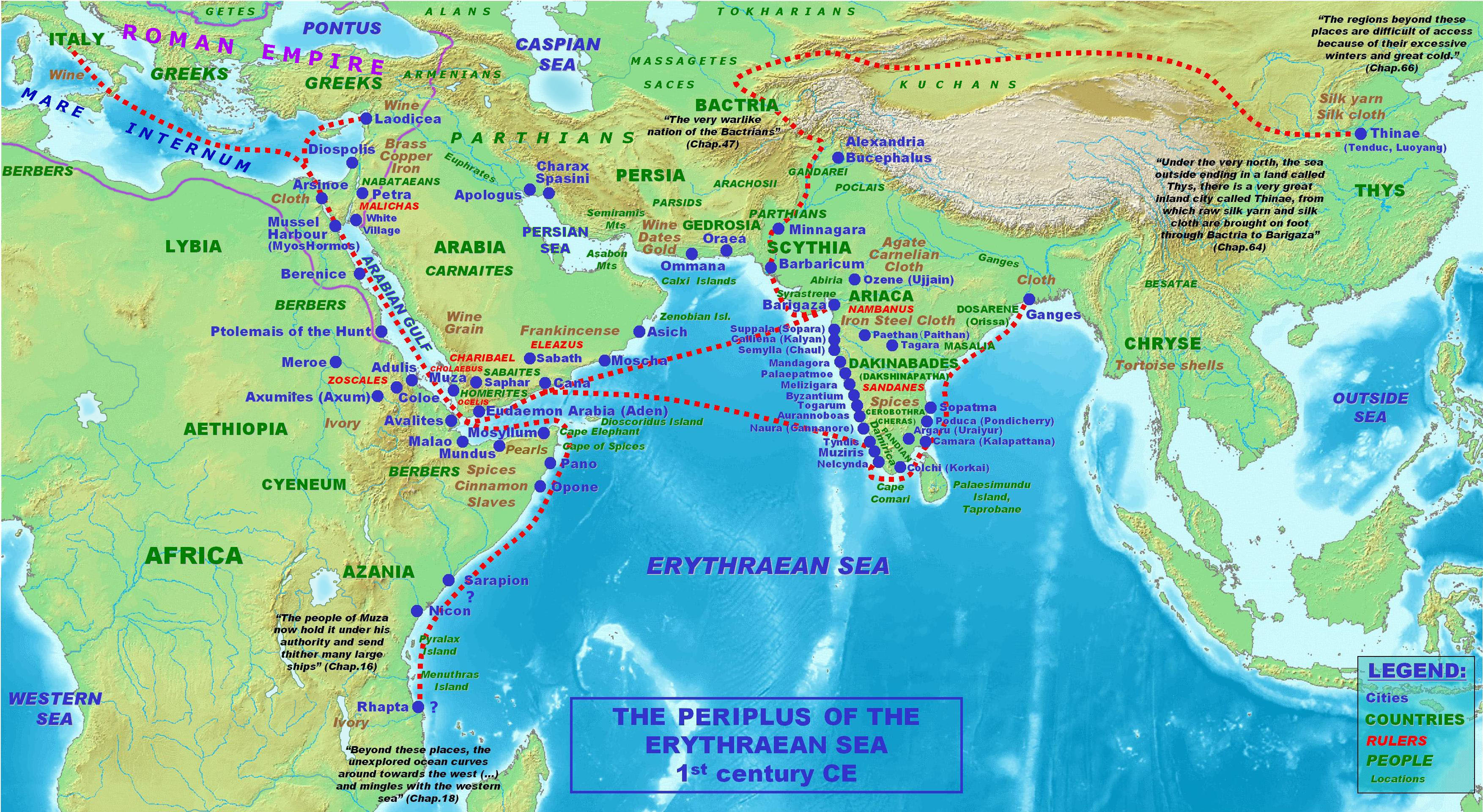
1550 BC—to 300 BC The Phoenicians, the first to sail completely around Africa, (and to Cornwall and Ireland for tin). Now, that's ocean-going.

Egypt,1420 BC —Wiki
Egypt, 1250 BC —Wiki

1000 BC—Ocean-going Polynesians settled Oceania 3,000 years ago. Easter Island, NZ, Hawaii. They covered huge distances—repeatedly. And the Pacific Ocean ain't so pacific.

Nubia/Axum traded with India, ships from Northeast Africa sailed between India/Sri Lanka—no small distance.

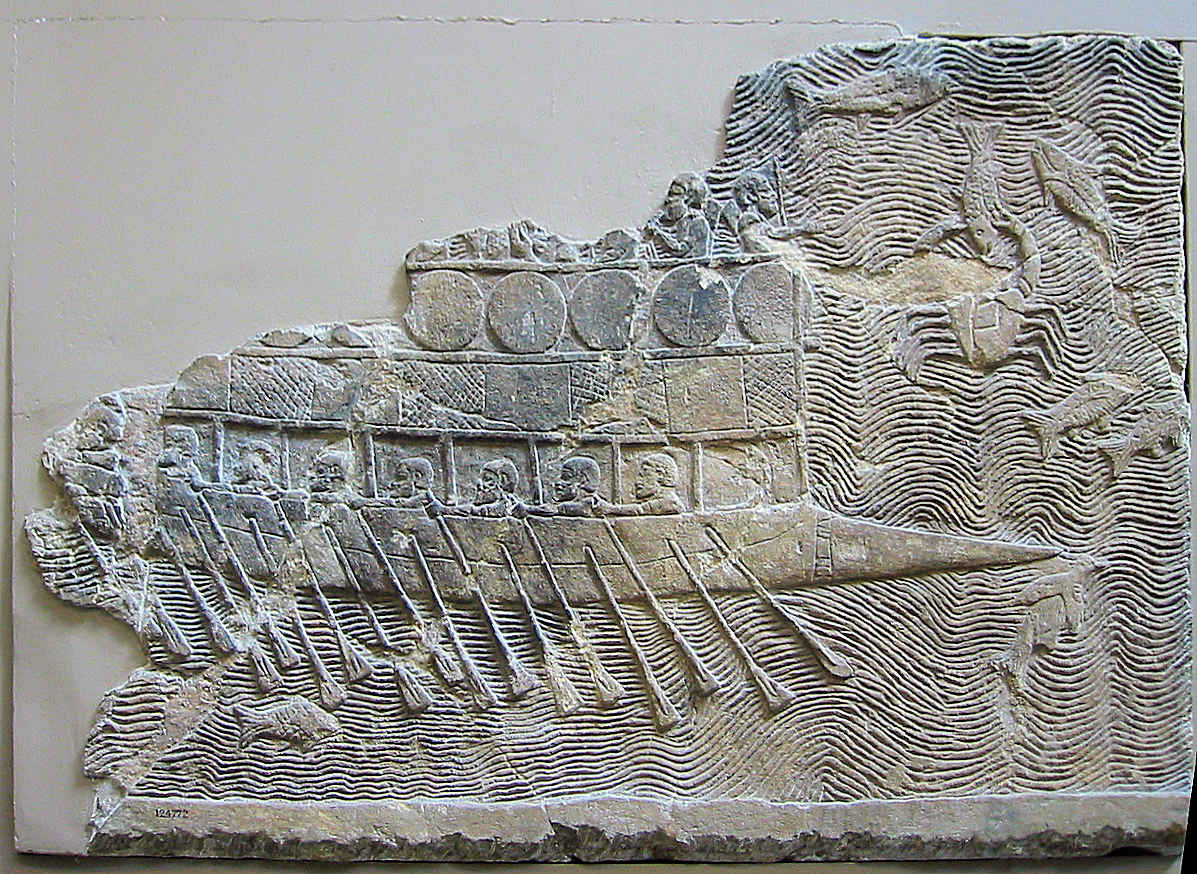
Phoenician warship with two banks of oars, (definitely two decks) relief from Nineveh, ca. 700 BC —Wiki 

Ca. 700 - 500 BC—Then there were uniremes, biremes, used for Caesar's invasions of Britain; triremes and quadriremes. (Latin: triremis "with three banks of oars;" Ancient Greek: τριήρης triērēs, literally "three-rower") was a type of galley.
Herodotus mentions that the Egyptian pharaoh Necho II (610–595 BC) built triremes on the Nile, for service in the Mediterranean, and in the Red Sea, but this reference is disputed by modern historians, and attributed to a confusion, since "triērēs" was by the 5th century used in the generic sense of "warship", regardless its type. The first definite reference to the use of triremes in naval combat dates to ca. 525 BC...  —Wiki
Lenormant Relief from the Acropolis, depicts 54+ oarsmen on an Athenian aphract or trireme, ca. 410 BC; there would be 60 (if they were carrying horses), to 200 oarsmen, that's definitely a warship. —Wiki 

Trade routes from Greece to the Crimean and Sevastopol were not carried out in puddle-jumping rowboats, I guarantee. Sails were involved.

The world according to Herodotus, 440 BC. He didn't think Phoenicians sailed around Libya. —Wiki

ca. 325 BC—Greek navigator Pytheas sailed to Great Britain.

Greek navigator Eudoxus of Cyzicus in 118 BC, sailed a galley, a man-powered sailing vessel. With 300 Greek ships a year sailed between Roman Empire and India, annual trade 300,000 tons.

The Broighter boat an Iron Age Irish boat from 100 BC, had 18 oars and rowlocks—Wiki

The Irish Broighter boat is a gold model of an Iron Age Irish boat from 100 BC, replete with 18 golden oars, rowlocks, benches, a paddle rudder for steering, boathook, a yardarm, tools, and a mast for a sail. By contrast, there is little evidence of sails being used in Norway until 700 AD. The Norse word for a ship lung is borrowed from the Irish word long."

Broighter boat tools: 1.Boat hook 2.Mast yard 3.Steering oar 4.Small grappling iron 5.Forked implements 6.Square ended oars 7.Oars. —Wiki

ca. 400-700 AD— The Irish sailed (and settled) the Faroe Islands and Iceland BEFORE the Vikings—who followed them. Possibly sailed to the New World as well. Njal's Saga? Neil, the redheaded Irishman—with a temper.

Metal replica of original stone plaque (Wild Goose Studio, Kinsale, Co. Cork); there would've been a sail, and at least four more oarsmen. The Broighter boat had 18 oars.

ca. 500 AD—St Brendan the Navigator set sail on the Atlantic Ocean with 14, 16, or 60 men. Old Irish Immrama (from iomramh-voyage), are voyage tales. Celts had sailing ships long before the Vikings.

800 AD—Viking sailing knörr. Most Viking ships were 15 - 70 feet; earlier vessels seem to be burial boats but then they were not sailboats either. The masted Irish Broighter boat is a model of an Iron Age Irish sailboat from 100 BC.

1000-1300 AD—Viking longboats (warships). One of the biggest Viking ships was made in Ireland. Irish oak. Not Viking, but Norse-Irish.

1100 AD—Chinese junks sailing boats with a rudder (war and transport vessels).

1300 AD—Arabic sources describe New World visit by a Mali fleet in 1311.

This seemingly simple timeline took far longer to create than I care to admit. But then, I always use the rovings to learn something new.


Sources:

Ship - Wikipedia, the free encyclopedia
Ancient Maritime History . Wikipedia, the free encyclopedia
Check this link out by vessel type at the Patrick Foundation (it has key texts and displays): CROSSING THE SEAS
Shipbuilding And Navigation - Hindupedia, the Hindu Encyclopedia
Ancient technology - Wikipedia, the free encyclopedia
Mohenjo-daro - Wikipedia, the free encyclopedia
SEA VEHICLES: Ships
Pytheas - Wikipedia, the free encyclopedia


Who is this not so Fabio, and why are my knickers in such a twist? From what I can glean off the internet, this dude studied social anthropology at School of Oriental and African Studies, the University of Oxford and The King's School, Canterbury. It's not like he didn't have access to the facts supping at the grand halls of academe. Pah! He probably doesn't even know the meaning of his hometown name: Milan.