Showing posts with label Bob Kaufman. Show all posts

Tuesday, May 20, 2014

Que Sera, Serra: Remembering Tony Serra is Pure Poetry


Out of the blue, last month,  someone contacted me on Twitter to ask permission to use an old photo of mine of Brownie Mary for a magazine article in a Capitol Hill rag, National Journal. 

I've been asked before for permission to use that Brownie Mary photo but I've declined as there were always strings attached—like relinquishing my copyright. Wiki, really? Really, 420 Archive? Permission to use my work by a non-profit is one thing. But completely giving it away, nope.

Anyway, once again dusting off Mary's photos, I came across photos of Tony Serra, and wondered how he was doing, if he was still alive. Apparently very much so judging from this blog link I found (posted below). I found myself rewriting a rather longish blerb to go with the link I had on my Facebook page. So, why not here as well?

I first met the legendary criminal defense lawyer Tony Serra, a self-avowed “anti-lawyer lawyer,” when he defended Brownie Mary Rathbun pro bono on a medical marijuana charge. I've been known to attend a poetry reading or two in his law offices.

Though he hails from working class roots, like Fr. Junipero Serra, Tony's no stranger to poverty, having taken an informal vow of poverty. Tony's no stranger to poetry either: he went to Stanford where a post-graduate poetry class influenced his thinking. 

Described as a "warrior with a touch of sainthood," Serra drives a $500 clunker and goes to Goodwill for his threads. He lives in Bob Kaufman’s old apartment building in North Beach, and is also a consummate “semantic warrior. ”Talk about MANIFESTO! 

In his autobiography, Serra wrote while in prison for tax evasion in 2005: “I became armed with a green obsidian semantic spear. My final closing argument thundered with green lightning flashing from the podium.” 

Tony thinks laterally much like the surrealist French poet, Rimbaud, rearranging the senses—challenging what people think they know. Serra's oratory style has been described as part poetry, pure conviction, and pure theater.

He says he's a criminal defense lawyer in order to to keep the courts and government honest. ''In the courtroom I'm a true believer, and a true believer's the most dangerous man alive.'' Tony was a Latin scholar and a lawyer whose rhetoric and flamboyance in the court is grounded in classical education. 

See the 1989 film based on the legendary Tony Serra, "True Believer", if you get a chance.

Tuesday, January 19, 2010

Recent Publications

Whereas it's true I'm a less than prolific blogger, that I endlessly rewrite my blogs until I'm right sick of them (Octopus blog was rewritten over the course of a month),


& that I didn't write a thing while I was in Hawaii bad—(but I did take 5000 photos—which serve as a remarkable memory aid),

& that I also didn't write a New Year's resolution, (but I'm a finicky bahumbuggerer affected by a lack of winter light),

nor did I write a blog on Haiti—tho I twittered endlessly, so much so that Tweetmeme picked up my tweets—as did CREDO, and many NGOs.

I now have more followers on Twitter than I have for this blog—unless you count the spammers—about the only mail I receive these days for this blog are from loyal spammers—it's gotten so bad, I've had to turn comments off under several blogs—something I am loath to do as I get little enough feedback as it is. Now my Literata comments are filed under Spam in my Gmail account. Is there no way to put a captcha under Blog Comments? I searched the Google Blog database, to no avail.

Then it dawned on me that I also haven't written about my latest publications either.

Though I must admit, with all the atrocities of Haiti, there's room for little else in my psyche. It's like what Meryl Streep said at the Golden Globes. How can I go out there? Put on a happy face, shove some money over to an NGO and go on...the show must go on. Yes.

So here's a bit of show and tell (I haven't been a total slaggard...).

1) My Beat poet pix* are featured in the just released "Life of Crime" the complete collection of newsletters from the Black Bart Poetry Society—for those who think poetry is a crime, about SF's Poetry Wars featuring NPR's Andrei Codrescu, Tom Clark, Dave Benedetti; and of course the editors themselves: Pat Nolan, Steve LaVoie, and Alastair Johnston... (Poltroon Press 2010) *Bob Kaufman, Joanne Kyger, Bobbie Louise Hawkins, etc. In Moe's and independent Berkeley bookstores now, trade copies at Small Press Distribution.

Hmm, Jack Crimmons gave me a headzup: "Life of Crime" made Ron Silliman rather cranky this morning! Alastair was pleased, said it'll stir up sales! The Poetry Wars do go on.... Andrei Codrescu dropped me a note: It's a wonderful book! What scurrilous characters! What grand times! Fine pics, too, made me nostalgic (a bit).


2) What the World Hears: California Poets in the Schools Statewide Anthology—45th Anniversary edition (with a foreword by Gary Soto). I've got a poem and two student poems in it.


4) Changing Perceptions: California Poets in the Schools Conference Anthology, Kim Shuck, ed. (2008) just arrived in the mail nearly a year and a half late with no © or publisher imprint. I'm rather disappointed in the haphazardness of the whole thing and the two-year wait, well, that's anti-climatic. There were many blank pages at the end that could've been used to cover the gobbelygook. Even if my CPITS anthologies, with the pages designed by kids, are funky, I take pride in what I do and always include the © and the credits... Many valid excuses were given but why didn't Kim give a shout out for help? We would've gladly helped, had we known.

For the record, Blogger has "updated" the blog editor and it's now much worse than back in the day when we had to enter our own HTML codes. What You See Is NOT What You Get.
It's an utter and counterintuitive nightmare to format—and getting photos to align up is another cashmar in perseverance. I hate it and would happily go back to the last version—if only I could figure out how. Gratuitous white spaces and line breaks not only drive me crazy, it makes me psychotically irate. Who designed it, and for whom? Inmates

Tuesday, December 29, 2009

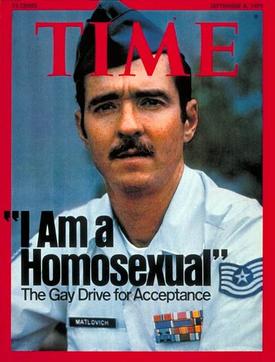
Missing Leonard Matlovich


September 8, 1975, issue of Time magazine
When I was in the military, they gave me a medal for killing two men and a discharge for loving one.—Leonard Matlovich, Vietnam Veteran (1943-1988)
Vietnam war veteran and Purple Heart recipient wounded in Da Nang, USAF pilot, Sgt. Leonard Matolvitch was the first gay man in the military to come out of the closet. In 1975, he was discharged for being "unfit for service" he was gay. He made the cover of Time Magazine.

Guerneville writer, Randy Shilts, in Conduct Unbecoming: Gays and Lesbians in the US Military, wrote: "It marked the first time the young gay movement had made the cover of a major newsweekly. To a movement still struggling for legitimacy, the event was a major turning point."

Leonard sued for reinstatement, but the court case dragged on until 1980, the military refused to reinstate him, but offered him a lump sum of $160,000 for back pay and his pension. He took the money and ran, and in 1981, he moved to Gurerneville, on the Russian River, an up-and-coming gay mecca.

Leonard was also a big patron of poetry, I used to produce poetry readings at his Stumptown Annie's Pizza Parlour in Guerneville, ca. 1983, he sold the place in Jan., 1984.)  Bobby Kaufman was on The River in those days—pretty strung out but Leonard was always a gracious host. In his honey-sweet Savannah drawl, Leonard once told me that J Edgar Hoover was a cross-dresser! Things like that.

Stumptown Annie’s 

In 1984, AIDS had reared its ugly head on the river. He sold Stumptown Annie's, and moved to Paris, while visiting the graves of lovers Gertrude Stein and Alice B. Toklas and  Oscar Wilde, he got the idea to create an AIDS memorial.

He moved back to the Castro District, in San Francisco, where he sold Ford cars. In 1986, a nasty chest cold was confirmed as AIDS. He became a champion for HIV/AIDS research, when he came out on Good Morning America that he was HIV positive, we were devastated.

On the steps of the California State Capitol during the March on Sacramento for Gay and Lesbian Rights, on May 7, 1988, Leonard made his final appearance:
...And I want you to look at the flag, our rainbow flag, and I want you to look at it with pride in your heart, because we too have a dream. And what is our dream? Ours is more than an American dream. It's a universal dream. Because in South Africa, we're black and white, and in Northern Ireland, we're Protestant and Catholic, and in Israel we're Jew and Muslim. And our mission is to reach out and teach people to love, and not to hate. And you know the reality of the situation is that before we as an individual meet, the only thing we have in common is our sexuality. And in the AIDS crisis - and I have AIDS - and in the AIDS crisis, if there is any one word that describes our community's reaction to AIDS, that word is love, love, love.
Less than a month before his 45th birthday, on June 22, 1988, Leonard died of complications from AIDS, in LA, beneath a large photo of Martin Luther King, Jr. Ironic that Leonard's tombstone at Congressional Cemetery in Washington, D.C., is in the same row as that old cross-dresser, FBI Director J. Edgar Hoover. Leonard's grave is a LGBT tourist attraction, and has become a de facto AIDS memorial site.

I miss you Leonard. Thank you for coming out so others could too. It was a very brave thing to do.

rev. 12/17/17

Thursday, August 20, 2009

Scanning B&W negatives

At long last, I am able to begin scanning my B&W negatives from the 1980s. I just rescued my negatives from cold storage, and my first scans were of Bob Kaufman at the Black Bart poetry reading in San Francisco, May, 1983. Pat Nolan and Alastair Johnston of Poltroon Press in Berkeley, plan to scan all the old Black Bart Life of Crime newsletters and turn it into a book. Which led me to the negative resurrection thing. 

I honestly thought I wouldn't be able to find the Black Bart contact sheet and negatives, as most of my poet negatives had a slight mishap at a really good party (people wanted to see my photos so I brought my binder with contact sheets and negs—mistake). Later on in the evening, my negative binders met up with an overturned carton of half and half—which led to late night washing of thousands of negatives and separation from their contact sheets. A logistic nightmare.

Migod do I ever have photos of dead poets....Brodsky, cold fish that he was, was right on top of the pile. And all the kazillions of Poetry International poets I documented over the years. Hugo Klaus, Bert Schierrbeck. All the late great Dutch & Belgish poets. Bert's funeral was a veritable who's who of the poetry world. The UK Adrians of Yellow Submarine fame....so easy to get distracted.

But scanning on a borrowed Nikon Coolpix L1000 has its' crankies. For starters, it's SCSI. That means I have to use a G4 and boot in OS 9 as there hasn't been any SCSI support for 15 years.

Most of the time the scanner won't show up for work. Restarting the Mac usually doesn't resolve the problem, But it's my only hope. My last and best hope. Oh, how I do love that three chord Mac cresendo: BOOOOONNNNG. Over and over and over again until I wish for the solitude of Zyzzyx Road in the Mojave Desert. So when I do get the scanner up and working, it's an all day and into the night marathon....

The first photos I posted to this blog were of Padraigín MacGuillicuddy (see Nov-Dec 2008). I was wanting photos of her as I'd posted a first draft of my story on her... Maybe someday, I'll find the final version of her story among clippings. (Another waiting in the wings project. Where, exactly, does the time go?)

Her daughter found my blog and wrote to me.. .she was going to send photos as was Sean Folsom, but nada. I'm glad to say that if you'd like to see that classy lady, the photos are up. I didn't realize how drop-dead gorgeous she was...very Maureen O'Hara.

I may post a few of the Black Bart photos here as well as a sneak preview—just because I can (besides, I suspect that the photos will be printed old school—read tamizdat—so very Cold War)... and Bobby Kaufman, the father of all Beatniks (tho Herb Caen is credited with coining the word Beatnik, a dirty word in both the USA and the USSR, Herb heard it first from Bobby's lips before immortalizing it in print.) I'm so jazzed. Can you dig it, baby?

Monday, April 30, 2007

The Soul of a Poet, Bob Kaufman

I first met the Beat poet Bobby Kaufman when I was a child. Bobby coined that word, "Beatnik," and SF Chronicle columnist Herb Caen made the word famous. My mother was a Beatnik artist and actress, always bringing strange people with cars home—for the ride.

We lived out in the wilds of West Marin in Forest Knolls with my grandmother, and if you missed the one commute Greyhound bus, you had to thumb a lift. So, I met all kinds of stranger folks (it was the '60s). Most of them I don't remember, but I'd never met a poet before. A black man that that. I only remember Bobby Kaufman's presence—we always called him Bobby, not Bob. I liked the way it rolled off the tongue. Filled the mouth and lips with a syncopated rhythm. I am sorry to say, there were no awe-inspiring conversations to record. Just his soft-spoken presence.

I remember the way he tilted his head like a crow, looking up our mountain, and the tall trees—as if in awe. You could see that he moved in a alien landscape, the City streets was his particular jungle. We stood outside leaning on the car as he drank in the West Marin landscape: tawny hills, dark oak and pine, sizzling crickets. I was pretty young and not much of a conversationalist so we just stood there—drinking it in.

*          *           *
In 1983, Bobby moved to the river and attended our Russian River Writers’ Guild weekly reading series, where I was a coordinator. He'd stand up at Open Mike (we were at Leonard Matlovich’s pizza place, Stumptown Annie's) and when Bobby would quote long passages from poems like the Abonomist Manifesto, it left me completely in awe.

I was never too sure how much Bobby Kaufman was taking in, he was pretty far along in terminal burnout, the emphysema, the long distance toll of drugs coming home—but one could still see something within him burning still. The soul of a poet to the end. That image stayed with me.

The impetus of my poem, Mantle, is the results of two separate events converging on the page. One night, I was walking to my car from the BART station through Berkeley Park and I felt some presence following me. I saw Bobby sitting and reaching up to me in every darkened doorway from Martin Luther King Drive to John Oliver Simon's house on California Street, I spun around but there was no one there. The streets were empty. I couldn’t shake the feeling I was being followed. Or haunted. And Bobby Kaufman was heavy on my mind.

It was a week before I heard the news that he died, it was after the Challenger Space Shuttle had just blown up. The two events were synchronistically linked in my mind. I was teaching poetry at Mark West School, in Santa Rosa.

I was standing in the parking lot gathering art supplies for our pocket poem project. I was compelled to look up in the sky, From the corner of my eye, I saw something explode in the sky. It was like a large moon snail or a spaceship. I stared up at it in horror—not knowing what it was, but I knew it was bad, very bad indeed.

I looked up again. But there was nothing there. I wiped my eyes as if to clear my vision. It was just my wild imagination and a vast blue sky in want of a cloudy formation. Then the news came: the Challenger had just blown up. We were all stunned. Christa McAulliff was a cultural icon at our school. We all cried. The kids gathered around me like petals to a flower.

My poem, Mantle, became an open letter to the sky, an elegy to the memory of Bobby Kaufman and to the members of the Challenger Space Shuttle. The day I wrote the poem, I was with Rubén Martínez, a Chicano poet visiting from LA, my then boyfriend John Oliver Simon, and San Francisco's Beat Poet Laureate, Jack Hirschman—we were all sitting around the table knocking back caffe lattes at the Cafe Trieste in San Francisco. I recorded the date in my journal—it was Feb. 2nd, 1986.

I'd had a disturbingly long dream the night before where I was carrying rain across the night sky in rusted buckets, but it wasn't rain, it was the stars. We were talking of communism and of Latin America and all I could hear was the insistent voice of this poem coming through, seeking audience. I furiously scribbled something in my journal. Jack asked me to read it. I was stricken. Raw footage. I read it, Jack mused, and said, "Hmmm, a real poet, you're a real poet."  That was a real compliment—coming from Jack.

© 2007 Maureen Hurley

Saturday, March 24, 2007

My Mother was a Bohemian

My glamorous mother was a real bohemian gypsy artist, traipsing all over the West Coast, following the jobs to Reno, Las Vegas and Hollywood but she always came back to her home base in San Francisco, where she was born, usually broke and more often, broken down. She'd mend for a spell and then she'd be off again seeking her fortune and fame on the road.

She'd talk of the places she'd been, the people she'd met. How nice Frank Sinatra was, how he bought her a drink at the Cal Neva. At one point, she did costumes for the show girls in Tahoe and Las Vegas, a connection which led to her working for costume designer Ruben Panis in Hollywood but that's a convoluted story of the 60s and '70s I'm not quite ready to excavate.

She brought home strangers she'd met, some of whom, paradoxically, I'd run into decades later as a poet: Beat poets Eugene Ruggles, Bobby Kaufman, in the late '60s and early '70s, even the singer Bobby Darin—who was holed up near Esalen. He was tall and thin and pale, leaned back on the couch in jeans and cowboy boots, hair pulled back in a ponytail, with the longest sideburns I'd ever seen. Enigmatic. I remember trying to fret the chords to "If I Were a Carpenter," on my cheap steel string guitar until my fingers bled.

I don't think he was impressed with my talent. I didn't get my Maritn until my 16th birthday, the winter of '68-69 in a pawn shop in San Francisco. The ending of Kevin Spacey's Beyond the Sea had a huge unexpected memory payload for me. I remember a very hippie Bobby sitting back on the sectional couch... But the corroborating details of those stories are lost.

When I was young, I wasn't interested, then she got too crazy with the drugs, I was distainful, now it's too late to recover the facts and now here I am, in my fifth decade, weaving the thin threads of the past into a tapestry of stories.


© 2007 Maureen Hurley

Monday, January 1, 2007

Cybernalia


What stands between my self and my e-self is a blog, a bit of cyber-literatia, or maybe cyber-inventia—maybe dementia—something I've resisted. A gimped knee has me web bound, Resistance is futile. The time is present. No time like...

Like the Beat poet Bobby Kaufman, it's as if I took a ten-year vow of silence, but the trance was merely a purgatorial haven or hell of my own creation. Initially, I blamed the silence on a near-fatal car accident (no, my life did not flash before my eyes), or I blamed the silence on grad school. Someone said they quit writing poetry in grad school. It burns it right out of you. With my MFA thesis's seven-year grace period about to expire, I know that one all to well.

But it comes down to this: who am I writing to and what for? The what for is what haunts me. Nihilism raises its ugly head.

Everything is post 2001 now. My old voice has fled, a victim of the mujadeen or the al Queda. Tired of writing about lovers gone bad (BTDT, been there, done that, the tee shirt is a holy rag or more like a holy cow), I grew weary of the rhetoric that inevitably follows writing with a political stance, I turned inward and with a number two pencil eraser, began to erase the inner markings, the deliniations of the soul, that force which drives us to create, to send our prodigal names out there into the world. But even that imploded.

At first, I was physically exhausted from a near-fatal car accident in June of 1997. I hadn't counted on the post-traumatic stress lasting for so long. Or my brain to go south for an extended winter. But I found that a punctured lung weakens more than the breath —for breath, the source of inspiration, is the root of creativity. Not as in God has breathed into, In-spire as in spiritus, but not sanctus. I'm a recovered Catholic enrolled in a two-step program sacred and profane.

Then it was onto to grad school to waken my slothful brain. I was fulfilling a decade old dream. And then I took the deepening vow of poverty a la Dante's Inferno–a poet and a student replete with student loans. Which was followed by a rebuilding of a life, such as it was. A decade of reinvention of the self from Ground Zero has led me back to my first fragile love, art. Poetry has gone on holiday. All that's left are the unformed stories.

And so, couch-bound by a bum knee and stuck in time present, I began to surf. I surfed my name to see how I fared during that decade of near silence and I was surprised to see that I actually had a web presence, though I'd never actively sought one. In fact, I shunned it. All my co writers and classmates were deep into the publish or perish frenzy while I was happy listing in the doledrums. (Been there, done that. Even seeing my name in print no longer inspires or thrills the way it once did. In my 30s and 40s, I was driven by a dark ambition.)

Fooled into thinking I'd find the time later to do what I want—all those big, unnameable projects looming on the horizon—but the horizon is dressed in death's robes and the passage of time is akin to snake-wrestling with cobras. Spit in your eye. Leave you with a Homeric blindness and no story to tell. Life and relationships have a way of taking over. It comes down to who does the housework. Who does the dishes, or scrubs the toilet. Poor Sylvia Plath, I'm beginning to understand her dark fascination with the oven. Did Ted Hughes metamorphose into the sly fox of art and escape domestic responsibility in order to achieve a fragile immortality of words?

But even now, I am afraid to let my cybernalia loose into the world, This blogless blog is bogged down in its aimlessness. Shiftless. No point of view. No goal. Who will read it? And why? Get a job. Going to the bog. Full of shyte. Call it initiation. Baptism. Begin. Regardless. Or take the anywhere approach and see the music of what happens.

Poets Mike Tuggle and Sharon Doubiago each said to write the stories down, you're a storyteller, I said no to that, thinking my stories weren't worth much. But then I said no to poetry too and perversely, it said yes to me, then shamelessly ran off with a lover. I don't know where. I don't have a burning urge to file a missing poems report. But I have to finish my MFA theses. Write anything. See where it leads. Jilted prose redux is what promises to follow during these august daze.


© 2007 Maureen Hurley
NOTE BENE) This blog post was indeed written in August 2007, but I had so much revised and new material to upload there was a logjam so I reorganized the blogs as I had created this site in January and then forgot about it. There was all this perfectly good cyberspace going to waste and I found that I could move the files around by date. And so I did. Since most of it is older work being revised, it really isn't date specific. So I opted for the genre approach. It's still evolving but Feb-Mar is early memory stuff, April is poetry month, May is mostly USSR stuff, July is reserved for my many MFA plays and monologues... then it's sort of calendar specific. I imagine it will keep evolving and shifting until I find an organic order. Drive the Technorati spiders crazy I suppose.

Guy Kawasaki says to write a blog like it's a book, good advice but the physics of it are all wrong as people stumbling upon it are not going to begin at the beginning. They'll either join in by subject matter or by newest entry...no way to read a book. SO there's no chronological attempt. Merely thematic.


To see some of my art go to
Maureen Hurley at MySpace.

Sunday, September 20, 1987

VOICE OF THE DEAD POET AT CITY HALL: FIRST SAN FRANCISCO ARTS COMMISSION FAIRE POETRY DAY IN HONOR OF BOB KAUFMAN

SF Arts Commission festival organizer, Allen Cohen 

VOICE OF THE DEAD POET AT CITY HALL
FIRST SAN FRANCISCO ARTS COMMISSION FAIRE POETRY DAY IN HONOR OF BOB KAUFMAN  (no tear sheet)

The small but steady crowd scattered amid the trees and sculpture gardens attended a day-long poetry event held in honor of the late poet Bob Kaufman in front of San Francisco City Hall, on Sept. 20. The event was designated as the first official Poetry Day at the San Francisco Arts Commission Festival "as an important step forward in recognition of the importance of poetry in our society," stated S.F.A.C. Festival Director Michael Bell, he continued, it's "…a milestone event." According to Poetry Day organizers Allen Cohen and Neeli Cherkovski, this was the first literary event ever sponsored by the Arts Commission in its 40 year history. A milestone event indeed.

Tributes to the acclaimed "American Rimbaud" and avant garde jazz poet Bob Kaufman who died January 12th, 1986 at the age of 60, included music, plays, and poetry. Saxophonist Richie Flores and playwright-biographer Mel Clay, who wrote Would You Wear My Eyes? a biography of Bob Kaufman, joined numerous luminous Bay Area poets including Janice Mirikitani, James Broughton, Jack Hirschman, John Oliver Simon, Kush, Julia Vinograd, Maureen Hurley, Jack Michelene, and Q.R. Hand—to name a few.

Kaufman's former wife of 26 years, Eileen Kaufman; and friend/companion Lynn Wildey both reminisced about Kaufman, and also read selections from his poetry.

Of the 16 poets who read at the Poetry Day Tribute, eight poets were winners from a juried poetry contest (I was one of those poets), and eight were chosen to represent a cross-section of San Francisco Bay Area ethnic communities for this first literary event, Michael Bell stated.

"The original BeBop Man," Kaufman, a legendary figure of San Francisco's "Beat Generation", was supposed to have coined the word "Beatnik." (Columnist Herb Caen made it a household word.) Kaufman was the first jazz-rap poet who brought the oral art of poetry to attention. His social political poetry "Second April," "Ancient Rain," and "The "Abomunist Manifesto" are considered to be among his finest writings.  Many of Kaufman's poems have jazzlike rhythms, riffs and synchopation he learned from the jazz greats—including Charlie "Bird" Parker.

Acclaimed in France as "THE  American Black Poet", Kaufman never received the poetic recognition he deserved in America. In France, his books are as avidly read as Rimbaud's, Kerouac's, Bukowski, or  Ginsberg's  poetry.  Because of the international recognition he has received, Bob was awarded a National Endowment for the Arts fellowship in 1960 to continue his work, but failing physical and mental health had already taken its toll.

Always an outspoken critic,  Kaufman experienced many brutal confrontations with the police which he documented in "Jail Poems" and "Would You wear My Eyes?" Kaufman's explosive and elegant outpourings ignited the San Francisco "Beat" poetry scene.

Kaufman was one of the founders of Beatitude Magazine, now in its 33rd year.  Ferlinghetti, Ginsberg, and Kerouac were deeply influenced by his work. Kaufman published numerous broadsides and his three books, Golden Sardines, Solitudes Crowded With Loneliness, and Ancient Rain are still available through City Lights Books.

In 1963, after the assassination of J.F. Kennedy, Kaufman took a Buddhist vow of silence neither speaking nor writing for ten years until the Vietnam war ended.

...
Let the voices of the dead poets
Ring louder in your- ears
Than the screechings mouthed
In mildewed editorials.
Listen to the music of centuries
Rising above the mushroom time.

—Bob Kaufman
    from "Believe, Believe."

On Sept. 20th, the stage in front of City Hall rang out with the words of "THE American Black Poet." The S.F.A.C. has made a first step forward in recognition of the importance of poetry in our society." Poetry Day should be an annual event. Will the S.F.A.C. continue to support literary events or will poets have to wait another 40 years to be heard?

SIDEBAR/PHOTO: A giant bar of Ivory soap carved into the likeness of the "Venus de Milo" by sculptor Art Grant and a roped-off section of grass sown with thousands of bullets representing our nuclear warheads, were some of the conceptual art pieces on display—suitingly surrealistic—for the event. Kaufman should have been there. It's too bad he had to die first in order to gain recognition as San Francisco's Poet. "Let the voices of the dead poets/ ring louder in your ears."

9/87

Thursday, September 11, 1986

Poetry Day Dedicated To Bob Kaufman


Poetry Day Dedicated To Bob Kaufman

A day of poetry, dedicated to the late San Francisco poet Bob Kaufman, will be presented on Saturday, Sept. 20, on the Civic Center Plaza stage adjacent to City Hall, as a part of the 40th Annual San Francisco Arts Commission Festival. Admission is free. “Poets Open Mike” will be featured from 10 am. to 12 noon with Tony Feldon, the Vagabond poet as M.C. From noon to 5 p.m. 16 San Francisco poets will read. Eight were selected from 120 poets who entered a juried Arts Commission-sponsored contest and the other poets were chosen to represent the diversity of poetry groups in San Francisco. Among those to read are Francisco Aragon, James Broughton, Lucha Corpi, Jack Hirschman, Maureen Hurley, and Aung Aung Taik.

Saturday, February 8, 1986

BANTU COMBINATIONS on Haiti with Jim Byrd (some imaged from Mantle)

The Haiti Junta Takes Over

Rivers were here before there were mountains.
The corner of the eye sees constellations
better than looking directly at the stars.
President for life, in death, his remains
scattered in the streets.
Shifting sand slides off rocks like water after the thaw.
The trade winds carry news,
smoke can be seen on the horizon.
There are great issues which have divided us before
and there are issues that will continue to divide us again.
The sky opened up and they were gone in a flash.
They made small talk on the way to the airport.
Suitcases held tribute of their sins.
Like street fighters, mountains with sharp edges
jockey for position in the sky.
Impossible to deepen that night,
the colors of fish became a song to fisherman,
who leaned from their boats.
Hundreds toasted rum bottles,
spewing liquor on each other's heads in the form of baptism.
Rain dampens the burning palace tonight.
In dreams, old friends come to visit.
They took marble chips from the tomb for souvenirs

Bantu combinations
Maureen Hurley, Jim Byrd
2/8/86


My lines only

The Haiti Junta takes over
Rivers were here before there were mountains.
The corners of the eye see the stars more clearly.
Shifting sands slides off rocks like water after the thaw.
There are great issues which have divided us before,
and they will divide us again.
The sky opens up and they were gone like a flash.
Like street fighters, mountains with sharp edges
jockey for position on the horizon.
Impossible to deepen that night,
hundreds toted rum bottles,
spewing each other like baptisms of whales,
they took marble chips from tombsfor souvenirs.

Maureen Hurley


Jim's line only

President for life
his remains scattered on the street
the trade winds carry news.
Smoke can be seen on the horizon.
They make small talk on the way to the airport.
Suitcases help tribute to their sins.
The color of fish became a song to fishermen
who leaned from their boats.
Rain dampens the burning palace
Tonight, in dreams, old friends are revisited.

Jim Byrd


Bantu combinations 2

Like a tidal interstice, the seasons drift
Another page falls from the calendar
Clouds have no answers
Tree branches leading to meet the ground
Dig deep into the earth
as if your life depended upon it
Inside the skull of night
I hesitate to disturb the spider's web.
Inside my blood, inside my blood,
like the Nile, journeys are recalled after dark
The plans of thieves are revealed
as a hole slowly falls in on itself
floating face down, the surface of water
can be felt as blue skin.

Maureen Hurley Jim Byrd
2/8/1986
at The Hiding Place
(over huevos rancheros)


My rewrite

another page falls from the calendar
like title interstices,
like the seasons
tree branches lean to meet
the most painted roof
dig deep into the earth
as if your life depended on it
After dark, the plans of thieves
are revealed as a hole slowly falls in on itself
Inside my blood, ancient journeys
like the faces of Ophelia
floating face downward
beneath the blue skin of water.

Seasons drift in the tidal moods
dig deep into the earth
as if your life depended upon it
Inside my blood, inside my blood
rusted buckets carry pinholes of light
Escaped notes vibrate in the air
like telephone lines in the storm
Bees carry the skull of night into the hive
until the black one comes,
and darkness reveals the plans of thieves
for those who float face down
A cloak of blue skin
seeps beneath her fingernails like ink.


It was a tumultuous week: right after the Challenger disaster, there was a revolution in Haiti, Baby Doc was overthrown, Bobby Kaufman had died. My boundaries between worlds were pretty thin. It was as if I was hearing voices, and hearing the news before it was news. Since my mother really did hear voices, I was not very happy with this outcome. But as it turned out, I WAS getting the news poetically, in strange dream sequences. I madly wrote it all down as it was coming in, and it eventually became MANTLE. You can see some of the many revisions here: First Draft of Bob Kaufman poem, Mantle.
Added 11/16

Sunday, February 2, 1986

MANTLE

           —for Bob Kaufman
              April 18, 1925 to Jan 12, 1986

News travels slowly.
In the time it took God to make the earth
you died and a voice fell from the sky.
I've been looking for you
in each bent and ragged head
of those stumbling down Telegraph,
of those ranting in Brautigan Square,
of those who live in Market Street doorways.
They say Lenin's legs were blackened
when the shroud slipped off.
I saw the map of death on your face
as you wandered the outskirts of your city.
The same map in my mother's eyes
and in the faces of those in the streets
who followed me even in sleep
but who held my hand in the dark?

A crowd laughed at the screaming woman
whose hands beat against our car window
as a man dragged her into an alley.
Another woman, still drunk, comes over
and complains of lost car keys and stolen children.
And in that order.
The sky caught fire
and seven astronauts were swallowed
by a blue-mantled snail.
Film makers converge upon us,
their eyes taking in odd angles of light.
It's like watching Kennedy shot over and over
with Jackie piecing together bits of skull and memory
with ineffective hands.

Bees carry the skull of night back into the hive.
The dead have taken to scratching poems on the water.
Even if we scatter your ashes to the wind for ten years
and listen for lyrical translations from the other side
it still won't cleanse this place.
Ten years of silence is buried.
We had a vision but the map is lost.
Who will collect the messages?
We confuse pinholes of light
leaking from rotted buckets
for the ancient rain of stars.
In my dreams they are coming and the door won't lock.

While in exile, lean closer to the sun.
Become birdlike
until you land spread-eagled
on this bone of the word
and in this endless blue
your flexing soul
will be the sound deep space sings.

2/2/86      


1988 Green Fuse
1986-88 Falling to Sea Level
1987 San Francisco Bay Guardian, 2nd Prize
         Thread Winding the Loom CPITS


MANTO                                                                        
                                    —para Bob Kaufman

Las noticias viajan lentamente.
En el tiempo que le tomo a dios hacer la tierra
moriste y una voz cayo del cielo.
Te he buscado en cada cabeza agachada y harapienta
de los que tropiezan por la avenida Telegraph
de los que viven erl los zaguanes de la calle Market.
Dicein que 1as piernas de Lenin se ennegrecieron
cuando se deslizó el ataúd.
Vi el mapa de la muerte en tu cara
mientras vagabas por las afueras de tu ciudad.
El mismo mapa en los ojos de mi madre
y en las caras de aquellos en la calle
que me seguían incluso en el sueño
pero ¿quién me cogió la mano en la oscuridad?

La muchedumbre se rió de la mujer gritona
cuyas manos golpedban nuestro parabrisas
mientras un hombre la arrastraba hacia un callejón.
Otra mujer, todavía borracha, viene para
quejarse de las llaves perdidas y los niños robados.
El cielo se encendió y siete astronautas fueron tragados
por un caracol de mano azul.
Cineastes convergen sobre nosotros
sus ojos toman originales ángulos de luz .
Es como mirar a Kennedy tiroteado una y otra vez
mientras Jackie junta pedazos de la calavera
y la memoria con manos inefectivas.

Las abeias llevan la calavera de la noche a la colmena.
Los muertos ya están granando sus poemas en el agua.
Aunque esparéramos tus cenizas al viento por diez años
esperando traducciones líricas del otro lado
ni así se limpiaría este lugar.
Diez años de silencio están enterrados.
Teníamos una visión pero se perdió el mapa.
¿Quién reunirá los mensajes? Confundimos los agujeros de luz
goteando de las cubetas podridas
con la lluvia antigua de las estrellas.
Vienen en mis sueños y la puerta no se podrá cerrar.

En el destierro, inclínate al sol.
Hazte como pájaro
hasta que aterrices extendido en este hueso del mundo
en este azul sin  fin tu alma desdoblada
será el sonido que canta el espacio profundo.

2/2/86                        —traducción John Oliver Simon y Juvenal Acosta                                           
1986-88 Falling to Sea Level

Friday, January 17, 1986

First Draft of Bob Kaufman poem, Mantle

               April 18, 1925 to Jan 12, 1986

Bobby, this whole week 
I've been looking for you 
stumbling down Telegraph, 
darkened streets and alleyways
Every bent head, every ragged step 
it drags sleep across 
the shadows of pushers
Your dark face in the darkness 
The news travels slowly 
in the time it took God to make the earth, 
you died and there's Jack on stage 
reading a poem to you,
dead all this week.

Jan 12, or 17? 1986
first journal entry is 2/3/86, but it was originally written on a napkin at Cafe Triest


see Bob Kaufman poem
MANTLE