6/22 Today we discovered that the nuns at Neil's parish, St. Aiden's, are Irish! So we're all getting along smashingly, Neil gave Sr. Breda a CD and now we're kissing cousins!
6/ 23 We'll be in Wales sometime next week...there's an ashram that Neil and David will go to and we'll be hanging out...somewhere near the village where The Prisoner was
filmed. Remember Patrick McGoohan...I am not a number....
So weird to see the sun up at 10 PM, eh?
We hiked into Elderslie to the Wallace Monument, then across the rail tracks to the graveyard where Neil ran into a cousin Anna (her mother, his auntie Kathy just died)...Anna and Neil hadn't seen each other in decades!!
Then we went to Paisley and after circling the abbey we explored the town...I kept insisting that I wanted to get to the top of the hill...fabulous buildings! and all the streets were named Oak something...don't tell me it wasn't a druidic site!...we could see Ben Lomond, the Campsies, etc.
It was crystal clear...but the best part was when I pet a dog and the woman who owned it took a shine to us and let us into the secret garden that she's restored, behind the Thomas Coates memorial church...a very secret garden...many alleys and closes...and it's not on the tourist path. The observatory is up there too...looking back, it's
a rounded hill leveled at the top...if there were archaeological ruins, they're long buried under massive stone edifices.
Anyway, bits and snatches of the past emerge despite progress..
Showing posts with label Renfrewshire. Show all posts
Showing posts with label Renfrewshire. Show all posts
Sunday, June 22, 2008


Thursday, June 19, 2008
Desperately Seeking Wifi
6/19 Johnstone, Renfrewshire, Scotland: Below the Hazel Arms (wifi reception).
I'm still trying to recover from Friday the Thirteenth, actually this whole week before we left for Scotland has been one vast Friday the 13th or like the movie, Groundhog Day...replete with lost passport, plus a hefty SF parking ticket ($50!!) all because of a slow lline at passport agency.
My iMac thinks it's a blank screen with an Apple logo and a fan is running like a 747 and it's allergic to its own startup/repair disk, all my school billing was on it... If I was Jewish, I would be pulling my hair out, saying oy, oy, oy, why me, oh God?
OmiGawd! there's a ring neck pheasant, or a partridge? It looks more like a grouse...sorta like being in Victoria BC here, same plants and latitude. Saw a fox last night...under a sodium light.
It was Neil's and his nephew David's birthday yesterday... we're definitely time confused circadian wise, or witless.
My wifi near the castle has fizzled. I'm looking for an internet signal in a field between showers, bundled up as if for winter... This small rock in the football (soccer) park is the only convenient place where I can pick up a signal.
Maybe Wales will have more consistent wifi.
We joined the Johnstone Library, and the Renfrewshire Library so we could have internet access but navigating Windows under pressure (we're only allowed 15-minute intervals on the PCs) has me stymied for lots of web stuff...too many gates/protocol...plus it's a long walk down to the town centre.
I'm writing this in a library, it's raining cats and dogs. Trying to find a signal on the laptop with a 'brolly in the playing field was way too much of a challenge! even with two people!
Thursday, January 3, 2008
Letter to Shirley MacLaine's Camino, Johannes Scottus Eríugena
Dear Shirley,
I enjoyed many aspects of the autobiographical memoir of your pilgrimage and journey on El Camino de Santiago de Compostela, or The Way of Saint James over the Pyrenees and across Spain, ending in the Celtic lands of Galicia and Finisterra at the end of the known world.
To travel West, to Tír na nÓg, the island of the ever-young (or the ever-dead), that mythical place beyond the edges of the map, is well attested in Irish Celtic mythology and oral tradition. But the idea that the genesis for this particular pilgrimage would have originated in Scotland under John the Scot literally has one traveling in the wrong direction. Do the geography. France seems to be the likely origin of el Camino de Santiago de Compostela pilgrimage. Spain was another route.
Pilgrimage to the West would have taken the Irish monks (most medieval Scottish monks were Irish-born) rather out of the way of Galicia—to Iceland and the Farøe Islands (or Vineland!). Irish hermits settled there the sixth century, introducing sheep, oats and early Irish language to the islands. Farøes place names to St Patrick and St. Brigit attest to pre-Viking, Irish occupation.
The Irish Saint Brendan (ca. 484–578 AD), was said to have visited the Farøes on two or three occasions (512-530 AD), naming Sheep Island (Farøe means sheep) and Paradise Island of Birds.
St. Columba was more contrary, sailing northwest to Iona. For the record, Scotland's patron saint Columba (or Columcille—and instigator of the world's first use of copyright) was Irish-born. Iona was not part of Scotland then. There was no Scotland as we know it. The Hebrides were their own entity—settled by the Irish—I might add.
I must however, take umbrage with your passing off the first John the Scot (b. 800-815 AD in Ireland)—as being Scottish. He was Irish.
It is possible that the idea of pilgrimage to the shrine of St. James, or Iago of Compostela was based on Gaulish Celtic tradition and cultivated by the Irish missionaries of Iona, the Hebrides, Scotland and Europe as the Irish monks were the innkeepers of Christianity and knowledge (fios) throughout the Dark Ages in Paris, Rheims, Bobbio, St. Gallen, Laon, and other important Christian centers of learning. Galicia is still a Celtic stronghold to this day.
The Irish also found interesting ways to write themselves into the Bible as they weren't mentioned in the Old Testament as one of the Lost Tribes or otherwise. So they got inventive. And there have always been strong ties between Galicia and Ireland. De Valera, Ireland's first president was Galician. But I digress.
The origins of the Santiago de Compostela legend dates back to ca. 813, roughly the same time Johannes Scotus Eríugena (see also) or, John the Scot, was born, circa 800 to 815 AD. in Ireland—not Scotland. John spent most of his adult life in what later became France under the patronage of Charles the Bald. Charlemagne (b. 742 ) died in 814 AD—a year before John was born. (Now that really would've been an anachronistic miracle having Charlemange converse with John at such a tender age!)
From 575 to 725 AD, Irish monks founded some 150 abbeys on the continent. To paraphrase Paul Gallagher's study, Irish Monastery Movement:
We don't know when John arrived in Paris (circa 830-40 AD?), but he was a monk at the Benedictine Abbey of St. Denis, a place of ancient pilgrimage, the most sacred place to be in France. By 630 AD, it was also one of the richest and most influential abbeys in Europe. Burial ground of kings, a new church was completed by Charlemagne in 877 AD.
It is clear you did some research as you got much of John the Scot's story right, but alas, by making John the Scot a Scots-Irish man, you anachrostically conflated him with a 12th c. Bishpop of Scotland who, curiously, also seems to be Irish-born. John the Scot was more commonly known throughout history as Johannes Scottus Eríugena. Eire is the ancient word for Ireland, and "gen" means born: as in Irish-born.
As to your extrapolation of William of Malmesbury's story of a king asking John: "Quid distat inter sottum et scottum?" as being a literary Easter egg of your discovery, this is an old story I learned at the knee of my Irish grandmother, it is not particularly obscure.
Circa 843 AD, the Frankish king, Charles the Bald (b. 823 AD), not Charlemange as you had noted, asked the famous question of John. Anyway, the story is well attested in medieval manuscripts, and as John was also a famous medieval poet and philosopher, it's a story that often gets repeated.
…
This is the quote in full
The king, Charles the Bald, who was dining with John asked: Quid distat inter sottum et Scottum?
(What separates a sot (drunkard) from an Irishman?)
John replied: Mensa tantum.
(Only a table).
(See a cartoon of the event here.)
Did John the Scot ever go to Santiago de Compostela? We don't know but the first written record of a pilgrimage to Santiago de Compostela was a century after his death.
Legend has it that John the Scot was invited back to Britain by Alfred the Great (who was educate in Ireland) to become Abbot of Malmesbury, or Athelny, or Oxford, but he was stabbed to death in 884 (10 years after his death) by acolyte-students with their pens for "trying to get them to think." (Philosophers). But seeing how goose wing quills were used for pens—I think this is a flight of fancy.
It's also said that John fled to Ireland at Charles the Bald's bidding as the pope was on a rampage after John's translation of Dennis the Areopagite was published without his consent. One count gives John's death in 874 in Ireland, another in 884 in Malmesbury. But it seems John died the same year as his long-time friend, Charles the Bald, in 877 AD. —History of Ireland, p 202-3.
John Scot Eriugena was a monk at St. Denis before going to the Carolingian court and Rheims; Eriugena retired to the monastery of Laon, a center of Irish influence in France. —Paul Gallagher, Irish Monastery Movement

I've visited several places where John the Scot was reputed to have taught including the hillfort citadel of Laon. My particular interest is in place name origins and in opidda, or Celtic hilltown forts—I've spent this Christmas season combing Google Earth in Renfrewshire for standing stones and Iron/bronze age forts and standing stones.
(An interesting aside, modern Scots still 'dress the stones' on the Solstice and New Years. Ach it was a hellish oiche maiden (hogmanay) this year (2006-07) with storms and 70 mph winds, but we managed to dress Cloch-na-Rhyderrick, or Clochoderrick, (perhaps I'll tell you about King Rhyderrick, friend of Columcille sometime—I was a student of UC Berkeley's Celtic Studies program.)
The stone of Rhyderrick, some call it Merlin's Stone—depending upon which story you hear—is still dressed today: others were clearly there before us, leaving red flowers and holly. As were the standing stones of the Girdle Toll in Irivne, Ayrshire.
I learned to dress the standing stones (with flowers, red berries, evergreens and whiskey) from my Irish Bantry Bay grannie, so I was the strange American hanging out with the rock, what's geologically called a glacial erratic. It's not technically a standing stone.
The rock, at one time, wobbled and it was used as a druidic judgement stone. It no longer wobbles as the mud is packed in around its base. We were trying not to get electrocuted by the farmer's fence as we so very carefully went over the stone stile—but I digress.
I imagine you must take umbrage at fan divulgence. Rest assured, I'm no raging fan, though I loved many of your movies. I'm a writer, cursed with the gift of the gab—or gob—on a 3 AM caffeind jag, and sufficiently irritated by your stretching of truth—or, shanghaiing of truth in Camino, to write to you, though I assume you'll never see it, nor respond. No matter, I will defend John the Scot's rightful birthright to cyberspace.
(Note bene: As to celebrity, I live with an actor, and I am the daughter of an actress so I know that tangled route. Between matinee and curtain call, my babysitters were the likes of Tommy Smothers, Lloyd Bridges & Sterling Hayden. The Gate Playhouse in Sausalito, Tiki Junction. My mother variously went by Maureen Reilly (nee), Maureen Hurley; one of her stage names was Kellé Hurley (as there was another actress Maureen Hurley); she was a dancer too, she admired you, and had me Out on a Limb reading your books at an early age.
Some of my school friends did make it to the big arena like Robin Williams, so please be assured I'm no autograph seeker nor fame collector. I did so love the writings of Kenneth Tynan, so that bit of story of Kathleen was precious to me...'horsemen pass by.' I'm more like Kathleen, pragmatic, less inclined to believe. But I do have glimmerings of the Sight, which drives my pragmatism crazy.)
Anyway, you might be interested to know that John the Scot was, perhaps, the most famous medieval philosopher, having translated the False-Dionysis treatise on the idea of free will. This treatise lead to an intellectual foment across Europe as John the Scot/ Johannes Scottus Eriugena had again taken up 5th c. Britons Celestinus and Pelagius' cause of free will versus the rote catechism of religious experience through the auspices of church dogma.
Needless to say, the idea of free will was not a popular concept with the pope as it undermined the church's papal authority (and tithing coffers). The pope had also posthumously excommunicated Pelagius for heresey. John the Scot too was well buried as it were, but he was rediscovered in 1680, and repatriated again to become the new rage of intelectual thought, profoundly influencing Schoppehaur and Kant—probably Spinoza as well. (Alas, Spinoza died in Amsterdam a full 4 years before John's treatises were widly published.
I have stood before the small iron gate of the synagogye where Spioza worshipped. So I reiterate, John was hardly as obscure as you suggest in Camino.
What becomes fascinating, however, is that you latched onto John the Scot, he does become the neo-Platonist who reintroduces the concept of individual experience with God, and free will vs church/state mandated group experience of religion. "Saints, sinners, generals, misfits, kings and queens. It is done by the intent to find one's deepest spiritual meaning and resolutions regarding conflicts in Self."
And so, here we are… so I thank you for that rediscovery, or shall I say, revisualized, with a deeper undertanding that comes with age. I too hope to complete the real Camino trek, before I'm 60, if possible (a bum knee—too many falls from horses in my youth—makes it a tough 500-mile proposition as I'm 54 and not at all likely to get younger) so your story (and imagination) did serve to re-inspire me to traverse the same route as Dante, Saint Francis of Assisi, Charlemagne, and Chaucer to go on pilgrimage.
In medieval legend, The Milky Way was said to be formed from the dust raised by the vast hordes of trekking pilgrims. The Spanish name for the Milky Way is El Camino de Santiago. Folk etymology has it that Compostela means field of stars.
The road of St. John may indeed be lit by a field of stars. Hoever, the Galician word, Compostella, derived from the Latin, compositum, is Composita Tella meaning "burial ground," not Field of Stars. With that, I'll bury this rant.

(This letter was sent to Shirley's webpage. No answer was the loud reply.)
I enjoyed many aspects of the autobiographical memoir of your pilgrimage and journey on El Camino de Santiago de Compostela, or The Way of Saint James over the Pyrenees and across Spain, ending in the Celtic lands of Galicia and Finisterra at the end of the known world.
Your book, Camino: Journey of the Spirit provided an entertaining read while I was rainbound with Scottish in-&-out-law relatives in Renfrewshire during the winter holidays (San Francisco is my natal town).
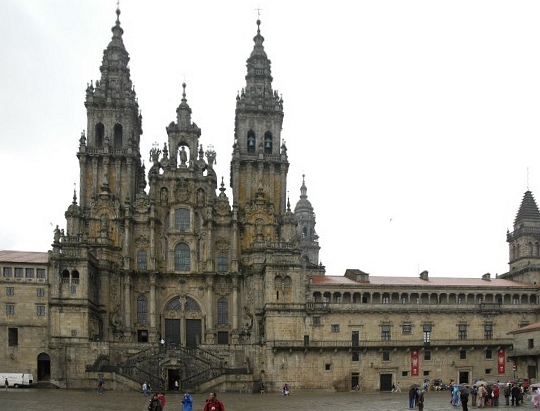 |
| According to Medieval legend, St. James's remains were carried by boat from Jerusalem to Libredon in Galicia where he was buried. In 813, a bright star guided a shepherd to the burial site, Santiago de Compostela. The miracle of St. James also served as a political wedge and a rallying battle cry against the invading Moors. (Wiki) |
To travel West, to Tír na nÓg, the island of the ever-young (or the ever-dead), that mythical place beyond the edges of the map, is well attested in Irish Celtic mythology and oral tradition. But the idea that the genesis for this particular pilgrimage would have originated in Scotland under John the Scot literally has one traveling in the wrong direction. Do the geography. France seems to be the likely origin of el Camino de Santiago de Compostela pilgrimage. Spain was another route.
Pilgrimage to the West would have taken the Irish monks (most medieval Scottish monks were Irish-born) rather out of the way of Galicia—to Iceland and the Farøe Islands (or Vineland!). Irish hermits settled there the sixth century, introducing sheep, oats and early Irish language to the islands. Farøes place names to St Patrick and St. Brigit attest to pre-Viking, Irish occupation.
The Irish Saint Brendan (ca. 484–578 AD), was said to have visited the Farøes on two or three occasions (512-530 AD), naming Sheep Island (Farøe means sheep) and Paradise Island of Birds.
St. Columba was more contrary, sailing northwest to Iona. For the record, Scotland's patron saint Columba (or Columcille—and instigator of the world's first use of copyright) was Irish-born. Iona was not part of Scotland then. There was no Scotland as we know it. The Hebrides were their own entity—settled by the Irish—I might add.
I must however, take umbrage with your passing off the first John the Scot (b. 800-815 AD in Ireland)—as being Scottish. He was Irish.
It is possible that the idea of pilgrimage to the shrine of St. James, or Iago of Compostela was based on Gaulish Celtic tradition and cultivated by the Irish missionaries of Iona, the Hebrides, Scotland and Europe as the Irish monks were the innkeepers of Christianity and knowledge (fios) throughout the Dark Ages in Paris, Rheims, Bobbio, St. Gallen, Laon, and other important Christian centers of learning. Galicia is still a Celtic stronghold to this day.
The Irish also found interesting ways to write themselves into the Bible as they weren't mentioned in the Old Testament as one of the Lost Tribes or otherwise. So they got inventive. And there have always been strong ties between Galicia and Ireland. De Valera, Ireland's first president was Galician. But I digress.
The origins of the Santiago de Compostela legend dates back to ca. 813, roughly the same time Johannes Scotus Eríugena (see also) or, John the Scot, was born, circa 800 to 815 AD. in Ireland—not Scotland. John spent most of his adult life in what later became France under the patronage of Charles the Bald. Charlemagne (b. 742 ) died in 814 AD—a year before John was born. (Now that really would've been an anachronistic miracle having Charlemange converse with John at such a tender age!)
From 575 to 725 AD, Irish monks founded some 150 abbeys on the continent. To paraphrase Paul Gallagher's study, Irish Monastery Movement:
Irish monastic scholars were renown throughout Europe for their knowledge of Greek, [Arabic], and Hebrew. Irish [monks founded European] monasteries that produced the teachers and scholars in Europe and remained centers of classical scholarship until the Viking invasions.If you had some medieval learning, you'd be aware that the word "Scot" referred to Ireland as Ireland was then known (since Roman times) as Scotia Major and Scotland (the part that was settled by the Irish) was known as Scotia Minor. That part of Scotland was called Little Ireland. Scotia probably means pirate, or raider, so I guess you're in fine order there.
We don't know when John arrived in Paris (circa 830-40 AD?), but he was a monk at the Benedictine Abbey of St. Denis, a place of ancient pilgrimage, the most sacred place to be in France. By 630 AD, it was also one of the richest and most influential abbeys in Europe. Burial ground of kings, a new church was completed by Charlemagne in 877 AD.
It is clear you did some research as you got much of John the Scot's story right, but alas, by making John the Scot a Scots-Irish man, you anachrostically conflated him with a 12th c. Bishpop of Scotland who, curiously, also seems to be Irish-born. John the Scot was more commonly known throughout history as Johannes Scottus Eríugena. Eire is the ancient word for Ireland, and "gen" means born: as in Irish-born.
As to your extrapolation of William of Malmesbury's story of a king asking John: "Quid distat inter sottum et scottum?" as being a literary Easter egg of your discovery, this is an old story I learned at the knee of my Irish grandmother, it is not particularly obscure.
 |
Carolingian king Charles the Bald had his hands full with the Breton Celts of Gaul who defeated him at the Battle of Ballon in 845. Challenging wits with John the Scot was not perhaps his brightest moment. But John was appointed head of the Court school.
|
Circa 843 AD, the Frankish king, Charles the Bald (b. 823 AD), not Charlemange as you had noted, asked the famous question of John. Anyway, the story is well attested in medieval manuscripts, and as John was also a famous medieval poet and philosopher, it's a story that often gets repeated.
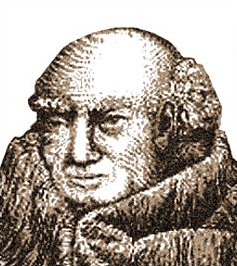 |
Johannes Scottus Eriugena b. ca. 800-815, d. ca. 874-877 AD, (also spelled Scottigena, Eriygena, Ierugena, and Erigena—means a "native of Ireland.") John the Scot, "a man of strong and eloquent mind", one of the brightest free thinkers of the Middle Ages, was eulogized as "coming out of the darkness like a meteor." A neoPlatonist, versed in knowledge of Greek, Arabic, and Hebrew, wrote that true philosophy is true religion. His work was condemned in 855 and 859 AD and labled "Scots porridge.")
|
…
This is the quote in full
The king, Charles the Bald, who was dining with John asked: Quid distat inter sottum et Scottum?
(What separates a sot (drunkard) from an Irishman?)
John replied: Mensa tantum.
(Only a table).
(See a cartoon of the event here.)
Did John the Scot ever go to Santiago de Compostela? We don't know but the first written record of a pilgrimage to Santiago de Compostela was a century after his death.
…the story of St. James was resurrected in perfect timing to spearhead the reconquest of Spain for Christianity, starting with the battle of Clavijo in 844 to the decisive victory at Las Navas de Tolosa in 1212, each time St. James appeared at the crucial moment to turn the tide of battle. St. James, Santiago Matamoros depicted as the knight in shining armour astride a white charger decapitating Moors with his sword. The first written record of pilgrimage to Santiago was when Bishop Gotescalco journeyed there in 950 and in 1072 Alfonso VI abolished tolls for all pilgrims travelling up into Galicia through Val Carce. —THE CAMINO – PAST, PRESENT & FUTURE
Legend has it that John the Scot was invited back to Britain by Alfred the Great (who was educate in Ireland) to become Abbot of Malmesbury, or Athelny, or Oxford, but he was stabbed to death in 884 (10 years after his death) by acolyte-students with their pens for "trying to get them to think." (Philosophers). But seeing how goose wing quills were used for pens—I think this is a flight of fancy.
It's also said that John fled to Ireland at Charles the Bald's bidding as the pope was on a rampage after John's translation of Dennis the Areopagite was published without his consent. One count gives John's death in 874 in Ireland, another in 884 in Malmesbury. But it seems John died the same year as his long-time friend, Charles the Bald, in 877 AD. —History of Ireland, p 202-3.
John Scot Eriugena was a monk at St. Denis before going to the Carolingian court and Rheims; Eriugena retired to the monastery of Laon, a center of Irish influence in France. —Paul Gallagher, Irish Monastery Movement

I've visited several places where John the Scot was reputed to have taught including the hillfort citadel of Laon. My particular interest is in place name origins and in opidda, or Celtic hilltown forts—I've spent this Christmas season combing Google Earth in Renfrewshire for standing stones and Iron/bronze age forts and standing stones.
(An interesting aside, modern Scots still 'dress the stones' on the Solstice and New Years. Ach it was a hellish oiche maiden (hogmanay) this year (2006-07) with storms and 70 mph winds, but we managed to dress Cloch-na-Rhyderrick, or Clochoderrick, (perhaps I'll tell you about King Rhyderrick, friend of Columcille sometime—I was a student of UC Berkeley's Celtic Studies program.)
The stone of Rhyderrick, some call it Merlin's Stone—depending upon which story you hear—is still dressed today: others were clearly there before us, leaving red flowers and holly. As were the standing stones of the Girdle Toll in Irivne, Ayrshire.
I learned to dress the standing stones (with flowers, red berries, evergreens and whiskey) from my Irish Bantry Bay grannie, so I was the strange American hanging out with the rock, what's geologically called a glacial erratic. It's not technically a standing stone.
The rock, at one time, wobbled and it was used as a druidic judgement stone. It no longer wobbles as the mud is packed in around its base. We were trying not to get electrocuted by the farmer's fence as we so very carefully went over the stone stile—but I digress.
I imagine you must take umbrage at fan divulgence. Rest assured, I'm no raging fan, though I loved many of your movies. I'm a writer, cursed with the gift of the gab—or gob—on a 3 AM caffeind jag, and sufficiently irritated by your stretching of truth—or, shanghaiing of truth in Camino, to write to you, though I assume you'll never see it, nor respond. No matter, I will defend John the Scot's rightful birthright to cyberspace.
(Note bene: As to celebrity, I live with an actor, and I am the daughter of an actress so I know that tangled route. Between matinee and curtain call, my babysitters were the likes of Tommy Smothers, Lloyd Bridges & Sterling Hayden. The Gate Playhouse in Sausalito, Tiki Junction. My mother variously went by Maureen Reilly (nee), Maureen Hurley; one of her stage names was Kellé Hurley (as there was another actress Maureen Hurley); she was a dancer too, she admired you, and had me Out on a Limb reading your books at an early age.
Some of my school friends did make it to the big arena like Robin Williams, so please be assured I'm no autograph seeker nor fame collector. I did so love the writings of Kenneth Tynan, so that bit of story of Kathleen was precious to me...'horsemen pass by.' I'm more like Kathleen, pragmatic, less inclined to believe. But I do have glimmerings of the Sight, which drives my pragmatism crazy.)
Anyway, you might be interested to know that John the Scot was, perhaps, the most famous medieval philosopher, having translated the False-Dionysis treatise on the idea of free will. This treatise lead to an intellectual foment across Europe as John the Scot/ Johannes Scottus Eriugena had again taken up 5th c. Britons Celestinus and Pelagius' cause of free will versus the rote catechism of religious experience through the auspices of church dogma.
Needless to say, the idea of free will was not a popular concept with the pope as it undermined the church's papal authority (and tithing coffers). The pope had also posthumously excommunicated Pelagius for heresey. John the Scot too was well buried as it were, but he was rediscovered in 1680, and repatriated again to become the new rage of intelectual thought, profoundly influencing Schoppehaur and Kant—probably Spinoza as well. (Alas, Spinoza died in Amsterdam a full 4 years before John's treatises were widly published.
I have stood before the small iron gate of the synagogye where Spioza worshipped. So I reiterate, John was hardly as obscure as you suggest in Camino.
What becomes fascinating, however, is that you latched onto John the Scot, he does become the neo-Platonist who reintroduces the concept of individual experience with God, and free will vs church/state mandated group experience of religion. "Saints, sinners, generals, misfits, kings and queens. It is done by the intent to find one's deepest spiritual meaning and resolutions regarding conflicts in Self."
And so, here we are… so I thank you for that rediscovery, or shall I say, revisualized, with a deeper undertanding that comes with age. I too hope to complete the real Camino trek, before I'm 60, if possible (a bum knee—too many falls from horses in my youth—makes it a tough 500-mile proposition as I'm 54 and not at all likely to get younger) so your story (and imagination) did serve to re-inspire me to traverse the same route as Dante, Saint Francis of Assisi, Charlemagne, and Chaucer to go on pilgrimage.
In medieval legend, The Milky Way was said to be formed from the dust raised by the vast hordes of trekking pilgrims. The Spanish name for the Milky Way is El Camino de Santiago. Folk etymology has it that Compostela means field of stars.
The road of St. John may indeed be lit by a field of stars. Hoever, the Galician word, Compostella, derived from the Latin, compositum, is Composita Tella meaning "burial ground," not Field of Stars. With that, I'll bury this rant.

(This letter was sent to Shirley's webpage. No answer was the loud reply.)
Friday, February 9, 2007
The profane president
Everyone groans, but it’s true, the president is profane from his head—such as it is—to his toes. All of it profane, the use of power, or the profane use of religion. But then, religion has always been the driving force of power, masquerading as something other than what it is. Take one vast oil field and multiply it by the altars of Maman.
We sit within the inner circle of oil refineries that have turned the largest profit ever, making more money in one year than the world’s total debt. Today I caught myself thinking at the gas pump that $2.75 was a pretty good price. When did that shift in thinking occur? When did I get used to thinking it was a good price? When did I begin to accept the inevitable ogliarchy of my government, though I protest. But I feel so helpless, unempowered, hunkering down to outwait the inevitable. This, too shall pass.
But the meek have not, and will not inherit the earth, ever. Unless they’re willing to accept drown continents as they’re just desert deserts.
I watch the news footage of vast sheets of glacial ice the size of small countries calving off into the ocean. Flying over Iceland and Greenland, I was mesmerized by the flotilla of icebergs, like unseasonable cherry blossoms strewn on the pavement at Paisley Abbey, midwinter. The church bells, a death knell for the earth.
2/9/2007 Writers’Group
2/9/2007 Writers’Group
Friday, January 19, 2007
Gratitude list
Gratitude, Gracias, or grassy-ass as Kirk would say. How do you say thank you for a year that was unkind? I’m thankful for my lust for food, ot diminished by age. The black checker at Costco lit up and lifted himself out of his robotic stance when he saw my excitement over a chicken sandwich. He said have a nice day and meant it.
I’m thankful for my curiosity, a trait, that what has lead me astray more than once. Curiosity to spend hours on Google Earth trying to find geologic anomalies and standing stones. I’m thankful for the fact that Neil let me go on wild hunts, whenever I got a buzz up the back of my neck, knowing I was closer yet to something ancient. The unnamed stones at Girdle Toll, an abandoned coal mine turned into a folly park.
We thanked the stones on the solstice and dressed them with holly, roses and rosehips, and Glen Fiddich. I’m thankful for the fact that Neil put himself aside just for a moment and entered into the solstice rituals without trying to take over—the way he usually does.
He so generously sluoshed the stones with whiskey at Cloch-na-Derrick, Rhyderick’s stone, a glacial erratic, divining the full moon on New Year’s night.
I’m sad that I had so little time for art, or for writing. I didn’t write my New Year’s Eve list. I’m sad that I am entering a decade of poetic silence. I am thankful that I still can craft words and make puns the few metaphors make it to the page.
1/19/2007 Writers’ Group?
Subscribe to:
Posts (Atom)

