Showing posts with label Russia. Show all posts

Thursday, May 18, 2023

Leave-takings


I was born with wanderlust. When I was a child, I would traipse off into the woods and hike up the ridges of Mt. Barnabe to see Elephant Mountain and Tomales Bay cleaving the land like a saber shining in the distance. Since then, I've traversed many landscapes the world over and for that I am grateful. 

One summer, when I was working in a small village deep in the Swiss Alps, I involuntarily threw my arms open wide as if to encompass the sublime majesty that left me breathless. Whenever I am overwhelmed by raw beauty, I open up my arms as if to embrace the landscape.

To anchor the self in place and time—if only just for a moment—that is my one true religion. I’ve done something similar with my own childhood landscapes, my ritual involves greeting the landscape as well as saying goodbye. Perhaps it is also a form of gratitude.

I once taught an old lover how to embrace the land. It was so exhilarating and liberating to acknowledge the intangible like that. As we hiked the long ridges that traversed the coastline, we opened our arms wide with impromptu hugs, kissing the vast landscape, saying I love you. I love you. A ritual that he continued to cherish long after we had broken up. 

When a Soviet friend had to return to the USSR when his visa expired, I was surprised to find there was also a Ukrainian custom of leave-takings—or saying goodbye to places you’ve been—which included bidding adeiu to my little cabin. 

It was somehow a fitting reminder to acknowledge the importance of departures. When you say goodbye to a house as if it were an old friend, you acknowledge its hospitality and shelter. It doesn’t need to be your house, it could be a place you've stayed, a place where the walls have protected you from the vagaries of the world.

And the house offered us refuge from our ourselves. Yes, I know, a house is an inanimate object, but it both shelters and cradles us in its arms like a mother. In that moment, it becomes not a house, but the idea of home. Something I learned while living in the USSR—and it seemed a fitting ritual. 

I can’t say there were many places in the Ukraine I wanted to embrace. The vast breadbasket was flat as a pancake all the way to the horizon and beyond—except for the desecrated kurgans, tumulus mounds punctuating an ancient landscape carpeted with sunflowers and wheat. 

At the steep ravine of the Bibi Yar, Stalin’s secret burial chasm, I wanted to weep even before I knew the backstory of the atrocities that had happened there, what was inhumanly possible. I said a goodbye racked with sobs for the eroding debris—bones of the unnamed dead hidden from the world in a mass grave.

Ditto that in Iona in the Hebrides as well—for entirely different reasons—the holiness of St. Columba's abby was graced with filtered light. I was letting go of something so profound, it was nearly nameless. It was as if I were shedding a lifetime of grief. The death of my grandmother, my mother. The absent father. 

Maybe it's a form of hiraeth or saudade. An overwhelming homesickness, more than nostalgia, it’s a longing for a place you cannot return to—the soul harboring equal parts of grief and love. As sobs racked my body, I was grateful that the holy community of Iona tactfully looked away, they understood the personal conversion of psyche.

The idea of leave-taking dates back to the 12th c., to receive permission from a liege lord to formally depart, as in fare thee well—I’m off to the holylands. As I made ready to leave, I was reminded of a saying I coined as a form of closure while on the steep slopes of Huayna Picchu, where I had left talismans: a lock of hair, and milky quartz from our hill in Northern California. For my grandmother, I said, as if bearing witness.

I instructed my friend, Always remember to say goodbye to the places you've been. Cherish them, say goodbye, for you will never pass this way again. 

And with that, I kissed the landscape goodbye.

5/18/23 Mill Valley Library non-fiction workshop with Sarah Broderick

Tuesday, April 11, 2023

GHOST SHIPS

A toxic desert with abandoned fleets of ghost ships

A herd of white camels, like displaced whitecaps, 
seeking refuge from the grueling desert heat,
slumber in the shadows of rusted ghosts freighters
resting on the bottom of what once was the Aral Sea,
a sea so vast, that Alexander the Great couldn’t cross it,
disappeared within a generation. For Soviet cotton.

3/11/23

Tuesday, January 17, 2023

Breakfast of campions

One summer day around 32,000 years ago, during the Pleistocene epoch, an arctic ground squirrel stopped to sniff the Siberian wildflowers and nibbled on little white campions gone to seed. As the squirrel digested his breakfast on the banks on the River Kolyma, we will never know how his life abruptly ended. Did a flood cover his burrow? Did a mastodon tread on his home, grinding him into the earth? Too much ice to burrow through, come spring thaw?

Enter Time present: in 2007, the squirrel’s tiny body, buried 12 stories deep, still asleep in his burrow, was recovered from the melting permafrost with hundreds of seeds still in his gut. And a well stocked larder, a seed cache for the coming winter. Russian scientists sorted and counted the seeds.  

Years later, enter Svetlana from the Russian Academy of Sciences who tried her luck at resurrecting the seeds, she extracted placental tissue and nurtured the silene stenophylla embryos along. Sure, it was a longshot. Damned if the 32,000 year-old Methuselah seeds didn’t sprout and grow leaves. All 36 seeds sprouted and bloomed in profusion all at once like good little Soviets as if they were thrilled to be free from the permafrost at last. Not a false spring—like so many others.

Winter was finally over. The little white campion flowers bloomed for the first time in 32,000 years. The lab was perfumed with a spicy clove-cinnamon odor as they unfurled their finery and went about the business of pollination. Svetlana and her sable hair brush did the honors. A squirrel, a freaking carnation. A regeneration of the world’s oldest seeds. Talk about bloomin’ luck. It was like Lazarus rising from the dead. Nostrovya, they said.

I love this story of silene stenophylla, a.k.a. white campion. 

I remember finding bladder campion in Wengen, the Swiss Alps in 1972— it had little pink and white candy stripes on its bladder as if it was the frilly apron, or fancy bloomers worn by a volunteer nurse. I was lonely working as a waitress, in a hotel one summer, without a common language. So I turned to that of flowers. 

The campion, a silene, was similar to an Indian pink (actually a scarlet wildflower with pinked, or sheared decal edges), that I knew from West Marin. Gentian and chicory I recognized. Dandelions and buttercups, eiderweiss and pearly everlasting. But there were so many flowers I didn’t know, I was hooked. It got me interested in botany. 

That summer I collected, pressed and dried alpine flowers between the pages of old books. Though I was desperate for my mother tongue, I forfeited my novels weighted down under the legs of my bed, they had a more important job— preserving flowers. I didn’t know the names of most of the flowers—other than edelweiss and gentian, heather and clover. But the silly silene, a card-carrying member of the pink, or carnation family, (Caryophyllaceae) is what kicked off my interest.

Some say that the carnation stands for fascination, and others say for love, whether filial or maternal. Agape. According to one legend, white carnations grew from the Virgin Mary's tears as she wept for her son hanging on the cross. 

But the red ones were the eyes of the shepherd that Diana, the huntress, plucked from his head for throwing her off her game. Dianthus: either way, is the flower of the goddess. White for luck and pink for gratitude and red for revolution. I remember buying carnations from the street vendors in Red Square keeping their fragile blooms warm in little glass houses lit by candles, snow falling like feathers on the corpse of a failed experiment.

A few years ago, I was hiking in the deep canyons above Santa Barbara, headed towards the top of the ridge. I was winded and grateful for a chance to rest—I was on my hands and knees with nose pressed to the ground. Right in front of me, on the umpteenth switchback, was a plant I’d never seen before, pink, like a carnation, but thorny. 

It reminded me of those alpine campions. My memory wandered back to those good old days, hiking in the Swiss Alps, startling other hikers who found me on my hands and knees by the side of the trail, doing a faceplant. I later realized I was looking at a member of the Cichorieae (Dandelion) tribe. Santa Barbara wire lettuce. Not a campion, but close enough—call it convergent evolution. Even way back then, I was always looking for equivalencies. Call it simile. Or perhaps metaphor.

Wednesday, April 27, 2022

CASUALTIES OF WAR (photos)

Mohammad Mohiedine Anis, 70, sits in his destroyed bedroom listening to music. Joseph Eid, WaPo

In that viral photo of Aleppo, from the Ides of March, 2017, an old man, Mohammad Anis, sits on the bed, the fallen headboard like the lid of a sarcophagus. He sits, with pipe in hand, he’s pushed back the bedspread covered in plaster dust to make room for his thoughts. He stares at the gramophone, the needle poised, the hand crank at the ready. He contemplates at the possibility of music during a time when the idea of home is gone,  the vinyl record is done. Only the hissing remains. The floor is strewn with rubble, jigsaw puzzles, pieces of plaster ceiling and wall have joined him. Who will find the hard edges to solve that puzzle? The man from Aleppo refuses to leave his home, the city of his ancestors. We can’t see his two cats napping in a wicker chair in a larger photo. The shutter is askew. There’s a crib in the corner by a petchka stove. A samovar. A pile of books, pages fluttering like bird wings, the window transoms are open to let the morning air in, but the glass is shattered by the impact of missiles. His collection of old cars, gone, he makes plans to rebuild for his children, children. A remnant of a lace curtain luffs in the breeze, a reminder of a gentler time. There is a lull, a momentary silence of grief embedded in the midst of this senseless jihad of a war. He raises his pipe to his mouth but the ember has gone out. He has no words left to explain this life.

Russian missile strikes a flat in northern Kharkiv, Feb 24, 2022. Sergey Bobok,Time

First Syria, and now Ukraine, we witness the handiwork of a despotic Putin intent on making war on civilians, we watch the six o’clock news, in real time, with no buffer. In Kharkiv, Ukraine, the photos of war are played out again, like a cinema trailer, only in real time, the entire body of a missile has pierced the ceiling and embedded itself in the floor like a strange pillar or plant. There is no one in the room. Only a mirror and the crucifix on the wall bearing witness. The bed is folded over into a couch. The occupant gone, but alive. Miraculously, the chandelier is intact. The table is set for breakfast, the keyboard covered in thick dust, the rubble on the floor, Soviet era concrete scours the nostrils. On the window ledge, plants in need of watering lean crazily towards the light. The computer screen and television are dressed in dust ghosts as if a child had breathed on them in order to draw a picture. There is no easy way to comprehend these civilian casualties in the midst of a senseless war. Soon the man will return to his flat to survey the damage. Kharkiv holds the line, Mariupol has fallen. My friend Miceál lands in Lviv with medical supplies and 10,000 bodybags. Meanwhile, the midst of all this chaos, a babushka, whose friends are learning the art of the sniper, is baking bread for the Ukrainian soldiers, she is offering bread and salt to welcome us to the world stage.

Wednesday, March 2, 2022

UNFURLING AN OLD FLAG


UNFURLING AN OLD FLAG
       —With thanks to Nâzim Hikmet’s Things I Didn’t Know I Loved

It’s summer, 1989, I’m standing in the back 
of the old wood-panel theater, filled to the rafters with comrades
filled with the sultry August heat and sweat, while outside 
the open windows, linden trees conspiratorially whisper 
the secrets of the air to the dank river.
Our oppressive clothing, like the local KGB, sticks to us like glue. 
Minoga ludi, says Oleg, my interpreter. 
Everyone is dressed in their Sunday best 
                   though it is not Sunday. No church bells tolling.
                   I am a visitor, not a tourist, I am bearing witness.
                   An Irish-American poet lost in the land of fields.

In the corner, stands the obligatory red flag of the USSR, 
soaked in the blood poppies of the fallen, 
       with its golden hammer and sickle, that reaped more 
                 than a harvest of wheat.

On the stage, Cossack dancers in red boots
             lash out with their feet, while an old man recites 
                    Taras Shevshenko’s verses 

to the strands of the balalika. A hush falls over the room 
as two maidens join him onstage, 
they are dressed in national costume 
     with wheat fronds in their floral headdresses like a halo
                or a nimbus cloud catching the last light of the sun. 

They carry something old and tasseled, on a pole,
       and as they unroll it, the audience gasps. 
             This is treason, said Oleg, despite Glasnost.
             But there are too many of us to be disappeared 
             during these halcyon days of open-armed Glasnost.
             I repeat, I am bearing witness. I am bearing witness

as I watch

a flag that was hidden, silenced for nearly 75 years, unfurl. 
Blue for the sky and the cornflowers in the fields, 
and yellow for the endless wheat and the sunflowers. 
The lustrous silk quivers and glistens in the limelight,
takes center stage as if it were about to sing an aria. 
              And so it did. Words once uttered, cannot be unsung.
                     There is no taking it back. The road goes ever onward.

I have some questions: who kept that flag safe all those years 
and how was it hidden from the aggressor? In what attic, or dacha?
In what Peredelkino? First, they came for the poets….
A call to poetry is a call to arms. 
                                They are one and the same, said my friend.

The silence in the room was astounding, no one dared breathe. 
And then one old voice began to warble the strains 
of the Ukrainian national anthem. 
         Another voice, also hoary and frail with age, joined him. 
Soon, others joined in, at first, hesitantly, mouthing the words,
       and then they sang with vigor and gusto, as they dusted off 
                  the words unsung for a nearly three-quarters of a century. 

We had witnessed something holy and profound. 
The word was on everyone’s lips 
          though not all knew the anthem. 
                And that day, there was no going back. 

I didn’t know I loved the way that old flag unfurled, 
or the way that paper sheath, stained with age, crackled like fire,
or the way the dustmotes trapped in the floodlights 
took on the twilight of the stars. Sometimes, the road stops here.
And there are things you can no longer retreat from.

It’s February 28, 2022, as Russian tanks wend their way 
towards the heart of the motherland, all roads lead to Kyiv, 
the ludi running ahead of those tanks, removed all the road signs,
they blew up the bridges, sacrificing their lives, 752 civilians dead.
Electronic road signs & billboards, uploaded with words in red lights:
Go fuck yourselves! до росії на хуя. Go back to Russia on your dicks.

You cannot cross the same river even once, said the Dnipro River.

Gospodi. There is no going back. Naked aggression comes 
in the form of Russian airstrikes on civilians. Putin is a whore-
cum-war criminal dressed in his Sunday-best despotic czar fatigues.
                Ukrainian soldiers are bringing their cats to the Russian front.
                Grannies lying on yoga mats, lock & load & aim their AK-47s. 
                Meanwhile, in the Kyiv subway-stations-cum-bomb-shelters, 
                babies are being born, a set of twins, oldtimers play chess,
                mothers & children make Molotov cocktails with laundry soap
                for sticky fire, while a million refugees flee their homeland. 
                               There really is no going back. 

Checkmate. Crimes against humanity. Rust and iron curtains.

                                             The colors of the Ukrainian flag 
are emblazoned on every bridge & every public building 
the world over, as we stand shoulder-to-shoulder in solidarity, 
dusting off the dulcet words of democracy & freedom for Ukraine.
Babushki offer bread and salt and sweet tea to the defecting soldiers
while Putin sends a bouquet of missiles to the city Kherson, COD.
A Russian soldier wrote to his mother, I am in the Ukraine, 
This is not an exercise, we have bombed all the cities. 
They are throwing themselves beneath our wheels,
they don’t want us here, Mama, this is so hard, 
                                              just moments before he was killed. 

As Lew Welch said, This is the last place. There is nowhere else to go.

The babushka hands young Russian soldiers handfuls of seeds, saying, 
Put these sunflower seeds in your pockets, please. 
You will lie down here with the seeds. 
               You came to my land. You are occupiers. 
                        Do you understand? You are enemies. 
                             Fucking pieces of shit.

This is the last place, there is nowhere else left to go.
They have already lain down their bodies & souls.
For the seeds of freedom are the only crop 
that will surely grow in black Ukrainian earth.
A vast army of sunflowers tracks the sun.

Slava Ukraini!

           2 March, 2022 From our CPITS Write On class, with Susie Terence

Friday, April 10, 2015

Dark Winter Days at the Hermitage


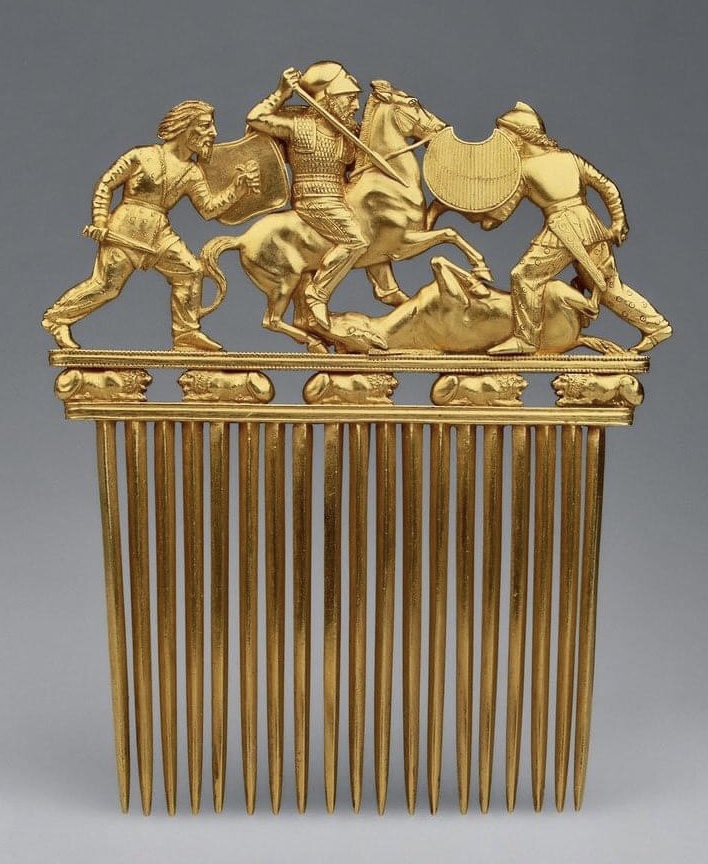
Greek-made Scythian gold comb, Solokha, Ukraine, 4th c. BC, Hermitage —Wiki

During the fall of the former Soviet Union, in the early 1990s, I spent a few seasons living in Leningrad with a noted pop singer. As winter closed in, and light diminished, I became stir-crazy, desperate for outside contact. I was living in isolation with a man from Grozny who spoke no English. But that's fodder for another story. One thing that enabled me to retain my sanity, other, than black market treats, including Earl Grey tea, was art for art's sake. I lived near the largest museum in the world, The Hermitage.

I literally spent my dark winter days in the dreary basement of the Old Hermitage. I discovered that I could waltz in the back door, for free, and avoid the long lines, if I attached myself to a busload of tourists....

Pop singer Valera Stupachenko, my Soviet fiancé, sometimes dropped me off at the museum when he had rehearsals at the Leningrad Rok Opera. I was lonely, isolated by language, or a lack thereof, though I could communicate basic needs in Russian.

I often divided my time between the Scythian, and the Fertile Crescent displays. The winged bull of Nineveh, the bust of the Akkadian king. Mysterious clay seals of Mohenjo-Daru, and cuneiform shards. Thracian gold. 

Of course, everything was explained in Russian, so I had to make do with what I remembered from my distant college art history classes. I painstakingly transcribed the Cyrillic placards into English. The guards did not seem to mind that I spend hours in darkened rooms gazing at these ancient wonders. 

A 2,300 yr-old women's soft red leather boot sewn with pyrite crystals and black beads, found  in an Altai mountain grave, 1948. Hermitage collection.

Having grown up on horseback, I was particularly fascinated by the Scythian horse trappings. Intricately designed saddles, felt applique blankets, bridles, stirrups, bits, and silk rugs—the oldest pile carpets in the world. Soft riding boots with wild roses beaded on the soles. I imagined a woman's feet never touched the earth, except for maybe to sit by the fire pit, dance on a thick carpet at her wedding, or when she was buried.

Oldest pile carpet in the world from an Altai Scythian tomb,.Pazyryk, ca. 4th c. BC. Hermitage

The elaborate gold Scythian pectoral collar made me weep, as did the golden reindeer, with horns so elaborate, they were like shining star-filled trees in a treeless tundra. They were more ancient and mysterious than the elaborate Greco-Scythian synthesized pieces. They were imbued with magic. Nomadic talismans.

Gilded wooden reindeer, Pazyryk, 5th c. BC. Hermitage

Afternoons were best spent in the (Post) Impressionist rooms, often the only direct sunlight I ever saw in winter was in those beautiful rooms with huge warped glass windows so old that I imagined they had somehow survived the Siege of Leningrad. 

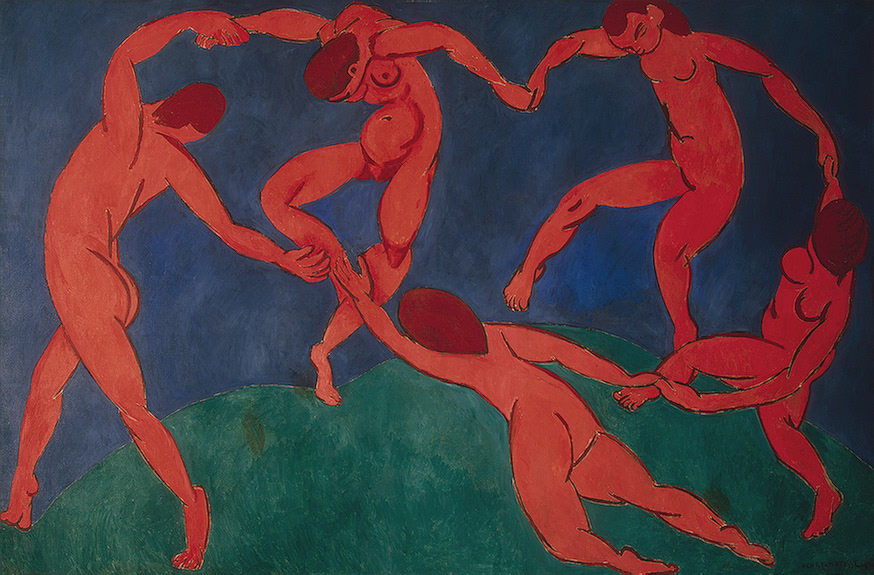
Henri Matisse, Dance, 1910, Hermitage (they aren't that red!)

I didn't know those Scythian finds were the foundation pieces for the genesis of the Hermitage. I had unerringly gone to the heart of the matter. During the early 18th c., Russian explorers brought Scythian gold from burial kurgans to Peter the Great. Catherine the Great, a fierce collector of art, and artifacts, was so amazed by Scythian artifacts that she ordered scholars to systematically research them—this was before modern archaeology got its groove on.

Scythian pectoral, Ukraine, 4th c. BC. Horses torn apart by (Greek) griffins. Hermitage —Wiki

A woman ahead of her horse and time, Catherine the Great had the largest collections of paintings in the world (4000), including hundreds of Impressionist paintings. They had to hang somewhere along with all the other art she had collected—some 3 million pieces. One of the oldest (and largest) museums in the world, the Hermitage, a collection of buildings fronting the Nevsky River, was founded in 1764 to house her treasures. (There was Scythian art in Moscow, Kiev and Budapest museums—but nothing matches the Hermitage collection.)

The Giottos, da Vincis and Raphaels were all wonderful, don't get me wrong, but I lived for Impressionism. The impressionist rooms in the southern wing of the Winter Palace were filled with movement. I clattered up three flights of stairs to see Matisse's Nude Dancers, and the old babushka guarding them said she saw them as messengers. It was not just a job to her. She put her hand over her heart. She had to be there every day to keep them dancing. To keep the world dancing. And so she did.

Both the Hermitage, and Moscow's Pushkin Museum had replicas of the world's greatest statuary (for art students). I stood before the Dying Gaul of Pergamon, and marveled over Greco-Thracian artifacts...another abiding interest. The Celts settled among the Thracians. Albania and Bulgaria retain scant traces of lost Balkan Celtic cultures.

The Dying Gaul, Gladiator, or Galatian, a Roman marble copy of a lost bronze Hellenistic statue, 3rd c. BC. Capitoline Museums, Rome. Livy recorded that the Celts of Asia Minor fought naked. There's a modern copy of the Dying Gaul against a Naples yellow wall at the Hermitage (see a copy here—there's no free Wiki image), in St. Petersburg, and another at the Pushkin Museum in Moscow.

And the Scythians of the steppes probably had contact with the Celts (and Tocharians)—especially along the Silk Road, as some artifacts seemed to have a curious cross-influence. Yellow embroidered silk slippers were found in theLate Hallstatt Celtic Lady of Vix's cart burial mound, and site of the world's largest wine krater (500 BC). She must've been thirsty after death.

Early Irish origin myths named Scythia as the Irish homeland and the Scythians as their kin. Perhaps the Irish scribes were miffed, and maybe it's an accretion, because Old Irish wasn't listed in the Tower of Babel, but the Bible included a reference to the Scythians, followed by barbarians. (Colossians 3:11) Better to be Scythian, than barbarian.

Modern archaeology links Scythia with Iranian (not Turkic) cultures, but I'm not entirely convinced. Satem (Avestan, Old Persian; Thracian may have been a transition language) vs. centum (Old Irish, Hittite, Hellenic, Tocharian). Soft vs hard C/K sound. Herodotus recorded that the tattoed Gelonii, were formerly Greeks; they "use a tongue partly Scythian and partly Greek." Sounds like a centum language.  He also placed the Keltoi homeland in the steppes at the source of the Ister/Danube. Like pots, gold doesn't speak much, other than of beauty.

This belt boss seems to have a Celtic echo. Note the wolfhound (lion?) riding the tail of the horse (deer?) has swirls similar to Hallstatt or La Tène art, as does the distinctive shape of the horse's body. No triskles, but plenty of swirls.

Gold Scythian belt boss, Azerbaijan, 7th c. BC. —Wiki

It was easy for me to spot the Classical influences, and/or Greek imports. I have a prodigious memory for art images. The saying goes: beware of Greeks bearing gifts. But these gifts from antiquity were no Trojan Horse filled with the enemy, or shiny objects to steal, or intended to usurp one's culture, they were bridges, or windows into ancient worlds, lost to time and memory. All we have left of so many cultures are shiny artifacts from another time.

Gold plaques: resurrection of a dead hero; Saka culture, 5th c. BC, HermitageWiki

I never married the singer. My heart wasn't in it. I never danced with him, for he loved God more than me, but my days were filled with wonder and beauty in that dank, dusty basement of the Hermitage. I could not resurrect what was never lost. The lower depths of the Hermitage was my only refuge during that last Soviet winter before the Fall.

Tuesday, April 1, 1997

April Foolishness

In the weightlessness of space,
an astronaut's heart shrinks.—Omni Magazine


A VOICE from home via the satellite link-up lessened the burden of homesickness. But where were the poems hidden? Why didn’t they come? Maybe living in another country would open the dam. Amster-dam: the 16th c. dam on the Amsterele river is real, not a metaphor. I've given into the timelessness of being at loose ends—no agendas, hidden or otherwise—in a country not my own, seeking what oddities life has to offer, for death takes such a long time coming in. In another country I could no longer dam my grief, I shed my skin, undressed down to the bone, and resurrected small pieces of myself from the ground up, for death irrevokably changes you, you cannot go home to who you were. Ever.

Death arrived out of breath, I was an orphan. I trolled old sources searching for my lost art. Page One of my journal documented the oddities of The Final Frontier: After fighting three years with Soviet bureaucracy to hook up a computer telecommunications system with the Ukraine for a cultural exchange program, I finally let go of the idea. Then, one April Fool's Day, my first E-mail message arrived from my ex lover via GlasNET. Incongruous to read a satellite message transmitted half-way around the world that began with: “Cosmonaut lands, doesn't recognize his own country.” My first message from the new independent nation, Ukraine, was not about freedom, but about space, the final frontier.

In another journal I found the story of a physicist who told me a story how he demonstrated jet propulsion while seated in his daughter’s Red Racer wagon; using a fire extinguisher for a booster rocket, he shot through the ivy league halls to the surprise of students and faculty alike. He liked to clown around, to act foolish. He gave me one of the first holograms ever made of a chambered nautilus sliced in half. It reminded me of the cross section of a space ship. I was not immune to his charisma or the three dimensional illusion of physics: a rainbow of light, the visible spectrum trapped on that sheet of mylar set my blood racing, but I was uneasy with the whispered secret rumors. Was it in spring? The word fool once meant someone who was in love. Foolish love. April Fools, a day for practical jokes and sex role reversals. My foolish Papá, said the daughter whose warrior soprano vision guided us through the turbulent protests of the ’60s and ’70s. Show me the prison, show me the jail... I study the exposed labial chambers of the nautilus for clues. What’s worse, the walled silence, or the knowing? Will I be silenced for writing holographic truth dammed behind the slander of divided light?

Inexplicably it reminded me of a hologram of St. Steven’s crown with its bent cross László gave me as we stood on the banks of the Danube the day my half-Russian childhood best friend, Stephanie was cremated on the other side of the world. My hands let rose petals stain the muddy river, I wanted to be home to touch the place where the wind took her up. Home to where her Nanna greeted us each day after school in the old tongue where ikonii and troikas were uttered in the present tense. That place called home that Nanna left, became the wind’s body, Stephanie came to me in sleep, we rode our horses out into the deep. Orion’s belt marked our crossing. She was mute, her eyes like stars. Death swallows the unspoken words hovering in the mouths of the dead. When she comes to visit from the other side, my grandmother’s mouth is a thin line dividing worlds in the country of death. I watch Lír’s sea foam horses racing the wind down the strand.

Death nearly boarded the spaceship Mir, forgotten during the 1991 August coup. Stranded Soviet cosmonaut Sergei Krikalev helplessly watched his country disappear: changing its name, anthem, and political order. The abandoned space program was officially broke with no way to get him home. Secret calls in the night; someone trying to sell Soviet space ships for hard currency. When Krikalev returned to Earth after ten months in space, he didn't recognize his own country. White ravens in the snow. In the weightlessness of space, an astronaut's heart shrinks. A loss of innocence. Complex metaphor approaching from the starboard side. In the safe harbor of Amsterdam, I mourned the mounting bodycount, my uncles, parents and best friend. I couldn’t go to Russia after the Fall, to see for myself, the changes. Instead, I translated mute testimony from the dead: my words took on the art of silence and omission. I placed my heart on a small casket, set it adrift in a dark, weightless sea.

Said No to another man who wanted to own me because he loved God more than me.

Who could compete with that?


© 1997, revised 2000 Maureen Hurley

Friday, January 31, 1997

Sleeping with the Enemy

LOST or abandoned thoughts often re-emerged like ghosts in a country not my own. Sleepless nights even the cats deserted me because my tossing and turning like a crazed narwhal reminded them of the bilious sea. Water is not their favorite subject, unless fish are involved.

(Actress Tallulah Bankhead said, I nevah drink the watah, dahling, fish fhuck in it. By the time her story reached me, it was phiss versus fhuck. As if piss were preferable to fucking. Tell me why society wasn’t ready for that Anglo-Saxon word.

My first opera: Tallulah was in a peacock-sequined gown, brandishing a cigarette holder longer than her arm, her sotto voice carried across the marble lobby into the streets where the homeless peered in from the pages of a Dostoyevsky novel, City Hall’s verdigree breast thrust in the mouth of the hungry sky. Fresh from the hills, I was wide-eyed in amazement, but that’s another story.)

Nocturnal epistolic documents produced by an obsessive urge to write, or an unwillingness to let go. Images of wheels spinning in the muddied ruts in the backroads of the mind. Self-indulgence is fine, as long as it goes no farther than the page, but writing demands an audience, that’s the other half of the Faustian pact. The monks had it right: indulgences. 

When death came to visit, language abandoned me, I practiced stillness. Called ambivalence. After the silence that followed the deaths of my parents and uncles, and when the raven sat on my shoulder, the words themselves abandoned me and fell silent: this prose, my indulgence—not poems, but practice in the marginalia of what may become a poem if one is lucky. Josip Brodsky said time loves language. A writer is caught up by the centrifugal nature of language [where] ambivalence and open-endedness as the essence of endeavor.

My lover from the Ukraine wrote: we dissidents are called white ravens—varonas. Our letters rarely reached their destination. The KGB (or NKVD—they changed the acronym every decade or so, but not their technique, their headquarters, the Lubiyanka, cold solemn stone fortress in the krasnaya heart of Moscow); they intercepted love letters complicated by poetry between the sheets.

We wrote in triplicate, mailing a copy, sending the others via “couriers.” I received mail postmarked from the cities of the free world, and calls from homesick Russian friends of friends wanting any contact, no matter how tenuous. 

The system was good because of the many delegations of people led by William Mandel, Armand Hammer and Henry Daiken opening up the East. They allowed me to communicate with my lover—who eventually emigrated to New York and shared afternoon coffees with Brodsky—who, in turn, gave his Nobel Prize money away to émigré Russians, including Oleg Atbashian.

Strange offerings I received—antique peasant dresses, marriage proposals, coral & amber necklaces, USSR army watches and pins—the Russians sent things of value to the West to raise valuta to buy an airline ticket, or to pay for delivering packets and letters.

Once I flew back from St. Petersburg smuggling out letters, lacy silver spoons and tea cup holders, and more US currency than I arrived with: I was afraid to get caught red-handed, so to speak. A counter-counter-revolutionary of sorts, I said No when they wanted me to take an old icon. Mary’s beatific almond-eyed face with rosebud lips anointed in gold was a bridging of East and West.

I chased elusive dreams to distant countries because they were forbidden, I slept with the enemy because in school I learned of a mythical Russia, troikas in the snow. In love with horses, I couldn’t let go of the image, I didn’t know it was tied to the frozen canals of Holland —Hans Brinker’s mythical silver skates.

I lived a winter in St. Petersburg with the pop singer, (Valeriy) Valera Stupachenko of the Leningrad Rok Opera (Singing Guitars) who performed Andrei Vosnesenski's   (J)Yunona and Avos/Juno & Avos at Fort Ross. Small patches of ice-free water beneath the bridges relentlessly patrolled by ducks who knew: to let go of the open pond was to let death in.

Oleg said he was jealous of my happiness. When he saw me with Valera, suddenly it was all very real. But he wouldn't leave his wife, like the way Valera couldn't leave his God. Or throw away his dead wife's clothes. Ghosts of Lady Haversham shrines in and out of the closet. Who could compete with that?
Valeriy Stupachenko

Friends are everything in Russia; without them survival is impossible. I am haunted by fragments of memory: On the Field of Mars I stood overlooking the converted palaces, children sledding down the steps, and really, it was no different than in Amsterdam. Tzar Peter modeled St. Petersburg after a city that inhabits my writing. Czaar Peterstraat and the birth of the Russian Navy; Amsterdam, his window to the west. 

I was sentenced to spend time looking out those same windows, letting go of the myths, only to reinvent them in the poem. I perversely learned history through the back door, a traveler in search of the elusive mystery. Why do we write, and for whom?

© 1997, revised 2000 what month was this written?

Tuesday, May 14, 1996

An Uneasy Truce: family


My publisher asked if I loved life, for he was held at gunpoint, & he questioned where all that passion came from. I’m not sure which passion he was referring to, living, or the taking of a life. The question came on the eve of my uncle Bill’s death, his funeral was on the day I left for Russia, I didn’t cancel my tickets, I wrongly assumed I was exempt from grief because he was an enemy. He once tried to sell my grandmother's house and land behind her back “for her own good” because she was “getting on, and I was growing up too wild.” 

My uncle Bill made her cry, bullying her with that first-born energy. My grandmother was a strong woman but a son is next to God in an Irish family. In a white-hot rage, I attacked my uncle, pummeling him with my small fists, a skinny 12-year-old who once wanted him dead. I felt nothing when I heard the news of his lung cancer. Now he’s dead, and I was surprised to find myself in a fog, suffering from grief because I discovered that blood is indeed like the cliché—thicker than reason or emotion—no matter how disfunctional the family. I will learn this lesson again when my parents die.

I’ve never been held at gunpoint, other than at a roadblock deep in the Guatemalan jungle—with no witnesses. Does that count? We were lucky to escape with our lives. I have never been held at gunpoint, but I watched the campesinos sleep with studied indifference as the soldiers practiced kickboxing with Uzis slung over their shoulders. I did count how many. 

Back home in the safety of America, I will have nightmares about snipers. In Peru, we came upon the body of a lawyer dumped in front of the Chorillos tunnel in Lima—his crime, he was a brilliant lawyer for the other side. I cannot shake the larger images of war from my mind, it wasn't my own life I was worried about, but the perpetual genocides committed by both factions in the name of liberty—for whom?

I am the grand-daughter of a revolutionary but I keep an uneasy truce with those roots. My grandfather, while working for the San Francisco city jail, shipped suitcases of guns to Ireland during the Rebellion, he knew Parnell and the executed Liam Mellows first hand. We have photos of him and Mellows in the field below our house in Forest Knolls. Did he know Michael Collins? Probably. My mother’s cousin is named after him.

My grandfather and my grand-uncles met in safe basements, filed serial numbers off the guns confiscated by the police force, and shipped them to a contact in New York. To Liverpool, and then onto Cork. A grand-uncle missed one serial number in the muzzle, and the shipment was traced back to my grandfather. When the feds tried to intimidate my grandfather into a confession, he said, just try and prove it, for he knew his law. Some vow there will never be peace in Ireland until the fifth field is no longer in British bondage. My aunt Jane helped airlift Irish kids out of Belfast so they could experience a normal life, if only for a summer.

My grandfather was a thorn in the side of the English. When the Germans fought the British in WW1, he was an acting German Consulate for San Francisco. We don’t know the details, he was a closed-mouthed man. When India struggled for independence, he was involved. When Indians were not allowed to own land, bought Fresno farmlands for them. 

A grateful Jahn Singh (Singh means lion) sent us crates of oranges and raisins every Christmas. My grandfather must’ve sent guns to India too. I came across an engraved invitation from the Indian Consulate dated 1945, inviting my family to the Independence celebration in San Francisco. A thank you letter from (James) Seamus Mooney, an infamous political prisoner of the ’30s who was held responsible for the death of a longshoreman during a union riot (I was surprised to hear a lawyer, speaking of ethics, refer back to the Mooney case). 

My grandfather took the city on, suing them and winning the landmark case (he was his own lawyer, having “read” the law, the Bar didn’t exist) when they discriminated against him, passing him up for promotion to High Sherriff in favor of someone else. My family emigrated to America after the Famine, so, we know no other passion, other than to survive.

My second cousin, a mathematician, was whisked off right out of high school to Chicago, to White Oak, Tennesee, to Alamagordo, then to a PO Box address in New Mexico. When she died of cancer, the story came out.  They said Manhattan Project. Fermi Institute. In Santa Fe, I stood at the bridge where the Rosenbergs were captured, and shivered in the sunlight, Born during this age of Light, I have no choice but to weave the stories. Nor could I stop crying at Los Alamos—what we've done in the name of an idea. Remember the Bay of Pigs? The scars go deep, and I cannot stop writing about it. Bearing witness—it is this writing I cannot get published because it's too dark.

Yes, I am uneasy about the new Russia, as I am about the new Latin America. Now that we've had our cake, we (who really do see the other side of the coin) have the audacity to tell them they can't have it—when we've set up the wish list of ultimate attainment to begin with. I know we can't convince the Olegs of the world—they are incapable of seeing out of the trench of their miserable lives, and there's something in the Slavic character, that will continue to hold them there—the root word “slave” speaks volumes and needs no interpretation. 
 
What traits I admired in Oleg while we were in the Ukraine quickly evaporated on American soil. Oleg's limited vision and inability to look inward for root causes is a microcosm of the whole; have we deluded ourselves into thinking that the ideals of communism (vs. anti-capitalism) or another system could overcome some basic human traits? He seem to think America owed him something, he could sit back and take life easy.

No matter the country, it's the same old story—war between the sexes, only I'm no one's footstool. I love life because I love my art—and every man seems to want that space for himself. And having been the victim of men's desire, I know first-hand of death, having nearly died because of the babies I gave back. I was the product of a divorce; I saw my mother go crazy (and the suicide attempts that followed), an aunt and drunken husband & co. where violence and poverty was second nature to breathing—to know better than to leave myself at the mercy of society as a single mother. I've been the psych wards from the inside and have no intention of becoming an inmate.

I love life because I know how easy it is to abdicate—the way my 17-year-old cousin did at 4 a.m. in downtown Santa Rosa on a Harley at full throttle. Maybe drugs were involved. I don't know. But when he died , I was there with him in my dreams—and I never wanted to wake up to hear the news. I dreamed the darkness, the fog, and the red light of my cousin's death—only we're not supposed to remember these things during our waking hours. My mother banging on the door to wake me with the news, but I refused to waken, because waking was worse than the nightmare. There are things I tell no one, but it comes out in my poetry; sometimes I worry about there being too much death in my work, but I am a witness.

Perhaps that’s why I teach poetry in the schools. I search for the bright ones—and despair when whole classes show nary a shining star. I sometimes wonder why I bother, the work is so exausting, but ultimately I have faith. The brilliant gift of a 2nd grader, Trevor Yeats (great-grand-nephew to William Butler Yeats) sustains me:

This body is to ask
this question of the mind:
Is the sun to shine on the day of my death?
Is the hole in the universe to stay as big?
Tell me, tell me, where is the answer?

Where is the answer to lie in today’s hands?
This is the breath, to breathe this air.

Trevor Yeats
2nd grade,
Higham Family School
Santa Rosa, Ca

© 1996 revised 2000 Maureen Hurley

Tuesday, December 12, 1995

All the Goldeneyed Birds


Yesterday Nathan and I went to see Goldeneye, the latest James Bond movie with Pierce Brosnan. He was certainly handsome, but I didn't laugh as much as I did in the old Sean Connery 007 films. The entendres were well delivered. You could see them coming, the bad girl was thoroughly bad, the Russian focus was fun—especially St. Petersburg, but having lived there, I was distracted by familiar sites, places that I had walked daily. The plaza where the blackbirds, with their golden eyes, trapped suns, strutted and cooed. I had a pang of homesickness when I saw the airport, where Valera had greeted me with carnations. A pang, because I fell out of love with him, and couldn't ever get back to that place within me. And now it seems that Sonny and I are heading towards a truce, but to what end? All the golden-eyed birds in the bottom of a shot-glass.

Wednesday, May 11, 1994

INTERVIEW WITH A LADY-IN-WAITING

INTERVIEW WITH A LADY-IN-WAITING

My life was filled with parties, dancing until dawn.
All those violins practicing the mating flight.
I don’t remember who called him The Great.
My destiny was to be a court songbird,
my art, to preen my feathers in the grand ballrooms.

I learned to smile; the sun rose on his every command.
The water garden at the Summer Palace
offered us a chance to discard our plumage.
So many rooms and floors with inlaid stones
and columns of malachite and gilt.

                                         Yes, the peasants labored,
but we never let that enter our pretty heads. Bread enough.
Of course winters were cold, they’re used to it.
I heard Bonaparte’s army was defeated by our mud.
What did he expect? Winter’s vast empire is Russia.

Once I said Yes to a man, then changed my mind.
Urgent rustle of wheat before the harvest.
I miss his eyes. The eye of the Baltic. The canals.
Afternoon tea in the gazebo. His honeyed arias.
His footprints, ravens in the carrion snow.

5/11/94
I was teaching workshops on interviews with the dead, where we had to get inside their heads and imagine.

Wednesday, September 4, 1991

Russian Connections 9/5/1991


LIVING HISTORY—A kind of impromptu cultural exchange in the weeks following the coup in the Soviet Union made the historic and present day links between Sonoma County and the Soviet Union even stronger. Above, History Professor Nikolai lvanovich Rokitiansky from De Anza College and Archbishop Anthony of the Russian Orthodox Church in San Francisco exchange interpretations of the events at Fort Ross.

By Maureen Hurley


WHEN 160 Soviet scientists, scholars, historians, geographers, businessmen, artists and crew joined the historic 250th anniversary voyage commemorating Vitus Bering and Alexei Chirikov's exploration of Russian America, little did they know that the Soviet Union they left behind on July 10, 1991, would cease to exist. News of the failed Soviet coup d'état, which kept most of us glued to CNN news and had mapmakers scrambling for updated versions of political boundaries, was celebrated with cheers by the Soviet entourage aboard the research vessel, the Akademik Shirshov, docked just hours later at San Francisco's Pier 32.

Soviets and Americans celebrated the culmination of a week's tumultuous political changes that swept the Soviet Union onto the shores of democracy during a visit to Fort Ross, where, with open arms and hearts, they feasted most sumptuously on borscht, caviar, and salmon—dancing and singing again under the flag of the Russian American Fur Trading Company that once flew over Fort Ross from 1812 to 1941.

According to crew member Yevgeny Shlei, a photo-journalist from Novosibirsk, during the seven decades of communism, the name and location of Fort Ross (Ross is an ancient Slavic name for Russia) was concealed from history and geography books and maps. To many Soviets, he says, Fort Ross is a symbol, a mythical place, a piece of old Russia—surrounded by California redwoods. He asked me why—even during the height of the Cold War—Americans didn't also conceal or change the name of the fort or the name of the Russian River.

Yevgeny Shlei elaborated: "Russia is finally coming back into the lap of depoliticized existence, while her children who once had to leave their country, have finally found that haven of human souls that could be substituted for their motherland. Fort Ross has become such a haven. Will Russia itself ever moor to it?"

When I queried Yevgeny Shlei about the coup, the breakup of the USSR, and the pending freedom of ten Soviet republics, he stoically said, "Russia is still Russia. That will never change." Another ex-Soviet added, "But you cannot again make a slave out of a man who stands up for his rights."


In 1728, Bering discovered the gulf between Asia and America. Searching for "de Gamma land," on July 16, he, like Columbus, discovered America, but didn't know it, as he had lost his way in the thick fog. Chirikov, who searched for Bering aboard the sister vessel, the St. Peter, had passed him up in the fog, so Chirikov also co-discovered America. But it wasn't official until Russian exploration of the "unoccupied" coast of the Pacific Northwest began in 1741 with the second Bering Expedition and the colonization of Sitka, Alaska, the first Russian-American colony.

Attracted by an abundance of prized otter and seals and a fertile coastline blessed with clement weather, Ivan Kuskov of the Russian-American Fur Trading Company, anchored in Roumiantzov Bay (Bodega Bay) in 1809 to scout out a possible settlement site; he returned with 25 Russians and 85 kayak-bearing Aleutians on the Chirikov in June of' 1812 to establish the colony of Fort Ross, Russia's southernmost colony. Russians, Aleutians, and Kashaya Pomo Indians lived together in rare tri-cultural harmony. (See "Digging the Past at Fort Ross" page 14.)

From the northern reaches of Alaska to the southernmost Channel Islands, the Russians and Aleuts had harvested the sea otter to the brink of extinction within a decade. By 1821 the fur trading business was over, the bottom had fallen out and the otter population decimated. And in 1841, the fort, considered a massive financial loss, was sold to Swiss immigrant settler Captain John Sutter for the sum of $30,000. The Russians packed up, lock stock, and, well, leaving behind the barrels and cannons—they sailed for home.

But the Russian Front returned to Fort Ross 150 years later, this August 24, to reestablish cordial relations. In addition to the festivities coordinated by the Fort Ross Living History interpreters, a rock opera staged by the Leningrad Rock Opera, "Juno and Avos"—a love story based on the historic romance and engagement of Presidio commandant's daughter, Maria de la Conceptíon Arguello, or Conchita, and Count Nikolai Rezanov, was staged in the reconstructed Fort Ross barracks.

Commanded home by the tsar in 1806, Rezanov set sail on the Juno. While traveling across Siberia, Rezanov was killed by a fall from a horse. Hearing no news of his death, Conchita waited faithfully for years before becoming California's first Carmelite nun. It was an interesting reality tweak to see this particular rock opera, replete with orchestration from the original iron bell cast in St. Petersburg, performed at the fort.

According to Fred Ptucha of Santa Rosa, the visit, a brainstorm of Fort Ross Interpretive Association President John Middleton of Monterey, began as a fluke—an idea conceived on a few sheets of Fort Ross stationery. Later, at Dutch Harbor, Alaska, when the Russian-American 250 Committee was under house-arrest, and the ship impounded by US Customs for not having official documents, they waved Middleton's letter, declaring they had an official letter of invitation.

The US bureaucrats backed down, and the expedition continued. But having received no reply from the Soviets, Middleton assumed the idea had met an early end—until some one happened to spot an article about the voyage, already underway, in the June issue of Soviet Life magazine. News that the Russians were indeed coming had several Americans hastily scrambling to organize a welcome committee for the delegation in Alaska, Washington, and California.

The California leg of the voyage was nearly aborted when news of the Soviet coup (putscht) reached the ship, but after the failure of the scheme, the Akademik Shirshov continued on its journey and headed for San Francisco. (Fort Ross harbor—such as it is—is far too small to accommodate the 400-foot scientific weather research vessel.)

With little warning and little time to prepare for the visitors, Sonoma County volunteers, headed up by Ptucha and Barbara Leger of Santa Rosa, rallied to the cause in true American fashion. With less than two days' notice, Santa Rosa-Cherkassy Sister City USSR arranged transportation, a tour of the Wine Country, a concert, and impromptu homestay for 52 stranded Soviet guests.

From the beginning of their epic journey, the crew of the Akademik Shirshov, which embarked on a goodwill journey from the Siberian military port of Vladivostok, in the extreme southeastern portion of the Soviet Far East, has been plagued with troubles. Rough seas, clashes with U.S. Customs, ten defections during the height of the coup scare, illness, and an aborted journey to Los Angeles were all part of the excursion in the United States.

But it was the theft of the ship's payroll-which ultimately left the crew and passengers stranded, broke, and without food or fuel, and docked for more than a week at San Francisco's Pier 32 that made headline news and brought offers of help from all directions. Russian American Yuri Shavanov donated $4000; An owner of an Oregon inn flew down from Portland to give the crew $100 each. Harbor master Jules Hall arranged docking fees, and $3000 worth of food. Countless others offered gifts of food and money to help the travelers return home.

Vladimir Baturin, deputy chairman of the Soviet expedition, said the aim of the expedition, which includes seven vessels (the Pallada, a 352-foot square rigger, and the 44-foot Baikal, arrive this week in San Francisco), is "a voyage of friendship to bring our two nations closer together, to build bridges across the ocean."

When the A. Shirshov finally departed, Americans (including many families from Sonoma County) and Soviets alike shed tears for their new-found friends. Americans threw cans of beer, toys, teddy bears, and candy aboard; Soviets returned the gesture with posters, flags, and fresh loaves of galley baked Russian bread.

Crew members say that had the attempted Soviet coup succeeded, defections would have increased dramatically. Only four Soviets in Seattle elected not to return home. However, there was another form of defection—consorting and fraternizing with the enemy. Before the ship was officially closed by customs officials, groggy Americans and Soviets emerged from cabins and berths, more than just a little bleary-eyed from necking the vodka bottle during the previous evening's festivities. In the true Russian-American tradition of Glasnost, more than one love match was spawned at every port—a guarantee the goodwill voyages will continue in another form.

Fighting heavy Labor Day traffic, I drove to a pre-designated spot at the Marin Headlands—I was a modern-day Conchita waving my impromptu flag-red pants—as the Akademik Shirshov emerged from beneath the Golden Gate Bridge. The ship returned my salute with two blasts from her horn. The new Russians waved back wildly as she headed out to sea; a white ship brilliant as an idea merged with the fog on its final voyage home and a return to an uncertain future.


From pages 1 & 14, The West Sonoma County Paper, Vol. 13, issue 7, September 5-18, 1991.

Tuesday, July 16, 1991

Kaanapali, Maui, Hawaii journal, 7/2/91


Maui Park Motel is old school, quite nice, huge rooms with full kitchen. Windy but clear, the West Maui mountains are shrouded in fog, as ever. Lahaina was a shock, it is now a fast-paced pick-up town, what Waikiki used to be like. It’s very commercial. At 8 AM people are already at the pool drinking. I miss the old laid-back Lahaina.

Yesterday’s flight from Kona was rough, and when I saw Kealakekua Bay from the air, I burst into tears. At this point, Oleg is boarding a plane to Moscow. I tried to call him last night but he was out. We had talked a few days before and had said our goodbyes. I had trouble hanging up. The reason why I said I’d call again was to lessen the sorrow of parting. He says he knows that we will meet again, under what circumstances, or where, he’s not certain.

His cousin Vlad wanted to know all about me. And I said oh no, what did you tell him? Oleg replied, well, I didn’t tell him you were penguin. I am sad that he’s leaving, but there was no space in my life for him. I was ready for it to be over. I’m sure I will miss him lots when I return home to an empty house.

Meanwhile I was distracted by other things including Eddie, who is so obviously the wrong man no matter how much I am attracted to him. And also I’m tired of that married men syndrome—not that he’s married, but he is preoccupied. I was surprised the attraction was still even there even after five years, was it all in my head? What was I attracted to? Classic codependency symptoms? At least I recognized it for what it was this time around. Also, the fact that he’s smoked dope for 20 years is a bit scary. Not to mention the drinking.

Last night I dreamed I was in high school. My neighbors were there. Alastair Ingram was playing on the sax. Piles and piles of dope everywhere, was it a cleaning school? I snitched a bud to give to George and Alastair but there was no need because more and more of it was available.

The night before, I dreamt a scorpion had stung me in my right palm. I was looking for someone to take the stinger out but no one would do it. Time was a wasting and the poison with soon take affect and I need an antidote. When no one was available I had to ride it out. I knew I wouldn’t die but the joy...

Telephone ringing. I kept thinking about Oleg, and when it rang, sure enough it was Oleg on the other end of the line. I had the day wrong. He leaves tomorrow. He said, I wish you well in your life, happiness, etc. I realized that he had never once thanked me for hosting him, perhaps it never dawned upon him. Different culture?

Natasha, Vlad’s wife said, please come to New York to visit. Vlad’s mother, Inna said hello—another family member. I remember looking at Oleg at Inna’s house in Cherkassy, thinking he was like my husband. This was long before we were lovers and that intuition was correct though I didn’t know it at the time. 

The whole time Oleg was staying with me, he was saying, in my country we don’t do this we don’t do that. And now that he’s in New York he hears himself saying in California we don’t do this, we don’t do that. He’s afraid that when he returns home he’ll say in the States we don’t do this or that, and everybody will hate it. I said you probably will. Ad nauseam.

10 AM. I’ve been up for hours and I’m annoyed when Marilyn, who’s been up an hour, she needs an additional 45 minutes to get ready. Me, I barely even brush my hair, let alone worry about makeup or clothing. I am all about experiencing life as it is. I don’t care how I look. True, she sat outside giving me privacy when I talked to Oleg, but we have so little time here, and I want to get on the road, so to speak.

Down at the pool, I swim a couple of laps, soak in the hot tub to cool off, pardon the paradox, or is it oxymoron? A man enters the spa wearing a cap, nice legs, toned body but I don’t even want to make eye contact. I don’t know how old he is, and I imagine variations of Meeting Mr. Right, especially after hanging up the phone with Oleg who wishes me well and happiness, and luck in finding the right man.

This all makes me so sad because the right man doesn’t exist. We are all imperfect beings. Most are willing to accept those flaws, and adjust—only I can’t seem to find that niche and I am lonely for love. Probably the best thing about our relationship was the sex, not the loving.

I was surprised to note how much my second cousin Eddie and John Simon were alike. I just remembered another dream I had told John Simon something about the hot tub. I can’t remember the dream. But the real man in the hot tub just did a strange twisting dance to remove something from his shoe. His ass is too tan for him to be a tourist. He’s very tight like Jim Byrd, another emotional violence waiting to be born.

As I approach my 40th decade, I am quicker to sum up the body types, comparing them to past boyfriends, mistakes I wanted to set right, but say that would be to deny all the good, the new nihilism. I tend to lump all the pain into one category that equals mistake.

Serial monogamy is a more clinical term. But I’m getting tired of all this yet another lover syndrome, new tricks and quirks to get used to, it gets so old quickly. At this point I prefer an on again off again relationship with the same man so I wouldn’t have to keep learning the new quirks. Perhaps I’m jaded but I’m envious of those who have working relationships.

It wasn’t quite there with Oleg, too many problems in the way. We could overcome some of them, perhaps. But then his children remain insufferably with that viper of a wife, Nadia, and for their sake he’ll have to go back home to live with it. The hell. Because there is nothing else he can do.

We only have so many options we are capable of comprehending. His viewpoint is much smaller than mine, his worldview, as well, though he is a quick study. As I keep saying, I have mixed feelings about his leaving. I don’t want to experience the sorrow or grief, I’m not even sure it’s there.

Why was I crying when I left Kona, was because I crying for all the star-crossed lovers I’ve met along the way and those who cannot escape even themselves. Kealakekua Bay eases into the land. Eddie took us out to where Captain Cook met his unfortunate demise. Eddie says he was probably eaten on Napoopoo Beach, the Sandwich Islands indeed. With poi. Snorkeling at the Captain Cook monument was fantastic.

In my hotel room is the rendition of Cook’s voyage with the Kealakekua Bay enlarged. So many constant reminders of Eddie on the Big Island. Some quirk of fate, larger than family, has thrown us together. He is a puere, his mother says, a boy in a man’s body, the eternal Peter Pan syndrome. I am no Wendy, and I seem to have a fatal attraction to them. But then again, I too am childlike. I will probably never return to visit him, we are Pau, so this trip was about saying goodbye to something that never was, that never could be.

Nina asks, what have I done wrong as a parent? I’ve read about toxic parents—we gave him love, perhaps too much love. But she is overbearingly opinionated, a strong Italian Catholic woman, not unlike John Oliver Simon’s mother. John considers me an ex-wife, though we were never married. 

Oleg considers himself my husband, but he is already married. Something in me, perhaps the Catholic, can’t escape the dilemma of multiple mates, yet if you look at most cultures, affairs continued in spite of the marriages. Even in Polynesia where love is freely given.

I’m becoming ka’aina, having returned again and again to these islands. More love flows through me like the tides. I have no attachment to it. Eb and flow. To each his own. If Ed and his absentee older girlfriend Kim are happy, who am I to say anything? I can’t fix the world. I don’t mind talking about it to his mother Nina, but she is a venomous lady when riled, and on some level I know anything I say could become a weapon in her hands. So, I am careful and keep schtum. She is a lawyer after all.

Thursday, October 1, 1987

There is so Much We Save from Childhood

Stephanie's mother died in the fire. A beam caught her on the forehead. She fell behind the door and Joe Bianchi never saw her until it was too late. They said the smoke killed her. They later blamed a faulty wire from a clothes drier, they blamed her drinking.

Smoke rose up like a thick black dragon snake to the empty blue sky as we walked through the fields from the bus stop. We were home from school. When he saw the source of the smoke, her brother Eric darted towards the house and the adults came running out from all sides trying to head us off but we were errant calves headed toward the barn, toward the burning light.

Steph and I stood by the corral trying to find a way to comprehend what we couldn't understand. I was almost ten. The oldest one. I held her hand. We retreated to the lower field and watched the flames eat the sky.

In the glistening cinders, we found a dog-eared photograph, an armless doll, the bent tricycle wheel, some hair tied with a grubby ribbon the color of rust and baby roses. Johanna's childhood toy horses covered with real fur and had real manes and tails that were miraculously unharmed. We indiscriminately admired the beauty of charcoal and emerald green sprouts of winter grass amid the rusted nails and glass rubble.

The end of a life, of an era. Of childhood. No more late afternoons, where we dozed off, bees buzzing to Brahm's Lullaby, when sonorous sleep blanketed the eye with the pale light of summer. The familiar gesture of a stranger, the face of a father. Not my own.

When we were impatient to grow up. Her father said, Stay children always. Stay young. His spaniel voice hung mournfully from our ears as we played. Stephanie listened and found that if she quit feeling, quit eating, Time stood still. While I hid the shame of my hunger, she denied its existence. She had climbed up out of this carnal world to a higher plane of existence. She left no ladder for me to follow.

One morning, Les placed the sick lab puppy with the blue tongue and cold feet on the oak stump to ripen in the winter sun. Its tender black ears like velvet moleskin gathered in no sound as the hatchet bit into the oak. We suspected the worst.

Somehow we got through it. We placed one foot in front of the other. As one foot lifted from the earth, we compensated for the earth's pull. We developed a trust for the way our feet brushed the surface and though we tottered on stilts always falling forward or backward, we caught ourselves at each step.

I have a vague memory of my own father asleep with his head on my mother's lap. She stroked his hair, the ocean pounded and the windows covered with spume.

When Stephanie's mother Johanna rode Binty, she let down her long black hair, a night waterfall. Binty pricked up her ears and tail, gathered in her haunches and leaped from the earth to fly up the driveway. She was no longer of this earthly plane with that precious cargo on her back.

And Binty's sister, Sununu, the red Arabian swallow, whinnied out a welcome as if her heart were about to burst.

Gravel scuttled in all directions, like our childhood.

Stephanie confided in me that her mother was a Russian translator for the United Nations. Johanna majored in Slavic languages at UC Berkeley. She was being watched by the government. We overheard words like McCarthy and FBI. Mimi spoke little English. Devuchka, she'd say.

Speaking the language of the enemy was enough to condemn a person during the purges. This I learned later. Hellman. Hammett taking the Fifth. Red diaper baby! It became a dream to go to Russia because of Johanna but I never rode troikas in the snow.

Astride Binty, Stephanie's thin legs barely reached half-way to the mare's sides. Binty knew the weight of the rider was not of Johanna, so she ran us into the sides of barns, and off cliffs to rid us of the memory.

Soon no one but Steph would ride her. Whether by grief or boredom, Binty began to chew on the barn. First the manger disappeared, then the stalls, soon the barn was as hollow as our hearts.

Binty turned white with age. Stephanie got married, moved away to the desert, got thin after the children were born, it was as if the Arizona sun sucked all the moisture from her bones. Later the cancer would come and drink the marrow from her bones but on some level, Steph was already gone.

They said Binty died with a splinter in her throat from chewing on too many fences. She'd eaten most of the barn with her nervous cribbing. They tried everything to make her stop. Creosote, electric fences, but she chewed that wood as if she was trying to devour every last molecule of scent from her lost mistress.

Johanna no longer needed watching. But sometimes Binty would raise her tail like a banner and run in the pasture as if Johanna were astride.

Stephanie and her two brothers moved into their grandmother Mimi's house at the foot of the road. We made daily pilgrimages past the charred house to feed the horses. Scoured, blackened wood glistening in the rain-heavy grass mesmerized us with its jewel-like splendor.

Perhaps it was because we were both raised by grandmothers, my mother was alive but not present, or because we born a year and two days apart, we were psychic twins.

I remember Johanna so clearly. In spring, she drove us the long way to the store. Sometimes we took the low road to Forest Knolls or the back road around Mt. Barnabe to Olema. As she pointed to Bolinas Ridge, the dark green oldsmobile gently nosed into the stonecrop-covered cliff for a closer look.

Next spring, I took Johanna's name for my conformation name. When it was my turn to approach the Bishop, I solemnly marched up to the altar and kissed his alexandrite ring, but he stopped and said it wasn't a Christian saint's name. He said he couldn't confirm me. The music stopped. Mortified, I replied I didn't care. She was someone I loved. My best friend's mother. She was with grace.

He asked, Would I take Jane? NO. I was so frightened I nearly peed myself but I didn't waver, though it meant excommunication. Eyes of the church upon me. The horrified nuns buzzed in each other's ears, they came up with a solution, and put Joanne, a diminutive Joan of Arc, on my certificate.

Stephanie's horse, Gay Girl, the thoroughbred, didn't get up one winter morning. Steph's brother placed the muzzle of the rifle very carefully over her small white star. A part of our childhood disappeared, locked into memory, as close as kin, as close as air.

A rusted snaffle bit hangs on a nail inside the barn where the swallows gather cobwebs ladened with powdered hay dung. I can't bear to look at the ridge without remembering the way Johanna admired the view of the purple fringed hills and dark shadowy forests on the north slopes. This place, a refuge.

Poor Johanna, living in the country, trapped by domestic life, a brilliant mind, branded by fire. I never knew her maiden name. That day when the house burned to the ground, Stephanie and I became blood sisters, we both had open wounds.

© Maureen Hurley. A shorter version of this was printed in Creative Discourse, Petaluma, CA 1988.

Other horse bits