Showing posts with label Wales. Show all posts

Wednesday, October 18, 2023

NANT FFRANCON


Having once slept in the glacial trough 
of Nant Ffrancon, the Valley of the Otter,
nestled between the Glyderau and Carneddau ranges,
dreaming of the shining cirque of Cwm Idwal,
I imagined sleeping an eternity there 
nestled amid the impossible summits of Snowdonia, 
craigs whetting their fangs against the sky.

Once I listened to the murmuring headwaters 
of Llyn Ogwen plash and foam down the rocks 
to the valley below, so denuded of trees that purple slate 
was hammered into thin earth to build fences, 
and sheep patrolled the heather and tundra willows. 
The salmon no longer return. No flash of silver and red.
The red dragon sleeps beneath Dinas Emrys.

It is said that after the Battle of Camlann, 
Sir Bedwyr, that is Sir Belvedere, banished Excalibur 
into the Lake of Ogwen where salmon once hurdled the cataracts. 
The Lady of the Lake was not named, yet she took up the sword 
to hide it in the lake’s secret depths once and forever.
But the restless sword still hungers for battles, 
both real and imagined, the way we all battle death daily,

while the world turns yet another jaundiced eye 
on Ukraine and Palestine. Not my war, they said, 
believing in fairy tales, they returned to their drinks.
We drove into Glanogwen, renamed Bethesda, the panacea,
by invaders who quarried slate for their Norman manses, 
they named the valley after their chapel, the house of mercy, 
when Penrhyn couldn’t hide those who died in the quarries.

They say that Lord Penrhyn’s castle is still haunted 
because it was built on the dark history of wealth 
gleaned from mining slate, Jamaican sugar, and the slave trade.
And so it goes. Whitewater over the backs of slaves and miners.
During the Welsh Revival, they got Methodist religion,
tossing out the old ways for brimstone. The churches and pubs 
of Bethesda hosted rival revivals to keep the mad world in check.

I’ll raise a glass and drink to the long steady course 
so that my ashes, winnowed like unseasonable snowflakes, 
will bloom on the machair, amid campion and saxifrage,
and perhaps we’ll dream again of a billowing sky at sunset,
in this land where the red dragon stirs in sleep, 
and the Lady of the Lake is said to wait with Pendragon’s sword, 
so that he may return, and we all may rise up again.

10/18/23 Write On! with Terri Glass

Wednesday, March 1, 2023

The cultivated history of daffodils as we know it


A daffodil admiring itself in the mirror, ca. 2008. I forgot to date it.
Note bene: This blogpost began as an excerpt from a letter I wrote to novelist Gregg Dunnett who emigrated to Spain from Britain and was missing his daffodils. I never did get around to reshaping my notes into a blogpost, until a year later, so these notes are convoluted. 
Lechyd da! Those daffodils that everybody bashes over their neighbors’ heads in Wales on March 1 may not be native to Britain because daffodils, as we know them, along with rabbits, originally hailed from Iberia! So get your repatriation papers in order. 

In Wales, the daffodil is known as cenhinen Bedr or ceninn Pedr in Welsh—that which is like St. Peter’s leeks. It’s a complicated simile. The daffodil leaves resembled a leek that rules out daffodils as being native in Wales as they didn’t even know its name. According to a 1630 broadside ballad, the Welsh wore leeks in their hats to recognize friend from foe before the battle won on St David's Day. And ate them afterwards. Crossing leeks and daffodils, the national flower of Wales, could be dangerous as they are, like all lilies, extremely toxic. Don’t tell Saint Dewi.


Sant Dewi stained glass window at St Non's Chapelnote the flowers—daffodils. Wiki

To be fair, there might also have been a “native” plant that resembled the narcissus/daffodil/jonquil in the British Isles. However, I don’t trust the sources (since they’ve all copied each other, warts, and all) though I’ve included the links below. People often confuse the concept of native wildflowers with escaped naturalized cultivar flowers. Like with mustard, forget-me-nots, and Scottish bluebells…. the word “wild” can swing both ways.

But I did find this: “ The only species of narcissus native to Britain is the rather demur Lent Lily…” However, The National Records of Scotland misidentified the daffodil, or narcissus as a member of the Primulaceae family. Ak! Nope. Strike the word, “native,” add “naturalized.” (Unless it is a primrose —not a daffodil.) At least Wikipedia got that part right—they came from Iberia. I should’ve just begun my quest with Wikipedia, and saved myself a lot of grief, but I wanted original sources.

That classification error by The National Records of Scotland led me on a merry Google chase—because despite Easter being movable feast, the idea of a flower named after Lent certainly suggests a long-term cultivation. For the record, the narcissus or daffodil is a member of the Amaryllidaceae family, a lily with six tepals, and not a four-petaled primrose (oxlip looks a bit like a narcissus). And narcissi are not native to the British Isles.

In the middle ages, narcotic cowslips were called St. Peter’s herb. Wiki

And it doesn’t help that the origin and symbology of the daffodil is muddied by the strife between Catholicism and Protestantism. I suppose we could blame Martin Luther who never saw it coming when he nailed his theses on the church door at Wittenberg in 1517.

The folklore surrounding the daffodil is diverse. During the middle ages, narcissus was associated with the Virgin Mary and resurrection. Its leaves were compared to a spear, its sap was a gateway drug to the undiscovered country from which no one returns. Elysian Fields and all that. I can see the leaves of daffodils compared to spears, and Dame Edna (yes, I met him too) said that gladiolus refers to the Celtic Claymore sword. (See Narcissus in Culture.)

Etymology Online revealed that the word daffodil possibly arrived by way of Middle English affodill " (ca. 1590s) by way of the Dutch affodyle), via medieval Latin, via Ancient Greek—to make numb. Narcissi, like all lilies, are extremely toxic. But despite the added-on article, “d,” an accretion from the Dutch “de affodyle,” references cite the word (d)affodil itself as from an unknown source. Another source stated that affodyle means 'that which comes early.’

I tried another approach. First reference in English. Terminus post quem (TPC—that is, the first ever literary mention I could find…) During the “late 16th and early 17th century botanists and herbalists John Gerard and John Parkinson described them as "Pseudonarcissus Anglicus pleno", "Gerrards double Daffodill".

Ok, that reference suggests that cultivated daffodils were introduced before 1629, as there were notices concerning the introduction of daffodils to the British Isles. This may be one of the earliest citations. (And don’t forget the 1630 Welsh reference to daffodils as Saint David’s leeks). When I looked up the original source, the gardener-monk Gerard wrote that “The common yellow Daffodilly or Daftodowndilly is fo well knowne to all, that it needeth no deicription.” He also noted with almost a nod that they originally came from Spain.

“The double yellow Daffodill hath fmalf finooth narrow leaues of a darke greene colour: among which rifeth up a naked hollow ftalke, of two hands high: bearing at the top a faire and beautifull double yellow flower…The common yellow Daffodilly or Daftodowndilly is fo well knowne to all, that it needeth no deicription. We haue in our London gardens another fort of this common kinde, which naturallic groweth in Spaine, very like vnto our beft knowne Daffodil in fhape and proportion…” —Gerard’s Herbal 1597
Gerard’s Herbal may be a TPQ for the term, daftodowndilly/ daffodowndilly, not A.A. Milne. Move over Winnie the Pooh! But Milne got it right, when the daffodil arrives, it’s a sure sign of spring. Winter is dead. 

Garden historian, Dr. Twigs Way, who is associated with the Cambridge University, gets it wrong too as she too repeats that Britain also has wild daffodils. She goes on to say “Daffodils… have been seen in England since the 17th century; Shakespeare celebrated them as the flower that “comes before the swallow dares”, and bunches of wild blooms were sold by flower girls on the streets of London.” 

The full Shakespeare quote: “Daffodils/ that comes before the swallow dares, and takes /the winds of March with beauty…”, (Winter’s Tale, Act IV Scene 3), which makes the reference date ca. 1609-11. Too late. Not TPQ.

Dr. Twig’s 17th century reference is too late on the cultural horizon, as by the Elizabethan era, daffodils and asphodels were firmly ensconced, if not entrenched in English literature. Somehow the dubious connection with the asphodel and daffodil ca. the 15th c. isn’t exactly a TPQ either. By the time the Daffodil Society was founded in 1898, the greeny asphodel dominated the decorative arts—especially William Morris’s wallpaper. No, not the wallpaper Oscar Wilde morbidly objected to. (And yes, like Winston, I ended that sentence on a preposition.)

I was reminded that William Carlos Williams wrote: "Asphodel, that greeny flower." I always wondered what the greeny asphodel was. (I was lazy and went to school before internet!) You know how the poets are overfond of death as muse. But Milton said it earlier: “To embathe in nectared lavers strewed with asphodel.” (Comus, 1634). And Tennyson wrote: "Others in Elysian valleys dwell, Resting weary limbs at last on beds of asphodel." 

And somewhere along the way, the similar sounding asphodel and daffodil and their death mythology were conflated with each other. cross colonization. Deep botany as we know it hadn't yet been invented. Asphodelaceae (which includes the red hot poker plant) wasn’t identified by Carl Linnaeus until 1753. Let that sink in.

So here’s the rub, asphodel is a completely separate family that got kicked out of the lily family along with aloe and asparagus by the way. DNA never lies. Allo? Who’s your daddy? And they do look like our New World Oenothera, aka evening-primrose. And there were no less than 10 different species of asphodel on the Iberian peninsula. The yellow ones do look a bit like daffodils if you have a good imagination, or need glasses and hearing aid.

Cleric Robert Herrick, in To Daffodils (1648), described narcissi as portents of death: Fair Daffodils, we weep to see/ You haste away so soon…And of course, By the time Wordsworth wrote his famous 1804 poem, I Wandered Lonely as a CloudWhen all at once I saw a crowd/A host, of golden daffodils;/Beside the lake…daffodils were thoroughly naturalized and canonized ad nauseam in English literature.

A teacher asked me for a drawing to go with Wordsworth. I got an epic sunburn in Feb.

Digging deeper, I found a vague reference: “Daffodils were introduced into gardens in about 300 BC. The Greek botanist and philosopher Theophrastus listed and described many of the earliest known kinds of narcissus in his nine-volume 'Enquiry into Plants'. Daffodils were brought to Britain by the Romans who thought that the sap from daffodils had healing powers.” (What? 300 BC? Asphodel or daffodil? Whose gardens? Where?)

I found another plagiarized source: “Narcissi were introduced to the UK in about 300 BC by the Romans who later inexplicably abandoned these blooms.” What? Somebody lifted and condensed  the sentence out of context, replete with the arrival date typo. Now, I’m fairly certain that the Romans had not settled in Britain circa 300 BC. That quote should probably read that in Greece and also in Rome people were cultivating daffodils circa 300 BC. In the Mediterranean, not Britain.

Trying to find out the truth about daffodils from the internet is like trying to sort out whether or not rabbits were brought to southern Britain by the Romans, or if they were introduced later during the Norman Conquest. See, that inexplicable line of logic suggests that daffodils were not introduced to Britain at all by the Romans, but much later. Like the rabbits. It always amazes me that people post nonsense and don’t even verify the basics—like a timeline.

A close-up, Mr. deMille, stabilo, pencil, ca. 1994; original drawing was destroyed.

I tried another approach. DNA. Yep, genetics definitively rules out the possibility of there being any endemic narcissi in Britain (see excerpts from a paper, below). Genetics can measure what is lost in the process of cultivation, and defines Iberia as the homeland of British “wild” daffodils. Iberian narcissi have the most genetic diversity whereas the daffodil cultivars of Britain have a truncated genetic pool. And the answer is daffodils were not introduced by the Romans. Certainly not in 300 BC! 

Also, narcissi weren’t even cultivated until Muslim era ca. the 10th -12th centuries. Etymology Online, footnotes daffodil with: “First reference to the yellow, early spring flower we know by this name (Narcissus pseudo-Narcissus) is from 1590s.” So, I didn’t get my TPQ closure as to when daffodils were introduced to the British Isles, but I can surmise they arrived from Holland somewhere around the 15th to the 16th century, and, as they say, the rest is history. at least the Welsh had enough common sense to not conflate the daffodil with the asphodel and made a leeky simile instead. Ceninn Ped. Happy St. David’s Day.

I was playing with backlighting. These daffodils were miniatures from the supermarket.

Sunday, December 6, 2015

Walk through the British Museum using Google Street View


When I went to the British Museum more than a half lifetime ago, I got lost in the bowels, somewhere between the Roman coins and the Elgin marbles, and lost all track of time. I had to run through the rest of the museum before it closed. I streaked by Peter Paul Rubens. All those fleshy apparitions.
But now using Google Street View you can  Walk through the British Museum without going to London
I spent hours virtually wandering these halls. Luckily I had the presence of mind to save the URLs. I've made some pitstops below. It's super easy to get lost via Google Street View. 

Ireland & Celtic Europe, where I spent most of my time in the Museum, but it was dark, not like this wonderfulk well-lit display.


Saturday, November 21, 2015

A Response to a FB Post Conflating Vikings with Bronze Age Celts

((Note bene: Because this piece begins in medias res, right in the middle of things, it doesn't have an introductory lead-in paragraph. I didn't know I was going to get so involved in it, or I would've saved the Facebook poster's statement. At one point, in her attempt to equate all things Celtic as Scottish, she conflated Vikings with Bronze Age Celts, by then, I was gnashing my teeth. Hence this bloggy bit. Of course, at this point, I'm writing into the void, as she'll never lay eyes on this post. Hopefully it will entertain you. There are some cool maps at the bottom too. This is how my Irish redheads blog evolved as well. In bits and pieces. Unlike Athena who sprung, full grown from Zeus's forehead, I have to ramble about to get to where I'm going—and I often know not where. And so, here we are, together again.)


Dear Historically-Challenged Reader,

The Vikings were LATE on the Irish cultural event horizon by nearly 2000 years. They had less influence in Ireland than what they were given credit for. Not only that, they were quickly assimilated in Ireland.

That's what happens when you marry Irish women, their children are half Irish, whose sons will who marry more Irish women, so they're now only 1/4 Viking in two generations. You see where that goes—since the Vikings brought few Viking women to Ireland.

And Viking power waned after the Battle of Clontarf in 1014 at the hands of Irish High King, Brian Bóruma mac Cennétig. If the Norsemen hadn't attempted to impose taxes in Munster, then, Irish history might have been different, then Viking influence would have had a profound impact.

Viking heritage in Ireland is but a drop in the bucket of time. Viking settlement and rule lasted roughly 200 years. And of course, those Icelandic Vikings had a lot of Irish ancestry, as the migratory brunt came from the Dublin Norse stronghold. See  the Icelandic Laxdæla saga, and Burnt Njall's saga, etc., rife with Irishmen and Irish women—most favored as slaves and feisty concubines.

Yes, the Vikings did settle permanently in Shetland, but the Celts (and pre-Celts) who lived there before the Vikings arrived, never actually went away. There's the historical misnomer. (Lots of Celtic DNA survives to this day.) Ditto with the Viking settlements in the Hebrides, and the Isle of Man. The Celts, or more technically correct, the Irish Scoti as they were called (which does NOT mean they were Scottish, but Irish), eventually drove the Vikings out. (Battle of Largs.)

Also that marrying/taking the Irish women thang, applies here too. Somerled, Lord of the Isles, was more Irish than Viking by blood (and by allegiance). The Norse-Irish culture was hybrid, not just Viking.

BTW, the word Scotland comes to us via Latin naming by way of Ireland. Scotia Major was Ireland, and because there were so many Irish living in what is now called Scotland, which was known as Scotia Minor until the 11thc. and the term was still used up to the 16th c.).

Isidore of Seville in 580 CE wrote: "Scotia and Hibernia are the same country." Adomnán, St. Columba's 3rd cousin, referred to the Gaels as Scotti.

It wasn't until the 15th c., that Pope Leo X (1475-1521) decreed that Scotland was, well, Scotland, and as such, had exclusive right over the word Scotland, which resulted in a huge landgrab as the English-Scots took over Irish monasteries on the Continent (i.e., Schottenklöster Irish Benedictine monasteries in south Germany taken over by Scots.).
Schottenklöster (meaning "Gaelic monasteries" in German, singular:Schottenkloster) is the name applied to the monastic foundations of Scottish and Irish missionaries in Continental Europe, particularly to the [Irish] Benedictine monasteries in Germany, which in the beginning of the 13th century were combined into one congregation whose abbot-general was the Abbot of the Scots monastery at RegensburgWiki
So there must've been internecine Irish/Scottish/English squabbling over who owned what, and perhaps some genuine confusion, for a pope to adjudicate as to what country owned the placename. The Irish monks got kicked out of their own monasteries; I'm sure there were some seriously irritated Irishmen. I bet full coffers were also at stake.

So, the next time you notice that Lindisfarne is referred to as an Anglo-Saxon monastery, that's propaganda, the polar opposite of historicity, at work. It was an Irish founded Hiberno-Saxon venture. But I digress. (If Blogger had a sidebar, this would be encapsulated, but I don't want to start another post.)

Where was I?

As to your note on the Viking and Irish similarities in artwork, therefore the Vikings must've taught the Irish how to utilize knotwork design, the Irish practically invented it! The La Tène culture, the source behind a lot of Irish art, equally predates the Viking era by 2000 years. A lot of native British Celtic art is erroneously attributed to Anglo-Saxons in Great Britian, who also predate the Vikings. (The Irish and the Britons shared many cultural traits, including artifacts. Then there was the British-Irish_Anglo-Saxon hybrid culture that followed.

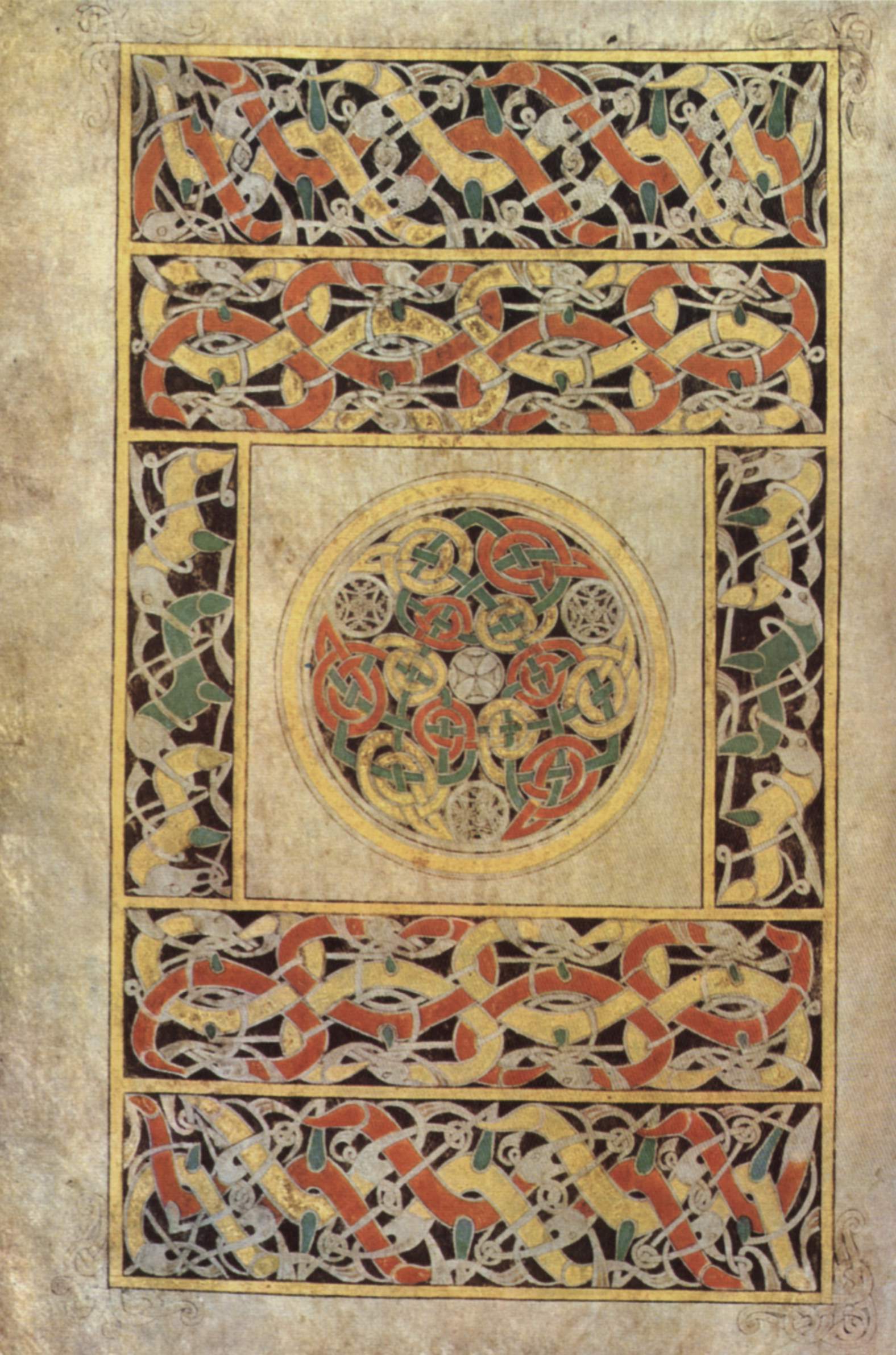
I would venture to say that the Insular art style with Celtic spirals, curvilinear, and geometric shapes employed in the Book of Durrow were not influenced by Norse or Viking raiding artisans. This kind of complex, intricate art did not suddenly spring forth in a brand new art form, the illustrated book arts. Especially when one's homeland was being invaded by Vikings. So what came first? Chicken or egg? (See folios 1v, 85v, 125v at bottom of Wiki page.)

There's more of a correlation with Anglo-Saxon art, and even that was a hybrid art form, later called the Hiberno-Saxon style. I find no Germanic Continental evidence of this Insular art form. What each of these cultures have in common, is exposure to Insular Celts. Early medieval Celtic book treasure bindings were highly coveted by the Vikings. One can only imagine what the lost treasure cover for the Book of Kells looked like.
Various metal fragments of what were probably book-mounts have survived, usually adapted as jewellery by Vikings. —Wiki
(Also, the Bronze Age Celts, and Celtic culture dominated the Continent, so some of their artifacts could have been found by what later become the ancestors of the Vikings.) There was cultural contact. But there's scant evidence that Viking artifacts predate Irish and Celtic art styles. To make an absurd parallel, many little girls the world over love Hello Kitty, that doesn't mean they were all Japanese samurai.
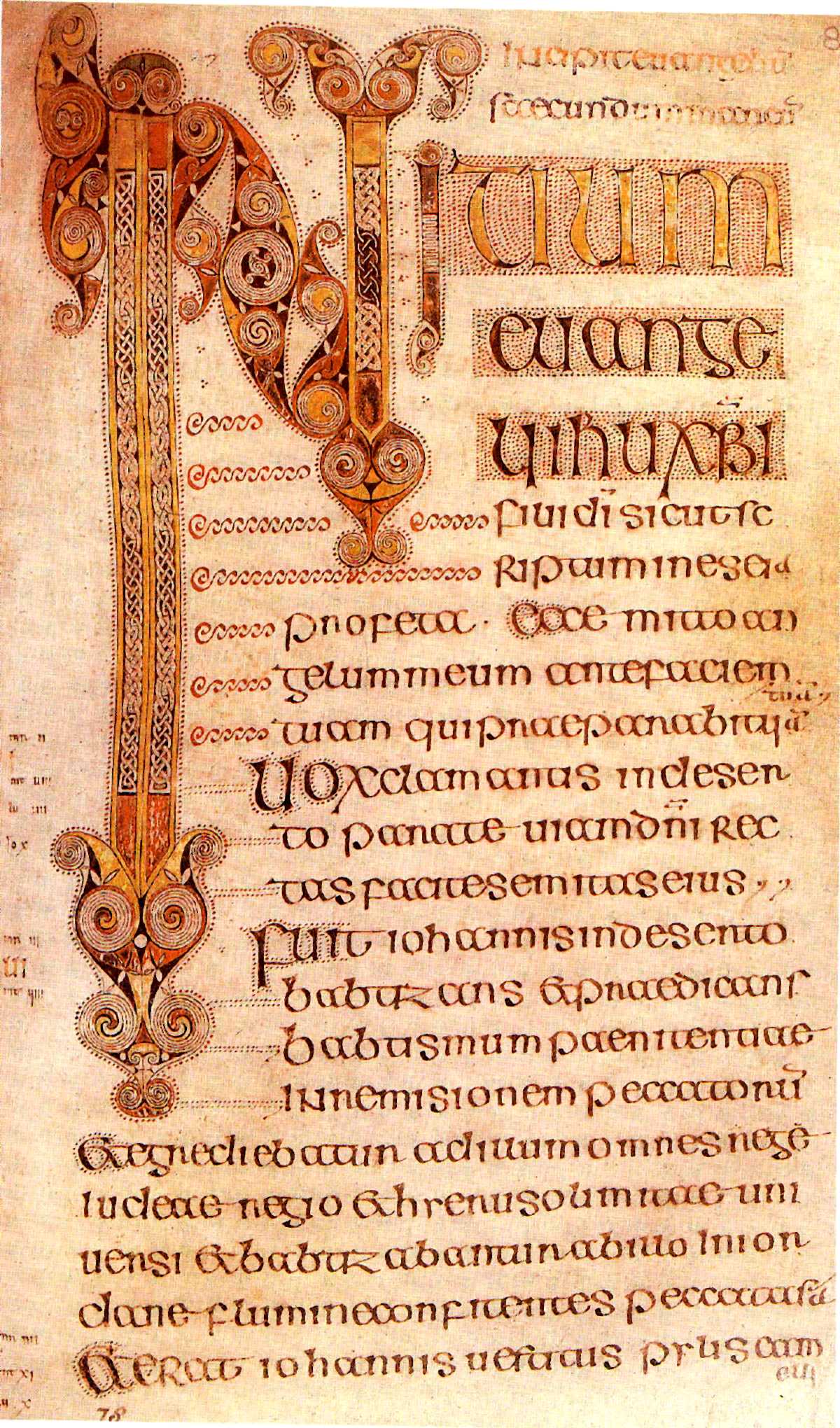

Gospel of Mark, Book of Durrow, 650-700 AD. —Wiki

The Vikings were raiders, they brought back artifacts from other cultures, which in turn, influenced their art. Geometric interlace doesn't appear in Viking culture until after they had contact with Britain and Ireland. They also brought back (Irish) slaves, who were artisans....Again, keep in mind the timeline, and it was a hybrid culture].

(See mid-9th c. Oseberg ship-burial. Artifacts included the Oseberg bucket, with patterned enamel figures similar "to the Gospel books of the Insular art of the British Isles, such as the Book of Durrow, (ca.650 AD)." —Wiki, and Irish Archaeology.

Several Viking ships in Roskilde Fjord, and the Skuldelev ships were made in Ireland. So claiming who did/owned what in the past is never quite as simple as it seems from our perspective. We don't know who carved the ships, and, again, it was a hybrid culture. Also, there was no timber in Iceland, so Icelandic ships too would've been built in Ireland or wood imported to Scandinavia.)

Book of Durrow Carpet page, similar in style to the Oseberg bucket, 650-700 AD. —Wiki
Check out the timeline, The Vikings (780–1100), and this one, but keep in mind that much of what we think of as Viking art was the result of artifacts collected from other cultures during raiding.

If you get a good grasp of the pre-Classical, Classical, and post Classical Celtic cultures, and migrations, then it will all make more sense.

Unfortunately working from a knowledge base that dates to the Plantation of Ulster as a reference point, is politically biased, therefore suspect. History written in the voice of the victor, and all that. Also, the intense hatred the English harbored for the ethnic Irish has also adversely colored "history." So, most Irish connections were extirpated. The OED is a prime example.

In Scotland, a lot of so-called Scots, were actually Irish. The Industrial Revolution, and two famines meant that many Irish immigrated to Scotland—especially The Barrows in Glesga, and along Clydebank (ships).

Yes, the Romans named the Picts, Picti, after a Continental Picti tribe, who were probably from the same Gaulish tribe. Picts were probably P-Celtic vs. Q-Celtic speakers. The Picts were also in N. Ireland, they were called the Cruithne, or Cruithín (they have an asteroid named after them, LOL!) The Cruithne/Criuthín included several tuatha, including the the Dál nAraidi—who settled in Scotland. Qritani/Cruithne comes from the word *pritenī (Pretani). Q-Celtic Irish speakers hated the plosive P sound and swapped it out for a more gutteral cough sound, hard c/q/k C: Cruithne/Pritani. mac/map, etc.

Ireland had many P-Celtic speaking tribes, as well as Q-Celtic speakers (Gaels, Galicia). See Ptolemy's map of Ireland for tribal names: Briganti, Dumnoni, etc. Cruithni and Menapi were probably Gaulish. The Ganganoi were also in N. Wales. In the 5th c AD, Gwynned was an Irish enclave, so there was a lot of back and forth movement.
A rendition of Ptolemy's map (Vlaclav Hollar, ca. 1650s-70s) —Wiki
Julius Caesar, in his Commentarii de Bello Gallico, is the first to call the island Hibernia... Wiki

Galicians were not Spaniards, but Iberian Celts, one of many CeltIberian tribes. Asturias, Galicia were Celtic kingdoms that managed to survive until the Middle Ages. They probably were the original Hispania immigrants who settled in Ireland, according to the Lebor Gabala Erenn (where the name Scotia is chronicled.)

In the Song of Amergin, the first Gael to settle in Ireland, (Galician) poet-druid Amergin (mac) Mil quells the sea, after the very tall Tuatha Dé Danánn send a big wind spell, proving he was a bigger, badder druid, than they. And to really ridiculously telescope mythological time, they slunk away, shrank, went underground, and became the fairyfolk!

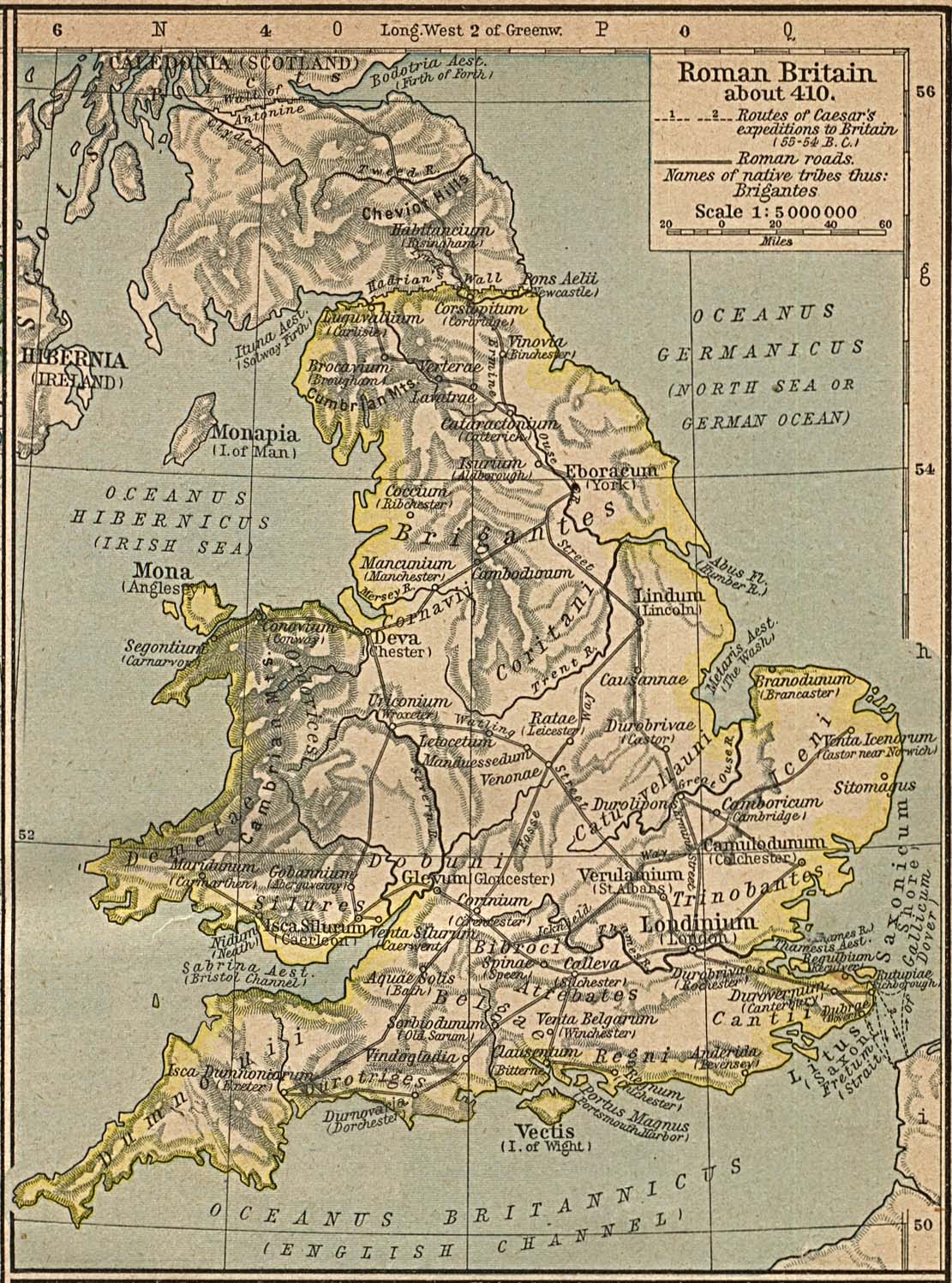
Here's a lovely Roman world view map of Scotland & Eire; note the use of the word Scotti in N. Ireland. Note also that Scotland was not called Scotland, but Valentia, and Caledonia. The Brigantes of Maxima Caesariensis were a buffer between Caesariens (Roman Britain) and what we now refer to as Scotland. Only Southern England, Kent, Cornwall and Devon (Cantii, Damnonii and Belgae tribes) was called Brittania.


Roman Britain —Wiki

Another old map.


Roman Britain in 410 —Wiki

And an updated 1654 map that chronicles Scotland as Scotia and Ireland as Hibernia/Ivverna. Pope Leo X (1475-1521) decreed (when?) that Scotland had exclusive rights to the term Scotland.
In early medieval times Ireland was known not only as Éire but also as Scotia, a name that the Romans used at times to refer to Ireland as well as Scotland. —Wiki

A 1654 map that notes Scotia as Scotland and Hibernia/Ivverna —Wiki

Sunday, July 12, 2015

MacCamelot: Stealing King Arthur, or Musing on Pseudo Histories


Oops! I made a grave mistake of responding to a link posted on someone's Facebook page. It was a poorly written pseudo-history article on King Arthur. I noted that it was an argument full of holes, and posted a comment (below), expecting a lively exchange. Instead I was unfriended for my candor. So very sad for the loss of friendship, I clearly misjudged her. I'm also flummoxed. Was I barking up the wrong tree? Perhaps I should have checked my allegory at the door.

Maybe it's because I've read so much pre-medieval and medieval scholarship, that I can't engage in reading pop-culture articles without a response. I thought the article was very poorly thought out, and said so. But it got me interested in researching the so-called "Scottish connection posed by Edinburgh author Adam Ardrey, (apparently he has an axe to grind with the English and Christianity). I was also curious to see if there were any interesting rebuttals posted on the internet.

I couldn't access the original link to the article in question as my friend had unfriended me. Then I remembered my browser's History menu. Yes! So here it is:

Was King Arthur actually Scottish? New research assesses the evidence

(More to come once I process it... or you can take a gander over to the Celebrate Scotland site. What follows below are roughshod notes—as I try and sort out my thoughts on the page. Or try and write my way out of a paper bag. So consider this a draft in progress.)


What I wrote on my former friend's Facebook page: 
"Augh, these dim-witted articles drive me crazy. Wasn't a myth of English-speaking people, as no one was really speaking much by way of English yet. Briton, maybe, Cumbric. Welsh was still differentiating itself from Cumbric at the time. Nennius was a bit of a fabulator. Geoffrey of Monmouth was much worse. If so, Arthur would have to be king of the Dalriadic Scotti, not the modern Scots. And it would be spelled Artio(s) or Artiaus (the bear). The entire west of Britain was Cumbric-speaking after the 5th c., with pockets of Erse speakers, significantly in Eboricum, along the Clyde, the Hebrides, and to north.
The place-names mentioned in the article are, in essence, Welsh words. it's really hard to get Avalon/ Welsh Afallon; Breton Avallenn from Hinba, or Iona.
Then there's the problem that both the Bretons and the Irish also have Arthurian tale, not to mention that the oldest Arthurian tale, Culhwch and Olwen is in Welsh.
Must be some sort of sugar rush from swilling too much Irn Bru affecting their brains."
So, was that above post harsh enough to merit my banishment from the kingdom of Facebook Friendships?


OK, so what little we do know is that King Arthur of myth and legend, was busy fighting against the Anglo-Saxon foe, so he couldn't be English as the Angles become Anglish. The Kingdom of Scotland wasn't founded until ca. 839, or 850 AD, so Arthur also couldn't be Scottish, as there was no such thing as Scotland yet. Caledonia was populated with Pictish natives and Irish settlers.

The Irish Scotti of Ulster migrated en masse to the edge of the Pictish lands (in what is now western Scotland), and founded the Kingdom of Dalriada (Dál Riata) in Caledonia at the end of the 5th c., so, if King Arthur was Scottish, as the article claimed, by this same insane reasoning, wouldn't that make Arthur Irish, and not Scottish?? LOL.

Pictland eventually fell to the Irish Scotti in 839 AD., Certainly Arthur was a Celtic, maybe Cumbrian, or proto-Welsh, or Cornish, or possibly a Romano-British, war leader, but Scottish? But not Anglish. What would Bede say?


This article, from the Scotsman, offers a more balanced rendition (if only they didn't use the word "Scottish"; my goat dander is all up in a fluff:

Author Adam Ardrey claims that Arthur was actually Arthur Mac Aedan, the sixth-century son of an ancient King of Scotland. Ardrey claims that instead of the romantic English king of legend who lived at Camelot – which is often said to be Tintagel in Cornwall or in Wales – Arthur was actually Arthur Mac Aedan, the sixth-century son of an ancient King of Scotland, whose Camelot was a marsh in Argyll. Ardrey, an amateur historian who works as an advocate in Edinburgh and previously wrote a book claiming Merlin the wizard was actually a politician from Glasgow, spent years investigating his theories and says that they can be proved “beyond reasonable doubt”. The assertions in his book Finding Arthur: The True Origins Of The Once And Future King are strengthened by the discovery in 2011—what some experts believe is King Arthur’s round table at Stirling Castle. Read more here: The Scotsman


Arthur was an English king? Where did that memo come from? In the 6th c, there was no Scotland. Certainly not a Scottish king. Pictish, maybe. And Merlin was a Weegie politician? 'Splains a lot. Must've been a Tory. Ardrey's theories can be proved “beyond reasonable doubt”? Amateur historian, indeed.

Tuesday, March 24, 2015

CAERNARFON

CAERNARFON

I stood at the massive gates 
of mighty Caernarfon Castle
one sultry summer evening, 
my back to Avalon, and the Holy Isle. 
I marveled at its tawny leonine beauty, 
reflected on twilight's indigo shoulders,
crowned with stars wavering in the moat.
But it was a fortress built by the enemy, 
with shackled native hands, for Longshanks, 
an agent of suppression, along with Beaumaris,
a triune kingdom on the edge of Anglesey.
Conwy Castle to the north, was once called
Aberconwy Abbey, founded by Llywelyn the Great,
the Prince of Wales. It was settled by English squatters,
where the Welsh were forbidden upon pain of death.
Such a gentle, pastoral word: colonization.
Images of sheep gamboling in green pastures.
Fields strewn with a hard culture of white bones.
And then the turbulent tide in the Menai Straits
began whispering a jumble of older names: 
Cair Segeint, the Roman garrison, Segontium,
or Cair Custoient, where stood the fort of Constantius,
he who begat Constantine the Great,
and Caer Aber Sein, the fort on the River Seiont.
And what of the hammer of the Ordovices?
In this rugged pasturage of bone, Caratacus still walks.
Not even Agricola launched the last sling and arrow.
In the kingdom of Gwynedd, the dream
of Macsen Wledig may have called me home
to the mouth of the River Seiont,
but the natives are still restless,
two dragons still fight in Dinas Emrys.
Owain Glyndŵr, the last prince of Wales,
returned and turned the bloodied tide,
a sleeping hero awaiting the klaxon call
of sword against stone—once and future king.
In my grandmother's house, the name
Longshanks, Hammer of the Scots,
was a curseword, along with Cromwell.
I found the dark road leading
to the bailey gate paved over
with the historical intent
of oppression.

3/24 and 4/1/2015

Wednesday, October 23, 2013

With Pointy Shoes & Bells on

                                      —For Adair Lara

Writer Adair Lara asked on Facebook: "How come people declare they will be coming to a party "with bells on"? Derivation?"

Someone lifted an old Yahoo Answers post to answer the origin of "with bells on" was when peddlers roamed the Appalachians selling wares, they traveled silently to avoid Indians, until they reached a settled area. Then they unmuffled the bells around their horses' necks to announce their arrival "with bells on."

And why were the horses wearing bells around their necks?

Well, I just couldn't pass that one up as it was wrong on so many levels. I'd just finished reading a paper on medieval shoes posted by Medievalist.net, so I was all fired up with useless pointy medieval shoe trivia, and nowhere to go dance it off.

The saying that Adair was referring to: "With rings on her fingers and bells on her toes" is from a 1700s nursery rhyme, Ride a Cock Horse to Banbury Cross. How much older the rhyme is, we don't know but nursery rhymes were passed on orally. I discovered that there are several motifs to follow: the role of hobbyhorse, white horse, rings and bells, and music (wherever the rider goes). 

William Wallace Denslow's illustration from1901—Wiki

The 1901 variant is based on this much older version:
Ride a cock horse to Banbury Cross, 
To see an old woman get up on her horse,
Rings on her fingers, and bells at her toes,
And so she makes music wherever she goes."
           —Warwickshire variant, from Gammer Gurtotis Garland (1783)
 Here's another variant (no date, sorry):
Ride a cock-horse to Banbury Cross,
To see a fine lady upon a white horse;
With rings on her fingers and bells on her toes,
She shall have music wherever she goes. 
It's a safe bet to assume the ditty predates the nursery rhyme published in 1744-84. But how far back it goes, nobody knows. (See Roud Folk Song Index # 21143). Some scholars think the words are associated with 11th c. noblewoman Lady Godiva (the horse tax-relief story appears two centuries after her death), or with Queen Elizabeth I, but it could be much older (or not). 

BTW, I know what you're thinking, a cock-horse is a hobbyhorse, a rocking horse, or a dandle horse. (It also could refer to helper horses who pulled  carriages up steep hills. First use, ca. 1541.)

I found this on Yahoo (it sounds spurious):
Queen Elizabeth I of England travelled to Banbury to see the new stone cross. 'With rings on her fingers' relates to the jewellery which would adorn a Queen. 'And bells on her toes' refers to the fashion of attaching bells to the end of the pointed toes of each shoe! Banbury was at the top of a steep hill and a white cock horse (a large stallion) was made available to help pull the carriages up the incline. When the Queen's carriage wheel broke, the Queen mounted a cockhorse to reach the Banbury cross. Her visit was so important that the people decorated the cockhorse with ribbons and bells and provided minstrels to accompany her "she shall have music wherever she goes". The big cross at Banbury was later destroyed by anti-Catholics. (NB: I shortened this piece, so it's not quite a quote).
Another train of thought is that it's an Anglo-Celtic nursery rhyme, merging Anglo-Saxon noblewoman Lady Godiva (gift of God), and Welsh goddess of the crossroads, Rhiannon (divine/great queen). A white horse, white mare, or a milk white steed is also a reference to the Celtic Otherworld (Open House is Oct 31, May 1), as is the symbol of Rhiannon who rode a white mare. A Gaulish Epona (Irish cognate: Macha) reference is embedded. 

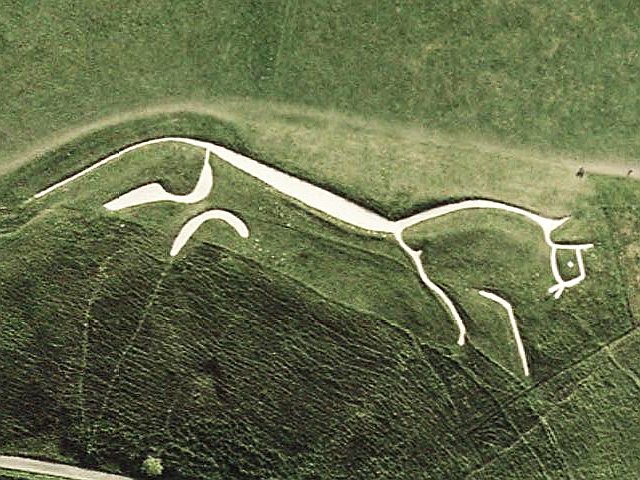
A white mare, a symbol of sovereignty, is a kingmaker because through her, the sacral king marries the sovereignty goddess, or the land itself. Giraldus Cambrensis described a "Celtic ritual, the king mates with a white mare thought to embody the goddess of sovereignty."—Wiki The millennia older Bronze Age white chalk horse of Uffington was also embedded in the folk memory of southern England.

The Bronze Age white horse of Uffington, on the Berkshire Downs in southern England, ca. 1400 BC.

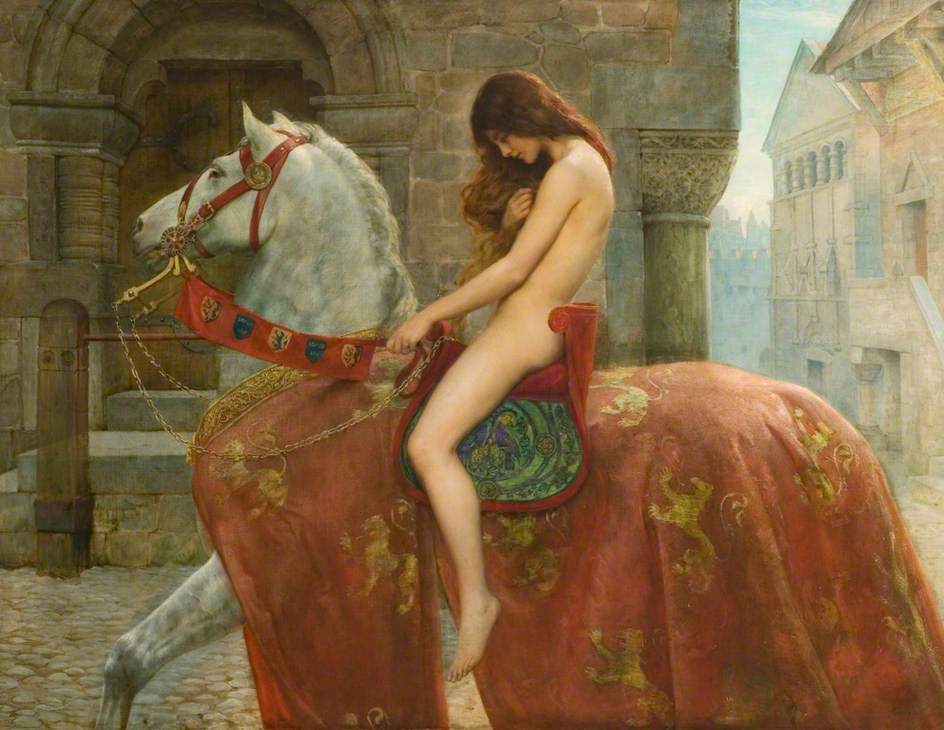
It's been suggested that Rhiannon is the archetype for Lady Godiva, and the nursery rhyme is about Lady Godiva. If Lady Godiva rode through Coventry town on a cock-horse buck-ass naked, where would she have hung her bells? Detail. Not buying it.

Lady Godiva by John Collierc.1897, note the white horse.—Wiki

To finish Rhiannon's story, though betrothed to Gwawl of Annwyn, Rhiannon married Pwyll, Lord of Dyved; at their wedding feast, she turned the jilted conniving Gwawl into a badger, and Pwyll bagged it—and thus, badger in the bag was born. There will be blood! Rhiannon was framed for her babe's murder, and forced to stand at the city gates wearing an asses' collar, proclaim to all that she killed her son, and carry visitors on her back like a horse into the keep. Throughout all the Welsh tales halo of birds is Rhiannin's enduring motif.
Ride a cock horse to Banbury Cross (or Coventry)
To see a fine Lady ride on a white horse
With birds as her halo and bells on her toes,
She will/shall have music wherever she goes.  
Note a distinction is made between She shall, or will have music versus She shall make music. Sorry, no date on this one either.

Banbury, Banna's 5th c. Saxon stockade in Oxfordshire, was built atop a 200 BC Iron Age fort at an ancient crossroads; it was the site of a battlefield between Anglo-Saxons and Britons in 556 AD.
The name Banbury derives from "Banna", a Saxon chieftain built a stockade in the 6th century (or Ban(n)a possibly a byname meaning ‘felon’, ‘murderer’, and "burgh" or settlement. The Saxon spelling was Banesbyrig. The name appears as "Banesberie" in Domesday Book. Another known spelling was 'Banesebury' in Medieval times.
Fittingly, Banbury has a Hobby Horse Festival. Hobby horses have a deep Epona connection, and in Wales, Cornwall and Somerset, they are associated with May Day, and Bealtaine celebrations (later moved to Christmas / New Year); Mummers PlaysMari Lwyd, and the Morris dance. Aka morisk, moreys, morisse daunce, it may mean a Moorish dance. But that may be a convenient assumption. First documentation in 1448 was a bill for seven schillings. There were definitely lots of bells on the Morris dancers' shanks' mares (shins). )

Welsh Mari Lwyd with Christmas ornaments for eyes.

Maybe the origin of the phrase With birds as her halo came from the Mabinogion recorded in the White Book of Rhydderch (scribed ca.1350, but from the 11th century), but I cannot find a reference to rings on her fingers, and bells on her toes in English translations. I did find this lovely line: "The birds of Rhiannon, they that wake the dead, and lull the living to sleep…"

Did the idea cross the Welsh border and enter into English? Lady Charlotte Guest's translation of the Mabinogion was published in 1877. Or is the line solely an English provenance? The English phrase is attested in English in 1745. Rhiannon's halo of magical birds of music didn't make an appearance in that edition, but the line with rings on her fingers and bells on her toes has managed to remain intact in English for at least 275 years. Maybe longer—though the wording is modern. It may be two different traditions merging.

How would an Elizabethan have said the phrase, or someone from the Middle Ages? (Surely they wouldn't refer to Elizabeth I, or Lady Godiva as old ladies!)  When does the phrase With rings on her fingers and bells on her toes enter into our language banks? The terminus ante quem question still begs and I'm far too lazy to drag my old bones to the musty basement of UC Berkeley's Doe Library, or Kroeber Folklore archives, to look up the rhyme like my folklore professor, Alan Dundes would expect of me. Maybe someday.

     *     *     *

Monday, July 7, 2008

Snowdonia, Wales

THURSDAY, JULY 3, 2008


I have literally just crawled out of the soggy mountains of Snowdonia, we went to to the holy isles of Anglesey, and Holyhead Island, and found among the bracken, the remains of an Iron Age fort. Also a passage grave, with two standing stones near the village with the longest name in the world. Will add it when I have better computer access.

Hope to be in Omagh, Ireland, next week if we can get a good passage, everything's so expensive...I'm in Manchester the noo. Crossing the Mersey was not like crossing the Mississippi at Memphis, but there was a thrill. it's Ferry, cross the Mersey... all this time I thought it was Mary crossing the Mersey.

We're in Manchester at the moment, just back from Wales... It's so very post industrial here. Makes Glasgow seem like a Victorian queen. Never thought I'd say that.

Liverpool in the distance with all its smokestacks. Grey on grey against a grey sky drained of color. Even the river is the color of steel. Manchester is made entirely of brick, so it's a red city.

My iMac went down with a flourish right before we left stateside and I'm down to the very sluggish Macbook...no pix on it, alas...teeny hard drive. Believe it or not the DVD drive went down too...so I can't resurrect the iMac... Luckily I have most stuff on a back up HD...it will be hard work to restore all my data when I return home.

I'll be back stateside Aug 7 by way of Cape Cod to perform at the Cranberry Coast Concert series. We have at least four gigs. It should be fun. I've never been to Massachusetts. I'm thinking of that Bee Gee's song...

It's been that kind of a summer. Sappy pop song fragments and little else worthy of transcribing. Oh, and some 5000 photos to sort and edit. They will yield more language, I think.

Monday, June 30, 2008

Caer Bryn Celli Ddu, Anglesey, Wales (photos)


Caer Bryn Celli Ddu, (the mound in the dark grove) was hard to find, it's a few miles south-east of the village of Llandaniel Fab, on the isle of Ynys Môn, (Anglesey, North, Wales) Cymru.

Bryn Celli Ddu is a chambered barrow that marks the summer solstice. It's linked to Maes Howe and Newgrange—that mark the winter solstice).

The mound's stone passage points to the midsummer rising sun. The rays light up a quartz-rich stone at the back of the tomb—like at Newgrange. An outer ring of postholes have been dated to over 6,000 years ago. A Welsh Stonehenge.


Caer Bryn Celli Ddu, (the mound in the dark grove)—a Stonehenge-like chambered barrow with a lightbox similar to that of Newgrange, that marked the summer solstice—making it linked to Maes Howe and Newgrange—that mark the winter solstice), near Llanddaniel Fab, on the isle of Ynys Môn, (Anglesey, North, Wales) Cymru.

The mound's stone passage points to the midsummer rising sun. An outer ring of postholes have been dated to over 6,000 years ago. A Welsh Stonehenge. The rays light up a quartz-rich stone at the back of the tomb.

In the early 5th century, Irish seafarers (OK, pirate) colonized Anglesey & were driven out 470 AD (or so they say), but Gwynedd has had a long history of Irish settlement. And many of those Welsh-Irish seafarers returned to Ireland with Strongbow's "Norman" invasion. Probably our Walsh ancestors.

The mound's stone passage points at the midsummer rising sun. Postholes outside, previously thought to be contemporary with the tomb (c3000BC), have been dated to over 6,000 years old. A row of five postholes in front of the barrow appears to be much older. A Welsh mini Stonehenge. The rays light up a quartz-rich stone at the back of the tomb. More 


Afternoon light striking the menhir inside the passage tomb just after the summer solstice. Not much light so I resorted to B&W. Photo below this one is a flash—it washed out detail, but also revealed the modern red ochre ogham on the cement lintel. Top of stone is also covered in red ochre.


The freestanding menhir inside the barrow is an oddity—there is no other example anywhere. There was a fire pit at the center of the henge (probably about where I'm standing to take this photo), covered by a stone slab with a human ear-bone beneath. (Stirrupbone?) Ear to the ground! Thought to be a re-dedication offering. 

Also found inside the barrow was a stone with wave and spiral designs across its surface—a replica is at east entrance. The much older standing stones were deliberately damaged when the tomb was constructed. Also nearby, there was an ox burial inside a three-sided shelter, with quartz pebbles (pavement?) like Newgrnge, but this is a summer solstice passage grave, not a winter one. The reconstructed mound is one quarter of the size of the original chamber.


©Maureen Hurley 2008

Nota bene: Newgrange, Grianstad inniu, The winter solstice date is normally considered to fall on the 21st of December in the northern hemisphere, however during the winter solstice, the position of the sun remains the same for three days. At Newgrange, the passage and chamber of the 5000-year-old monument are illuminated by the winter solstice sunrise. A shaft of sunlight shines through the roof box over the entrance and penetrates the passage to light up the chamber. The dramatic event lasts for 17 minutes at dawn from the 19th to the 23rd of December.  More


12/2013: After being MIA for years, my lost Scotland/Wales pix showed up on an old hard drive—so thrilled to see them again. I only had the one I posted (above) earlier. Now I have a choice, oh my!

added 2/2017