Showing posts with label Kenneth Rexroth. Show all posts

Friday, October 7, 2022

Gallery 6 reading poster


From City Lights Bookstore: 
On this day, 67 years ago, the Six Gallery reading took place on 3119 Fillmore St.
Philip Lamantia (reading the work of John Hoffman)
Michael McClure
Allen Ginsberg
Gary Snyder
Philip Whalen
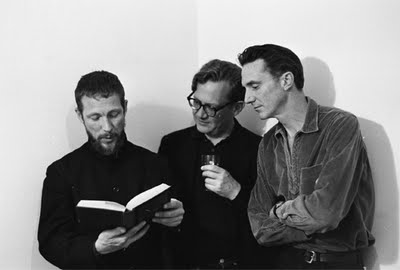
Kenneth Rexroth was the MC


A momentous event in Western literature, 1955, this reading at Gallery 6 heralded in the birth of the Beat poets. Kenneth Rexroth would’ve been the most renown poet of his time, part of the San Francisco literary renaissance. The others were relatively new to poetry. The idea of Beat poets had not yet been coined.

My old boyfriend, John Oliver Simon, was one of the Six Gallery poets featured at a later reading. He had a framed poster on his living room wall. He considered it his most significant reading. I never thought to take a photo of it.

I knew everyone on this list, except for Lamantia. I only knew McClure in passing; Ginsberg and Rexroth were aloof. Snyder and Whalen were always kind, especially Philip. 

Also in attendance were Jack Kerouac, and Lawrence Ferlinghetti, who published Howl after hearing it at the reading. And Neal Cassady was the doorman. One can assume that Jack Spicer was also there. And Robin Blazer. One could also speculate Robert Duncan was there too…. It was a small world. Gallery co-founder, Wally Hedrick lived in the San Geronimo Valley, where I grew up….

I have old negatives (I need to scan) of most of them….way back from when I was newly arrived to poetry. I was always documenting readings as no one else was…. We produced a new reading with Kenneth Rexroth and Michael McClure at Sonoma State, it was a stellar event. Ginsberg came to a friend’s memorial service in Santa Rosa which blew all our minds.

Rexroth, who wrote a weekly column, was a hiking buddy of my grandfather’s, at Devil’s Gulch. And his wife used to attend our church in Lagunitas. She kept the name long after Kenneth had divorced her.

Poet Kenneth Rexroth wrote some 700 columns (1960-67) for SF Examiner, he was known primarily as a political and cultural radical, and  even (somewhat misleadingly) as "the godfather of the Beat Generation." See my post on Rexroth columns, a synopsis of the reading from Verdant Press, and McClure’s reminiscences at UC Press post.

Thursday, December 22, 2011

REXROTH


The Rexroths owned a summer cabin a few ravines over from us. After school, I used to ride my red mare by his place near Dead Man's Curve on the way to the Inkwell. I remember the wooden sign, a fence plank with Rexroth painted in big black letters, rotting into the hillside. Tanoak and redwood duff. His wife used to sit in the same pew as my grandmother at St. Cecelia's Church in Lagunitas. The morning sun lit them as if from within. Sometimes my grandfather would run into him hiking up Devil's Gulch. They talked of salmon runs and politics. He religiously clipped Rexroth's newspaper columns with curved nail scissors. I remember reading the yelllowed columns as a child. No idea of him as the poet. Or me either.

Tuesday, February 23, 2010

Kenneth Rexroth's columns (1960-67) for the SF Examiner posted


Poet Kenneth Rexroth wrote some 700 columns (1960-67) for SF Examiner; Ken Knabb will post them 50 yrs after original pub date at the Bureau of Public Secrets.

Says Knabb: "Although Rexroth was by that time a well-known figure in the Bay Area, he was known primarily as a political and cultural radical, and even (somewhat misleadingly) as "the godfather of the Beat Generation."

But he was willing to work for the Examiner as long as they gave him complete freedom to write whatever he wanted. They did so until June 1967, when they fired him after he wrote a particularly scathing article about the American police."

Columns from the San Francisco Examiner (1960-1967) and San Francisco Magazine (1968-1975)


Kenneth Rexroths San Francisco Journalism (1960-1975).
bopsecrets.org
 

 http://www.bopsecrets.org/rexroth/sfe

More Kenneth Rexroth columns posted here:
http://www.bopsecrets.org/rexroth/sf
Sam Hamill Rexroth, on being called Grandaddy of the Beats: "An entomologist is not a bug." Robert Duncan on KR's role in the San Francisco Renaissance: "He was our chief librarian."
 
Mo Hurley Ha! My grandfather used to hike with Kenneth up Devi's Gulch. My grandmother religiously saved all his columns; she also sat next to Marie Rexroth at St. Cecelia's church in Lagunitas for decades! I used to ride by their cabin on horseback—REXROTH painted in black on a long wooden board resting in the redwood & oak duff. Funny reading about Kenneth's girls, knowing that John McBride would later marry one—he used to spend time with his aunt & uncle who lived in Nicasio (or had a summer home) & we knew them as well. I met Kenneth at Sonoma State—I'd organized a reading for him there but he was a right cranky old codger with everyone religiously kowtowing before him...he was seemingly bored with living.
 
Sam Hamill Far from it. Kenneth was fed up the capitalist criminal class and had many health problems in his old age. Around young progressives and radicals he was a-glow. Next fall or spring U of Michigan will publish Rachelle Lerner's absolutely masterful book on KR, a thoroughly researched critical appreciation.
 
Mo Hurley It was right before he died—in 81, I think; and he wasn't in good health...his wife was ? jean?
 
Sam Hamill Carol Tinker.
 
Mo Hurley Right!
 
 
from a facebook post

Sunday, March 8, 2009

Remembering Lew Welch


There's been a bit of a buzz on Facebook lately about Beat poet Lew Welch. Poet/guitar maker, L. Layne Russell posted a link from PennSound and I found myself listening to audio bytes of Lew's poems and writing a small memory fragment on David Meltzer's wall. I realized I'd never written about that memory as there wasn't very much to it. No context by which to frame it other than our family names.

But then the little bits of Lew fragments began to add up into a strange constellation of words wanting reassembly. Like Brodsky, I'm "caught up by the relentless centrifugal nature of language." So I guess I have David Meltzer's Two-Way Mirror to blame for this wee blogeen. Go raibh maith agat! They are so few and far between.

David wrote on his wall: "Lew was mentor & friend & we all miss him & keep waiting for him to buzz the bell & visit & listen to Lester Young & knock back a fifth of something strong & then say goodnight & split."


Ar scáth a chéile a mhaireann na daoine:
people live in one another’s shadows.

My mother, nee Maureen Reilly, then, Maureen Hurley, who chucked out all her given and married names, and went by the stage name, Kellé Hurley, and later, Kellé Green, as the name Maureen Hurley was already taken at SAG. She was a Project Artaud artist-painter, an actor, fey poet, and friend of Bobby Kaufman, the first poet who was reputed to have been called a "Beatnik." (Thanks to the press in Herb Cane's weekly column, the moniker stuck).

My mother occasionally hung out with the Beats in North Beach but they were really an exclusive bad boy's club. No women need apply. Many women who later aligned themselves with the Beats were ex-girlfriends and hangers-on. She was no one's girlfriend. She was her own woman. (I once saw a photo in a coffee table book, of my mysterious mother dressed in a striped Marseilles style sailor shirt and black capri pants. Several Beat poets and artists are standing on a street corner. But she's standing off to one side, by a street post, as if not quite with the group, slipping out of the confines of the frame and time. But she was like that.)

I was raised—not by my mother, but by my Irish grandmother who hailed from Bantry Bay, County Cork—out in the west country, in the wilds of Forest Knolls, which in those days, was light years from Fairfax, let alone, San Francisco.

We lived in an red iron oxide stained house perched on railroad ties; it had a summer porch with copper screens and windows salvaged from St. Vincent's School for Boys. It sat alone on a southwestern slope above the watershed of Arroyo Creek on Barranca Road.

My grandmother named the land Coom an-nÓr, the Hill of Gold, with twinned live oaks lining the gateway. Our place looked remarkably like my grandmother's lost family farm in Bantry. Hence the name.

Living out so far in the country in the late 1950s without public transport or a car, meant we were fairly well isolated, and dependent upon neighbors and relations to go Over the Hill (White's Hill) into Fairfax for shopping, or out to Point Reyes, where my doctor, Dr. Whitte (the poet), lived. (But I didn't find that out until years later). But the land was good to us, it fired and fed the imagination.

My grandfather had died a few years before, of throat cancer so I was my grandmother's sole companion. They sold the City victorian on 131 Third Avenue after he died. Forest Knolls was always our country home since the early '20s, we were Old Marin. My grandfather bought the house back in 1910 and the two other lots later from a railroad man who kept his silver under the floorboards. We had thirteen acres straight up a steep coastal hill replete with its own dolmen and artesian spring, facing westward towards Mt. Barnabe, was home.

During the Great Depression, my family lived in Forest Knolls year round, with my grandfather commuting into San Francisco by train and by ferry. The train tracks were all pulled up during WWII for the steel. We used to love hiking and riding along the level railroad beds. No greasebush meant no ticks.

Anyway, one bright afternoon, this yellow checker cab came bounding up our long dirt driveway, lurching and leaping the potholes like a wild pony. The white cab sign perched on the roof, like a nurse's cap. Maybe it was a Red Cross rescue mission. Who was being rescued will never be answered in this lifetime.

We rarely had visitors. In those days, there was very little traffic in the San Geronimo Valley. In those days, it was so quiet, you could hear the progress of a lone car shifting into third gear up the long mile stretch of Arroyo Road from Sir Francis Drake, the highway that bisected The Valley.

We were trapped on an island lost in time and place, caught somewhere between a metaphoric incarnation of Appalachia, the Ozarks and the Azores. We were a backwash of immigrants and welfare families. Not part of Marin proper. The Point Reyes National Seashore was still working ranches, not an urban escape route.

Seeing a cab this far out in the wilderness was akin to seeing a mirage or maybe seeing the bus, Priscilla, Queen of the Desert (but neither Priscilla nor the Magic Bus had yet been born—there's a story about that too.) In those days, there was an unwritten rule: a San Francisco cabbie didn't cross the Golden Gate Bridge. Ever. Besides, there was a $50 surcharge. A bloody fortune in the 1950s and '60s. If my mom had paid that cab fare, it would've taken her SSI checks for the next six months.

Whenever my crazy mom got her SSI check, we could expect a visit, so it must've been at the beginning of a month. What month, I couldn't tell you. Or what year. Or whether it was spring, or fall, but it felt like it was a Sunday afternoon in the fall. Perhaps because my grandmother was lying on the couch reading the Sunday paper, or because it was sunny and there was something evocative about looking up at that indefatigable blue sky of childhood so irrevocably linked to memory that will haunt me forever.

The cab pulled around the Bishop pine at the bend by the big live oak into the turn-around in front of our house and came to a sliding halt at our front door. A puff of dust. My mom and a tall fellow unfolded themselves from the car. My grandmother looked out the kitchen window and said, "Oop, it must be the beginning of the month. Here's your mother." She put the kettle on.

In our house, the ritual of tea was required to properly welcome all visitors, whether they were family, friends or strangers. Fill the kettle to the top with spring water from the tap. Bring the water to a full rolling boil, scald the big teapot, measure in a rounded teaspoon of loose Irish tea (McGraths, Barry's or Lyons will do), one for each guest. Don't forget to put in an extra spoonful for the pot. Reboil the water. Fill teapot to brim. Brew 5 minutes.

Mom and the cabbie, Lew Welch came in and settled in on the other couch by the window; my grandmother got up from her couch, stooped over the tea tray atop old Life magazines and the Sunday paper scattered on the heavy octagonal oak card gaming table, with sawed off legs cut down low to coffee table size. As my grannie poured tea, it was the music of running water and ancient healing wells. My mom had resurfaced the"coffee" table with an awful gold and white mottled faux marble finish, and in the middle of that gold lake, a large crescent black and gold moon shaped ashtray floated; it matched the painted black legs. Very homegrown '50s moderne.

Scores of escaped cigarette butts had burned and scarred the table surface so that it puckered up like tiny craters. But a permanent layer of newspapers hid them from sight. Besides, over the decades, the original oak surface had been burned so many times it looked like a herd of tiny black feet had trompled across it.

What made that oak table really great, was being able to put both your feet up on it, and kick back. It was funny to watch a guest realize that he was expected to put his feet on the table—thinking he'd died and gone to heaven. Someone said those old oak tables were made heavy on purpose so that no irate gambler who lost a fortune at a bad hand of cards, could tip it over in a rampage. It was made to keep gamblers honest. It was so thick, it could probably stop a bullet too. I sat on one corner and watched my mom and Lew chat.

My grandmother poured the properly brewed Irish tea into big mugs, mixing it with milk and sugar, the spoon beat out a melodious rhythm like the clapper of a small bell— like the ones the altar boys rang during the mass. Lew was in luck. There were thick wedges of her famous sodabread hot out of the oven, slathered with butter too. He settled back with a jailhouse mug of tea in hand. Put his feet on the table and kicked back while the Bushmills was released from its prison of closet and shoes to baptize and benedict their cups.

Conversation droned on, sonorous as bees converging on the hive. My grandmother launched into yet another long diatribe about the ancient Celts or politics and such…. Her index finger punctuated each point. My grandmother's maiden name was Walsh. She was busy telling Lew that Walsh and Welsh/Welch were all the same name, meaning the Welshmen who came into Ireland with Strongbow during the Norman Conquest (1169) and settled in Wexford and Bantry.

By the second cuppa tea, we were practically cousins in her telescoping of time. She was deep into the abduction of Dervorgilla, a Breifne chieftain's wife (Tiernan O'Rourke), by Dermot MacMorrough and his traiterous deed which led to Ireland's downfall and played her into the hands of King Herry II of England.

At the creek of Baginbun, Ireland was lost and won.

Welch-Norman lord, Richard FitxGilbert de Clare, Earl of Pembroke, AKA Richard Strongbow (moniker for Welch longbow archers), had fallen out of favor with Henry and saw the invasion of Ireland as a way to curry his back into Henry's good graces. Strongbow's forced marriage to Dermot's daughter Aiofe and the fall of (Viking) Wexford in 1170 pretty much sealed Ireland's fate; when Dublin fell, she would be forever wedded and chained to England.

The diatribe of Cromwell the antiChrist, was up next. My grannie was on a roll. We were well beyond the Pale. My attention wandered, I was a child, and I wanted to play outside, so I don't remember much else.

What I do remember was looking up at Lew; he was a tall, thin cool drink of water, with his auburn hair slicked back, looking so much like my uncles, I thought we were related. They all had the same pointed widow's peak, freckles, and a toothy Irish grin. Lew looked like a cross between Uncle Myles (who had recently died of melanoma) and Uncle John. We were down to two men. Lew was a shoe-in.

But Lew's widow's peak was more pronounced like Uncle Bill's. He looked closest to an old picture of my Uncle Feilim on horseback, but I never met my Uncle Feilim as he died at 17, in my grandmother's arms, of a ruptured appendix right in this very room. Perhaps that's why my grandmother and my mom took such a shine to Lew. Family resemblance. My grandmother never got over Feilim's death.

How my mother and Lew met, the details are lost to history, or herstory—interrupted by death, but my mom probably was a fare he'd picked up in San Francisco, and they got to talking. You know how gregarious the Irish are, with the gift of the gob, I mean, gab. I suppose Lew was living in Corte Madera or Fairfax (or maybe Bolinas) in those days, so he was probably on his way home after a slow day trolling for fares.

But Lew did rescue my mother from the streets of San Francisco more than once. She was a damsel in distress (I'm sure it didn't hurt that she was a a tall, willowy stunner with a long mane of fiery auburn hair and a classic Irish face). Those two crazies decided to take a ride out in the country to meet my rather remarkable Irish grandmother who was an active bearer of the oral tradition and language.

Besides, Lew had friends in The Valley. Grover Sales was living right down the road with Chuck (Charlene) Sutton, the jazzman's wife, in Lagunitas. Sutton and Tristano were hot in the New York jazz scene. When I was in my 20s, a boyfriend, Geoff Davis loaned me a copy of Ring of Bone autographed by Lew over to Grover Sales. But Geoff took it back when we broke up. So I made a photocopy of the book because Ring of Bone was out of print and Lew hadn't yet been "rediscovered" so there were not reprints and posthumous collections in their second incarnation.

In those days, Kenneth Rexroth still had his summer cabin past St. Cecelia's Church on Sir Francis Drake Boulevard between Dead Man's Curve and the cutoff to China House by Shafter's Bridge and the Inkwells. Though Rexroth probably wasn't there as he lived mostly in town.

Come summer, we saw his wife. Marie in church on Sundays. Never Rexroth Himself (my grandfather once hiked up Devil's Gulch with him). My grandmother religiously read Rexroth's weekly column in the News Call Bulletin. Mrs. Rexroth sat in a pew near my grandmother. They always sat on the left side of the church, facing the altar, third pew from the front.

Well, my mom came home that afternoon for tea, stayed a while and then, inexplicably, she left again with Lew. Oxymoron. I was pretty upset as I rarely saw my mother as it was. Sometimes it was months, or a half a year or more between visits. I pined in loneliness like a dog. Hid my scalding tears so no one ever knew.

I guess my mother was no longer just a fare, but an affair of sorts, she got around, some memories are better lost or forgotten and buried along with the dead. She was always leaving me behind. The road, always longer than memory. I carried an ache that was never erased by posthumous promises and tearful embraces at Christmas.

I remember Lew coming back up to the house a couple more times, dropping my mother off. I used to confuse him with Keith Bullock whom I knew long before I met his son Ken, in high school.

I don't remember meeting Huey Lewis, Lew's stepson (it was plausable), but we went to different schools. I knew of Huey because when he played at Uncle Charlie's in Corte Madera with Alex Call, we'd make a pilgrimage to see Lew's stepson play music on Monday nights.

I remember meeting Magda and Honey (Lenny Bruce's ex-stripper wife) in the '70s at The Sleeping Lady Cafe in Fairfax. I may even have a photo buried somewhere. I knew that Huey took Lew's name as his own. But I was not a writer. I had to wait until I was 30 before I began to write. So it comes in transparent dream fragments—shattered, reflected images trapped in pur-blind mirrors.

I can't help but wonder if my grandmother's Irish stories affected Lew, did he remember them? Who was Alice Herlihe? ("Winter") Herlihe is the Irish form of Hurley.

Mt. Tamalpais from Big Rock Ridge, Lucas Valley.


One of my favorite Lew Welch poems is "The Song Mt. Tamalpais Sings," perhaps because I was conceived on the western slopes of the Sleeping Lady. I imagine my mother looking over my father's shoulder at the jewel, Bolinas Lagoon, sparkling in the distance at sunset, whenever I read this poem.

Mt. Tamalpais from Loma Alta/White's Hill, Fairfax.

THE SONG MT. TAMALPAIS SINGS

This is the last place.
There is nowhere else to go.

Human movements,
but for a few,
are Westerly.
Man follows the sun.

This is the last place.
There is nowhere else to go.

Or follows what he thinks to be the
movement of the Sun.
It is hard to feel it, as a rider,
on a spinning ball.

This is the last place.
There is nowhere else to go.

Centuries and hordes of us,
from every quarter of the earth,
now piling up,
and each wave going back
to get some more.

This is the last place.
There is nowhere else to go.

"My face is the map of the Steppes,"
she said, on this mountain, looking West.

My blood set singing by it,
to the old tunes,
Irish, still,
among these Oaks.

This is the last place.
There is nowhere else to go.

This is why
once again we celebrate
the great Spring Tides

Beaches are strewn again with Jaspar,
Agate, and Jade.
The Mussel-rock stands clear.

This is the last place.
There is nowhere else to go.

This is why
once again we celebrate the
Headland's huge, cairn-studded, fall
into the Sea.

This is the last place.
There is nowhere else to go.

For we have walked the jeweled beaches
at the feet of thr final cliffs
of all Man's wanderings.
This is the last place.

There is nowhere else we need to go.

—Lew Welch


Speaking of Lew the Cabbie, I found this poem:

AFTER ANACREON

When I drive cab
I am moved by strange whistles and wear a hat.

When I drive cab
I am the hunter. The prey leaps out from where it
hid, beguiling me with gestures.

When I drive cab
I am guided by voices descending from the naked air.

When I drive cab
A revelation of movement comes to me: They wake now.
Now they want to work or look around. Now they want
Drunkenness and heavy food. Now they contrive to love.

When I drive cab
I bring the sailor home from the sea. In the back of
my car he fingers the pelt of his maiden.

When I drive cab
I watch for stragglers in the urban order of things.

When I drive cab
I end the only lit and waitful thing in miles of
darkened houses.

—Lew Welch


In 1971, while staying at Gary Snyder's house on Kitkitdizzie Ridge, Lew Welch walked off into the wilderness carrying his shotgun; his body was never found. So the story goes. Fare meter up. He left a note for Snyder:
"I never could make anything work out right and now I'm betraying my friends. I can't make anything out of it — never could. I had great visions but never could bring them together with reality. I used it all up. It's all gone. Don Allen is to be my literary executor — use MSS at Gary's and at Grove Press. I have $2,000 in Nevada City Bank of America — use it to cover my affairs and debts. I don't owe Allen G. anything yet nor my Mother. I went Southwest. Goodbye. Lew Welch."

And at a fateful reading of Gary Snyder's at Olney Hall, College of Marin, CA. 1976, I heard Gary read Lew and Manzanita. He was reading poems about MY watershed, my ridges and groves, that's when I decided to become a writer. I said, "I can do that." Little did I know what I was in for...and some 33 years later, I'm still teaching the children about the life cycles:


FOR/FROM LEW

Lew Welch just turned up one day
live as you and me. "Damn, Lew" I said,
"you didn't shoot yourself after all."
"Yes I did" he said
and even then I felt the tingling
down my back.
"Yes you did, too" I said -- "I can feel it now."
"Yeah" he said,"
"there's a basic fear between your
world and mind.
I don't know why.
What I came to say, was,
teach the children about the cycles.
The life cycles. All the other cycles.
That's what it's all about,
and it's all forgot."

27.IV.76
—Gary Snyder

from An Appreciation of Lew Welch,
edited by S. Fox, Stone Soup.

Gary Snyder, Phil Whalen & Lew Welch

For more Lew stories, check out "Hey Lew." Clew Press, Bolinas, CA,1998.

Audiotape of Lew Welch reading at SF State Poetry Center (via Ron Silliman's Blog).


Wednesday, September 20, 1995

After Hearing Gary Snyder Read on the Autumn Equinox, photos


September 20: After teaching Sonoma County History at Elderhostel at Silverpenny Farms, I went into Copperfield's Books to get more material on California Indians—Miwok, and Pomo. There were posters of Gary Snyder all over the store, people purchasing tickets for tonight's benefit event sponsored by the Sonoma County Land Trust.

I look over at a bookshelf, Gary Snyder's in the house. What's funny, is that everybody's importantly confiding to their neighbors—You know I heard Snyder read at... blah blah blah. And no one even knows it's him—practically standing right in front of them. It's as if he were a ghost. I can see him just fine. But apparently no one else can. They carry on. We smirk.

Gary's aged quite a bit since I last saw him. He's more washed out. I went up introduced myself again, hating to have to use those tags. I said by way of introduction, "I was the one who took the photo of you and Will Staple at the Maui Zendo....

Gary, says Oh yes! And reminisces about Aitken Roshi, trying to pinpoint this date. I say, It was the Deep Ecology Conference. He says, you look about the same. How are you? (A non-sequitor.) It's been ten years or more since Maui.

I asked Gary about the event last Saturday evening at San Geronimo Valley Art Center. When I drove by, there were hundreds of cars parked along Sir Francis Drake Boulevard. It was a zoo. I asked, So, was it a benefit? He said, No it was an event in honor of Kenneth Rexroth. We hiked up to his cabin where he used to write at, and me dictate.…

I interrupted Gary because he'd already slipped into his teacher mode. I said, I grew up there. But Gary's on a roll, he's teaching me about the park, etc. I blurt, My grandfather knew Kenneth Rexroth, but Snyder drones on… And Samuel P. Taylor Park, he says, There's a place called Devil's Gulch… I say, Yes, I know it well, my grandfather used to hike over Mt. Barnabe to visit him…

By the third interruption, I'm frustrated, and Gary finally begins to listen, realizing that I already knew all that information. A regular case of coals to Newcastle. I don't tell him the reason why I became a writer was because when he had read a poem about my ridges, from Manzanita, at Olney Hall, College of Marin, and got the directions all wrong, that was when I began to write. I said, I can do that. And so I did.

I wanted the new stuff— like the how and the why…what it was like to be back in Devil's Gulch after so many years. The cabin is long gone. I wanted a real conversation, not tapes on autopilot.

Perhaps I'm a bit put off by Gary because he continually is cold to those he doesn't know well, especially the women. I remember being hurt by his curtness a few years back, and I told Will Staple about it, who immediately turned around and reacquainted me with Snyder. Snyder suddenly was all very warm and receptive—especially since Philip Whalen, whom I'd known for years, was there, warmly greeting me with enthusiasm.

I guess it all boils down to the company you keep. I hate the fact that I even have to attach myself to men poets in order to get remembered. Where are the women on the Bearshit Trail, indeed? Snyder is a cold fish but we manage a few more civilities. He said he was just browsing around, checking out this book, and turns back to the bookstacks. I step out into sunlight, crispness in the air. First day of Fall.

After the poetry reading, Gary was available for book signing. I'd already bought Axe Handles to be signed, but I couldn't find my other books, some were first editions. We chitchatted a bit, and that was that. Awkward. I'm tired of trying to connect with Gary Snyder.


21st of September: Last night, some 300 to 400 people must've turned up to hear Gary Snyder read at Analy High School. I got there at 6:30 and already it was filling fast. They delayed the reading to get everyone seated, even in the balcony. I forgot my journal and resorted to writing on scraps, notes to the unconscious.

Gary read from No Nature: New and Selected Poems. It incorporates almost all his early work. Awesome collection. He opened with a poem I'd never heard before, Song of the Taste. Very erotic. I like to the anecdotal stories prefacing each of the poems, I like the context. Hay for the Horses, an old favorite, Manzanita, and Riprap. He reads from Cold Mountain. Li Po is invoked. Axe Handles—Fenceposts. Word Basket Woman, a poem I use in the classroom when I teach poetry to kids.
A clear, attentive mind
has no meaning but that
which sees is truly seen.
—from Piute Creek
He said the impetus of For/From Lou came from a dream. The circumstances of Lew's death are as follows: Lou Welch disappeared back in 1973 in the Sierra Nevadas. He was he was camping on my land. He didn't come to dinner that night. We went searching for him and found the suicide note in his van. We searched but found nothing, never a word, never a bone. He had told us that he was going to do it.

Now, 12-year-old boys are still searching for Lew's a skull. He's become the friendly ghost poet. For Lew Welch in a Snowfall, also came from a dream, said Snyder.

He talked about writing prose, how it's hard work. With prose, you have to flagellate yourself. He says, It's a call to arms. He says, Don't let right-wingers steal the word, or ethics from us.

He tells us creation stories about Turtle Island, the enduring name, not USA, not America, he talks about the longview. He told a wonderful story about friends of the LA River. A bunch of poets and musicians thought that the river was lonely, all culverted up, so one night they all went down to the river to read it some poems, They played it music to cheer it up.

Word got out, folks began joining them for the readings, and they found themselves organizing into action committee. When the Sacramento folks heard about it, they came calling too. Now local neighborhoods are turning their houses around, and turning everything around to face the river. 

(See my four pages of notes)


After the reading Gary was available for book signing. I brought Axe Handles again but I couldn't find my other books, they were first editions too. Snyder was very warm to me on the second meeting. he drew me a picture of a man on the title page, and on No Nature, he wrote: To Maureen – fellow poet… closure.

Lee, who's a rare book dealer, says that signature is worth something because it's to me, and it refers to me as a poet. I also had Gary sign Atomic Ghost, he had two poems. 

I told him I put on a reading for the anthology and that I was in it too. I gave Gary copies of Mother Earth Journal, as he has a poem in it called Word Basket Woman, and I suspect that he sent it to us before it was published. I also gave him the complete Mother Earth collection. He bowed and thanked me.

I asked if he still wanted a collection of my kid poetry books too and he said: I do, I do. He has several of my anthologies already. He says when he gets a big stack of children's poetry, he wants to do an essay on it. I tell him it's sorely needed. 

Earlier, Lee Perron told me how he had given Snyder a book of his, only to find it in a used bookstore with his inscription on it, weeks later. We discussed how Snyder can be so cold just like that! Turns out his mother lived in Petaluma he used to come visit her on his motorcycle. It sounds like she might've been a bit crazy. Anyway, the relationship wasn't good.

I asked Gary if he'd like me to sign my books too, he says, Please do. I write: To Gary, may the poems of the children continue to teach us. Should I put his last name? Oh well. Lee has some books too. I introduce them, saying Lee started California Poets in the Schools in Sonoma County and that he was my mentor teacher. Their conversation opens up as they talk about CPITS. Good

However the autograph line is long, all the way down the hall—and I had taken cuts with Lee who was near the front. Upon leaving I ask, Gary: Are you still at Kitkitdizze? Gary replies, Yes. I say, If there are any worthwhile photos I'll send you some. We make our goodbyes, the people in line are angry with us, but Gary kept us talking.

It was a complete turnaround from the coldness of this afternoon, I remarked to Lee. He says: I believe Gary was genuinely quite touched by tonight's reception, and the fact that you had his poems marked in Atomic Ghost, end that you had read them at the book party… Somehow I had touched the man behind behind the coldness. 

We agreed that the public setting probably had something to do with it, and he was also on his best behavior. I said, I hated having to continually reintroduce myself as the photographer… That I wasn't into hero worship, I wanted to meet him on equal footing. Keeping in mind how many thousands of people he meets in a year—and I only see him once every 3 to 5 years. 

When talking with Lee, Gary began dropping my name as if he knew me, I was no longer the stranger. Earlier, I pointed out my name on the book, This Body is to Ask, for spelling purposes only. He said: That's the only way I know how to spell it. There are few Maureens that come through the autograph lines, I daresay.

9/20-21/1995
transcribed & edited 11/6/2015


Saturday, April 10, 1993

Ascending the Muse of Mt. Tam 4/10/93

ARTISTS UNDER THE INFLUENCE

by Maureen Hurley

Basements are either the penultimate scrounger’s paradise—or the déjà vu epicenter of nightmares—things juxtaposed in every corner. In the lower depths of the Sonoma County Museum one rainy afternoon, the source of my muse (and, my beginning) was waiting for light.

We skirted the gold velvet casting couch guarded by an army of ghostly headless mannequins—one sprouting hairy vaquero’s chaps and another sporting my purple jacket; we waded through narrow labyrinths to reach the object of our desire: the preview of an upcoming art exhibit of Mt. Tamalpais. After viewing racks of paintings, I was struck by the sheer volume of art the legendary peak has inspired in artists and writers over the years.

Mount Tamalpais: An Artistic Interpretation , Sonoma County Museum’s second major Landmark exhibition, opens April 16 and runs through August 8. The mono-thematic exhibit primarily focuses upon the Hudson River style ofnature painting popular in the 1850’s. This premier show is the result of over a year’s worth of negotiation with public and private collectors across the US, and it’s a first for so many paintings of Mt. Tam, to be been displayed under one roof.

Almost every major California artist has painted the mountain. According to curator J. Eric Nelson, “this is an important exhibit of historically significant paintings and literary interpretations.” He views historical art as an integral part of history—necessary to interpret the past.

Marine painter William A. Coulter’s “Mount Tamalpais from the Mouth of the Petaluma River” and “The Genivieve,” a sailboat under full sail, accurately depict turn-of-the-century life of a bygone era on the water-roads, as does Charles Marple’s “Mount Tamalpais from the Napa Slough.”

Though the most recent canvas in the exhibition of oils, watercolors and pastels from 1850 to 1930, is over 60 years old, within this 80-odd year period, most of the major modern schools of painting evolved—from the French Barbizon School to the flat planes of fauvism and sculptural social realism so prevalent in WPA murals of the ’30s. Add Impressionism sandwiched between the American Lumenist- and the Hudson River schools for an aesthetically intriguing collection of paintings.

Several of the represented artists studied in Europe, and were influenced by the plein air outdoor painters of the Barbizon School (which evolved in reaction to studio-painted classical themes favored by the Academy). There are paintings in the style of Papa Corot, replete with cows, to keep the traditional realist happy down on the farm.

Based upon an awareness of structure, and solid forms, Hudson River style paintings depicted majestic nature themes as an expression of the sublime mystery; distilled movements of the elements—light and water—as a metaphor for the religious experience—studies of theosophy and light.

Mt. Tam grows taller, becomes more rugged. . . It’s said that landscape painters enter a sacred inner realm—a place no one else sees. But not all that meets the eye is pastoral. Ironically, while the painter was recording these timeless primordial visions, the exploitation and collapse of the natural world—mining, logging, siltation, overgrazing and the extinction of native species—was in full swing.

Theodore Wores turn-of-the-century painting, “Mount Tamalpais from Corte Madera Creek” is a pleasing blend of styles—reminiscent of the sculptural and flat planes of the Munich School—with impressionistic energy and sensibilities, as is S. C. Gile’s “Mount Tam from Belvedere Lagoon.” An early California painter, Gile was a member of the “Society of 6” along with Percy Gray.

As we unwrapped these paintings, I kept thinking of WPA projects—especially the Coit Tower frescoes. I am drawn to the solid pieces—Fauvism? perhaps best exemplified by Xavier Martinez’s canvas with its blue shard of sky poking the horizon. Sidney T. Daken (“Mount Tamalpais, Early Evening”) was a fresco painter in San Francisco. After the 1906 quake, he moved to Santa Rosa and opened an art school, and Edwin C. Siegfried (“Mount Tamalpais and Sausalito”) was a WPA artist.

Another important aspect of the exhibit is the emphasis on the rich literary tradition that arose a century-and-a-half ago, that continues to flourish. San Francisco’s Golden Age in the ’30s owes much to the influence of the Muse.

The exhibit includes a collection of early books and poetry as well as memorabilia from various hiking clubs. Avid hikers and readers, my grandparents were on intimate terms with the mountain and her lore.

V.S. Naipaul states “No city or landscape is truly rich unless it has been given the quality of myth by the writer, painter or association with great events.” Mt. Tam, The Sleeping Lady, the Indian Princess, a.k.a. The Magic Mountain, the North Bay and Marin County’s most visible landmark, is associated with great events (from the oldest west coast cross-country race from hell, the Dipsea Race, to myriad groundbreaking rock concerts—with debuts by the Doors, Steppenwolf, Maria Muldour), and has served as resident muse for countless artists of all disciplines.

Thomas Mann’s novel, The Magic Mountain, may have been responsible for Mount Tam’s tune-in, turn-on & drop-out nickname popular in the 1960s. The Spanish couldn’t agree upon a single name, and gave it several: La Sierra de Nuestra Padre de San Francisco (The Mountain Range of our Father, St. Francis); Pico y Cerro de Reyes (Peak and Hill of Kings); Picacho Prieto (Sharp Dark Peak).

British explorers monikered it the “Table Hill of Beechey,” the French christened it “Mont de La Table,” one homesick Mexican alcalde called it “Palma,” and the Italians dubbed it “Palermo Mountain.”

General Vallejo used the Miwok tribal name, and their name for the mountain: Temal-pa. In the days of yore, spelling was at best, a creative act; the Spanish corruption of Temal-pa resulted in a dozen different spellings and theories—i.e., the name came from the Mexican state of Tamalipas.

Searching for Indo-European linguistic roots, my grandmother transliterated it as the land of the Tamals (of India), grumbled, “Maybe they got Columbus all wrong.” Most likely the name Tamalpais is of Coast Miwok origin: tamal for bay/bay-country or west and pa-is for hill or mountain (depending upon which linguist you read).

Contrary to how she may look, Mt. Tam is not a volcano; the crown jewel rising from the world’s most beautiful bay is metamorphic. At 2,560 ft., Mt. Tam (the West Peak was 2,604 ft. until the military shaved it), Marin’s tallest, is one of three prominent Bay Area peaks (4,344 ft. Mt. St. Helena and 3,849 ft. Mt. Diablo are taller). She has been compared to Japan’s sacred volcano—bestowed with the honorific title of the Mt. Fuji of the West by the Japanese.

And she has real treasures: East Peak’s rare metamorphic dark quartz-tourmaline (normally found in igneous rock), is a geologic enigma not listed in field guides. We used to find other treasure—tiny opals and garnets at the pale green serpentine and blueschist outcroppings where ancient stands of pygmy Sargent cypress, with trunks the size of broomhandles, compressed time. And there are even rarer endemic plants. . .

Like Mt. Fuji, Mt. Tam has spurred generations toward great passion since the idea of speech was first whispered into the ear of the air. The Coast Miwoks of Southern Sonoma and Marin Counties called her the mythic turtle the island of the earth rests upon—Turtle Island—and when she moves, the earth trembles.

There’s another creation story of two struggling giants (Mts. Tam and Diablo)—their fighting divided the earth—the bay came to be, and their severed limbs formed the long coastal ridges.

The romantic stories of Temelpa, the beautiful Indian maiden for whom many a brave warrior had fallen, is Anglo—with roots in the tales of Brothers Grimm. Some say Temelpa was troubled by all the fighting, and died of sorrow, or, to stop the warring, sacrificed herself/or was martyred to save the village. Her lover carried her to the top of the mountain and died next to her. The gods took pity and turned her into a mountain; the foothill by her side (Mill Valley) is the Fallen Warrior.

Others say she is merely sleeping, waiting for the bridegroom sky to wake her with a kiss.

Seeking the source of the Muse, California’s first official Poet Laureate (1915), Ina Coolbrith was said to have written The Ivory Tower one summer atop Mt. Tam’s East peak. Also under the influence were Ambrose Bierce, Kathleen Norris, Juaquin Miller, Robert Louis Stevenson, Jack London, and Sir Arthur Conan Doyle who said of Tam’s charms, “I never had a more glorious experience,” (elementary, my dear Watson!).

Donn Totheroh’s pageant of the Indian princess, Tamalpa, staged at the Mountain Theater in 1921, became the official Mountain play. (In 1966, we too were under the influence—stoned and listening to rock & roll music in the Greek-style Mountain Amphitheater. . .)

In the ’30s and ’40s, poet/journalist Kenneth Rexroth, and later, The Beats readily succumbed to the Muse and got immortalized in the process: the character Japhy Ryder (poet Gary Snyder) in Jack Kerouac’s The Dharma Bums, said that Tam is as beautiful a mountain as anywhere in the world.

Poet/Zen master Philip Whalen wrote extensively of (and on) Mt. Tam as did Lew Welch (Huey Lewis’s step-father): Praise is Tamalpais/perfect in wisdom and beauty/she of the wheeling birds. And in Lew’s much-anthologized “The Song Mt. Tamalpais Sings,” he wrote:

Centuries and hordes of us,
from every quarter of the earth,
now piling up,
and each wave going back
to get some more.

This is the last place.
There is nowhere else left to go.

For we have walked the jeweled beaches
at the foot of the final cliffs
of all Man’s wanderings.

This is the last place.
There is nowhere else we need to go.

The mountain served as a place where all manner of rites of passage, from conception to death, took place. Rexroth wrote of his dead wife Andree: “These are the forest trails we walked together,/. . . your ashes scattered on this mountain/ moving seaward on this stream.”

I have a particular attachment to the mountain. My grandparents spent weekends courting, and hiking on the slopes of Mt. Tam. And, according to my mother, I was conceived on the mountain as well. I speculate: if my mother hadn’t been so deeply moved by the sunset at summer solstice, would I even exist?

In “Journey to Mt. Tamalpais” Sausalito poet and friend, Etel Adnan writes: “When you realize you are mortal, you also realize the tremendous sense of the future. You fall in love with a time you never perceive.”


The Western Sonoma County Paper April, 10, 1993

Friday, November 16, 1984

HORSES RUNNING THROUGH THE STREETS OF ZENIA AT NIGHT

HORSES RUNNING THROUGH THE STREETS OF ZENIA AT NIGHT
"The post is the consolation of life."
            —Voltaire

PART I

The road into Hayfork winds along a narrow valley.
In the fields, a man stops, wipes his brow and waves as we pass.
The alders and poplars shake yellow sunlight out of the sky.
I still can't get used to the idea of snow.
You say it gets old fast.
The silver twigs and trunks etched against grey sky
are familiar like an ache out of childhood.

It is difficult to start a poem
or to find the beginning of anything.
An abandoned grape arbor shades the once-tiled floor
of what we called Lew's cabin--
I can still see you along the river, green as cat's eyes.
In photographs, we are all strangers frozen on film
but in the mirror we recognize ourselves.
If only we could get to the other side of the mirror.

* * * *

In Lagunitas, Father Connery died
and so did Marie Rexroth.
As kids we thought they'd be around forever.
Grandma used to point them out in church
and tell us of the hikes into Devil's Gulch.
In old age, he was a gruff, cantankerous poet.
He didn't remember me--
a thin child on a bony bay nag.

They say Marie never got over his death
even after all those years of separation
and his other wives. She did nothing,
just let the cancer grow,
and kept his poetry dusted, waiting.
I remember stopping by her house
but there was nowhere to tie the horse.
I wanted to say to her:
bless me Marie, for I have sinned.
I am a poet.

* * * *

The De Rutte boy opened his door one night
and the Zebra Killer pulled the trigger.
As an altar boy, he served me communion.
His youngest brother was convicted
of raping and drowning an old woman in her bathtub.
His mother testifies, "He was an angel.
Wouldn't hurt a fly." She said,
"That old commie woman had bags of dope
under her house. It was her fault."
We relived the details of Mark's death.
I have friends on both sides of the courtroom.

To this day, I awaken screaming and choking
with a black weight upon my chest
and I see the edges of ghosts
even when the light is on.
A friend blames the mirrors in my house
for letting all the ghosts out
and burns sage to banish them.
It works for a while. Then they're back.
My landlady asked me to tell her father-in-law
"We love you. You have another fine grandson.
You can rest now," the next time he comes
in the night to fix my leaky faucets.

* * * *

I dreamed my grandmother had fallen
and a weight had dropped.
Her lips were blue.
During the night, a slag of iron
pierced the sagging dewlap of her arm.
I held her in my arms, thus,
as she must have held her own children
and later, me. Hallowe'en she slipped quietly off
to the other side talking of those hedgehogs
loose in the livingroom again
leaving me to face this world alone.
At night she keeps telling me they've made a mistake.
She's not dead and shakes her white head, no—
when I tell her it's true. Is it an accident
both she and Joseph Campbell chose the same day to
travel the road to Tír nan-Óg?

I dream of calling her long distance
but I haven't got the number.
In the mountains I gathered stones for her.
Jasper, obsidian, quartz. I left her food, water,
and my hair so she'd find it. Genetic code.

* * * *

In the mail today, a photo of Hayfork
suspension bridge arrives holding up the sky.
I remember a boy who grappled the bellies of steelhead
resting on the banks of Papermill Creek.
Do you remember how the fish slipped up the ladders
with a motion almost quicker than the eye can see?
The fish no longer return.

* * * *

What is better: fucking on the river rocks
in the hot sun or minutely examining
the wanderings of dung beetles
for some revelatory cipher or glyph?
After photocopying Lew's book I wrote a poem
to all those whose hands that book had passed through.
All, part of our childhood.

* * * *

To Whom it May (or May Not) Concern:

This illegal version of On Out
was photocopied during work hours
on their machine when no one was looking.
I got the original from Geoff
who got it from Chuck Sutton
who was, at the time seeing Grover Sales
(to whom this book is signed—

For Grover—
"If you can't kill it,
shoot it."

Lew
8/19/66 )

who was seeing another woman
whose room mate was seeing Geoff's brother
(I think) and Geoff who is seeing me still
so I can't steal the original yet.
This thief hopes that Lew, wherever he may be
will appreciate the spirit in which this book
(and everyone else) was taken.

* * * *
PART II
"Each particular erases from the clarity of a general idea."
—Robert Hass, "Meditation at Lagunitas"


Definition in Ten Parts for DNA

*

You ask who I am.
At four a.m., I am not "I"
but a dream as I pour your coffee.
Write me a poem about the fine line
between earth and space
and I will dream a river of blood for you.
If you return before the apples drop
it will be soon for they are picking them now.
When I come north, we'll plant trees.

*

Without definition
I feel luminous at the sight of you.
Our bodies keep us honest
if nothing else will.
They've been reading our mail.
Nothing is confidential.

*

A tunnel distills the familiar world
into a thin passage. I feel a little lost.
Am I dreaming and the rain coming down?

*

I fed you pomegranates to bring you back.
But your yard is littered with cases of beer cans
and I have seen my aunt's face
after her husband beat her during a drunk.

*

The story goes, "When God loves a mortal woman, pfffft!
She goes up in smoke when he touches her," said the monk.
Winter is coming like a cat hunkered up on a porch rail.
I rock back on my heels, Indian fashion
and weather the storm.

*

Lew said, "Poetry out to be as vigorous
and useful as natural speech."
I have no words for the loaves of craziness,
my mother—likening it to love—fed me.
I learn the inside of every hospital ward is the same green.
No one wears shoes and pens are lethal weapons.
Ring of bone. Each suicide, an attempt at life.

*

Dioxyribonucleic Acid. DNA.
Taken one syllable at a time
it becomes a simple ladder.
Double helix. Specific pairing.
Suddenly it's no longer a game.
Then the long silence.

*

A psychiatrist tells me craziness is not inherited.
Red roe floats in the silt of Papermill Creek.
Life takes strange twists and turns
until we come back to what we are.

*

I spend another season alone
and watch the moon pull on my blood.
In a Garberville motel, Suzie Campbell and Paul Turner
likening it to love, made a pact and took dead aim.
Did they make a ritual as they loaded each bullet?
Warhol's soup can; target practice with grace notes.

*

What grey kinship of brain,
black squiggles, dunghill beetles,
cartouche of phaoahs? This writing.
Who measures the sanity of psychologists or poets?
One person in five is clinically insane.
We need something to take with us before we go.

* * * *

PART III

At Hoaglin-Zenia--a one room school I teach poetry.
The soccer ball becomes a metaphor for the moon.
At lunch we talk of incest—
the 8th grader who couldn't take any more
shot her mother after graduation.
Such a fine hair trigger.

The toy uzi at your house brings it back home--
living on the mountain in the middle of nowhere
where the smallest coin is a $50 bill.
But the same attraction pulls at us, your arms
like a massive bear hold me with the weight of the life
I might have lived. The children we might have had.
And you say the postmistress still reads the mail
from the front porch of the farmhouse-cum-post office/general store.
You say hang onto those negatives because Blanche and Hank
are going down for the count.

Tonight I thought of Eric Satie, the composer
who ate only what was white.
White sugar, cauliflower, wine.
Things are not what they seem.
This poem, familiar, out of childhood.
We hold each other up like mirrors
and send occasional postcards.
I am sleeping under the stories that are all true.
Not true. Only fiction.
The fact is, that we lie.

There are no streets in Zenia.
There is no town. I made it all up.
But when the bars close in Garberville and Alderpoint
you still call me from only phone booth for miles
with the best view of Longridge and along the Eel River,
xenoliths, strange rocks that grow nowhere else in the world,
seeth and twist. In fall, the blanket of snow tucks
itself right up to the glass walls.
The last toll station in California is mechanized.
No more listening in on the line.
And Lew, with a gun to his head
walked into the forest because there was no way left
to remind the planet of its gentleness.
Hayfork is miles from Zenia or Lagunitas
and we are a half a day's journey from anywhere.

* * * *