Family story about a farm fertility custom, driving cattle between two fires on Samhain & Beltaine, circa 1896.
My grandmother, Jennie Walsh Reilly was born in 1893, on the Walsh family farm, Coomb an nOr (valley of gold), outside the town of Bantry Bay, Co. Cork, Ireland. She emigrated to California with her aunt Mae in June, 1912—literally having missed the boat when the Titanic sailed—and sank—in April), and raised me in Forest Knolls, West Marin, Ca. Ever since I was a young child (and sole companion after her husband died in 1956), she was always after telling me stories about life and customs on their family farm in Ireland.
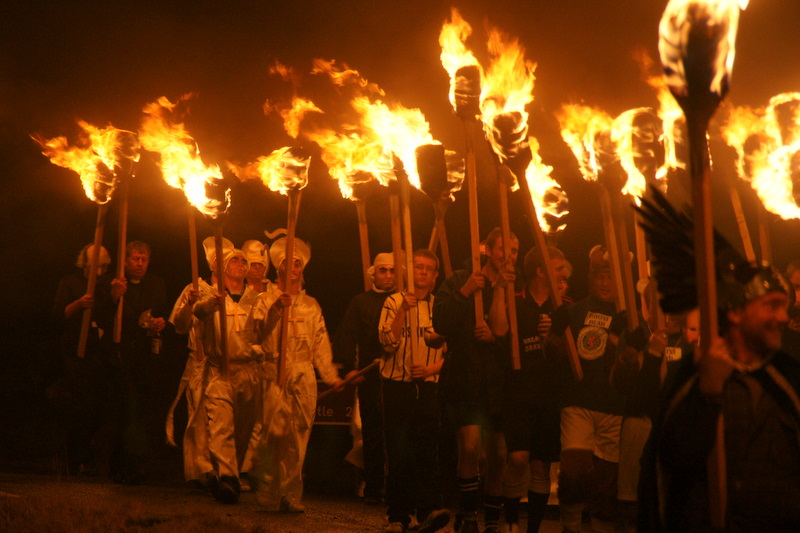
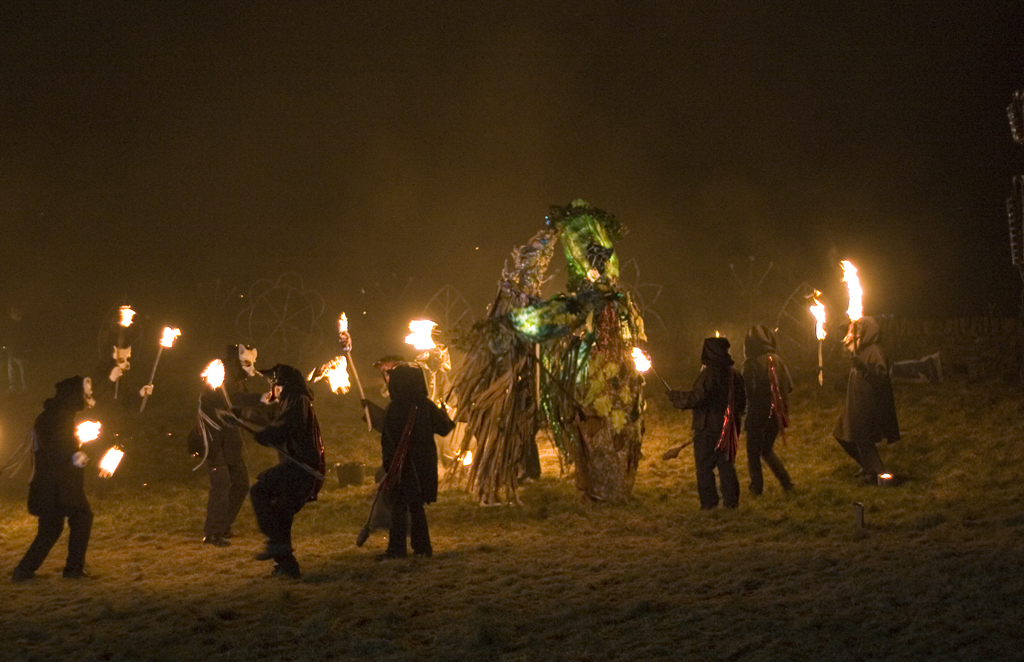
I remember the story (usually told on Hallowe'en), of how her father, Michael Walsh, would fill two oak barrels with tar and then drag them to the top of their hill at Coomb an nOr each Beltaine Eve (April 31st) and Samhain—or to use the Christianized name, Hallowe'en—(Oct. 31st), he'd light them at dusk, and then he'd drive the family cattle between the two burring barrels.
She said that the custom was to make the cattle fertile for the coming season. Then, after the cattle were smoked, he'd finish up by rolling the still-burning barrels down the hill to make a firetrail.
My grandmother explained that this custom was done on the evening of Oct. 31st, which is the first day of the Celtic New Year (The Celtic day begins at sunset); and Beltaine (the god Bel's fires) was the beginning of summer. Sometimes on Beltaine, he'd also cover a wagon wheel in tar and roll that down the hill too. Someone later said it was a Catherine wheel.
We had several fire-related rituals that had seasonal significance. My grandmother's attempt to recreate for me a version of this ritual—since to roll a burning barrel down our dry, grassy hill (also named Coonb an nOr) in West Marin, was a form of pyrotechnic suicide—her solution was to build a big fire in the fireplace (which was a converted ship's boiler), or to light herbs and to smudge the house.
And once, when I was eight or nine (1968), she put a candle in the middle of the living room floor and told me leap over it. I don't know whose idea it was to sing the nursery rhyme, "Jack be nimble, Jack be quick, Jack jump over the candlestick," since this causal magic act was never repeated, I'm not sure if it qualifies as folklore, but it had a profound lasting impact on me.
My grandmother explained that the people of pagan Celtic Britain and Ireland traditionally celebrated these two dates with bonfires, and told me how she celebrated Hallowe'en in Ireland, hollowing out turnips and placing them in the windows, etc.
Ann Ross in "Pagan Celtic Britain" (Academy Chicago Publishers, 1967), wrote, "During the festival [Beltaine/Samhain] Druids seemingly drove cattle between fires." (p 83).
I believe my grandmother and her father were both aware of the ritual use of causal magic to promote cattle fertility, but probably didn't believe in it, and that the use of smoke as a purification was a practical application of folk medicine to remove parasites, a sound agrarian practice. For me, the story captured a lost fragment of our pre-Christian past.
From the UC Berkeley Kroeber Hall Folklore Files.