Showing posts with label Bantry. Show all posts

Wednesday, March 8, 2023

Who am I on this international day of women?


March 8, 2023. Who am I on this international day of women? I am of Ireland where every place has a name and every name has a meaning. I am of four generations of strong Irish women: my great-grandmother, Jane/Sineád Rose Sullivan/Ó Súilleabháin (dark/hawk-eyed) (Walsh/Breathnach-from Wales), from Gortnascreena/GortnaScríne (place of the standing stone), Drimoleague (Droim Dhá Liag, ridge of two stones), near Skibbereen (An Sciobairín, a place of small skiffs). 

I am of Ireland. Her daughter, my grandmother, Jenny/Sineád Walsh (Reilly/Ó Raghallaigh-valiant), from Coom-anOre/Com an Óir (hollow or Valley of gold-as in a goldmine), really another place of standing stones between the River Bandon (Abhainn na Bandan, ban-dea, as in Tuatha Dé, the goddess), near Dunmanway (Dúnmaonmhuí, Dún Mánmha, the fort of yellow haired? women) and Bantry (Beanntraí, place of Beann's people (ban/ben = peak, point, prong, horn or top), Co. Cork (Corcaí/corcach, marsh). 

I am of Ireland. My grandmother, who begat Maureen/Máirín Reilly (Hurley/O hUirthile-descendants of some warrior dude, ok, it means sea-tide), San Francisco, and my mother who begat me, Maureen Hurley, Máirín ni hUirthile of San Francisco. 

Ich am of Irlonde,
Ant of the holy londe
Of Irlonde.

Goode sire, praye ich thee,
For of sainte charitee,
Com ant daunce wyt me
In Irlonde.

Medieval Irish Lyric, circa 13th-14th century AD)

I am of Ireland. Come and dance with me. What’s in a name? I can trace my mothers back to six generations of strong Irish women. My great-grandmother’s mother was Kate Connolly/O'Conghaile (descendant of Conghal, fierce wolf/hound), also born in Gortnascreena, whose mother was Julia Downey, or Devney (no v or w in Irish, O'Dunadhaigh- keeper /defender of the fort), from Esk, Kerry (an Eisc-the Fish? Or uisce?) Esk (a place of waterfalls) is a mountain near Glengarriff, overlooking Dingle, on the Beara Peninsula. 

Kerry is Ciarraí, or Ciarraighe, meaning the people of Ciar (the dark ones), the name of a pre-Celtic? tribe. The legendary founder of the tribe was Ciar, son of Fergus mac Róich, the son of great stallion. That takes us back into the mythological cycle. And there the trail ends. 

Who am I? I am all these women The entire maternal side of my family is 100% Irish, a rarity, despite the Walsh name. I guess you could say my ancestors came from between a few rocks and quite a few hard places. Then there’s my father’s side, also from near the River Bandon. But from there, the trail leads across the sea to Antigonish, and becomes murky, from Boston to SF, where Viola Mae Heaney, my other grandmother was born of a dysfunctional family, and so the generational trail of mental abuse ends with me.

Monday, August 20, 2018

Mae the Moonshiner and the Revinoors

Mae Sullivan Crean probably made that entire outfit including the hat.

My great-great aunt Mae, was a Sullivan from Gort-na-Screena, a farm in Drimoleague, on the Bantry peninsula, She married Ed Forbes in San Francisco, by way of Home Ranch in Nevada. But he died in the great flu epidemic, along with their young daughter, leaving the widow alone, in a foreign country, if I'm remembering the story right.

During the Prohibition, Great Aunt Mae (my grandmother always called her mother's sister Great Aunt Mae, though she was technically my grandmother's aunt, thus conflating my mother's generation with mine own...unless, of course, Mae was just great anyway, which is more likely the case. She was one of those women who broke the mold.

Anyway, Mae made some mighty fine bathtub booze. There was always a steady stream of customers, San Francisco's finest coppers, firemen and priests paid their due respects at the house. Not a dry eye in the Forbes house. She did right well, indeed.

They got an early wind, a small bird uttered a warning that a raid was eminent. May and her nieces hid the coil and still, dumped the mash down the toilet but very nearly got caught by the Revinoors when the mash plugged up the plumbing and the toilet backed up, hiccuping potent 30-proof burps.

They manage to dump most of the stash, except for one jug, so she lay down on the bed with the baby, the jug between the baby and and her rather ample breasts, and feigned sleep.

When the Revinoors came into the bedroom, seeing her in disarray, with her hair tumbling from her chignon like wildfire, stepped back, She let out a proper banshee screech, the bebé began wailing in earnest. The coppers were most apologetic and slowly backed out of the bedroom like dumb draft horses without continuing their search, saying Sorry to disturb you, ma'am. Sorry, Sorry.

Great-great Aunt Mae with her nephew, a young Daniel Sullivan
The two girls in the back, Julia and Kitty, are Mae's nieces.
I love the fake car and the painted backdrop.

Thursday, October 8, 2015

Marconi's Oranges


One dreary winter afternoon we drove out to the coast along the eastern shore of Tomales Bay with our Norwegian neighbor Agnes, and her sister Borg Haugen, who both loved the sea. The Haugen sisters also drank like Vikings, hitting the bottle after breakfast was not unheard of during the holidays.

We pretended we didn't notice, we played along with Toofta, an invisible wight (similar to our leipreachán), who had a fondness for screwdrivers and spiked eggnog. After a morning's liberal libation, the sisters grew restive, and longed to be in sight of the sea. So we piled into the green Packard and would often wind up somewhere along the coast.

As we headed out to Marconi Station near Marshall, my grannie who sailed over from Bantry Bay on the world's largest passenger ship, the Lusitania, Lady of Inverclyde (it was torpedoed in 1915), told us a story about Valentia Island, off the coast of Kerry. She said that Valentia Island was hooked up to the Marconi Station in Tomales Bay. (The KPH receiving station is in Marshall, and the transmitting station is in at RCA Beach near Bolinas.) 

Somehow Hawaii was also involved with my childish equation of Marconi Station, as Agnes received ship-to-shore calls from her husband Lucien, a merchant marine. No matter that I thought those sea cliffs of the Farallon Islands were Hawaii. Borg said that she sailed to Waikiki on a Cunard ship and it took days to get there, yet I could see the islands from the Golden Gate Bridge.

Sunday evenings we'd gather round Agnes's radio and listen to Hawaii Calls on the radio. The idea of Pearly shells from the ocean, shining in the sun....crackled across the sea, fired my imagination.

As my grandmother elaborated upon the stringing of those transatlantic cables, the wonderous Guglielmo Marconi, Morse Code, telegrams, or marconigrams, I was confounded. I envisioned those really long cables stretched under the oceans still being used a hundred years later.

Though I was only a child, even I knew that Ireland was a long way from the shores of Americay, and that we were due west of west. And the world was a really big place, Hawaii aside. Not only was there the Atlantic ocean to cross, but the entire continent of North America in the way.


The old ship-to-shore Marconi telegraph receiving station was built after my grannie had left Ireland for good, in 1912. After a mishap, she was late and missed the boat, which happened to be the good ship Titanic, laden with Irish immigrants—otherwise I wouldn't be there to tell you this story.

The old Marconi Station, near the site of the old Coast Miwok village Echa-kolum, had been closed since 1939. During the early 1960s, it was converted to a drug rehabilitation center called Synanon. It seemed like a good idea at the time. A sober utopia. There was a big spread on it in the Sunday Paper. We had no idea that Synanon would become synonymous with evilness incarnate, but that's another story. It should've been renamed Narconi Station.

It must've been mid-winter when we took that drive north along Tomales Bay toward Dillon Beach. It could've been a day straddling either side of Christmas. The sky was overcast. Perhaps it was drizzling. A soft Irish day, my grannnie would always say. 

Perhaps I was grousing over a lack of adequate Christmas gifts, or perhaps I was was ever hopeful for pie in the sky kind of Christmas. Seeding the field, so to speak, for Christmases to come. Christmas was a meager affair, as my grannie's small pension barely covered the necessities. I was dependent upon our neighbors for gifts.

My grannie also told me that every Christmas her brothers and sisters each got one sweet Valentia orange wrapped in foil for Christmas. That was it. It was something to be savored, its seeds duly counted. One for each member of the family, if luck would have it. The trick was to hold out and eat it after everyone else had eaten theirs. Then eat it in front of them. Slowly.

Sometimes my grannie and her siblings got a few walnuts and sultana raisins, or tiny currants—like the kind she added to Irish sodabread—too if her parents could afford it. Sweetmeats were considered luxuries in the west of Ireland at the end of 19th century.

There wasn't anything much to see at Marconi Station. Not even a plaque. A disappointment. I kicked the sand as they admired the pullout off Highway One. I didn't understand it was the end of an era. They had no camera, but the day is indelibly etched in memory.

Unraveling my grannie's convoluted stories is probably why I became a writer. I couldn't see or hear that silent 't" in Valentia, and confused it with Valencia oranges. The conundrum haunted me. See? Suits you to a "t," as my grannie might say as she handed me a proverbial orange. 

But then, adults were always doing inexplicable things—like driving up the coast on a  whim, not wanting to stop so we wound up in Gualala staying the night with not even a toothbrush between us, let alone pajamas.

What I learned was: Valencia is in Spain. Valencia, spelled with a "c" was once a river island. They grow Valencia oranges there. Apparently they wrapped them in gold foil for export, a real Christmas treasure. Valencia oranges came from India, or China. 

My grannie loved Valencia oranges. Too sweet for me. I prefer tangy tangerines or naval oranges—don't even ask me about the conflation of bellybutton (really a lost orange twin) and nautical equation). A good thing I didn't know about Valencia, California.

Valencia, located on the orange blossom coast of the Mediterranean Sea, was once spelled Valentia, in rough Latin, meaning strength/valor.  Its Moorish nickname was Medina bu-Tarab/Turab (either city of joy, or city sand, depending on the mis-translation.) However, a Marconi station was built in Aranjuez near Madrid, Spain. It means hawthorn in Basque. So, magic was afoot. It seems those Marconi stations were everywhere.


Valentia Island, spelled with a "t." is located in County Kerry, Ireland. Why they called it Valentia, after Valencia, Spain was a complete mystery. Maybe they really liked Christmas oranges, my ten-year-old mind reasoned. Or they liked Marconi. Of course, I confused Marconi with macaroni and wondered what pasta salad had to do with Yankee Doodle.

Then, there's one of the old Roman names for the fifth province (Northern England (Eboracum /York) and Southern Scotland), also called Valentia, either named after Valentinian, or his brother, the Eastern emperor Valens ("Land of Valens,"), or it's a wordplay on the Latin vallum ("wall"). Or it could be a wordplay off  the Welsh, as in Wal/Val.

Valentia Island is a malapropism, a corruption from Oilean Dairbhre—means the Island of the Oak Woods (pronounced dwervne). I was disappointed to discover that Valentia Island is not even remotely located in Spain, but it is one of Ireland's most westerly points off the Iveragh Peninsula in County Kerry.

Before the Transatlantic Cable was installed, it took a fortnight or longer for messages to reach North America from Europe by boat. Valentia was where transatlantic telegraph communications cables were laid from Telegraph Field, the "birthplace of global communications" at Foilhommerum Bay, Ireland, to Heart's Content, Newfoundland in 1866, some 2,300 nautical miles away—after six unsuccessful attempts (1857).

Valentia was formerly an island studded with oaks and apparently some rampant resident druids. The telegraph was one of history's game-changing moments, global telecommunications, the ancestor of the internet. That's pure wizardry at work. Imagine that. It was like a case of Marconi's oranges colliding on Christmas. 

On 16 August, 1858, transatlantic communication was established. The message: “Glory to God in the highest, and on earth, peace, good will to men.” Unfortunately the overexcited engineer fried the cable. In 1866, the final cable was laid. The Valencia Transatlantic Cable Station was laid to rest in 1966. And in 2013 it was up for sale. I wonder who bought it?

I know I've wandered far and wide in this memoir, but that's the shape of memory. Back then, if I knew what he adults were up to, I wouldn't have had this story to tell now, would I? Perhaps that tangled up day was the first day of the rest of my life. A self-examined life, as told through memoir, itself, an oxymoron for truth, such as it is.

Writing too, is an addiction, from which there is no recovery, nor cure. I understand that full recovery is impossible. As I write these words, I discover anew, that today, as always, is the first day of the rest of my life.

Saturday, June 14, 2014

Arbutus, Madroño, or a Strawberry Tree by any other name (photos)


Clusters of berries, leaves and flowers of the arbutus unedo.

A stand of Irish strawberry trees (or Killarney strawberry trees) are fruiting in front of my physical therapist's office in Berkeley. I climbed up on the hood of my car to reach the fruit, but didn't realize I couldn't get back down without loosing my "strawberries." I squashed them all over the place—they were like little golden suns with fiery coronas—when I nearly fell off the car. Would've been difficult to explain that injury to my PT. But I was gluttonous as a bear.

My grandmother often talked about eating the wild arbutus "strawberries" as a child, comparing their flavor to the haws of hawthorn trees. They don't taste anything like strawberries—they just look like them on the outside. In the inside, they're like little orange suns flecked with tiny seeds. The Irish do know the difference between strawberries and arbutus tree fruit. Wild strawberries also grow in Ireland. It's a simile, sweetie.

Ripe arbutus berries are pebbly & red outside, golden & mushy inside.

My grannie, who hailed from Bantry, said that the Gulfstream, that warm Atlantic current that bathes the coasts of western Ireland, created an ideal micro-climate where tropical plants flourish—including palm trees. However, the arbutus, or strawberry tree, is also native to western Ireland but, curiously, not to England.

The Irish arbutus was introduced to England from Ireland during the 16th c., and one estate plant catalogue mentions "one very fayre tree, called the Irish arbutis standing in the midle parte of the sayd kitchin garden, very lovely to look upon." 

The broad glossy evergreen leaves are about three inches long, an inch wide with a toothed, or serrated edge. And the clusters of fragrant flowers are showy white or pink tinted bells—like most plants in the heath, or Ericaceae family, as arbutus is related to heather and bilberries.

Arbutus berries; the hard yellow ones are unripe. 

The story goes, that when the Spanish explorers landed in California, they recognized our native madrone. (naming it madroño) as being related to their madroño the stately Arbutus unedo, or the shaggy-barked Arbutus arachne which is more common in Greece, and throughout the greater Mediterranean basin from Albania to Croatia, Lebanon to Sardinia, Portugal to Tunisia, and Iraq—even the Canary Islands. Father Juan Crespi, chronicler of the 1769 Portola expedition, wrote about the many madroños at the “lost bay” of Monterey.

There's an anomaly of isolated arbutus groves in western Ireland—especially in Bantry, West Cork, (my grandmother, from Bantry, gave me the roots of this story), and the Dingle Peninsula on the Kerry coast. Sligo has the most northerly stand of Arbutus unedo in the world, a remnant from the pre-Ice Age Atlantic period. (Or possibly brought to Ireland by the Iberian Bell-Beaker Folk, ca. 2500 BC—renown for their bell-shaped clay drinking vessels, stone wrist-guards, and gold lunulae. Their motto might have been: Don't drink that arbutus beer, and shoot arrows at the crescent moon. Or were lunulae really splash guards?)
The [arbutus] species is one of a select group of plants, fifteen in all, native to Ireland but not to Britain. Taken together, these special Irish natives have come to be known as the Lusitanian or Hiberno-Cantabrian flora, owing to the fact that their nearest relatives are to be found on the Iberian Peninsula. How this flora arrived to the blank canvass that was post-Ice Age Ireland is not well understood, but it is possible that they spread overland along the changing coast of the British Isles as they emerged from under glacier and sea. —The Strawberry Tree, UP Cronin
Dr. Cronin (M.Sc. in Plant Science, University College Cork and a Ph.D. in Microbiology, University of Limerick), writes that the eighth century Irish legal tract, Bretha Comaithchesa (laws of the 'hood) ranks caithne (arbutus) as a fodla fedo — or third division tree, used for manufacturing charcoal or making small pieces of decorative red inlay.

It's an Irish toponym: Ard na Caithne (Ardnaconnia), or Strawberry Tree Heights (a headland—also known as Smerwick, or Butter Bay) is located in the heart of the Kerry Gaeltacht, near Corca Dhuibhne—the tip of the Dingle Peninsula. Ard na Caithne (with its arbutus groves, laden with little golden apples of the sun) is a significant site: it's the home of Dún an Óir ('Fort of Gold'), an Iron Age fort; the site of sixth-eighth c. monastic settlements, the Gallarus Oratory (the oldest beehive hut in Ireland—I saw it from the road but my cousin wouldn't stop the car) and An Riasc; and for the horrific Siege of Smerwick (1580), where the surrendered Irish freedom fighters were slaughtered by the British Lord Grey. The sacred ground was stained by more than just arbutus berries that day.

Ard na Caithne was home to 17th c. Irish poet and harpist, Piaras Feiritéar, who surrendered to the English after the Confederate Ireland wars, was granted safe passage, but was hanged in 1653. The ruins of his castle still stand among the arbutus trees at Ard na Caithne and his poetry lives on in the oral tradition. 

Ard na Caithne was also home to Séamus Ó Muircheartaigh (1877–1927) who wrote under the pseudonym, An Spáilpín Fánach
 
(The Wandering Labourer—also the name of his song). Séamus Moriarty emigrated to San Francisco (via Butte, MT) and knew my grandparents through the Gaelic League. His son, Cuchulain was a civil rights activist with César Chavez—the Lawyers’ Committee for Civil Rights Father Cuchulain Moriarty Award is named after him. But I digress....

There are four Old World species, and six New World species of arbutus. Our hybrid ornamental street tree, Arbutus x Marina is named after the Marina in San Francisco where it was hybridized. Its parentage is a mystery but it may be a cross between the Arbutus unedo and Arbutus arachne. Old World arbutus is related to our native madrone and its cousin, manzanita (Arctostaphylos). Our Pacific Madrone, or Madrona, is Arbutus menziesii. We often ate the tiny astringent berries that taste like sour crabapples. After all, manzanita means little apple in Spanish.

Kerry has the largest arbutus stands in Ireland. A recent DNA pollen study suggests the arbutus was brought to Kerry via Northern Spain more than 4000 years ago, possibly by Iberian copper miners. But that doesn’t explain the Sligo stand.)

The Irish "strawberry" is called caithne in Irish, arbousier in French, madroños, alborocera, alborio, borto, or albedro in Spanish, corbezzolo, or albatro in Italian, koumaria in Greek, and bearberry, or Cain apple in English. I guess Cain used them to slay Abel. Or maybe he fed him unripe fruit loaded with tannins.

The fruit has a vague anise odor but tastes more like tangy rose hips—which it's related to. Edible prickly red armor on the outside and a creamy-mealy amber flesh, it's a superfruit (like açai) loaded with vitamin C and pectin. The fruits are high in sugar and contain bioflavonoids, malic acid as well as tannin (more here). But the yellow unripe fruit can cause nausea (so it is said).

Warty arbutus berries ripen on the tree tend to burst if you pick them.
When eaten in quantities this fruit is said to be narcotic, and the wine made from it in Spain has the same property. —A Modern Herbal
Berries will ferment right on the tree (berries have been measured up to 24.6° Brix, or 5 to 14% alcohol—and no liquor license needed); the birds get inebriated as they gobble up the beer-berries. A few peasants figured out that if the birds could get so blasted on arbutus berries, that they couldn't fly a straight line, then so could they. (Wing flapping ensued....)

My friend Chris Devine said, "There used to be a pub in Killarney called 'The Strawberry Tree'. Never understood why. 'Til now." The Strawberry Tree Pub, 23 Plunkett Street, Killarney.

The Greeks make a liqueur called koumaro, which is often added to tsipouro (a type of ouzo), the Portuguese say they are very brave trees and make arguardente de medroñho or medroñheira from the berries, and the Italians make many liqueurs: in Corsica they make a Liqueur a l'Arbouse, in Sardinia they make fior, and Acquavita di Corbezzolo. 


Sun-dried arbutus berries are like dried apricots, full of flavor.

You can also make marmelades, jams, jellies, pies, dried fruit, vinegars, pomaces, sorbets, and a grilled meat sauce (like cranberry, or quince sauce), from arbutus berries. You can plop those overripe berries into a bottle of red wine to make a killer sangria, or use the fruit as a red dye, and the bark to tan leather. I wonder if the prized red Cordova leather was dyed with madroño berries? Research for another time.

Because the fruit and flowers appear on the tree at the same time, the Romans thought the arbutus held magical powers: flowers were also placed on graves as a sign of respect. In The Tenth Labor of Heracles, the blood shed by the giant Geyorn was said to produce a tree with both flowers and fruit at the same time when the Pleiades were high in the sky—the arbutus.
Horace praises the tree for its shade and Ovid for its loads of 'blushing fruit.' Virgil recommends the young shoots as winter food for goats and for basket-work. Gerard speaks of it in his time as growing in 'some few gardens,' and says, 'the fruit being ripe is of a gallant red colour, in taste somewhat harsh, and in a manner without any relish, of which thrushes and blackbirds do feed in winter. —A Modern Herbal 
The Coast Salish used all parts of the sacred Pacific madrone for medicine. The Coast Miwok, made a tangy brew from madrone and manzanita berries. According to the Coast Salish an anthropomorphic form of madrone tree sap went fishing at dawn but came home late one morning and melted in the sun; the other jealous trees stole all his sap. I don't know if this occurred before, or after they discovered that the berries could be fermented.

Hieronymus Bosch's painting (housed in Madrid since 1939), "The Garden of Earthly Delights," was originally called "La Pintura del Madroño", or "The Painting of the Arbutus." Why a strawberry tree? I bet something got lost in translation... The Tuscans use "strawberry" as an exclamation referring to ahem, the male anatomy.
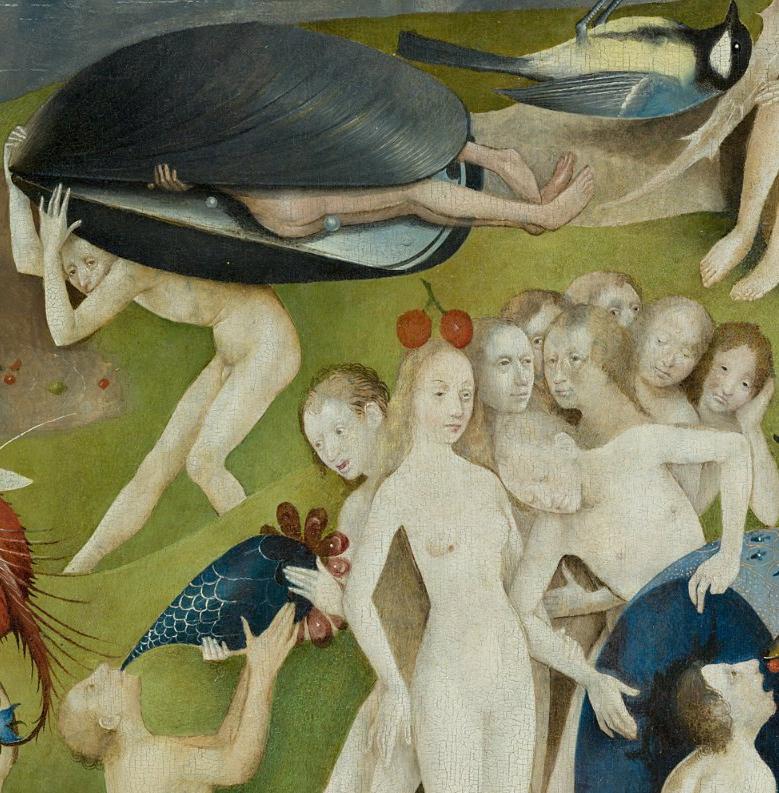

The fruit above her head, identified as cherries, is a convenient explanation for popping the cherry, but if you look at the fruit, they're not cherries, but warty arbutus berries. Cherries elsewhere in the painting are painted smooth-skinned, with a reflective sheen. —Mo H. Image from Wiki

Strawberry trees. Clearly there is other symbolism going on. Either Bosch didn't know what they really were, or he had other ideas for including them. —Wiki

In Latin, Arbutus means "struggle." But because the bear is so closely associated with the arbutus tree in myth and lore, I suspect that Artio (Dea Artio) a Gallo-Celtic bear goddess was also involved. Near Berne, a bronze sculpture of the goddess Artio is seated beside a small tree, holding fruit in her lap, feeding the bear—with the inscription: Deae Artioni / Licinia Sabinilla. 


(Artos means bear in Celtic. (Delamarre 2003 p. 55-56), from Proto-Celtic *arto-, from Proto-Indo-European *h₂ŕ̥tḱos, bear.) —Wiki

An Italian website on plants also hypothesizes that Arbutus may be a Celtic word:
The name "Arbutus unedo" probably derives from the Celtic. In fact, "ar" in Celtic means "bitter, astringent" and "unedo" is the name that was used in ancient times which probably derives from the three Latin words "unu-off edo" "I eat only one" to mean that one should not exaggerate and give in to temptation because of the pleasantness of its fruit which when eaten in excessive quantities gave nausea and constipation. —MEDICINAL PLANTS, Elicriso
A gluttonous bear eating arbutus berries from the strawberry tree figures prominently in the coat of arms of Madrid, Spain. In Puerta del Sol, the city center of Madrid, there is a statue of a bear gobbling berries from a madroño tree.

Pliny the Elder enigmatically explained that 'unedo' means unum edo or "I eat one", and so I did. And another. Whether he meant you could eat only one because it was so awful, or eat one and not be be able to stop because it was so good (and you'd get a hangover, or a bad case of the farts), we'll never know. But I can safely say no struggle (or bears) was involved. They're tasty.


Wednesday, August 21, 2013

Sheep Islands: What about the sheep? Notes on the Voyage of St. Brendan


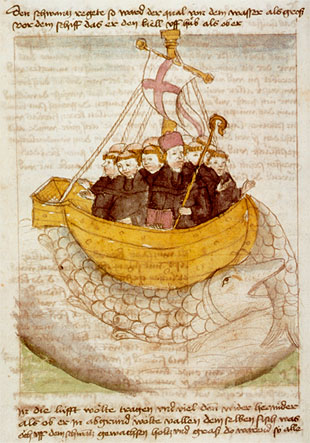
Saint Brendan & the whale—from a 15th-c. German manuscript. Wiki

There is an Irish oral tradition that the Irish settled in the Faroes, during the pre-Viking era, and the descriptions in the Voyage of St. Brendan, of "insulae" (islands) sounds remarkably similar to the Faroe Islands. There was a persistent belief that islands to the west of Great Britain existed as early as 330 BC.  One fanciful name for those northern islands was Thule, which was "a six days' sail north of Britain, and near the frozen sea."

My Bantry grandmother told me that Irish monks brought sheep to the Faroes, and the toponym, though Nordic, means sheep islands. And sheep islands do figure heavily into the Brendan tales. There are several stories from the Navigatio of St. Bréanainn of Clonfert.

Some say Brendan (c. 484 – 577), was born to Finnlug (Fair Lugh) and Cara of the Altraige tribe, of the Ciarraige Luachra, the people of Ciar, who gave their name to County Kerry, on Fenit Island, near Tralee. I don't know if Tralee and Bantry both claim Brendan as he's also Bantry's patron saint. Galway, too clams Brendan. All have one thing in common—they are all seaport towns.

We do know Brendan was a real Irish sailor.His name in Irish: Broen-finn, or 'fair-drop', Naomh (St) Breandán. In Icelandic, it keeps the Latin, Brandanus. 

Brendan was baptized by an ex-druid, Saint Erc of Slane (and Cornwall, aka St Erth), and schooled by Saint Ita, "the Brigid of Munster", or "foster-mother of saints" who had some major goddess qualities.

After sailing around the Irish, and the Hebridean islands, he set sail into the void from Kerry.

Brendan built a currach—a leather boat. The boat frame was woven from hazel and willow wattles, he covered the naomhóg the "little holy one", with cowhides tanned in oak-bark and softened/waterproofed with bog butter. He added a mast and a white linen sail. And he was set to go—with either 14 or 16 of his bestie apostles. It must've been one very crowded, smelly vessel.


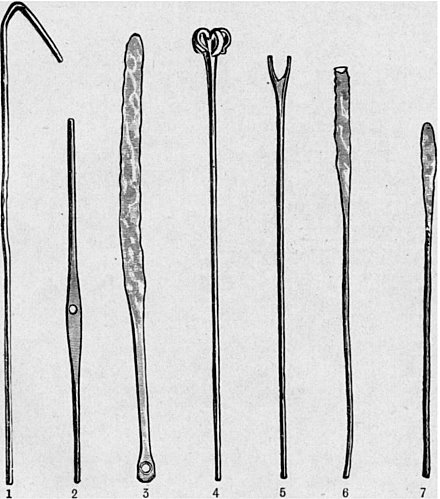
The gold Broighter boat is a model of an Iron Age Irish boat from 100 BC, replete with 18 golden oars, rowlocks, benches, a paddle rudder for steering, boathook, a yardarm, tools, and a mast for a sail. “There is also good evidence that they [the Celts] had sails: there is a model boat from Ireland that dates from about 100 BC that has a mast, which could be a model for Celtic boats more generally,” Jennings said. “There is not so much evidence of sails in Norway until as late as 700 AD. It is therefore more likely that these early Faroese settlers came from the British Isles.” —Andrew Jennings, Nordic Historian The Norse word for a ship lung is from the Irish word long." —Medieval Review

Broighter boat,1.Boat hook 2.Mast yard 3.Steering oar 4.Small grappling iron 5.Forked implements 6.Square ended oars 7.Oars. —Wiki

The boat, a votive offering in the La Tene style, was found by two ploughmen near Loch Foyle in 1896; compare it to the 15th c. German drawing at the top of this page.

The Broighter boat —Wiki

The Brendan immram Voyage tale was transcribed from Irish into Latin in 800 AD.) Old Irish Immrama (from iomramh-voyage), or voyager stories, depict a hero's sea journey to the Otherworld, (with a Christian overlay); they date to ca. the 3rd c. AD.

The Otherworld is always to the West. Tír na-nÓg (Land of the Ever-young) was another mythical island to the west. Reason enough to set sail—because they were there. In his legendary quest, St. Brendan was seeking the Isle of the Blessed (Saint Brendan's phantom Island), which may have been the Faroe islands.

Half-way to Iceland, the Faroes are the first stepping stone across the North Atlantic. 

St. Brendan described the largest of the Faroe Isles island as the Island of Sheep (Streymoy?) A bay in the southern part of Streymoy, is called Brandansvik (St. Brendan's Bay). His "bird paradise" might be the island of Mykines. There are several Faroe places named after the Irish monks (papar) including remote caves. —Faroe Islands Review History
The Faroes were part of a trade network with Dublin as a hub, and many Irish women made their way there as wives or slaves. DNA analysis shows that 84% of Faroese females are of Irish or Scottish descent. —Faroe Islands Review History
(NB: contrary to modern belief, Irish monks were NOT celebate.)

Northern European settlements in the Faroes have been archaeologically dated to ca. 400 AD. Some 500 years later, the Vikings arrived in the Faroes, enroute to Iceland, and it looks like they may not have destroyed all evidence of Irish settlement in the Faroes. There is malted barley grain carbon-dated older than the Viking era—Barley is not indigenous to the Faroes—and old field systems that didn’t fit into later settlements.

There are also placenames of two Faroe settlements are Irish saints' names (Patrick & Brigit), survive—albeit with a Norse spelling. There might be other embedded Irish words. The Norse who settled in the Faroes were probably Norse-Irish from Dublin, not Norse from Scandinavia.

Medieval chronicler Ari Thorgilsson said Ingólfr was the first Nordic settler in Iceland, but mentioned that "Papar" – i.e. Irish monks and hermits – had been in the country before the Norsemen. He wrote that they left because they did not want to live amongst the newly arrived pagans. Ingólfr Arnarson —Wiki

According to the Færeyjar Saga, an Icelandic Christian conversion story, one Faroe islander was "Tróndur í Gøtu, a descendant of Scandinavian chiefs who settled in Dublin, Ireland." And "Icelanders' own records record that 400 original settlers "with mostly Celtic nicknames" were living in Iceland previous to Norse colonization. (Clements). The significance of that statement is that European settlers were in Iceland and the Faroes long before Norse discovery.

In the 2nd half of the 8th century, Irish monk-geographer, Dicuil in "De menura orbis terrae" wrote of "heremitae ex nostra Scotia" ("hermits from our land of Ireland") living in the Faroes. (Scotia referred to Ireland, not Scotland!)  They lived on the northerly islands of Britain for a hundred years until the arrival of Norse pirates. An Irish nickname of Faroe islanders, Na Scigirí, possibly refers to the Eyja-Skeggjar (land of bearded men).

Dicuil’s geographical book describes islands that aren't mentioned in any other writing of the time:
Many other islands lie in the northerly British Ocean. One reaches them from the northerly islands of Britain, by sailing directly for two days and two nights with a full sail in a favourable wind the whole time … Most of these islands are small, they are separated by narrow channels, and for nearly a hundred years hermits lived there, coming from our land, Ireland, by boat.
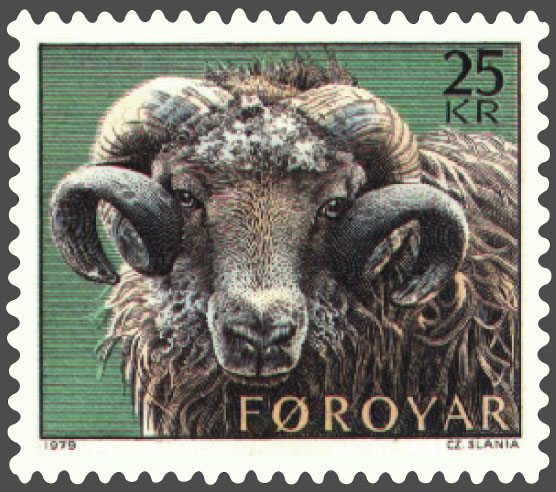
Archaeologists now believe Dicui was referring to the Faroes. Faroe or Føroyar means sheep in Norse. When the Norse arrived, there were already sheep there. So, who brought the sheep? The puffins?

Immrama, or voyage stories, are different than echtrae or adventure stories. The hero's faith is challenged—often with a multitude of pagan motifs. In this case, with herds of black sheep and white sheep on a disappearing island shrouded in fog.

THE VOYAGE OF BRENDAN SYNOPSIS (Chapters are relative depending on version,There are over 100 manuscripts of the Brendan story, not counting translations.)

In chapter 8 or 9 of the Navigatio, Brendan's sailors discovered an island of sheep, ate some lamb, and stayed on for Holy Week (before Easter). NB—the Irish celebrated Eater as late as mid-May. Let's just say there was a major difference of opinion with Rome as to when Easter was on the calendar. (In The Voyage of Mael Duin, monks also visited an island of sheep.

The following year, (chapter 14) they returned to the islands of Sheep, Jasconius, and the Paradise of Birds. (So we know there were at least three islands, and lots of birds and whales.) A bird said they had to repeat their journey seven years before they were holy enough to reach the Island of Paradise. They discovered a "coagulated" sea (icebergs?), sea monsters, more whales and fish, an island of grapes, magic (lethe?) water, griffins, seals, otters, an island of angry blacksmiths throwing hot slag at them, and more volcanoes. 

In chapter 28, they returned to the island of Sheep, Jasconius, and the Paradise of Birds, before finding the Promised Land of Saints. They returned home, where St. Brendan died. -Wiki synopsis.

Some excerpts:
Perambulantes autem illam insulam invenerunt diverses turmas ovium unius coloris id est albi ita ut non possent ultra videre terram prae multitudine ovium.  
On the island we found flocks of white sheep—we could not see the land, for the multitudes of sheep. (They sacrificed an ewe lamb. Loaded up the boat with mutton.) 
Sanctus Brendanus illum quomodo potuissent oves esse tam magnae sicut ibi visae sunt. Erant enim majores quam boves. Cui ille dixit: «Nemo colligit lac de ovibus in hac insula nec hiemps distringit illas sed in pascuis semper commorantur die noctuque. 
Brendan said the sheep were larger than cattle. "No one collects milk from sheep in this island or winter pastures them, they live in accordance with day and night. (So the sheep are feral, and the sailors drink sheep's milk.) They set sail.
Erat autem illa insula petrosa sine ulla herba. Silva rara erat ibi et in litore illius nihil de arena fuit.  
The island, however, was rocky, without grass. The forest was rare and there was no sand on the shore.      —from Navigatio Sancti Brendani Abbatis
So what about them sheep? Small N. European short-tailed sheep, related to Icelandic sheep, not inclined to hang out in herds. Hardy. No birds of a feather flock together philosophy for them.

On medieval maps, Brendan's fabled misty Isle appeared in various locations (including west of the Canaries—the Azores?). And on Christopher Columbus's maps—most notable is Martin Behaim's Erdapfel of 1492—known as La isla de San Borondón or isla de Samborombó. Borondón and Samborombó is St. Brendan in Spanish.

A reoccuring theme of the immrama is that you can't go home again—ever...certainly never to return the same person as when you left. Sort of like going on the Camino. Enlightenment was always sought and invoked on far distant shores. Apparently sheep were also somehow involved. Brendan's Feast Day is May 16. A good day to eat sheep.

Wednesday, October 31, 2012

Halloween Traditions in Bantry


This is the original published sort version of Halloween agus Samhian


This post on our timeline by Maureen Hurley is so good we decided to share it with you all. Thanks Maureen.

Hallowe'en (aka All Hallows Eve—an Irish Catholic tradition supplanted older pagan Samhain traditions) was introduced to Scotland. And then it was introduced to America by the Irish, not the Scots.

As a child, my grandmother carved turnips (or swedes, or mangles—any big pithy round roots used for cow fodder) in Bantry during the 1890s. Turnips were used as lanterns, candles were placed in the window. It was also a tradition to let the hearth fire die, clean the hearth, and then the sacred tradition of relighting it—from the flame of those travelling turnips. Out with the old, in with the new. It was New Year's Eve, after all!

Wearing masks (as a disguise) and using bull roarers to scare off spirits—were all part and parcel of a long ongoing tradition of Hallowe'en. My grannie was thoroughly disgusted by the American tradition of Trick or Treat. She said in Ireland, one had to dance and sing, or recite a poem or story, and then, if one was good, they might be given a treat, or a ha-penny if they were very, very good. One was expected to trot out one's best pony show. Move over, Simon Cowell.

As to the Scottish Hallowe'en connection: much of Glasgow (and River Clyde) environs—especially the slums—was heavily settled and continuously resettled by waves of itinerant Catholic Irish workers—through the industrial revolution.


Hallowe'en, An Irish Tradition

Hallowe'en (aka All Hallows Eve—an Irish Catholic tradition supplanted older pagan Samhain traditions) was introduced to Scotland. And then it was introduced to America by the Irish, not the Scots.

As a child, my grandmother carved turnips (or swedes, or mangles—any big pithy round roots used for cow fodder) in Bantry during the 1890s. Turnips were used as lanterns, candles were placed in the window. It was also a tradition to let the hearth fire die, clean the hearth, and then the sacred tradition of relighting it—from the flame of those traveling turnips. Out with the old, in with the new. It was New Year's Eve, after all!

Wearing masks (as a disguise) and using bull roarers to scare off spirits—were all part and parcel of a long ongoing tradition of Hallowe'en. My grannie was thoroughly disgusted by the American tradition of Trick or Treat. She said, in Ireland, one had to dance and sing, or recite a poem or story, and then, if one was good, they might be given a treat, or a ha-penny if they were very, very good. One was expected to trot out one's best pony show. Move over, Simon Cowell.

Sunday, October 3, 2010

Bantry cousins


Still recovering after partying with the 80-year-olds. Nothing like a small, intimate 4-generation family clan gathering of nearly 50, with cousins from Ireland (many who've never met) plus two birthdays. But we were in Caesar’s and the Italians understand family gatherings. When Neil and Michael broke into O Solo Mio, it was a showstopper. They also entertained the waiters at Ceasar's with Molly Malone. We closed the joint down. After we closed Caesar’s, we headed over to the Sheraton Hotel and had a another gabfest and singalong until 2AM in the Sheraton lounge. I'm both hoarse and deaf.

What was a scream was all the Sheraton customers who wandered in and stuck around to listen to us singing—a real Irish session. Even the bellhops. One guy brought his bottle of wine over from the bar and watched us. Ah but the craic was good. I once said "craic" outside of Irish circles—and the guy thought we were referring to doing heroin! I was gobsmacked.

Funny, though I'd never met  my Irish cousin Teresa before, the minute I saw her, I knew we were related. She looks like my great aunt Peg. Little kids too recognized kin, they were wrapping their arms around any available leg.

We don't have that many family gatherings—usually wedding & funerals. But when we do, everybody makes up for lost time. This was a first in that this particular lot of Irish cousins hadn't ever been to America—and the long "lost" Nevada Walshes hadn't met either of us. So it was a historic event.  We need to actually plan a picnic. We used to do that in the 60s-80s, but too many of the matriarchs died and the families scattered. This reunion was put together at the last minute—with a week's notice. Finding the lost Walshes from the 1930s via the internet (or them finding us) is a new miracle twist.

Friday, May 1, 2009

Beltaine, May Day dream sequence

Lá buidhe Bealtaine shona daoibh. 

To celebrate the day of Beltaine,
wash in the May morning dew.

The woman who washes her face
in it will be beautiful;
the man who washes his hands
will be skilled with knots and nets.

Dew, they said DEW. not a feckin' downpour or monsoon! Sheesh! The rain woke me. No chance of dew. Then I remembered, the dream flooded back.... Beltaine, May Day is the night when the gates to the Otherworld open, it often comes in as if a dream. May First begins the season of the dream walkers.

* * *


I dreamed I was traveling on foot across the countryside, and in a wooded clearing, I stumbled across a wide barrow on my right. Thinking I'd stumbled upon something like the massive rabbit warrens that my grandmother crawled into as a child, seeking refuge in the hills above Bantry Bay, I got down on my hands and knees to see what I could see. I must've heard a noise because I looked deeper into the limnal jaws of the underground maw.

As my eyes adjusted to the dimness, I saw vermin, no, a little black fox, with matted fur, or at least I thought it was a fox. He was mangy and grubby but unafraid of my alien presence. Behind him I saw a buried Liliputian city, replete with Victorians painted yellow, orange and red, fiery, as if lit from within, in this underground cavern. It was night in that realm, streetlamps cast small pools of light on the pavements grey. Perhaps it was a reminder that this was a dream, not real.

The little fox was standing on a street corner, perhaps in another land, or another time. I no longer knew where I was, but I was growing frightened. This much I knew: the burrow was the gates to the
Otherworld. To enter the Otherworld was to never return to this realm, it was also the gateway to enchantment or death. Land to the west. Tír na nÓg. Perhaps. like Oisín, I would return to another century.

Sometimes in dreams, my dead mother comes to visit. Sometimes she is with my grandmother. It is always a tearful reunion, they can never stay long. And here I was, willingly crawling underground, still very much alive.

But like a changeling child, the little black fox kept beseeching me with his milk blue eyes and small whine, begging me to come to him into the
cruachan, but I was afraid of his fleas, and imagined diseases. 

I thought of rabies and of the bubonic plague, the black death that killed many millions during the Middle Ages, they knew rats were somehow involved, they never dreamed it was the fleas. 

I thought too of my grandmother's stories of the OweynagCat, the cave of the great Irish three-headed saber cat, in which case, I was right in the middle of some seriously dark Otherworld sidhe mojo, as Samhain was the feast night of the Great Cat. And this was Beltaine, the beginning of Hafgan's realm, the Annwn Welsh lord of summer. A time of stolen children and horses. At least I had enough sense to leave the rowan and whitehtorn unplucked.

But the young pup cowered and whimpered, wanting creature comfort. I realized that he was as lost and out of his element as I was, so I crawled into the burrow to comfort him. He gladly crept into my arms, licked my face and throat. Initiation by saliva. He whimpered with recognition and squirmed with joy. Who was this little fellow and why was he abandoned on the metaphorical mean streets of an underground city?

I realized that his unkempt appearance was not because of mange or disease, though I still feared his fleas, but because he was a puppy, not a fox, and that there were others of his kind, hiding in the alleys and back streets. He was a sentinel scout for his brothers. The litter came bounding forth, surrounding me with their joyous puppy energy.

I was gathering them in, comforting them, when I sensed another darker presence on my right, and I was looking into the ominous yellow eyes, not of a fox, but a wary long-haired dog, a dog unlike anything I'd ever seen. Surely not an Alsatian or a German shepherd guarding the gates of hell.

The dog's ink dark coat was longer, thicker, no distinctive saddle markings. Her head was narrower, her ears bigger, her snout longer. Perhaps she was a half-breed. No Cerebus, but there was something unkempt and uncivilized about her that I couldn't quite put my finger on.

I realized I was looking right into the eyes of a wild wolf mother and I was in her den. In her territory. I froze and we eyed it off. I backed away slowly, but the pups would have none of it. They bounded in my arms, pounced on me, pulled at the tie that held back my waist long hair with their milk teeth, and paraded it forth until I was bound up in a veiled tangle of my own hair, I was a
selkie caught fast in the fisherman's net.

The mother wolf backed off her stance, lifted a front paw slightly, and sat, as if to acknowledge that I meant her babies no harm, and then she stiffly, or formally approached. I offered my curled right hand, palm down, for her to sniff. The tension crackled like static electricity.

I willed myself into calmness and looked down at the ground, not daring to make eye contact as I knew that would be perceived as a threat. My throat exposed, my hand, soft in supplication, I had to will the fear from my body and just be there, in timeless suspension. I focused on my breath. When I felt her cold nose on my hand, I knew that the danger was past and that I would live to see another day.

The
loba returned to her young, sat down, with a ribbon of tongue lolling out, she began the endless task of bathing them, taking in their sour milk-odor, as they settled in for a long suckle. I retreated from their burrow and with that, I awoke to the heavy downpour of rain on the first day of May. 


So much for bathing in the May morning dew.

Was it May Day, or maybe mayday but then I realized that I was true dreaming, that I had indeed traveled to another place and time. It was a dextrous right-handed dream, and in that moment I realized that in the face of death, the fear is something I make daily, of my own choosing.

And in that moment I realized also that the reason why my mother and grandmother were hovering in the wings of my dreams, was that they had come, not for me, but for their remaining daughters and sisters, my aunts—where the cancer blossoms inside them like a black rose.


I awoke to the urgent ringing of the phone—on the answering machine was the dark news no one wants to hear. The ravening wolf.


YouTube of Oweynagat, a journey into mother earth: still images of the entrance to the Otherworld, by Mike Croghan, with music by Afto Celt Sound System.

Wednesday, October 31, 2001

Folklore: Fertility Rites

Family story about a farm fertility custom, driving cattle between two fires on Samhain & Beltaine, circa 1896.
My grandmother, Jennie Walsh Reilly was born in 1893, on the Walsh family farm, Coomb an nOr (valley of gold), outside the town of Bantry Bay, Co. Cork, Ireland. She emigrated to California with her aunt Mae in June, 1912—literally having missed the boat when the Titanic sailed—and sank—in April), and raised me in Forest Knolls, West Marin, Ca. Ever since I was a young child (and sole companion after her husband died in 1956), she was always after telling me stories about life and customs on their family farm in Ireland.

I remember the story (usually told on Hallowe'en), of how her father, Michael Walsh, would fill two oak barrels with tar and then drag them to the top of their hill at Coomb an nOr each Beltaine Eve (April 31st) and Samhain—or to use the Christianized name, Hallowe'en—(Oct. 31st), he'd light them at dusk, and then he'd drive the family cattle between the two burring barrels.

She said that the custom was to make the cattle fertile for the coming season. Then, after the cattle were smoked, he'd finish up by rolling the still-burning barrels down the hill to make a firetrail.

My grandmother explained that this custom was done on the evening of Oct. 31st, which is the first day of the Celtic New Year (The Celtic day begins at sunset); and Beltaine (the god Bel's fires) was the beginning of summer. Sometimes on Beltaine, he'd also cover a wagon wheel in tar and roll that down the hill too. Someone later said it was a Catherine wheel.

We had several fire-related rituals that had seasonal significance. My grandmother's attempt to recreate for me a version of this ritual—since to roll a burning barrel down our dry, grassy hill (also named Coonb an nOr) in West Marin, was a form of pyrotechnic suicide—her solution was to build a big fire in the fireplace (which was a converted ship's boiler), or to light herbs and to smudge the house.

And once, when I was eight or nine (1968), she put a candle in the middle of the living room floor and told me leap over it. I don't know whose idea it was to sing the nursery rhyme, "Jack be nimble, Jack be quick, Jack jump over the candlestick," since this causal magic act was never repeated, I'm not sure if it qualifies as folklore, but it had a profound lasting impact on me.

My grandmother explained that the people of pagan Celtic Britain and Ireland traditionally celebrated these two dates with bonfires, and told me how she celebrated Hallowe'en in Ireland, hollowing out turnips and placing them in the windows, etc.

Ann Ross in "Pagan Celtic Britain" (Academy Chicago Publishers, 1967), wrote, "During the festival [Beltaine/Samhain] Druids seemingly drove cattle between fires." (p 83).

I believe my grandmother and her father were both aware of the ritual use of causal magic to promote cattle fertility, but probably didn't believe in it, and that the use of smoke as a purification was a practical application of folk medicine to remove parasites, a sound agrarian practice. For me, the story captured a lost fragment of our pre-Christian past.

From the UC Berkeley Kroeber Hall Folklore Files.

Folklore: Stumbling = Death

"The one who stumbles (in the grave) is the next to go"
and a variant,"they're grabbing after you."

In 2001, my third cousin Mary Kate Walsh and her sister came to visit us in America, from Bantry Bay, Co, Cork, Ireland, and we had a big party at the Sullivan's on Skyline in SSF. As everyone was catching up on who was still alive and who was dead, the talk gravitated toward stories of death and the supernatural.

What was interesting was their avoidance of the words "death" and "grave," it was suggested with pauses in speech. Mary Kate didn't elaborate on the saying, it was "understood," rather than spelled out. When we asked her about it, she meant, stumbling anywhere—as opposed to only on graves.

This sign superstition seems to be a fairly common one as several of my sources used variants of it. The idea being that you invited death in by stumbling on the graves of the dead. What intrigued me, this particular saying didn't even mention the word "grave" at all, so theoretically, the act of stumbling anywhere could be a portent of a death to come. Which made one think about being doubly careful about walking around.

Suddenly the taboo zone of danger exponentially broadened to include everywhere, not just graveyards. So many times when an elderly person falls and breaks a hip, it is the beginning of the end, and many do die within the year. It as if the act of stumbling is akin to dying, and that you're always a step away from the grave.

From the UC Berkeley Kroeber Hall Folklore Files.