Wednesday, July 31, 2013

Write, Sing, and Move the Future Poetry Writing & Teaching Symposium


Join us for a fantastic poetry & teaching symposium

Write, Sing, and Move the Future
Poetry Writing & Teaching Symposium

with California Poets In the Schools,
August 23-25, 2013
at La Casa de Maria
in Santa Barbara, California


Deadline to register is coming up SOOOON!


GooglePomes: WHY? HOW?


Yesterday, as I was working on a blog, I was researching about Ivanpah, and typed "why" in the search box of Google. I never got to the question as I was startled to get an impromptu volunteer "found" poem from Google. So, then I tried "how." Not as successful. Ridiculous use of Google search engines, I know. But the frivolity of it all appeals.

Someone else who saw my Facebook post attempted a "why" poem as well, and his second line was: why is my poop green? Needless to say, the rest of the poem was pretty shitty as well. Perhaps he was green with envy. I guess so much depends upon one's previous browsing history.


To be fair, I did attempt some Google poem collaborations before about a year ago, and I posted them on Facebook but I had forgotten all about them. Until now. So, I thought these would make fine companion pieces. 

Sometimes when I'm alone I pretend I'm a carrot is, by far, the most peculiar line yet. Never would have crossed my mind. Maybe if I was a donkey and I had a stick and a bit of string, maybe.


And even more accidental Google pomes: 8/18/13


See also MECHANICAL POEMS for my more regrettable lines.

And now there are even blogs devoted to Google auto-complete poems!
OPINION: Google search is poetry in motion has an article: "The idea of Google Poetry began with a blog Google Poems, launched 12 months ago by Sampsa Nuotio and Raisa Omaheimo."


Um, Rod Chester, that's not quite right —the terminus post quem is not with these folks. I've been snagging Google poems for more than a year. And I bet others have been collecting them too.


Tuesday, July 30, 2013

Cat Composing on the Keyboard


Rowfft! Moveit, ya wee qwerty bastard! When I owned cats, or rather, when they owned me, yes, they dearlyLOVED the keyboard. All that psychic energy emanating from it, I guess. Added to the fact that I was paying more attention to it than the cat. Only caveat, was that I had an Apple 2C, and, later a PowerBook—so it was a bit crowded on the keyboard with a purring, drooling cat fondly gazing into my eyes. Here, let me lift your catwoogers (bellyskirt) draped over the top of the keyboard. Sometimes I had my own live fur finger mittens as I typed. No cats were harmed in the process, but I typed many strange poems in a heretofore unknown language. Talk about touch-typing! I'm sure Molly Fisk has some funny cattyping stories as well.

Willits Bypass notes


There are areas that should not be developed.

Willits is going through turmoil now with Cal Trans building a super highway through an ecologically sensitive area. Old bog meadows under the earthmovers. No doubt, it’s a nightmare getting through Willits, but destroying precious land by moving it is not the answer!

I hate the traffic on 101 but I love going through Willits. Makes you want to stop the car and visit a spell, instead of zipping by at 70mph. Cloverdale was bypassed. Who goes through Cloverdale anymore?

There are reports of the CHP shooting protestors with rubber bullets. Humboldt has the Save the Redwoods League. Who is saving Willits?

Speaking of protestors, who remember Judi Bari (EarthFirst!)? Much of the impetus for Save the Redwoods began in Gurerneville. People chained themselves to the Big Trees in order to save them from evil CalTrans.

Sadly, US 101, AKA the Redwood Corridor—there were redwoods planted along 101 from Petaluma to Windsor—and CalTrans has CUT THEM ALL DOWN! And there was no need—it's like a pathological urge to destroy nature. As bad as the Army Corps of Engineers. There’s plenty of room for widening 101. I won't even mention all the live oaks they cut down between Novato and Petaluma. Even the sacred elms are slated for the saw.

I’m trying to remember my EarthFirst reporter friend's name. I can see his face in my mind's eye. He started out reporting on Judi Bari's involvement, then became a protestor. Then a lover. It was a long time ago. He kept saying: I can’t believe 'm in bed with Maureen Hurley, until I began to feel embarrassed about the whole thing.

Daryl Cheney is still alive and living in Willits—now there's a name I haven't heard in a while. Old growth. Out of the past.


Spirit Rockiness


Agh! I liked Spirit Rock a whole lot more before it got "renamed" by New Age yuppies. None of us called it that growing up. Not even my aunts and uncles who played there as children. All that enlightened pretentiousness in the middle of what was once a lovely cow pasture. Still, better that, than a subdivision.

Wait. it IS a subdivision—with 10,000 bodhisattva invaders. No one ever thinks of the flip side of the story. And it's not true that anyone can visit, or hang out there. As far as our personal suffering by our attachments to things attractive—it was more attractive when it was what it was—pure unadorned land.

Clearly I am suffering from a dramatic form of divided mind syndrome (the past vs progress, or time)—not wanting to see any development on The Valley, because once it's gone, you can never get it back. Development is the is a epicenter of of roller coaster emotions. The old narrow gauge railroad bed goes right past it—you can still see the berm if you look for it. 

Once there were rare vernal pools that stretched all along the length of the valley—that's why the railroad track hugged the hills—to avoid the seasonal pools and why Lagunitas was called "little lagunas"). At least the majority of Spirit Rock dwellings are not too visible from the road.

We called it Indian Rock before it was dubbed "Spirit Rock." But the Indians are all gone now. Even then, we were looking back to the past.

Ivanpah, World's Largest Solar Array

If we can’t use the Mojave Desert, then what the hell good is it? —Arnold Schwarzenegger, Yale Climate Conference
In the good old days, when folks headed for Las Vegas, they stopped off at the Mojave desert oases of Barstow, or Baker. Crossroads to Death Valley, and half-way to Hell, someone once said. These two towns were the last major watering holes on Interstate 15 (once called the old Arrowhead Trail, and/or the Mojave Barstow Highway—depending on where you were coming from, or going to). Barstow is also the fabled half-way mark from Los Angeles to Las Vegas.

 At the Bun Boy restaurant in in Baker, home of the world's tallest thermometer (134 feet)—commemorating the hottest day in Death Valley, the hottest place on earth. On July 10, 1913, at Furnace Creek, the thermometer reached 134°, the hottest day ever recorded. We very nearly beat that world record this year—it was 135.5° on July 1 at Badwater, but that didn't count—as it's not an official weather official station which recorded a mere 129 or 130°, depending on the tilt of your head. Mo Hurley photo

Once it was a long haul across the fabled Mojave Desert, where fuel and water were non-existant, and it was always a long way to the next big watering hole, Las Vegas (which means the meadows). Not only is Barstow an important crossroads, it's the Southern Pacific train hub for the region.

Barstow, on Historic Route 66, often called the Mother Road. Most of the diners and motels (a Route 66 invention) are gone, replaced by Mcdonalds and Marriotts. Mo Hurley photo

Farther up the Highway 15 grade from Barstowyou pass Zzyzx Road, cross the dry soda lakebed at Baker, head up another steep grade to Halloran Springs, then onto Valley Wells, and finally the ghost town of Cima and then Mountain Pass. Most of these places were once historic mining claim settlements—little more than wet spots along the way with interesting mom & pop curio shops. But that's what makes the Mojave so interesting. Who stores visits to corporate franchises in their memory banks?

Way back when, cars regularly overheated, people would sit a spell, and sip on a coke or iced tea and maybe chew on the weather while waiting for the coolness of evening before driving on. Travel was a more leisurely affair. Like William Least Heat Moon, I favor those blue highways. You're closer to the land, not being held prisoner on the conveyer belt of the interstate highway with its paucity of off-ramps.

I remember stopping off at Halloran Springs in the 1970s, and it cost the equivalent of $5 to use the toilet. There was once a gas pump in Halloran Springs too but prices were astronomical. The LoBall and Eat gas sign is an iconic desert rat's dream.

In those days, State Line (two words—not to be confused with Stateline, NV, at Lake Tahoe) was a cluster of trailers, and one rather iffy-gas pump with the cool red floaty balls leaping inside the glass tube on the face of the gas pump. Primm didn't yet exist. Business was so bad in the 1920s, that "Whiskey Pete" MacIntyre gave up pumping gas and turned to pumping bootleg. In the 1950s-70s, State Line was a gas station, with a tow truck, a large monkey wrench, and a formica lunch counter with slot machines.

If you broke down near State Line, you could get your car fixed, gamble and suck down a cold one at the same time. Some gamblers considered that wide spot in the road a little slice of heaven. Las Vegas was 40 more miles down the road.

Then in the 1980s, cars became more efficient, they had air conditioning. They could travel 350 or more miles on a tank of gas. It put State Line right out of business.

Monday, July 29, 2013

Culling Old Files

Side affect of culling old back-up CDs and reorganizing old hard drives, is that I've stumbled across all kinds of orphaned oddities. The most pleasant, by far, are frightened herds of old poems I never got around to finishing/posting.

It seems that since I went back to school for my MA/MFA, I've written few poems—but as I shepherded in all those orphan poems (and played the guessing game—when did I write this?), I discovered I have a goodly amount of poems after all. OK, so the titles are often generic, and sucky, but some of the work surprises me (in a good way). A poem a week for 2009 (and counting) ain't so bad. And I haven't properly tackled the other back years in arrears.

There's a saying: Go to grad school and quit writing. In a sense, I traded in poems for prose and memoir. (I had made the blog in back in 2007 and promptly ran the other way—afraid of all that vast potential.)  I let it lay fallow for a year, then began posting sporadically in 2008. I began blogging in earnest in August, 2009. I filled 2007 and 2008 with old work and news stories. I've yet to get around to posting most of my old work from the 80s and 90s.

And now that I've waited so long to open those encrusted files, I've discovered that technology has left them behind. Even photos created in OS 7-9 are locked away in little gray Unix packets. Sometimes I can open them, sometimes not. Talk about having a fire in the belly—and not in a good way.

For a while I was saving things in old AOL emails. NO way in hell can I open those. Luckily it was mostly quotes and jokes. But I now must dust off and  resurrect an old PPC Mac and run Classic on it in order to open old Word 5 files, and SimpleText docs.

Sadly, my old work is on MS Works/Appleworks (the first version) and that's a bit more of a challenge to find a workaround. The stories I posted in 2007-08, were rescued files from when I had a working PPC iMac. Now I don't have one, and I never dreamed vast swaths of unattended work would become charcoal briquettes on my hard drive.

I am haunted by all those little gray tiles holding potential, but there's no way to even peek at the files as Stuffit has a fit every time I compulsively click on something to see what it is/was. Luckily, I found a workaround for some stuff—it's called Unarchiver. But it is flummoxed by AOL files. All I care about is rescuing my old photos from the millennial double oughts to 2009ish.

I also have vast libraries of jpg art I used in my teaching. Those too are little gray icons. I was fond of collecting landscapes, flowers, and wild animal jpgs. I considered it a bank for ideas. I especially loved my deep space pix. Horseshead Nebula, Carmina, etc. Sure I can re-collect them, but that's not the same.

And since I still haven't burnt DVDs of all those old CDs I loaded (and rescued and ameliorated when I could), because I was distracted by the shapely ankles of slender poems of bygone years, I needs must get back on task. It's burn, baby burn time.

And what are people really reading on my blog? All 86,203 visitors? (Since Blogger started counting in 2010). Well, FWIW, 25,103 of them have read my post on Vikings & redheads. Go figure. I guess I really shouldn't be obsessing about posting a dearth of poems. Maybe I should be writing redheaded poems.

THE VIKING IRISH REDHEAD GENE MYTH

SUMMER MOUSE HAIPU

SUMMER MOUSE HAIPU
(Or my Heart of Darkness when it comes to mice)

Amid fennel seeds
mouse turds on the cutting board—
mistah mouse, he dead.

Saturday, July 20, 2013

BULL'S BLOOD

              —For Luis Kong & Carol Merideth

On my 40th birthday, Celia
threw me a surprise party. 
During the toast, I upstaged myself
& raised up my wineglass too fast,
sloshing a river of Hungarian Bull's Blood 
on my friends' pristine white wool carpet. 
That was right after I'd disgraced myself 
by flipping my dinnerplate heaped with beets 
red cabbage, & spaghetti down their white walls.
Everybody was screeching: use club soda. 
No, use salt. Vinegar. More wine! Nothing worked. 
It was really wine-stained. An ugly purple bruise 
that became a red cape waving before the bull.
My friends got divorced before I turned 41.
I, who had danced at their wedding.
Talk about bottleshock! Over a white carpet.
It took them years to reconcile, & to remarry. 
Something had to go & it wasn't the wine.
During their wedding, they clinched a deal:
& toasted their reunion with a fine red wine.
No more white wool carpets in their house!
Or me either, apparently. We should've just
thrown the rest of the wine on the carpet.
It would've saved them a lot of grief in the end.


7/20/13 & 8/17/14

Wednesday, July 17, 2013

Pufferfish mandalas


Who knew pufferfish were sand mandala engineers?They build elaborate mandalas to woo a female into their nest. It is literally a tree of life.  I've snorkeled with pufferfish, and do admit that I once yanked on their little tails to make them blow up like kootchie balls, because I could—and discovered in the process, they have the most amazing dulcet indigo eyes— like peacock feathers. No fugu on the menu—how could anyone eat this little ziggurat builder?


Read more: http://bit.ly/15mVe1X

added 7/17/18

Sunday, July 14, 2013

Ocean Going Ships Timeline


Fabio Paolo Barbieri (on Facebook) wrote that Vikings invented the first ocean-going ships. I think not. Ocean-going ship, or sea-going boat? There's a fine line of distinction. What is the difference?

A working definition of ships (vs boats) is based on their ability to carry cargo, or people, and operate independently for extended periods of time. (They also had sails and oars, usually a keel, but not always.) And length, too. Any vessel over 100 feet was a ship. Or, a ship had a fitted deck above the water line, a boat may have a cockpit or it may be completely open. (Which brings us back to the matter of ballast and cargo definition of ship—as it was stored under the deck.)

But ancient boats too were definitely ocean-going, carried cargo, and were self-sustaining for long periods of time. That got me a-Googling.
The earliest known reference to an organization devoted to ships in ancient India is to the Mauryan Empire from the 4th century BC. It is believed that the navigation as a science originated on the river Indus some 5000 years ago. Maritime trade began with safer coastal trade and evolved with the manipulation of the monsoon winds, soon resulting in trade crossing boundaries such as the Arabian Sea and the Bay of Bengal. —Ancient Maritime History . Wikipedia
One simple answer was: a ship can carry a boat, but a boat cannot carry a ship. Did Viking ships carry boats? Nope. Another definition is "A vessel with only one deck is a boat, more than one deck—it's a ship." Again, that rules out Viking boats. 

I also found this: "A ship is a vessel with no fewer than three masts." Well, that rules out all vessel until the iconic sailing ships of the 1800s!  BTW, there is no evidence of sails on Viking boats until 700 AD; in contrast, St. Brendan (c. 484-577) was sailing far and wide in his wee báidín replete with 12 apostles. In fact, the Norse word for ship, lung is borrowed from the Irish word long." And the Irish word for boat, báta, is a loanword from...the Latin.  Bark (ship) (barque, barca.


Old Norse
Irish
English
French
Spanish
Danish
Norwegian
bátr
bád
boat
bateau
barco, 
barca, 
embarcación
båd; fartøj
båt, fartøy


                —from Loanwords in the Irish language

The one I loved was: You can row a boat, you can't row a ship. A ship is propelled by sail (or power only). Oars make vessels into boats?

Another answer: The difference between a ship or a boat has to do with function. On a boat, the function is on its deck, the function of a ship is inside it. That definitely rules out those Viking boats. A boat leans into a turn—a ship leans out.  But these are modern definitions.

We are rather slovenly with our terminology as to the differences between ships (also a verbal noun). and boats, and tend to use them interchangeably, and when in doubt we revert to the word vessel. 

I suspect in the ancient world, any seaworthy vessel capable of sailing far distances, was a ship, either with upper deck, or open boat. I suspect our friend was using this definition for a Viking ship: A ship is an ocean-going vessel. A boat is a coastal vessel, it hugs the shoreline and inland waters. You can ship things on boats.


boat (n.) Look up boat at Dictionary.com
Old English bat "boat, ship, vessel," from Proto-Germanic *bait- (cognates: Old Norse batr, Dutch boot, German Boot), possibly from PIE root *bheid- "to split" (see fissure) if the notion is of making a boat by hollowing out a tree trunk; or it may be an extension of the name for some part of a ship. French bateau "boat" is from Old English or Norse. Spanish batel, Italian battello, Medieval Latin batellus likewise probably are from Germanic.
ship (v.) Look up ship at Dictionary.com
c.1300, "to send or transport (merchandise, people) by ship; to board a ship; to travel by ship, sail, set sail," also figurative, fromship (n.). Old English scipian is attested only in the senses "take ship, embark; be furnished with a ship." 
c.1300, "a ship," from ship (n.). Meaning "act of sending (freight) by a ship, etc." is from late 15c. As "ships generally or collectively" from 1590s.
vessel (n.) Look up vessel at Dictionary.com
c.1300, "container," from Old French vessel "container, receptacle, barrel; ship" (12c., Modern French vaisseau) from Late Latinvascellum "small vase or urn," also "a ship," alteration of Latin vasculum, diminutive of vas "vessel." Sense of "ship, boat" is found in English from early 14c. "The association between hollow utensils and boats appears in all languages."
skipper (n.1) Look up skipper at Dictionary.com
"captain or master of a ship," late 14c., from Middle Dutch scipper, from scip (see ship (n.)). Compare English shipper, used from late 15c. to 17c. in sense "skipper." Transferred sense of "captain of a sporting team" is from 1830.

At the very least, I had a good time assembling this timeline and learned gobs about vasculitii (from Latin vasculum "a small vessel," diminutive of vas "vessel"), to all types of boats, in the process. The haphazardness of this timeline (still in flux) has much to do with the order in which I found the information, sometimes, literally, boat by boat.


My very ad hoc timeline:

3000 BC—Ancient Egyptians assembled wooden planks into a hull using woven straps to lash planks together, and reeds for caulking to seal the seams. (Q: is this a river boat or sea boat?—The Mediterranean Sea is much calmer than the ocean. So we take this with a grain of salt. We're thinking river barge or rafts. But here's the thing, many had sails. Some had 16 oars. Ship or boat? You decide.

ca. 2600 BC—The Mohenjodaro had extensive technical ship-building texts.

By 2500 BC, the Egyptians were building wooden vessels capable of sailing across oceans. 

2500 BC—Somalis were trading with the Arabian Peninsula; Swahili & Mali were part of huge maritime cultures of Central Africa. 

2030 BC—Ferriby Boat 3, Humber River, Yorkshire, Britain, probably was ocean-going, but because it was a flat-bottomed boat, there's considerable debate.

2000 BC—Minoan naval power controlled the Mediterranean.

1940 BC—Ferriby Boat 2, Humber River, Britain.

1900 BC World's Oldest Sea Vessels Discovered in Egypt ca. 4,000 years ago, capable of voyages 1,000 miles away.

1880-1680 BC—Ferriby Boat 1, Humber River, Yorkshire, Britain, 43 feet long and nearly six feet wide, and fitted with 18 paddles, it probably was ocean-going, but it was a three-strake (sallow keel—like a canoe) flat-bottomed boat, so there's considerable debate. The Ferriby boats are the earliest known sewn-plank boats in Europe. A big technological step from the dugout Hanson Log Boat.

The Dover boat  at the Dover Museum is sewn together. No nails.

1500 BC The Dover Bronze Age Boat, hewn from oak planks, wedged with hazelwood, moss, and sewn with yew withies, is the world's oldest known intact seagoing boat Yes, it's a large boat, it seated two abreast, but we don't know actually how long the boat was because modern buildings and roads were plunked atop it. It looks like a large modern sailboat with a central cleat-rail. However, the narrower Ferriby boats are older; Ferriby boat 3 dates back to 2030 BC—and they may have been seaworthy. The Dover boat navigated the English Channel, long before Tutankhamun became Pharaoh of Egypt. (The oldest intact boat, is the Khufu ship, built in ancient Egypt and was used in burial rituals).  —see The Dover Boat and its amazing rescue from mud and brine. And How significant is the Dover Bronze Age Boat?

1550 BC—to 300 BC The Phoenicians, the first to sail completely around Africa, (and to Cornwall and Ireland for tin). Now, that's ocean-going.

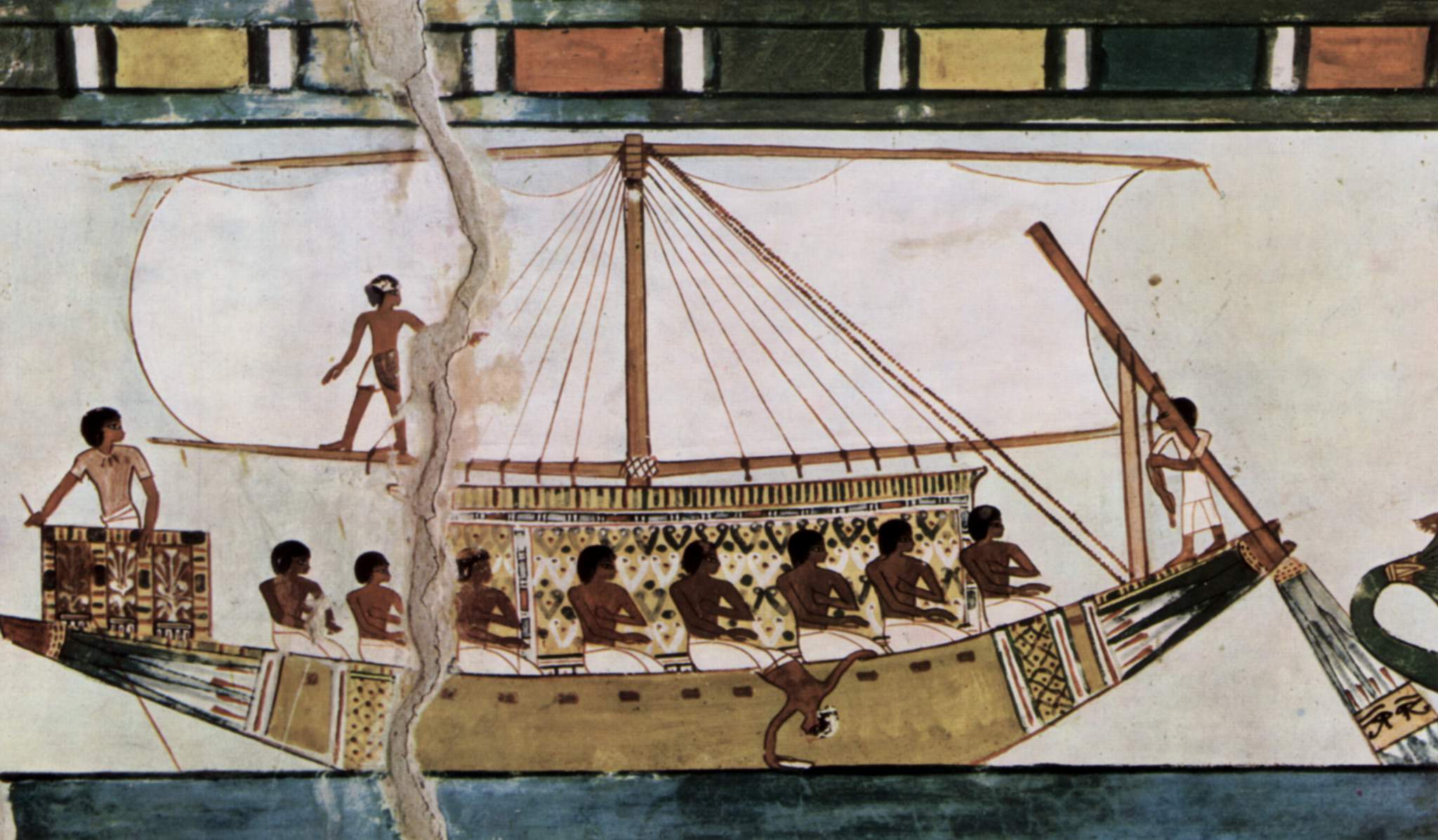
Egypt,1420 BC —Wiki
Egypt, 1250 BC —Wiki

1000 BC—Ocean-going Polynesians settled Oceania 3,000 years ago. Easter Island, NZ, Hawaii. They covered huge distances—repeatedly. And the Pacific Ocean ain't so pacific.

Nubia/Axum traded with India, ships from Northeast Africa sailed between India/Sri Lanka—no small distance.

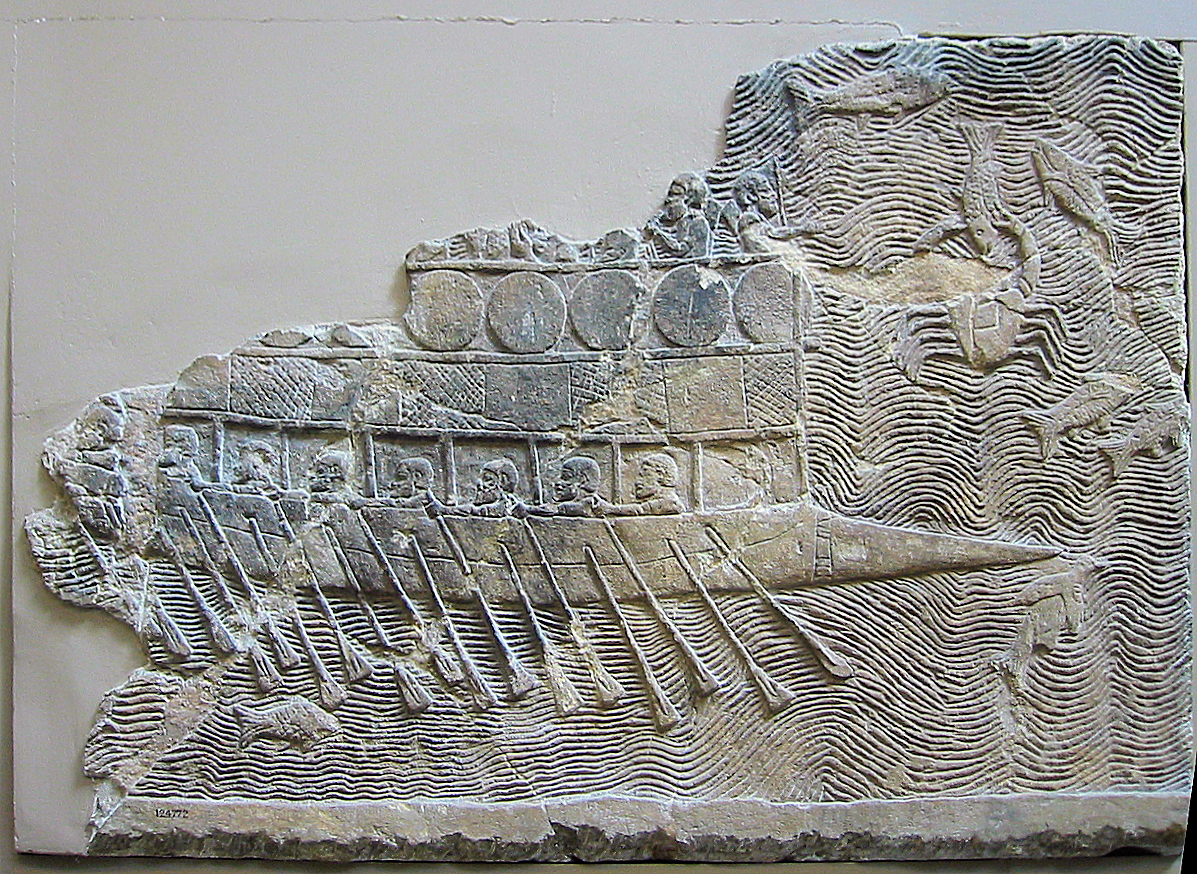
Phoenician warship with two banks of oars, (definitely two decks) relief from Nineveh, ca. 700 BC —Wiki 

Ca. 700 - 500 BC—Then there were uniremes, biremes, used for Caesar's invasions of Britain; triremes and quadriremes. (Latin: triremis "with three banks of oars;" Ancient Greek: τριήρης triērēs, literally "three-rower") was a type of galley.
Herodotus mentions that the Egyptian pharaoh Necho II (610–595 BC) built triremes on the Nile, for service in the Mediterranean, and in the Red Sea, but this reference is disputed by modern historians, and attributed to a confusion, since "triērēs" was by the 5th century used in the generic sense of "warship", regardless its type. The first definite reference to the use of triremes in naval combat dates to ca. 525 BC...  —Wiki
Lenormant Relief from the Acropolis, depicts 54+ oarsmen on an Athenian aphract or trireme, ca. 410 BC; there would be 60 (if they were carrying horses), to 200 oarsmen, that's definitely a warship. —Wiki 

Trade routes from Greece to the Crimean and Sevastopol were not carried out in puddle-jumping rowboats, I guarantee. Sails were involved.

The world according to Herodotus, 440 BC. He didn't think Phoenicians sailed around Libya. —Wiki

ca. 325 BC—Greek navigator Pytheas sailed to Great Britain.

Greek navigator Eudoxus of Cyzicus in 118 BC, sailed a galley, a man-powered sailing vessel. With 300 Greek ships a year sailed between Roman Empire and India, annual trade 300,000 tons.

The Broighter boat an Iron Age Irish boat from 100 BC, had 18 oars and rowlocks—Wiki

The Irish Broighter boat is a gold model of an Iron Age Irish boat from 100 BC, replete with 18 golden oars, rowlocks, benches, a paddle rudder for steering, boathook, a yardarm, tools, and a mast for a sail. By contrast, there is little evidence of sails being used in Norway until 700 AD. The Norse word for a ship lung is borrowed from the Irish word long."

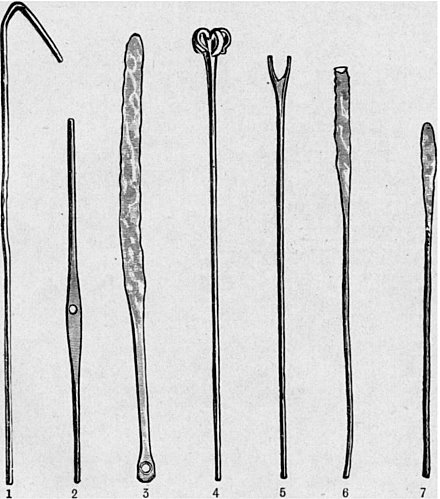
Broighter boat tools: 1.Boat hook 2.Mast yard 3.Steering oar 4.Small grappling iron 5.Forked implements 6.Square ended oars 7.Oars. —Wiki

ca. 400-700 AD— The Irish sailed (and settled) the Faroe Islands and Iceland BEFORE the Vikings—who followed them. Possibly sailed to the New World as well. Njal's Saga? Neil, the redheaded Irishman—with a temper.

Metal replica of original stone plaque (Wild Goose Studio, Kinsale, Co. Cork); there would've been a sail, and at least four more oarsmen. The Broighter boat had 18 oars.

ca. 500 AD—St Brendan the Navigator set sail on the Atlantic Ocean with 14, 16, or 60 men. Old Irish Immrama (from iomramh-voyage), are voyage tales. Celts had sailing ships long before the Vikings.

800 AD—Viking sailing knörr. Most Viking ships were 15 - 70 feet; earlier vessels seem to be burial boats but then they were not sailboats either. The masted Irish Broighter boat is a model of an Iron Age Irish sailboat from 100 BC.

1000-1300 AD—Viking longboats (warships). One of the biggest Viking ships was made in Ireland. Irish oak. Not Viking, but Norse-Irish.

1100 AD—Chinese junks sailing boats with a rudder (war and transport vessels).

1300 AD—Arabic sources describe New World visit by a Mali fleet in 1311.

This seemingly simple timeline took far longer to create than I care to admit. But then, I always use the rovings to learn something new.


Sources:

Ship - Wikipedia, the free encyclopedia
Ancient Maritime History . Wikipedia, the free encyclopedia
Check this link out by vessel type at the Patrick Foundation (it has key texts and displays): CROSSING THE SEAS
Shipbuilding And Navigation - Hindupedia, the Hindu Encyclopedia
Ancient technology - Wikipedia, the free encyclopedia
Mohenjo-daro - Wikipedia, the free encyclopedia
SEA VEHICLES: Ships
Pytheas - Wikipedia, the free encyclopedia


Who is this not so Fabio, and why are my knickers in such a twist? From what I can glean off the internet, this dude studied social anthropology at School of Oriental and African Studies, the University of Oxford and The King's School, Canterbury. It's not like he didn't have access to the facts supping at the grand halls of academe. Pah! He probably doesn't even know the meaning of his hometown name: Milan.

Saturday, July 13, 2013

West County Girl


I'm glad there's not much by way of info on West County on the internet. Where I came of age as a writer, and an artist in the schools. I was always a west county girl—it was a very different reality than the more civilized parts of SonoMarin. We reveled in our weirdness. Because there were no boundaries, we flourished. We did.


Not much by way of info on West County. We reveled in our weirdness. Where I came of age as a writer, and an artist in the schools. I was always a west county girl—it was a very different reality than the more civilized parts of SonoMarin.

Friday, July 12, 2013

PROTESTING AT THE GROVE (prose poem)

PROTESTING AT THE GROVE

Hot July on the Russian River. Bathers and Bohemians. Encampment. We posed as hookers as Bohos slaked their thirst on our side of the river. Northwoods Lodge: FBI agents, Bohos and us. Only there were no cameras. Maybe stealth ones.

Rose refreshed her lipstick in the mirror, looked me in the eye, said: I don't know if you gals are working tonight, but there's a bust going down. Tonight. Was I undercover, or under the covers?

Poet Karla Anderdatter was talking to the river on the Monte Rio Bridge. That's where we bonded. Beauty queen-activist Mary Moore rallied us. Things got ugly at the protest. I was clubbed on the back as I outran the law, camera in hand. Snap!


Did we cross the river? We went skinny-dipping, and the Bohos came to us to slake their thirst. The famous optometrist returning from Russia. Nothing wrong with his eyes. Leering at our flesh, he fed us the news.

Simone got her story on Helmut Kohl. I hardly knew who he was. I took photos. No need for words. Judy Bari also wrote for The Paper (Now The North Bay Bohemian). Newspapers and Bohemians. Full circle! These wild wolf women. Somewhere I have the negatives. Somewhere.

While we angled for more stories at the oasis, someone said sneak into the Grove? So I dropped my cover and we blew the joint. A US Olympic swimmer, he broke a world record for the backstroke. He also could've been lying. Somewhere I have notes. Somewhere. He took me in after midnight. Not much to see in the dark. A large parking lot. Lights in the distance. Maybe atomic ghosts. We howled at the moon.

Not much else to tell, so I took him home. He was sleek as a seal. We did the backstroke and the butterfly and the breaststroke. Dropped him off at the gates at dawn. Was I sleeping with the enemy? All that water under the bridge. Tide coming in. Moon falling into the arms of the sea.

7/12/2013

PROSE POEM

GUNS, not tampons!


Apparently the new Texas Senate 
anti-abortion motto is: 
GUNS, not tampons! 

or maybe it should be:

When tampons are outlawed, 

only outlaws will have tampons. 

Ergo, all women are outlaws
wielding weapons of mass menstruation.

I say, tampons, not guns.
I support a woman's right to bare tampons.
Or there will be blood.

False syllogisms aside (the bread and butter of all politicians), women entering the Texas Senate gallery were frisked for lethal weapons such tampons and Maxi-pads. I won't even ask about the ones in use. Will women on the rag pop tampons out like wine corks and lob them onto the Senate floor?

Holy ogres and onions, are we—like—being totally punked here, or is this the work of America's finest news source, The Onion

OK, so where's the hidden camera? 

Noooooo, things are just looney in Texas. (And they call us the Left Coast). Must be The Big Oil Guns. They planted a bunch of Cadillacs nose-first in the wheatfields, of Amarillo, remember? This is where they shot Jack. Remember? We won't mention the scourge of invasive shrubbery. Makes me want to vomit over three wheatfields.


What, you wanted tampons? American Carhenge, Cadillac Ranch. TX —Wiki

Carhenge and tampon-gates aside, even diabetes kits were confiscated by the Texas Department of Public Safety—sugar packets as lethal weapons. Now, I'm pretty sure withholding diabetes medication is breaking a federal law. Texans breaking the law is an oxymoron. Or maybe onanism. Whatever comes first. But to do in the Senate?


What about the douche bags? You might well ask. Apparently men were allowed to keep their loaded weapons on them at all times. In fact, they were given an expedited CHL (concealed handgun license) entrance by the DPL to bypass the long lines of those packing concealed vaginas—who were detained and frisked for contraband—tampons—for before they were allowed to enter the Senate gallery. 

No mention of special entrances for pregnant, or menopausal women—who don't pack tampons. That's another classification of heat.

What is it with Texas legislators and their preoccupation with women's vaginas, anyway? Have they all lost their bleedin' minds, are they experiencing mass PMS hysteria, or what? Shades of raging hormones and low blood-sugar. You, little lady, you packin' a concealed cooter box? A cock holster? A twat? A womb with a view? We'll need to legislate and register it. Stand down, please. An' gimme that chocolate bar, real slow now, ya hear?

And they call this whole uterine she-bang pro-choice? Next, they'll be banning wanking and onanism. Nah, they wouldn't touch a cocked pistol like that, would they? Ya go a license for that thang? Why yes, I have special concealed handjob permit. To be fair: condoms also were not allowed in the gallery.

Meanwhile, How to Build a tampon gun sites are proliferating on Google.

Maybe we should just drop Texas from the Unites States. Before they make complete jackasses of themselves. Wait, they already did that. Bless Wendy Davis's filibusterin' shoes.

Maybe the Lone Star State's motto should become the Lone Sphincter State. Somebody, take Tex-ass, please. Except for Austin. We'd like to keep Austin. Just to the city limits, of course.

Maybe it's time to break out the Midol. Make that Oxycodone on the rocks. With sugar on top.

Not tonight, dear, I have a headache.


BREAKING: And, it looks as if the women of Texas have lost the right to say Our Bodies, Ourselves is a woman’s right to choose. What business do politicians have to legislate what goes on between a woman's legs? So much for constitutional rights. What's next, will the women of Texas lose the right to vote as well? Ya can't keep breeders down on the farm. There will be blood. Mark my words.


Stand With Texas Women


Tampons Confiscated, Guns Allowed as Texas Senate Debates Abortion news.yahoo.com State troopers confiscated tampons and maxi pads from people entering the Texas Senate gallery on Friday afternoon as senators began debating a controversial new abortion regulations that are almost certain to pass. However, folks with conceal-and-carry permits are allowed in with their guns... State troopers said they were taking anything that could be thrown at legislators, which included tampons, maxi pads, sugar packets, and condoms. But guns are still a go. 


And a send-up: Texas Weighs Ban on Women AUSTIN (The Borowitz Report)—Republican lawmakers in the Texas State Senate are proposing a precedent-setting new bill that would make it illegal for women to live in the state. Senator Harland Dorrinson, one of the many pro-life lawmakers backing the woman ban, crafted his bill after witnessing Senator Wendy Davis filibuster an anti-abortion bill last month. “That was our moment to say, ‘Enough is enough,’ ” he said. “This comes down to a choice between life and women, and we choose life.”

Texas Officially Loses It, Bans Tampons and Diabetic Supplies from Senate Chamber, Guns OK I don’t even know where to start with this pathetic display of nonsense from the Texas Legislature and Department of Public Safety. It seems so much like something ripped from The Onion, but sadly, it’s not.  The Texas Department of Public Safety forced women to hand over their tampons and pads before entering the Senate chamber today. Not only that, but they were also forcing diabetics to hand over sugar packets and other diabetes supplies which are lifelines when dealing with low blood glucose levels


SPEAKING OF BLOOD: these accretions are either the baby, or bathwater—I initially wrote these before I tucked into the main piece—which keeps changing. They no longer fit, so I tossed them out with the bathwater in the ongoing revision process, but didn't want to loose them completely.

Flustered when my gorgeous British professor, a bit of a Hotspur, himself, leaned in a little too close after class, I whipped a tampon out of my bag instead of a pen to take a note. We both looked at it non-plussed. Written in blood, perhaps? Though I liked Shakespeare, and blood is mentioned 42 times in Hamlet, I bled, I hemorrhaged, I dropped the class.

My ex-boyfriend's ex-wife (it's complicated), Shameless Hussy poet, Alta once posed nude for a poster wearing nothing by a tampax. Caused quite the scandal. Brought men to their knees. I double-dare you with chocolate on top to find that on the internet. 

Note bene: Shameless Hussy Press published friends & lovers, John Oliver Simon, their daughter Kia Simon, Paul Mariah, Mimi Albert, and people I knew—Susan Griffin, Ntozake Shange, Mary Mackey, Opal Nations.