Showing posts with label Beltaine. Show all posts

Sunday, May 4, 2014

Lá Fhéile Bealtaine shona daoibh


Notch-peaf, or heliotrope phacelia, Mojave Desert, near Ivanpah

When I was a child, my grandmother always bade me wash my face in the May morning dew. Something to do with the fairies and the Otherworld. In this way culture was transmitted. Mayday was the one day we were allowed to bring a branch of the sacred hawthorn into the house. We had two trees she planted below the house. They didn't thrive in the California heat. But each spring, they blossomed, one red, and and one white. In Bantry, her father drove cattle between bonfires, and sent Catherine wheels down the hill. They weren't wheels, but whiskey barrels filled with tar. He lit and rolled them down the hill from the farm at Coom anÓr. This evening commemorates when the dark half of the year dies and the bright half of the year begins. My grannie was always quick to point out that Beltaine began on the eve of May 4. Not May 1. Somehow, the West Corkonians kept track of the old ways, counting the Cross Quarter days, despite the shift in the Gregorian calendar. She also said Bel/Beal was the god of light, he was not related to Balor, who was a solar god, like Lugh. She said May had to do with the arrival of summer, hence Bel's fires. Bal-ti-mor, who knew the American city was named after the fire god of May? Once I was chosen to crown the statue of the Virgin Mary with a pink rosebud wreath—we sang to the fairest Queen of the May. How did the Virgin Mary become associated with May? In school we wove May baskets of colored paper, and filled them with flowers then left them on neighbors' doorsteps. We also sang A tisket, a tasket, a green and yellow basket... It was a day of hair ribbons and frilly dresses with long sashes. At school, we danced around the Maypole. Such magic was afoot, we were giddy with delight. Then the Lagunitas school board declared it pagan. They feared it was tainted with paganism and the the ever-present threat of Communism was a sub-text. We were devastated, of course. Something in us died that day. Something of wonder, something of beauty. They couldn't hear our distress call. mayday, mayday.  ... ---...  A small sliver of culture went down with the ship that day.


from a Facebook memory
added & rev. 4/1/2016 

Bealtaine (be-all-tin-a) from the Irish, meaning ‘Bright Fire’ 

My story on Mayday


Thursday, August 1, 2013

Lúghnasa


The Mórríghan, my namesake, dressed as a crow was calling outside my window at dawn: it's Lúghnasa! Or maybe it was Lúgh's raven. I couldn't see it, I was trying to sleep. The bird didn't really caw, it was more like a bark: get up you lazybones. I pulled the pillows over my ears. It kept barking. (I was up all night listening to Dick Francis' Even Money. It takes longer to listen to a book than to read it. And I can never put a good book down.)

Only the male crow sings. It's a rather mournful little warble. This one was barking orders outside my window like a drill sargeant. It could have been a raven, but ravens in Oakland? They are deep-voiced. Croak, the raven, evermore? Let's just say corvids were involved.

OK, OK, I'm up. Got it. It's Lúghnasa. (No, not the band). I can't climb the highest peak, nor dance, nor even circle the proverbial well—not with this torn knee. Yesterday I cleaned house for the first time since I was injured in March, and am paying dearly for it. But somehow the body keeps time with tradition, despite the century one is living in. About the only thing up for dancing today, is my imagination.

Sometimes The Mórríghan, the Great Queen, is called the phantom queen, or the war goddess. Or "Morrigu" for short. She's an ancient triune goddess land/ soverighnty. As in mother of the gods. Some say the Welsh Morgan le Fey is a cognate of the Mórríghan (or Morrigan), others say no FN way—it's a case of bad linguistics.

That little fada (accent) on the first syllable, mór changes the meaning of the word from sea—mor, muir, mer—(or horse—but I really don't see how anyone can get "horse" out of itto—great, or big—as in The Big Kahuna.

My Welsh friend Mábli named me The Mórríghan in grad school and it stuck. I miss Mábli, living far awa' in Stornowa'. I know, Maureen is supposed to mean little Mary—but I fancifully said that's a Christian overlay for a name already in Irish mythology. And so, The Mórríghan moniker stuck.

Maíriín is Maíri with a diminutive ending, -ín, or in English: Maura + -een. Like Colleen: cail + în. You're probably thinking Maureen sounds nothing like Mórríghan. Welcome to Irish 1A. That -gh in the middle of Mórríghan is silent, more of a swallowed y sound. Like a gulp. Call this an exercise in false etymology, or maybe a bad case of vivid poetic imagination.

About the only thing that warring camps of Indo-European linguists do agree on is that  = king/queen, or soverignty. The rest is up for grabs.

Then there's the thought that Mor-ríghan is cognate with Morgan idea, with no fada, as in the sea. This is where it gets tricky. She-of-the-sea, my old boyfriend, climber-poet Edwin Drummond (aka The Human Fly) used to call me. Great big sea. (No, not the band). Fanciful wordplay drives linguists to drink, but if you're an IE linguist, where consonants count for little, and vowels count for nothing at all, any excuse to drink is probably good. Or if you're a poet. Besides, who wants to be called Biitter Herbs anyway? Just don't call me Battleaxe.

You're probably wondering what all this has to do with Lúghnasa, or August 1. I'm wending my way there. Never could think straight, so it's widdershins for me. My thoughts travel at the speed of Celtic knots. Or maybe I'm bird-brained from being wakened at dawn.

The crow is one of the Mórríghan's animal personae, a shape-shifter. Not only was she a triple goddess—there's fierce debate as to which three goddesses—she could turn into an eel and a wolf as well as a white, red-eared heifer (OK, so that's four critters—which goes against the Celtic trinity thing).

But in Irish literature, The Mórríghan was most famous as the scaldcrow, or raven on the shoulder of CúChullain's corpse—he died, strapped to a menhir on the battlefield in the Táin Bó Cúailnge while she ate his guts. She is the Irish goddess of war and fate. The washer at the ford, she ordains who will live or die on the battlefield.

Those two had a serious love-hate thing going on. Cú should never have spurned The Mórríghan  when she offered herself up. (She had this re-virgination land thing going on too). You know what they say about a woman scorned. Kick that up a few notches when she's an cougar sovereign goddess—and mother of the gods. Besides, Lúgh was Cú's father. So, I'm sure there was another interesting triangle going on as well. Welcoming them home with open thighs, and all that. Let's just say she's complicated.

Lúgh too had a thing about those corvids—oracle ravens. You know, the ravens at the Tower of London? No wonder the Romans had to bury statues of imperial Roman eagles there. To break up the juju. Some say London is Lugh's city, Lugdunum. Did the ancient Irish distinguish between ravens and crows? They're both Otherworld carrion birds. Some IE linguists claim that the Gaulish lugos (Lúgh is a cognate) means raven. Or maybe it means *lug as in oath, pledge, or in Proto-Indo European it could mean *leuk (light). Or maybe it's wordplay with ravens. —Check out Lugh - in Mary Jones dictionary.

The Hound of Ulster's man-handle was CúChullain, but his baby name was Sétanta (sé as in Sidhe?). There was something odd about his birth(s): unseasonable snow, birds, twinned colts (making it a triad birth), maybe some kidnapping or infantacide. Let's just say he-who-was-to-become-Sétanta, then CúChullain, died more than once, and Lúgh had to stick the kid's soul back into Deichtine's womb all over again. (Deichtine was sort of like the Welsh Arianrhod (silver wheel) and her magical sons: Dylan Ail Don and Lleu Llaw Gyffes. All these multiple virgin births. I'm sure their Facebook status is set to: It's extremely complicated. Monks trying to shoehorn Irish mythology into Biblical shoes.)

So when the Mórríghan was calling me nine times outside my window at dawn, in a place where crows don't normally visit—it got my attention. Made me realize it's a feastday. A crossroad of the year. I thought about baking some sodabread to celebrate the great wheel of the year. Not that I actually did anything, other than attempt to write this blogín.

The other ancient  Irish feast days are largely forgotten—but everybody knows of Hallowe'en, or Samhain. Then there's Imbolc (first milk) and Beltane (Bel's fires). And Lúgnasadh. Or Lúghnasa—its Christian frock is the harvest, or first-new-grain-loaf festival, aka Lammas Day. Technically, Lúghnasa began yesterday, as Irish days, like Hebrew days begin at dusk.

Today is the feastday of the god Lúgh Lámhfhada. And whenever you begin invoking the old Irish gods, they all want to come to the party. And young Lúgh, a bona fide member of the Tuatha Dé Danann, was the young rising god, a real party animal. 

Lúgnasa is the half-way mark between the summer solstice and autumn equinox. The word is a combination of Lúg (the god Lúgh) and -násad (which is an assembly, or gathering). His handle, Lámhfhada means long arm. God of all arts, he was really good with his, er… spear. (See also pan-Celtic god Lugus, and Welsh counterpart Lleu Llaw Gyffes, "The Bright One with the Strong Hand.")

Lúgh (modern: Lú) founded the Óenach Tailten (the ancient Irish Olympic Games—similar to the Greek Games) as a funeral feast for his (foster) mother Tailtiu, queen of the Fir Bolg. Royal
fosterage was a big deal in ancient Irish mythology—it built alliances between clans and tribes. Foster children had mixed allegiances—to their foster families, and to their blood kin. 

Cian of the Tuatha Dé Danann was Lugh's father, and Ethniu, daughter of Balor, of the Fomorians, was his mother. (Or Lugh had three fathers, or was born three times, or was a lone surviving triplet—Balor drowned the others.) Got that? There's a test at the end, should you ever get to the bottom of it. I would imagine most of you are stark raving by now—with all those pimpley hyperlinks screaming: pick me, pick me!

So, we have three conjoined Irish races: Tuatha Dé Danann (TDD), and some Fomorians from under the sea (making Lúgh a half-god), with the Fir Bolgs as his foster parents. Add fosterage with Manannán mac Lír at Emhain Abhlach (Anglesey) too. we're not to sure what mythical race he was, TDD? Manannán arms Lúgh. So, Lúgh has three fathers, and/or is triplets, or was the product of a triple birth. Good old Indo-European threes. Surely that was significant. I said, it's complicated. Gawd, I need a drink.

Lúgh's poor foster mother Tailtiu, died of exhaustion after clearing the plains of Ireland for agriculture. Not too sure what all the menfolk were doing when all this was happening. Sitting on their keisters swilling heather beer in yon bonny glen? Apparently clearing the fields was women's work—even if she was the queen. What's with that? Master and commander?

So Lúgh of the Long Arm threw his foster mother Tailtiu the mother of all Irish wakes, or funeral feasts—if you must. The first Óenach Tailten, or Áenach Tailteann, was traditionally said to be held at modern Teltown, County Meath. Telltown is a corruption of Tailtu's name. It's also the seat of the early Uí Néills, so locating it there is a dynastic thing. Turf wars and all that. They later footed the bill for the See of St. Patrick at Armagh and took on some retroactive airs.

The Óenach Tailten Games were celebrated as late as the 18th century and included feasting, fighting and fecking. Or the ritual sacrifice of a white bull, heavy athletic competitions, handfasting, dancing, pilgrimages to the top of Croagh Patrick and to holy wells (Brigid, the beer goddess and the hearth is invoked), and the ritual cutting of the first harvest grain—with August 1 as the epicenter. 

Surely you didn't think these parties lasted only a day, did you? More like a month and a day. Takes about a week or two to ease into it. Like poets arriving fashionably late. Then, it was party like a rock star for another week or so, then nurse the hangover. Willow bark tea was as good as it got for aspirin.

See, when the Games were gussied up and Christianized, the sagarts had to make the festival fall on a Sunday to make things work out right. Eddie Stack mentioned in his blog that July 26 was Féile Lúghnasa. It's a movable feast—whatever it takes to make it to fall on the last Sunday in July.
One time it was held at around 200 sites, nearly always remote, inaccessible places that were on heights, or near water. The festival was dedicated to Lúgh, the young and most brilliant god of the Tuatha de Danann. Lúgh was the god of light, god of arts and crafts, father of inventions and the likes. It was he who saved the harvest by vanquishing Bal, the sun god who was in the process of scorching all the country’s plants and crops with relentless heat.  —Eddie Stack 2010
Lúghnasa is ancestor of Aonach an Phoic Puck FairDomnach na bhFraochóg, or Bilberry Sunday. (AKA frachóg, whorts, or heatherberries. In our family, August is also the opening day of huckleberry season. My grannie would take us up the ridge at Tomales Bay to check on the bushes. Just to make sure.)

The Áenach Tailteann is also the ancestor Games of Scottish Highland Games—as they too were traditionally held in August. 

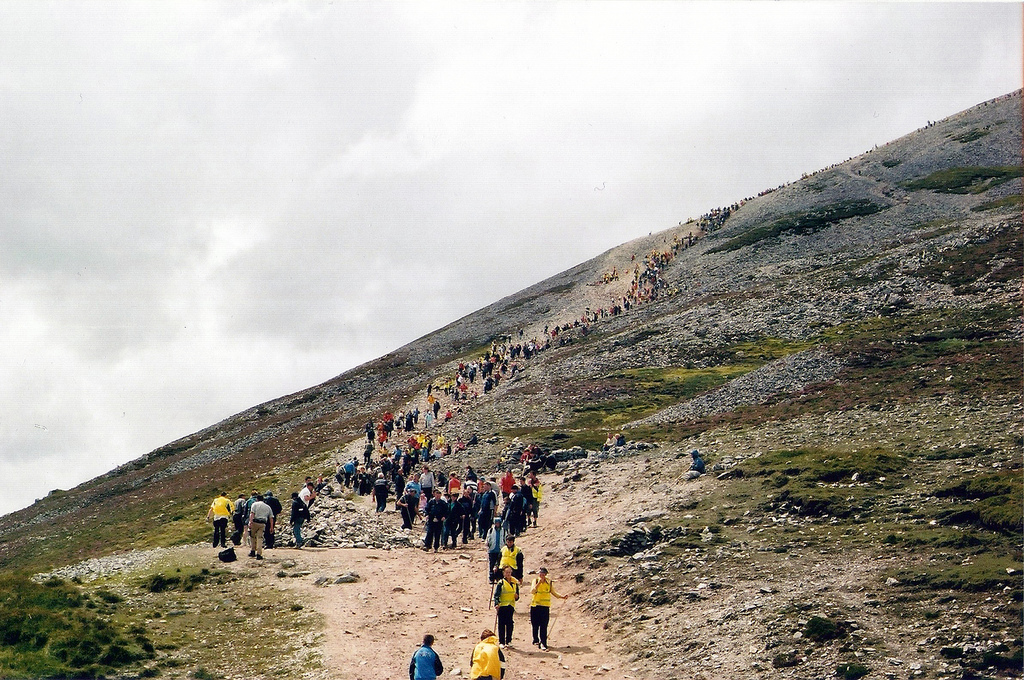
Lúghnasa was once called Dé Domhnach Chrom Dubh, or Crom Dubh Sunday—he was a bent/crooked dark fertility god, said to reside in a cave at the crest of Croagh Patrick. But Christianity banished him as an evil one.  Another permutation of Lúghnasa is Domhnach na CruaicheReek Sunday, or Garland Sunday, is the day 30,000 Irish lemmings crawl up Croagh Patrick on bended knee. Or blindfolded, or both, while praying all the way up with myriad jaysusmaryanjosephs. Not me, my knees will never kneel again. Though I do prefer to walk barefoot.

Pilgrims climbing Croagh Patrick on "Reek Sunday," part of the festival of Lúgh since ancient times. —Wiki
Lúgh Lámhfhada was also the patron god of cobblers. Thought I'd throw that one in for free. The thought of shoes at a time like this tickles me. I can't bend down to put on my shoes. Besides, the closest I got to a holy well today was the shower. I was circling the drain. Does dyeing your hair count as pilgrimage?

So you had a few goats, some old and new, toss in a bit of the living and the dead, and the dead coming back to life again—what more could you ask for? An "A" party list.

Lá Fhéile Lúghnasa Sona Daoibh!

Thursday, May 2, 2013

Beltaine Chickens?

Today's SF Gate headlines blazed: Chickens go up in flames.

A little egg-cessive Beltaine celebrating gone awry in Palo Alto—or an otherwise slow day for the news?

Believe it or not, the Irish Word a Day is Sicín - Chicken.
Ba mhaith liom sicín a ithe.

None dare call it WickerHen.

Owner says hens were probably smoking in the henhouse.

I think the Colonel did it.

Ok, so I just can't help myself—either it's the Monty Python tea that's given me the giggles or the fires raging in SoNapa counties are burning an early bumper crop of something green.

They say it's going to be another drought year.

Sunday, May 1, 2011

Beltaine

The May Day hills were burning, far and near. —Seamus Heaney

Beltaine: My great-grandfather in Bantry used to drive his cattle between two fires to purify them & bring luck. The God Bel, or Belenos' fires. Eadar dà theine Bhealltainn

Saturday, April 30, 2011

Happy Beltaine ~ Féile Na Bealtaine


Happy Beltaine ~ Féile Na Bealtaine. The night of Bel's fires. Light a candle tonight, smudge the house with sage smoke. Jump over the candlestick. This is a night of enchantment, like Halloween, when the doors of the Otherworld open. Magic happens.

The Celtic day begin at sunset. So April 30, at sunset, is really May 1. Got it? Good. I won't mention that the calendar we use, is not the same as the one used in the Middle Ages, so it's anywhere from 4 to 9 days off, depending upon which century you hailed from.

I was driving down Hwy 80 from Martinez when the lurid sunset outdid its own clichés. I was stuck in the mother of all traffic jams and the sky was practicing its own weird version of coastal alpenglow. I thought of Heidi's firebird. A phoenix sky to herald the beginning of summer. (No not, the Summer Solstice, that's the half-way mark of summer.


added & revised 4/30/2016 from a FB memory

Friday, May 1, 2009

Beltaine, May Day dream sequence

Lá buidhe Bealtaine shona daoibh. 

To celebrate the day of Beltaine,
wash in the May morning dew.

The woman who washes her face
in it will be beautiful;
the man who washes his hands
will be skilled with knots and nets.

Dew, they said DEW. not a feckin' downpour or monsoon! Sheesh! The rain woke me. No chance of dew. Then I remembered, the dream flooded back.... Beltaine, May Day is the night when the gates to the Otherworld open, it often comes in as if a dream. May First begins the season of the dream walkers.

* * *


I dreamed I was traveling on foot across the countryside, and in a wooded clearing, I stumbled across a wide barrow on my right. Thinking I'd stumbled upon something like the massive rabbit warrens that my grandmother crawled into as a child, seeking refuge in the hills above Bantry Bay, I got down on my hands and knees to see what I could see. I must've heard a noise because I looked deeper into the limnal jaws of the underground maw.

As my eyes adjusted to the dimness, I saw vermin, no, a little black fox, with matted fur, or at least I thought it was a fox. He was mangy and grubby but unafraid of my alien presence. Behind him I saw a buried Liliputian city, replete with Victorians painted yellow, orange and red, fiery, as if lit from within, in this underground cavern. It was night in that realm, streetlamps cast small pools of light on the pavements grey. Perhaps it was a reminder that this was a dream, not real.

The little fox was standing on a street corner, perhaps in another land, or another time. I no longer knew where I was, but I was growing frightened. This much I knew: the burrow was the gates to the
Otherworld. To enter the Otherworld was to never return to this realm, it was also the gateway to enchantment or death. Land to the west. Tír na nÓg. Perhaps. like Oisín, I would return to another century.

Sometimes in dreams, my dead mother comes to visit. Sometimes she is with my grandmother. It is always a tearful reunion, they can never stay long. And here I was, willingly crawling underground, still very much alive.

But like a changeling child, the little black fox kept beseeching me with his milk blue eyes and small whine, begging me to come to him into the
cruachan, but I was afraid of his fleas, and imagined diseases. 

I thought of rabies and of the bubonic plague, the black death that killed many millions during the Middle Ages, they knew rats were somehow involved, they never dreamed it was the fleas. 

I thought too of my grandmother's stories of the OweynagCat, the cave of the great Irish three-headed saber cat, in which case, I was right in the middle of some seriously dark Otherworld sidhe mojo, as Samhain was the feast night of the Great Cat. And this was Beltaine, the beginning of Hafgan's realm, the Annwn Welsh lord of summer. A time of stolen children and horses. At least I had enough sense to leave the rowan and whitehtorn unplucked.

But the young pup cowered and whimpered, wanting creature comfort. I realized that he was as lost and out of his element as I was, so I crawled into the burrow to comfort him. He gladly crept into my arms, licked my face and throat. Initiation by saliva. He whimpered with recognition and squirmed with joy. Who was this little fellow and why was he abandoned on the metaphorical mean streets of an underground city?

I realized that his unkempt appearance was not because of mange or disease, though I still feared his fleas, but because he was a puppy, not a fox, and that there were others of his kind, hiding in the alleys and back streets. He was a sentinel scout for his brothers. The litter came bounding forth, surrounding me with their joyous puppy energy.

I was gathering them in, comforting them, when I sensed another darker presence on my right, and I was looking into the ominous yellow eyes, not of a fox, but a wary long-haired dog, a dog unlike anything I'd ever seen. Surely not an Alsatian or a German shepherd guarding the gates of hell.

The dog's ink dark coat was longer, thicker, no distinctive saddle markings. Her head was narrower, her ears bigger, her snout longer. Perhaps she was a half-breed. No Cerebus, but there was something unkempt and uncivilized about her that I couldn't quite put my finger on.

I realized I was looking right into the eyes of a wild wolf mother and I was in her den. In her territory. I froze and we eyed it off. I backed away slowly, but the pups would have none of it. They bounded in my arms, pounced on me, pulled at the tie that held back my waist long hair with their milk teeth, and paraded it forth until I was bound up in a veiled tangle of my own hair, I was a
selkie caught fast in the fisherman's net.

The mother wolf backed off her stance, lifted a front paw slightly, and sat, as if to acknowledge that I meant her babies no harm, and then she stiffly, or formally approached. I offered my curled right hand, palm down, for her to sniff. The tension crackled like static electricity.

I willed myself into calmness and looked down at the ground, not daring to make eye contact as I knew that would be perceived as a threat. My throat exposed, my hand, soft in supplication, I had to will the fear from my body and just be there, in timeless suspension. I focused on my breath. When I felt her cold nose on my hand, I knew that the danger was past and that I would live to see another day.

The
loba returned to her young, sat down, with a ribbon of tongue lolling out, she began the endless task of bathing them, taking in their sour milk-odor, as they settled in for a long suckle. I retreated from their burrow and with that, I awoke to the heavy downpour of rain on the first day of May. 


So much for bathing in the May morning dew.

Was it May Day, or maybe mayday but then I realized that I was true dreaming, that I had indeed traveled to another place and time. It was a dextrous right-handed dream, and in that moment I realized that in the face of death, the fear is something I make daily, of my own choosing.

And in that moment I realized also that the reason why my mother and grandmother were hovering in the wings of my dreams, was that they had come, not for me, but for their remaining daughters and sisters, my aunts—where the cancer blossoms inside them like a black rose.


I awoke to the urgent ringing of the phone—on the answering machine was the dark news no one wants to hear. The ravening wolf.


YouTube of Oweynagat, a journey into mother earth: still images of the entrance to the Otherworld, by Mike Croghan, with music by Afto Celt Sound System.

Wednesday, October 31, 2001

Folklore: Fertility Rites

Family story about a farm fertility custom, driving cattle between two fires on Samhain & Beltaine, circa 1896.
My grandmother, Jennie Walsh Reilly was born in 1893, on the Walsh family farm, Coomb an nOr (valley of gold), outside the town of Bantry Bay, Co. Cork, Ireland. She emigrated to California with her aunt Mae in June, 1912—literally having missed the boat when the Titanic sailed—and sank—in April), and raised me in Forest Knolls, West Marin, Ca. Ever since I was a young child (and sole companion after her husband died in 1956), she was always after telling me stories about life and customs on their family farm in Ireland.

I remember the story (usually told on Hallowe'en), of how her father, Michael Walsh, would fill two oak barrels with tar and then drag them to the top of their hill at Coomb an nOr each Beltaine Eve (April 31st) and Samhain—or to use the Christianized name, Hallowe'en—(Oct. 31st), he'd light them at dusk, and then he'd drive the family cattle between the two burring barrels.

She said that the custom was to make the cattle fertile for the coming season. Then, after the cattle were smoked, he'd finish up by rolling the still-burning barrels down the hill to make a firetrail.

My grandmother explained that this custom was done on the evening of Oct. 31st, which is the first day of the Celtic New Year (The Celtic day begins at sunset); and Beltaine (the god Bel's fires) was the beginning of summer. Sometimes on Beltaine, he'd also cover a wagon wheel in tar and roll that down the hill too. Someone later said it was a Catherine wheel.

We had several fire-related rituals that had seasonal significance. My grandmother's attempt to recreate for me a version of this ritual—since to roll a burning barrel down our dry, grassy hill (also named Coonb an nOr) in West Marin, was a form of pyrotechnic suicide—her solution was to build a big fire in the fireplace (which was a converted ship's boiler), or to light herbs and to smudge the house.

And once, when I was eight or nine (1968), she put a candle in the middle of the living room floor and told me leap over it. I don't know whose idea it was to sing the nursery rhyme, "Jack be nimble, Jack be quick, Jack jump over the candlestick," since this causal magic act was never repeated, I'm not sure if it qualifies as folklore, but it had a profound lasting impact on me.

My grandmother explained that the people of pagan Celtic Britain and Ireland traditionally celebrated these two dates with bonfires, and told me how she celebrated Hallowe'en in Ireland, hollowing out turnips and placing them in the windows, etc.

Ann Ross in "Pagan Celtic Britain" (Academy Chicago Publishers, 1967), wrote, "During the festival [Beltaine/Samhain] Druids seemingly drove cattle between fires." (p 83).

I believe my grandmother and her father were both aware of the ritual use of causal magic to promote cattle fertility, but probably didn't believe in it, and that the use of smoke as a purification was a practical application of folk medicine to remove parasites, a sound agrarian practice. For me, the story captured a lost fragment of our pre-Christian past.

From the UC Berkeley Kroeber Hall Folklore Files.