Showing posts with label North Bay Bohemian. Show all posts

Monday, October 6, 2014

The Value of Poetry: Pure Gold

After I sent out a zany email to the Press Democrat to cover our upcoming California Poets in the Schools symposium, Voices of Gold, they decided to write a little feature on me instead. Oops. I became the news. Last time the PD did a story on me, the Loma Prieta earthquake struck. The next time I had something big and newsworthy, 9/11 happened—just as I was going out the door to the Marin Poetry Center reading, and the coffee table book I was promoting, Writing the Rails—Best Loved Train Stories (Black Dog & Leventhal), was remaindered before it was released. Third time's a charm? These are my soft notes. It will be interesting to see how it will be shaped. It has a Sonoma County slant as those are the newspaper demographics. It took me two days to write this—like a cat writing my way out of a paper bag. Of course, now that I've sent it in (too late now), I see all kinds of rough segues, errors, and bits in need of revision. It is what it is...

What is the value of poetry?

The doctor poet-William Carlos Williams wrote: 'It is difficult to get the news from poems, yet men die miserably every day for lack of what is found there.” Poetry allows us to examine our emotions and and contemplate our thoughts. Wordsworth scribed: “Poetry is human emotion recollected in tranquillity.” Not that there’s much by way of tranquillity to be had during this day and age. In the process of recollection, poetry gives shape and form and meaning to those constantly chattering voices inside our heads, and renders them into an art form.

What can poetry accomplish that prose cannot?

Prose is to poetry as math is to music—you need both—but prose is analytical, expository, and tends toward the utilitarian. Poetry is like dancing with words. Poetry gives shape to our innermost feelings, and presents them in a tangible art form that others can enjoy, and get the Aha! epiphany. The ancient Greeks dubbed poetry as the mother of all arts. During a poetry lesson on “If…,” one of my kindergarten students at San Miguel School stood up and proclaimed: “If I were king of the universe, I’d dance for a living.” He got the Aha! moment.

Ironically I hated the study of poetry when I was young, because I didn't get it. I have dyslexia—which was part of the problem. But I was looking at form versus content, or meaning. As a writer, I’m not a big fan of metered verse, though we tend to speak in iambic stress. It took me a long time to make that full circle—which is ironic in that I coach high school students to recite poetry for the Poetry Out Loud competition.

CPITS poets create a personalized a standards-based grade level curriculum (California history, the ancient world, water cycles, or health ed.,) and infuse it with magic and mystery, often marrying theatre, music and visual arts with the literary arts.

How does the CPITS program capture—and hold—a child’s interest?

Through the immediacy and approachability of our CPTS poetry lesson plans, we offer poems from the great body of literature, as well as peer student poems, as models. It’s a mirroring process. We write our own poems based on other poems. 

Imagine being a student cut off from writing about your feeling and thoughts. With the current state curriculum standards, most student writing is expository, or fill in the dots, and there’s no room for creative self-expression. Then imagine these wild poets who come along, they take language, they damsel it up and shake it all about. Suddenly that stuffy poetry is equal parts theater and soap-box pulpit, coupled with innermost feelings fueled by wild imagination—and suddenly it’s all fun.

Most kids discover that writing their own poetry is liberating—especially those kids who traditionally don’t do well in school, or have trouble accessing the language arts curriculum. Because there’s no right or wrong way to write poetry, it’s a place where they can excel. Then, their poems are published in a school handout or a book—and suddenly poetry matters.

Suddenly you’ve kids with a vested interest in getting every word right, and every simile and comma in its exact right place. It happens like that. I was teaching in a tough East Oakland inner-city school where a fifth grader, Franklin, my star poet, was expelled. As he cleared out his desk, he eavesdropped in on the poetry lesson. He put his stuff down, grabbed some paper out of the trash, and madly wrote an amazing stream of consciousness poem that was later published in our 2012 CPITS anthology, Turning into Stars.

I wish there was a CPITS residency offered when I was in school. Since CPITS was founded in 1964, it could’ve been technically possible. It would’ve changed my entire relationship with school and with poetry. About the time I began to write poetry, I was also diagnosed with dyslexia. There’s a reason why I had so much trouble in school, and why did I have to wait until I was 30 to discover that I loved to write?

When traditional education failed, poetry taught me to think, and I went on to write essays and arts grants—I had seven California Arts Council artist-in-residency grant at Mark West School in Santa Rosa. And I became a feature writer for the Sonoma County Stump as well as for the West Sonoma County Paper (now the North Bay Bohemian.) None of it would’ve happened if I hadn’t discovered poetry.  

The reason why I’m in the classroom, is that, as a poet, I’m a role model. I can reach those kids who traditionally fall through the cracks, and show them how they can access their minds. Poetry creates a powerful tool for change and self actualization. A former student from Mark West School, who didn’t think poetry was important, called me up at midnight to read me a poem he’d just written out of the blue. Scott Meisner was a 21-year-old college student with a MBA who finally got the Aha! moment when he realized that poetry matters.

If the program isn’t at my child’s school, how can I help bring it there?

The best way to get poetry into the schools is usually through a parent volunteer, the PTA, or a teacher. At Alexander Valley School, a teacher, Peggy Maddock, brought poetry to the school—and now first grade teacher Shannon Hausman continues the tradition. Since 1991, I’ve taught an entire generation of Alexander Valley kids poetry.

There are numerous school and community funding sources that can be utilized to fund a CPITS residency. We are trained to work with teachers to locate and develop funding sources: including specialized school funds—from gifted and talented, youth at risk, library funds, etc; to state and local arts education resources: the Community Foundation of Sonoma County, and the California Arts Council. We’ve become gifted grantwriters in the process.

During this time of dire funding for the arts, we’ve some great breaking news: thanks to a California Arts Council /Artists in Schools grant, Sonoma County CPITS poets will offer long-term, in-depth poetry writing residencies at four schools in Sonoma County. Contact the Sonoma-Napa CPITS Area Coordinator Meg Hamill, megmariehamill@gmail.com, or the San Francisco CPITS office info@CPITS.org, (415) 221-4201, for more information.

CPITS, a collective of professional poets who bring literary craft into classrooms statewide, is one of the nation’s oldest visiting writers program—and this weekend we’re celebrating our 50th anniversary October 10-12 at IONS Earthrise Retreat on the Sono-Marin border. If you’re an artist and want to work in the schools, or you’re a teacher interested in enriching your language arts curriculum, our CPITS Symposium, Voices of Gold, is an excellent resource and training ground. We’ve ten more spaces open for day-use folks, either Saturday, or Saturday and Sunday. Two more IONS rooms just opened up if they need to stay over. The view from the ridge is breathtaking and the food is fabulous.

Our keynote will be former California Poet Laureate Al Young. On Friday, an intensive “method writing” workshop will be led by Los Angeles poet and screenwriter Jack Grapes. The symposium will also features spoken word artist Josh Healey and visiting poets from around the state who will share proven strategies to deliver hands-on and out-loud poetry in schools.

If you’d like to become involved as a teacher, poet, donor or school, please find us on the web at www.cpits.org to help build the future for young writers in California. Statewide CPITS residencies reach more than 25,000 students, and trained CPITS poets offer time-tested teaching tools to enhance literacy, and foster creative problem solving and self-expression. Poetry workshops are held at public and private schools, juvenile hall, libraries, after-school programs, hospitals, multilingual settings and other community venues.

And if you can’t come to the symposium, you might want to order our inaugural CPITS lesson plan book, “Poetry Crossing: 50 Lessons for K-12 Classrooms.” Edited by former CPITS AC, Phyllis Meshalum of Sebastopol, it’s a large format ready-to-roll writing lesson ideas for all ages.

Friday, July 12, 2013

Protesting at the Grove


Hot July on the Russian River. Land of bathers and boaters. Land of barbecues and Bohemians. Resort towns and summer homes abound on the river from Forestville, Rio Nido, Guerneville, Monte Rio, Duncan's Mills, to Jenner.

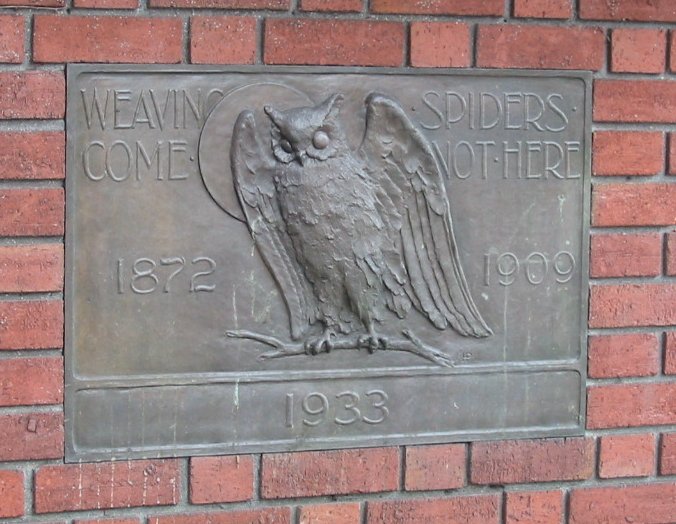
The Russian River is also summer home to the Bohemian Grove encampment, sponsored by San Francisco's Bohemian Club, a private men's enclave, founded in 1872. The club's mascot is an owl, and their motto is "Weaving Spiders Come Not Here." The idea is that you leave your cares behind.

Imagine upwards of 3,000 big-wig male guests descending upon an old sawmill and camping out. That's the Bohemian Grove encampment. The Bohemian Club guest list has included every Republican and some Democratic presidents since 1923, and myriad cabinet officials. Add CEOs of large corporations, oil magnates, financial institutions, banks, military contractors, utilities commissions, and the national media. Let's just say a whole lot of in-bed friendships are forged at the Grove.

Weaving spiders come not here—inscription with an owl mascot on a bronze plaque at Taylor & Post Streets, San Francisco
Members of the once arty Bohemian Club were comprised of journalists, painters, pianists, and poets. Now, membership is comprised of local and global leaders, politicians, and businessmen—who are entertained by the Bohemians—those self-same artists and musicians who originally founded the club.

Bohemian tent, 1900s, Porter Garnett, George SterlingJack London —Wiki

Summer camping in the North Bay is a fine old San Francisco tradition. In fact, most city folks moved en masse to the river for the summer. (Probably trying to escape the fog.) Grand hotels like the Monte Rio, were vast summer palaces. The river was jammed from shore to shore, from beginning to end, with campers.

The first Bohemian Club campout was at Taylorville (Samuel P. Taylor State Park), in West Marin, a little over a hundred years ago, in 1878. That's right down the creek from where I grew up on the Lagunitas/Forest Knolls border.

The Bohemian Club campout began as a rousing thespian send-off for founding member, Henry "Harry" Edwards, a stage actor (and entomologist) headed for the New York stage. The liquor flowed wild and free, men flubbed their lines, a rousing good time was had by all, and a hundred drunken men slept it off under the redwoods. It's amazing the Japanese paper lanterns didn't burn the place down. Harry went east, but such a good time was had by all, thespian camping became an annual tradition without Harry.

Why Camp Taylor, you might ask? The name of the creek should give you a broad hint: Papermill. Rags from the city arrived by train, watermills pulped them into paper, which was sent back to the city for the newspapers, mint currency and so on. The Bohemian Club was founded by newspapermen.

Because of train access, Camp Taylor was also a popular summer destination and so many folks camped all along the length of Papermill (or Lagunitas) Creek during the summer, it was a zoo. (And a cesspool, too, I would imagine.)

When the Bohemian Club's camp outgrew Camp Taylor, it moved south to Muir Woods in the 1900s, where it picked up the moniker Bohemian Grove. (There's a plaque for that.) The Bohemian Club scouted out new locations along the Russian River, and moved summer camp to a redwood stand at Duncan's Mills, near the mouth of the Russian River, before settling permanently in the Meeker Sawmill in Monte Rio in 1893. 

The Bohemian Grove, is a 2700-acre encampment with permanent dwellings. It's also the screening site for potential new members nominated during Spring Jinks, in June. Forty-year members, called "The Old Guard," are the gatekeepers.

What began as Midsummer High Jinks, the Bohemian Club's cultural centerpiece, where poems were once recited, songs sung, and dramatic readings given under the redwood trees, has, over the decades, devolved into the spawning ground of global politics.
The Owl Shrine and the lake— a man-made pond. —Wiki

The Bohemian Grove's annual commencement ceremony, a theatrical production, the Cremation of Care, commemorates the burning of an effigy of "Dull Care" on an altar of a 40-foot stucco owl, by hooded Druids, kicks off the encampment. Instead of allegorically banishing worldly cares, and the informal "Lakeside Talks," have fostered an abuse of political power. Guest speakers have included Henry Kissinger to Helmut Kohl. The virtues of lyric poetry was the farthest thing from their minds.

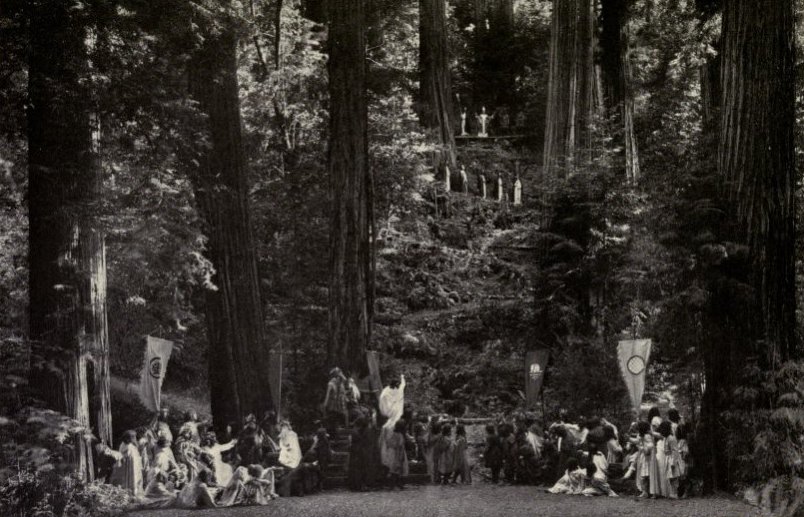
A dress rehearsal for the 1909 Grove PlaySt. Patrick at Tara —Wiki
Maynard Dixon's illustration of the 1909 Grove Play St. Patrick at Tara, the spirit of Irish hero Cuchulainn appears to Saint Patrick among the Redwoods. —Wiki

The Grove is a place where many political webs are spun, and it's the birthplace of warmongering projects from the Manhattan Project, to the Gulf War, and the invasion of Iraq. Policies made inside the Grove affect the outside world. The decision to drop the A-bomb on Hiroshima was made at the Grove.

Cremation of Care in 1907 -Wiki
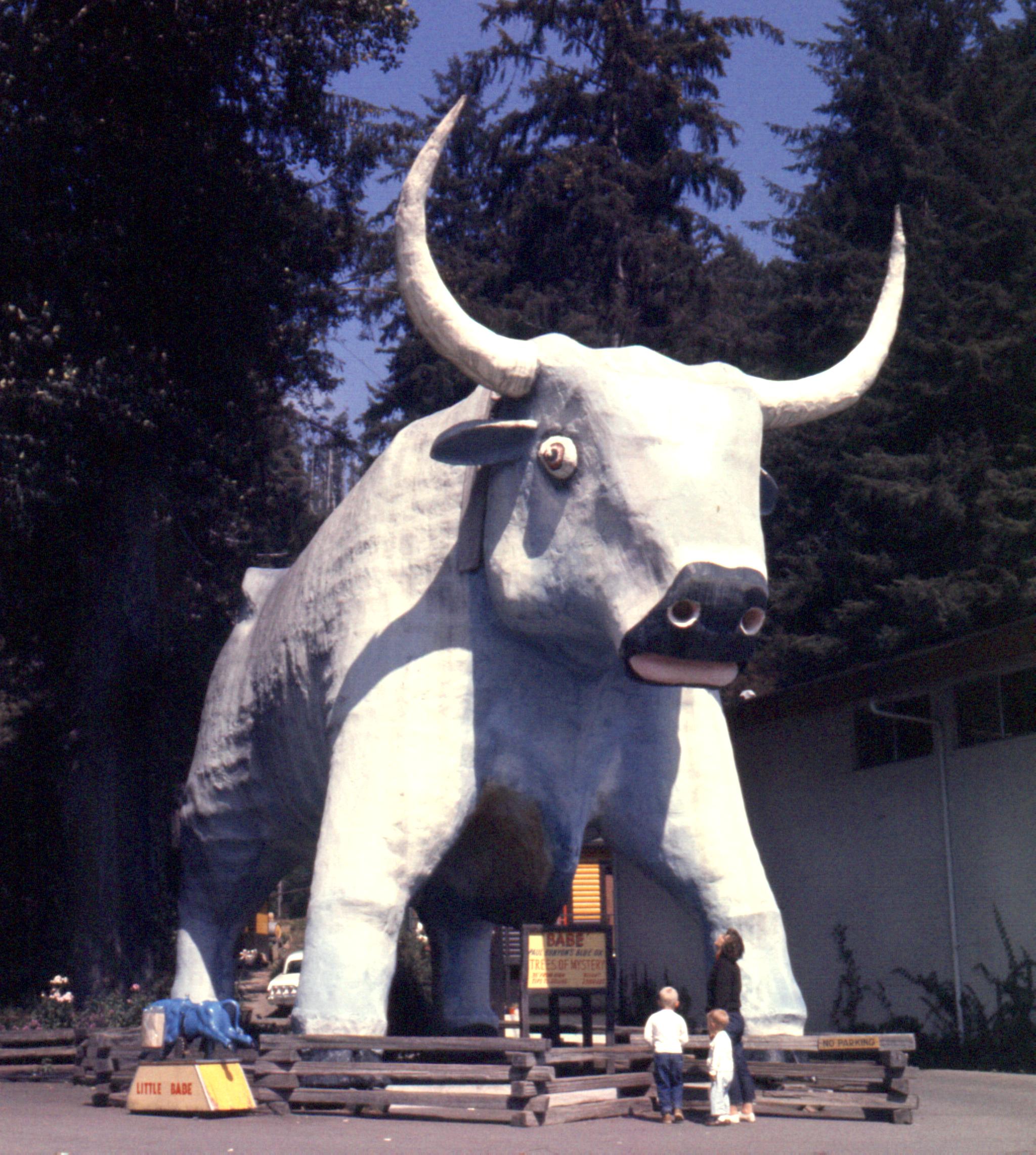
The twin Bohemias: I grew up in Forest Knolls, and came of political age in Forestville. I traded one forest for another, but unlike many a frequent Grove camper, peeing on the trees—like Governor Reagan who famously quipped, "If you've seen one redwood, you've seen them all," I could see the forest and the trees. Some pretty tall Paul Bunyon tales got their bullish start at the Grove by leaving the Babe home. Some say more like Moloch.

Babe the Blue Ox, Trees of MysteryKlamath, CA —Wiki

Fishing for stories, Paper reporter, Simone Wilson and I once posed as hookers at the Northwoods Lodge as the Boho campers furiously slaked themselves on our side of the river. There were FBI (replete in pencil pants and white socks, just like in the movies) and infamous San Francisco hookers. Only there were no cameras that night. Stealth cameras, maybe.

Frowsy redheaded Rose, the madam, carrying on the Barbary Coast tradition of prostitution during the 1980s, refreshed her lipstick in the mirror, looked me in the eye and said: I don't know who you gals are working for, but there's a bust going down tonight. 

I was oddly flattered that Rose thought I was the real deal, but then, my mom once worked for Sally Stanford at The Valhalla —as a cocktail waitress. I had the best models.

Margo St. James of COYOTE spoke to our Women's Studies class at College of Marin in the early 70s, and I've read poetry with Carol Leigh AKA Scarlot Harlot, who coined the term, sex worker. So I could namedrop and not blow my cover.

Should I have confessed to Rose that I was working undercover, not under the covers? (The S&L bust was coming to a head at Manu Khomeini's lodge. Yes, a nephew. The family jewels reached that far.)


Earlier that day, Marin poet Karla Anderdatter of The Butterfly Tree, drove up from Muir Beach and met us on the  Monte Rio Bridge for a protest staged outside the Grove as the campers drove in. 

Camp Meeker's Mary Moore, a former beauty queen, and founder of the Bohemian Grove Action Network, and SoNoMore Atomics, rallied us on the bullhorn, declaring it a "Weapons-Free Zone" as the Bohemians barrelled through the gate.

Mary's encampment (founded ca. 1980) outside the gates to the Grove, and counter-ceremony was called the "Resurrection of Care," as a foil to the Cremation of Care. It was a reverse exorcism of the Demons. Mary rightly surmised that club members with corporate interests adversely influenced government.

The year when the Chancellor of West Germany Helmut Kohl was guest speaker (I'm still trying to anchor the date—ca, 1982-85), rent-a-cops were brought it. Things quickly got ugly. With camera in hand, I documented the event for The Paper, but they came for me too. As I outran the law, I was clubbed from behind between the shoulder blades. 

Judi Bari of Earth First! fame, was one of the eco-activists who worked for the alternative newspaper, generically called The Paper, (later dubbed The West County Paper, then the Sonoma County Independent. Now it's The North Bay Bohemian). Talk about full circle! 

They're mostly all gone now, these wild wolf women. Somewhere I have the negatives to prove it. Somewhere.

Someone asked: did we cross the river? We did the next best thing, we went skinny-dipping, and Bohos came over to our side of the river to slake their thirst. The famous optometrist returning from Russia. Nothing wrong with his eyes. Leering at our young flesh, he fed us the news in drips and drabs.

There were many allegedly said's in Simone's news story on Helmut Kohl's Lakeside Chat. Me—I hardly knew who he was. I was always finding out the facts after the fact. But I was the photographer. No big deal.

That night, while we were angling for more story at the oasis, someone asked: would you like to go into the Grove? A US Olympic swimmer, friend of Mark Spitz, was working there as a Camp Valet. (I don't remember which camp. Owl?) So, I dropped my cover and we blew the joint.

What was his name: Mike Stamm? He broke a world record for the backstroke. He also could've been lying. Pre-internet. Somewhere I have notes. Somewhere. He took me quite a ways into the grove after midnight. Not much to see in the dark. A large parking lot. Lights in the distance. Some passionate kissing in the back seat.

Manhattan Project —Wiki

Perhaps the lights I saw were of the Clubhouse designed by Bernard Maybeck the site of the 1942 Manhattan Project planning meeting. The top secret project that would lay claim my mother's first cousin's personal life, and then, later, her life, via cancer. Certainly, they were ghosts.

Not much to tell, it was during the early 1980s, AIDS was still undercover, so I took my Olympic swimmer home. He was sleek as a seal. We did the backstroke and the butterfly and the breaststroke. No speedos were harmed in the process. I dropped him off at the gates at dawn. Was I sleeping with the enemy?

All that water under the bridge.

Saturday, July 21, 2012

Alexander Cockburn, Dead and Alive


When I worked for the West Sonoma County Paper (aka The Paper, The Independent, then The North Bay Bohemian) we knew Alex Cockburn because he wrote for a sister newspaper, The Anderson Valley Advertiser, and he'd often send us missives (and books) that kept us up late at night changing our headlines on more than one occasion.

Cockburn wrote for both radical and conservative newspapers and magazines—from the Wall Street Journal to The Village Voice. He penned a controversial column for The Nation, called "Beat the Devil." And so he did. With a stick. Nothing was sacrosanct. His newsletter, CounterPunch sucker-punched greasy politicians right and left. Alex was a bit of a Schrödinger's cat, he could argue both sides of the quantum superposition paradox and come out smiling. 

I first met Alex when the Russians began coming to the North Bay—we had a grand Irish confab in the middle of all that splendid Soviet defection at a Booneville winery. I was covering Soviet artists for The Paper. Did I have the presence of mind to photograph Alex? Not sure. I think not. And now he's gone. There's a hole in the universe where he used to be. I don't have the heart to write an obituary. So this will have to do. Goodbye old man. Like Lenin said, "Be as radical as reality."  I know you will take those pearly gates by storm.

July 21, 2012 
added and expanded 7/24/16

first draft
When I worked for the Western Sonoma County Paper (aka Independent/NB Bohemian) we knew Alex because he wrote for a sister newspaper, Anderson Valley Advertiser, and he'd often send us missives (and books) that kept us up late at night–changing our headlines on more than one occasion. I met him when the Russians began coming to North Bay—did I have the presence of mind to photograph him? Not sure.

Monday, January 1, 1979

The Paper and the Sonoma County Stump

Since I've discovered that I can now backdate my old blog posts that were crammed into the years 2007, and 2008, when I first began blogging, I've been rearranging old posts. However, they no longer have context. So here's a bit on the newspapers I worked for during the 1980s and 1990s, to give you some kickoff perspective.

See also Old Posts, New Posts

The Paper was first launched in 1979 by Elizabeth Poole and Nick Valentine, in Guernewood Park, and later moved to Monte Rio. After Bliss Buys and Joe Leary's Sonoma County Stump folded around 1981, Simone Wilson and I began working for The Paper. Somewhere along the way, it became the West Sonoma County Paper. Nick Valentine, or the new owner, John Boland (of KQED fame) may have changed the name again. John Boland moved The Paper from Monte RIo to Forestville to Freestone, to Santa Rosa and it became the Sonoma County Independent.

It was purchased in 1994 by Silicon Valley-based Metro Newspapers Group (a chain of 10 weeklies: AAN Metro Silicon Valley and Metro Santa Cruz).  Soon after that, I left The Paper, the thrill was gone, micromanagers and myopic editors, and turfy journalists including Gretchen Giles, ran roughshod over us. I didn't survive the politics. The jerk with whom I was sharing darkroom duties (I was on the road a lot in those days) stole my negatives and  job. And that was that.

The Sonoma County Independent morphed into the Northern California Bohemian in 2000, or rather, The North Bay Bohemian. Alas, the archives only date back to November of 1995. I use the same name throughout, though I worked for at least three iterations of the paper. I got some good stories, I learned a lot. For that I'm grateful.

More here on The Paper.    THURSDAY, JULY 28, 2011

Remembering Nick Valentine & Phil Osborn at The Paper

Activist Mary Moore wrote to the Bohemian editor: Your birth was in Monte Rio around 1979 as The Paper and I still have many articles saved from that time. With Nick Valentine as editor and Tom and Elizabeth as publishers, this brave little weekly with beautiful graphics and extraordinary layout (before computers) became must reading for all us counterculture types. It replaced Bliss Buy's previous paper, the Sonoma County Stump as the activist publication, and was one of the reasons that we were so successful in 1980, the first year that we protested at Bohemian Grove. It took us through the early 1980s protests at Rancho Seco, Diablo Canyon and the Livermore labs as well as covering all our doings here at home.

Impossible to find anything online about The Sonoma County Stump. But I found this:
Patrick K. Lanzing, Editor/Photographer/Life StudentSonoma County Stump1972 – 1975 (3 years) Russian River, California
Learned how to run a local-area community newspaper in the beautiful Russian River region of Sonoma County, CA, alongside one of the great unsung heroines of the American Free Press: Bliss Buys (ne: Cochrane). Helped organize a benefit featuring the Jerry Garcia and Robert Hunter Bands. Photographed the Russian River Rodeo and stomped grapes with folks who nowadays own their own wineries. Walked in the redwoods, happy but dirt poor. Wrote stirring editorials and knew my community. Then I went to the big city and got a "real" job.
I found this reference in the March 1978 Oak Leaf: Jerry Garcia Band and Robert Hunter’s band Comfort will be appearing at the Sebastopol Veterans Auditorium on March 22 to do a Benefit for the Sonoma County Stump, a local newspaper. Tickets are on sale now so if you’re interested, go get ’em while they’re still available.