Showing posts with label Valeriy Stupachenko. Show all posts

Friday, April 10, 2015

Dark Winter Days at the Hermitage


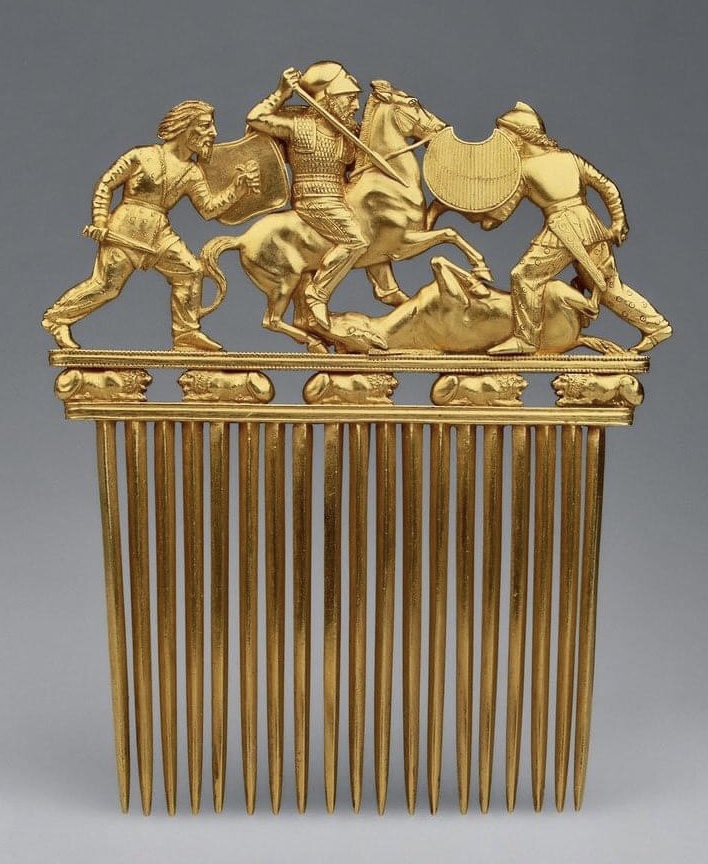
Greek-made Scythian gold comb, Solokha, Ukraine, 4th c. BC, Hermitage —Wiki

During the fall of the former Soviet Union, in the early 1990s, I spent a few seasons living in Leningrad with a noted pop singer. As winter closed in, and light diminished, I became stir-crazy, desperate for outside contact. I was living in isolation with a man from Grozny who spoke no English. But that's fodder for another story. One thing that enabled me to retain my sanity, other, than black market treats, including Earl Grey tea, was art for art's sake. I lived near the largest museum in the world, The Hermitage.

I literally spent my dark winter days in the dreary basement of the Old Hermitage. I discovered that I could waltz in the back door, for free, and avoid the long lines, if I attached myself to a busload of tourists....

Pop singer Valera Stupachenko, my Soviet fiancé, sometimes dropped me off at the museum when he had rehearsals at the Leningrad Rok Opera. I was lonely, isolated by language, or a lack thereof, though I could communicate basic needs in Russian.

I often divided my time between the Scythian, and the Fertile Crescent displays. The winged bull of Nineveh, the bust of the Akkadian king. Mysterious clay seals of Mohenjo-Daru, and cuneiform shards. Thracian gold. 

Of course, everything was explained in Russian, so I had to make do with what I remembered from my distant college art history classes. I painstakingly transcribed the Cyrillic placards into English. The guards did not seem to mind that I spend hours in darkened rooms gazing at these ancient wonders. 

A 2,300 yr-old women's soft red leather boot sewn with pyrite crystals and black beads, found  in an Altai mountain grave, 1948. Hermitage collection.

Having grown up on horseback, I was particularly fascinated by the Scythian horse trappings. Intricately designed saddles, felt applique blankets, bridles, stirrups, bits, and silk rugs—the oldest pile carpets in the world. Soft riding boots with wild roses beaded on the soles. I imagined a woman's feet never touched the earth, except for maybe to sit by the fire pit, dance on a thick carpet at her wedding, or when she was buried.

Oldest pile carpet in the world from an Altai Scythian tomb,.Pazyryk, ca. 4th c. BC. Hermitage

The elaborate gold Scythian pectoral collar made me weep, as did the golden reindeer, with horns so elaborate, they were like shining star-filled trees in a treeless tundra. They were more ancient and mysterious than the elaborate Greco-Scythian synthesized pieces. They were imbued with magic. Nomadic talismans.

Gilded wooden reindeer, Pazyryk, 5th c. BC. Hermitage

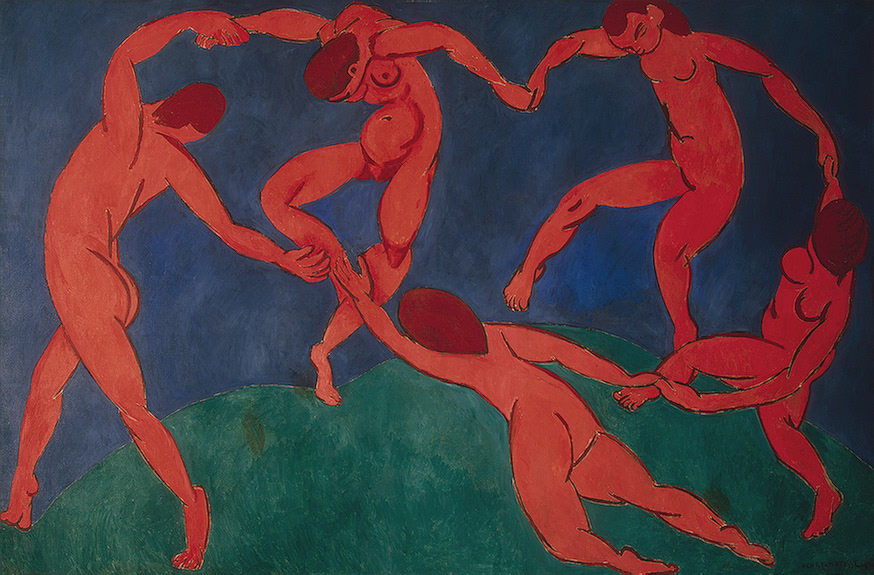
Afternoons were best spent in the (Post) Impressionist rooms, often the only direct sunlight I ever saw in winter was in those beautiful rooms with huge warped glass windows so old that I imagined they had somehow survived the Siege of Leningrad. 

Henri Matisse, Dance, 1910, Hermitage (they aren't that red!)

I didn't know those Scythian finds were the foundation pieces for the genesis of the Hermitage. I had unerringly gone to the heart of the matter. During the early 18th c., Russian explorers brought Scythian gold from burial kurgans to Peter the Great. Catherine the Great, a fierce collector of art, and artifacts, was so amazed by Scythian artifacts that she ordered scholars to systematically research them—this was before modern archaeology got its groove on.

Scythian pectoral, Ukraine, 4th c. BC. Horses torn apart by (Greek) griffins. Hermitage —Wiki

A woman ahead of her horse and time, Catherine the Great had the largest collections of paintings in the world (4000), including hundreds of Impressionist paintings. They had to hang somewhere along with all the other art she had collected—some 3 million pieces. One of the oldest (and largest) museums in the world, the Hermitage, a collection of buildings fronting the Nevsky River, was founded in 1764 to house her treasures. (There was Scythian art in Moscow, Kiev and Budapest museums—but nothing matches the Hermitage collection.)

The Giottos, da Vincis and Raphaels were all wonderful, don't get me wrong, but I lived for Impressionism. The impressionist rooms in the southern wing of the Winter Palace were filled with movement. I clattered up three flights of stairs to see Matisse's Nude Dancers, and the old babushka guarding them said she saw them as messengers. It was not just a job to her. She put her hand over her heart. She had to be there every day to keep them dancing. To keep the world dancing. And so she did.

Both the Hermitage, and Moscow's Pushkin Museum had replicas of the world's greatest statuary (for art students). I stood before the Dying Gaul of Pergamon, and marveled over Greco-Thracian artifacts...another abiding interest. The Celts settled among the Thracians. Albania and Bulgaria retain scant traces of lost Balkan Celtic cultures.

The Dying Gaul, Gladiator, or Galatian, a Roman marble copy of a lost bronze Hellenistic statue, 3rd c. BC. Capitoline Museums, Rome. Livy recorded that the Celts of Asia Minor fought naked. There's a modern copy of the Dying Gaul against a Naples yellow wall at the Hermitage (see a copy here—there's no free Wiki image), in St. Petersburg, and another at the Pushkin Museum in Moscow.

And the Scythians of the steppes probably had contact with the Celts (and Tocharians)—especially along the Silk Road, as some artifacts seemed to have a curious cross-influence. Yellow embroidered silk slippers were found in theLate Hallstatt Celtic Lady of Vix's cart burial mound, and site of the world's largest wine krater (500 BC). She must've been thirsty after death.

Early Irish origin myths named Scythia as the Irish homeland and the Scythians as their kin. Perhaps the Irish scribes were miffed, and maybe it's an accretion, because Old Irish wasn't listed in the Tower of Babel, but the Bible included a reference to the Scythians, followed by barbarians. (Colossians 3:11) Better to be Scythian, than barbarian.

Modern archaeology links Scythia with Iranian (not Turkic) cultures, but I'm not entirely convinced. Satem (Avestan, Old Persian; Thracian may have been a transition language) vs. centum (Old Irish, Hittite, Hellenic, Tocharian). Soft vs hard C/K sound. Herodotus recorded that the tattoed Gelonii, were formerly Greeks; they "use a tongue partly Scythian and partly Greek." Sounds like a centum language.  He also placed the Keltoi homeland in the steppes at the source of the Ister/Danube. Like pots, gold doesn't speak much, other than of beauty.

This belt boss seems to have a Celtic echo. Note the wolfhound (lion?) riding the tail of the horse (deer?) has swirls similar to Hallstatt or La Tène art, as does the distinctive shape of the horse's body. No triskles, but plenty of swirls.

Gold Scythian belt boss, Azerbaijan, 7th c. BC. —Wiki

It was easy for me to spot the Classical influences, and/or Greek imports. I have a prodigious memory for art images. The saying goes: beware of Greeks bearing gifts. But these gifts from antiquity were no Trojan Horse filled with the enemy, or shiny objects to steal, or intended to usurp one's culture, they were bridges, or windows into ancient worlds, lost to time and memory. All we have left of so many cultures are shiny artifacts from another time.

Gold plaques: resurrection of a dead hero; Saka culture, 5th c. BC, HermitageWiki

I never married the singer. My heart wasn't in it. I never danced with him, for he loved God more than me, but my days were filled with wonder and beauty in that dank, dusty basement of the Hermitage. I could not resurrect what was never lost. The lower depths of the Hermitage was my only refuge during that last Soviet winter before the Fall.

Thursday, August 5, 2010

The New Zamizdat

OK, I must admit that I'm mesmerized by the new Blogger stats tool—in a shiny packratty sort of way. I am endlessly fascinated that I can now view what pieces are being read—how many readers, and what countries. Positively mind-blowing.

First, writing is a lonely business. Audience is a whole other hemisphere. Then there's the old saw: Who do you write for? Who are your readers? The publish or perish paradigm took off its kid cloves and flexed its knuckles and whistled, "hey kid 'comere!" when blogging was invented. Shades of Marshall McLuhan's Global Village.

I come from the American school of Samizdat or, rather, Tamizdat tradition. No, tamizdat is not a typo—as one well-intending publisher tried to correct one of my posts.
Russian samizdat, from samo- (self) + izdatelstvo (publishing house), from izdat (to publish). Coined facetiously on the model of Gosizdat (State Publishing House). (from AWAD)
Soviet samizdat was a form of illegal self-publishing in a seriously limited edition format, using ten layers of carbon paper plus ten sheets of clean paper—and an upright manual typewriter replete with a print ribbon you had to re-ink by hand. Typing through that many layers of paper was a real bitch. Weak ring finger strength equaled blurred "e"s in final copies. And pity the poor sot who was gifted copy #10—it was a bitch to the tenth power to read.

This is the underground tradition in which Soviet poetry (and secret texts including copies of Bibles) were painstakenly reproduced—and distributed, underground. I met one of Osip Mandelstahm's samizdat publishers in Leningrad, held a fragile copy in my hands—knowing that people risked their lives preserving his poetry. Mandelstahm & Blok's chapbooks still reeked of rancid printer's ink decades later.

Then there was the Leningrad Rock Opera singer Valera (aka Valery / Valeriy) Stupachenko - Валерий Ступаченко (who I did not marry because he loved his dead wife and God more than me—who could compete with that?) Valera treasured his dog-eared carbon-paper Bible. Cherished possessions from a time when religious worship too was illegal.

Friday, January 31, 1997

Sleeping with the Enemy

LOST or abandoned thoughts often re-emerged like ghosts in a country not my own. Sleepless nights even the cats deserted me because my tossing and turning like a crazed narwhal reminded them of the bilious sea. Water is not their favorite subject, unless fish are involved.

(Actress Tallulah Bankhead said, I nevah drink the watah, dahling, fish fhuck in it. By the time her story reached me, it was phiss versus fhuck. As if piss were preferable to fucking. Tell me why society wasn’t ready for that Anglo-Saxon word.

My first opera: Tallulah was in a peacock-sequined gown, brandishing a cigarette holder longer than her arm, her sotto voice carried across the marble lobby into the streets where the homeless peered in from the pages of a Dostoyevsky novel, City Hall’s verdigree breast thrust in the mouth of the hungry sky. Fresh from the hills, I was wide-eyed in amazement, but that’s another story.)

Nocturnal epistolic documents produced by an obsessive urge to write, or an unwillingness to let go. Images of wheels spinning in the muddied ruts in the backroads of the mind. Self-indulgence is fine, as long as it goes no farther than the page, but writing demands an audience, that’s the other half of the Faustian pact. The monks had it right: indulgences. 

When death came to visit, language abandoned me, I practiced stillness. Called ambivalence. After the silence that followed the deaths of my parents and uncles, and when the raven sat on my shoulder, the words themselves abandoned me and fell silent: this prose, my indulgence—not poems, but practice in the marginalia of what may become a poem if one is lucky. Josip Brodsky said time loves language. A writer is caught up by the centrifugal nature of language [where] ambivalence and open-endedness as the essence of endeavor.

My lover from the Ukraine wrote: we dissidents are called white ravens—varonas. Our letters rarely reached their destination. The KGB (or NKVD—they changed the acronym every decade or so, but not their technique, their headquarters, the Lubiyanka, cold solemn stone fortress in the krasnaya heart of Moscow); they intercepted love letters complicated by poetry between the sheets.

We wrote in triplicate, mailing a copy, sending the others via “couriers.” I received mail postmarked from the cities of the free world, and calls from homesick Russian friends of friends wanting any contact, no matter how tenuous. 

The system was good because of the many delegations of people led by William Mandel, Armand Hammer and Henry Daiken opening up the East. They allowed me to communicate with my lover—who eventually emigrated to New York and shared afternoon coffees with Brodsky—who, in turn, gave his Nobel Prize money away to émigré Russians, including Oleg Atbashian.

Strange offerings I received—antique peasant dresses, marriage proposals, coral & amber necklaces, USSR army watches and pins—the Russians sent things of value to the West to raise valuta to buy an airline ticket, or to pay for delivering packets and letters.

Once I flew back from St. Petersburg smuggling out letters, lacy silver spoons and tea cup holders, and more US currency than I arrived with: I was afraid to get caught red-handed, so to speak. A counter-counter-revolutionary of sorts, I said No when they wanted me to take an old icon. Mary’s beatific almond-eyed face with rosebud lips anointed in gold was a bridging of East and West.

I chased elusive dreams to distant countries because they were forbidden, I slept with the enemy because in school I learned of a mythical Russia, troikas in the snow. In love with horses, I couldn’t let go of the image, I didn’t know it was tied to the frozen canals of Holland —Hans Brinker’s mythical silver skates.

I lived a winter in St. Petersburg with the pop singer, (Valeriy) Valera Stupachenko of the Leningrad Rok Opera (Singing Guitars) who performed Andrei Vosnesenski's   (J)Yunona and Avos/Juno & Avos at Fort Ross. Small patches of ice-free water beneath the bridges relentlessly patrolled by ducks who knew: to let go of the open pond was to let death in.

Oleg said he was jealous of my happiness. When he saw me with Valera, suddenly it was all very real. But he wouldn't leave his wife, like the way Valera couldn't leave his God. Or throw away his dead wife's clothes. Ghosts of Lady Haversham shrines in and out of the closet. Who could compete with that?
Valeriy Stupachenko

Friends are everything in Russia; without them survival is impossible. I am haunted by fragments of memory: On the Field of Mars I stood overlooking the converted palaces, children sledding down the steps, and really, it was no different than in Amsterdam. Tzar Peter modeled St. Petersburg after a city that inhabits my writing. Czaar Peterstraat and the birth of the Russian Navy; Amsterdam, his window to the west. 

I was sentenced to spend time looking out those same windows, letting go of the myths, only to reinvent them in the poem. I perversely learned history through the back door, a traveler in search of the elusive mystery. Why do we write, and for whom?

© 1997, revised 2000 what month was this written?

Tuesday, December 12, 1995

All the Goldeneyed Birds


Yesterday Nathan and I went to see Goldeneye, the latest James Bond movie with Pierce Brosnan. He was certainly handsome, but I didn't laugh as much as I did in the old Sean Connery 007 films. The entendres were well delivered. You could see them coming, the bad girl was thoroughly bad, the Russian focus was fun—especially St. Petersburg, but having lived there, I was distracted by familiar sites, places that I had walked daily. The plaza where the blackbirds, with their golden eyes, trapped suns, strutted and cooed. I had a pang of homesickness when I saw the airport, where Valera had greeted me with carnations. A pang, because I fell out of love with him, and couldn't ever get back to that place within me. And now it seems that Sonny and I are heading towards a truce, but to what end? All the golden-eyed birds in the bottom of a shot-glass.

Monday, June 14, 1993

STOPTREIN THROUGH HAARLEM


STOPTREIN THROUGH HAARLEM

It’s June 14, 1993, I’m sitting by the window of the two-storey stoptrein
            with neon lime plastic seats. It’s raining again, diamonds come to mind.
                        I don’t like comparing rain on glass to diamonds;
                                    the word apartheid was invented here.
Returning from the Rotterdam poetry reading,
            I know the express train always arrives first,
            though it leaves much later,
                         but I’m too impatient to wait for it. 
On the platform, a poster announces the arrival of the Harlem Globe Trotters.
            The train sign, Haarlem with its two aa’s reminds me of where I am.
I’m borderless, night has fallen, the  water fragments into shards of darkness and light.
I didn’t know I liked the easiness of comparing water to broken glass.

I didn’t know that in this country of canals, the ghettos of the past would follow me
(like the tail of this train);
            or that the common thread between my disparate journeys and lovers
                        would be both the noose and the lifeline.
                                    That I’d become mute from witnessing too much.
At the reading, a Mexican poet recognizes me
            from the photo on an old chapbook, Falling to Sea Level,
            given to him years ago,
                        and asks if I am la mujer de John.
                                                — I say ¡No, es finito! es kaput!
I don’t like mixing languages or speaking ill of those I once wished to be dead
            in metaphors of dear John letters,
                        or being identified by their bedsheets.
There is reason enough to be concerned, I am living below sea level
            with another man I will leave behind on the train,
                                                and there are others.

Near midsummer, the northern light extends its boundaries toward midnight.
I am still in the dark. I don’t like being jealous of poets whose work does not move me.
Someone asks, What makes it a poem? I am at a loss for words and I don’t like it.

While Stranded on the Amsterdam Train


WHILE STRANDED ON THE AMSTERDAM TRAIN
                                                — after Nazim Hikmet’s, Things I Didn’t Know I Loved.

It’s almost the Summer Solstice, I’m sitting by the window of the stoptrein to Amsterdam. It’s raining again, diamonds come to mind. I don’t like comparing rain on glass to that of diamonds; the word apartheid was invented here. Returning from the poetry reading, I know the express train always arrives first, but I’m too impatient to wait for it. I dreamed I walked barefoot on red African earth with the white grandmothers. On the platform, a poster announces the arrival of the Harlem Globe Trotters. The train sign, Haarlem with its two aa’s reminds me of where I am. Glass beads to buy an island, to furnish the ghettos of Niewe Amsterdam. I’m borderless, night has fallen, the water fragments into shards of darkness and light. I like the easiness of comparing water to broken glass; where are the Black grandmothers?

I didn’t know that in this country of canals, the past would follow me (like the tail of this train); or that the common thread between disparate journeys and lovers would be both the noose and the lifeline. That I’d become mute from bearing witness like the poets exiled from the sordid gardens of home: what of Breytenbach, on Malebranche, the street of sinister branches, or was it apples? who cannot shake South Africa from his words, Paris, an afterthought. In Leiden, where the Pilgrim Fathers left for the new world, I watch Duo Dou and Bei Dao cycle down Papengracht, Tianenman Square whispering in the spokes: red meat could do no better, red meat could do no better.
                                                     
The plane wreck at the Bijlmer ghetto, Black grandchildren sitting down to Sunday dinner, where I witnessed the flames rise like a mushroom; walked among the debris of the dead. Hikmet, in the middle of Moscow winter, dreaming of Ramadan nights with his grandfather and the Turkish poplars of Izmir; the white birches of Russia could do no better. What of the secrets that are kept from us?

At the reading, a Mexican poet recognizes me from the photo on an old chapbook, Falling to Sea Level, given to him years ago, and asks if I am la mujer de John. I say ¡No, es finito, es kaput! I don’t like mixing languages, speaking ill of those I once wished dead, or being identified by their bedsheets. There is reason enough to be concerned; I am living below sea level with another man I will leave on the train. Near midsummer, the northern light extends its boundaries toward midnight. I don’t like being jealous of famous old men poets whose work does not move me. Someone asks, What makes it a poem? I am at a loss for words and I don’t like it.

*       *         *
It seems I am destined to circle the outskirts of the city by night, on the wrong train, going nowhere in a hurry, in search of the right platform home. This train doesn’t go to the final station, but plunges toward the darkness of its origin; the point of destination doppleganging with the point of departure, everything replaying in reverse, Möibius time slipping out from under me. I don’t like sitting by the window, in my 4th decade, crying like a lost child because I’m in the wrong language, don’t understand the equation of broken tracks while sitting by the window on the Amsterdam train.

*       *         *
I remember a train ride across Ireland; I was 19—horses galloping after the fox, the ruined tower against billowing sky. I knew I wanted to live there, had lived there in a past life, the concept of home buried in the simultaneous suspension between the pillars of ancestral memory and déjà vu; the new trailhead of lovers at my feet.

I just remembered the how Belgian lowlands rose imperceptibly, like a slow sigh, the fields of grain giving way to the urgency of the Swiss Alps, the village lights so high above us, I mistook them for stars. I waited on tables, mute, unable to speak, except in the language of food. I rode tiny cog railways, loved the way the clouds unveiled the secret faces of the mountains, slowly—Jungfrau, Schilthorn, Eiger—I knew their beauty was too much to see all at once, like that of Medusa’s; my eyes did not turned to stone. I didn’t like being alone in a strange country with no way home, or how it soured my perception of beauty; the separation of ice and stone, not equal to the whole. I didn’t know I came so close to dying in a chateau turret in the hills of Luxembourg; the fireflies were magic enough when the fever broke. Came home to a man for seven years, became a writer, but he left, just like that.

*       *         *
The Mexican poet, Victor Manuel, smiles at me so beautifully, I am reminded of Alps and train rides across the Andes to Lake Titicaca with my middle-aged lover: the poet who left me at the end of the trip for a 19-year-old blonde with cheaper words. Sleeping in the underbelly of the southern continent I dream they removed Lenin’s shroud, slowly. Hammer and Sickle stenciled on the wall of the Inca fort, Puku Pukara; ¿Que Condor Pasa? and Tambomachai take flight on quena flutes. Cuzco nights under the Southern Cross, my ribs ache from breathing thin air. In the 2nd-class car with no light, we sit on boards propped in the aisles with the restless chickens. Soldiers stop the train; bayonet the Indians’ luggage, looking for coca leaves.

A myopic Frenchman crawls out to take a piss, a thief steals the glasses from his face—Por el oro, the gold. The mines of Potosi, no longer productive. Bolivia shines with the deceptive white of purity, or of death. The Frenchman blindly fumbles his way back to his seat. I can still see him pinching his pale one-eyed cock by the foreskin like a naked rat. At the biological experiment station, we watch llamas mate while lying down. Sendero Luminosos will slaughter these same animals a few nights hence. The news follows us like plague dogs. Darkness is descending, fearing for our belongings, maybe even our lives, I rage at John who crawls back to the Pullman where the mordida, five US dollars “buys” us first class, air-conditioned seats. How simple. Titicaca parts like the Red Sea on both sides of the train. We have reached the promised land.

I take Victor Manuel to the train station, navigate between Spanish and English with the ticketseller, and contemplate the way his lips move in his native tongue. He lives on Calle Amsterdam in Mexico City; we laugh at the cosmic joke.

*       *         *
Moscow Nights. This is not Hikmet’s Prague-Berlin train; I never knew I liked the way he compared night to a tired bird on a smoky wet plain. I know I am not writing this from a known place; and I don’t know if the guards are beating another prisoner, or if I’m imagining things in my own oubliette of words. I know the guerrillas blew up the electrical plant Independence Eve,
the explosion rocked Lima, I finished my soupa criolla in darkness, the staccato of guns in the distance like a drum tattoo. I didn’t know the body we found the next morning was that of the famous lawyer, named after flowers. I didn’t know we would be among the first to welcome him to death. I didn’t know that my life might depend on the difference of knowing Soviet and Israeli guns upon sight. That I’d see so many dead men, or that I’d throw three fetuses back into the sea at the request of the men who loved me, or that John’s would be the last. I never knew I’d bear witness to all these things before I was 40, or that I’d have to lose my heart in order to write about them while stranded on the Amsterdam train.

*       *         *
I know my escape to another country will bring other forms of exile. It’s August, 1989, I don’t know the Berlin Wall will fall, or that in the aftershock, eastern bloc countries, like so many dominos, will lose their boundaries in the calendar of days. Or that the velvet revolution will cloak another kind of darkness. I have some questions for the kosmonaut stranded in space three months after his country disappeared: did his shrunken heart find the capacity to love again, could he still look into the night sky without finding despair; what was worse, the exile or the abandonment? Did he have to learn to walk again?

Cherkassy, on the Dniper River, shashlik picnics amid the haystacks; I read Zhivago, and sleep on the living room couchbed of my host-family. Sordid details we blame on the erotic poetry we translate; it undoes us like slow mother-of-pearl buttons. Leaving the Ukraine in the private Car #17, a communist party official coach, I worry about pregnancy; the blonde leaves John for another woman: poetic justice.

New Year’s Eve, 1990. Carnival. In the square, a masked stranger kisses me; the sound of ice falling. Bitter cold; I learn to eat fat in order to keep warm. We return to Moscow in Car #17; the tickets cost a half a month’s salary, we celebrate by eating Ukrainian cherries in brandy. Slowly he enters the temple of my body but the urgency of residual memory separates us from ourselves; the paneling is of cherrywood.

*       *         *
In Red Square I stand transfixed, snow falls on the writhing madness of St. Basil’s domes. I don’t know if Ivan the Terrible put out the architect’s eyes, or if it’s another story of languid squalor amid false beauty. At the Pushkin Museum, Matisse’s Goldfish has me in real tears. I don’t know why. Maybe it’s because my period started. Or because I’ve seen Akhmatova’s sister feeding pigeons in the snow, or that the Arbat, where Akhmadulina still lives is a carnival for the camera’s eye. A sentimental journey of no return for the dead: A daughter of the light, Marina Tsvetayeva, my namesake, found only compelling darkness in the noose in the language of lost words, & I cannot write. None of us knows the USSR will cease to exist in two years, or what will succeed it.

I never knew red carnations in the snow by Lenin’s tomb would stain my retina. I never expected to be on the Moscow-Leningrad train in a 2nd-class cattle car without official permission, not able to speak English, and risk facing deportation. Mid-winter, six people to an open compartment; two more in the aisle. Eighteen hours of wet fur, coal fumes, and garlic kilbasa-kilbasa; the whispering of the tracks. I long for sweet tea from the rough, capable hands of the dizhurnia. The matron carrying flowers to a funeral and I come to blows over gladioli and sleeping benches. Oleg says, You’re a real Soviet citizen now! I have no country, except that of the mind. We huddle a few moments in an upper bunk under the glare of six pairs of eyes and a light bulb that will burn most of the night. I am reminded privacy is a western affectation. I didn’t know we would be sentenced to understand each other. Slave, slav, slavery of the heart, the tracks whisper. I am not Karenina, I will not bow my head to the altar of steel tracks though sometimes it comes upon me for weeks on end. There is no escape from the heart. We say our final goodbyes at Platform A; he has no right to be jealous, but he is. In Car #17 the American businessman holds me from Moscow to Kiev.

*       *         *
It’s August, 1991, The Coup. I fall in love with a Soviet pop singer stranded at Fort Ross who stays with me until his ship sails. He lives in Leningrad, only now it’s St. Petersburg. He calls me his Conchita, only I’m no nun or saint. He’s not Rezanov, this is not Siberia, there are no horses to be thrown from except in dreams. And death is a ship with a cargo of repeated history.
What if the Russians had stayed in California, or if Rezanov hadn’t been killed by a horse?

*       *         *
At the Hotel Kosmos the singer gives a speech in Russian, hands me red carnations. The interpreter translates, He proposes marriage. What do you answer? The singer and I live in Petersburg. He’s devoutly orthodox, has insomnia, Living in sin makes him uneasy. He prays for sleep, won’t talk of the past. On the subway, people touch his arm like a holy relic: Payush Guitara? Whispering suicide, his dead wife sleeps in the other room. When he leaves I try on her things. He sings One-way Ticket, doesn’t know what it means. Returning by train from the mirrored halls of Ekaterina Dvorets, I whisper yes to a life sentence, then change my mind. Vagaries of the heart.

In the city where Catherine loved men and horses & Peter the Great’s prick was aptly named, we make love in elevators and stairwells because the singer’s house is a shrine to God. I tell him I’m an atheist; he falls to his knees, adds my name to the prayer list. We ride to Moscow; in the quiet dark of the rocking train, making love in the lower bunk becomes a game, my hand over his mouth. Our mouths, small white O’s in the dark frozen wasteland halfway between the two cities, our faces lit by the erratic strobe of platform lights. I waver over the proposal, and dream of captive horses. We explore the Summer Palace in winter, the solstice approaches, New Year’s Eve, the Soviet Union will cease to exist. By then, I’ll be safely home. Maryna comes to visit; we are twins on an island in a sea of insane people. In line for bread, she says, I was 19-years-married to a religious fanatic. They don’t get over it—ever.

*       *         *
On my return to Russia, I stop in Vienna to visit Ken; we go to Hungary by train. I wander the hills of Budapest, find no answers, other than the commerce of ambivalence. Speech eludes me, my paper becomes mute when my notebook drowns in the Secheny Baths, a Rohrshat test of migrating ink; six months of writing lost. Having no family, and afraid of infirm streets, I cannot write about it. The Siganiy’s Magyar-Russlich is as bad as mine, but we have a common yezik, or tongue, singing Russian songs after the violins and tourist coins fall silent in Obuda. Why am I suddenly remembering the Seagull Cafe off Nevsky Prospekt where we drank coffee bought in hard currency, worth a month’s wages in rubles? Censorship comes to mind. Is it because freedom is what we value least, there’s always a Jesse Helms in the wings waiting to ride shotgun on the world.

*       *         *
The Vienna train is about to leave, I heave my luggage onto the floor. My rucksack catches on the door, I’m thrown off-balance, my waterbottle clatters onto the moving tracks. So this is how it ends, beneath the wheels of the Budapest train, but a conductor shoves my ass through the door. The ticket agent sees this, lets me ride to Vienna for free. A friend of Isaac Singer tells me even with all the prizes, in America, he couldn’t sell his work. I get “stood up” at the Succession Building where Klimpt’s kiss unleashes the demons of pleasure in frescos of Byzantine gold, I am crying in a lost language. At the gates of Vienna where Turkish horses once grazed on the killing fields, Ken changes travel plans again. He’s going home to America, leaving me here. We decide on the night train, learning Amstel is another name for Amsterdam. The train is late. First-class on the freight train is four airplane seats, no bed. Our last supper: in a foul mood, I swig Hungarian wine, the tracks whispering in Eb. Tchaikovsky’s violin concerto comes to mind.

The conductor conveys to Ken in broken French: You must get off at the next station to flag down the Köln train to Amsterdam. Amstel is nothing: a village in the Alps. I’m twice-abandoned on the night train with mail sacks. We say our goodbyes, but the conductor, alarmed, motions me off too. In my nightshirt, I throw my things out the door and leap toward faith. We sleep in the waiting room; like Cretaceous monsters from the deep, periodic trains shake us awake

Six A.M., we’re the wild-eyed travelers among the placid businessmen, riding across Germany (a billboard of swine on satin pillows—we know we’ve crossed the border). Ken gets off in Frankfurt. I remember to change trains in Köln, offer florins to restore the Gothic cathedral, the gargoyles need a facelift. The Netherlands are like the paintings I saw at the Hermitage. Peter the Great also lived in Amsterdam, saw the mirrored light for himself.

Ten years has aged Vins, I barely recognize my college classmate who chain smokes and stays up all night pondering the philosophic vagaries of the human psyche. My three-day stay before catching the Petersburg train extends several months. We pass the houses of the thinkers, the ghosts of Cartesian logic and Calvinism, the philosopher’s stone, the cornerstone in the city of bankers: cogito ergo sum. At the train station I tell him what he already knows, there’s no turning back.

*       *         *
It’s the Winter Solstice, I’m 40 years old. He writes me long love letters. A friend comes to San Francisco, we photograph the homeless, we are moths circling the light. He makes love to me; says he loves men. I dream of large cocks, the gaunt faces of the men with AIDS that glow with a holy light, and enter into complicated equations of ownership that will come to fruition when I return to the Netherlands. Marilet invites me to teach poetry in South Africa. Fearing tainting from the Dutch, the Pilgrim Fathers fled to the New World, then, imposed their will upon the savages where apartheid was practiced long before the word was coined. We who laugh at the Russians who confuse democracy with capitalism; our own freedom is bought at the expense of others. Dreaming is circular breathing. Living is no laughing matter; will I ever be able to laugh from the deep, this far below sea level where the plain reveals ancient transgressions of riverbeds.

The Yugoslavian lover, is he still alive? Do my Russian friends have enough food to eat? Each time I enter Russia, it’s from another fallen border. I cannot speak of the Belgrade where I bought a wedding dress for the married groom; lace made of bedsheets for the bride who never was, never will be. And I haven’t talked of the woods outside Peredelkino, Pasternak’s white birches and Hikmet’s dark exile; there is a Zhivago in each of us searching for the purity of love in the midst of war and there’s always a Lubyanka to hold us prisoner; Hikmet knew that best. Did he dream his poems in Turkish, transcribing them from the mother of tongues?

Riding the train at dawn, I divide fragments of time like the mathematical dilemma of Hermes and the tortoise in a race that never ends because it never begins. To get half way, they had to travel half that distance, and so on, back to the beginning of divisible time. Hikmet was right: exile is not easy—especially from the language of lost words.

Maybe the train never left the station. Maybe we were never born. Maybe this is a dream in search of the whole picture both coming and going. It’s raining again. I’m borderless, night has fallen, water fragments into darkness and light; I’ve lost the words for home. Sitting by the window on the train to Amsterdam I watch the world disappear like the evidence of truth, an arrow shot into the air and falling back without leaving the plucked song of the bow in the wind.

14 June, 1993,  enroute to Amsterdam
& 14 August, Bolinas, CA

Tuesday, August 4, 1992

Budapest Nights

Sultry Búdapest nights: as clichéd as it might sound, during the dog days of summer, 1992, I walked along a parapet of the fish market at sunset listening to the distant wild strains of someone playing gypsy violins.

I'd walked several miles from the Pest (Pesht) side of town all the way up to the top of the ancient walled hillfort of old Búda (Obúda). But as perverse luck would have it, my friend, theater critic, Ken Bullock, was with his Hungarian girlfriend on the Pest side of the river leaving me stranded.

It seems we were always on opposite shores of the Danube most of that summer. I wasn't picking up any survival Magyar, my German was non-existent and so I was pretty lonely. Búda and Pest are two separate cities conjoined by modern bridges. But this whole trip was filled with turned tables, burnt bridges, and switched alliances.

During most of August of 1992, I lived across from the Houses of Parliament on the Pest side of the river, while Ken was staying in a pied–à–terre near Boulevard Bartok in Búda proper. I loved looking at the Houses of Parliament, modeled after Westminister. The spires and steeples were constantly changing moods, it was like living within a Turner painting at sunset with the glassy Danube changing its négligé.

Calling Ken's cramped quarters a pied–à–terre was generous, Ken had a closet-sized flat, nothing more than a bookshelf and a murphy bed in a room so small you had to step into the hall just to change your mind. Let alone, your shoes. This was a country still suffering from the throes of communism. No amenities, no phones. And we were both living on frayed shoestring budgets.

My free housing arrangements in Búdapest had fallen through at the last minute and I was afraid of spending too much money before I got to Russia as I was planning on spending six months to a year in Leningrad and dollars were the only stable currency. So what was supposed to be cash for my meager food budget went into renting a dark little hovel of a room on the other side of the river. Walking to Ken's instead of taking the tram meant I had some spare coins for morning caffè latte. My only indulgence.

Búdapest is the city of romance, and I was there all alone, thinking—trying to imagine myself as the wife of a devoutly religious Russian man, living in Russia, leaving my homeland, my family and friends—perhaps forever—and I just couldn't get the pictures and reality to merge.

These were not exactly the thoughts of a woman ready to meet her lover after an absence of seven months. I was in limbo, feeling quite lost. But I'd been in limbo since my former boyfriend John Oliver Simon and I had split up—though the parting distance between us was longer than the length of the relationship.

But my friend Celia Woloch knew of such things because, as she said before I left home, "we are not swans" mating for life—though I swam in the Duna, the Donau, the Danube with the other wild birds.

The afternoons were ours—we often met at Santo's Espresso café on the utca across from my room. Ken is my polar twin; unable to commit to his girlfriend, we endlessly fulminated over the myriad problems between cultures in regards to marriage.

Ken said the idea of Hungary and America merging was not such a stretch of the imagination—his girlfriend spoke English, and is in the same business as Ken (the theater), and she has lived in California. Yet he was extremely cautious.

Obscure guardian angel—Ken said he wanted me to see an Eastern Block country that was full of joy and prosperous—not like the Slavic dolorosa I knew so well. And my folly seemed to be an extreme form of madness under the clarity of these extraordinary Budapest skies.

My plan was to Eurail from Hungary to Helsinki (changing trains in Amsterdam, visit college classmate Vinz van Neerven a week) and then from Helsinki, I would take the St. Petersburg train into Russia, and return to Amsterdam via Moscow to catch my flight home some six months later.

I was really in a quandary over what to do about Valera.

In my suitcases—I had myriad letters and gifts from Russians living in America, I had tele-communications devices and tele-connector wires, Mac programs, even an Apple printer to trade/barter with Valentine Yemelin for an airline ticket for Valera (Valeriy) Stupachenko to come to the States… But he had no desire to live in America. His world was the Leningrad Rok Opera and serving as a deacon in a church.

It all came down to valuta. Valuta. (Hard currency). Because I had so much luggage with me, I mailed three boxes of books and two boxes of luggage and cigarettes to Valera in St. Petersburg from Búdapest. Books, cigarettes and western clothing—especially jeans—were invaluable barter currency in the former USSR. Worth a small fortune. No guarantee it would ever arrive in Russia but I was tired of lugging it around.

Ken had left a day earlier for Vienna to visit another friend, I was learning to navigate quite nicely in Búdapest on my own—even without a language. So I was really on my own to navigate the trials of travel.

Right before the end of my Búdapest stay, I visited László Tabóri and Irén Kiss's home in Búda to co-translate poetry into English for a poetry periodical I edited with Herman Berlandt, Mother Earth News.

After my first visit to the Ukraine in 1989, I came back with so much translated Russian poetry, Herman and I had concocted the idea of doing a contemporary poetry anthology in newspaper format that covered the seven continents. (See Soviet Poetry Since Glasnost.)

László, a poet and playwright and his wife Irén, a poet teaching at the university, agreed to be the Hungarian editors for the Eastern Bloc issue of Mother Earth News.

We discovered that even when English-speaking poets translated poems into English, poems needed a second translation into poetic English. Metaphor doesn't travel well. That's where I came in. I had a real knack for wrestling their broken English into poetry.

Whenever possible, I worked directly with the poets and a translator together as well. So I found myself in otherwise improbable triadic situations all for the sake of poetry. Like at the Széchenyi baths or the Houses of Parliamant.

László and Irén had a big going-away party for me with all the intelligensci and literati of Búdapest in tow. A Rumanian woman playwright was trying to converse with me over a glass of Bull's Blood to no avail. Kiss Anna vagyok. So we slid through what languages we knew and out of the six languages we attempted, we found the only tongue we had in common was—Russian. I found myself apologizing to her in the language of the oppressor!

The famous Hungarian poet Anna Kiss had overheard me speaking in Russian and with that liberation of language, we found ourselves gleefully talking of poetry in halting Russian until we were utterly exhausted by the strain of thinking in languages not our own. Smiles and gestures became our conversation when our brains and tongues grew weary. We raised our glasses high.

I still love the Russians, and the language, and wouldn't trade my experiences in the Soviet Union for anything in the world. I hope my guilt over abandoning Valera Stupachenko won't cut me off from that experience. (Am I burning my bridges?)

Russia was my attempt to fill a vacuum in my own life— a parallel to what I experienced with John Oliver Simon's Latin American connections. And I gained some invaluable experiences from it—my writing took a giant leap forward. And I did create some excitement in my life, in fact, much, much more than I bargained for.

My college friend Vinz met me in Amsterdam what was to be a short week's stay. He often complained that I was always going to Russia, but I never came to visit him. So this time I was amending that problem. It was so wonderful to be in Amsterdam. I loved it and I could see how Peter the Great, who lived in Amsterdam for a while, was influenced by its architecture. St. Peterbourg (Leningrad) was modeled after Amsterdam.

But as the final day approached where I had to make my train reservation to Helsinki and St. Petersburg, the fears began to return full force; I was absolutely crazed. My friend Vinz was amazed when I announced I wasn't going to Russia as we went up the last escalator to the train station at the eleventh hour. More like 11:59.

I think that snap-decision was like a good game of poker, bluffing yourself (and your opponents) with a weak hand in order to win the jackpot by chance. When caught in a quandry, I often procrastinate to the last possible minute. And I often don't know how I feel or want until after the fact. Going into Russia was like that. But I'm getting ahead of my narrative. And out of sequence. In medias res.

Though I'd mailed several parcels on ahead, I was enroute to Russia with enough luggage to founder and bog a truck in the mud. My printer and laptop each had their own baggage requirements with converters and wallwarts the size and weight of bricks. Then there were my cameras. This was the pre digital camera age. I was NOT traveling light.

A lot of this baggage was my dowry—so to speak. I could sell most of it on the Black Market for ten times what it was worth stateside. I went several hours early to the Búdapest train station to get my Eurail pass stamped to Vienna where Ken was waiting with Claire.

But first, I needed to activate my Eurail Pass. So I got in line three hours early. And stood. And Stood. And Stood. Soviet "efficiency" still very much in operation in this former Eastern Block country; two minutes before my train to Vienna was to leave, I was still 5th in line at the ticket cassa.

Swearing like a sailor, I gave up trying to validate my Eurail ticket (ignoring warnings of severe penalties—your hair will fall out, we'll throw you from the moving train, excommunicate you, take all your money and revoke the ticket—threats didn't deter me). I decided to take my chances with the conductor because my friend Ken was meeting me on this train, not the later one. And we had no way of reaching each other. No phones. No addresses.

I grabbed my two wheelies laden with baggage and raced to the platform: the girl in front of me turned and said to her friend in English, "car 270." Where it was going, I wasn't sure. I didn't even have time to check. The gods must be crazy, I looked at my ticket, the numbers checked, I threw my backpack, my two bags (with computer, cameras and printer) and wheelie luggage rack onto the moving train as it pulled away from the platform.

I made a leap for the caboose, my waterbottle, loosened from my daypack, clunketed onto the spinning tracks, leaving me little time to ponder if I could really fight both gravity and physics at the same time. I was literally teetering on the brink of indecision.

The weight of the daypack on my back was literally pulling me backwards out the door. All those camera lenses. My luggage aboard, my corporal body was fighting both centrifical force and gravity at the same time. I thought, "Uh-oh, I'm not going to make it. I'm going to die horribly beneath a train just like Anna Karenina."

Running alongside the train, the train attendant literally lent me a helping hand, he shoved my protuding ass hard up the stairs and over my luggage, shutting the door behind me.

I lay sprawled in a heap over my luggage, stunned, taking a panicked personal inventory of luggage, passport, tickets, arms and toes.

MEETING SYLVIA TOTA

I stumbled into my train compartment which occupied by a henna-wigged Hungarian woman well on the other side of fifty, replete with false eyelashes and carmine claws. She was dressed like an overstuffed canary silk couch and had enough luggage to go into business retail perched on four of the six seats.

I asked to sit in the only vacant seat. Crabbily, she said in an accent more outrageous than the famous Gabor sisters, "No! Zis ees not smokingk compartment; zat's MY seat! I haf ticket." She waived it menancingly in my face.

But I was in a dangerous mood after having nearly fallen off the train as I boarded it, and with an adrenalin rush, I told her she couldn't have tickets for the whole compartment. She begrudgingly moved one of her Louis Vuitton makeup bags two inches closer to make room for me.

Trying to ameliorate our hostile beginnings, as Vienna was a long train ride away, I made some small talk, and eventually won her over. Unbelievably, we became friends by the time it took her goose liver (a whole, unadorned mountainous pale goose liver the size of Mt. Rushmore) sandwich to thaw; my pocketknife slicing neat pink cutlets from its generous slopes for breakfast.

As we began to unravel the theads that clothed our lives, Sylvia Tota told me that in 1954, when she was 19, she escaped Búdapest with her first husband via the underground railway. She described leaving home in the dead of the night, crawling through a hole under the border fence. Heavy midwinter fog, barbed wire, faces smudged with coal. Her face, too much a Jewish map for her to safely stay behind as the Soviets marched across her homeland.

They were smuggled into Austria, where she lived for a time in a refugee camp until safe passage was made on a ship destined for Canada. There weren't many places for Hungarian refugees to go. Canada was one safe harbour.

In Toronto, Sylvia learned English, she got a job waitressing, life was hard. She eventually divorced her Hungarian husband, leaving him for an Italian immigrant, which is how she wound up in New York, and then later, Miami. Her husband died so she was on her own, a wealthy widow.

Sylvia was a literary agent for the late Fedor Ágnes, a famous Hungarian writer who wrote "Sárga Nárcisz," and "Különös Karnevál," or "Strange Carnival," which she hoped to get printed in Hungarian, a challenge as Jewish Holocaust writing was banned in Hungary for so long.

Jewish Hungarian writers were truly a lost generation, lost to Hungary, lost to Israel, lost to America. She wanted to rekindle the flame, to get the book published in Hungary so that she could entice an American publishing house to print a bilingual edition.

In "Women’s Voices in Hungarian Holocaust Literature," Dr. Katalin Pécsi, Director of Education at the Holocaust Memorial and Documentation Center in Budapest, wrote, "Although quite a few personal memoirs had been published directly after the war, they did not become well known for some reason – so they did not become part of the Jewish canon either." (Alas, I found only this one link.)

Ágnes Fedor’s interview-style novel chronicles the story of her family living in hiding a la Anne Frank. Fedor’s article 'Bevilaqua' from the Esti Hírlap newspaper informs us that “Bela Borsody Bevilaqua was a patron saint of journalists… By chance, I think he saved my life…"
Fedor wrote, "When I interviewed Bevilaqua in 1939 about the origin of Hungarian Jews, whom he considered to be Khazar based on evidence of geographic and family names, he looked at me and asked, ‘Doesn't this anti-Semitic law apply to you as well?’ I nodded. ‘But you’re a typical Khazar!’ he said.
He stared at me drawing an inventory of my features—but he did so with the purpose of saving my life. Then he said, ‘With your features, complexion and bone structure, you could pass as a Slovakian maid servant. It’s only your eyebrows that you have to dye fair!’It was snowing in March 1944, just like today. I dyed my eyebrows fair in the danger of death. And I survived.”
Sylvia and I chitchat about the literary world, contracts, and rights as I was in Hungary to meet poets. I told her about one poet whose poems I'd worked on, polishing them into poetic English for an upcoming Mother Earth issue on Eastern Block poetry after Glasnost. I was to meet Gyula Kodolányi, who was Hungary's Secretary of State. I never did meet with him, except to briefly shake his hand as he descended the steps of the Hungarian House of Parliament, he was a very busy man—though I talked to his wife several times.

Everything moved slowly in Hungary—the manãna complex was alive and well. It took me a week just to get his phone number from Ken's friend, playwright László Tabóri, a former student of Kodolányi's. László's wife, Irén Kiss, also a poet, was a former editor of "The New Hungarian Review," and held Kodolányi's old job at the University. Irén informed me everything is corrupt in Hungary.

She told me Kodolányi married a famous poet's daughter; Gyula Setijis—I'd never heard of him either, but then, I know little about Hungary to begin with. I was armed with a few random poet's names and a lot of faith in optimism and sychronicity.

Irén said she had quit "The New Hungarian Review" because it was a communist party organ; she said they had an editorial parting of the ways. That was a huge blow as I had counted on getting poems from their archives.

Irén studied with Italian poet Edouardo Sanguinetti (whom I later met in Holland at Poetry International); we translated several of her poems done in the Italian style. Like in Russia, everything is 10 to 20 years behind the times. Kodolányi was paradoxically a member of the old guard, and of the new wave at the same time. I wanted to meet poets from the other side but I had trouble finding them.

Sylvia told me, "There's no money in writing. At least not in America". I said, "Tell me something I don't know." I was floored—nay my flabber was ghasted—when she told me a friend of hers was Isaac Bashevis Singer. Sylvia said, that when he received the Nobel prize for literature, she called him up to congratulate him and he despaired, "Here I am, a famous writer, and all I get is rejected manuscripts in the mail. This is no life for a writer." Amen to that.

When the conductor came into our carriage to check our tickets, Sylvia explained the circumstances to him in Magyar. I was relieved to have this unlikely angel come to my rescue.

The conductor gave me a closer look and remembered me. He laughed and said, "Yes, I remember her. I saw her board the train at the last minute with all her baggage. If I validate the ticket on the train there'll be a severe penalty, but she looks like a nice, poor girl. Tell her to take care of it in Vienna." And so I rode to Vienna for free. Since Sylvia was translating this, I had only her word—but I do know they had a good laugh at my expense about my ass literally hanging out of the train.

When I told Sylvia the story of going to Moscow to meet Valera (Valeriy) Stupachenko, the Russian pop singer of the Leningrad Rok Opera, and formerly of Singing Guitars—Payush Guitara, at first she said very yenta-ishly, "Don't marry him if he can't support you and take care of you. Marriage is a business transaction."

When I showed her Valera's picture, she looked at it a long time, perhaps remembering something of her own past. I told her of the unusual circumstances of how we'd met during the August coup/putchst aboard the Soviet research vessel, the Akademik Shirshov, she said, "I see. It's very romantic, just marry him, if you wait, you'll rationalize. Don't let it spoil by waiting."

Valeriy Stupachenko, Akademik Shirshov, SF, CA 1991

Bewildered and bolstered by her advice, I prepared to leave. We kissed three times, she saw me off the train as if I was family. I was remembering other trains, seeing off the Soviet students at Kiev, staying behind with my Ukranian lover Oleg Atbashian. Ken meeting me in both times in Vienna.

I am always grateful by how special it is to be met at the train or plane; like when Ken met me at the airport before my last trip to Russia. These passages, or transitions, travel are often lonely ventures. We never come back to what we were. And we will never pass this way again.

But Peter the Great's beloved city upon which he modeled Peter'burg, Amsterdam, the city of his youth, had other plans for me. My dreams of Russia dissipated into the Baltic mist.

Maureen Hurley, Amsterdam,

Friday, May 29, 1992

PANTOUM FOR DARKNESS

PANTOUM FOR DARKNESS
—for Valera Stupachenko

The white shawl of fog covered the Baltic.
He said only time will tell if I was to believe.
The first sun in days made me nostalgic,
for the Gulf of Finland, a glistening reprieve.

He thought time would tell if I was to believe.
I had no words to say, the sun was shining
on the Gulf of Finland, a glistening reprieve
from the prison of winter ice; the streets blinding.

I had no words to say, the sun was shining.
I interrupted his morning prayers to take leave
from the prison of winter ice, the streets blinding.
I gathered carnations in order to be free,

interrupting his morning prayers to take my leave.
No anullment for grief, a dead wife’s pin.
I gathered carnations in order to be free
from committing yet another mortal sin.

No anullment for grief, a dead wife’s pin
underfoot, I couldn't shake the ghosts of suicide.
Who has committed yet another mortal sin?
Resurrection tainted the purity of love, we hid

underfoot, I couldn't shake the ghosts of suicide.
One’s whole life suddenly revolved around schedules.
Resurrection tainted the purity of love, we hid
in the closets of deceit, devouring those victuals.

One’s whole life suddenly revolved around schedules.
The curious human need for mysticism abounds
in the closets of deceit, devouring those victuals.
When we hunger for nourishment, religion resounds.

The curious human need for mysticism abounds
in the darkness of the year’s longest night.
We hunger for nourishment, religion resounds
in the passionate cry of desire for the light,

in the darkness of the year’s longest night.
I have no words to say, the sun is shining
in the passionate cry of desire for the light
from the prison of winter ice, the streets blinding.

The first sun in days made me nostalgic
for the white shawl of fog that covered the Baltic.

5/29/92

Thursday, March 5, 1992

LATE AT NIGHT I GET CALLS

LATE AT NIGHT I GET CALLS
          —for Igor Tischler

Late at night I get calls from strangers
who speak good English with thick Russian accents
from places like North Carolina, New York, Iowa—
They are homesick, or want to send packages of shoes
to daughters left behind in Moscow, Leningrad, Cherkassy.
In this way, I find out about my friends in Russia—
via the Slavic grapevine. It's always the same news:
times are hard, life is a struggle, the price of bread in every conversation.
Igor says: I get homesick for America when he is already living here.
He has grown used to conveniences, the quality of food, the sameness.
He says: in every store the bananas are in the same corner.
Here, I don't have to worry about where to find them.
Natasha says her family is fine, they eat lots of bread now—
when they can get it. The lines are longer than ever.

I think of all the dried bread in every Russian apartment,
so glad I didn't throw out Valera's stored bread
when I cleaned the cabinets—meal bugs, stale food.
Guilty of what little food I did toss—bugs are protein too.
Cereal laced with insects and mouse shit sticks in my craw.
In America, I'm not reduced to such choices.
The green canned meat he wouldn't let me throw out,
or the furry sausage saying, it's good. Vicusna. Hotchish?
In America we throw out food that's still good.
In Russia, any food is considered spoils;
a people constantly at war with bureaucracy.
Booty in the form of dried bread, a bank account.
Daily bread to feed the birds. There is no equation to be made.
In Russia, all of life is punctuated with lines.

Late at night I talk to friends of friends who I've never met,
we share something in common.
Always they say: Khome veesit our khaus in Ameerika!
And I know they mean it—
their doors to their hearts always unlocked
for the potential future friend.
Because in this way, they will survive.
Friends are everything. Isolation is death.
Better off in Siberia, or Magadan with friends.
Here, we are voluntary exiles, xenophobes used to the soft life,
we slam doors on our own thumbs as a matter of course.
The more Igor and I discuss American and Russian psyches,
the more we discover we are alike,
having traded places somewhere during the first thaw
of the Cold War. The final thaw, irrevocably.

Censorship comes to mind. Michael Jackson's crotch.
Igor laments Edward Albee, the American Chekhov
is unknown in his own country.
Those who recognize his name ask: is he still alive?
Albee met Igor with a bouquet of flowers at JFK airport at 6 am,
easing his transition into the den of iniquity. Albee? I'm stunned.
Flowers for the death of one way of life and the birth of another.
But what of all the daughters of Russia waiting for American shoes?

Igor says: I do fine here, but sometimes, late at night,
I go crazy with fear. What he can't do is send shoes to his daughter.
Like Vadim who keeps buying more shoes on sale,
because the others have become too small.
Neither can send shoes home: the package is small,
do you know of anyone going to Russia? 

I say: Yes. I will ask, so they can ease back to sleep,
knowing the storyline by heart, how hell is named,
with shoes, becomes tangible. It is empowerment.
Here, they have money to buy shoes, no way to send them.
The choices are: to stay in Russia together as a family
and have nothing, or to escape to America's golden streets
and send things to the family left at home.
Most never want to go back. The well-muscled
American night is filled with longing for homeland,
all those orphan shoes walking in the night
towards all the daughters of home.

3/5/92