Showing posts with label Gary Snyder. Show all posts

Tuesday, January 14, 2020

The Human Be-In


I was at the Human Be-In with my mother, I was just turned 14, barely into my teens. It was a gloriously sunny, if cold day, and the grass was damp. There were flowers and candles, incense and feathers, cymbals and chimes—and lots of smoke. 

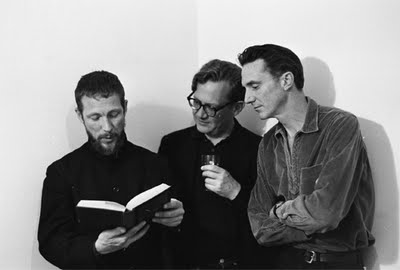
Gary Snyder, in a fringed leather vest, was on stage chanting and reading poetry, Allen Ginsberg was standing behind him with Michael McClure dressed in black. Lenore Kandel. My first Beat poetry reading. (I later met, and read with all of them). It was a gathering of the tribes, and the wild tribe kept growing all afternoon, from a thousand souls to a crowd of 30,000 people converging on the polo fields, and the bands played on.

See the royal maze website that mentions John Cooke
Court jester Timothy Leary, all dressed in white, leaped off the stage, tumbled down among the masses, tripping down the main aisle like a pied piper, he spotted my mom, a tall willowy auburn-haired beauty, and bear-hugged her. They knew each other from before. It’s an Irish thing. She was always bringing the Irish poets home like Lew Welsh and Gene Ruggles. He solemnly shook my hand. And smiled beatifically.

Photo by Jim Marshall, from San Francisco Remembered. With thanks to Janet Duncan

As they twirled and hugged, she threw back her head and laughed, her long red mane combusted in the sunlight. I’d never seen her so radiant as in that moment. She was like another person, not depressed. She said, God bless you Timothy Leary, he laughed and drifted onward toward the back of the crowd, creating hives of excitement whenever he stopped. Jerry Garcia was onto a long guitar riff. Bubbles danced in the breeze. Me, awkwardly standing there in soggy rain-soaked pants, taking it all in, never dreaming I’d one day become a writer.


Big Brother and Janis Joplin lived down the road from us in Forest Knolls, Sons of Champlain, Jefferson Starship, Grateful Dead, and Carlos Santana also lived in the San Geronimo Valley so the musicians were all neighbors of sorts. I later met most of them hitching back and forth to high school. My mom took it up a notch, sometimes she took me in tow when she partied with them.

San Francisco, January 1967, was an electrifying year of social deconstruction and reconfiguration. The Gathering of the Tribes where spiritual generation amassed for a Human Be-In at the Polo Fields. Guest speakers Ram Dass and Timothy Leary spoke to some 10,000 very stoned pilgrims who turned on, tuned in, and dropped out en masse.

And yes, there really was a psychedelic poster. I remember it. Someone said that if a poster had the year on it, then it was fake. Whether this one is real, is moot.  The point is, we were there.


Friday, April 20, 2018

MOUNTAIN MISERY


Someone wanted an identification of a wild lily,
once called Zigadine, now Toxicoscordion fremontii.
My eyeballs weren't yet awake. Batting 50/50,
I mis-ID the bearmat as gold-back fern.
Then realized no self-respecting gold-back fern
would ever grow out in the open like that.
And the location, pine foothills...
But I know a death camas when I see it.

I loved saying the old name, Zigadine!
One of the few Latin plant names I know by heart.
The way it explodes off the tongue
and becomes something like shooting stars.
I never once called it a Fremont lily,
for John C. Frémont was a toxic mass-murderer
of the California Indians. And he fomented a revolt
for personal gain, choosing a bear as his bandolier.

I never knew the other moniker, and was horrified
to discover that I had transplanted death camas
to our lower field where we grazed horses in spring.
No wonder the gophers always left it alone.
And luckily, the horses did too.

As for the bearmat, aka kit-kit-dizze, 
which is also a placename where
poet Gary Snyder lives, on North San Juan Ridge.
My old boyfriend from Grass Valley,
who admired Gary Snyder from afar,
and accidentally introduced me to poetry,
said that the bears liked to roll on it.

I loved the tarry odor of the leaves, but they're clingy.
Some folks call it mountain misery, or bear clover.
Despite its lovely white rose petal blossoms,
bearmat is the bane of careless hikers and dogs,
because it's so stickery, and its seeds are hitchhikers.
It has some redeeming qualities as well,
you can make rheumatism tea from the leaves.
Maybe the bears had rheumatism too.
We were always on the lookout for it.
And the bears. But when the words found me,
much to my old boyfriend's chagrin,
he ambled off into the mountain misery,
never to be seen again.

4/20/18

Sunday, April 8, 2018

HOUSE OF THE SUN


While scanning old photos, I found one of me
sitting on top of the world, at the Kalahaku Overlook,
Puʻu ʻUlaʻula on Haleakalā, the House of the Sun.

The crater at the summit was Māui's grandmother's home.
Māui's mother Hina, complained that her kapa bark cloth
wouldn't dry because the days were too short. All that work ruined.
So his blind grandmother helped him snare the sun with a net
made of his sister's hair to slow its journey across the sky.
The sun pleaded for its life, they came to an arrangement
that the days would be long in summer and shorter in winter.
It 's a good story, no matter that we're close to the equator,
where the days and nights are nearly equal.

Going down the Sliding Sands Trail into the volcanic desert
was the easy part, like schussing in snow,
only it was made of red pumice.... We took giant strides
where each step took us one body height downward.
It was like walking on the moon as we descended 2000 ft
to the crater floor in minutes. Our ears strained like divers.

Will Staple and Gary Snyder opted to take the trail
down the mountain out the bottom of the crater.
I had to hike back up to the observatory by myself.
I felt abandoned. I was alone on the steep slope,
with only my restless thoughts to accompany me.
The sun scorched my arms, until I was on fire.
The thin air at 10,000 feet whistled,
my tongue was like a dry stone.

I had opportunity to study the rare 'ahinahina,
or Haleakalā silverswords, looking like porcupines
or a bouquet of swords tipped in the purple blood of flowers.
They may live a century, but only bloom once,
one chance to make seeds, no multiple families.

I slid back down the trail backwards a half-step
for every step forward. Pumice singing beneath my feet.
Then I had to face the long drive back down the mountain,
jelly-thighed, I just wanted to sleep by the side of the road,
become part of the mountain, and wait for Māui to push up the sky.

4/8/18
rev. 4/21/18

Friday, April 7, 2017

Summer of Love, etc.


You know the Robin Williams line—even if he didn't say it: if you remember the 60s, you weren't really there. But we were really there. What my classmate Robin should have said: Remembering the '60s is tricky, at best.

I grew up between worlds and times in the San Geronimo Valley, a rural enclave in West Marin which was rapidly becoming an alternative lifestyle destination. A lot of interesting folks who shunned the cities and suburbs wound up in The Valley, as it was called. It was an uneasy marriage of radically different worlds.

I attended Lagunitas School District—LSD (I know, 'splains a lot). I was straddling the old redneck ranchers' world (living with my Irish Victorian grannie), and the Flower Children dancing in the dawn of a New Age—and me, trying to toe the mutable line. Not an easy task.

During the late 60s, I attended Sir Francis Drake High School—the only high school (emphasis on the word high) in the nation to shut down a local draft board.  We were a pretty radicalized group of kids.

Our student body president was Jared Rossman from Fairfax. That last name should ring a bell—as his older brother, Michael Rossman, was a key figure in the Free Speech Movement at UC Berkeley in 1964. On the eve of The Summer of Love, we marched to town and shut down the San Rafael Draft Board. Our school made the cover of Time Magazine and the 6 O'Clock News. And we gave the FBI a new client list.

When the school district took away our buses, I was the roadside kid hitching home from school. This is how I met most of the rock musicians of that era, Ken Kesey and his cast of Merry Pranksters, and boarded Further, etc.

During the Summer of Love, I was pretty straight, I was also very young. I was 14—a mere 'tweenie. Between worlds. What I remember most from that era was the original 1967 "A Gathering of the Tribes Human Be In" in Golden Gate Park. It was a protest gathering to counter a new California law to make LSD illegal. Timothy Leary famously said from the stage, "Turn on, tune in, drop out" and then came tripping out through the audience to give my mom a hug.

A Beatnik and a Project Artaud painter, my mom was one of the first artists to embrace the hippie movement. She was at the epicenter of The Summer of Love. Mom dragged me through the Haight early and often. Sometimes our worlds intersected. I was a wide-eyed kid trying to take it all in. A vicarious bystander. Sure, there was fallout, growing up like that in unchartered territory. But I survived the social revolution more or less intact.

I didn't know it at the time, but I was meeting future mentors of our generation: Richard Alpert ("Ram Dass"), Allen Ginsberg, who chanted mantras, Gary Snyder, Lenore Kandel, Lawrence Ferlinghetti, and Jerry Rubin. Most of the bands who played in the parks were our near neighbors in West Marin: Jefferson Airplane, The Grateful Dead, Big Brother and the Holding Company, and Quicksilver Messenger Service.

For some reason, though we lived in the epicenter of this sociological turmoil, it's hard to write about it so, from time to time, I whittle away at it, in search of the through line. Memory's always a work in progress.

I told former Sonoma County poet, Colorado Arts Commissioner Art Goodtimes, a mushroom aficionado, that I had a wild mother who claimed I was an amanita child. As if that explained things. We laughed and blamed the drugs.

I was living out in rural West Marin and commuting into the suburbs to go to school, holding onto a dual life between worlds while most of my friends were defecting, tuning in and dropping out, and running off with bands or the circus. It was some crazy times. Somehow we grew up between the Be-in, The Summer of Love, and the Kent State Massacre. This was our legacy.

Yes, we were really there. And we do remember. Robert Frost wrote: The best way out is always through. We survived the 'tween years—we could see no other way out but through. What a long, strange trip it's been.


Sunday, October 5, 2014

Two CPITS Poetry Books Hot off the Press: If the Sky Was My Heart, and Poetry Crossing: 50 + Lessons for 50 Years


IF THE SKY WAS MY HEART: SONOMA COUNTY STUDENTS WIN PUBLICATION HONORS

Sonoma County students sixth grader, Ryan Murgatroyd, 4th grader, Nicholas Voegels, and 3rd grader, Gemma Ahern, of Kenwood Elementary School; 6th grader, Eduardo Lopez, of Cali Calmécac Language Academy, in Windsor; 3rd grader, Gavin Rognlien, of Prestwood School; and the entire Fort Ross School Kindergarten-2nd grade class all have poems in the new poetry anthology, If the Sky Was My Heart, just released by California Poets in the Schools. The book features poetry by more than sixty students from around California, their poems were selected from among thousands of poems written during the past year.

Dawn After Sappho

A moment ago, gold-sandaled
dawn woke me up
with the voice of my mom.
She tells me to wake up
or the bus will leave me.
I get dressed and I put
on my golden-winged
sandals. I brush
my teeth and then
I grab my backpack
and go flying to
the bus stop.

Eduardo Lopez
Grade Six, Cali Calmécac Language Academy, 
Windsor, Sonoma County
Richard Meza, classroom teacher, 
Phyllis Meshulam, poet-teacher

If the Sky Was My Heart, edited by Blake More, also features poems by Sonoma County CPITS poets Arthur Dawson of Kenwood, Gwynn O’Gara (Sebastopol Poet Laureate), Phyllis Meshalum—both of Sebastopol; Jabez W. Churchill (Ukiah Poet Laureate), and Maureen Hurley. Other Sonoma County CPITS poets in the program include Molly Albracht-Sierra, Claire Drucker, Iris Jamahl Dunkle, Jackie Hallerberg, Meg Hamill, Kyle Matthews, Blake More, and Kathleen Winters.
(The book title If the Sky Was My Heart, came from a poem by one of my 4th grade students Emily Mozzetti of Buri Buri School in South San Francisco. I also have a poem in the anthology, KINDLING).

POETRY CROSSING: 50 + LESSONS FOR 50 YEARS

Sebastopol's Phyllis Meshulam is the editor of another new CPITS book, Poetry Crossing: 50 + Lessons for 50 Years. It’s an anthology of teaching resources chock-full of 50 fabulous creative writing lesson plans, and contains a foreword by Susan Wooldridge, author of Poemcrazy. Said Phyllis: This book is filled with ready-to-go lessons for poets of all ages. It features model poems by award-winning poets and poets laureate, as well as student poems, and bilingual resources.”

Contributors with a California connection include former United States Poet Laureate Robert Hass along with Jane Hirshfield, Brenda Hillman, Ellen Bass, Juan Felipe Herrera, Al Young, Gary Snyder, Francisco Alarcón, David St. John, and other poets who have have donated their poems in order to further the mission of inspiring youth. Poetry Crossing makes tangible decades of CPITS creative writing pedagogy, aimed to stimulate the intellectual curiosity and creative problem-solving skills of today’s students.


A generic statewide press release in the works:

IF THE SKY WAS MY HEART: CALIFORNIA STUDENTS WIN PUBLICATION HONORS

California students from kindergarten to 12th grade are featured poets in the new poetry anthology, If the Sky Was My Heart, just released by California Poets in the Schools. The anthology features poetry by more than sixty students fromSan Diego to Del Norte counties—their poems were selected from among thousands of poems written during the past year.

Dawn After Sappho

A moment ago, gold-sandaled
dawn woke me up
with the voice of my mom.
She tells me to wake up
or the bus will leave me.
I get dressed and I put
on my golden-winged
sandals. I brush
my teeth and then
I grab my backpack
and go flying to
the bus stop.

Eduardo Lopez
Grade Six, Cali Calmécac Language Academy, 
Windsor, Sonoma County
Richard Meza, classroom teacher, 
Phyllis Meshulam, poet-teacher

The book title If the Sky Was My Heart, came from a poem by one of Maureen Hurley's 4th grade students Emily Mozzetti in South San Francisco.
If the Sky Was My Heart

If the sky was my heart
the birds would be my voice.
If the river could talk
it would tell me to swim
until the end of time.
If the wind was my breath
the sky would be my soul.
If our galaxy was a rollercoaster
there would be a line
running through the Milky Way.
If I was the sun
I would be the king of light.
If my heart were the world
it would be filled with love.

Emily Mozzetti
Grade Four, Buri Buri Elementary School,
South San Francisco, Sam Mateo County
Ms. Moussa, classroom teacher
Maureen Hurley, poet-teache


If the Sky Was My Heart, edited by Blake More, also features poems by CPITS poet-teachers.

Friday, September 19, 2014

Procrastination Syndrome


Yesterday, I was procrastinating over an important writing job I needed to finish, but kept putting off, so I read old blog posts instead. I meant to correct one small typo on a piece I'd written on St. Brendan in the Faroes Islands, and then just get on with it. Some 14 hours later, I was still at it, revising—hammer and tong. It occurred to me as I utterly destroyed my bloggy bit on St. Brendan, that:
a) I really, really should've saved a copy of the first draft, at present, it's unrecognizable, and 
2) The joy of writing is having the temerity to turn a piece into a dog's breakfast, knowing that eventually I'll have to rewrite my way out to the other side—having uncovered all kinds of connections that wouldn't otherwise have happened, had I played it "safe."
(Sheesh, I can't even think linearly within any given system: a), b). I had to change points mid-stream: a), 2). What's with that?) Oh look, shiny!

Out of destruction and chaos comes... But now I have to really fix the demolished post..it's all over the place.(Or at least hide it from the web crawlers). But I'm stalling. Again. Procrastination. Again. Shun's the operative word here.

So far, this morning, I've mopped the floor, organized my hair bands and postage stamps, shuffled piles of horizontal files, uncharacteristically hung up his clothes, I also uncharacteristically rearranged his closet, cleaned out old emails from three different accounts (not an easy thing as I'm an obsessive reader, and need to read everything before I delete it), I beheaded basil flowers, thus disturbing the leafhoppers.

I thought about those bugs, wondering how many of them we accidentally eat, without knowing it, and about making pesto with sunflower seeds because I'm fresh out of pine nuts and they're too expensive anyway. Pesto would the perfect last hurrah before summer's end. But I'm fresh out of garlic. Phew. Sidestepped that one.

Meanwhile, I've got one thoroughly garbled post that needs mending. Or nuking. And that other thing I was avoiding yesterday. And today as well. Apparently.

With that, I bring you, Dear Reader, a little distraction for our reading pleasure: an article from the Atlantic Monthly, on writers and procrastination!
Why Writers Are the Worst Procrastinators
The psychological origins of waiting (... and waiting, and waiting) to work. (Which is adapted from Megan McArdle's The Up Side of Down: Why Failing Well Is the Key to Success.)
See, I too am an inveterate procrastinator. This morning I posted Facebook messages to a classmate whom I hardly knew, and haven’t seen in at least four point five decades... we took a spin down an unpaved memory lane. I also marvelled with childhood friend Micaela who found a photo by Brett Weston, of her mother Rosalind Sharpe Wall, in Bixby Canyon. That's how I "met" that old classmate.

I talked like a pirate about John Malcovich's stunning role as Blackbeard the Pirate (Edward Teach) in CrossBones—sadly cancelled after one season. I suggest that you watch all nine episodes today, it's international Talk Like a Pirate Day. Arr and avast, ye maties! Teach invented the pirate flag. I bet you didn't know that.

I even rewrote a Peter Piper tongue twister on Adair Lara's wall... If Peter piper (shouldn't that be a capital P, or should I use commas?) picked a peck of pickpocket-proof pants, was he peckish for pound notes? It's all her fault. She shouldn't have posted that cool Instagram photo. My mind was off and racing like the ponies at Golden Gate Fields. What about California Chrome, anyway?

Yes, I do procrastination quite well. Layers upon layers, embedded so deep, that I can no longer tell which particular task I'm avoiding. Or for what reason. And who among us doesn't suffer from "imposter syndrome"? I've been faking it for decades. So far, so good. Do you think they know?

I agree with that author Megan McArdle that among writers procrastination "is a peculiarly common occupational hazard." I wonder what other foibles writers use to distract themselves from themselves.

For example, I wonder if the incredibly prolific Maria Popova of Brain Pickings ever procrastinates? What is Adair Lara's particular, peculiar anti-writing vice? Besides posting photos of her new pickpocket-proof pants. 

I know Eugene O'Neill liked to sharpen a dozen no. 2 Ticonderoga pencils to weapons-grade perfection before he arranged them just so, on a dozen yellow legal-sized writing pads fanned out on the living room rug. By then, it was time for drinkies all around.

O'Neill did not view alcohol as a performance-inhibiting drug. Nor did Steinbeck, Hemingway, F. Scott and Zelda Fitzgerald, or Styron. When novelists sober up, they usually dry up. Drinking is good for inhibiting the "imposter syndrome." There are sober coffee-table books, fergawdsakes, on writers and their favorite tipple.


Sunday, May 5, 2013

'Tween Worlds


You know the Robin Williams line—even if he didn't say it: if you remember the 60s, you weren't really there. But we were really there. Meanwhile Gertrude Stein said: There is no there there. And there you have it as my grannie would say. What Robin should have said: Remembering it is tricky, at best.

SFchronicle_vault Dec. 9, 1987: Robin Williams hangs out with comedian Will Durst (left) after Durst lost a mayoral run. We're thinking that's Vera Carp of "Greater Tuna" on the right. 📷: Chronicle Archive

I follow a couple of Facebook groups and we've posted collective memory threads from multiple perspectives. Some of my recent blog posts are outtakes from those threads. Sometimes the outtakes gel, sometimes. they're merely placeholders of an idea I might revisit later.

We were reminiscing what it was like growing up between times during those turbulent years. Part of the backstory was the anniversary of the May 4, 1970 Kent State Massacre (which I didn't include). These outtakes are from random fragments that drifted in and out of that series of dialogues.

For some reason, though we lived in the epicenter of this sociological turmoil, it's hard to write about it so, from time to time, I whittle away at it, in search of the through line. Memory's always a work in progress.

I told Colorado poet, Art Goodtimes, a mushroom aficionado, that I had a wild mother who claimed I was an amanita child. As if that explained things. We laughed and blamed the drugs.

However, I was pretty straight, I was also very young. I was 14—a mere 'tweenie at the original 1967 "A Gathering of the Tribes Human Be In" in Golden Gate Park. It was a protest gathering to counter a new California law to make LSD illegal.


Timothy Leary famously said from the stage, "Turn on, tune in, drop out" and then came tripping out through the audience to give my mom a hug.

A Beatnik and a Project Artaud painter, my mom was one of the first artists to embrace the hippie movement. She was also one of the first artists to transform and live inside the Hamms Brewery vats—but that's an '80s story of punk rockers & hippie wars. Mom dragged me through the Haight early and often. Sometimes our worlds intersected. I was a wide-eyed kid trying to take it all in.

(I'm leaping ahead in my story here. The problem with a run-on memory fragment is that it's a challenge to force it to toe the timeline of congruity. Not an easy thing when the 60s' are invoked.) My mom knew Kush of Cloud House. She got around. She was featured in Whitman McGowan's poem-video, White Folks Was Once Wild Too. That's her dancing around the bonfire.
sfchronicle_vault June 1959: Allen Ginsberg flips through a Jack Kerouac book at a San Francisco bookstore. The Beatniks, as named by Chronicle columnist Herb Caen, had a positive influence on visual arts, performing arts and music. They challenged the values of a conservative city. And they built a foundation for a progressive future. 📷: Joe Rosenthal

I didn't know it at the time, but I was meeting future mentors of our generation: Richard Alpert "Ram Dass"), Allen Ginsberg, who chanted mantras, Gary Snyder, Lenore Kandel, Lawrence Ferlinghetti, and Jerry Rubin. Most of the bands who played were near neighbors: Jefferson Airplane, The Grateful Dead, Big Brother and the Holding Company, and Quicksilver Messenger Service.

I grew up between worlds and times in the San Geronimo Valley, a rural enclave which was rapidly becoming an alternative lifestyle destination. A lot of interesting folks shunned the cities and suburbs wound up in The Valley, as it was called. It was an uneasy marriage of radically different worlds.

I attended Lagunitas School District—LSD ('splains a lot). I was straddling the old redneck ranchers' world (living with my Irish Victorian grannie), and the Flower Children dancing in the dawn of a New Age—and me, trying to toe the mutable line. Not an easy task. 

During the late 60s, I attended Sir Francis Drake High School—the only high school (emphasis on the word high) in the nation to shut down a local draft board. 

We were a pretty radicalized group of kids. Our class president was Jared Rossman from Fairfax. That last name shoulld ring a bell—as in his older brother, Michael Rossman, a key figure in the Free Speech Movement at UC Berkeley in 1964. When we shut down the San Rafael Draft Board, we made the cover of Time Magazine and the 6 O'Clock news. And gave the FBI a new client list.

When the school district took away our buses, I was the kid hitching home from school. How I met most of the rock musicians of that era, Ken Kesey and his cast of Merry Pranksters, and boarded Further, etc.

I was living out in rural West Marin and commuting into the suburbs to go to school, holding onto a dual life between worlds while most of my friends were defecting, tuning in and dropping out, and running off with bands or the circus. It was some crazy times. Somehow we grew up between the Be-in, The Summer of Love, and the Kent State Massacre. This was our legacy.

Yes, we were really there. And we do remember. Robert Frost wrote: The best way out is always through. We survived the 'tween years—we could see no other way out but through. What a long, strange trip it's been.


My related blog post

Ken Kesey

Hitching in Marin during late 60s, early 70s

Note bene: for some reason someone, who posted a comment as "Anonymous" took umbrage to this post and wrote "b.s." Of course I didn't publish it—as they didn't bother to sign their name, nor did they say why they thought it was b.s. It's my past I'm writing about, so how is it b.s.? Maybe he thought it was made up. Who knows? Clearly he was full of b.s. for posting it. And so it goes. I invite comment and dialogue, but not b.s.

Tuesday, June 7, 2011

Lloyd Reynolds' Calligraphic Legacy


Lloyd Reynolds by Henk Pander, cover of Encore (Jan 1978)

About the time I began writing poetry in the late 1970s, I studied calligraphy with Sonoma State University French professor, Adele Friedman, who was a student and friend of Georgianna Greenwood; both were students of master calligrapher Lloyd Reynolds.

So depending upon how you want to count, I am within one or two degrees of separation from both Lloyd Reynolds and Steve Jobs.

At the time, I didn't have a typewriter, so I hand-calligraphed all my poems in a sort of Japanese "running grass" style Italic chancery cursive script for David Bromige's poetry classes. He seemed to like that—and told me it was a Reed College tradition: Philip Whalen, Lew Welch, Gary Snyder, etc., (all of whom I had met, so I was in good company.)

Calligraphy, a Greek word, literally means "beautiful writing." Beautiful, my handwriting was not—it was really awful and disjointed (I'm dyslexic). I hated writing, but after I studied calligraphy for a year, my handwriting dramatically improved. So did my brain. Calligraphy is much more than the sum of its parts: not only is it the art of fine penmanship, it is a state of being.

I never intended to become a scribe. Calligraphy and poetry honed my critical thinking skills and allowed me a visual workaround to combat the dyslexic roadblocks and labyrinths that had plagued me all my life. It was a major miracle that I even made it to junior college, let alone, earn a BA in Art—with a side order in poetry.

The introduction of Apple and Mac computers allowed me to write. The technology unlocked the doors of my convoluted brain. I taught myself how to write on an old Apple IIc with floppy disks. I began small, with poetry, and then branched out to write newspaper stories, and grants—which led to my life's work, teaching poetry and art to kids in the schools.

One of my first artist in residency jobs was at Healdsburg Elementary School teaching RSP/Learning Disabled kids how to write calligraphy (and poetry)—when all else had failed them. I redesigned my approach to the letters, and made up stories about them so the kids could really see the shapes as shapes—not letters. We flourished. Kids wrote poetry and their handwriting and reading skills improved.

During this time, The Calligraphy of Lloyd J. Reynolds was my Bible. I found a battered copy of the rare, o.o.p. book and it was the most money I'd ever spent on a used book.
Letters have fascinated me ever since I found their power and beauty when I was five years old.  I learned to read.  I was always drawing and letters were a favorite subject. —Lloyd Reynolds, Autobiographical Notes
When Lloyd Reynolds (1902-1978), a poet who taught at Reed College for 40 years (1949-1984—the year the Mac was invented), first discovered calligraphy in 1934, he said "The letters would not leave me alone…."

It was like "a bolt of lightning," he wrote: "It seemed perfectly obvious—the only logical approach is the historical one. Learn to cut reed and quill pens and write your way through the history of the alphabet!" Lloyd spent the next few years studying paleography. Connect the dots. (Autobiographical Notes).
[Lloyd] He respected students, and he added joy to the skill. Legibility, communication, clarity, and respect for others—all these were tenets in the religion of Lloyd Reynolds and calligraphy. You got as much from who he was as from what he was teaching, and that’s the talent of a great teacher. —Georgianna Greenwood (Reed, ’60)
In 1972, Lloyd Reynolds was honored as Calligrapher Laureate of Oregon‚ the first title ever bestowed in the nation. Reynolds, who revived the art of calligraphy in the West, saw it as a means to work one's way back into the origins of literature. A gateway to history.

It was also very Zen. One had to approach the blank page with a meditative approach. The mind had to be stilled. It was a true Vulcan body - mind meld. There was no room for hesitation or false starts.

I had to wipe my mind clean: in that state of mind, I could recognize the letters I needed to write, but I couldn't say what the word was nor could I spell it. If someone talked to me, I immediately made a mistake—I misspelled the word—or added the words they said—usually a noun. Wherever my mind went while I was calligraphing was not of this world—it was a tranquil white place of suspended time.

During the late 1970s and early 80s, I became the resident calligrapher / sign painter at Sonoma State University. I traded in my steel pen nibs to dance with fat greengrocer felt paint brushes, I pushed the art form into large format. My ephemeral signs and banners on butcher paper graced every corner of the campus.

I made signs for The Student Union, the InterCultural Center, Peter Scarlet's Sonoma Film Institute, and campus events including backdrops for Pete Seeger, Daniel Berrigan, The Jewish Oral History Project, Westwind, The Dead Kennedys, James Burke, etc. Many performing artists who visited SSU, took my banners home with them.

I also did some freelance calligraphy (I called my business Calligrafix). I made wedding invitations, obituaries, cards, menus, programs, tickets, etc. All our posters and broadsides for The Russian River Writers' Guild were hand-calligraphed as getting anything professionally photo-typeset on a huge Compugraphic machine the size of a VW bus—was prohibitively expensive. Hot lead press typography was still in use. Desktop publishing was still a nascent glimmer in Steve Jobs' eye.

About the time I gave up my IBM Selectric typewriter with its daisywheel fonts, is when I quit doing calligraphy. I began to use the Apple and the Mac (and a Laserwriter) with multiple typefaces and proportionally spaced fonts. The desktop publishing revolution had begun.

This post is a funny circle back to Tim Girvin's blog about his connection with Steve Jobs, and Jobs' connection with Lloyd Reynolds and the evolution of the Mac's superb typographic legacy. Reynolds is really the godfather of desktop publishing.

I guess I unconsciously recognized Lloyd Reynold's long-reaching influence on the art of lettering and typography even on the Mac. Steve Jobs stated, "If I had never dropped in on that single course [and audited] in [Reed] college, the Mac would have never had multiple typefaces or proportionally spaced fonts."

Interesting to note that Tim Girvin's own chancery examples look a lot like Georgiana's work. Lloyd had a strong influence. A distinctive style imprinted upon so many of us—even those of us once and twice removed from the source.

Even Joan Baez kept my calligraphy sign.

Lloyd Reynolds

Note Bene: This blog entry is in response to an interesting calligraphy link posted by Oregon poet Jim Carmin, whose day job is an antiquarian rare book collector and manuscript wrangler for the John Wilson Special Collections at the Multnomah Library. @JimCarmin tweeted: GIRVIN: Steve Jobs, Calligraphy, Lloyd Reynolds and Reed College. Check it out.

Friday, September 11, 2009

MY LIFE ACCORDING TO GARY SNYDER


          —after lines by Gary Snyder 

Word basket woman
Burning the small dead
Tiny energies escape
My home was at Cold Mountain
By Frasier Creek Falls
Each dawn was clear
Ripples on the surface
The morning star is not a star
Truth in the belly of a woman turning
Flung from demonic wombs
Under the skin of it
A migration of birds
Fear not tomorrow’s song
Of stone-flake and salmon.


9/13/2009

Sunday, March 8, 2009

Remembering Lew Welch


There's been a bit of a buzz on Facebook lately about Beat poet Lew Welch. Poet/guitar maker, L. Layne Russell posted a link from PennSound and I found myself listening to audio bytes of Lew's poems and writing a small memory fragment on David Meltzer's wall. I realized I'd never written about that memory as there wasn't very much to it. No context by which to frame it other than our family names.

But then the little bits of Lew fragments began to add up into a strange constellation of words wanting reassembly. Like Brodsky, I'm "caught up by the relentless centrifugal nature of language." So I guess I have David Meltzer's Two-Way Mirror to blame for this wee blogeen. Go raibh maith agat! They are so few and far between.

David wrote on his wall: "Lew was mentor & friend & we all miss him & keep waiting for him to buzz the bell & visit & listen to Lester Young & knock back a fifth of something strong & then say goodnight & split."


Ar scáth a chéile a mhaireann na daoine:
people live in one another’s shadows.

My mother, nee Maureen Reilly, then, Maureen Hurley, who chucked out all her given and married names, and went by the stage name, Kellé Hurley, and later, Kellé Green, as the name Maureen Hurley was already taken at SAG. She was a Project Artaud artist-painter, an actor, fey poet, and friend of Bobby Kaufman, the first poet who was reputed to have been called a "Beatnik." (Thanks to the press in Herb Cane's weekly column, the moniker stuck).

My mother occasionally hung out with the Beats in North Beach but they were really an exclusive bad boy's club. No women need apply. Many women who later aligned themselves with the Beats were ex-girlfriends and hangers-on. She was no one's girlfriend. She was her own woman. (I once saw a photo in a coffee table book, of my mysterious mother dressed in a striped Marseilles style sailor shirt and black capri pants. Several Beat poets and artists are standing on a street corner. But she's standing off to one side, by a street post, as if not quite with the group, slipping out of the confines of the frame and time. But she was like that.)

I was raised—not by my mother, but by my Irish grandmother who hailed from Bantry Bay, County Cork—out in the west country, in the wilds of Forest Knolls, which in those days, was light years from Fairfax, let alone, San Francisco.

We lived in an red iron oxide stained house perched on railroad ties; it had a summer porch with copper screens and windows salvaged from St. Vincent's School for Boys. It sat alone on a southwestern slope above the watershed of Arroyo Creek on Barranca Road.

My grandmother named the land Coom an-nÓr, the Hill of Gold, with twinned live oaks lining the gateway. Our place looked remarkably like my grandmother's lost family farm in Bantry. Hence the name.

Living out so far in the country in the late 1950s without public transport or a car, meant we were fairly well isolated, and dependent upon neighbors and relations to go Over the Hill (White's Hill) into Fairfax for shopping, or out to Point Reyes, where my doctor, Dr. Whitte (the poet), lived. (But I didn't find that out until years later). But the land was good to us, it fired and fed the imagination.

My grandfather had died a few years before, of throat cancer so I was my grandmother's sole companion. They sold the City victorian on 131 Third Avenue after he died. Forest Knolls was always our country home since the early '20s, we were Old Marin. My grandfather bought the house back in 1910 and the two other lots later from a railroad man who kept his silver under the floorboards. We had thirteen acres straight up a steep coastal hill replete with its own dolmen and artesian spring, facing westward towards Mt. Barnabe, was home.

During the Great Depression, my family lived in Forest Knolls year round, with my grandfather commuting into San Francisco by train and by ferry. The train tracks were all pulled up during WWII for the steel. We used to love hiking and riding along the level railroad beds. No greasebush meant no ticks.

Anyway, one bright afternoon, this yellow checker cab came bounding up our long dirt driveway, lurching and leaping the potholes like a wild pony. The white cab sign perched on the roof, like a nurse's cap. Maybe it was a Red Cross rescue mission. Who was being rescued will never be answered in this lifetime.

We rarely had visitors. In those days, there was very little traffic in the San Geronimo Valley. In those days, it was so quiet, you could hear the progress of a lone car shifting into third gear up the long mile stretch of Arroyo Road from Sir Francis Drake, the highway that bisected The Valley.

We were trapped on an island lost in time and place, caught somewhere between a metaphoric incarnation of Appalachia, the Ozarks and the Azores. We were a backwash of immigrants and welfare families. Not part of Marin proper. The Point Reyes National Seashore was still working ranches, not an urban escape route.

Seeing a cab this far out in the wilderness was akin to seeing a mirage or maybe seeing the bus, Priscilla, Queen of the Desert (but neither Priscilla nor the Magic Bus had yet been born—there's a story about that too.) In those days, there was an unwritten rule: a San Francisco cabbie didn't cross the Golden Gate Bridge. Ever. Besides, there was a $50 surcharge. A bloody fortune in the 1950s and '60s. If my mom had paid that cab fare, it would've taken her SSI checks for the next six months.

Whenever my crazy mom got her SSI check, we could expect a visit, so it must've been at the beginning of a month. What month, I couldn't tell you. Or what year. Or whether it was spring, or fall, but it felt like it was a Sunday afternoon in the fall. Perhaps because my grandmother was lying on the couch reading the Sunday paper, or because it was sunny and there was something evocative about looking up at that indefatigable blue sky of childhood so irrevocably linked to memory that will haunt me forever.

The cab pulled around the Bishop pine at the bend by the big live oak into the turn-around in front of our house and came to a sliding halt at our front door. A puff of dust. My mom and a tall fellow unfolded themselves from the car. My grandmother looked out the kitchen window and said, "Oop, it must be the beginning of the month. Here's your mother." She put the kettle on.

In our house, the ritual of tea was required to properly welcome all visitors, whether they were family, friends or strangers. Fill the kettle to the top with spring water from the tap. Bring the water to a full rolling boil, scald the big teapot, measure in a rounded teaspoon of loose Irish tea (McGraths, Barry's or Lyons will do), one for each guest. Don't forget to put in an extra spoonful for the pot. Reboil the water. Fill teapot to brim. Brew 5 minutes.

Mom and the cabbie, Lew Welch came in and settled in on the other couch by the window; my grandmother got up from her couch, stooped over the tea tray atop old Life magazines and the Sunday paper scattered on the heavy octagonal oak card gaming table, with sawed off legs cut down low to coffee table size. As my grannie poured tea, it was the music of running water and ancient healing wells. My mom had resurfaced the"coffee" table with an awful gold and white mottled faux marble finish, and in the middle of that gold lake, a large crescent black and gold moon shaped ashtray floated; it matched the painted black legs. Very homegrown '50s moderne.

Scores of escaped cigarette butts had burned and scarred the table surface so that it puckered up like tiny craters. But a permanent layer of newspapers hid them from sight. Besides, over the decades, the original oak surface had been burned so many times it looked like a herd of tiny black feet had trompled across it.

What made that oak table really great, was being able to put both your feet up on it, and kick back. It was funny to watch a guest realize that he was expected to put his feet on the table—thinking he'd died and gone to heaven. Someone said those old oak tables were made heavy on purpose so that no irate gambler who lost a fortune at a bad hand of cards, could tip it over in a rampage. It was made to keep gamblers honest. It was so thick, it could probably stop a bullet too. I sat on one corner and watched my mom and Lew chat.

My grandmother poured the properly brewed Irish tea into big mugs, mixing it with milk and sugar, the spoon beat out a melodious rhythm like the clapper of a small bell— like the ones the altar boys rang during the mass. Lew was in luck. There were thick wedges of her famous sodabread hot out of the oven, slathered with butter too. He settled back with a jailhouse mug of tea in hand. Put his feet on the table and kicked back while the Bushmills was released from its prison of closet and shoes to baptize and benedict their cups.

Conversation droned on, sonorous as bees converging on the hive. My grandmother launched into yet another long diatribe about the ancient Celts or politics and such…. Her index finger punctuated each point. My grandmother's maiden name was Walsh. She was busy telling Lew that Walsh and Welsh/Welch were all the same name, meaning the Welshmen who came into Ireland with Strongbow during the Norman Conquest (1169) and settled in Wexford and Bantry.

By the second cuppa tea, we were practically cousins in her telescoping of time. She was deep into the abduction of Dervorgilla, a Breifne chieftain's wife (Tiernan O'Rourke), by Dermot MacMorrough and his traiterous deed which led to Ireland's downfall and played her into the hands of King Herry II of England.

At the creek of Baginbun, Ireland was lost and won.

Welch-Norman lord, Richard FitxGilbert de Clare, Earl of Pembroke, AKA Richard Strongbow (moniker for Welch longbow archers), had fallen out of favor with Henry and saw the invasion of Ireland as a way to curry his back into Henry's good graces. Strongbow's forced marriage to Dermot's daughter Aiofe and the fall of (Viking) Wexford in 1170 pretty much sealed Ireland's fate; when Dublin fell, she would be forever wedded and chained to England.

The diatribe of Cromwell the antiChrist, was up next. My grannie was on a roll. We were well beyond the Pale. My attention wandered, I was a child, and I wanted to play outside, so I don't remember much else.

What I do remember was looking up at Lew; he was a tall, thin cool drink of water, with his auburn hair slicked back, looking so much like my uncles, I thought we were related. They all had the same pointed widow's peak, freckles, and a toothy Irish grin. Lew looked like a cross between Uncle Myles (who had recently died of melanoma) and Uncle John. We were down to two men. Lew was a shoe-in.

But Lew's widow's peak was more pronounced like Uncle Bill's. He looked closest to an old picture of my Uncle Feilim on horseback, but I never met my Uncle Feilim as he died at 17, in my grandmother's arms, of a ruptured appendix right in this very room. Perhaps that's why my grandmother and my mom took such a shine to Lew. Family resemblance. My grandmother never got over Feilim's death.

How my mother and Lew met, the details are lost to history, or herstory—interrupted by death, but my mom probably was a fare he'd picked up in San Francisco, and they got to talking. You know how gregarious the Irish are, with the gift of the gob, I mean, gab. I suppose Lew was living in Corte Madera or Fairfax (or maybe Bolinas) in those days, so he was probably on his way home after a slow day trolling for fares.

But Lew did rescue my mother from the streets of San Francisco more than once. She was a damsel in distress (I'm sure it didn't hurt that she was a a tall, willowy stunner with a long mane of fiery auburn hair and a classic Irish face). Those two crazies decided to take a ride out in the country to meet my rather remarkable Irish grandmother who was an active bearer of the oral tradition and language.

Besides, Lew had friends in The Valley. Grover Sales was living right down the road with Chuck (Charlene) Sutton, the jazzman's wife, in Lagunitas. Sutton and Tristano were hot in the New York jazz scene. When I was in my 20s, a boyfriend, Geoff Davis loaned me a copy of Ring of Bone autographed by Lew over to Grover Sales. But Geoff took it back when we broke up. So I made a photocopy of the book because Ring of Bone was out of print and Lew hadn't yet been "rediscovered" so there were not reprints and posthumous collections in their second incarnation.

In those days, Kenneth Rexroth still had his summer cabin past St. Cecelia's Church on Sir Francis Drake Boulevard between Dead Man's Curve and the cutoff to China House by Shafter's Bridge and the Inkwells. Though Rexroth probably wasn't there as he lived mostly in town.

Come summer, we saw his wife. Marie in church on Sundays. Never Rexroth Himself (my grandfather once hiked up Devil's Gulch with him). My grandmother religiously read Rexroth's weekly column in the News Call Bulletin. Mrs. Rexroth sat in a pew near my grandmother. They always sat on the left side of the church, facing the altar, third pew from the front.

Well, my mom came home that afternoon for tea, stayed a while and then, inexplicably, she left again with Lew. Oxymoron. I was pretty upset as I rarely saw my mother as it was. Sometimes it was months, or a half a year or more between visits. I pined in loneliness like a dog. Hid my scalding tears so no one ever knew.

I guess my mother was no longer just a fare, but an affair of sorts, she got around, some memories are better lost or forgotten and buried along with the dead. She was always leaving me behind. The road, always longer than memory. I carried an ache that was never erased by posthumous promises and tearful embraces at Christmas.

I remember Lew coming back up to the house a couple more times, dropping my mother off. I used to confuse him with Keith Bullock whom I knew long before I met his son Ken, in high school.

I don't remember meeting Huey Lewis, Lew's stepson (it was plausable), but we went to different schools. I knew of Huey because when he played at Uncle Charlie's in Corte Madera with Alex Call, we'd make a pilgrimage to see Lew's stepson play music on Monday nights.

I remember meeting Magda and Honey (Lenny Bruce's ex-stripper wife) in the '70s at The Sleeping Lady Cafe in Fairfax. I may even have a photo buried somewhere. I knew that Huey took Lew's name as his own. But I was not a writer. I had to wait until I was 30 before I began to write. So it comes in transparent dream fragments—shattered, reflected images trapped in pur-blind mirrors.

I can't help but wonder if my grandmother's Irish stories affected Lew, did he remember them? Who was Alice Herlihe? ("Winter") Herlihe is the Irish form of Hurley.

Mt. Tamalpais from Big Rock Ridge, Lucas Valley.


One of my favorite Lew Welch poems is "The Song Mt. Tamalpais Sings," perhaps because I was conceived on the western slopes of the Sleeping Lady. I imagine my mother looking over my father's shoulder at the jewel, Bolinas Lagoon, sparkling in the distance at sunset, whenever I read this poem.

Mt. Tamalpais from Loma Alta/White's Hill, Fairfax.

THE SONG MT. TAMALPAIS SINGS

This is the last place.
There is nowhere else to go.

Human movements,
but for a few,
are Westerly.
Man follows the sun.

This is the last place.
There is nowhere else to go.

Or follows what he thinks to be the
movement of the Sun.
It is hard to feel it, as a rider,
on a spinning ball.

This is the last place.
There is nowhere else to go.

Centuries and hordes of us,
from every quarter of the earth,
now piling up,
and each wave going back
to get some more.

This is the last place.
There is nowhere else to go.

"My face is the map of the Steppes,"
she said, on this mountain, looking West.

My blood set singing by it,
to the old tunes,
Irish, still,
among these Oaks.

This is the last place.
There is nowhere else to go.

This is why
once again we celebrate
the great Spring Tides

Beaches are strewn again with Jaspar,
Agate, and Jade.
The Mussel-rock stands clear.

This is the last place.
There is nowhere else to go.

This is why
once again we celebrate the
Headland's huge, cairn-studded, fall
into the Sea.

This is the last place.
There is nowhere else to go.

For we have walked the jeweled beaches
at the feet of thr final cliffs
of all Man's wanderings.
This is the last place.

There is nowhere else we need to go.

—Lew Welch


Speaking of Lew the Cabbie, I found this poem:

AFTER ANACREON

When I drive cab
I am moved by strange whistles and wear a hat.

When I drive cab
I am the hunter. The prey leaps out from where it
hid, beguiling me with gestures.

When I drive cab
I am guided by voices descending from the naked air.

When I drive cab
A revelation of movement comes to me: They wake now.
Now they want to work or look around. Now they want
Drunkenness and heavy food. Now they contrive to love.

When I drive cab
I bring the sailor home from the sea. In the back of
my car he fingers the pelt of his maiden.

When I drive cab
I watch for stragglers in the urban order of things.

When I drive cab
I end the only lit and waitful thing in miles of
darkened houses.

—Lew Welch


In 1971, while staying at Gary Snyder's house on Kitkitdizzie Ridge, Lew Welch walked off into the wilderness carrying his shotgun; his body was never found. So the story goes. Fare meter up. He left a note for Snyder:
"I never could make anything work out right and now I'm betraying my friends. I can't make anything out of it — never could. I had great visions but never could bring them together with reality. I used it all up. It's all gone. Don Allen is to be my literary executor — use MSS at Gary's and at Grove Press. I have $2,000 in Nevada City Bank of America — use it to cover my affairs and debts. I don't owe Allen G. anything yet nor my Mother. I went Southwest. Goodbye. Lew Welch."

And at a fateful reading of Gary Snyder's at Olney Hall, College of Marin, CA. 1976, I heard Gary read Lew and Manzanita. He was reading poems about MY watershed, my ridges and groves, that's when I decided to become a writer. I said, "I can do that." Little did I know what I was in for...and some 33 years later, I'm still teaching the children about the life cycles:


FOR/FROM LEW

Lew Welch just turned up one day
live as you and me. "Damn, Lew" I said,
"you didn't shoot yourself after all."
"Yes I did" he said
and even then I felt the tingling
down my back.
"Yes you did, too" I said -- "I can feel it now."
"Yeah" he said,"
"there's a basic fear between your
world and mind.
I don't know why.
What I came to say, was,
teach the children about the cycles.
The life cycles. All the other cycles.
That's what it's all about,
and it's all forgot."

27.IV.76
—Gary Snyder

from An Appreciation of Lew Welch,
edited by S. Fox, Stone Soup.

Gary Snyder, Phil Whalen & Lew Welch

For more Lew stories, check out "Hey Lew." Clew Press, Bolinas, CA,1998.

Audiotape of Lew Welch reading at SF State Poetry Center (via Ron Silliman's Blog).


Friday, April 19, 1996

Poetry reading with Bill Moyers, Sonoma


I spent the morning on PBS radio with three students, and Arthur Dawson had two students reading poetry. Then we practiced with students at Roseland, running off flyers, then dashing off to the Sonoma high school gymnasium to meet PBS investigative journalist and author, cultural icon, Bill Moyers.

Bill Moyers said many of us aspire to be poets and then he read a quote from Gary Snyder saying that the mind interprets the world in so many ways. Tonight we are paying honor to the handwork. Moyers says that poetry is a journey. When you get it right pass it on, said Snyder. 

Bill Moyers recounted that William Stafford said he writes a poem a day. So what if it's not good? I just lower my standards. We laugh. Jimmy Santiago Baca in El Gato, said he wrote a poem to the parole board to get out of jail. Bill had a question: what's poetry done for you? Jimmy Santiago Baca said, Poetry's kept me from being one of America's most wanted.


We re-created the July Readers' Books event for Bill Moyers, with Jane Hirschfield David Bromidge, Tom Centolella, Sam Keen, Arthur Dawson, myself, and our students reading poems, in tribute to Bill Moyers and his PBS series, The Language of Life. It was a tear-moving event.

Bill Moyers praised us, and California Poets in the Schools, what we do in essence, is the heart of poetry. CPITS was the central focus of tonight's events. I emceed the student reading: Little Matthew Merner, a second grader from Higham Family School read with such confidence, I thought I'd burst with pride. And it was a packed gymnasium, all the way to the rafters.

I closed the kids' poetry section with Trevor Yeats' poem, This Body is to Ask. The audience gasped in appreciation. I had tested the audience earlier by telling them that Trevor Yeats was the great-grand-nephew of William Butler Yeats and they all yelled Yeats! I said, OK, you guys passed. I finished the reading with my Poem for Sarah, which Bill Moyers said he liked very much, and asked for a copy of it so I gave him the kid book.
This body is to ask
this question of the mind:
Is the sun to shine on the day of my death?
Is the hole in the universe to stay as big?
Tell me, tell me, where is the answer?

Where is the answer to lie in today’s hands?
This is the breath, to breathe this air.

Trevor Yeats
2nd grade,
Higham Family School
Santa Rosa, CA
I said that the poem was coming out in Voices Israel and, and he asked me to keep in touch. Later Judith, his wife said the next program they are working on is on healing and the mind, and they wanted to use poetry. Yvonne Lyerla told him how I had worked at Napa State Hospital. But I leapt ahead, nervous. 

At the end of my reading I said picking upon a line by young poet, Gabby, who was 10, had said about politics. I closed with: poetry is the ultimate political act. Which at the end, Bill Moyers quoted, building his closing speech around it. I was twice honored. A magical evening. 

We all went to a restaurant across from Murphy's pub where a guitarist was singing the Foggy Dew. My grandfather's favorite song. Earlier this morning I had read something that Bill Moyers had written in his book about folksongs as being poetry, and leading us to poetry. And I thought of how those Irish folk songs led me to poetry, and those circles were completing themselves tonight on several levels. Epiphany after epiphany.