Showing posts with label Calligraphy. Show all posts
Showing posts with label Calligraphy. Show all posts
Saturday, July 28, 2018
Just say no to two spaces after a period
Just say no to those two spaces after a period unless you're typing in a fixed width font, like, say, Courier. Typesetting does not require two spaces. Ever. Two spaces after proportionally spaced typeset periods creates distracting white rivers.
It comes down to this. Two spaces is fine on an old school typewriter, but nothing else. Not even calligraphy.
As a practicing dyslexic, I completely disagree with Rebecca Johnson's harebrained notion that two spaces after a period facilitates reading comprehension. Saying that it "drastically hurts our ability to read fluently" is utter rubbish. People couldn't read fluently before the advent of the fixed-spaced font typewriter? I think not.
If she had a modicum of historical perspective on typography, she'd know the origin of the two spaces after a period and how it came to be accepted. The typewriter pool. Yes. To keep keys from jamming. That's how it came to be. A freakish accident.
I too find two spaces after a period unsettling. I would question her data. And 60 people (from Skidmore) is far too slender a pool of test subjects. In the age of proportional fonts, using two spaces is retro, a dinosaur's nod to the typing pool, and it needs to stop.
Steve Jobs sat at the feet of master calligrapher Lloyd Reynolds, and then invented the proportionally spaced fonts that we ALL use today via computers, based on calligraphy, so why would we even want to go back to those mono-spaced fonts? Let the dinosaur die.


Sunday, November 30, 2014
The Lindisfarne Gospels are Insular art, not Anglo-Saxon art
 |
| Folio 27r, Lindisfarne Gospels with incipit from the Gospel of Matthew. —Wiki |
What got my lather all whipped into a fine froth this morning was that Medievalists.net, posted "A very beautiful Anglo-Saxon manuscript." I saw red....this is what ensued:
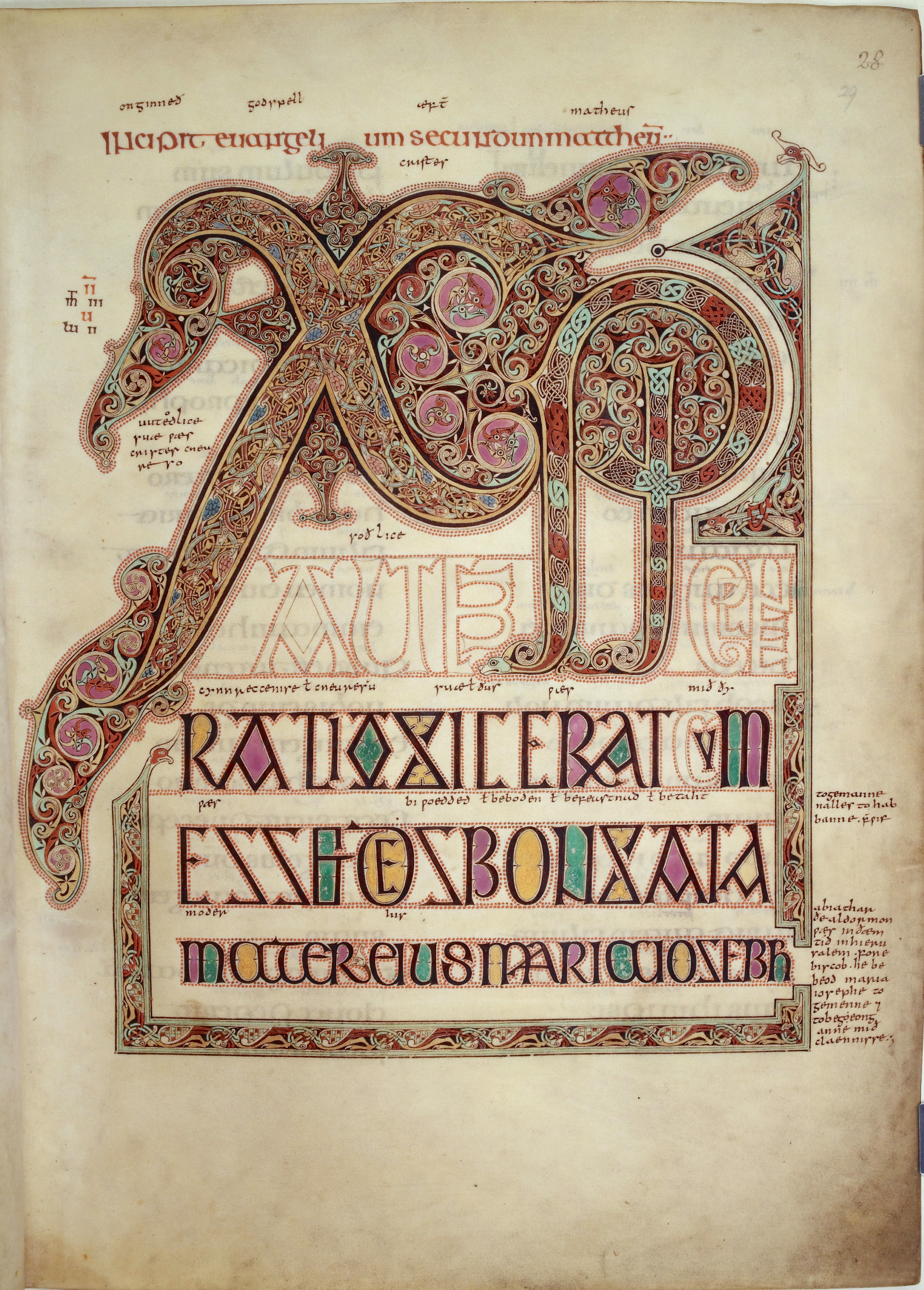 |
| "Chi-Rho" monogram, the Gospel of Matthew—Wiki |
Go hailin. Indeed the Lindisfarne Gospels are very beautiful Irish-Anglo-Saxon, or, more correctly, a joint Hiberno-Saxon manuscript, illuminated in the Irish style, The Lindisfarne Gospels, like the (later) Book of Kells, were once considered to be a relic of St. Columba. Calling it Anglo-Saxon art is to do it a disfavor; it's a much more cosmopolitan manuscript than that.
The Celtic monastery of Lindisfarne was founded in 635 AD, by Columban Irish monk Saint Aidan (d.651), from the Isle of Iona. Irish monks founded Celtic monasteries on most of the British, Scottish, and Irish islands, and Columban Irish scribes would've trained Saxon scribes in the the insular Irish style—right down to the red lead dots surrounding the letters (the Durham Gospels, and the Book of Durrow, being its predecessors). But first, the Irish monks had to convert the Saxons....
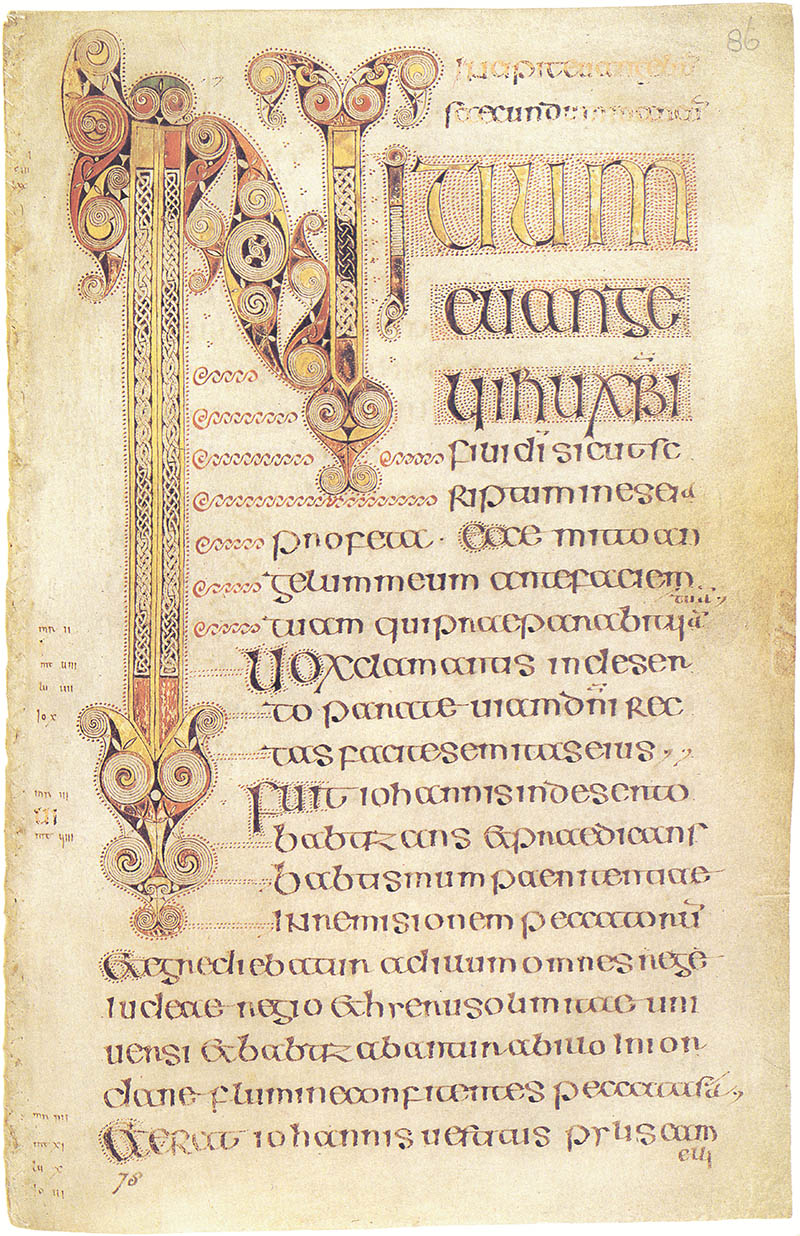 |
| The beginning of the Gospel of Mark from the Book of Durrow.—Wiki |
The Lindisfarne manuscript, an illustrated Latin copy of the Gospels of Matthew, Mark, Luke and John, was probably made at Lindisfarne, but it could've been made elsewhere, even Iona, as it has an Iona connection. The text is also written in (Irish) insular script.
The problem with tagging this manuscript as Anglo-Saxon, is that it's virtually impossible to tell the difference between Irish, Welsh, Scottish, and Anglo-Saxon illuminated manuscript art, because they were all created in Celtic Irish monasteries between 500-900; later in Ireland, to 1400 AD), and they share far too many similarities. It was also an incestuously small world.
A "safer" nomenclature would be to label these illuminated manuscripts as "insular." Ditto for the continental manuscript, also created in Celtic monasteries founded by Irish monks. (See "List of Hiberno-Saxon illuminated manuscripts" at bottom of page.)
And most 'scholars' writing of these things never delve beyond the current political border of a country when describing where an artifact was discovered, or attributed to, when labeling art. If it was made in St. Gallen, ergo it must be Swiss; or in Bobbio, it's Italian (Irish monasteries!)
 |
| The St. Gall Gospel Chi-Rho page, written by Irish monks ca. 750AD—from Irish Medieval History |
Irish manuscripts often display the first three letters, Chi-Rho-Iota, from the Greek ΧΡΙΣΤΟΣ, as a monogram. In the Latin Vulgate, it reads: "[Christi (XPI) autem generatio sic erat… Note the distinctive long left leg on the Chi/X—also found in the Book of Kells, Book of Durrow, St. Gallen Gospel, MacDurnan Gospels, Book of Lindisfarne and many more. The long "i"pronunciation in Christ, is a result of Irish missionary work in England during the 7th - 8th c.—from Irish Medieval History
Some slovenly writer described this manuscript as an amalgam of Anglo-Saxon, Irish and German art—WTF? I couldn't figure out how/why Germany—then it dawned on me, they were referring to manuscripts found in Germany, made by Irish monks. And archaeologists tend to be even sloppier. Sometimes I wonder if they know any history at all.
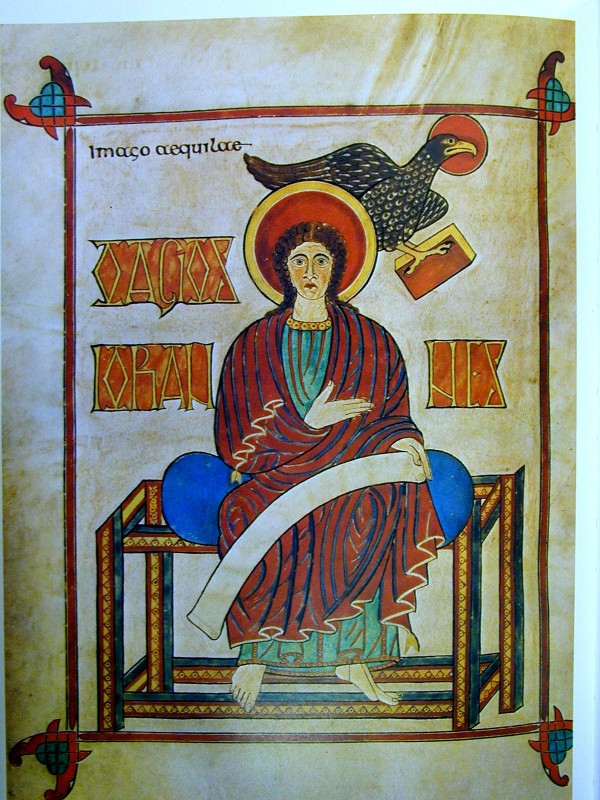 |
| Eagle-eyed John the Evangelist —Wiki |
Some background on Lindisfarne, founded in 632, according to the Annals of the 4 Masters; modern articles say 635 AD. It was also the age of writing fancy Vitae to one's patron saints.
The three Lindisfarne bishops who followed the Irish founder, St. Aiden of Iona (590-651), were all Irish-born: St. Finan, St. Colmán, St. Tuda—43 years later, Eata, apparently he was not saintly fodder, but he was St. Aiden's student, and the first native Northumbrian bishop (678-685); then St. Cuthbert (though born in Scotland, he was also from the Cult of St. Columba school).
From what I can tell, St. Eadberht was the second ever Northumbrian bishop—he put up lead walls and a lead roof on the thatched oak church, I bet many monks were very grateful.
And then we get to oor man, St. Eadfrith (also a fine Northumbrian, b.?, who was bishop from 688-98) who was possibly the artist and scribe...the manuscripts are attributed to him, but they could've also been commissioned by him.
A little backstory: Things were not all hunky-dory between the Saxons and the Irish just because Christianity gained a tiny toehold, and the Lindisfarne monastery was established, ca. 635. Oswald of Northumbria, a king living in exile since 616, vowed to bring Christianity to pagan Northumbria. In 634, when he gained the crown of Northumbria, he invited St. Columba's monks to establish a monastery.
But things were still pretty woolly. In 683, the Saxons raided Magh Breg in ireland and took hostages. In 684, Eadfrith's contemporary, St. Adamnán (624-704), St. Columba's distant cousin and Abbot of Iona (679-704)...
...went to Saxon Land, to request a restoration of the prisoners which the North Saxons had carried off from Magh Breagh the year before mentioned. He obtained a restoration of them, after having performed wonders and miracles before the hosts; and they afterwards gave him great honour and respect, together with a full restoration of everything he asked of them. —Annals of the 4 Masters
(These were the apocalyptic plague years. After nearly all the children and animals died, I imagine any kind of miracles were welcome—including Columban monks walking across the Irish Sea to Scotland, it was that cold. But at least the cold snap must've killed off the plague fleas.)
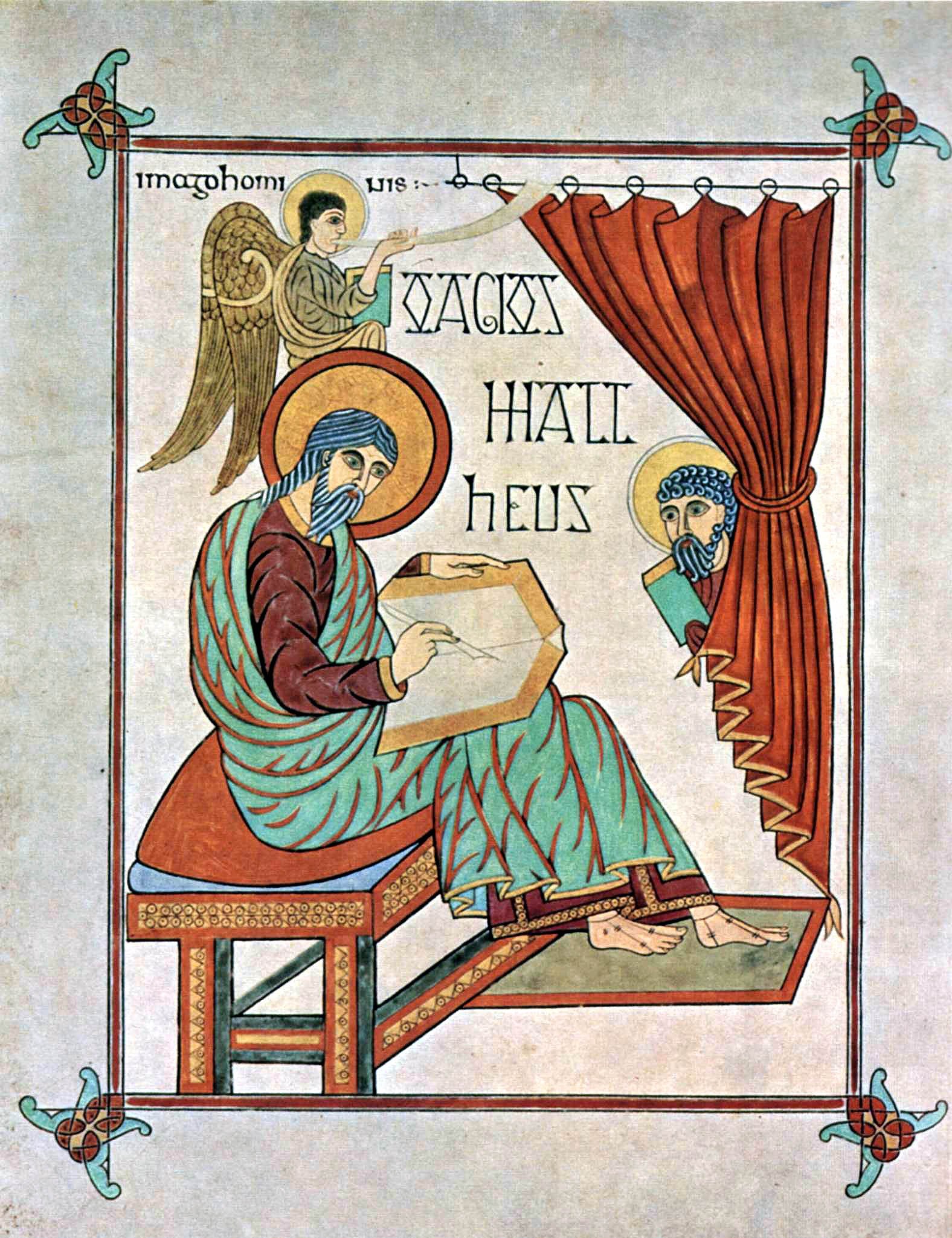 |
| Portrait of the artist benched as Matthew the Evangelist —Wiki |
A century after Lindisfarne was abandoned because of repeated viking raids, a colophon was added to the Lindisfarne Gospels by a self-serving scribe and provost, Aldred the Glossator, who penned Anglo-Saxon glosses under the Latin text, between 950 and 970, and then he graffitied on the text that Eadfrith was the scribe and artist responsible for the work—some 150-70 years later... Lead-poisoning aside, there must've been some librarian apoplexy in the wings. Stories do change. There was also a viking raid or two in the way as well.
it is only from Aldred’s inscription that we presume Eadfrith created the manuscript and another monk, Billfrith, its original binding. Margaret Walker, The Lindisfarne Gospels: A Living Manuscript, University of Edinburgh Postgraduate Journal of Culture and the ArtsBut the illuminated mss. was probably a commission produced in honor of St. Cuthbert (634-687). It was probably made ca. 700, most scholars suggest 715, but Eadfrith died in 721—presumably while still in office, of old age as did most bishops—with their boots on (it was a very good gig). If so, then he probably didn't scribe the manuscripts himself, as he also commissioned three books on the Life of Saint Cuthbert as well. Calligraphy and advanced old age don't mix well—too many hand tremors, not to mention a profound loss of eyesight.
 |
| Carpet page: possibly based on early Coptic manuscripts depicting Islamic prayer rugs. Can you see the embedded cross?—Wiki |
The next bishop, (last) St. Æthelwold of Lindisfarne (721- 740), took the raw manuscripts that St. Eadfrith had prepared (note the word "raw"), had them bound and gilded, and commissioned a jewel-encrusted gold cover made by St. Billfrith (ca. 8th c.), which the Dane-vikings literally ripped iff, of course.
The Lindisfarne Gospels had to wait until 1852 to get another decent cover. But that's another story. And this is the end of my story.
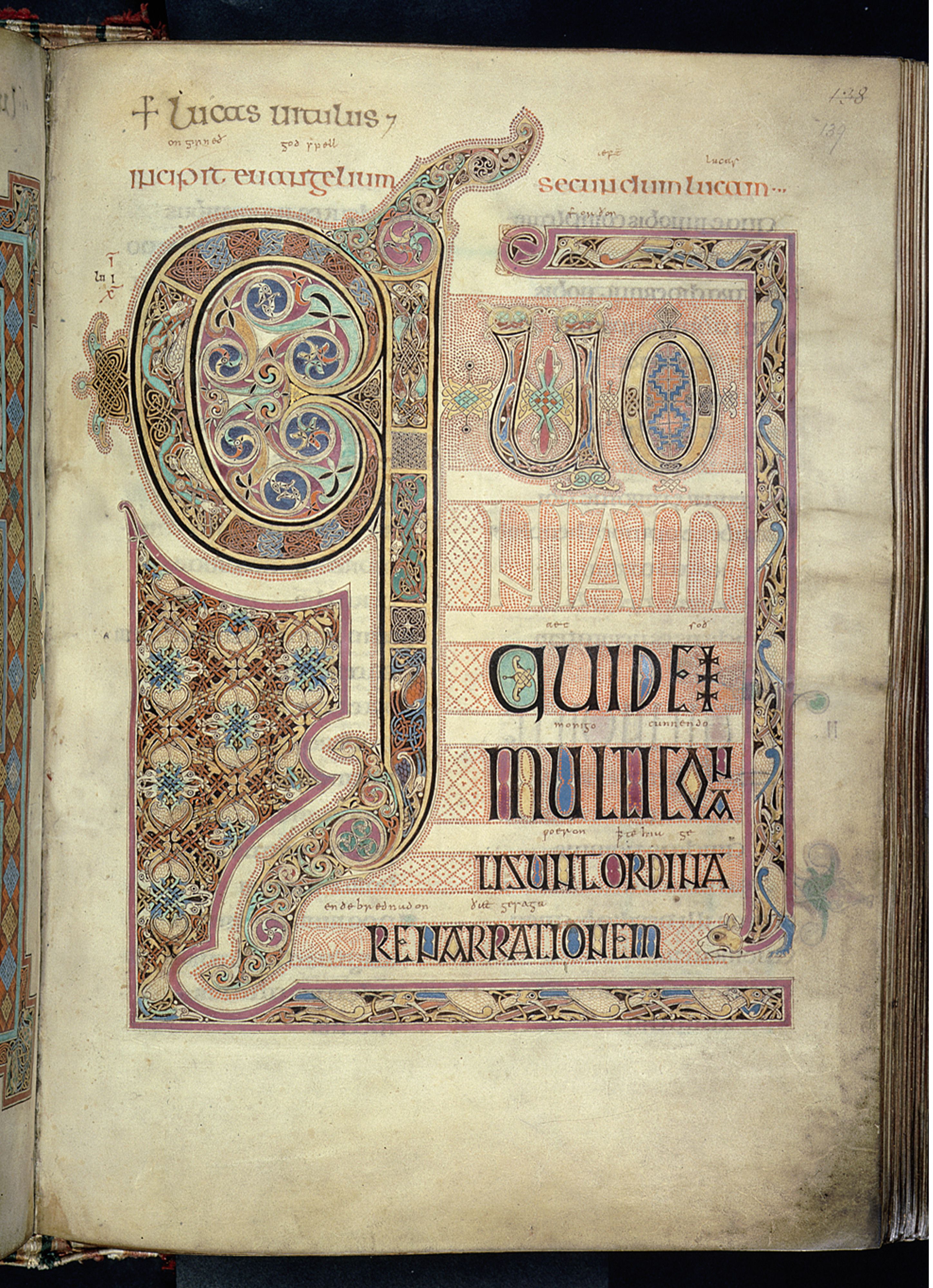 |
| Gospel of St. Luke—Wiki |
The Old English name, Lindisfarena, was not recorded until 793, probably from the Irish (lin/d-pool/stream); the 9th c. Welsh Historia Brittonum, records Lindisfarne as Medcaut; the term Holy isle/Insula Sacra was commonly used until the 11th century, and is alternatively used to this day. Cumbria, northern Umbria, Lothian and the Kingdom of Strathclyde formed the diocese of Lindisfarne.
SOME OF MY CELTIC BLOG LINKS
Colum Cille & the Picts notes
Copy, Right?
Merovingians notes
Olaf the Peacock's Irish Mother
ANNALS OF THE 4 MASTERS (many dates are about 3 years off...)
Tuesday, June 7, 2011
Lloyd Reynolds' Calligraphic Legacy
 |
| Lloyd Reynolds by Henk Pander, cover of Encore (Jan 1978) |
About the time I began writing poetry in the late 1970s, I studied calligraphy with Sonoma State University French professor, Adele Friedman, who was a student and friend of Georgianna Greenwood; both were students of master calligrapher Lloyd Reynolds.
So depending upon how you want to count, I am within one or two degrees of separation from both Lloyd Reynolds and Steve Jobs.
At the time, I didn't have a typewriter, so I hand-calligraphed all my poems in a sort of Japanese "running grass" style Italic chancery cursive script for David Bromige's poetry classes. He seemed to like that—and told me it was a Reed College tradition: Philip Whalen, Lew Welch, Gary Snyder, etc., (all of whom I had met, so I was in good company.)
Calligraphy, a Greek word, literally means "beautiful writing." Beautiful, my handwriting was not—it was really awful and disjointed (I'm dyslexic). I hated writing, but after I studied calligraphy for a year, my handwriting dramatically improved. So did my brain. Calligraphy is much more than the sum of its parts: not only is it the art of fine penmanship, it is a state of being.
I never intended to become a scribe. Calligraphy and poetry honed my critical thinking skills and allowed me a visual workaround to combat the dyslexic roadblocks and labyrinths that had plagued me all my life. It was a major miracle that I even made it to junior college, let alone, earn a BA in Art—with a side order in poetry.
The introduction of Apple and Mac computers allowed me to write. The technology unlocked the doors of my convoluted brain. I taught myself how to write on an old Apple IIc with floppy disks. I began small, with poetry, and then branched out to write newspaper stories, and grants—which led to my life's work, teaching poetry and art to kids in the schools.
One of my first artist in residency jobs was at Healdsburg Elementary School teaching RSP/Learning Disabled kids how to write calligraphy (and poetry)—when all else had failed them. I redesigned my approach to the letters, and made up stories about them so the kids could really see the shapes as shapes—not letters. We flourished. Kids wrote poetry and their handwriting and reading skills improved.
During this time, The Calligraphy of Lloyd J. Reynolds was my Bible. I found a battered copy of the rare, o.o.p. book and it was the most money I'd ever spent on a used book.
Letters have fascinated me ever since I found their power and beauty when I was five years old. I learned to read. I was always drawing and letters were a favorite subject. —Lloyd Reynolds, Autobiographical NotesWhen Lloyd Reynolds (1902-1978), a poet who taught at Reed College for 40 years (1949-1984—the year the Mac was invented), first discovered calligraphy in 1934, he said "The letters would not leave me alone…."
It was like "a bolt of lightning," he wrote: "It seemed perfectly obvious—the only logical approach is the historical one. Learn to cut reed and quill pens and write your way through the history of the alphabet!" Lloyd spent the next few years studying paleography. Connect the dots. (Autobiographical Notes).
[Lloyd] He respected students, and he added joy to the skill. Legibility, communication, clarity, and respect for others—all these were tenets in the religion of Lloyd Reynolds and calligraphy. You got as much from who he was as from what he was teaching, and that’s the talent of a great teacher. —Georgianna Greenwood (Reed, ’60)In 1972, Lloyd Reynolds was honored as Calligrapher Laureate of Oregon‚ the first title ever bestowed in the nation. Reynolds, who revived the art of calligraphy in the West, saw it as a means to work one's way back into the origins of literature. A gateway to history.
It was also very Zen. One had to approach the blank page with a meditative approach. The mind had to be stilled. It was a true Vulcan body - mind meld. There was no room for hesitation or false starts.
I had to wipe my mind clean: in that state of mind, I could recognize the letters I needed to write, but I couldn't say what the word was nor could I spell it. If someone talked to me, I immediately made a mistake—I misspelled the word—or added the words they said—usually a noun. Wherever my mind went while I was calligraphing was not of this world—it was a tranquil white place of suspended time.
During the late 1970s and early 80s, I became the resident calligrapher / sign painter at Sonoma State University. I traded in my steel pen nibs to dance with fat greengrocer felt paint brushes, I pushed the art form into large format. My ephemeral signs and banners on butcher paper graced every corner of the campus.
I made signs for The Student Union, the InterCultural Center, Peter Scarlet's Sonoma Film Institute, and campus events including backdrops for Pete Seeger, Daniel Berrigan, The Jewish Oral History Project, Westwind, The Dead Kennedys, James Burke, etc. Many performing artists who visited SSU, took my banners home with them.
I also did some freelance calligraphy (I called my business Calligrafix). I made wedding invitations, obituaries, cards, menus, programs, tickets, etc. All our posters and broadsides for The Russian River Writers' Guild were hand-calligraphed as getting anything professionally photo-typeset on a huge Compugraphic machine the size of a VW bus—was prohibitively expensive. Hot lead press typography was still in use. Desktop publishing was still a nascent glimmer in Steve Jobs' eye.
This post is a funny circle back to Tim Girvin's blog about his connection with Steve Jobs, and Jobs' connection with Lloyd Reynolds and the evolution of the Mac's superb typographic legacy. Reynolds is really the godfather of desktop publishing.
Interesting to note that Tim Girvin's own chancery examples look a lot like Georgiana's work. Lloyd had a strong influence. A distinctive style imprinted upon so many of us—even those of us once and twice removed from the source.
 |
| Even Joan Baez kept my calligraphy sign. |
Lloyd Reynolds
Note Bene: This blog entry is in response to an interesting calligraphy link posted by Oregon poet Jim Carmin, whose day job is an antiquarian rare book collector and manuscript wrangler for the John Wilson Special Collections at the Multnomah Library. @JimCarmin tweeted: GIRVIN: Steve Jobs, Calligraphy, Lloyd Reynolds and Reed College. Check it out.
SOME LINKS AND CLIPS:
Italic Calligraphy and Handwriting with Lloyd Reynolds
Lloyd Reynolds: Italic Calligraphy
Italic Calligraphy and Handwriting with Lloyd Reynolds
Lloyd Reynolds: Italic Calligraphy
Lloyd J. Reynolds Biography
The Dance of the Pen
'Lloyd Reynolds: A Life of Forms in Art,' on view at Reed College
The Dance of the Pen
'Lloyd Reynolds: A Life of Forms in Art,' on view at Reed College
Steve Jobs Stanford Commemoration speech 2005
My links:
Calligraphy doodles (art)
see also my early calligraphed poems from 1978, 79... (uneven work—some were drafts, and some were silly poems)
My links:
Calligraphy doodles (art)
see also my early calligraphed poems from 1978, 79... (uneven work—some were drafts, and some were silly poems)
Saturday, December 31, 2005
Young Audiences of Northern CA Calligraphy Residency
Artist: Maureen Hurley
Discipline: Introduction to Calligraphy & Graphic Arts
Goals of Residency/Teaching Philosophy
Goals: For teachers: to spark ideas for the creation of an integrated curriculum, using visual arts and language arts. For students: this calligraphy residency will teach the art and history of fine hand lettering, and instill in students, the historical and aesthetic tradition of the art of calligraphy.
What is your approach to working with children?
I am an active published artist, performer/writer and educator. The excitement of, and proximity to creativity carries over into the classroom and ignites students and teachers alike with a desire to learn a difficult skill. Sharing this inspiration in the classroom allows me to create an arts community and foster a nurturing and safe space for students of all ages to explore divergent thinking skills.
What approach do you use to teach them skills in your arts discipline?
I love integrating core curriculum into my lessons, whether it be language arts or visual arts, social studies or science. I share my artistic process with students and instill in them my teaching philosophy which includes a sense of excitement, playfulness, and a burning desire for exploration and experimentation. I use specific models, class demonstration, group and one-on-one instruction, review process, critique/compliment sessions, and portfolio assessment.
Learning Objectives
(what do you want students to know by the end of the residency?):
Objectives: During this six-session residency, students will practice various skills in the visual and written graphic arts. At residency’s end, students will have a grasp of the mechanics of fine art lettering, and with the skills they’ve learned and the handouts I’ve given them, they will be able to continue learning long after the residency is over. I often ask them to teach a sibling or friend after class so they have a sense of ownership in the learning process.
Tuesday, December 1, 1987


Monday, August 31, 1987
Thursday, February 14, 1985
BLAME IT ON THE MOON
BLAME IT ON THE MOON
During the full moon,
my birds flock to your chest
and turn into the moon's silken young—
they alight, and slide down to where
you've furrowed and tended the earth
between us and we discover

During the full moon,
my birds flock to your chest
and turn into the moon's silken young—
they alight, and slide down to where
you've furrowed and tended the earth
between us and we discover
glistening stars in the tilled darkness.
2/1985 these small poems are hard to date, as I tended to fiddle with them as I was honing my sullied craft. This calligraphed ditty is an earlier draft, probably written in a CPITS workshop
2/1985 these small poems are hard to date, as I tended to fiddle with them as I was honing my sullied craft. This calligraphed ditty is an earlier draft, probably written in a CPITS workshop

Monday, December 31, 1984


Friday, June 1, 1984
Magabark/ Medicine Bundle collaborative art show at the Falkirk Center

 |
| My poem In the San Geronimo Valley, Ann Faught, visual artist. |

 |
| I made art postcards as personal invitations to the show. |
 |
| I also created a collaborative poem scroll. |
 |
| Bill Witherup's medicine bundle, which was the genesis of the show. |
 |
| Bill Wiley's piece based on Bill Witherup's poem |
 |
| I didn't label slides, thinking I could read them. Carl Dern & ? poet |
Sunday, May 6, 1984
Ken Larsen's MA Thesis, Art and the Bourgeoise, a dissertation presented on ribbons
Conceptual art piece, Ken Larsen's Thesis, Art and the Bourgeoisie, a hand-calligraphed dissertation presented on silk ribbons attached to a sunhat, and read aloud to his thesis advisor, Bruce Hackett in J St. Park, Sacramento, CA, in May, 1984. I got tired of Ken's procrastination, so I interviewed him, and distilled his dissertation down into a dozen threads. Bruce read the entire dissertation aloud. It took us several walks around the park to complete the process. Ken got his MA.


Sunday, January 1, 1984
GAMBLING ODDS
GAMBLING ODDS
Seeing old lovers again
is like playing tic tac toe
with the moon.
Like with Jimmy the Greek
the odds are 100%
1984 date? I think it's older
1983? Marin Poetry Review

Tuesday, November 23, 1982
MOTHLIGHT
MOTH LIGHT

 a page from the Marin Poetry Center anthology, 1982? or 83?
As you breathe in
the light,
darkness, softly fallen
from your face
reveals these burnt wings
rekindled in your eyes.
11/23/83
Date may be off, it may have been published in Radius or Arc. I used the published version line breaks.


Saturday, March 13, 1982

Saturday, February 16, 1980
LOVE, ITSELF
LOVE, ITSELF
Love itself
has no season, no time
to turn the rhythm of our souls.
As if by convection our breath
is snatched away and suspended
from mist particles along
the pounding shore
2/1980
 |
| Page from the Marin Poetry Center anthology 1982? |
Friday, January 18, 1980
HES students peek into past through art

Healdsburg Elementary School students, along with interested parents, teachers and community members, got a sneak preview Wednesday of the school's upcoming Winter Arts program The presentation was part of the Fourth K program at HES. Artists from Sonoma County, 14 in all, came to the school to demonstrate what they will teach the students while in residency there. • The arts and crafts will help teach history and social studies to the students, in addition to the traditional methods of study. Students will be able to understand foreign cultures by learning the crafts people had to know for survival in past cultures, according to program coordinator Lee Perron. Sixth graders will be studying Japan. China, Russia, Israel. Latin America and various European nations. Fifth graders will study early American history. Fourth graders will lake up the early history of California. Arts and crafts in the winter program include: candle making, soap making by Elwin Millerick, pottery by Tony Evans, mask making by Greer Upton, calligraphy by Maureen Hurley, puppet making by Jan VanSchuyver, leaded glass by Mark Allen, weaving by Lynn Lewbel Mecce, paper making by Deborah Soloman, charcoal drawing by Armondo Gomez, music by Philip VanGelder, pine needle basket making by Marisa de Joseph, silk screening by Kino Novella and spinning and carding by Cynthia Gallager and Linda Gardelto.
Friday, September 1, 1978

Subscribe to:
Posts (Atom)


