Showing posts with label Irish. Show all posts

Thursday, March 25, 2021

AN EPIPHAN-i-LINGUISTIC CONUNDRUM

AN EPIPHAN-i-LINGUISTIC CONUNDRUM

She asked, Why did Yeats call willows sally trees?
I answered without thinking, saileach,
as if that explained everything, and said,
I speak more Irish than the average bear.
But then it hit me, an epiphany—I was gobsmacked.
Bears don’t speak much by way of Irish, now, do they?
Not to mention there are no more bears in Ireland
other than the one in a Dublin business park.

3/25/2021

Monday, July 6, 2020

Irish-American women rebel-rousers


IWW activist Elizabeth Gurley Flynn was model for Joe Hill's The Rebel Girl Wiki

Someone on Facebook posted a story about how American women were instrumental in affecting social change. I was surprised that her examples didn’t include any Irish American women—not even the fabled Mother Jones. And when I attempted to add Irish American women to her list—who were not actresses—I drew a blank after the first handful of women. I searched online in vain for a list of Irish-American women rabble-rousers who were real rebel rousers, not just pretty faces on the celluloid screen—which led to this blogpost.  

(Note bene: This is a draft.... a few of the biographies are not done. But I’m close. I just ran out of steam.)

Wednesday, April 15, 2020

Connemara pony origins


Cúchulainns’s pony, Liath Macha, was a grey. Connemara pony—Wiki

A well-meaning writer friend who leads New Age spiritual anim cara style trips to Ireland, invoking its mythical misty past, posted a story on Facebook about how the Vikings brought the Connemara pony to Ireland. Well, you can bet your bottom dollar that got my goat, er, pony. I mean he has something like 4000 followers who dote on his every word. Perhaps seeking damage control, I posted this comment on his page:

Contrary to what Wikipedia says, the Connemara pony is native to Ireland, it was not brought to Ireland by the Vikings. I can’t even begin to fathom how that notion came about. There were already plenty of fine horses in Ireland. And because Ireland was a cattle culture from the Bronze Age, right up to the Viking invasions, horses too were very much part of the cultural landscape.

The Connemara pony’s genetic ancestry is derived from an ancient source that predates the arrival of the Vikings. In fact, they carry a northern late glacial European mDNA C1 gene cluster shared with Exmoor, Shetland, Fjord, Icelandic, and Scottish Highland ponies—which “suggests a common late glacial or postglacial origin for these pony breeds.” 1. DNA studies were conducted on “five British-Irish native pony populations... Carneddau (Welsh)... Connemara ponies (native to Ireland) and Highland ponies (native to Scotland).” 2. And  they discovered that “The Highland and Connemara matrilines were more closely related than to the Welsh ponies.” Meaning they probably did travel back and forth across the Irish Sea.

We know, at least according to the Irish epics, that native aboriginal Bronze Age British and Irish ponies were theoretically being raced in two-wheeled chariots as early as 400 BC. Icelandic ponies, related to what is called the early Celtic horse—specifically the Kerry Bog pony, Ireland’s oldest breed—probably contributed to the Icelandic pony gene pool too, as Dublin was the main port of call to Iceland, not Norway.) The ambling, or toelting gene present in 8th c. British horses and Icelandic horses, but NOT in Scandinavian horses—strongly suggests that Icelandic horse ancestry included ponies from Shetland and the British Isles.

Sometimes articles cite the Andalusian horse as an ancestor breed that contributing to the Connemara bloodlines. The problem with that theory is that the Andalusian horse carries a completely different gene cluster, D1. The DNA isn’t there. So how does this work? Magical thinking? During the 1970s Connemara ponies were crossbred with warmbloods to “improve the breed” as a sport horse.

But to be fair, “In the 12th Century, Spanish (Iberian) stallions were imported and used to breed with small (Welsh) mountain mares.” 2. in Wales, to create the bigger Powys, and Hackney pony (British). So it’s remotely possible some of that hot Iberian bloodline eventually found its way into the Connemara pony bloodlines, but, here’s the rub, the appropriate DNA cluster simply isn’t there. Besides, the 12th c. is no longer considered to be the Viking era, the Norman era, maybe.

This story may be the source of the Andalusian bloodline theory. “The Connemara Pony's origins go back some 2,500 years to the time when Celtic warriors brought their dun-colored ponies onto the island of Ireland and used them to draw war chariots and carts along the beaches and river plains of their newfound home. The history is obscure, yet the Connemara Pony is considered Ireland's only native breed. Mythology tells us that the tribes of western Ireland were mounted. Legend has it that when the Spanish Armada sank off the Connemara coast in the 16th Century, the horses swam to shore and bred with the native ponies running wild in the mountains.” 3.

But anything linking an Armada ancestry theory is always suspect. Legend, and not fact. Repeat something often enough, and it becomes “true.” Like with today’s politics. Ditto that with the Viking story. Also, why would Vikings even need to bring horses to Ireland, it would be like bringing coals to Newcastle. (I actually had to explain that idiom to someone who had never heard of Newcastle before. It’s a good thing I didn’t have to explain First Footing. But I digress.)

During the 1700s, Arabian blood was introduced to many Forest, or northern/cold horse breeds. That’s how we got the thoroughbred. But according to conservation genetics of endangered horse breeds, the native pony breeds show far less less foreign genetic influence than the large horses—probably because they weren’t considered valuable. Their diminutive size protected their gene pool. But no matter what, the native mare always carries essence of the bloodline. Blood will out.

Anyway, silence was his loud reply.

Saturday, March 31, 2018

Good Friday translation rant, aka an odd insomnia cure


I awoke 4 AM, with a blinding headache, from pulling recalcitrant honeysuckle vines from the engulfed Meyer lemon tree. I was in dire pain and the Advil hadn't yet kicked in, so there I was, with full-on insomnia, resurrecting my rusty Irish translation skills on a Facebook genealogy site. Perfect thing to do on the aftermath of Good Friday, no?

It's almost impossible to resurrect the meaning of Irish placenames as they've been Englishified and phoneticized to death. The English attempt to destroy a language. With no small thanks to the Royal Engineers and the 1833 Ordnance Survey. Irish playwright Brian Friel's play,Translations, tackles the systematic disembowelment of the Irish language by the English hellbent on cultural imperialism. But sometime enough of the original ghost Irish remains behind to see the meaning behind a placename.

Saturday, October 29, 2016

On Irish Saints' Names and Family Names


Molly posts a photograph of the two churches in Nevada City, stranded  on opposite sides of the freeway, St. Canice's & Trinity Episcopal. If you stand just so, you can see both spires at once. Two churches separated by road and by faith.

Few know that Canice was an Irish saint, Cainnech moccu Dalánn, he was born in Glengiven, Ireland, and was a close friend of St. Columba's. Helped convert the Picts. 

I'm sure everybody mispronounces the church name. That's Canice, not Candace—which drove my aunt Canice crazy. Just. Don't.

My aunt Canice, the last child in line, was named after a dude. Yep. That would be Kenneth, in English, or Anguish as my grannie would say... 

The name gave my aunt Canice much anguish during her lifetime. She gave up trying to correct people and eventually went by the handle of Candy. People couldn't screw that name up. How sweet.

Sort of like why I cowped to using Mo vs. Maureen after resisting for decades. Not that there was a Saint Maureen, but it means Little Mary, or bitter herbs. Take your pick.

It's a good thing my granny didn't choose St. Kevin. Can you imagine what would've happened with the moniker, Caoimhín, in the mouths of the English speakers? 

Keeping in the family tradition of unpronounceable Irish names, Canice named her only daughter  Sinead, after my grandmother. You'd think she would've known better.  I guess it could've been Siobhan. St. Joan.

My cousin Sinead doesn't let anyone read her nametag at work, their eyes get all tangled up in the random assortment of vowels. And she won't give her real name out to baristas—it comes out as Sin-head, or Sineed! We liked Sinhead. It makes us laugh. 

All this naming after saints in my family to keep us in line. Not that it ever took.

Thursday, July 28, 2016

Those Irish-Iberian Connections


There's an article on a webpage, Signs of the Times (Sott.net—The world for people who think) from 2013 that gets trotted out regularly on Facebook,  DNA shows Irish people have more complex origins than previously thought, that, for some reason, pushes my buttons. I suspect that it's the way it's written that froths my dander, more than anything else.

This is my off the cuff response to the article: I need to go back and synthesize it, until I find my way with it. Now I don't have a through line. Working on it.

I wrote: This article/writer needs to be taken with a grain of salt (or read carefully) in that what it's trying to point out, and what it actually does point out, seem to be two different agendas. It's a bit of a rehash. Or maybe a mishmash.

RE: the statement that "The blood in Irish veins is Celtic, right? Well, not exactly.... the Irish are close genetic relatives of the people of northern Spain." OK, here's the argument she's making. Thesis statement, if you will.
 

However, there needs to be a qualifier: yes, there's a link with Galicia, a known Celtic country, not with Spain, nor Basquelands, either. Bronze Age Iberia was mostly settled by Celts who spoke Gaulish, fergawdsakes, of course there would be genetic links. Ditto that with Northern Portugal too.

The Irish are not related to the Spanish (or Portuguese), they're related to an ancient group of Celtic  peoples (pre-Spanish), some of whom who still inhabit the northern parts of the Iberian Peninsula. 


The minute you mention Spain, everybody immediately jumps to Basque links—no, they're not related, and certainly not linguistically related. Then they jump to Black Irish, and ridiculous Spanish Armada links. The persistence of myth is hard to eradicate.

The author goes on to say: "the latest research into both British and Irish DNA suggests that people on the two islands have much genetically in common."

Yes. We're still talking about Haplogroup 1 (or Rb1—related to the redhead gene) here. Same as the Keltoi of Central Europe. Didn't she just claim the opposite?

My main gripe: there has never been a conclusive genome map done of the entire British Isles by one scientific group. Not like what was done in Iceland. That needs to be done first, before sweeping conclusions can be made. Not isolate genome bits here and there, with piecemeal theories pastiched together.

"Many people still refer to Irish, Scottish and Welsh as Celtic culture." (This is what I think she's trying to refute via ethnicity).

They still are culturally related, this article proves nothing. Culture is defined by many signatures, and not all need to be present at once: language, ritual/religion, DNA, etc.

Let's look at the larger use of rhetoric. The scope of the article. Her stance: Irish are not the same as British. Therefore they're not directly descended from the Keltoi of central Europe. Ergo, also not related to the British. This article was written in 2013, by someone in Northern Ireland. So what is her point? The case she's making? Otherness? Why? What purpose?

FWIW, I have books on the history of the Celts dating back to the 1990s and earlier that acknowledge that there's an Iberian (not Spanish) connection with Ireland. But it's not the only Celtic connection. I don't think the Central European Keltoi La Tene artistic links came from Iberia. Just sayin'.

Also, there's linguistic evidence in Ireland of both P-Celtic and Q-Celtic languages, via tribal and placenames, which suggests a much more complex picture of Celtic migrations than what's painted here. But it's a start.

Sunday, July 24, 2016

On Web Trolls and Heavy Breathing


Dear Ones,

I've received yet another abusive comment on this blog, this time from someone named Guls, which I've marked as spam and decided not to repost.

I find it distressing that on my personal blog page, why someone who has managed to publish only ONE blog entry on his blogsite (extraDimensionalDarkie) in the past five years, chooses to be a such a spiteful troll and feels the need to share it with me. (Whereas my blog's been visited at least 300,000 times—more than that, as I didn't have a page-counter during the first few years.)

Apparently I'm an idiot because I took the time to challenge a popular idea, then I had the audacity to research, and write about it, then post it without first checking in with him. Good to know that the thought police are alive and well and living in the outback-a beyond.

Speaking of idiots, Guls is also not a very careful, or competent reader, yet, English is clearly his first language: He wrote "why would this idiot bring up, Australia as having anything to do with the origin of redheads."

Wow. I never even remotely said that. What I did write was:
Scientists agree that red hair is more common among those with genetic roots in northwestern Europe, especially Ireland and Scotland (and by extension, Argentina, and Australia—via immigration and penal colonies). —Maureen Hurley, Viking-Irish Redhead Gene Myth
Who's the eejit now? Then Guls couldn't leave well enough alone—and went into full auto-erectile dysfunctional mode: his sinewy-tongued comments went from bad to worse. All I can say is that a penal colony is a place of confinement and punishment: a prison, not a penis—which apparently, is what he uses for a brain.

And then Guls suggested that I go and (ahem) blow on it. Yeah, well, I prefer to blow on a hot pen. Or maybe a pair of liar's dice. I guess my bio photo didn't clue him in that I wasn't a ginger-haired auto-fellatio sort of fellow? What a douche, or should I say, dildo? It seems Guls is trapped in a prison of his own making, and apparently there's nowhere left to transport the wanker. So he trolls the internet.

Guls did raise a valid point that the layout of my Viking-Irish Redhead Gene Myth page is atrocious. Sorry, I agree, but I really have nothing to do with that. That was Google/ Blogger's state-of-the-art layout way back in August of 2007 when I started this blog (but I didn't begin writing until 2009, I was a slow adopter). I can't do much about it now, not with the prospect of losing 1700 posts in the process. There are certainly more sexy web design choices now.

As to the layout of this particular blog entry, he's right. It is a right mess. But I cannot even get into the blog post in order to make changes, let alone, clean it up. I think it has too many embedded links. Durty HTML as it were. I have tried. But I can't repost the changes. They won't take. It crashes.

I never meant to write that particular blog piece, really. I found little nuggets that supported particular trains of thought that I wanted to add, and tacked them on. The more I researched, the more amazing facts and folklore I uncovered. It sort of happened, so I didn't have a floorplan. So yeah, organization is not my strong suit. I'm a messy writer.

I can no longer make additions or corrections to the Redhead post as it crashes Blogger. It's too bulky for me to edit—it crashes, or disappears completely when I try to update it. I've had it disappear no less than three times when I tried to revise it. Talk about blue language. TG for Safari cache, I was able to retrieve it once that way, and another time via the backspace arrow. Third time I got wise to Blogger's ways, and pasted it into a TextEdit document before attempting an edit job. 

As to the structure, I could delete the post, start over via copy and paste, but then I'd lose all 52 comments. So it is what it is. It is a popular post, such as it is, having been read 71,275 times. More than all my other posts combined. How many poets can say that they've had a poem read 70,000+ times? Hmmm?

I must admit that I am constantly amazed by how much interest there is in the origin of red hair. And by the erroneous information as well. This particular post gets lots of traffic (and some flack too from the red-haired Viking school that can't accept the fact that red hair predated Viking invasions in Ireland).

Truth be told, I grew weary of the piece, and literally ran out of steam.... As I'd mentioned, the piece came out of an email reaction to something someone wrote on Tim Ferry's Irish in California listserve St. Patrick's Day, 2009, and it expanded and grew in exponential proportions....until my head hurt. So I abandoned it.

Ironically, it was also my debut piece into the art of blogging. I began it during NaNoWriMo, and worked on it for days. Maybe even weeks. (Yeah, I know NaNoWriMo is in November, and it's posted in March. In those days, I moved posts around according to theme vs. creation date, which caused massive headaches when I tried to repost everything chronologically last summer. Woe still is me.)

I get a smattering of flattering comments on that Redhead post—some replete with hidden sneaky spam links, and a few downright snarky ones. Luckily I do have veto power and don't publish them. They're always signed: Anon! Except for oor man Guls.

I've considered turning off the comments on my blog. A few bad apples... That said, I do read all your comments, and I do try to write back. I have no idea if any of my readers ever see my comments to them, but I do value all of you readers. So if you've any feedback, I'd love to hear from you. Spare me the heavy breathing, though.

Sunday, April 10, 2016

LETTER TO COLM TÓIBÍN


Colm Tóibín, it's come to this;
a neighbor, madly in love with
the wandering road of your writing,
rang my doorbell, asking me
how to pronounce your name,
which led to an Irish linguistics course
on aspects of hidden vowels,
slender consonants, síneadh fadas,
and diminutive endings. The reason
for the shh! in my cousin Sinéad's name.
How Hebrew and Irish, despite everything,
carry the hunger of the shark-toothed sound.
And how the final -ín in Máirín, and Tóibín
are but small endearments, like cailín.
Why say the ó and not the i, she asked.
I explained the role of the fada, the haloed ó—
she got more than she bargained for,
as we wandered from the story of Brooklyn,
on how to say Saoirse, to the The Testament 
of Mary, who, despite everything, did not believe. 
What my neighbor really wanted to know
was how the syllabic dove was nestled
within the folds of your name, and Iona's naomh.
But we are also bound by testament of cold iron,
our grandparents smuggled guns to Eniscorthy.
My neighbor got a discourse on the uprising,
and hidden pocket vowels within bol-g and fil-um, 
as my grannie would say. The anaptyctic mediator
smuggling vowels and proverbial bullets
across borders. This béarla
we hold in common.

4/10/2016

Bay Area Generations #42
2/2017

SILENT HAICHES
DEEP NOVEMBER
FOUND POEMS FROM THE IRISH
Hurley: Sea Tide

Sunday, February 21, 2016

Linguistics segue on Celts and Albanians (raw notes)

This is a placeholder for lost notes. I will probably never get back to it. I was in the midst of discussing Albanian linguistic origins on an Indo European language post when Facebook completely spazzed out and took off. And everything I wrote was lost. I had posted that the Albanian word for fish was too similar to Welsh—in Irish it’s iasc, and in Welsh, it’s pysc. I can’t remember the Albanian. Thanks to Facebook, I’ve lost the Albanian word. 

The upshot is that the word for fish is probably not a Latin loanword... (Why do people assume Latin is always the Ur language for other IE languages, when the PIE word is the model at hand?) O bhuel, perhaps someone will take offense at my post and then I'll be able find it again and finish my thought. (Didn’t happen.

What I'm intrigued by is that this Smithsonian article does not challenge format of the model, which should be in question, it's an example of the historicity of the mapping of IE, with all its (unconscious) biases. If you watch the map, note that German follows modern political borders... and I don't think it was that widespread. And does it predate Celtic? I think not. It's pure supposition.

Oh look, they even forgot to include Celtic in its original homeland, in what is now Austria. Oopise. Celtic had much larger range, and yet gauging by the Smithsonian Magazine map, it's depicted as less than half its original range. Iberia isn't even included. From what I could tell Iberian Gaulish was similar to Gaulish, but there were also similarities to Irish...mainly hard 'c" vs "p."

And then there's are semantic gaffs, "Ancient Turkey..." etc.; clearly the writer has a poor grasp on the subject matter (and history)...the article should've been edited. Also, look to the animated mapmaker. Since when is Business Insider in the linguistics business?

And of course, the out of Anatolia theory is but one model. Gawd, I loved those accidental lessons in linguistics, when I took Old Irish. I was not a good student, in way over my head, but I took a year if it. And I worked hard at it every single day. A classmate was taking Hittite at the same time so I got a peek into Hittite as well.

Got the original Smithsonian Page
See also how I E languages expanded.

Saturday, December 5, 2015

Hurley: Sea Tide


"Hurley, Murihily, O Morhelly, Murley, O'hUrthuile Ó Muirthile and Morley from Murthuile meaning “sea tide,” is from mur/ muir. Of the sea tides, the Hurleys were sea-farers and mariners. A name almost exclusively from Cork, where my family hails from.

Wow! Thálatta, thálatta! The sea, the sea. A sea tidal surge as a surname suits me. I am named for the sea twiceover.

And if I play fast and loose, I can also transliterate my first name as She of the Sea (an old boyfriend, Edwin Drummond dubbed me She of the Sea), vs. little Mary, Maureen, Máirín (it's the Irish spelling, not Pokémon character fergawdsakes!).

Upon occasion, I've also been called the Morrígan, goddess of battle, strife, and sovereignty (the phantom, or great queen); the Morrígu or the plural triune, the Morrígna. She is depicted as a skald crow, or raven flying over the battlefield, and her triune animal shapes are the eel, wolf, and cow. Not solely the goddess of death, she is the goddess of wealth of the land. Her triune sister aspects are: Badb, Macha and Nemain (or Anand).

Mor may derive from an Indo-European stem, cognate with Old English maere (which  gives us "nightmare" and rí-gan translates as queen, or rather, king., from the Proto-Celtic, *Moro-rīganī-s. But in Old, and Middle Irish, it was scribed as mór, which means great, grand, big; from PIE, *Māra Rīganī-s.

There is also a connection with the Arthurian Morgan le Faymor may derive from a Welsh word for the sea, môr, but the scholarly argument against that derivation is that the names are from different cultures and branches of the Celtic linguistic tree. However, there are plenty of cognates in Welsh and Irish, so it is not a strong argument. (All Brythonic forms are *mor; all Goidelic forms are muir; Manx is spelled mooir). The Morrígan could be Queen of the Sea, she was tempestuous enough.

The Welsh, Mair, Manx Moirrey, Irish/Scottish: Maura, Moira (English: Mariah), with the diminutive -ín ending added, equals little Mary. Mairenn, Máirín, Maureen. But then, even the name Mary also has connotations with the sea, as in Our Lady of the Sea.  

In the Middle Ages, Mary was equated with the sea, mare, as in Stella Maris. Not that misogynistic Jewish definition of Maryam as bitterness, or bitter herbs, nor rebelliousness (well, maybe that). Mariam, as in drop of the sea. A name considered so holy in Ireland, it wasn't even used until the Renaissance.

Then there's Muirín from muir f ‎(genitive singular, and nominative plural mara). Old Irish muir, from Proto-Celtic *mori, (Welsh môr, Manx mooir), from Proto-Indo-European*móri, (Latin mare, English mere, German Meer). I guess the idea of a rough sea was always a nightmare.

Hebrew word ma'or for star and yam for the sea equals Maryam. Stella Maris, Venus. Sea-star, also Polaris, the lode-star leading the way. Once I was chosen as Queen of the May, and I crowned the statue of Mary with a crown of roses. And I was baptized at Star of the Sea. Ave Maris Stella. And I grew up in Marin, within sight of the sea, if I climbed up Mt. Barnabe.

Thalatta! Thalatta! She is our great sweet mother.*
Epi oinopa ponton. I'll drink to that.

Ah, the hidden poetry of naming. 

 Goleen Star of the Sea, Mizen Head, Co. Cork, most southwesterly point in Ireland —Wiki


Saturday, November 21, 2015

A Response to a FB Post Conflating Vikings with Bronze Age Celts

((Note bene: Because this piece begins in medias res, right in the middle of things, it doesn't have an introductory lead-in paragraph. I didn't know I was going to get so involved in it, or I would've saved the Facebook poster's statement. At one point, in her attempt to equate all things Celtic as Scottish, she conflated Vikings with Bronze Age Celts, by then, I was gnashing my teeth. Hence this bloggy bit. Of course, at this point, I'm writing into the void, as she'll never lay eyes on this post. Hopefully it will entertain you. There are some cool maps at the bottom too. This is how my Irish redheads blog evolved as well. In bits and pieces. Unlike Athena who sprung, full grown from Zeus's forehead, I have to ramble about to get to where I'm going—and I often know not where. And so, here we are, together again.)


Dear Historically-Challenged Reader,

The Vikings were LATE on the Irish cultural event horizon by nearly 2000 years. They had less influence in Ireland than what they were given credit for. Not only that, they were quickly assimilated in Ireland.

That's what happens when you marry Irish women, their children are half Irish, whose sons will who marry more Irish women, so they're now only 1/4 Viking in two generations. You see where that goes—since the Vikings brought few Viking women to Ireland.

And Viking power waned after the Battle of Clontarf in 1014 at the hands of Irish High King, Brian Bóruma mac Cennétig. If the Norsemen hadn't attempted to impose taxes in Munster, then, Irish history might have been different, then Viking influence would have had a profound impact.

Viking heritage in Ireland is but a drop in the bucket of time. Viking settlement and rule lasted roughly 200 years. And of course, those Icelandic Vikings had a lot of Irish ancestry, as the migratory brunt came from the Dublin Norse stronghold. See  the Icelandic Laxdæla saga, and Burnt Njall's saga, etc., rife with Irishmen and Irish women—most favored as slaves and feisty concubines.

Yes, the Vikings did settle permanently in Shetland, but the Celts (and pre-Celts) who lived there before the Vikings arrived, never actually went away. There's the historical misnomer. (Lots of Celtic DNA survives to this day.) Ditto with the Viking settlements in the Hebrides, and the Isle of Man. The Celts, or more technically correct, the Irish Scoti as they were called (which does NOT mean they were Scottish, but Irish), eventually drove the Vikings out. (Battle of Largs.)

Also that marrying/taking the Irish women thang, applies here too. Somerled, Lord of the Isles, was more Irish than Viking by blood (and by allegiance). The Norse-Irish culture was hybrid, not just Viking.

BTW, the word Scotland comes to us via Latin naming by way of Ireland. Scotia Major was Ireland, and because there were so many Irish living in what is now called Scotland, which was known as Scotia Minor until the 11thc. and the term was still used up to the 16th c.).

Isidore of Seville in 580 CE wrote: "Scotia and Hibernia are the same country." Adomnán, St. Columba's 3rd cousin, referred to the Gaels as Scotti.

It wasn't until the 15th c., that Pope Leo X (1475-1521) decreed that Scotland was, well, Scotland, and as such, had exclusive right over the word Scotland, which resulted in a huge landgrab as the English-Scots took over Irish monasteries on the Continent (i.e., Schottenklöster Irish Benedictine monasteries in south Germany taken over by Scots.).
Schottenklöster (meaning "Gaelic monasteries" in German, singular:Schottenkloster) is the name applied to the monastic foundations of Scottish and Irish missionaries in Continental Europe, particularly to the [Irish] Benedictine monasteries in Germany, which in the beginning of the 13th century were combined into one congregation whose abbot-general was the Abbot of the Scots monastery at RegensburgWiki
So there must've been internecine Irish/Scottish/English squabbling over who owned what, and perhaps some genuine confusion, for a pope to adjudicate as to what country owned the placename. The Irish monks got kicked out of their own monasteries; I'm sure there were some seriously irritated Irishmen. I bet full coffers were also at stake.

So, the next time you notice that Lindisfarne is referred to as an Anglo-Saxon monastery, that's propaganda, the polar opposite of historicity, at work. It was an Irish founded Hiberno-Saxon venture. But I digress. (If Blogger had a sidebar, this would be encapsulated, but I don't want to start another post.)

Where was I?

As to your note on the Viking and Irish similarities in artwork, therefore the Vikings must've taught the Irish how to utilize knotwork design, the Irish practically invented it! The La Tène culture, the source behind a lot of Irish art, equally predates the Viking era by 2000 years. A lot of native British Celtic art is erroneously attributed to Anglo-Saxons in Great Britian, who also predate the Vikings. (The Irish and the Britons shared many cultural traits, including artifacts. Then there was the British-Irish_Anglo-Saxon hybrid culture that followed.

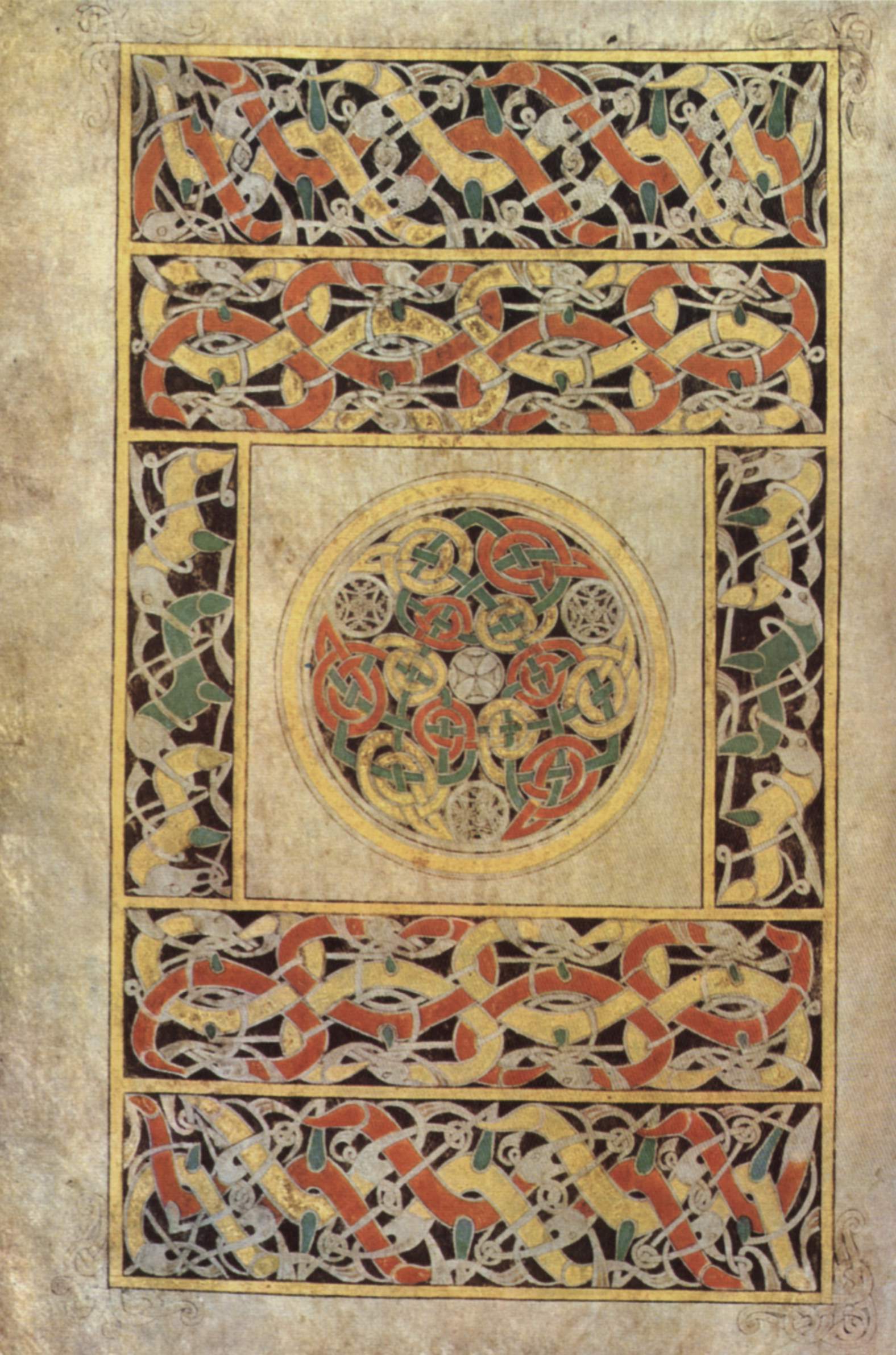
I would venture to say that the Insular art style with Celtic spirals, curvilinear, and geometric shapes employed in the Book of Durrow were not influenced by Norse or Viking raiding artisans. This kind of complex, intricate art did not suddenly spring forth in a brand new art form, the illustrated book arts. Especially when one's homeland was being invaded by Vikings. So what came first? Chicken or egg? (See folios 1v, 85v, 125v at bottom of Wiki page.)

There's more of a correlation with Anglo-Saxon art, and even that was a hybrid art form, later called the Hiberno-Saxon style. I find no Germanic Continental evidence of this Insular art form. What each of these cultures have in common, is exposure to Insular Celts. Early medieval Celtic book treasure bindings were highly coveted by the Vikings. One can only imagine what the lost treasure cover for the Book of Kells looked like.
Various metal fragments of what were probably book-mounts have survived, usually adapted as jewellery by Vikings. —Wiki
(Also, the Bronze Age Celts, and Celtic culture dominated the Continent, so some of their artifacts could have been found by what later become the ancestors of the Vikings.) There was cultural contact. But there's scant evidence that Viking artifacts predate Irish and Celtic art styles. To make an absurd parallel, many little girls the world over love Hello Kitty, that doesn't mean they were all Japanese samurai.
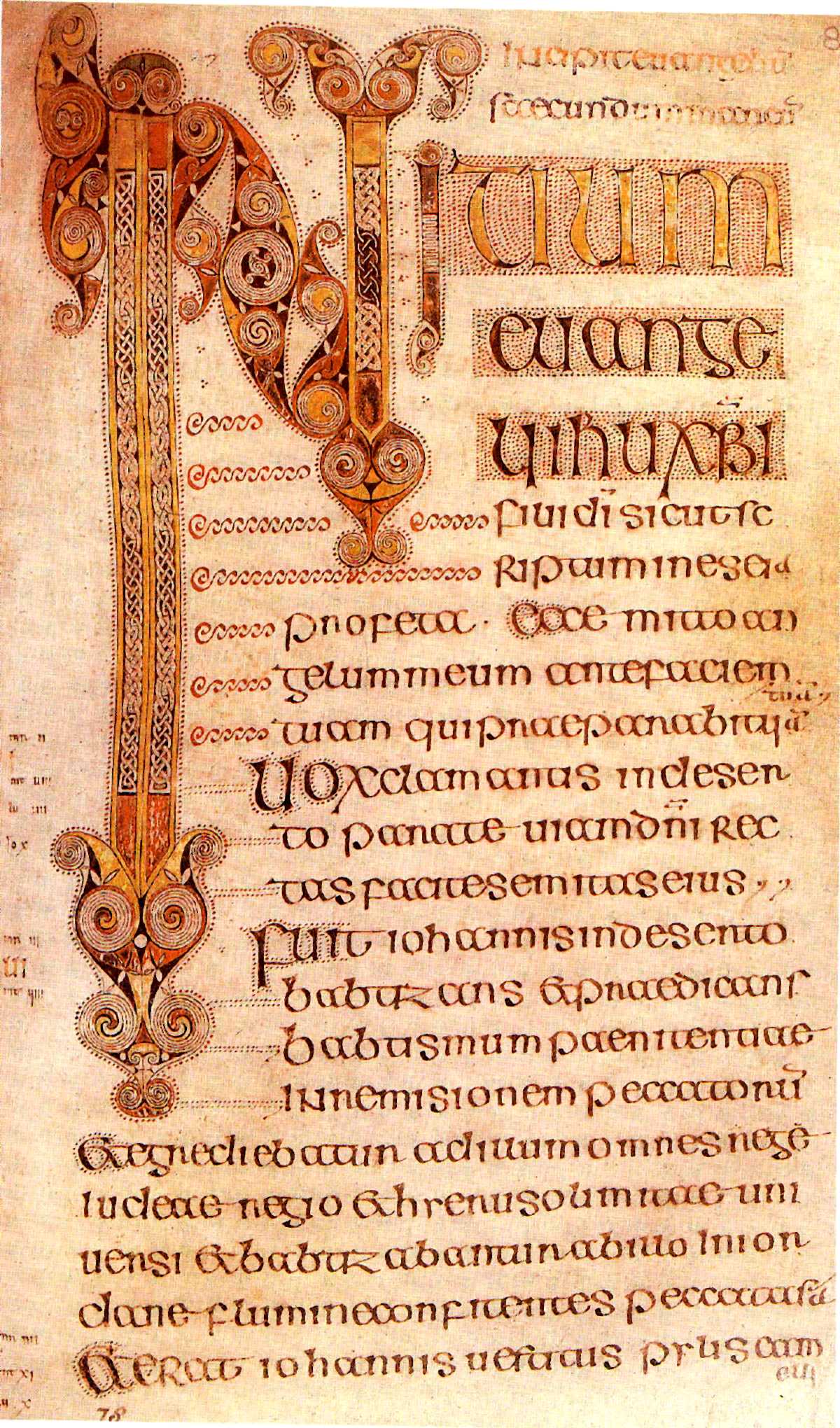

Gospel of Mark, Book of Durrow, 650-700 AD. —Wiki

The Vikings were raiders, they brought back artifacts from other cultures, which in turn, influenced their art. Geometric interlace doesn't appear in Viking culture until after they had contact with Britain and Ireland. They also brought back (Irish) slaves, who were artisans....Again, keep in mind the timeline, and it was a hybrid culture].

(See mid-9th c. Oseberg ship-burial. Artifacts included the Oseberg bucket, with patterned enamel figures similar "to the Gospel books of the Insular art of the British Isles, such as the Book of Durrow, (ca.650 AD)." —Wiki, and Irish Archaeology.

Several Viking ships in Roskilde Fjord, and the Skuldelev ships were made in Ireland. So claiming who did/owned what in the past is never quite as simple as it seems from our perspective. We don't know who carved the ships, and, again, it was a hybrid culture. Also, there was no timber in Iceland, so Icelandic ships too would've been built in Ireland or wood imported to Scandinavia.)

Book of Durrow Carpet page, similar in style to the Oseberg bucket, 650-700 AD. —Wiki
Check out the timeline, The Vikings (780–1100), and this one, but keep in mind that much of what we think of as Viking art was the result of artifacts collected from other cultures during raiding.

If you get a good grasp of the pre-Classical, Classical, and post Classical Celtic cultures, and migrations, then it will all make more sense.

Unfortunately working from a knowledge base that dates to the Plantation of Ulster as a reference point, is politically biased, therefore suspect. History written in the voice of the victor, and all that. Also, the intense hatred the English harbored for the ethnic Irish has also adversely colored "history." So, most Irish connections were extirpated. The OED is a prime example.

In Scotland, a lot of so-called Scots, were actually Irish. The Industrial Revolution, and two famines meant that many Irish immigrated to Scotland—especially The Barrows in Glesga, and along Clydebank (ships).

Yes, the Romans named the Picts, Picti, after a Continental Picti tribe, who were probably from the same Gaulish tribe. Picts were probably P-Celtic vs. Q-Celtic speakers. The Picts were also in N. Ireland, they were called the Cruithne, or Cruithín (they have an asteroid named after them, LOL!) The Cruithne/Criuthín included several tuatha, including the the Dál nAraidi—who settled in Scotland. Qritani/Cruithne comes from the word *pritenī (Pretani). Q-Celtic Irish speakers hated the plosive P sound and swapped it out for a more gutteral cough sound, hard c/q/k C: Cruithne/Pritani. mac/map, etc.

Ireland had many P-Celtic speaking tribes, as well as Q-Celtic speakers (Gaels, Galicia). See Ptolemy's map of Ireland for tribal names: Briganti, Dumnoni, etc. Cruithni and Menapi were probably Gaulish. The Ganganoi were also in N. Wales. In the 5th c AD, Gwynned was an Irish enclave, so there was a lot of back and forth movement.
A rendition of Ptolemy's map (Vlaclav Hollar, ca. 1650s-70s) —Wiki
Julius Caesar, in his Commentarii de Bello Gallico, is the first to call the island Hibernia... Wiki

Galicians were not Spaniards, but Iberian Celts, one of many CeltIberian tribes. Asturias, Galicia were Celtic kingdoms that managed to survive until the Middle Ages. They probably were the original Hispania immigrants who settled in Ireland, according to the Lebor Gabala Erenn (where the name Scotia is chronicled.)

In the Song of Amergin, the first Gael to settle in Ireland, (Galician) poet-druid Amergin (mac) Mil quells the sea, after the very tall Tuatha Dé Danánn send a big wind spell, proving he was a bigger, badder druid, than they. And to really ridiculously telescope mythological time, they slunk away, shrank, went underground, and became the fairyfolk!

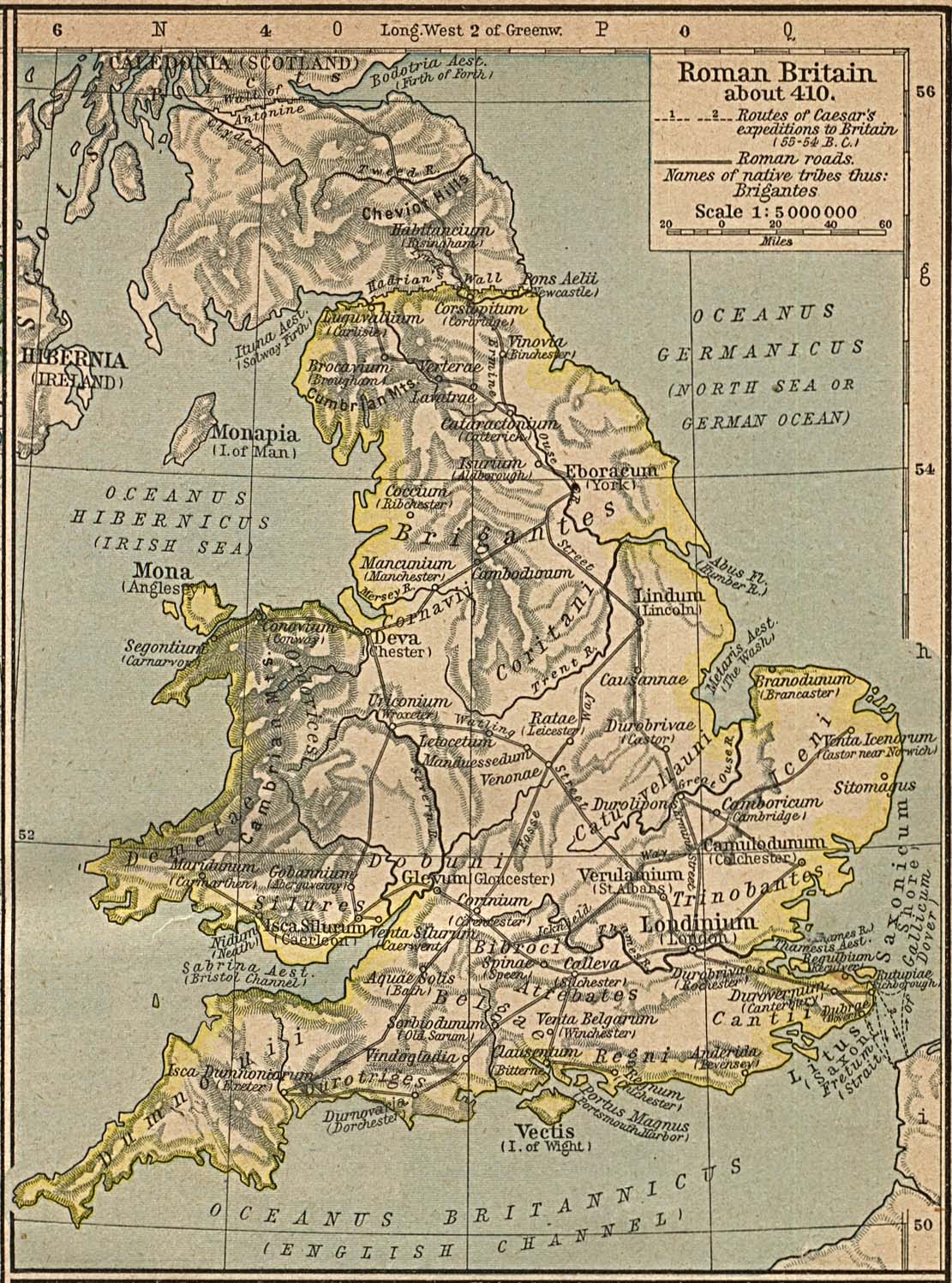
Here's a lovely Roman world view map of Scotland & Eire; note the use of the word Scotti in N. Ireland. Note also that Scotland was not called Scotland, but Valentia, and Caledonia. The Brigantes of Maxima Caesariensis were a buffer between Caesariens (Roman Britain) and what we now refer to as Scotland. Only Southern England, Kent, Cornwall and Devon (Cantii, Damnonii and Belgae tribes) was called Brittania.


Roman Britain —Wiki

Another old map.


Roman Britain in 410 —Wiki

And an updated 1654 map that chronicles Scotland as Scotia and Ireland as Hibernia/Ivverna. Pope Leo X (1475-1521) decreed (when?) that Scotland had exclusive rights to the term Scotland.
In early medieval times Ireland was known not only as Éire but also as Scotia, a name that the Romans used at times to refer to Ireland as well as Scotland. —Wiki

A 1654 map that notes Scotia as Scotland and Hibernia/Ivverna —Wiki

Wednesday, October 21, 2015

SILENT HAICHES

SILENT HAICHES

My grannie taught me to write
old school Gaelic League Irish
with dots over the muted consonants; 
they were marked with a sí buailte,
a diacritic hangover from Old Irish.
Sí buailte means strike—not to strike,
no infinitive verb in Irish. Drop the fada 
Seán becomes sean, which means old, she said.
She didn't like reformed Irish at all. 
Modern typography couldn't  handle those dots
so haiches were added after the consonant.
"There are no Haiches in Irish, she scoffed. 
"Haich is a ladder to the sky, 
Haich is silent, holy, haich is like God." 
So I learned the old style writing
with long-tailed rs and esses
I learned to dot my Ts and Cs to soften them.
Then we had some tea with milk and sugar
as we silently worked on our letters.

Oct, 24/2015

Monday, August 24, 2015

Longing/Saudade/Hiraeth


Someone asks about saudade. Yes, I answer, it's longing, yearning (melancholia/nostalgia). He is yearning for home = tá cumha air i ndiaidh a bhaile (literally, "there is loneliness on him after his home"). There are at least five words for that ephemeral state of being in Scots Gaelic.

In Welsh, it's hiraeth, a homesickness for somewhere you cannot return to, the nostalgia and the grief for the lost places of your past, places that never were.

The Breton for the French nostalgie is hiraezh. This could be a cognate, or borrowed from the Welsh. Hiraeth (first recorded in 1499) corresponds with Cornish hyreth, and Irish sireacht." Someone said it appears in the Book of Aneirin 'Blwydyn hiraeth er gwyr catraeth' ('a year's longing for the men of Catraeth'), which dates it to the late 13th c. Unfortunately I did not keep my reference.

The Welsh and Breton come from the Celtic root siros, from Proto-Celtic *sīr-axto-, akin to Gaulish siraxta (“longing”). I thought it was related to Latin serus. But someone astutely pointed out that the Latinate cognate is solitas.

Regardless, it’s still a full circle to Saudade.

Hiraeth

Saturday, January 31, 2015

"Up Helly Aa," reconstructed Fire Festival, or Imbolc in Viking drag?

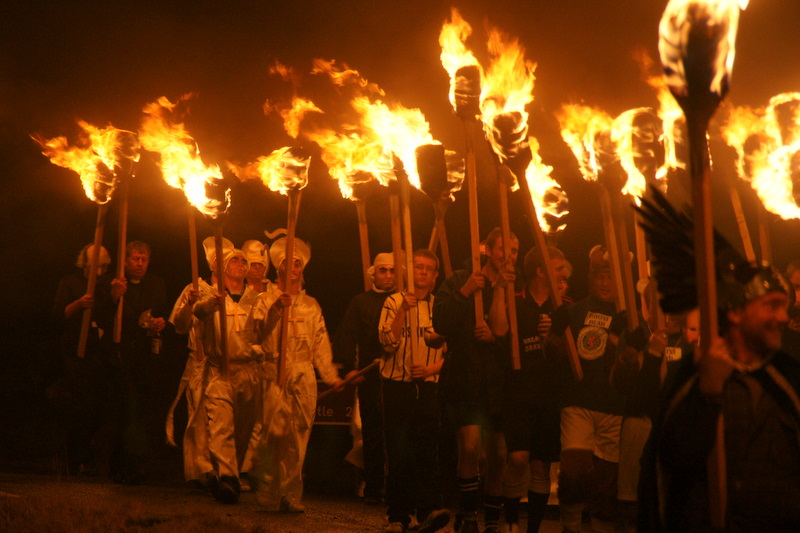
Guizers with torches at Up Helly Aa celebration in Uyeasound,Shetland.  Before the 19th c., tar barrels, not torches, were used. They look a bit KKKish.
The “Viking” Up Helly Aa fire festival celebrated on the last Tuesday of January (originally held on old Christmas Eve) in the Shetland Isles in Northern Scotland, is not a Norse festival, but a "reconstructed" Victorian Solstice fire festival. I'm not convinced the festival has any Viking roots, though modern-day Shetlanders, proud of their Norse heritage, would probably avow it does. 

The setting of the beacons, or the wards along the coasts and the lit tar barrels rolled downhill are well-attested Celtic motifs. The lit barrels, (my great grandfather also lit on Beltaine in Bantry County Cork, Ireland), evolved into setting a fire a long ship. 

The origin is a bit more obscure, as the Vikings invaded the Shetland Islands during the 9th century, and the fire festival was founded in 1880s—1905, more than 500 years after Norse rule was vanquished. Besides, there were other cultures living in the Shetland Isles since the Neolithic era. They didn’t just disappear with the arrival of the Vikings.

The Vikings, as we know, were not big on sharing the wealth, and 19th century Viking scholars were also not keen on sharing either. When something is claimed as being authentically Viking in Celtic lands, there is often a convenient blurring of anthropological lines, with the idea of Vikings still plundering other cultures a millennia after assimilation.

What cultures in situ before the Viking invasion, are often overlooked, because it doesn't fit current romantic thought. So, rather than observing the overlay with a cultural substrate, we often get skewed cultural theories based solely on later invading cultures—especially in Scotland where the Viking love affair is still in full swing some six centuries later. There is only "I" in Viking. Not even poetic license can alter that.

Shetland (sometimes referred to as Thule in Classical tracts), was no terra nullius before the Vikings invaded. The archipelagos of Shetland, the Orkneys and the Hebrides, also were not considered part of Scotland, which did not become a kingdom until the ninth century. The Latin term Scoti/Scotti referred to the Irish Gaels, whether in Ireland (Scotia Major) or Scotland (Scotia Minor). 

Long before the Shetland archipelago (Scots Gaelic: Sealtainn) was under Icelandic-Norse control, it was a Mesolithic, Neolithic, then a Celtic stronghold—for millennia. The Shetland Islands were originally settled by Neolithic Bell-Beaker peoples, then the Celts and the Picts, and the Scotti, or the Irish Celts—who also celebrated a fire festival on this date as well. Thule was supposedly settled by blue painted people (Picts), it could be a corruption of the word for fire, Iceland was also referred to as Innis Tile.

The first written mention of the Shetland Islands, comprised of some 300 islands and skerries, is from the Icelandic 13th c. epic, Njal’s saga. And of course, redheaded Njal with his fierce temper was probably an Irish-Norse Dubliner. At least one Irish Scotti place-name survived the Viking invasions, Dunrossness, and the islands of Papa Stour (Papey Stóra) and Papa Little (P. Litla) refers to Irish Culdee monks. Brother Island may also refer to those Irish monks. Three island place-names may be of Pictish or even pre-Celtic origin: Fetlar, Unst and Yell—once heavily settled by Culdee monks (Pappay/Papil Ness, Loch of Papil and Papil Bay.) St. Ninian’s Isle too was a papar stronghold.

Another Celtic influenced place-name Muckle meaning “big” in 17th c. Scots dialect, and Rua, meaning red (Old Irish ruiadh), a red granite islet, though Muckle Rua is erroneously identified as a Norse place-name, as is Dunrossness. But Dun is fort and ross is a promontory. And ness is a common Scots-Norse accretion also meaning headland in case one didn’t know what a ross was—a clear indication that the promontory was already aptly named before the Vikings arrived. Nothing to do with a noisy tidal race

The early medieval Pictish Bressay Stone,  (It’s in the basement of the National Museum in Edinburgh) with Celtic knotwork and beasties, has an Ogam inscription: “The cross of Natdad's daughter, child of Maqqddrroann,” (OId Irish Mac (son of) Droann. More here.) One of five Ogham stones in Shetland, the inscription is an admixture of Old Irish, and Norn, as the word for daughter is in Norse. Certainly, most of the village names would be of Old Norse derivation as the Irish Scotti didn’t go in big for the idea of towns.

Since the Neolithic era, (4000 BC), people have raised cattle and sheep, and farmed the Shetland Isles. What survives are prehistoric field systems, Bronze Age burnt mounds, Iron Age brochs, and Pictish wheelhouses. The oldest archaeological find, ca. 4000 BC, is a midden at West Voe, Sumburgh. Hard to imagine now, but much of the North Sea was once dry land, Shetland was lightly wooded and the climate was warmer. Neolithic burials include stone cists, and heel-chambered cairns on the island of Vementry, Punds Water and Islesburgh. Skara Brae, Maes Howe, and Ring of Brogar, in nearby Orkney, are extraordinary Neolithic monuments.

During the Bronze Age (2000 to 600 BC), the climate deteriorated, peat bogs spread, and sea level rose. Some 300 crescent-shaped burnt mounds (possible hearths) date back to the Bronze Age. "Ireland was the chief center for the manufacture of bronze and Scotland's early settlers were energetic seamen." Even way then there was a lot of travel between the islands. For millennia, there was Irish contact in the Shetlands, whether by trade, or by theft: a bronze-gilt harness mounting was made in Ireland during the 8th or 9th c. AD, was excavated from an archaeological dig.

Possibly due to a population explosion, or increased warfare, the Iron Age in Shetland saw the rise of massive fortifications: double-walled circular towers, and dry stone brochs—sometimes called "Pictish Towers", but their construction predates the Picts. Ancestors of the Picts, maybe.

Of the 120 Iron Age broch sites, Old Scatness, and the Broch of Mousa (ca. 100 BC), are among the finest preserved examples of Iron Age fort towers. In the case of Old Scatness, the Celts, the late Iron Age Picts, then the Vikings each built atop the old fortifications. Excavations at Jarlshof, confirm archaeological evidence in Mainland, Shetland, since the Bronze Age.
By the sixth century AD, Shetland had become integrated into the mainstream of Pictish politics and life. Artefacts such as painted pebbles and carved symbol stones demonstrate a strong Pictish presence in the islands. Good examples include the ogham script of the Lunnasting Stone, and Christian cross-slabs which include fine examples such as the cross slab and the Monk’s Stone, both from Papil.... From the late 8th century, Shetland was subject to the turbulent impact of the expanding Viking world.—Visit Shetland
The Viking invasions began ca. 800 AD. The earliest archaeological evidence of Norse occupation is in the nearby Orkneys (Viking Shetland was administered as part of the Orkneys, and they were both called the Northern Isles). In 800 AD, a Pictish, or Irish Culdee hoard of silver bowls, brooches, torcs, thimbles, chapes, and a porpoise jaw, was found beneath St. Ninian's church floor on Shetland's St. Ninian's Isle. (See St Ninian's Isle Treasure. St. Ninian AKA Apostle to the Southern Picts).
Human settlement of the island dates from circa 3000 BC and there are remains of several Neolithic burial chambers known as 'heel-shaped cairns'. Little is known of the pre-Celtic and Celtic eras, but when the Norse arrived it is likely they found a religious settlement as the name of the island derives from Papey Stóra meaning "Big island of the Papar" (Celtic monks), in distinction to Papa Little. —Wiki  (see Culdees or papar.)
In 1299 AD, the oldest Old Norse manuscript from Shetland (the Norse called it Hjaltland), was over a duel, where the isle of Papa Stour is referenced. Thorvald Thoresson, accused of corruption, was called "dominus de Papay." In early Irish literature, Shetland was referred to as Inse Catt—"the Isles of Cats." And the name Shetland, like Caithiness, may derive from the Pictish name for the cat islands. Ferocious European wildcats were not your modern moggies.

During the outbreak of Celtic Christianity, when "green" martyrs were seeking hermitages to commune with God, the Irish monks settled on most of the Hebrides, Orkneys and the Shetland Isles, as well as the Faroe Islands, and Iceland, the first stepping stone from Shetland to Iceland. Iceland was settled by the Norse, and Celts from the British Isles—including from Hebrides and Shetland.
During the Dark Ages, groups of outlaws and farmers took to the sea from the northernmost reaches of Europe. These seafaring marauders became known as the Vikings. Some of these outcasts among the Vikings were to achieve historical distinction indirectly through dubious means. —from The Struggle against Colonialism and Imperialism in Kalaallit Nunaat
What's interesting about the Up Helly Aa festival is that it completely obliterates any connection with the peoples of the past, other than a nod to 19th century Viking revival nostalgia. It's a wayward case of settler colonialism displacing the preexisting subculture, as a means strengthening an invader's power base to shore up national identity. This was certainly true in Iceland even though Iceland was settled by as many Irish as Vikings. So, what is Up Helly Aa?
According to John Jamieson's Etymological Dictionary of the Scottish Language (1818), up is used in the sense of something being at an end, and derives from the Old Norse word uppi which is still used in Faroese and Icelandic, while helly refers to a holy day or festival. The Scottish National Dictionary defines helly, probably derived from the Old Norse helgr (helgi in the dative and accusative case, meaning a holiday or festival), as "[a] series of festive days, esp. the period in which Christmas festivities are held from 25th Dec. to 5th Jan." while aa may represent a', meaning "all".  —Wiki Up Helly Aa
But the Northern Isles were once described as "Pictish in culture and speech."  Not Viking. Few Irish pr Pictish place-names survive, except for the northern islands Fetlar with its stone Funzie Girt (Finn's Dyke) a Bronze Age Berlin Wall, Unst and Yell, the second largest island, with 12 brochs, and 15 early chapels—a Culdee stronghold, probably not as enticing to the Norse. The dearth of Celtic "place-names suggest that the Picts may have been forced onto poorer land."There is another school of thought that they are pre-Celtic place names.
Despite many archaeological remains, we have only a patchy understanding of those who lived in Shetland before the Viking invasions of around 800 AD. Immediately before the Vikings arrived, though, it’s clear that Shetland – like much of Scotland - was part of the Pictish culture. By the time of the Viking invasion, possibly two or three hundred years earlier, Christianity had reached the islands. —History of Shetland
The "Northern Isles were the first to be conquered by Vikings and the last to be relinquished by the Norwegian crown." The historical record is weak but Woolf (2007) suggests the Icelandic sagas proclaiming dominion over the Shetland Isles are stories concocted "to legitimise Norwegian claims to sovereignty in the region.Perhaps that is also why a Celtic fire festival, possibly Imbolc, underwent a transformation into Up Helly aa.

An interesting aside: according to the Icelandic sagas, Egil's saga, and the Orkneyinga saga, the Broch of Mousa was used as a refuge for runaway lovers.

I suppose if one is inventive enough, the Norse origin of other island place-names could be challenged: Vementry (Old Norse: "Vemunðarey) could also be derived from a form of Finn, as in Finn's beach: as in Ventry, (Irish: Ceann Trá—which means head beach), which is an anglicization of Fionntrá, in Dingle, Co. Kerry. St. Ninian was also known as Fionnian. M, B and F, in the genitive, take on a v sound. But I'm being linguistically silly.

Maybe it would be more fruitful to look at DNA. Shetland's genetic heritage is 60% Norwegian Y-chromosome DNA (R1a Sigurd), and 40% is ancient Briton (Celts) DNA. The most common male Y chromosomes reflect the most recent migration. Apparently the Norse married lots of local women; as Norse (matrilineal) mtDNA was 30%. However:
[in] Orkney and Shetland, Roberts reported (1985, 1990) that both island populations diverged considerably in allele frequencies from neighboring populations. Roberts concluded that the islanders of Orkney and Shetland most likely represented remnants of an aboriginal gene pool that had changed on the British mainland because of later population movements.... Of the Scottish populations, Orkney [not Shetland] evidently has the closest matrilineal links with Scandinavia. The inhabitants of the Scottish islands share two to seven times more of their lineages exclusively with Gaels than they do with Scandinavians.... mtDNA lineages can be used to identify recent migration. Viking men settled and intermarried with existing populations in Shetland... —mtDNA and the Islands of the North Atlantic
So, with all that intact ancient matrilineal Celtic Briton gene pool intact, do you think their fire customs, celebrated since time immemorial, would suddenly be forgotten and just disappear with the occupation of the Vikings—only to return as a new and improved Viking festival? Methinks this particular fire festival smacks of the neo-Romantic Viking revivalist movement: think truncated Wagner as performed by Viking mummers. (Note that Up Helly Aa is not celebrated in Scandinavia.) 

According to the Smithsonian article, "Up Helly Aa was first celebrated in the 1880s. Before then, rowdy residents would take to the streets to mark the end of the Yule season by burning tar barrels." 

Up Helly Aa is a procession of 1000 guizers celebrating their Norse heritage. Guizers (dis-guisers and galoshins) are a long-standing tradition in the Celtic ream; our modern Halloween trick or treaters are guisers

The festival is stapled onto the end of Yule season (see: Burning of the clavie), but even using the old calendar, "Old Twelfth" would have fallen on Jan. 17, not the end of January, which would be Imbolc, the Fire Festival of Brigid.

A parallel story of confusion: an Irish Medieval History Facebook post notes that people erroneously assume the pagan Celtic Goddess Brigid, who represented the light half of the year, was transported into Christianity as Saint Brigid. Ancient customs and religious beliefs were not swept away with the arrival of Christianity and traditions associated with St. Brigid’s day are thought to date from the pre-Christian period. Candlemas is the Christian overlay of Imbolc.

So taking that model for cultural continuance, despite new landlords, I suspect this Shetland fire festival is an offshoot of the festival of Imbolc, and of the pan-Celtic Goddess Brigid, which was a time for a massive spring clean-up, burning old possessions and replacing them with new ones. 


Since Neolithic times, cross-quarter days, that midway point between solstice and equinox, were celebrated with fire festivals. Cross-quarter days were marked via astronomical alignments on ancient monuments: Mound of the Hostages: Hill of Tara, Howth, Newgrange, Stonehenge. The four fire festivals, Samhain (the end of the Celtic harvest year), Imbolc, Beltane and Lughnasadh also mark the beginning of each season. Spring was the beginning of the Roman New Year.

Imbolc might derive from Old Irish í mBolc, meaning in the belly (as in pregnant—bolg — Spanish /Galician bolsa means bag); it might mean purification or, First Milk.
...which arises from the word “oimelc/oí melg” used in the 10th century Sanas Cormaic (Cormac’s Glossary) which some people have taken to mean “sheep’s milk”. The word “melg” meaning ‘milk’ comes from the Proto-Indo-European (PIE—the ancestor language of most European languages) word “melg” which means "to wipe, to rub off". Purification/ cleansing was an important aspect of many ancient festivals and “oí melg” is not milking but rubbing, as in the act of cleansing. Further evidence of cleansing comes from the Roman festival of Februalia. The Old Irish word for February is ‘febra’, ‘febrae’ from Latin ‘Februarius’ which in turn comes from ‘februa’ meaning purifications. —Irish Medieval History: February 1st or Imbolc 
Imbolc was the second of the four great fire festivals, with significance placed upon the Light of fire. The Irish word for spring, "errach” thought to be related to the word “airreach” which means hauling and dragging. In Ireland, Imbolc is referred to as the big Spring Clean. "Right up to the twentieth century, on Brigid’s eve, the house was be scrubbed from top to bottom by the women who worked into the night." 

All debris was burned (including floor rushes, beds and bedding). Bonfires galore. Oh, and Brigid is a daughter of the Dagda, and a poet. She is the patron of the hearth, healing, metal smithcraft; and inventor of poetry, keening, and beer making. Ya don't want to piss her off. Burn, baby, burn. Sláinte!
A Bhríd, a Bhríd, thig a sligh as gabh do leabaidh
Bríd Bríd, come in; thy bed is ready
Brede, Brede, come to my house tonight.
Open the door for Brede and let Brede come in.
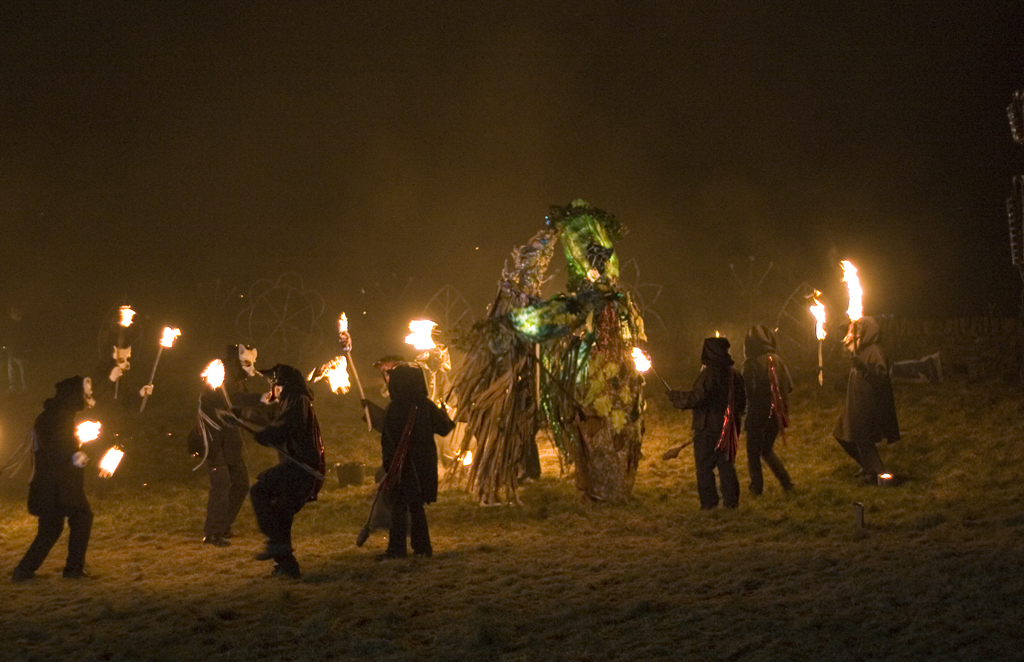
Imbolc festival in Marsden, Yorkshire. —Wiki

Brigid's the goddess of weather, for an early spring, forget the groundhog, chant this instead:
Thig an nathair as an toll
Là donn Brìde,
Ged robh trì troighean dhen t-sneachd
Air leac an làir.
 
The serpent will come from the hole
On the brown Day of Bríde,
Though there should be three feet of snow
On the flat surface of the ground.
Lá Fhéile Bríde shona dóibh go léir (Happy St. Brigid’s festival day to you all)!

Saturday, January 24, 2015

Old Irish family stories emerging (photos)


We ran into my cousin Katie at the Nicasio Druid's Hall crab feed. Lovely surprise. Old Irish family stories emerging, overlapping, Buried history revealed. The mosaic of our lives. We'll visit her ranch at the foot of Black Mountain (Elephant Mountain!) Connection long time coming.


Sunday, November 30, 2014

The Lindisfarne Gospels are Insular art, not Anglo-Saxon art


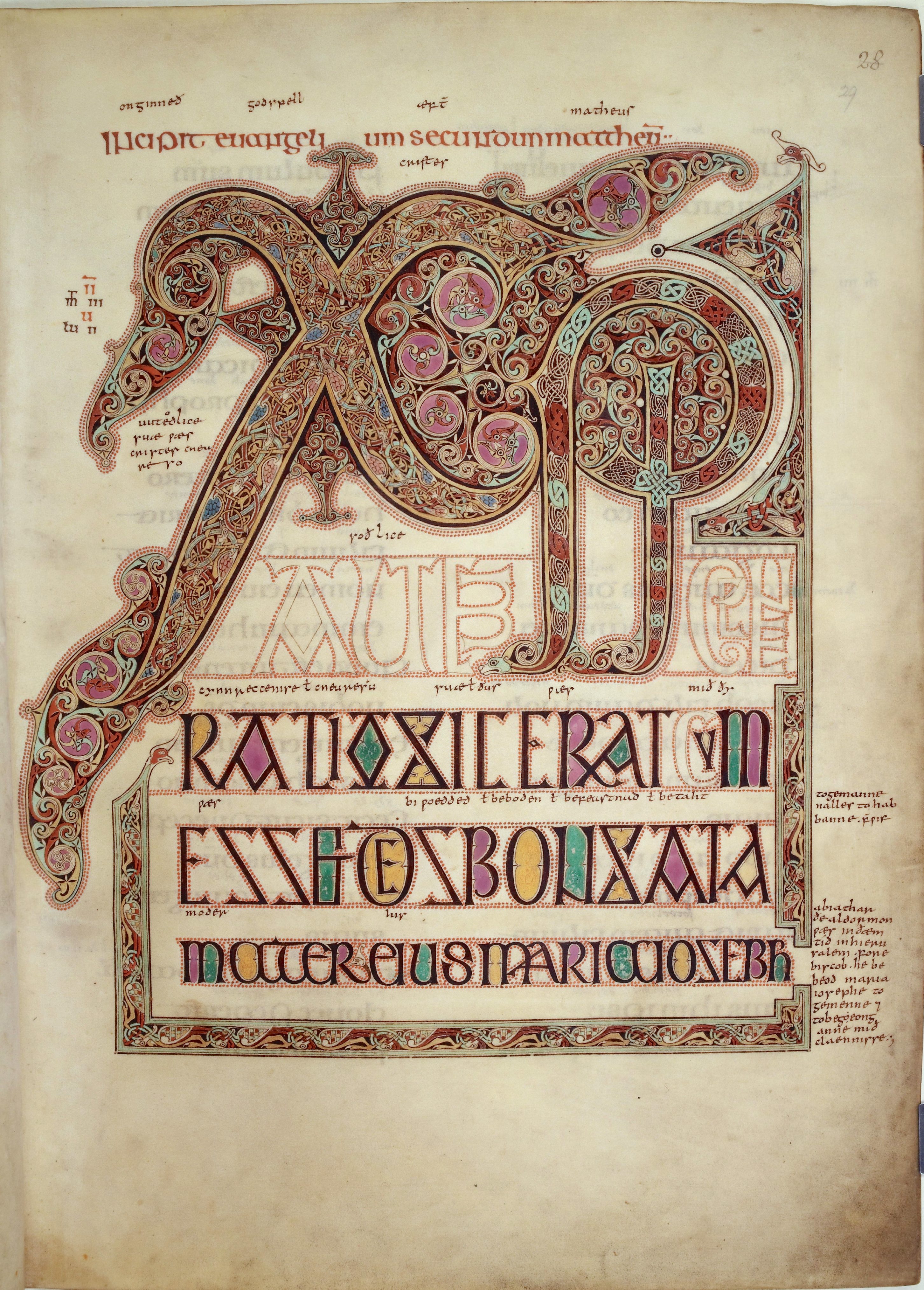
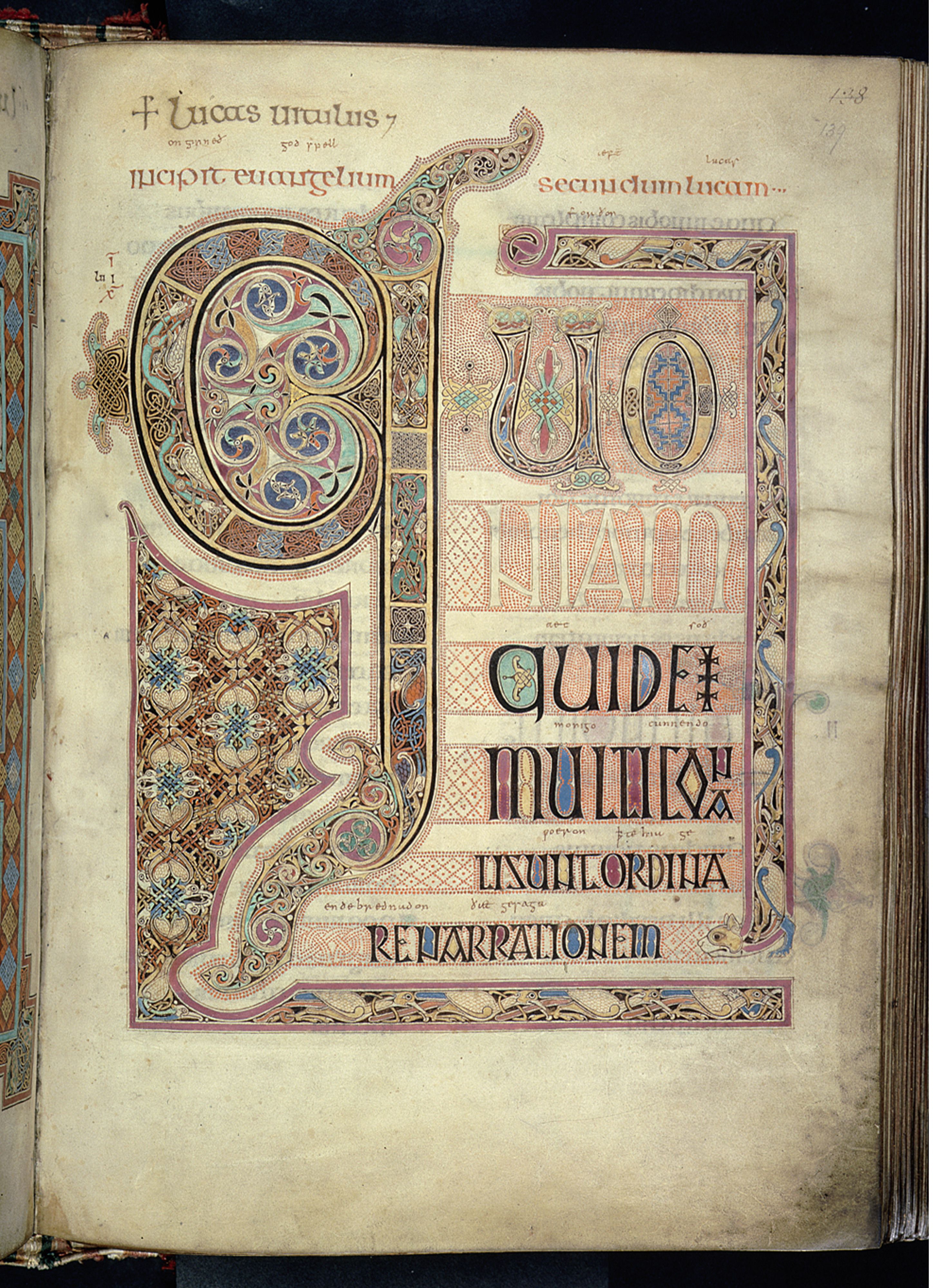
Folio 27r, Lindisfarne Gospels with incipit from the Gospel of Matthew. —Wiki

A Facebook site I dearly love, Medievalists.net, posts scholarly papers on the the medieval world. Sometimes I find myself disagreeing with posts, and misleading headlines, and then, the next thing ya know, I'm posting a comment that turns into a lively rant (and several hours later, when I've come up for air, I've got what amounts to a bit of a blogeen—not that I usually bother to post them here).

What got my lather all whipped into a fine froth this morning was that  Medievalists.net, posted "A very beautiful Anglo-Saxon manuscript." I saw red....this is what ensued:

"Chi-Rho" monogram, the Gospel of Matthew—Wiki

Go hailin. Indeed the Lindisfarne Gospels are very beautiful Irish-Anglo-Saxon, or, more correctly, a joint Hiberno-Saxon manuscript, illuminated in the Irish style, The Lindisfarne Gospels, like the (later) Book of Kells, were once considered to be a relic of St. Columba. Calling it Anglo-Saxon art is to do it a disfavor; it's a much more cosmopolitan manuscript than that.

The Celtic monastery of Lindisfarne was founded in 635 AD, by Columban Irish monk Saint Aidan (d.651), from the Isle of Iona. Irish monks founded Celtic monasteries on most of the British, Scottish, and Irish islands, and Columban Irish scribes would've trained Saxon scribes in the the insular Irish style—right down to the red lead dots surrounding the letters (the Durham Gospels, and the Book of Durrow, being its predecessors). But first, the Irish monks had to convert the Saxons....

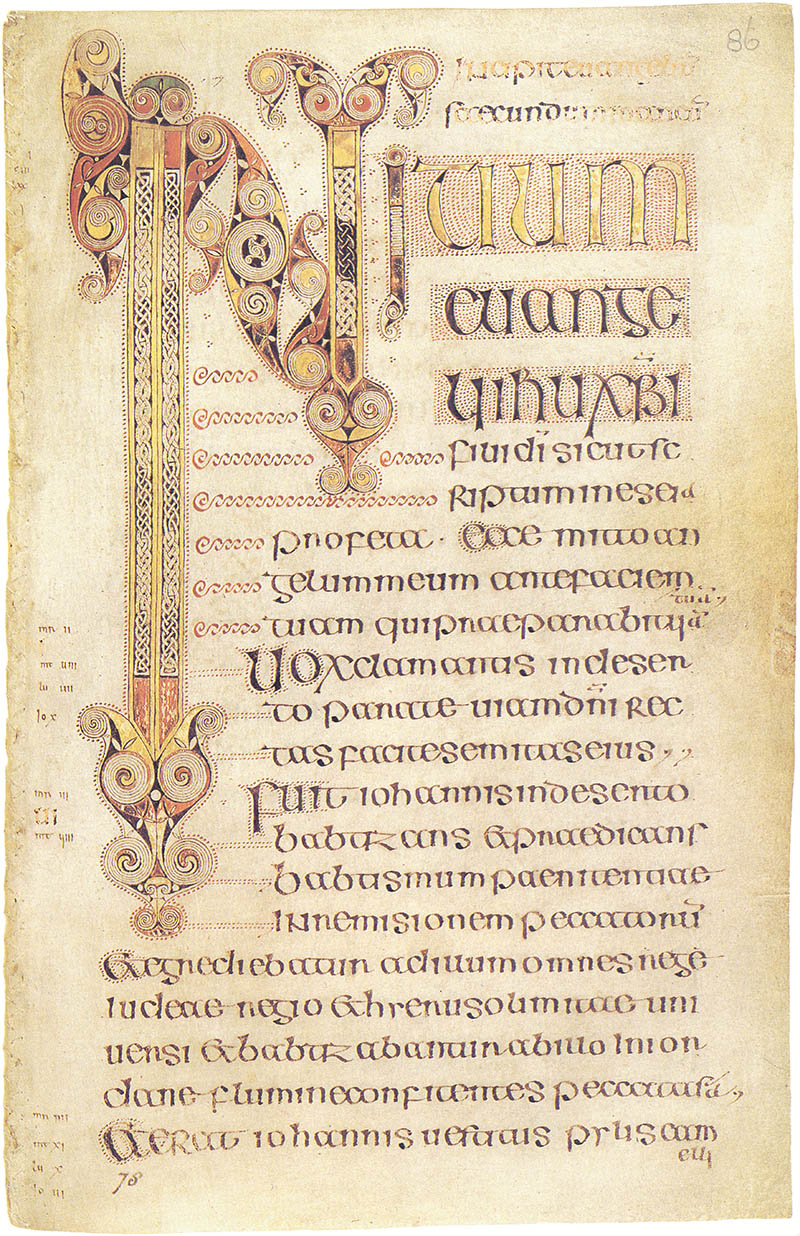
The beginning of the Gospel of Mark from the Book of Durrow.—Wiki

The Lindisfarne manuscript, an illustrated Latin copy of the Gospels of Matthew, Mark, Luke and John, was probably made at Lindisfarne, but it could've been made elsewhere, even Iona, as it has an Iona connection. The text is also written in (Irish) insular script.

The problem with tagging this manuscript as Anglo-Saxon, is that it's virtually impossible to tell the difference between Irish, Welsh, Scottish, and Anglo-Saxon illuminated manuscript art, because they were all created in Celtic Irish monasteries between 500-900; later in Ireland, to 1400 AD), and they share far too many similarities. It was also an incestuously small world.

A "safer" nomenclature would be to label these illuminated manuscripts as "insular." Ditto for the continental manuscript, also created in Celtic monasteries founded by Irish monks. (See "List of Hiberno-Saxon illuminated manuscripts" at bottom of page.)

And most 'scholars' writing of these things never delve beyond the current political border of a country when describing where an artifact was discovered, or attributed to, when labeling art. If it was made in St. Gallen, ergo it must be Swiss; or in Bobbio, it's Italian (Irish monasteries!)

The St. Gall Gospel Chi-Rho page, written by Irish monks ca. 750AD—from Irish Medieval History 
Irish manuscripts often display the first three letters, Chi-Rho-Iota, from the Greek ΧΡΙΣΤΟΣ, as a monogram. In the Latin Vulgate, it reads: "[Christi (XPI) autem generatio sic erat…  Note the distinctive long left leg on the Chi/X—also found in the Book of Kells, Book of Durrow, St. Gallen Gospel, MacDurnan Gospels, Book of Lindisfarne and many more. The long "i"pronunciation in Christ, is a result of Irish missionary work in England during the 7th - 8th c.—from Irish Medieval History 

Some slovenly writer described this manuscript as an amalgam of Anglo-Saxon, Irish and German art—WTF? I couldn't figure out how/why Germany—then it dawned on me, they were referring to manuscripts found in Germany, made by Irish monks. And archaeologists tend to be even sloppier. Sometimes I wonder if they know any history at all.

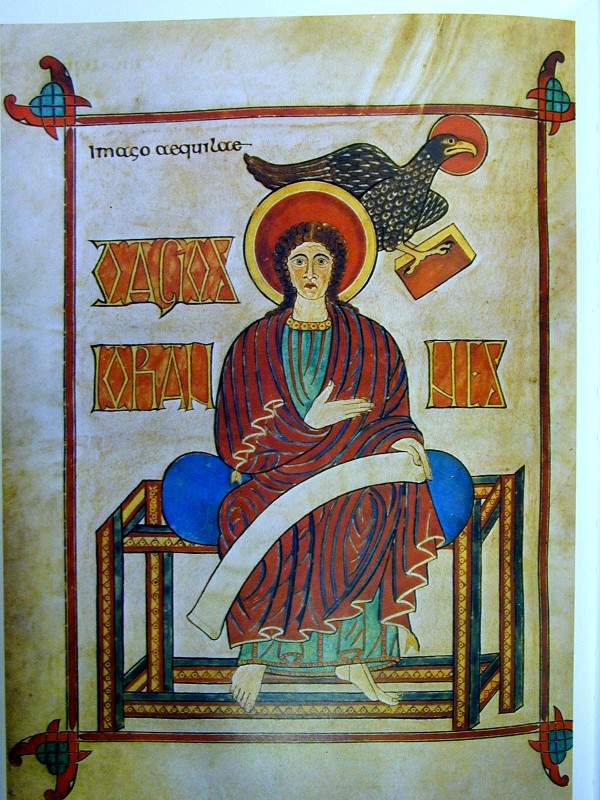
Eagle-eyed John the Evangelist Wiki 

Some background on Lindisfarne, founded in 632, according to the Annals of the 4 Masters; modern articles say 635 AD. It was also the age of writing fancy Vitae to one's patron saints.

The three Lindisfarne bishops who followed the Irish founder, St. Aiden of Iona (590-651), were all Irish-born: St. Finan, St. Colmán, St. Tuda—43 years later, Eata, apparently he was not saintly fodder, but he was St. Aiden's student, and the first native Northumbrian bishop (678-685); then St. Cuthbert (though born in Scotland, he was also from the Cult of St. Columba school).

From what I can tell, St. Eadberht was the second ever Northumbrian bishop—he put up lead walls and a lead roof on the thatched oak church, I bet many monks were very grateful.

And then we get to oor man, St. Eadfrith (also a fine Northumbrian, b.?, who was bishop from 688-98) who was possibly the artist and scribe...the manuscripts are attributed to him, but they could've also been commissioned by him.

A little backstory: Things were not all hunky-dory between the Saxons and the Irish just because Christianity gained a tiny toehold, and the Lindisfarne monastery was established, ca. 635. Oswald of Northumbria, a king living in exile since 616, vowed to bring Christianity to pagan Northumbria. In 634, when he gained the crown of Northumbria, he invited St. Columba's monks to establish a monastery.

But things were still pretty woolly. In 683, the Saxons raided Magh Breg in ireland and took hostages. In 684, Eadfrith's contemporary, St. Adamnán (624-704), St. Columba's distant cousin and Abbot of Iona (679-704)... 
...went to Saxon Land, to request a restoration of the prisoners which the North Saxons had carried off from Magh Breagh the year before mentioned. He obtained a restoration of them, after having performed wonders and miracles before the hosts; and they afterwards gave him great honour and respect, together with a full restoration of everything he asked of them. —Annals of the 4 Masters
 (These were the apocalyptic plague years. After nearly all the children and animals died, I imagine any kind of miracles were welcome—including Columban monks walking across the Irish Sea to Scotland, it was that cold. But at least the cold snap must've killed off the plague fleas.)

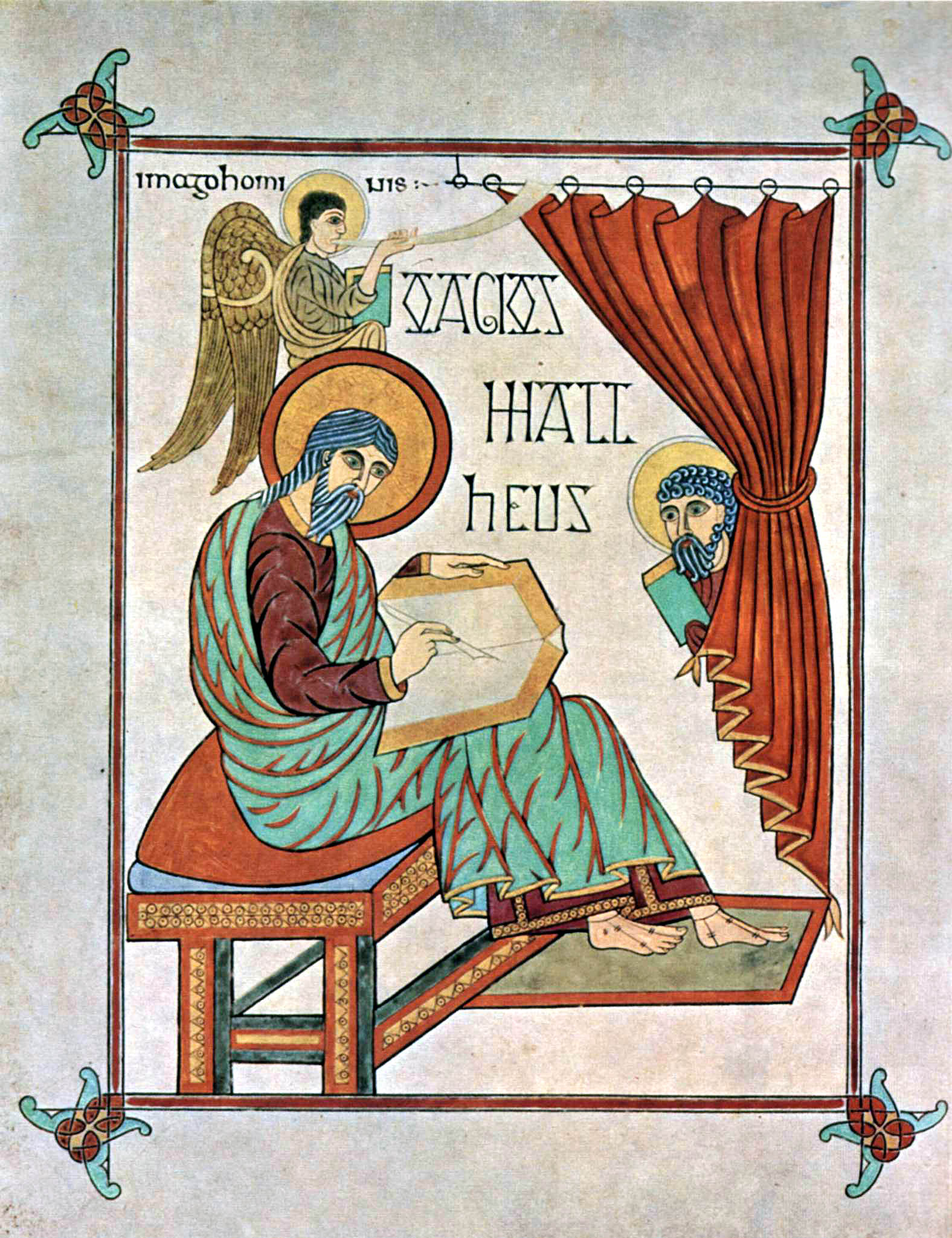
Portrait of the artist benched as Matthew the Evangelist —Wiki

A century after Lindisfarne was abandoned because of repeated viking raids, a colophon was added to the Lindisfarne Gospels by a self-serving scribe and provost, Aldred the Glossator, who penned Anglo-Saxon glosses under the Latin text, between 950 and 970, and then he graffitied on the text that Eadfrith was the scribe and artist responsible for the work—some 150-70 years later... Lead-poisoning aside, there must've been some librarian apoplexy in the wings. Stories do change. There was also a viking raid or two in the way as well.
it is only from Aldred’s inscription that we presume Eadfrith created the manuscript and another monk, Billfrith, its original binding. Margaret Walker, The Lindisfarne Gospels: A Living ManuscriptUniversity of Edinburgh Postgraduate Journal of Culture and the Arts
But the illuminated mss. was probably a commission produced in honor of St. Cuthbert (634-687). It was probably made ca. 700, most scholars suggest 715, but Eadfrith died in 721—presumably while still in office, of old age as did most bishops—with their boots on (it was a very good gig). If so, then he probably didn't scribe the manuscripts himself, as he also commissioned three books on the Life of Saint Cuthbert as well. Calligraphy and advanced old age don't mix well—too many hand tremors, not to mention a profound loss of eyesight.

Carpet page: possibly based on early Coptic manuscripts depicting Islamic prayer rugs. Can you see the embedded cross?—Wiki

The next bishop, (last) St. Æthelwold of Lindisfarne (721- 740), took the raw manuscripts that St. Eadfrith had prepared (note the word "raw"), had them bound and gilded, and commissioned a jewel-encrusted gold cover made by St. Billfrith (ca. 8th c.), which the Dane-vikings literally ripped iff, of course.

The Lindisfarne Gospels had to wait until 1852 to get another decent cover.  But that's another story. And this is the end of my story.


Gospel of St. Luke—Wiki 


The Old English name, Lindisfarena, was not recorded until 793, probably from the Irish (lin/d-pool/stream); the 9th c. Welsh Historia Brittonum, records Lindisfarne as Medcaut; the term Holy isle/Insula Sacra was commonly used until the 11th century, and is alternatively used to this day. Cumbria, northern Umbria, Lothian and the Kingdom of Strathclyde formed the diocese of Lindisfarne.