The “Viking” Up Helly Aa fire festival celebrated on the last Tuesday of January (originally held on old Christmas Eve) in the Shetland Isles in Northern Scotland, is not a Norse festival, but a "reconstructed" Victorian Solstice fire festival. I'm not convinced the festival has any Viking roots, though modern-day Shetlanders, proud of their Norse heritage, would probably avow it does.
Guizers with torches at Up Helly Aa celebration in Uyeasound,Shetland. Before the 19th c., tar barrels, not torches, were used. They look a bit KKKish.
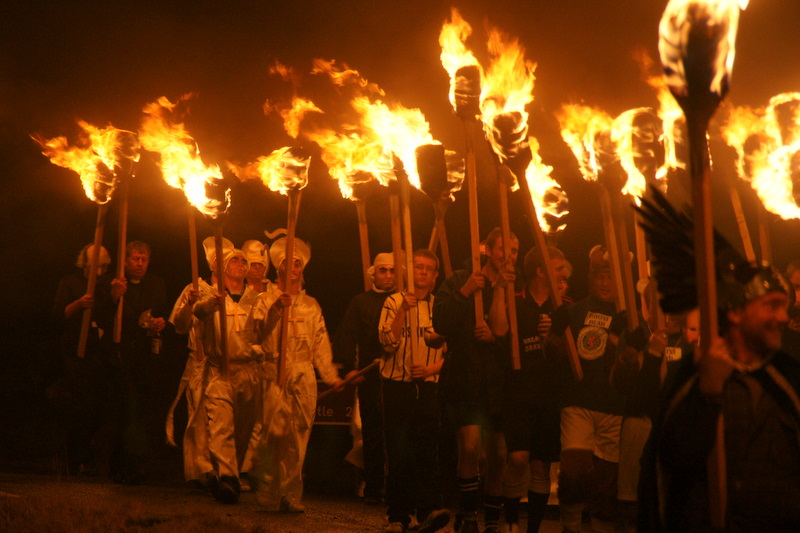
The setting of the beacons, or the wards along the coasts and the lit tar barrels rolled downhill are well-attested Celtic motifs. The lit barrels, (my great grandfather also lit on Beltaine in Bantry County Cork, Ireland), evolved into setting a fire a long ship.
The origin is a bit more obscure, as the Vikings invaded the Shetland Islands during the 9th century, and the fire festival was founded in 1880s—1905, more than 500 years after Norse rule was vanquished. Besides, there were other cultures living in the Shetland Isles since the Neolithic era. They didn’t just disappear with the arrival of the Vikings.
The Vikings, as we know, were not big on sharing the wealth, and 19th century Viking scholars were also not keen on sharing either. When something is claimed as being authentically Viking in Celtic lands, there is often a convenient blurring of anthropological lines, with the idea of Vikings still plundering other cultures a millennia after assimilation.
Since the Neolithic era, (4000 BC), people have raised cattle and sheep, and farmed the Shetland Isles. What survives are prehistoric field systems, Bronze Age burnt mounds, Iron Age brochs, and Pictish wheelhouses. The oldest archaeological find, ca. 4000 BC, is a midden at West Voe, Sumburgh. Hard to imagine now, but much of the North Sea was once dry land, Shetland was lightly wooded and the climate was warmer. Neolithic burials include stone cists, and heel-chambered cairns on the island of Vementry, Punds Water and Islesburgh. Skara Brae, Maes Howe, and Ring of Brogar, in nearby Orkney, are extraordinary Neolithic monuments.
During the Bronze Age (2000 to 600 BC), the climate deteriorated, peat bogs spread, and sea level rose. Some 300 crescent-shaped burnt mounds (possible hearths) date back to the Bronze Age. "Ireland was the chief center for the manufacture of bronze and Scotland's early settlers were energetic seamen." Even way then there was a lot of travel between the islands. For millennia, there was Irish contact in the Shetlands, whether by trade, or by theft: a bronze-gilt harness mounting was made in Ireland during the 8th or 9th c. AD, was excavated from an archaeological dig.
Possibly due to a population explosion, or increased warfare, the Iron Age in Shetland saw the rise of massive fortifications: double-walled circular towers, and dry stone brochs—sometimes called "Pictish Towers", but their construction predates the Picts. Ancestors of the Picts, maybe.
Of the 120 Iron Age broch sites, Old Scatness, and the Broch of Mousa (ca. 100 BC), are among the finest preserved examples of Iron Age fort towers. In the case of Old Scatness, the Celts, the late Iron Age Picts, then the Vikings each built atop the old fortifications. Excavations at Jarlshof, confirm archaeological evidence in Mainland, Shetland, since the Bronze Age.
During the outbreak of Celtic Christianity, when "green" martyrs were seeking hermitages to commune with God, the Irish monks settled on most of the Hebrides, Orkneys and the Shetland Isles, as well as the Faroe Islands, and Iceland, the first stepping stone from Shetland to Iceland. Iceland was settled by the Norse, and Celts from the British Isles—including from Hebrides and Shetland.
An interesting aside: according to the Icelandic sagas, Egil's saga, and the Orkneyinga saga, the Broch of Mousa was used as a refuge for runaway lovers.
I suppose if one is inventive enough, the Norse origin of other island place-names could be challenged: Vementry (Old Norse: "Vemunðarey) could also be derived from a form of Finn, as in Finn's beach: as in Ventry, (Irish: Ceann Trá—which means head beach), which is an anglicization of Fionntrá, in Dingle, Co. Kerry. St. Ninian was also known as Fionnian. M, B and F, in the genitive, take on a v sound. But I'm being linguistically silly.
Maybe it would be more fruitful to look at DNA. Shetland's genetic heritage is 60% Norwegian Y-chromosome DNA (R1a Sigurd), and 40% is ancient Briton (Celts) DNA. The most common male Y chromosomes reflect the most recent migration. Apparently the Norse married lots of local women; as Norse (matrilineal) mtDNA was 30%. However:
According to the Smithsonian article, "Up Helly Aa was first celebrated in the 1880s. Before then, rowdy residents would take to the streets to mark the end of the Yule season by burning tar barrels."
Up Helly Aa is a procession of 1000 guizers celebrating their Norse heritage. Guizers (dis-guisers and galoshins) are a long-standing tradition in the Celtic ream; our modern Halloween trick or treaters are guisers.
The festival is stapled onto the end of Yule season (see: Burning of the clavie), but even using the old calendar, "Old Twelfth" would have fallen on Jan. 17, not the end of January, which would be Imbolc, the Fire Festival of Brigid.
A parallel story of confusion: an Irish Medieval History Facebook post notes that people erroneously assume the pagan Celtic Goddess Brigid, who represented the light half of the year, was transported into Christianity as Saint Brigid. Ancient customs and religious beliefs were not swept away with the arrival of Christianity and traditions associated with St. Brigid’s day are thought to date from the pre-Christian period. Candlemas is the Christian overlay of Imbolc.
So taking that model for cultural continuance, despite new landlords, I suspect this Shetland fire festival is an offshoot of the festival of Imbolc, and of the pan-Celtic Goddess Brigid, which was a time for a massive spring clean-up, burning old possessions and replacing them with new ones.
Since Neolithic times, cross-quarter days, that midway point between solstice and equinox, were celebrated with fire festivals. Cross-quarter days were marked via astronomical alignments on ancient monuments: Mound of the Hostages: Hill of Tara, Howth, Newgrange, Stonehenge. The four fire festivals, Samhain (the end of the Celtic harvest year), Imbolc, Beltane and Lughnasadh also mark the beginning of each season. Spring was the beginning of the Roman New Year.
All debris was burned (including floor rushes, beds and bedding). Bonfires galore. Oh, and Brigid is a daughter of the Dagda, and a poet. She is the patron of the hearth, healing, metal smithcraft; and inventor of poetry, keening, and beer making. Ya don't want to piss her off. Burn, baby, burn. Sláinte!
The Vikings, as we know, were not big on sharing the wealth, and 19th century Viking scholars were also not keen on sharing either. When something is claimed as being authentically Viking in Celtic lands, there is often a convenient blurring of anthropological lines, with the idea of Vikings still plundering other cultures a millennia after assimilation.
What cultures in situ before the Viking invasion, are often overlooked, because it doesn't fit current romantic thought. So, rather than observing the overlay with a cultural substrate, we often get skewed cultural theories based solely on later invading cultures—especially in Scotland where the Viking love affair is still in full swing some six centuries later. There is only "I" in Viking. Not even poetic license can alter that.
Shetland (sometimes referred to as Thule in Classical tracts), was no terra nullius before the Vikings invaded. The archipelagos of Shetland, the Orkneys and the Hebrides, also were not considered part of Scotland, which did not become a kingdom until the ninth century. The Latin term Scoti/Scotti referred to the Irish Gaels, whether in Ireland (Scotia Major) or Scotland (Scotia Minor).
Shetland (sometimes referred to as Thule in Classical tracts), was no terra nullius before the Vikings invaded. The archipelagos of Shetland, the Orkneys and the Hebrides, also were not considered part of Scotland, which did not become a kingdom until the ninth century. The Latin term Scoti/Scotti referred to the Irish Gaels, whether in Ireland (Scotia Major) or Scotland (Scotia Minor).
Long before the Shetland archipelago (Scots Gaelic: Sealtainn) was under Icelandic-Norse control, it was a Mesolithic, Neolithic, then a Celtic stronghold—for millennia. The Shetland Islands were originally settled by Neolithic Bell-Beaker peoples, then the Celts and the Picts, and the Scotti, or the Irish Celts—who also celebrated a fire festival on this date as well. Thule was supposedly settled by blue painted people (Picts), it could be a corruption of the word for fire, Iceland was also referred to as Innis Tile.
The first written mention of the Shetland Islands, comprised of some 300 islands and skerries, is from the Icelandic 13th c. epic, Njal’s saga. And of course, redheaded Njal with his fierce temper was probably an Irish-Norse Dubliner. At least one Irish Scotti place-name survived the Viking invasions, Dunrossness, and the islands of Papa Stour (Papey Stóra) and Papa Little (P. Litla) refers to Irish Culdee monks. Brother Island may also refer to those Irish monks. Three island place-names may be of Pictish or even pre-Celtic origin: Fetlar, Unst and Yell—once heavily settled by Culdee monks (Pappay/Papil Ness, Loch of Papil and Papil Bay.) St. Ninian’s Isle too was a papar stronghold.
Another Celtic influenced place-name Muckle meaning “big” in 17th c. Scots dialect, and Rua, meaning red (Old Irish ruiadh), a red granite islet, though Muckle Rua is erroneously identified as a Norse place-name, as is Dunrossness. But Dun is fort and ross is a promontory. And ness is a common Scots-Norse accretion also meaning headland in case one didn’t know what a ross was—a clear indication that the promontory was already aptly named before the Vikings arrived. Nothing to do with a noisy tidal race.
The early medieval Pictish Bressay Stone, (It’s in the basement of the National Museum in Edinburgh) with Celtic knotwork and beasties, has an Ogam inscription: “The cross of Natdad's daughter, child of Maqqddrroann,” (OId Irish Mac (son of) Droann. More here.) One of five Ogham stones in Shetland, the inscription is an admixture of Old Irish, and Norn, as the word for daughter is in Norse. Certainly, most of the village names would be of Old Norse derivation as the Irish Scotti didn’t go in big for the idea of towns.
Since the Neolithic era, (4000 BC), people have raised cattle and sheep, and farmed the Shetland Isles. What survives are prehistoric field systems, Bronze Age burnt mounds, Iron Age brochs, and Pictish wheelhouses. The oldest archaeological find, ca. 4000 BC, is a midden at West Voe, Sumburgh. Hard to imagine now, but much of the North Sea was once dry land, Shetland was lightly wooded and the climate was warmer. Neolithic burials include stone cists, and heel-chambered cairns on the island of Vementry, Punds Water and Islesburgh. Skara Brae, Maes Howe, and Ring of Brogar, in nearby Orkney, are extraordinary Neolithic monuments.
During the Bronze Age (2000 to 600 BC), the climate deteriorated, peat bogs spread, and sea level rose. Some 300 crescent-shaped burnt mounds (possible hearths) date back to the Bronze Age. "Ireland was the chief center for the manufacture of bronze and Scotland's early settlers were energetic seamen." Even way then there was a lot of travel between the islands. For millennia, there was Irish contact in the Shetlands, whether by trade, or by theft: a bronze-gilt harness mounting was made in Ireland during the 8th or 9th c. AD, was excavated from an archaeological dig.
Possibly due to a population explosion, or increased warfare, the Iron Age in Shetland saw the rise of massive fortifications: double-walled circular towers, and dry stone brochs—sometimes called "Pictish Towers", but their construction predates the Picts. Ancestors of the Picts, maybe.
Of the 120 Iron Age broch sites, Old Scatness, and the Broch of Mousa (ca. 100 BC), are among the finest preserved examples of Iron Age fort towers. In the case of Old Scatness, the Celts, the late Iron Age Picts, then the Vikings each built atop the old fortifications. Excavations at Jarlshof, confirm archaeological evidence in Mainland, Shetland, since the Bronze Age.
By the sixth century AD, Shetland had become integrated into the mainstream of Pictish politics and life. Artefacts such as painted pebbles and carved symbol stones demonstrate a strong Pictish presence in the islands. Good examples include the ogham script of the Lunnasting Stone, and Christian cross-slabs which include fine examples such as the cross slab and the Monk’s Stone, both from Papil.... From the late 8th century, Shetland was subject to the turbulent impact of the expanding Viking world.—Visit ShetlandThe Viking invasions began ca. 800 AD. The earliest archaeological evidence of Norse occupation is in the nearby Orkneys (Viking Shetland was administered as part of the Orkneys, and they were both called the Northern Isles). In 800 AD, a Pictish, or Irish Culdee hoard of silver bowls, brooches, torcs, thimbles, chapes, and a porpoise jaw, was found beneath St. Ninian's church floor on Shetland's St. Ninian's Isle. (See St Ninian's Isle Treasure. St. Ninian AKA Apostle to the Southern Picts).
Human settlement of the island dates from circa 3000 BC and there are remains of several Neolithic burial chambers known as 'heel-shaped cairns'. Little is known of the pre-Celtic and Celtic eras, but when the Norse arrived it is likely they found a religious settlement as the name of the island derives from Papey Stóra meaning "Big island of the Papar" (Celtic monks), in distinction to Papa Little. —Wiki (see Culdees or papar.)In 1299 AD, the oldest Old Norse manuscript from Shetland (the Norse called it Hjaltland), was over a duel, where the isle of Papa Stour is referenced. Thorvald Thoresson, accused of corruption, was called "dominus de Papay." In early Irish literature, Shetland was referred to as Inse Catt—"the Isles of Cats." And the name Shetland, like Caithiness, may derive from the Pictish name for the cat islands. Ferocious European wildcats were not your modern moggies.
During the outbreak of Celtic Christianity, when "green" martyrs were seeking hermitages to commune with God, the Irish monks settled on most of the Hebrides, Orkneys and the Shetland Isles, as well as the Faroe Islands, and Iceland, the first stepping stone from Shetland to Iceland. Iceland was settled by the Norse, and Celts from the British Isles—including from Hebrides and Shetland.
During the Dark Ages, groups of outlaws and farmers took to the sea from the northernmost reaches of Europe. These seafaring marauders became known as the Vikings. Some of these outcasts among the Vikings were to achieve historical distinction indirectly through dubious means. —from The Struggle against Colonialism and Imperialism in Kalaallit NunaatWhat's interesting about the Up Helly Aa festival is that it completely obliterates any connection with the peoples of the past, other than a nod to 19th century Viking revival nostalgia. It's a wayward case of settler colonialism displacing the preexisting subculture, as a means strengthening an invader's power base to shore up national identity. This was certainly true in Iceland even though Iceland was settled by as many Irish as Vikings. So, what is Up Helly Aa?
According to John Jamieson's Etymological Dictionary of the Scottish Language (1818), up is used in the sense of something being at an end, and derives from the Old Norse word uppi which is still used in Faroese and Icelandic, while helly refers to a holy day or festival. The Scottish National Dictionary defines helly, probably derived from the Old Norse helgr (helgi in the dative and accusative case, meaning a holiday or festival), as "[a] series of festive days, esp. the period in which Christmas festivities are held from 25th Dec. to 5th Jan." while aa may represent a', meaning "all". —Wiki Up Helly AaBut the Northern Isles were once described as "Pictish in culture and speech." Not Viking. Few Irish pr Pictish place-names survive, except for the northern islands Fetlar with its stone Funzie Girt (Finn's Dyke) a Bronze Age Berlin Wall, Unst and Yell, the second largest island, with 12 brochs, and 15 early chapels—a Culdee stronghold, probably not as enticing to the Norse. The dearth of Celtic "place-names suggest that the Picts may have been forced onto poorer land."There is another school of thought that they are pre-Celtic place names.
Despite many archaeological remains, we have only a patchy understanding of those who lived in Shetland before the Viking invasions of around 800 AD. Immediately before the Vikings arrived, though, it’s clear that Shetland – like much of Scotland - was part of the Pictish culture. By the time of the Viking invasion, possibly two or three hundred years earlier, Christianity had reached the islands. —History of ShetlandThe "Northern Isles were the first to be conquered by Vikings and the last to be relinquished by the Norwegian crown." The historical record is weak but Woolf (2007) suggests the Icelandic sagas proclaiming dominion over the Shetland Isles are stories concocted "to legitimise Norwegian claims to sovereignty in the region." Perhaps that is also why a Celtic fire festival, possibly Imbolc, underwent a transformation into Up Helly aa.
An interesting aside: according to the Icelandic sagas, Egil's saga, and the Orkneyinga saga, the Broch of Mousa was used as a refuge for runaway lovers.
I suppose if one is inventive enough, the Norse origin of other island place-names could be challenged: Vementry (Old Norse: "Vemunðarey) could also be derived from a form of Finn, as in Finn's beach: as in Ventry, (Irish: Ceann Trá—which means head beach), which is an anglicization of Fionntrá, in Dingle, Co. Kerry. St. Ninian was also known as Fionnian. M, B and F, in the genitive, take on a v sound. But I'm being linguistically silly.
Maybe it would be more fruitful to look at DNA. Shetland's genetic heritage is 60% Norwegian Y-chromosome DNA (R1a Sigurd), and 40% is ancient Briton (Celts) DNA. The most common male Y chromosomes reflect the most recent migration. Apparently the Norse married lots of local women; as Norse (matrilineal) mtDNA was 30%. However:
[in] Orkney and Shetland, Roberts reported (1985, 1990) that both island populations diverged considerably in allele frequencies from neighboring populations. Roberts concluded that the islanders of Orkney and Shetland most likely represented remnants of an aboriginal gene pool that had changed on the British mainland because of later population movements.... Of the Scottish populations, Orkney [not Shetland] evidently has the closest matrilineal links with Scandinavia. The inhabitants of the Scottish islands share two to seven times more of their lineages exclusively with Gaels than they do with Scandinavians.... mtDNA lineages can be used to identify recent migration. Viking men settled and intermarried with existing populations in Shetland... —mtDNA and the Islands of the North AtlanticSo, with all that intact ancient matrilineal Celtic Briton gene pool intact, do you think their fire customs, celebrated since time immemorial, would suddenly be forgotten and just disappear with the occupation of the Vikings—only to return as a new and improved Viking festival? Methinks this particular fire festival smacks of the neo-Romantic Viking revivalist movement: think truncated Wagner as performed by Viking mummers. (Note that Up Helly Aa is not celebrated in Scandinavia.)
According to the Smithsonian article, "Up Helly Aa was first celebrated in the 1880s. Before then, rowdy residents would take to the streets to mark the end of the Yule season by burning tar barrels."
Up Helly Aa is a procession of 1000 guizers celebrating their Norse heritage. Guizers (dis-guisers and galoshins) are a long-standing tradition in the Celtic ream; our modern Halloween trick or treaters are guisers.
The festival is stapled onto the end of Yule season (see: Burning of the clavie), but even using the old calendar, "Old Twelfth" would have fallen on Jan. 17, not the end of January, which would be Imbolc, the Fire Festival of Brigid.
A parallel story of confusion: an Irish Medieval History Facebook post notes that people erroneously assume the pagan Celtic Goddess Brigid, who represented the light half of the year, was transported into Christianity as Saint Brigid. Ancient customs and religious beliefs were not swept away with the arrival of Christianity and traditions associated with St. Brigid’s day are thought to date from the pre-Christian period. Candlemas is the Christian overlay of Imbolc.
So taking that model for cultural continuance, despite new landlords, I suspect this Shetland fire festival is an offshoot of the festival of Imbolc, and of the pan-Celtic Goddess Brigid, which was a time for a massive spring clean-up, burning old possessions and replacing them with new ones.
Since Neolithic times, cross-quarter days, that midway point between solstice and equinox, were celebrated with fire festivals. Cross-quarter days were marked via astronomical alignments on ancient monuments: Mound of the Hostages: Hill of Tara, Howth, Newgrange, Stonehenge. The four fire festivals, Samhain (the end of the Celtic harvest year), Imbolc, Beltane and Lughnasadh also mark the beginning of each season. Spring was the beginning of the Roman New Year.
Imbolc might derive from Old Irish í mBolc, meaning in the belly (as in pregnant—bolg — Spanish /Galician bolsa means bag); it might mean purification or, First Milk.
...which arises from the word “oimelc/oí melg” used in the 10th century Sanas Cormaic (Cormac’s Glossary) which some people have taken to mean “sheep’s milk”. The word “melg” meaning ‘milk’ comes from the Proto-Indo-European (PIE—the ancestor language of most European languages) word “melg” which means "to wipe, to rub off". Purification/ cleansing was an important aspect of many ancient festivals and “oí melg” is not milking but rubbing, as in the act of cleansing. Further evidence of cleansing comes from the Roman festival of Februalia. The Old Irish word for February is ‘febra’, ‘febrae’ from Latin ‘Februarius’ which in turn comes from ‘februa’ meaning purifications. —Irish Medieval History: February 1st or ImbolcImbolc was the second of the four great fire festivals, with significance placed upon the Light of fire. The Irish word for spring, "errach” thought to be related to the word “airreach” which means hauling and dragging. In Ireland, Imbolc is referred to as the big Spring Clean. "Right up to the twentieth century, on Brigid’s eve, the house was be scrubbed from top to bottom by the women who worked into the night."
All debris was burned (including floor rushes, beds and bedding). Bonfires galore. Oh, and Brigid is a daughter of the Dagda, and a poet. She is the patron of the hearth, healing, metal smithcraft; and inventor of poetry, keening, and beer making. Ya don't want to piss her off. Burn, baby, burn. Sláinte!
A Bhríd, a Bhríd, thig a sligh as gabh do leabaidh
Bríd Bríd, come in; thy bed is ready
Brede, Brede, come to my house tonight.
Open the door for Brede and let Brede come in.
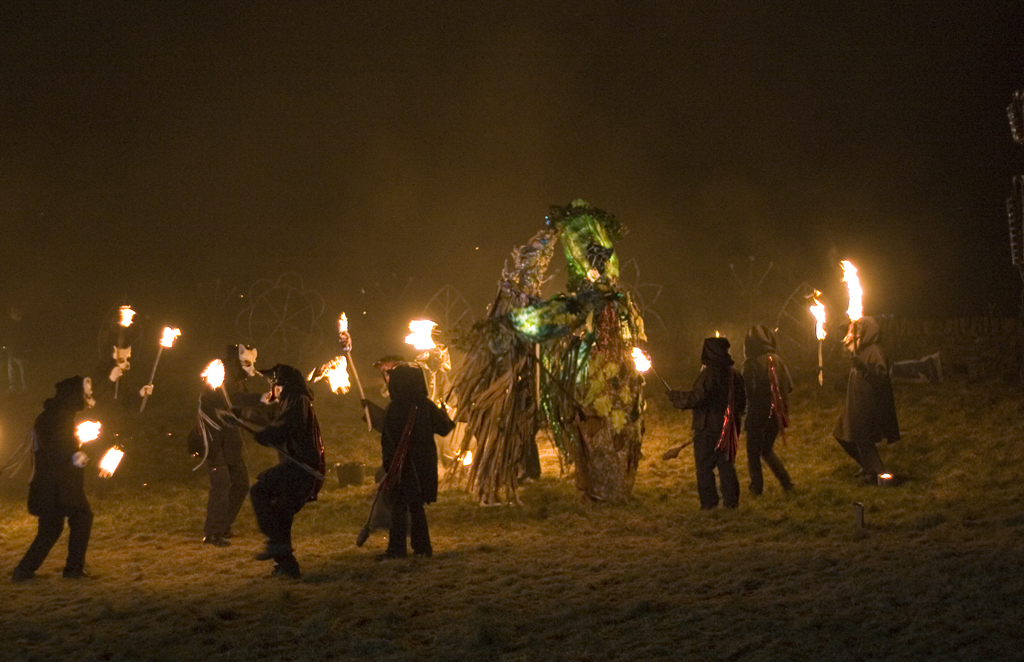 |
| Imbolc festival in Marsden, Yorkshire. —Wiki |
Brigid's the goddess of weather, for an early spring, forget the groundhog, chant this instead:
Thig an nathair as an toll
Là donn Brìde,
Ged robh trì troighean dhen t-sneachd
Air leac an làir.
The serpent will come from the hole
On the brown Day of Bríde,
Though there should be three feet of snow
On the flat surface of the ground.
Lá Fhéile Bríde shona dóibh go léir (Happy St. Brigid’s festival day to you all)!


