Last night I finally got around to finishing my daffodil post from 2023, it was more notes than a blog post. And I put the finishing touches on it today, so I do not have a new post for Saint David’s Day. My brain hurts. I can’t believe that it took me a year before I could wrap my head around my notes and craft it into an article. Not sure why it was so difficult. But today I struck gold while researching daffodils. I was trying to find out when narcissi were introduced to the British Isles and got railroaded with false information, with noted writers insisting there was a native daffodil. I finally put that theory to rest via genetic analysis. Their homeland is Iberia (they have the most genetic variation while the cultivars have a limited gene pool.) It looks like they and the word daffodil were introduced to England sometime during the 1590s, but it could’ve been as early as 1400. The information is lost in the mists of time. But now I can stay unequivocally that narcissi are not native to the British Isles. However, I had a great time tracking down the literary references in the process of writing that piece. and the reason why I write is about discovery.
Showing posts with label Welsh. Show all posts
Friday, March 1, 2024
Saturday, March 27, 2021
Notes to Lùthais MacGriogair, Celtic Languages Facebook group
These were notes to a certain Lùthais MacGriogair, certified boor, and an administrator in a prominent Celtic Languages Facebook group who was always questioning my linguistic background, assuming that I had no right, or scholarly training to make or post comments, that I didn’t have a linguistic leg to stand on. That got me in a lather. My reply grew by leaps and bounds as I hosed him down. I eventually grew weary of his overprivileged snottiness, and left the group, as he was only interested in linguistic slogging matches. I have little patience for the pejorative male ego. So much for having fun in a Facebook group, gawdforbid!
I’ve studied several versions of Irish, from Archaic to modern, skipping Middle Irish—probably the very language I needed in order to read the later manuscripts, but I did make linear translations of the early Irish epics, including the Táin Bó Fraích at UC Berkeley, where I also took a course on medieval Welsh, which didn’t stick. But we did translate a tale from the Mabinogion, and another tale.
When I was young, my Corkonian grandmother from Bantry, b. 1893—her parents spoke Irish—tried to instill in me some basic Gaelic League Irish. An gort glas. So I can read the old writing.
When I was in Leuven, there was something written in the old style script, which my Dutch friend couldn’t read, above an iron gate and I turned to my polyglot Dutch companion and told him what it said, it was an Irish college dedicated to St. James. He said you do realize it’s written in Irish, don’t you? Startled, I looked up at the gate. And thus began my lifelong interest in the Medieval Celtic realm—especially the Irish on the Continent.
When I was young, I traveled to Switzerland to work, and unfortunately I did not know that there were Irish manuscripts in the library in Saint Gall, where I was stuck for a time, but I do remember pondering the beauty of the locked doors of the library. In another Swiss village, I did find Celtic artifacts—mostly weapons—all the small Swiss museums—they have not buried their Celtic heritage. The village where I lived paid homage to their Celtic ancestors.
I began to realize all that crazy information my grandmother tried to impart in me, long before modern archaeology supported her claims, via the oral tradition, was in fact, true. In my 20s and 30s I did try to keep up my Irish studies by unsuccessfully using various learning systems, including Teach Yourself Irish, and Teach Yourself Gaelic, a Donegal primer, a Scots primer for kids, Buntús Cainte and Myles Dillon. Later, DuoLingo, etc.
Because I have been so long away from the languages—not much opportunity to converse in Archaic Irish—and since I’ve hardly used any of it, it is all in danger of slipping away. But oddly, language is persistent as well, and sometimes words rise up unbidden in the psyche, and pester me. Ear worms. Chun, for example. At least there are no eels in my hovercraft.
I can more or less slog through something written in Irish and get the gist of it and make a very rough translation. But the tenses are slipping away, especially the past tense, fittingly. I want to learn more, or keep what little Irish I do have, alive—which is more than the average bear, but bears don’t speak Irish, now do they? That’s why I joined this group.
Monday, March 1, 2021
Dydd Gŵyl Dewi Hapus! A daffodil for Dewi Sant, photos
I'm not sure how the tradition first began, but about 40 years ago, daffodils, sold at a buck a bulb, were planted along Sonoma County roadsides to raise money for cancer research (the tradition may have begun in Canada as early as1965.) However it started, it was a wild success story. And daffodils have been used to raise money and promote cancer awareness ever since. Because daffodils have a chemical, esemastine, that kills breast cancer cells, they have become an international symbol of hope. (Narcissus pseudonarcissus, Amaryllidaceae family, are native to Northern Europe).
In Sonoma County it has become a tradition that when someone dies of cancer, family and friends plant daffodils in remembrance—like the transplanted Mexican tradition of roadside memorials for car crash victims. The two traditions are beginning to merge in West Marin—shrines with la virgin de Guadalupe, trinkets and toys—even baby shoes—now include a stand of daffodils or narcissi. Most North Bay county roadsides are a riot of daffodils—a living reminder for those who have died.
Wednesday, December 7, 2016
More meanderings on Hiraeth/Saudade
A friend, Slim Russell, noted the similarity between the Welsh hiraeth and Portuguese saudade, not knowing the linguistic relationship. These are from some notes I wrote to her.
Well, it's not so strange a connection in that Portuguese/Galego (Galician) and Welsh are related, both stemming from the same Gaulish-Celtic ancestor...and that strange melancholia was a noted trait among the Celts.
I discovered that the Welsh hiraeth, Breton hiraezh, Cornish hyreth, and Irish sireacht (shiracht), all stem from the Celtic root word, siros, from Proto-Celtic *sīr-axto-, akin to Gaulish siraxta (“longing”) which is related to Latin serus—which evolved into Portuguese/Galician via Iberian Celtic speakers, full circle to Saudade. Galicians also use morriña, that's extreme saudade on steroids. But someone pointed out that it probably came from the classical Latin solitās, Makes more sense but I’m not up to deconstructing that last paragraph.
Portuguese/Galician Gaulish had many similarities to Irish (Q-Celtic) vs Gaulish, from which Welsh (P-Celtic) stems. Of course Portuguese/Galician evolved from Iberian, or Atlantic Celts trying to speak Latin, language of the conquerors.
"Hiraeth is a Welsh word for which there is no direct English translation: homesickness tinged with grief or sadness over the lost or departed. It is a mix of longing, yearning, nostalgia, wistfulness, or an earnest desire for the Wales of the past.
Hiraeth bears considerable similarities with the Portuguese concept of saudade (a key theme in Fado music), Brazilian Portuguese banzo (more related to homesickness), Galician morriña, Romanian dor, Russian toska and Ethiopian tizita." —Wiki
"Saudade is a word in Portuguese and Galician (from which it entered Spanish) that claims no direct translation in English. ...Saudade is also associated with Galicia, where it is used similarly to the word morriña (longingness). Yet, morriña often implies a deeper stage of saudade, a "saudade so strong it can even kill," as the Galician saying goes. Morriña was a term often used by emigrant Galicians when talking about the Galician motherland they left behind. Although saudade is also a Galician word, the meaning of longing for something that might return is generally associated with morriña. A literary example showing the understanding of the difference and the use of both words is the song Un canto a Galicia by Julio Iglesias." —Wiki
One of my favorite songs of Cesária Evora, is Sodade. (Cape Verde spelling.)
Y un canto a Galicia, desde Julio Iglesias, who is Galician.
It's Pearl Harbor Day, a good a day as any to suffer from a case of saudade or hiraeth.
Longing/Saudade/Hiraeth A blog I wrote on saudade/hiraeth.
and another on Hiraeth.
Sunday, February 21, 2016
Linguistics segue on Celts and Albanians (raw notes)
This is a placeholder for lost notes. I will probably never get back to it. I was in the midst of discussing Albanian linguistic origins on an Indo European language post when Facebook completely spazzed out and took off. And everything I wrote was lost. I had posted that the Albanian word for fish was too similar to Welsh—in Irish it’s iasc, and in Welsh, it’s pysc. I can’t remember the Albanian. Thanks to Facebook, I’ve lost the Albanian word.
The upshot is that the word for fish is probably not a Latin loanword... (Why do people assume Latin is always the Ur language for other IE languages, when the PIE word is the model at hand?) O bhuel, perhaps someone will take offense at my post and then I'll be able find it again and finish my thought. (Didn’t happen.
What I'm intrigued by is that this Smithsonian article does not challenge format of the model, which should be in question, it's an example of the historicity of the mapping of IE, with all its (unconscious) biases. If you watch the map, note that German follows modern political borders... and I don't think it was that widespread. And does it predate Celtic? I think not. It's pure supposition.
Oh look, they even forgot to include Celtic in its original homeland, in what is now Austria. Oopise. Celtic had much larger range, and yet gauging by the Smithsonian Magazine map, it's depicted as less than half its original range. Iberia isn't even included. From what I could tell Iberian Gaulish was similar to Gaulish, but there were also similarities to Irish...mainly hard 'c" vs "p."
And then there's are semantic gaffs, "Ancient Turkey..." etc.; clearly the writer has a poor grasp on the subject matter (and history)...the article should've been edited. Also, look to the animated mapmaker. Since when is Business Insider in the linguistics business?
And of course, the out of Anatolia theory is but one model. Gawd, I loved those accidental lessons in linguistics, when I took Old Irish. I was not a good student, in way over my head, but I took a year if it. And I worked hard at it every single day. A classmate was taking Hittite at the same time so I got a peek into Hittite as well.
Got the original Smithsonian Page
See also how I E languages expanded.
Tuesday, February 2, 2016
Hiraeth
Hiraeth is a Cymraeg (Welsh) word which doesn't translate well into English. Hiraeth, and the Cornish hireth are co-equivalents to the Portuguese saudade. It is a deep longing for home, but it's not mere homesickness. It's a deep, abiding bond one feels with homeland, tinged with grief or sadness over the lost or departed, or the past. It is an admixture of longing, yearning, nostalgia, wistfulness, and desire. A lump that begins in the back of the throat, straddling both the real, and imagined past, both coming and going simultaneously as you stand there, at one with the eternal moment that is always now.
2/2/2016
This is probably the origin of this post.
Longing/Saudade/Hiraeth
Monday, August 24, 2015
Longing/Saudade/Hiraeth
Someone asks about saudade. Yes, I answer, it's longing, yearning (melancholia/nostalgia). He is yearning for home = tá cumha air i ndiaidh a bhaile (literally, "there is loneliness on him after his home"). There are at least five words for that ephemeral state of being in Scots Gaelic.
In Welsh, it's hiraeth, a homesickness for somewhere you cannot return to, the nostalgia and the grief for the lost places of your past, places that never were.
The Breton for the French nostalgie is hiraezh. This could be a cognate, or borrowed from the Welsh. Hiraeth (first recorded in 1499) corresponds with Cornish hyreth, and Irish sireacht." Someone said it appears in the Book of Aneirin 'Blwydyn hiraeth er gwyr catraeth' ('a year's longing for the men of Catraeth'), which dates it to the late 13th c. Unfortunately I did not keep my reference.
The Welsh and Breton come from the Celtic root siros, from Proto-Celtic *sīr-axto-, akin to Gaulish siraxta (“longing”). I thought it was related to Latin serus. But someone astutely pointed out that the Latinate cognate is solitas.
Regardless, it’s still a full circle to Saudade.
Hiraeth
Thursday, November 27, 2014
York is not a Norse name, it was called Eboricum
NOTE TO CELTIC GUIDE MAGAZINE:
York comes from Norse Jorvik? I thought it came from the Latin, "Eboricum", and before that, from a Celtic place name. York is most definitely not a Norse placename, it is a Norse pronunciation of a much older placename, Eboricum, founded in 71 AD, the Roman legionary fortress and capital of Brittania Inferior, when the Ninth Legion conquered the Brigantes. During Anglo-Saxon times, it was known as the trading port of Eoforwic.
The word York (from Old Danish Jórvík 9th century AD) derives from the Latinised name for the city, variously rendered as Eboracum, Eburacum or Eburaci. The first mention of York by this name is dated to circa 95–104 AD as an address on a wooden stylus tablet from the Roman fortress of Vindolanda in Northumberland. —Wiki
The old Brittonic name was probably Eburacon which was Latinized as Eburacum (with the same vowel quantities and stress sounds as the Brittonic pronunciation).
That Norse J in Jorvik is trying to simulate a Celtic eu sound (as in ewe tree)—there was no y letter. In Irish orthography, the pronunciation and written Irish are not identical, nor do the sounds correlate with English pronunciation rules. They are closest to Latin, with their own peculiar twists of lenited vs long sounds. For example, the letters b and v within a word in Irish tend to gather a swallowed ya sound, or sometimes a w sound, like Samhain (Sowen). But there was no Y or W in the Irish alphabet.
It is thought that Eboracum is derived from the Brythonic word Eborakon, a combination of eburos "yew-tree" (cf. Old Irish ibar "yew-tree", Welsh efwr "alder buckthorn", Breton evor "alder buckthorn") and suffix *-āko(n) "place" (cf. Welsh -og) meaning either "place of the yew trees" (cf. efrog in Welsh, eabhrac in Irish Gaelic and eabhraig in Scottish Gaelic, by which names the city is known in those languages); or less probably, Eburos, 'property', which is a personal Celtic name mentioned in different documents as Eβουρος, Eburus and Eburius, and which, combined with the same suffix *-āko(n), could denote a property. —WikiThe Classical Latin spelling was Eburacum; the alternate spelling Eboracum reflects the Vulgar Latin change of u to o; but the stress remained on the a sound. Some of the earlier instances of Eboracum mentioned in Ptolemy may be 'corrections' by later copyists, reflecting a shift in language sounds. Bede, writing in the 8th century, used both spellings. Besides, exact spelling was a relative concept even during Shakespeare's time.
That Norse J in Jorvik is trying to simulate a Celtic eu sound (as in ewe tree)—there was no y letter. In Irish orthography, the pronunciation and written Irish are not identical, nor do the sounds correlate with English pronunciation rules. They are closest to Latin, with their own peculiar twists of lenited vs long sounds. For example, the letters b and v within a word in Irish tend to gather a swallowed ya sound, or sometimes a w sound, like Samhain (Sowen). But there was no Y or W in the Irish alphabet.
![]() |
| Cicely Mary Barker 1895 -1973 |
What I found on the internet:
Yew in Old Irish is written as ibar/ibhar and (edad, edhadh), from Old Irish é(o). meaning either the tree or the weapon. Another Irish word for yew, is eo.
"W" is unknown to Latin or Greek writing. Old Irish, the language of the earliest sources in the Latin alphabet, takes place during the 6th century. Long before the Vikings came to York, I might add.
The morpheme aco /a:ko/ denoting a "place" still survives in modern Welsh as -og (earlier -awg).
But Ebruros is also attested as a personal name in Gaul, so some think it meant: "Eburos' estate". On the balance the evidence seems to favor "place of yews", but it is not certain.
If the Romano-British name had been taken over by the English, then the modern English (after Norman spelling 'deforms') would be something like: Everock. And certainly not Jorvik.
Yew in Old Irish is written as ibar/ibhar and (edad, edhadh), from Old Irish é(o). meaning either the tree or the weapon. Another Irish word for yew, is eo.
"W" is unknown to Latin or Greek writing. Old Irish, the language of the earliest sources in the Latin alphabet, takes place during the 6th century. Long before the Vikings came to York, I might add.
The morpheme aco /a:ko/ denoting a "place" still survives in modern Welsh as -og (earlier -awg).
There is debate as to the meaning of the root ebur(o)-. Some people insist that it is an old root meaning "yew" (Old Irish ibhar is glossed as 'taxus'), and thus Eburacum is "place of yews".
But Ebruros is also attested as a personal name in Gaul, so some think it meant: "Eburos' estate". On the balance the evidence seems to favor "place of yews", but it is not certain.
If the Romano-British name had been taken over by the English, then the modern English (after Norman spelling 'deforms') would be something like: Everock. And certainly not Jorvik.
Saturday, March 1, 2014
How the Welsh language was really invented
Dydd Gwyl Dewi Dedwydd—or how the Welsh language was really invented: whiskered kittens on keyboards wearing white woolen mittens.
Llanfair PG for short—is not the byproduct of a cat walking on keyboards, but it is a real village on the isle of Anglesey in Wales. One of the longest place names in the world, it was an 1860s gimmick for the longest railway station name in Britain prize—only no one can pronounce it. The railway sign is so long we could barely fit it all in the photo frame.
Barbarella's secret password is pronounced Llan-vire-pooll-guin-gill-go-ger-u-chwurn-drob-ooll-llantus-ilio-gogo-goch, which means [St.] Mary's Church (Llanfair) [in] the hollow (pwll) of the white hazel (gwyngyll) near (goger) the rapid whirlpool (y chwyrndrobwll) [and] the church of [St.] Tysilio (llantysilio) with a red cave ([a]g ogo goch). Got that? Good.
I double-dare you to Google these phrases I've compiled for your next Welsh lesson:
Wnewch chi ysgrifennu hynna, os gwelwch yn dda?
Helpa fi! Helpwch fi!
Galw'r heddlu!
Dw i ddim yn deall
Mae fy hofrenfad yn llawn llyswennod. (Omniglot).
Aside from the pesky eels in the hovercraft (a linguist's inside joke), a friend of mine said Welsh looks like it is suffering from a severe case of irritable vowel syndrome. But it's really just a case of bad orthography. OK, so there are a lot of ds in a row too.
You know that Dydd Gwyl Dewi Dedwydd is a Welsh national holiday, today, right?
Eight of those letter combos (digraphs) are really one-letter sounds written in the English alphabet with two Latin letters:ch—èch, dd—èdd, ff—èff, ng— ll—èll, ph—ffi/yff, rh—rhi, th—èth.
Speaking of those irritable vowels: the usual complement: a, e, i, o, u—but, hold on—w and y are also vowels.
The Welsh—Cymraeg (aka Cambrian,
Cambric, Cymric)—alphabet has 28 letters
(but no j, k, q, v, x, or z), and it is related to Cornish, Breton(Brezhoneg); Cumbric, and Pictish—are both extinct. Probably because nobody could spell them either.
Welsh is a P-Celtic language. Irish, Scots Gaelic and Manx are Q-Celtic—as were almost all the Atlantic Celtic languages of Iberia—which is different than Gaulish.
TRANSLATE: I live in Wales
Welsh - Dw i'n byw yng Nghymru
Cornish - Trigys ov yn Kembra
Breton - E Kembre emaon o chom
Irish - Tá mé i mo chónaí sa Bhreatain Bheag
Scottish Gaelic - Tha mi a' fuireach anns a' Chuimrigh
Manx - Ta mee cummal 'sy Vretyn (Omniglot).
BONUS POINTS—TRANSLATE & MATCH LANGUAGE:
Mae fy hofrenfad yn llawn llyswennod
Leun gant sili eo ma dourruzer
Tá m'árthach foluaineach lán d'eascanna.
Leun a sylli yw ow skath bargesi
BONUS POINTS—TRANSLATE & MATCH LANGUAGE:
Mae fy hofrenfad yn llawn llyswennod
Leun gant sili eo ma dourruzer
Tá m'árthach foluaineach lán d'eascanna.
Leun a sylli yw ow skath bargesi
Ta my haagh crowal lane dy astan.
Ma hoovercraft's full o eyls
Ma hoovercraft's breemin' ower wi eyls
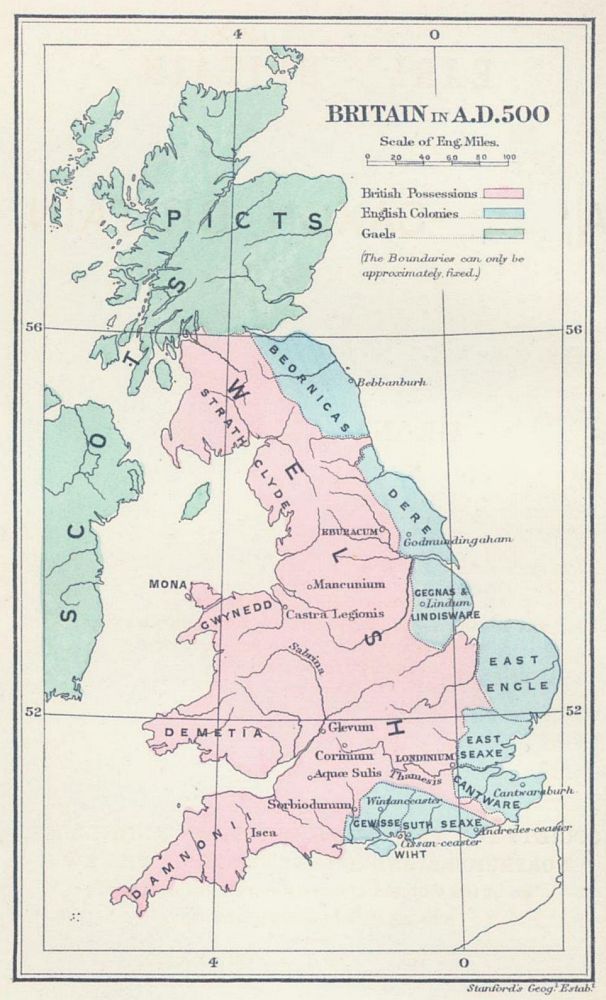
Welsh emerged from Common Brittonic, or another down in the 'eels Brittonic dialect, ca. 6th c.AD. The Britons were all pushed to the west of what is now England/Scotland, and eventually the Brittonic-speaking west, was divided near modern-day Manchester/Liverpool, and the boundaries of modern Wales were founded.
Before the 6th c., Brittonic kingdoms extended from The River Clyde (Cumbria), to Cornwall & the Isle of Wight.
Another Welsh bard, was Aneirin, a Cumbric poet from Dumbarton (also modern Scotland), aka the "prince of bards, of flowing verse." Aneirin's epic Y Gododdin, records a pitched battle between the Britons and Angles at the Battle of Catraeth ca, 600 AD, in remembrance of his fallen patrons and lords of Hen Ogledd.
So, I guess we could say that the roots of written Welsh is really Scottish! Of course, there was no Scotland yet. Detail, I know. Also understanding the Brittonic language map during the post Classical era, and the early middle ages gives some linguistic credence to the next Mad March Celtic holiday on deck—that St. Patrick was actually from what is later known as Scotland.
Welsh was much easier to learn than Old Irish (also VSO and sometimes P*, but less tenses to fuss with). However, I was a mental disaster in my Medieval Welsh class at Berkeley—it was also post-9/11. I had the post-acopolytic mind of a squirrel. I did, however, manage to get through the first story of the Mabinogi, and another tale in Medieval Welsh. All I can say is, I'm glad I already knew how the stories were going to end.
*Verb, Subject, Object, Preposition that conjugates with personal pronoun.
Anyway, all this to say to you: Happy Dewi Sant! Or Dydd Gwyl Dewi hapus! Do you have a bouquet of daffodils in hand, and a lucky leek stuck behind your left ear? Then, let the March madness begin.
White rabbit, rabbit, rabbit.
Note Bene: David, the patron saint of Wales and doves, whose feast/death day is March 1st (ca. 569-601 AD), would've been a contemporary of Taliesin and Aneirin.
During the height of Welsh resistance against the Normans, Saint David was recognized as the national patron saint. On his deathbed Dewi Sant was said to have uttered: "Brothers be ye constant. The yoke which with single mind ye have taken, bear ye to the end; and whatsoever ye have seen with me and heard, keep and fulfil."
An 8th c. poem prophesied that when all might seem lost, the Cymry would unite under the banner of David to defeat the English; "A lluman glân Dewi a ddyrchafant" (And they will raise the pure banner of Dewi)."
Dewi was son of Sandde, the Prince of Powys— the Ceredigion clan, and Non of Menevia. He founded a Celtic monastery at Glyn Rhosin (Vale of Roses) at Sir Benfro. He was buried at St David's Cathedral at Pembrokeshire; his shrine was a pilgrimage hot spot during the Middle Ages. Saint David is also associated with corpse candles, a flame, or blue fireball (bog-fire, will-o-the-wisp, ignis fatuus) that foretold death.
There was a lot of prehistoric travel back and forth from southern Ireland to Wales. During the 5th c., Gwynned was an Irish settlement, as was Anglesey. The word Gwynedd is an early borrowing from the Irish, related to the Old Irish name Féni. Finn/Gwyn are cognates—fair/white.
Welsh emerged from Common Brittonic, or another down in the 'eels Brittonic dialect, ca. 6th c.AD. The Britons were all pushed to the west of what is now England/Scotland, and eventually the Brittonic-speaking west, was divided near modern-day Manchester/Liverpool, and the boundaries of modern Wales were founded.
Before the 6th c., Brittonic kingdoms extended from The River Clyde (Cumbria), to Cornwall & the Isle of Wight.
The earliest Welsh literature dates back to 600 AD. Wales' first Welsh bard was Taliesin of the 'shining/radiant brow' (or Tal-iesin, Taliessin; c. 534 – c. 599). He composed the story of Urien of Rheged, a 6th c.
king—in what is now southern Scotland.
Another Welsh bard, was Aneirin, a Cumbric poet from Dumbarton (also modern Scotland), aka the "prince of bards, of flowing verse." Aneirin's epic Y Gododdin, records a pitched battle between the Britons and Angles at the Battle of Catraeth ca, 600 AD, in remembrance of his fallen patrons and lords of Hen Ogledd.
So, I guess we could say that the roots of written Welsh is really Scottish! Of course, there was no Scotland yet. Detail, I know. Also understanding the Brittonic language map during the post Classical era, and the early middle ages gives some linguistic credence to the next Mad March Celtic holiday on deck—that St. Patrick was actually from what is later known as Scotland.
Welsh was much easier to learn than Old Irish (also VSO and sometimes P*, but less tenses to fuss with). However, I was a mental disaster in my Medieval Welsh class at Berkeley—it was also post-9/11. I had the post-acopolytic mind of a squirrel. I did, however, manage to get through the first story of the Mabinogi, and another tale in Medieval Welsh. All I can say is, I'm glad I already knew how the stories were going to end.
*Verb, Subject, Object, Preposition that conjugates with personal pronoun.
![]() |
| Dydd Gwyl Dewi hapus |
White rabbit, rabbit, rabbit.
Note Bene: David, the patron saint of Wales and doves, whose feast/death day is March 1st (ca. 569-601 AD), would've been a contemporary of Taliesin and Aneirin.
During the height of Welsh resistance against the Normans, Saint David was recognized as the national patron saint. On his deathbed Dewi Sant was said to have uttered: "Brothers be ye constant. The yoke which with single mind ye have taken, bear ye to the end; and whatsoever ye have seen with me and heard, keep and fulfil."
An 8th c. poem prophesied that when all might seem lost, the Cymry would unite under the banner of David to defeat the English; "A lluman glân Dewi a ddyrchafant" (And they will raise the pure banner of Dewi)."
Dewi was son of Sandde, the Prince of Powys— the Ceredigion clan, and Non of Menevia. He founded a Celtic monastery at Glyn Rhosin (Vale of Roses) at Sir Benfro. He was buried at St David's Cathedral at Pembrokeshire; his shrine was a pilgrimage hot spot during the Middle Ages. Saint David is also associated with corpse candles, a flame, or blue fireball (bog-fire, will-o-the-wisp, ignis fatuus) that foretold death.
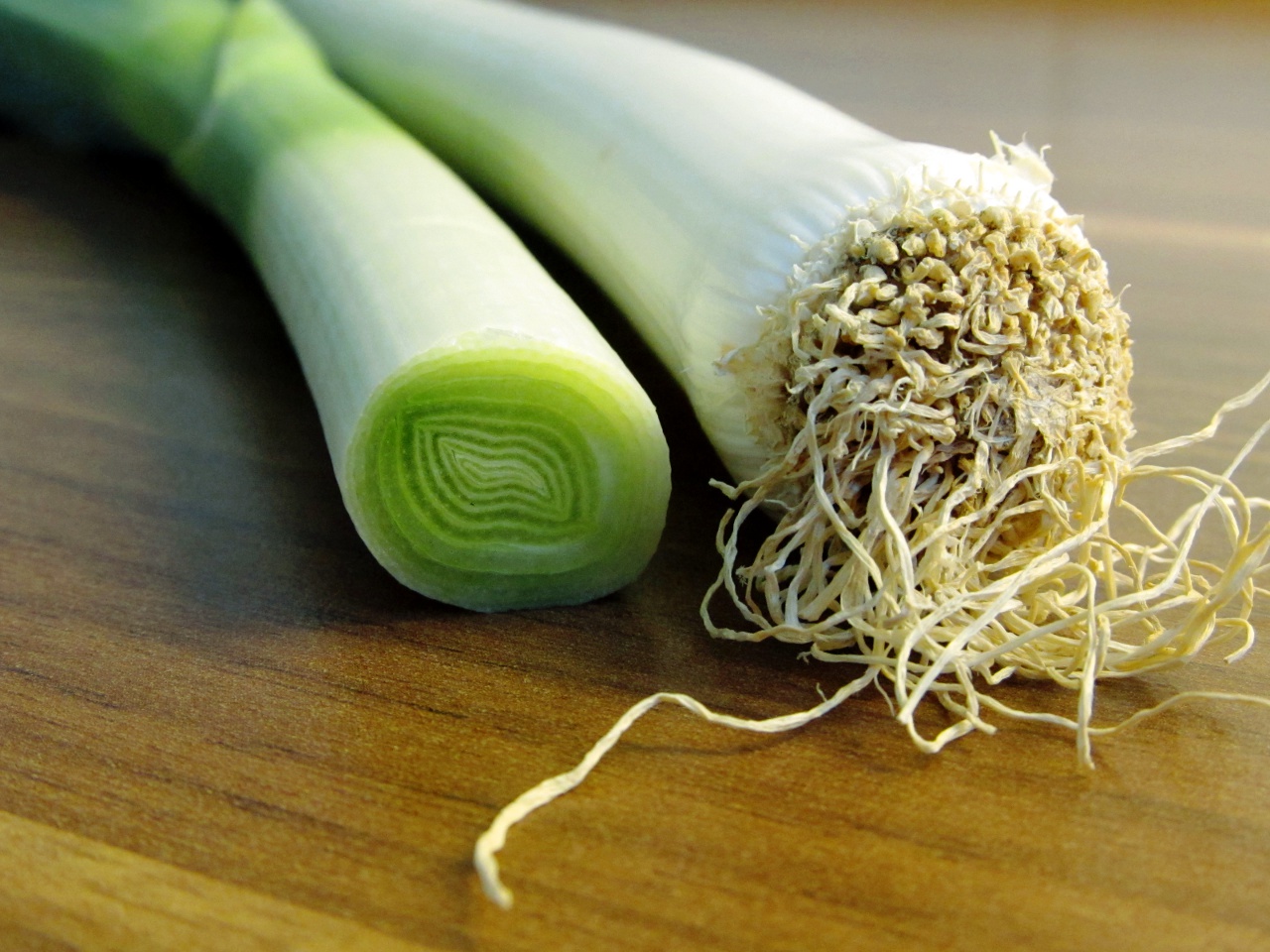
The Welsh wear a daffodil (symbol of spring) or the leek (secret sign) on their lapel to celebrate the feast of St. David. The words are similar in Welsh, Cenhinen (leek) and Cenhinen Pedr (daffodil, "Peter's leek").The leek was used as a symbol to distinguish Welsh troops from the pagan Saxon enemy. Friend or foe.
The word Cymry dates back to the post-Classical Roman Era, meaning the peoples of "Yr Hen Ogledd", or the Men of the North. In Old Welsh combrog means "compatriot, or Welshman"; from cymryu+ brogi —country, or territory.
The word Wales, or Welsh, is not from within the culture. It's from the Germanic root (Walh, Walha) foreigner, which ironically was derived from the name of a fierce Gaulish tribe, the Volcae Tectosages—who gave Rome some real grief. The Volcae fought alongside Alexander the Great, and feared nothing.
![]() |
| Cenhinen |
The word Wales, or Welsh, is not from within the culture. It's from the Germanic root (Walh, Walha) foreigner, which ironically was derived from the name of a fierce Gaulish tribe, the Volcae Tectosages—who gave Rome some real grief. The Volcae fought alongside Alexander the Great, and feared nothing.
![]() |
| Britain 500 AD: Pink: Celtic Britons, or Welsh. Blue: Germanic tribes Angles, Saxons. Green: Gaels & Picts. |
There was a lot of prehistoric travel back and forth from southern Ireland to Wales. During the 5th c., Gwynned was an Irish settlement, as was Anglesey. The word Gwynedd is an early borrowing from the Irish, related to the Old Irish name Féni. Finn/Gwyn are cognates—fair/white.
My family name, Walsh (the Welshmen), is Breathnach in Irish. This does not mean our family were supplanted Normans, they might have come over to Bantry from Wales with Strongbow, they may have been descendants from the kingdom of Gwynned, or they may simply have been Brittonic-speakers in Ireland.
Thursday, August 1, 2013
Lúghnasa
The Mórríghan, my namesake, dressed as a crow was calling outside my window at dawn: it's Lúghnasa! Or maybe it was Lúgh's raven. I couldn't see it, I was trying to sleep. The bird didn't really caw, it was more like a bark: get up you lazybones. I pulled the pillows over my ears. It kept barking. (I was up all night listening to Dick Francis' Even Money. It takes longer to listen to a book than to read it. And I can never put a good book down.)
Only the male crow sings. It's a rather mournful little warble. This one was barking orders outside my window like a drill sargeant. It could have been a raven, but ravens in Oakland? They are deep-voiced. Croak, the raven, evermore? Let's just say corvids were involved.
OK, OK, I'm up. Got it. It's Lúghnasa. (No, not the band). I can't climb the highest peak, nor dance, nor even circle the proverbial well—not with this torn knee. Yesterday I cleaned house for the first time since I was injured in March, and am paying dearly for it. But somehow the body keeps time with tradition, despite the century one is living in. About the only thing up for dancing today, is my imagination.
Sometimes The Mórríghan, the Great Queen, is called the phantom queen, or the war goddess. Or "Morrigu" for short. She's an ancient triune goddess land/ soverighnty. As in mother of the gods. Some say the Welsh Morgan le Fey is a cognate of the Mórríghan (or Morrigan), others say no FN way—it's a case of bad linguistics.
That little fada (accent) on the first syllable, mór changes the meaning of the word from sea—mor, muir, mer—(or horse—but I really don't see how anyone can get "horse" out of it) to—great, or big—as in The Big Kahuna.
My Welsh friend Mábli named me The Mórríghan in grad school and it stuck. I miss Mábli, living far awa' in Stornowa'. I know, Maureen is supposed to mean little Mary—but I fancifully said that's a Christian overlay for a name already in Irish mythology. And so, The Mórríghan moniker stuck.
Maíriín is Maíri with a diminutive ending, -ín, or in English: Maura + -een. Like Colleen: cail + în. You're probably thinking Maureen sounds nothing like Mórríghan. Welcome to Irish 1A. That -gh in the middle of Mórríghan is silent, more of a swallowed y sound. Like a gulp. Call this an exercise in false etymology, or maybe a bad case of vivid poetic imagination.
About the only thing that warring camps of Indo-European linguists do agree on is that rí = king/queen, or soverignty. The rest is up for grabs.
Then there's the thought that Mor-ríghan is cognate with Morgan idea, with no fada, as in the sea. This is where it gets tricky. She-of-the-sea, my old boyfriend, climber-poet Edwin Drummond (aka The Human Fly) used to call me. Great big sea. (No, not the band). Fanciful wordplay drives linguists to drink, but if you're an IE linguist, where consonants count for little, and vowels count for nothing at all, any excuse to drink is probably good. Or if you're a poet. Besides, who wants to be called Biitter Herbs anyway? Just don't call me Battleaxe.
The Óenach Tailten Games were celebrated as late as the 18th century and included feasting, fighting and fecking. Or the ritual sacrifice of a white bull, heavy athletic competitions, handfasting, dancing, pilgrimages to the top of Croagh Patrick and to holy wells (Brigid, the beer goddess and the hearth is invoked), and the ritual cutting of the first harvest grain—with August 1 as the epicenter.
Surely you didn't think these parties lasted only a day, did you? More like a month and a day. Takes about a week or two to ease into it. Like poets arriving fashionably late. Then, it was party like a rock star for another week or so, then nurse the hangover. Willow bark tea was as good as it got for aspirin.
See, when the Games were gussied up and Christianized, the sagarts had to make the festival fall on a Sunday to make things work out right. Eddie Stack mentioned in his blog that July 26 was Féile Lúghnasa. It's a movable feast—whatever it takes to make it to fall on the last Sunday in July.
Lúghnasa was once called Dé Domhnach Chrom Dubh, or Crom Dubh Sunday—he was a bent/crooked dark fertility god, said to reside in a cave at the crest of Croagh Patrick. But Christianity banished him as an evil one. Another permutation of Lúghnasa is Domhnach na Cruaiche—Reek Sunday, or Garland Sunday, is the day 30,000 Irish lemmings crawl up Croagh Patrick on bended knee. Or blindfolded, or both, while praying all the way up with myriad jaysusmaryanjosephs. Not me, my knees will never kneel again. Though I do prefer to walk barefoot.
Lá Fhéile Lúghnasa Sona Daoibh!
That little fada (accent) on the first syllable, mór changes the meaning of the word from sea—mor, muir, mer—(or horse—but I really don't see how anyone can get "horse" out of it) to—great, or big—as in The Big Kahuna.
My Welsh friend Mábli named me The Mórríghan in grad school and it stuck. I miss Mábli, living far awa' in Stornowa'. I know, Maureen is supposed to mean little Mary—but I fancifully said that's a Christian overlay for a name already in Irish mythology. And so, The Mórríghan moniker stuck.
Maíriín is Maíri with a diminutive ending, -ín, or in English: Maura + -een. Like Colleen: cail + în. You're probably thinking Maureen sounds nothing like Mórríghan. Welcome to Irish 1A. That -gh in the middle of Mórríghan is silent, more of a swallowed y sound. Like a gulp. Call this an exercise in false etymology, or maybe a bad case of vivid poetic imagination.
About the only thing that warring camps of Indo-European linguists do agree on is that rí = king/queen, or soverignty. The rest is up for grabs.
Then there's the thought that Mor-ríghan is cognate with Morgan idea, with no fada, as in the sea. This is where it gets tricky. She-of-the-sea, my old boyfriend, climber-poet Edwin Drummond (aka The Human Fly) used to call me. Great big sea. (No, not the band). Fanciful wordplay drives linguists to drink, but if you're an IE linguist, where consonants count for little, and vowels count for nothing at all, any excuse to drink is probably good. Or if you're a poet. Besides, who wants to be called Biitter Herbs anyway? Just don't call me Battleaxe.
You're probably wondering what all this has to do with Lúghnasa, or August 1. I'm wending my way there. Never could think straight, so it's widdershins for me. My thoughts travel at the speed of Celtic knots. Or maybe I'm bird-brained from being wakened at dawn.
The crow is one of the Mórríghan's animal personae, a shape-shifter. Not only was she a triple goddess—there's fierce debate as to which three goddesses—she could turn into an eel and a wolf as well as a white, red-eared heifer (OK, so that's four critters—which goes against the Celtic trinity thing).
But in Irish literature, The Mórríghan was most famous as the scaldcrow, or raven on the shoulder of CúChullain's corpse—he died, strapped to a menhir on the battlefield in the Táin Bó Cúailnge while she ate his guts. She is the Irish goddess of war and fate. The washer at the ford, she ordains who will live or die on the battlefield.
The crow is one of the Mórríghan's animal personae, a shape-shifter. Not only was she a triple goddess—there's fierce debate as to which three goddesses—she could turn into an eel and a wolf as well as a white, red-eared heifer (OK, so that's four critters—which goes against the Celtic trinity thing).
But in Irish literature, The Mórríghan was most famous as the scaldcrow, or raven on the shoulder of CúChullain's corpse—he died, strapped to a menhir on the battlefield in the Táin Bó Cúailnge while she ate his guts. She is the Irish goddess of war and fate. The washer at the ford, she ordains who will live or die on the battlefield.
Those two had a serious love-hate thing going on. Cú should never have spurned The Mórríghan when she offered herself up. (She had this re-virgination land thing going on too). You know what they say about a woman scorned. Kick that up a few notches when she's an cougar sovereign goddess—and mother of the gods. Besides, Lúgh was Cú's father. So, I'm sure there was another interesting triangle going on as well. Welcoming them home with open thighs, and all that. Let's just say she's complicated.
Lúgh too had a thing about those corvids—oracle ravens. You know, the ravens at the Tower of London? No wonder the Romans had to bury statues of imperial Roman eagles there. To break up the juju. Some say London is Lugh's city, Lugdunum. Did the ancient Irish distinguish between ravens and crows? They're both Otherworld carrion birds. Some IE linguists claim that the Gaulish lugos (Lúgh is a cognate) means raven. Or maybe it means *lug as in oath, pledge, or in Proto-Indo European it could mean *leuk (light). Or maybe it's wordplay with ravens. —Check out Lugh - in Mary Jones dictionary.
The Hound of Ulster's man-handle was CúChullain, but his baby name was Sétanta (sé as in Sidhe?). There was something odd about his birth(s): unseasonable snow, birds, twinned colts (making it a triad birth), maybe some kidnapping or infantacide. Let's just say he-who-was-to-become-Sétanta, then CúChullain, died more than once, and Lúgh had to stick the kid's soul back into Deichtine's womb all over again. (Deichtine was sort of like the Welsh Arianrhod (silver wheel) and her magical sons: Dylan Ail Don and Lleu Llaw Gyffes. All these multiple virgin births. I'm sure their Facebook status is set to: It's extremely complicated. Monks trying to shoehorn Irish mythology into Biblical shoes.)
So when the Mórríghan was calling me nine times outside my window at dawn, in a place where crows don't normally visit—it got my attention. Made me realize it's a feastday. A crossroad of the year. I thought about baking some sodabread to celebrate the great wheel of the year. Not that I actually did anything, other than attempt to write this blogín.
The other ancient Irish feast days are largely forgotten—but everybody knows of Hallowe'en, or Samhain. Then there's Imbolc (first milk) and Beltane (Bel's fires). And Lúgnasadh. Or Lúghnasa—its Christian frock is the harvest, or first-new-grain-loaf festival, aka Lammas Day. Technically, Lúghnasa began yesterday, as Irish days, like Hebrew days begin at dusk.
Today is the feastday of the god Lúgh Lámhfhada. And whenever you begin invoking the old Irish gods, they all want to come to the party. And young Lúgh, a bona fide member of the Tuatha Dé Danann, was the young rising god, a real party animal.
So when the Mórríghan was calling me nine times outside my window at dawn, in a place where crows don't normally visit—it got my attention. Made me realize it's a feastday. A crossroad of the year. I thought about baking some sodabread to celebrate the great wheel of the year. Not that I actually did anything, other than attempt to write this blogín.
The other ancient Irish feast days are largely forgotten—but everybody knows of Hallowe'en, or Samhain. Then there's Imbolc (first milk) and Beltane (Bel's fires). And Lúgnasadh. Or Lúghnasa—its Christian frock is the harvest, or first-new-grain-loaf festival, aka Lammas Day. Technically, Lúghnasa began yesterday, as Irish days, like Hebrew days begin at dusk.
Today is the feastday of the god Lúgh Lámhfhada. And whenever you begin invoking the old Irish gods, they all want to come to the party. And young Lúgh, a bona fide member of the Tuatha Dé Danann, was the young rising god, a real party animal.
Lúgnasa is the half-way mark between the summer solstice and autumn equinox. The word is a combination of Lúg (the god Lúgh) and -násad (which is an assembly, or gathering). His handle, Lámhfhada means long arm. God of all arts, he was really good with his, er… spear. (See also pan-Celtic god Lugus, and Welsh counterpart Lleu Llaw Gyffes, "The Bright One with the Strong Hand.")
Lúgh (modern: Lú) founded the Óenach Tailten (the ancient Irish Olympic Games—similar to the Greek Games) as a funeral feast for his (foster) mother Tailtiu, queen of the Fir Bolg. Royal fosterage was a big deal in ancient Irish mythology—it built alliances between clans and tribes. Foster children had mixed allegiances—to their foster families, and to their blood kin.
Cian of the Tuatha Dé Danann was Lugh's father, and Ethniu, daughter of Balor, of the Fomorians, was his mother. (Or Lugh had three fathers, or was born three times, or was a lone surviving triplet—Balor drowned the others.) Got that? There's a test at the end, should you ever get to the bottom of it. I would imagine most of you are stark raving by now—with all those pimpley hyperlinks screaming: pick me, pick me!
So, we have three conjoined Irish races: Tuatha Dé Danann (TDD), and some Fomorians from under the sea (making Lúgh a half-god), with the Fir Bolgs as his foster parents. Add fosterage with Manannán mac Lír at Emhain Abhlach (Anglesey) too. we're not to sure what mythical race he was, TDD? Manannán arms Lúgh. So, Lúgh has three fathers, and/or is triplets, or was the product of a triple birth. Good old Indo-European threes. Surely that was significant. I said, it's complicated. Gawd, I need a drink.
Lúgh's poor foster mother Tailtiu, died of exhaustion after clearing the plains of Ireland for agriculture. Not too sure what all the menfolk were doing when all this was happening. Sitting on their keisters swilling heather beer in yon bonny glen? Apparently clearing the fields was women's work—even if she was the queen. What's with that? Master and commander?
So Lúgh of the Long Arm threw his foster mother Tailtiu the mother of all Irish wakes, or funeral feasts—if you must. The first Óenach Tailten, or Áenach Tailteann, was traditionally said to be held at modern Teltown, County Meath. Telltown is a corruption of Tailtu's name. It's also the seat of the early Uí Néills, so locating it there is a dynastic thing. Turf wars and all that. They later footed the bill for the See of St. Patrick at Armagh and took on some retroactive airs.
The Óenach Tailten Games were celebrated as late as the 18th century and included feasting, fighting and fecking. Or the ritual sacrifice of a white bull, heavy athletic competitions, handfasting, dancing, pilgrimages to the top of Croagh Patrick and to holy wells (Brigid, the beer goddess and the hearth is invoked), and the ritual cutting of the first harvest grain—with August 1 as the epicenter.
Surely you didn't think these parties lasted only a day, did you? More like a month and a day. Takes about a week or two to ease into it. Like poets arriving fashionably late. Then, it was party like a rock star for another week or so, then nurse the hangover. Willow bark tea was as good as it got for aspirin.
See, when the Games were gussied up and Christianized, the sagarts had to make the festival fall on a Sunday to make things work out right. Eddie Stack mentioned in his blog that July 26 was Féile Lúghnasa. It's a movable feast—whatever it takes to make it to fall on the last Sunday in July.
One time it was held at around 200 sites, nearly always remote, inaccessible places that were on heights, or near water. The festival was dedicated to Lúgh, the young and most brilliant god of the Tuatha de Danann. Lúgh was the god of light, god of arts and crafts, father of inventions and the likes. It was he who saved the harvest by vanquishing Bal, the sun god who was in the process of scorching all the country’s plants and crops with relentless heat. —Eddie Stack 2010
Lúghnasa is ancestor of Aonach an Phoic Puck Fair, Domnach na bhFraochóg, or Bilberry Sunday. (AKA frachóg, whorts, or heatherberries. In our family, August is also the opening day of huckleberry season. My grannie would take us up the ridge at Tomales Bay to check on the bushes. Just to make sure.)
The Áenach Tailteann is also the ancestor Games of Scottish Highland Games—as they too were traditionally held in August.
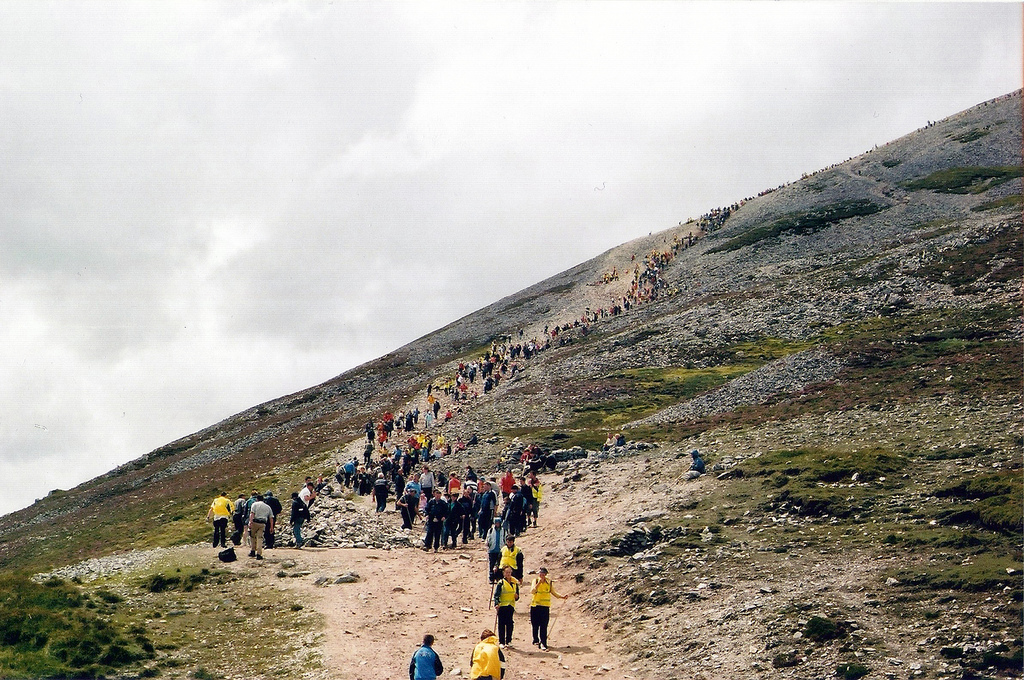
Lúghnasa was once called Dé Domhnach Chrom Dubh, or Crom Dubh Sunday—he was a bent/crooked dark fertility god, said to reside in a cave at the crest of Croagh Patrick. But Christianity banished him as an evil one. Another permutation of Lúghnasa is Domhnach na Cruaiche—Reek Sunday, or Garland Sunday, is the day 30,000 Irish lemmings crawl up Croagh Patrick on bended knee. Or blindfolded, or both, while praying all the way up with myriad jaysusmaryanjosephs. Not me, my knees will never kneel again. Though I do prefer to walk barefoot.
![]() |
| Pilgrims climbing Croagh Patrick on "Reek Sunday," part of the festival of Lúgh since ancient times. —Wiki |
Lúgh Lámhfhada was also the patron god of cobblers. Thought I'd throw that one in for free. The thought of shoes at a time like this tickles me. I can't bend down to put on my shoes. Besides, the closest I got to a holy well today was the shower. I was circling the drain. Does dyeing your hair count as pilgrimage?
So you had a few goats, some old and new, toss in a bit of the living and the dead, and the dead coming back to life again—what more could you ask for? An "A" party list.
Lá Fhéile Lúghnasa Sona Daoibh!
Tuesday, March 17, 2009
St Patrick was a Strathclyde Briton
NB: This post was in response to a rock-stubborn Scottish American lassie (not terribly clear on history) who slavishly flamed our Irish in CA group. I've removed most of the personal references. It's challenging to turn an email letter into a blog. I feel like St. Patrick writing a shame Letter to the Soldiers of Coroticus. When I get time, I will revise this. Add links. Or not. This is not a blog on St. Patrick, per se. I'm assuming the reader already knows the basic story.
St Patrick was a probably a Strathclyde Briton. Meaning he didn't speak Irish. Or Scots-Irish. Or English. He probably spoke something similar to Welsh or Cumbrian.
The Roman term "Scottii "has been variously translated as "raider" and "pirate." The term may have evolved to distinguish Q-Celtic speaking regions from P-Celtic regions.
Curiously, Scoti is not a Roman or Latin ethnonym. (The Romans used Hibernii, based on Ptolemy's Greek, Iérnē). Nor is it Goidelic, but there is a reference to Scoti in the Middle Irish MS, Lebor Gabála Érenn: Scota, daughter of a Pharaoh of Egypt. (Scota was probably Milesian, or Iberian vs. Egyptian—tho the Ptolemys did hire some 40,000 Celtic mercenaries), and Scota was the eponymous leader of the Gaels, who created the Irish language.
The word "Briton" comes from Pretanii. P/B sounds were indistinguishable in insular P-Celtic, the language spoken in most of Great Britain—including the Pretenic of the Picts (but they had elements of both P- & Q-Celtic embedded in their language.)
There was also Q-Celtic, the languages spoken in CeltIberia; (Goidelic), Ireland, parts of Scotland (there were numerous waves Irish settlers in Strathclyde and Renfrewshire), The Hebrides, and the Isle of Man.
Yes, Q-Celtic was also spoken in the Isle of Man. Manx is a dialect of Irish with a different orthography (spelling). In other words, I can grasp Manx if I say it out loud. (Viking veneer aside), there is also linguistic evidence that the Celtic inhabitants of the Orkneys and Hebrides spoke Q-Celtic. There was no difference between Scots Gaelic, Manx, or Irish during the 17th & 18th centuries. It was one language, one dialect.
Irish Q-Celtic place names in Strathclyde region are still in evidence. There is record of Q-Celtic spoken in the West of Britain: there is an ogham stone in Irish. Many waves of Irish speaking settlers in the Lake District, etc.
Scotland and Wales don't emerge as national and separate nations/ identities until centuries after the Anglo-Saxon invasions severed the West Coast Britons into two groups. The language spoken at the time on the West Coast of Great Britain was the same. Eventually the P-Celtic evolved into two dialects (ancestor of Welsh and Cumbrian).
We know very little about St. Patrick—other than he DIDN'T speak Q-Celtic. He had to learn Irish. We also don't know if he spoke P-Celtic. We do know he spoke and wrote in Latin and that his family were Roman citizens. Patricius is Latin. This does not mean he was Roman (or Italian), but we do know he was a Romanized Celt, as was the Cis-Alpine Gaulish writer, Vergil, and probably Catullus, Trajan, and many other so-called Roman authors.
I am Patrick, a sinner, most unlearned, the least of all the faithful, and utterly despised by many. My father was Calpornius, a deacon, son of Potitus, a priest, of the village Bannavem Taburniae he had a country seat nearby, and there I was taken captive. —The "Confessio" of Saint Patrick (http://www.robotwisdom.com/jaj/patrick.html seems to be a dead link)
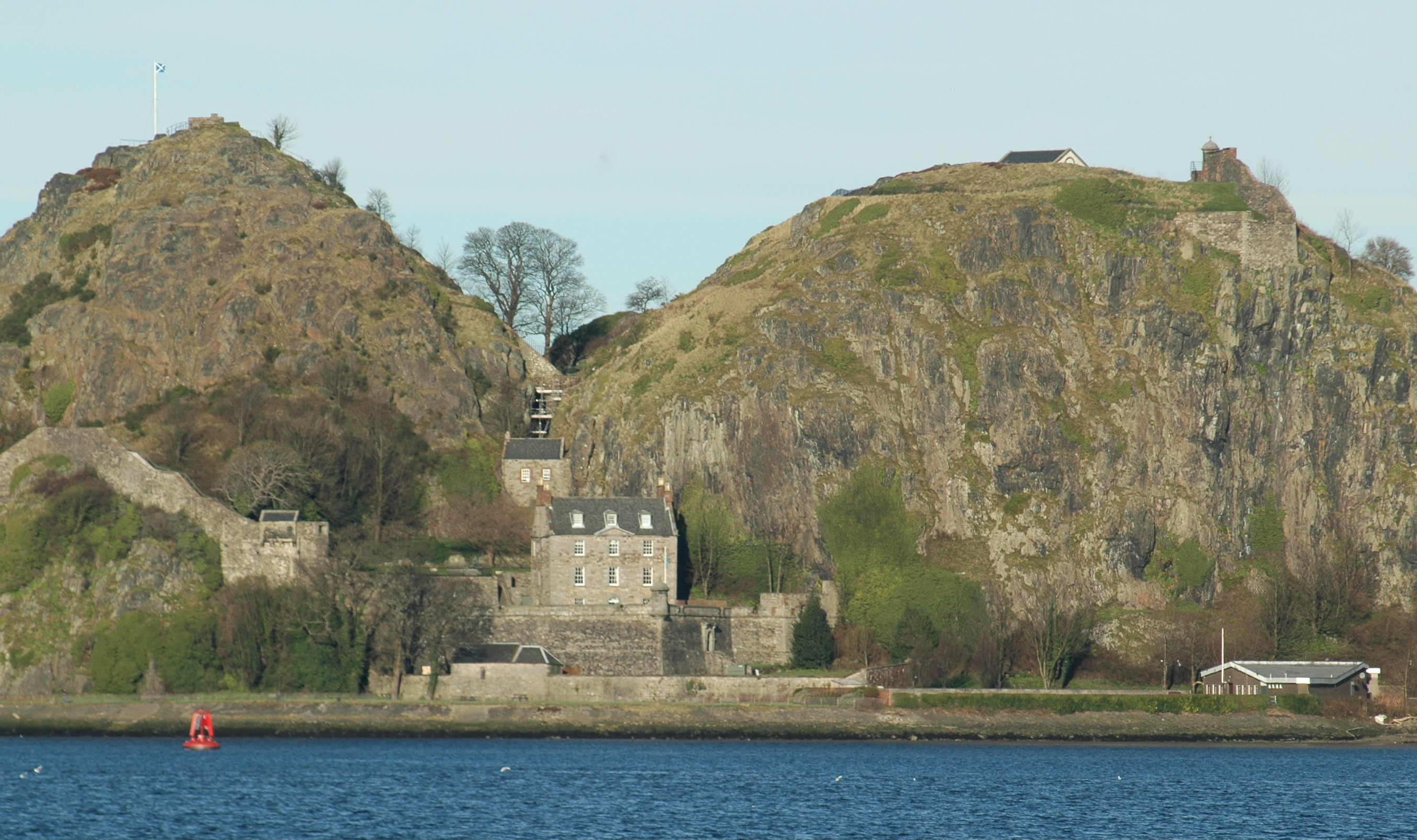
No one knows where the village of Bannavem Taburniae was. But Cumbria, or southern Scotland may have been Patrick's homeland. There's some conjecture that it was near Dumbarton (Dùn Breatainn, or Alt Clut—Clyde Rock) on the River Clyde, translates as Fort of the Britons.
The Dumbarton settlement was first recorded in the famous letter Saint Patrick wrote to Ceretic (aka Coroticus of Letter fame) King of Alt Clut in the late 5th century. Merlin was rumored to have slept at Alt Clut too. Sir Thomas Grey of Heaton, in his medieval tale, Scalacronica, recorded that "Arthur left Hoël of Little Britain his nephew sick at Alcluit in Scotland."
Some historical "truth" is in order. The term "Briton" in the 5th c. does not refer to a slur, as in "Brit," or the Irish slur, "West Briton," a wannabe Englishman. The correct term in this case, is a Briton, not a Scot. It is not intended as a racial slur but an anthropological/ cultural/ linguistic time/ place indicator.
King Arthur is referred to as a Briton... A Briton was a P-Celtic-speaking native living on an island (Pretannia) that was later referred to as England. There were dozens of Celtic tribes, the Icenii, Caledonii, (or) The Pictii, etc, who spoke Brythonic Celtic, or P-Celtic. (Pictish seems to have elements of both P- and Q-Celtic. It may be an older archaic language, related to Gaulish, as the Romans do identify the Pictii as being in Gaul as well.)
In the 5th C. the term "Scott" would have referred to an Irishman, or an Irish speaker, not a Scotsman.
At one point, "Scotii" referred to the Q-Celtic-speaking Irish, not the modern day Scots, as Ireland was referred to as Scotia Major, and because of all the Irish settlements in what is now referred to as Scotland, that region of Scotland (Dal Riada) was called Scotia Minor.
King Arthur is referred to as a Briton... A Briton was a P-Celtic-speaking native living on an island (Pretannia) that was later referred to as England. There were dozens of Celtic tribes, the Icenii, Caledonii, (or) The Pictii, etc, who spoke Brythonic Celtic, or P-Celtic. (Pictish seems to have elements of both P- and Q-Celtic. It may be an older archaic language, related to Gaulish, as the Romans do identify the Pictii as being in Gaul as well.)
In the 5th C. the term "Scott" would have referred to an Irishman, or an Irish speaker, not a Scotsman.
At one point, "Scotii" referred to the Q-Celtic-speaking Irish, not the modern day Scots, as Ireland was referred to as Scotia Major, and because of all the Irish settlements in what is now referred to as Scotland, that region of Scotland (Dal Riada) was called Scotia Minor.
The Roman term "Scottii "has been variously translated as "raider" and "pirate." The term may have evolved to distinguish Q-Celtic speaking regions from P-Celtic regions.
Curiously, Scoti is not a Roman or Latin ethnonym. (The Romans used Hibernii, based on Ptolemy's Greek, Iérnē). Nor is it Goidelic, but there is a reference to Scoti in the Middle Irish MS, Lebor Gabála Érenn: Scota, daughter of a Pharaoh of Egypt. (Scota was probably Milesian, or Iberian vs. Egyptian—tho the Ptolemys did hire some 40,000 Celtic mercenaries), and Scota was the eponymous leader of the Gaels, who created the Irish language.
The word "Briton" comes from Pretanii. P/B sounds were indistinguishable in insular P-Celtic, the language spoken in most of Great Britain—including the Pretenic of the Picts (but they had elements of both P- & Q-Celtic embedded in their language.)
There was also Q-Celtic, the languages spoken in CeltIberia; (Goidelic), Ireland, parts of Scotland (there were numerous waves Irish settlers in Strathclyde and Renfrewshire), The Hebrides, and the Isle of Man.
Yes, Q-Celtic was also spoken in the Isle of Man. Manx is a dialect of Irish with a different orthography (spelling). In other words, I can grasp Manx if I say it out loud. (Viking veneer aside), there is also linguistic evidence that the Celtic inhabitants of the Orkneys and Hebrides spoke Q-Celtic. There was no difference between Scots Gaelic, Manx, or Irish during the 17th & 18th centuries. It was one language, one dialect.
Irish Q-Celtic place names in Strathclyde region are still in evidence. There is record of Q-Celtic spoken in the West of Britain: there is an ogham stone in Irish. Many waves of Irish speaking settlers in the Lake District, etc.
Scotland and Wales don't emerge as national and separate nations/ identities until centuries after the Anglo-Saxon invasions severed the West Coast Britons into two groups. The language spoken at the time on the West Coast of Great Britain was the same. Eventually the P-Celtic evolved into two dialects (ancestor of Welsh and Cumbrian).
We know very little about St. Patrick—other than he DIDN'T speak Q-Celtic. He had to learn Irish. We also don't know if he spoke P-Celtic. We do know he spoke and wrote in Latin and that his family were Roman citizens. Patricius is Latin. This does not mean he was Roman (or Italian), but we do know he was a Romanized Celt, as was the Cis-Alpine Gaulish writer, Vergil, and probably Catullus, Trajan, and many other so-called Roman authors.
Tuesday, September 4, 2001
Intro to Folklore, Dundes, Medieval Welsh Language & Lit., Kla
Medieval Welsh Language & Literature;
Prof. Kathryn Klar (audited)
FALL 2001: Celtic Studies146A (4 units),
Prof. Kathryn Klar (audited)
A selection
of medieval Welsh prose and poetry from medieval Welsh manuscripts: Culhwch and
Olwen, the earliest Arthurian tale in any vernacular language, and Aneirin?s
Gododdin, which has the earliest reference in the vernacular to King
Arthur. ther texts will include the Mabinogi and poems, The Gododdin
(Canu Aneirin).Texts will be read, all or in part, in Middle Welsh; for those
works read in extracts, translations of the entire work will be available. In-class
translations will normally form part of each class and a reader will be made
available. Grading based upon class participation, and final paper.
TEXTS:
Dafydd ap
Gwilym
Owein,
Chwedyl Iarlles Y Ffynnawn
Bran
Pwyll
Pendeuic Dyuet
Manawydan
uab Llyr,(White Book, Rhydderch) Patrick Ford
Lear and
His daughters (Red Book of Hergest), Strachan
Cyfranc
Lludd a Llevelys, Ifor Williams
Intro to
Early Welsh, Strachan
For some reason, I didn't do so well in the class. The events of 9/11 made me ADD; I don't even remember doing a paper.
...............................................
Intro to
Folklore
Prof Alan
Dundes
FALL 2001: ANTHRO 160A (4 units),
(Cross-registered, SFSU, grade A)
FALL 2001: ANTHRO 160A (4 units),
(Cross-registered, SFSU, grade A)
TEXTS:
The Study
of American Folklore, Harold Brunvand
International
Folkloristics, ed. Alan Dundes
Folklore
Matters, Alan Dundes
Holy Writ
as Oral Lit, Alan Dundes
The Study
of Folklore, Alan Dundes
Life is
Like a Chicken Coop Ladder, Alan Dundes,
Plus
reader, reserved readings.
I collected and annotated over 60 pieces of folklore from informants in Portugal, Ireland, and California. They are in this blog and also in the Folklore Archives, Kroeber Hall, where Ishi once lived. I loved this class, I never wanted it to end. I am grateful for the time I got to spend with Alan; Neil was a special pet of Alan's, so we spent many an hour jawing in Alan's office. Neil called him Papa Dundes. Alan's heart was big as the world. WWDS has become my motto.
If I hadn't gone to Portugal right after 9/11, chances would be pretty good I would've dropped out of school. I was a bad state, no focus, no stamina, etc. So maybe this class saved me.
I eventually plan to transcribe my class notes, so this is a placeholder. A reminder. —MH 11/2015
I collected and annotated over 60 pieces of folklore from informants in Portugal, Ireland, and California. They are in this blog and also in the Folklore Archives, Kroeber Hall, where Ishi once lived. I loved this class, I never wanted it to end. I am grateful for the time I got to spend with Alan; Neil was a special pet of Alan's, so we spent many an hour jawing in Alan's office. Neil called him Papa Dundes. Alan's heart was big as the world. WWDS has become my motto.
If I hadn't gone to Portugal right after 9/11, chances would be pretty good I would've dropped out of school. I was a bad state, no focus, no stamina, etc. So maybe this class saved me.
I eventually plan to transcribe my class notes, so this is a placeholder. A reminder. —MH 11/2015
Tuesday, October 24, 2000
Le Morte d’Arthur, by Sir Thomas Malory, summary
Klar, Celtic Romanticism 170
Summary
LE MORTE D’ARTHUR
by Sir Thomas Malory
Malory’s 1471 version of the story of King Arthur, said to be the first great prose epic to be written in English (I guess Beowulf doesn’t count), is probably the most enduring version of Arthurian legend.
His story follows that of Geoffrey’s but incorporated many motifs of the French Lays. How much is Malory’s own invention, as with Geoffrey’s version, is still under speculation as we don’t know what was still circulating in the oral tradition.
Said to be written while Malory, a roughish knight and politician of Warwickshire, while he was imprisoned for many civil crimes during the reign of Edward IV, the tale ends with a plea for the prayer of his soul, so, once again, who was his audience?
Let us look at the motifs: like Geoffrey’s story, this tale focuses on the conception, birth, life, love and death of King Arthur and his knights. A tale of, and for the nobility with adventure, honor, courtly etiquette, chivalry and jousting central to the story—which gives some clue to 14th c. mores and preoccupations.
Sir Lancelot, a Cú Chulainn figure, is Arthur’s foremost champion. But because of his enduring love for Gwynevere, is impure, he cannot seek the Grail (the Celtic cauldron)—said to be a holy relic brought by Jesus’ father!—only a pure and virtuous knight.
The only three (pure) white bulls of the Round Table: Sir Gareth, Sir Galahad and the third bull with the black spot (= one sexual adventure) King Pelles. The rest are with blemish. So they find the Grail in the Waste Lands, but since the clergy knew where it was all along, why couldn’t they either help/or get it themselves?
Does the Grail shrive the knights from their sins or save anybody? Not really. Lancelot repents for his behavior in the end, but it seems to have little to do with the Grail itself.
Gawain’s revenge (avenging murdered kin is a central motif) upon Lancelot hastens the destruction of King Arthur’s court—with a little help from Sir Mordred, Arthur’s incestuous stepson, who seizes the throne and Gwynevere while Arthur is fighting Lancelot in Brittany. In this blood feud we have the House of Arthur versus the House of Lancelot, in short, we have the War of the Roses in allegorical format with Marcher Lords and the fickle populace switching sides at will.
The role of the ultimate victory and power of the church is a strong story element, much stronger than in Geoffrey’s story, and he, a bishop! The stories of Tristram and the Holy Grail are so allegorical, they seem to be written (or edited) by someone other than Malory—perhaps he was appealing to the clergy?
Saving souls and repentance play strong roles. The might of the church aside, many of the age-old Celtic motifs are present throughout: the three “F”s (feasting, fighting, and, er, swivving.)
We have godlike heroes fighting the enemy and in times of peace, each other. We have betrayals, brother killing brother, false identities, incest, magic swords stuck in rocks, feasts, funeral barges, numerology (three days and nights, 15 days, a year and a day, seven years); apple trees, visions, miracles and allegory (seven knights/hermits = the seven deadly sins),
We have questing beasts, monsters magic wells and rivers where noblewomen ride by on white palfreys, where heroes enter into the otherworld, where battles are fought, where all women are beautiful and are either sorceresses or virtuous. A preoccupation with noble blood, virginity and sex.
Few commoners mentioned; oblique references to the common soldier, a woodsman, some foresters and hermits but most of these characters seem to have magical powers. As with Geoffrey’s story, Merlin doesn’t play a big role in the story. So many characters are imbued with druidic powers, it’s hard to categorize them.
Only the clergy can correctly interpret dreams (how did they get this powerful?) Blood magic is a strong element throughout. Naming (or withholding of a name—sometimes with dire consequences—as with Cú Chulainn and Connla ) also prevalent. A virtual crescendo of miracles occur as the clergy take a stronger role toward the heavily moralized end of the story where Lancelot and Gwynevere repent and join monasteries. So many masses are said, I lost count! But God wins in the end.
Subscribe to:
Posts (Atom)