Showing posts with label Timothy Leary. Show all posts

Tuesday, January 14, 2020

The Human Be-In


I was at the Human Be-In with my mother, I was just turned 14, barely into my teens. It was a gloriously sunny, if cold day, and the grass was damp. There were flowers and candles, incense and feathers, cymbals and chimes—and lots of smoke. 

Gary Snyder, in a fringed leather vest, was on stage chanting and reading poetry, Allen Ginsberg was standing behind him with Michael McClure dressed in black. Lenore Kandel. My first Beat poetry reading. (I later met, and read with all of them). It was a gathering of the tribes, and the wild tribe kept growing all afternoon, from a thousand souls to a crowd of 30,000 people converging on the polo fields, and the bands played on.

See the royal maze website that mentions John Cooke
Court jester Timothy Leary, all dressed in white, leaped off the stage, tumbled down among the masses, tripping down the main aisle like a pied piper, he spotted my mom, a tall willowy auburn-haired beauty, and bear-hugged her. They knew each other from before. It’s an Irish thing. She was always bringing the Irish poets home like Lew Welsh and Gene Ruggles. He solemnly shook my hand. And smiled beatifically.

Photo by Jim Marshall, from San Francisco Remembered. With thanks to Janet Duncan

As they twirled and hugged, she threw back her head and laughed, her long red mane combusted in the sunlight. I’d never seen her so radiant as in that moment. She was like another person, not depressed. She said, God bless you Timothy Leary, he laughed and drifted onward toward the back of the crowd, creating hives of excitement whenever he stopped. Jerry Garcia was onto a long guitar riff. Bubbles danced in the breeze. Me, awkwardly standing there in soggy rain-soaked pants, taking it all in, never dreaming I’d one day become a writer.


Big Brother and Janis Joplin lived down the road from us in Forest Knolls, Sons of Champlain, Jefferson Starship, Grateful Dead, and Carlos Santana also lived in the San Geronimo Valley so the musicians were all neighbors of sorts. I later met most of them hitching back and forth to high school. My mom took it up a notch, sometimes she took me in tow when she partied with them.

San Francisco, January 1967, was an electrifying year of social deconstruction and reconfiguration. The Gathering of the Tribes where spiritual generation amassed for a Human Be-In at the Polo Fields. Guest speakers Ram Dass and Timothy Leary spoke to some 10,000 very stoned pilgrims who turned on, tuned in, and dropped out en masse.

And yes, there really was a psychedelic poster. I remember it. Someone said that if a poster had the year on it, then it was fake. Whether this one is real, is moot.  The point is, we were there.


Friday, April 7, 2017

Summer of Love, etc.


You know the Robin Williams line—even if he didn't say it: if you remember the 60s, you weren't really there. But we were really there. What my classmate Robin should have said: Remembering the '60s is tricky, at best.

I grew up between worlds and times in the San Geronimo Valley, a rural enclave in West Marin which was rapidly becoming an alternative lifestyle destination. A lot of interesting folks who shunned the cities and suburbs wound up in The Valley, as it was called. It was an uneasy marriage of radically different worlds.

I attended Lagunitas School District—LSD (I know, 'splains a lot). I was straddling the old redneck ranchers' world (living with my Irish Victorian grannie), and the Flower Children dancing in the dawn of a New Age—and me, trying to toe the mutable line. Not an easy task.

During the late 60s, I attended Sir Francis Drake High School—the only high school (emphasis on the word high) in the nation to shut down a local draft board.  We were a pretty radicalized group of kids.

Our student body president was Jared Rossman from Fairfax. That last name should ring a bell—as his older brother, Michael Rossman, was a key figure in the Free Speech Movement at UC Berkeley in 1964. On the eve of The Summer of Love, we marched to town and shut down the San Rafael Draft Board. Our school made the cover of Time Magazine and the 6 O'Clock News. And we gave the FBI a new client list.

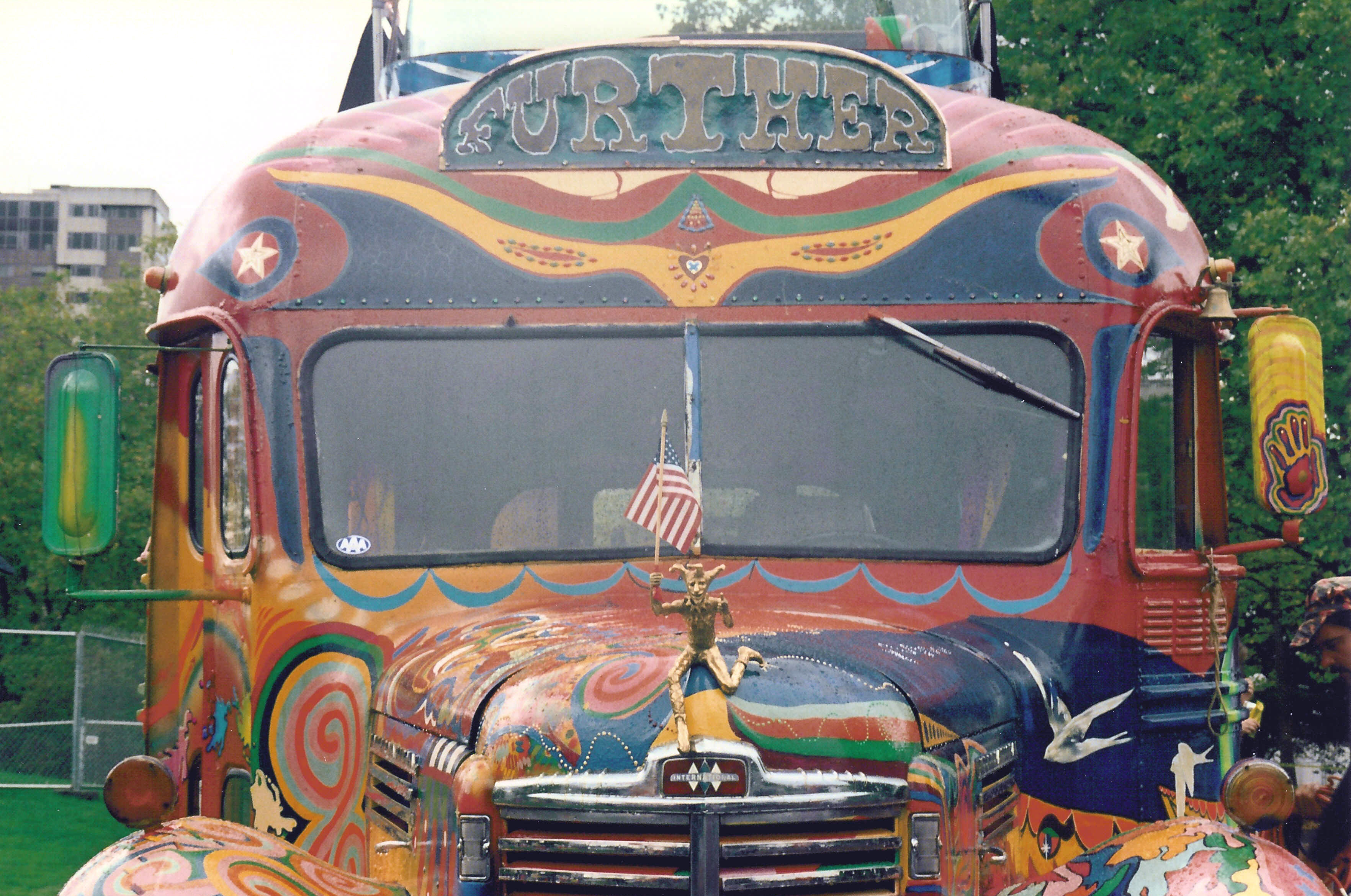
When the school district took away our buses, I was the roadside kid hitching home from school. This is how I met most of the rock musicians of that era, Ken Kesey and his cast of Merry Pranksters, and boarded Further, etc.

During the Summer of Love, I was pretty straight, I was also very young. I was 14—a mere 'tweenie. Between worlds. What I remember most from that era was the original 1967 "A Gathering of the Tribes Human Be In" in Golden Gate Park. It was a protest gathering to counter a new California law to make LSD illegal. Timothy Leary famously said from the stage, "Turn on, tune in, drop out" and then came tripping out through the audience to give my mom a hug.

A Beatnik and a Project Artaud painter, my mom was one of the first artists to embrace the hippie movement. She was at the epicenter of The Summer of Love. Mom dragged me through the Haight early and often. Sometimes our worlds intersected. I was a wide-eyed kid trying to take it all in. A vicarious bystander. Sure, there was fallout, growing up like that in unchartered territory. But I survived the social revolution more or less intact.

I didn't know it at the time, but I was meeting future mentors of our generation: Richard Alpert ("Ram Dass"), Allen Ginsberg, who chanted mantras, Gary Snyder, Lenore Kandel, Lawrence Ferlinghetti, and Jerry Rubin. Most of the bands who played in the parks were our near neighbors in West Marin: Jefferson Airplane, The Grateful Dead, Big Brother and the Holding Company, and Quicksilver Messenger Service.

For some reason, though we lived in the epicenter of this sociological turmoil, it's hard to write about it so, from time to time, I whittle away at it, in search of the through line. Memory's always a work in progress.

I told former Sonoma County poet, Colorado Arts Commissioner Art Goodtimes, a mushroom aficionado, that I had a wild mother who claimed I was an amanita child. As if that explained things. We laughed and blamed the drugs.

I was living out in rural West Marin and commuting into the suburbs to go to school, holding onto a dual life between worlds while most of my friends were defecting, tuning in and dropping out, and running off with bands or the circus. It was some crazy times. Somehow we grew up between the Be-in, The Summer of Love, and the Kent State Massacre. This was our legacy.

Yes, we were really there. And we do remember. Robert Frost wrote: The best way out is always through. We survived the 'tween years—we could see no other way out but through. What a long, strange trip it's been.


Sunday, May 5, 2013

'Tween Worlds


You know the Robin Williams line—even if he didn't say it: if you remember the 60s, you weren't really there. But we were really there. Meanwhile Gertrude Stein said: There is no there there. And there you have it as my grannie would say. What Robin should have said: Remembering it is tricky, at best.

SFchronicle_vault Dec. 9, 1987: Robin Williams hangs out with comedian Will Durst (left) after Durst lost a mayoral run. We're thinking that's Vera Carp of "Greater Tuna" on the right. 📷: Chronicle Archive

I follow a couple of Facebook groups and we've posted collective memory threads from multiple perspectives. Some of my recent blog posts are outtakes from those threads. Sometimes the outtakes gel, sometimes. they're merely placeholders of an idea I might revisit later.

We were reminiscing what it was like growing up between times during those turbulent years. Part of the backstory was the anniversary of the May 4, 1970 Kent State Massacre (which I didn't include). These outtakes are from random fragments that drifted in and out of that series of dialogues.

For some reason, though we lived in the epicenter of this sociological turmoil, it's hard to write about it so, from time to time, I whittle away at it, in search of the through line. Memory's always a work in progress.

I told Colorado poet, Art Goodtimes, a mushroom aficionado, that I had a wild mother who claimed I was an amanita child. As if that explained things. We laughed and blamed the drugs.

However, I was pretty straight, I was also very young. I was 14—a mere 'tweenie at the original 1967 "A Gathering of the Tribes Human Be In" in Golden Gate Park. It was a protest gathering to counter a new California law to make LSD illegal.


Timothy Leary famously said from the stage, "Turn on, tune in, drop out" and then came tripping out through the audience to give my mom a hug.

A Beatnik and a Project Artaud painter, my mom was one of the first artists to embrace the hippie movement. She was also one of the first artists to transform and live inside the Hamms Brewery vats—but that's an '80s story of punk rockers & hippie wars. Mom dragged me through the Haight early and often. Sometimes our worlds intersected. I was a wide-eyed kid trying to take it all in.

(I'm leaping ahead in my story here. The problem with a run-on memory fragment is that it's a challenge to force it to toe the timeline of congruity. Not an easy thing when the 60s' are invoked.) My mom knew Kush of Cloud House. She got around. She was featured in Whitman McGowan's poem-video, White Folks Was Once Wild Too. That's her dancing around the bonfire.
sfchronicle_vault June 1959: Allen Ginsberg flips through a Jack Kerouac book at a San Francisco bookstore. The Beatniks, as named by Chronicle columnist Herb Caen, had a positive influence on visual arts, performing arts and music. They challenged the values of a conservative city. And they built a foundation for a progressive future. 📷: Joe Rosenthal

I didn't know it at the time, but I was meeting future mentors of our generation: Richard Alpert "Ram Dass"), Allen Ginsberg, who chanted mantrasGary SnyderLenore KandelLawrence Ferlinghetti, and Jerry Rubin. Most of the bands who played were near neighbors: Jefferson Airplane, The Grateful Dead, Big Brother and the Holding Company, and Quicksilver Messenger Service.

I grew up between worlds and times in the San Geronimo Valley, a rural enclave which was rapidly becoming an alternative lifestyle destination. A lot of interesting folks shunned the cities and suburbs wound up in The Valley, as it was called. It was an uneasy marriage of radically different worlds.

I attended Lagunitas School District—LSD ('splains a lot). I was straddling the old redneck ranchers' world (living with my Irish Victorian grannie), and the Flower Children dancing in the dawn of a New Age—and me, trying to toe the mutable line. Not an easy task. 

During the late 60s, I attended Sir Francis Drake High School—the only high school (emphasis on the word high) in the nation to shut down a local draft board. 

We were a pretty radicalized group of kids. Our class president was Jared Rossman from Fairfax. That last name shoulld ring a bell—as in his older brother, Michael Rossman, a key figure in the Free Speech Movement at UC Berkeley in 1964. When we shut down the San Rafael Draft Board, we made the cover of Time Magazine and the 6 O'Clock news. And gave the FBI a new client list.

When the school district took away our buses, I was the kid hitching home from school. How I met most of the rock musicians of that era, Ken Kesey and his cast of Merry Pranksters, and boarded Further, etc.

I was living out in rural West Marin and commuting into the suburbs to go to school, holding onto a dual life between worlds while most of my friends were defecting, tuning in and dropping out, and running off with bands or the circus. It was some crazy times. Somehow we grew up between the Be-in, The Summer of Love, and the Kent State Massacre. This was our legacy.

Yes, we were really there. And we do remember. Robert Frost wrote: The best way out is always through. We survived the 'tween years—we could see no other way out but through. What a long, strange trip it's been.


My related blog post

Ken Kesey

Hitching in Marin during late 60s, early 70s

Note bene: for some reason someone, who posted a comment as "Anonymous" took umbrage to this post and wrote "b.s." Of course I didn't publish it—as they didn't bother to sign their name, nor did they say why they thought it was b.s. It's my past I'm writing about, so how is it b.s.? Maybe he thought it was made up. Who knows? Clearly he was full of b.s. for posting it. And so it goes. I invite comment and dialogue, but not b.s.

Sunday, May 20, 2012

Ken Kesey

Ken Kesey once sent me rather unusually inscribed checks to purchase some new age tarot cards I was selling. My job at Western Star Press, located in the basement of Alice Kent's big Victorian house in Kentfield, was sorting old tarot decks. 


My best friend's mother, artist, Rosalind Sharpe Wall and Alice Kent's brother, Bohemian, John Starr Cooke made a New Age Tarot deck, The New Tarot: a deck for the Aquarian Age (1969).


(See poet-librarian Jim Carmin's Facebook post and photo, about unpacking a VCR tape from Ken Kesey for the Multnomah Library Special Collections. Shall we say, it was, um, an acid-colored and tie-dyed VCR tape? Jim's post was the source of inspiration for this blog post. Once again, thanks Jim!)


There's not much on the internet about Alice Kent's brother, John, or the The New Tarot for the Aquarian Age, for that matter, which is odd, as John, friend of Timothy Leary, William S. Burroughs, and Paul Bowles, a disciple of Aleister Crowley, was revered as a sufi, he had the shakti. But I found this second-hand description of interest:
The New Tarot aka The Tarot for the Aquarian Age 
This deck is very different from most Tarot decks. The Majors have all been renamed and the suits are Blades, Serpents, Pears and Stones, which represent air, fire, water and earth respectively. The Majors are radically different; The Fool is called Nameless One, The High Priestess becomes The Mother, The Lovers becomes Unity and The World becomes The Virgin. All of the trumps are like this with the exception of The Hanged Man. The court cards have the normal names (Page, Knight, Queen and King), but the pictures do not show people. The Minors do not show scenes, rather they show the number and the requisite number of pears, serpents etc. The deck comes with 3 books, a 150-page guide which explains the reasoning and symbolism on each card followed by a short question and answer section for each card. The symbols were supposedly given to the designer during Ouija board readings in 1962 and 1963 and the deck was purportedly predicted by Madame Blavatsky in her magazine Lucifer. The second book describes a spread called The Game of Destiny, and the third book is a small booklet, similar in size to most deck booklets which describes a game to be played with the deck called The Royal Maze. The deck has its own box and the boxed deck and the books come in a larger box. © 1997 by Michele Jackson (the link is dead).
During the early 60s, John was living in Carmel. The Ouija board medium who/that channeled the deck to John, was called the One. So they called the deck The word of One. In 1964, a posse of psychedelic rangers traipsed down to John's place in Cuernavaca, at the foot of Popocatapetl, in Mexico, to work out the details. 

The New Age brujos delved into the occult with a little help from LSD, datura and magic mushrooms, to shepherd in the New Age. And then they brought it back to the Haight Ashbury. Which, in turn, led to the Human Be-In...that's where I come into this story, as I was there with my mother, who knew Timothy Leary....

And Ken Kesey and his Merry Pranksters were fed LSD treats courtesy of the US Army. Which led to electric kool-aid acid tests where other pranksters could “turn on, tune in, and drop out.” And the incarnation of Further in her day-glo splendor (and, yes, I boarded the bus when Ken stopped).

John and Rosalind designed the Tarot deck, Roz did the artwork. She wasn't very good at drawing or painting people as I recall... But she persisted with her painting throughout her life. I inherited a big box of her brushes, paints and tools when she died. The odor of rancid linseed reminds me of her.


My job was sorting and making up the decks to make them whole. And I do mean sorting—the printer had a serious mishap or played 52-card pick up with hundreds of decks during the final print run. Wheee! Talk about not having a full deck....

Though the cards were officially out of print, orders were still coming in. After all, this was THE tarot deck for the Aquarian Age. My tedious job was to send people missing cards, and  make up new complete decks—which required finding all the cards, and sorting them into major arcanas. Those images inhabited my waking and sleeping moments. Especially the burning ouroboros. Ad infinitum.

I didn't dare tell my mom about this rather particular job as my mom and Rosalind were arch-enemies on the highest wiccan order—they had a falling out over this deck. My mom had designed her own deck. They traded notes, then realized that they didn't see eye-to-eye on intellectual matters of the occult.


Ken and I struck up a correspondence of sorts. I told Ken that my mom, whom he likely knew, made me read his books. (She got around—and perhaps unofficially qualified as a Merry Prankster, as she probably dropped acid with Timothy Leary whom Nixon dubbed "the most dangerous man in America").


When the Beatnik scene died out, my mom embraced the next wave. She became a well-tuned psycho-delic card-carrying member of the "turn on, tune in and drop out" crowd. She made me read One Flew Over the Cuckoo's Nest when I was young, in order to better understand what her manic-depressive illness was like. 


Ken must've been impressed with that story, as a consolation prize, he sent me a signed complete set of a poetry & prose journal he was editor of, called "Spit in the Ocean." Much of it was beyond my comprehension. But I was a late bloomer. I do remember pausing over a grainy photo of the original Further, the magic bus I had once hitched a ride on coming home from high school—driven by Ken Kesey himself. What a strange trip that was.


Ken wrote me that the bus broke down and was rotting in the lower south forty pasture on his farm in Pleasant Hill, Oregon. It was the original Further. Maybe even during the Summer of Love. Who remembers, who cares? It was then. And this is now. It's always now but memory has a way of sneaking in and curling up on a sunspot when you're not thinking about it.


Further, the 2nd (painted in the late 1980s), proof that you can go back home again.
I was also distracted by Ebbe Boregaard outside my window, who was stripped down, a bronzed Viking god, rebuilding the front steps of the old house, telling me stories of restoring his Egyptian scow and poetry. Little did I know that the gods of poetry were beginning to develop the plot on my becoming a writer. I was 17. What did I know?


I didn't save Ken Kesey's letters or the books. Or rather, my first boyfriend Sweet old Bob Hamilton, ran off with a redhead named Dulcie, and all my books—he was the "literate" one who got me into this mess to begin with. Someone out there has them and is probably wondering who this "Maureen" was and why Ken Kesey sent them to her. 


Perhaps they'll turn up in a special collection somewhere. Perhaps it's just a spit in the ocean after all.


See my post: Hitching in Marin during late 60s, early 70s

Monday, March 22, 1999

Sidebar: Ram Dass notes


SIDEBAR: RAM DASS  (draft—need to check facts) 
                 
Spearhead of the psychological growth movement that began in the 1970s, eloquent spiritual leader, counterculture icon, and social activist, Richard Alpert, better known as Ram Dass, began his career as a psychologist to the hip intelligencia. 

In the summer of 1961, drug experimentation led him to the idea of God. Alpert went to Cuerna Vaca with Timothy Leary, where they took magic mushrooms and had an out of body experiences Alpert saw himself as God.  (WHEN???)  He came back to Harvard in the Fall of ’61 to do research on consciousness-expanding drugs. In ’63, both he and Leary were fired from Harvard faculty for experimenting with LSD with undergrads—as LSD was now illegal, criminalized that same year.

Unlike Leary, Richard Alpert, with a Ph.D. in Motivational Psychology (WHEN??), managed to keep his academic standing and taught at Stanford University, where he was also Director of Psychedelic Review.

San Francisco, 1967: an electrifying year of social deconstruction and reconfiguration. In January, there was a Gathering of the Tribes where spiritual generation amassed for a Human Be-In. At the Polo Fields, guest speakers Ram Dass and Leary spoke to some 10,000 very stoned pilgrims who turned on, tuned in, and dropped out en masse. I was there.

Alpert, Timothy Leary and the Diggers hang out with the Hell’s Angels in the Haight. Alpert lectured on LSD in San Francisco and UCLA on “Psychedelics Drugs and the Law” Kesey’s Acid Tests in Santa Cruz).

After the breakup of the Summer of Love, and the Haight, the hippies and anarchist Diggers moved onto the land with a circuit of communes in Northern California, Nevada, and New Mexico. Alpert settled in??? Marin Santa Cruz? XXX 

After experimenting with mind -expanding drugs, Richard Alpert turned to meditation to seek drug-free enlightenment. In mid-1967, Alpert’s friend, Beat poet Allen Ginsberg returned from India and told him about meditation. Alpert went 1st class in a Land Rover to India. In Kathmandu he met 27 year-old Californian from Manhattan Beach? Bagawan Dass, who’d been studying in India for years. High on peach melbas? they connected on several levels of spiritual life, kundalini... 

Bagawan Dass toured with Richard Alpert. They went to the Himalayas where Alpert met his future guru, Neem Karoli Baba, and became a disciple. Alpert experienced shaktipat (spiritual awakening), and spent 3 months doing seva (volunteer work) at an ashram while learning and practicing various lines of yoga. Alpert was given the name, Baba Ram Dass which means “Servant of God.” When Ram Dass returned to the United States (an expired visa), he lived in upstate New York (with LEARY??), where he began lecturing informally about his experiences.... garnering a wide following.

Those recollections evolved in the groundbreaking book, Be Here Now, which became something of a bible in New Age circles. Be Here Now which chronicles group meditation process in the New Mexico desert…xxx

“Richard Alpert used to talk about the orange basketball,” remarked Stewart Brand some years after the Haight scene had collapsed. “Psychologists had raised some ducklings with a basketball and they imprinted on it as if it were their mother. Wherever the basketball rolled, they’d follow it. That’s what the movement was to us. That was our basketball. Wherever it rolls, we’ll follow.”  p281 Rolling Stone editor Charles Perry, “The Haight Ashbury: A History” (84)

Ram Dass’ guru died in 1973; Dass formed the HANUMAN FOUNDATION in 1974 to “further the spiritual awakening in our society.”(Hanuman is the Hindu monkey god of XXX) One aim was to promote development of a broad base for meditation in the West. They began with a list of facilities and helpful quotations which evolved into a best selling, popular book, Journey of Awakening, the proceeds of which helped to support the foundation.

Ram Dass’ continued rise in fame was partly in response to the latent yearnings of the “Me Generation” in pursuit of spiritual connection, of greater consciousness and equanimity, what Tibetan Lama Trungpa Rinpoche dubbed as spiritual materialists.

“In the sixties, when we first encountered Eastern ideas of enlightenment, we expected to be personally enlightened in a matter of a month, a year, or a decade at most. …but now in the mid-eighties we have come to appreciate the fine print in the Eastern texts… We have learned patience and humility and an understanding that we practice dharma without attachment to the goal”  —Grist preface.

Ram Dass attempts to share with us “the unspeakable” to “know what is not knowable. … For ultimately we will transcend knowing.” from Grist, a pioneer who forged new psychological territory in the West by bringing from the East,  translations of teachings of eastern mysticism of the westerner.

Ram Dass drifted into the Death and Dying Project late ’70s and co-wrote a book with Stephen Levine, “Grist for the Mill” documenting one-on-one work with death & dying and the spiritual path. The project created innovative hotlines for the terminally ill, as well as centers, the 1st in Santa Cruz? Groundbreaking videos of the project were filmed in Berkeley.

In the early ’80s, Ram Dass traveled extensively, visiting monks and religious centers around the world. “The eighties are the sixties twenty years later.” Wavy Gravy once quipped to Ram Dass. During the ’80s & ’90s, Dass lent his name and energies to a series of charities and volunteer projects, and was also the most sought after speaker for new age conferences, workshops, the lecture circuit and events where he was “known for ability to convey mystical ideas with lucidity, humor and grace.”  (Don Lattin, 5/26/97, SF Chronicle).

After his stroke in February of ’97, those closest to him said the loss of language was the most frustrating aspect. If you listen with patience, the old message still gets through; he communicates with what he calls the “eloquence with silence.”

AGING AND THE HUMAN SPIRIT” WITH RAM DASS: SERVANT OF GOD

at the First Church of Religious Science, Oakland Hills, Spring Equinox, 1999

A Tibetan bowl rings in the silence of the day: pulsation of sound resonates midpoint between the ears, that primal space we call the mind/brain-ego, where Ram Dass’ blood betrayed him with the genetics of age. A “stroke of genius” in February, ‘97, left him paralyzed, without language, just as he was rewriting a book: “Conscious Aging.” Roses and fire lilies burn on the proscenium, the altar.

They wheel him in up the ramp. What was I expecting? A shell of a man? Non-presence? A Stephen Hawkins style imprisonment? Stroke or no, this man, spiritual teacher of a generation, is fully present, shedding light. A pink camellia, heart-open, on his denim jacket. His right hand strapped down to the arm of the wheelchair.

This is the second lecture of the day for the former Harvard professor and psychologist. The emcee said that the first gathering was also standing room only. Ram Dass, a.k.a. Richard Alpert, can still pack them in. Ram Dass burst onto the national psyche in 1963 when he and Timothy Leary were fired from Harvard for taking LSD; he met up with Allan Ginsberg, and traveled extensively to India and beyond in search of a drug-free enlightenment, where he became a disciple of Indian guru, Neem Karoli Baba. In 1971, he penned his experiences and insight on meditation and East-West mysticism in the landmark book, “Be Here Now.”


(Last time I saw the 68-year-old self-styled counter-culture guru, Baba Ram Dass, was presiding at a sold-out Timothy Leary benefit at College of Marin in the early ’70s; we were literally sprawled at his feet on the gym floor and there he swayed creaked above us, like a young redwood sapling in the storm. At times like this, I wonder why do I merely recall the mundane proximity of his new lily-white sneakers? And not what he said.

Memory dusts off and replays a tape unused for a quarter of a century: Alan Ginsburg chants, his lover, Peter Orlofsky sings a dirty ditty; Alan’s sitar whining about altered states. I begin to remember more.

A mantra gathered us in, like the hearth. Whether he was there, or in prison, or on the lam from a LSD-fueled event, former Harvard co-professor Timothy Leary was present. We chanted: “God Bless Timothy Leary.” At the end of the talk, Ram Dass singles us out and hugs us: an impromptu Be Here Now-in with Ken Kesey’s busload of Merry Pranksters illegally parked in the loaded zone, collecting cosmic fares in the galleries of the soul… But then, in the late ’60s and early ’70s, Marin was that kind of place: dharma bums and  Diggers.)
You can read or download “Be Here Now” here. Free! Nope. HarperCollins had it removed. Sorry. There’s always the library. And I bet it’s on audiobook, too.
This time we’re far better dressed (and well-heeled, from the look of it), prettily sitting in church pews. Aging Baby Boomers, we spontaneously rise: a standing wave of welcome surges through the church as they wheel him in. Richard Alpert is still ineffably Ram Dass, as I remembered him. 

The Reverend Joan Steadman reads off Alpert’s curriculum vita: Impatient, we watch her mouth slow words down like “psychologist” and “sociologist.” She adds to the list: a Ph.D. in human motivation and development, from Weslyan; teacher at Harvard, Stanford, and UC Berkeley; he expanded consciousness and LSD. 

The packed audience perks up. Ram Dass smiles, nods at us knowingly. (We’ve all been there.) The audience laughs knowingly. Speaking of Be Here Now; how many of us found this event via the grapevine? Many of us raise our hands. Some of us at the very last minute. We overhear some blue-haired church patrons ask: “Who is this Ram Dass anyway?” We giggle. Odd bedfellows, we. It’s going to be a wild sleigh ride.

The Reverend continues, “He was dismissed from Harvard—which was a blessing.” Utterly delighted (for there’s no other way to describe the radiance emanating from his face), Ram Dass slaps his good left hand to his knee; we crack up. 

She lists more stats: He went to India…she mentions various gurus. Baba Ram Dass means “Servant of God… Mentions his lifelong seva, the Hanuman Foundation: the Dying Project, the Prison Ashram Project, the SEVA Foundation. She gets down to the wire: “in February of ’97 he was ‘stroked. Coining Ram Dass’ own etymology, she explains to us how speech aphasia works, and introduces the remains of the day (for we’ve crashed the gates of this church en masse): spiritual dimensions of suffering and aging. Service as a spiritual path.

From his chrome-wheeled chariot-throne, he surveys us: his loyal subjects. Sets the tone with a moment of silence: we lean toward him, not knowing what to expect. The roots of cognizance? or Babel-speak… 

Eloquent Ram Dass, once one of the most sought after speakers on the New Age circuit, observes us to see if we’re up to snuff. The internet becomes the day’s topical metaphor by which to surf this event that ranges from the physics of the stroke and doctor-gods, and being caught between incarnations, to the metaphysics of the sanctum of the inner journey…

“The ground rules of speech…” He haltingly searches for a bridge in the neuron pathways so that his words may migrate to our nascent ears. “Because of the aphasia (a silence follows)… That’s it! The sickness… Every time I search for the word… because it’s… The damage is close to the dressing room for me. I dress them in words. Inside (he points to his head),… Inside I know what to say, but… 

(A series of false starts; we begin our job as active listeners by filling in the connective tissue of language. He is patiently waiting for us, his errant spiritual children to get it! I make good use of parentheses and ellipses because translation of synapses into synopses is less interesting than the unexpurgated poetics of aphasia, and I resist the temptation to polish or fix his speech; this writing inadvertantly documents how he must struggle to convey an idea with a minimum of words.)

“Now that… those silences… I make use of them… The first part of the silence, say… five minutes or so (he exaggerates and shrugs as if apologetically, then instructs us on how to listen, really listen), I look for the word… And you can look for the word too! (We giggle.) I’m looking for an interaction. People. Their word is as good as mine…I start to surf the silences on the outside, it gets me high because I’m surfing the silence. It surfs in and in and in. I get to the crux of me, and I get to the silent self. (He is extraordinarily present, razor-honed. I can hear the structure and craft the paragraph and punctuation in his slow speech; I’m able to enscribe what he says, almost verbatim.)

“We are each so many selves. In ‘I,’ what does ‘I’ mean? I-ego? I-soul? I-God? So, when you look at somebody… I can look at all of you… it’s a redundancy as far as God: god god god god (he repeats, pointing to each of us: mirror-images). It’s interesting looking out at another person. You look at me, I’m in a wheelchair, I’m a wheelchair-er! (We giggle at the verbing.) looki g at you. And you have reactions to that. That’s my role. 

Then, there is Ram Dass. Yech! Ooooh! (we snortle with laughter) Ahhhhh,” he says, looking up at us beseechingly. His good left hand is laden with puns, it dances and orchestrates a subtext of linguistic imagery from God-like inspiration to stick shifts. In the ensuing silence that follows, I surf the idea of dexter-sinister: how the church fathers delegated the left hand to be the Devil’s own domain. It seems God too, is a Merry Prankster.