Showing posts with label Hebrides. Show all posts

Saturday, December 31, 2022

The Isle of Staffa

In 2008, we sailed by the isle of Staffa from the Iona to Mull ferry and I was dumbstruck by the beauty of all that columnar basalt dressed in lichen, moss, and sea spray. I wanted to jump off the deck of the small ferry boat. Of course there was no time to backtrack and visit the island. 

Ours was a mad overnight run from Oban, courtesy of a newfound friend who scored us coveted ferry tickets for locals on an overbooked ferry. Driving down Mull from the wee village of Craignure to catch the Iona ferry at Fionnphort, we were late late late, so we barreled down the one-lane road like banshees along the glaciated Ross of Mull which took my breath away, such ragged beauty. 

Iona was extraordinary, on my bucket list for ages, My Irish grandmother, who inspired me to visit Iona, often talked about Iona and Tír na nÓg, the land of the ever-young, in the same breath—it was a whirlwind visit replete with several missed ferries, no place to stay, last minute reprieve, but then, it was over, we had to leave that singular beauty. 

Saturday, October 5, 2013

Olaf the Peacock's Irish Mother


Heiðarvíga saga, story of the heath-slayings

  The Icelandic sagas are prose histories of the Norse —and Celts—who settled in Iceland during the 10th - 11th centuries. The sagas, capturing an earlier oral tradition, were probably set to writing during the 13th and 14th centuries.

"Some of the richest and most interesting writings from medieval Europe come from one of its furthest corners: during the 13th and 14th century Icelanders began to write down the stories they had collected orally from previous centuries. These sagas would cover events in Iceland and elsewhere, going back to the days when the island was first discovered and settled back in the ninth century. They are stories of family feuds, outlaws and the occasional monster lurking somewhere the uninhabited stretches of the Iceland.' —Medievalists.net 

The only problem with this post narrative (above) from Medievalists.net is that when the Viking Norse "discovered" an "empty" Iceland, and Norse colonists arrived ca. 870-930 AD—there were already Northern European settlements dating from ca. 400-500 AD. And the other problem with Medievalist's statement is that those Icelanders were not wholly Norse, their slaves and concubines were often Irish or Scottish. Of course, viking means pirate, so I guess pirating of history itself is fitting.

Naddod was a Faroese Viking (by way of Shetland) who is credited with the discovery of Iceland. Grímur Kamban became the first to settle ca. 825. Grimur was either Irish/Scottish or Norse Irish, with a Gaelic nickname. 

Garðarr Svavarsson is credited as the first Scandinavian to have lived in Iceland one winter. He was was married to a woman from the Hebrides. A Hebridean woman would be Irish/Scottish, not Norse as the Norse did not bring Norse women with them. They took Celts as slaves. The Vikings were NOT the first Northern Europeans in the Faroes, and Iceland. (Not to mention, the Inuit.) Unless, of course, one were to definitively define Icelanders (and Faroes Islanders) as half-Scandinavian and half-Celtic.
The medieval chronicler Ari Thorgilsson said Ingólfr was the first Nordic settler in Iceland, but mentioned that "Papar" – i.e. Irish monks and hermits – had been in the country before the Norsemen. He wrote that they left because they did not want to live amongst the newly arrived pagans.  Ingólfr Arnarson —Wiki
Hjörleifr had been murdered by his Irish slaves because of his ill-treatment. Ingólfr hunted them down and killed them in the Westman Islands (Vestmannaeyjar, named after the slaves).
This tidbit's significant as you will see from the excerpts of the tale posted below, the Laxdaela Saga. The sagas seem to be "fictionalised distortions of real societies.…" and 'family sagas' of Icelandic literature are quite distinct, the overall network of saga society is consistent with real social networks." It's a strong possibility the Icelanders were following in the tradition of Irish recording of oral tradition, though a few centuries later. They could also have had Irish scribes living among them.

(BTW, what is this skewed fascination with Vikings anyway, and why is most everything we associate with Vikings, is plain old wrong? Like (Celtic) horned helmets? Where did we pick up this romantic ideal fraught with bogus information? Does it date back to Hitler, and his search for the "pure" Aryan race? Or is it an earlier Victorian hangover? But I digress.)

The ceremonial Waterloo Helmet is the only existing Celtic bronze horned helmet —La Tène  c.150–50 BC. —Wiki

The word "viking" was first popularised at the beginning of the 19th century by Erik Gustaf Geijer in his poem, The Viking. Geijer's poem did much to propagate the new romanticised ideal of the Viking, which had little basis in historical fact.    —Vikings  

A romanticised picture of Vikings as noble savages began to take root in the 18th century, and this developed and became widely propagated during the 19th-century Viking revival.

Norse myths were religiously adopted by Germanic Neopaganists in Germanic countries during the early 20th c., and in most of the the English-speaking world during the 1960s. It's probably during that latest Neopagan adaptation that most of our Viking misconceptions were spawned.

There's an Irish oral tradition that a Tralee mariner Brendan the Navigator visited Iceland and the Faroe Islands circa 400 AD. Bantry's (where my family is from) patron saint is Brendan. (Based on an immram, or voyage tale, the Brendan Voyage tale was transcribed in Latin in 800 AD.) The description of Brendan's "insulae" (islands) is remarkably similar to the Faroe Islands.

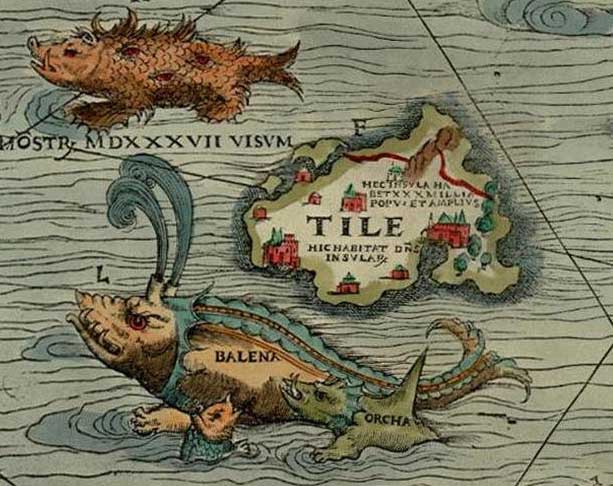
One fanciful name for these mythical northern islands was Thule, which was reported to be "a six days' sail north of Britain, and near the frozen sea." (There was persistent belief that islands to the west of Great Britain recorded as early as 330 BC. Whether fact or fiction, it fed the questing beast)  

The Irish Tír na-nÓg (Land of the Ever-young) was another mythical island to the west. Reason enough to set sail—because they were there. "The Icelanders' own records mention about 400 original settlers "with mostly Celtic nicknames" who were living in Iceland previous to Norse colonization. (Clements). The significant part of that statement is that settlers were there previous to Norse discovery.

Thule or Tile on the Carta Marina of 1539 by Olaus Magnus, located northwest of the Orkney islands, with a "monster, seen in 1537", a whale ("balena"), and an orca. —Wiki

My Bantry grandmother told me that the Irish monks brought sheep to the Faroes, and the name, though Nordic, means sheep islands. And sheep islands do figure into the Brendan tales.

St. Brendan described the largest island as the Island of Sheep (Streymoy?) A bay in the southern part of Streymoy, is called Brandansvik (St. Brendan's Bay). His "bird paradise" might be the island of Mykines. There are several Faroe places named after the Irish monks (papar) including remote caves. —Faroe Islands Review History
The Faroes were part of a trade network with Dublin as a hub, and many Irish women made their way there as wives or slaves. DNA analysis shows that 84% of Faroese females are of Irish or Scottish descent.  —Faroe Islands Review History
(NB: contrary to modern belief, Irish monks were NOT celebate.)

Dicuil, in the 2nd half of the 8th century, wrote of "heremitae ex nostra Scotia" ("hermits from our land of Ireland"—Scotia was Ireland, not Scotland!) who lived on the northerly islands of Britain for a hundred years until the arrival of Norse pirates. An Irish nickname of Faroe islanders, Na Scigirí, possibly refers to the Eyja-Skeggjar (land of bearded men).

Northern European settlements (whether Irish, Scottish or Pictish) in the Faroes have been archaeologically dated to ca. 400 AD.
“There is also good evidence that they [the Celts] had sails: there is a model boat from Ireland that dates from about 100 BC that has a mast, which could be a model for Celtic boats more generally,” Jennings said. “There is not so much evidence of sails in Norway until as late as 700 AD. It is therefore more likely that these early Faroese settlers came from the British Isles.” —Andrew Jennings, Nordic Historian
The Vikings settled in the Faroe Islands before they went to Iceland, ca. 800 AD. Then, 60 years later, Iceland was supposedly "discovered" by the Norse. That's the equivalent of three generations in the Faroes before the Norse shoved off to Iceland. Plenty of time to hear about those Celtic settlements in Iceland. During the settlement of Iceland, the Faroes, the half-way mark, was the only provision stop for grain, meat and water.

The Faroe Islands, a remote North Atlantic archipelago, stepping stones half-way between Scotland Norway and Iceland, were inhabited 500 years before the Vikings arrived. Archaeologists taking "scientific samples for environmental archaeological analysis from the medieval Viking settlement,“ did not expect to find evidence of a previous culture.

Archaeologists Mike Church and Símun V. Arge said: “We uncovered some burnt peat ash containing barley grains under the Viking longhouse. It was not until we had it dated that we realized what we had found.” Barley is not indigenous to the Faroes, and there were "old field systems that didn’t seem to tie into later settlements." Church concluded, “There is evidence of Irish hermits sailing into the North Atlantic islands in a passage by an Irish Monk called Dicuil in 825AD.”
Many other islands lie in the northerly British Ocean. One reaches them from the northerly islands of Britain, by sailing directly for two days and two nights with a full sail in a favourable wind the whole time … Most of these islands are small, they are separated by narrow channels, and for nearly a hundred years hermits lived there, coming from our land, Ireland, by boat.
Here's the rub: Icelanders have maintained that they were purely Scandinavian, and that they lived in genetic isolation for 1200 years. Note that there were no Irish mentioned in the equation. The Irish were expunged from Icelandic oral tradition and there's almost no mention of the Irish in the Icelandic sagas that were recorded around the 13-14th centuries—with the exception of the Laxdaela Saga, and Burnt Njáll—whose name sounded suspiciously like the Irish Niall. (Kin to 5th c. Niall Nóigiallach, whose middle name was randy: he dinna wear pants; his Y-DNA genes got around. M222 sub-clade rools.) But in the 1970s, my English professors insisted there was NO relationship—merely coincidence. Icelandic peoples were Scandinavian.

Then the human genome mapping project got up to speed. Lo, there were chinks in the Viking armor. Iceland had relative genetic isolation, yes, but their preferred bedfellahs of choice were Irish captives—who did not come or go gentle unto that good night. And who were the real transmitters of culture? The Icelandic-Irish women who spoke to their children in Irish, and in some cases, gave them Irish names. And we know this because they just happened to turn up in Icelandic sagas.

New genetic studies in Iceland uphold a deep Irish connection in that the DNA genome tests reveals that 20% males and 63% females are of Irish ancestry (Irish Roots in Iceland). "The population of the Faroe Islands appears to have the highest level of asymmetry in Scandinavian vs British Isles ancestry proportions among female and male settlers of the archipelago." mDNA analysis shows that 84% of Faroese females are of Irish or Scottish descent. Mitochondrial DNA is passed from mother to offspring. (Then there is the mystery of the Celtic sheep in the Faroes.)

Burnt Njáll the lawyer, and Erik the Red(head) had prodigious tempers. (I'm gathering that when the omens were bad, the Vikings burnt all the lawyers.) All that loose Irish DNA might explain some of those Viking redheads too. Tróndur í Gøtu of the Færeyinga Saga, was described as having "a shock head of red hair, and…freckled of face and right grim of look", features which were inherent to Faroese, who are said to have descended from Thorstan the Red's daughter. (I bet she was Irish). The appearance of red hair and freckles were exotic enough to be recorded in the sagas. By contrast, most Norse were dark-haired, not blond.

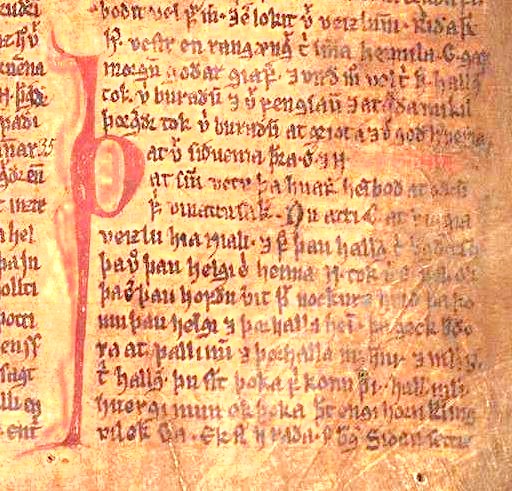
Excerpt from Njáls saga (Möðruvallabók AM 32 folio 13r cia. 1350). —Wiki

At least 60% of the Icelandic and Faroese.maternal gene pool hails from Ireland and Scotland. And the Viking contribution: "mtDNA lineages from Scandinavia to the populations of Iceland, Orkney, the Western Isles, and the Isle of Skye are 37.5%, 35.5%, 11.5%, and 12.5%, respectively." The mDNA study shows that the majority of female settlers came from the British Isles, "whereas ~80% of male settlers were Scandinavian." This data confirms Irish oral tradition. 

The study also notes that "the Gaelic contribution to the Icelandic mtDNA pool may have been at least as large as that from Scandinavia." (mtDNA and the Islands of the North Atlantic). That means there were almost no Scandinavian women emigrating form Norway. Norse-Irish women from Dublin and the Hebrides, yes.

I found interesting research on Iceland where "genealogy is an integral part of the culture — 80% of all Icelandic people who have ever lived can be traced on family trees." The country is isolated geographically, with little migration from other places ever since a few hundred Vikings and some Celts arrived almost 1200 years ago. (Decodeing Iceland's DNA). Note the acretion: "and some Celts," and these Celts are?

Islandia map by Abraham Ortelius ca 1590 —Wiki

Contrary to what we've been led to believe, Iceland was not an isolated Norse settlement unto itself. There's also a slew of Icelandic-Irish names which is curious as Vikings were more conservative naming boys than girls: Njáll/Njála, Brjan/Brjánn, Dufniall/ Domnall, Konall, Kjartan, Kjallakr, Kaðall, Kormakr, Meldun, Melpatrikr, Oskar, Patrek, Brigit. 

An Icelandic village, Patreksfjörður, is Padraig's Fjord. Vestmannaeyjar means "Irish Island." Írafell, and a mountain called, Írafellsbunga (are Éire (Irish) Fell, and  Éire Mountain, respectively), and Kjaransvík (Ciaran’s Bay) in the Westfjörðs, which seems to have been an Irish-Icelandic stronghold.

Of particular interest is the placename, Melkorkustaðir, once home to an irate Irish slave girl, Melkorka (see my story below), who was mother of Olaf the Peacock, a prominent character in many Icelandic sagas. None of this proves the Irish were in Iceland beforehand, it just proves they were there right alongside the Norse—in the thick of things. It also strongly suggests the sagas are based on historical fact.

Recent archaeological digs in the Faroes and Iceland note that there were Northern European settlements from ca. 400 to 800 AD, that definitely predate the Norse settlements. Archaeologists are reluctant to suggest as to who these people actually were. Chances of finding burials and intact DNA are slim to none. 

Also, Vikings often built on top of the older sites—which means their either integrated, or wiped the other settlers out. We know the earlier settlers raised barley, cut peat turf, and built soil beds with ash and seaweed—like Aran Islanders.

Another fact that seems to get buried in the Viking version of history is that female Icelandic settlers; slaves and concubines were predominantly Irish. Aud the Deep-minded, (Unn, or Auðr, daughter of Ketil Flatnose (ruler of the Hebrides)—he kicks off Laxdael Saga). Aud/Unn/Auðr, wife of Olaf the White, King of Dublin (853 AD), brought Irish slaves with her to Iceland from Dublin (by way of Caithiness). (Clements). She may not have been Irish, but it's possible that her father was Norse Irish, (and the chances of her mother being Irish?) which makes her…

At any rate, Aud/Unn/Auðr was a singularly unViking woman: she secretly built a ship in the forest (Scandinavian women were not allowed to own ships; had fewer rights—unlike Irish women who were on equal footing with men); she sailed to Orkney; married off one of her granddaughters; and then set sail for Iceland. She then freed all her Irish slaves in Iceland. Another reference noted she had a child with an Irish slave. I guess the attraction worked both ways. Fiercely independent Aud sounds similar to 15th c. Irish pirate queen, Gráinne Ó Máille ( c. 1530 – c. 1603).

Olaf the Peacock's grandfather, Höskuldr Dala-Kollsson's mother was Thorgerd Thorsteinsdottir, daughter of Thorstein the Red, who was son of Olaf the White, King of Dublin, whose father was Hiberno-Norse warlord Ingjald Helgasson. I won't even mention that several these Icelandic and Norse characters who settled the Hebrides, or came from there, before emigrating to Iceland, were also Norse-Irish. (And no you won’t be tested  on this.)

Ketill Bjǫrnsson, aka Flatnose (Old Norse: Flatnefr), was a 9th c. (Irish?) Norse King of the Isles—who led raids AGAINST Norway. (Orkneyinga Saga). However, Irish genealogy recorded that Aud's father was also Irish King Aedh. (Annals of Ulster). It could be a scribal error, or there was more than one outrageously uppity Norse woman named Aud. And Aud sounds a lot like Aedh. A female version of Hugh? 

Ketill sounds suspiciously like Kaðall/Cathal, and Flatnefr may be a phonetic corruption of Find (white). Scratch the surface—most emigrating Norsemen had Irish mothers, their children had Irish nicknames. (Jennings and Kruse).

The sagas of Iceland's colonization attempted to expunge all record of any Irish presence, but the Laxdaela saga-maker captured an Irish family pedigree—probably because the story wouldn't work without the Irish connection. Unique among Icelandic sagas, the Laxdaela Saga seems to have a feminine hand—recording matrilineal lineages in both Norse and Irish; perhaps it was composed by a woman, in Western Iceland, ca. 1230-1260.

Excerpts from the Laxdaela SagaChapter 21:

Sunday, February 5, 2012

DUN I, IONA

DUN I, IONA
(after a translation from the Ohlone)

I dreamed you were a sliver
of light glinting on the curve of the sea
On the machair, the rabbits
cleansed their scalloped sand porches
while amid the lambs, the hares stood sentinel
I dreamed of you dreaming me
on the granite dome of Dun I,
at the center of the island
between a rowan and an oak
in a crevice at the well of age,
the falcon's eye, a distant sun
dancing on the edge of the world.

2/5/12

published in A MOUSE THE COLOR OF MOUSE ©2012
Poetry Inside Out, Center for the Art of Translation
Medusa's Kitchen, 2012

Saturday, May 30, 2009

Tweed Waulking


Photo: Mabli Agozzino, Mouth Music workshop with Pam Swan at UC Berkeley. That's me in magenta sitting next to Pam.

Listening to the Browne Sisters sing A Thousand Curses on Love in Scots Gaelic (Mile Marbhphaisg Air A'Ghaol).

Call and response tweed waulking song from the West Hebrides—possibly one of the most beautiful places I've ever been in the whole wide world. Tweed waulking is exclusively women's work. Very tribal.

They've softened the blow, so to speak, with their harmonies. Usually the song has quite a thump downbeat as the women smash the tweed into the table and pass it on. Smash it down and pass it on.

No, we did not soak the tweed in urine as is traditional. But the tweed was soaked in water. It’s quite heavy.

Monday, July 21, 2008

Iona, The Inner Hebrides, Scotland


Just getting to the sacred isle of Iona was strewn with so many hurdles that it made going on pilgrimage seem like a piece of cake. After a few untimely mishaps in Oban, we missed the early CalMac ferry to the Hebridean Isle of Mull. We missed it because Neil was overtired from his music gig the night before at Markie Dan's Pub in the basement of the four-star SYHA hostel, the Victorian Corran House.

And like a foundered horse, Neil O'Neill just couldn't get up to speed. No amount of carroty bribes or verbal threats would move him. It wasn't just the craic and the free beer or the amazing variety of scotch to choose from, or dancing with Anne, or jammin' with his old friend, Louis Barrow, that wore him out.

He was at cross-purposes with himself—being both long in tooth and long in jaw. Too much gift of the gab. And a good time was had by all. A real ceili that went on into the wee hours. Whereas I was just plain old cross as a bear. Next morning, even at top dead speed, Neil ONeill, the man so nice they named him twice, was in slo-mo. And that was that.

The tourist resort and fishing village of Oban, in Argyleshire, smack dab in the middle of the whisky trail, is also the leaping off point to the Gateway to the Isles. With incredible sweeping views of the Inner Hebrides, the Isle of Kerrera (where Alexander II of Scotland died), and the mountains of Mull, the Oban waterfront has it all. A picturesque horseshoe harbor, and a waterfront, with rainbow-hued houses much like the Hebridean villages of Tobermory or Bonnie Portree, but on a grander scale, Oban has its share of towers and castles too—even a Victorian folly replica of the Roman Coliseum looms on the horizon.

There is nothing more desolate than hearing the departure whistle of the ferry you're supposed to be on. No ferry tickets were left for the next sailing two hours later either. It was full up. Which meant visiting both Mull and Iona were out of the question. To have come this far and be thwarted by time and circumstance, was testing what little self-control I had left. I was feeling positively gladatorial. My Irish was up. And there's no putting it back switch. Must've been a combination of the whisky vapors and the coliseum on the hill spurring me on to a full-blown tantrum.

But we got a last minute (re-)prize, or rather (sur)prise ferry tickets from Anne, a local fairy godmother, who was good at pulling in strings and had a few local favors due. With the help of the incredible, the inimitable and stately Anne McDonald, proprietor with her daughter, of the Corran House Hostel, who was a former teacher from the Isle of Mull, and friend to actors—we managed to squeeze in a mad overnight jaunt to the holy isle of Iona.

Anne found us sitting like stunned birds in our rental car, ensconced in the ferry wait-listed Godot lane, in utter despair. The air was thick with disappointment. We missed the boarding cutoff by three cars. I brushed aside my tears and flagellated: if only Neil had gotten it together sooner.... Not being able to board the ferry was like a body blow. Our last hopes had vanished, sunk like a stone to the bottom of the harbor of regret.

But Anne came up to the car, smartly rapped on the window, and handed us the coveted ferry tickets—which we couldn't purchase for love or money. She said we'd have to pretend we were residents—a little hard to pull off in a rental car. But everyone kindly looked the other way. Anne was truly a guardian angel. I was sad to see her go. It was like leaving family behind on a distant shore. But the ferry was boarding. They waved us on.

We were elated. The ferry ride from Oban on the Firth of Lorn, to the Isle of  Mull, second largest of the Inner Hebridean islands, was amazing and postcard scenic. The passage takes about 45 minutes and you pass very close by Duart Castle, the oldest inhabited castle on Mull, home of the 28th Chief of Clan MacLean. The quintessentially Scottish Duart Castle was featured in Entrapment (1999) with Sean Connery (a Maclean on his mother's side) and Catherine Zeta-Jones.

I stood on the tallest deck of the ferry and spread my wings—a nylon windbreaker—and I was transported, or  rather, momentarily airborne. I was hovering over the deck like a big black bird in the gale winds sweeping unfettered down the Lynn of Lorn, Loch Linnhe. We passed a lighthouse on Eilean Musdile guarding the southern tip of low-lying Lismore island (the great garden isle), once a major center of Celtic Christianity. Oddly, where the water is still on the leeward side, the 1883 lighthouse that replaced the standing stone that once marked the winter solstice, looks like a stripped down version of the Taj Mahal.

The ferry ride was too soon over. I wanted to sail on up the passage to Skye and the Isle of Lewis. But Mull was the gateway to Iona. We landed at the wee village of Craignure (little more than a wide spot in the road) on Mull's eastern shore, and headed south on a country road. We passed the entrance to Duart Castle. Incredible jeweled finger bays off the Firth of Lorne, sheltered coves. It was like being in Northern California and in the tropics at the same time—indescribable turquoise and cobalt waters, white sand beaches.

The isle of Mull is quite large and mountainous. As we drove down the sinuous road, through valley & glen, I kept thinking I was in Ireland. The Hebridean Isles, scrupulously scoured and carved by glaciers, are quite different than the rest of Scotland. The lowlands is a misnomer—there are long rolling ridges, but als a sameness to the topography.

We had little flex time to spare to catch the Iona ferry at Fionnphort, so we drove like banshees down the fantastic glaciated Ross of Mull peninsula, wildly swerving around flocks of Hebridean and merino sheep and sollitary cyclists. It takes approximately an hour to sanely drive from Craignure to Fionnaphort (pronounced Finafor)  on a 40-mile-long sinuous one-lane road. Not many tourists, but lots of sheep, so we rarely had to make use of the skinny little pullouts for oncoming traffic.

We rounded a bend and wended through the croft-village of Bunessan with its sole hotel/pub on the shores of the seaweed garden of Loch Scridain. An oncoming lorry and no turn-outs meant we had to back our way through the village in reverse. Odd way to sightsee backwards. (Bunessan is home of the Gaelic hymn, Child in a Manger, known to Cat Stevens fans as Morning Has Broken). Ben More was hiding in its own weather system.

Then another wide spot in the road, the hamlet of Pennygheal, marked with strange striped barber poles designating a passing spot. Sad to see so much beauty whizzing by at 60 MPH. No time to lose. And then it was on to Fionnphort, population 70-80, depending on who's counting,

But we missed the Iona foot ferry by minutes, and then we missed the 2nd ferry too as we had to park the car up at the St Columba Museum, because we found out too late that the road shoulders were marked No Parking. Then we had to lug our stuff down to the ferry... Luckily they came every 30 minutes, more or less, depending on the weather and the inclinations of the captain. Hard to believe that some 140,000 tourists a year are funneled through here.

The ferry disgorged its handful of foot passengers, returning tourist-pilgrims and some four-footed ones–sheep! Was I the only one enjoying the religio-pastoral joke? We lugged our gear down the ramp. The black-faced sheep suspiciously eyed Neil's guitar case and daintily stepped aside. The tourists droned on in loud superior-than-thou tourist tones. Nothing worse than a gaggle of smug returning pilgrims.

From aboard the ferry, we admired the small harbor of Fionnphort, finger slot coves, scalloped beaches, the incredible clear blue water, and on a shoal, a large rounded granite glacial erratic boulder cleaved in two by time itself. Twain worlds indeed.