Showing posts with label Celtic. Show all posts

Saturday, April 2, 2022

TO A BULLFINCH

 TO A BULLFINCH

The Manx word for bullfinch is roo ruy. 
Embedded in its branches, the Irish rí ruadh hidden within. 
The roots of the teanga, destroyed when the English bearla 
was used to capture a dying language. Hurrah for John Bull.
The red lord of the trees sits high upon his branch,
heralding spring with his red breast so like that
of Cock Robin, anglicized from the Welsh, coch rhi ben, 
Lugh’s little red lordling with his breast made of sunset.
A brû-dearg or spideóg with messages from the Otherworld.
Who killed Cock Robin? I did, said the sparrow.
He was having an affair with Jenny Wren, the dreolín.
And who remembers the crime that traitorous bird committed?
Who tolled the bell? I did, said the bullfinch
as he hung the sparrow for his well-placed arrow.
You’d think that the arrow maker, the fetcher did the deed.
There was a goldfinch, a chaffinch, all manner of finches 
and sundry birds who attended Cock Robin’s funeral.
But only the dove truly mourned for him. 
The story got truncated along the way to a bull.
I have never seen a bull with his hangman’s noose 
sitting in a tree, nor a bullfinch, for that matter.

4/2/22 NaPoWriMo.  variants of Cock Robin here 

Obscure words lifted from @Haggard Hawks

Friday, January 31, 2020

Imbolc offering to Brigid, simultaneous saint & goddess, ca. 2000

I made a Celtic scarf as a prop for finals in my MA MFA playwriting classes on monologue at San Francisco State University in 2000. Making the scarf went off without a hitch, after a lot of research, I banged the drawing out in about 45 minutes, and another hour or so for painting it with dye. The pin I was using to hold it in place, slid off during my monologue, and Justin Chinn dinged my performance for a costume fail. It was a class monologue reading for fucksake, not a public performance. He was an absolutely horrid teacher, resting on recent minor theatrical accolades, and he should never have been teaching. The class was a required waste of space, so I called him on it. He gave me a C-minus for the class. I fought the low grade and won. But the A-minus dropped my entire MA/ MFA perfect GPA to 3.9. May he rot.

I also simultaneously used the St. Brigid scarf for a final in my Celtic studies class with Professor Dan Melia at UC Berkeley. I came to class dressed as the goddess/St. Brigid, so it must’ve been around Imbolc, February, 1, 2000, as I began the long poem in October of 1999. I’m not too sure where the poem came from, as it was something that literally possessed me, written in a fugue, augmented with facts—after the fact, as it were. Probably because I was devouring medieval Celtic timelines, including the Annals of the Four Masters, so my brain was oversaturated. I wish I had kept a first draft of the poem as the original might have given me a way back to the source, and an entirely different revision might have evolved. But without that long-winded piece of didacticism, the scarf would’ve never came to be. Art works in mysterious ways.

For my Brigid costume, I made a halo of twelve candles (with little battery operated Xmas lights) I was dressed in purple robes, a green Celtic shawl for a cape, a kirtle with all her symbols attached to the costume, including a poem, an iron horseshoe, a candle, and a rubber chicken, I read a poem monologue, and prepared a traditional Celtic feast for the class. Salmon, bread, and beer as she was the goddess of bread making, and beer making. Dan sniggered and said, you can’t bring alcohol to class, pocketing the Guinness for later. I got an A-plus. Sadly, I don’t have a clear in-focus photo of the scarf when it was fresh.

BRIGID/BRIGIT  A triune goddess of:
1) healing                             (therapy)
2) blacksmiths                    (fire)
3) fertility & poetry  (light—poets/seers, divination, prophecy)


Monday, December 24, 2018

Wild Apples


The apples are good from this feral volunteer that chose to grow on a rocky outcrop

An otherwise lovely story on apples in The Guardian that appeared last May, claimed that all apples came from Kazakhistan. My immediate knee-jerk reaction was that the statement was wrong on so many levels.

The geographic origin of the apple can be traced to modern-day Kazakhstan but the Romans are the ones that popularized it the most. Gardens: why we need to protect Kazakhstan’s wild apples
And the more I delved into that sentence, the more wrong it seemed. My second thought was: What were the Romans doing in Kazakhstan, anyway? Did I miss that history lesson? And what about the native apples of Asia? Merely hearsay? The chase was on.

I agree we need to protect Kazakhstani apples, but the birthplace of the modern apple is Central Asia, specifically the Altai and the Tian Shan Mountains—which includes not only Kazakhstan, Kyrgyzstan, Turkmenistan, Uzbekistan and Xinjiang in Northwest China—in other words, the Silk Road. The sentence should have scanned: "modern apples." And my hackles wouldn’t have been raised. (See the Smithsonian article for a more accurate history.)

Despite popular belief, a species of wild apples (Malus sylvestris) were already in the British Isles long before the Romans arrived (they just brought bigger, better apples). Circa 98 AD, Roman historian Gaius Tacitus reported that the Briton Druid Ovates carried silver apple boughs with bronze, silver, or gold bells. And in Ireland, Otherworld apples also feature prominently in Echtrae Chonnlai which was recorded in the 8th or 9th c., but it's a much older tale. And in The Song of Wandering Aengus, Yeats made famous the lines lifted from Irish folklore, The silver apples of the moon, The golden apples of the sun. 

But the wild European crabapple was native to the British Isles long before the Romans or Christianity reached its shores. In fact, there is evidence that wild apples grew wild in Ireland and Britain during the Neolithic era. It’s a Northern Hemisphere circumpolar boreal plant along with raspberries, salmonberries and roses, buttercups, crucíferos plants, hazels, and vaccinium species including cranberries and blueberries.

The word apple is embedded in many insular place-names that predate Roman occupation in the British Isles. Anglesey, the Isle of Apples, Avalon. Anglesey (Ynys Môn) was sometimes called Afallach, or rich in apples. Geoffrey of Monmouth called the island Insule Ponorum, or the island of the apples. In Immram Brain, a síd woman gives Bran a silver branch in white bloom—a cróeb dind abaill a hEmain, or ‘a branch from the apple-tree of Emain. Emain Macha was sometimes called Emain Ablach. –The Apple in Early Irish Narrative.

When I was living in the Ukraine, I was struck by how similar the word apple яблоко yablacko in Russian is to the Irish (genitive) Ablach, clearly a shared Indo-European ancestry.
From Old Irish uball, ubull (Scottish Gaelic ubhal), from Proto-Celtic *abalom (compare Welsh afal), from Proto-Indo-European *h₂ébōl (compare English apple, Lithuanian obuolỹs, Russian я́блоко (jábloko), Serbo-Croatian jȁbuka). —Wictionary
And the Celtic apple of the day would've been a quasi-domestic relative of the wild European crabapple Malus sylvestris, aka the small forest apple, not the ancestor of the modern apple, Malus sieversii (native to the mountains of Turkey and Kazakhstan).

The symbol of the apple wasn't necessarily a tradition borrowed from the Middle East. Or the mid-way point to the Far East. Greek historical references to apples predate Roman cultivation, and the role of the apple is central to Bronze Age Celtic lore. Even Homer's Odyssey refers to apples. Then there's the apple tussle of Aphrodite, Athena and Hera to consider. You know, like, Who's the most beautiful goddess of all, and the sour apples of discord? (Those apples may have been quinces, native to the Caucasus.) Fairytale heroine Snow White chokes on an apple and falls asleep for a very long time.

The Greek word "μήλον" for apple or any kind of globular, or round fruit, and fat-bottom girls—is malon, or melon. Think generic. Sort of like asking for a Coke and getting orange soda. In Homeric times, "μήλον" also referred to sheep or goats (my mind wanders to that tree of goats photo). Pomaceous: anything-apple-shaped. Round. There must've been some seriously fat goats. Poet Sappho of Lesbos likened a young bride to an ‘sweet apple’ (gluku’malon). Better than being compared to a fat goat.

When does the word apple enter into the English translation of the Bible as THE depicted forbidden fruit? Bede? (late 7th c.) Aldred? (10th c.) John Wycliffe? (late 14th c.) King James? What was the Latin word: fructus, or malum? Or was it the more drought-tolerant quince? (The Irish monk-scribes would've been reading the Bible bits in Greek and Latin.)

There were certainly native European crab apples in the British Isles since the last Ice Age, but the problem is even thornier than that. Get this: apples, indigenous to cold northern climates, weren't even a Levant fruit. Too dry and too hot. Even way back then.  (They're now carefully propagated in the Golan Heights.) The so-called "apple" of the Holy Land was most likely a sturdy, heat-tolerant quince, popular in the Levant. The apple would've been an unknown fruit in the Middle East during Biblical times. There goes the old Tree of Knowledge metaphor.

I also discovered that the word "apple" was used as a generic term for ALL globular (foreign) fruit and some vegetables (not berries or nuts), as late as the 17th century. Tomatoes were called love apples, cucumbers and potatoes, earth apples. Even oranges were referred to as apples. Because they were ROUND!

The two words for apple and evil in Latin are also a tongue-in-cheek pun: Eve ate a malum (apple—or something fat and round), and became mālum (evil). The Arabic for apple is tuffah, Hebrew is tappuach, from the Aramaic. But it was probably a borrowing, as the so-called apple of the Holy Land was most likely a quince. The apple would've been an unknown fruit in the Middle East during Biblical times.

Also, it's a western European concept to associate apples with the Tree of Knowledge. (When? Probably since the late Middle Ages. The apple is depicted in art during the Renaissance.) So, the much maligned apples were not necessarily considered to be the forbidden fruit during the 6th - 8th centuries. 


It's a muddled idea, at best. Or perhaps it's all muddled old road apples.

The modern apple, Malus pumila, or M. domestica, related to the wild forest apples, the Asian Malus sieversii, and Malus silvestris seems to have had a wide geographic distribution from the British Isles to Central Asia, and then some, and there are no less than four other malus species in North America. It's probably a circumpolar Ice Age relic holarctic plant species like vaccinium.

So, if apples came from Kazakhstan, how in the bleeding blue blazes did they arrive in North America before Columbus, or, say, Lief Erickson? And don't tell me Johnny Appleseed, hero of cider makers everywhere, planted them all. He did sow the Northwest Territories with apple trees. Since he used apple seeds, gawd only knows what wild varieties sprouted since apples don't seed true to form.

In fact, crab apples are also native to the entire Northern Hemisphere. (I had previously learned that apples were brought to the New World by colonists, and scholars still erroneously note European apples originally came by way of Kazakhstan, or China, along with the peach, which really messes with the myriad apple references embedded within Medieval Celtic mythology.) 
 
I am fascinated by the evolution of the apple. With the streamlining of marketable apples, we're down to a handful of tasteless eating apples with names like Fuji, Pink Lady, and Gala. Our Italian neighbor, Mary Bianchi, in Forest Knolls, had cooking apples (monstrous sour things), plus a variety of eating apples including striped winesaps, Gravensteins, and also bitter cider apples.
"Hard apple cider was hugely popular in early America, and cider vinegar was an essential home ingredient." According to Oregonian heirloom apple hunter, David Benscoter, “It is estimated that of the 17,000 named apple varieties originating in North America, only around 4,000 still exist today." —Apple detective finds five more apple varieties thought to be extinct...
According to most definitions, the main difference between a crab apple and an edible, domestic apple is the size of the fruit (and the sourness). But it's more complicated than that. Farmers and cider-makers traditionally waited for the bitter fruit laden with tannin to be kissed and sweetened by the first frost before harvest (similar to bletting).
The familiar edible apples did not grow in North America before the arrival of European settlers. Old World apple trees became established in the New World from the trees and seeds that Dutch and English emigrants brought from Europe. As legend has it, Johnny Appleseed profoundly influenced the spread of apples in North America by sowing them everywhere he traveled, but he was just one of many pioneers who planted apple seeds in the new territories. The original cultivated apple trees also became established naturally through seeds dispersed by birds and mammals. Old World Apples. [For more on Old World apple species, see also "Old-Time Apples," THE WORLD & I, October 1989, p. 388]
Before European apples were introduced to the New World, crab apples were native to North America. Although less familiar than commercial apples, these native American species still grow in the wild. 

In North America, there's Malus ioensis, or prairie crabapple (ioensis refers to Iowa). The most common variety, Malus ioensis var. ioensis, is native to the prairies of the upper Mississippi Valley. Another variety, Malus ioensis var. texana, or the Texas crabapple, is native to a tiny region of central Texas. There's even a Southern crabapple, Malus angustifolia. Then there's Malus fusca, native to western North America from Alaska, with a range from British Columbia, to northwestern California. Flowers are white or pale pink. 

According to a blogpost, Native American Apple, plant taxonomists may quibble over the number of apples native to North America, but most agree that there are four major species. The three eastern species are quite similar to each other. But the lone western species is a bird of a different feather. The western species shares similarities with wild apples native to China, while the three eastern species seem to have Middle East connections—thought to have split off early in the evolution of the genus Malus.
There are an estimated 25-47 different species of Malus worldwide. This number fluctuates greatly due to the ease in which species of Malus are able to hybridize with each other, making the process of differentiation between the species very difficult. Of this number, only four species are native to North America. These species are Malus fusca, Malus coronaria, Malus angustifolia and Malus ioensis. Crab Apple Trees Native to North America.
But worldwide, wild crab apples have become endangered, due to farmers preferring to grow commercial table apples to cider apples (cider crab apple varieties include Foxwhelp, Kingston Black, Yarlington Mill and Dabinett.)

In northern California, there was a wild crab apple tree in the gulch across the way from us where my grandmother used to gather the apples after the first frost. I loved eating them. I never considered it a native species. The diminutive apples were dense, with golden yellow pulp, sweet, but with a bitter astringent afterbite. It was probably a Pacific crab apple or Oregon crab apple. One fall, our new neighbor, in an attempt to tame the land, viciously hacked it down with a chainsaw, and we mourned its loss.

Now, decades later, after I learned that the old crab apple tree wasn't an escapee from some farmer's orchard by way of pooping birds, but a native species, I doubly mourn its loss.

Friday, October 5, 2018

What would Boudicca do? (on reading Rebecca Solint’s essay onthe appointment of Kavanaugh to the Supreme Court)


She will slay her opponents with a spear and finish them off with a long sword. She will lead a massive uprising against the occupying Roman forces. Then she will ride roughshod over her daughter’s rapists with her chariot. She will fight bravely. She will not be silenced. She will not go down without a fight. She will die for her annexed land to uphold honor and justice. She will die for equality—and the right for a woman to rule her own kingdom. Long live Boudicca, queen of the Iceni. We are what will happen.

https://en.m.wikipedia.org/wiki/Boudica

Tuesday, May 15, 2018

Carnyxes on my mind


Imagine a Roman legionary encamped in enemy territory, awakening to the otherworldly Gallic sounds of war. As myriad carnyx tongues flutter eerily in the predawn mist, you are reminded of the saying, The enemy of your enemy is my friend. Visiting UC Berkeley scholar, musicologist Simon O Dwyer made a replica carnyx and when he played it for us, my hackles rose. I tried to play it, they're hinged, on a pivot, mid-point, and are exceedingly heavy. You need serious upper body strength to carry and play them. The sine curve is well balanced. Let's just say I lost my balance and went careening off into the walls, for a mad Monty Python moment, but I managed to not crash the instrument. Pretty much. Any composure I might have had was lost. The looks on their faces, their mouths and eyes, silent white Os. I always meant to transcribe my notes but got hopelessly lost, they were so convoluted.

A video where musician John Kenny demonstrates a Celtic carnyx. You can also see Celtic warriors playing  the carnyxes on the Gundestrup cauldron. And on this rare Celtic gold coin that depicts both a chariot and carnyx.


"Fig. 2 Gold quarter stater of Ambiani tribe. On one side is the head of Apollo with a lyre hidden in his curly hair. On the other we see a Celtic hammer-god driving his chariot across the sky. He has long flowing hair and holds a large hammer in his right hand. He may be Sucellos ‘the good striker’. A big bee – the Celts made mead with honey – buzzes before the horse’s snout. Only one other specimen of this coin is known and that is in the Bibliothèque Nationale, Paris. The above coin will be sold by auction early in March." The link is dead.

See my story 

Sunday, October 30, 2016

Triskeles, whiteface, and woad, photos


Celtic triskeles and spiral inspired by La Tene art in whiteface and woad—I mean Maybelline. As to the usual: Yes, but what are you supposed to be, my answer was I am that I am. If you need a name, the hag cycle of the Morríghan, the phantom queen, goddess of fertility, war and death; or the Cailleach, the divine crone, a creator/weather/ancestor deity. (From caille, mantle, the veiled one.) The feather growth on the side of my head is part of a plaster bandage mask/cast of my face—also in whiteface and spirals. But prettier. The maiden aspect. I couldn't wear my scary face when I taught kids poetry, so the mask was a compromise. I either wore the mask on my face, or on the back of my head—which really freaked people out. They couldn't tell whether I was coming or going. Nor could I, apparently. 

I always painted my face up as the grotesque Celtic hag with triskeles, but people complained, asked, can't you do something nice....I just wasn't into "pretty" so this was as good as it got. Only once, and once only. I got tired of explaining my character/costume. A New Age Pierrot-Columbina character?


Monday, September 26, 2016

Summer's End in the Alps

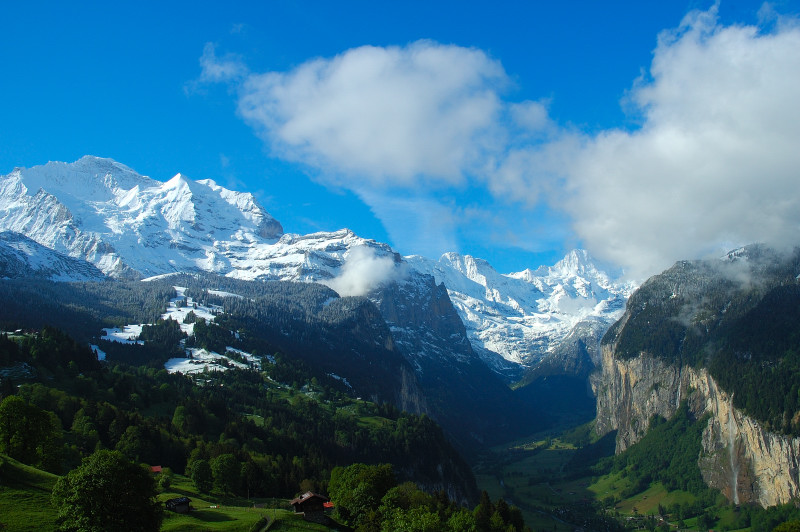
Wengen, overlooking Lauterbrunnen Valley. —Wiki

Summer's end in the Swiss Alps above Wengen, in the Berner Oberland, where I worked one summer, is not marked by the equinox, but by the vagaries of weather. When the grass no longer yields its bounty, the cows are driven down from high mountain meadows to winter pastures in the valleys below. That marks the end of summer.

I got to witness the Alpabzug (Désalpe) in 1972, I was transfixed by transhumance, a tradition that dates back to the ancient Celtic inhabitants—alp is a Celtic word.

Maurus Servius Honoratus, wrote that the mountains were called Alpes by the Celts. Possibly a pre-Indo-European word  for hill, alpe was a name for many mountainous regions besides the Swiss Alps; Albania, the Caucasus, and of course, Alba is another name for Scotland. 

My friend Claire spoke a Gallo-Italic language Romansh, (a "language spoken to kinder and cows"), which retains remnants of Celtic and Raetic languages (once spoken from the Rhine Valley to the Irish enclave, St. Gallen, and Tyrol until the 17th c.; mat/mac = boy).  

Wengernalp, overlooking Wengen, and Lauterbrunnen Valley. —Wiki

And I was told that Wengernalp, where most of the cows are summer-pastured in the shadow of the mighty Jungfrau, means cheek of the alp.

Each fall, after the Grand Cheese festival, after the cow-shareholders have collected their alpkäse shares, the cows are brought down from the alps by their Älpler cowherders dressed in traditional costume. They festively thread their way down the mountain, and parade down Dorfstrasse, the narrow main street of Wengen, a car-free village, which was probably once an ancient drover's road.
 
Hotel Bernerhof, my garret room for the summer was under the eaves on the far right.

The cows' hooves, waxed and shined, their rich cream and russet coats were shampooed, and brushed to perfection. Everyone stops what they're doing to witness the ancient annual passage of the cows. It is a time of celebration. Though I was working as a waitress setting up for lunch in the Hotel Bernerhof, I was unceremoniously shooed outside, in my apron, to witness the traditional passing of the cows. Apparently, some sort of transference of luck was involved.

Thank you Rolf & Wengen Switzerland for permission to use photos.

The queen cow (and her entourage) wear elaborate garlanded crowns made of a pine tree decorated with silk flowers and ribbons, Swiss flags, a cross (for protection from the sky), or mirrors (to ward off the evil eye), and real flowers: alpenrosen (almrausch), edelweiss, daisies, geraniums, even thistles, on their horns. 

The cows' parade finery is replete with a florid embroidered, and embossed leather forehead band, and collar studded with silver rosettes, which holds an enormous ceremonial bell, the size of a man's head, knelling in deep tongues. In spring, the herders themselves must carry the cowbells the last mile up to the alpine pastures. The cows don't wear those enormous bells all summer, only one day a year.  Their summer bells are much smaller.


The larger the treicheln (trychel, or hammered) bell, the richer the sound, and the farmer, so it is said. They're hefty klaxons, so the cows only wear them on parade. The bells are lined up like trophies under the eaves of the summer huts (Scottish: shielings.) The use of cow bells dates back to the Iron Age,  each note represents a specific cow. Some bronze bells are etched with edelweiss, and other floral, or geometric designs.


The queen of queens sets a regal pace, she knows she's Top Bossy. She lows, and aggressively shakes her horns at any interloper that attempts to pass her. If push comes to shove, bovine battles are settled with head-butting contests. In Combats des Reines: there can be only one queen cow, the Kranzkuh, (La Reine des Reines) to rule the collective herd.

Thank you Rolf & Wengen Switzerland for permission to use photos.

I don't know why some cows are also adorned with flowered surcingles, or cinches, as well as headdresses. Some sort of ranking order?  Fighting badges? Social equivalent to The Hulk's wrestling belt?

The heifers, the teenagers, follow up the tail of the herd, their horns sometimes dressed in diminutive greenery, perhaps a single rose, and they were adorned with dainty bells, that rang like silver spoons against bone china teacups. Next year, after they've borne their first calves, in their winter pastures in Lauterbrunnen, if they produce lots of milk, they too will graduate to wearing larger bells and full
headdresses. They too will have a chance to compete on the alpen slopes, and perhaps they too will dream of becoming queens for a day.


Sunday, July 24, 2016

On Web Trolls and Heavy Breathing


Dear Ones,

I've received yet another abusive comment on this blog, this time from someone named Guls, which I've marked as spam and decided not to repost.

I find it distressing that on my personal blog page, why someone who has managed to publish only ONE blog entry on his blogsite (extraDimensionalDarkie) in the past five years, chooses to be a such a spiteful troll and feels the need to share it with me. (Whereas my blog's been visited at least 300,000 times—more than that, as I didn't have a page-counter during the first few years.)

Apparently I'm an idiot because I took the time to challenge a popular idea, then I had the audacity to research, and write about it, then post it without first checking in with him. Good to know that the thought police are alive and well and living in the outback-a beyond.

Speaking of idiots, Guls is also not a very careful, or competent reader, yet, English is clearly his first language: He wrote "why would this idiot bring up, Australia as having anything to do with the origin of redheads."

Wow. I never even remotely said that. What I did write was:
Scientists agree that red hair is more common among those with genetic roots in northwestern Europe, especially Ireland and Scotland (and by extension, Argentina, and Australia—via immigration and penal colonies). —Maureen Hurley, Viking-Irish Redhead Gene Myth
Who's the eejit now? Then Guls couldn't leave well enough alone—and went into full auto-erectile dysfunctional mode: his sinewy-tongued comments went from bad to worse. All I can say is that a penal colony is a place of confinement and punishment: a prison, not a penis—which apparently, is what he uses for a brain.

And then Guls suggested that I go and (ahem) blow on it. Yeah, well, I prefer to blow on a hot pen. Or maybe a pair of liar's dice. I guess my bio photo didn't clue him in that I wasn't a ginger-haired auto-fellatio sort of fellow? What a douche, or should I say, dildo? It seems Guls is trapped in a prison of his own making, and apparently there's nowhere left to transport the wanker. So he trolls the internet.

Guls did raise a valid point that the layout of my Viking-Irish Redhead Gene Myth page is atrocious. Sorry, I agree, but I really have nothing to do with that. That was Google/ Blogger's state-of-the-art layout way back in August of 2007 when I started this blog (but I didn't begin writing until 2009, I was a slow adopter). I can't do much about it now, not with the prospect of losing 1700 posts in the process. There are certainly more sexy web design choices now.

As to the layout of this particular blog entry, he's right. It is a right mess. But I cannot even get into the blog post in order to make changes, let alone, clean it up. I think it has too many embedded links. Durty HTML as it were. I have tried. But I can't repost the changes. They won't take. It crashes.

I never meant to write that particular blog piece, really. I found little nuggets that supported particular trains of thought that I wanted to add, and tacked them on. The more I researched, the more amazing facts and folklore I uncovered. It sort of happened, so I didn't have a floorplan. So yeah, organization is not my strong suit. I'm a messy writer.

I can no longer make additions or corrections to the Redhead post as it crashes Blogger. It's too bulky for me to edit—it crashes, or disappears completely when I try to update it. I've had it disappear no less than three times when I tried to revise it. Talk about blue language. TG for Safari cache, I was able to retrieve it once that way, and another time via the backspace arrow. Third time I got wise to Blogger's ways, and pasted it into a TextEdit document before attempting an edit job. 

As to the structure, I could delete the post, start over via copy and paste, but then I'd lose all 52 comments. So it is what it is. It is a popular post, such as it is, having been read 71,275 times. More than all my other posts combined. How many poets can say that they've had a poem read 70,000+ times? Hmmm?

I must admit that I am constantly amazed by how much interest there is in the origin of red hair. And by the erroneous information as well. This particular post gets lots of traffic (and some flack too from the red-haired Viking school that can't accept the fact that red hair predated Viking invasions in Ireland).

Truth be told, I grew weary of the piece, and literally ran out of steam.... As I'd mentioned, the piece came out of an email reaction to something someone wrote on Tim Ferry's Irish in California listserve St. Patrick's Day, 2009, and it expanded and grew in exponential proportions....until my head hurt. So I abandoned it.

Ironically, it was also my debut piece into the art of blogging. I began it during NaNoWriMo, and worked on it for days. Maybe even weeks. (Yeah, I know NaNoWriMo is in November, and it's posted in March. In those days, I moved posts around according to theme vs. creation date, which caused massive headaches when I tried to repost everything chronologically last summer. Woe still is me.)

I get a smattering of flattering comments on that Redhead post—some replete with hidden sneaky spam links, and a few downright snarky ones. Luckily I do have veto power and don't publish them. They're always signed: Anon! Except for oor man Guls.

I've considered turning off the comments on my blog. A few bad apples... That said, I do read all your comments, and I do try to write back. I have no idea if any of my readers ever see my comments to them, but I do value all of you readers. So if you've any feedback, I'd love to hear from you. Spare me the heavy breathing, though.

Friday, March 25, 2016

Splitting Hares and Rabbiting on


A young brown hare, watercolor, 1502, Albrect Dürer —Wiki

A photographer, hoping to sell prints, conflated rabbits with snowshoe hares calling them Easter Bunnies. Augh! For the record, hares are not bunny rabbits. They're not even distant cousins either. They may look alike, but it's convergent evolution. It's a great herbivore model. But they are a very separate species, even more divergent than sheep are to goats. More like gazelles and sheep. Different genus, Genius!

Through I suspect the hare was the mythological pre-Christian role model, the term, Easter Bunny referred to a rabbit, because in the Middle Ages rabbits (not hares) were called cunnys, which rhymes with bunny and hunny. Baby cunnys were called rabbits (or kits), but that word cunny was later changed to coneys, because prostitutes were called... Well, you get the picture. Coney Island. Rabbits, or....?

European cunnys/conejos (Oryctolagus cuniculus) are not native to most of Europe, they came from Iberia, they're not even native to Northern Europe or Britain. Some historians think rabbits were brought to Northern Europe and Britain by the Romans. But the Romans preferred to eat sleepy doormice. So, this speculation is wrong, as “during the Middle Ages, they were regarded as a high-status food and transported across Europe.” —Discover Magazine

Most historians agree that rabbits were introduced to Northern Europe in the Middle Ages. The Normans brought rabbits to Britain and Ireland. And cunnys were easy dinner fixins'. Which led to a population explosion, and some really weird Medieval manuscript drawings of bloodthirsty hares (not bunnies) armed to the teeth with lances, axes, swords, hellbent on harming humans. 

Hares do not make good pets, they're not domesticated, and share few traits with rabbits. They're solitary creatures, prone to boxing and brawling with potential mates and interlopers alike. The term "mad as a March hare" came from observing their combatative breeding nuptials. (Don't preach to me about the "wrong" use of combatative vs combative. Just. Don't. It's in the OED.) How mad? Go ask Alice.

Lewis Carroll's Alice and the Mad March Hare (a European hare)—Wiki

Mountain hares are smaller than European, or brown hares. The maigheach bhan, or bocaire fasaich, or Scottish mountain hare (Lepus timidus), is a hare of many colors and an astonishing assortment of names: whiddie baudrons, bawtie, cutty, donie, fuddie, lang lugs and maukin. AKA the blue hare, tundra hare, variable hare, the white, snow, or alpine hare (but never an Arctic hare), the mountain hare is big on camo—like ptarmigans and stoats, it turns white in winter—except for the Irish hare (L. t. hibernicus), a separate (sub) species—it prefers to tan the beaches. 

(In Irish mythology, the shapeshifter hare, the giorrea (little deer), is associated with the realm of the Otherworld. To harm a hare carried dire consequences. The warrior Oisín was spirited away to the Otherworld for accidentally wounding a hare with his dart, who was a woman of the Sídhe. Druids used hares in divination and prophesy by catching them, then turning them loose to guise the path of their escape.)

There are hares, and there are even more hares. There are 32 species of hares worldwide, and not one of them can crossbreed with rabbits (they have 48 chromosomes vs. rabbits' 44 chromosomes.) According to an article in LiveScience, “There are … "cryptic species" that appear identical but are genetically distinct.” Probably a good thing too, otherwise we'd have Monty Python killer rabbit-hares running amok armed with swords and whatnot whacking the bushes and our kneecaps.


European explorers were terribly cavalier at identifying Old and New World animals so there were bound to be mix-ups. Take our native North American hares, for example. Jackrabbits are not rabbits. Hares are larger, have longer black-tipped ears, large amber eyes, long hind legs, and are positively antisocial as compared to cuddly wabbits. They also tuck their tails down when they run—and they’re faster too, clocking in at 45MPH.

Despite its confusing common name, a jackrabbit is a hare. Short for jackass-(who looks like a)-rabbit. Got that? Of course, the word “jack” in front of rabbit, sort of like a Cousin Jack reference, as in being distantly related (not Cornish miners), was probably a nod to the fact that the explorers knew the New World creatures were hares. Jacks and Jills refer to hares, not rabbits.

On the other hand, a Belgian hare is not a hare, it's a true rabbit bred to look like a hare. A cottontail, on the other hand, really is a wabbit. Rabbits are social animals and make great pets. Think Peter Rabbit. Not anti-social Jack, or he'll smack the shit outta you. That goes for Jill too. Especially Jill.

According to H. L. Menken, "Zoologically speaking, there are no native rabbits in the United States; they are all hares." I guess he never saw a cottontail. Or perhaps fuzzy logic was involved. What he probably meant was there are no European rabbits (Oryctolagus) vs. native rabbits in America. Which is true as cottontails (Sylvilagus) are a separate species.


Rabbits and hares from the Leporidae family (not its sub-order, Genus), which is a sub-branch of the order Lagomorpha, which includes rabbits, hares and pikas (sometimes called rock hares). Got that? It's a Kings Played Chess On Fine Grain Sand ss moment... Order, Family, Genus, Species: it goes Lagomorpha, Leporidae. And that's where the semblance ends.

North and South American cottontail rabbits Sylvilagus are the ONLY rabbit that doesn't burrow, like the hare. They're sort of a straddle-the-difference species niche. They're not Old World rabbits. They're more rabbitish than rabbity, at this point, I'm probably splitting hares. Sylvilagus xx— (13 species) are not European rabbits (Oryctolagus cuniculus—there can be only one!), starting with its tail, and its habits. But I'm not about to list all the burrowing/ feeding differences, let alone, weird kinetic skull differences. You'll have to look them up yourself hare. 

BTW, since I know you're dying to ask, cottontails (Sylvilagus) cannot interbreed with domestic European (Oryctolagus) rabbits. Though they can do the down and dirty, and even produce embryos, European rabbits have 22 pairs of chromosomes, while native wild cottontails have 21pairs of chromosomes. Score one for DNA! At least that gene pool's clean.

Thursday, December 31, 2015

Wee Celtic beasties for silk scarf design 8//15

I was drawing some wee Celtic beasties for silk scarf design. Neil wanted me to design a T-shirt logo with a Celtic tiger but none of my ideas seemed to go anywhere. He also didn't seem very interested in any of my drawings. Wouldn't even look at them. Then wondered why I balked and yowled when he wanted a T-shirt design pronto just days before the Games. No lead time at all. I can't work like that.

July-Aug. 11/2015

Celtic knotwork drawings for silk scarf designs 8/15


Sunday, November 15, 2015

Red Hair, A German Trait?


This is a comment from my Viking-Irish Redhead Gene Myth blog post turned into a blogeen of its own. I've reposted it here. I wind up doing so much research in order to answer people's comments, it takes me hours to write a rebuttal. Maybe it'll turn into a full post later.
Ross Hunter said...

Red hair is actually a very German trait. I know this not only from my own family history going back several hundred years on my Mom's side of the family, but also from my personal studies on many sources. Even the book "Germania", written around the year 98AD, describes the Germans as having "rutilae comae" which is reddish hair. The Romans who came into contact with the Germans brought that trait into their own society, thus the now large number of red haired Italians. The Germans were described as very warlike in in Germania, and in idle times, they often dreamed of waging their next war. While that may seem to put them in a romantic light, it's actually not that awesome considering their attrition rate. They also were said to have practiced human sacrifice and held a lot of superstitions at the time. They were described as "indians" and wore very little clothing.

I'm actually surprised that people don't associate red hair with Germans more often than they do, it's actually pretty common, even the old bog bodies from Germany have well preserved reddish to golden red hair. Sure, things have changed a lot in the modern days, but there is a lot of historical, concrete evidence to support this. APRIL 27, 2015
Maureen Hurley said...
Dear Ross Hunter,

Sorry I never commented back I must've missed it. A few notes on Germany and redheads. What is now present day Germany now was not Germany then. Much of what is Germany now, was actually Celtic territory, not German. Especially Bavaria, and the area around Cologne.

The bog bodies were found in present day northern Germany, etc., but that doesn't make them German. We tend to use current political boundaries to define ancient peoples, and that is a false syllogism. Ahlintel Man, and others were from Lower Saxony and Schleswig-Holstein, which was part of Jutland, so they could also be Frisian/Danish/Scandinavian/Celtic bog bodies.

However, the Nienburg (and the Jastorf) had material cultural characteristics similar to Celtic cultures.... It should, as the Nienburg culture (grave goods, and weaponry) was the northward thrust of the Hallstatt culture. Some La tene influence as well.

The thing to keep in mind here is that Hallstatt was NOT a Germanic culture. Lower Saxony and Schleswig-Holstein were not settled by the Germans unto the 3-7th c.s AD., considerably later than the bog-folk. At any rate, there is archaeological evidence of isolated Celtic settlements as well in Jutland.

Hair color is impossible to determine on a bog body as bog water, heavy in tannins, both leaches and stains. DNA analysis would have to be done to determine if they were redheads. Blond or grey hair would stain read in bog water, so it's not a reliable indicator.

"There has also been migration from former Celtic areas into Scandinavia .... investigations at Dosenmoor, Schleswig-Holstein, and Svanemose, Jutland, Boreas " —The Germani - Haplogroup I2b1 info

There were Celts also in the Netherlands, and many bog bodies were found near Drenthe.

The Celts lived on both sides of the Rhine. Caesar, when he was thumping the war chest coffers stretched the truth a bit (a lot). Hw said that the Gauls were an awful foe, and that the "Germans" were even worse, so he could get funding. Tacitus stretched the truth even further, both did so, to meet their own political needs—which was to get more money from the senate.

Remember, victory was written in the voice of the winners, who had a political agenda. We need to read those old texts with a grain of salt. Rhetoric.

Part of the confusion lies in the fact that the word Germania is not a German tribe, just like Teutates: both are Celtic words. Germania is actually a Celtic war cry, and Teutates, was a Celtic god.

I have read Tacitus carefully, and many of the names he uses are linguistically Celtic, not Germanic, so methinks he was fabricating just a bit. They also could have been a Celto-Germanic tribe. But culturally and linguistically, many of the peoples that Tacitus described, were Celtic, not Germanic.

As to those red-haired Italians, the north of Italy was settled by the same Celts that settled in Anatolia. Especially around Ravenna, Modena, the Po Valley, and the mountains: it was called Cis-Alpine Gaul. So yes, the red-hair gene would be dominant in the north.

Thursday, July 30, 2015

Arielle and me the morning after a raucous gig at Johnny Fox’s, Vancouver, BC


Another morning after Johnnie Fox's. Arielle and Maureen at mine and Kevin’s little Hobbit Hole dwelling in east Vancouver. Good times with grand souls. Elegwen Ó Maoileóin photo 2015

Monday, July 27, 2015

Headed to Vancouver (music video, photos)


Hey, Elegwen Ó Maoileóin, we're in Enumclaw (Scottish Games are over) and we're headed north, any cheap places/couches to stay in Vancouver? Gigs to visit/ tomorrow, etc? Neil O'Neill wants to go to the Jimi Hendrix Museum this afternoon, then we're more or less open after that for gigs and whatnot.


Jammin at Elegwen’s

Saturday, June 14, 2014

Arbutus, Madroño, or a Strawberry Tree by any other name (photos)


Clusters of berries, leaves and flowers of the arbutus unedo.

A stand of Irish strawberry trees (or Killarney strawberry trees) are fruiting in front of my physical therapist's office in Berkeley. I climbed up on the hood of my car to reach the fruit, but didn't realize I couldn't get back down without loosing my "strawberries." I squashed them all over the place—they were like little golden suns with fiery coronas—when I nearly fell off the car. Would've been difficult to explain that injury to my PT. But I was gluttonous as a bear.

My grandmother often talked about eating the wild arbutus "strawberries" as a child, comparing their flavor to the haws of hawthorn trees. They don't taste anything like strawberries—they just look like them on the outside. In the inside, they're like little orange suns flecked with tiny seeds. The Irish do know the difference between strawberries and arbutus tree fruit. Wild strawberries also grow in Ireland. It's a simile, sweetie.

Ripe arbutus berries are pebbly & red outside, golden & mushy inside.

My grannie, who hailed from Bantry, said that the Gulfstream, that warm Atlantic current that bathes the coasts of western Ireland, created an ideal micro-climate where tropical plants flourish—including palm trees. However, the arbutus, or strawberry tree, is also native to western Ireland but, curiously, not to England.

The Irish arbutus was introduced to England from Ireland during the 16th c., and one estate plant catalogue mentions "one very fayre tree, called the Irish arbutis standing in the midle parte of the sayd kitchin garden, very lovely to look upon." 

The broad glossy evergreen leaves are about three inches long, an inch wide with a toothed, or serrated edge. And the clusters of fragrant flowers are showy white or pink tinted bells—like most plants in the heath, or Ericaceae family, as arbutus is related to heather and bilberries.

Arbutus berries; the hard yellow ones are unripe. 

The story goes, that when the Spanish explorers landed in California, they recognized our native madrone. (naming it madroño) as being related to their madroño the stately Arbutus unedo, or the shaggy-barked Arbutus arachne which is more common in Greece, and throughout the greater Mediterranean basin from Albania to Croatia, Lebanon to Sardinia, Portugal to Tunisia, and Iraq—even the Canary Islands. Father Juan Crespi, chronicler of the 1769 Portola expedition, wrote about the many madroños at the “lost bay” of Monterey.

There's an anomaly of isolated arbutus groves in western Ireland—especially in Bantry, West Cork, (my grandmother, from Bantry, gave me the roots of this story), and the Dingle Peninsula on the Kerry coast. Sligo has the most northerly stand of Arbutus unedo in the world, a remnant from the pre-Ice Age Atlantic period. (Or possibly brought to Ireland by the Iberian Bell-Beaker Folk, ca. 2500 BC—renown for their bell-shaped clay drinking vessels, stone wrist-guards, and gold lunulae. Their motto might have been: Don't drink that arbutus beer, and shoot arrows at the crescent moon. Or were lunulae really splash guards?)
The [arbutus] species is one of a select group of plants, fifteen in all, native to Ireland but not to Britain. Taken together, these special Irish natives have come to be known as the Lusitanian or Hiberno-Cantabrian flora, owing to the fact that their nearest relatives are to be found on the Iberian Peninsula. How this flora arrived to the blank canvass that was post-Ice Age Ireland is not well understood, but it is possible that they spread overland along the changing coast of the British Isles as they emerged from under glacier and sea. —The Strawberry Tree, UP Cronin
Dr. Cronin (M.Sc. in Plant Science, University College Cork and a Ph.D. in Microbiology, University of Limerick), writes that the eighth century Irish legal tract, Bretha Comaithchesa (laws of the 'hood) ranks caithne (arbutus) as a fodla fedo — or third division tree, used for manufacturing charcoal or making small pieces of decorative red inlay.

It's an Irish toponym: Ard na Caithne (Ardnaconnia), or Strawberry Tree Heights (a headland—also known as Smerwick, or Butter Bay) is located in the heart of the Kerry Gaeltacht, near Corca Dhuibhne—the tip of the Dingle Peninsula. Ard na Caithne (with its arbutus groves, laden with little golden apples of the sun) is a significant site: it's the home of Dún an Óir ('Fort of Gold'), an Iron Age fort; the site of sixth-eighth c. monastic settlements, the Gallarus Oratory (the oldest beehive hut in Ireland—I saw it from the road but my cousin wouldn't stop the car) and An Riasc; and for the horrific Siege of Smerwick (1580), where the surrendered Irish freedom fighters were slaughtered by the British Lord Grey. The sacred ground was stained by more than just arbutus berries that day.

Ard na Caithne was home to 17th c. Irish poet and harpist, Piaras Feiritéar, who surrendered to the English after the Confederate Ireland wars, was granted safe passage, but was hanged in 1653. The ruins of his castle still stand among the arbutus trees at Ard na Caithne and his poetry lives on in the oral tradition. 

Ard na Caithne was also home to Séamus Ó Muircheartaigh (1877–1927) who wrote under the pseudonym, An Spáilpín Fánach
 
(The Wandering Labourer—also the name of his song). Séamus Moriarty emigrated to San Francisco (via Butte, MT) and knew my grandparents through the Gaelic League. His son, Cuchulain was a civil rights activist with César Chavez—the Lawyers’ Committee for Civil Rights Father Cuchulain Moriarty Award is named after him. But I digress....

There are four Old World species, and six New World species of arbutus. Our hybrid ornamental street tree, Arbutus x Marina is named after the Marina in San Francisco where it was hybridized. Its parentage is a mystery but it may be a cross between the Arbutus unedo and Arbutus arachne. Old World arbutus is related to our native madrone and its cousin, manzanita (Arctostaphylos). Our Pacific Madrone, or Madrona, is Arbutus menziesii. We often ate the tiny astringent berries that taste like sour crabapples. After all, manzanita means little apple in Spanish.

Kerry has the largest arbutus stands in Ireland. A recent DNA pollen study suggests the arbutus was brought to Kerry via Northern Spain more than 4000 years ago, possibly by Iberian copper miners. But that doesn’t explain the Sligo stand.)

The Irish "strawberry" is called caithne in Irish, arbousier in French, madroños, alborocera, alborio, borto, or albedro in Spanish, corbezzolo, or albatro in Italian, koumaria in Greek, and bearberry, or Cain apple in English. I guess Cain used them to slay Abel. Or maybe he fed him unripe fruit loaded with tannins.

The fruit has a vague anise odor but tastes more like tangy rose hips—which it's related to. Edible prickly red armor on the outside and a creamy-mealy amber flesh, it's a superfruit (like açai) loaded with vitamin C and pectin. The fruits are high in sugar and contain bioflavonoids, malic acid as well as tannin (more here). But the yellow unripe fruit can cause nausea (so it is said).

Warty arbutus berries ripen on the tree tend to burst if you pick them.
When eaten in quantities this fruit is said to be narcotic, and the wine made from it in Spain has the same property. —A Modern Herbal
Berries will ferment right on the tree (berries have been measured up to 24.6° Brix, or 5 to 14% alcohol—and no liquor license needed); the birds get inebriated as they gobble up the beer-berries. A few peasants figured out that if the birds could get so blasted on arbutus berries, that they couldn't fly a straight line, then so could they. (Wing flapping ensued....)

My friend Chris Devine said, "There used to be a pub in Killarney called 'The Strawberry Tree'. Never understood why. 'Til now." The Strawberry Tree Pub, 23 Plunkett Street, Killarney.

The Greeks make a liqueur called koumaro, which is often added to tsipouro (a type of ouzo), the Portuguese say they are very brave trees and make arguardente de medroñho or medroñheira from the berries, and the Italians make many liqueurs: in Corsica they make a Liqueur a l'Arbouse, in Sardinia they make fior, and Acquavita di Corbezzolo. 


Sun-dried arbutus berries are like dried apricots, full of flavor.

You can also make marmelades, jams, jellies, pies, dried fruit, vinegars, pomaces, sorbets, and a grilled meat sauce (like cranberry, or quince sauce), from arbutus berries. You can plop those overripe berries into a bottle of red wine to make a killer sangria, or use the fruit as a red dye, and the bark to tan leather. I wonder if the prized red Cordova leather was dyed with madroño berries? Research for another time.

Because the fruit and flowers appear on the tree at the same time, the Romans thought the arbutus held magical powers: flowers were also placed on graves as a sign of respect. In The Tenth Labor of Heracles, the blood shed by the giant Geyorn was said to produce a tree with both flowers and fruit at the same time when the Pleiades were high in the sky—the arbutus.
Horace praises the tree for its shade and Ovid for its loads of 'blushing fruit.' Virgil recommends the young shoots as winter food for goats and for basket-work. Gerard speaks of it in his time as growing in 'some few gardens,' and says, 'the fruit being ripe is of a gallant red colour, in taste somewhat harsh, and in a manner without any relish, of which thrushes and blackbirds do feed in winter. —A Modern Herbal 
The Coast Salish used all parts of the sacred Pacific madrone for medicine. The Coast Miwok, made a tangy brew from madrone and manzanita berries. According to the Coast Salish an anthropomorphic form of madrone tree sap went fishing at dawn but came home late one morning and melted in the sun; the other jealous trees stole all his sap. I don't know if this occurred before, or after they discovered that the berries could be fermented.

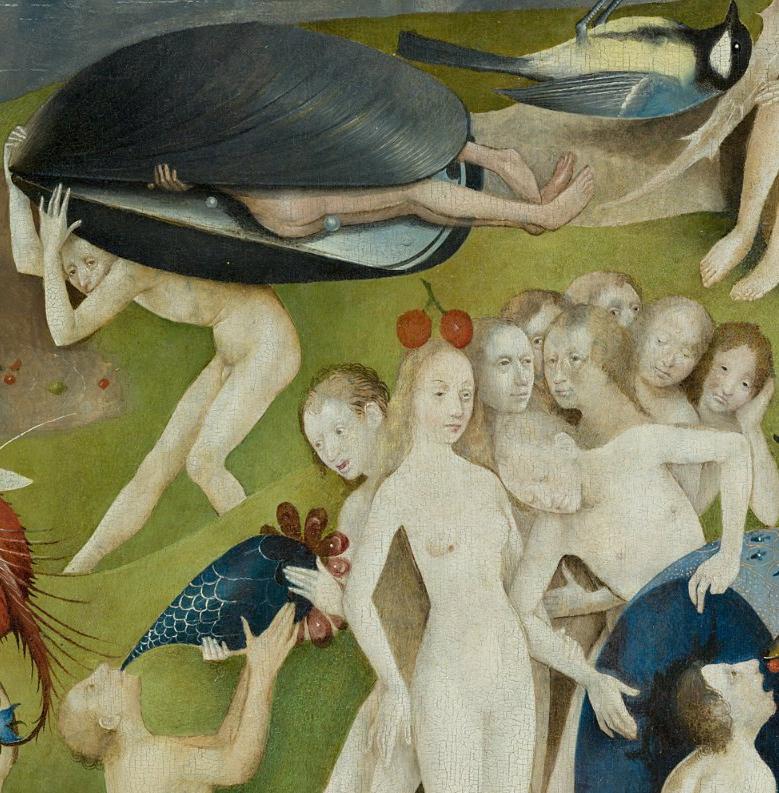
Hieronymus Bosch's painting (housed in Madrid since 1939), "The Garden of Earthly Delights," was originally called "La Pintura del Madroño", or "The Painting of the Arbutus." Why a strawberry tree? I bet something got lost in translation... The Tuscans use "strawberry" as an exclamation referring to ahem, the male anatomy.


The fruit above her head, identified as cherries, is a convenient explanation for popping the cherry, but if you look at the fruit, they're not cherries, but warty arbutus berries. Cherries elsewhere in the painting are painted smooth-skinned, with a reflective sheen. —Mo H. Image from Wiki

Strawberry trees. Clearly there is other symbolism going on. Either Bosch didn't know what they really were, or he had other ideas for including them. —Wiki

In Latin, Arbutus means "struggle." But because the bear is so closely associated with the arbutus tree in myth and lore, I suspect that Artio (Dea Artio) a Gallo-Celtic bear goddess was also involved. Near Berne, a bronze sculpture of the goddess Artio is seated beside a small tree, holding fruit in her lap, feeding the bear—with the inscription: Deae Artioni / Licinia Sabinilla. 


(Artos means bear in Celtic. (Delamarre 2003 p. 55-56), from Proto-Celtic *arto-, from Proto-Indo-European *h₂ŕ̥tḱos, bear.) —Wiki

An Italian website on plants also hypothesizes that Arbutus may be a Celtic word:
The name "Arbutus unedo" probably derives from the Celtic. In fact, "ar" in Celtic means "bitter, astringent" and "unedo" is the name that was used in ancient times which probably derives from the three Latin words "unu-off edo" "I eat only one" to mean that one should not exaggerate and give in to temptation because of the pleasantness of its fruit which when eaten in excessive quantities gave nausea and constipation. —MEDICINAL PLANTS, Elicriso
A gluttonous bear eating arbutus berries from the strawberry tree figures prominently in the coat of arms of Madrid, Spain. In Puerta del Sol, the city center of Madrid, there is a statue of a bear gobbling berries from a madroño tree.

Pliny the Elder enigmatically explained that 'unedo' means unum edo or "I eat one", and so I did. And another. Whether he meant you could eat only one because it was so awful, or eat one and not be be able to stop because it was so good (and you'd get a hangover, or a bad case of the farts), we'll never know. But I can safely say no struggle (or bears) was involved. They're tasty.