Showing posts with label Icelandic ponies. Show all posts

Wednesday, April 15, 2020

Connemara pony origins


Cúchulainns’s pony, Liath Macha, was a grey. Connemara pony—Wiki

A well-meaning writer friend who leads New Age spiritual anim cara style trips to Ireland, invoking its mythical misty past, posted a story on Facebook about how the Vikings brought the Connemara pony to Ireland. Well, you can bet your bottom dollar that got my goat, er, pony. I mean he has something like 4000 followers who dote on his every word. Perhaps seeking damage control, I posted this comment on his page:

Contrary to what Wikipedia says, the Connemara pony is native to Ireland, it was not brought to Ireland by the Vikings. I can’t even begin to fathom how that notion came about. There were already plenty of fine horses in Ireland. And because Ireland was a cattle culture from the Bronze Age, right up to the Viking invasions, horses too were very much part of the cultural landscape.

The Connemara pony’s genetic ancestry is derived from an ancient source that predates the arrival of the Vikings. In fact, they carry a northern late glacial European mDNA C1 gene cluster shared with Exmoor, Shetland, Fjord, Icelandic, and Scottish Highland ponies—which “suggests a common late glacial or postglacial origin for these pony breeds.” 1. DNA studies were conducted on “five British-Irish native pony populations... Carneddau (Welsh)... Connemara ponies (native to Ireland) and Highland ponies (native to Scotland).” 2. And  they discovered that “The Highland and Connemara matrilines were more closely related than to the Welsh ponies.” Meaning they probably did travel back and forth across the Irish Sea.

We know, at least according to the Irish epics, that native aboriginal Bronze Age British and Irish ponies were theoretically being raced in two-wheeled chariots as early as 400 BC. Icelandic ponies, related to what is called the early Celtic horse—specifically the Kerry Bog pony, Ireland’s oldest breed—probably contributed to the Icelandic pony gene pool too, as Dublin was the main port of call to Iceland, not Norway.) The ambling, or toelting gene present in 8th c. British horses and Icelandic horses, but NOT in Scandinavian horses—strongly suggests that Icelandic horse ancestry included ponies from Shetland and the British Isles.

Sometimes articles cite the Andalusian horse as an ancestor breed that contributing to the Connemara bloodlines. The problem with that theory is that the Andalusian horse carries a completely different gene cluster, D1. The DNA isn’t there. So how does this work? Magical thinking? During the 1970s Connemara ponies were crossbred with warmbloods to “improve the breed” as a sport horse.

But to be fair, “In the 12th Century, Spanish (Iberian) stallions were imported and used to breed with small (Welsh) mountain mares.” 2. in Wales, to create the bigger Powys, and Hackney pony (British). So it’s remotely possible some of that hot Iberian bloodline eventually found its way into the Connemara pony bloodlines, but, here’s the rub, the appropriate DNA cluster simply isn’t there. Besides, the 12th c. is no longer considered to be the Viking era, the Norman era, maybe.

This story may be the source of the Andalusian bloodline theory. “The Connemara Pony's origins go back some 2,500 years to the time when Celtic warriors brought their dun-colored ponies onto the island of Ireland and used them to draw war chariots and carts along the beaches and river plains of their newfound home. The history is obscure, yet the Connemara Pony is considered Ireland's only native breed. Mythology tells us that the tribes of western Ireland were mounted. Legend has it that when the Spanish Armada sank off the Connemara coast in the 16th Century, the horses swam to shore and bred with the native ponies running wild in the mountains.” 3.

But anything linking an Armada ancestry theory is always suspect. Legend, and not fact. Repeat something often enough, and it becomes “true.” Like with today’s politics. Ditto that with the Viking story. Also, why would Vikings even need to bring horses to Ireland, it would be like bringing coals to Newcastle. (I actually had to explain that idiom to someone who had never heard of Newcastle before. It’s a good thing I didn’t have to explain First Footing. But I digress.)

During the 1700s, Arabian blood was introduced to many Forest, or northern/cold horse breeds. That’s how we got the thoroughbred. But according to conservation genetics of endangered horse breeds, the native pony breeds show far less less foreign genetic influence than the large horses—probably because they weren’t considered valuable. Their diminutive size protected their gene pool. But no matter what, the native mare always carries essence of the bloodline. Blood will out.

Anyway, silence was his loud reply.

Tuesday, May 29, 2007

Helgar the Horrible

Hliods bid ek allar helgar kindir,
Listen to me all sacred people,
—from “The Poetic Edda”

Brenda Fullick’s dun-colored Icelandic pony, Helgar the Horrible, was unlike the other horses. He wasn't wily as my bandit Shetlands, dubbed the “Little Shytes” by irate neighbors, as there wasn’t a fence made that could contain the ponies. Nor was he prissy like the dainty Welsh ponies pretending to be grown-up horses at a gymkhana, their manes in need of imaginary smoothing.

Helgar was more akin to the dour donkeys—but the similarities ended with the dorsal stripes. Helgar didn't carry a grudge the way they did. Bent on carrot revenge, one donkey named Joshua, clamped down on my finger like a bulldog as I flailed on her forehead with my free hand. Luckily I had strong bones.

Helgar was an anomaly. How an Icelandic pony, descendent of Viking horses, came to northern California in the early 1960s, was an enigma. He couldn’t tell us his story. He was alone in a strange land, no kindred herd to cling to.

One quirk offered a faint clue to Helgar’s mysterious past, he was afraid of water tanks. Once he slammed Brenda against a redwood wine vat full of spring water. It resounded like a huge drum. The tank must have reminded him of rough seas. Unlike Leif Ericksson, who sailed to America in an open longship, maybe Helgar was imprisoned inside the belly of a freighter on that long dark voyage from Iceland.

If we offered Helgar a ladle-full of water, he’d rear up, with eyes rolled up inside his head, like a rabid dog at the sight of water. But he ferociously crossed streams and attacked his feed trough, a cast-iron bathtub, with impunity. Our tuna fish sandwiches were fair game as well.

This Icelandic pony was thick-headed—both metaphorically and literally. Physics wasn't his strong suit. Sometimes his brakes didn't work quite right. Hence the moniker, “Helgar the Horrible” (after Hägar, a Viking cartoon character). Helgar was otherwise very sweet.

Brenda was more than willing to trade mounts after he skidded off an embankment or two, or when he ran into the side of a barn that materialized out of nowhere. Why he was named after Hägar's wife, Helga, we'll never know. If the name Helgar is from Old Norse heilagr, a girl's name meaning the “holy, or blessed one”, then Helgar was a holy terror. Riding Helgar was a baptism by fire: we all rode him with a wing and a prayer.

Poor Helgar was an exile seeking companionship among Shetlands, donkeys and calves, he really didn’t like horses. We grew up with a circus collection of ungulates including a plains bison, (we called them buffalo), who peacefully grazed with the Holsteins in front of the Nicasio church—until some dimestore cowboy shot him one hopped-up Saturday night. Or at least that’s how the story went down in our circles. Wildfire gossip. She probably died of old age.

Rancher Mr. Nunes got another bison calf and fed him loaves of dry French bread, Nickel looked like a woolly version of Winston Churchill, replete with cigar. (Old American nickels had an imprint of a bison on one side with an Indian on the obverse side.) Nickel was a gentle, if massive presence, grazing on the slopes of Mt. Barnabe with the Herefords and Holsteins.

Helgar was fleet-footed—except for whenever he had a momentary lapse with physics. He could manage a spanking trot along the thinnest of goat tracks as if it were a groomed bridal path. He never needed shoeing, his hard hooves were like flint. We could ride him all day long and he would never tire, no matter how steep the terrain.

At daybreak, we’d traverse along the steep coastal ridges of West Marin, north of San Francisco, from Tomales to Bay, to Bolinas Ridge, or the slopes of Mt. Tamalpais, “the Sleeping Lady”—all were a good day’s ride from home. Helgar was a tank, he always wanted to be first to climb to the top of a peak. He was like a kid playing “King of the mountain.”

Occasionally the stunted bull calf, Mr. Smitts, tagged along. (We called him Mr. Smitts because he was smitten by the Shetlands. They were exactly his size). He didn't know he was bovine which was downright embarrassing in spring when his hormones began to rise. At an inopportune moment, he’d roll his eyes up and hop up right behind us, lowing and drooling; we were more in danger of being impaled in the back by his budding horns (and libido) than by getting lost.

Mr. Smitts kept his distance from Helgar who gave him a swift, well planted kick if he ventured too near. We often rode back from our adventures in darkness, sometimes under a full moon, the ponies always knew the way home.

When it came to speed, Helgar preferred to amble or trot, he had at least three gears, and he could trot almost as fast as a cantering thoroughbred. But it was like riding a jackhammer. We would sing, our voices revving “uh-uh-uh” like a car ignition, in time with his vigorous gait.

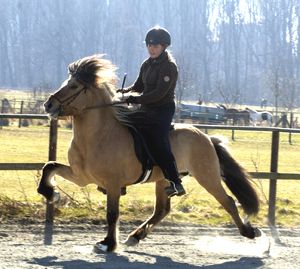
It was nearly impossible to get Helgar to canter or gallop (drumming our heels into his felted side was useless). At best it was a rough valhopp—with one end of the horse cantering and the other end trotting. If we were lucky, he would break into a high-stepping tölt (a smooth running gait), or a flugskeið, (flying pace) and when the horses left him in the dust, he'd come up from behind, all worried, nostrils flaring, as if to say, “Hey, what’s the big rush?”

An Icelandic horse’s rapid ambling gait known as the tölt (Wiki)

There was an ornery jugheaded sorrel Standardbred named Brandy I sometimes rode (I had to get past his teeth to mount him. I didn’t have my own horse at the time, so I got the ones nobody else wanted to ride). Brandy, a retired racing harness horse, heavier than a thoroughbred, must've stood at 18 hands, while Helgar was a mere 12 hands tall. Brandy was no legendary Dan Patch—who never lost a race, but he could really trot. The two horses looked ridiculous earnestly pacing side by side.

Helgar's fierce pacing was very distinct. I can still see him in my mind's eye with his head thrown back, fetlocks flashing out like hairy pistons, matching Brandy stride for stride. However, it wasn’t a comfortable ride, not like being on a Peruvian Paso Fino.

Helgar really had a thick skull, not refined like the modern Welsh pony who might carry an Arabian gene or two—though they had the same ancestor, the extinct Celtic pony, of which, the Exmoor pony is said to be the closest relative. (See also the endangered Iberian Sorraia—with distinctive DNA—ancestor to the Spanish mustang, the Galician, the Garrano/Minho and the Austurcón ponies).

Helgar also had long guard hairs on his fetlocks and jaw, and an unruly mohawk mane —like the prehistoric horses in the Cro-Magnon cave art of Altamira and Lascaux. When winter set in, he looked like a hefty hamster, his coat was so thick—he never adapted to mild California winters.

Cave painting of a dun horse from Lascaux, France ca. 15,000 BC (Upper Paleolithic). Wiki

Helgar refused to go in a barn or paddock shelter, preferring to stand in the downpour. From beneath a shaggy dun coat, he’d peer our at us with bright beady eyes, rain running right off him. We thought he was a little daft as we got 45 to 60 inches of rain, and frost too. Not like in Iceland, of course, but cold enough to freeze the ground.

Helgar was a summer camp pony, so he was probably picked up at an auction somewhere during the early 1960s. Gregg's Forest Farm Summer Camp leased out their horses to us locals from September until June. Brenda, who lived right below Gregg’s Camp, had first pick. It was always Helgar. When the Fullicks move into in the Sutton's old house on Arroyo Road, I lost my playmate, Pete. My world crumbled. But I gained a good riding friend.

Brenda was a couple of years younger than me and a bit mercurial. But her foster mom, the tall willowy blonde Judy Fullick, who was badly burned in a fire, and my mom were once good friends. I don't remember the story about how Judy got burned, there was a bit of a mystery to it. I do remember that there were two Judys in the Valley, the other Judy was Steve's mom, Judy Tristano. In those day, Pete and Steve were best friends. They wouldn't always play with me because I was a girl but when they went to the treefort up the hill, I traipsed behind them.

I ignored Brenda (who was younger than me) for ages, but my enduring love of horses led me down many diverse roads. Brenda and I became friends, united by our love of horses. She was somebody to ride with. Each fall, Brenda always got Helgar from Forest Farm Camp, so he was her de facto horse, except for during the summer months when inner city kids rode him—or tried to.

Helgar got a kick out of bucking those city slickers off, so come September, Brenda had to show him who was boss all over again. His buck, more like a rocking horse than a bronco’s, was all for show. I suspected his bouts with precipices were also for show. He was some kind of pony. A real wing borrower.

Sunday, July 25, 2004

Letter to Sigrun in Iceland (Helgar the Horrible)


Icelandic Horses in the rain mic@vikinghorse.freeserve.co.uk
Sigrun,

Alas I have no photos of Helgar the Horrible, who by this time is probably in Icelandic horse heaven! He was a gelding, not a stallion. I suspect that's why he was allowed to come to the US in the first place, no danger of gene pool problems.

He was unusual, some of his behavior was unlike that horses. Closer to pony or donkey behavior. Unlike the donkeys, he was not revengeful & didn't carry a grudge. BUT you never knew quite what to expect from him. He wasn't as wily as the Shetlands. Boy was he sometimes thick-headed: both metaphorically & literally! He once tried to take me right through a water tank. Guess physics wasn't his strong point... We never quite knew what made him tick. He was pretty enigmatic. Sometimes his brakes didn't work right so we never knew what to expect....

He was surefooted...except whenever he had a momentary lapse with physics, that is. He never needed shoeing, his hard hooves were like flint. You could ride him all day long and he never would tire, no matter how steep the mountain, and believe me, we rode hard. We took our assorted ponies, horses, donkeys and an occasional lonesome stunted (dwarf) bull calf named Mr. Smitts out for miles over the steep coastal ridges of Marin County, Northern California, as far as Point Reyes national seashore, and Bolinas (from Forest Knolls)... (we called the bull calf that because he was smitten by our Shetland ponies, and didn't know he was a bovine... which was downright embarrassing in the spring when his hormones began to run... he'd hop up right behind me, and the danger of being impaled in the back by his horns was...but I digress.)

Monday, April 19, 1993

Too Bright to See


Poet Linda Gregg grew up down the hill from me, on the next ridge over, Tamal Road, which was on top of a hill above my great-aunt Ellen Budjick's cottage in Forest Knolls.

We used to sneak through the Gregg’s Forest Farm Summer Camp on our donkeys because that was the only shortcut to get to Tamal Road from the Barbano's Lagunitas Summer Camp. We'd ride a wide loop back up into the hills where Forest Farm Camp winter-pastured their horses and then we'd traverse the final ridges homeward in darkness.

Forest Farms Camp is the same place where Jerry Garcia of the Grateful Dead died. But by that point, the summer camp had transformed into a rehab place with a different name: Serenity Knolls Chemical Dependency Center.

Jerry Garcia was personally responsible for record sales of Ben & Jerry's ice cream at the Forest Knolls store. But heroin didn't kill Jerry. Despite his daily walk down the hill to the store, his heart just gave out. I'm sure the ice cream didn't help the diabetes any either. The Godfather of acid rock was dead at 53.

Seems Forest Farm Camp was always a troubled place. Janis Joplin lived on Arroyo Road at Barbano's Lagunitas Summer Camp with Big Brother and the Holding Company—but that's another story to tell....

In the 40s and 50s and into the early 60s (before the economic crash happened), Forest Farm Summer Camp was a pretty radical co-ed summer camp for inner city kids who were pretty much like Martians to us.

We thought it was a weird, if interesting concept for kids to go to Forest Farm Summer Camp. So did the FBI. (In those days, most summer camps were not co-ed, nor were they such a strange admixture of kids from all walks of life—sort of a mini-United Nations).

Anyway, varying shades of McCarthyism colored a rosy hue over our little valley so the FBI was interested in several families.


We locals were definitely not welcome at Forest Farm Camp at any time which upped the ante during the summer months when we'd sneak through camp on our slow-dreaming donkeys and have staredowns with the camp kids from New York—it was as if we were in a bad spaghetti western with a thin plot. They were big, bad and ugly.

But Brenda Fullick who leased her Icelandic pony, Helgar from the Greggs after summer camp was over, liked to sneak in a visit to see Helgar who hated the city slickers on his back. He was a one-girl pony. And Brenda was his girl. Whenever he saw her, he'd buck off his rider and come over to wicker a hello.

We had a strange notion that we were invisible on our long-eared mounts, lost in the resulting meleé, because everybody else was on horseback too. The Gregg girls never finked on us or told us to leave. Only Old Man Gregg would chase us off like vermin.

I remember Old Man Gregg, I thought he was the most dour man alive. He'd just as soon bite your head off rather than give you the time of day.

Ironic in that they'd taken refuge in Forest Knolls, far from the claws of McCarthyism, like many Valley folk. Then they too shunned everyone.

Mrs. Gregg was kinder, she was a local, who grew up in Petaluma, but the Anglo Saxon Presbyterians kept themselves separate from us Catholics. The Troubles of Northern Ireland were so deeply ingrained, the distance lent itself to generations. You were marked at the church door.

When Jack and Claire Felson took over Forest Farms Camp from 1966-1976, it became a kinder, gentler, more inclusive place that invited participation from Valley folks. But by that time I was long gone, chasing the wind over some distant horizon.