Showing posts with label Alan Dundes. Show all posts

Saturday, February 18, 2017

Getting your Kip

Someone posted a list on how to get a good night's sleep. At best it's a hodgepodge list of cobbled-together pseudoscience. It's also making a lot of cultural assumptions. Which got my goat. Or my rhetorical flycatcher.

Here's the list.
Tips for good sleep include:
Eliminate caffeine.
Avoid naps.
Don’t drink alcohol.
Don’t eat a large meal near bedtime.
Exercise.
Try to go to bed and get up at the same times every day.
Reserve your bedroom for sleep – no TV, piles of laundry to sort or even books. If you can’t sleep, get up after 20 minutes.
Go into another room and read or listen to music until you’re sleepy.
Avoid bright lights and electronic screens before bedtime.
At first glance the list looks good, and some of it's fairly sound advice, except that napping is good for you, unless you're an insomniac.  (We do love our lists. They make us feel so organized...)

I would move Exercise to the very top of the list. Exercise during the day (not in the evenings after work). It releases endorphins. Exercise at night will certainly rile you up. 

Eliminate caffeine. Or just don't have any after after 2 PM. That includes chocolate. Yes. (Gasp!).

Avoid naps. You decide. Some people thrive on naps. Depends on the culture too. Me, I can't nap and I don't like falling asleep too early because I will wake up at 2 AM raring to go. I sometimes get my best work in during the middle of the night. 

Don’t drink alcohol—let's amend that one: after dinner. Why cut alcohol out completely unless you have a problem with it? Seems silly. I can see getting blottoed before bedtime could be a problem, but a glass of wine with dinner is good for the heart. It releases endorphins. Just like exercise. And chocolate. What should be on that list is no sugar (in the evening) because sugar, like caffeine, interferes with sleep. As does chocolate. Yes, chocolate.

Don’t eat a large meal near bedtime. Well, duh. Digestion and sleep don't mix well. Eat your dinner at dinnertime. Unless you're in Spain, or anywhere in the Mediterranean, then eat your dinner during the day and your supper late. But then, take long afternoon naps, call them siestas.... Oh wait, you're still sleeping after a big meal...

Move this list to another culture and the paradigm falls apart. How we divide our day with food and sleep is entirely cultural. There is no one correct method.

I did some research on sleep patterns since the Middle Ages It turns out this eight hours of solid sleep a night is a post-Industrial Revolution thing. And all kinds of myths have arisen around the concept of what constitutes sound sleep patterns. Most of them are bogus. (See my reading list below.)

The point on that list that rankled me most was: Reserve your otherwise empty bedroom for sleep and have nothing in your bedroom, including laundry, or books...that is so post 20th c., and a first world notion. For whom is this sleep list meant for? It strikes me as very Northern European Anglo-centric. Waspish, even, with a Puritanical hangover. Laundry causes sleeplessness? Oh my. There's an embedded judgement in there.

If clutter were a factor causing sleeplessness, then no one would be able to sleep in their bedrooms—since at least the Middle Ages. In fact, during the Middle Ages, most people didn't even have bedrooms. Or beds. Besides, you can't see those clothes hanging on hooks and book avalanche invading your sleep space when the lights are turned off—unless you have very good night vision.

I've lived on other countries, and slept in some odd places. My bedroom in Leningrad was also a well-stocked famine pantry. I slept on large vats of canned foods, the cupboard above my head was stacked with dried bread, dried garlic and onions hung from the walls. (I won't mention what it was like sleeping in the Indios' best company beds in Andean huts.) Most people in the USSR didn't even have separate bedrooms, the living room couches converted into beds. I doubt that it's changed much.

Ditto that in Japan where the communal living space converts to sleeping space. Where everything is beautifully austere and clutter-free. I could go on...

And what about we artists in our live/work spaces? Clearly clutter has little to do with getting a good night's sleep. Messy rooms, messy desks, equals a fertile imagination. No books? What's with that? My old poetry professor David Bromige propped his bed up with overdue library books. (Don't ask how I know, and no, it wasn't me).

I get the idea—remove anything from your room that you might be stressing on. But that sounds like a case of evoking sympathetic magic as UC Berkeley’s folklore anthropologist Prof. Dundes might have said.

The idea of an empty bedroom equals a good night's sleep, also evokes the austerity of a nun's or a monk's cell. For the record, they never slept well. Or even through the night. There were novenas to be said, water clocks to be reset in the middle of the night. Other offerings. And that instruction: Go into another room to read...how we repeat the past. That's exactly what the monks did. They said their prayers then crawled back into bed for their second kip.

And the current pseudo-science notion that anything electronic (blue light) including a Kindle, an iPad, your computer screen (or TV), disrupts or interferes with sleep patterns is unsupported "science." The whole "blue light spectrum" theory is one person's hunch, no scientific studies have actually been done on it, and it keeps getting repeated as a fact...until it becomes "fact." Personally, I think she had a grudge against K-Mart's Blue Light Special.

Now I love incandescent light, it's comfy, reminiscent of hearth fires and candlelight. I'm no fan of LED or florescent light, and I don't like the blue color range. So you'd think I'd jump on the electronic blue light bandwagon. But I don't think it disrupts one's circadian rhythm to the point of creating insomnia.

I'm still toying with how it ties in with the idea of light boxes and SAD. Or if that's its origin. Besides, by now, almost everyone uses those energy saver light bulbs, right? Hello? Blue light? Yep. So having that table lamp on is emitting the same color spectrum as my iPad or laptop?

Someone at Apple read that same theory and now since the installment of iOS 10, my blasted iPad starts glowing like an orange pumpkin with indigestion at sunset because of the so-called blue light theory. First few times it happened I thought I was losing my mind...Why is the screen glowing orange? No, I'm not getting sleepy. Is there something wrong with my eyes? TG I found the app that caused my iPad to glow so strangely....

That said, I agree that TVs and electronics can keep you overstimulated at night when you're trying to doze off...but they also seem to have the opposite effect on me. Put on a boring show and it’s....zzzz.

What probably messes with our sleep patterns more than anything is our fear of not getting a good night's rest. We've been told that we need eight hours of uninterrupted sleep—or else. Just like we've been told that we need to drink eight glasses of water a day—or else. There's not science behind either notion. There is no magic formula.

While we do need at least eight hours of down time, how we get that sleep, as long as we get both REM and lighter sleep (or deep rest), and we're not tired, then all is good. Unless you're Margaret Thatcher operating on four hours of sleep a night while running a country, That's not good. (I don't want to know the sleep habits of the Orange One.) But there is such a thing as sleep deficit. Hey-ho, hey-ho, it's off to work we go probably messes with our sleep patterns more than we care to admit.

Snyx? Did I miss something? I wasn't asleep, really...

Wednesday, October 23, 2013

With Pointy Shoes & Bells on

                                      —For Adair Lara

Writer Adair Lara asked on Facebook: "How come people declare they will be coming to a party "with bells on"? Derivation?"

Someone lifted an old Yahoo Answers post to answer the origin of "with bells on" was when peddlers roamed the Appalachians selling wares, they traveled silently to avoid Indians, until they reached a settled area. Then they unmuffled the bells around their horses' necks to announce their arrival "with bells on."

And why were the horses wearing bells around their necks?

Well, I just couldn't pass that one up as it was wrong on so many levels. I'd just finished reading a paper on medieval shoes posted by Medievalist.net, so I was all fired up with useless pointy medieval shoe trivia, and nowhere to go dance it off.

The saying that Adair was referring to: "With rings on her fingers and bells on her toes" is from a 1700s nursery rhyme, Ride a Cock Horse to Banbury Cross. How much older the rhyme is, we don't know but nursery rhymes were passed on orally. I discovered that there are several motifs to follow: the role of hobbyhorse, white horse, rings and bells, and music (wherever the rider goes). 

William Wallace Denslow's illustration from1901—Wiki

The 1901 variant is based on this much older version:
Ride a cock horse to Banbury Cross, 
To see an old woman get up on her horse,
Rings on her fingers, and bells at her toes,
And so she makes music wherever she goes."
           —Warwickshire variant, from Gammer Gurtotis Garland (1783)
 Here's another variant (no date, sorry):
Ride a cock-horse to Banbury Cross,
To see a fine lady upon a white horse;
With rings on her fingers and bells on her toes,
She shall have music wherever she goes. 
It's a safe bet to assume the ditty predates the nursery rhyme published in 1744-84. But how far back it goes, nobody knows. (See Roud Folk Song Index # 21143). Some scholars think the words are associated with 11th c. noblewoman Lady Godiva (the horse tax-relief story appears two centuries after her death), or with Queen Elizabeth I, but it could be much older (or not). 

BTW, I know what you're thinking, a cock-horse is a hobbyhorse, a rocking horse, or a dandle horse. (It also could refer to helper horses who pulled  carriages up steep hills. First use, ca. 1541.)

I found this on Yahoo (it sounds spurious):
Queen Elizabeth I of England travelled to Banbury to see the new stone cross. 'With rings on her fingers' relates to the jewellery which would adorn a Queen. 'And bells on her toes' refers to the fashion of attaching bells to the end of the pointed toes of each shoe! Banbury was at the top of a steep hill and a white cock horse (a large stallion) was made available to help pull the carriages up the incline. When the Queen's carriage wheel broke, the Queen mounted a cockhorse to reach the Banbury cross. Her visit was so important that the people decorated the cockhorse with ribbons and bells and provided minstrels to accompany her "she shall have music wherever she goes". The big cross at Banbury was later destroyed by anti-Catholics. (NB: I shortened this piece, so it's not quite a quote).
Another train of thought is that it's an Anglo-Celtic nursery rhyme, merging Anglo-Saxon noblewoman Lady Godiva (gift of God), and Welsh goddess of the crossroads, Rhiannon (divine/great queen). A white horse, white mare, or a milk white steed is also a reference to the Celtic Otherworld (Open House is Oct 31, May 1), as is the symbol of Rhiannon who rode a white mare. A Gaulish Epona (Irish cognate: Macha) reference is embedded. 

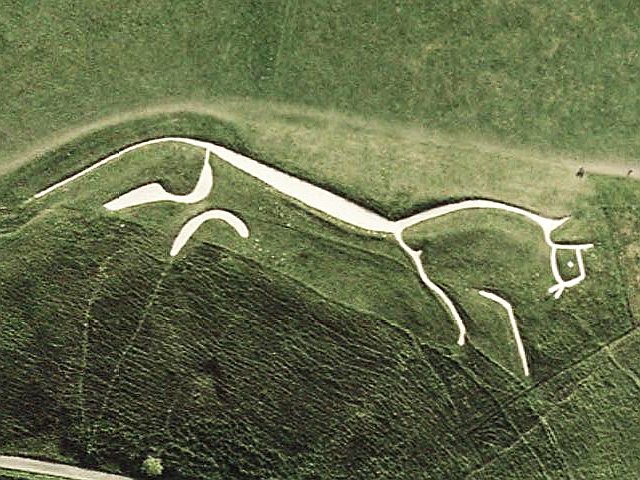
A white mare, a symbol of sovereignty, is a kingmaker because through her, the sacral king marries the sovereignty goddess, or the land itself. Giraldus Cambrensis described a "Celtic ritual, the king mates with a white mare thought to embody the goddess of sovereignty."—Wiki The millennia older Bronze Age white chalk horse of Uffington was also embedded in the folk memory of southern England.

The Bronze Age white horse of Uffington, on the Berkshire Downs in southern England, ca. 1400 BC.

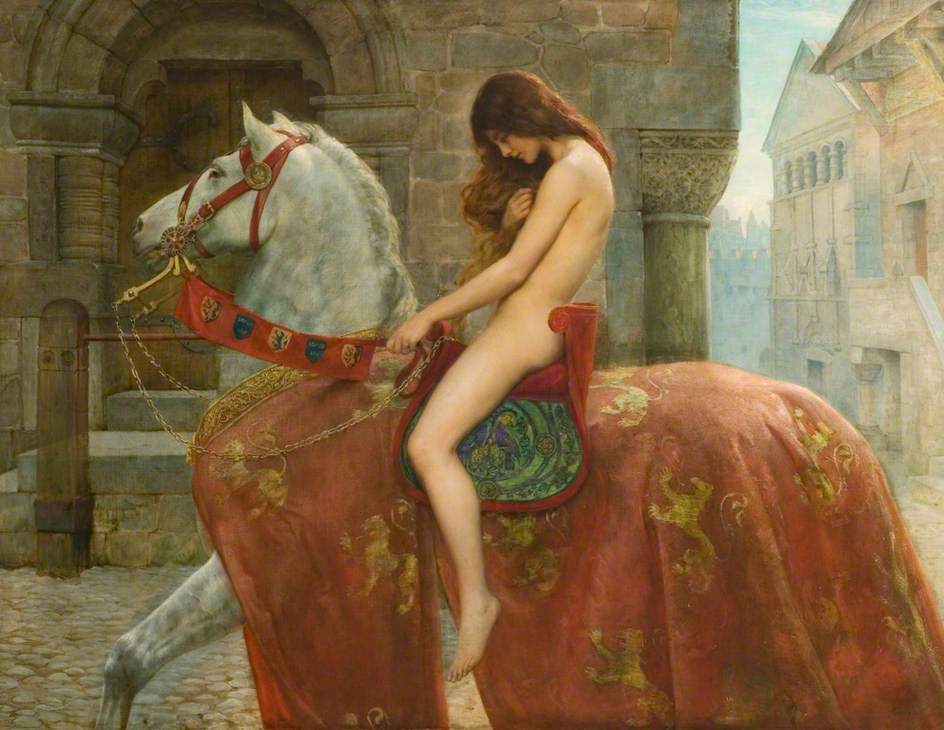
It's been suggested that Rhiannon is the archetype for Lady Godiva, and the nursery rhyme is about Lady Godiva. If Lady Godiva rode through Coventry town on a cock-horse buck-ass naked, where would she have hung her bells? Detail. Not buying it.

Lady Godiva by John Collierc.1897, note the white horse.—Wiki

To finish Rhiannon's story, though betrothed to Gwawl of Annwyn, Rhiannon married Pwyll, Lord of Dyved; at their wedding feast, she turned the jilted conniving Gwawl into a badger, and Pwyll bagged it—and thus, badger in the bag was born. There will be blood! Rhiannon was framed for her babe's murder, and forced to stand at the city gates wearing an asses' collar, proclaim to all that she killed her son, and carry visitors on her back like a horse into the keep. Throughout all the Welsh tales halo of birds is Rhiannin's enduring motif.
Ride a cock horse to Banbury Cross (or Coventry)
To see a fine Lady ride on a white horse
With birds as her halo and bells on her toes,
She will/shall have music wherever she goes.  
Note a distinction is made between She shall, or will have music versus She shall make music. Sorry, no date on this one either.

Banbury, Banna's 5th c. Saxon stockade in Oxfordshire, was built atop a 200 BC Iron Age fort at an ancient crossroads; it was the site of a battlefield between Anglo-Saxons and Britons in 556 AD.
The name Banbury derives from "Banna", a Saxon chieftain built a stockade in the 6th century (or Ban(n)a possibly a byname meaning ‘felon’, ‘murderer’, and "burgh" or settlement. The Saxon spelling was Banesbyrig. The name appears as "Banesberie" in Domesday Book. Another known spelling was 'Banesebury' in Medieval times.
Fittingly, Banbury has a Hobby Horse Festival. Hobby horses have a deep Epona connection, and in Wales, Cornwall and Somerset, they are associated with May Day, and Bealtaine celebrations (later moved to Christmas / New Year); Mummers PlaysMari Lwyd, and the Morris dance. Aka morisk, moreys, morisse daunce, it may mean a Moorish dance. But that may be a convenient assumption. First documentation in 1448 was a bill for seven schillings. There were definitely lots of bells on the Morris dancers' shanks' mares (shins). )

Welsh Mari Lwyd with Christmas ornaments for eyes.

Maybe the origin of the phrase With birds as her halo came from the Mabinogion recorded in the White Book of Rhydderch (scribed ca.1350, but from the 11th century), but I cannot find a reference to rings on her fingers, and bells on her toes in English translations. I did find this lovely line: "The birds of Rhiannon, they that wake the dead, and lull the living to sleep…"

Did the idea cross the Welsh border and enter into English? Lady Charlotte Guest's translation of the Mabinogion was published in 1877. Or is the line solely an English provenance? The English phrase is attested in English in 1745. Rhiannon's halo of magical birds of music didn't make an appearance in that edition, but the line with rings on her fingers and bells on her toes has managed to remain intact in English for at least 275 years. Maybe longer—though the wording is modern. It may be two different traditions merging.

How would an Elizabethan have said the phrase, or someone from the Middle Ages? (Surely they wouldn't refer to Elizabeth I, or Lady Godiva as old ladies!)  When does the phrase With rings on her fingers and bells on her toes enter into our language banks? The terminus ante quem question still begs and I'm far too lazy to drag my old bones to the musty basement of UC Berkeley's Doe Library, or Kroeber Folklore archives, to look up the rhyme like my folklore professor, Alan Dundes would expect of me. Maybe someday.

     *     *     *

Monday, February 18, 2013

Lost Particles of History

I am utterly enchanted with the intersection of archaeology, anthropology & linguistics. Blame it on my linguistics professor at Berkeley, or the fact that I studied Ancient, Early & Modern Irish (rather badly), as well as Medieval Welsh (also rather badly)—because I could. 

Or because I sat at the feet of the great folklorist-anthropologist, Dr. Alan Dundes. And of course, because, pots don't talk. 

On a more personal note, I am interested in the story of the underdog—not history written at the hands of the victor. Blame it on my well-read grannie who gave me a different, if not slanted, perspective of the world. 

Also, blame my high school biology teacher, Dr. Fatt, a Finnish marvel. And yes, se was also fat. She instilled in me, the quest for obscure biological tidbits. Ask me about stickelback fishes (her PhD thesis), or why Siamese cats have heat sensitive fur (and how to prove it.) Or the propensity of RH- bloodtypes in Finland. 

And why I see red when someone makes sweeping statements. My but-but-but button begins blinking. It's the lost particles of history that make the story go round. As to most favored wave-particle theory, well, I lean toward letting Schrodinger's cat out of the box! 

Indeed, how lovely it is to be (or not be) alive.

Thursday, December 6, 2012

California Accent

When I was young, we always honed in on the rare new kids who were from out of state. In those byegone days, midway between the last century and this one, there was no cable TV, there were very few television channels, broadcast stations were local, as was radio. That kept the local accent fairly stable.

So we could acutely hear the regional accent of those who were descendants of the Oklahoma Dust Bowl (often by way of LA). For some reason it was high on our radar. New kids quickly learned to drop their accent and blend in in order to fit in. The playground was a great equalizer of accents. 

Ironically, most of us came from immigrant families, and we learned to code switch. Speak like our playmates in the school yard. Maybe we were mimicking our teachers. But Miss Kolanoski was a Hunkie, so that didn't work.

My parents had a distinctive SF Mission Irish accent (by way of Boston)—but I didn't inherit it because I grew up in West Marin and raised by my Irish grandmother—so my accent is neutrally rural, if anything. I represent an older strain of the Northern California accent. 

I had to unravel my Irish syntax and create American structured sentences in order to fit in. You'd think I would have done well in English, but no, I was a colossal failure. I made up for it by being an avid reader—when I finally learned to read in the 3rd grade. But words I didn't know how to pronounce were given a new—usually dyslexic—twist. 

When I relax, and the Irish musicality creeps back into my voice (but not my sentence structure), most people are positive I'm from the British Isles, not California. I used to be terribly insulted when someone asked if I was from England. 

No! Northern California. 

Funny, you don't sound Californian. 

Really? Because that's where I'm from. 

No surfer dude drawl—another influx accent.

We rarely encountered the deep southern drawl, it was anomaly. Pearlie May's mother was from Lousiana, and Mary Ann's dad was from Georgia. But their accents were contained, isolated. Didn't rub off on us.

So, Dear Reader, how do you pronounce insurance? That's an accentual watershed: do you say INNsurance or inSUREance? Interestingly, many Native Americans also carry some of those broad midwestern nuances in their speech patterns. But it makes sense when you realize how many First Nation tribes were driven into the Oklahoma Territories.

Sometimes people affected that Midwest accent to sound rural or trustworthy. An aww shucks twangy down-on-the farm folksy kind of moment. Redneck bonding. Different than the Midwestern broadcast network accent.

Where did we develop our ear? Old black and white movies on TV. Migrant farm workers. Ma and Pa Joad. Used car dealers, TV commercials. What I think of—when I'm in Bakersfield, for example. Accents we avoided. We called it the California Oakie accent.

Then, during the 1970s, a new influx of accents flooded the Northern California accent matrix, the broad urban nasal sounds of NY or LA. We hated the sound. We mimicked it. Made fun of it.  The invaders prevailed.

Don't even get me started on the 1980s Valley Girl accent of the San Fernando Valley. Again—that too was media-driven. 

Then, massive migrations of Latin American farmworkers brought other accents elements but that took a long time to cross over and meld into the California accent. Then, when California's population doubled—from 15 million to 30 million, overnight—it was a polyglot of languages. Suddenly everybody was moving to California. 

Since California has increasingly become a multicultural state, local and regional accents have also taken on the flavor of immigrant population accents as well. 

So how do you sort it all out? What is a California accent? Is there one? Several? 

I am the Alameda County coordinator for the student Poetry Out Loud project, I successfully coached two Contra Costa County students who placed 2nd and 3rd at the statewide level—and one of the things I've noticed is that I could distinctly 'hear" what regions the kids parents and grandparents were from by the way they pronounced certain key words.

I've seen kids code-switch—one accent is used at home, and another accent at school. I can't imagine coming up with a single definitive accent (or dialect — You, and what army? Sorry, couldn't resist—bad linguist joke). 

So how do we define local accent with code switching and speech acts? People putting on their Sunday best voice versus talking to family at home.

One of the key things I learned from UC Berkeley's Alan Dundes, while collecting folklore—is to never "clean up" the interviewee's speech acts. Stet. As a writer, of course, I want to polish my own writing—but it was interesting to collect folklore while maintaining the authenticity of the subject's linguistic background.

I am acutely aware of regional levels of socio-economic strata accents—for example, when the str combo suddenly became slurred (via inner-city, and rap music movement) and now everybody's slurring str words—even broadcasters. Schtraight. 

Gangsta speak has become everyday speak. No more code switching. Drives me crazy.

'Sup bro?

Such is the power of media. 

Sunday, September 30, 2012

On Andamanese Languages


(I responded to a Facebook rant—and did far too much Wiki surfing.)

A recent Facebook post I read on Andamanese peoples was a case of fast and loose reading with overbroad extrapolation and interpretation of facts. And it gave the appearance of ethnocentric (read: American Black) racism at the expense of indigenous cultures.

I wanted to tell the author, though I respected his attempt to reconcile the convoluted history of peoples and migrations throughout the eons, stating that Jōmon, and Andamanese peoples were one and the same—both out of Africa based on the outward appearances of skin color and hair—is wrong.

We have no photographic or linguistic record of ancient Jōmon cultures. As my ceramics teacher, Thano Johnson was fond of repeating: pots don't talk. My anthropology teachers McGrath and Dundes, reiterated the phrase. Be careful how you arrive at conclusions.

Granted that Andamanese languages and genes are old, very old. Possibly Proto-Australoid, it doesn't make them African.

A few Andamanese genetic characteristics are present in isolated populations from Asia to Oceania: southern India, Sri Lanka, Malaysia, Indonesia, Papua New Guinea, and China.

Andaman languages (during the 1900s there were ten-plus mutually unintelligible Andaman languages—meaning they've been around a while—at least 60,000 years) are what is called a "linguistic isolate"—today only 3 languages survive, and they are in decline.

Genetically, "Andaman Islanders have been isolated for a substantial period of time." Andamanese genes have little genetic variation (bottleneck). The Jarawas carry an allele with no affinity to any other population in the world. It means they've been inhabiting the Andaman acrchpelago for a long, long time.

I noted that the subclade of the D haplogroup is not present outside of the Andamans—which supports the extreme insularity of these tribes. They are haploid D group, yes, but not the unique subclass marker. It does not make them Ainu, or vice versa.

(Archaic DNA origins of the Ainu, or Utari of Japan and Russia have not been scientifically identified (but they are thought to be proto-Mongoloid). Their Y-DNA haplogroup D2 is common in Tibet and the Andaman Islands. Mitochondrial DNA haplogroup Y is also found among Nivkhs, Tungusic peoples, Koreans, Mongols (including Kalmyks and Buryats), Chinese, Japanese, Central Asians, South Siberian Turkic peoples (e.g. Tuvans, Todjins, Soyots), Koryaks, Alyutors, Itelmens, Taiwanese aborigines, Filipinos, Indonesians, and Malaysians. )

Take mtDNA: All Andamanese belong to the subgroup M[10] which is also on the Indian subcontinent, it represents 60% of maternal lineages, but also in Africa and other areas west of India. But M2 is unique to the Andamanese. M2 and M4 lineages diverged 60,000-30,000 years ago. They've been an isolate group for so long, they had no immunity against common diseases—like the Amerindians.

In other words, nothing is as simple as it seems—other than these two groups are extremely old. Skimming the surface, with overbroad extrapolation and interpretation of facts serves only to muddy the water. Not shed light.

The oldest Chinese pictographs—the sun, moon, tree, etc., all share parentage with the glyphs and writing of ALL world cultures. Some things are held in common, as a development of mankind. It doesn't mean that they're African—unless you go really far back. Broaden the lens.

Friday, December 7, 2001

Folklore: Shivers = grave; Steal a seat = death

Genre: superstition, Irish and Irish-Scots
Neil O’Neill, male, 47
English-speaking Irish-Scots American
Lecturer, UC Berkeley
Dec 7, 2001
Collected in Oakland, CA (residence)

"Someone is walking on my/your grave."
and
“would you take my grave as quickly?" 

Neil O’Neil said, “My mother told me that when you got the shivers it meant that someone was walking on your grave.” His mother Beatrice lives in Scotland (b.1926), but is of Scots-Irish descent. 

Neil said, “I was probably about ten or eleven, it was 1962-63, somebody came in from the rain with wet clothes on, and they took them off to dry and they put on a sweater, and sat down by the fire and then, started shivering. That’s when my mother said it. She said her mother told her that when she was a kid in Johnstone [Scotland], and that it was an Irish saying.

Neil also said that if someone steals your seat in your absence, the reply would be: “would you take my grave as quickly?" 

Neil said, “I heard that at work, at CIBA Geigy, in Pasley, Scotland, in 1971. Jemima Watson, a co-worker, left her stool in the lab, I borrowed it, and she came back in and said to me, ‘Would you take my grave as quick?’ 

I said, ‘What do you mean?’ and she said, ‘You stole my chair!’ She was being light-hearted about it but I gave her back her chair. I thought it was an instance of black Scottish humor.”

Neil elucidated, “It’s about confusion, it’s about death. You’re stealing their chair, you’re taking their seat. It’s an extreme comparison. You won’t ever take their chair again. Think about the symbology of a seat, it’s one’s home, one’s life, one’s castle, and can represent position in society. You can compare it to Rosa Parks on the bus. It’s a subversion of someone else’s property. It’s a breach of social propriety, and it highlights a collision of ownership. Who owns what. That’s a direct relationship to the power relations between people in a given society.” 

What's interesting to me is that shivering is a sign of a future foreboding—that may or may not happen, God forbid. Shiver, and you might die, and cause your own death. 

And the stealing of one's seat also portends a future death. (And an implied curse). How many of us have reserved our seat position when we run to the loo, or called dibs on a free seat, or yell "I'm riding shotgun!" It's about hierarchy and pecking order as well.

UC Berkeley Folklore Collections
Kroeber Hall, Dr. Alan Dundes

Tuesday, December 4, 2001

Folklore: Death Customs

Genre: Folk Narrative/ Belief, Celtic  (myself)
Rhiannon’s Birds whose enchanted song could
“wake the dead and make the living forget everything.”

The Christmas of 1956, I was five, my Irish-born grandmother, Jennie Walsh Reilly (b. 1893), broke with tradition and dragged home a bare madrone tree from up the hill instead of an evergreen Christmas tree, and decorated it with stuffed birds. The previous New Year’s Eve, my grandfather died, we left 131 Third Ave., San Francisco, and moved to the summer home in Forest Knolls, Marin Co., Ca.,

When we moved, it broke up our large three-generation family. Grandma said that my parents were divorcing, and I knew both my uncle Myles and my grandpa were dead of cancer.

I remember my grandpa standing at the front door, suitcase in hand, saying goodbye. I wanted to know where he was going. Uncle Myles went away and never returned. I was not ready for the answer of “heaven,” so I asked where else it was beside in the painted dome of the Star of the Sea church on Geary St. where I was baptized. He pointed up to the clouds in the blue sky and said something about angels. I was relieved when he didn’t ask me along with him.

Our first Christmas on our own, I wasn’t ready to let go of the idea of a real evergreen Christmas tree, so I trudged up the ridge in the rain and dragged home my own tree—a Douglas fir, more sprout than tree. We made another cross for the base and the two trees stood tied side by side, my tree was too weak to hold ornaments or lights, and the one angel we had placed on the tip, kept doing swan-dives off the top.

But the red-skinned madrone tree, with its lights, silver glass balls and songbirds, was strong enough to hold up the Christmas angel. So I climbed up the ladder and placed her at the crown of Grandma’s skeletal madrone tree. Her madrone tree was beautiful, with its bare branches, but it just didn’t feel right.

I remember she told me the reason why she used the stuffed birds on the tree, with a Welsh story of the queen-goddess Rhiannon’s Birds, and how their enchanted song could “wake the dead and make the living forget everything.” She said we were building a new life, starting with the bones of the tree. And the red-skinned madrone, peeling from the heat of the fireplace, showed us the heartwood under it—green with the promise of life to come in spring.

I believe my grandmother, out of grief, was acting unconsciously, and was unaware of the metaphoric significance of her actions in choosing the birds, but I was so upset, she had to come up with something to appease me. She believed that wild birds entering the house were a sure sing of death, but since death had already visited the house, perhaps it was projected inversion of sorts.

I was fiercely attached to tradition, even at five, I knew there were patterns for everything, and I must’ve thought bad things happened (death) because we’d broken a taboo of sorts and were being punished. Ann Ross in “Pagan Celtic Britain” (Academy Chicago Publishers, 1967), writes: “The birds of Rhiannon are associated with...the blissful Otherworld...where there is no death...or decay.” (p 288).

UC Berkeley Folklore Collections
Kroeber Hall, Dr. Alan Dundes

Folklore: Foodways, saying, a food thief/ house sprite

Genre: Folk Saying/Foodways, Norwegian (myself)
December 4, 2001
“Toofta took it”

Our next-door neighbor Agnes, in Forest Knolls, West Marin Co., Ca, was Norwegian-American and in the mid-1950s, when I was a young child, I learned many Norwegian customs from her. Agnes Haugen Vincilione, in her late 40s, was married to a sea captain, Lucien Vincilione, who was away at sea most of the year, and so to occupy herself, she took solace in the afternoon with bourbon on the rocks.

Whenever her drink got low, which it invariably did, she always blamed an invisible Norwegian troll called Toofta, for stealing, or finishing her drink. Of course, this was an excuse to crack open the bourbon jug that was kept under the sink, to pour herself another drink, to raise her glass to Toofta and say, “Skøl pifiskin,” (a salutation that means cheers/ health & fish!). Apparently Toofta had a powerful thirst. Since I was only five years old at the time, I thought Toofta was real, and though I tried to keep my eyes open for this thieving drink-napper, I never spotted him.

Agnes had an elder sister, Borghild, or Borg Haugen, who lived in San Jose; she visited every weekend and she too blamed Toofta for stealing things, not only drinks but food as well—especially Norwegian cookies. I knew Toofta had a sweet tooth and liked his bourbon, but not lutefisk (jellied fish). I imagined he looked like a leprechaun but stockier, because he was a troll; he dressed in Norwegian clothes.

Borg “adopted” me and I remember visiting the family home in Seattle. Borg and Agnes had two sisters, and a brother, Einer; it was a Norwegian-speaking household—their parents and uncle Otto didn’t speak any English. Janet and her mentally retarded sister, Sally lived at the family summer home on Vashon Island, and Einer, in Seattle. They too blamed Toofta for missing things.

Though I was skeptical, Toofta stood a good chance of being more real than Santa Claus—whom I knew was a fraud, because there was a Santa was on every street corner in the City ringing bells at the same time. (Besides, he couldn’t fit down the stovepipe).

Toofta was especially busy during the holidays when there was baking to be done. We made krumkaker, a thin, rolled conical waffle with scrolled designs embedded in the wafer, which he seemed especially fond of; wreath-shaped spritz, and cardamom-flavored fatiman twists—which I hated the flavor of. As far as I was concerned, Toofta could have them all. Naturally, with his sweet tooth, Toofta also took my first tooth, but he didn’t leave me a kroner under the pillow.

When I was 9, Borg gave me a krumkaker iron she brought back from Norway, and some 30 Christmases later, I’m still making krumkakers for my aunts & cousins. Since my family is Irish-American, it’s odd that we’ve picked up a Norwegian custom and adopted it as a family tradition. My cousins insists that eating krumkaker is an integral part of their Christmas experience.

Folklore: Irish Soda Bread Recipe (two loaves)

IRISH SODA BREAD

Nollaig na nBan
JENNIE WALSH REILLY, 1893-1987, Bantry Bay, Co. Cork, Ireland
(as taught to her granddaughter, Maureen Hurley, 1952— in Forest Knolls)

PRE-ASSEMBLY:

Preheat oven to 450 degrees. Or full blast.

Melt 2/3 cup of shortening (butter/margarine; or Saffola oil mix—melt butter, pour into measuring cup, add enough oil to make 2/3 cup). Let it cool to room temperature.

Grease up two bread pans (Grandma saved butter wrappers to grease pans; or use oil). I use Pyrex glass lids to melt the butter, then use them as baking dishes. Pre-greased!

More traditional: use heavy round cast iron frying pans (like a griddle) or a Dutch oven for a thicker crust. Batter is thick enough to stand alone. (If you’re camping or cooking over a hearth fire, then a Dutch oven with lid is necessary. Preheat lid in the peat fire.) Coat greased pans with flour. Knock extra flour into large mixing bowl. Set aside.

MIX DRY INGREDIENTS:

In a large mixing bowl, take 6 cups flour (part of the mixture can be made up of 1 to 2 cups of whole wheat and/or 1 to 2 cups coarsely ground oatmeal flour* can be substituted. Use a coffee grinder to grind the oats—or you can just add large handfuls of quick cooking oats. I use 2 very generous cups of coarsely ground rolled oats. Don’t use old fashioned steel cut oats, they won’t soften up enough—you’ll break your teeth. Total flour should be about 6+ cups).

1 level teaspoon baking soda, or bicarbonate of soda (use box edge or knife to level it). 
If you don’t have baking powder, add a pinch of cream of tartar to baking soda and increase baking soda by 1/2.
3-4 level teaspoon baking powder (depends upon strength/brand/freshness of baking powder and the sourness of the buttermilk. Lately I've been using 3-4 teaspoons of baking powder, as oats are dense.)
2 tablespoons sugar, up to 1/4 cup. (Great-Aunt Kitty used more sugar; veritable wars were fought over correct family recipes. Also, too much sugar is a humectant and will make the bread flatter).
1 teaspoon to 1 tablespoon salt. (Or one small hand hollow. Grandma used the hollow of her hand to measure. So do I). If you use oil, or lightly salted butter, use more salt.

OPTIONAL:

1 to 2 tablespoons caraway seeds (Or one large hand hollow.) Caraway is very Celtic.
1/4 to 1/2 cup currants or raisins (currants are more traditional, but harder to find. Most so-called currants are small raisins, not currants; it’s often called Irish freckle bread, or spotted dog). Or add 1/4 cup dried cranberries to an equal amount of currants or raisins.

Mix dry ingredients thoroughly until raisins are coated with flour. I use a whisk. I also use the dry mix to dust the greased pans, banging off the excess flour right back into the bowl. You can also strew a handful of rolled oats atop the floured, buttered pan. They press into the wet dough nicely.

WET INGREDIENTS:

In a small mixing bowl, beat 2 extra-large fresh eggs, mix together with

2/3 cup of melted shortening (butter or margarine or oil—if you use a cup of butter, the bread will be extra crunchy but you'll need to add extra flour) mix with
2 cups fresh buttermilk (use that greased shortening cup & buttermilk won’t stick! or just use a 1/2 quart of buttermilk from the carton). Mix well. If you don’t have buttermilk, you can sour 2 cups of milk with a tablespoon or two of vinegar or lemon juice. If you ad a few dollops of sour cream or yogurt to thicken it, use less milk to keep it in the 2 cups of liquid ratio intact.

ASSEMBLY:

Make a well in dry flour mix, pour in buttermilk/egg mix. Scrape off any liquid in the bowl. Mix dough quickly using a spatula to fold, or cut ingredients. You want them mixed, but barely moistened. Don’t stir it too hard or gluten will develop and your bread will be tough. Mixture should be lumpy, on the dry side, not soupy. Add more flour if necessary. But don't over mix. NEVER knead a quickbread.

Divide dough into two portions and put into two greased, floured pans. I use Pyrex lids. Cast iron pans are hard to come by. Don't pack the sodabread down. Cut a large X in middle to divide loaf into four quarters, or farls “to let the fairies out.” This X is often called St. Brighid’s Cross. Brighid was the pagan goddess of the hearth, cattle, and abundance who was later made into a Catholic saint as she was a central mythological figure. Paint top of bread with butter and sprinkle with rolled oats (optional).

Scones can also be made from Irish bread mix. Fashion a round loaf about 2 inches high, and cut into 6 or 8 farls (St. Catherine’s wheel) and baked in a hot oven for 20-30 minutes. The main thing to remember, that for a tender, crunchy soda bread, is to barely mix the ingredients and handle dough as little as possible.

MIXING TIP:

Soda reacts immediately to wet ingredients. So don’t blather on, you need to get the dough into the hot oven as soon as possible! Bake bread on top shelf of oven at 450° for 15 minutes; lower heat to 350° to 375° for 30 to 45 minutes to an hour. When knife (or broom straw—use the clean, top portion of the straw, not the part that sweeps the floor!) comes out clean and bread is golden, the bread is ready.

Remove bread from the pans or the crust will soften.

Bottom of bread should sound hollow like a drum when struck. Cut bread into generous portions and serve piping hot with Irish butter and marmalade or homemade blackberry jam for afternoon tea.

PLAN B:

If you need to keep bread warm for company, you can bake the bread for about 30 minutes at 350° until it sounds hollow when you knock on it (after the initial 15 minutes at 450°). If the bread is still wet, you need to bake it to the moist stage. Check with a knife. Then turn off the oven, and leave the bread in the pans for about an hour, and they'll still be warm and crusty.


Folklore: Foodways/ How to make Irish Soda Bread

Genre: Folk saying/narrative/ Foodways, Irish Maureen Hurley
English-speaking Irish-American
December, 4, 2001


“Too many cooks spoil the broth,” “two people, three opinions,”
or how to make Irish soda bread without WW III erupting.

The tradition of making Irish soda bread in my family for guests has its roots in Bantry Bay, Co. Cork, southern Ireland, where my ancestors made it in over a turf fire in a Dutch oven. According to my grandmother, Jennie Walsh Reilly (b. 1893), who raised me in San Francisco, and later in Forest Knolls, Ca. (in the ‘50s), serving Irish soda bread and piping hot tea to guests was an absolute must, no matter what.

Because there is a correct procedure in which to make it, there was always plenty of contention among my grandmother’s sisters, Peig and Ceit, as to the proper sugar/ fat/ leavening ratio. My grandmother would frequently retort, “too many cooks spoil the broth,” or more rarely, “two people, three opinions.” 

The purists wouldn’t use baking powder, only baking soda (I remember when my grandmother began to use baking powder, a big concession), some were guilty of over sugaring the dough. Another (God forbid!) used Crisco (taboo) instead of butter. 

How three sisters, who got this recipe from their mother—and who quickly followed each other to the United States, each bringing the next sibling out the following year in the “teens”—could have developed such radical variations in making soda bread, is baffling. Whenever one visited the other, either arguments erupted whenever soda bread was served, or snide remarks about its lack of merit, were muttered under breath. I suspect that the brouhaha had something to do with maintaining tradition and issues of proper Celtic hospitality customs. 

I tend to think my grandmother’s recipe is the correct one as she was the eldest daughter, and so learned it first. Her eldest daughter, my aunt Jane (73), has also changed the recipe; she insists it’s the correct one, that mine is wrong (but I have it in my grandmother’s spidery handwriting.) But arguments still flare up whenever the recipe’s mentioned. Jane uses too much baking powder and too much sugar. 

I bet some of the sibling disagreement had to do with the fact that baking powder is a New World invention, and that using baking soda would be more authentic. (But according to food historians, bicarbonate of baking soda wasn’t used in cooking until a couple hundred years ago, in 1843). 

Does that mean quickbreads are a recent invention? No. Delving deeper, I found that soda ash aka washing soda, sodium carbonate/carbonate of soda was used as a leavening agent in the 1790s. But it was also used as a flux for glassmaking and soldering jewelry for at least 5000 years. Not to mention all that laundry. Why not use it in cooking too? 

Then it dawned on me that tracking chemical leavening use is obscure because of Passover or Easter. No yeast leavened bread allowed during Passover or Lent? The workaround was washing soda. Take pretzels invented by a wily peckish monk wanting a bit of bread during Lent in 610AD. Flour, water, and soda ash. No yeast. Ah, apocryphal stories waiting to be debunked. I found an earlier precedent of three-fold pretzel making which means using soda ash in cookery has ancient roots. 

You might also add pretzel’s progeny, bagels to the bread hagiography list, invented ca. 1200AD. Yeah, yeah, it was used on the outside as a browning agent via Maillard reaction. But my point is that cooks used soda ash for a variety of recipes. Like making shirakaki and ramen noodles. Now we also use bicarbonate of soda as a browning agent—to tenderize and brown meat too.

But I digress. We do know that commercially available carbonate of soda which needed to be activated with water, was used as leavening agent in the 1800s. (See recipe below). My grandmother said they substituted white wood ash (aka soda ash), pearlash or potash (or even muriatic acid) if they didn’t have baking soda.) 


My grandmother said caraway was a necessary ingredient—something to do with ancestors and the returning of the sun. For that reason, it’s also called Irish freckle bread. There were always plenty of people wanting my grandmother’s recipe for Irish bread. Whenever there’s a party or a Celtic event at UCB, I’m pressed upon to bring my soda bread. 

When we went through my absentee father’s things after he died 7 years ago, we found my grandmother’s handwritten recipe, she had given him during a rare visit, some 30 years before, carefully tucked away beneath the car visor flap. What was odd, was that the recipe, which was used (it had fat stains), was obviously transferred to his new car and we know he was on at least his third or fourth car. Why he carried the recipe there, we haven’t a clue.


THE CORRECT WAY TO MAKE JENNY WALSH REILLY’S IRISH SODA BREAD

An hour and a half before guests arrive, measure
2 and 1/2 cups unbleached white bread flour
(you may also substitute a little stone-ground whole wheat flour
and/or a 1/2 cup of oat flour for extra nuttiness; but grind it in a coffee grinder first.)
1/2 teaspoon salt
1/2 teaspoon baking soda
2 teaspoons baking powder (make sure it isn’t damp)
1 scant tablespoon sugar

Mix dry ingredients together.
add 1/2 cup raisins, or currants, but coat them well with flour so they won’t sink to the bottom
1/2 teaspoon caraway seeds (optional)

Preheat oven to 400° and grease a small 6˝ to 8˝ round cast-iron skillet with butter, douse it liberally with flour so the bread won’t stick.

In another bowl, mix together:
1/3 cup melted butter, or oil (but dough will be wetter, add more flour)
1 beaten extra large egg
1 cup good quality fresh tart buttermilk; don’t use the synthetic stuff

Pour wet ingredients into flour mixture. Work very quickly as the soda reacts with the buttermilk to create the gas which gives this bread its loft. Fold ingredients gently with a spatula or spoon until just barely moistened. Mixture should be very stiff and dry. Don’t develop gluten by overstirring, otherwise it will be tough. 

Flip dough into skillet so that it’s nicely heaped up. Don’t pat it smooth. It should look like a craggy mountain. With a greased knife, cut the sign of the cross for the Savior or St. Brighid (four farls) on it, and immediately place it on the top shelf of the 400° oven. Bake 15 minutes at 400°; reduce head to 350°; bake for 45 minutes, or until done when an inserted knife (or clean broom straw) comes out clean. (Option: drizzle top of bread with melted butter and sprinkle surface with rolled oats before baking.) Makes one loaf.

 Recipe may be successfully doubled, but use slightly less less baking powder or it will taste metallic. (This is also true of your buttermilk isn’t up to snuff; the tarter, the better.)

Invert the loaf onto breadboard, let it rest a few minutes before serving. Bring to the table wrapped in a clean tea towel and serve farls slathered with generous portions of butter and jam, and gallons of piping hot tea with cream and sugar. (A drop or two of whiskey for the tea is optional).


See Irish Soda Bread Recipe too. UC Berkeley Folklore Collections
Kroeber Hall, Dr. Alan Dundes

Sunday, December 2, 2001

Folklore: Superstition, Law of 3

Genre: Proverb/Superstition, British (myself)
December, 2, 2001

“Parsley goes nine times to the devil.”

My grandmother, Jennie Walsh Reilly (born in 1893, Co. Cork, Ireland, emigrated to California in 1919), who raised me in Forest Knolls, West Marin, Ca., had relatively few active superstitions for an Irish Catholic woman but this proverb was repeated several times on a yearly basis—especially to the parsley pot outside the kitchen door. My grandmother had trouble sowing the parsley and often roundly cursed it.

I first heard this proverb when I was quite young, during the 1950s (she was in her late 70s), but it wasn’t until I was a teenager before I thought to ask her what it meant. She explained that parsley was such a difficult herb to grow from seed, sometimes she’d have to sow it as many as three to five times before it sprouted. 

She never had such rotten luck as to have to sow it nine times though. I wasn’t sure what the devil had to do with it and the idea of him prowling around to have a look at our parsley was a daunting proposition. However, she did hide the pot away from view, “to keeps the cats from taking a snooze (or a shit) in the pot,” she’d explain. 

When the parsley sprouted, we’d chew on some of the leaves and she’d always tell me how “parsley was good for the heart.” She said that she must’ve learned the proverb in Bantry Bay, Ireland, where she most likely heard it from her mother (but she wasn’t sure), on their family farm, Coomb an nOr (Hill of gold). 

In the “Concise Oxford Dictionary of Proverbs,” J.A. Simpson, ed. (Oxford, 1982), A terminus ante quem is suggested for “Parsley goes nine times to the devil.” as it is first notated in 1658 in Memes & Smith, “Wit Restored (34), “There is as saying in the North Riding of Yorkshire that the weed [parsley] before it’s borne nine times the devil sees.” (p 193). I would add that the ritual use of 9 (3 x 3) is a significant compound of the Indo-European Law of Three.

I don’t think my grandmother believed the devil was withering her parsley with his malevolent gaze, because the cats usually got blamed for it. Or she’d note that she either over watered the seeds or forgot to water them. She rarely indulged in evoking superstitions, she thought they were, nonsense; she was terribly practical for a Victorian Irish woman. I think her goal was to be an active bearer of the oral tradition and I was the intended recipient. 

She often said, of all her “children” (though I was her eldest-born granddaughter), I was the most like her in temperament. And she was forever filling my head with stories of the ancient Celts. I grew up in a divided world: I learned Irish history at home, and an Anglo-British version of history in school. Often the two didn’t correspond. Later, when I studied anthropology and epic literature in college, I discovered most of her stories proved to be true.

UC Berkeley Folklore Collections
Kroeber Hall, Dr. Alan Dundes

Folklore: Charm to ward off bad luck

Genre: Proverb/charm, Provençal?  (myself)
December, 2, 2001

Avanti, avanti, maleficium defense
(avantee, avantee mal-le feecee-ium defance)
out out evil protect Out, out evilness, and protect (me?)
honi soit qui male pense. let there be no thoughts which are bad.
(oni swoa kay mal-ee pance)
it that bad and thought

I first learned the proverb from a former boyfriend, poet John Oliver Simon (b. 1942), of Berkeley, Ca., ca. 1982. He used “Avanti” as a preventative magic superstition charm to ward off evil. The first time he used it was when he ritually smudged his house with sage to purify it ca. 1982, and another time, when we were in San Cristobál de las Casas, Chíapas, México, in the mid-’80s, during the New Age event, the Harmonic Convergence, touted by José and Ivan Argüelles.

But instead of harmony, it was as if the dead and the devils were truly on the rampage. While hiking, we met a gringa (American) who had been raped, and someone else was just murdered on the trail we were on....we were too close to the underbelly of the world.

The night of the so-called Convergence, I had nightmares that the dead were after me, and I kept waking up, screaming my lungs out, with my hands in the aura where their ghostly green presence was. After my third nightmare, John felt the need to purify us. He said “Avanti” was an old Provençal proverb from the Middle Ages, and he’d successfully used it as a charm for 20 years.

Still I was haunted, so we gave up the idea of sleep, climbed onto the roof and sat back-to-back with our elbows interlocked and chanted the charm as we watched the stars while waiting for dawn to arrive.

When I described the strange dead woman who visited me in my dreams that night, John said he recognized her; I’d described how she dressed, demonstrated how she stood, hand on hip, pointing to John. She had a message for him, but I couldn’t make it out. He said, “That’s Mickela, in Berkeley. Something’s happened.” I hadn’t a clue who Mikela was.

But next morning, a telegram arrived from the poet Alta, John’s former wife: Mikela died that night. The first apparition was a friend of mine, poet Dave Evans,—I wondered why he was in my dream.

When I returned home to the States months later, I learned Dave Evans had died that week of a heart attack. The third apparition was demonic, perhaps Jaguar & it wanted me. My Irish grandmother had the gift of the Second Sight, I’d dreamt of the deaths of Borg Haugen, and a poet-friend Boschka Layton, (sister of Donald Sutherland, & wife of poet Irving Layton), but I never dreampt of someone I didn’t know, and for another person. I’ve no explanation for it, as I don’t tend to place much stock in it. However, if I’m in a tight situation, I will say “Avanti.”

In an attempt to track down the origin of this proverb, I asked far and wide, to no avail, I couldn’t even get anyone to help me translate it. I was told it was medieval Provençal, but how could I prove it? It kept niggling at me. I knew this proverb from somewhere else, but where?

The only clue I had to go by was the 1994 movie, “The Madness of King George,” the king wears blue ribbons (the Order of the Garter) around his calves with the proverb printed on them. So I began to think of knights, and a UC Berkeley linguist, Renee Perelmuttter, said, “Isn’t that from Sir Gawain and the Green Knight? He wears it on his girdle to remind himself of his foolishness. And then all the knights wore girdles too.”

Then I began to harbor some anatomical worries. Seething like Malvolio at cross-purposes with his garters, I pondered: why did they confuse girdles which presumably go around a man’s waist, to garters, which hold up one’s stockings around the calf or thigh?

The last line in the 1959 Penguin edition of “Sir Gawain and the Green Knight” indeed ends with: “HONY SOYT QUI MAL PENCE” (p 125). It is not in most of the Sir Gawain tales. I looked at 5 other tales. This particular version of Sir Gawain comes from the 14th c. Cotton Collection MS, Nero Ax, in the British Museum. A footnote revealed: “The conjunction of the green baldric and the motto of the Order of the Garter; but that order was founded by Edward III, in about 1347...” It went on to say that the Green Knight was originally associated with the Order of the Bath. And “Ritual purification of knights by bathing appears to have been practiced by the English as long ago as the 11th c.” Henry IV formalized the Order in 1349. So we have a terminus ante quem of the early to mid-14th c; and a possible 11th c. source. Since the story Sir Gawain is a Romantic reworking of an older Celtic tale (it first appears in the Ulster Cycle, in the 12th c. MS, Leabhar nahUidre), further research into Medieval French courtly poetry is required to see if I can locate the first line of the proverb.

UC Berkeley Folklore Collections
Kroeber Hall, Dr. Alan Dundes

Folklore: Sign Superstition/ Birds/ Death

Genre: Superstition/Folk Saying, Celtic  (myself)  December, 2, 2001
“A bird flying into the house
was to let death come into the house.”

My grandmother, Jennie Walsh Reilly (born in 1893, Co. Cork, Ireland, emigrated to California in 1919), who raised me in Forest Knolls, West Marin, Ca., had a few Irish superstitions about death. One was, “A bird flying into the house lets death come into the house.”

Since we lived in the country, and she usually left both the kitchen and front doors open in good weather, we often had winged visitors, including the wild towees that clustered like small chickens at the kitchen door to peck at the toast crumbs.

The first time I remember her telling me this death superstition was when a brown towee flew into the house. I was about six years old in the mid-50s. Since it was usually up to me to catch and release the birds before the cats spotted them, it was a time of great excitement, so I wasn’t too worried about the idea of portending death.

But later, when several deaths did occur after birds flew into the house, or banged against the windows, I began to sit up and take notice, filing the idea away for future reference....to test the hypothesis. I sensed the type of bird that entered the house also mattered by intensity of degree, but I couldn’t say why. Towees and bluejays were lower on the totem pole, a woodpecker or a wren had more significance. Ravens were the war goddess, the Morrígan’s own doomsday birds.

A variation of the bird coming into the house was when a bird tapped its beak or banged against a window—it didn’t matter whether it was inside or outside the house—it also portended a coming death. The combination of a bird entering the house and knocking were both omens of death signals. If my grandmother was wakened by the sound of knocking at night, she said it was a sure sign of death.

She’d wait for the bad news with resignation. And usually within the week or two, a letter would arrive from Ireland or California announcing the death of someone in the family. After the third time it happened, whenever a bird entered the house, I’d get goose bumps.

This is a sign superstition in that the event is our control. According to J.H. Brunvand in “The Study of American Folklore,” (Norton, 1966), “Superstitious death and funeral customs (category VII) reflect our fear of all things associated with death. A bird flying into the house...signs that were once widely regarded as sure omens of a coming death in the house...” (p. 387). Venetia Newall in “Discovering the Folklore of Birds & Beasts” (Herefordshire, Shire Publications 1946)writes that many birds, especially the owl, represents misfortune and death. (pp. 46-47). Ann Ross in “Pagan Celtic Britain,” (Academy Chicago Publishers, 1967), writes: “There are many references in [ancient] Irish literature to the drawing of omens from birds.....Evil is also divined in the flight of birds.” (p 329). The raven, the Irish war bird, was the most evil bird of all.

UC Berkeley Folklore Collections
Kroeber Hall, Dr. Alan Dundes

Friday, November 30, 2001

Folklore Parody song to tune of Auld Lang Syne

Genre: Folk Song (parody?)
Mike Tuggle, male, 60s
poet and painter
American, born in Oklahoma
Nov 30, 2001
Cazadero CA (residence)
JOSEPHUS & BOHUNKUS
(Sung to the tune of Auld Lang Syne)

There was a father had two sons
and these two sons were brothers.
Josephus was the name of one,
Bohunkus was the other.

Now these two boys to college went
for reasons quite specific.
Josephus was religious bent
Bohunkus, scientific.

Now these two boys are dead and gone.
Long may their ashes rest.
Josephus of the cholera died.
Bohunkus, by request.

I first heard Mike Tuggle sing this song to the tune of Auld Lang Syne, at a poetry reading he was giving in 1980, in Sonoma County, Ca. Since then, I have heard him sing it at dozens of readings; it’s become somewhat of a trademark of his. And though I’ve sung the song to many others over the years, no one else seems to have heard of it, nor is it in any of my songbooks including my Irwin Silber Songbook, and my Alan Lomax folk song collections.

Mike said that his father taught it to him when they lived in Oklahoma, and that it was passed down through the family. Mike is Irish-American and Cherokee descent. He thinks it’s a folk history of sorts, modeled after a real event. I agree. I think there was also a middle verse with mules too.

I like to sing the song, because there’s more of it than first meets the eye. Even though it has a biting, moral tone, it offers an interesting world view. Given that the song is at least 75 to 100 years old, it refers back to an earlier era, perhaps the early 1800s, and the idea of both brothers going to college would have seemed unusual (and expensive) for midwesterners. (It turns up as a college song in at least two midwestern colleges).

It doesn’t strike me as a particularly eastern song, it seems to fit within the cowboy lament genre, even though one brother is a scientist and the other, a preacher/scholar. And the fact that they’re cremated seems a bit fantastic. Most songs—laments of the funereal genre, like The Streets of Loredo—tend to have coffins and graves in them. I like the irony of the last stanza, whether they were good or bad, they both still died in the end.


Thursday, November 22, 2001

Folklore: Superstition, Unexpected Guests/ Hospitality/ Luck

Genre: Custom/ Superstition Irish-American? (myself)
To set an extra place at the table during a feast
because it might attract an unexpected guest
(what is implied, an unexpected guest brings good luck).

I first remember observing the custom of setting an extra plate for the unexpected guest in the late 1950s when I was eight or nine years old—for Thanksgiving dinner. Because my grandmother who raised me, (Jennie Walsh Reilly, born in 1893, Co. Cork, Ireland), had a large family of eight children—with children of their own.

Thanksgivings were a huge affair with my cousins at the little table, and aunts and uncles & spouses galore at the big table. It was a madhouse of some 20-30 people, plates and chairs, all crowded in to the dining room & adjoining living room. How we were supposed to fit an extra guest in, I wasn’t sure. But we always set an extra plate, just in case—and invariably an unexpected guest arrived at the door just as we all sat down

My grandmother would always be the last one to sit down at the head of the table. It was almost as if she were waiting for that extra place to be filled before she sat down. She’d stall until we all got upset and demanded that she sit down. I’m not sure how I arrived at the idea that an uninvited guest arriving during the holiday was considered to be good luck. I just “knew” it, probably because when someone did arrive unannounced, my grandmother would welcome him with excitement and happiness (especially if it was a tall, dark, handsome man).

I suspect that this custom held some elements of a Celtic hospitality custom. My grandmother grew up in the oral tradition in the Southwest of Ireland, and I learned many Irish customs and tales from her. Serving tea to unexpected guests was part of that welcoming custom, though it would not be considered causal magic superstition. 

As I was collecting folklore, my aunts explained to me the custom of “George” the mythical extra guest. I’d heard about “George,” but never understood that other members of my family (3 generations) thought the extra place was for him as well—as my grandmother, Jennie, didn’t use the saying. She sometimes mentioned a McGregor. 

I remember her annotating it with a reference to Elijah—perhaps to tie it in with the Christian tradition. Though I didn’t find a specific reference in J.H. Brunvand’s “The Study of American Folklore,” (Norton, 1966), he does write that: “Superstitions associated with home and domestic pursuits (category III) usually concern cooking,...changing households....[and methods of] allowing someone to enter the house...” (p. 385).

UC Berkeley Folklore Collections
Kroeber Hall, Dr. Alan Dundes

Folklore: Extra Dinner Guests

Genre: Proverb, British-American (myself) November, 22, 2001
“Wherever McGregor sits, he’s always head of the table.”

As two dozen of us sat down to Thanksgiving dinner this year out in the yard like pilgrims, having outgrown the house because another family had joined us, my uncle was late at arriving to the table. His wife, my aunt “Toddy” repeated the family saying, “Wherever McGregor sits, he’s always head of the table.”

I first remember hearing this saying in the late 1950s when I was around eight or nine years old—as we sat down for Thanksgiving dinner in Forest Knolls, Ca.

Because my grandmother who raised me, (Jennie Walsh Reilly., born in 1893, Co. Cork, Ireland), had a large family of eight children—who also had children of their own—Thanksgivings were a huge madhouse affair with my ten cousins (whose ranks later swelled to 18) at the little table, and aunts and uncles with spouses galore sitting at the big table—it was a sea of people, plates and chairs.

 How we were supposed to fit McGregor into all this, and who McGregor was, I wasn’t sure. But invariably some unexpected guest came to the door as we sat down and was squeezed in at the extra plate. I confused the two customs and thought the plate was for McGregor.

My grandmother would always be the last one to sit down—which was always at the head of the table. Why would she say this when she was already at the head of the table? And as she sat down, she’d say: “Wherever McGregor sits, he’s always head of the table.” 

I wasn’t too sure who McGregor was. She wasn’t a McGregor, she was a Walsh-Sullivan, but for years I figured he was an ancestor or relation of sorts. But he was Scottish and we were Irish. Even though a great-aunt married a Scotsman (Ward), I wasn’t too sure where McGregor fit into the scheme of things. I remember once worriedly looking up at the Reilly and Walsh family coats of arms on the wall, wondering what his crest would look like—maybe with a turkey or a plate in it.

I confused and conflated the saying of McGregor with another custom we had which was to set an extra plate at the table for the unexpected guest—an uninvited guest arriving during the holiday was considered to be good luck. 

As I was collecting this folklore, my aunts explained to me the custom of “George” the mythical extra guest. I’d heard about “George, but never understood that they thought the extra place was for him as well, as my grandmother didn’t tend to use the saying. She sometimes mentioned McGregor. I remember her once annotating it with a reference to Elijah as someone unexpectedly arrived at the door in time for dinner. 

Part of my confusion with McGregor/George had to do with the fact that I had to sit with the ever swelling ranks of little kids and I wasn’t allowed to join the big table until I was about ten. My birthday fell on Thanksgiving that year, I was allowed to join the adults. I remember puzzling over McGregor.

Interestingly enough, when I explained my confusion about McGregor and the extra plate, my aunt Jane, 73, went ballistic and thoroughly chewed me out with a character assassination which left us all stunned as I was explaining to my family that what made folklore unique was that there were variations in folklore and that this was my own (if flawed) variation. I don’t know why she got so angry, but that made it impossible to probe deeper into the origins of McGregor.

I had to later re-interview my other aunts and cousin in order to get their opinions as to what they thought it meant. I think Jane was threatened by the process of analysis of the folklore which they rejected the idea that McGregor had something to do with Scots thriftiness and stinginess, though they did mention freeloaders and free meals. 

My aunt “Toddy” said the association with McGregor was “so nobody would feel bad wherever you sat because you might get shifted from your place if a stranger came.” We all learned to associate McGregor with the extra plate.

I always thought my grandmother’s usage of McGregor had to do with the famous betrayal and slaughter of the Scottish Highland McGregor clan, invited to the rival Campbell clan’s stronghold for a feast at Glencoe, then killed by the treacherous Campbells—a horrific breach of Celtic hospitality. She’d often use “The Campbells are coming” as a threat. I thought she was honoring the slain McGregors, they’d always be welcome at our table. But when we looked up this story, we discovered the McDonalds were slaughtered in 1692 by the Campbells, not McGregor.

The idea of resurrecting clanship may not be far off the mark. I think my grandmother, as acting head of the Reilly clan, abdicated her personal role, and stood in place for the absent chieftain (hence the mythical McGregor), since her husband had died in the 1950s. My grandfather, as the eldest surviving male Reilly (a sept of the O’Neils), had the legal right to claim the family holdings in Co. Longford, Ireland, but he chose not to do so.

Note Bene: Looking McGregor up in Scottish and British proverb sources yielded nothing, but when I flipped through Archer Taylor & Bartlett Jere White’s “American Proverbs and Proverbial Phrases, 1820-1880,” (Harvard, 1958), while looking up “shank’s mare,” another favorite of my grandmother’s, I stumbled upon: “Wherever Macdonald sits, there is the head of the table.” The quote is listed as Emerson’s Works 1, 105, (p. 232), but I suspect it’s much older than that. This makes our McGregor an interesting variation indeed.

UC Berkeley Folklore Collections
Kroeber Hall, Dr. Alan Dundes