Showing posts with label Brigid. Show all posts

Friday, January 31, 2020

Imbolc offering to Brigid, simultaneous saint & goddess, ca. 2000

I made a Celtic scarf as a prop for finals in my MA MFA playwriting classes on monologue at San Francisco State University in 2000. Making the scarf went off without a hitch, after a lot of research, I banged the drawing out in about 45 minutes, and another hour or so for painting it with dye. The pin I was using to hold it in place, slid off during my monologue, and Justin Chinn dinged my performance for a costume fail. It was a class monologue reading for fucksake, not a public performance. He was an absolutely horrid teacher, resting on recent minor theatrical accolades, and he should never have been teaching. The class was a required waste of space, so I called him on it. He gave me a C-minus for the class. I fought the low grade and won. But the A-minus dropped my entire MA/ MFA perfect GPA to 3.9. May he rot.

I also simultaneously used the St. Brigid scarf for a final in my Celtic studies class with Professor Dan Melia at UC Berkeley. I came to class dressed as the goddess/St. Brigid, so it must’ve been around Imbolc, February, 1, 2000, as I began the long poem in October of 1999. I’m not too sure where the poem came from, as it was something that literally possessed me, written in a fugue, augmented with facts—after the fact, as it were. Probably because I was devouring medieval Celtic timelines, including the Annals of the Four Masters, so my brain was oversaturated. I wish I had kept a first draft of the poem as the original might have given me a way back to the source, and an entirely different revision might have evolved. But without that long-winded piece of didacticism, the scarf would’ve never came to be. Art works in mysterious ways.

For my Brigid costume, I made a halo of twelve candles (with little battery operated Xmas lights) I was dressed in purple robes, a green Celtic shawl for a cape, a kirtle with all her symbols attached to the costume, including a poem, an iron horseshoe, a candle, and a rubber chicken, I read a poem monologue, and prepared a traditional Celtic feast for the class. Salmon, bread, and beer as she was the goddess of bread making, and beer making. Dan sniggered and said, you can’t bring alcohol to class, pocketing the Guinness for later. I got an A-plus. Sadly, I don’t have a clear in-focus photo of the scarf when it was fresh.

BRIGID/BRIGIT  A triune goddess of:
1) healing                             (therapy)
2) blacksmiths                    (fire)
3) fertility & poetry  (light—poets/seers, divination, prophecy)


Saturday, January 31, 2015

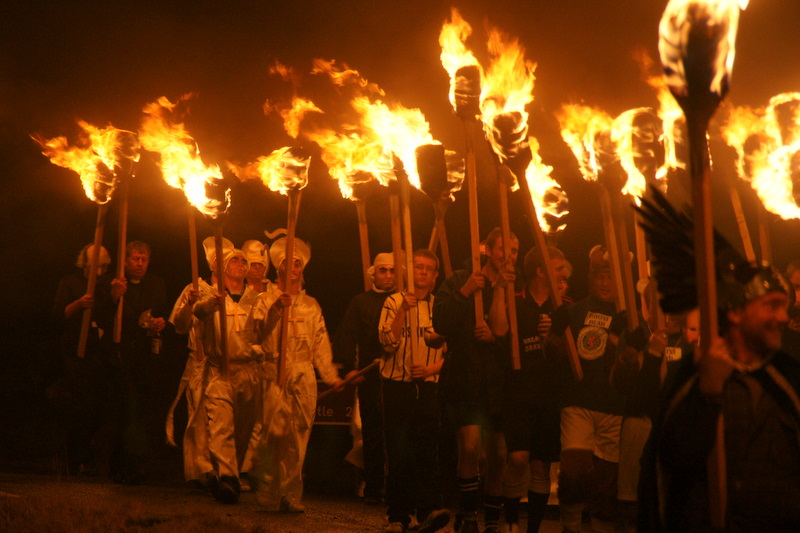
"Up Helly Aa," reconstructed Fire Festival, or Imbolc in Viking drag?

Guizers with torches at Up Helly Aa celebration in Uyeasound,Shetland.  Before the 19th c., tar barrels, not torches, were used. They look a bit KKKish.
The “Viking” Up Helly Aa fire festival celebrated on the last Tuesday of January (originally held on old Christmas Eve) in the Shetland Isles in Northern Scotland, is not a Norse festival, but a "reconstructed" Victorian Solstice fire festival. I'm not convinced the festival has any Viking roots, though modern-day Shetlanders, proud of their Norse heritage, would probably avow it does. 

The setting of the beacons, or the wards along the coasts and the lit tar barrels rolled downhill are well-attested Celtic motifs. The lit barrels, (my great grandfather also lit on Beltaine in Bantry County Cork, Ireland), evolved into setting a fire a long ship. 

The origin is a bit more obscure, as the Vikings invaded the Shetland Islands during the 9th century, and the fire festival was founded in 1880s—1905, more than 500 years after Norse rule was vanquished. Besides, there were other cultures living in the Shetland Isles since the Neolithic era. They didn’t just disappear with the arrival of the Vikings.

The Vikings, as we know, were not big on sharing the wealth, and 19th century Viking scholars were also not keen on sharing either. When something is claimed as being authentically Viking in Celtic lands, there is often a convenient blurring of anthropological lines, with the idea of Vikings still plundering other cultures a millennia after assimilation.

What cultures in situ before the Viking invasion, are often overlooked, because it doesn't fit current romantic thought. So, rather than observing the overlay with a cultural substrate, we often get skewed cultural theories based solely on later invading cultures—especially in Scotland where the Viking love affair is still in full swing some six centuries later. There is only "I" in Viking. Not even poetic license can alter that.

Shetland (sometimes referred to as Thule in Classical tracts), was no terra nullius before the Vikings invaded. The archipelagos of Shetland, the Orkneys and the Hebrides, also were not considered part of Scotland, which did not become a kingdom until the ninth century. The Latin term Scoti/Scotti referred to the Irish Gaels, whether in Ireland (Scotia Major) or Scotland (Scotia Minor). 

Long before the Shetland archipelago (Scots Gaelic: Sealtainn) was under Icelandic-Norse control, it was a Mesolithic, Neolithic, then a Celtic stronghold—for millennia. The Shetland Islands were originally settled by Neolithic Bell-Beaker peoples, then the Celts and the Picts, and the Scotti, or the Irish Celts—who also celebrated a fire festival on this date as well. Thule was supposedly settled by blue painted people (Picts), it could be a corruption of the word for fire, Iceland was also referred to as Innis Tile.

The first written mention of the Shetland Islands, comprised of some 300 islands and skerries, is from the Icelandic 13th c. epic, Njal’s saga. And of course, redheaded Njal with his fierce temper was probably an Irish-Norse Dubliner. At least one Irish Scotti place-name survived the Viking invasions, Dunrossness, and the islands of Papa Stour (Papey Stóra) and Papa Little (P. Litla) refers to Irish Culdee monks. Brother Island may also refer to those Irish monks. Three island place-names may be of Pictish or even pre-Celtic origin: Fetlar, Unst and Yell—once heavily settled by Culdee monks (Pappay/Papil Ness, Loch of Papil and Papil Bay.) St. Ninian’s Isle too was a papar stronghold.

Another Celtic influenced place-name Muckle meaning “big” in 17th c. Scots dialect, and Rua, meaning red (Old Irish ruiadh), a red granite islet, though Muckle Rua is erroneously identified as a Norse place-name, as is Dunrossness. But Dun is fort and ross is a promontory. And ness is a common Scots-Norse accretion also meaning headland in case one didn’t know what a ross was—a clear indication that the promontory was already aptly named before the Vikings arrived. Nothing to do with a noisy tidal race

The early medieval Pictish Bressay Stone,  (It’s in the basement of the National Museum in Edinburgh) with Celtic knotwork and beasties, has an Ogam inscription: “The cross of Natdad's daughter, child of Maqqddrroann,” (OId Irish Mac (son of) Droann. More here.) One of five Ogham stones in Shetland, the inscription is an admixture of Old Irish, and Norn, as the word for daughter is in Norse. Certainly, most of the village names would be of Old Norse derivation as the Irish Scotti didn’t go in big for the idea of towns.

Since the Neolithic era, (4000 BC), people have raised cattle and sheep, and farmed the Shetland Isles. What survives are prehistoric field systems, Bronze Age burnt mounds, Iron Age brochs, and Pictish wheelhouses. The oldest archaeological find, ca. 4000 BC, is a midden at West Voe, Sumburgh. Hard to imagine now, but much of the North Sea was once dry land, Shetland was lightly wooded and the climate was warmer. Neolithic burials include stone cists, and heel-chambered cairns on the island of Vementry, Punds Water and Islesburgh. Skara Brae, Maes Howe, and Ring of Brogar, in nearby Orkney, are extraordinary Neolithic monuments.

During the Bronze Age (2000 to 600 BC), the climate deteriorated, peat bogs spread, and sea level rose. Some 300 crescent-shaped burnt mounds (possible hearths) date back to the Bronze Age. "Ireland was the chief center for the manufacture of bronze and Scotland's early settlers were energetic seamen." Even way then there was a lot of travel between the islands. For millennia, there was Irish contact in the Shetlands, whether by trade, or by theft: a bronze-gilt harness mounting was made in Ireland during the 8th or 9th c. AD, was excavated from an archaeological dig.

Possibly due to a population explosion, or increased warfare, the Iron Age in Shetland saw the rise of massive fortifications: double-walled circular towers, and dry stone brochs—sometimes called "Pictish Towers", but their construction predates the Picts. Ancestors of the Picts, maybe.

Of the 120 Iron Age broch sites, Old Scatness, and the Broch of Mousa (ca. 100 BC), are among the finest preserved examples of Iron Age fort towers. In the case of Old Scatness, the Celts, the late Iron Age Picts, then the Vikings each built atop the old fortifications. Excavations at Jarlshof, confirm archaeological evidence in Mainland, Shetland, since the Bronze Age.
By the sixth century AD, Shetland had become integrated into the mainstream of Pictish politics and life. Artefacts such as painted pebbles and carved symbol stones demonstrate a strong Pictish presence in the islands. Good examples include the ogham script of the Lunnasting Stone, and Christian cross-slabs which include fine examples such as the cross slab and the Monk’s Stone, both from Papil.... From the late 8th century, Shetland was subject to the turbulent impact of the expanding Viking world.—Visit Shetland
The Viking invasions began ca. 800 AD. The earliest archaeological evidence of Norse occupation is in the nearby Orkneys (Viking Shetland was administered as part of the Orkneys, and they were both called the Northern Isles). In 800 AD, a Pictish, or Irish Culdee hoard of silver bowls, brooches, torcs, thimbles, chapes, and a porpoise jaw, was found beneath St. Ninian's church floor on Shetland's St. Ninian's Isle. (See St Ninian's Isle Treasure. St. Ninian AKA Apostle to the Southern Picts).
Human settlement of the island dates from circa 3000 BC and there are remains of several Neolithic burial chambers known as 'heel-shaped cairns'. Little is known of the pre-Celtic and Celtic eras, but when the Norse arrived it is likely they found a religious settlement as the name of the island derives from Papey Stóra meaning "Big island of the Papar" (Celtic monks), in distinction to Papa Little. —Wiki  (see Culdees or papar.)
In 1299 AD, the oldest Old Norse manuscript from Shetland (the Norse called it Hjaltland), was over a duel, where the isle of Papa Stour is referenced. Thorvald Thoresson, accused of corruption, was called "dominus de Papay." In early Irish literature, Shetland was referred to as Inse Catt—"the Isles of Cats." And the name Shetland, like Caithiness, may derive from the Pictish name for the cat islands. Ferocious European wildcats were not your modern moggies.

During the outbreak of Celtic Christianity, when "green" martyrs were seeking hermitages to commune with God, the Irish monks settled on most of the Hebrides, Orkneys and the Shetland Isles, as well as the Faroe Islands, and Iceland, the first stepping stone from Shetland to Iceland. Iceland was settled by the Norse, and Celts from the British Isles—including from Hebrides and Shetland.
During the Dark Ages, groups of outlaws and farmers took to the sea from the northernmost reaches of Europe. These seafaring marauders became known as the Vikings. Some of these outcasts among the Vikings were to achieve historical distinction indirectly through dubious means. —from The Struggle against Colonialism and Imperialism in Kalaallit Nunaat
What's interesting about the Up Helly Aa festival is that it completely obliterates any connection with the peoples of the past, other than a nod to 19th century Viking revival nostalgia. It's a wayward case of settler colonialism displacing the preexisting subculture, as a means strengthening an invader's power base to shore up national identity. This was certainly true in Iceland even though Iceland was settled by as many Irish as Vikings. So, what is Up Helly Aa?
According to John Jamieson's Etymological Dictionary of the Scottish Language (1818), up is used in the sense of something being at an end, and derives from the Old Norse word uppi which is still used in Faroese and Icelandic, while helly refers to a holy day or festival. The Scottish National Dictionary defines helly, probably derived from the Old Norse helgr (helgi in the dative and accusative case, meaning a holiday or festival), as "[a] series of festive days, esp. the period in which Christmas festivities are held from 25th Dec. to 5th Jan." while aa may represent a', meaning "all".  —Wiki Up Helly Aa
But the Northern Isles were once described as "Pictish in culture and speech."  Not Viking. Few Irish pr Pictish place-names survive, except for the northern islands Fetlar with its stone Funzie Girt (Finn's Dyke) a Bronze Age Berlin Wall, Unst and Yell, the second largest island, with 12 brochs, and 15 early chapels—a Culdee stronghold, probably not as enticing to the Norse. The dearth of Celtic "place-names suggest that the Picts may have been forced onto poorer land."There is another school of thought that they are pre-Celtic place names.
Despite many archaeological remains, we have only a patchy understanding of those who lived in Shetland before the Viking invasions of around 800 AD. Immediately before the Vikings arrived, though, it’s clear that Shetland – like much of Scotland - was part of the Pictish culture. By the time of the Viking invasion, possibly two or three hundred years earlier, Christianity had reached the islands. —History of Shetland
The "Northern Isles were the first to be conquered by Vikings and the last to be relinquished by the Norwegian crown." The historical record is weak but Woolf (2007) suggests the Icelandic sagas proclaiming dominion over the Shetland Isles are stories concocted "to legitimise Norwegian claims to sovereignty in the region.Perhaps that is also why a Celtic fire festival, possibly Imbolc, underwent a transformation into Up Helly aa.

An interesting aside: according to the Icelandic sagas, Egil's saga, and the Orkneyinga saga, the Broch of Mousa was used as a refuge for runaway lovers.

I suppose if one is inventive enough, the Norse origin of other island place-names could be challenged: Vementry (Old Norse: "Vemunðarey) could also be derived from a form of Finn, as in Finn's beach: as in Ventry, (Irish: Ceann Trá—which means head beach), which is an anglicization of Fionntrá, in Dingle, Co. Kerry. St. Ninian was also known as Fionnian. M, B and F, in the genitive, take on a v sound. But I'm being linguistically silly.

Maybe it would be more fruitful to look at DNA. Shetland's genetic heritage is 60% Norwegian Y-chromosome DNA (R1a Sigurd), and 40% is ancient Briton (Celts) DNA. The most common male Y chromosomes reflect the most recent migration. Apparently the Norse married lots of local women; as Norse (matrilineal) mtDNA was 30%. However:
[in] Orkney and Shetland, Roberts reported (1985, 1990) that both island populations diverged considerably in allele frequencies from neighboring populations. Roberts concluded that the islanders of Orkney and Shetland most likely represented remnants of an aboriginal gene pool that had changed on the British mainland because of later population movements.... Of the Scottish populations, Orkney [not Shetland] evidently has the closest matrilineal links with Scandinavia. The inhabitants of the Scottish islands share two to seven times more of their lineages exclusively with Gaels than they do with Scandinavians.... mtDNA lineages can be used to identify recent migration. Viking men settled and intermarried with existing populations in Shetland... —mtDNA and the Islands of the North Atlantic
So, with all that intact ancient matrilineal Celtic Briton gene pool intact, do you think their fire customs, celebrated since time immemorial, would suddenly be forgotten and just disappear with the occupation of the Vikings—only to return as a new and improved Viking festival? Methinks this particular fire festival smacks of the neo-Romantic Viking revivalist movement: think truncated Wagner as performed by Viking mummers. (Note that Up Helly Aa is not celebrated in Scandinavia.) 

According to the Smithsonian article, "Up Helly Aa was first celebrated in the 1880s. Before then, rowdy residents would take to the streets to mark the end of the Yule season by burning tar barrels." 

Up Helly Aa is a procession of 1000 guizers celebrating their Norse heritage. Guizers (dis-guisers and galoshins) are a long-standing tradition in the Celtic ream; our modern Halloween trick or treaters are guisers

The festival is stapled onto the end of Yule season (see: Burning of the clavie), but even using the old calendar, "Old Twelfth" would have fallen on Jan. 17, not the end of January, which would be Imbolc, the Fire Festival of Brigid.

A parallel story of confusion: an Irish Medieval History Facebook post notes that people erroneously assume the pagan Celtic Goddess Brigid, who represented the light half of the year, was transported into Christianity as Saint Brigid. Ancient customs and religious beliefs were not swept away with the arrival of Christianity and traditions associated with St. Brigid’s day are thought to date from the pre-Christian period. Candlemas is the Christian overlay of Imbolc.

So taking that model for cultural continuance, despite new landlords, I suspect this Shetland fire festival is an offshoot of the festival of Imbolc, and of the pan-Celtic Goddess Brigid, which was a time for a massive spring clean-up, burning old possessions and replacing them with new ones. 


Since Neolithic times, cross-quarter days, that midway point between solstice and equinox, were celebrated with fire festivals. Cross-quarter days were marked via astronomical alignments on ancient monuments: Mound of the Hostages: Hill of Tara, Howth, Newgrange, Stonehenge. The four fire festivals, Samhain (the end of the Celtic harvest year), Imbolc, Beltane and Lughnasadh also mark the beginning of each season. Spring was the beginning of the Roman New Year.

Imbolc might derive from Old Irish í mBolc, meaning in the belly (as in pregnant—bolg — Spanish /Galician bolsa means bag); it might mean purification or, First Milk.
...which arises from the word “oimelc/oí melg” used in the 10th century Sanas Cormaic (Cormac’s Glossary) which some people have taken to mean “sheep’s milk”. The word “melg” meaning ‘milk’ comes from the Proto-Indo-European (PIE—the ancestor language of most European languages) word “melg” which means "to wipe, to rub off". Purification/ cleansing was an important aspect of many ancient festivals and “oí melg” is not milking but rubbing, as in the act of cleansing. Further evidence of cleansing comes from the Roman festival of Februalia. The Old Irish word for February is ‘febra’, ‘febrae’ from Latin ‘Februarius’ which in turn comes from ‘februa’ meaning purifications. —Irish Medieval History: February 1st or Imbolc 
Imbolc was the second of the four great fire festivals, with significance placed upon the Light of fire. The Irish word for spring, "errach” thought to be related to the word “airreach” which means hauling and dragging. In Ireland, Imbolc is referred to as the big Spring Clean. "Right up to the twentieth century, on Brigid’s eve, the house was be scrubbed from top to bottom by the women who worked into the night." 

All debris was burned (including floor rushes, beds and bedding). Bonfires galore. Oh, and Brigid is a daughter of the Dagda, and a poet. She is the patron of the hearth, healing, metal smithcraft; and inventor of poetry, keening, and beer making. Ya don't want to piss her off. Burn, baby, burn. Sláinte!
A Bhríd, a Bhríd, thig a sligh as gabh do leabaidh
Bríd Bríd, come in; thy bed is ready
Brede, Brede, come to my house tonight.
Open the door for Brede and let Brede come in.
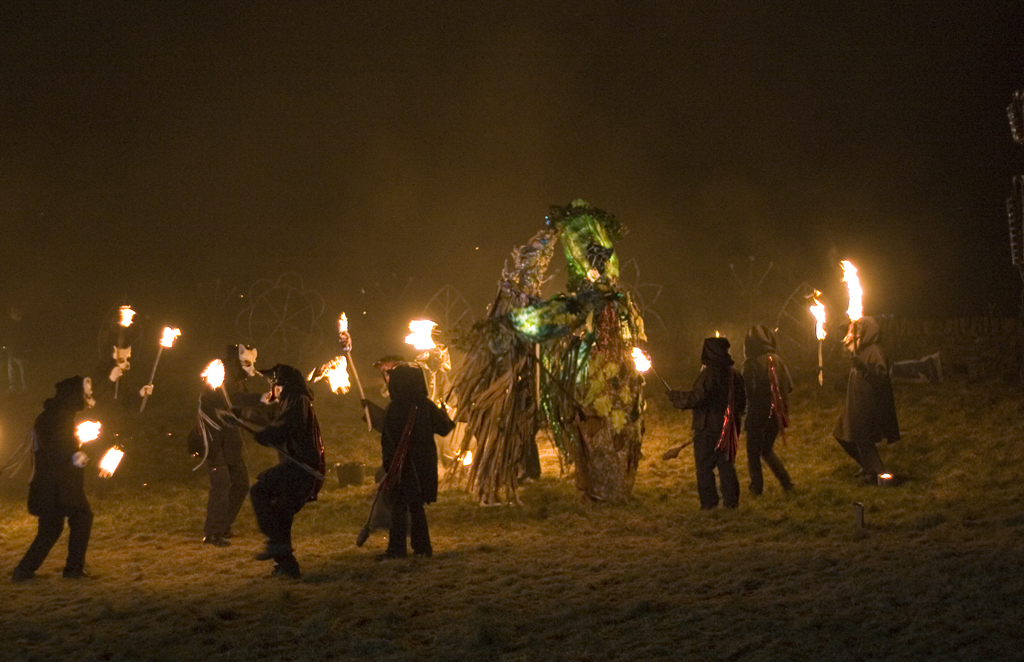
Imbolc festival in Marsden, Yorkshire. —Wiki

Brigid's the goddess of weather, for an early spring, forget the groundhog, chant this instead:
Thig an nathair as an toll
Là donn Brìde,
Ged robh trì troighean dhen t-sneachd
Air leac an làir.
 
The serpent will come from the hole
On the brown Day of Bríde,
Though there should be three feet of snow
On the flat surface of the ground.
Lá Fhéile Bríde shona dóibh go léir (Happy St. Brigid’s festival day to you all)!

Thursday, December 14, 2000

BRIGHID OF NAMES: A TRIPARTITE LIFE iii

BRIGID OF NAMES: A TRIPARTITE LIFE

I
Breeda, Bridey, Bridge-it:  Those eedjit Sassenach
never could wrap their thick Bearla around our sweet teanga.
Once I was Bree-id,  but I bridle at being called Bridie,
so undignified. Then they called me a Bride of Christ.
I, who was God-ness far beyond the Scythian Sea
I was every maiden, every bride and every crone.
In the Isle of the Blesséd, the Túatha  called me Brigantia
and gladly I gave my warrior cry to them,
for were they not my children?
Now brigantine corrupts my line.

In the beginning I was the triune Brí-ed,
but men from the east stripped me of my sisters: I was reduced to
Brighid of the healing, whom midwives and mothers beseeched,
Brighid of the Goibniu, who fanned the forge with her sweet breath.
And I, the anvil of poetry, wrote the ranna into the numbering of years,
I was christened Naomh Brighid for my deeds.
But they drove my Túatha    underground, calling them sídhe—faeries.

Up the airy mountain, down the rushy glen
we durna go a huntin’ for fear of little men
Wee folk, good folk trooping all together
Green jacket, red cap and white owl’s feather.

They took little Brigit for seven years long...

I was reduced to a faery, a mortal and a saint in one blow.
Poor Brigid Cleary, reduced to ashes by a husband who thought her a changeling.
Her only crime—a bad cough—but it was an unusually damp winter in 1889...
but that’s another story.

I was born at the atha  between worlds, betwixt night and dawn,
neither within nor without the house, ní an thigh ní an rígh.
The Daghda, the Good God, he was my áthair,
who was my máthair? Bóand of the Cows? Or Dana? I never knew.
Dana whose rivers adorned continents. Dnipr, Dienster, Don, Danube.
They say I was a fussy child, drinking only bainne from the red-eared cow.

I was wed a while to Bres, but he was a half-Fomorii from beyond the sea...
more interested in playing the Cattle of Tethra, his blasted fish, instead of me.
I watched our three sons fall, blessed by the song of the sword.
It was I who keened the first sorrow ever to face Éire.
I wanted them beside me, not in the land of the ever-young. Tír na n-Óg.

Caesar, in love with the scheme of things,
called me his little Minerva, making me patron of arts and crafts,
but he, with his silly interpretatia  never guessed
I was the fire Sulis, and her sisters of the lost names.
Greine Bélsima (most brilliant I was). The very heart of the sun.

Then, from across the sea they came with their tonsures and Latin learning,
reduced my Féis Dé, to Candlemas, but I was still a woman of sudden flame.
Nothing could susume me. I was simply present in the beginning of language
for my name simply means goddess, goddess, goddess.

Ah, Imbolc, the sweet milking for the lambs on the first day of Earrach.
It was I who divided the year into lovers: Samhain and Gemredh. (fall and summer)
In the first paragraph of paradise, I was shaper of the land, the consort of kings.

II BRIGIT AS MORTAL

In the first year of the plagues, Cogitius the monk scribed:
to a mortal slave she was born, swathed in a druid’s ráth on the Curragh.
I was thrice-born in the sweet land of Medbh, intoxicating queen of honeyed thighs.
I was born at Cú Chulainn’s menhir where he faced his final hour,
where my sister, the Mórrígan,was the war-raven tasting his eyes.
To appease his jealous wife, my dark father, Dubthach,
sold me to a king who thought me too worthy a wife
when I gave away his sword, chariot, horses, and treasury...
With my mantle, I claimed the whole of the Curragh
that land where as a girl I raced my chariot against the wind,
I claimed it to grass the cattle of the poor.
Milk overflowed in my fields. I bettered the sheep, I satisfied the birds.
For the night I was born, three cows gave birth at once
in the kitchen of the milk god.

It’s true, in the mortal coil, I refused marriage, even to the filidh
who couldn’t take a joke and fled like an omen hare
when my eye burst like a meteor on my cheek. Ach, it was only in jest.
Before battling with goddesses, remember the poem is better than any lord.
The lepers and the blind loved me, for my holy wells healed their maladies.
My little speckled fish wagged his tail, restored sight and prophecy.

St. Brendan of Tra Lí,  with thoughts always to the sea,
who preferred its music to that of the harp,
stayed in his blue martyrdom seven long years.
No one to cure my headaches, or to tell me tales of leviathan isles,
where he unwittingly said Easter mass on the back of a whale,
how it shrugged him off when he tried to build a fire.

Over the wave-voice of the strong-maned sea
and over the mouths of the marvelous, bitter ocean...
multitudes of furious red-mouthed monsters chased him.

He told me of The Land of Promise, an isle of mice, a paradise of birds,
and stories of crystal columns, and lost cities of glass beneath the foam,
and of ships in adrift in the sky, dropping anchor on some steeple below.
And the mayhem that followed when he climbed down the chain for a closer look.
My Forever Navigator, he tried to hang his wet cloak upon sunbeams like me.
My jealous brother, born between the salt water and the sea strand,
claimed the beasts of the sea loved me better. He was right, you know.
I gentled mad horses and soothed the voices of the waves.
They say I never crossed seven furrows without thinking of God.
I simply never took my mind off her.

With seven sisters, they say I built monasteries beneath the oaks.
But the oaks, not the churches, were my temple.
Even Column Cille loved his oaks. I came to him as a bird and sang.
Did they not know Cill Dara was already mine own?

From the time the earth took me back into her womb
until the dubhgaill  pirates came in longships from the north
I was smuggled to Dún Pádraig with himself and Colum Cille,
for 500 years we three slept together, blissfully forgotten.
No separation of marrow from bone.
We had but one heart and one mind.
I sleep but my heart waketh.
On the eve of Invasion, it was Maolachi who found us...

Dear Cormac in his Glossary penned that as a saint I usurped “a goddess
whom the bards worshipped, for great and noble was my perfection.”
He was right, you know, Briga is the word for Goddess.

Nineteen of my cailleacha  kept my fires lit with their sweet breath
Brigit guard your fire, the next night belongs to you, they always said.
I left a footprint in the ashes as a token of my affection.
In the 1200th year of Our Lord, Normans doused that fire and my 10,000 nuns wept.
That Welsh monk Gerald scryed there was a matter of a hedge no man could cross.
Hmmf! Plenty of men came to visit me, let me tell you.
The only thing that drove them mad was their silly fear of desire.
Hairy-psalmed men moved by soft Latin and flagellation never interested me.
Three sons I had: and they claimed me a virgin! What were they thinking?
I sent the kestrel to the spires of Kildare when her breeding was done
to mock them. Let them breed in someone else’s parish.
And that bit about the nuns: as if I needed prompting to mind my own fire!
Neither Gerald nor Cormac never recognized me as their own St. Ffraid.

It wasn’t Ibor who conferred me to the veil—history has it wrong—
it was Mel, so intoxicated by my presence,
that he read the ritual for ordaining a bishop over me. Bishop Brigit,
second only to Ticfa Pádraig; I kept my monks supplied in food and beer.
Silly things drank my bath water from Maundy Thursday to Low Sunday
before they realized it wasn’t ale. They, who called me Mary of the Gael
were clean mad to drink anything if it were blessed—even bog water.

Everything I put my hand to, received a threefold increase.
Churning, spinning, weaving were at my board. Brigit of the braziers.
Once I fed the dog the bishop’s dinner; and the meat was back on the bone by supper.
The multitudes I fed from that same haunch! Go leor: plenty and enough at my board.
But a sleighty fox stole the bone so I sent him packing to trouble a king’s court
to beg for tricks like a hound for a year and a day.

As a child, my hands charmed three yields of milk from my cows,
and the butter! I once filled the dairy with it to impress a stranger
who was horrified at the sight of a mountain of butter.
But to the vain woman bearing me wizened gifts of pride-apples,
I gave her fruitless trees as a small token of my gratitude.
How she eagerly watched the blossoms set to fruit each spring
only to ripen into husks, like herself. Crone!

How I miss my little bishop, Conleth, the metal-smith, falsely accused
of fathering a child, but it was Brón, (sorrow’s patronage abused.)
I bade the newborn speak the name of his father.
Brón Trogain, he mewed. Earth’s sorrow.
Did I not reside over His birth, did my sisters not nurse the Holy Child,
he who was to come, the triune God, the Son and the Father, all in one,
who was three in one, and one in three, a trinity like my sisters Bríd and me?

III
Know you that at the red hand of Ireland
I have been resurrected in the third age, a woman
without name, reborn in the fire of the last phrase of the millennium,
while child soldiers slouching on street corners, defend blood faith,
and the alien Bearla is now our sweet foreign tongue.
The Navigator Poet saying, Read the hand, read the hand...
In Ulster and Killdare, I sleepeth but my heart waketh.
I, who made Patrick’s shroud, who will read mine
when the last paragraph of paradise unfolds its wings?

Saturday, November 4, 2000

Brigid monologue outline for a one-act play in three parts


Subj: Brigid monologue
Date: 11/04/00

Query to Gemma Whelan, Breda Courtney
Wilde Irish Productions

Dear Gemma,

Thank you for your interest in my monologue. Below is the structure I envision for my Brigid monologue piece, and the first piece which I performed (but it doesn't incorporated the structure...since that's newer). The challenge is working within a structure when I'm not sure what impetus is needed to carry a monolog of this length (10--15 minutes...seems like an eternity).

BRIGID I envision a ninefold story in three movements, as it were.

1, Brigit as mythological goddess Creatrix

a) maker of the earth—only she can hear the earth singing—she is wearing a cloak or mantle NSEW
b) as morning star/fire venus / love
3) as darkness/chaos (not sure of this aspect)

2 Brigit as saint

a) childhood Curragh north
b) sainthood Kildare west east, also Wales as St. Ffraid 
 fight w/ imposter Brigid in Sweden?
c) death Ulster??? not sure of this aspect

3 Brigit as mortal

a) as changeling, invoke Brigid Cleary, little brigid/fairies
b) shiva/kali Bridie Murphy story
c) ?? tying in w/ Ulster and the red hand....destruction of the earth/ozone

Then I can work in something on the line of L Gregory's "You have taken the north from me, the south from me--that fabulous poem in Huston's The Dead....

Any other ideas gratefully sought.

as to costume:
wig/crown w/20 cantles (xmas lights)... her mantle...I've some silk pieces I've made, with tendrils hidden beneath it, spreading as she spins to claim the earth.... not just the Curragh. And the evil that escapes to the sea (Bres/Fomorii) will return...armageddon-like...to haunt our own polluted earth. Alpha/omega: ourobouros. At closure, she lifts her red hand to the audience saying "read the hand..." (I borrowed that from Heaney...)

(I edited out much of the middle saint/mortal section out during my performance; part three is very weak as I didn't have an ending, and didn't know where to go with it. What is of interest? What has potential? (It ran away with me, I need to bridle it, but first I need to find a bridle! Was a time I had bridles aplenty.)

Monday, November 15, 1999

BRIGHID OF NAMES: A TRIPARTITE LIFE, ii

BRIGID OF NAMES: A TRIPARTITE LIFE

1.  Bridge- id: Bridge- it: Those eedjit Sassenach
never could wrap their thick, alien Bearla around our sweet teanga.
Once I was Bree-id, Bride of Christ, but I bridled at Bridie: undignified.
I was synonymous with God-ness far beyond the Scythian Sea.
In the Isle of the Blesséd, the tuatha called me Brigantia
and gladly I gave name to them, for were they not my children?
I was the triune Bríd, but men from the east stripped me of my sisters:
Brighid of the healing, whom midwives and mothers beseeched,
bright Brighid of the Goibniu, who fanned the forge with her sweet breath.
But I, Brighid, the anvil of poetry, wrote the ranna into the numbering of years,
and was christened Naomh Brighid for my valorous deeds.

The Daghda, the Good God of Plenitudes, was my áthair,
who was my máthair? Bóand of the Cows? Or Danú? I never knew.
I was a fussy child, drinking only bainne from the red-eared cow.
I was born at the atha between worlds, betwixt night and dawn,
neither within nor without the house, ní an theach, ní an rígh,
wed a while to Bres, a half-Fomorii from beyond the sea...
My three strong sons fell, blessed by the song of the sword.
It was I who keened the first sorrow ever to face Éiru.
I wanted them beside me, not in the land of the ever-young.
Tír na n-Óg: did they not know Cill Dara was mine own?

At Bath, Caesar called me his wise Minerva: patron of arts and crafts,
but he never knew I was also Sulis, and her sister of the lost names.
Bélsima (most brilliant I was), then, from across the sea, they came
renamed my Féis Dé, Candlemas, but I was still a woman of sudden flame.
Ah, Imbolc, the sweet milking for the lambs on the first day of Earrach.
It was I who divided the year into two lovers: Samhain and Gemredh.
In the first paragraph of paradise, I was shaper of the land, consort of kings.

2. In the year of the plagues, Cogitius and other monks scribed:
to a slave I was born, swathed in a druid’s ráth, Foughart, Meath, 445,
to the sweet land of Medbh, regal woman of honeyed thighs.
My dark father, Dubthach, sold me to another king who thought me
too worthy a wife when I gave away sword, chariot, horses, treasury...
With my swirling cloak I claimed all his land to grass the cattle of the poor.
Milk overflowed in my fields. I bettered the sheep, I satisfied the birds.
It’s true, in the mortal coil, I refused marriage, even to the filidh
who couldn’t take a joke and fled when my eye burst like a meteor.
Before battling with angels, remember the Lord is better than any poem.
The lepers and the blind loved me, for my holy wells healed their maladies.
My little speckled fish wagged his tail, cured disease, restored sight and prophecy.

Brennaín of Tra Lí, in his blue martyrdom, for seven long years, went to sea.
No one to cure my headaches, or to tell me tales of breathing leviathan islands,
how he anchored on cities of glass beneath the foam, or of ships in adrift in the sky.
Forever Navigator, he never managed to hang his wet cloak upon the sunbeams.
My jealous brother, born of two worlds between the salt water and the sea strand,
claimed the beasts of the sea loved me better than Pádraig or he. By pondering
solely on God, I gentled mad horses, and soothed the voices of the waves.
With seven sisters, I built two monasteries beneath the oaks,
three-quarters of a century later, the earth took me back into her womb
until the dubhgaill pirates came in longships from the north
I was smuggled to Dún Pádraig with himself and Colum Cille,
500 years we slept, blissfully forgotten. No separation of marrow from bone.
We had but one heart and one mind.
On the eve of Conquest, it was Maolachi who found us.

3.  Dear Cormac in his Glossary penned: I usurped “ a goddess
whom the bards worshipped, for great and noble was her perfection.”
He was right, you know, my name was synonymous with Goddess.
19 of my cailleacha kept my fires lit with their breath until the 1200th year.
That Welsh monk Gerald scryed there was a matter of a hedge no man could cross.
Plenty came to visit. The only thing that drove them mad was their fear of desire.
Hairy-psalmed men moved by soft Latin. Three sons: and they claimed me a virgin!
That’s why I sent the kestrel to the spires of Kildare when her breeding was done.
And that bit about the nuns: As if I needed reminding to mind my own fire!
He never recognized me as his St. Ffraid of Wales, Angli-land, and beyond.

It wasn’t Ibor who conferred me to the veil,
it was Mel, so intoxicated by my presence so near,
that he read the ritual for ordaining a bishop over me.
Second only to Ticfa Pádraig; I kept my monks in food and beer.
Silly things drank my bath water from Maundy Thursday to Low Sunday
before they realized it wasn’t ale. They, who called me Mary of the Gael!
Everything I put my hand to received a threefold increase.
Once I fed the dog the bishop’s dinner; meat was back on the bone by supper.
The multitudes I fed from that same haunch! Go leor: plenty and emough.
But a sleighty fox stole the bone. I sent him packing to a king’s court
to beg for tricks like a hound a year and a day. To every dog its bone...
As a child, my hands charmed three yields of milk from my cows,
and the butter! I filled the dairy with it to impress a stranger.
But to the vain woman bearing me gifts of pride-apples,
I gave her fruitless trees as a token of my gratitude.

How I miss my bishop, Conleth, the metal-smith, falsely accused
of fathering a child, but it was Brón, (sorrow’s patronage abused.)
I bade the newborn speak the name of his father .Brón Trogain, he mewed.
Did I not reside over His birth, did my sisters not nurse the Holy Child,
he who was to come, God, the Son and the Father, all in one,
who was three in one, and one in three, like my sisters Bríd and me?

Know you that at the red hand of Ireland
I have been resurrected for the third age, a nameless woman,
reborn in the fire of the last phrase of the millennium,
while soldiers slouching on street corners, defend blood faith,
and the alien Bearla is now our sweet foreign tongue.
In it, the Nobel poet said to me: Read the hand, read the hand...

The Ides of Samhain, 1999
Berkeley, CA

Friday, November 12, 1999

SOURCE SYNOPSES ON BRIGID AS GODDESS & SAINT (notes for a paper and a poem)


SOURCE SYNOPSES ON BRIGID AS GODDESS & SAINT (bibl at end of each synopsis)
(parenthetical notes are mine; not text’s)

BRIGID/BRIGIT  A triune goddess of:
1) healing                                   therapy           
2) blacksmiths                            fire
3) fertility & poetry                    light, poets/seers, divination, prophecy

(also Patron saint of travelers, domestic arts; weaving & dyeing, agricultural abundance; the kitchen (bread), brewing;  arts/crafts learning; protectress of women; patroness of midwives/childbirth, water)

Mythological aspects: A daughter of the Dagda (The Good God ....Q is Boand (cow goddess) her mother??? her two sisters were also called Brigid, in other words, she was a triune goddess: that is, three in one). Must’ve been confusing having three goddesses with the same name.
She was married a while to Bres, the half-Fomorii ruler of the Dé Danann. By Tuireann she had 3 sons: Brían, Iuchar, Iuchara (twins+ 1, a mythic motif. It is said that at the death of her son, uttered the first cry of sorrow in Ireland.)

She appears as the equivalent to Dana, mother of all gods.
Counterpart in Brythonic Celtic (Brigantia; Totem of the Brigantes) and Gaulish (Brigindo) cultures. Her name seems to represent “High One”
(Exaulted One, Fiery Arrow. Bríg means god. A cognate with brihati in Vedic Sanskrit, correspondent in Britain with Briganti, latinized to Brigantia,)

Festival, Imbolg/Imbolc, Feb. 1, one of four great Celtic feasts. Pastoral festival assoc. w/the milk of the ewes and 1st day of spring.

(NOTE St. Brigid’s Night divided the year into 2 seasons winter/summer ....(from A& B Rees book, Celtic Heritage) Gemredh (winter half), Samhain (summer half), Earrach (spring or Oimelk/Imbolg or Imbolc -bolg+stomach/bag...ime is butter  butterbag??? cream bag/stomach? bainne = milk in Irish. If she’s the Indo European Cow Goddess, this all ties in. Cow, serpent, bird, cockerel assoc. w Brigid)

4. Brígid, 5th C. SAINT, AKA Mary of the Gaels; her tradition is often confused with the goddess. Attribute;  Icon: cow lying at her feet.
St. Brigid was born in Faughart in AD 540 and died in Kildare in 523; (note c.453 -523;
daughter of a slavegirl and Dubthach...a chieftain (or possibly a druid)
either sent to a druid or was born in a druid’s house...
She was baptized and returned to her father’s house, refusing offers of marriage (from a poet, no less), took the vow of virginity & with 7 companions, she founded Kildare, one of the greatest monasteries in Ireland. It was probably an important pagan site  kil= cell and dare= oak; Classical references state the druids worshipped in oak groves; it’s possible she was also perceived as a druidess. On the flat plains of what came to be Cell Dara were certain areas sacred to the fertility goddess Bríg, where her priestesses kept an eternal fire, The plains were left untilled  even though fertile, a sign that the goddess owned them.  Isle of the Saints: Monastic Settlement and Christian Community in Early Ireland, Lisa Bitel, Cornell  University Press, 1990  p 44).

Numerous accounts of her life were written soon after her death and her cult became widespread.. Her cult is second only to St. Patrick in Ireland (a paradox, if she was real, with 2nd generation monk-saints, a real misogyny seems to arise: it is said that St. Kevin disliked women as did Kentigern, and Columba, there’s even a tale attached to Brendan’s fear of women...a new element under Christianity : women lost many, if not most of their legal rights with the introduction of Christianity).

Many traditions and ceremonies assoc. w/ her predecessor, the goddess. Her Feast Day Feb. 1.  (Candlemas...interesting fire imagery here, also one description of her from the Hebrides has her head haloed with candles).
“RAS MacAlister put forward the theory that the saint was actually a priestess of Brigid who converted to Christianity. In most accounts of her life, her father is named as Dubhthach, a druid.”

p 50, A Dictionary of Irish Mythology, Peter Berresford Ellis, Oxford University Press, GB 1987.
---------------

BRIGID (Brigit, Bridget, Bride)  d 525 Abbess of Kildare. Historical facts about her extremely rare; some scholars doubt her existence. Lives mainly anecdotes and miracle stories, deeply rooted in Irish pagan folklore.
Born near Uinmeras, 5 miles from Kildare, parents of humble origin, baptized by Patrick, became a nun at an early age, founded a monastery at Kildare and contributed notably to the spread of Christianity. Her miracles stories portray her as a personification of compassion. Themes: multiplication of food, butter to the poor, and her bathwater into beer! (kinky!!!) to satisfy the thirst of unexpected cleric visitors. Even her cows gave milk three times during the same day to ensure that some thirsty bishops has enough milk to drink.

Other legends personify her with the Blessed Virgin (Mary of the Gael) based on a vision of Bishop Ibor the night before an assembly addressed by Brigid. When she arrived she corresponded exactly to his vision of Mary. Ibor also supposed to have consecrated her (or perhaps Mel “When Brigid went to Bishop Mel to receive the veil of a nun, he became so ‘intoxicated’ with the sanctity in his presence that he read the ritual for ordaining a bishop over her. Thus, Brigid is unique among Irish holy women in being a fully accredited bishop.” (Conversing With Angels & Ancients: Literary Myths of Medieval Ireland,  Joseph Nage (Cornell 1997)  p233 ) 

ODS  author David Hugh Farmer states: claims of bishops and abbesses of Kildare supreme over others in the whole of Ireland were a principal reason for the existence of even the earliest Lives, such as that by Cogitosus *(c. 650). (Ultan of Ard Braccan, d. 657, also wrote a Life). Lives translated into Old French, Middle English, German (some 7 Lives written??? ).

(Cogitosus maintains that Brigid’s patruchia stretched throughout Ireland....Brigid remains so colorless as an historical person that one doubts whether she had lived as a saint at all.” Medieval Ireland: The Enduring Tradition, Michael Richter, St. Martin’s Press 1995  p78.

(In Conversing With Angels & Ancients: Literary Myths of Medieval Ireland, UCLA Celtic Studies scholar Joseph Nage writes; “There is no serviceable modern edition of Cogitosus’s text (in Louvain)” page 234).
(“The cult of Brigid is the most spectacular example of the transformations effected by the medieval Irish hagiographic tradition, whereby pre-Christian divinity or divine trait becomes Christian saint or typical saintly behavior. There are incontrovertible references in medieval Irish literature to a pre-Christian divinity Bríg or Bright, who is obviously the inspiration for much of the cult of St.  Brigid.” Conversing With Angels & Ancients: Literary Myths of Medieval Ireland,  Nage,  p 233).

Unusual Double monastery of Kildare Brigid and Bishop Conleth (it’s significant that he’s a metalsmith, in one story, he’s accused of fathering a child and Brigid makes the child point out its father, in another story the cleric is Brón (sorrow), Another more repressed story where she gets rid of a nun’s fetus “public determination of paternity...is at the heart of the story pattern.”  Conversing With Angels & Ancients: Literary Myths of Medieval Ireland, Nage,  p231).

NOTE also suggested that the double monastery was w/ Patrick and / or her brother).
Her cult is second only to Patrick. Popular in England (19 ancient churches dedicated to her: St. Bride’s Fleet St.)  and in Wales: as many churches (NOTE numerology: 19 churches, 19 nuns) St. Bride’s Day, Dyfed emphasizes strong links w/ Irish Christianity. Many places in Wales called Llansantaffraid (=St Bride’s Church ...llan  santa FFraid: Welsh for Brigit). The cult of Brigid was popular on Continent, esp. in Alsace, Flanders & Portugal. (Also France & Italy...what’s amazing about this is that it is thought that women didn’t travel, so monks would’ve had to spread the word. But if she was indeed a bishop as Nage suggests, it would explain her power and widespread cult).
 
Brigid is patron of poets, blacksmiths and healers. Icon: cow lying at her feet, which recalls her phase as a nun-cowgirl.
A relic of her shoe in Nat Museum, Dublin (NOTE: she is often paired w/ Lugh...patron of shoemakers...get back to that later).
Folkloric elements important in her Lives and cult. Gerald of Wales d.c. 1200 (See orig. text, incl. & use in paper) described a fire kept burning continuously at her shrine for centuries, tended by 20 (19) nuns of her community. The fire was surrounded by a circle of bushes, which no man was allowed to enter.
Brig also means valor or might, personified as a goddess whose fire cult took place on Feb. 1; her translation to June 10. There is another feast on March 24 commemorated the discovery by St. Malachy in 1185 of the supposed bodies of Patrick, Columba and Brigid at Downpatrick.

—from p 50 Oxford Dictionary of Saints, David Hugh Farmer, ed. Oxford University Press, GB 1978. (he cites Plummer, among others) take tidbits from his intro on Celtic saints???
-----------------

(Note Morgan uses similar verbiage as Oxford Dictionary) Brigid...gathered together women from all over Ireland into protected monastic communities. (Why did they suddenly need protection? Viking invasions?) Brigid was legendary in her abilities to multiply food: turning bath water into beer & milking her cows successfully 3 x day (he misunderstands the information: it should say 3 x the yield, not 3 x day). She was an agriculturist: cowherd, shepherd, butter churner, baker, corn reaper (add more from Life).
The association with Brig whose cult was celebrated with a ceremony of fire. “Brigid has experienced a relatively recent insurgence of popularity due to the interest of contemporary feminist and environmental groups, as well as the growing women’s movement in Ireland.”

p 29 Saints: a Visual Almanac of the Virtuous, Pure, Praiseworthy, and Good, Chronicle Books, Tom Morgan, San Francisco 1994.
------------------------------

Brigid: Caesar includes her among major deities of Gaul (Interpretatio Romana) as Minerva, patron of the arts and crafts, but Celtic deities were larger and more complex, often assoc. w Mercury & Vulcan. Her cult was especially strong among the lower social orders, hence the patron of domestic arts: weaving & dyeing. Arts & healing, Brigid is honored at Bath (Aquae Sulis) and associated with Sulis.
Nearest counterpart, Irish Brighid in Cormac’s Glossary (c.8th c) states that she was the patron of filidhecht (poetry and learning, divination and prophecy-worshipped by the filidh).
Daughter of the Daghda, her two sisters also named Brighid: patrons of healing and smithing.
p 34  “Among all the Irish a goddess used to be called Brighid...her name used to be synonymous for Goddess.” Cormac’s Glossary (c.8th c).
There is slight historical evidence for her Christian namesake. “She usurped the role of the goddess and much of her mythological tradition”
In the saint’s Lives, she’s associated with livestock and any produce of the earth.
She was born at sunrise, a liminal boundary, neither within nor without the house (between worlds like Cuchulainn at the ford), and fed milk from a white, red-eared cow (supernatural Otherworld connection). And (while in conversation w/ St. Brendan) she hangs her wet cloak on the rays of the sun (Lugh/Griannos connection??) her house was ablaze when she entered.
Gerald of Wales quote: she and 19 nuns took turns guarding the perpetual sacred fire surrounded by a hedge, no men could enter (NOTE add Columba story of the man who went mad who crossed the threshold of bushes).

Solinus, in the 3rd c., mentioned that Minerva’s sanctuary (Bath?) in Britain contained a perpetual fire. Minerva’s epithet: Bélsima (most brilliant) Brigid: The Exalted one; cognate with brihati in Vedic Sanskrit, correspondent in Britain with Briganti latinized Brigantia, tutelary goddess of the Brigantes.
She gives her name to rivers: Brent in England, Braint in Wales and Brighid in Ireland.
There is no clear distinction between goddess and saint. Kildare was probably an important pagan site, Brigid was not a missionary saint, nor widely traveled (though chariot stories abound). There are dedications to her throughout Celtdom.

p 93 (compare w the Hag of Beare....re sovereignty) mother goddess, shaper of the land, consort of kings  “The composite legend of goddess and saint connected her to...learning, craftsmanship, healing...childbirth and animal abundance....predominantly pacific concerns.” War: she intervenes for Leinstermen as a tutelary goddess concerned with political and economic well being. A territorial goddess of the land assoc. with sacral kingship. Land should be prosperous and inviolate under his rule; only a legitimate spouse of the goddess personified.

p 132 ...the notion of sovereignty...abundant evidence that symbolism and function of both myth and ritual, still clearly perceived pagan traditions and cults thrived and flourished...under the mantle of the church...spurious seal of respectability, pagan deities canonized and assimilated.

pp 32-4; 93, 132  Celtic Mythology, Proinsius MacCana, Peder Bedrick Books, 1983
-----------------

p 53 springs and sacred wells associated with divine cults of healing, Brigid, Coventina
p54 Celtic Festivals 4 seasonal religious festivals  mythic tradition, farming year Imbolc Feb. 1-2 (lactation of ewes aka Oimelk) linked with Brigid (St. Brigid’s Night/Candlemas) a multifunctional goddess who protected women in childbirth who presided over the ale harvest; assoc. w poetry and prophecy.

p65 Brigid born in a druid’s household.
p66 Brigid patron goddess of seers, an expert in divination, prophecy, learning & poetry.
p 53, 54, 65, 66  Celtic Myths, Miranda Green, British Museum Press/Univ. of Texas, 1993
--------------

p 78 Matres, triple goddess associated with food— loaves, fishes, a suckling infant and a dog at her feet (in this case, the symbol of dog equals abundance, note the Brigid story where she feeds the dog the bishop’s dinner and the meat is magically restored, a reference to abundance) (Brigid is also portrayed with a cow resting at her feet).

“Triplism a basic phenomenon of Celtic religion...mother goddesses abound...a type  of Celtic divinity...and the triadic form appeared to have played an important role in her worship and cult expression.” Note the three-headed goddesses...and Mercury was triple phallused! (The Welsh saint had three breasts).

p 101  ...native /fertility goddess mates with mortal sovereign to ensure continued prosperity of Ireland.” The idea of Triplism is ethnically important. War was also an important aspect of fertility symbolism. “Irish fertility goddesses combine features of war, maternity, youth, age, monstrosity, always part of a fundamental life/death protective symbolism.”

p 150  Healing cult of sacred springs—votive offerings, replicas of heads, organs, legs, offered to the goddess. Blindness, arthritis, goiter, hernia clearly represented. Breasts, genitals (archaeological evidence in Britain and on the continent)  regenerative powers of water, a kind of fertility motif.

p 153  Epona, Apollo/belenus, bricta 7 Luxouvious,  couples who was Brigid’s?
154 Coventina counterpart? w/ sulis minerva? Bath again.

pp 78, 85, 101, 150, 153, 154  Gods of the Celts, Miranda Green, Sutton Publishing, Ltd. 1986
--------------------

“The abundance of cow imagery reinforces the dependence of Ireland upon cattle. The goddess Brigid was reared on the milk of an otherworld cow.” This is a significant trope.

pp184-5  Animals in Celtic Life and Myth, Miranda Green, Routhledge NY 1992
---------------

p 20 threefold goddess of light/fire/healing; worshipped at a fire festival Feb. 2 called Brigantia or Imbolc

Cormac’s Glossary (9th c) the bishop wrote: “A goddess whom the bards worshipped, for very great and noble was her perfection. Her sisters were Brigid, the woman of healing, and Brigid, the smith-woman.” This is when Christianity replaced polytheism, ...(did) a priestess-guardian of the shrine became identified mythically with the goddess (use Giraldus’ description of the sacred fires like the Vestal Virgins of Rome)
“Until 1220, a perpetual fire, tended by 19 nuns, burnt in a shrine near her church at Kildare. ..no bellows were used to keep the fire burning, only the breath of women.... there were attempts to rekindle it in the 1990’s.”

St. Brigid is also the epitome of kindness and charity: assisting and feeding the poor, freeing slaves, interceding on behalf of the unfortunate.

p21  Story of her father beating a servant, she stopped him “‘Would to God you were always here to protect us from the Master’s violence,’ a servant told her. Because of this, St. Brigid is the protectress of women.” Wild geese and ducks came to her for caresses, and foxes...

Brigid was famous for her ale (from bathwater?) “...on one occasion she supplied 17 churches in Meath with ale from Maundy Thursday to Low Sunday.” 

Under the name of St. Ffraid, Brighd was a popular saint in Wales.
Travelers said this prayer; “St. Ffraid bless us on our journey.”
She was sometimes conflated with Mary. St. Broccan called Brigid “The one-mother of the Great King’s son, wrote a hymn, Brigid, mother of my king,/ of the Kingdom of Heaven,/ Best was she born.”

There was more than one St. Brighd, who were disciples, or former devotees of the Goddess. “In Ireland, at Candlemas, it is the custom for people to make special St. Brigid crosses out of rushes, The rushes must be pulled up, not cut on St. Brighd’s Eve., and must be woven from left to right, Then the Brigid’s Cross is set above the door, as a sacred protection for the house, and left there until the next year, when it is replaced by a new one. Traditionally Brigid is welcomed back at her festival by rekindling the hearth fire after the house has been spring-cleaned.”

pp 20, 22  The Celtic Saints, Nigel Pennick, Bridgewater Book Co., Ltd., GB 1997.
------------
misc notes:

Synopses of L Gregory’s collection: some 20 tales of Brigid which seem to incorporate most of the earlier Lives themes, some are barely recognizable and some are skeletal remains of the earlier miracles; most have interesting accretions that include many aspects of the heroic tradition; especially the supernatural signposts surrounding her birth. She was born at sunrise (another tale has her born half-way between day and night) on the first day of spring (between the 2 halves of the year) in a druid’s house...she drank the milk of a white, red-eared Otherworld cow (which is her totemic animal), everything she put her hand to used to increase, feeding a dog (another totemic animal).