Showing posts with label Judi Bari. Show all posts

Monday, January 5, 2015

Christian Burkhardt: Almost Amish


While weeding through an old suitcase full of my grandmother's yellowed newspaper clippings, I found an article on an old friend, a neighbor I used to know a long time ago. A dark clipping of Christian Burkhardt & his horse Brandy pulling a custom racing cart along the backroads of the San Geronimo Valley—a familiar sight during the 1970s.

Christian and I used to go on long trail rides over rough  fire roads starting out from Forest Knolls. One time we went all the way to Mt. Tamalpais along the San Geronimo Ridge, to Alpine Dam, via the the Meadow Club, in his two-wheeled racing sulky prototype made from a bicycle, wire mesh, and aluminum strips drilled out with big holes (to keep the cart light).

Or sometimes we'd go up the Lagunitas fire roads near Kent Lake along Bolinas Ridge, to Bolinas Mesa, and onto what is now called the Palomarin Trail. We'd trot past Double Point, Bass Lake, Olema, etc. The miles flew by, the open air stung our cheeks, we'd pack a lunch and take off down the open road, not knowing where we'd end up.


I taught Christian the English names of plants. I pointed out a primitive plant, Equus, I'd say, pointing to Brandy's tail, horsetail fern (Equisetum). He'd reply in German: wassercandlen. His father was a famous botanist, they were born in Germany, so it made sense that Christian would know the German names of plants. English was his second language.

Christian was super smart and had many odd notions. He was part eccentric, part geek, and almost Amish. He wanted to harken back to a simpler time that never was. Christian once built an entire Model A Ford from scratch, because he could. But he wouldn't drive it. He was somewhat steampunk'd decades before it was reinvented. But then the entire family was most original in thought and manner. The saying, They broke the mold when....applied to the Burkhardts—all of them. Like the Amish people he admired, Christian wanted to be simple, he wanted to be plain. In fact, he did eventually apprentice with the Pennsylvania Amish community.

Christian Burkhardt and Brandy with his prototype buggy made of bicycle parts.

Christian lived with his parents and grannie on a house on a knoll that his father Hans had designed, made of river stone, cement, and floors with radiant heat. Hans loved the trees, and managed to build his house around them without resorting to scorched earth practices. Christian built an elaborate treehouse in a Douglas fir, with cathedral windows, electricity, a record player and a telescope (much to the dismay of Stephanie Stone's parents). That gave Christian quite a reputation. The Stones invested in bedroom curtains.

I don't know what part of Germany the Burkhardts hailed from, but Christian's grannie didn't speak a word of English and she too was pretty eccentric. I remember being shocked when Christian told me that when she was a young girl, his grannie was an ardent fan of Hitler; when he came to their village, she broke her arm falling off a chair cheering for him. It probably saved her life. 

When I was a teenager, I'd found a Nazi dagger up our hill, buried in the dirt above our spring. Our neighbor, German Consul, Old Man Latendorf must've been hiding refugee Germans in the woods. The story goes, when things got too hot, and he too went into hiding, my Irish grandfather stepped in as acting German Consul. First, my high school math teacher, Archie Williams, shook Hitler's hand after he won the Olympics gold medal with Jesse Owens, and now Grannie Burkhardt?

When we were cleaning out my grandmother's house last month, my uncle found the old Nazi dagger, but it was so rusted, he threw it out. I should've saved it, the little black and white enamel swastica was still recognizable, but I didn't have the heart to keep it. It was tainted with too much history. I wasn't expecting it to resurrect and intersect itself here in this blog. But I digress...


Western view from Mt. Barnabe toward Camp Taylor. we grew up on the other side. —Wiki

Back to our backroad explorations. Christian Burkhardt and I discovered that we could cover amazing distances in the racing sulky, much farther than if we were riding astride our own horses. Brandy, a dark mahogany bay Morgan with black points, a white sock, and a star on his forehead, could trot for hours. My horse had died a few years before, so I was truly horseless, no longer riding for Rafter L Ranches, and I welcomed the chance to travel my favorite ridges again.

On the way home from the Mt. Tam ride, we bit off way more than we could chew: we were late leaving Mt. Tam, it was so glorious at the top. A friend of mine, Dale Walsh, was working at the fire lookout, he invited us up and we spent the afternoon gazing out over the ridges of the Bay Area.

Coming back around Alpine Lake to the Meadow Club, we crossed the Fairfax-Bolinas Road, to pick up our fire road home, but took a wrong turn, and ended up on the top of Pine Mountain at sunset. Fantastic views of Mt. Wittenberg, Elephant Mountain, Big Rock RIdge. But we were on the wrong ridge that divided the middle arm of Kent Lake like a peninsula.


I told Christian we needed to veer to the right, and take what looked like a chaparral-lined goat track, but he wanted to stick to the main fire road. He said it made more sense. There was no arguing with him. He held the reins, so...off we trotted to the west. Then towards the south. Wrong way. I threw a fit and got us to turn back towards San Geronimo. But we discovered that there was a fence in the way. We lost valuable time searching for a way back though the fence as we didn't want to backtrack all the way to the Meadow Club. We were also running out of daylight.


We needed to get onto the right fire road that followed the crest of San Geronimo Ridge paralleling Sir Francis Drake Boulevard (the old Northwestern Pacific Railroad bed). I found a portugee gate of sorts, a mend in the fence; we were able to lift the sulky over the barbed wire, and sneak Brandy through a gap in the fence. I laid my vest over the lower wires so he could see in order to step over the treacherous wire. Good thing it was a full harvest moon to light our way. Otherwise we would've had to spend the entire night on the ridge.

After the second summit, I was never so glad to see the first sure landmark, the pygmy sargent cypress forest, and the ghostly serpentine outcroppings. (The San Geronimo Ridge was either Marin Municipal Water District watershed, or privately held ranch lands in those days, now the Gary Giacomini Open Space Preserve is accessible via the Bay Area Ridge Trail. See photos at the Bay Area Hiker's blog. A recent post is on Trailhiker's blog.)

To download this PDF of San Geronimo Ridge, go to MCPOS
I can't remember where we came down off the ridge, but I think it was by De La Montanya's place—we called it the deer camp road (there was an old deer camp on the ridge overlooking the lake, it ran into East Sylvestris fire road and dead ended at Meadow Way in San Geronimo. Of course none of us ever knew that the names of fire roads, or that they even had names. Google hindsight is a wondrous thing.

It was far too dark to follow the ridge to Forest Knolls even under a full moon. To come down off the ridge down Tamarack, or by the Nielsen's place on Resaca Road would have been positively suicidal in the dark. By the time we reached Arroyo Road, it was well after midnight. I was so cold, I wanted to trot alongside the sulky, but I had such painful chillblains, I could barely walk. I was never so glad to get home.

We didn't know it at the time, but when we didn't return home by darkfall, the families began to worry. Christian's father, Hans had sent the sheriff out looking for us, we were gone so long. Even my grandmother was worried, and she never worried much about me coming home after dark. The horse always brought me home. Christian caught hell for being out so late—they thought we'd been injured or killed. No cellphones or GPS back in those days, let alone, access to topo maps, we really were miles from civilization.


Poor Christian was socially gauche (as most adolescent boys are). He was always the little kid who lived down the road. He used to tag along after us when we went out riding. About the only thing we had in common was a love of horses.

I used to give him rides to SF State when we were attending college there during 1974-75. He helped to pay for gas and bridge fare so I was glad for his company as it was a long commute from Forest Knolls to Stonestown.

Christian didn't know his own strength. One time he twisted the door handle right off my old '58 Volvo panel van, not realizing it was locked. But he was also a mechanical genius, so he welded on a new shank and fixed it, not quite as good as new. But close. The handle drooped a bit. I offered to teach him to drive but he steadfastly refused. He didn't want to have anything to do with combustion engines whereas I was always under the hood trying to keep the damned car running.

Christian's father Hans, a botanist, was a pioneer in the process of cloning orchids. He'd hybridize and divide the orchid buds with a scalpel and put them in test tubes filled with coconut water. The orchid clones had to be constantly agitated in order to grow. There was a riot of rare orchids blooming all throughout their house. Christian's mother, Hannah, a quiet dark-haired woman of otherworldly charm, was his lab assistant. She was probably a doctor as well. There was much I didn't know about the Burkhardts.

The Burkhardts left the San Geronimo Valley and moved to a remote valley along the Noyo River during the late 1970s or early 80s. Their nearest address was Sanctuary Station, an unscheduled freight stop on the Northwestern Pacific Railroad freight line, now California Western Railroad line. The Skunk Train took them 20 miles to Willits or to Fort Bragg for provisions, but they were self-sufficient. The fire road into Sanctuary Station and Camp Nine was impassable during the wet season. I visited Christian a few times, as an activist poet friend of mine, Mary Norbert Korte, a former Dominican nun, was their nearest neighbor, and we held several rather wild California Poets in the Schools conferences at Mary's place.

The California Western Railroad, a Mendocino County heritage railroad that parallels the convoluted narrow Highway 20 (Fort Bragg-Willits Road). The CWR runs 40 miles along the Noyo River and Pudding Creek, crossing 30 bridges and trestles, and two tunnels. Northspur, 11 miles north of Comptche, on the confluence of the North Fork of the Noyo River, is the only watering hole, about half-way from Willits. Otherwise there's not much by the way of civilization in the canyon.—Wiki

Dr. Hans Burkhardt was an environmental analyst for Mendocino County, which was in the midst of clearcutting wars, disastrous for the Noyo River canyon. Hans' efforts led to the formation of the Mendocino County Forest Advisory Committee. He wrote a booklet, “Maximizing Forest Productivity” that outlined sound forest practices to sustain a healthy vibrant industry, but corporate forest owners branded him an extremist, along with marbled murrelets, northern spotted owls, EarthFirsters and Judi Bari.

The steam and diesel-powered Skunk Train, on the California Western Railroad.   —Wiki
When I was visiting the Burkhardts, poor Hans was nearly felled by a redtail hawk who mistook his shiny bald pate for dinner. Hans managed to live to a ripe old age of 75, fighting the good fight against big lumber. He's been gone ten years now. The Mendocino woods have lost a champion.

I heard that Brandy was killed by a car...but I'm not sure if that's true or not. I imagine it happened while Christian was driving one of his custom buggies. It would've utterly devastated Christian as he absolutely doted on that horse. I envision Christian living on that homestead deep in the Noyo forest, inventing all sorts of useful and harebrained contraptions. But our madcap buggy rides was surely the stuff of dreams.

Tuesday, July 30, 2013

Willits Bypass notes


There are areas that should not be developed.

Willits is going through turmoil now with Cal Trans building a super highway through an ecologically sensitive area. Old bog meadows under the earthmovers. No doubt, it’s a nightmare getting through Willits, but destroying precious land by moving it is not the answer!

I hate the traffic on 101 but I love going through Willits. Makes you want to stop the car and visit a spell, instead of zipping by at 70mph. Cloverdale was bypassed. Who goes through Cloverdale anymore?

There are reports of the CHP shooting protestors with rubber bullets. Humboldt has the Save the Redwoods League. Who is saving Willits?

Speaking of protestors, who remember Judi Bari (EarthFirst!)? Much of the impetus for Save the Redwoods began in Gurerneville. People chained themselves to the Big Trees in order to save them from evil CalTrans.

Sadly, US 101, AKA the Redwood Corridor—there were redwoods planted along 101 from Petaluma to Windsor—and CalTrans has CUT THEM ALL DOWN! And there was no need—it's like a pathological urge to destroy nature. As bad as the Army Corps of Engineers. There’s plenty of room for widening 101. I won't even mention all the live oaks they cut down between Novato and Petaluma. Even the sacred elms are slated for the saw.

I’m trying to remember my EarthFirst reporter friend's name. I can see his face in my mind's eye. He started out reporting on Judi Bari's involvement, then became a protestor. Then a lover. It was a long time ago. He kept saying: I can’t believe 'm in bed with Maureen Hurley, until I began to feel embarrassed about the whole thing.

Daryl Cheney is still alive and living in Willits—now there's a name I haven't heard in a while. Old growth. Out of the past.


Friday, July 12, 2013

Protesting at the Grove


Hot July on the Russian River. Land of bathers and boaters. Land of barbecues and Bohemians. Resort towns and summer homes abound on the river from Forestville, Rio Nido, Guerneville, Monte Rio, Duncan's Mills, to Jenner.

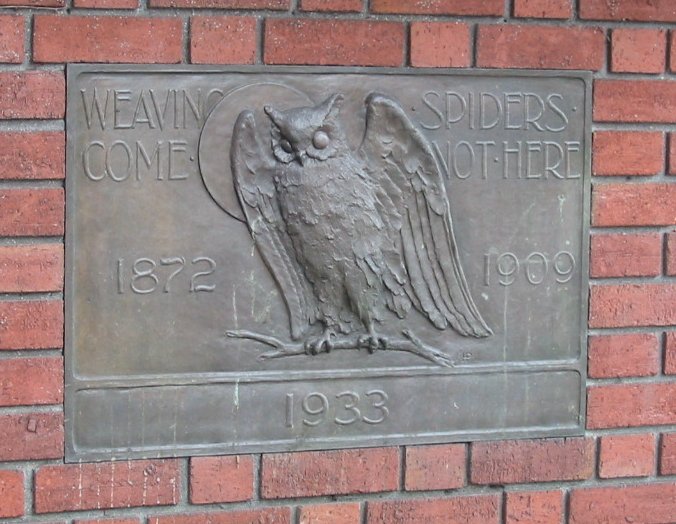
The Russian River is also summer home to the Bohemian Grove encampment, sponsored by San Francisco's Bohemian Club, a private men's enclave, founded in 1872. The club's mascot is an owl, and their motto is "Weaving Spiders Come Not Here." The idea is that you leave your cares behind.

Imagine upwards of 3,000 big-wig male guests descending upon an old sawmill and camping out. That's the Bohemian Grove encampment. The Bohemian Club guest list has included every Republican and some Democratic presidents since 1923, and myriad cabinet officials. Add CEOs of large corporations, oil magnates, financial institutions, banks, military contractors, utilities commissions, and the national media. Let's just say a whole lot of in-bed friendships are forged at the Grove.

Weaving spiders come not here—inscription with an owl mascot on a bronze plaque at Taylor & Post Streets, San Francisco
Members of the once arty Bohemian Club were comprised of journalists, painters, pianists, and poets. Now, membership is comprised of local and global leaders, politicians, and businessmen—who are entertained by the Bohemians—those self-same artists and musicians who originally founded the club.

Bohemian tent, 1900s, Porter Garnett, George SterlingJack London —Wiki

Summer camping in the North Bay is a fine old San Francisco tradition. In fact, most city folks moved en masse to the river for the summer. (Probably trying to escape the fog.) Grand hotels like the Monte Rio, were vast summer palaces. The river was jammed from shore to shore, from beginning to end, with campers.

The first Bohemian Club campout was at Taylorville (Samuel P. Taylor State Park), in West Marin, a little over a hundred years ago, in 1878. That's right down the creek from where I grew up on the Lagunitas/Forest Knolls border.

The Bohemian Club campout began as a rousing thespian send-off for founding member, Henry "Harry" Edwards, a stage actor (and entomologist) headed for the New York stage. The liquor flowed wild and free, men flubbed their lines, a rousing good time was had by all, and a hundred drunken men slept it off under the redwoods. It's amazing the Japanese paper lanterns didn't burn the place down. Harry went east, but such a good time was had by all, thespian camping became an annual tradition without Harry.

Why Camp Taylor, you might ask? The name of the creek should give you a broad hint: Papermill. Rags from the city arrived by train, watermills pulped them into paper, which was sent back to the city for the newspapers, mint currency and so on. The Bohemian Club was founded by newspapermen.

Because of train access, Camp Taylor was also a popular summer destination and so many folks camped all along the length of Papermill (or Lagunitas) Creek during the summer, it was a zoo. (And a cesspool, too, I would imagine.)

When the Bohemian Club's camp outgrew Camp Taylor, it moved south to Muir Woods in the 1900s, where it picked up the moniker Bohemian Grove. (There's a plaque for that.) The Bohemian Club scouted out new locations along the Russian River, and moved summer camp to a redwood stand at Duncan's Mills, near the mouth of the Russian River, before settling permanently in the Meeker Sawmill in Monte Rio in 1893. 

The Bohemian Grove, is a 2700-acre encampment with permanent dwellings. It's also the screening site for potential new members nominated during Spring Jinks, in June. Forty-year members, called "The Old Guard," are the gatekeepers.

What began as Midsummer High Jinks, the Bohemian Club's cultural centerpiece, where poems were once recited, songs sung, and dramatic readings given under the redwood trees, has, over the decades, devolved into the spawning ground of global politics.
The Owl Shrine and the lake— a man-made pond. —Wiki

The Bohemian Grove's annual commencement ceremony, a theatrical production, the Cremation of Care, commemorates the burning of an effigy of "Dull Care" on an altar of a 40-foot stucco owl, by hooded Druids, kicks off the encampment. Instead of allegorically banishing worldly cares, and the informal "Lakeside Talks," have fostered an abuse of political power. Guest speakers have included Henry Kissinger to Helmut Kohl. The virtues of lyric poetry was the farthest thing from their minds.

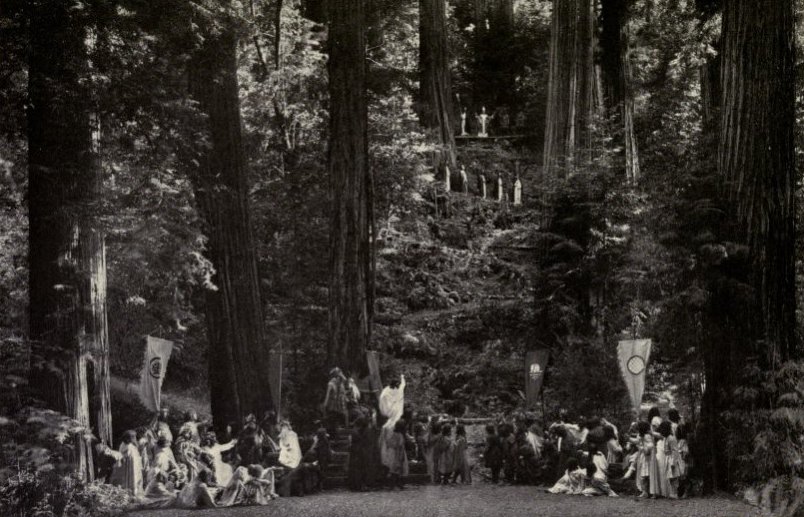
A dress rehearsal for the 1909 Grove PlaySt. Patrick at Tara —Wiki
Maynard Dixon's illustration of the 1909 Grove Play St. Patrick at Tara, the spirit of Irish hero Cuchulainn appears to Saint Patrick among the Redwoods. —Wiki

The Grove is a place where many political webs are spun, and it's the birthplace of warmongering projects from the Manhattan Project, to the Gulf War, and the invasion of Iraq. Policies made inside the Grove affect the outside world. The decision to drop the A-bomb on Hiroshima was made at the Grove.

Cremation of Care in 1907 -Wiki
The twin Bohemias: I grew up in Forest Knolls, and came of political age in Forestville. I traded one forest for another, but unlike many a frequent Grove camper, peeing on the trees—like Governor Reagan who famously quipped, "If you've seen one redwood, you've seen them all," I could see the forest and the trees. Some pretty tall Paul Bunyon tales got their bullish start at the Grove by leaving the Babe home. Some say more like Moloch.

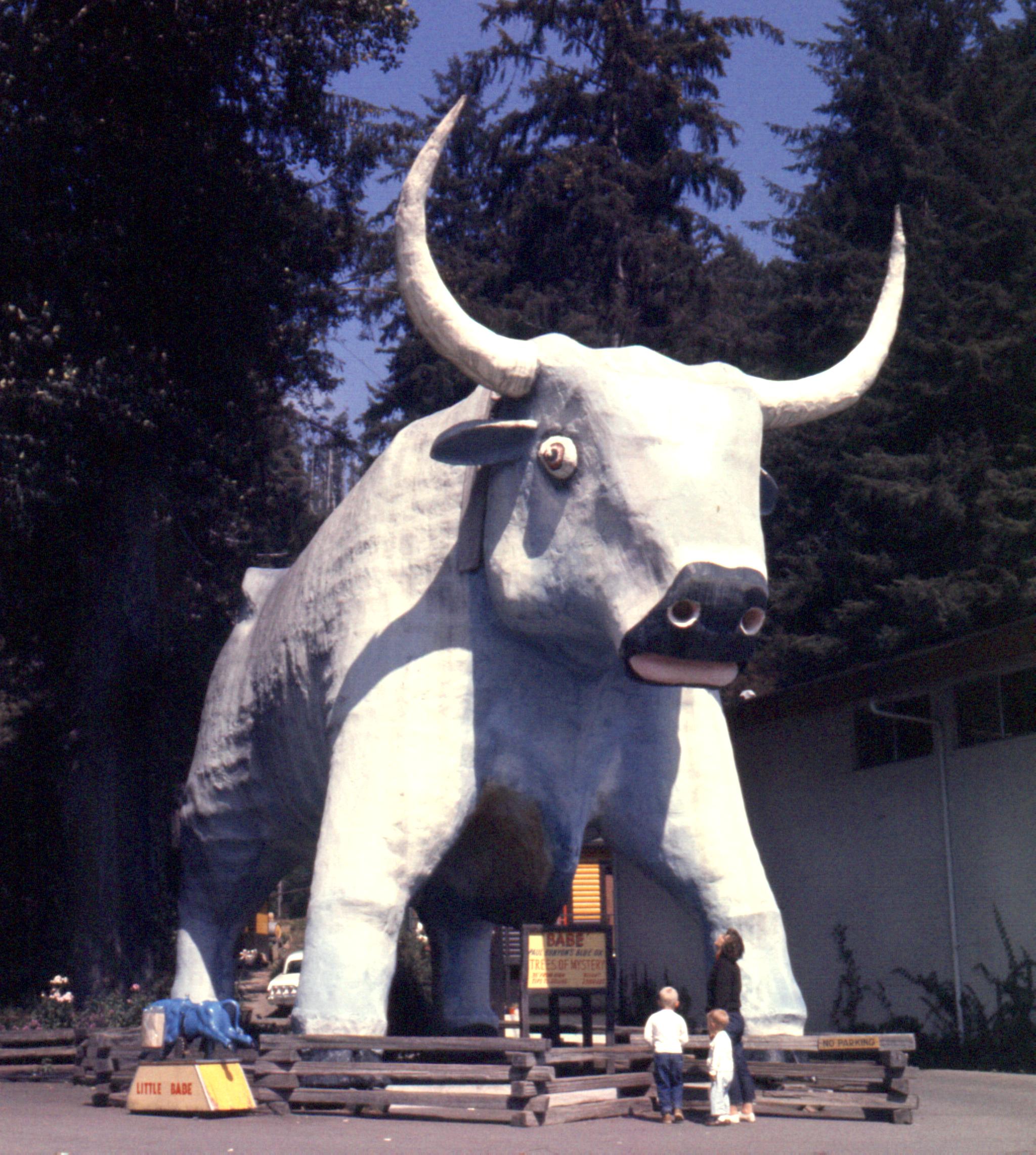
Babe the Blue Ox, Trees of MysteryKlamath, CA —Wiki

Fishing for stories, Paper reporter, Simone Wilson and I once posed as hookers at the Northwoods Lodge as the Boho campers furiously slaked themselves on our side of the river. There were FBI (replete in pencil pants and white socks, just like in the movies) and infamous San Francisco hookers. Only there were no cameras that night. Stealth cameras, maybe.

Frowsy redheaded Rose, the madam, carrying on the Barbary Coast tradition of prostitution during the 1980s, refreshed her lipstick in the mirror, looked me in the eye and said: I don't know who you gals are working for, but there's a bust going down tonight. 

I was oddly flattered that Rose thought I was the real deal, but then, my mom once worked for Sally Stanford at The Valhalla —as a cocktail waitress. I had the best models.

Margo St. James of COYOTE spoke to our Women's Studies class at College of Marin in the early 70s, and I've read poetry with Carol Leigh AKA Scarlot Harlot, who coined the term, sex worker. So I could namedrop and not blow my cover.

Should I have confessed to Rose that I was working undercover, not under the covers? (The S&L bust was coming to a head at Manu Khomeini's lodge. Yes, a nephew. The family jewels reached that far.)


Earlier that day, Marin poet Karla Anderdatter of The Butterfly Tree, drove up from Muir Beach and met us on the  Monte Rio Bridge for a protest staged outside the Grove as the campers drove in. 

Camp Meeker's Mary Moore, a former beauty queen, and founder of the Bohemian Grove Action Network, and SoNoMore Atomics, rallied us on the bullhorn, declaring it a "Weapons-Free Zone" as the Bohemians barrelled through the gate.

Mary's encampment (founded ca. 1980) outside the gates to the Grove, and counter-ceremony was called the "Resurrection of Care," as a foil to the Cremation of Care. It was a reverse exorcism of the Demons. Mary rightly surmised that club members with corporate interests adversely influenced government.

The year when the Chancellor of West Germany Helmut Kohl was guest speaker (I'm still trying to anchor the date—ca, 1982-85), rent-a-cops were brought it. Things quickly got ugly. With camera in hand, I documented the event for The Paper, but they came for me too. As I outran the law, I was clubbed from behind between the shoulder blades. 

Judi Bari of Earth First! fame, was one of the eco-activists who worked for the alternative newspaper, generically called The Paper, (later dubbed The West County Paper, then the Sonoma County Independent. Now it's The North Bay Bohemian). Talk about full circle! 

They're mostly all gone now, these wild wolf women. Somewhere I have the negatives to prove it. Somewhere.

Someone asked: did we cross the river? We did the next best thing, we went skinny-dipping, and Bohos came over to our side of the river to slake their thirst. The famous optometrist returning from Russia. Nothing wrong with his eyes. Leering at our young flesh, he fed us the news in drips and drabs.

There were many allegedly said's in Simone's news story on Helmut Kohl's Lakeside Chat. Me—I hardly knew who he was. I was always finding out the facts after the fact. But I was the photographer. No big deal.

That night, while we were angling for more story at the oasis, someone asked: would you like to go into the Grove? A US Olympic swimmer, friend of Mark Spitz, was working there as a Camp Valet. (I don't remember which camp. Owl?) So, I dropped my cover and we blew the joint.

What was his name: Mike Stamm? He broke a world record for the backstroke. He also could've been lying. Pre-internet. Somewhere I have notes. Somewhere. He took me quite a ways into the grove after midnight. Not much to see in the dark. A large parking lot. Lights in the distance. Some passionate kissing in the back seat.

Manhattan Project —Wiki

Perhaps the lights I saw were of the Clubhouse designed by Bernard Maybeck the site of the 1942 Manhattan Project planning meeting. The top secret project that would lay claim my mother's first cousin's personal life, and then, later, her life, via cancer. Certainly, they were ghosts.

Not much to tell, it was during the early 1980s, AIDS was still undercover, so I took my Olympic swimmer home. He was sleek as a seal. We did the backstroke and the butterfly and the breaststroke. No speedos were harmed in the process. I dropped him off at the gates at dawn. Was I sleeping with the enemy?

All that water under the bridge.