Thursday, June 26, 2014

Toponyms: I say naCASHyo, You say nickCASSSeoh

Riggy Rackin to Maureen Hurley (Facebook thread) OK, get ready to grate your guts, and want to hurl me out the window, Ms Hurley.... I just attended this talk, and heard our local, long-standing expert call the town we know you know "Nick-CASS-e-oh". When the question and answer segment opened I called her on it, told her you & Rocky Shone say it's not Spanish and but a Miwok word, pronounced Nuh CASH oh. Her 80 year old eyes glimmered and said you guys are WRONG, and it is in fact a Spanish derived name based on St Ignatius. Whatchu think of THAT ??
see
Maureen Hurley LOL. Did Betty Goerke grow up in NiCASHio? No? It was a Miwok chief's LATIN name. I never said it was a Miwok word. Ignacius is the Latin name, not Spanish. 

 How do you say St. Ignacius? With a Sh sound? IgNAYshius? Yes? Or was it a slithery snake sound?I Ig-NASS-us. Ditto that with Nicashio. The name is from Nicasius, BTW, not Ignacius. 

According to Ken Bullock's grandfather, it was also pronounced Nicashia, BTW. Still the SH sound. Lest ye forget, my LOCAL West Marin family data base goes back a hundred years...and those of us who actually grew up there, learned to say it from our parents and grandparents and our neighbors— and they ALL said NiCASHio. Are you calling five+ generations of several families wrong? So there! (raspberry sound).

I remember Betty Goerke, BTW...if she was a good anthropologist worth her salt, then she would know that there is an alternative, but persistent long-lived pronunciation of Nicasio. Oh, but wait, she's an archaeologist—and you know the saying, pots don't speak. She's far afield when it comes to linguistics and toponyms. Why not ask a LOCAL how to pronounce it? 

Earth to Riggy: a profound fact: Just because it's in a book doesn't mean it's correct. Betty Goerke, came to Marin in what, 1984? I wasn't at all impressed with her way back then. She is guilty of slovenly scholarship, if you can call it that.

My family has 75 years residency on Betty Goerke. Two of my aunts married Nicasio boys. Guess how they pronounced Nicasio? Guess. 

Ultimately it doesn't matter what the root origin of the word is, what I said is that we locals have always called it Nicashio. Stet. Please DO note that Batty has the wrong saint's name for the toponym. Just sayin'. (Stet to the typo on her name too.)

My original documentation source on the Miwok of Nicasio was from IJ columnist A. Bray Dickinson, postmaster of Tomales. Historian and author of Tomales Township— a History, Francis Drake's Landing Place in California, and Narrow Gauge to the Redwoods. 

Understand that  there was almost NO information on Coast Miwok peoples at the College of Marin, or the UC Berleley libraries, in 1969—other than Kroeber's tomes. So most Coast Miwok info is reconstructed—it's all post-colonial, as it were. 

Vinson Brown wrote a book on Pomo Indians of California and Their Neighbors (1969), someone else adapted it for Coast Miwok, even borrowing the writing. And so it goes: after the fact. 

Albert Elsasser was my CA Native American go-to guy. FWIW, I've been to the Museum of Ethnography in Leningrad, seen Pomo and Miwok artifacts stored in their basement. Personal tour. I'll tell you about it sometime.)

"The name Nicasio is believed to come from a local etcha-tamal Indian shepherd named after St. Nicasius"


Oh, Riggy! I found this: I rest my case. Terminus ante quem!
Nicasio, nî-kash'-ó:
"Nicasio was probably an Indian who had received the name of one of several saints (Saint Nicasius) at his baptism. (ca 1835)/"

Monday, June 23, 2014

Cebolla by any other name (photo)


I am easily distracted while cooking. Line, form, texture. Are you ready for your close-up, Mr, Onion? This onion's photo shoot was long enough for the onion itself to start weeping. Glistening onion tears. Then I chopped it up and sauteed it. And ate it.

Saturday, June 21, 2014

Solstice rant after getting flame mail from a stranger


FWIW, the front end of the horse gets up first. My equine expertise—I come from a long line of horse whisperers. I rode damned near every four-legged ungulate I could throw a leg over (except deer). I grew up on donkey, pony, steer, horseback. I wanted to be a vet. My quaterhorse was a racehorse with bad knees. My mother was crazy and very hep. Thank you notes weren't in her lexicon. She was anti-establishment. She knew Timothy Leary. Nuff said. I have several half-brothers—most were complete surprises. No sisters. I was named after my mother, not Maureen O'Hara. My grannie named her after Maureen O"Sullivan (keeping the name in the family since my great grannie was a Sullivan. My grannie lived to be 94 and never suffered from dementia. I never had an infant Prague gown but I remember the nuns dressing him at St. Cecelia's church. I was once Queen of the May. I'd love to know how to steal 500,000.00 dollars by writing a blog. So far, I've gotten nothing—not even a ha-penny for all my blogging. She says "you want everyone on here to think you are so good and so sweet." LOL, I'm cranky as a polecat without a pole on a good day. As to the age of the gown, I can only say I was done with dressing dolls long before then. But thank you for the writing assignment.

from Facebook
(see the original flame male that inspired this, below.)

Monday, June 16, 2014

BLOOMSDAY


It never snows in Marin
except for when it snows. 
Then it snows all afternoon. 
I rode a green colt in the lower field.
It was June and it began to snow
all afternoon, in summer, it snowed.
The horse, a silly dapple grey 
with less brains than brawn, 
mistook his equipage for shadows
tried to kick the snow flurries away. 
Blackbirds wove tight circles
and sang in the branches of the oaks,
The pale dry grass listened 
to its own conclusion as the snow
turned to unseasonable blooms in summer.


Saturday, June 14, 2014

Arbutus, Madroño, or a Strawberry Tree by any other name (photos)


Clusters of berries, leaves and flowers of the arbutus unedo.

A stand of Irish strawberry trees (or Killarney strawberry trees) are fruiting in front of my physical therapist's office in Berkeley. I climbed up on the hood of my car to reach the fruit, but didn't realize I couldn't get back down without loosing my "strawberries." I squashed them all over the place—they were like little golden suns with fiery coronas—when I nearly fell off the car. Would've been difficult to explain that injury to my PT. But I was gluttonous as a bear.

My grandmother often talked about eating the wild arbutus "strawberries" as a child, comparing their flavor to the haws of hawthorn trees. They don't taste anything like strawberries—they just look like them on the outside. In the inside, they're like little orange suns flecked with tiny seeds. The Irish do know the difference between strawberries and arbutus tree fruit. Wild strawberries also grow in Ireland. It's a simile, sweetie.

Ripe arbutus berries are pebbly & red outside, golden & mushy inside.

My grannie, who hailed from Bantry, said that the Gulfstream, that warm Atlantic current that bathes the coasts of western Ireland, created an ideal micro-climate where tropical plants flourish—including palm trees. However, the arbutus, or strawberry tree, is also native to western Ireland but, curiously, not to England.

The Irish arbutus was introduced to England from Ireland during the 16th c., and one estate plant catalogue mentions "one very fayre tree, called the Irish arbutis standing in the midle parte of the sayd kitchin garden, very lovely to look upon." 

The broad glossy evergreen leaves are about three inches long, an inch wide with a toothed, or serrated edge. And the clusters of fragrant flowers are showy white or pink tinted bells—like most plants in the heath, or Ericaceae family, as arbutus is related to heather and bilberries.

Arbutus berries; the hard yellow ones are unripe. 

The story goes, that when the Spanish explorers landed in California, they recognized our native madrone. (naming it madroño) as being related to their madroño the stately Arbutus unedo, or the shaggy-barked Arbutus arachne which is more common in Greece, and throughout the greater Mediterranean basin from Albania to Croatia, Lebanon to Sardinia, Portugal to Tunisia, and Iraq—even the Canary Islands. Father Juan Crespi, chronicler of the 1769 Portola expedition, wrote about the many madroños at the “lost bay” of Monterey.

There's an anomaly of isolated arbutus groves in western Ireland—especially in Bantry, West Cork, (my grandmother, from Bantry, gave me the roots of this story), and the Dingle Peninsula on the Kerry coast. Sligo has the most northerly stand of Arbutus unedo in the world, a remnant from the pre-Ice Age Atlantic period. (Or possibly brought to Ireland by the Iberian Bell-Beaker Folk, ca. 2500 BC—renown for their bell-shaped clay drinking vessels, stone wrist-guards, and gold lunulae. Their motto might have been: Don't drink that arbutus beer, and shoot arrows at the crescent moon. Or were lunulae really splash guards?)
The [arbutus] species is one of a select group of plants, fifteen in all, native to Ireland but not to Britain. Taken together, these special Irish natives have come to be known as the Lusitanian or Hiberno-Cantabrian flora, owing to the fact that their nearest relatives are to be found on the Iberian Peninsula. How this flora arrived to the blank canvass that was post-Ice Age Ireland is not well understood, but it is possible that they spread overland along the changing coast of the British Isles as they emerged from under glacier and sea. —The Strawberry Tree, UP Cronin
Dr. Cronin (M.Sc. in Plant Science, University College Cork and a Ph.D. in Microbiology, University of Limerick), writes that the eighth century Irish legal tract, Bretha Comaithchesa (laws of the 'hood) ranks caithne (arbutus) as a fodla fedo — or third division tree, used for manufacturing charcoal or making small pieces of decorative red inlay.

It's an Irish toponym: Ard na Caithne (Ardnaconnia), or Strawberry Tree Heights (a headland—also known as Smerwick, or Butter Bay) is located in the heart of the Kerry Gaeltacht, near Corca Dhuibhne—the tip of the Dingle Peninsula. Ard na Caithne (with its arbutus groves, laden with little golden apples of the sun) is a significant site: it's the home of Dún an Óir ('Fort of Gold'), an Iron Age fort; the site of sixth-eighth c. monastic settlements, the Gallarus Oratory (the oldest beehive hut in Ireland—I saw it from the road but my cousin wouldn't stop the car) and An Riasc; and for the horrific Siege of Smerwick (1580), where the surrendered Irish freedom fighters were slaughtered by the British Lord Grey. The sacred ground was stained by more than just arbutus berries that day.

Ard na Caithne was home to 17th c. Irish poet and harpist, Piaras Feiritéar, who surrendered to the English after the Confederate Ireland wars, was granted safe passage, but was hanged in 1653. The ruins of his castle still stand among the arbutus trees at Ard na Caithne and his poetry lives on in the oral tradition. 

Ard na Caithne was also home to Séamus Ó Muircheartaigh (1877–1927) who wrote under the pseudonym, An Spáilpín Fánach
 
(The Wandering Labourer—also the name of his song). Séamus Moriarty emigrated to San Francisco (via Butte, MT) and knew my grandparents through the Gaelic League. His son, Cuchulain was a civil rights activist with César Chavez—the Lawyers’ Committee for Civil Rights Father Cuchulain Moriarty Award is named after him. But I digress....

There are four Old World species, and six New World species of arbutus. Our hybrid ornamental street tree, Arbutus x Marina is named after the Marina in San Francisco where it was hybridized. Its parentage is a mystery but it may be a cross between the Arbutus unedo and Arbutus arachne. Old World arbutus is related to our native madrone and its cousin, manzanita (Arctostaphylos). Our Pacific Madrone, or Madrona, is Arbutus menziesii. We often ate the tiny astringent berries that taste like sour crabapples. After all, manzanita means little apple in Spanish.

Kerry has the largest arbutus stands in Ireland. A recent DNA pollen study suggests the arbutus was brought to Kerry via Northern Spain more than 4000 years ago, possibly by Iberian copper miners. But that doesn’t explain the Sligo stand.)

The Irish "strawberry" is called caithne in Irish, arbousier in French, madroños, alborocera, alborio, borto, or albedro in Spanish, corbezzolo, or albatro in Italian, koumaria in Greek, and bearberry, or Cain apple in English. I guess Cain used them to slay Abel. Or maybe he fed him unripe fruit loaded with tannins.

The fruit has a vague anise odor but tastes more like tangy rose hips—which it's related to. Edible prickly red armor on the outside and a creamy-mealy amber flesh, it's a superfruit (like açai) loaded with vitamin C and pectin. The fruits are high in sugar and contain bioflavonoids, malic acid as well as tannin (more here). But the yellow unripe fruit can cause nausea (so it is said).

Warty arbutus berries ripen on the tree tend to burst if you pick them.
When eaten in quantities this fruit is said to be narcotic, and the wine made from it in Spain has the same property. —A Modern Herbal
Berries will ferment right on the tree (berries have been measured up to 24.6° Brix, or 5 to 14% alcohol—and no liquor license needed); the birds get inebriated as they gobble up the beer-berries. A few peasants figured out that if the birds could get so blasted on arbutus berries, that they couldn't fly a straight line, then so could they. (Wing flapping ensued....)

My friend Chris Devine said, "There used to be a pub in Killarney called 'The Strawberry Tree'. Never understood why. 'Til now." The Strawberry Tree Pub, 23 Plunkett Street, Killarney.

The Greeks make a liqueur called koumaro, which is often added to tsipouro (a type of ouzo), the Portuguese say they are very brave trees and make arguardente de medroñho or medroñheira from the berriesand the Italians make many liqueurs: in Corsica they make a Liqueur a l'Arbouse, in Sardinia they make fior, and Acquavita di Corbezzolo


Sun-dried arbutus berries are like dried apricots, full of flavor.

You can also make marmelades, jams, jellies, pies, dried fruit, vinegars, pomaces, sorbets, and a grilled meat sauce (like cranberry, or quince sauce), from arbutus berries. You can plop those overripe berries into a bottle of red wine to make a killer sangria, or use the fruit as a red dye, and the bark to tan leather. I wonder if the prized red Cordova leather was dyed with madroño berries? Research for another time.

Because the fruit and flowers appear on the tree at the same time, the Romans thought the arbutus held magical powers: flowers were also placed on graves as a sign of respect. In The Tenth Labor of Heracles, the blood shed by the giant Geyorn was said to produce a tree with both flowers and fruit at the same time when the Pleiades were high in the sky—the arbutus.
Horace praises the tree for its shade and Ovid for its loads of 'blushing fruit.' Virgil recommends the young shoots as winter food for goats and for basket-work. Gerard speaks of it in his time as growing in 'some few gardens,' and says, 'the fruit being ripe is of a gallant red colour, in taste somewhat harsh, and in a manner without any relish, of which thrushes and blackbirds do feed in winter. —A Modern Herbal 
The Coast Salish used all parts of the sacred Pacific madrone for medicine. The Coast Miwok, made a tangy brew from madrone and manzanita berries. According to the Coast Salish an anthropomorphic form of madrone tree sap went fishing at dawn but came home late one morning and melted in the sun; the other jealous trees stole all his sap. I don't know if this occurred before, or after they discovered that the berries could be fermented.

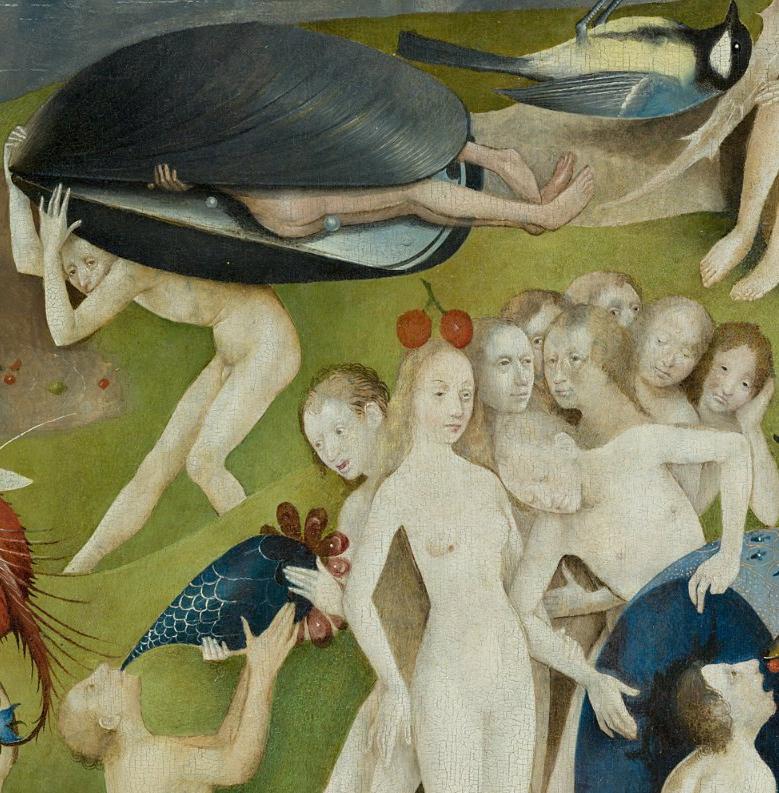
Hieronymus Bosch's painting (housed in Madrid since 1939), "The Garden of Earthly Delights," was originally called "La Pintura del Madroño", or "The Painting of the Arbutus." Why a strawberry tree? I bet something got lost in translation... The Tuscans use "strawberry" as an exclamation referring to ahem, the male anatomy.


The fruit above her head, identified as cherries, is a convenient explanation for popping the cherry, but if you look at the fruit, they're not cherries, but warty arbutus berries. Cherries elsewhere in the painting are painted smooth-skinned, with a reflective sheen. —Mo H. Image from Wiki

Strawberry trees. Clearly there is other symbolism going on. Either Bosch didn't know what they really were, or he had other ideas for including them. —Wiki

In Latin, Arbutus means "struggle." But because the bear is so closely associated with the arbutus tree in myth and lore, I suspect that Artio (Dea Artio) a Gallo-Celtic bear goddess was also involved. Near Berne, a bronze sculpture of the goddess Artio is seated beside a small tree, holding fruit in her lap, feeding the bear—with the inscription: Deae Artioni / Licinia Sabinilla. 


(Artos means bear in Celtic. (Delamarre 2003 p. 55-56), from Proto-Celtic *arto-, from Proto-Indo-European *h₂ŕ̥tḱos, bear.) —Wiki

An Italian website on plants also hypothesizes that Arbutus may be a Celtic word:
The name "Arbutus unedo" probably derives from the Celtic. In fact, "ar" in Celtic means "bitter, astringent" and "unedo" is the name that was used in ancient times which probably derives from the three Latin words "unu-off edo" "I eat only one" to mean that one should not exaggerate and give in to temptation because of the pleasantness of its fruit which when eaten in excessive quantities gave nausea and constipation. —MEDICINAL PLANTS, Elicriso
A gluttonous bear eating arbutus berries from the strawberry tree figures prominently in the coat of arms of Madrid, Spain. In Puerta del Sol, the city center of Madrid, there is a statue of a bear gobbling berries from a madroño tree.

Pliny the Elder enigmatically explained that 'unedo' means unum edo or "I eat one", and so I did. And another. Whether he meant you could eat only one because it was so awful, or eat one and not be be able to stop because it was so good (and you'd get a hangover, or a bad case of the farts), we'll never know. But I can safely say no struggle (or bears) was involved. They're tasty.


Picking Strawberries from the Strawberry Tree


I picked some Irish (or Killarney) "strawberries" from a strawberry tree in front of my physical therapist's office. I climbed up on the hood of my car to pick the fruit, didn't realize that I couldn't get back down without loosing my "strawberries." Squashed them all over the place. Right down the front of my shirt.

It was one of those Aha! moments when the past converged onto the present, and two stories became one. My grandmother often talked about eating them as a child, comparing their flavor to the haws of hawthorne trees.

Our ornamental street tree, Arbutus x Marina is named after the Marina in San Francisco where it was hybridized. It's distantly related to our native madrone and manzanita. 

The story goes, that when the Spanish explorers landed here, they recognized our madrone (naming it madroño) as being related to the Arbutus unedo which is common throughout the Mediterranean: Portugal to Lebanon to Tunisia; Albania to Croatia, and some isolated trees in western Ireland.

Sligo has the most northerly stand in the world, a remnant from the Atlantic period. It was introduced to England from Ireland in the 16th c. "one very fayre tree, called the Irish arbutis standing in the midle parte of the sayd kitchin garden, very lovely to look upon.

Hieronymus Bosch's painting, "The Garden of Earthly Delights," was originally called " La Pintura del Madroño "The Painting of the Strawberry Tree."

Pliny the Elder said 'unedo' means unum edo or "I eat one", and so I did.

Friday, June 13, 2014

RIchard Diebenkorn's place, Soda Rock Lane (photos)


RIchard Diebenkorn's place, Soda Rock Lane, Alexander Valley. My friend Leah used to babysit for Richard Diebenkorn. Every photo I take of his house reveals something sweet and quaint. So I did a negative image. It seems more fitting. More ghostlike. I love the roiling trees, like gazing into a blue fire. Doesn't it look like Richard is standing on the porch.


Robert Lee Haycock said: Been there years ago after his passing to receive some of his work that the family was loaning to the museum. I believe it was his widow I worked with then, a charming woman, who gave us the run of the house so that we could admire RD's work hanging EVERYWHERE in EVERY available space. Quite an experience.


from a Facebook post, added 6/17

REAR VIEW MIRRORS

                               —for Katelin Stuart

It seems I've gotten a jumpstart on Friday the 13th.
Backing out of the old narrow garage, 
built in the days of carriages and Model Ts,
requires a subtle skill set in order to park
without tearing the side mirrors off the car.
Something I've managed to do for 13 years.
But a freak wind gust slammed a carriage door 
into my left side rear view mirror,
breaking it clean off off at the door frame. 
No hope of properly fixing the plastic housing
so I jimmied it with duct tape and kite string.

Then, while driving back into the garage, 
apparently I didn't get the first lesson of the day.
Another stealthy gust, & the other carriage door 
thunderously smacked the passenger mirror off. 
So, I can't see what's behind me—literally.
Now I'm afraid of what will happen if I look up
through the inside rear view mirror. 
Perhaps the roof will fall on me.
A friend reminds me that at least
I still have a rear view mirror.
For a while, the car thieves had it.
I should consider myself lucky.
At least neither mirror broke.

Wednesday, June 11, 2014

Lesser Goldfinch (photos)


I hold them to treat them for shock, the hollow of my hand is warm, dark, and safe. I can feel their racing hearts slow down, then it's time to let them go—yes, about 30 minutes. But for 30 minutes, I get to witness something amazing, as they relax, and begin to recover, they watch you and check you out. We are at one in that moment. 

This little guy hit the window so hard, he was out cold for 30 minutes. His heart was racing so fast, I thought he would surely die of heart failure. He took much longer to recover. I watched him come around. My arm was killing me, but when he was ready, he took off. OK, so I had to nudge his sorry ass into gear, he was parked in my palm for the duration. Does anybody know what kind of bird he is?

If a critter needs rescuing, I tend to be the one to do it. Me and Mr. Mallard—he was caught up in fishing line, and beating me off with his powerful wings (very Leda and the swan), so I flipped him upside down—he went comatose (good way to calm chickens too), and I was able to cut the filament off his legs.

Finch: that much I know (the beak)—but he's a yellow-green one. Not quite ripe? I have not written about the fawn I rescued from a malamute, it died in my arms. Rich, thick blood covering my arms. I wanted to kill that dog. I was 19. But somewhere, buried in that story, is the original impulse for my becoming a writer, I just had to wait until I was 30 for it to jell. Bearing witness.


Sunday, June 8, 2014

Bird in hand (again) Bewick's wren photo


Bird in hand (again). A Bewick's wren decided to move into the living room, then roundly scolded me because he couldn't find a way back out. 

He's a bit shocked that I caught him. He's regrouping. They say that birds will die if you catch them, but I've also learned, that if a bird that has crashed into a window, it will survive if you cup them in your hand (dark, warm place) until they come around, they'll live. 

He was positively cussing up a blue streak by the time I caught him and carried him outside. Then he decided my hand wasn't so bad after all. Grumbling all the while. Long narrow beak, a flycatcher, not a seed eater. I had to goose him in the ass in order to get him to fly off. He flew to the fence and gave me the what-for.

Wednesday, June 4, 2014

Tianenmen Square

That day, I drew/painted trees, pages and pages of trees lined up in military precision like tanks. Big canvasses, and I wept as I drew. I was teaching kids art with Marsha Connell at the California Museum of Art in Santa Rosa, Duane Jones, the curator, handed me large posterboards. And I drew and drew, like a young child. A friend of mine, Bei Dao escaped—only because Marti Mooij from Poetry International had arranged a ticked at the airport for a reading. The fax machine (pre-email days) was the savior of the day. Bei Dao made his way to the airport. The rest is history.

Tuesday, June 3, 2014

Pieces of the sky (photos)


Ithuriel's spears, or grassnut. Bulbs are tasty, but a bit slimy. Flowers are too pretty to eat the corms. Ithuriel's spears are now in a new genus under Brodiaeoideae. Triteleia laxa, also known as triplet lilies.


I posted these flowers as a poetic Proustlike madeline moment for a dear friend Jack Crimmins. In Blake's Tyger, Tyger, Ithuriel's spears watered heaven with their tears. Every time I see them I can't help but recite the poem. Their color is so extraordinary, they are small bits of a lost paradise. (Milton).


Photo is by the big pool and waterfall as you begin to descend from Big Rock to the redwoods. Different watershed than Miller Creek where Jack grew up. I still remember the day we sat on the swings in Cotati Park and laid down our poetic manifestos to live oak, air and blue sky.

Monday, June 2, 2014

SQUEAKY TOYS


In the middle of the night,
Jack the Cat caught a mouse
under the couch I was surfing on,
and set it down by my luggage
to play with it. Naturally, it ran off.
He was perplexed. He sat down
and contemplated it, perhaps
wondering why his other toys
never ran off.

Got my car back, but the starter's dead....

Back from the north countries, my replacement FasTrak arrived, but I'm still carless. Waiting for a new ignition. Vroom! Ignition replaced, but OUCH! There's a $250 deductible. Waiting for hoodlatch cable. Thieves done busted it trying to steal the battery. Now the battery's no good. OK, the gift that keeps on giving.

Thieves ran the battery down to the ground—it didn't hold a charge overnight. Got stuck trying to popstart it from garage....missed my class. AAA came, said it was toast. Got a new battery for cheaper than Automall right from AAA. Some grace.
I'm finding bits of car parts on the floor.

6/3 Got my car back from the mechanic. Wasn't expecting to feel quite so sucker-punched. Think I need to smudge my car to chase out the bad juju. Thief left radio on a rap station, startling me. Thief's handprint on the passenger door. A haunted presence.. How can an inanimate object feel so sullied, violated? Trying hard to disengage my anthropomorphism...

Yes, I'm washing the car, inside and out. Maybe even smudging it with sage. Am I being too Marin? Bloody thief left my life in a shambles. At least I got the car back. And most of my art supplies. That's something.


Sunday, June 1, 2014

Our Chromie's Wing and a Prayer to win the Belmont Stakes


Our California Chrome, our Cinderfella who rose up from the ashes of humble origin, has new shoes, and he just might win the last waltz of horseracing—the Triple CrownIf so, he'll be the first winner in 36 years. And the only California horse to win. Ever. The odds against California Chrome winning Triple Crown's "test of champions" are a staggering million-to-1 longshot. But we're good with California Dreamin' and longshots.

Only 11 horses have ever won the Triple Crown, including War Admiral, Citation, Secretariat, Seattle Slew, and the last Triple Crown winner, Affirmed. 

Only thing is, most of the horses Chromie's up against at the Belmont Stakes were not all in the Derby or Belmont, so they're be much fresher. 

Does Chrome (aka Junior) carry Secretariat's large heart gene—the "x" factor? If so, his heart will carry him to the finish line. But then, Chromie has good bloodlines on both sides of the family, including Secretariat and Seattle Slew. 

When Secretariat, aka Big Red, broke the Triple Crown time records there were only 5 other horses racing against him. Not a packed field like the Belmont Park race will be.  

The Kentucky Derby at Churchill Downs was a full 10-horse field, and California Chrome won with ease. He could have won by 10 lengths but his jockey held him back to save his energy for the Preakness and the Belmont. No riding crop was needed or applied, other than its being raised in a victory salute.

The Preakness at the Pimlico Race Course was also a packed 10-horse field, but only three of those horses also ran in the Derby. The Preakness was sandy and long: 1.5 miles, but Chromie had Seattle Slew in his genetic pocket. His lineage includes long distance horses and a sprinter (Lucky Pulpit, his dad, was a sprinter—which is why everyone thought Chrome would lose the Preakness). Chrome won with ease.

Secretariat won the Belmont Stakes by a whopping thirty-one lengths, in record time of 2:24, becoming a U.S. Triple Crown champion. His record still stands as the fastest speed for the Belmont Stakes.

So far, there are 12 horses entered in the Belmont Stakes, aka "Run for the Carnations." The 1.5 mile track is the world’s largest dirt track—making it the most gruelling of the Triple Crown races.

California-bred Belmont winners are so rare, it's only happened twice: Comanche in 1893 and Africander in 1903. It's a course that favors native horses; 15 New York horses have won in the past 25 years.
Fewer than 1 percent of all horses who have raced in North America since 1973 – the year Secretariat swept the Triple Crown – won three or more stakes in their entire careers.  —Historically, odds are against California Chrome winning Triple Crown

Read more here: http://www.sacbee.com/2014/05/30/6445786/historically-odds-are-against.html#storylink=cpy
Horses can be entered up to 72 hours before the race. California Chrome’s main contenders include: Wicked Strong (Derby), Tonalist (new), Commanding Curve (Derby), and Ride on Curlin (Preakness). 

Chrome doesn't like dirt in his face, so he'll want to be out front, and there are a lot more rail curves at the Belmont track (51%), so it'll be tricky to conserve his stamina. Many horses burn out too early.

"According to a chart on bloodhorse.com, 51 percent (4,040 feet) of the Belmont Stakes is run on the turns, compared with 39 percent (2,554.5 feet) for the Derby and 42 percent (2,654) for the Preakness." Chromie seems to favor the long inside turn.

Let's hope for no rain on June 7. A muddy track changes the odds as Chrome's never run on a wet track. 

Did you know that the American horse races are run widdershins, or in the counter-clockwise direction? English racing is run in the clockwise tradition. 

It all comes to a head on June 7. Nasalgate aside, I haven't been this excited about a horse race since Secretariat's record-breaking triple win back in 1973!


Thursday, May 29, 2014

My stolen car was found in the Oakland hills


My car was found in the Oakland hills! The thieves traded my car in for an older model—as it was out of gas. I commiserated with the man whose son's car was stolen, hence the rapid turnaround time on my car. Inside of my car looks like a hurricane hit it. I also gained some useless electronics—half a CD player, broken earphones, Costco bags and a froufrou bag from another heist. I think it was either a woman thief or a man and woman team. They stole other things, like 2 pair of jeans for Costco, etc. Thoroughly trashed the inside of the car. I took it to mechanic to fix the ignition, etc. as it's trashed, and permanently stuck in the On position. Ignition replaced, but OUCH! There's a $250 deductible. Waiting in vain for a hoodlatch, as they busted it trying to get under the hood.

FasTrak killed my FasTrak responder so the thieves couldn't leave East Bay, and Costco put a stolen merchandise hold on those two pairs of jeans with receipts so they can't be returned at any of their stores. Damage control went well. Dispatch officers and police were amazing. Everyone wishing me well. I think it was  story of the' poetry journals that got their attention. Thanks to everyone for your support and concern, it seems to have made a difference.  Poetic intent rules!

Most the drawing stuff, and the kids' poetry journals are intact. Sadly, now I can't get journals back to kids, school is now closed, and under construction until next year, and they graduated. Most of my small drawing critters went MIA: the thieves left the lizards, turtles, creepy crawly bugs (a few fish misfiled in with cockroaches & ants), and barnyard animals. MIA ladybugs, frogs, dragonflies, bees, African Savannah animals, North American wild animals, etc. In other words, they stole all the animals I use. Still haven't checked for toy cars. Hoping I didn't load them in the car.

Stolen cars are generally found within homing range. Wish there was a long-range tracker app, like Find my iPhone. or a spy bug to find stolen cars.

Wednesday, May 28, 2014

The Caged Bird Has Flown

Maya Angelou pauses while reading a poem for Archbishop Desmond Tutu in 2008.
Mays Angelou (April 4, 1928–May 28, 2014)

So sad to hear of Mays Angelou's passing. She had to cancel an event, Major League Baseball Civil Rights Game where she was the honoree. It did cross my mind when I read the news. Bottom of the ninth. I was mentally holding vigil. Her heart may have failed her but it never failed us.

"An unexpected medical emergency caused me the greatest disappointment of having to cancel my visit to the Major League Baseball Civil Rights Game ceremony. I am so proud to be selected as its honoree. However, my doctors told me it would be unadvisable for me to travel at that time. My thanks to Robin Roberts for speaking up for me and thank you for all your prayers. I am each day better." —Maya Angelou, May 26

Statement from Dr. Maya Angelou’s Family:
"Dr. Maya Angelou passed quietly in her home before 8:00 a.m. EST. Her family is extremely grateful that her ascension was not belabored by a loss of acuity or comprehension. She lived a life as a teacher, activist, artist and human being. She was a warrior for equality, tolerance and peace. The family is extremely appreciative of the time we had with her and we know that she is looking down upon us with love." —Guy B. Johnson
"The world has lost a great voice today. A self-taught master of the written word, Angelou also spoke no less than six languages. A traumatic and violent childhood, marked by years of silence, led to a blossoming of her artistry and her gifts. She was a champion for civil rights and justice, and on the inner circle with Dr. Martin Luther King, Jr. In 2011 she received our nation's civilian highest honor, the Medal of Freedom. We know now why the caged bird sings, and we release her spirit today back to the starry heavens. May your light shine ever on, Maya Angelou" —George Takai
I remember Maya telling me that she was a fan dancer at the Hungry I and at the Purple Onion in North Beach. That the act of writing was a catharsis after hours of mind-numbing dancing in those bawdy skin joints.

My mother was also a North Beach habituee and I remember thinking they must've known each other—same Beat crowd. Women were merely tolerated by the Beats. Solidarity in sisterhood.

If I recall correctly, Maya Angelou wrote I Know Why the Caged Bird Sings while she was living in the town of Sonoma.

Anyway, I read Caged Bird when I was young, for a women's studies class, ca. 1971—long before it was considered an American classic. Our College of Marin teachers were pretty radical. We also met Margo St. James and other sex workers from Coyote. Maya was not as unschooled as she would lead you to believe. But she was largely self-taught, and world-wise.

Maya Angelou was always very supportive of our local poetry events. I once read with her and her son Guy Johnson, for Herman Berlandt's National Poetry Week.(I've B&W negatives somewhere.)

Maya was always kind, always gracious, and very direct. I'll never forget when she and Lucille Clifton swapped bawdy tales on the vagaries of aging as we were waiting in the wings to read. I guess that was the origin of her poem, Phenomenal Woman from Still I Rise (1978). And so she was.

As our California Poet Laureate Juan Felipe Herrera said:
"You were always unbound, and you could see beyond—let's call it love, that is why the caged bird sings—in memory, in presence, Maya Angelou."

And when great souls die,
after a period peace blooms,
slowly and always
irregularly.  Spaces fill
with a kind of
soothing electric vibration.
Our senses, restored, never
to be the same, whisper to us.
They existed.  They existed.
We can be.  Be and be
better.  For they existed.

Maya Angelou

Just make sure she gets that good long cool drink of water. OK?

My car stolen in broad daylight


I can't believe this: my Honda Civic Hatchback was stolen from in front of our house in broad daylight. I had all my art drawing supplies loaded in it in order to teach classes tomorrow. All my toys for drawing assignments, I also had 38 mirrors for self portraits, and dozens of drawing pens for our end-of-year art classes to illustrate our poetry books. So now this means that I can't teach drawing, or teach self portrait lessons to kids. I have taught thousands of kids in more schools that I can remember, to draw with those toys. We unlocked magic with those drawing pens.

It literally took me years to collect all those toys. I had boxes full of cool plastic toys, large iguanas, spiders, frogs. I had ziplock bags full of hundreds of little animals, and an equal amount of toy cars. I was leaving to drop off kid poetry books and head north. It means that one class won't get to draw the bugs, dinosaurs, and cars for our poetry book. It also means a whole bunch of kids from a SSF school won't get their poetry journals back, ever. Some drawings from 1st graders were lost too.

Handsome big critters are harder to find—and are often better for drawing than little critters. One very large toy beetle I will surely miss the most, was 8x10" I think he's HUGE aphid. Yes, realistic. The big buggy bhoys were really gorgeous. Especially the geckoes and frogs. Big boys 4-6", little guys 1" but those I can replace from the Dollar Store. Fish, lizards, butterflies, bugs, but no snakes —two dimensional, too flat = boring drawings. Ditto that with centipedes. I tend to teach by phylum: invertebrates, vertibrates, etc.


I used the toy cars (some were Matchbox antiques) to build 3-D model landscapes with kids—like this—you start drawing from the bottom of the page and work your way up to the top. Super successful way to teach drawing.

The mirrors are going to be especially hard to replace. They were postcard-sized 4x6" and encased in plastic, with kickstands. I haven’t seen anything like them in years. Round mirrors won’t do. I got the mirrors at El Molino Pharmacy a long, long time ago... in the 1980s. Also the matchbook cars and trucks. I've been known to raid kid's toy boxes, including my cousin’s child’s toy box.

I lost the last 3 dozen of my waterbase felt tip EberhardFaber pens—they’re no longer even made. Magic pens. Fantastic for contour lines. And I lost 3 dozen new drawing pens to replace aging EberhardFaber pens.

NO, the keys were not in it. The car was very much locked up tight, and I have tinted rear windows, and a hatch cover, so the art supplies weren’t immediately visible. Wheels were turned in towards the curb so the steering column too was also locked. The irony is that I just drove down from Healdsburg to do a good deed, to move Neil's car so it wouldn’t get a ticket, as it was parked on the wrong side of the street—I moved his car into the garage, and left mine on the street, as I was leaving again today. I went to load it up this afternoon and it was gone...stolen within the hour.

Of course I called the police, cancelled FasTrak, and my insurance. Still waiting for police to show up. I was hoping my car was merely towed for some infringement, there’s a tow sign down the street where there’s construction, but the dispatch said no. I think the thieves use a tow truck. It was literally right in front of the driveway—and on a busy street. I'm glad I hadn't yet put my overnight bag back in, I was just loading it up when I discovered the car was missing.

And when the cop asked, "Do you want to press charges? I said, You betcha. And I want to kick the thief in the shins too. He laughed, and said the stolen cars are used to commit crimes. But Honda hatchbacks are in a league of their own—clearly it’s  the easiest car to steal. And kids like to street race them. So apparently my elderly car is out for a joyride. This cop was very empathetic, and actually drove around the 'hood looking for my car. OK, so now I need a car...anyone have an old clunker?

*              *              *

In less than 24 hours, I got my car back—in record time, I might add! A cop found it abandoned way up in the Oakland Hills, Probably graduating kids tweaking. End of school year prank, most likely. Dead battery. I popstarted it and took it to the garage to get the ignition replace—the hijackers used a shim and forced it into the ignition, destroying it, which ran the battery down, as the car ignition was basically on the entire time it was parked. The radio was blaring rap music. Very telling. They probably parked and smoked way into the night, and then the car wouldn’t start, so they had to hoof it out. Some poor guy down the street had his Honda parked on his deck and they merely traded cars.

There were toy lizards and geckoes on the windshield, under the wipers, toys wedged all throughout the car. Not just a case of opening the bags, and scattering them. Very surreal. I'm sure they stole a few bags of toys, as the bucket was only half full. Ironically my bags of cockroaches, centipedes and snakes and worms is what probably saved the rest of my toys from being stolen as they were scattered all over the grass as if someone had reached in to see what was there and pulled out creepy crawlies. Will take inventory later when I'm not so traumatized. Let's just say it was a very trying 24 hours.

Made it back north in time (barely) for my Healdsburg kid poetry reading. So sweet. 1st -3rd graders reading at Alexander Valley School. I've been teaching CPITS poetry there for an entire generation. Did the 50 years of CPITS announcement. They love us in Alexander Valley, they do. And I love what I do. But I am heartsick. And the cost of the theft of toys, along with the garage bill, means I basically worked for free.

But other than not returning poetry journals in time for last day of school, and not teaching one drawing class, I managed to meet all my appointments. Most of my small drawing critters went MIA: the thieves left the lizards, turtles, creepy bugs (a few fish misfiled in with cockroaches & ants), and barnyard animals. MIA are my favorite ladybugs, frogs, dragonflies, bees, African savannah animals, North American wild animals, etc. In other words, they stole all the toy animals I use. Still haven't checked for toy cars. Hoping I didn't load them in the car.

Wow, and now someone just unfriended me because of this thread?  She made a joke of it saying that I had parked on the wrong side of the street, suggesting it was my fault, which wasn’t even true, and I said it wasn't funny, that I felt violated. Well, that really sucks too.

From a Facebook thread


Tuesday, May 20, 2014

Que Sera, Serra: Remembering Tony Serra is Pure Poetry


Out of the blue, last month,  someone contacted me on Twitter to ask permission to use an old photo of mine of Brownie Mary for a magazine article in a Capitol Hill rag, National Journal. 

I've been asked before for permission to use that Brownie Mary photo but I've declined as there were always strings attached—like relinquishing my copyright. Wiki, really? Really, 420 Archive? Permission to use my work by a non-profit is one thing. But completely giving it away, nope.

Anyway, once again dusting off Mary's photos, I came across photos of Tony Serra, and wondered how he was doing, if he was still alive. Apparently very much so judging from this blog link I found (posted below). I found myself rewriting a rather longish blerb to go with the link I had on my Facebook page. So, why not here as well?

I first met the legendary criminal defense lawyer Tony Serra, a self-avowed “anti-lawyer lawyer,” when he defended Brownie Mary Rathbun pro bono on a medical marijuana charge. I've been known to attend a poetry reading or two in his law offices.

Though he hails from working class roots, like Fr. Junipero Serra, Tony's no stranger to poverty, having taken an informal vow of poverty. Tony's no stranger to poetry either: he went to Stanford where a post-graduate poetry class influenced his thinking. 

Described as a "warrior with a touch of sainthood," Serra drives a $500 clunker and goes to Goodwill for his threads. He lives in Bob Kaufman’s old apartment building in North Beach, and is also a consummate “semantic warrior. ”Talk about MANIFESTO! 

In his autobiography, Serra wrote while in prison for tax evasion in 2005: “I became armed with a green obsidian semantic spear. My final closing argument thundered with green lightning flashing from the podium.” 

Tony thinks laterally much like the surrealist French poet, Rimbaud, rearranging the senses—challenging what people think they know. Serra's oratory style has been described as part poetry, pure conviction, and pure theater.

He says he's a criminal defense lawyer in order to to keep the courts and government honest. ''In the courtroom I'm a true believer, and a true believer's the most dangerous man alive.'' Tony was a Latin scholar and a lawyer whose rhetoric and flamboyance in the court is grounded in classical education. 

See the 1989 film based on the legendary Tony Serra, "True Believer", if you get a chance.