Friday, April 27, 2012

Edgewood Preserve


The empty fire trail is always a siren call, pulling me deeper into the hills. I never want to turn back, I want to keep on going, walking faster and faster, delving deeper into the hills. A swath of meadow gold & tidy tips, always on the next horizon, teasing me on.


I am allergic to the concept of putting nature under lock and key barring the path. No trespassing is not  a concept I adhere to. The cyclone fence between me and my desire was plastered with myriad no parking, no trespassing, no loitering signs. That's a new one: loitering!


I loitered long and I lingered even longer. I loitered and looked long and hard and took hundreds of photos, though the light was low. I defied someone to arrest me for loitering amid the wildflowers. The land should not be held prisoner. However, I begrudgingly have to admit that this rare wildflower meadow is in pristine condition because of the lockdown stewardship of the San Francisco Water Board. Cattle and humans impact the fragile serpentine soil and disrupt the wildflowers.

So I skirted the cyclone fence looking for openings—this one was too tall to hop over, and I stumbled upon a footpath. I had no idea where it went but it skirted the object of my desire. Access to the wildflowers on the serpentine ridge. A half mile later, the trail led me to the Edgewood Preserve. Imagine my delight. The way was carpeted with wildflowers leading me ever onward into the hills.


The paradox is that the farther (and faster) I delve into the hills, the closer I approach civilization. There are few places left where you can escape the ravages of civilization. Reminders everywhere. Distant hum of Highway 280, like the ocean's roar. The flower-painted ridges marred by flight markers and tall pylons carrying electricity to Half Moon Bay over the next ridge. I am always honing my eye like a split lens to see the landscape how it might have looked a century before.


A brooding storm front was building. The air was charged with the acrid odor of negative ions. The sky spitting. The bluebirds flew low to the ground, landing it front of me as if to tease me with their color. Escaped bits of larkspur petals let loose into the air.


The park volunteer I met near the trailhead was pulling out invasive weeds—Hawk's beard, or something. Looks lke a dandelion, but bigger. He said it was a pity that I wasn't at the preserve on Earth Day as the flowers were all ablaze—they've closed up because of the storm. Sure it would have been lovely being here on a clear day when the riot of flowers rivaled the sun in yellow and orange cadence. But oh, what a sky! If it was clear, would it have been this dramatic?


Besides, if I had been here on Earth Day there would have been scores of people there, crawling all over everything. I prefer my landscape neat, straight up and unpeopled. This way, I had the entire valley to myself.


I spent my childhood in coastal hills like these, also on the San Andreas Fault. They're an admixture of Franciscan strata, serpentine ridges and limestone reefs—creating a mecca for wildflowers where nothing else will grow. Sort of like the Burrens in Ireland—a limestone reef. The serpentine is inhospitable or toxic to most plants and grasses, creating an oasis for a few hardy wildflowers that have adapted to the unique soil, if you can call it soil. Serpentine soil is celadon green. Franciscan soil is burnt sienna. Seeing patches of the two side by side makes your eyes blur.

The clouds grew ominous. They began to spit. I hurried down the trail and around the corner, I disturbed a young rabbit at his dinner. Not a jackrabbit, but a cottontail I noted to myself, as he disappeared in a flash, his white tail, a flag of surrender. We only had jackrabbits in West Marin—they are large hares, not rabbits.


On the Pacific Plate on the other side of the reservoir lake, full climax forest. Granite enriched soils give way to oak and pine. Like San Geronimo, or Inverness Ridge. On the exposed serpentine escarpment, there was even a pygmy oak forest where the San Andreas Fault discects the rift.


The photos were taken at the half way point where I couldn't see the beginning or the end of the trailhead. So I was at my happiness point.


Sunday, April 22, 2012

Earth Day & Squirrel


OMG! I can't believe I missed international squirrel day. Look what I found perched in the lemon tree for Earth Day! She kept clutching her paw to her chest, and flicking her tail. The tail, a sign of aggression? The paw, appeasement? In some pix, she's twitching her tail so fast, it's a blur.

The squirrel and I, were not quite seeing eye to aye. She was jealously guarding her fairy coach pumpkin that I had bought for Halloween, so it was a turf war thing. I had kept the enormous red striped squash intact through the winter and planned to plant the seeds. She drilled a hole in its tough hide, and was mining pumpkin seeds from within the cavity.

Whenever I approached her to try and save some seeds, she kept gesturing at/to me. It was a soft, self protecting hand gesture. She did it over and over again. Probably means something like: "I'm harmless, please don't eat me." Damned cute. Clearly, I don't speak squirrel sign language. So she kept repeating the gesture, thinking I'd eventually get it. The tail thrashing needed no translation.

added & rev. 4/22/2016

Fresh snow, Earth Day, Mt. Charleston, Clark Co., NV (photo)


Mt. Charleston, Clark Co., NV © Maureen Hurley 2012 

Monday, April 16, 2012

Sunrise Mountain


Sitting at the base of Sunrise Mountain
watching the last light leave the peak,
everything all rose and dusk.

Sunrise Mountain, part of the Great Unconformity, is above east Las Vegas, toward Lake Mead. I can see the strip in the distance. The Needle like a drill captain leading the band. Las Vegas is better this way, seen from a distance. Such extremes. We went up Mt. Charleston. Alpine landscape. Snow!

Friday, April 13, 2012

Musician's Special

I'm stealing wifi, poolside at the Golden Nugget (can't get on via their room wifi). Remodeled rooms are a darned sight better than 4 years ago. They stuck us in a time capsule of a dingy corner room off an old mezzanine, that was built in the 40s, replete with sagging mattress, chenille bedspread, in battleship gray decor redolent with the odor of stale cigarette smoke and spilled beer left over from the days of Bugsy Malone. The lone window overlooked Fremont Street, it was like a bad movie set. We were horrified, I slept on the balcony, rather than spend one night in that room. We couldn't complain. The contract said a room, It didn't say what kind of room. A real Musician's Special.

4/13/2012
rev. 4/2016

We're at the very bottom of Fremont Street. No sign of the flying Elvises—but the sling-line's as close as we're gonna get to flying. Last year, men in kilts on the (zip) sling-line, was a sight to behold. Talk about galloping bollockitis! The weekend is young.

Thursday, April 12, 2012

Enroute, Las Vegas


We went up the Tehachepe train circle at Keene and saw the incredible train grade—the engineer tooted to us as he went round and round two times. Carpets of flowers everywhere. 

The Mojave Desert is in full bloom—a riot of color every which way you look. As if God had painted yellow, orange and purple carpets between the creosote and sage. I'm SO allergic, I thought I was sick. The air is heavy with honey.


Enroute to Las Vegas, we went down Zyzzyx Road bear Baker, and I showed Neil the remnants of Lake Mojave. A millenium later, blackbirds still whistle in the remnants of bull rushes—growing out of salt pan. Tule rushes and cattails have adapted too. Incredible white cone asters. Tiny chub acting all pupfish. 

We walked out on the evaporating lakebed, squishing alkaline mud between our toes. They moved the old boat to the CSU research center. Coots clacked at us, patrolling the oasis pond with fierce attention. The rock walls were turquoise and desert varnish. Incredible.

Wednesday, April 11, 2012

TORNADO


Last night it snowed on the Tehachepes
but the Grapevine was open.
Driving down I-5, we saw vast
angel wings of hail and snow falling from the sky,
and a massive cloud column or tower—
I joked that it looked like a budding tornado.
not that I have ever seen a tornado.
It had lightning, and a rainbow! A real tornado.
From the heights of Hwy 33, 
you could see how the cloud tower
came all the way down to the ground 
in a wide pillar, pulsing and swirling.
A cloud show of biblical proportions
suckling everything in, 
including the last remnants of daylight.

4/11/12
rev. 4/11/19

Monday, April 9, 2012

Anti-virus wars

Last night was rough. Fever & sweats left me wrung out. Canceled art teaching today. A good thing too. Still hoarse as a debarked dog but I've got small islands of voice coming back. Woof! Er, meow? Occupational hazard withing with kids, and at a market too. Extreme sports viruses. I've learned not to touch their pencils in poetry, but in art classes, I do need to collect my art supplies! People assume we have weak immune systems—not accounting for the sheer volume of people we see (and handle their items) each week. At the retail job, money, items, and customer trash—huge germ pool. Nurses must have it worst of all. I had to cancel. I'm a much more interesting art teacher when I'm not fighting a virus! The kitties don't seem to mind that I'm sick. They're piled all over me. Fur jacket nurses.

Kitty & Turtle-sitting Journal

Kitty & turtle-sitting journal: Turtle wars! I gave the big fellah a broccoli stalk after his avocado bit, as the little one is not culinarily adventurous and won't come out of his pond. Rattle and commotion—two turtles banging against the glass fighting over a broccoli stalk. Shredded broccoli florets all over the tank. They fought like two dogs over a large bone. Hysterical. It was all about the bright green stalk. Forget the good bits. Never seen turtles that active. They also like bananas. Apparently broccoli is the new banana. They're red-eared sliders. Serious personalities on those two. Who knew? They're jealous, greedy, ambitious, attention-hungry, and curious. I gave them a 2nd stalk of broccoli—they're so over it. Turned their noses up at it. They did. It was about the turf. Surf & turf wars?


Housesitting for Leah on Cleveland Ave

Wednesday, April 4, 2012

Daddy-longlegs and woolybears

Growing up in rural Forest Knolls, I had few friends my own age, but I befriended many odd crawly pets. My favorite insects included purple rolypoly pillbugs (or sowbugs) that dwelled in the cracks of the cement slab that served as our front porch. I'd get them to tuck up and used them in tiny rolling games on the tiled floor until they got tired of it and staggered off into the garden.

There were big black stinkbugs that trekked across the hardpan driveway at dusk (the cats found out that they're best viewed from afar after they've hoisted their butts skyward). Ladybugs and manbugs (the green beetles) were super good luck—and you could make a wish on them if they landed on you. Potato bugs were just too weird. I tried to like them but they looked like little babies rooting in the compost heap.

Of course, I loved the hoppers—when I could catch them in the grass. Crickets could tell us how hot the night was by how quickly they rasped their hind legs together. As if you couldn't tell if it was hot or not by yourself.

Grasshoppers were easier to catch. They would stare at you with their strange big eyes, and sometimes took a nip out of you to see if you were edible. Beautiful dragonflies darning the stems down by the creek also bit you.

The squat furry black & russet jumping spiders that inhabited the lower field by the oak tree, never, ever bit you. I didn't know about the scorpions. I kept clear of the massive, shaggy grey wolf spider that lived in the basement. He was too big—the size of your hand—and far too scary. Like a tarantula. But we didn't have them in Forest Knolls.

I didn't know about the scorpions in the crawl space in the basement until much later, either. A case of blissful ignorance as I often crawled up there to catch the cats who ran away, dressed to the nines in my doll clothes.

To my grandmother's dismay, I adopted all silverfish I found on the bathroom floor or under the newspaper lining the bureau drawers—that made them practically literate eating all those words. I was busy making similes, creating my own world order.

The silverfish reminded me of small metallic seals with long horns. Silverfish can hop amazing heights relative to body size. Sometimes called silverfish moths, these long-lived wingless pests (who knew that they lived 5-8 years). They didn't bite but loved to eat old books, wool and silk. My idea of a bookworm was a silverfish.


I especially liked the orange & black woolybears, and other caterpillars that dwelled on the cherryplum tree at the corner of the shed each spring. Someone said woolybears were like groundhogs—they could predict the winter by their color—a wider black band meant we had to stack more wood.

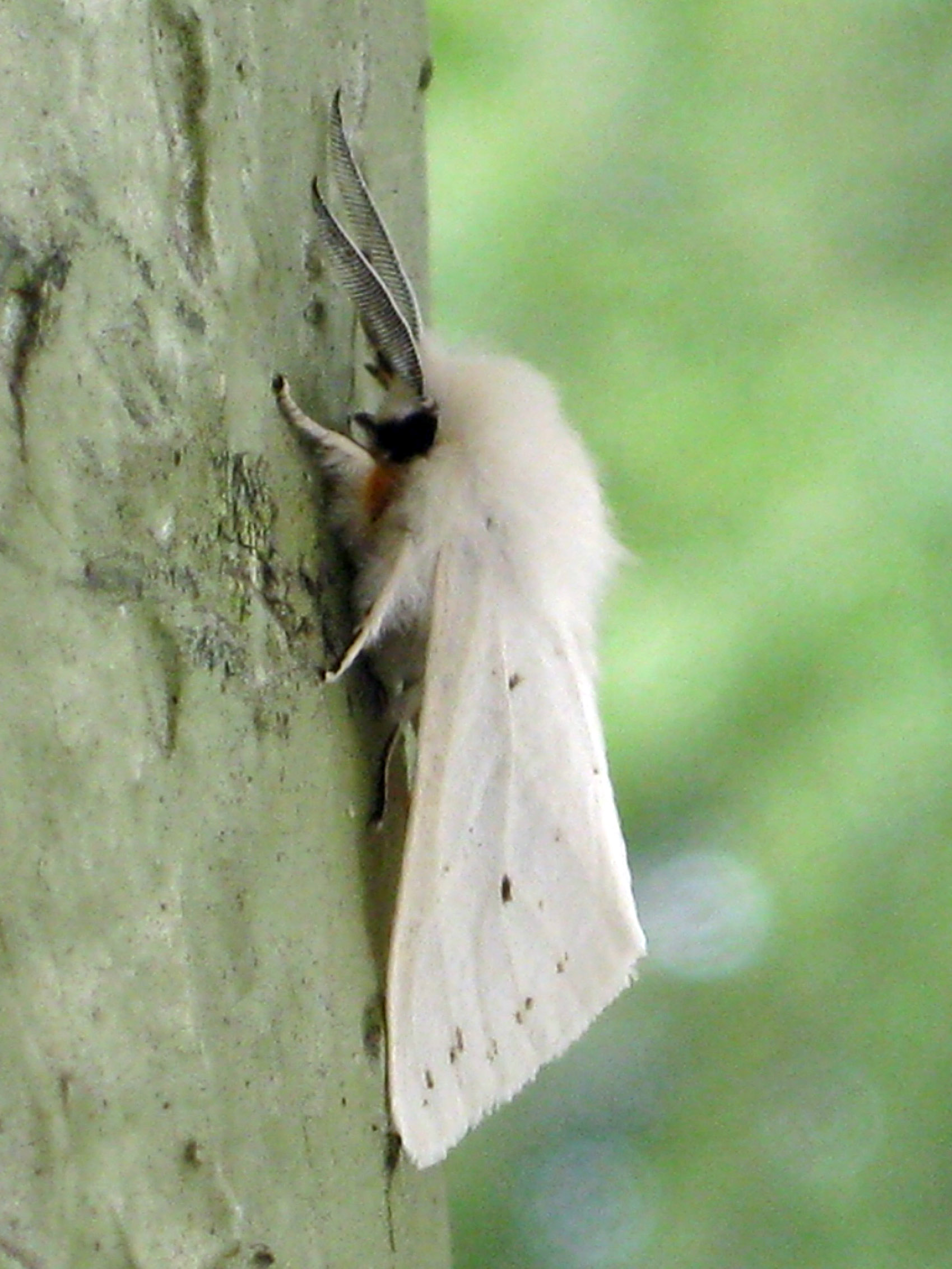
Ornate Tiger moth, Nicasio. CA
What I didn't know was that their relatives hatched into mosaic-striped tussock moths, or tiger moths that favored the back bedroom in summer, and their rarer cousins: striking white moths with black spots, black eyes, feathery black antennae; with a red bib and underwing near the thorax, black legs covered in little furry red pantaloons—sort of like this fellow pictured here.

I hated the tent caterpillars. One year they ate every leaf off our wild cherryplum. Destructive little buggers. No fruit that year. But they were fascinating to watch, always busy following the caterpillar in front of them like little runaway trains going clackety-clackety down the branches, hellbent for the ends of the earth.  Or the end of the branch. Talk about terminal. Their tents were death shrouds for the fruit trees.

My favorite pests were the daddy-longlegs that inhabited the living room corner by the swank '50s pole lamp. Sometimes a cluster of daddy-longlegs would face the light, link legs, then hover and bounce in unison in the corner of the ceiling near my grandmother who was reading on the couch. She'd mutter and swat at them with a newspaper if an adventurous one got too close, but she never killed them (or mosquitohawks either). That was bad luck.

I tolerated the skeeterhawks—often distinguished by their droning tap when they were trapped in windows and corners (but definitely from afar—they could, and did bite). From my grandmother, I learned that beneficial creatures came in small stinging sizes too.

When I was in my late teens, I was in bed reading, one adventurous daddy-longlegs, that I dubbed Trackstar would come scurrying over for a daily visit. Sometimes he'd observe me with his two beady eyes that can't form a coherent image, tapping at my skin like a blindman with front legs that double as arms, tongue and feelers. Then he'd bounce on his long legs like a trampoline—clearly he was communicating something. But what? Not like a bluebelly lizard doing pushups and strutting for a female.

This weird behavior went on for months. I was fascinated by the 'spider." He was probably feeding on crumbs and dead skin cells. I was his veritable banquet hall. If he found a tidbit, he'd wash his legs like a cat.

Daddy-longlegs are fragile creatures, we learned to let them roam on us at will, but we had to be careful because their sensitive legs (that serve as eyes, ears, nose and mouth), will fall off and then twitch away like decoy lizard tails—long after the creature has hobbled off to safety.

Alas, one day I jumped out of bed too quickly and stepped on him. I didn't realize he made his daily trek across the floor from the area of the closet. I mourned that silly "spider." An impossible pet to keep.

He was definitely not a cellar spider. Daddy-longlegs aren't spiders at all. They're opiliones. Arachnids, yes, like scorpions, but not spiders.

Opiliones are sometimes called harvestmen—because they congregate en masse during the fall. According to fossils found in Scotland, they haven't changed very much in 400 million years. They have oval bodes. Like a dark little pill with geometric brown markings. Up close, you can see that they're very unspidery looking creatures, other than their legs. More like a tiny crab. The male has a much larger body than the female.

Someone, perhaps jealous of my fascination with daddy-longlegs, once told me that they were one of the most poisonous spiders in the world, but their fangs were too short to bite humans. The venom thing is utter rubbish. However, I was pretty disgusted with my friend for believing such nonsense.

Maybe they meant the long-legged wood, or, cellar spiders, that really are spiders, and are often mistaken for daddy-longlegs, were poisonous. I gave them wide berth as spiders like me a little too much as fodder. These delicate daddy-longlegs have no venom or fangs or silk glands. Just tiny little arms they use to ferry crumbs to their impossibly small mouths.

Tuesday, April 3, 2012

dread virus woes, or teaching while voiceless


Sick again. Ugh. Feeling a little better this AM—nasty virus kneecapped me on Sunday. "Course, I haven't really gotten up yet. So all seems good. I really felt it this afternoon. Did too much. Not horrible, just sickly. Cough cough. Taught oil pastels to 3 classes of 4-5th graders in San Jose—part of a CAC AIS grant. Very tired. Need to jump on it and get into the wind (as James Byrd would say). For I have miles to go before I sleep. CROAK! Now I'm completely voiceless. Neil O'Neill likes this. Maddening in that Neil kept asking me how I lost my voice, as if I was careless and left it on the bus or something. Think I'm going to try another shower to see/hear if that helps. Still hoarse, sound like a hoase debarked dog. Throat is killing me. I have little islands of voice back... still unpredictable. But every once and a while I can actually make a normal sound. Hit a note or two. Maybe I should try singing in order to speak.

Monday, March 26, 2012

CA Poetry Out Loud

We're at Poetry Out Loud finals in Sacramento. Competing students from 33 counties were stellar. First round was AMAZING. I'd hate to be a judge. How can you judge perfection? 


Dana Gioia showed up and gave an impassioned speech about Why Poetry Matters. Imagine  being a high school student reciting a poem by Dana Gioia, former Chair of & the genius behind Poetry Out Loud, while he's here watching? YEP! Dana said the student did a better job on his poem than he did. Praise indeed.


Head of the California Arts Council, Craig Watson gave an amazing testimonial about his deep and abiding connection with poetry, and Council member Malissa Shriver is a true champion for the arts. It gives me hope in a dark time for arts funding. 


California Poets Laureate: Juan Felipe Herrera and Al Young as judges. Former Assemblyman Dennis Mangers!  I met his way back when —when I was an arts advocate/lobbying for arts education with Ken Larsen. 


WOW! riding high. What a night for poetry. It really Matters. Besitos all round.


For me, tonight was several of so many small circles closing, completing, overlapping. When I told Dana Gioia way back in the early 1980s that I didn't buy the whole POL concept, why did it matter, he wanted to know about the pivotal moment when I got it. 

When Craig Watson was there for me in the outbacks of Santa Rosa, another "way back when story" giving me advice, art supplies, and hope for the future—I still have those magic pencils, having taught thousands of students to draw with them. 


And Juan Felipe Herrera and me working on CAC evaluation processes for the NEA‚ how many years ago? Me & JF with Juan Valdez of Zoot Suits fame way back when. 


And the CAC's inimitable Wayne Cook who wears a secret Super(Art)man shirt under his suit—but don't tell. So many amazing mentors in my life. Small circles opening into larger circles, myriad pools rippling in the consciousness of life—when it all came together, tonight at a banquet hall at a hotel in Sacramento tonight. What circles we travel in. For all this, I am truly grateful.


You see, I am a poetry coach for Poetry Out Loud. Last year my student Mark Reifenheiser from Diablo Valley High School placed second in the California state Poetry Out Loud finals, and the year before, my student from Deer Valley High School, Cheryl Evans came in 3rd. I'm onto something here. Don't know exactly what. But there it is. 

I tell my students that the real POL equation is being emotionally honest when redacting poem. Not over the top, not acting. But being with the poem, discovering it anew from the inside out—taking the audience along for the ride so they too discover something new in hearing the poem. These students really get it.

Thursday, March 15, 2012

It's PADDY not Patty


For PaddySnakes! Why is it that as we approach St. Patrick's Day, the Irish-American (and wannabe Irish-American plastic Paddy) illiteratii, perhaps with a sullied and powerful thirst upon themselves—therefore, being thoroughly deficient in any reasoning skills, or little gray cells, crawl out of the woodwork, and insist on calling their international drinking day St. Patty's Day?  PATTY? Tut-tut. Are you kidding me?

Bah! What's with all these amateurish alcoholics who don't even know how to spell their patron saint's professional binge-drinking day nameslake?

It really gets my goat. My initial response (aside from my knee jerking so hard so as to render myself unconscious from a self-inflicted blow to the chin), is who's she? She? Baaaaa?

Did St. Patrick undergo a sex change? A sea change? Was he Swedish? A cloned sheep? No, that was Dolly. We do know that Patrick had a thing for pigs, not sheep. At 15, when most kids were fooling around in the bushes, he was captured by Irish pirates, and became a slave. 

An Antrim chieftain named Miliucc (his name sounds suspiciously similar to the Irish word for pig—muc, as in mucky. Anyway, Miliucc called Patrick "Succat." (That's Irish for sucker—not.) Probably because that was his real name: Maewyn Succat. It means warlike in proto-Welsh. He'd have to be, considering besotted Americans would be calling him Patty some 1500 years hence.

Maewyn Succat (he wasn't yet baptized Patricius) was a swineherd for seven years in the mountains of mourn—er, Antrim, with nobody to talk to except them little piggsies. Maewyn-Patrick-Succat was off gamboling with the jamóns for seven long years? Helloooo Dolly! Can you say rashers of bacon?

The Irish word for pig muc, comes from the Old Irish word for pig, which is socc (soch/suck). Sounds suspiciously like Succat, doesn't it. Being called a pig or boar in Irish or Welsh (trwch) wasn't a bad thing in the pre-medieval ages. The pig, or boar, was considered a sacred animal. You're on the pig's back now means you're on a roll. Of course, nobody could say trwch in Welsh without sneezing or sounding like a pig. Better than being called sucker! 

How the little piggsies (that's banw in Welsh) ever taught Maewyn-Patrick to speak Irish, remains a mystery. They must've been very talented swine. Perhaps they were bilingual? You may well ask: seven years? So, what's time to a pig? Maewyn-Patrick was 21, far from home, and he readily admitted to hearing voices on or in the hillside. Holy Leaping Schizophrenics, Gilligan! No wonder he drove all the snakes from Ireland. They didn't speak Oirish like the pigs. Or they weren't speaking to the pigs at all, so they got eaten.


I know St. Patrick had a cross to bear trying to convert the so-called heathen Irish to Christianity—but, ferfeckakes, not TWO of them. (No matter that Palladius was already busy converting the Irish when Patrick was still wet behind the ears.) I digress. Not PaTTy (see the two crosses?), but PaDDy. As in a DruiD. Was it some loose canon (stet) of a TT stutttttttering off somebody's keyboard to blame, or what?

How did this glaring "T" typo snake its way to these clemented shores of Amerikay? Maybe it's derived from the baby hand-jive, patticake. Or maybe it's from slinging hamburger. Gimme a patty. Raw. Hold the curly shamrocks, Babycakes!

it's PaDDy—not Patty—ever! Patty is a girl's nickname. Got it?  St. Patrick was not one billion McDonald's burgers served either—which is probably the natal spawning ground of this blaring typo. Blame it on those preliterate generations raised on Big Macs. Paddy is not necessarily a derogatory term. It's a man's (diminutive) nickname, or pet name.

St Patrick
Ok, so my great-great uncle was called Paddy Walsh, and his son was really called Patsy to distinguish him from his father. Really. No one would dare call Paddy diminutive, or Patty, for that matter, and live to tell the tale. 

But there were too many Patricks and Patricias in the family. Patsy's cousin was a Patsy too. Their sons were Paddys. Paddies and Patsies. Yup. We tend to flip the dimunitives every other generation. Works like a charm until they begin to overlap. Then we're right fecked.

Our family is rather name-challenged—we keep recycling the same handful of names over and over. Even the girls are called Patsy. (Not Patty!) Causes massive confusion in the family tree. We just know we're all related. But not exactly how. Sort of like a Kentucky Family Tree—you know, straight up, only ours is horizontal. Or maybe it's drowning itself neat in affrontal lobotomy of uisce beatha. But that's fodder for an-udder blogger.

Imagine being a cowboy called Patsy in the wild, wild and wooly west of Nevada. Yep. That was my rellie. I suspect some serious bar room brawls were in order. It's sort of like a Boy Named Sue. Paddy was also called The Boss. But trust me, no one called any of my relatives—male or female, Patty! Ever. So we tend to take umbrage rather easily.

Call it Saint Patrick's Day? Grand. It's all right and proper. (You may also genuflect here—a full knee drop, if you please, at the bar of your choosing—not some pannywaist half-knee crick or, gawdforbid, a curtsy—though royalty is invoked.)

Call it Paddy's Day? It'll do; but don't forget the St. part. As in saint, not street. Or Paddywagon. Get it?

St. Pat's? Och aye, if ye must. 

St. Patty? NO feckin' way, ye illiterate goats! Bahhh! Maaaa? 

It's enough to make and Irish(wo)man to take up flinging pigshit or cow paddies or worse, become bullish and see red—er, make that green. No wait, that's a river in Chicago. (No, not in back alleys. The real river. They dye it green.) Enough to get your knickers in a twist.

Beides, have you ever heard of a police prisoner transport vehicle referred to as a Patty wagon? I think not. Black Maria, maybe.

As my Irish teacher, Joe Nugent from Mullingar would say: We'll have one o' that fookin' shamrockery here!

Friday, March 9, 2012

Poet Leonard Cirino (1943-2012)

         Most of my life I’ve been poor,
          I never lived in a house with gables.
          This year I’ll grow flowers.
          The movements change hour by hour.
                  —from The Moments Change, Leonard Cirino

I found out via a small Facebook comment posted by Crawdad Nelson that poet Leonard Cirino had died. I had no idea that Leonard was even ill. I was out of the loop and I'm completely stunned. No one thought to contact me—not Lee Perron, Claire Josefine, nor Crawdad Nelson. Donna Champion, who was in constant contact with Leonard, knew he was sick, but not the dying part. No Leonard-flavored instruction manual. He didn't tell Donna the news either—and we were among the ones who knew him the longest.

Apparently it was a quick diagnosis on January 23, Leonard's liver cancer had spread like wildfire. Leonard was given six months to wrap it up. Instead, he got only six weeks. Barely enough time to say hello to death, let alone, goodbye to life. According to his Facebook page, he said he wanted another 15-20 years more. He literally ran out of time.

So I am gleaning the web for links to Leonard in case others too didn't get the news. It may be a bit of a chaotic collection here but at least it's a start.

An Italian-American native of the San Gabriel Valley, east of LA, Leonard John Cirino was born 11 September 1943 and died 9 March 2012, in Springfield, OR. During the early 1960s, Leonard was a state champion pole vaulter in high school and in college. Leonard attended UC Berkeley during the FSM days—where he said his real education began. He tuned in, turned on and dropped out and did the Timothy Leary thing. Moved back to the land. Tried to clean up. Speed took its mordida. Went crazy. Was institutionalized for a horrific, violent crime. I remember the sun stood still the day he told me the news. It was a litmus test of faith. A watershed of loyalty.

Leonard was paroled in 1975. Rehabilitated, then repatriated. He reenrolled in college, and picked up where he left off. Leonard graduated from Sonona State University in 1978 and moved to Albion Ridge, in Mendocino, where he earned his keep as a jack-of-all-trades: landscape laborer, carpenter, solar specialist, a news reporter, and dishwasher. Writing all the while.

About that same time Leonard was at Sonoma State (circa 1976-78) I met him through Lee Perron and Donna Champion. I was organizing readings at Sonoma State. We hit it off like long-lost kin. Maybe it was an Irish-Italian thing, We had the same saints queued up along the portico. We knew when to genuflect.

Thursday, March 8, 2012

PURIM MOON, INTERNATIONAL WOMEN'S DAY (photos)

Bearded iris at dawn. It was on a traffic island on Stanford and San Pablo in Berkeley—I nearly got run over. I just want to be a bee and crawl inside this iris and roll over on my back.


Eden Landing Ecological Reserve at sunset. Full moon over the Coyote Hills. 


The moon is still in the earth's shadow at sunset. It was more rose-colored than orange-hued but the sunset was spectacular (see tide flats photo above) and it tinged everything orange. Also the zoom may have distorted the color. I was stuck on top of the San Mateo bridge in traffic and the moon had just come up. As it rose, it became a standard issue white moon. The magic, gone.


Purim Moon from San Mateo Bridge. Eden Landing Ecological Reserve. That blue line is the earth's shadow.


© Maureen Hurley photos 2012.

Standing on the San Andreas Fault, Crystal Lakes (photos)


Standing on the San Andreas Fault, I straddle two continents.


Rock wallflower in serpentine gravel at eye level, Crystal Lakes (San Andreas Fault). San Mateo County. Erysimum X? is a Brassicaceae related to mustard. Cream-colored E. franciscanum does come in bright yellow in its southern range (to Santa Cruz). About 6" tall.


Tidytips growing in serpentine gravel, like small artists painting the wind with perfume. Crystal Lakes, San Mateo County. Layia platyglossa?


Missed the pussywillows (again). Catkins calling out my name... mewling in the underbrush.
What I nearly stepped on...she had a lot to say and scolded me for my carelessness.


© Maureen Hurley photos 2012.

Tuesday, February 21, 2012

DEAR MIGRAINE

I'm at the Apple Store waiting for a walk-in appointment to get my cranky refurbished Airport Extreme's noonies checked out, I'm blinded by all the whiteness.

I need Ray Charles shades and my new Airport is suffering from some form of extreme wifi dementia even though it's the latest generation! Can't blame its age. It's a baby. Wet behind the ears. But I can't get on the internet. Driving me crazy.

Apple genius pokes it, prods it, and says the unbelievable: Here's a new one. Take it. I said: But it's a refurbished one. I didn't buy it new. She said: Go on! And handed me the bag.

So, to celebrate, I went shopping. Call it caregiver therapy. Chocolate is good. Very good. I bought some snazzy track shoes so I can hit the ground running. I'll need it for this crowded week. 

Noise and light are still unbearable. Acute hearing sucks. The yapdog metronome next door, the tiny hooves of the keyboard, the soprano squeal of leaky faucets. The rushing blood singing in my ears.

Dear migraine, please go away, like the rain, to come again another day. When I have the time—belay that thought. But hey, no more vertigo makin' me dizzy! I'm staarvin' Always a good sign.

Let the chocolate-covered auras begin. Do we have liftoff?

Monday, February 6, 2012

Dead iMackii


Woohoo! Ol' Lazarus is back in town. Took my dead elderly iMackii to the Apple Store. The Apple genius turned it on its side, she prodded and burped it, and lo! It fired right up. Who knew?

I brought it home. Nada. Turned it on its side, turned it face down on the bed, whacked it upside the head, then pushed hard on the plug and it chimed. Gawd, I love that chord.

It's the last chord you hear right before the Beatles begin singing "Don't Let Me Down" which is what everyone subconsciously thinks as they're pushing the start button. It also sounds like the last chord in "A day in the life" by the Beatles. I'd love to turn you on.....

Having a gurl genius rocked. She got me, and my passion for keeping old technology alive (and useful)—not like those other whippersnappers who want you to slip into the latest model.

Dear Ones, With the unusual sunspot activity, all electronics are particularly vulnerable due to excess EMS activity.

My myriad, peculiar, ongoing Mac woes are a case in point. I lost my USB ports in my MacBook. A static zap! I saw a spark (and heard a resounding SNAP!) when I plugged in my SD card reader. Luckily, I was able to do a PRAM hard reset, and restore my ports.  Didn't need to do a ful SMS reset. Turns out, OSX disables USB ports if there's too much of a "draw." TG.

If you're wearing shoes or socks, and working on synthetic rugs, plastic chair mats, touch some metal BEFORE you plug anything into your FW or USB ports. Barefoot on wooden floors is best. We've got another year of this extreme EM activity, so train up now! And scan the night skies for Aurorae Borealis!

We all just have far too much magnetism these days (and nights).

Maureen Carden says: Back to pen and paper, folks. Remember "letters"?

I say it's tricky to edit photos with pen and paper...


Sunday, February 5, 2012

DUN I, IONA

DUN I, IONA
(after a translation from the Ohlone)

I dreamed you were a sliver
of light glinting on the curve of the sea
On the machair, the rabbits
cleansed their scalloped sand porches
while amid the lambs, the hares stood sentinel
I dreamed of you dreaming me
on the granite dome of Dun I,
at the center of the island
between a rowan and an oak
in a crevice at the well of age,
the falcon's eye, a distant sun
dancing on the edge of the world.

2/5/12

published in A MOUSE THE COLOR OF MOUSE ©2012
Poetry Inside Out, Center for the Art of Translation
Medusa's Kitchen, 2012

POETRY INSIDE OUT translation workshop

YO NO SOY  (interlinear translation)
—Juan Ramón Jiménez


I am not I
I am the one
who is the one who is at my side
without my seeing him
sometimes I glimpse him
sometimes I forget 
about the quiet one, serene, when I speak
the one who forgives, dulcetly, when I hate
the one who will remain standing
when I die.

         published in A MOUSE THE COLOR OF MOUSE ©2012
                          Poetry Inside Out, Center for the Art of Translation


I AM NOT I
(after a translation from YO NO SOY, Juan Ramón Jiménez)

I am not I 
I am myself
who is following me
in dark dreams
and alleyways
sometimes from the corner of an eye
I catch a glimpse of her
sometimes I forget she's there
she's so quiet, serene, 
like the feathering of first snow
when I speak
she forgives me
when I'm filled with rage           
she appears
when I'm not all there
she's the one who'll remain
when I am gone.            


TRANSLATION FROM THE OHLONE
(interlinear translation)

I'm dreaming
I dreamed I saw you 
leaping toward me
o cottontail
jackrabbit 
and quail

....

dancing on the brink of the world
on the edge of the dancing world


         published in A MOUSE THE COLOR OF MOUSE ©2012
                          Poetry Inside Out, Center for the Art of Translation


DUN I, IONA
(after a translation from the Ohlone)

I  dreamed you were a sliver 
of light glinting on the curve of the sea
On the machair, the rabbits 
cleansed their scalloped sand porches
while amid the lambs, the hares stood sentinel
I dreamed of you dreaming me
on the granite dome of Dun I,
at the center of the island
between a rowan and an oak
in a crevice at the well of age,
the falcon's eye, a distant sun
dancing on the edge of the world.


         published in A MOUSE THE COLOR OF MOUSE ©2012
                          Poetry Inside Out, Center for the Art of Translation


Bashō translation
(interlinear translation)

1. old mossy pond
frog jump
water sound

2. Venerable pond
Look! A fat frog leaping in
Kerplunk! Water sounds.


         published in A MOUSE THE COLOR OF MOUSE ©2012
                          Poetry Inside Out, Center for the Art of Translation

O PILLANGÓ—Tibor Tollas 
     homophonic transliteration from the Magyar

O butterfly, how you endlessly swirl and swoop
circuitously sipping breeze the on gilded wings, 
those flitting moments slipping away
your wings, a visage of false eyes and lost loves
as you wander, and so it goes, you're left
with a tisane of sunflowers in spontaneous gardens
tucked in folded fields and hidden lanes of the heart.


LA GUITARRA
—Frederico García Lorca (interlinear translation)

The guitar sobs
it weeps, 
lonely in its cups
as dawn's empty glass
shatters 
on the restless sea


—after Lorca's La Guitarra

The guitar weeps
it sobs, lonely in its cups
as dawn's empty glass
shatters on the restless sea
it is impossible to silence
the guitar, the sea, the tide,
the breath, respire, respire hondo
Be still, o restless drum
of my heart.


—after Núno Judice's A Luz de Lisboa

The light transverses the room
between two windows
it is always the same, mesmerizing light
while on the other side of the room
the setting sun that was once the rising sun
the two conjoined, rising, setting
and it is this intersection that confuses the eye
the blank stare that does not know
the time or the hour of that first light
and so I watch how it spans the gap
between both windows
as if it had no beginning, no end.


—after Núno Judice's A Luz de Lisboa

the wind enters the room with a flourish
wraps its tentacles around the curtains, tugs them
ghosts, as if from the corner of the eye
it becomes visible for a moment, then silence
the windows are eyes, or mouths for the wind
speaking in tongues as if from the east
confounding the delicate shell of the nascent ear


—after Efraín Huerta

Always
with silence
the cat
creeps in
on little pat
feet


—after Efraín Huerta

How 
sad
that he
always 
called me
Dad
this boy
with 
no mother.


TRANSLATION
(interlinear translation)
 No sé por que piensas tú
Nicolás Guillén


I don't know why you believe

soldier, that I hate you
since we are the same, me & you.

You are poor and so am I
I'm from the barrio, so are you.
Where did you get the idea
soldier, than I hate you?

It pains me that somehow you
forget who I am.
Crapola! Since I am you
just like you are me.


3/6


MOUNTAIN WHY DO YOU STAND
          —after Nicolás Guillén's No sé por que piensas tú

Mountain, why do you stand resolute
thinking the sky will be there, 
blue vault full of promise, freedom 
taken for granted, like venial lies.

Sky, why hide the silent face
of the mountain from us, keeping
secrets, a lenticular crowning
like a pale hackneyed haloed deity?

Godlet, why do you always insist 
upon your omnipotence when the mountain 
will surely disappear, worn down by 
the sky's tears, as should you.


WHY DO YOU STAND
—after Nicolás Guillén's No sé por que piensas tú

Monsanto, why did you poison plants
splicing genes and pesticide, calling it
progress, calling it  by any other name
than what it is: utter devastation.

Capitalism, when did the end result
become more important than life itself
and the ones who raised you up
became grist for wheels of progress?


Monsanto, Monsatan.


CONGO NEGRO 
( homophonic transliteration)
           Nicolás Guillén

Hey hi ya hey heyo
sound the Congo slongo
Congo slongo beat
dancing hey hey diddledaddio

Mama drumba
sing me a pupusu mamba

the Black man sings and jives
the Black man jives and sings
the Black man sings and splits
Remember me
Hey hey heidio

Bopdiddybop bop bop
Drum the Black man falling down
Death of the Black man
Shit! The Black man singing
hey hey heidio


DARK DRUMSONG
—after Nicolás Guillén's Congo Negro

Agó amé    mjambo    me llamo amé
repeat the drumtalk, the dumbek
the deep, dark drumtalk, dumbek
the heartbeat of the jungle, the Congo, 
the bongo drumsong of the heart, 
your name dances on one leg!

mama moondancer dancin' in the street
serenadiing me crossing the river
the darksong sings and snaps its digits
the darksong snaps its fingers and sings
speak to me, kiss my drumskin
Agó amé, mjambo amé   snap!

drum bumbek drum bumbek drum
drum on the dark one who goes down
the buried one, the one buried, buried crown
holy cow now how the dark one, shackled, is free
Agó amé    mjambo amé   your name!


TAKE 2

CANTO DE MACHU PICCHU
—after Nicolás Guillén's Congo Negro

Ollantaytamo Ollantaytamo a mé
Repetirlo, sing me a river song, sing me.
Repeat the song of the Urubamba, Pachamana.
The melody of the milpa, o fallow milagro de Díos.
Pachatata, an ancestor storm shaking the mountains!

Who sings to me a blue song of the sky, who tied the sun
to the intihuatana? The jaguar, he purrs in the night
while the vicuña sleeps, while she sleeps.
The milpa terraces are burning, they are burning
The night wears a necklace of fire, grows old and dies.
Pachacuti, the stones rise up, fire devouring the mountains!

The temple of the moon devours the temple of the sun
Inti sun going down, the moon's children flock to the sky
while the Southern Cross drills a hole in the universe
Quidado! the Urubamba asleep, opens an eye, licks its lips.
Ollantaytamo Ollantaytamo a mé!


3/9


TWEED WAULKING SONG
—after Nicolás Guillén's CONGO NEGRO 

Hey Mandu! Hey Mandu!
Play the sounds, play the mouth sounds.
The mouth music, use it, don't lose it.
Wet wool, dark as night, stinking of sheep
and urine pounding down the tweed!

Hey Mandu! Hey Mandu!
In the Hebrides women once felted tweed
they waulked the tweed, they waulked it down.
Down down derry down. Down, down.
They beat out a drum song on the table.
They beat it down, twistitg it soleil with the sun!

Mouth music, mouth music.
Women's work from another time.
The dark cloth thickens its lips, toughens its weft
to protect the fishermen against winter's fierce bite.
It develops a thick skin, and a thirst for whisky.
The dark cloth sings wet lanolin songs
of whisky and lost sheep clinging to sea cliffs!

Who remembers the mouth music?
Now, it's nonsense uttered in gutteral tongues.
Lost translations of work songs, ancient songs.
Who remembers when time itself was mesmerized 
by the seasons set in stone?

We sit in a circle, in a college classroom 
on the other side of the world, no island sheep,
no North Sea hissing outside the door, only the freeway.
We're waulking a long snake of stinky tweed 
singing Hey Mandu! Hey Mandu!

The table thrums, the table is a bodhrán drum
for primitive, ancient songs of felted tweed.
The old women singing Hey Mandu! Hey Mandu!
3/13/12


THINGS I
—after Nazim Hikmet's Things I didn't Know I Loved

I'm sitting by an open window
waiting for the train, it's running late
waiting for the clock to trip over
like a deck of cards fanning itself
52-card pick-up, cowboys & Indians.

I saw the clouds gather like sheep
the bitter wind nipping at their heels
they cowered in the blue-vaulted sky
bleating piteously at all that open space
corralled by the jagged peaks and valleys.

I know I'll never pass this way again
the alps stabbing the sky, the train 
moans and strains on its tracks, humming 
like a lost mouth harp at twilight
the sour notes careening off cliff walls.

I believe that time stood still, frozen
when I ran down the tracks, almost 
missing the last one to take me 
to another country, the iron borders closing 
in on me, a life not lived.

I loved my freedom far too much
to be shackled by chains of marriage
to another country where women are chattel
my dowery of words enough to sustain
my art, my ephemeral vows, might flee.

3/15


TEACHERMAN HE SAY

Rasta teacherman bellows out 
in a metric monotone.
He sings a pejorative song 
of a preacherman
confronting hell and damnation saying
Thank you, thank you SO much. 
Have a seat. SIDDOWN!
Come sit with me now.
Come here, or get out of my room
Stand up, please. Don't move the chair.
Siddown siddown. Now.
Turn around, yes, you! 
Saying Turn around now!
to lazy boys waiting to enter 
the legal system
as inmates.

3/15


LOOONS/LUNES
(American Haiku)

A LIFE OF PAPER

A life of paper, 
filling the bed, the house, 
orphaned words everywhere.

(take 2)
A life of paper, 
orphaned words filling the bed, 
the house, everywhere.

IS SHE

Autistic or artistic
the Asperger's question of creativity
Flip a coin.

In the classroom
the poets flute brings order
to writing mayhem.

The wind stole
the poet's green flute, jealous
of his song.

Over the garbage
the poet sharpens his pencil
with his wit.

In deep woods
a child thinks of fairytales
imagines wolves howling.

The teacher screams
Be creative. Do it NOW.
A condescending note.

3/22


Wind poppies dancing
sun, cream and fire combusting
in deep grass.

Poet counts words
arranging them like ducklings all
in a row.

Archway defines both
the shape of the doorjam
and liminal boundaries.

Riot of blooms
rosemary prays to the sky
in lost remembrance.

In spring, rosemary 
prays to a brooding sky
in azure remembrance.

By the roadside
paint buckets and snare drums
catch a beat.

Forgotten porchlight shines
captive starlight in a day
full of sunshine.

Porch light burns 
a baleful eye glaring at 
an empty sidewalk.

Tiger cat stalks
cabbage moth in a garden 
of shadowed delight.

Madeleines and mint
tea, remembrance of things speaking
in small cat tongues.

On Monday morning
counting words in 3s & 5s
American haiku looons.

Crepe myrtle petals 
seek asylum where royalty walks 
in purple stains.

A Catholic guilt
crepe myrtle petals seek forgiveness
in purple asylum.

In Arequipa lawns
jacaranda blossoms settled like birds
amid green oases.

After the storm
jacaranda blossoms flock like birds
on suburban lawns.

A lone blossom
clinging to an apple tree 
fruitlessly resists rain.

Lone blossom clinging 
to a branch fruitlessly resists 
the pounding rain.

Blossom fist grips 
a branch and fruitlessly resists 
the pounding rain.

Miriam's cheek smeared
with paint: good day at 
the art studio.

Fat couple walks
up the street in tandem
clutching a pizzabox.

On the dashboard
dried roses cackle like chickens
beneath my fingers.

Even in fog
bluejay tail feathers still sing
in scissored rhapsodies.

Against yellow adobe
agave arms itself with centuries
of blue silence.

Beneath the pyracantha
robins stagger like old drunks
in holding tanks.

The redwood moans
like a young girl when
the wind twists it.

Spring fig leaves
dress the naked tree with
small green hands.

Two crows patrol
the road looking for carnage 
on the line.

After a squall
white petals rim the puddles
like sea rime.

Laptop wi-fi scans
surveillance van #3 lurking
in the hood.

3/30