There were big black stinkbugs that trekked across the hardpan driveway at dusk (the cats found out that they're best viewed from afar after they've hoisted their butts skyward). Ladybugs and manbugs (the green beetles) were super good luck—and you could make a wish on them if they landed on you. Potato bugs were just too weird. I tried to like them but they looked like little babies rooting in the compost heap.
Of course, I loved the hoppers—when I could catch them in the grass. Crickets could tell us how hot the night was by how quickly they rasped their hind legs together. As if you couldn't tell if it was hot or not by yourself.
Grasshoppers were easier to catch. They would stare at you with their strange big eyes, and sometimes took a nip out of you to see if you were edible. Beautiful dragonflies darning the stems down by the creek also bit you.
The squat furry black & russet jumping spiders that inhabited the lower field by the oak tree, never, ever bit you. I didn't know about the scorpions. I kept clear of the massive, shaggy grey wolf spider that lived in the basement. He was too big—the size of your hand—and far too scary. Like a tarantula. But we didn't have them in Forest Knolls.
I didn't know about the scorpions in the crawl space in the basement until much later, either. A case of blissful ignorance as I often crawled up there to catch the cats who ran away, dressed to the nines in my doll clothes.
To my grandmother's dismay, I adopted all silverfish I found on the bathroom floor or under the newspaper lining the bureau drawers—that made them practically literate eating all those words. I was busy making similes, creating my own world order.
The silverfish reminded me of small metallic seals with long horns. Silverfish can hop amazing heights relative to body size. Sometimes called silverfish moths, these long-lived wingless pests (who knew that they lived 5-8 years). They didn't bite but loved to eat old books, wool and silk. My idea of a bookworm was a silverfish.


I especially liked the orange & black woolybears, and other caterpillars that dwelled on the cherryplum tree at the corner of the shed each spring. Someone said woolybears were like groundhogs—they could predict the winter by their color—a wider black band meant we had to stack more wood.
 |
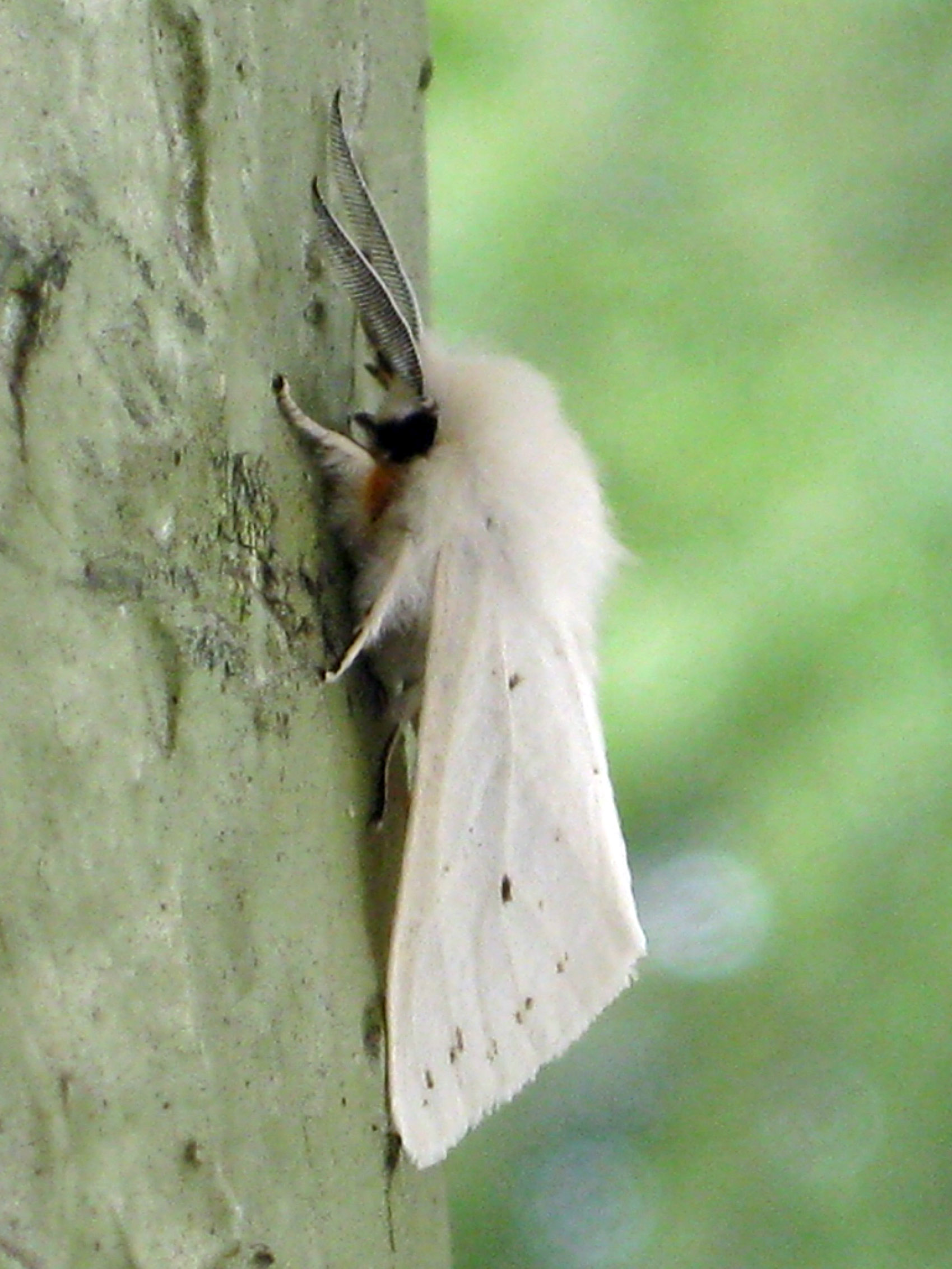
| Ornate Tiger moth, Nicasio. CA |
 What I didn't know was that their relatives hatched into mosaic-striped tussock moths, or tiger moths that favored the back bedroom in summer, and their rarer cousins: striking white moths with black spots, black eyes, feathery black antennae; with a red bib and underwing near the thorax, black legs covered in little furry red pantaloons—sort of like this fellow pictured here.
 I hated the tent caterpillars. One year they ate every leaf off our wild
cherryplum. Destructive little buggers. No fruit that year. But they were fascinating to watch, always busy following the
caterpillar in front of them like little runaway trains going clackety-clackety down the branches, hellbent for the ends of the earth. Or the end of the branch. Talk about terminal. Their tents were death shrouds for the fruit trees.
I hated the tent caterpillars. One year they ate every leaf off our wild
cherryplum. Destructive little buggers. No fruit that year. But they were fascinating to watch, always busy following the
caterpillar in front of them like little runaway trains going clackety-clackety down the branches, hellbent for the ends of the earth. Or the end of the branch. Talk about terminal. Their tents were death shrouds for the fruit trees.My favorite pests were the daddy-longlegs that inhabited the living room corner by the swank '50s pole lamp. Sometimes a cluster of daddy-longlegs would face the light, link legs, then hover and bounce in unison in the corner of the ceiling near my grandmother who was reading on the couch. She'd mutter and swat at them with a newspaper if an adventurous one got too close, but she never killed them (or mosquitohawks either). That was bad luck.
I tolerated the skeeterhawks—often distinguished by their droning tap when they were trapped in windows and corners (but definitely from afar—they could, and did bite). From my grandmother, I learned that beneficial creatures came in small stinging sizes too.
When I was in my late teens, I was in bed reading, one adventurous daddy-longlegs, that I dubbed Trackstar would come scurrying over for a daily visit. Sometimes he'd observe me with his two beady eyes that can't form a coherent image, tapping at my skin like a blindman with front legs that double as arms, tongue and feelers. Then he'd bounce on his long legs like a trampoline—clearly he was communicating something. But what? Not like a bluebelly lizard doing pushups and strutting for a female.
This weird behavior went on for months. I was fascinated by the 'spider." He was probably feeding on crumbs and dead skin cells. I was his veritable banquet hall. If he found a tidbit, he'd wash his legs like a cat.
Daddy-longlegs are fragile creatures, we learned to let them roam on us at will, but we had to be careful because their sensitive legs (that serve as eyes, ears, nose and mouth), will fall off and then twitch away like decoy lizard tails—long after the creature has hobbled off to safety.
Alas, one day I jumped out of bed too quickly and stepped on him. I didn't realize he made his daily trek across the floor from the area of the closet. I mourned that silly "spider." An impossible pet to keep.
He was definitely not a cellar spider. Daddy-longlegs aren't spiders at all. They're opiliones. Arachnids, yes, like scorpions, but not spiders.
Opiliones are sometimes called harvestmen—because they congregate en masse during the fall. According to fossils found in Scotland, they haven't changed very much in 400 million years. They have oval bodes. Like a dark little pill with geometric brown markings. Up close, you can see that they're very unspidery looking creatures, other than their legs. More like a tiny crab. The male has a much larger body than the female.
Someone, perhaps jealous of my fascination with daddy-longlegs, once told me that they were one of the most poisonous spiders in the world, but their fangs were too short to bite humans. The venom thing is utter rubbish. However, I was pretty disgusted with my friend for believing such nonsense.
Maybe they meant the long-legged wood, or, cellar spiders, that really are spiders, and are often mistaken for daddy-longlegs, were poisonous. I gave them wide berth as spiders like me a little too much as fodder. These delicate daddy-longlegs have no venom or fangs or silk glands. Just tiny little arms they use to ferry crumbs to their impossibly small mouths.
NOTE BENE: I was an avid fan of both Jean Webster's 1912 epistolary serial novel, Daddy-Long-Legs, given to me by my Aunt Toddy (she always brought me interesting books whenever she came to visit); and I enjoyed watching the 1955 black and white film, with Fred Astaire in the lead role as Daddy Long Legs.
 |
| I never saw the adaptations made famous by Mary Pickford, or Janet Gaynor (I did see the Shirley Temple version, Curly Top), but the poster is not © so I can post it. |
Perhaps I felt abandoned, my mother dumped me at my grandmother's house when I was four. Like Judy, I wore hand-me-downs—other people's cast off clothing. I never knew my "Elvis' lookalike father, other than from afar; he was short and squat and drunk.
I wanted to be rescued from an orphanage by a tall, dark, handsome stranger who would waltz into my life, and then whisk me off into the sunset on some tropical island. But not to a man old enough to be my father. Ugh. What's with that? Talk about spiders and flies.
And so, long before I became a writer, I wrote imaginary letters in my head to an invisible benefactor who would never read, or answer them. It always bothered me that Judy poured her heart out in her monthly letters to this anonymous man but he never even read them. To my way of thinking, that was a major character flaw. Sort of like this blog. Indeed, this blog is dedicated "To You."
Dear Enemy, is Jean Webster's popular 1915 sequel to Daddy-Long-Legs.


No comments:
Post a Comment