Friday, June 1, 2007

Teaching Artist Toolbox: Integration Notes


“The Teaching Artist Toolbox: Connecting Your Art and the School.”

I wrote this essay for a book that never made it to print. Or, editor Faye Stanley never bothered to tell me that my piece was rejected. Either way, I waited with baited breath for a long time. Time to post it. I think waiting seven years for a rejection letter is long enough. —7/1/2014


INTEGRATION NOTES

The success of an artist’s school residency depends upon receptive teachers, administrators and support staff who are advocates of the arts. I’ve found that working with parents—especially the PTA—is the most effective method to develop a long term, in-depth arts residency. In post Prop 13 California, despite recent funding, we are still ranked at the bottom of the national list on public arts and education funding. Most school communities are grateful to be offered any arts programming as credentialed K-7 teachers are not trained to teach art with their students. Many feel stymied by art, and they feel pressured because there’s not enough time in the day to teach the basics, let alone art. That’s where offering to integrating the arts into school curriculum comes into play. I tell them that Art is the fourth “R.” If an administrator mandates that all teachers MUST participate in a project, then I ensure that we have enough common ground so the teachers are supportive of the residency.

With school advocates, I often develop and co-write grants to fund arts residencies. I will also explore areas where we can utilize school site and discretionary funds. There are sometimes obscure pockets of funding that can be used for the arts—especially if the grantor’s goals is developing self-esteem, then the arts become the tool or vehicle to develop self esteem. It’s a matter of mirroring language.

When I develop an arts residency, I meet with teachers on campus to get a sense of their classroom environment and teaching philosophy. If I can arrange a phone conversation beforehand, I will ask what they are planning to teach during the next few weeks. Then I explain my areas of expertise. I show teachers a portfolio of my work and student work. I explain ways we can integrate the arts into existing curriculum. From there we develop a curriculum based arts project. I encourage teachers to actively partner and develop new lesson plans with me so it doesn’t become an art la carte, or a catered event where the teacher uses my time slot for extra prep time. I encourage teachers to sit down with the students to create art too—sometimes it takes a few sessions before they feel brave enough, but many do, and are as delighted as the students with their art.

Developing an integrated arts curriculum is in addition to my teaching philosophy of experiencing art for art’s sake. Foremost in my teaching philosophy, is that art is a process and from that process, we create a product. My goals are to teach students to learn to use new mediums, to develop new skills, to learn artistic terms, to appreciate each other’s work, to gain a sense of the history of art, and most important to create a portfolio of their own art—not make copies of the masters. I don’t want them to produce 20 van Gogh’s “Sunflowers” all in a row.

Before I approach the school site, I refresh myself with typical grade level specific curriculum in the California State education frameworks: the Visual and Performing Arts-, the Language Arts-, the ESL, and Science frameworks. Then I look for areas where my art residency will naturally intersect with the frameworks. Often the curriculum vocabulary is different in each framework, but the goals and objectives are similar. I have a stock of visual arts and language arts lesson plans I’ve developed over the years, so I am familiar with tailoring my lesson plans to meet specific site needs.

For example, I often integrate science with visual arts. The Science Framework—to observe and record the physical world—are really the same skills in the visual arts framework, only the language is different. I find it helpful to use a yellow highlighter and highlight anything that catches my attention, and taking the disparate parts, and specific vocabularies, to reshape my lesson plans. In some ways, we are decoding and translating the frameworks for the teachers. Drawing and painting from nature is easy to adapt to the science framework, whether it be the study of geology, of land forms, or water/weather/plant cycles.

I like to begin residencies invoking the ancient Greeks, I explain to students that the ancient philosophers (scientists) who were also artists and poets, divided the world into what they considered the four basic elements: air earth fire and water. This is the ancestor of our periodic tables. By 5th grade, most kids have had a brush with the periodic tables. This idea also ties in well with the Chinese way of reckoning the world, so I use this as a way to show convergent systems.

I write on the white/blackboard a list of the four basic elements. We each vote as to which element we think we are and we write/draw from that perspective. Because the list creates categories, I’m introducing thematic based art. I demonstrate to the students how to use a particular medium, but I want them to tap into their own creative ideas too, not just copy and regurgitate my examples. As models I use artists from around the world so kids are exposed to art in many forms. We often talk about what we see, what we like, etc., before I introduce the lesson.

For example, when I introduce tempera paints and color mixing, I use large calendar landscape photos for models. What the images all have in common is a plethora of triangular and rectangular shapes. Even kindergarteners can find and identify those shapes. We trace the basic shapes with our fingers, and then we make do simple “baby” drawings on a small piece of paper. (I demonstrate this on the board). Usually it’s only 5-7 simple contour lines, but it’s recognizably a landscape. Because I choose mountain with reflecting water images, it’s easy for kids to find the horizon line or water line and they build drawings from the middle out. In this exercise I’m teaching them to see land forms with a geometric basis, sometimes with the older kids I talk about fractals and math. The shape of coastlines and oak tree limbs.

Sometimes we even draw landscapes with our arms, incorporating kinesthetic movement, big sweeping ranges, tall mountains, swirling water. Then I reintroduce how to use the art materials and we paint gorgeous landscapes in tempera using only the three primary colors (cyan/yellow/magenta). I use an ice cube tray as a palette and I explain that all the colors of the world live in that ice tray. When they look skeptical, I ask them if they’ve ever seen an inkjet printer.

With a stockpile of ideas based on the basic elements to develop art lessons, I have kids design templates for silk hoops based on the four elements. Or they might write poetry as an element. I use a special medium—silk, silk dye, and gutta, but it could be adapted to painting too. Painting on silk especially lends itself to exploration in the scientific realm. Osmosis, surfaction, absorbtion….once you find the right vocabulary, the possibilities for integration are endless.

Another neglected area in the care and feeding of an arts residency is increasing community awareness. Sending students home with an arts portfolio isn’t enough. I coordinate my flashier arts projects such as silk painting, to coincide with public events including Open House or thematic school events. I also invite the press. This led to the uncovering of a new arts funding source, our local PBS television station! We’ve received arts funding from KQED’s SPARK arts education fund.

Another area of integration is to create an arts specific event. A new tradition at one school I work at in Oakland, CA, is our annual PTA Fall Art Auction/Spaghetti Feed. We showcase student art, produce poetry readings and we have a silent auction of student art and silk hoops and group banners displayed on the walls. The art auction raises enough money to pay for food and art supplies. Parents are more willing to directly contribute to specific fund drives, join the PTA, and generally support the arts when they too are part of the arts process.


(Faye Stanley, I have jpgs too… I could go on, explaining specific lesson plans, or I could conclude with a synopsis on how to integrate a residency…)

Tuesday, May 29, 2007

Helgar the Horrible

Hliods bid ek allar helgar kindir,
Listen to me all sacred people,
—from “The Poetic Edda”

Brenda Fullick’s dun-colored Icelandic pony, Helgar the Horrible, was unlike the other horses. He wasn't wily as my bandit Shetlands, dubbed the “Little Shytes” by irate neighbors, as there wasn’t a fence made that could contain the ponies. Nor was he prissy like the dainty Welsh ponies pretending to be grown-up horses at a gymkhana, their manes in need of imaginary smoothing.

Helgar was more akin to the dour donkeys—but the similarities ended with the dorsal stripes. Helgar didn't carry a grudge the way they did. Bent on carrot revenge, one donkey named Joshua, clamped down on my finger like a bulldog as I flailed on her forehead with my free hand. Luckily I had strong bones.

Helgar was an anomaly. How an Icelandic pony, descendent of Viking horses, came to northern California in the early 1960s, was an enigma. He couldn’t tell us his story. He was alone in a strange land, no kindred herd to cling to.

One quirk offered a faint clue to Helgar’s mysterious past, he was afraid of water tanks. Once he slammed Brenda against a redwood wine vat full of spring water. It resounded like a huge drum. The tank must have reminded him of rough seas. Unlike Leif Ericksson, who sailed to America in an open longship, maybe Helgar was imprisoned inside the belly of a freighter on that long dark voyage from Iceland.

If we offered Helgar a ladle-full of water, he’d rear up, with eyes rolled up inside his head, like a rabid dog at the sight of water. But he ferociously crossed streams and attacked his feed trough, a cast-iron bathtub, with impunity. Our tuna fish sandwiches were fair game as well.

This Icelandic pony was thick-headed—both metaphorically and literally. Physics wasn't his strong suit. Sometimes his brakes didn't work quite right. Hence the moniker, “Helgar the Horrible” (after Hägar, a Viking cartoon character). Helgar was otherwise very sweet.

Brenda was more than willing to trade mounts after he skidded off an embankment or two, or when he ran into the side of a barn that materialized out of nowhere. Why he was named after Hägar's wife, Helga, we'll never know. If the name Helgar is from Old Norse heilagr, a girl's name meaning the “holy, or blessed one”, then Helgar was a holy terror. Riding Helgar was a baptism by fire: we all rode him with a wing and a prayer.

Poor Helgar was an exile seeking companionship among Shetlands, donkeys and calves, he really didn’t like horses. We grew up with a circus collection of ungulates including a plains bison, (we called them buffalo), who peacefully grazed with the Holsteins in front of the Nicasio church—until some dimestore cowboy shot him one hopped-up Saturday night. Or at least that’s how the story went down in our circles. Wildfire gossip. She probably died of old age.

Rancher Mr. Nunes got another bison calf and fed him loaves of dry French bread, Nickel looked like a woolly version of Winston Churchill, replete with cigar. (Old American nickels had an imprint of a bison on one side with an Indian on the obverse side.) Nickel was a gentle, if massive presence, grazing on the slopes of Mt. Barnabe with the Herefords and Holsteins.

Helgar was fleet-footed—except for whenever he had a momentary lapse with physics. He could manage a spanking trot along the thinnest of goat tracks as if it were a groomed bridal path. He never needed shoeing, his hard hooves were like flint. We could ride him all day long and he would never tire, no matter how steep the terrain.

At daybreak, we’d traverse along the steep coastal ridges of West Marin, north of San Francisco, from Tomales to Bay, to Bolinas Ridge, or the slopes of Mt. Tamalpais, “the Sleeping Lady”—all were a good day’s ride from home. Helgar was a tank, he always wanted to be first to climb to the top of a peak. He was like a kid playing “King of the mountain.”

Occasionally the stunted bull calf, Mr. Smitts, tagged along. (We called him Mr. Smitts because he was smitten by the Shetlands. They were exactly his size). He didn't know he was bovine which was downright embarrassing in spring when his hormones began to rise. At an inopportune moment, he’d roll his eyes up and hop up right behind us, lowing and drooling; we were more in danger of being impaled in the back by his budding horns (and libido) than by getting lost.

Mr. Smitts kept his distance from Helgar who gave him a swift, well planted kick if he ventured too near. We often rode back from our adventures in darkness, sometimes under a full moon, the ponies always knew the way home.

When it came to speed, Helgar preferred to amble or trot, he had at least three gears, and he could trot almost as fast as a cantering thoroughbred. But it was like riding a jackhammer. We would sing, our voices revving “uh-uh-uh” like a car ignition, in time with his vigorous gait.

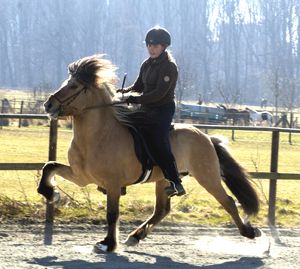
It was nearly impossible to get Helgar to canter or gallop (drumming our heels into his felted side was useless). At best it was a rough valhopp—with one end of the horse cantering and the other end trotting. If we were lucky, he would break into a high-stepping tölt (a smooth running gait), or a flugskeið, (flying pace) and when the horses left him in the dust, he'd come up from behind, all worried, nostrils flaring, as if to say, “Hey, what’s the big rush?”

An Icelandic horse’s rapid ambling gait known as the tölt (Wiki)

There was an ornery jugheaded sorrel Standardbred named Brandy I sometimes rode (I had to get past his teeth to mount him. I didn’t have my own horse at the time, so I got the ones nobody else wanted to ride). Brandy, a retired racing harness horse, heavier than a thoroughbred, must've stood at 18 hands, while Helgar was a mere 12 hands tall. Brandy was no legendary Dan Patch—who never lost a race, but he could really trot. The two horses looked ridiculous earnestly pacing side by side.

Helgar's fierce pacing was very distinct. I can still see him in my mind's eye with his head thrown back, fetlocks flashing out like hairy pistons, matching Brandy stride for stride. However, it wasn’t a comfortable ride, not like being on a Peruvian Paso Fino.

Helgar really had a thick skull, not refined like the modern Welsh pony who might carry an Arabian gene or two—though they had the same ancestor, the extinct Celtic pony, of which, the Exmoor pony is said to be the closest relative. (See also the endangered Iberian Sorraia—with distinctive DNA—ancestor to the Spanish mustang, the Galician, the Garrano/Minho and the Austurcón ponies).

Helgar also had long guard hairs on his fetlocks and jaw, and an unruly mohawk mane —like the prehistoric horses in the Cro-Magnon cave art of Altamira and Lascaux. When winter set in, he looked like a hefty hamster, his coat was so thick—he never adapted to mild California winters.

Cave painting of a dun horse from LascauxFrance ca. 15,000 BC (Upper Paleolithic). Wiki

Helgar refused to go in a barn or paddock shelter, preferring to stand in the downpour. From beneath a shaggy dun coat, he’d peer our at us with bright beady eyes, rain running right off him. We thought he was a little daft as we got 45 to 60 inches of rain, and frost too. Not like in Iceland, of course, but cold enough to freeze the ground.

Helgar was a summer camp pony, so he was probably picked up at an auction somewhere during the early 1960s. Gregg's Forest Farm Summer Camp leased out their horses to us locals from September until June. Brenda, who lived right below Gregg’s Camp, had first pick. It was always Helgar. When the Fullicks move into in the Sutton's old house on Arroyo Road, I lost my playmate, Pete. My world crumbled. But I gained a good riding friend.

Brenda was a couple of years younger than me and a bit mercurial. But her foster mom, the tall willowy blonde Judy Fullick, who was badly burned in a fire, and my mom were once good friends. I don't remember the story about how Judy got burned, there was a bit of a mystery to it. I do remember that there were two Judys in the Valley, the other Judy was Steve's mom, Judy Tristano. In those day, Pete and Steve were best friends. They wouldn't always play with me because I was a girl but when they went to the treefort up the hill, I traipsed behind them.

I ignored Brenda (who was younger than me) for ages, but my enduring love of horses led me down many diverse roads. Brenda and I became friends, united by our love of horses. She was somebody to ride with. Each fall, Brenda always got Helgar from Forest Farm Camp, so he was her de facto horse, except for during the summer months when inner city kids rode him—or tried to.

Helgar got a kick out of bucking those city slickers off, so come September, Brenda had to show him who was boss all over again. His buck, more like a rocking horse than a bronco’s, was all for show. I suspected his bouts with precipices were also for show. He was some kind of pony. A real wing borrower.

Tuesday, May 1, 2007

ODE TO SNAILS


For you crawl on your belly
like a worm, leaving
a glistening trail of startracks
for others to follow
You leave a trail of light
trapped in slime
rainbows appear in the moonlight
and meadows of color
escape into the air.
O snail, your shell
is like the whirlpool,
a Charybdis sucking us in.
Your raspy beak rotors through
the strongest of boxes and
colored chalk, and prized flowers.
Then in return, you leave behind
small paintings of the sun
on a apple left out overnight
on the table.


Sometimes in the middle of the night
when i'm thirsty
my sleepy feet lead me
to the kitchen sink
where I fidn your kith and kin
barefoot, the sound of eggshell
and the silent moon cry
O snail, your body, 
a small painting on the floor
no one will admire 
or visit in a museum.


CPITS poem written at Cleveland ES, ca 5/07

Monday, April 30, 2007

The Soul of a Poet, Bob Kaufman

I first met the Beat poet Bobby Kaufman when I was a child. Bobby coined that word, "Beatnik," and SF Chronicle columnist Herb Caen made the word famous. My mother was a Beatnik artist and actress, always bringing strange people with cars home—for the ride.

We lived out in the wilds of West Marin in Forest Knolls with my grandmother, and if you missed the one commute Greyhound bus, you had to thumb a lift. So, I met all kinds of stranger folks (it was the '60s). Most of them I don't remember, but I'd never met a poet before. A black man that that. I only remember Bobby Kaufman's presence—we always called him Bobby, not Bob. I liked the way it rolled off the tongue. Filled the mouth and lips with a syncopated rhythm. I am sorry to say, there were no awe-inspiring conversations to record. Just his soft-spoken presence.

I remember the way he tilted his head like a crow, looking up our mountain, and the tall trees—as if in awe. You could see that he moved in a alien landscape, the City streets was his particular jungle. We stood outside leaning on the car as he drank in the West Marin landscape: tawny hills, dark oak and pine, sizzling crickets. I was pretty young and not much of a conversationalist so we just stood there—drinking it in.

*          *           *
In 1983, Bobby moved to the river and attended our Russian River Writers’ Guild weekly reading series, where I was a coordinator. He'd stand up at Open Mike (we were at Leonard Matlovich’s pizza place, Stumptown Annie's) and when Bobby would quote long passages from poems like the Abonomist Manifesto, it left me completely in awe.

I was never too sure how much Bobby Kaufman was taking in, he was pretty far along in terminal burnout, the emphysema, the long distance toll of drugs coming home—but one could still see something within him burning still. The soul of a poet to the end. That image stayed with me.

The impetus of my poem, Mantle, is the results of two separate events converging on the page. One night, I was walking to my car from the BART station through Berkeley Park and I felt some presence following me. I saw Bobby sitting and reaching up to me in every darkened doorway from Martin Luther King Drive to John Oliver Simon's house on California Street, I spun around but there was no one there. The streets were empty. I couldn’t shake the feeling I was being followed. Or haunted. And Bobby Kaufman was heavy on my mind.

It was a week before I heard the news that he died, it was after the Challenger Space Shuttle had just blown up. The two events were synchronistically linked in my mind. I was teaching poetry at Mark West School, in Santa Rosa.

I was standing in the parking lot gathering art supplies for our pocket poem project. I was compelled to look up in the sky, From the corner of my eye, I saw something explode in the sky. It was like a large moon snail or a spaceship. I stared up at it in horror—not knowing what it was, but I knew it was bad, very bad indeed.

I looked up again. But there was nothing there. I wiped my eyes as if to clear my vision. It was just my wild imagination and a vast blue sky in want of a cloudy formation. Then the news came: the Challenger had just blown up. We were all stunned. Christa McAulliff was a cultural icon at our school. We all cried. The kids gathered around me like petals to a flower.

My poem, Mantle, became an open letter to the sky, an elegy to the memory of Bobby Kaufman and to the members of the Challenger Space Shuttle. The day I wrote the poem, I was with Rubén Martínez, a Chicano poet visiting from LA, my then boyfriend John Oliver Simon, and San Francisco's Beat Poet Laureate, Jack Hirschman—we were all sitting around the table knocking back caffe lattes at the Cafe Trieste in San Francisco. I recorded the date in my journal—it was Feb. 2nd, 1986.

I'd had a disturbingly long dream the night before where I was carrying rain across the night sky in rusted buckets, but it wasn't rain, it was the stars. We were talking of communism and of Latin America and all I could hear was the insistent voice of this poem coming through, seeking audience. I furiously scribbled something in my journal. Jack asked me to read it. I was stricken. Raw footage. I read it, Jack mused, and said, "Hmmm, a real poet, you're a real poet."  That was a real compliment—coming from Jack.

© 2007 Maureen Hurley

Sunday, April 1, 2007

Letter to Gail

Dear Gail, 

This is just to say please excuse the handwritten format of poems as my laptop computer, which took an unauthorized flying lesson, has joined the celestial Macs in the sky, or perhaps it is searching for Beatrice in Dante’s Inferno. And my loaner Mac has no floppy drive so every time I finally get networked, it dies, and loses its identity. I totally understand. I won’t mention the fact that when I backed up all my files, my computer destroyed all my floppy disks with many files rendered unretrievable. Murphy’s Law squared and, cubed. So, I don’t even have access to my teaching files and poems. I heard rumor of my computer’s eminent resurrection on or about Easter, but I’m not holding my breath or waving palm fronds. After much surgery and TLC, it may or may not work. Eventually, I’ll be able to retrieve my files from the hard drive, but at present, it is not an option. So, I have this lesson plan, a flyer, a handout that you might want to use, but if I only had a computer or even a typewriter, I’d flush it out more. If you’re interested, I can work on it during ahem, Easter vacation. 

PS Will says you’re doing well in GV. I don’t know if you remember me. I met you a few times in Berkeley you came to Sonoma to read for us for the Russian River Writers’ Guild. 

PPS it’s raining so hard we’re about to float away. Some April Fool’s joke this turned out to be.

Undated, probably around 1980, what Gail, I don’t know. And GV may stand for either grass valley or Guerneville. Will refers to Will Staple. So it must be Grass Valley.

Thursday, March 29, 2007

SUBURBAN LIGHT

SUBURBAN LIGHT
—For Deborah Garnett, 1944-2007

Dressed in a blue hospital gown,
she is luminous, radiant eyes and face.
It’s a brilliant photograph. She’s like a movie star in rehab,
reminding me of my best childhood friend, Stephanie,
had she lived until she was 63 years old.
She is translucent, calm but nervous, smiling for the camera,
ready to go, ready to face what comes, what will come to pass.
The unknown is around every corner, 
but we always forget. It is a lesson we learn anew 
and fail to remember with each passing.

The shoulders of her gown, with its snaps are like a road
separating the front from the back, the past from the present.
There is no future, there is only the now tearing the fabric of space. 
Small blue stars on her gown form clusters at the edges of her eyes,
I imagine galaxies of blue stars receding from the light.

It’s funny how the corner of the room evenly dissects 
her body into the cardinal directions. A compass or a cross.
She would have objected loudly to the idea of a cross,
being Jewish, and a New Yorker, 
she would complain in firm Manhattanese.
In the picture there is a hint of a door just to the right.
It leads to the unknown room, perhaps to the waiting room.
She is in transit. We are all in transit. No one knows
the timetable or the master schedule, 
or the fare—only the “all aboard.”
We stand on the platform for years, in limbo, waiting.

We stand there to wave her off, 
to wish her luck and a bon voyage on her journey.
We give her a shekel or a drachma. 
Coins and honeycakes to see her on Charon’s way.
She would have pinched each coin as it fell from the purse.
Sure, she had some rough edges, 
she was salty and strong-willed as they come,
and you’d think the universe revolved around her, 
she was a princess, but she had a big heart. 
The breathless heart shrouded by decoy symptoms.

Someone says it’s Saturday in that photograph.
It will always be a Saturday frozen in time.
On Sunday morning, my uncle too will arrive at the platform,
not ready to go, he will rage against the dying light.
There will be the classic long goodbyes from the family.
Late reconciliations played out around the hospital bed.
His heart having failed him early in life, when he
slid down the neck of a bottle. But he took heart again, 
redeemed himself with seva. Like Deborah. The good work.
Courageous. Mon coeur, we could have been friends.
I bring her an armload of flowers from my uncle’s wake.

Deborah will wait until Monday morning,
she will wait for the real work week
to begin the letting go of this mortal coil. 
Her enormous heart will fail her.

Deborah, I don’t remember when we first met,
perhaps at the writers’ group, some five years ago,
but I will remember your passing, and your big heart.
I will wear your clothes with style so that you may see again.

In the photograph, it could be Taos, or Santa Fe,
or perhaps one of the turquoised Greek isles you loved so well.
Instead, it’s a suburban hospital just up the road
from the lost inheritance of his father’s hospital, 
a hospital well within view of the road not taken.

                        —Maureen Hurley, 3/9/2007

Saturday, March 24, 2007

My Mother was a Bohemian

My glamorous mother was a real bohemian gypsy artist, traipsing all over the West Coast, following the jobs to Reno, Las Vegas and Hollywood but she always came back to her home base in San Francisco, where she was born, usually broke and more often, broken down. She'd mend for a spell and then she'd be off again seeking her fortune and fame on the road.

She'd talk of the places she'd been, the people she'd met. How nice Frank Sinatra was, how he bought her a drink at the Cal Neva. At one point, she did costumes for the show girls in Tahoe and Las Vegas, a connection which led to her working for costume designer Ruben Panis in Hollywood but that's a convoluted story of the 60s and '70s I'm not quite ready to excavate.

She brought home strangers she'd met, some of whom, paradoxically, I'd run into decades later as a poet: Beat poets Eugene Ruggles, Bobby Kaufman, in the late '60s and early '70s, even the singer Bobby Darin—who was holed up near Esalen. He was tall and thin and pale, leaned back on the couch in jeans and cowboy boots, hair pulled back in a ponytail, with the longest sideburns I'd ever seen. Enigmatic. I remember trying to fret the chords to "If I Were a Carpenter," on my cheap steel string guitar until my fingers bled.

I don't think he was impressed with my talent. I didn't get my Maritn until my 16th birthday, the winter of '68-69 in a pawn shop in San Francisco. The ending of Kevin Spacey's Beyond the Sea had a huge unexpected memory payload for me. I remember a very hippie Bobby sitting back on the sectional couch... But the corroborating details of those stories are lost.

When I was young, I wasn't interested, then she got too crazy with the drugs, I was distainful, now it's too late to recover the facts and now here I am, in my fifth decade, weaving the thin threads of the past into a tapestry of stories.


© 2007 Maureen Hurley

Friendship, Merrill Gardens, last day, freewrite


Friendship comes in like little like cat tongues. Write first thought, best thought. But that’s obviously wonky. Commenting upon it means I’m floundering on the surface instead of diving beneath the meta noun. 

My censor to self, the part that wants to sound reasonably smart, should’ve said friendship comes in like the tides. The sustained metaphor wants to hold, even though I’m stuck on cat tongues. Maybe it’s the vast ocean, or how friends are indeed like a ship, a life boat on a stormy sea.

Navigating the vagaries of life is hard enough as it is, and friends, laughing with them, even if for a moment, we leave it all behind. All the troubles and sorrows, the pain and suffering disappears.

Today as I taught my last class at the old folks’ home, I was struck by how deep the friendships had grown among us, without our even having noticed.

Our elders, some areyoung enough to be my grandmother, others are old enough to be my father, unlike the one I never had. But in this room, age has dissolved, and we are all one age between us.

Li says we are all like family sitting around this table. I know so much about each of you. We have traveled beyond the shore where student and teacher are forever divided. This is not casual garden-variety friendship. We have deepened with each other.

Sometimes I feel strange teaching my elders, but the young students I teach must think a vast gulf divides us as well, yet, we too are one. Friendship with 10-year-olds or with 90-year-olds is one thing. Unintentionally or proximity, it doesn’t matter in the end.

3/24/2007 Writers’ Group

Blessed sleep, freewrite


I am almost narcoleptic now, catatonic, somnbulent even. A serious lack of sleep deprivation even, but the show must go on. Despite a profound lack of sleep, the night before a big day when I need to sleep most, sleep abandons me and leaves me out to pasture, counting sheep, until I want to sucker punch the woolly apparitions.

Not that I actually count sheep, but as a child, I tried, and no matter how much how I visualized them, queuing them up in order to get them running fast enough to build up enough steam to clear the log fence, was a nightmare. Try herding sleep sheep sometime. They’re absolutely unruly. You need a sleep sheepdog. If anything, the process gets me so riled up, I could kiss any fleeting hope of getting some blessed sleep goodbye.

Then the damn things won’t shut up with their baahing like goats with an occasional basso profundo ewe chiming in with her bleating lambs, not exactly chiming, no bell, she. Not even the bell of the ball.

We stopped on Coleman Valley Road overlooking the sea to watch a gang of lambs playing on the hillside, each one shoving the other off the ledge. None could keep still for more than two seconds. They’ve been alive for less than two months. They gambol about with such energy.

Sonoma county sheep are born in January in February so they’ll be ready for Easter dinner. Little fresh guys, youngsters, rowdy, and on the move. No clue as to what’s in store for them. Not blessed, sheep, but blessed sleep. Forever and a night, will they count dinners jumping over a dinner table for an eternity to come?

324, 2007? Writers’ Group

Friday, March 23, 2007

Guys and Dolls


In the late '50s, and early '60s, live staged television was the new medium. A veteran actor with over a hundred film credits, Lloyd Bridges too was transitioning over to television. Lloyd Bridges' movie career may have been interrupted during the McCarthy trials, but he still very much the local actor about town, having grown up in Petaluma. My mother knew Lloyd from her Sausalito Gate Playhouse days. I'm not sure how it evolved, but she did the costuming for Guys and Dolls, and The Student Prince at the Music Circus Theater in the Round, one hot summer of 1959.

Lloyd Bridges, my mother, Maureen AKA “Kellé” Hurley, The Student Prince.

I don't remember the particulars (I was six), but we all moved to the Central Valley for at few weeks to produce the show. What I do remember was that there was a live televised show with ballet, men arguing, lots of singing, and poodle-skirted girls.

It was Midsummernight's Eve, June, 22, 1959, and according to Christopher McSwain, the Community Affairs Director of the California Musical Theatre, Guys and Dolls ran only one week. (I originally thought it was circa 1960, or 1961, because my memories were so vivid, I though I was much older).

But I do remember that Lloyd Bridges was Sky Masterson in Guys and Dolls at Sacramento's Theater in the Round, at the Music Circus. With some 30 television credits under his belt, Lloyd was both an actor (Sky Masterson) and emcee. Of course, my mother wasn't listed anywhere in the credits. (McSwain said she wasn't part of the ensemble, or costume crew, but note that she's sewing the costume for The Student Prince in the photo below. Beside, my aunt Canice also sewed costumes for Guys and Dolls.)

My mother sewing the costume she wore in The Student Prince.

We were (cast and crew) staying at a white stucco ranch style motel. Mornings, while everybody was sleeping in, I'd sneak into the kitchenette and eat Tony the Tiger corn flakes from waxpaper-lined cardboard boxes that you cut along the dotted lines. Two doors opened to frosted cereal sweetness—no bowl needed—which I thought was pretty amazing.

When everybody finally woke up (late) and went to rehearsal, my aunt Canice babysat me—even Lloyd Bridges did a babysitting stint or two—but he was usually in rehearsal. So I often hung out at the theater with my mom or with the Bridges boys.

At the motel, I had no one to play with and I was bored to tears (no such thing as TV in every room). Our room was at the shallow end of the tiny kidney-shaped pool and the Bridges' room was at the deep end. That summer, my world was divided up according to the depth of the pool. I wasn't allowed near the deep end. Lloyd's boys wouldn't play with me in the turquoise pool because I couldn't swim in the deep end.

Jeff was three years older than me. When you're young (six) and days seem like weeks, three years is a half a lifetime. But his brother was a whopping eleven years older and wouldn't have anything to do with me. I remember Lloyd introducing me to his two sons, we were standing near the shallow end of the pool.

I remember Lloyd telling me his oldest son's name was Boy, which I thought was bizarre 'cause he was clearly much older, he was a teenager, practically a man, and Jeff, who was closer to my age, was obviously younger, and therefore should rightfully be called Boy. Lloyd threw back his head and roared with laughter when I explained to him him why I thought that Jeff should be called Boy.

But that summer I was fast discovering that adults often told lies and were unreliable. What? Even my hero, Mike Nichols of Sea Hunt was making up strange stories. Just because I was six going on seven, I wasn't THAT gullible. Hiding my disappointment, I said, Hi Boy, and, of course, he completely ignored me. It wasn't until I saw him in Hotel New Hampshire (1984), that I realized his name was Beau, not boy.

The boys were enshrouded in their own world of water and sun like blond viking godlings with eyes the color of the sky. From the safety of my end of the pool I watched them become airborne as birds against the cerulean sky and plunge into the turquoise depths. Sometimes Jeff resurface at my end of the pool to play with me—I stood there mesmerized—but Boy would always call him back. I can safely say I've been cannon-balled by the Bridges boys. Not that they'd remember making me cry.

I was inconsolable as the boys were the only other kids around and Lloyd must've taken pity on me. One afternoon at the theater, he gathered me up, dandled me on his knee, and said, "I have a daughter about your age, Lucinda." But she was a whole year—and a month—younger than me, I was desperate for a playmate, I asked if I could play with her but he said, no, she was at home in LA.

Lloyd reached into his pocket and pulled out an exquisite crystal star on a silver chain. I was dazzled. He placed a star around my neck. My faith in adults restored, I wondered, did he give his daughter a little crystal star too? And would I get to play with her later?

My mom fitting a costume possibly for Guys and Dolls.

During rehearsal, Lloyd said I could stay and watch the show that night if I was very quiet as they were filming it for live TV. I practiced my own dress rehearsal by sitting in the empty theater, quiet as a mouse as the purple netting curtain descended from the ceiling to create a dreamscape of stardust and a ballet dancer emerged like a swan from the darkness into teal and blue spot light. It was pure magic. I was starstruck.
Wardrobe assistant, Maureen Hurley adjusts the costume of Betty Downey
Sacramento Bee, June 21, 1959 Newspapers 

I remember the ballet dancers, lots of people singing, short-sleeved men with fedoras tussling with each other and banging down their fists on red and white checkered table cloths. Everyone bursting into improbable song. Gaffers silently rising, large cameras the size of ponies. At that age, what I remember was the magic of theater, but the plot was far beyond me. Maybe that's why I dislike musical theater to this day.

Later that year, with the crystal star around my neck, I religiously watched Sea Hunt at neighbors' houses, as we didn't have a TV. Sometimes I'd glimpse the summer boys on TV, sleek as otters. From Lloyd as Mike Nelson, I have an enduring love of the sea and I love to snorkel for hours on end, no matter how rough the sea.

I lost that crystal star, one morning it slipped down behind the back seat of a neighbor's car. She wouldn't pull out the seat. I realized much later, she was probably far too drunk to do it. But I didn't know it then. I cried for the loss of that star, and sometimes I'd find it again in dreams, I'd reach for it to pull it out and it'd slip from my grasp, ephemeral as water.

© 2007 Maureen Hurley

Thursday, March 22, 2007

You rarely got what you wanted at Juanita’s Galley, but you got a lot of it


THE most distinctive memory I have of of my mother during Sausalito's halcyon Bohemian Gate 5 days, was when she worked for local legend, Juanita Musson, circa 1958.

Friend of Sally Stanford, former madame and unlikely restauranteur, Juanita Musson, in her trademark Hawaiian muu-muu, and acres of hair piled atop her head, was a local—if not infamous—institution. Of ample body and heart, Juanita, who tipped the scale at 300-pounds, was renowned for her eclectic cooking and unorthodox style of restauranteuring, which was more akin to rest-RANT-eering.

Truly a unique dining experience was had by all who crossed her many thresholds. Juanita was both a finicky diner's and health inspector's worst nightmare; she was immune to the mundane trivia of sanitation health codes, brushing them off like midges. I remember a turkey being served in an oval enamel baby's bath pan.

Juanita's was open at 5 AM, and she fed everybody in town, including the local fishermen (Sausalito was still a real fishing village in those days). Her heart was so big, she fed starving artists and equally starving actors (everybody was thin as a rail) and of course, myriad stray dogs.

On fine Sunday mornings, everyone turned up en masse at Juanita's Galley, which was often so full, she fed the overflow crowd on long picnic tables made of sawhorses and old doors in the dirt parking lot at Gate 5 Road.

Doorknobs poked up through the tablecloths—if you got one. Generally there was nothing more than the unvarnished truth between your plate and the door. In those days, anything resembling a dish or a vessel—from ferries to jam jars to bedpans—was also pressed into service. It made the Baghdad Cafe look like a 4-star Marriot.

You rarely ever got what you ordered at Juanita's restaurant, not like Alice! and if you protested, well, then, she'd wave her arms like a windmill and scream bloody hell seasoned with plenty of verbal (as)salt at you in that big crass Panhandle voice, "Eat it, or wear it!" And if, God forbid, you didn't finish your food, then, you had to take it with you. Or else.

Feeling very grown up at the age of six, I ordered a rare treat, pancakes. It was a tough decision between pancakes and French toast. The kitchen was already out of French toast. My mouth watered in anticipation. I wasn't allowed to eat them except on Sundays. My usual fodder was my grandmother's oatmeal mush.

But, after an intolerably long wait, my order finally came. My mother was busy waiting on customers at the other end of the parking lot, so Juanita herself hustled out in her red muu-muu, and plonked down a real fisherman's breakfast: eggs, runny side up, bacon, a big leathery slab of steak, toast, and mountains and mountains of white rice—more than I could possibly eat in several Sundays. I was aghast. No syrupy sweet pancakes?

I just stared at those two quivering yellow orbs staring right back at me from the rim of the plate and did what any reasonable six-year-old would do, I cried. The sunshine had gone right out of my day. Thunderclouds on the horizon.

I was six, and I knew the clean plate rules, firsthand. I also knew about starving pagan babies in China, and all that. And as ill luck would have it, there were no street dogs or starving Chinese kids to the rescue. And mailing my breakfast to China was not an option. I didn't have the postage.

The insurmountable mountain of food would have challenged even a fisherman's prodigious appetite. As customers watched, transfixed—to see what would happen next—Juanita, startled by my tears, softened a bit, seeing as it was me, after all. And so she grabbed a stack of pancakes from a hapless customer who, knowing from experience, the futility of complaining to Juanita, was just about to tuck in to what HE didn't order.

Now instead of giving my first plate to the man, I was stuck with TWO breakfasts. And Juanita took no prisoners. You cleaned all your plates—even if you were six! I began to wail in earnest, while plotting an escape—perhaps I could crawl under the table. Then what? Make a run for the car? My mom was pretty swamped waiting on tables at the other end of the parking lot, so she couldn't run interference, or rescue me until the brunch crowd had been fed.

Someone finally took pity on me and helped me out. I think it was my mom's good friend, the tall, skinny bespectacled New Yorker, Skip Rognlien, who was a Gate Playhouse set designer, playwright and director (along with Les Abbott); he happily polished off a second breakfast.

There are many outrageous stories of Juanita's restaurants—and all of them apparently true. But unfortunately it's hard to find the active bearers of oral tradition. Hence this blog. To see what will crawl out of the woodwork. Most people remember Juanita, but not the specifics. Painter and sonic artist, Richard Waters remembers it was pretty crazy washing dishes for Juanita during his starving artist days the 1960s, but little else, other than he ate well. As classmate, Robin Williams famously quipped, "If you can remember the '60s, you weren't really there..."

Sometimes Juanita, with her auburn hair piled high and red lipstick often askew, or decorating a tooth—she had a large toothy smile—would sneak up from behind and wrap her big boobs around the ears of a hapless male customer and if he turned around, she'd smother him, rocking his nose deep into her cleavage, and then she'd laugh like a hyena while he struggled for breath. Wives later reported that Juanita's boob-muffin worked like viagra. I remember Juanita muu-muu-ing some poor fisherman who entered the galley kitchen. At Juanita's Galley, you were expected to pour your own coffee and to bus your own dishes—or you might be wearing them as ornaments upside the back of your head.

The kitchen was really a ferryboat galley. Was it The MV Vallejo? I don't remember. Someone insisted that it was the Charles Van Damme but that ferry was stuck high in the mud at the north end of Gate 5 or Tiki Junction and this Juanita's Galley was still floating. I remember that it moaned and shifted like an uneasy horse on the tide.

If I remember correctly, the ferry sported a forest green trim and the Charles Van Damm was white. Maybe Juanita moved the Galley over there later? Some of the mothballed green and white ferryboats were later retrofitted and sent to Puget Sound—in the 1970s, I rode the MV Lagunitas ferry to Anacortes. Does anyone remember what happened to The Trade Fair ferryboat by the park? Please drop me a line...

In her house above Casa Madrone, Juanita kept a strange menagerie of animals. One sunny afternoon when my mother and I were visiting (we lived out in Forest Knolls, my mom must've had a rehearsal at the Gate Playhouse), Juanita wore so many bangles on her wrists, they sounded like an empty closet of coathangers. She offhandedly offered me some grapes. But the monkey beat me to them. Beauregard leaped down from the ceiling molding and stole the grapes right from my hand.

Juanita kept a blind cockerel rooster that perched on her shoulder like a parrot, and there were rampant chickens, myriad cats, stray dogs and goats wandering in and out the front door. I remember she adopted an orphaned fawn named Sissy that rode around on a bed in the back of her white Ford Falcon station wagon. I remember that the fawn still had its spots, like a dusting of snow, and its fur was coarse to the touch. But its ears were shaped like the air scoop on the ferry and it had the longest lashes I'd ever seen.

I was already scandalized by the idea of a monkey in the parlour and a rooster on her shoulder. But I was particularly flummoxed by the conundrum of Juanita's owning a pet fawn, because even at the age of six, I knew that deer belonged in the wild, not in captivity.

I was putting together a list of things that had their rightful order in the universe, but with the fawn, Juanita had upset my idea of order. I didn't give a thought to how a nursing fawn could survive on its own. Or the compassion Juanita must've felt as she nursed that orphan from a glass milk bottle with Lucas Valley Dairy imprinted on its side. The fawn was clearly imprinted on Juanita and followed her like a little dog on reed-thin legs. Tiny hooves clattered on cement like a staccato of hard rain.

I was just getting my first glimpses of life lessons and I was learning that my mother was becoming too fey and fragile for this world. It was as if God had made a deal with my mother—trading talent for emotional stability. She opted for talent and it drove her crazy. More than once, Juanita picked my mom up and put her back on her feet. Juanita was that kind of woman. Picked you up by the scruff of the neck and plopped you in front of the trough with the rest of your littermates.

It seems Juanita was always picking up and setting down roots herself (she was a plucky old gal—built like a Peterbuilt) and it seems that someone was always burning down her restaurants—by her own count, she had some eleven establishments.

Several of Juanita's legendary venues were opened in Sonoma's Valley of the Moon: Boyes Hot Springs, Fetter's Hot Springs and Glen Ellen. Then, I'd heard she moved to Port Costa, then to Vallejo and lastly, to Winters.

A surprising number of her places really did burn down. One—was it in Winters?—was lost to back taxes, or maybe Juanita just grew tired of it. There was always wild speculation that she did them in herself for the fire insurance, but as far as I know, Juanita always ran a lean shop, so there was no money for frilliness like fire insurance. Someone said she had a thing going with an insurance salesman....but you know how rumors spread like wildfire.

In the early '70s, I went to Juanita's Fetter's Hot Springs restaurant, and the joint was crammed to the gills with odd antiques and old hunting lodge memorabilia, with dusty moose heads and bucks with impressive racks—sort of like Speck McAuliff's bar in Lagunitas (another fabled Marin institution that fell to an arson's hands).

Cobwebbed candles stuck higglety pigglety in any convenient corner over the fireplace mantle and chimney, with bright layers of wax stalagtites dripping down the rocks in rainbow hues. Diners were crammed in knee-to-knee, tighter than a party of sardines at a canning factory. Sweet-old-Bob, my boyfriend from the 'burbs, was left speechless by his first (and only) Juanita dining experience.

The menu was prime rib for two and you had to share it with someone, or else. Heaven help the lone diner. When Juanita came out the kitchen with the cleaver in hand to divvy up the slab of meat, diners were surprisingly meek. The Juanita's Galley House Rules were printed on the dining check: 1. Pour your own coffee. 2. Write your own order. Be sure to put your name on your order so we can find you. 3. Our food is guaranteed—but not the disposition of the cook. Check Here for Special Service: Slow. Don't Care. Damned Big Rush. Those in the know never checked the last box.

Goats tethered in the yard on long chains (they ate through ropes), mowed down the weeds. There was Erica the white pig and even a holstein cow looking longingly toward the greener pasture out back of the restaurant. And there were flocks of randy ducks were swimming in the old bathtub cum water trough, or recreating, and nailing everything in sight—including escapee enamel bedpans from Sonoma State Hospital.

In 2006, I heard there was a "Juanita Roast" at Little Switzerland in Sonoma, replete with Juanita's signature dinner: moose-sized slabs of prime rib—enough to feed triplets, set in an acre park of mashed potatoes. The only thing un-Juanita-like about the dinner was the price. She'd never charge $40 a plate! During the Roast, Tommy Smothers (my one-time babysitter at Gate 5), or someone quipped, "Well, now, Juanita was never very good with candles...," and the audience roared with laughter. Ya hadda be there....

I recently ran into someone who remembered Juanita during the Sausalito days, and I had the opportunity to ask her: "Did Juanita really walk around with a rooster perched on on her shoulder or is my memory playing tricks on me?" She answered, "Yes, Juanita really did. So the story is true—which, BTW, inaugurated this blog.

Remember that blind, one-eyed rooster? Well, the story goes, that Juanita would amble up to men in the restaurant with that little banty rooster riding shotgun, and she'd say, "How do you like my cock?" Of course, at age six, that allusion went right over my head. I had to ripen a good decade or three before I finally got it.

© 2007 Maureen Hurley

A shorter version of this story appears in Marin Nostalgia (in fact, this story was revised and expanded in December, 2008 because Jason Lewis wanted to use it on his website.

Tiki Junction, Sausalito


When my mother, actress and costume designer, Kellé Reilly (aka Maureen Hurley) was working at the Gate Playhouse theatre, I was often left behind with friends to be babysat on one of the houseboats at Tiki Junction, Gate Five or Gate Six. My favorite babysitters were the Smothers Brothers and Sterling Hayden lived in a railroad car by Tiki Junction. I loved it when my mom parked the big white Ford convertible right in front of the tikis at Tiki Junction because then I could stand up on the red car seat and see them eyeball to eyeball.

My mother knew Barney West, the woodcarver who learned his trade in the South Pacific. He once told us he had to padlock the tikis together like a San Quentin chain gang because people were always trying to steal them. These tikis were huge, stealing them must've taken some planning. Not something you could pop in the trunk on a whim without blowing out your rear tires and busting an axle.

Barney West salvaged a lot of his wood after the big storms. Winter of '64 was record flood year (we measured rain by the foot in '63 too), and when it retreated, (following on the cusp of the big Alaska quake and tsunami) left a lot of debris and salvaged boatwrecks behind.

Years later, there were still huge beached logs and big burls shipwrecked and marooned in the oddest places up and down the coast. (I remember the Good Friday quake, I was home, sick, leaning back on the couch the wall, with a fever, and the wall suddenly slapped the back of my head like a cricket bat. Marin was hit hard, the tsunami, though small inside the Gate, stacked the bay water up. Many boats, snapped from their moorings, were turned into kindling).

At the junction, there was always a tiki boneyard in reserve. We'd climb the logs and burls like they were Mt. Everest. Sometimes they'd be floating in the bay, seasoning, I guess.


I remember watching Barney work, shirtless, his sun-baked skin glistening like mahogany, sometimes he worked with chainsaw and axe, or with mallet and chisel.

Barney was not one for smalltalk, or for small kids pestering him, but I was fascinated, watching the progress from blank wood to terrifying tiki. Sometimes painted, sometimes not. What remains in memory, a flotsam carpet of woodchips, the sonorous chainsaw idle and whine, the resinous odor of carved wood left me with a lifelong urge to visit the mo'ai of Easter Island.

Wednesday, March 21, 2007

Gate 5, Gate Playhouse, Sausalito


Gate Playhouse Theatre, ca. 1961. (Photo courtesy of Richard Knablin)

During the 1950s and early 1960s, my mother Maureen (Kellé Hurley) Reilly was an actress and costume/ set designer/painter for the Gate Community Playhouse Theater Company, on Bridgeway, catty-corner from the No Name Bar, in downtown Sausalito.

After a show closed, I used to love playing dress-up with the discarded costumes and remnants mouldering in my grandmother's basement. Yards of purple netting from Guys & Dolls at the Music Circus, loud silk print dresses, Victorian capes and witches' rags.

Sometimes I went to the theater or work with my mother when she was staying with us out in Forest Knolls. She never lived with us for long. She'd drive over White's Hill in her big white convertible with the top down and the known world spun past my forehead in the form of cerulean blue sky, green oak canyons and golden hills. I must've been about six or seven.

My mother supported her ephemeral art by working as a waitress in nearly every coffee shop in Sausalito. So I got to know them all from the inside out. The Kettle, The Valhalla, Juanita's.

Juanita was unforgettable with her menagerie (a rooster perched on her shoulder, a spider monkey and an orphan fawn named Cissy) following her around the parking lot as she served customers on Sunday mornings at Gate 5.

I don't remember the infamous Trident (until I was older) because it was on the other side of town by the bronze seal (though for a time, my mother did move into the big shingle house overlooking the water near Sally Stanford's infamous Valhalla). I do remember meeting The Kingston Trio. Perhaps that's why Tommy Smothers and others were hanging out at Gate 5. (It may have technically been Gate 6, but it was always called Gate 5.)

There was the time when my mother was working for Sally Stanford at the Valhalla and who should walk in but Perry Como! Richard Knablin happened to be hanging out at the bar that night, and said (my mother) Kellé looked great standing there in her Valhalla costume, fishnet stockings, tall heels, a merry widow and not much else, as Perry Como walked in and sit at one of her tables. She had the classic tall willowy showgirl figure for it.

Perry left a nice tip. There might have even been an autographed napkin involved as well. I've a vague memory of something like that....


My mother, Kellé Reilly (later it was Kellé Green—her stage name as there was already an actress, Maureen Hurley in SAG), Richard Knablin, Skip Rognlien and Vee Rae, Christmas, 1960. (Photo by Chris Gracida, courtesy of Richard Knablin.)

When a show was running at the Gate, sometimes I went to the theater (I saw Guys and Dolls, Pipedream, The Fantastics, Anything Goes, Annie Get Your Gun, On the Town, Of Thee I Sing, and a children's matinee, Hansel & Gretel—my mom played the evil witch. It was in November of 1960?, because The Gate Players had a tradition of bringing all the birthday kids onstage after the show for a big birthday cake and ice cream party. But it quickly became ice scream.

We were all gathered round the cake singing Happy Birthday to blow the candles out when my mom came out from the wings still in costume and makeup to give me a hug. I knew it was my mom, but the other kids didn't, they saw the witch had come to eat them, so when she hugged me, pandemonium broke out as they all ran off the stage—screaming.

I was the only one left standing so I blew out the candles by myself. I was also the last kid left standing, mortified, glued to the spot, but I had the whole cake to myself as none of the kids would come back on stage even after my mom took her makeup off. I shrugged my shoulders as if to say, it's their loss and went on with the serious business of eating cake.

Les Abbott and the Marquee. Vee Rae photos 1961

Courtesy of Vee Rae photos 1961

But more often than not, I was left on one of the houseboats at Tiki Junction or at Gate Five or Gate Six.

Before the show, I was deposited at Dick and Tommy Smothers' houseboat where there were folks sitting around on chairs and pillows in the living room singing and playing banjos and guitars. With all that adult attention, I was pretty precocious and I'd dance around in circles to the music. In hindsight, it was probably The Kingston Trio and entourage down from The Trident.

My babysitters were the funny men: There was big black Sam the actor, with a fabulous physique who looked like a bald muscleman genie from Aladdin. I asked him if he was Samson but where was his hair, did Delila cut it all off, and was he still strong? He roared with laughter and tossed me up into the air. I'd never seen a black man before wearing a single gold earring so I knew he was exotic and not of this world.

In those days, I was preparing for my first communion, I was busy equating everyone with Biblical characters—trying to reconcile imperfect metaphor with reality. The nuns at the Lagunitas church, St. Cecelia's, told us me that whenever it rained, it was God's tears because we were so bad in church. I said He was peeing on us and let me tell you, I got into deep doo-doo for that remark. I was never was asked again to be Queen of the May, never again to crown the statue of the Virgin Mary.

Unlike his dour brother, Dick, who didn't seem to like kids, Tommy Smothers was kind and funny, if not funny looking with his ears sticking out like teapot handles. I liked Tommy the best. He was a real kid magnet. Whenever I'd spot him, I'd launch myself at him and he'd sing me around the room by the arms and then throw me through his legs and toss me back up into the air until I nearly hit the ceiling and I screamed with laughter. (And I probably immediately fell asleep exhausted).

In the '60s and 70s, I was shocked to later see Tommy's name on billboard at the Purple Onion, or on TV —The Smothers Brothers Show. A few years ago, when I ran into Pat Paulson's daughter and we exchanged stories, she said Pat was living in Sausalito too, but I don't remember him. Weird to think I might have played with her as a child.

Gate Playhouse. Vee Rae photos 1961

I remember seeing Sterling Hayden in a movie—The Ten Commandments—I was in Switzerland as an "exchange" student in 1973—I'd seen very few movies in my lifetime and almost no TV when I was young, so I tended to remember everything in minute details. I asked my mom why he seemed so familiar and she said because I knew him from the Sausalito days. Another veil lifted. I have only one image of Sterling, taller than forever, tossing me up into the air by the elephant fountain. I thought he was a Viking God.

During the '50s and '60s, McCarthyism drove many Hollywood folks north to the Bay Area. In the '80s I remember seeing converted chicken ranch barns in Sebastopol and Cotati made from Hollywood backdrops and movie props. Whatever happened to the Gate Playhouse director, Skip Rognlien, from New York, or to beautiful Greek Athena Martin the actress living in the Alta Mira above the Village Fair, who looked like Jackie O?

Back of the Gate Playhouse. Vee Rae photos 1961

Back of the Gate Playhouse opened abruptly into the bay,
a tiny ledge & nothing more than air. Vee Rae photo 1961

I ran into my mom's sidekick, Sally Lacey, who lived near Sally Stanford's Valhalla, they'd all meet for coffee and sit on the deck with the whiskey-voiced chain smoking Madame, Sally Stanford, and later mayor of Sausalito holding court. I ran into a toothless Sally Lacy—in the looney bin at Napa State Hospital where I was teaching poetry to the inmates. Sally Lacey remembered me, but that was about it. Time had not been kind to her. Was Sally one of Madame Sally's girls from 1144 Pine Street in the City? Or another colorful character from Sausalito's past? Vee Rae said Sally was Marilyn Monroe's stand-in in Hollywood.

And I haven't even mentioned Pat Wall, Piro and Alice, Peter Wolfe and Jean Varda....but that was my second Sausalito incarnation, when I was ten and learned to pilfer at the Trade Fair. Fodder for another blog.

The Ark, 1967

Sally Stanford died in 1982. I heard that Juanita died in a fire, when someone torched her restaurant in Boyes Hot Springs. But rumors of her death are greatly exaggerated. She's alive, and well, living in Sonoma County, (She died in 2011) Sterling died in 1986 in Sausalito.

They cleaned up the waterfront, blew up the ferryboats and a bit of the past along with it. Tommy opened a Volvo car dealership in Santa Rosa, and Pat opened a winery in the Valley of the Moon. My mom died in 1994, Lloyd, in 1998. With them, the rich stories of Sausalito in the 1950s, are irrevocably lost.

The 7 Seas

© 2007 Maureen Hurley

Thursday, March 15, 2007

My mother & Tom Green


NOTES:

My mother Kellé hooked up with actor/playwright Tom Green in the early 1960s...I truly hated him. Not enough words in the English language to cover all his vagaries.

And the drug thing was Tom's doing. I suspect why I kept such a distance from the theatre was because I saw what my mother turned into under the the influence of Tom Green. He latched onto her and wouldn't let go. Took her down with him as far as I'm concerned. He was forever writing that half-assed Fellini rip-off screenplay, 4 and a quarter, that never materialized... But I did inherit his old compact baby blue enameled Olivetti, my first real writing machine.

Tom Green stayed in her life one way or another until he died of TB. Or something like that. By the end, even he—human leach that he was—was too much for her and she no longer lived with him, ca. the end of the 1980s.

Anyway, we saw a lot of Mom during the 70s and I must say that hanging out in the early 70s with her was a blast, I remember concerts in Golden Gate Park—especially the Human Be-in... I remember hanging out in the Haight in a cafe, a big booth.... We were always dropping in on folks and things were so loose in those days.


Some names emerge from the memory blank (stet): Lynn Deutra—a Digger who ran the Forest Knolls Freestore. Vampyre Mike, Pasha (I met her later at Whitman's memorial), Whitman McGowan—you can see a glimpse of my mother in his DVD "White Folks Was Once Wild Too." Eugene Ruggles, Bobby Kaufman.

I've one memory of wandering with a girlfriend into Grace Slick's place on Fulton? during a drug deal. Grace was in a black ecru lined babydoll, heavy raccoon eyes, and was generally rather cross that we were hanging out in her living room.

But by the 80s, my mom was spending more time in The City, I suspect she was becoming increasingly marginalized. Or strung out. I think speed was her drug of choice. She was painting a lot at Project Artaud. For a while she lived in a beer vat at the old Hamm's Brewery and was den mother to fledgling punk rockers.

sfchronicle_vault June 24, 1954: The Hamm’s Brewery sign🍺 was always able to toast itself, high above the Central Freeway, a neon chalice that filled and emptied endlessly in the San Francisco night sky. It seems like a dream now. There is no known video, and The Chronicle only has black-and-white photos. But for more than two decades, the 13-foot-tall glass of luminescent beer was the most prominent landmark in the center of the city. 📷: Bob Campbell

I've not yet written about the Venice memories, I stayed a couple of summers with her and my brother Guy stayed on the full year when she moved to the canals—I don't even know the names of the streets. Was she on the canal or on the beach?

Or what it was like for my brother living with her. He never talked about it. Her friend Pat was the one who kidnapped the baby boy, Billy, and then gave him up to the state. Kellé pretty much went off the deep end after that.

I would love to find someone who remembers anything of the gigs she got in Las Vegas costuming—how that came about? What went wrong? It seems she could've made it bigtime and derailed.

My grannie said she wasn't sleeping, up sewing 60 hours straight. There was some story about a missed deadline, falling asleep at the wheel, waking in the desert, beads breaking on one of the costumes (probably something I threaded), showgirls falling on the beads onstage—all scattered snippets of lost stories.

But I remember what she wore as she sewed. White capris and a B&W Marseilles sailor striped shirt. She showed me how to dance the cha-cha-cha. She showed me the place where she had drinks with Frank Sinatra at Cal Neva. So I know it happened. But how to shape it into a story?