Showing posts with label Helgar. Show all posts
Showing posts with label Helgar. Show all posts
Sunday, August 31, 2008
I grew up on the other side of Mt. Barnabe...
I grew up on the other side of Mt. Barnabe, on the southern slope, in full sunlight. Barnabe's mule bones have long since slipped back into the earth. We used to loiter by the pools of Lagunitas Creek, Carson Creek, Devil’s Gulch, and Arroyo Creek when the salmon were running, we waited for that flash, coinage of silver, vermilion and green heralded the fall.
Though the Devil's Gulch route was the most direct route over the mountain, and was one of my grandfather's favorite hikes, it was such a long, hot and desolate ride over the summit of Mt. Barnabe to Camp Taylor, we kids avoided it.
Following the flat railroad bed from Lagunitas, or the creekbed to Tocaloma was the easiest route.
There was also a more northerly route over Mt. Barnabe that avoided the summit. It took us along the hogback ridges through abandoned apple and bitter pear orchards down to the deserted settlement of Devil's Gulch. I felt so far from home, thankful for the warm reassurance of my horse under me.
It was in Devil's Gulch where my mother, as a child, stumbled into a wasp's nest and was nearly stung to death. My grandmother cooled the poor child off in the creek and covered her stings with fine clay mud to draw out the poison. My grandmother said it was always a longer walk home. But when something went wrong, the road home doubled in distance.
Sometimes I made a circle up over Mt. Barnabe and down its steep slopes to Camp Taylor and then returned home up the railroad bed to Lagunitas and Arroyo Road. At one point or another, I've ridden most of what's left of the railroad beds from Woodacre to Tocaloma.
Early mornings, we'd race our horses along the flat stretches of railroad bed to the park gate. I always pulled out ahead at the quarter mile, but a two-mile course fatigued my quarter horse, and the nags would always pull ahead. Even Brenda Bullock's Icelandic pony, Helgar, or little Susie Mattsson's plug could beat my mare on the two-mile run.
Soon after that, my mare pulled up lame, but I was 15, and addicted to racing, I avoided the warning signals. Riding her bareback at breakneck speed was an unmatched thrill. She was pure verve and muscle, it was like riding a barrel down Class Two rapids.
One time when Becky Dart ran away with me at Kent Lake, I sawed on the bit until flecks of blood and foam decorated us, her tongue nearly cut in two by the metal snaffle bit. But still she ran, a Three Bars mare at heart. I just had to let her run it out.
It was spring, my sorrel mare was out to grass, but foxtails carpeted her wound. Every day I had to tweezer the stickers and oats out of the raw flesh, which I cauterized with silver nitrate. Daily I was reminded of what I'd done to this animal by racing her, firing her up like that. I was reminded that she came from a long line of champion race horses, it was in her blood to run.
Granddaugher of the fabled Three Bars, my mare had the thoroughbred lineage of kings in her blood. She was one degree removed from The Preakness, the Kentucky Derby, Sarasota Springs. When my aunt's friend Chuck traced her pedigree, at first, he thought it was forged, but he said, If this proves to be true, you've got quite a valuable mare there, she could beget champions even if her knees were bad.
It was like finding a secret treasure in the woods, or a Vermeer hidden under an artless painting. There wasn't another horse in the valley who could match her at the quarter mile, and no one would race me unless it was a long track.
It was precisely on those kinds of afternoons when you knew spring had arrived. We'd ride and ride for miles on the open road. Time took us on a curious echoing quality. I can still recall the poignancy of late afternoon rides and the dappled roads under tall trees. Bleeding hearts, checker lilies and false Solomon's seal nodding their heads. Trilliums spreading their tripartite wings.
Riding horseback was as natural as walking or breathing. My best friend Stephanie Stone and I rode everywhere. We grew up and lost touch. I hadn't heard from her in years. Her brother Eric said she had a horse in Arizona to ride and that helped to keep her sane through a loveless marriage. But that's when the drinking began. She kept it to herself. Held it in until the cancer ate her marrow.
At seventeen, after my mare tragically died of colic, from eating too much new spring grass in the Bianchi's pasture, I worked for the Lehman's training stable. I showed their horses at gymkhanas, I collected armloads of blue and red ribbons, but I didn't want to own another horse, losing her was devastating. She was big and beautiful, there was so more of her to love.
At nineteen, my other interests, my art—demanded that I move into the larger area of the world. I was at odds. Two worlds colliding. I had a chance to travel, a work-study job in Switzerland. I was sorry to leave, I almost didn't go to Europe, but Edie said, Don't be silly! It's a chance of a lifetime. Go! Have fun!
There were plenty of other girls, like Donna Lopez—who once unscrupulously kicked my horse right when I was in front of the judge, costing me the blue ribbon—girls like her were only too happy to step into my coveted job. And so she did.
I felt a crippling loss, separated from the horses like that. There was nothing much left of my childhood landscape. And so I sometimes dream of horses, and wake up with an inconsolable sense of longing. Everyone else moved into bucolic Marin. They came from LA, and from back east, they bought up the valley, they quickclaimed it and put up plywood palaces, they put up electric fences, they dammed the creeks and gated the roads.
They brought their urban nightmares with them. Runaway horses on the precipice.
When the invaders came, we lost more than our right of way. We lost our way.
The wild creature within me has slowly become urbanized with time. But I still dream of following the horses on endless fire roads running along the horizon.
Twenty years later, laid up with a bad knee, I am remembering it all as if it were yesterday. No point, no point of view. Merely Bob Hass's rivers running uphill against memory and time.


Tuesday, May 29, 2007
Helgar the Horrible
Hliods bid ek allar helgar kindir,
Listen to me all sacred people,
—from “The Poetic Edda”
Listen to me all sacred people,
—from “The Poetic Edda”
Brenda Fullick’s dun-colored Icelandic pony, Helgar the Horrible, was unlike the other horses. He wasn't wily as my bandit Shetlands, dubbed the “Little Shytes” by irate neighbors, as there wasn’t a fence made that could contain the ponies. Nor was he prissy like the dainty Welsh ponies pretending to be grown-up horses at a gymkhana, their manes in need of imaginary smoothing.
Helgar was more akin to the dour donkeys—but the similarities ended with the dorsal stripes. Helgar didn't carry a grudge the way they did. Bent on carrot revenge, one donkey named Joshua, clamped down on my finger like a bulldog as I flailed on her forehead with my free hand. Luckily I had strong bones.
Helgar was an anomaly. How an Icelandic pony, descendent of Viking horses, came to northern California in the early 1960s, was an enigma. He couldn’t tell us his story. He was alone in a strange land, no kindred herd to cling to.
One quirk offered a faint clue to Helgar’s mysterious past, he was afraid of water tanks. Once he slammed Brenda against a redwood wine vat full of spring water. It resounded like a huge drum. The tank must have reminded him of rough seas. Unlike Leif Ericksson, who sailed to America in an open longship, maybe Helgar was imprisoned inside the belly of a freighter on that long dark voyage from Iceland.
If we offered Helgar a ladle-full of water, he’d rear up, with eyes rolled up inside his head, like a rabid dog at the sight of water. But he ferociously crossed streams and attacked his feed trough, a cast-iron bathtub, with impunity. Our tuna fish sandwiches were fair game as well.
This Icelandic pony was thick-headed—both metaphorically and literally. Physics wasn't his strong suit. Sometimes his brakes didn't work quite right. Hence the moniker, “Helgar the Horrible” (after Hägar, a Viking cartoon character). Helgar was otherwise very sweet.
Brenda was more than willing to trade mounts after he skidded off an embankment or two, or when he ran into the side of a barn that materialized out of nowhere. Why he was named after Hägar's wife, Helga, we'll never know. If the name Helgar is from Old Norse heilagr, a girl's name meaning the “holy, or blessed one”, then Helgar was a holy terror. Riding Helgar was a baptism by fire: we all rode him with a wing and a prayer.
Poor Helgar was an exile seeking companionship among Shetlands, donkeys and calves, he really didn’t like horses. We grew up with a circus collection of ungulates including a plains bison, (we called them buffalo), who peacefully grazed with the Holsteins in front of the Nicasio church—until some dimestore cowboy shot him one hopped-up Saturday night. Or at least that’s how the story went down in our circles. Wildfire gossip. She probably died of old age.
Rancher Mr. Nunes got another bison calf and fed him loaves of dry French bread, Nickel looked like a woolly version of Winston Churchill, replete with cigar. (Old American nickels had an imprint of a bison on one side with an Indian on the obverse side.) Nickel was a gentle, if massive presence, grazing on the slopes of Mt. Barnabe with the Herefords and Holsteins.
Helgar was fleet-footed—except for whenever he had a momentary lapse with physics. He could manage a spanking trot along the thinnest of goat tracks as if it were a groomed bridal path. He never needed shoeing, his hard hooves were like flint. We could ride him all day long and he would never tire, no matter how steep the terrain.
At daybreak, we’d traverse along the steep coastal ridges of West Marin, north of San Francisco, from Tomales to Bay, to Bolinas Ridge, or the slopes of Mt. Tamalpais, “the Sleeping Lady”—all were a good day’s ride from home. Helgar was a tank, he always wanted to be first to climb to the top of a peak. He was like a kid playing “King of the mountain.”
Occasionally the stunted bull calf, Mr. Smitts, tagged along. (We called him Mr. Smitts because he was smitten by the Shetlands. They were exactly his size). He didn't know he was bovine which was downright embarrassing in spring when his hormones began to rise. At an inopportune moment, he’d roll his eyes up and hop up right behind us, lowing and drooling; we were more in danger of being impaled in the back by his budding horns (and libido) than by getting lost.
Mr. Smitts kept his distance from Helgar who gave him a swift, well planted kick if he ventured too near. We often rode back from our adventures in darkness, sometimes under a full moon, the ponies always knew the way home.
When it came to speed, Helgar preferred to amble or trot, he had at least three gears, and he could trot almost as fast as a cantering thoroughbred. But it was like riding a jackhammer. We would sing, our voices revving “uh-uh-uh” like a car ignition, in time with his vigorous gait.
It was nearly impossible to get Helgar to canter or gallop (drumming our heels into his felted side was useless). At best it was a rough valhopp—with one end of the horse cantering and the other end trotting. If we were lucky, he would break into a high-stepping tölt (a smooth running gait), or a flugskeið, (flying pace) and when the horses left him in the dust, he'd come up from behind, all worried, nostrils flaring, as if to say, “Hey, what’s the big rush?”
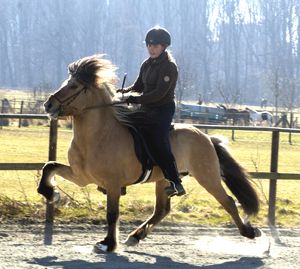 |
| An Icelandic horse’s rapid ambling gait known as the tölt (Wiki) |
There was an ornery jugheaded sorrel Standardbred named Brandy I sometimes rode (I had to get past his teeth to mount him. I didn’t have my own horse at the time, so I got the ones nobody else wanted to ride). Brandy, a retired racing harness horse, heavier than a thoroughbred, must've stood at 18 hands, while Helgar was a mere 12 hands tall. Brandy was no legendary Dan Patch—who never lost a race, but he could really trot. The two horses looked ridiculous earnestly pacing side by side.
Helgar's fierce pacing was very distinct. I can still see him in my mind's eye with his head thrown back, fetlocks flashing out like hairy pistons, matching Brandy stride for stride. However, it wasn’t a comfortable ride, not like being on a Peruvian Paso Fino.
Helgar really had a thick skull, not refined like the modern Welsh pony who might carry an Arabian gene or two—though they had the same ancestor, the extinct Celtic pony, of which, the Exmoor pony is said to be the closest relative. (See also the endangered Iberian Sorraia—with distinctive DNA—ancestor to the Spanish mustang, the Galician, the Garrano/Minho and the Austurcón ponies).
Helgar also had long guard hairs on his fetlocks and jaw, and an unruly mohawk mane —like the prehistoric horses in the Cro-Magnon cave art of Altamira and Lascaux. When winter set in, he looked like a hefty hamster, his coat was so thick—he never adapted to mild California winters.
Helgar's fierce pacing was very distinct. I can still see him in my mind's eye with his head thrown back, fetlocks flashing out like hairy pistons, matching Brandy stride for stride. However, it wasn’t a comfortable ride, not like being on a Peruvian Paso Fino.
Helgar really had a thick skull, not refined like the modern Welsh pony who might carry an Arabian gene or two—though they had the same ancestor, the extinct Celtic pony, of which, the Exmoor pony is said to be the closest relative. (See also the endangered Iberian Sorraia—with distinctive DNA—ancestor to the Spanish mustang, the Galician, the Garrano/Minho and the Austurcón ponies).
Helgar also had long guard hairs on his fetlocks and jaw, and an unruly mohawk mane —like the prehistoric horses in the Cro-Magnon cave art of Altamira and Lascaux. When winter set in, he looked like a hefty hamster, his coat was so thick—he never adapted to mild California winters.
 |
| Cave painting of a dun horse from Lascaux, France ca. 15,000 BC (Upper Paleolithic). Wiki |
Helgar refused to go in a barn or paddock shelter, preferring to stand in the downpour. From beneath a shaggy dun coat, he’d peer our at us with bright beady eyes, rain running right off him. We thought he was a little daft as we got 45 to 60 inches of rain, and frost too. Not like in Iceland, of course, but cold enough to freeze the ground.
Helgar was a summer camp pony, so he was probably picked up at an auction somewhere during the early 1960s. Gregg's Forest Farm Summer Camp leased out their horses to us locals from September until June. Brenda, who lived right below Gregg’s Camp, had first pick. It was always Helgar. When the Fullicks move into in the Sutton's old house on Arroyo Road, I lost my playmate, Pete. My world crumbled. But I gained a good riding friend.
Brenda was a couple of years younger than me and a bit mercurial. But her foster mom, the tall willowy blonde Judy Fullick, who was badly burned in a fire, and my mom were once good friends. I don't remember the story about how Judy got burned, there was a bit of a mystery to it. I do remember that there were two Judys in the Valley, the other Judy was Steve's mom, Judy Tristano. In those day, Pete and Steve were best friends. They wouldn't always play with me because I was a girl but when they went to the treefort up the hill, I traipsed behind them.
Helgar was a summer camp pony, so he was probably picked up at an auction somewhere during the early 1960s. Gregg's Forest Farm Summer Camp leased out their horses to us locals from September until June. Brenda, who lived right below Gregg’s Camp, had first pick. It was always Helgar. When the Fullicks move into in the Sutton's old house on Arroyo Road, I lost my playmate, Pete. My world crumbled. But I gained a good riding friend.
Brenda was a couple of years younger than me and a bit mercurial. But her foster mom, the tall willowy blonde Judy Fullick, who was badly burned in a fire, and my mom were once good friends. I don't remember the story about how Judy got burned, there was a bit of a mystery to it. I do remember that there were two Judys in the Valley, the other Judy was Steve's mom, Judy Tristano. In those day, Pete and Steve were best friends. They wouldn't always play with me because I was a girl but when they went to the treefort up the hill, I traipsed behind them.
I ignored Brenda (who was younger than me) for ages, but my enduring love of horses led me down many diverse roads. Brenda and I became friends, united by our love of horses. She was somebody to ride with. Each fall, Brenda always got Helgar from Forest Farm Camp, so he was her de facto horse, except for during the summer months when inner city kids rode him—or tried to.
Helgar got a kick out of bucking those city slickers off, so come September, Brenda had to show him who was boss all over again. His buck, more like a rocking horse than a bronco’s, was all for show. I suspected his bouts with precipices were also for show. He was some kind of pony. A real wing borrower.
Subscribe to:
Posts (Atom)

