Showing posts with label Epona. Show all posts

Monday, September 9, 2019

Kiger mustangs carry rare Iberian Sorraia mtDNA


A chalk drawing on a broken school desk I made for an art show.

Someone posted on Facebook a photo of dun-colored Kiger mustangs, a horse that carries a rare mtDNA recessive dun-color gene from Iberia, and I fell down the Google rabbithole. I noted the phenotype was similar to the endangered Iberian horses related to the Gallego, and Sorraia breeds. The Southeastern Oregon Kiger mustangs were originally flagged as being unusual because of their dun coloring. Instead of shooting the mustangs for dogfood, someone thought to sequence their mDNA. So, being a horse of a different color literally saved a rare genetic pool from extinction.

BLM photo of dun Kiger mustangs in southeastern Oregon

The BLM photos of the Kiger mustangs made me think of the autochthonous, or Neolithic CeltIberian Sorraia (closely related to the Marismeño) horse, also with rare mtDNA markers. Coat coloration was the clue. Horses that are dun colored (a bay, or chestnut dilution gene), or grey-dun grullo (an even rarer black dilution gene—neither roan, nor grey) not only carry a primitive recessive coloration gene, they often have dark faces and points with pangaré markings, body mottling, zebra-striped legs, and dorsal stripes—a primitive dun horse trait similar to those tarpan-like horses represented in paleolithic cave paintings. Their manes and tails are often bi-colored with white guard hairs and black upright manes like that of the feral Polish Konik horse, and the Heck. The wild Przewalski's horse has a solid black upright mane and tail.
Many equines appearing in prehistoric cave paintings such as in Chauvet cave are dun, and several closely related species in the genus Equus show dun characteristics. These include the Przewalski's horse...and an extinct subspecies of horse, the tarpan. —Wiki

Chauvet, Ardèche, France, 31 000 BP —Wiki

Contrary to popular belief, Spanish and Portuguese explorers didn't ship their prized Baroque Andalusian horses to the New World. Instead, they sent primitive native horses on long ocean voyages that lasted two months or more. Hardy and resistant, unlike the valuable blooded horses preferred by the nobility, those diminutive horses captured from the fens and marshes of Portugal, were practically breathatarians, and  could survive the harshest of conditions, and subsist on little food or water.

Paleolithic artwork in Lascaux II, note the horse is pacing, not trotting—Wiki
Because the native ponies weren't valued as blood animals, they also nearly became extinct in both the New and Old Worlds via neglect and distain. The Sorraia was once hunted for food, and the Exmoor ponies of Britain was used for target practice during WWII, they were a source of illegal meat in the cities. During the 1970s, the BLM was infamous for slaughtering entire herds of mustangs for dogfood. And their nearest ancestor, the native American wild horse was probably also hunted to extinction during the Ice Age.

Wednesday, October 23, 2013

With Pointy Shoes & Bells on

                                      —For Adair Lara

Writer Adair Lara asked on Facebook: "How come people declare they will be coming to a party "with bells on"? Derivation?"

Someone lifted an old Yahoo Answers post to answer the origin of "with bells on" was when peddlers roamed the Appalachians selling wares, they traveled silently to avoid Indians, until they reached a settled area. Then they unmuffled the bells around their horses' necks to announce their arrival "with bells on."

And why were the horses wearing bells around their necks?

Well, I just couldn't pass that one up as it was wrong on so many levels. I'd just finished reading a paper on medieval shoes posted by Medievalist.net, so I was all fired up with useless pointy medieval shoe trivia, and nowhere to go dance it off.

The saying that Adair was referring to: "With rings on her fingers and bells on her toes" is from a 1700s nursery rhyme, Ride a Cock Horse to Banbury Cross. How much older the rhyme is, we don't know but nursery rhymes were passed on orally. I discovered that there are several motifs to follow: the role of hobbyhorse, white horse, rings and bells, and music (wherever the rider goes). 

William Wallace Denslow's illustration from1901—Wiki

The 1901 variant is based on this much older version:
Ride a cock horse to Banbury Cross, 
To see an old woman get up on her horse,
Rings on her fingers, and bells at her toes,
And so she makes music wherever she goes."
           —Warwickshire variant, from Gammer Gurtotis Garland (1783)
 Here's another variant (no date, sorry):
Ride a cock-horse to Banbury Cross,
To see a fine lady upon a white horse;
With rings on her fingers and bells on her toes,
She shall have music wherever she goes. 
It's a safe bet to assume the ditty predates the nursery rhyme published in 1744-84. But how far back it goes, nobody knows. (See Roud Folk Song Index # 21143). Some scholars think the words are associated with 11th c. noblewoman Lady Godiva (the horse tax-relief story appears two centuries after her death), or with Queen Elizabeth I, but it could be much older (or not). 

BTW, I know what you're thinking, a cock-horse is a hobbyhorse, a rocking horse, or a dandle horse. (It also could refer to helper horses who pulled  carriages up steep hills. First use, ca. 1541.)

I found this on Yahoo (it sounds spurious):
Queen Elizabeth I of England travelled to Banbury to see the new stone cross. 'With rings on her fingers' relates to the jewellery which would adorn a Queen. 'And bells on her toes' refers to the fashion of attaching bells to the end of the pointed toes of each shoe! Banbury was at the top of a steep hill and a white cock horse (a large stallion) was made available to help pull the carriages up the incline. When the Queen's carriage wheel broke, the Queen mounted a cockhorse to reach the Banbury cross. Her visit was so important that the people decorated the cockhorse with ribbons and bells and provided minstrels to accompany her "she shall have music wherever she goes". The big cross at Banbury was later destroyed by anti-Catholics. (NB: I shortened this piece, so it's not quite a quote).
Another train of thought is that it's an Anglo-Celtic nursery rhyme, merging Anglo-Saxon noblewoman Lady Godiva (gift of God), and Welsh goddess of the crossroads, Rhiannon (divine/great queen). A white horse, white mare, or a milk white steed is also a reference to the Celtic Otherworld (Open House is Oct 31, May 1), as is the symbol of Rhiannon who rode a white mare. A Gaulish Epona (Irish cognate: Macha) reference is embedded. 

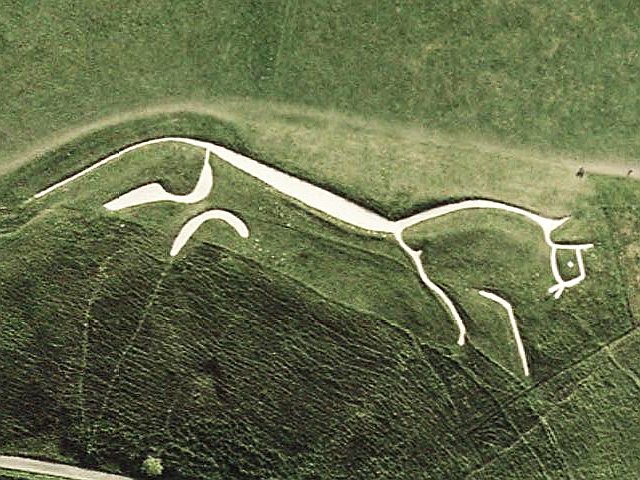
A white mare, a symbol of sovereignty, is a kingmaker because through her, the sacral king marries the sovereignty goddess, or the land itself. Giraldus Cambrensis described a "Celtic ritual, the king mates with a white mare thought to embody the goddess of sovereignty."—Wiki The millennia older Bronze Age white chalk horse of Uffington was also embedded in the folk memory of southern England.

The Bronze Age white horse of Uffington, on the Berkshire Downs in southern England, ca. 1400 BC.

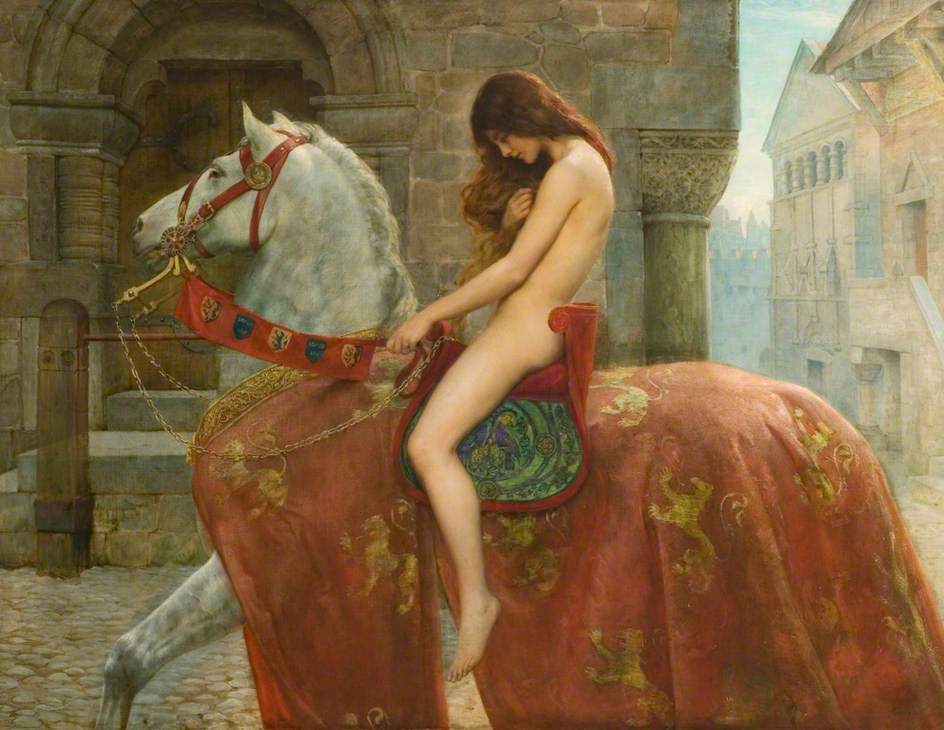
It's been suggested that Rhiannon is the archetype for Lady Godiva, and the nursery rhyme is about Lady Godiva. If Lady Godiva rode through Coventry town on a cock-horse buck-ass naked, where would she have hung her bells? Detail. Not buying it.

Lady Godiva by John Collierc.1897, note the white horse.—Wiki

To finish Rhiannon's story, though betrothed to Gwawl of Annwyn, Rhiannon married Pwyll, Lord of Dyved; at their wedding feast, she turned the jilted conniving Gwawl into a badger, and Pwyll bagged it—and thus, badger in the bag was born. There will be blood! Rhiannon was framed for her babe's murder, and forced to stand at the city gates wearing an asses' collar, proclaim to all that she killed her son, and carry visitors on her back like a horse into the keep. Throughout all the Welsh tales halo of birds is Rhiannin's enduring motif.
Ride a cock horse to Banbury Cross (or Coventry)
To see a fine Lady ride on a white horse
With birds as her halo and bells on her toes,
She will/shall have music wherever she goes.  
Note a distinction is made between She shall, or will have music versus She shall make music. Sorry, no date on this one either.

Banbury, Banna's 5th c. Saxon stockade in Oxfordshire, was built atop a 200 BC Iron Age fort at an ancient crossroads; it was the site of a battlefield between Anglo-Saxons and Britons in 556 AD.
The name Banbury derives from "Banna", a Saxon chieftain built a stockade in the 6th century (or Ban(n)a possibly a byname meaning ‘felon’, ‘murderer’, and "burgh" or settlement. The Saxon spelling was Banesbyrig. The name appears as "Banesberie" in Domesday Book. Another known spelling was 'Banesebury' in Medieval times.
Fittingly, Banbury has a Hobby Horse Festival. Hobby horses have a deep Epona connection, and in Wales, Cornwall and Somerset, they are associated with May Day, and Bealtaine celebrations (later moved to Christmas / New Year); Mummers PlaysMari Lwyd, and the Morris dance. Aka morisk, moreys, morisse daunce, it may mean a Moorish dance. But that may be a convenient assumption. First documentation in 1448 was a bill for seven schillings. There were definitely lots of bells on the Morris dancers' shanks' mares (shins). )

Welsh Mari Lwyd with Christmas ornaments for eyes.

Maybe the origin of the phrase With birds as her halo came from the Mabinogion recorded in the White Book of Rhydderch (scribed ca.1350, but from the 11th century), but I cannot find a reference to rings on her fingers, and bells on her toes in English translations. I did find this lovely line: "The birds of Rhiannon, they that wake the dead, and lull the living to sleep…"

Did the idea cross the Welsh border and enter into English? Lady Charlotte Guest's translation of the Mabinogion was published in 1877. Or is the line solely an English provenance? The English phrase is attested in English in 1745. Rhiannon's halo of magical birds of music didn't make an appearance in that edition, but the line with rings on her fingers and bells on her toes has managed to remain intact in English for at least 275 years. Maybe longer—though the wording is modern. It may be two different traditions merging.

How would an Elizabethan have said the phrase, or someone from the Middle Ages? (Surely they wouldn't refer to Elizabeth I, or Lady Godiva as old ladies!)  When does the phrase With rings on her fingers and bells on her toes enter into our language banks? The terminus ante quem question still begs and I'm far too lazy to drag my old bones to the musty basement of UC Berkeley's Doe Library, or Kroeber Folklore archives, to look up the rhyme like my folklore professor, Alan Dundes would expect of me. Maybe someday.

     *     *     *

Tuesday, May 29, 2007

Helgar the Horrible

Hliods bid ek allar helgar kindir,
Listen to me all sacred people,
—from “The Poetic Edda”

Brenda Fullick’s dun-colored Icelandic pony, Helgar the Horrible, was unlike the other horses. He wasn't wily as my bandit Shetlands, dubbed the “Little Shytes” by irate neighbors, as there wasn’t a fence made that could contain the ponies. Nor was he prissy like the dainty Welsh ponies pretending to be grown-up horses at a gymkhana, their manes in need of imaginary smoothing.

Helgar was more akin to the dour donkeys—but the similarities ended with the dorsal stripes. Helgar didn't carry a grudge the way they did. Bent on carrot revenge, one donkey named Joshua, clamped down on my finger like a bulldog as I flailed on her forehead with my free hand. Luckily I had strong bones.

Helgar was an anomaly. How an Icelandic pony, descendent of Viking horses, came to northern California in the early 1960s, was an enigma. He couldn’t tell us his story. He was alone in a strange land, no kindred herd to cling to.

One quirk offered a faint clue to Helgar’s mysterious past, he was afraid of water tanks. Once he slammed Brenda against a redwood wine vat full of spring water. It resounded like a huge drum. The tank must have reminded him of rough seas. Unlike Leif Ericksson, who sailed to America in an open longship, maybe Helgar was imprisoned inside the belly of a freighter on that long dark voyage from Iceland.

If we offered Helgar a ladle-full of water, he’d rear up, with eyes rolled up inside his head, like a rabid dog at the sight of water. But he ferociously crossed streams and attacked his feed trough, a cast-iron bathtub, with impunity. Our tuna fish sandwiches were fair game as well.

This Icelandic pony was thick-headed—both metaphorically and literally. Physics wasn't his strong suit. Sometimes his brakes didn't work quite right. Hence the moniker, “Helgar the Horrible” (after Hägar, a Viking cartoon character). Helgar was otherwise very sweet.

Brenda was more than willing to trade mounts after he skidded off an embankment or two, or when he ran into the side of a barn that materialized out of nowhere. Why he was named after Hägar's wife, Helga, we'll never know. If the name Helgar is from Old Norse heilagr, a girl's name meaning the “holy, or blessed one”, then Helgar was a holy terror. Riding Helgar was a baptism by fire: we all rode him with a wing and a prayer.

Poor Helgar was an exile seeking companionship among Shetlands, donkeys and calves, he really didn’t like horses. We grew up with a circus collection of ungulates including a plains bison, (we called them buffalo), who peacefully grazed with the Holsteins in front of the Nicasio church—until some dimestore cowboy shot him one hopped-up Saturday night. Or at least that’s how the story went down in our circles. Wildfire gossip. She probably died of old age.

Rancher Mr. Nunes got another bison calf and fed him loaves of dry French bread, Nickel looked like a woolly version of Winston Churchill, replete with cigar. (Old American nickels had an imprint of a bison on one side with an Indian on the obverse side.) Nickel was a gentle, if massive presence, grazing on the slopes of Mt. Barnabe with the Herefords and Holsteins.

Helgar was fleet-footed—except for whenever he had a momentary lapse with physics. He could manage a spanking trot along the thinnest of goat tracks as if it were a groomed bridal path. He never needed shoeing, his hard hooves were like flint. We could ride him all day long and he would never tire, no matter how steep the terrain.

At daybreak, we’d traverse along the steep coastal ridges of West Marin, north of San Francisco, from Tomales to Bay, to Bolinas Ridge, or the slopes of Mt. Tamalpais, “the Sleeping Lady”—all were a good day’s ride from home. Helgar was a tank, he always wanted to be first to climb to the top of a peak. He was like a kid playing “King of the mountain.”

Occasionally the stunted bull calf, Mr. Smitts, tagged along. (We called him Mr. Smitts because he was smitten by the Shetlands. They were exactly his size). He didn't know he was bovine which was downright embarrassing in spring when his hormones began to rise. At an inopportune moment, he’d roll his eyes up and hop up right behind us, lowing and drooling; we were more in danger of being impaled in the back by his budding horns (and libido) than by getting lost.

Mr. Smitts kept his distance from Helgar who gave him a swift, well planted kick if he ventured too near. We often rode back from our adventures in darkness, sometimes under a full moon, the ponies always knew the way home.

When it came to speed, Helgar preferred to amble or trot, he had at least three gears, and he could trot almost as fast as a cantering thoroughbred. But it was like riding a jackhammer. We would sing, our voices revving “uh-uh-uh” like a car ignition, in time with his vigorous gait.

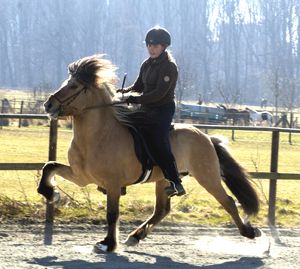
It was nearly impossible to get Helgar to canter or gallop (drumming our heels into his felted side was useless). At best it was a rough valhopp—with one end of the horse cantering and the other end trotting. If we were lucky, he would break into a high-stepping tölt (a smooth running gait), or a flugskeið, (flying pace) and when the horses left him in the dust, he'd come up from behind, all worried, nostrils flaring, as if to say, “Hey, what’s the big rush?”

An Icelandic horse’s rapid ambling gait known as the tölt (Wiki)

There was an ornery jugheaded sorrel Standardbred named Brandy I sometimes rode (I had to get past his teeth to mount him. I didn’t have my own horse at the time, so I got the ones nobody else wanted to ride). Brandy, a retired racing harness horse, heavier than a thoroughbred, must've stood at 18 hands, while Helgar was a mere 12 hands tall. Brandy was no legendary Dan Patch—who never lost a race, but he could really trot. The two horses looked ridiculous earnestly pacing side by side.

Helgar's fierce pacing was very distinct. I can still see him in my mind's eye with his head thrown back, fetlocks flashing out like hairy pistons, matching Brandy stride for stride. However, it wasn’t a comfortable ride, not like being on a Peruvian Paso Fino.

Helgar really had a thick skull, not refined like the modern Welsh pony who might carry an Arabian gene or two—though they had the same ancestor, the extinct Celtic pony, of which, the Exmoor pony is said to be the closest relative. (See also the endangered Iberian Sorraia—with distinctive DNA—ancestor to the Spanish mustang, the Galician, the Garrano/Minho and the Austurcón ponies).

Helgar also had long guard hairs on his fetlocks and jaw, and an unruly mohawk mane —like the prehistoric horses in the Cro-Magnon cave art of Altamira and Lascaux. When winter set in, he looked like a hefty hamster, his coat was so thick—he never adapted to mild California winters.

Cave painting of a dun horse from LascauxFrance ca. 15,000 BC (Upper Paleolithic). Wiki

Helgar refused to go in a barn or paddock shelter, preferring to stand in the downpour. From beneath a shaggy dun coat, he’d peer our at us with bright beady eyes, rain running right off him. We thought he was a little daft as we got 45 to 60 inches of rain, and frost too. Not like in Iceland, of course, but cold enough to freeze the ground.

Helgar was a summer camp pony, so he was probably picked up at an auction somewhere during the early 1960s. Gregg's Forest Farm Summer Camp leased out their horses to us locals from September until June. Brenda, who lived right below Gregg’s Camp, had first pick. It was always Helgar. When the Fullicks move into in the Sutton's old house on Arroyo Road, I lost my playmate, Pete. My world crumbled. But I gained a good riding friend.

Brenda was a couple of years younger than me and a bit mercurial. But her foster mom, the tall willowy blonde Judy Fullick, who was badly burned in a fire, and my mom were once good friends. I don't remember the story about how Judy got burned, there was a bit of a mystery to it. I do remember that there were two Judys in the Valley, the other Judy was Steve's mom, Judy Tristano. In those day, Pete and Steve were best friends. They wouldn't always play with me because I was a girl but when they went to the treefort up the hill, I traipsed behind them.

I ignored Brenda (who was younger than me) for ages, but my enduring love of horses led me down many diverse roads. Brenda and I became friends, united by our love of horses. She was somebody to ride with. Each fall, Brenda always got Helgar from Forest Farm Camp, so he was her de facto horse, except for during the summer months when inner city kids rode him—or tried to.

Helgar got a kick out of bucking those city slickers off, so come September, Brenda had to show him who was boss all over again. His buck, more like a rocking horse than a bronco’s, was all for show. I suspected his bouts with precipices were also for show. He was some kind of pony. A real wing borrower.