Showing posts with label Leonard Matlovich. Show all posts

Tuesday, December 29, 2009

Missing Leonard Matlovich


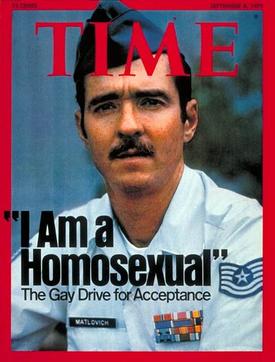
September 8, 1975, issue of Time magazine
When I was in the military, they gave me a medal for killing two men and a discharge for loving one.—Leonard Matlovich, Vietnam Veteran (1943-1988)
Vietnam war veteran and Purple Heart recipient wounded in Da Nang, USAF pilot, Sgt. Leonard Matolvitch was the first gay man in the military to come out of the closet. In 1975, he was discharged for being "unfit for service" he was gay. He made the cover of Time Magazine.

Guerneville writer, Randy Shilts, in Conduct Unbecoming: Gays and Lesbians in the US Military, wrote: "It marked the first time the young gay movement had made the cover of a major newsweekly. To a movement still struggling for legitimacy, the event was a major turning point."

Leonard sued for reinstatement, but the court case dragged on until 1980, the military refused to reinstate him, but offered him a lump sum of $160,000 for back pay and his pension. He took the money and ran, and in 1981, he moved to Gurerneville, on the Russian River, an up-and-coming gay mecca.

Leonard was also a big patron of poetry, I used to produce poetry readings at his Stumptown Annie's Pizza Parlour in Guerneville, ca. 1983, he sold the place in Jan., 1984.)  Bobby Kaufman was on The River in those days—pretty strung out but Leonard was always a gracious host. In his honey-sweet Savannah drawl, Leonard once told me that J Edgar Hoover was a cross-dresser! Things like that.

Stumptown Annie’s 

In 1984, AIDS had reared its ugly head on the river. He sold Stumptown Annie's, and moved to Paris, while visiting the graves of lovers Gertrude Stein and Alice B. Toklas and  Oscar Wilde, he got the idea to create an AIDS memorial.

He moved back to the Castro District, in San Francisco, where he sold Ford cars. In 1986, a nasty chest cold was confirmed as AIDS. He became a champion for HIV/AIDS research, when he came out on Good Morning America that he was HIV positive, we were devastated.

On the steps of the California State Capitol during the March on Sacramento for Gay and Lesbian Rights, on May 7, 1988, Leonard made his final appearance:
...And I want you to look at the flag, our rainbow flag, and I want you to look at it with pride in your heart, because we too have a dream. And what is our dream? Ours is more than an American dream. It's a universal dream. Because in South Africa, we're black and white, and in Northern Ireland, we're Protestant and Catholic, and in Israel we're Jew and Muslim. And our mission is to reach out and teach people to love, and not to hate. And you know the reality of the situation is that before we as an individual meet, the only thing we have in common is our sexuality. And in the AIDS crisis - and I have AIDS - and in the AIDS crisis, if there is any one word that describes our community's reaction to AIDS, that word is love, love, love.
Less than a month before his 45th birthday, on June 22, 1988, Leonard died of complications from AIDS, in LA, beneath a large photo of Martin Luther King, Jr. Ironic that Leonard's tombstone at Congressional Cemetery in Washington, D.C., is in the same row as that old cross-dresser, FBI Director J. Edgar Hoover. Leonard's grave is a LGBT tourist attraction, and has become a de facto AIDS memorial site.

I miss you Leonard. Thank you for coming out so others could too. It was a very brave thing to do.

rev. 12/17/17

Monday, April 30, 2007

The Soul of a Poet, Bob Kaufman

I first met the Beat poet Bobby Kaufman when I was a child. Bobby coined that word, "Beatnik," and SF Chronicle columnist Herb Caen made the word famous. My mother was a Beatnik artist and actress, always bringing strange people with cars home—for the ride.

We lived out in the wilds of West Marin in Forest Knolls with my grandmother, and if you missed the one commute Greyhound bus, you had to thumb a lift. So, I met all kinds of stranger folks (it was the '60s). Most of them I don't remember, but I'd never met a poet before. A black man that that. I only remember Bobby Kaufman's presence—we always called him Bobby, not Bob. I liked the way it rolled off the tongue. Filled the mouth and lips with a syncopated rhythm. I am sorry to say, there were no awe-inspiring conversations to record. Just his soft-spoken presence.

I remember the way he tilted his head like a crow, looking up our mountain, and the tall trees—as if in awe. You could see that he moved in a alien landscape, the City streets was his particular jungle. We stood outside leaning on the car as he drank in the West Marin landscape: tawny hills, dark oak and pine, sizzling crickets. I was pretty young and not much of a conversationalist so we just stood there—drinking it in.

*          *           *
In 1983, Bobby moved to the river and attended our Russian River Writers’ Guild weekly reading series, where I was a coordinator. He'd stand up at Open Mike (we were at Leonard Matlovich’s pizza place, Stumptown Annie's) and when Bobby would quote long passages from poems like the Abonomist Manifesto, it left me completely in awe.

I was never too sure how much Bobby Kaufman was taking in, he was pretty far along in terminal burnout, the emphysema, the long distance toll of drugs coming home—but one could still see something within him burning still. The soul of a poet to the end. That image stayed with me.

The impetus of my poem, Mantle, is the results of two separate events converging on the page. One night, I was walking to my car from the BART station through Berkeley Park and I felt some presence following me. I saw Bobby sitting and reaching up to me in every darkened doorway from Martin Luther King Drive to John Oliver Simon's house on California Street, I spun around but there was no one there. The streets were empty. I couldn’t shake the feeling I was being followed. Or haunted. And Bobby Kaufman was heavy on my mind.

It was a week before I heard the news that he died, it was after the Challenger Space Shuttle had just blown up. The two events were synchronistically linked in my mind. I was teaching poetry at Mark West School, in Santa Rosa.

I was standing in the parking lot gathering art supplies for our pocket poem project. I was compelled to look up in the sky, From the corner of my eye, I saw something explode in the sky. It was like a large moon snail or a spaceship. I stared up at it in horror—not knowing what it was, but I knew it was bad, very bad indeed.

I looked up again. But there was nothing there. I wiped my eyes as if to clear my vision. It was just my wild imagination and a vast blue sky in want of a cloudy formation. Then the news came: the Challenger had just blown up. We were all stunned. Christa McAulliff was a cultural icon at our school. We all cried. The kids gathered around me like petals to a flower.

My poem, Mantle, became an open letter to the sky, an elegy to the memory of Bobby Kaufman and to the members of the Challenger Space Shuttle. The day I wrote the poem, I was with Rubén Martínez, a Chicano poet visiting from LA, my then boyfriend John Oliver Simon, and San Francisco's Beat Poet Laureate, Jack Hirschman—we were all sitting around the table knocking back caffe lattes at the Cafe Trieste in San Francisco. I recorded the date in my journal—it was Feb. 2nd, 1986.

I'd had a disturbingly long dream the night before where I was carrying rain across the night sky in rusted buckets, but it wasn't rain, it was the stars. We were talking of communism and of Latin America and all I could hear was the insistent voice of this poem coming through, seeking audience. I furiously scribbled something in my journal. Jack asked me to read it. I was stricken. Raw footage. I read it, Jack mused, and said, "Hmmm, a real poet, you're a real poet."  That was a real compliment—coming from Jack.

© 2007 Maureen Hurley