Thursday, January 8, 1987

Making a white heart for SSU Art from the Heart show (journal)


White on white, a map of the heart. For the Sonoma State University's Art from the Heart Valentine show, I made a piece of art on Morillo board, a papier-mâché heart on a sheet of paper, a heart cast from paper pulp. I added a section of urchin shell, a spotted guinea fowl's feather, some silk from a dead grandmother's shawl, and fragile coral from the Bahamas.

This is what the viewer sees. What I see: a break up of a seven-year relationship, too many belongings stored under my damp house, an accident, my whiplash, a long slow recovery, and an unusually wet winter – not a passage of time. But flooding stole memory from me.

It took me another seven years to heal before I could confront the loss of my possessions. Negatives without emulsion, glued photographs of random color and shape, this once was Yosemite. This once was a photo of my horse, my cats, me as a child, my friends. Imagine 20 years of documentation of childhood. Gone. My first books, Bambi's Children, books of fairytales illustrated by Arthur Rackham, and Kay Nielsen, The Bobbsey Twins, and The X Bar X boys, an outdoor girls' adventures series, all rotted to pulp.

All my art books. Dali's gold foil candy covered book with drooping watches glued together, now a large rotting laminated piece of cardboard. Janson's History of Art is now a gray pulpy mass. I won't miss that book. Or Mr. Johanson who insisted that we read it cover to cover. He hadn't updated his teaching skills in 50 years.

I mourn for my Encyclopedia of Natural History book with its lists of all the plants and animals of North America, now gone. I spent hours poring over that book as a child. Rereading each section over and over, collecting feathers, fur bits, chipmunk tails (the cats brought in), etc., to augment the hokey illustrations, now barely recognizable. A painful loss. How I loved those books! That one really really shaped my childhood interest in plants and animals.

I saw my very first coatimundi in the Yucatan, which we promptly ran over in our rental car, a rare jungle animal. And we ran over it. Whoops! John said, it was his time. I first learned of coatimundi from that book. The Spanish word is tejón, foes that mean there once were coatis roaming Tejon Pass? Probably not, as it means badger.


My horse's pedigree fell out of the back of the truck as I headed for the dump, taking what was left of my recorded memories of childhood with it. A pamphlet on the US equestrian team, and the Olympics in Mexico City fluttered to the ground.

As a child I fantasized about going to Mexico City. I read up Tenochtitlán and of the canals of Xochimilco, the floating islands. I was going to get there and visit the Museum of Anthropology too. Someday. I was.

Well it finally happened, I did get to Mexico City. You still can see some of the canals and the standing patches of water, but most of the lake bed is filled with cement. The temples have been torn down. I walk on paving stones that once were part of Tenochtitlan. The basilica of the church is made of ancient dressed stone. Tenochtitlán lives in the hidden hearts of stone. The lake lives beneath the city. You can see glimpses of it beneath the sewer grating on the streets. the ancient sure hidden in those cavernous depths.

How can I put all this in that white pulp slurry of a heart? Old art folders, once full of pristine watercolor paper, mildewed and rotted with age. I shredded the rag paper and bleached it . I used the pulp to make valentines of white handmade paper. Who will noticed that there are shreds of fine silk from Bob's grandmother's shawl?

When we got to Oxnard to visit Bob's grandmother, she was so excited that she had a heart attack, and died soon after. We were devastated. I know that Bob's father somehow blamed us for it. He was that kind of man. Hard to believe his mother was so loving. A bon vivant who knew Diego Rivera, and once showed us a mock-up of a mural he was painting.

When Bob left me, the shawl was one of the few things he didn't take with him. Probably because it was rotted at the time, like him, the decay from within. I used it as a beautiful curtain that let the sunlight in but blocked out peering eyes. The cross-sections of pale blue ribbon silk against sheer gauze, and a hand-knotted fringe. Someone said it was a bar mitzvah shaw. Hidden Judaism in the most WASPish of families, there was even a menorah in the closet. Her husband was Dalmatian, and what else? The story is lost forever.

Someone bought the heart at the art auction, I don't know who, I have no photos of it. Somehow it's fitting, since it was made of lost things from the past. Nostalgia tinted with pain of things lost forever, except for a glancing blow in this writing.

Wednesday, January 7, 1987

Baja Journal from the Air: revisiting the past, ruminating on photography and art


1/17 Remembering the past, exploits, from the air.... these second-hand memories, once removed, like unfamiliar second cousins.

I sit in my bed remembering an airplane ride, which in turn, reminded me of three previous trips. Memory within memory within memory—everything reshaping to fit the current turn of events. Reality vs. memory.

As I write about this, what is real? What becomes the synthesis for my poetry? Or my art? When I can record so little during the actual experience? I am so absorbed, so involved in the new experiences, it leaves little time for reflection, and recording of observation.

Even my photography falls off the wagon. At least I do it, but I forget to use the tools. Also, a part of me doesn't want to disrupt the absorption process with the intrusion of my camera.

Behind the camera, I become an organ, sensing only light and shape. I lose contact with where I am and what I'm doing.

At the Museum of Anthropology in Mexico City, after I'd shot a roll of B&W kid shots for John's book, I said I wanted to go back in to see the Mayan exhibit. John said, "But we've been in the Mayan exhibit for the past 20 minutes!"

POP! ZIP! A strange scrambling of perception as I take a few minutes to refocus on my surroundings. Oh. Of course.

To photograph, sometimes my other senses retreat. My eye, the part of the brain that sees shape and light comes forward, becomes dominant. Nothing else exists. Speech is laborious. Exhaustion falls off. The world exists only in a dimension of light, shadows and shape. I am always dazed, and somewhat exhausted after an hour of shooting. It is so intensely absorbing. Utterly so.

I believe the Indians who said that he camera takes a little bit of their soul. It takes something of the photographer's soul too.

I did some charcoal pastel drawings of an Edward Curtis print of an Indian holding up a buffalo (bison) skull to the sky. In the second drawing he holds a box camera up. In the third drawing, he becomes the buffalo with the camera.

And in the fourth drawing, he becomes a shape in contrasting colors. Red and green, like a color negative. Horribly naive drawings. The four pieces are not particularly successful as far as art goes, but I like the idea that spurred me to do it. I destroy them. Baby and bathwater. The art is a byproduct of the experience, a symbol of the thought process.

Sometimes it takes on more, or other meanings beyond the original intent. But for the most part, the finished product is only the tip of the iceberg. What leads me to art is a long, and complicated process. A jumble of memories, conflicting sentiments, and ideas pour into a piece.

When a piece is completed it takes on a life of its own. All that underwater ice. The subconscious, if you will, is no longer relevant, or important. Ghostlike, it's both there, and not there.

added 9/17

Baja Journal from the air: Bahía Concepción from the air


Bahía Concepción from the air. I can make out Sanispac Point where John Ford lives. I saw his tall daughter, Angelica, watching us as she walked along the shore in a long white peasant dress, as we desperately rowed against the afternoon wind from Lighthouse Island.

How foolish we were to go so far out, and then to not leave the island before the afternoon winds arose. We took turns in the water, using our fins to propel our raft. We made it to the lee side of Sanispac, but offshore winds made rowing impossible. I waded among the boulders towing the raft. The sharp coral punctured my diving booties.

Someone in a boat gave us a tow to shore that last half mile, thank god. We could've done it on our own. We'd made it through the worst part, but we were cold and exhausted.

From the air I can make out Lighthouse Island—a fair distance to row against the wind and current in a small leaking rubber boat. In hindsight, I am impressed by our past exploits and our sheer foolhardiness.


added 9/17

Baja Journal from the air: Lagunas Hanson, Salada, & the Salton Sea


Baja—flying up the peninsula. I am struck by the geologic nakedness of the land. It's as if someone had peeled the skin back to reveal a layer of muscle and tissue and bone beneath. Erosion. Etched canyons on smooth mesas. 

Vulcanism. Perfect craters on top of the mesa. One half of a moon crater casting a perfect shadow behind it. The escarpment, a rift that divides Baja west and east. Sierra de San Pedro Mártir looms, and Picacho del Diablo, pink granite rises straight up 10,000 feet. Cerro del la Cúpula's observatories, like strange fungus.

A misplaced wedge of blue: Laguna Hansen, on top of that flat crest. When we drove in 30 miles on dirt roads—if you can call them roads—and pygmy forests. We never could see more than a few feet ahead of us. And beyond that isolated blue ledge, a piece of sky? A tiny mirror of the sky, the Sea of Cortez.

The shallow basin where the Colorado River enters (negligible), and the seasonal Laguna Salada, an inland sea, ten meters below sea level, is like its twin, the Salton Sea, in the Coachilla Valley. Like the Salton, it comes and it goes.

From the air it's so obviously part of the Sea of Cortez bed. Very little elevation separates Laguna Salada, the Salton Sea, and the Sea of Cortez from each other. Just a little rise of sand dunes, and flat sand bars several miles wide. I imagine how it must've looked before we robbed the mighty Colorado River of its mouth. A vast delta and miles of wetlands. Lagunas reflecting the sky.

Laguna Salada 1984-2016 Laloxtreet, YouTube

These lakes may be man-made in recorded history—when we began tinkering with the Colorado's flow. But these bodies of water have come and gone so many times without our help. All are rifts, from the San Andreas Fault.

The Salton Sea is rising, inundating the houses along the shore. Agricultural runoff from the Imperial Valley. It’s seeking the ancient Lake Cahuilla shoreline. You can see the bathtub ring along the foot of the mountains. The Colorado  River aqueduct burst in 1906, and ran into the dry lake bed for two whole years. But there's also a record of the Salton Sea having water in 1849 as well, with no help from man—meaning Europeans. And of course, the Coachilla Indians claim it always had water. Until the arrival of the white man. There are ancient fish weirs along its archaic shores.

Ditto that for Laguna Salada. Who was around to record it, other than the Coachilla Indians?


Mexico/California: two "manmade" seas straddling the border. They say Laguna Salada is manmade too, and will evaporate within 20 years. It's happening already, the beach resorts no longer fringe the lake. A dock surrounded by sand. We walked out a long way before we could swim.

We swam out to some submerged trees covered with barnacles above the level of the lake water. And we had a lively discussion as to what came first, the barnacle or the tree. The tree, of course. But barnacles? How did they even get here? There is no passage to the Sea of Cortez.

Of course, I'm still trying to grasp the idea of what look like oak trees growing in this barren land, in the first place. Lake or no lake. This was once a wooded valley with vast marshlands.

The Salton Sea, also well below sea level, has become a poisonous wasteland from agricultural runoff. And the New American River drains effluent from Mexicali, on the border, into the US. But the US has something to do with the pollution returned to our shores from the other side of the border. The pharmaceutical companies evading US pollution laws, are on Mexican soil. Exempt.

The politics of land use: only the land suffers.

What we cannot change.

added 9/17

  • NOTE: THIS POST ALONG WITH 12 OTHER POSTS WAS ERRONEOUSLY REMOVED BY BLOGGER FOR VIOLATING COMMUNITY STANDARDS ON 5/14/21. It was reinstated as a draft the next day. I am still pissed off.

Mexico City Journal


1/7 The problem with all this running everywhere is that I never have enough time to sit still and organize my thoughts, let alone, write. John is a compulsive writer. He can't help himself. Couldn't stop writing if his life depended on it, while I have to struggle to align my thoughts in any semblance of order.

A fragment: I am in awe of the Yucatan, the jungle, so familiar, something almost remembered, as if from a pre-cambrian past.


Thursday, January 1, 1987

Mérida Mordida


At the farmers' market, the Ladinos sellers stop harassing us momentarily to admire and to touch my turquoise necklace. Suddenly I had something they wanted. The Mayans revere jade above gold, turquoise was a close second. 

Are we returned to Mérida, our car was gone. Towed? Stolen?

Mérida without baggage. No luggage. Just the clothing on our backs and a few pesos in our pockets. A long story, several trips across the city, and several dollars poorer, we retrieve our rented car from the towing compound.

A Ladino family takes pity on us and gives us a ride from the compound to the fine office on the other side of Mérida, and back to the compound again. Their car too was towed. 

They laugh as John jokes with them in Spanish about grudas, or grutas, meaning mordidas. We get charged six times local rate because we are gringos. They are in their late 40s, with a carful of children. Their fine is much less. They won't accept any money for driving us back and forth. We shake hands and smile. Odd way to meet the local populace. We're cruising around in a huge tanker American car with a bunch of Mayans. 

In line again, we meet a man who had made the unfortunate mistake of being outside his house at 2 AM with his car and trailer, when the police pulled up. When they questioned him, he said he lived there, but they towed his car and trailer anyway, then beat him up and threw him in jail. The fine was high for him too. We all pulled out spare change to help him. Moral: don't park in the streets of Merida or you'll pay la mordida.

Quetzal Feathers, Jaguar Sighting


The pyramids of the Yucatán. We climbed every pyramid we could find. We climbed each temple, counting stairs and breaths, as the year drew to a close. At the stela below the temple of Cobá, an amber ring of copal and melted wax. Candles held vigil beneath the shell pitted limestone stelae. The Mayan hieroglyphs are pitted almost beyond recognition.

A Mayan park ranger in zoris, a whistle about his neck, mounted on a rusted bike, said that a jaguar was killed here for nights ago. We can almost hear the eerie cat cry and the jungle reeks of cat odor.

At Chichén Viejo there are few tourists. It is off the beaten path. In the partially cleared jungle, pale grass like a fur coat, covers the stones. Each mound, a collapsed temple or a hut. Lives lived and lost. Unexcavated.

I'm in the Templo del Falos. I could hear something breathing outside but I was the only one inside. John was away exploring another temple.

I wanted to sit on those wide stone benches 
and touch you. There, and there.
But you pulled away, ever the acetic. 
Your eyes were brimming with desire.


We follow the Mayan path of raised limestone blocks back into the jungle. I hear the breathing of hounds behind me. I feel the presence of eyes upon my back. The whispering grows louder, more intensified as we walk faster.

At the na, a Mayan hut, an oval boat-like thatched wattle and daub hut, we stopped, look down into the dry well. And we took photos but the shutter stuck, and you refused to cross the threshold of the hut a second time.

I am entranced by a small stone idol with indistinct features at the foot of the fire pit. Light ash is still swirling in the air. Remnants of the 20th century, some plastic bags in the rafters, and bottles behind the shack. Someone still uses this hut.

The gods have moved away from Uxmal and Chichén Itzá. They live here in the ruins. I say all this is nonsense. There are no more gods. This is merely rock and sky. Acab Dzib keeps its silence. Obscure writing.

But something is still following us through the jungle. Not tourists, they don't come this far. From a small temple, earlier, we spied a stray group of tourists. They never even saw us. We knew we were alone here. And something was tracking us. We broke into a run, following the curved green wall, the urge to hurry intensifying our need to return to the 20th century.

Something blue catches my eye. I pick up a ragged, broken brilliant feather that turns blue and green then indigo like a peacock feather, that iridescent green. I look at it and realize it is a quetzal feather. No they're extinct in this area my guidebook says. A green bluejay? No too bright. What is this feather doing here? An old feather, part of a Mayan headdress?

The bushes have eyes. We protect ourselves from curses and emerge from behind the nunnery into dazzling light, where sedate groups of tourist randomly snap photographs while we linger on the edge of darkness, the jungle closes in behind just with a snap.

You bow to the darkness, your fingers in lotus position against them like a hex.

In this jungle we are unbound by time. This river of air unfolds clocks and we cross memories and images, interstices. When one path crosses another, we are are unsure of when will be, but not where we are.

I keep imagining mysterious stories in this jungle, of those who hiked along these paths and reemerged years later with wild tales of feathered serpents and stone Chaak Mools turning their heads to watch them pass.


Tourists sit on the raingod Chaak's offering bowl, the one that Chaak Mool holds out begging for a fresh human heart. Instead he gets dozens of large human asses draped on the lip of his offertory bowl. He wears that same half amused expression for centuries on the end. Perhaps those who sat on his stomach will die of heart failure.

There are traces of red ocher embedded in the deep crevices of the statues. Someone is worshiping them still. Polychrome temples, pavilions and statues. Red iron, cinnabar, yellow ocher, chrome green. And that indescribable Maya blue—the sacred color of Chaak, the rain god. The red and black umbers are the most enduring colors of the stucco frescoes and carved walls, are but obscure traces of what once was here.

We count steps on the pyramid: 91 steps times four sides equals 364, and the top step equals one year. The Mayans still paint unlucky people blue but no longer throw them down the well or into the cenote.

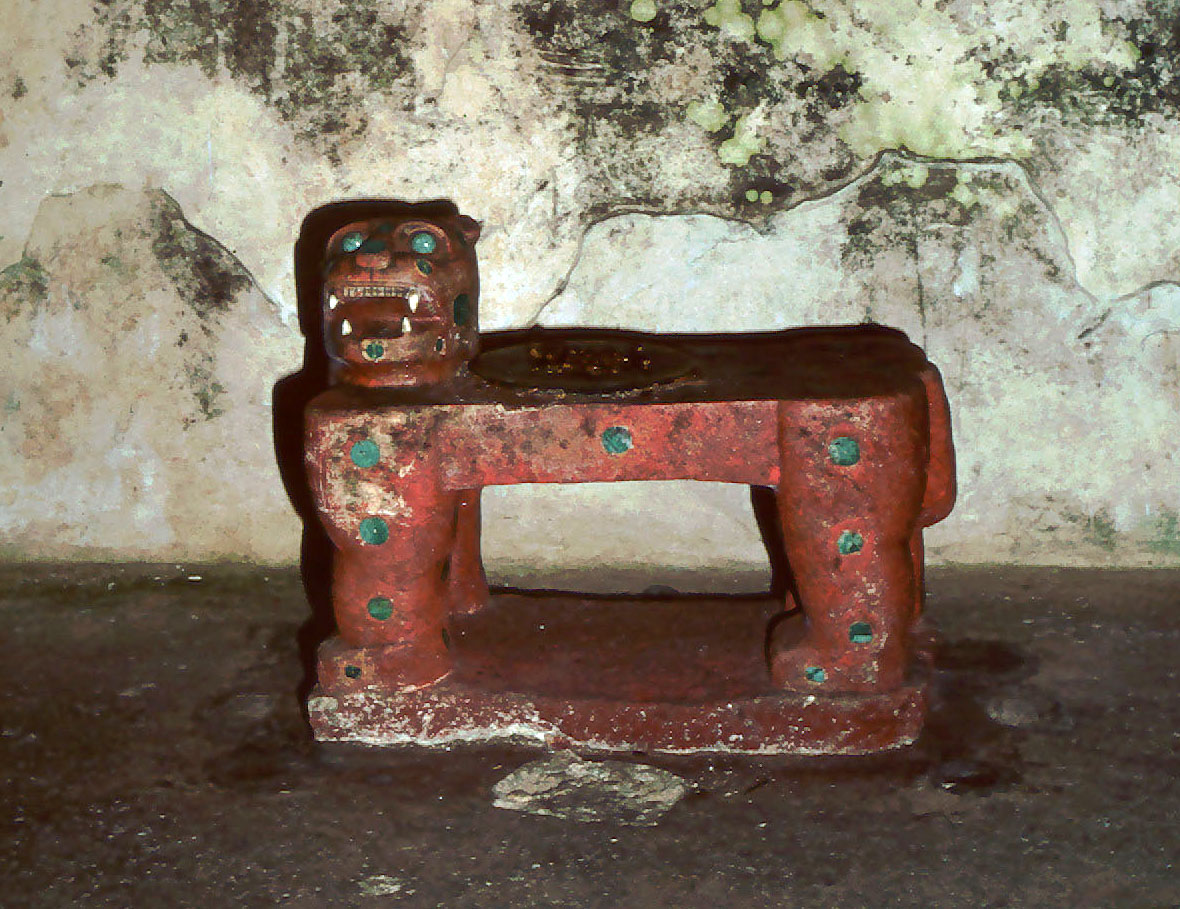
Underneath El Castillo, the tallest pyramid of each city is called El Castillo, there's usually a governor's palace and a nunnery. Whether these titular roles actually existed as such as another matter—this is what they are called. Inside the Castillo is another temple, and inside that temple is the throne of the red jaguar with jade eyes. Like infinity looking in on itself.

Trono de Jaguar en El Castillo, Chichen Itza.

RACING DARKNESS


We glimpsed our first Coatimundi in the Yucatán,
which we promptly ran over with our rental car.
A rare jungle animal. And we ran it down.
His black and white tail with its warning stripes,
was useless against nervous gringos racing the darkness.
Whoops! said John, I guess it was his time.

Late Dec., or early Jan., 1987 (written down on 1/7/87—probably on a scrap of paper)
added  & revised 9/17 In Mexico, it is never a good idea to drive after dark.

Wednesday, December 31, 1986

Puffins, Ken Larsen, watercolors


Visiting the Polivka family in Paradise. Their daughter was a friend of Ken Larsen’s. The old folks are gone as is the son who sold Ken the VW squareback I painted. Ken said the family sold  the Paradise house a few years ago. Polivka was an aeronautical engineering who fled Czechoslovakia after WWII.

Below, a study of puffins. Every once and a while, we would get buzzed by puffins blown off course. What those arctic pelagic birds thought of Point Reyes National Seashore is anyone’s guess. My grannie loved watching the puffins when she was a child in Bantry. I did these puffins from photos, I guess. I don’t remember.


Nasturtiums painting

I'm not sure of the date on this watercolor, circa the summer of 1986, or 1987. I had carefully trained these nasturtiums to cover an ugly concrete and rebar wall in John Oliver Simon's back yard. He, not seeing the beauty of my handiwork, tore them all out while he was readying the garden though they were not taking up any garden real estate. I was heartbroken, I salvaged what blossoms I could, and then painted them. Watercolor and gouache.

Nasturtiums 9x12" watercolor & gouache

Pen & ink sketch of John Oliver Simon

Friday, December 26, 1986

Christmas Day, hung over, with a parrot, Mexico City

Canadá 40, Coyoacán:

Burrrrro! Oh, burrrrro! Uh-oh! Aha! Anna? Anna! Yo quiero Coca-Cola.The parrot in the courtyard below keeps shouting and whistling TV slogans. He yells Burrrrro! and Lorrrrro! and repeats his entire repetoire at the top of his lungs. I wonder where the burro is hiding. Inside my head. Oh!

John has gone exploring in Coyacán for breakfast. I'm translating Spanish from a parrot. Hola he says. I'm translating messages from the parrot world. Oh, hangover!

Pan dulce, papaya, jugo, we have breakfast at Jorge's. Every place is closed today, it's Christmas. Last night the entire city partied until dawn. No one told me that Christmas Eve, or La Posada, was an all night affair. 

María Engracía's family was wild. At 3 AM I was utterly exhausted, drunk, ready to sleep under the table, but the night was still young. Her husband Jorge, I liked very much. We spent the evening discussing the Rosetta Stone. I found out later he was an archaeologist. I wish I had known, I have so many burning questions. But oh, my head. El perico dice: ¡Lor-r-r-ro!

Mexico journals
added 9/17

When I later told Jorge Luján, who was staying at his girlfriend Rebbe's flat, the story, he said: You must be imagining things. The neighbors don't have a parrot. ¡Ojala, tengo un dolor grande en mi cabeza!

Christmas en DF, Mexico City

Mexico City fragments: Xochimilco


When I was a child, I fantasized about going to Mexico City. I read up on Tenochtitlán, and the canals of Xochimilco, the floating islands, caught my fancy. I wanted to visit the Museum of Anthropology too. Well I finally did get to Mexico City.

You still can see some of the canals and the standing patches of water, but most of the lakebed of Xochimilco is filled with cement. The temples have been torn down. I walked on paving stones that once were part of Tenochtitlan. The basilica of the church is made of ancient dressed stone. Tenochtitlán still lives in the hidden hearts of stone. 

The underground lake still lives beneath the city. You can see glimpses of it beneath the sewer grating on the streets. The ancient lake is hidden in those cavernous depths.


added, slightly rev. 9/17
Xochimilco, in Nahuatl, is: a place seeded with flowers. Xochitl- flower, -milli- seeded land, and -co place.

Thursday, December 25, 1986

Christmas en DF, Mexico City


December 25, Mexico City.

The transition from one culture to another still takes time. Absorbing this culture, I've been mute. John's friends here are all very special, an anchor I seem to need.

On Linea Dos, riding the tram into the Zócalo, the first day here was mas dificile para mi—for me. The first time I went to Baja, the same thing happened. I was overwhelmed by so many little things. But it is the people who have so little, begging for cambio, for change on every corner—the poverty is so deeply ingrained, it profoundly affects me. I am in tears.

On Linea Dos, a blind Indio with his family sang a beautiful haunting melody and people plinked pesos into his cup. Somehow, it was the timbre of his voice, that sobbing pathos one hears in a song, that brought me to tears. Welcome to DF (pronounced De Effe, for Districto Federal), the dark heart of Mexico City.


Tuesday, December 23, 1986

Winter solstice, Chichén Itzá

Winter Solstice, Chichén Itzá

I'm inside El Caracol, Chichén Itzá, at sunset. During the solstice, light neatly passes through one opening unscathed, with little shadow on the side walls. magic.

Sunlight wraps itself around the walls, illuminating them. I go camera crazy. In the top chamber, I take photos of John with refracted light. He is a sun god.
You have to rock climb in order to get up inside El Caracol. The circular stairway ends 12 feet above the outside hall. A tree trunk beam with carved steps near the opening to the roof offers a way up. John enters the circular stairwell. I climb an outside wall. The distance from the beam to the opening is too far for me to span. I need to try another approach.

From the top of El Caracol, on the observatory, you can enter the stairwell but then you must crawl on hands and knees because the stairs were not meant to be used in the upright position. It's about reverence. I scoot up the steps on my fanny, thus startling some Mexican boys on their way down, not many women come here. It's not an easy journey.

On the top of what's left of El Caracol, there are three slots on the roof, sight-lines for star constellations, the moon and Venus. One wonders what other astronomical observations were made here. The guidebooks place an unusual emphasis on Venus. It seems that Venus is well represented, or the guidebooks are all rather simple.

On top of the outer wall, sections of the roof had caved in, one looks down into the dark heart of El Caracol. And dreams. Time stands still. We will never know what astronomical alignments they marked.

The Yucatán is basically a flat limestone terrace raised a few feet above sea level. To the south, a long line of hills breaks the view. these hills or pu'uc rise less than 360 feet above sea level along the rift that shoved them up. A string of cenotes, or sinkholes, are visible from the air. Round wells in various stages of collapse. Jade green water necklaces strung across the Yucatán.

There are tropical fish in the sacred cenotes of Chichén Itzá, at least 100 miles inland from the sea, and there are no natural rivers here. How did the fish get here? By hurricane? By land, or sea? Where they planted here by Toltecs, or by the Mayans? Or were they trapped here during a hurricane and evolved into freshwater fish?

We hiked to the profane cenote, secular is a more apt word, and the soil gives way. We careen down a steep slope and grab at some trees to stop us. The descent into the cenote is like falling into the jaws of an ant lion's sand trap.

Inside the cenote, we discover an overgrown water temple. The land is riddled with limestone arches and partial caves. Some looked painted. So little has been done here, there is still so much to discover—even at Chichén Itzá.

At Kabáh, we find the keystone arch, the gate to the city, 11 straight miles from Uxmal on a straight, raised Mayan road. Sacabe, or sacabeob, the sacred white roads. There are no cenotes here, the Mayans are entirely dependent upon the vagaries of rain, and the capriciousness of Cha'ac, or Tlaloc in Toltec. Near the temple of the long nosed god, there is an altar to Chacmul with his head turned toward the sun. We eat bitter Mayan oranges from a wild orange tree growing in the rubble of a fallen edifice. Bitter orange, naranja agria, or Su'uts' pak'áal, is a medley of all the citrus flavors of the world. It's also the main ingredient in the chicken, and the cochinita, or puerco pibil dishes indigenous to the region.

Each pueblo strung along the main highway that travels the length of the Yucatán peninsula is like a tiny jewel encapsulating several eras of history. The Na, or traditional Mayan thatched huts stand alongside colonial buildings with their imposing tall double doors, replete with windows that open out into the world.

Topos, speed bumps, steep enough to launch your car like Steve McQueen's famous car chase scene in Bullitt, keep most of the cars at a reasonable pace. Iridescent wild turkeys (Meleagris ocellata) and pigs continually cross the road, along with the ubiquitous chickens.

A small Mayan dog, the tz'i', a delicate hound with soft ears, is seen slinking around nearly everywhere. The Mayans have nine words for dog, whether it was eaten, sacrificed, or raised to the status of a deity. In the Mesoamerican calendar, Itzcuintli, the tenth day is the day of the dog.

The diminutive, well-proportioned Mayans readily smile at you. Women carry buckets of corn to the granary, and  bring buckets of cornmeal back home on their heads. More women weave white huipil shifts, long lace petticoats, and the skinny Mayan shawl that doubles as a head cushion for a heavy-headed load.

Men everywhere on bicycles carry large bundles of wood from the jungle. An older man carries wood on his back, anchored with a forehead strap, the bundle of wood nearly as big as he is. Coatimundis and long-tailed blackbirds hide in the jungle, painted with the brilliant plumage of unnamed birds. Chuckwallas, temple guardians, enjoy their small spot in the sun.

I dreamed of iridescent feathers
falling from the sky
and we raced after them,
collecting their bounty in our arms.
A bouquet of such promise.

12/23/1986
Chichén Itzá
added 9/17
minor revision

Friday, October 31, 1986

2 in class freewrites

I am the star of the sea
Among the waves of the ocean,
longest night,
more than the day,
only sorrow parts the waves.
I am never alone.
Who but I walks the planets.


Son which burns the fire.
Among the stars of the night,
lost in the battle of planets,
more than the breeze
which parts the fire.


In class freewrites found in a teaching folder, no idea as to when—ca. 1986-87. Probably from my CAC grant at Mark West School as that's when I developed the lesson. Around Halloween, as it was in the Song of Amergin folder. Or it could've been around St. Patrick's Day.

Since I'm short of work from 1986, I'll file it there.
added 10/16

Friday, October 24, 1986

Letter from Rosalind Sharpe Wall

Dear Maureen:                      October 24, 1986 (I can’t read much of it)

I was much moved by your poems and their quality – also seeing your picture with that nice young man. I am glad you are seeing something of Micaela. 

My only suggestion in regards to a poetry reading or whatever, is the Carl Cherry Foundation. My friend Jane Wilgevess is no longer the curator, but if you just write the foundation and mention my name to them. I am still Rosalind Sharpe Wall, an accompanying booklet I wrote for them. you will get some sort of answer and I believe their policies have changed somewhat since Jane is no longer heading it, but I am sure they will give you some preference on my account, if none other. 

The address is Cherry Foundation, PO Box 863, Carmel, CA 93921 phone 408-624-749. 

The artistic center is at the Sunset cultural center but I don’t know how to contact them. I will try to find out and write you again.

I am home which is to say, in my home technically, but I don’t get around and don’t generally mind …. Much on account of my physical condition. In addition to advanced emphysema, I am on oxygen, I am crippled and can walk almost not at all. 

But I am busy writing, Maureen, my book on the Big Sur coast. I am rewriting it. When the Coast was Wild and Lonely will be out in January by …  I hope my publisher will be sending you an invitation to the  autograph party at the Thunderbird bookshop. I hope you can come. I … and hope it is a meal of food to … and I hope that my professors at SSU might be able to come. Helen Dunn, Marty Blaze, Gerry Haslam and Jerry Rosen.

I am much interested from… that’s my book was excepted by a house a creative project in lieu of a journal MA thesis in 1984.

In the past two months I have been working on a new version of the New Tarot for the Aquarian Age, but Alice Kent and I do not see eye to eye on it, and although she says she is giving it back over to me, she is retaining control. And I have four other books to write I am a little miffed?…. and I made working in it? a priority. Not … I shall plow on, but I realize it will all come together in the end. … It has been restrictive and depressing to me. But I realize it will all come out alright in the end.

Tell Micaela to show you my story about Bixby creek where I grew up in the Herald which was published September 21. It’s a freelance piece for the Monterey Herald weekend magazine.

I intend to type all after some publ. I will call in the next day or two the Sunset Cultural Center about its programming. Meanwhile go ahead and write to the cherry foundation. As a writer, I have dropped the Wall, after all, I am an ex Mrs. having been divorced for over 30 years so I have reverted back to my maiden name, Rosalind Sharpe. 

Love to you Maureen, 
signed, Rosalind

October 25, 1986 dear Maureen

Have some more info for you. Cherry Hall seats 50 and the charge is $10 per hour but they are open to  negotiation. Phone or write Linda Coppens c/o the Cherry Foundation, same address phone number, call Tuesday through Friday between 9:30 and 4:30 ask for Linda Copppens. 

carpenter carpenter Hall at the Sunset center seats 150. Some thing a address is PO Box 5066, Carmel, CA 93921 phone 408-624-3996 I don’t know what the charges for advanced publicity releases that could be arranged there The Monterey Peninsula herald in the Carmel pinecone PO Box G Carmel but eyes support the cherry foundation and or the carpenter whole arrange the advance publicity releases cherry foundation runs a something enormously schedule cultural events in the Carmel pinecone I don’t know who is crutch in the who is to contact at the Herald but I will find out once you have the cherry foundation and or Carpenter hall or sunset Creek love Rossiland Then she writes on the back of the envelope this is PS I miss addressed a letter to you yesterday but this one contains the info you needed hi

Friday, October 10, 1986

Mexico City after the Quake


The weekend of October 10, John and I steal away from the arts meeting in Pasadena to hear Jack Grapes and Rubén Martínez read at Venice Sculpture Gardens.

Our host, Rubén is distracted, shaken by the earthquake. He withdraws his last $500 out of the bank to fly to El Salvador, the latest earthquake was M7.9. His family, his grandparents—still no word. His parents tell him it's useless to go. But tonight he will leave for Mexico City and then onto El Salvador. I tell him to record the event, to be a journalist as well as a worker and a poet.

I'm reading an article by Rubén in a Santa Cruz paper edited by poet Stephen Kessler, called The Sun. They are repairing the Hotel Monte Carlo where DH Lawrence once lived. We ascend the circular stairway and visit each room with its purity of plaster and dust and paint.

The old church, now a library, leans heavily on the Hotel Monte Carlo. The nine-story parking garage is reduced to three stories. A building across the street is being torn down. Most of the buildings are being repaired. It's harder to see the effects of the earthquake now.

There's a new Zócalo along La Avenida Reforma where a huge high-rise hotel once stood. On the way to the House of Cambio to change our dollars into pesos, we step over healed cracks in the pavement. In some places the earth rose up several several inches. Other places had lateral motion. The curb along the Reforma is displaced by several inches.

Jorge's third story flat has huge cracks running through it, the metal window frames no longer fit. So we tie them close. Life continues.

Earthquakes – Mexico City is still recovering from the September 1985 quake. One year later, it's harder to see the damage. Sometimes I look up and see the torn buildings and I begin to cry. So much gray cement. Where does it all go?

El Salvador. Rubén removes the cement. There will be bodies beneath those ruins. Impromtu tombstones. I'm afraid to leave this article about the earthquakes behind in Mexico City. As if that could remove the damage. Sympathetic magic. So I take the newspaper back to the states.

We live on the San Andreas Fault. When there are earthquakes in Mexico and in El Salvador, Americans say there was so much damage because of the way buildings were constructed there, and laugh with a superior attitude.

Magnitude 7.4 what buildings can withstand that shock? How will San Francisco do any better when the big quake comes? They have no idea how bad the damage can be. When it comes, who will dig them out? Who will bury them?

October 10, 1986
added 9/17

Thursday, September 11, 1986

Poetry Day Dedicated To Bob Kaufman


Poetry Day Dedicated To Bob Kaufman

A day of poetry, dedicated to the late San Francisco poet Bob Kaufman, will be presented on Saturday, Sept. 20, on the Civic Center Plaza stage adjacent to City Hall, as a part of the 40th Annual San Francisco Arts Commission Festival. Admission is free. “Poets Open Mike” will be featured from 10 am. to 12 noon with Tony Feldon, the Vagabond poet as M.C. From noon to 5 p.m. 16 San Francisco poets will read. Eight were selected from 120 poets who entered a juried Arts Commission-sponsored contest and the other poets were chosen to represent the diversity of poetry groups in San Francisco. Among those to read are Francisco Aragon, James Broughton, Lucha Corpi, Jack Hirschman, Maureen Hurley, and Aung Aung Taik.

Thursday, August 7, 1986

RANDOM NOTES FOR A POEM

RANDOM NOTES FOR A POEM

We swam in the cenote,
liquid jade dripped from our lips,
slight salt tang, and tropical fish in the cistern.
A mouse was drawn to the dark chocolate,
could it be tamed? A kangaroo rat
ran over our bags, disturbing our dreams.
Only when we climbed the cliffs
did we find the petroglyphs.
Strange men with raised arms,
rams, and lightning. The sun swirling.

This morning, a raven in the oak tree
outside my window awakened me.
He had a lot to say. With a mixture of joy
and foreboding, I watched how the sun
glistened on his feathers, dark rainbows,
the comforting crock-crock sound
with a reverberation of death—
Those I have known. And the unknown.
Today I found out another friend died.
The eyes of the five kit raccoons
shone like embers as they observed me,
uneasily washing the cat kibble.
They were perplexed when the Frisky's Xes
melted in the water. Xes and Os. Tic-tac-toe.

I followed the tracks of a mountain lion
that circled us as we slept below Pyramid Peak.
The second confirmation in a year,
someone said. I don't know if I'm excited or scared.

I took John to the secret place above the garden
of my grandmothers house, that place I call home,
the resin odor of poison oak and fir greeted us
I showed him the place where a wounded cougar
once stalked my uncle until the report of a rifle
frightened it off.

I have nothing much to say really
just random notes, because it's been too long
since I've written a poem. Or written at all.
The salti-sweetness of milk distracted me,
like snow, or virgin's tears—lachrymosa,
and now I've gone and forgotten the true lines
I was going to write down when dawn broke.

8/7/1986
added 2/17
slight revision

Friday, August 1, 1986

LIGHTING THE ELECTRIC FIRE

       Runners dressed in skins carried embers
       in moss-lined pouches to the next hearth.

        —Jane Walsh Reilly, 1893—1987

In the dark-paneled hall
of my grandmother's house,
mother-of-pearl light switchesó
the kind you push in & out,
resounded like sprung mouse traps
& light flooded the room.
The moment after one pushed in the switch,
wires inside the light bulb glowed red
like embers from earlier fires
to keep back the wolves and the night.

It was the woman's job
to keep the hearth fires lit.
To let it go out was to let death
come into the house,
my grandmother said.

Inside the heart of the light bulb,
between horn-like filaments,
beside the finely-coiled spring,
a smoldering spark from the first hearth
is locked inside because all atoms
are recycled except the ones we've split.

The white hair of my grandmother
as she bends to read
throws off its own aura of light.

8/1986
1992 Green Fuse
        Apostrofe! (in Ukrainian)
1986-88 Falling to Sea Level
1987 Marin Poetry Review
1986 More Than Words, CPITS Anthology

An instant of reproof (corrupt text)

An instant of reproof 
shines in his eyes 
as he takes in all the angles 
which made me show him
that more was possible. 
Mass extinctions, 
a sequence, I said.
I'd try you with some ashes 
taking penetrated                xxxxx
by the labyrinth of sea bears.

August 1986
date?

Tuesday, July 1, 1986

SAILING INTO DARKNESS, ll


SAILING INTO DARKNESS, ll

Maybe it's the way the San Andreas Fault grinds at the coast
or how ropes of sunlight fall on marine haze, or the wind.
Maybe it's the rancher's wife murdered by her husband
who comes to sit among these tombs sprouting small milk teeth
in crooked rows. I hear women whispering inside those trunks
of cypress growing from Manchester to Point Area.
They came here from Canada, Ireland, and Germany,
with high hopes but their dead built cities on this lonely coast.
The wind followed them across oceans, forests and prairies
to the edge of the continent. It licked beneath doors,
between cracks and floorboards, stirring lamp flames
and passion until the air was ablaze.

Like a rotted tooth, a charred headboard with no name
has lost its place in line. Monuments to young girls
spared the grief of motherhood. "Charity is beloved."
Her mother feeling the loss, climbed down to join her.
Piper's mother slipped into the same womb six years later.
Jennie McMullin's twins Paulie and Ellie born and died the same day.
I think, RH negative. Then all the miscarriages.
She quit naming them after that. What more did Samuel want?
At my age, she followed the sixth babe back into earth.
The graveyard dissolves into the silence of blackberries.
Lichen gains a toehold on carved letters.
Mother, beloved father. Infant, unnamed.
How many names for darkness?
The Bishop family, squeezed in four separate plots
between Clays, Munroes and McFarlins--
still search for kin among stones and roots.

If you lie down, snake-like, and listen with your ribs
you can almost hear the earth shift. I say almost--
the way a rattlesnake, blind in summer moult "hears"
with heat sensors and minute vibrations felt through the skin;
strikes blind at anything that comes too close.
Marsh grass whipped into a frenzy catches fire
as sun and sundog slide down the mandarin throat of ocean.
Brazen beauty mark of Venus. Shy, distant Regulus.
Yesterday, Suzanne, who told me the story of the rancher's wife
drove out to the beach. New moon in the old moon's arms.
They found her wearing her best clothes and jewelry--
Not even a note. None of us knew what troubled her.
Tongues of fog lick traces of blue from the sky.
No graves or names to mark the three babies I gave back.
Fingers of wind tangle my hair, invisible ropes tighten,
pulling me toward those gleaming cypress trunks
until the hands of men who planted them are all over me
and cacophony of wind pulls me down into pale earth;
this harvest I never asked for.

1986? or 1987
rev. 6/87,1988, 6/89, 6/91
Garcia River, Point Arena

Notes for SAILING INTO DARKNESS

Blue Horses in the Rain—after Franz Marc

BLUE HORSES IN THE RAIN

A child's watercolor set invited me to the breakfast table of a house perched on the crest of Mount Vider. The Napa Valley, shrouded in fog, barely visible caves, like puncture marks on the ridge opposite. I am a houseguest applying color to pale toast and blank paper. I fill the pages with color and think of Franz Marc's Blue Horses in the Rain. He died very close to Lascaux. Calligraphy of bison before the hunt. Ochre pigment. Hemitite. When a child found the painted caves, at first no one believed her stories of bison and horses running across rock ceiling. Not even her father. Especially her father.

As I paint, a woman silhouetted against the morning sun, comes over and asks me if I always awaken like this. We are both writers. A small flickering arrow in my stomach—and I wonder why I no longer wake with a brush in my hand, tracing a pale yellow wash across the white of morning. I cannot write, the blood clots my pen. The sunlight on her hair blinds me. My father, an absence of light, I am torn between the obsidian darkness of two worlds.

Yesterday, my notebook stumbled down a steep ravine and landed face-down on a branch of poison oak suspended above a creek. My writing saved by poison. On the way back up the ravine, the sound of an oncoming car hurried me and I tore my skirt. I though of the swaddled mummies of Nazca, and the cycle of earlier fires—tree carbon transformed to ink markings on the page. The land is the color of cinnibar and discarded shells.

I can’t shake this aftermath of sleep and the deaths I dream of: those I know, and those of strangers. The night is becoming too crowded. A friend blames the ghosts in my mirrors, there are too many of them. That’s why they come. I am shivering from what I have heard. Someone asks, Are you a mother? This paper becomes a rock wall. I hold my brush poised in the air waiting for the blue horses to come pouring down from the sky.

7/86 & 3/94

Friday, June 27, 1986

WAITING FOR THE STORM

WAITING FOR THE STORM

When a fish swims on an inland sea 
we can go no farther than the nearest shore 
because there are no other shipwrecks 
other than the ones we are on. 
How many shells will it take to build up this reef?
How many palm leaves will it take to calm the wind?
Is there an edge to this wave?
In the rainy season fill all the bathtubs with gin
 and wait for the storm to pass. 

6/27/1986
added 2/17

Notes for SAILING INTO DARKNESS

Notes for SAILING INTO DARKNESS, short .

In the fog, ropes of light
hang from the eucalyptus trees.
The story of the murdered wife 
haunts the cypresses.
The names McNeil, Monroe, 
Casey, the Bishops, the Clays. 
Our baby, unnamed, born 1832, died 1832.
McFarland, so many babies like him followed 
and slept beneath rough carved granite.
Charity is beloved. Mother and daughter 
share a tomb with an infant who came from Canada.
Then they were followed by Pauline and Ellie
and six more babies a year nine months apart.
McMillan, Samuel, and Jeanne, 
someone's daughter, age 10.
The mother slipped in six years later,
unable to withstand the gulf 
of inconsolable distances.
One week old, another, stillborn.
The last one standing
buried them all.

6/27/1986?  
Point Arena
no date, Herb Kohl event?
added /rev. 2/17

OPHELIA'S REFLECTION

OPHELIA'S REFLECTION

She slipped beneath the wheel
as if a carnival of alley music
was captured in a childhood memory
and laundry flapped to the rhythm
of the unwashed years.
Do his blue eyes still reflect the sky?
Brilliant greens of the mallard
glisten in the sun as he dives for food.
Eye spots of sunfish stare up at me
through the murkiness. Intangible hordes.
The surface of the pond supports
the reflection of my weight.
The night green scent of the pond
seduces me in and under:
Ophelia's last dance.

6/27/1986
added 2/17

PORTRAITS

PORTRAITS

Their teeth aren't attached to their heads
They walk softly on wooden legs 
and kneel before each other on hollow knees
They dissolve each other's faces 
and hang them on meat hooks 
carefully saving the eyes for last 
so that they can polish them 
on their chests until they shine 
with malice.

6/27/1986
added 2/17

Thursday, June 26, 1986

FORGETFUL Rilke transliterations

        —after Rilke

I have been a fawn amid the ferns
I won't die when the wind comes
I see her wandering with the darkness
on such a night like this.
The turf is sleeping, saintlike,
and in the morning the road
is still the first pattern of the night
and the stream's answer is not there.
Then waking the storm to let the egrets fly
across the sea and I braid my eyes
so that they will fall like hair into yours
and from that we will drink
and gaze into the broken storm.

6/24/1986

Fragments

When I come to your command
and watch you rise up to meet me
like the boat of evening and we ride
each other's swell until your face
is like an empty mirrored sea
upon which the dragons of memory sleep.

To say come out of darkness for me
for three meals a day: one in heaven,
and two on earth. Bounty.
He wore a lion's helmet: one red as blood.
the other green as grass.

Until we reach four mountain passes
and have nothing but a point of light
to guide us from the darkness,
we will have no more handholds.
Be not afraid because the time that will come
is no different from that of the past.

In my wearied soul
drifting under an inflamed sky
the punishing slickness,
troubling for those among us
who are tired, and for those who follow me.
A fiery hand is goading me onward
under the weight of the nebulous sea.

6/24/1986
The damage was so extensive on the last stanza, I was only able to resurrect one word in five. added, rev. 9/17

Tuesday, June 24, 1986

CPITS retreat, Calistoga 2, drafts

CPITS retreat, Calistoga
6/24/1986 three words per line poem

Three virgin hills,
Islands arising from a deeper blue
where the sea and sky
confuse themselves
with circular distances
and the cloud formation
doesn't just happen to appear
on the horizon
like there was no tomorrow
because today my mind's, a fog,
it's fogged like those sea cliff arches
and no one even knows they're there
but still the wind moans through them
because it's not often one finds a mouth
in such a place as this.
So we go on as they say
this fog to will disappear
with enough heat and pressure
but who's counting keeping counting score?
The Giants won 18 to something
you said in the middle of a conversation.
I feel like leaping from cliff to cliff.
That's about as much logic as we can stand
in a place like this, falling, falling
like snow covered apples,
we tumble into the sea
and float to the horizon
where the sea is returned to blue sky.

6/24/1986
added 2/17
I'm not positive about these dates and this would be Monday/Tuesday vs weekend.

to do:
FORGETFUL
after Rilke

I've been with one fawn with terns. (MISSING TEXT)
Found in a Pages doc

Monday, June 23, 1986

CPITS retreat, Calistoga 1, drafts

CPITS retreat, Calistoga
6/23/1986

Esperaba hasta que alguin pidiera bailar.
She waited for someone to ask her to dance.

The trick is to trap the wild laughter
of the ancestors beneath a fat hill

laughing like fat hills
wild ancestors
trap and trick us
into believing anything.

A stranger knows
how fast lightning
captures the spirit under glass
before we put out the flames.

The magician who travels
to the source knows
the bitter surrender
of the wave to the beach
is central to the struggle.

The resourceful magician who travels
to the center of the earth
will bitterly object
to surrendering
to sand on the beach.

6/23/1986
added 2/17
CPITS retreat, Calistoga, from wordcards?

When the greed of horses
strips the fossils of time
from the checkbook of skeletons,
then go to the carnival of books
where the clown of tears
wears a wedding band of fright
under his shawl of death.
There you will find the mask
of fluttering lies has fallen
from the face of the moon. 

6/23/1986
added 2/17

AFTER ROUSSEAU
Sleeping Gypsy
Ekphrastic poetry

Under a full desert moon
a lion stands guard 
over the sleeping man
dressed in a striped tunic
with a jug and a mandolin at his side

the green sky, like a lake
that feeds the mangrove swamps.

A cold Indian in ceremonial robes
floats on the cloud-studded horizon.

6/23/1986
added 2/17

CPITS retreat, original drafts, missing text

623 1986 CPITS retreat, Calistoga

FOWLISH BEHAVIOR

FOWLISH BEHAVIOR

Why do I say hair?
I say braids, plaited leaves.
Three geese stroll beneath the willow
like it was Sunday in the park.

The hair of the willow drinks from the pond.
Shadows of blackbirds weave and stitch
the clouds to the mirror of water.

The red claw of a dismembered crawdad
no longer pinches the sunlight.
What errant boy did this?
Ducks parade and commute from lawn
to pond and from pond back to the lawn.
Fowlishly nattering on all the while.

6/27/1986
added/rev. 2/17

THE SLEEPING GYPSY, after Rousseau


The Sleeping Gypsy 1897, Henri Rousseau —Wiki

THE SLEEPING GYPSY
La Bohémienne endormie
—after Rousseau 

Under a full desert moon
a lion stands guard 
over a sleeping woman
dressed in a striped tunic
with a jug of wine
and a mandolin at her side.

Her walking stick dreams of snakes.
The Big Dipper holds its water.
The green sky is a lake
feeding the mangrove swamps.

Tonight the lion isn't hungry
because the moonlight is a song 
dressed in ceremonial robes
floating on a star-studded horizon.

6/23/1986
added/rev. 2/17

Sunday, June 22, 1986

AntiChrist Comes in the Form of Invasion (Einstein Sleeps) v.1, draft,

see
AT THE CENTER OF A BIRD'S BACK EINSTEIN SLEEPS

AT THE CENTER OF A BIRD'S BACK EINSTEIN SLEEPS


My aunt says the millennium is at hand.
She strokes my cheek, wants me to believe, be saved,
reunited "upstairs" when the time comes,
while on T.V., a modern-day Elmer Gantry preaches a concoction
   of science and myth—anthropomorphic bible-thumping.
It's the tenth anniversary of Jonestown, Greneda.
I have not received communion since the Vietnam war.
For this, I will spend an unspecified amount of time in purgatory,
my aunt says. But there are graver sins I have committed
which I tell no one. I watch re-runs of Kennedy shot over and over.
After 25 years, grief unfurls anew and I am ten years old again.

The sacred volcanos of Peru and Guatemala are littered with corpses.
In the Peten Itza jungle, near the sacred city of Tikal, saraguato monkeys howl,
making no distinction between exiled guerillas, and the invading army—
Uzis bought with U.S. dollars. AK-47's. In the jungle the Cold War continues.
In the ceiba trees scarlet macaws scream warning to thrumming insects.
Oblivious leaf-cutter ants carve low tunnels through the underbrush.
I never get used to the guns. In the highlands I never saw boys or men—
only women and babies waiting under the volcanic shadows of Atitlán.
On a shining path deep in the Andes, friends carrying medical supplies
are stopped by leftist Sendero Luminoso terrorists on horseback
who let them go when they answer each question right.
Having passed the test, they feel reborn. Their path leads forward still.

Like with Kennedy, I cannot erase or help the blood
of lawyer Manuel Febres-Flores migrating to the sea.
My Peruvian friend said don't look, but it was too late
as we sped off through the Chorillos tunnel to safety.
The TV news fills in the details. He went to buy a newspaper.
His crime was that he was a good lawyer on the "wrong" side.
I have committed this to memory, and I have no words
for bearing witness to the casual departure of life.
There are no front lines in the jungle, the cordilleras, or here.

The Japanese woman warns me never to sleep
at the foot of the bed, or I will have terrible dreams.
During this harvest of apocryphal nights, I learn I have "thin boundaries"
because I dream of snipers in the jungle, and wake up on the floor
crawling toward the safety of closets. I worry about borderline
madness but there are those in power who don't dream. Ever.
Instead, they bring us nightmares. Names of horses.

Before the attack on Hiroshima, an ex-pilot boasted
how he dropped warning leaflets written in English.
He said they were like falling snow, or "window,"
the metal filaments they used to avoid electronic surveillance
while flying in enemy space. He said they named the bombs
and planes after children: Fat Man, Little  Boy, Enola Gay.
I wasn't born yet when this happened
but I keep making origami cranes to heal something in myself.
There are thin boundaries between water, air, and space.
Point in time. Crushed beneath the burden of air, fish drown.
On the swing set, I heard angels striking matches in dry summer grass.
The Hibakusha, the first to witness bright plasma clouds and shadow
are nearly all gone now. At the center of a bird's back Einstein sleeps.
Antichrist arrives in the form of invasion.
When the last condor dies, who will strip it clean of flesh
and make a quena flute from the feathers of its wings?

1986
rev. 1987 & 1989