The pyramids of the Yucatán. We climbed every pyramid we could find. We climbed each temple, counting stairs and breaths, as the year drew to a close. At the stela below the temple of Cobá, an amber ring of copal and melted wax. Candles held vigil beneath the shell pitted limestone stelae. The Mayan hieroglyphs are pitted almost beyond recognition.
A Mayan park ranger in zoris, a whistle about his neck, mounted on a rusted bike, said that a jaguar was killed here for nights ago. We can almost hear the eerie cat cry and the jungle reeks of cat odor.
A Mayan park ranger in zoris, a whistle about his neck, mounted on a rusted bike, said that a jaguar was killed here for nights ago. We can almost hear the eerie cat cry and the jungle reeks of cat odor.
At Chichén Viejo there are few tourists. It is off the beaten path. In the partially cleared jungle, pale grass like a fur coat, covers the stones. Each mound, a collapsed temple or a hut. Lives lived and lost. Unexcavated.
I'm in the Templo del Falos. I could hear something breathing outside but I was the only one inside. John was away exploring another temple.
I wanted to sit on those wide stone benches
and touch you. There, and there.
But you pulled away, ever the acetic.
Your eyes were brimming with desire.

We follow the Mayan path of raised limestone blocks back into the jungle. I hear the breathing of hounds behind me. I feel the presence of eyes upon my back. The whispering grows louder, more intensified as we walk faster.
At the na, a Mayan hut, an oval boat-like thatched wattle and daub hut, we stopped, look down into the dry well. And we took photos but the shutter stuck, and you refused to cross the threshold of the hut a second time.
I am entranced by a small stone idol with indistinct features at the foot of the fire pit. Light ash is still swirling in the air. Remnants of the 20th century, some plastic bags in the rafters, and bottles behind the shack. Someone still uses this hut.
The gods have moved away from Uxmal and Chichén Itzá. They live here in the ruins. I say all this is nonsense. There are no more gods. This is merely rock and sky. Acab Dzib keeps its silence. Obscure writing.
But something is still following us through the jungle. Not tourists, they don't come this far. From a small temple, earlier, we spied a stray group of tourists. They never even saw us. We knew we were alone here. And something was tracking us. We broke into a run, following the curved green wall, the urge to hurry intensifying our need to return to the 20th century.
I wanted to sit on those wide stone benches
and touch you. There, and there.
But you pulled away, ever the acetic.
Your eyes were brimming with desire.

We follow the Mayan path of raised limestone blocks back into the jungle. I hear the breathing of hounds behind me. I feel the presence of eyes upon my back. The whispering grows louder, more intensified as we walk faster.
At the na, a Mayan hut, an oval boat-like thatched wattle and daub hut, we stopped, look down into the dry well. And we took photos but the shutter stuck, and you refused to cross the threshold of the hut a second time.
I am entranced by a small stone idol with indistinct features at the foot of the fire pit. Light ash is still swirling in the air. Remnants of the 20th century, some plastic bags in the rafters, and bottles behind the shack. Someone still uses this hut.
The gods have moved away from Uxmal and Chichén Itzá. They live here in the ruins. I say all this is nonsense. There are no more gods. This is merely rock and sky. Acab Dzib keeps its silence. Obscure writing.
But something is still following us through the jungle. Not tourists, they don't come this far. From a small temple, earlier, we spied a stray group of tourists. They never even saw us. We knew we were alone here. And something was tracking us. We broke into a run, following the curved green wall, the urge to hurry intensifying our need to return to the 20th century.
Something blue catches my eye. I pick up a ragged, broken brilliant feather that turns blue and green then indigo like a peacock feather, that iridescent green. I look at it and realize it is a quetzal feather. No they're extinct in this area my guidebook says. A green bluejay? No too bright. What is this feather doing here? An old feather, part of a Mayan headdress?
The bushes have eyes. We protect ourselves from curses and emerge from behind the nunnery into dazzling light, where sedate groups of tourist randomly snap photographs while we linger on the edge of darkness, the jungle closes in behind just with a snap.
The bushes have eyes. We protect ourselves from curses and emerge from behind the nunnery into dazzling light, where sedate groups of tourist randomly snap photographs while we linger on the edge of darkness, the jungle closes in behind just with a snap.
You bow to the darkness, your fingers in lotus position against them like a hex.
In this jungle we are unbound by time. This river of air unfolds clocks and we cross memories and images, interstices. When one path crosses another, we are are unsure of when will be, but not where we are.
I keep imagining mysterious stories in this jungle, of those who hiked along these paths and reemerged years later with wild tales of feathered serpents and stone Chaak Mools turning their heads to watch them pass.


Tourists sit on the raingod Chaak's offering bowl, the one that Chaak Mool holds out begging for a fresh human heart. Instead he gets dozens of large human asses draped on the lip of his offertory bowl. He wears that same half amused expression for centuries on the end. Perhaps those who sat on his stomach will die of heart failure.
There are traces of red ocher embedded in the deep crevices of the statues. Someone is worshiping them still. Polychrome temples, pavilions and statues. Red iron, cinnabar, yellow ocher, chrome green. And that indescribable Maya blue—the sacred color of Chaak, the rain god. The red and black umbers are the most enduring colors of the stucco frescoes and carved walls, are but obscure traces of what once was here.
There are traces of red ocher embedded in the deep crevices of the statues. Someone is worshiping them still. Polychrome temples, pavilions and statues. Red iron, cinnabar, yellow ocher, chrome green. And that indescribable Maya blue—the sacred color of Chaak, the rain god. The red and black umbers are the most enduring colors of the stucco frescoes and carved walls, are but obscure traces of what once was here.
We count steps on the pyramid: 91 steps times four sides equals 364, and the top step equals one year. The Mayans still paint unlucky people blue but no longer throw them down the well or into the cenote.
Underneath El Castillo, the tallest pyramid of each city is called El Castillo, there's usually a governor's palace and a nunnery. Whether these titular roles actually existed as such as another matter—this is what they are called. Inside the Castillo is another temple, and inside that temple is the throne of the red jaguar with jade eyes. Like infinity looking in on itself.
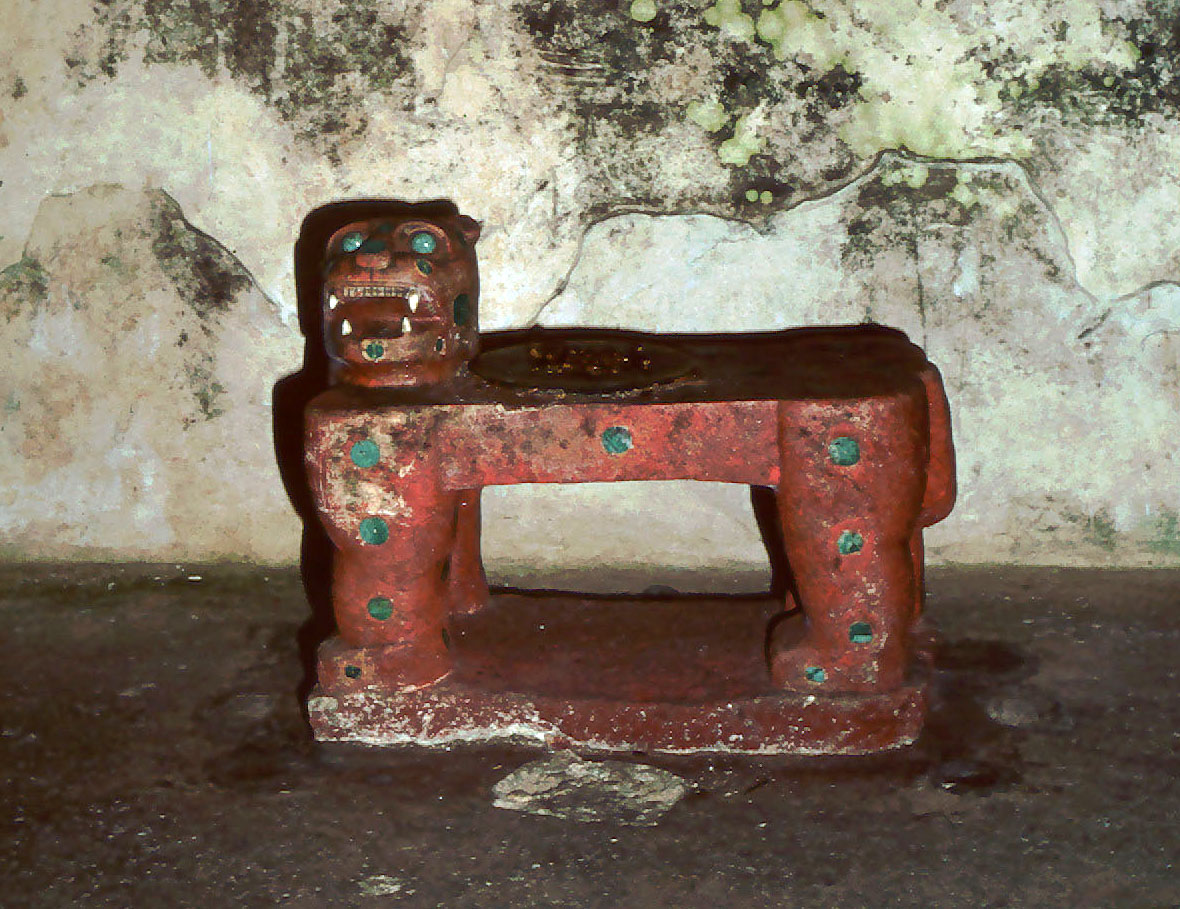 |
| Trono de Jaguar en El Castillo, Chichen Itza. |
See also Inside El Caracol at Chichén Itzá at sunset, the Solstice....
I think this is a rough draft of AKAD DZIB *
I think this is a rough draft of AKAD DZIB *


No comments:
Post a Comment