Showing posts with label Rosalind Sharpe. Show all posts

Sunday, May 20, 2012

Ken Kesey

Ken Kesey once sent me rather unusually inscribed checks to purchase some new age tarot cards I was selling. My job at Western Star Press, located in the basement of Alice Kent's big Victorian house in Kentfield, was sorting old tarot decks. 


My best friend's mother, artist, Rosalind Sharpe Wall and Alice Kent's brother, Bohemian, John Starr Cooke made a New Age Tarot deck, The New Tarot: a deck for the Aquarian Age (1969).


(See poet-librarian Jim Carmin's Facebook post and photo, about unpacking a VCR tape from Ken Kesey for the Multnomah Library Special Collections. Shall we say, it was, um, an acid-colored and tie-dyed VCR tape? Jim's post was the source of inspiration for this blog post. Once again, thanks Jim!)


There's not much on the internet about Alice Kent's brother, John, or the The New Tarot for the Aquarian Age, for that matter, which is odd, as John, friend of Timothy Leary, William S. Burroughs, and Paul Bowles, a disciple of Aleister Crowley, was revered as a sufi, he had the shakti. But I found this second-hand description of interest:
The New Tarot aka The Tarot for the Aquarian Age 
This deck is very different from most Tarot decks. The Majors have all been renamed and the suits are Blades, Serpents, Pears and Stones, which represent air, fire, water and earth respectively. The Majors are radically different; The Fool is called Nameless One, The High Priestess becomes The Mother, The Lovers becomes Unity and The World becomes The Virgin. All of the trumps are like this with the exception of The Hanged Man. The court cards have the normal names (Page, Knight, Queen and King), but the pictures do not show people. The Minors do not show scenes, rather they show the number and the requisite number of pears, serpents etc. The deck comes with 3 books, a 150-page guide which explains the reasoning and symbolism on each card followed by a short question and answer section for each card. The symbols were supposedly given to the designer during Ouija board readings in 1962 and 1963 and the deck was purportedly predicted by Madame Blavatsky in her magazine Lucifer. The second book describes a spread called The Game of Destiny, and the third book is a small booklet, similar in size to most deck booklets which describes a game to be played with the deck called The Royal Maze. The deck has its own box and the boxed deck and the books come in a larger box. © 1997 by Michele Jackson (the link is dead).
During the early 60s, John was living in Carmel. The Ouija board medium who/that channeled the deck to John, was called the One. So they called the deck The word of One. In 1964, a posse of psychedelic rangers traipsed down to John's place in Cuernavaca, at the foot of Popocatapetl, in Mexico, to work out the details. 

The New Age brujos delved into the occult with a little help from LSD, datura and magic mushrooms, to shepherd in the New Age. And then they brought it back to the Haight Ashbury. Which, in turn, led to the Human Be-In...that's where I come into this story, as I was there with my mother, who knew Timothy Leary....

And Ken Kesey and his Merry Pranksters were fed LSD treats courtesy of the US Army. Which led to electric kool-aid acid tests where other pranksters could “turn on, tune in, and drop out.” And the incarnation of Further in her day-glo splendor (and, yes, I boarded the bus when Ken stopped).

John and Rosalind designed the Tarot deck, Roz did the artwork. She wasn't very good at drawing or painting people as I recall... But she persisted with her painting throughout her life. I inherited a big box of her brushes, paints and tools when she died. The odor of rancid linseed reminds me of her.


My job was sorting and making up the decks to make them whole. And I do mean sorting—the printer had a serious mishap or played 52-card pick up with hundreds of decks during the final print run. Wheee! Talk about not having a full deck....

Though the cards were officially out of print, orders were still coming in. After all, this was THE tarot deck for the Aquarian Age. My tedious job was to send people missing cards, and  make up new complete decks—which required finding all the cards, and sorting them into major arcanas. Those images inhabited my waking and sleeping moments. Especially the burning ouroboros. Ad infinitum.

I didn't dare tell my mom about this rather particular job as my mom and Rosalind were arch-enemies on the highest wiccan order—they had a falling out over this deck. My mom had designed her own deck. They traded notes, then realized that they didn't see eye-to-eye on intellectual matters of the occult.


Ken and I struck up a correspondence of sorts. I told Ken that my mom, whom he likely knew, made me read his books. (She got around—and perhaps unofficially qualified as a Merry Prankster, as she probably dropped acid with Timothy Leary whom Nixon dubbed "the most dangerous man in America").


When the Beatnik scene died out, my mom embraced the next wave. She became a well-tuned psycho-delic card-carrying member of the "turn on, tune in and drop out" crowd. She made me read One Flew Over the Cuckoo's Nest when I was young, in order to better understand what her manic-depressive illness was like. 


Ken must've been impressed with that story, as a consolation prize, he sent me a signed complete set of a poetry & prose journal he was editor of, called "Spit in the Ocean." Much of it was beyond my comprehension. But I was a late bloomer. I do remember pausing over a grainy photo of the original Further, the magic bus I had once hitched a ride on coming home from high school—driven by Ken Kesey himself. What a strange trip that was.


Ken wrote me that the bus broke down and was rotting in the lower south forty pasture on his farm in Pleasant Hill, Oregon. It was the original Further. Maybe even during the Summer of Love. Who remembers, who cares? It was then. And this is now. It's always now but memory has a way of sneaking in and curling up on a sunspot when you're not thinking about it.
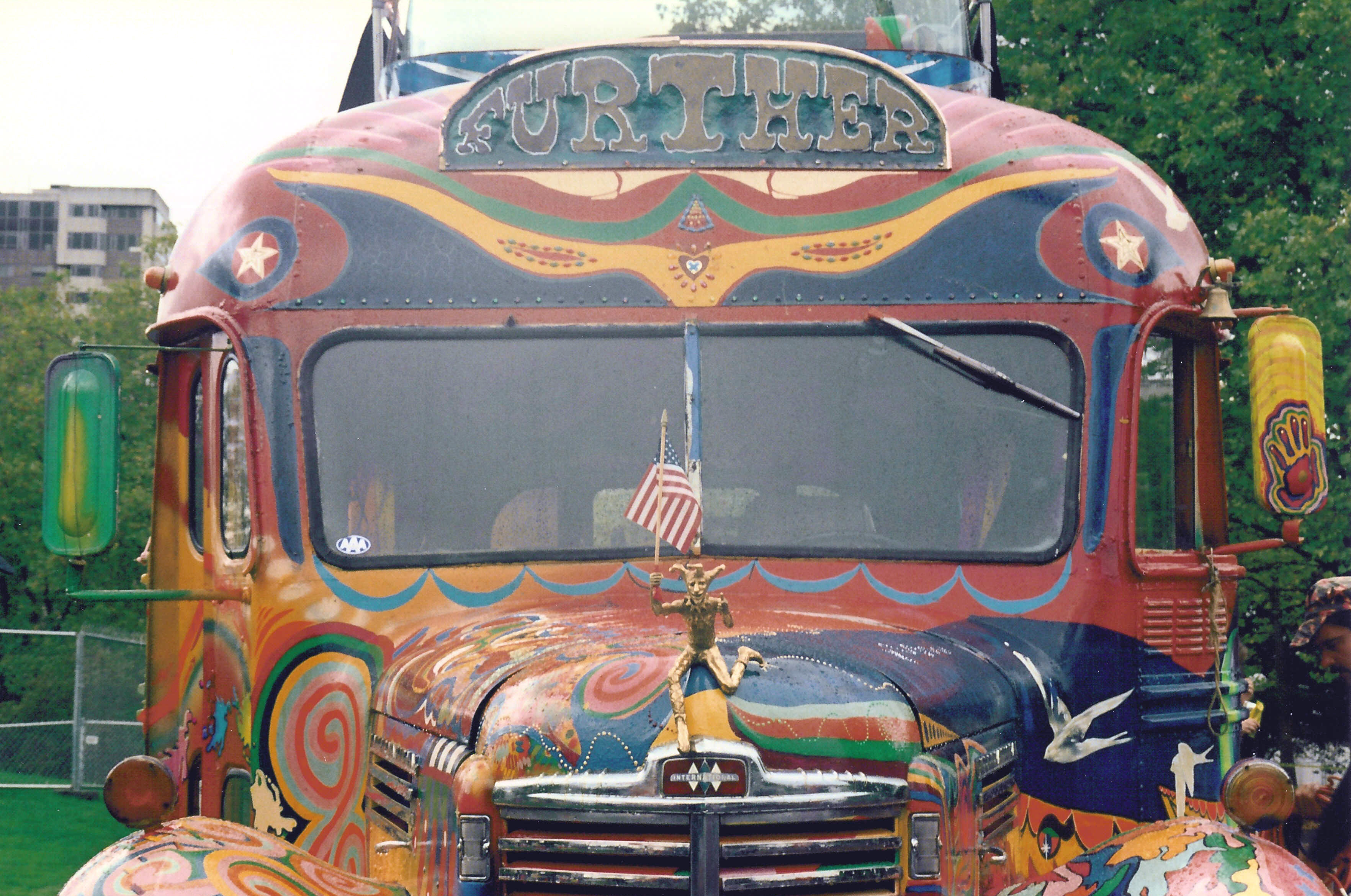

Further, the 2nd (painted in the late 1980s), proof that you can go back home again.
I was also distracted by Ebbe Boregaard outside my window, who was stripped down, a bronzed Viking god, rebuilding the front steps of the old house, telling me stories of restoring his Egyptian scow and poetry. Little did I know that the gods of poetry were beginning to develop the plot on my becoming a writer. I was 17. What did I know?


I didn't save Ken Kesey's letters or the books. Or rather, my first boyfriend Sweet old Bob Hamilton, ran off with a redhead named Dulcie, and all my books—he was the "literate" one who got me into this mess to begin with. Someone out there has them and is probably wondering who this "Maureen" was and why Ken Kesey sent them to her. 


Perhaps they'll turn up in a special collection somewhere. Perhaps it's just a spit in the ocean after all.


See my post: Hitching in Marin during late 60s, early 70s

Monday, October 11, 2010

Hitching in Marin during late 60s, early 70s


When I was a teenager, I bought my guitar stings from Van Morrison's mother at Caledonia Records in Fairfax.


It was worth the bother to get there as she'd make us a cuppa tea with shortbread. I was round-eyed—she sounded like my grannie but was from the north of Ireland. I looked for horns. We shared a name in common: Violet—but her fingernails and mouth were little scarlet wounds circling her cigarette.

Mr. Morrison, in his tweeds, was sitting on a stool, puffing away on his pipe, smiling at us from afar. Meanwhile one of Van's songs—maybe it was Gloria—was blaring on KFRC's Top Ten. I was learning Pastures of Plenty, and Cottenpicking—they chastizing me for not having a guitar case for such a valuable guitar.

One time she was shop-sitting for a friend at Amazing Grace Music, an old gas station cum music store on a tiny wedge of land between the Miracle Mile (Red Hill Ave.) and San Anselmo Avenue in San Anselmo. It was much farther out of the way for me so I rarely went there, but I had a Martin and I needed some Martin strings.

Mrs. Morrison made Van give me a ride home. Van the Man in the van was not pleased. He was seriously bent out of shape by the request so I was terrified to speak to him. And it was a long ride home held in utter silence. I lived far from town—way out in Forest Knolls, and he lived even farther out in Inverness.

Violet Morrison was a chanteuse in Northern Ireland

There was no bus service out to The Valley so it was either thumb, or shank's mare. Van the Man drove a van. I had no real idea who he was at the time... I was so fecking shy I couldn't talk to him even if I wanted to.

It seems that every rock musician from the 60s moved out to West Marin—sort of a fallout from the Haight. West Marin was invaded by the likes of the Sons of Champlin, Big Brother & the Holding Company, Grateful Dead, Jefferson Airplane—to name a few. 


They saw us kids hitching home every day—to us, it was merely an alternate bus service. We didn't think twice that these guys were famous. The road out to The Valley was long and winding, and in those days, people generally stopped for hitchikers.


Jesse Colin Young, who also lived in Inverness, was much easier to talk to than Van. He had cute little kids who took swimming lessons with ze French Mrs. Zettl who lived half way up Arroyo Road—so I got a ride almost all the way home from Jesse.

Carlos Santana was silent like Van—absolute mauna. He had a nice Mercedes with fawn leather seats though... One morning, I was still half-asleep, hitching into Drake High School (emphasis at that point was on getting high), Carlos pulled over to offer me a lift.

It was pretty early so Carlos might not have been awake either. He was pulling pretty hard on both his coffee mug and a joint. He looked half-dressed—like he just rolled out of bed. I remember being a little shocked that he wore those baggy string pants. Them string pants were riding dangerously low on Carlito's hips as I recall....

Carlos moved into my friend Lindy Young's place on Tamal Road (right up from Linda Gregg's place—where Jerry Garcia later died) and he had horses too—that was our common ground. I don't remember much else—other than I got to school on time.

Got a ride from decopage artists Larry Fuentes and Dickens Bascom too.
Dickens' art car had an entire Remington typewriter that still worked glued to the trunk of his Fort Falcon. The sides and fins were lined with worn out sneaker bottoms—like fish scales. Poetic justice.

My College of Marin classmate David Best copied Dickens Bascom and Larry Fuentes' art-cars and came up with some amazing art-cars of his own—and made a career of it. I loved the flocked chia seed Cadillac punctuated with mirror shards and a water buffalo head hood ornament that he used to park at Micky McGowan's Unknown Museum in Mill Valley.

The Unknown Museum, (founded ca. 1974—but I think it was earlier than that) which closed its doors in 1989, was something to behold with all its repurposed Americana detritus as iconography—the ultimate recycler's wetdream.

David told me that at night the deer came down to graze on the car. Mickey the cobbler had a Fiat stuffed with Disney toys and Barbie dolls.The Fiat didn't run, but David's Caddy did—I sat in it with David and talked until the cows came home, but never got a real ride in it. So I guess it doesn't count. Somewhere I have the slides... fodder for another blog.

Tuesday, August 11, 1998

Carmel Pine Cone art reviews, The Pat Wall Gallery, Dec. 13, 1946

While I was searching for information on the Pat Wall Modern Art Gallery in Carmel & Monterey, during the 1940s (there isn’t much), I stumbled across a treasure trove of art reviews and articles written by several writers from the Carmel Pine Cone—located in the Internet Archives. The full artist interviews are posted as separate entries, all posted on Aug. 11, 1989, to keep them together with my Pat Wall stories.

These pieces are fillers. Pieces I cleaned up to see if there was anything I could glean Because they’re form an OCR scanned newspaper archive, the text was a mess: columns were combined, chunks of text went missing, there was mysterious orphaned text, and strings of illegible clusters of consonants. And most headlines were lost. But I cleaned the pieces up as best I could and restored them to printed realm. I am posting them here along with my Pat Wall stories, for context. I have used snippets of them elsewhere in my Pat Wall stories but here they are in their archival entirety—cleaned up, of course! There were several arts articles in this issue, it was probably the last issue of the year, published on Friday the 13th!

I wonder if the Carmel Pine Cone was underwritten by Carl and Jeanne Cherry? The Cherry Foundation underwrote most of the arts events in Carmel. Carl had invented the blind rivet which revolutionized the airplane and shipbuilding industries. They were true patrons of the arts. I posted Rosalind Sharpe’s interview and about her, Jeanne D’Orge, and I constructed a biography, gleaned from several sources. 

I love the gossipyness of the columns, and the lists of names, it was a veritable who’s who about town. It is probably the first time that these articles have seen the light since 1946 (other than when they were scanned for the Internet Archives, where they are virtually unreadable). —Maureen Hurley, Vernal Equinox, 2021

Carmel Pine Cone 1946-12-13
FRIDAY, DECEMBER 13, 1946
At Pat Wall Gallery

Although the crowd was smaller than usual at the Pat Wall Modern Art Gallery Tuesday night show, a lot of people flowed in for a look at the paintings and the inevitable visit to the sherry table (this time in a big bed of ice) after the Guiomar Novaez concert. Among those present during the course of a stimulating evening of conversation, dancing and music, were Mr. and Mrs. Edward Ricketts, Webster Street, Dr. Eric Berne, Muriel Rukeyser, Mr. and Mrs. Bud Foster, Gretchen Gray, Mr. and Mrs. Richard Lofton, Philip Pinner, Mr. and Mrs. James Hopper, Henry Meade Williams, Jean Varda, Mr. and Mrs. Ellwood Graham, Remo Scardigli,' John Roberts, Angus MacDougal, Mrs. Phil Nesbitt, Rosalind Sharpe, Abel Warshawsky, Mr. and Mrs. Frank Lloyd, Mr. and Mrs. William Fassett, Mrs. Hilda Duarte Brown, Joseph Shoeninger, Sally Fry, Marjorie Warren, Roger Johnson, and many others.

New group show in the Pat Wall Gallery in Monterey
By NANCY LOFTON

The new group show in the Pat Wall Gallery in Monterey is notable for color that jumps at you when you enter the door. The majority of the pictures are painted in a high, bright key which combines with the color of the gallery to produce an almost strident effect. Barbara Stevenson’s Green House is a notable exception. In this canvas, Miss Stevenson paints with solidity and seriousness, and her tones of blue and green and gray produce an effect of balance and maturity. Her canvas makes most of the other pictures in the show seem lacking in depth.

Joan Hinchman’s Boat in the back of the gallery has pleasing movement and textural quality, and Ellwood Graham’s Retrospect makes a graph-like curve into an interesting pattern.

The show includes canvases by Philip Pinner, Barbara Stevenson, Itogaway, Andre Moreau, George Harris, Ellwood Graham, Lilick Schatz, Dan Harris, Margaret Peterson, Alfred Morano, Joan Hinchman, and Jean Varda. 

The jewelry by Filippa Brooks, also on display, is original and subtle in coloring, and Pete Macchiarini’s pieces use modern lines and forms to good advantage. There’s a ring set with gold-flecked quartz that’s very beautiful. 

(It doesn’t seem to have an ending).

Henry Miller book review By Rosalind Sharpe, Carmel Pine Cone, 12/13/1946


While I was searching for obscure information on the Pat Wall Modern Art Gallery in Carmel, and Monterey, during the 1940s to 1960, I stumbled across a few of my friend’s mother’s art reviews and articles from the Carmel Pine Cone in the Internet Archives. Because it’s an OCR scanned newspaper archive, it was a mess: columns combined, chunks of text missing, orphaned text, and illegible clusters of consonants. But I cleaned it up and restored it to print, and am posting them here along with the Pat Wall stories, for context. there were several arts articles in this issue, probably the last issue of the year, published on Friday the 13th! I knew Roz for most of my younger life, and kept in touch with her when she lived in Marin and Sonoma Counties, so I was pretty excited to find something she had written during the Bohemian years. It is probably the first time that this article has seen the light since 1946 (other than the Internet Archives, where it is virtually unreadable). Read on.
 
Carmel Pine Cone 1946-12-13 
FRIDAY, DECEMBER 13, 1946
Henry Miller book review
By Rosalind Sharpe

By no means the best or the most recent of Miller, The Wisdom of the Heart, a collection of essays ranging in subject from sex and French prostitutes to D. H. Lawrence, Gutkind and the Collective Whole, gives one unfamiliar with his work a good bird's eye view of the range, style, and, in some instances, the very essence of Millerism. Heterogeneous in sequence, it is in short a kind of teaser, a, capsulized version of Miller, which nevertheless seems as organically whole as anything else he has written, in that everything he writes of proceeds from himself, his own personality, his own reactions, impressions, searching, awareness. "Writing,” as he said in Reflections on Writing, "like life itself, is a voyage of discovery.” The essays are a good spring-board from which to proceed to Air-Conditioned Nightmare, Colossus of tyaroussi, or the Tropic of Cancer (if you can get it), which are arranged in a more definite sequence, centered on the topics of America, Greece and French prostitutes respectively.

Some of the essays in Wisdom of the Heart, particularly Creative Death, Uterine Hunger and Reflections on Writing, make one aware of the brilliance, clarity, ceaseless fertility, richness and creative variation of his reaction to reality; his paradox and never-ending exploration of values and meanings and symbols and sensations—the sort of thing that has made Henry Miller a cult among his admirers.

He has expressed his basic attitude towards writing, life and reality very lucidly in the essay Reflections on Writing where he says, "I began in absolute chaos and darkness, in a bog or swamp of ideas and emotions and experiences. Even now I do not consider myself a writer in the ordinary sense of the word. I am a man telling the story of his life.... It is a turning inside out, a voyaging through X dimensions, with the result that... one discovers that what one has to tell is not nearly so important as the telling it in dry-lipped whispers, ...characters and come forth with such books as the Wisdom of the Heart (a collection of essays), The Colossus of Maroussi (about Greece), and Air-Conditioned Nightmare (his impressions of America), all conspicuously devoid of four letter words.

Down the coast, he is writing a sequel to the latter volume, entitled Air-Conditioned Nightmare II.

He goes on to say, ”1 talk now about Reality, but I know there is no getting at it, leastwise by writing. I learn less and realize more. I learn in some different, subterranean way. I acquire more and more the gift of immediacy. ... I haven’t the slightest idea what my future books will be like, even the one immediately to follow. My charts and plans are the slenderest sort of guides; 1 scrap them at will. I invent, distort, deform, lie, inflate, exaggerate, confound and confuse as the mood seizes me. I obey only my own instincts and intuitions. I know nothing in advance.”

It is altogether obvious that comment on Henry Miller and about Henry Miller by other writers is a foolish and superfluous business. Henry Miller has said it all. He is honest and searching. He discovers everything in himself and exposes it to view. His search through reality and sensation is continually given body in his writing, and if one wants to know Miller, all one has to do is to read him. He withholds very little. If he changes, then so be it, life changes, reality changes, the "voyage of discovery” goes on.

Sam Colburn, Carmel Water Colorist, In Farm-Group Period By Rosalind Sharpe, Carmel Pine Cone 1946


While I was trolling the internet for leads on the Pat Wall Modern Art Gallery in Carmel & Monterey, during the 1940s, I discovered a friend’s mother’s art reviews and articles from the Carmel Pine Cone in the Internet Archives. Because it’s an OCR scanned newspaper archive, the text was a mess: columns combined, whole chunks of missing, or orphaned text, and illegible clusters of consonants. But I cleaned it up and restored it to cyber-print, and I am posting most of them here along with my Pat Wall stories, for context. 

I knew Roz for most of my younger life, she was like a second artist mother, and we kept in touch, so I was excited to find something she had written during Carmel’s extraordinary Bohemian era. It is a safe bet that this is the first time that this readable article has seen the light since 1946 (other than the Internet Archives, where it is virtually unreadable). I’m sure there’s much more to be gleaned from the Carmel Pine Cone archives, if they even exist. Funny, my mother’s cousin, Marie Gilman was the Carmel Librarian. If only I could go back in time. The Monterey Peninsula Herald is another source, but its impossible to scan their microfiche archives. No text. Read on.  —Maureen Hurley, Spring Solstice, 2021

Carmel Pine Cone 1946-12-13 
FRIDAY, DECEMBER 13, 1946
At Pat Wall Gallery

Sam Colburn, Carmel Water Colorist,
Currently In Farm-Group Period
By Rosalind Sharpe

While oil painters are a dime a dozen in this neck of the woods, watercolorists (particularly good ones) are scarce as hen’s teeth, and Sam Colburn, along with Royden Martin of the Carmel Valley, is not only one of the rare representatives of this art on the peninsula but enjoys the not inconsiderable distinction of being good enough to stack up with some of the best in the field anywhere. He is a young man who has come a long way since he first arrived here and started painting in 1937, and particularly has gained command of his medium during the last three or four years. People hope great things of “Sammy” whose work already is distinguished for its simplicity of form, and its finely concentrated mood quality and his achievement is particularly remarkable when one realizes that he is a virtually self-taught artist in a medium which is generally considered the most difficult of them all.

When Sam was traveling through France, Spain, Mallorca, England and Germany in the early ’30s, he did a little sketching, but although he had always been interested in painting it was “nothing that felt like a career,” and later, when he settled down in southern California selling cub airplanes, he attended some life classes in the adult education program and was fortunate enough to get a teacher who was mainly interested in sculptural form. “To hell with cast shadows and all that,” as Sammy put it. But it was only when he came to Carmel where he had a lot and decided to build a house that he actually got launched on an artistic career. This was in 1937.

“That decided me,” he said, “No further waverings. Painting? I drifted into it gradually, until I became' thoroughly involved, enmeshed."

As to why he chose water color instead of oil paint as a medium, his surprising answer, "I was intrigued with water color because it was very difficult. Besides. I am very much interested in luminosity. You can achieve effect with water color not possible in oil."

"The oil painter," he added with a grin, “has to carry hundreds of brushes, paint rags, tubes, easels, all sorts of paraphernalia. It clutters up the place.”

Sam, who is a thin, lanky individual with a deceptively casual air , who usually impresses people fOL being one of those characters who^drift through life without strain or undue exertion, is actually an extremely hard worker who rises nearly every morning around 6:30 or 7:30. ‘I get out very early when the sun is not high,” he said.

"The landscape is more dramatic in early morning or late evening." And when Colburn is really in his stride, he turns out two or three water colors a day. Some, however, take a lot of time. Others are more sketchy. But watercolor on the

[in tyith people and everyday living, ]. Sam had some pungent comments to offer.

“Art and artists are receiving a wider acceptance lately,” he said. "There is more interest, no matter in what kind of art. At one time artists were considered ‘precious.’ They were looked down upon as producers of nothing worthwhile. But people realize now that they have plenty to offer.”

“Museums,” he continued thoughtfully, “are very bad and even art galleries from one standpoint. People think they have to walk in and stand in awe. It scares them away from art and they think it’s something that has nothing to do with themselves. Paintings should be in homes and restaurants and bars and stores. Mainly in homes, where people live with them.

Jeanne D’Orge, painter, exhibit at the Pat Wall Modern Art Gallery “Paintings Not for Sale“


While trolling through Google looking for articles on my friend Micaela’s father’s art gallery, the Pat Wall Modern Art Gallery in Carmel, and Monterey, during the 1940s to 1960, I stumbled across one of Micaela’s mother’s article from the Carmel Pine Cone in the Internet Archives. Because it’s an OCR scanned newspaper archive, it was a mess. But I cleaned it up and restored it and then I realized it was something of interest. It fleshed out the stories I was working on about Pat Wall. And then it becomes a gift to my friend Micaela, a Memento Mori, words written by her mother so long ago. It’s safe to say this Jeanne D’Orge interview of Rosalind Sharpe Wall hasn’t seen the light of day since 1946. Obviously this blogpost was written much later than 1998, but since these are themed pieces, I am posting it here. 

During the 1970s, my boyfriend Bob Hamilton, and I spend most weekends in Monterey County. We camped in the VW Bus and explored the Big Sur area. We were interested in the bohemian artists of the 1940s. I have a vague memory of visiting the Jeanne D’Orge gallery and spending an evening looking through her work. In retrospect, I realized the kindly gallery sitter was probably Jane Wilgress (see below). Because I was not yet a writer, I don’t have specific images to share, perhaps visiting all of this is a way to regain memories from that time when I did not write. —Maureen Hurley, Spring Equinox, 2021.

Cherry Center for the Arts

Jeanne D’Orge, neé Lena Yates, was born in Cheshire, England in 1877. When her father, a seed merchant, deserted the family, she and her mother moved to the outskirts of Edinburgh. Lena published her first poems at 20, and wrote a series of children's books on animal fables under the pen name of Lena Dalkeith—playing on a combination of her birthname, Lena, and the quaint Midlothian village of Dalkeith, near Edinburgh, where she was raised. Thus was the beginning of a woman of many identities.

While on a walking holiday in France in 1906, Lena was swept off her feet by geographer and engineer, widower Alfred Burton (dean of M.I.T.).  Lena and her mother joined Burton and his two sons in Newton Grange, Massachusetts where she and Alfred were married. A pioneering modernist poet, Lena became involved with the Others, a poetry group that included Marianne Moore, William Carlos Williams, and Wallace Stevens, and she began publishing her work in literary magazines, Others: A magazine of the new verse, and Poetry. Some of her prose poems were published under the name Lena Dalkeith Burton.

Suffering from poor health, and a profound dislike of east coast weather and New England mores, Lena moved to Carmel in 1920 with her 3 children in tow—where she built a Craftsman style house. Her husband retired from M.I.T, and joined her a year later. They became involved in community theater, with Dr. Burton building sets and acting in Forest Theater productions; Lena wrote and produced a series of Commedia dell’ Arte styled plays, including Crazy Ann, under the penname of Lena Burton.

In 1928 Lena created a scandal when she left husband and children to live with the Forest Theater lighting technician, and M.I.T. graduate, Carl Cherry, some 20 years her junior. They converted his mother’s old Queen Anne cottage, a wedding gift (they were married in 1930), into an art studio for Lena, and a workshop for Cherry. During the lean years, they lived off canned tuna and coffee. She began painting in earnest in 1937, and Carl Cherry struck paydirt when one of his inventions, the one-sided blind rivet, revolutionized airplane and shipbuilding construction during the war years. Lena took up her painting name Jeanne D'Orge, after a river in France, having shed all vestiges of her past lives. For D'Orge painting embodied the intangible moods of form, color, and feelings that cannot be expressed in poetry or music.

The Cherrys carried on as before, living a simple lifestyle, but used their newfound fortune to establish the philanthropic Cherry Foundation to "further the culture of America by sponsoring experimental fine arts, sciences and education." The foundation underwrote arts events, concerts, plays, lectures and seminars featuring world class lecturers and performers. She became friends with Robinson Jeffers and Edward Weston, and wrote plays under the pseudonym of Juniper Green, after a neighboring village near Edinburgh. After her husband Carl Cherry died of cancer in 1947, D'Orge continued to run the Carl Cherry Center for the Arts, and "often appeared on the streets of Carmel wearing a big pink hat, ankle length Chinese robes and paint-stained tennis shoes." She died in 1964. Her former home, now an art center, houses over 1200 pieces of her art, plus letters, books, manuscripts, photos and memorabilia, as well as an extensive library.

Sunday, August 9, 1998

Pat Wall, Modern Art Dealer: 3 Henry Miller and the Avant Guardians (journal)


Amazing to spend the morning reading about the Pat Wall Art Gallery and its wild guests, then to look around Micaela's room and see the very art mentioned in the reviews. The Avant Guardians are watching over me as I sleep.

I'm looking at Henry Miller's self-portrait with its red and green five sided frame, the brushstrokes are deft. Henry, supposedly in his 50s, stared back at me across the years, a young man with sallow skin and Prussian blue ears and nose. 

You painted what you liked, Henry. I hope you died happy. Henry looks a bit like Oleg Atbashian, which puts me off a bit. Self-absorbed men. Was it the talent that made them so self-absorbed, or was it the rank self-absorbtion that allowed them to become so talented?

I recognize so many of the paintings: McClatchy's Door. Several Graham paintings: Lament, and The Beginning of War. Other unnamed pieces. When Graham and Miller became rather famous, things changed. 

In the early 1970s, I remember traveling to someone's house under the Bixby Bridge to see Henry Miller's watercolors. I was not duly impressed. But I dutifully read everything that Miller ever wrote, so I felt compelled to witness the paintings too. I think I was reading Nexus at the time.

I think the owner was rather hoping that we'd buy a painting, but we were as penniless as Miller was when he moved to Big Sur. Micaela has more articles on Henry Miller's watercolors. Wish I had time to read them all.

Henry moved to Big Sur in 1943 and lived in a tent alongside the highway, he was already living the life of Big Sur and the Oranges of Hieronymus Bosch, it was a cult of sex and anarchy on the coast. He said, "I'm not perverse, but the idea of looking through a keyhole fascinates me."

A keyhole in a tent? I asked myself. And thought of camera obscurae.

April 14, 1947: Henry Miller talked about how his paintings morphed from landscape into fish. I wonder if that's a reference to his Red Fish? 

Said Miller, "When I paint I have a lot of fun but I feel I'm on a tight rope. I'm jittery sometimes when I start out to do a landscape I end up with a fish I worried about this until the other painter said they do the same thing."

I had to laugh, Mike Goldberg's painting, Sardines, came to mind. See, Frank O'Hara's poem Why I Am Not a Painter sums it up nicely.
....I am a real poet. My poem
is finished and I haven’t mentioned
orange yet. It’s twelve poems, I call
it ORANGES. And one day in a gallery
I see Mike’s painting, called SARDINES.
Pat Wall's art gallery became the focal point in a Harpers article on the new west coast cult of "sex and anarchy." A Times reporter descended, to buy a Miller painting, then left for the East Coast, calling it Paris of the West. Miller was a Paris expat, so he had several threads going. The race was on.

About the same time, the restless New Mexico contingencies (Wilfred Lang and Co.), were experiencing hot flashes, the Age of Light was born. (My grandmother's niece was working on the Manhattan project).

And somehow the role of art went from the cultured confines of the City of Light to the Age of Light. Miller detonated a moral code in Big Sur. The world fell apart, the center did not hold.

Henry must've loved exhibiting his thermonuclear watercolors next to the surrealist nudes of Dutch oil painter, Cock van Gent (a she!), and Edward Weston's extreme close-up photos of bell pepper buttocks.

The Grahams, Toni & Ed Ricketts, James Broughton, Virginia Varda, Dr. Rodin, Henry Miller's physician, and someone named Brewsie were among those attending. Everyone signed the register as Mr. and Mrs. So-and-so, as if that slender slice of decorum could contain the avant guardians.

Pat Wall, Modern Art Dealer: 2 Betty Wall (journal)

Pat & Betty Wall, me, Arthur Boericke, Fort Bragg 1971

One of Pat Wall's gallery artists, Joseph Albers, a Bauhaus student and teacher, painter and poet, taught at Black Mountain College in North Carolina with Jean Varda. Varda I remember from the Sausalito houseboat days when I used to stay at Pat and Betty Wall's house. Micaela, Chris and I often played on the Charles van Damme ferryboat.

I knew Walter Gropius's name would eventually crop up in this crowd. Too bad the Hexagon House in Guerneville burned down. We used to go to tea dances there in the early 1980s. I remember sitting on a tall stool admiring that open beam work. I was always told that he designed it, but someone else did. No matter, it’s gone now.

Another clipping on top of the scanner: thieves broke into Picasso's home, took his clothes, took his money a radio, but left the art. Thieves also broke into a Berkeley woman's house to steal a painting by Dan Harris. Who is Dan Harris? (a painter, his wife Gertrude gallery sat Pat’s art gallery).

Names from my childhood kept cropping up. Sue Wall dressed as a girl sucking on a lollypop, a painting by by Dan Harris. Pat's other wives: Rosalind Sharp, Mrs. Margaret Lane. Did those women have any idea what was in store for them? Still in their separate identities. 

Pat would later divorce Sue and marry Rosalind and have two children, Micaela and Chris. Meanwhile Mrs. Lang and Wilfred Lang separated… Which one? My God is that a reference to Betty Wall, Micaela's stepmother and Pat's third wife? 

So, who was married to Wilfred at the time? I can't imagine Betty as the "other' woman. But they all were "other" women, one way or another. Betty was more of a mother to me than anyone else in my life, certainly my own mother—besides my grandmother that is… The other women who raised us. Art was our mother. Art was also the other woman.

Aug 9, 1998

Pat Wall, Modern Art Dealer: Ellwood Graham (journal)


Patrick Wall, founder of The Pat Wall Gallery, Carmel/Monterey, ca. 1973

When I was a child, my eyes feasted on the paintings collected by my best friend's father, Patrick Wall, when he was an art dealer in Monterey during the 1940s. Pat's gallery was on Olivier Street, we never did collect his oral history, so this is a placeholder for what we collectively remember. We also didn't realize that Pat singlehandedly changed the face of West Coast art with his controversial unorthodox exhibits. 

Pat, who was from Jersey, the Channel Islands, UK, came to California ca. 1940, with his inheritance and a dream of art. He took a chance on the local "moderns" and created The Pat Wall Modern Art Gallery, and through this connection is how I got to know the work of Ellwood Graham who "painted out loud" with lots of hot colors. His abstract portrait of John Steinbeck was controversial at the time—circa the 1940s.

What I loved were how Graham's personal hieroglyphics, or pictogram paintings which were almost quilt-like in nature, I loved the way the heavy dark colors were a combination of thick impasto, a drawing, and transparent glaze. A doodle, a half a whale (the tail end) captivated my attention. He compared his work to a composer working on a "musical canvas." Graham painted an egg tempera mural in the Ventura Post Office. Is it still there?

So much history attached to those old paintings of Pat's. There was John Steinbeck and Ed Ricketts, known as Doc Ricketts— they too were juxtaposed in Graham's work. It was John Steinbeck who told the artist to paint out loud imagine that—paint out loud. Graham moved to Monterey because of John Steinbeck.
Steinbeck also created in Graham's [Monterey] studio. He wrote Sea of Cortez while Graham rendered his portrait. Of course he sold the painting to Steinbeck, but "I kept some studies and sketches." 'Where is that portrait now? "People have been calling me for years... I don't know." he says, "I haven't seen it in over 50 years."

Then he adds, "That portrait was very good... I hear it was bought by Burgess Meredith but I also heard it belonged to John Huston. —from Alta Vista Magazine, 1992 "Ellwood Graham: Never Say Die," —Susan Lea Hubbard (see bottom of this post for more stories).

Friday, October 24, 1986

Letter from Rosalind Sharpe Wall

Dear Maureen:                      October 24, 1986 (I can’t read much of it)

I was much moved by your poems and their quality – also seeing your picture with that nice young man. I am glad you are seeing something of Micaela. 

My only suggestion in regards to a poetry reading or whatever, is the Carl Cherry Foundation. My friend Jane Wilgevess is no longer the curator, but if you just write the foundation and mention my name to them. I am still Rosalind Sharpe Wall, an accompanying booklet I wrote for them. you will get some sort of answer and I believe their policies have changed somewhat since Jane is no longer heading it, but I am sure they will give you some preference on my account, if none other. 

The address is Cherry Foundation, PO Box 863, Carmel, CA 93921 phone 408-624-749. 

The artistic center is at the Sunset cultural center but I don’t know how to contact them. I will try to find out and write you again.

I am home which is to say, in my home technically, but I don’t get around and don’t generally mind …. Much on account of my physical condition. In addition to advanced emphysema, I am on oxygen, I am crippled and can walk almost not at all. 

But I am busy writing, Maureen, my book on the Big Sur coast. I am rewriting it. When the Coast was Wild and Lonely will be out in January by …  I hope my publisher will be sending you an invitation to the  autograph party at the Thunderbird bookshop. I hope you can come. I … and hope it is a meal of food to … and I hope that my professors at SSU might be able to come. Helen Dunn, Marty Blaze, Gerry Haslam and Jerry Rosen.

I am much interested from… that’s my book was excepted by a house a creative project in lieu of a journal MA thesis in 1984.

In the past two months I have been working on a new version of the New Tarot for the Aquarian Age, but Alice Kent and I do not see eye to eye on it, and although she says she is giving it back over to me, she is retaining control. And I have four other books to write I am a little miffed?…. and I made working in it? a priority. Not … I shall plow on, but I realize it will all come together in the end. … It has been restrictive and depressing to me. But I realize it will all come out alright in the end.

Tell Micaela to show you my story about Bixby creek where I grew up in the Herald which was published September 21. It’s a freelance piece for the Monterey Herald weekend magazine.

I intend to type all after some publ. I will call in the next day or two the Sunset Cultural Center about its programming. Meanwhile go ahead and write to the cherry foundation. As a writer, I have dropped the Wall, after all, I am an ex Mrs. having been divorced for over 30 years so I have reverted back to my maiden name, Rosalind Sharpe. 

Love to you Maureen, 
signed, Rosalind

October 25, 1986 dear Maureen

Have some more info for you. Cherry Hall seats 50 and the charge is $10 per hour but they are open to  negotiation. Phone or write Linda Coppens c/o the Cherry Foundation, same address phone number, call Tuesday through Friday between 9:30 and 4:30 ask for Linda Copppens. 

carpenter carpenter Hall at the Sunset center seats 150. Some thing a address is PO Box 5066, Carmel, CA 93921 phone 408-624-3996 I don’t know what the charges for advanced publicity releases that could be arranged there The Monterey Peninsula herald in the Carmel pinecone PO Box G Carmel but eyes support the cherry foundation and or the carpenter whole arrange the advance publicity releases cherry foundation runs a something enormously schedule cultural events in the Carmel pinecone I don’t know who is crutch in the who is to contact at the Herald but I will find out once you have the cherry foundation and or Carpenter hall or sunset Creek love Rossiland Then she writes on the back of the envelope this is PS I miss addressed a letter to you yesterday but this one contains the info you needed hi