Writer Adair Lara asked on Facebook: "How come people declare they will be coming to a party "with bells on"? Derivation?"
Someone lifted an old Yahoo Answers post to answer the origin of "with bells on" was when peddlers roamed the Appalachians selling wares, they traveled silently to avoid Indians, until they reached a settled area. Then they unmuffled the bells around their horses' necks to announce their arrival "with bells on."
And why were the horses wearing bells around their necks?
Well, I just couldn't pass that one up as it was wrong on so many levels. I'd just finished reading a paper on medieval shoes posted by Medievalist.net, so I was all fired up with useless pointy medieval shoe trivia, and nowhere to go dance it off.
The saying that Adair was referring to: "With rings on her fingers and bells on her toes" is from a 1700s nursery rhyme, Ride a Cock Horse to Banbury Cross. How much older the rhyme is, we don't know but nursery rhymes were passed on orally. I discovered that there are several motifs to follow: the role of hobbyhorse, white horse, rings and bells, and music (wherever the rider goes).
 |
| William Wallace Denslow's illustration from1901—Wiki |
The 1901 variant is based on this much older version:
Here's another variant (no date, sorry):Ride a cock horse to Banbury Cross,To see an old woman get up on her horse,Rings on her fingers, and bells at her toes,And so she makes music wherever she goes."—Warwickshire variant, from Gammer Gurtotis Garland (1783)
Ride a cock-horse to Banbury Cross,It's a safe bet to assume the ditty predates the nursery rhyme published in 1744-84. But how far back it goes, nobody knows. (See Roud Folk Song Index # 21143). Some scholars think the words are associated with 11th c. noblewoman Lady Godiva (the horse tax-relief story appears two centuries after her death), or with Queen Elizabeth I, but it could be much older (or not).
To see a fine lady upon a white horse;
With rings on her fingers and bells on her toes,
She shall have music wherever she goes.
BTW, I know what you're thinking, a cock-horse is a hobbyhorse, a rocking horse, or a dandle horse. (It also could refer to helper horses who pulled carriages up steep hills. First use, ca. 1541.)
I found this on Yahoo (it sounds spurious):
Queen Elizabeth I of England travelled to Banbury to see the new stone cross. 'With rings on her fingers' relates to the jewellery which would adorn a Queen. 'And bells on her toes' refers to the fashion of attaching bells to the end of the pointed toes of each shoe! Banbury was at the top of a steep hill and a white cock horse (a large stallion) was made available to help pull the carriages up the incline. When the Queen's carriage wheel broke, the Queen mounted a cockhorse to reach the Banbury cross. Her visit was so important that the people decorated the cockhorse with ribbons and bells and provided minstrels to accompany her "she shall have music wherever she goes". The big cross at Banbury was later destroyed by anti-Catholics. (NB: I shortened this piece, so it's not quite a quote).Another train of thought is that it's an Anglo-Celtic nursery rhyme, merging Anglo-Saxon noblewoman Lady Godiva (gift of God), and Welsh goddess of the crossroads, Rhiannon (divine/great queen). A white horse, white mare, or a milk white steed is also a reference to the Celtic Otherworld (Open House is Oct 31, May 1), as is the symbol of Rhiannon who rode a white mare. A Gaulish Epona (Irish cognate: Macha) reference is embedded.
A white mare, a symbol of sovereignty, is a kingmaker because through her, the sacral king marries the sovereignty goddess, or the land itself. Giraldus Cambrensis described a "Celtic ritual, the king mates with a white mare thought to embody the goddess of sovereignty."—Wiki The millennia older Bronze Age white chalk horse of Uffington was also embedded in the folk memory of southern England.
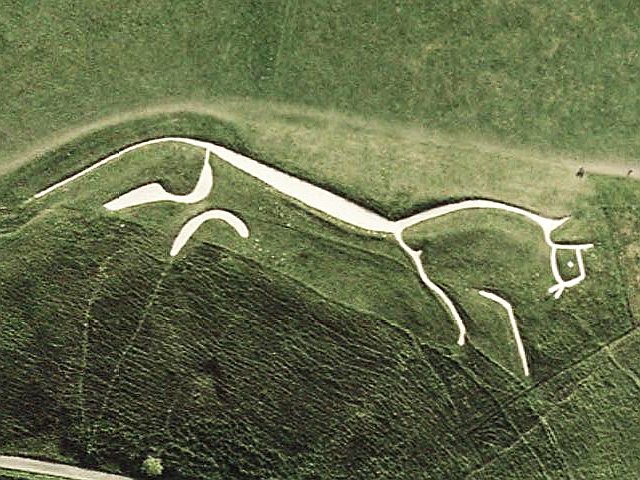 |
| The Bronze Age white horse of Uffington, on the Berkshire Downs in southern England, ca. 1400 BC. |
It's been suggested that Rhiannon is the archetype for Lady Godiva, and the nursery rhyme is about Lady Godiva. If Lady Godiva rode through Coventry town on a cock-horse buck-ass naked, where would she have hung her bells? Detail. Not buying it.
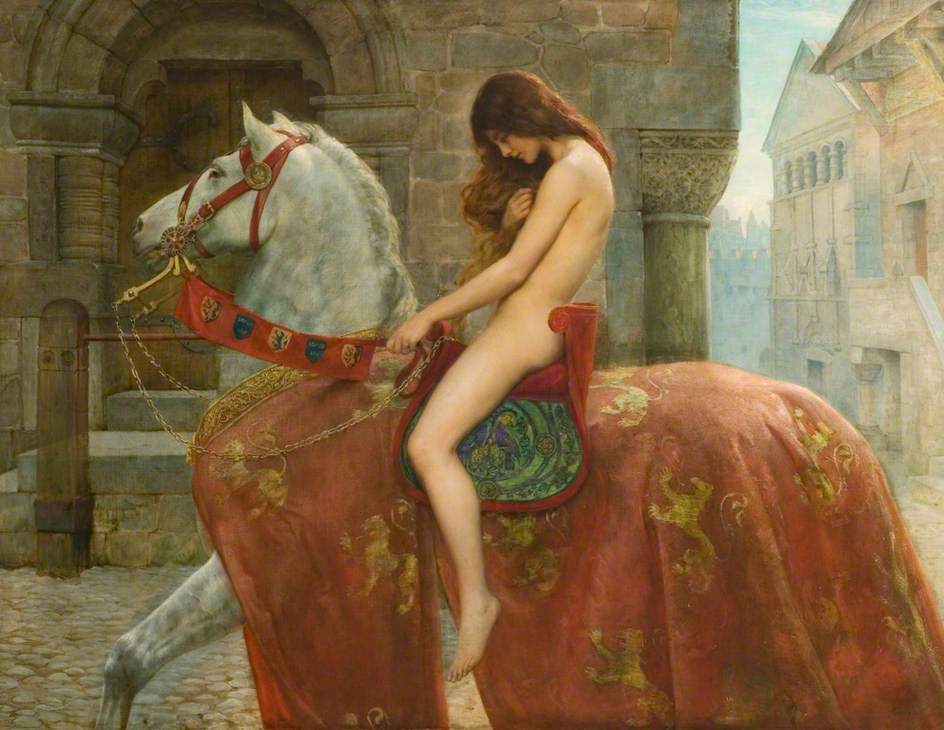 |
| Lady Godiva by John Collier, c.1897, note the white horse.—Wiki |
To finish Rhiannon's story, though betrothed to Gwawl of Annwyn, Rhiannon married Pwyll, Lord of Dyved; at their wedding feast, she turned the jilted conniving Gwawl into a badger, and Pwyll bagged it—and thus, badger in the bag was born. There will be blood! Rhiannon was framed for her babe's murder, and forced to stand at the city gates wearing an asses' collar, proclaim to all that she killed her son, and carry visitors on her back like a horse into the keep. Throughout all the Welsh tales halo of birds is Rhiannin's enduring motif.
Ride a cock horse to Banbury Cross (or Coventry)Note a distinction is made between She shall, or will have music versus She shall make music. Sorry, no date on this one either.
To see a fine Lady ride on a white horse
With birds as her halo and bells on her toes,
She will/shall have music wherever she goes.
Banbury, Banna's 5th c. Saxon stockade in Oxfordshire, was built atop a 200 BC Iron Age fort at an ancient crossroads; it was the site of a battlefield between Anglo-Saxons and Britons in 556 AD.
Maybe the origin of the phrase With birds as her halo came from the Mabinogion recorded in the White Book of Rhydderch (scribed ca.1350, but from the 11th century), but I cannot find a reference to rings on her fingers, and bells on her toes in English translations. I did find this lovely line: "The birds of Rhiannon, they that wake the dead, and lull the living to sleep…"
Did the idea cross the Welsh border and enter into English? Lady Charlotte Guest's translation of the Mabinogion was published in 1877. Or is the line solely an English provenance? The English phrase is attested in English in 1745. Rhiannon's halo of magical birds of music didn't make an appearance in that edition, but the line with rings on her fingers and bells on her toes has managed to remain intact in English for at least 275 years. Maybe longer—though the wording is modern. It may be two different traditions merging.
How would an Elizabethan have said the phrase, or someone from the Middle Ages? (Surely they wouldn't refer to Elizabeth I, or Lady Godiva as old ladies!) When does the phrase With rings on her fingers and bells on her toes enter into our language banks? The terminus ante quem question still begs and I'm far too lazy to drag my old bones to the musty basement of UC Berkeley's Doe Library, or Kroeber Folklore archives, to look up the rhyme like my folklore professor, Alan Dundes would expect of me. Maybe someday.
* * *
The name Banbury derives from "Banna", a Saxon chieftain built a stockade in the 6th century (or Ban(n)a possibly a byname meaning ‘felon’, ‘murderer’, and "burgh" or settlement. The Saxon spelling was Banesbyrig. The name appears as "Banesberie" in Domesday Book. Another known spelling was 'Banesebury' in Medieval times.Fittingly, Banbury has a Hobby Horse Festival. Hobby horses have a deep Epona connection, and in Wales, Cornwall and Somerset, they are associated with May Day, and Bealtaine celebrations (later moved to Christmas / New Year); Mummers Plays, Mari Lwyd, and the Morris dance. Aka morisk, moreys, morisse daunce, it may mean a Moorish dance. But that may be a convenient assumption. First documentation in 1448 was a bill for seven schillings. There were definitely lots of bells on the Morris dancers' shanks' mares (shins). )
.jpg) |
| Welsh Mari Lwyd with Christmas ornaments for eyes. |
Maybe the origin of the phrase With birds as her halo came from the Mabinogion recorded in the White Book of Rhydderch (scribed ca.1350, but from the 11th century), but I cannot find a reference to rings on her fingers, and bells on her toes in English translations. I did find this lovely line: "The birds of Rhiannon, they that wake the dead, and lull the living to sleep…"
Did the idea cross the Welsh border and enter into English? Lady Charlotte Guest's translation of the Mabinogion was published in 1877. Or is the line solely an English provenance? The English phrase is attested in English in 1745. Rhiannon's halo of magical birds of music didn't make an appearance in that edition, but the line with rings on her fingers and bells on her toes has managed to remain intact in English for at least 275 years. Maybe longer—though the wording is modern. It may be two different traditions merging.
How would an Elizabethan have said the phrase, or someone from the Middle Ages? (Surely they wouldn't refer to Elizabeth I, or Lady Godiva as old ladies!) When does the phrase With rings on her fingers and bells on her toes enter into our language banks? The terminus ante quem question still begs and I'm far too lazy to drag my old bones to the musty basement of UC Berkeley's Doe Library, or Kroeber Folklore archives, to look up the rhyme like my folklore professor, Alan Dundes would expect of me. Maybe someday.
* * *


