Feeling fairly well chuffed here—I, who never win anything, just won an iFan pass for MacWorldExpo! I'm an odd duck on a wet day‚ I'm renown for taking apart old Macs and reassembling them because I can. Duct tape is good. They mostly (usually) work when I do patch them together—except when the power supply blows. That scares me. My poor beloved elderly PPC iMac went KABLOOM! But I have hope for Ol' Lazarus. The old iMac is sublime for photo editing. Imagine seeing your photo 20” across. Talk about detail. That’s why I work so hard to keep it alive. The newer iMacs don’t have the same kind of screen. Too glossy. A mirror of sorts. I am an avid Mac addict and always learn lots by going to the MacExpo at Moscone Center. It's like a floating techno-university. And this year, iPhonograpy is featured—a huge photo exhibit!
Tuesday, November 27, 2012


Saturday, November 24, 2012
WHAT TODDY SAID:
WHAT TODDY SAID:
I don't think I am getting enough dreaming in
I don't think I am getting enough dreaming in
because it solves problems while you sleep,
Dreaming gives you a better perspective.
Something's wrong inside my head, I know
it's the not knowing what it is, or how to correct it.
I can't remember. I'm worried about walking in my sleep.
Something's wrong inside my head, I know.
I know.
11/24/12
My dear aunt Toddy who, after too much wine, was caught streaking in her sleep one night. Officially diagnosed with dementia. Sad. But such clarity, nonetheless.
Something's wrong inside my head, I know.
I know.
11/24/12
My dear aunt Toddy who, after too much wine, was caught streaking in her sleep one night. Officially diagnosed with dementia. Sad. But such clarity, nonetheless.
Tuesday, November 13, 2012
RIP Jack Gilbert
 |
| Joy Harjo, Bob Hass & Linda Gregg |
I met Linda Gregg backstage at the Watershed Poetry Festival in Berkeley in September—Bob Hass said, Maureen, do you know Linda Gregg?
And my jaw hit the floor.
I told her about an after-school softball game I watched at Lagunitas School—the Gregg twins were on 2nd & 3rd base, Billy Joe Bianchi hit a home run and when they ran, they were so freckled and golden, I was in awe.
Someone was up at bat. Maybe it was Liz Haas. Or one of the Farley boys. I remembered them from catechism class. I think it was Lagunitas vs. Nicasio. It was a foul ball that rolled right down the third base line and turned out at the last minute, so everyone had to retrace their steps.
I was about 6 or 7, so baseball was a mystery to me—but Billy Joe was my neighbor (family friends). So, I watched the game and cheered as he brought them all home.
Linda was a little blown away by the baseball story—expecting something more modern, perhaps—her role as a major poet and me as sycophant—instead it was about a childhood softball game.
As it turned out, her sister was in the audience, too. So I got to meet the Gregg twins together again. I always want to call her Alma, but that's the name of Linda's seminal poetry book—if women can have a seminal books, that is. But perhaps her sister was Linda's Alma. Louise lives in Tomales. The weather has taken its toll on her. She favors the same plaid shirts as did her father. Tough no-nonsense women, the Gregg twins.
Linda had just come from seeing Jack Gilbert. She said that he wasn't doing well. His mind may have taken flight. But he always knew her. A bond that deep.

I'm racking the brain as to how the story is possible as they are 10 years older than me but Lagunitas was such a small place in those days and I started school early—perhaps they also started school late, to make the timeline work.
Or, they were already in high school. I remember someone saying they were 8th graders—and that seemed like such an impossible distance in time, I couldn't fathom it. Maybe Carol Manning remembers it better.
And my jaw hit the floor.
I told her about an after-school softball game I watched at Lagunitas School—the Gregg twins were on 2nd & 3rd base, Billy Joe Bianchi hit a home run and when they ran, they were so freckled and golden, I was in awe.
Someone was up at bat. Maybe it was Liz Haas. Or one of the Farley boys. I remembered them from catechism class. I think it was Lagunitas vs. Nicasio. It was a foul ball that rolled right down the third base line and turned out at the last minute, so everyone had to retrace their steps.
I was about 6 or 7, so baseball was a mystery to me—but Billy Joe was my neighbor (family friends). So, I watched the game and cheered as he brought them all home.
Linda was a little blown away by the baseball story—expecting something more modern, perhaps—her role as a major poet and me as sycophant—instead it was about a childhood softball game.
As it turned out, her sister was in the audience, too. So I got to meet the Gregg twins together again. I always want to call her Alma, but that's the name of Linda's seminal poetry book—if women can have a seminal books, that is. But perhaps her sister was Linda's Alma. Louise lives in Tomales. The weather has taken its toll on her. She favors the same plaid shirts as did her father. Tough no-nonsense women, the Gregg twins.
 |
| Linda & Louise Gregg |
Linda had just come from seeing Jack Gilbert. She said that he wasn't doing well. His mind may have taken flight. But he always knew her. A bond that deep.

I'm racking the brain as to how the story is possible as they are 10 years older than me but Lagunitas was such a small place in those days and I started school early—perhaps they also started school late, to make the timeline work.
Or, they were already in high school. I remember someone saying they were 8th graders—and that seemed like such an impossible distance in time, I couldn't fathom it. Maybe Carol Manning remembers it better.
A BETTER EYE VIEW
I once found a tiny octopus
curled up in a tiny abalone shell
I thought my eyes deceived me
but he hitchhiked up my finger,
perhaps for a better look at me.
11/13/12
Thursday, November 8, 2012
Wrinkle in Time as Graphic Novel
I adored the Newbery award-winning (1962) classic, Wrinkle in Time, an adventure through space and time, the first time around—it was a magical book.
I voraciously read all Madeline L'Engle's (1918-2007) time-travel quintet (and other books) again as an adult. The magic still held.
However, I'm ambivalent about the idea of graphic novels—an extended comic book, but, then, I'm a fast reader. So a weighty tome doesn't slow me down.
Certainly the Harry Potter books demonstrate that kids can and do read lengthy books—not that Madeline's books are even long. They're not.
So, if graphic novels encourage kids (and adults) who struggle to read, then, all is good. I guess.
But in a graphic novel, crucial text is necessarily omitted because of length. It concerns me (especially the loss of metaphor/simile), and the inevitable dumbing down, the visual spoonfeeding of mental imagery disallows the readers to form their own unique images.
Hope Larsen's interpretations of tessering may be vividly imagined in the graphic novel rendition of Wrinkle in Time. But they're HER interpretations. Not the reader's. A little too pat. Taming the wildness.
The engagement of one's imagination is an important aspect of reading. That amazing movie-in-your head. I know, I know—it's a facet of the old "book vs. movie" paradigm. Movies of books generally disappoint, but then, I've an agile imagination (artist/ writer) and that enters into it.
During the Middle Ages, books (the Bible, psalters, etc.) were graphic novellas in that most people couldn't read—but the graphics were splendid summations.
When I traveled to tiny villages in South America, I was amazed to see semi-literate men reading graphic novels—torrid little affairs—bodice rippers for men—but at least they were reading (sort of.)
I'm all for wild imagination versus passive reading. But I hope that kids will also read the original novels as well.
NB: this came from a post to James Patterson on Facebook.
Thursday, November 1, 2012
Elderberry Whine
 |
| Sambucus cerulea, aka S. nigra ssp. caerulea; S. mexicana; S. canadensis |
One year I made a killer wine from elderberries (no, not the Arsenic & Old Lace variety). We weren't after anybody's pension, my grannie's was so minuscule, we lived below the poverty belt, but elderberries do contain "just a pinch" of cyanide, or rather, a cyanide inducing glycoside. My grannie said that during the Prohibition, the ladies of the parish brewed a sacramental wine (or was it a cordial?) out of elderberries for the priests. I suppose that's what gave me the idea to make wine out of elderberries.
One year I became obsessed with brewing—someone had given me a homesteading cookbook for my birthday, and that year I made wine from everything I could think of—blackberries, apple juice, cranberry juice, huckleberries, and elderberries.
Not enough tannin? I added a handful of tea leaves—Irish Breakfast. Not acidic enough? Lemons did the trick. The huckleberries and elderberry wines were the most successful of my home brews because they didn't need adulteration. They fermented just fine.
In those days, I didn't like booze, I was 19, as there were far too many alcoholics in the family, so my grandmother was the official guinea-pig, sipping each variety from an old scuffed shot-glass, and giving her nod of approval. She didn't die, so I knew my fruit wines were safe to drink.
A few years later, I found some abandoned bottles of my homebrew on the back porch toilet that we'd missed. Or rather, that my Uncle John Ritter had missed. One fall, while chopping winter wood, my aunt's husband discovered my hooch stash and drank his way through it. And lived. The hangover was not recorded. I was furious.
I brought a bottle of my huckleberry-elderberry blend wine to a regional French Culture class at Sonoma State—painter Marguerite Pendergast, (née Thomas) who, as a child, spent summers in France, taught these great off-campus weekend classes—we'd learn about folklore and cuisine. It was really an excuse to eat and drink ourselves silly. It was also the 1970s. Everyone said that it was like a dry Pinot Noir. There were hangovers, yes, but nobody croaked.
Wednesday, October 31, 2012
Halloween Traditions in Bantry
This is the original published sort version of Halloween agus Samhian
This post on our timeline by Maureen Hurley is so good we decided to share it with you all. Thanks Maureen.
Hallowe'en (aka All Hallows Eve—an Irish Catholic tradition supplanted older pagan Samhain traditions) was introduced to Scotland. And then it was introduced to America by the Irish, not the Scots.
As a child, my grandmother carved turnips (or swedes, or mangles—any big pithy round roots used for cow fodder) in Bantry during the 1890s. Turnips were used as lanterns, candles were placed in the window. It was also a tradition to let the hearth fire die, clean the hearth, and then the sacred tradition of relighting it—from the flame of those travelling turnips. Out with the old, in with the new. It was New Year's Eve, after all!
Wearing masks (as a disguise) and using bull roarers to scare off spirits—were all part and parcel of a long ongoing tradition of Hallowe'en. My grannie was thoroughly disgusted by the American tradition of Trick or Treat. She said in Ireland, one had to dance and sing, or recite a poem or story, and then, if one was good, they might be given a treat, or a ha-penny if they were very, very good. One was expected to trot out one's best pony show. Move over, Simon Cowell.
As to the Scottish Hallowe'en connection: much of Glasgow (and River Clyde) environs—especially the slums—was heavily settled and continuously resettled by waves of itinerant Catholic Irish workers—through the industrial revolution.
Hallowe'en (aka All Hallows Eve—an Irish Catholic tradition supplanted older pagan Samhain traditions) was introduced to Scotland. And then it was introduced to America by the Irish, not the Scots.
As a child, my grandmother carved turnips (or swedes, or mangles—any big pithy round roots used for cow fodder) in Bantry during the 1890s. Turnips were used as lanterns, candles were placed in the window. It was also a tradition to let the hearth fire die, clean the hearth, and then the sacred tradition of relighting it—from the flame of those travelling turnips. Out with the old, in with the new. It was New Year's Eve, after all!
Wearing masks (as a disguise) and using bull roarers to scare off spirits—were all part and parcel of a long ongoing tradition of Hallowe'en. My grannie was thoroughly disgusted by the American tradition of Trick or Treat. She said in Ireland, one had to dance and sing, or recite a poem or story, and then, if one was good, they might be given a treat, or a ha-penny if they were very, very good. One was expected to trot out one's best pony show. Move over, Simon Cowell.
As to the Scottish Hallowe'en connection: much of Glasgow (and River Clyde) environs—especially the slums—was heavily settled and continuously resettled by waves of itinerant Catholic Irish workers—through the industrial revolution.
Hallowe'en, An Irish Tradition
Hallowe'en
(aka All Hallows Eve—an Irish Catholic tradition supplanted older pagan
Samhain traditions) was introduced to Scotland. And then it was
introduced to America by the Irish, not the Scots.
As a child, my grandmother carved turnips (or swedes, or mangles—any big pithy round roots used for cow fodder) in Bantry during the 1890s. Turnips were used as lanterns, candles were placed in the window. It was also a tradition to let the hearth fire die, clean the hearth, and then the sacred tradition of relighting it—from the flame of those traveling turnips. Out with the old, in with the new. It was New Year's Eve, after all!
Wearing masks (as a disguise) and using bull roarers to scare off spirits—were all part and parcel of a long ongoing tradition of Hallowe'en. My grannie was thoroughly disgusted by the American tradition of Trick or Treat. She said, in Ireland, one had to dance and sing, or recite a poem or story, and then, if one was good, they might be given a treat, or a ha-penny if they were very, very good. One was expected to trot out one's best pony show. Move over, Simon Cowell.
As a child, my grandmother carved turnips (or swedes, or mangles—any big pithy round roots used for cow fodder) in Bantry during the 1890s. Turnips were used as lanterns, candles were placed in the window. It was also a tradition to let the hearth fire die, clean the hearth, and then the sacred tradition of relighting it—from the flame of those traveling turnips. Out with the old, in with the new. It was New Year's Eve, after all!
Wearing masks (as a disguise) and using bull roarers to scare off spirits—were all part and parcel of a long ongoing tradition of Hallowe'en. My grannie was thoroughly disgusted by the American tradition of Trick or Treat. She said, in Ireland, one had to dance and sing, or recite a poem or story, and then, if one was good, they might be given a treat, or a ha-penny if they were very, very good. One was expected to trot out one's best pony show. Move over, Simon Cowell.
Hallowe'en agus Samhain
 |
| Newgrange, 1905 —Wiki |
Someone had posted a thread on Facebook that Hallowe'en (or Samhain) was a Scottish tradition (versus Irish—or even a shared Celtic tradition) that got me all in a lather.
He wrote: "a small fact that halloween started in scotland in 16th century and this was a A modern jack-o'-lantern is typically a carved pumpkin, although originally typically large turnips. It is associated chiefly with the holiday of Samhain and Halloween and was named after the phenomenon of strange light flickering over peat bogs, called ignis fatuus or jack-o'-lantern.lol")Note that I left the fellow's punctuation & spelling intact—stet. LOL, indeed.
Samhain/ Hallowe'en customs may have traveled to Scotland, but, for the record, the Scots didn't invent it. Not sure where that misconception arose. Maybe it's the word Hallowe'en itself, allegedly a Scots phrase, that leads to this red herring.
This is not to say that Hallowe'en/Samhain isn't celebrated in Scotland. As to a Scottish-Irish connection: it occurred to me (as I was gnashing my teeth) that during recent times, much of the east end of Glasgow was heavily settled by Irish immigrants (as well as the Barrowland), and along the River Clyde wherever there were shipyards.
One could also include most of Renfrewshire in that Irish matrix—especially Johnstone, one epicenter of the Industrial Revolution: paper, flax, cotton mills, lathes—has distinct boundaries between the Protestant and Irish Catholic parts of town.
Glasgow slums were heavily settled by, and continuously resettled by waves of itinerant Irish Catholic workers—especially after the Irish Famine. Harvest/Fall traditions carried to Scotland from Ireland took root.
If one goes back far enough, much of Scotland—especially the Highlands, was settled by the Dalriadan Irish—who spoke Gaelic, and brought their customs with them.
October 31 has been a big mojo date in the Celtic Irish world for at least 2000 years—with and without church sanction. All ancient Irish epic tales (dating back 2000 years, but recorded in the 6-10th centuries) include many traditions we now associate with Hallowe'en—and most tales begin on the last day of the old harvest year, Samhain, when the gates to the Otherworld open.
But Hallowe'en customs in Scotland seem to arise a bit later on the event horizon. Curious to know as to when they arise in Isle of Man? There seems to be a strong link in the Goidelic-speaking regions (vs. Brythonic).
Hallowe'en arose because the older Celtic pagan traditions worshipping ancestors and mythological deities needed to be Catholicised and brought into the churchfold: hence we have All Hallows Eve(n), All Saints Day and All Souls Day.
Think of the feast days as a hierarchical list of who got to heaven, or not—and it gave the living souls a chance to boost the fannies of the tarnished souls of their ancestors and dearly departed ones a notch up the corporate ladder of purgatory. And so Hallowe'en was church sanctioned, as it were—just like México's El Día de los Muertos (originally celebrated in August.)
From Wiki: Scholars trace the origins of the modern Mexican holiday to indigenous observances dating back hundreds of years and to an Aztec festival dedicated to the goddess Mictecacihuatl.If you can pronounce the name of the Aztec queen of the underworld, that flaca star-swallower, Mictecacihuatl, then you get ten purgatorial points.
BTW—there's a reason why there are shared customs in both the Old, and New World. In the 9th c., Pope Boniface IV decided to show those heathens a thing or two and Christinised the holidays (holy days). Not really, it was more complicated than that. Besides, the New World hadn't been "discovered" yet. Detail.
According to Halloween Facts and Misinformation: "Pope Boniface IV dedicated the Pantheon in Rome to the Virgin Mary. The date was later changed to Nov 1 by Pope Gregory III who dedicated a chapel in honor of all saints in the Vatican Basilica."
Well, that certainly explains a lot. Like someone giving directions to their home and becoming increasingly incoherent as they get closer to home and you drive around the block trying to find home.
Wiki Answers posted: "Boniface IV introduced All Saints Day to replace the pagan feast of Lemures - in which malevolent and restless spirits of the dead were propitiated. It took place on/about the 13th of May and All Saints replaced it. All Saints Day was moved to November 1 by Pope Gregory III (731-741) and the previous May 13th day was then discontinued."I'm sorry, the festival you are seeking is no longer in service. Please check your calends and try again.
Take three:
All Saints Day on Nov. 1 in England, and such a celebration also existed in Salzburg, Austria. Ado of Vienne (d. 875) recounted how Pope Gregory IV asked King Louis the Pious (778-840) to proclaim Nov. 1 as All Saints Day throughout the Holy Roman Empire.So, who dunnit? Bonyface or Gregory? I found this on a rather rabid Christian site. (I feel the need to post it in 6-point type and eliminate all adjectives, and past perfect tense references so I shortened it a bit. —Maureen : 1)
It took another hundred years for the entire Catholic Church to celebrate the saints on one single day. Pope Gregory IV (827-834) declared November 1 as the new date to celebrate the Feast of the Holy Martyrs and expanded it to include all saints, not just those who died for their faith. All Hallow's Eve, the vigil, was celebrated on October 31.
By the first century A.D., the Romans conquered Celtic territory and adopted (some) traditions as their own. Since the Catholic church... became the official religion of the Roman Empire, pagan rituals were incorporated by the church (to make) Catholicism more appealing to the heathen(s).However it all went down, the secular aspect of Hallowe'en certainly caught fire in America a few centuries later.
In the 6th century, "Gregory the Great (A.D. 540-604) advised the Archbishop of Canterbury to retain Druid sacrifices (REALLY???)and celebrate them in honor of the Christian saints" (Occult ABC, Kurt Koch, p. 87).
During the 7th century, in an attempt to replace the Celtic festival with a similiar, but "holier" holiday, Pope Boniface IV designated November 1 as a time to honor "saints and martyrs" and called it "All Saints' Day". This celebration was also known as All-hallows or All-hallowmas (from the Middle English word "Alholowmesse", (or) All Saints' Day) and the night before, Samhain, (was) called All-hallows Eve and, eventually, Halloween.
Then in the year 1000, the Catholic church set up November 2 to be All Souls' Day, a day to honor the dead. It was celebrated much like Samhain, with bonfires, parades, while the people dressed as saints, angels, and devils.
The first historical reference of Hallowe'en in America dates back to 1919, The Book of Hallowe'en—written by a Massachusetts librarian, Ruth Edna Kelley. She credited the Famine Irish with bringing to the new world, Hallowe'en customs.
The place of the old lord of the dead, the Tuatha god Saman, to whom vigil was kept and prayers said on November Eve for the good of departed souls, was taken in Christian times by St. Colomba or Columb Kill, the founder of a monastery in Iona in the fifth century. In the seventeenth century the Irish peasants went about begging money and goodies for a feast, and demanding in the name of Columb Kill that fatted calved and black sheep be prepared. In place of the Druid fires, candles were collected and lighted on Hallowe'en, and prayers for the souls of the givers said before them. The name of Saman is kept in the title "Oidhche Shamhna," "vigil of Saman," by which the night of October 31st was until recently called in Ireland. The Book of Hallowe'en
AS in Ireland the Scotch Baal festival of November was called Samhain. Western Scotland, lying nearest Tara, center alike of pagan and Christian religion in Ireland, was colonized by both the people and the customs of eastern Ireland.The November Eve fires which in Ireland were replaced by candles and were continued in Scotland. In Buchan, where was the altar-source of the Samhain fire, bonfires were lighted on hilltops in the eighteenth century; and in Moray the idea of fires of thanksgiving for harvest was kept to as late as 1866. The Book of Hallowe'enSpeaking of fire, of course, there were no flashlights (or torches) and glass chimneys were not always an option, way back when, so carving a turnip root lantern makes sense if one wanted any form of light at night whether in Scotland or Ireland. Just try using a naked candle outside at night—even if there's no wind (or rain) you're blindsided by it. Turnip lanterns were a brilliant, if practical rural invention—like organic alabaster lamps.
As a child, my grandmother carved turnips (or swedes, or even mangles—any big pithy round roots used for cow fodder) in Bantry during the 1890s. Turnips were used as lanterns, candles were placed in the window.
This is what I turniped on the Irish ancestors of Jack O'lanterns:
"The turnip or white turnip (Brassica rapa, subsp. rapa) is a root vegetable grown in temperate climates for its white, bulbous taproot. Small, tender varieties are grown for human consumption, larger varieties as feed for livestock. In northern England and Scotland, the turnip is called neep; the word turnip is an old compound of neep. Neep also refers to the larger, yellow rutabaga AKA the "swede" (from "Swedish turnip")." —Wiki
In Scots, it is known as "turnip," "tumshie" or "neep" (from Old English næp, Latin napus). In North-East England, turnips and swedes are colloquially called "snadgers" or "snaggers" (archaic). —WikiApparently a rutabaga (Brassica napus, subsp. rapifera), or yellow turnip, is a (natural?) cross between a cabbage and a turnip. First noted in 1620 by a Swiss biologist. this sordid little love affair was also noted by Carl Linnaeus in 1753 because the resulting crossbreeding doubled its chromosomes. This relationship is aka the Triangle of U.
Rutabagas were carved out and used as candle lanterns in Halloween celebrations in Scotland and Ireland. —WikiWhether kålrot, or steckrübe, or or rotabagge—the old Swedish word rotabagge, meant "root ram"; or turnips were used as root lanterns, the root vegetables were considered famine foods, fit only for livestock. So the origin of Jack O'lanterns was really a poor man's torch. Somehow our family survived the Great Potato Famine: an Gorta Mór (1845-52), in the hills of Coomanore, and I suspect it was because they ate lots of turnips.
It was also an Irish tradition to let the hearth fire die, clean the hearth, and then the sacred tradition of relighting it—from the flame of those traveling turnips. Out with the old, in with the new. It was New Year's Eve, after all!
My
great-grandfather also used to run his cattle between two bonfires, on
his farm in the hills of Coomanore. My grandmother told me he also
filled an oak (whiskey?) barrel with tar, set it alight and rolled it down
the hill. An Irish Catherine wheel of sorts. (The Walsh farm, Coomanore.)
Wearing masks (as a disguise) and using bull roarers to scare off spirits—were all part and parcel of a long ongoing tradition of Hallowe'en. There was a plenitude of food for the dead—soul cakes, and apples and nuts. In my grandmother's time, prized Valencia oranges—a luxury item wrapped in foil—was also given as gifts. There was scrying in water or mirrors—if you owned one. Then there was the barmbrack cake with its symbolic thimble, ring and penny baked inside. (See James Joyce's The Dead.)
Wearing masks (as a disguise) and using bull roarers to scare off spirits—were all part and parcel of a long ongoing tradition of Hallowe'en. There was a plenitude of food for the dead—soul cakes, and apples and nuts. In my grandmother's time, prized Valencia oranges—a luxury item wrapped in foil—was also given as gifts. There was scrying in water or mirrors—if you owned one. Then there was the barmbrack cake with its symbolic thimble, ring and penny baked inside. (See James Joyce's The Dead.)
My grannie was thoroughly disgusted by the
American tradition of Trick or Treat. She said, in Ireland, one had to
dance and sing, or recite a poem or story, and then, if one was good,
they might be given a treat, or an orange or a ha-penny if they were very, very good.
One was expected to trot out one's best pony show. Move over, Simon
Cowell.
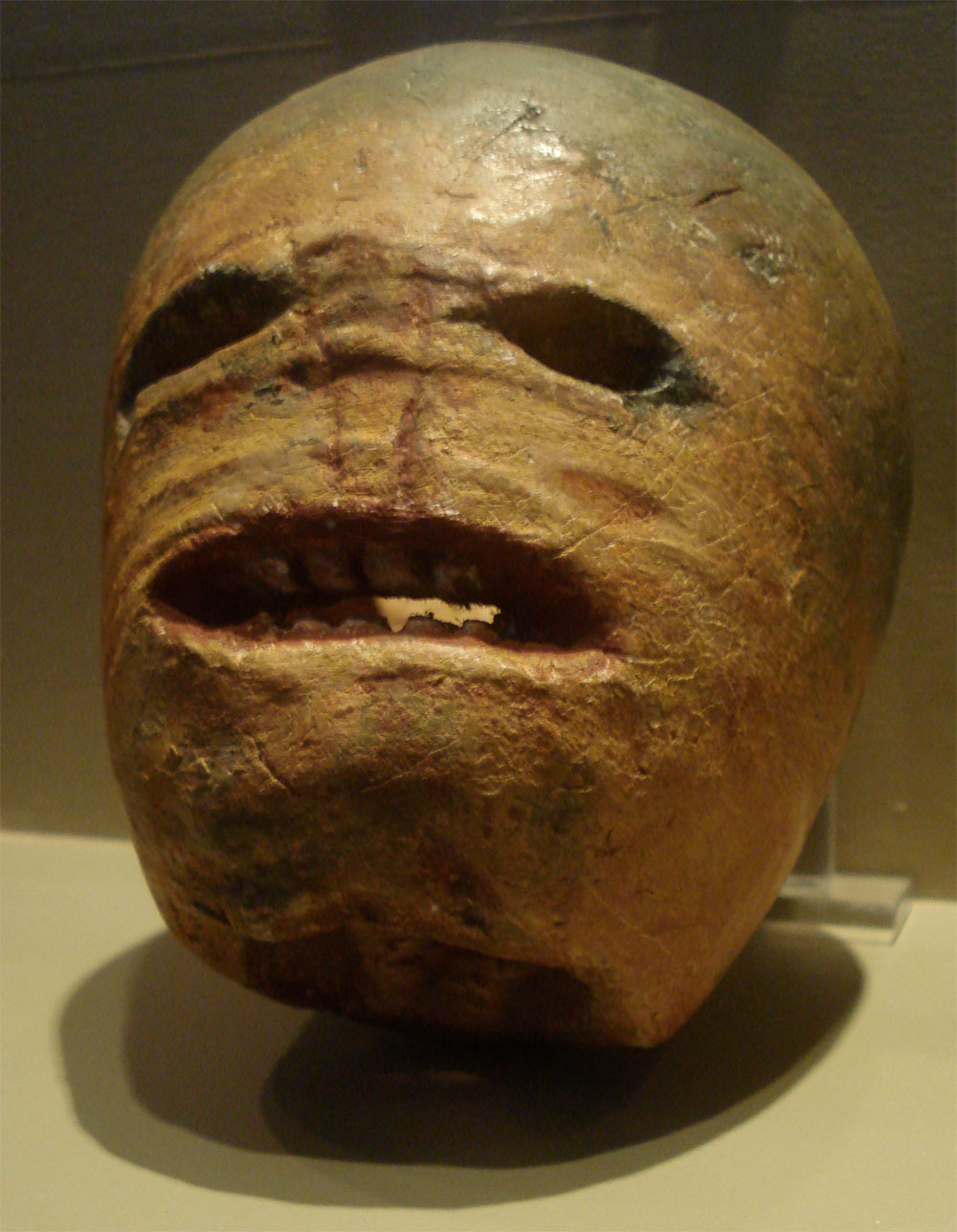
An Irish turnip lantern from the early 20th century at the Museum of Country Life
Monday, October 29, 2012
Jerry Brown Sighting
Today, I saw a familiar figure turn and approach my sample booth where I was serving Halloween cake samples—I recognized those ears. The way they stuck out. I was surprised no one in the store noticed who it was.
So I started clapping, and soon others joined me.
Jerry Brown approached my table, smiling.
I said You should be out running around Lake Merritt.
He said I just was!
I laughed and fed him cake—we chit-chatted. I said to the gathering crowd Jerry Brown gave me my first California Arts Council Artist in Residency grant at Mark West School in Santa Rosa.
He said You don't say.
I said I voted.
He said, Good. Where's the salmon.
I yelled to a co-worker, Can you please show the Governor where the salmon is? Fish of wisdom.
I thought my co-worker was going to die of shock as he led the governor over to the fresh produce section.
Sunday, October 28, 2012
Old Oakland Poster

Oakland, California
Where Ship and Rail Meet
The terminus of three transcontinental railways
Friday, October 26, 2012
Paddy Keenan—the Jimi Hendrix of uillean pipes

If you haven't heard Paddy Keenan play, add him to your musical bucket list. He's a marvellous international treasure—the Jimi Hendrix of uillean pipes.
Paddy Keenan was a founding member of The Bothy Band, one of the most influential bands of the 1970s that turned traditional Irish music on its ear. Paddy's unmatched virtuosity on the pipes, combined with the ferocity and passion of his playing, made him, in the opinion of many, its driving force.
Bothy Band-mate Donal Lunny once described Paddy as "the Jimi Hendrix of the pipes"; more recently, due to his genius for improvisation and counter-melody, he has been compared to jazz great John Coltrane.
Recent awards include: 2002 Irish National Traditional Musician; 2010 Irish Music Awards Top Uilleann Piper; and in 2011 Irish Music Awards Lifetime Achievement Award.
 |
| At The Plough & the Stars in SF. Isn't Jack Gilder looking grand? |
Wednesday, October 24, 2012
Swallowing a wisdom tooth
Damned! Just ate a quadrant of my wisdom tooth—does that make me any less smarter? I still have 3.75 wisdom teeth left. I have very small teeth and a long jawline . So I need all the wisdom and grinding surface I can get! Ok, so after a visit to the dentist, I'm gumming it—wisdom tooth with a shiny new silver filling. Sort of like putting new spats on old shoes. I have a very sore mouth, and have met one rather disgruntled dentist—why is it that ALL dentists feel wisdom teeth should be plucked out of our heads before we're barely ripe? Let alone, smart? I have perfectly well behaved wisdom teeth, that don't take cuts in line, or jump the queue. They’re not shoving my molars off the bus. Great little grinders they are—even if they do collect cruft in the far corners of my mouth. TG I have all four, er, make that 3.75 wisdom teeth. I ate the other .25. Great source of calcium. If you want to keep your molars, avoid Grape Nuts, popcorn, corn nuts, and almonds! I dare say these are the first wisdom teeth my dentist has ever filled. He who used to work on the mouth of Jessica Hagadorn...she hardly had any teeth. He wondered why she even bothered. His morning wasn’t all in vain as he had to replace a filling on another tooth. It was the filling on my lower molar that crumbled, leaving my wisdom tooth vulnerable, and the rock-hard almond just sheared it right off. There’s a metaphor buried somewhere in all this, only I can’t quite put my finger on it. Guess I need a full set of wisdom teeth for that one.
Vaguely revised 10/24/18
Saturday, October 20, 2012
Patriotic Citizen
Today Neil became a US citizen and someone at the ashram gave him a silk scarf as a gift—it had the American flag woven into it. I though, oh, that's nice. Then he said who it belonged to: Alan
Beavan—the man who singlehandedly kept Flight 93 from crashing into the White House. And gave up his life. Now, that was an act of real patriotism. I
burst into tears, surprised that the aftermath 9/11 still burns so bright the psyche after all these years.
Thursday, October 18, 2012
Beginias reflected (photo)

OK, so it took me a while to clean up the patio for summer—Jajaja it's Autumn—but Autumn is our summer in the Bay Area.You can tell by the soft focus and relative lack of light. I snagged a heavy old beveled mirror headboard on the street, we put it against the wall, and now it doubles my wimpy begonia pleasure! Weird hairy little things! You can see me (or my hands) on the left, and camera. And who knew the wild birds were so vain?
Sunday, October 14, 2012
On the Scots Tongue
Most of the sentiment of an article posted on Facebook, The Scots Language and its European Roots, by Dr. Sheila Douglas, on the development of the Scots Tongue, is of great interest. But it reminds me of something my Celtic Studies professor, Dan Melia loved to quote: "A language is a dialect with an army and navy."
It seems that the author, Dr. Sheila Douglas plays a bit fast and loose with facts—perhaps trying to overprove a point for nationalism's sake. Though I agree with the author's basic premise, that Scots English evolved concurrent with what later became standard English, I find myself picking apart the argument. (Try reading Sir Gawain and the Green Knight—one distinct strand of the English dialect—or the works of Blind Harry) they're almost as obtuse as Beowulf in a different dialect).
For example, much of the relationship between Danish and the broad Scots tongue can be linked via the Germanic branch of the Indo-European continuum—not necessarily a direct infusion from the Danish (or Dutch).
One statement concerning Gaelic is too generalized and therefore, is misleading: "Gaelic is also a language with European roots linked to other languages like Irish, Welsh and Breton."
For starters, Irish, was also called Gaelic until quite recently. It predates Scots Gaelic—which is, in itself, a dialect of Donegal Irish, having come from Ireland to begin with.
Ireland was called Scotia Major by the Romans, and Scotland—Scotia Minor. Scotland was predominantly settled by the Irish.
Orthography (spelling) has changed since the 18th c.—especially in Irish. But the "languages" are still mutually intelligible. Ergo, they are dialects—as is Manx—though the Manx orthography is phonetic English—you have to read it aloud to hear the words.
All three languages are from the Goidelic branch of Celtic languages—they are not similar to the Brythonic branch of Celtic languages: Cumbrian, Pictish, Cornish, Welsh and Breton, though they are all Celtic languages and share the same ancestry-predating the Germanic tree, BTW.
The only Celtic language that's "European"—I think what the author means, is, from the Continent, versus insular (from Britain), is Breton—which probably evolved from a Welsh or Cornish settlement in Brittany. So it was a rather poor example—thus eroding the veracity of the argument.
It seems that the author, Dr. Sheila Douglas plays a bit fast and loose with facts—perhaps trying to overprove a point for nationalism's sake. Though I agree with the author's basic premise, that Scots English evolved concurrent with what later became standard English, I find myself picking apart the argument. (Try reading Sir Gawain and the Green Knight—one distinct strand of the English dialect—or the works of Blind Harry) they're almost as obtuse as Beowulf in a different dialect).
For example, much of the relationship between Danish and the broad Scots tongue can be linked via the Germanic branch of the Indo-European continuum—not necessarily a direct infusion from the Danish (or Dutch).
One statement concerning Gaelic is too generalized and therefore, is misleading: "Gaelic is also a language with European roots linked to other languages like Irish, Welsh and Breton."
For starters, Irish, was also called Gaelic until quite recently. It predates Scots Gaelic—which is, in itself, a dialect of Donegal Irish, having come from Ireland to begin with.
Ireland was called Scotia Major by the Romans, and Scotland—Scotia Minor. Scotland was predominantly settled by the Irish.
Orthography (spelling) has changed since the 18th c.—especially in Irish. But the "languages" are still mutually intelligible. Ergo, they are dialects—as is Manx—though the Manx orthography is phonetic English—you have to read it aloud to hear the words.
All three languages are from the Goidelic branch of Celtic languages—they are not similar to the Brythonic branch of Celtic languages: Cumbrian, Pictish, Cornish, Welsh and Breton, though they are all Celtic languages and share the same ancestry-predating the Germanic tree, BTW.
The only Celtic language that's "European"—I think what the author means, is, from the Continent, versus insular (from Britain), is Breton—which probably evolved from a Welsh or Cornish settlement in Brittany. So it was a rather poor example—thus eroding the veracity of the argument.
Monday, October 8, 2012
John Tchikai 1936-2012 (drawing/photo)
John Tchikai
April 28, 1936 — October 8, 2012 Remembering John Tchicai. RIP jazzman. Glad to have known you all these years.
I don't remember when I did this drawing. I think it’s of of John, I was with Ken Bullock. We had dinner at Ken's parents' place in Inverness, and we also went to a couple of John's concerts, in Davis, and Stern Grove in SF. Ken said the drawing definitely looks like John, but John didn’t play a brass instrument. Maybe I never finished the drawing, adding the brass mouthpiece later instead of a tenor sax mouthpiece.

April 28, 1936 — October 8, 2012 Remembering John Tchicai. RIP jazzman. Glad to have known you all these years.
I don't remember when I did this drawing. I think it’s of of John, I was with Ken Bullock. We had dinner at Ken's parents' place in Inverness, and we also went to a couple of John's concerts, in Davis, and Stern Grove in SF. Ken said the drawing definitely looks like John, but John didn’t play a brass instrument. Maybe I never finished the drawing, adding the brass mouthpiece later instead of a tenor sax mouthpiece.

 |
| John Tchikai & poet David Gitin in Half Moon Bay, 1996. Ken Bullock photo |
Sunday, September 30, 2012
On Andamanese Languages
(I responded to a Facebook rant—and did far too much Wiki surfing.)
A recent Facebook post I read on Andamanese peoples was a case of fast and loose reading with overbroad extrapolation and interpretation of facts. And it gave the appearance of ethnocentric (read: American Black) racism at the expense of indigenous cultures.
I wanted to tell the author, though I respected his attempt to reconcile the convoluted history of peoples and migrations throughout the eons, stating that Jōmon, and Andamanese peoples were one and the same—both out of Africa based on the outward appearances of skin color and hair—is wrong.
We have no photographic or linguistic record of ancient Jōmon cultures. As my ceramics teacher, Thano Johnson was fond of repeating: pots don't talk. My anthropology teachers McGrath and Dundes, reiterated the phrase. Be careful how you arrive at conclusions.
Granted that Andamanese languages and genes are old, very old. Possibly Proto-Australoid, it doesn't make them African.
A few Andamanese genetic characteristics are present in isolated populations from Asia to Oceania: southern India, Sri Lanka, Malaysia, Indonesia, Papua New Guinea, and China.
Andaman languages (during the 1900s there were ten-plus mutually unintelligible Andaman languages—meaning they've been around a while—at least 60,000 years) are what is called a "linguistic isolate"—today only 3 languages survive, and they are in decline.
Genetically, "Andaman Islanders have been isolated for a substantial period of time." Andamanese genes have little genetic variation (bottleneck). The Jarawas carry an allele with no affinity to any other population in the world. It means they've been inhabiting the Andaman acrchpelago for a long, long time.
I noted that the subclade of the D haplogroup is not present outside of the Andamans—which supports the extreme insularity of these tribes. They are haploid D group, yes, but not the unique subclass marker. It does not make them Ainu, or vice versa.
(Archaic DNA origins of the Ainu, or Utari of Japan and Russia have not been scientifically identified (but they are thought to be proto-Mongoloid). Their Y-DNA haplogroup D2 is common in Tibet and the Andaman Islands. Mitochondrial DNA haplogroup Y is also found among Nivkhs, Tungusic peoples, Koreans, Mongols (including Kalmyks and Buryats), Chinese, Japanese, Central Asians, South Siberian Turkic peoples (e.g. Tuvans, Todjins, Soyots), Koryaks, Alyutors, Itelmens, Taiwanese aborigines, Filipinos, Indonesians, and Malaysians. )
Take mtDNA: All Andamanese belong to the subgroup M[10] which is also on the Indian subcontinent, it represents 60% of maternal lineages, but also in Africa and other areas west of India. But M2 is unique to the Andamanese. M2 and M4 lineages diverged 60,000-30,000 years ago. They've been an isolate group for so long, they had no immunity against common diseases—like the Amerindians.
In other words, nothing is as simple as it seems—other than these two groups are extremely old. Skimming the surface, with overbroad extrapolation and interpretation of facts serves only to muddy the water. Not shed light.
The oldest Chinese pictographs—the sun, moon, tree, etc., all share parentage with the glyphs and writing of ALL world cultures. Some things are held in common, as a development of mankind. It doesn't mean that they're African—unless you go really far back. Broaden the lens.
Saturday, September 29, 2012
STREAMSONG
I grew up within the melody range of streams
Our watershed creeks were named Arroyo & Barranca
for things bone-dry but our streams ran year-round,
a raging torrent in winter, a small song in summer
where minnows nosed the rocks in shallow pools
and snapped up damselflies and larvae
Sometimes I'd catch fingerlings in my palms
I'd build rock dams to deepen the pools
and then cup my hands to scoop them up
One spring I caught three small salmon fry
and kept them close in a mayonnaise jar
i marveled at their olive spots, their mouths groping
the way their silver undersides
flashed and wove water into threads of light
but we were going to my aunt's for the summer
so I screwed the lid on tight and toted my troutlings with me
I caught flies, small insects, I fed them hamburger
After a few weeks of city living, two went belly-up,
I gave them fishy funerals by the seashore
But one fish survived the long ride back home
The pools on Barranca Creek seemed so small
after seeing the world like that,
my fish was well traveled, so I set him free,
I slipped him into the cool depths
of the wine vat that was our spring-fed water tank
The daddy-long-legs on the cover
bounced in unison as if to say yes!
I never told my grandmother where I'd set him free.
I was perfecting the art of omission of truth.
Daily I hiked up the hill, maybe it was guilt that drove me
or perhaps I wanted to prove the adults wrong,
that the fish could live with us after all
But I never thought to the future,
or that I had interrupted a lifecycle
I kept tabs on that little fish
as he nosed at the bright algae
growing on the walls of the tank,
I marveled at the way
a shaft of sunlight sliced the darkness of his pool
and he'd swim towards the light,
but the tank couldn't sustain him
By summer's end he was gone,
melted back into the water
and I drank him in, salmon wisdom
returning home to natal grounds.
9/29/2012
This piece was written for Watershed Festival—I was a featured poet on the Strawberry Creek walk. I read this piece to the creek with other poets.
17th Annual Watershed Environmental Poetry Festival


17th Annual Watershed Environmental Poetry Festival
Saturday, September 29, 10:00 a.m.
Saturday, September 29, 10:00 a.m.
Strawberry Creek Walk • Meet at Oxford & Center Streets in Berkeley.
Creek Walk poets: Chris Olander, Susan Kelly-DeWitt, Maya Khosla, Rebecca Moos, Maureen Hurley, Rebecca Moos, Kim Shuck
A walk from Strawberry Creek on the UC Berkeley campus to the Watershed festival led by poet/eco-educator Chris Olander with poetry readings by poets and commentary by creek restoration experts, featuring Chris Olander, Susan Kelly-DeWitt, Maya Khosla, Maureen Hurley, Rebecca Moos, Kim Shuck, Tim Pine (UC Berkeley), Kirstin Miller (Ecocity Builders).
Festival Main Stage • Martin Luther King, Jr. Civic Center Park
Robert Hass • Joy Harjo • Michael McClure • Brenda Hillman • Francisco X. Alarcón • Rebecca Foust • Richard Silberg

Wednesday, September 26, 2012
Sunday, September 23, 2012
Wáng Wéi translations BIRDS
Myriad Birds Calling in the Ravine
—Interlinear translation of Wáng Wéi's Niāo Míng Jiàn
I am lost amid the falling petals of the cassia tree
calm spring night in the deserted hills
rising moon startles the mountain birds
birds singing forever deep in the ravine.
—2nd translation
Lulled by a sweet drift of cassia petals
night nestles on the empty ridges
moonrise startles the mountain birds
a cascade of birdsong floods the steep ravine.
Water Ousels in the Gorge
—after Wáng Wéi's Niāo Míng Jiàn
(freewrite transliteration)
They hide between shining trees
A stone hut in the distance
A woman's thoughts like the moon
trapped in the pines
Windows, so like the sun, or eyes
Clouds upon clouds, mountains
and the moon, hidden in the mist
Ousels skim across reflected light
the river mouth singing.
Poetry Inside Out workshop
Niǎo Míng Jiàn
Wáng Wéi 699-759
Rén xián guìhuā luò,
Yèjìng chūnshān kōng.
Yuèchū jīng shān niǎo,
Shí míng chūn jiàn zhōng.
To see the Chinese Mountain Song
—Interlinear translation of Wáng Wéi's Niāo Míng Jiàn
I am lost amid the falling petals of the cassia tree
calm spring night in the deserted hills
rising moon startles the mountain birds
birds singing forever deep in the ravine.
—2nd translation
Lulled by a sweet drift of cassia petals
night nestles on the empty ridges
moonrise startles the mountain birds
a cascade of birdsong floods the steep ravine.
Water Ousels in the Gorge
—after Wáng Wéi's Niāo Míng Jiàn
(freewrite transliteration)
They hide between shining trees
A stone hut in the distance
A woman's thoughts like the moon
trapped in the pines
Windows, so like the sun, or eyes
Clouds upon clouds, mountains
and the moon, hidden in the mist
Ousels skim across reflected light
the river mouth singing.
Poetry Inside Out workshop
Niǎo Míng Jiàn
Wáng Wéi 699-759
Rén xián guìhuā luò,
Yèjìng chūnshān kōng.
Yuèchū jīng shān niǎo,
Shí míng chūn jiàn zhōng.
To see the Chinese Mountain Song
Saturday, September 22, 2012
Mac Hell and the realm of Lost Permissions
Hell and damnation. Hell and damnation and back again. The Snow Leopard Update I ran on my "new" MacBookPro stalled, via the iCloud, but due to slow DSL, it also locked all my external volumes to "custom access"
and now I can't access ANY of my backup hard drive files under Info/Unlock. Not exactly progress.
Some Terminal codes I get are: drw-rw-r-T and an uchg flag. Anyone know Terminal, or UNIX?
Some Terminal codes I get are: drw-rw-r-T and an uchg flag. Anyone know Terminal, or UNIX?
Subscribe to:
Posts (Atom)


