 |
| Newgrange, 1905 —Wiki |
Someone had posted a thread on Facebook that Hallowe'en (or Samhain) was a Scottish tradition (versus Irish—or even a shared Celtic tradition) that got me all in a lather.
He wrote: "a small fact that halloween started in scotland in 16th century and this was a A modern jack-o'-lantern is typically a carved pumpkin, although originally typically large turnips. It is associated chiefly with the holiday of Samhain and Halloween and was named after the phenomenon of strange light flickering over peat bogs, called ignis fatuus or jack-o'-lantern.lol")Note that I left the fellow's punctuation & spelling intact—stet. LOL, indeed.
Samhain/ Hallowe'en customs may have traveled to Scotland, but, for the record, the Scots didn't invent it. Not sure where that misconception arose. Maybe it's the word Hallowe'en itself, allegedly a Scots phrase, that leads to this red herring.
This is not to say that Hallowe'en/Samhain isn't celebrated in Scotland. As to a Scottish-Irish connection: it occurred to me (as I was gnashing my teeth) that during recent times, much of the east end of Glasgow was heavily settled by Irish immigrants (as well as the Barrowland), and along the River Clyde wherever there were shipyards.
One could also include most of Renfrewshire in that Irish matrix—especially Johnstone, one epicenter of the Industrial Revolution: paper, flax, cotton mills, lathes—has distinct boundaries between the Protestant and Irish Catholic parts of town.
Glasgow slums were heavily settled by, and continuously resettled by waves of itinerant Irish Catholic workers—especially after the Irish Famine. Harvest/Fall traditions carried to Scotland from Ireland took root.
If one goes back far enough, much of Scotland—especially the Highlands, was settled by the Dalriadan Irish—who spoke Gaelic, and brought their customs with them.
October 31 has been a big mojo date in the Celtic Irish world for at least 2000 years—with and without church sanction. All ancient Irish epic tales (dating back 2000 years, but recorded in the 6-10th centuries) include many traditions we now associate with Hallowe'en—and most tales begin on the last day of the old harvest year, Samhain, when the gates to the Otherworld open.
But Hallowe'en customs in Scotland seem to arise a bit later on the event horizon. Curious to know as to when they arise in Isle of Man? There seems to be a strong link in the Goidelic-speaking regions (vs. Brythonic).
Hallowe'en arose because the older Celtic pagan traditions worshipping ancestors and mythological deities needed to be Catholicised and brought into the churchfold: hence we have All Hallows Eve(n), All Saints Day and All Souls Day.
Think of the feast days as a hierarchical list of who got to heaven, or not—and it gave the living souls a chance to boost the fannies of the tarnished souls of their ancestors and dearly departed ones a notch up the corporate ladder of purgatory. And so Hallowe'en was church sanctioned, as it were—just like México's El Día de los Muertos (originally celebrated in August.)
From Wiki: Scholars trace the origins of the modern Mexican holiday to indigenous observances dating back hundreds of years and to an Aztec festival dedicated to the goddess Mictecacihuatl.If you can pronounce the name of the Aztec queen of the underworld, that flaca star-swallower, Mictecacihuatl, then you get ten purgatorial points.
BTW—there's a reason why there are shared customs in both the Old, and New World. In the 9th c., Pope Boniface IV decided to show those heathens a thing or two and Christinised the holidays (holy days). Not really, it was more complicated than that. Besides, the New World hadn't been "discovered" yet. Detail.
According to Halloween Facts and Misinformation: "Pope Boniface IV dedicated the Pantheon in Rome to the Virgin Mary. The date was later changed to Nov 1 by Pope Gregory III who dedicated a chapel in honor of all saints in the Vatican Basilica."
Well, that certainly explains a lot. Like someone giving directions to their home and becoming increasingly incoherent as they get closer to home and you drive around the block trying to find home.
Wiki Answers posted: "Boniface IV introduced All Saints Day to replace the pagan feast of Lemures - in which malevolent and restless spirits of the dead were propitiated. It took place on/about the 13th of May and All Saints replaced it. All Saints Day was moved to November 1 by Pope Gregory III (731-741) and the previous May 13th day was then discontinued."I'm sorry, the festival you are seeking is no longer in service. Please check your calends and try again.
Take three:
All Saints Day on Nov. 1 in England, and such a celebration also existed in Salzburg, Austria. Ado of Vienne (d. 875) recounted how Pope Gregory IV asked King Louis the Pious (778-840) to proclaim Nov. 1 as All Saints Day throughout the Holy Roman Empire.So, who dunnit? Bonyface or Gregory? I found this on a rather rabid Christian site. (I feel the need to post it in 6-point type and eliminate all adjectives, and past perfect tense references so I shortened it a bit. —Maureen : 1)
It took another hundred years for the entire Catholic Church to celebrate the saints on one single day. Pope Gregory IV (827-834) declared November 1 as the new date to celebrate the Feast of the Holy Martyrs and expanded it to include all saints, not just those who died for their faith. All Hallow's Eve, the vigil, was celebrated on October 31.
By the first century A.D., the Romans conquered Celtic territory and adopted (some) traditions as their own. Since the Catholic church... became the official religion of the Roman Empire, pagan rituals were incorporated by the church (to make) Catholicism more appealing to the heathen(s).However it all went down, the secular aspect of Hallowe'en certainly caught fire in America a few centuries later.
In the 6th century, "Gregory the Great (A.D. 540-604) advised the Archbishop of Canterbury to retain Druid sacrifices (REALLY???)and celebrate them in honor of the Christian saints" (Occult ABC, Kurt Koch, p. 87).
During the 7th century, in an attempt to replace the Celtic festival with a similiar, but "holier" holiday, Pope Boniface IV designated November 1 as a time to honor "saints and martyrs" and called it "All Saints' Day". This celebration was also known as All-hallows or All-hallowmas (from the Middle English word "Alholowmesse", (or) All Saints' Day) and the night before, Samhain, (was) called All-hallows Eve and, eventually, Halloween.
Then in the year 1000, the Catholic church set up November 2 to be All Souls' Day, a day to honor the dead. It was celebrated much like Samhain, with bonfires, parades, while the people dressed as saints, angels, and devils.
The first historical reference of Hallowe'en in America dates back to 1919, The Book of Hallowe'en—written by a Massachusetts librarian, Ruth Edna Kelley. She credited the Famine Irish with bringing to the new world, Hallowe'en customs.
The place of the old lord of the dead, the Tuatha god Saman, to whom vigil was kept and prayers said on November Eve for the good of departed souls, was taken in Christian times by St. Colomba or Columb Kill, the founder of a monastery in Iona in the fifth century. In the seventeenth century the Irish peasants went about begging money and goodies for a feast, and demanding in the name of Columb Kill that fatted calved and black sheep be prepared. In place of the Druid fires, candles were collected and lighted on Hallowe'en, and prayers for the souls of the givers said before them. The name of Saman is kept in the title "Oidhche Shamhna," "vigil of Saman," by which the night of October 31st was until recently called in Ireland. The Book of Hallowe'en
AS in Ireland the Scotch Baal festival of November was called Samhain. Western Scotland, lying nearest Tara, center alike of pagan and Christian religion in Ireland, was colonized by both the people and the customs of eastern Ireland.The November Eve fires which in Ireland were replaced by candles and were continued in Scotland. In Buchan, where was the altar-source of the Samhain fire, bonfires were lighted on hilltops in the eighteenth century; and in Moray the idea of fires of thanksgiving for harvest was kept to as late as 1866. The Book of Hallowe'enSpeaking of fire, of course, there were no flashlights (or torches) and glass chimneys were not always an option, way back when, so carving a turnip root lantern makes sense if one wanted any form of light at night whether in Scotland or Ireland. Just try using a naked candle outside at night—even if there's no wind (or rain) you're blindsided by it. Turnip lanterns were a brilliant, if practical rural invention—like organic alabaster lamps.
As a child, my grandmother carved turnips (or swedes, or even mangles—any big pithy round roots used for cow fodder) in Bantry during the 1890s. Turnips were used as lanterns, candles were placed in the window.
This is what I turniped on the Irish ancestors of Jack O'lanterns:
"The turnip or white turnip (Brassica rapa, subsp. rapa) is a root vegetable grown in temperate climates for its white, bulbous taproot. Small, tender varieties are grown for human consumption, larger varieties as feed for livestock. In northern England and Scotland, the turnip is called neep; the word turnip is an old compound of neep. Neep also refers to the larger, yellow rutabaga AKA the "swede" (from "Swedish turnip")." —Wiki
In Scots, it is known as "turnip," "tumshie" or "neep" (from Old English næp, Latin napus). In North-East England, turnips and swedes are colloquially called "snadgers" or "snaggers" (archaic). —WikiApparently a rutabaga (Brassica napus, subsp. rapifera), or yellow turnip, is a (natural?) cross between a cabbage and a turnip. First noted in 1620 by a Swiss biologist. this sordid little love affair was also noted by Carl Linnaeus in 1753 because the resulting crossbreeding doubled its chromosomes. This relationship is aka the Triangle of U.
Rutabagas were carved out and used as candle lanterns in Halloween celebrations in Scotland and Ireland. —WikiWhether kålrot, or steckrübe, or or rotabagge—the old Swedish word rotabagge, meant "root ram"; or turnips were used as root lanterns, the root vegetables were considered famine foods, fit only for livestock. So the origin of Jack O'lanterns was really a poor man's torch. Somehow our family survived the Great Potato Famine: an Gorta Mór (1845-52), in the hills of Coomanore, and I suspect it was because they ate lots of turnips.
It was also an Irish tradition to let the hearth fire die, clean the hearth, and then the sacred tradition of relighting it—from the flame of those traveling turnips. Out with the old, in with the new. It was New Year's Eve, after all!
My
great-grandfather also used to run his cattle between two bonfires, on
his farm in the hills of Coomanore. My grandmother told me he also
filled an oak (whiskey?) barrel with tar, set it alight and rolled it down
the hill. An Irish Catherine wheel of sorts. (The Walsh farm, Coomanore.)
Wearing masks (as a disguise) and using bull roarers to scare off spirits—were all part and parcel of a long ongoing tradition of Hallowe'en. There was a plenitude of food for the dead—soul cakes, and apples and nuts. In my grandmother's time, prized Valencia oranges—a luxury item wrapped in foil—was also given as gifts. There was scrying in water or mirrors—if you owned one. Then there was the barmbrack cake with its symbolic thimble, ring and penny baked inside. (See James Joyce's The Dead.)
Wearing masks (as a disguise) and using bull roarers to scare off spirits—were all part and parcel of a long ongoing tradition of Hallowe'en. There was a plenitude of food for the dead—soul cakes, and apples and nuts. In my grandmother's time, prized Valencia oranges—a luxury item wrapped in foil—was also given as gifts. There was scrying in water or mirrors—if you owned one. Then there was the barmbrack cake with its symbolic thimble, ring and penny baked inside. (See James Joyce's The Dead.)
My grannie was thoroughly disgusted by the
American tradition of Trick or Treat. She said, in Ireland, one had to
dance and sing, or recite a poem or story, and then, if one was good,
they might be given a treat, or an orange or a ha-penny if they were very, very good.
One was expected to trot out one's best pony show. Move over, Simon
Cowell.
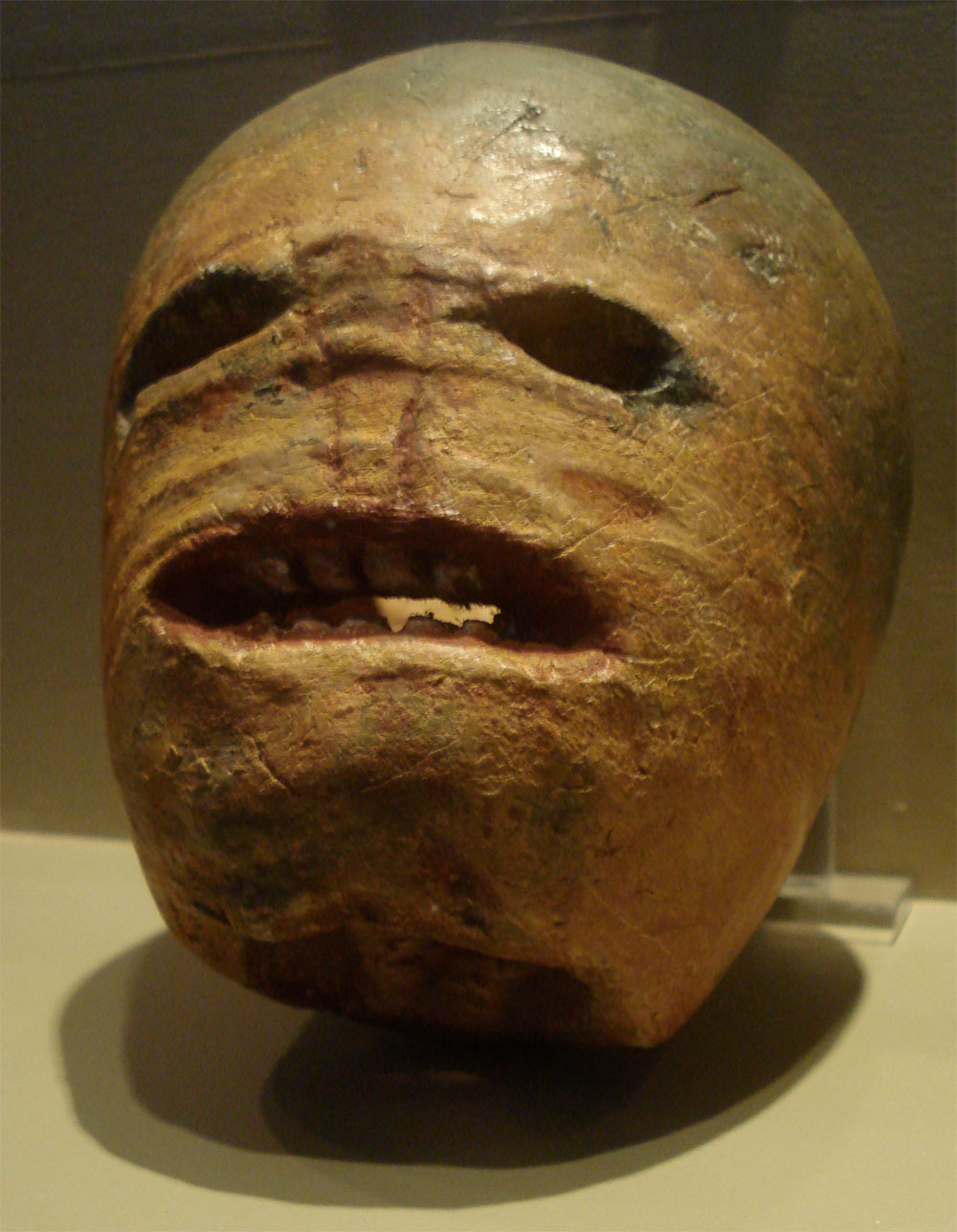
An Irish turnip lantern from the early 20th century at the Museum of Country Life


